1153: Reasons to Own a Wii

Poor old Wii. Despite being one of the biggest-selling consoles of all time and bringing new people who never would have considered gaming before to the hobby, it doesn't have the best reputation among self-professed "hardcore" gamers. In fact, it's not really taken seriously by the press or public alike in most cases, with Wii titles often being noticeably absent from "best of the generation" lists and people often forgetting that it is, in fact, home to some astonishingly good games.

What's also worth noting is that if you've picked up a Wii U recently, you have access to all of these previous-generation games and can discover them for the first time if you've never checked them out.

I'm going to share some of my favourite Wii games now, and none of them are going to be Mario or Zelda games. They are, however, all excellent games, and you should absolutely check them out. If the sole reason you haven't checked them out is because the Wii runs in 480p resolution, get over yourself and stop being so shallow. You're missing out on some fantastic experiences.

So without further ado and in no particular order, here we go:

Xenoblade Chronicles

First of the three "Operation Rainfall" games, Xenoblade Chronicles is a sprawling Japanese role-playing game that bucks almost every convention of the genre to create an experience that should get even the most hardened, grizzled Western RPG veteran to sit up and pay attention. The game features a sprawling open world populated with hundreds of unique NPCs, many of whom have quests to give you; an awesome real-time(ish) MMO-style combat system with some fantastic party AI; some brilliant British voice acting (and the option for Japanese if you prefer); a decent story in a highly imaginative setting; and a rockin' soundtrack, Xenoblade Chronicles is an absolute winner that will keep you busy for well over a hundred hours in total.

The only real criticisms you can level at it are that there's a bit of filler content (that you can easily ignore), the character faces are a bit blurry and facial animations are a bit inconsistent. The latter two are side-effects of the game being produced on a much smaller budget than a game of this magnitude would require on HD consoles, and as such are easily forgiven.

The Last Story

The second of the three "Operation Rainfall" role-playing games, The Last Story is a cinematic JRPG with a resolutely linear storyline that is over and done with within 25-30 hours, making it something you can play and enjoy without having to dedicate a month or two to it. It has interesting and unconventional characters, a well-realised "hub town", a cool story, an interesting combat system and the pedigree of Hironobu "Final Fantasy" Sakaguchi behind it.

Common criticisms include the prevalence of brown in the graphics (a deliberate stylistic choice to sepia-tint the whole thing that you'll either be into or not), the fact that some parts are pushing the Wii a little too hard, leading to drops in frame rate, and the fact the unusual real-time combat system takes a little while to get interesting. Still well worth a punt, though. There's also a multiplayer mode, bizarrely, though I'd be surprised if anyone's still playing.

Pandora's Tower

The third of the three "Operation Rainfall" games, and the most unconventional of the lot. Unfolding more like a cross between Zelda, Ico and Shadow of the Colossus than a typical Japanese role-playing game, Pandora's Tower is an emotional tale of a young man trying desperately to save the woman he loves from a horrific curse — and the pair of them doing anything it takes to survive the ordeal. By turns romantic and horrific, Pandora's Tower is simultaneously epic and intimate, with a wonderful sense of atmosphere and excellent use of the Wii's unique control scheme.

Trauma Center: Second Opinion

Despite the name, this was the first Trauma Center game to hit the Wii; the Second Opinion part of the title refers to the fact that it is a remake of the first Trauma Center game: Under the Knife for Nintendo DS. The plot tells the tale of rookie surgeon Dr Derek Stiles and his assistant Angie as they attempt to rid the world of a mysterious illness known as GUILT, and the Wii version adds some new story material to the mix courtesy of newcomer Dr Naomi Kimishima and her assistant Navel.

Gameplay is a peculiar fusion of visual novel sequences and frantic, terrifying, arcade-like surgery sequences in which your skill with the Wii Remote and its unique capabilities will be well and truly put to the test. Don't be fooled into thinking this is a realistic medical drama — this is entertaining Japanese sci-fi at its finest, and you'll find yourself doing everything from performing relatively conventional surgical procedures to battling mutant viruses and defusing bombs with your surgical implements. It's not perfect — lack of 16:9 aspect ratio support is a sticking point for some — but it's still worth playing. As is its sequel.

Trauma Center: New Blood

The first all-new Trauma Center game to hit the Wii brings a whole new cast, a new storyline and a new disease to battle against. It also adds 16:9 aspect ratio support, a rather unnecessary (and not particularly well-implemented) two-player cooperative mode, full speech for the story sequences and generally a nice refinement of the formula. The main theme tune also sounds like it was ripped off from House.

Trauma Team

The ultimate refinement of the Trauma Center formula, Trauma Team features not only the surgery gameplay of the previous two games, but also adds a variety of other gameplay styles — the frantic pace of First Response missions, the tense, skill-based gameplay of Orthopedics, the Descent-style first-person exploration of Endoscopy, and two distinct adventure game-style components in Diagnosis and Forensics. Each of the game's characters has their own distinct plotline to follow, and they all come together for a seriously epic final episode towards the end of the game. The traditional visual novel presentation of the earlier games has been replaced by a fantastic "motion comic" style, and the whole experience is absolutely gripping.

Fire Emblem: Radiant Dawn

I must confess to not having played this yet, but you can't go wrong with Fire Emblem. Radiant Dawn is the direct sequel to Gamecube title Path of Radiance, and continues the series' iconic strategy-RPG gameplay.

Zack & Wiki: Quest for Barbaros' Treasure

This unusual and all-but-unknown offering from Capcom is a curious fusion of traditional point and click adventure and puzzle game, and has a huge amount of visual charm. Deceptively simple gameplay — point at things with the Wii Remote and click on them — belies some absolutely fiendish puzzles that alternate between slow-paced headscratchers and tests of reflexes.

Silent Hill: Shattered Memories

Arguably one of the best Silent Hill games, and one of the most thought-provoking games out there. Silent Hill: Shattered Memories is a complete reimagining of the first Silent Hill game (and consequently requires no knowledge of the franchise) and features some immensely clever psychological tricks and treats over the course of its narrative. It's also noteworthy for featuring no combat whatsoever, instead replacing the fighting and gunplay of the other games in the series with "running frantically away in the dark" sequences that aren't entirely successful, but do evoke a pleasing feeling of panic.

Honourable Mentions (that I haven't played but have on my shelf)

No More Heroes/No More Heroes 2
Sin and Punishment
Resident Evil 4
Cursed Mountain

____

Got any more to share that don't have Mario or Zelda in the name? Feel free to comment!
1152: Gaming on the Go

I play a lot of mobile games for my day job. Some of them are great. Some of them are fucking atrocious. Very few of them hold my attention after I have reviewed them. I've been trying to pin down why this is, and it comes down to a variety of factors.

Firstly, and probably most seriously, is that I don't get any real feeling of "accomplishment" (or perhaps more accurately "fulfilment") from playing them for the most part. In the vast majority of cases, I find myself drawn to games that have a bit more "structure" to them, usually in the form of a strong narrative. So many mobile games — particularly those with social features, or which purport to be a "mobile MMO" — completely eschew any sort of narrative in favour of a completely open-ended experience with no discernible end and no real "goal" save for the short-term objectives set by the ever-present quest system. If I have nothing to aim for, I have no incentive to play. And no, "reach level 50" isn't enough of an incentive for me — I know it is for some people, just not for me.

Secondly is the fact that it's often difficult to shake the feeling that in many cases, there are plenty of better games I could be playing. I play something like Candy Crush Saga with its obnoxious £35 in-app purchases and just feel that I'd rather be playing Bejeweled 3 on PC; I play something like Infinity Blade and feel that if I wanted to play an extended Quick-Time Event, I could just play Fahrenheit or Heavy Rain and have a decent story to go along with my occasional carefully-timed button pushing; I play a slot machine game and I'd rather slit my wrists.

Thirdly is the frequency with which in-app purchases ruin everything. If they're not throttling your play sessions (hello, Real Racing 3), they're unbalancing the gameplay so that you need to pay money to progress — that or grind the same level for three thousand years to earn the money you need for the slightly better gun that is always just out of your reach. I also just get a bad taste in my mouth any time I play a game in which I have the choice between using my skill to progress or simply paying up to bypass anything that might be a bit difficult. Again, I know there are people who are fine with this; I'm just not one of them.

Fourthly is the fact that so many mobile games are so fucking completely clone-tastically identical to each other that I have absolutely no need (let alone desire) to play them in my free time. I have no desire to ever play another bubble shooter, Bejeweled ripoff, slot machine game, text-based "card battle RPG", isometric-perspective citybuilder or "hardcore" (hah) strategy (hah) game. I wouldn't mind so much if these developers were ripping off good ideas, but as far as I can tell they rip off the lowest common denominator, "most likely to make idiots pay through the nose in IAP" ideas, flooding the market with complete turds and making the genuinely good games utterly impossible to find if you don't know what you're looking for.

What this leaves me with is a significantly reduced proportion of mobile games that I can actually find enjoyable. If you discount all the directionless free-to-play crap in which the sole purpose of playing is mindless busywork with no long-term goal, there's significantly less in the way of quality interactive entertainment. But thankfully there are still developers out there who cater to people like me, even though people like me don't necessarily lead to obscene monthly profits.

Today I reviewed a title from an indie studio called Vlambeer. The game was called Ridiculous Fishing and has been in development for two and a half years, which is an incredibly long time for a mobile game. The reason for its incredibly long gestation period is that shortly after the team started development, they discovered that a large mobile game publisher called Gamenauts had completely ripped off their game idea (from an earlier Web-based version of what would later become Ridiculous Fishing) and released their own iOS game before Vlambeer could even officially announce their own offering. Understandably demoralised, they put the project on the backburner and almost cancelled it, but this week it finally hit the App Store and has been doing very well. It's a $2.99 paid app with no in-app purchases whatsoever. I bought it immediately without hesitation; I like the developer, and I was sorry to see how bummed they were when their game was cloned. I also want to support the survival of the "pay once, play forever" business model, because it's a dying breed in the mobile sector.

Ghost Trick. Chaos Rings. Sword of Fargoal. Anything by Jeff Minter. Anything by Cave. Support these developers and the great work they do, because if you don't, mobile gaming will become a wasteland even more devoid of creativity than it already is. Fuck it if the price of admission isn't "free" for these games; "free" doesn't mean "free" any more. Forgo a latte and a sandwich from your local coffee house and support the hard work of developers who have brought you quality creative entertainment rather than regurgitated clonesville crap.

1151: Twitter Let Me Down (Or: Why I'm Not Going Back)

Page_1Let's recap.

About a month ago, I was the victim of an organised "cyberbullying" campaign on Twitter. (Aside: I hate the term "cyberbullying", but it seems to be the accepted terminology so I will use it for now.) Members of an Internet-based organisation known as the "GNAA" (NSFW Wikipedia link) started harassing me, attempting to spread slanderous rumours that I was a paedophile, and copying me in on their pronouncements, presumably attempting to get a rise out of me. I blocked and ignored them as is the sensible thing to do in this sort of situation, but still they kept coming.

They started phoning people close to me — specifically, my brother and the owner of Games Are Evil, both of whose phone numbers are stored in the "WHOIS" information for their respective websites. Not just one phone call, either — several, each increasing the intensity of the threats to get the authorities called on me for my supposed (and, I'm sure I don't have to add, fictional) perversions.

The reason for this group's attack on me, it transpires, was the fact I had the word "Brony" on my Twitter bio. ("Brony", for those who don't know, is the term for adult-age fans of the recent My Little Pony: Friendship is Magic TV show, a group which I identify myself as being a part of. Seriously, that show's great.) This group had been attacking Bronies for a while and attempting to slander them in similar ways. They were also responsible for a high-profile attack on the social networking/blogging platform Tumblr back in December — said hack was also an attack on the Brony community.

Because this unprovoked assault on both me and my reputation was frightening and unpleasant, I reported it to Twitter. Because it was spilling out of the online sphere and into the "real world" with the phone calls, I also reported it to my local police station. The latter weren't able to do much about it — I wasn't really expecting them to be able to, to be honest — but I did at least feel somewhat reassured that I'd done all the things they would have suggested I do in this situation: change my username, block the perpetrators, do not engage with them, let other people know what's going on. Eventually, the perpetrators tracked down my new username and hijacked my old one, using it to impersonate me with the most obviously fake "this is what a paedophile does" sort of posts you'd ever see.

I reported the impersonation to Twitter as a separate issue, which required me to fax them a copy of my passport at my own expense to prove my identity. (Fax? Seriously?) It took them a few days to respond to this, but they eventually suspended my old Twitter username to prevent it from posting further offensive content in my name; in the meantime, I closed my Twitter account completely.

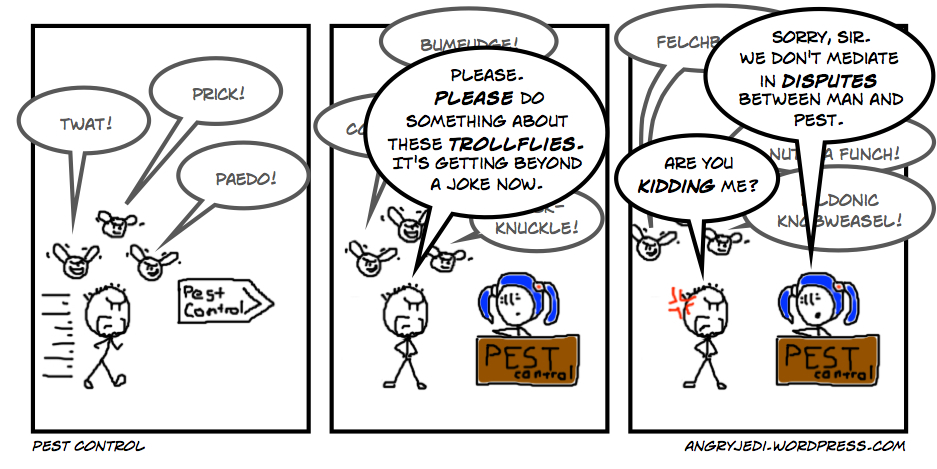
What I'm particularly disappointed about is Twitter's handling of the rest of the issue. I reported the problems I had been having back when that original post I linked to was written — mid February — and only received a response last night. The response I received was boilerplate text that simply said there had been no violation of Twitter policy, and that they didn't mediate in disputes between users. No attempt to address my concerns. No response to the fact that I had clearly laid out a series of tweets that showed an organised — and demonstrably unprovoked — campaign of hate against me. No concern for my wellbeing.

There is a difference between a "dispute between users" or a "difference of opinion" and an organised campaign to victimise someone based on their tastes and preferences. The offenders in this particular case went above and beyond simple name-calling into full-on harassment of not only me, but also my family and friends — and not only on the Internet, but also over the phone. None of this appears to have been taken into account in the month that Twitter's safety team have had to review this situation. In the meantime, the unpleasant individuals responsible for causing me such upset remain at large and unpunished, free to do it again to someone different for just the same stupid reasons they attacked me.

For this reason, I will not be returning to Twitter as a means of personal communications or social networking. While I appreciate a network of that size is difficult and time-consuming to police, that doesn't mean that the site's user safety department should get to just sit back and say "deal with it." This incident caused me considerable personal distress, and doubtless it upset and confused my family and friends who were dragged into it, too. The complete lack of concern Twitter's user safety department has shown towards a demonstrable case of organised harassment and bullying means that I do not feel comfortable trusting them in future; consequently, I will not be returning.

I doubt they care, of course; one user is but a drop in the ocean. I felt the need to share my frustration regarding this issue, however. Cyberbullying is a real problem that destroys lives — literally in many cases — and for Twitter to just turn a blind eye like this doesn't strike me as particularly acceptable.

If you used to follow me on Twitter, please feel free to share this post with any of our mutual friends. I would like to spread the word about this if at all possible.

Thanks, as always, for listening.

1150: Further Enthusing Regarding Trauma Team

Page_1It's not an exaggeration to say that I have been eagerly anticipating the ability to play Trauma Team ever since it was first announced, and I have been inordinately frustrated until recently at Atlus' complete lack of a regular European distributor meaning that it never got an official release on this side of the pond. Now that I am happily playing my North American copy on my hacked Wii, you'll hopefully forgive me if I perhaps dedicate a few posts to the awesome things about this game I've been waiting to play for a very long time — because judging by the bit I played tonight (I know I said I wouldn't, but I am weak) there are going to be a lot of them.

I specifically wanted to talk about the Forensics missions today, because they're one of the reasons I was so interested to play this game. A friend of mine described the presence of these missions as "you got Ace Attorney in my Trauma Center" — and if you know me well, you'll know that that sounds like a match made in heaven for me. I'm pleased to note that these missions very much lived up to their promise.

In a Forensics mission, you take on the role of Dr Naomi Kimishima, a character who occasionally showed up in Trauma Center: Second Opinion. Naomi is a forensics specialist with a curious (and secret) talent — when she enters a crime scene, she can hear the victim's dying words on her phone. Exactly why this is the case hasn't been explained yet, but given that we're dealing with a game in which an orthopaedic surgeon is also a superhero and the hospital's resident endoscopy specialist comes from a long line of ninjas, I'm not entirely surprised by this turn of events.

Anyway. Gameplay in a Forensics mission involves nipping back and forth between Naomi's office, the evidence room that houses the corpse and their personal effects, and the crime scene itself. By examining various items and pointing out abnormalities, Naomi collects "cards" that represent items of evidence or thoughts about the situation. By combining these cards together or sending them off for analysis to her FBI partner "Little Guy" (rather charmingly represented as a Mii avatar on her computer — this is a Wii game after all) she can inch them closer to being "solid evidence". When all the cards she has in her possession are "solid evidence," the case is solved, and you have to point out the relevant cards as she does her police procedural-style "wrap up" of the end of the case.

It's not quite that simple, though. You effectively have to "show your working" as you deduce various things about the situation by answering multiple-choice questions. These generally ask what you, the player, have deduced from the items of evidence you've observed or combined. Most of the time, thinking logically through them will get you through, but there have already been a few headscratchers and pieces of misdirection along the way — plus you have to make sure you remember plenty of details about the case as you go along. You can't just try every answer until you get it right, either — make too many mistakes and you'll fail the mission.

The whole thing was brilliantly presented with some atmospheric music, excellent visuals and decent voice acting, and it's exactly the sort of thing I'd like to see more of in the console space. Essentially, it was nothing more than a kind of point and click adventure, but it was hugely fun and massively engaging. I'm looking forward to seeing more of Naomi — and of seeing how her story ties in with that of the other doctors, as so far she's been largely separate from the rest of them. Trauma Team has a very interesting narrative structure, but that's something I'll save talking about until a later time when I'm a bit further on.

This sort of experience is exactly why I love Atlus, and why I love the Trauma Center series in particular. I'm doing things in this game that I have never done in any other game before — not just in Naomi's forensics section, but also in the diagnostic and surgery components, too. The game is also a fantastic use of the Wii's distinctive control scheme, making brilliant use of all the Wii Remote and Nunchuk's features, ranging from their accelerometers to the pointer function and even the speaker in the handset. It's a game that really couldn't be done in the same way on any other platform — perhaps PlayStation Move, though making a Move-exclusive title is pretty much commercial suicide — and a fantastic experience that I would very much like to jam in the face of anyone who complains that the Wii doesn't have any good games.

1148: On the Stage

I happened to be online earlier when a university friend of mine posted a Soundcloud clip of a comedy set he performed recently on Facebook. (That was a clumsy sentence. I apologise profusely. He posted the set on Facebook, he didn't perform it there.) I had a listen and found it immensely entertaining. Here it is:

At least, there it is if the embed code works correctly.

(EDIT: It did not. Here is a link to it instead.)

Anyway. Listening to Mr Millerick strutting his stuff and yell at British Gas on the stage got me thinking rather nostalgically about the reason I know him, and one of my favourite parts of university, which was my involvement with the university Theatre Group.

The Theatre Group was known at various junctures as Theatre Group, Blow Up and Rattlesnake! (with an exclamation mark) and I cannot for the life of me remember where the latter two names came from. I first joined it in my first year during that period of time when you feel like you should join some sort of club and meet people. I had enjoyed the two productions I'd been involved in at secondary school (The Wizard of Oz and Twelfth Night, if you're curious) and so I figured I'd try out for the university's luvvies society. One of my flatmates was also involved in the group, so I was glad to know there'd be at least one friendly face there.

The first production I was involved in was Macbeth. The Matrix hadn't long come out, so this marked the beginning of that phase when it was seemingly obligatory for everyone doing Shakespeare to do something Matrix-inspired, particularly if you were a student theatre group. By all accounts our production was pretty spectacular (and massively over budget) — it was a hugely enjoyable experience, though to be honest I didn't feel I got to know that many people that well at the time. The fun of being on stage was enough to make up for that, though.

Over my time at university, I was involved in several other productions, including a double-bill of French play L'Epreuve (A Test of Character) by Marivaux and Black Comedy by Peter Shaffer; Turgenev's tragic love story A Month in the Country (which we took to the Edinburgh Fringe to modest success); Alan Ayckbourn's Round and Round the Garden from The Norman Conquests (which we also took to the Edinburgh Fringe to more noticeable success — turns out punters are more interested in relatable, gentle comedy in proper theatres rather than tragic Russian love stories performed in botanical gardens several miles away from the main Festival area); and doubtless some others that have slipped my mind along the way. As time passed, I got to know a lot of the Theatre Group peeps well, and they became close friends.

One of my favourite things that the group did, though, was our Monday night improvisation sessions, where we all showed up, played some theatre games that we normally used for "warmups" in rehearsals for shows, then went out and got really drunk. Although these sessions weren't particularly structured, everyone got involved (even shy, retiring wallflowers like myself) and everyone was immensely supportive of each other's efforts. So successful were these events that they eventually spawned a semi-regular event in the Theatre Group's calendar — Count Rompula's Showcase. It had a more grand title which I've sadly forgotten, but Count Rompula was certainly involved in there somewhere.

Count Rompula brought us a variety of memorable performances, including one known as The Web of Dan. The Web of Dan started as a running joke among the group at Edinburgh, if I recall correctly, in which we figured it would be amusing if we did some sort of experimental theatre that was just Dan (obviously) trapped in a web and saying vaguely profound things. Count Rompula helped make this a reality, and it was glorious — though I do have to wonder what those people who showed up and had no idea what the big in-joke was thought.

Of all the aspects of university, Theatre Group is the thing I miss the most. One day I might actually succeed in getting these people back together for some sort of entertaining improvisation session (or, more likely, a drinking session) but in the meantime, I have very fond memories that I believe will stay with me for many years.

1147: SimCity Limits

So I played an hour or two of the new SimCity earlier, and I have some thoughts. I shall now elaborate on these thoughts for your reading pleasure.

  • After the game applied a patch (which took a few minutes, though this may be more down to the fact that I hadn't long started up my computer and it was still doing that inexplicable hard-drive churning Windows does for about half an hour after you turn it on when you've had a computer for more than a year or so), I logged straight in and started playing with no hiccups whatsoever. Looks like those server issues are mostly sorted out — though there are plenty marked as "full". The team at Maxis/EA have bumped up the server number by a significant amount, however, so you should always be able to find one on which you can play. Pleasingly, too, you can play on any server in the world, meaning cross-region play is viable.
  • Is the "online-only" requirement a form of DRM? Frankly I don't give a shit, much like I didn't with Diablo III. As far as I'm concerned, it's an online game, regardless of the previous games' single-player status. Thinking of it in that way, regardless of the reasons for it, means considerably less frustration. It's annoying when you can't log in, yes, but it's annoying when you can't log in to World of Warcraft or Guild Wars 2, too. Getting irritable doesn't solve the issues, though. Go and play something else for a bit. There are enough neat things added to the game by it being online that I have no problem with it requiring a connection to play. It should have worked perfectly on launch day, yes, but I am yet to see any online game from any publisher — even those who know what they are doing — not have server issues for the first few days after launch. We should be past that by now, but we're not; that's a fact we can do little about.
  • The actual online component of the game is very cool, giving the game "world" a much greater feeling of life than in any other past SimCity game. I was playing a small two-city region with a friend earlier, and I was constantly kept updated as to what was going on in their city as well as mine. I could set up trade routes, send gifts of products or money or volunteer some of my "spare" emergency services to go and help out in their city, which brought me some money. There's actually a pretty neat requirement to cooperate here — if your city is manufacturing tons of stuff and has nowhere to sell it, you'd better ask the other people in the region nicely if they wouldn't mind awfully building some commercial districts so that you can send them your goods. The various city plots also all have various resources that can be tapped using the right specialist buildings, so there's plenty of scope for collaboration there.
  • The actual gameplay is simultaneously familiar and probably the biggest change to the series since it went isometric-perspective with SimCity 2000. Gone is the grid-based system, meaning you can build roads in any shape you like, and even make them actually curve. Gone is the rectangular zoning system, replaced with the ability to only zone immediately along roads, with the maximum building size on a road determined by how big the road is. In comes a much deeper use of various buildings like the police station and fire station, all of which can be expanded by bolting extra bits on to them such as new garages, offices, prison cells and other things appropriate to the structure in question. There's a huge amount of depth, but it's kept accessible by a simple, logical interface in which clicking on a particular category of items to build also summons relevant overlay information relating to, say, power, water or crime.
  • The available area for buildings cities is quite small, but again I don't mind too much. I don't think I ever played a previous SimCity well enough to fill a full region, so I'm absolutely fine with the small space. When it's full, I can either work hard to try and optimize it, knock it down and start again, or go and play in another region altogether. The game features a sort of "win condition" if you want one — each region has a space for a "Great Work" that generally requires the collaboration of all the cities in the area to complete, and if you want to say that you've "won" when you've built one, so be it.
  • The soundtrack is lovely, being composed by one Mr Chris Tilton of Alias and Fringe fame.
  • The tutorial is a bit patronising. I've played too many Facebook games to tolerate condescending pulsing arrows telling me what I should click on. I couldn't see a means of skipping it, either, though it did at least have some useful information to impart.
  • On the whole, it's pretty good. It scratches that nice "creative" itch that SimCity has always stimulated, and the collaborative aspect opens up some really interesting possibilities. Once the server issues are stabilised and the team at Maxis can start concentrating on doing things like the regular special events and competitions, it's going to be a really cool experience, I think.

1146: Doing It Wrong

We've had a day of board gaming today, including a game of Agricola, a game of Small World and finishing off with a quest and a half worth's of Descent: Second Edition.

Partway through our Descent session, I looked up something on a whim, and it transpires that we've been playing a certain rule completely wrong for the duration of our campaign. It turns out the Stun condition, which we'd been playing as completely eliminating a figure's go (i.e. the only action they could take that turn is getting rid of Stun status) actually only removes one of a figure's two actions per turn. Given that one of the hero characters has an ability that automatically inflicts Stun on any monster figure that begins their turn adjacent to them — and, more to the point, has been making extensive use of that ability — this has likely had a significant knock-on effect on our campaign. I knew that ability as we had been playing it felt distinctly unbalanced, and now I know why — the way we were playing it, it was!

Fortunately, Descent 2 is fun enough that even with the hero players being armed to the teeth with a variety of ill-gotten gains through earlier quests that they might not necessarily have won had my Overlord's forces not spent most of their time staggering around in a daze, it's still enjoyable to play. I'm still losing pretty much every quest and it's entirely likely that I will lose the entire campaign as a result of our earlier fuckup, but it doesn't matter too much. We know now, at least, and from the sound of the conversation around our gaming table this evening it looks highly likely that we're going to do another run through the campaign once we're finished, with everyone in different roles.

This is the one tricky thing about board games versus video games. In video games, assuming they have been programmed correctly, there is no way to do that wrong. Had Descent 2 been made as a Fire Emblem-style video game (which would be fantastic, incidentally — I would pay good money for a video game version of it, particularly with multiplayer) then there would have been no ambiguity about the rules. We'd always be using the correct skills, we wouldn't inadvertently be breaking the rules and there'd be no disputes over what the wording of certain cards meant.

This is actually a common problem with the theme-heavy games that I'm such a fan of. Because theme-heavy games tend to have a lot of rules, many of which only apply to very specific situations (usually tied to happenings in the "narrative" of the play session), it's very easy to misunderstand, forget or otherwise mutilate the rules in some way. If everyone agrees on a variation, it hurts no-one, but it can be frustrating to have played something for a hefty period of time and discover that you've been Doing It Wrong.

Oh well. As I say, I'm not too worried. I've had a blast playing through the Descent 2 campaign so far, and we're coming up on the finale. Once that's done and dusted, we'll be able to start a new game — possibly with the recently-released expansion pack — and play it, you know, properly. We have a running joke in our gaming group that if we fuck something up rules-wise and it's too late to do anything about it, the game in question is a "training game". When it comes to a multi-session campaign like this, it's a little harder to justify, but as I say, since we're highly likely to be playing it again we can chalk our experiences this time around up to learning the ropes, and hopefully do a better job next time around.

If I haven't made it clear by the several other posts I've written on this subject to date, Descent 2 is a really good game. It's been a big hit with our gaming group due to the fact that it marries genuinely strategic gameplay with theme-heavy shenanigans and lovely-quality components — the miniatures in particular are beautifully-detailed, if rendered in rather bendy plastic — and thus appeals to both the people who enjoy games with "stories" and a lot of theme, and those who enjoy competitive, strategic play. I can highly recommend it for anyone looking for a good, relatively easy to understand (rules for the Stun condition aside) game with a lot of variety and huge replay value.

1145: Metafalica

Page_1I've been continuing to play Ar Tonelico II and it's really rather good. One thing I've found particularly endearing about it is the fact that just when you think you've got a handle on the way it does things, it goes and does something else interesting just to throw you off a bit. And yet even despite all these mechanics that get added over time, it still feels like a coherent experience as a whole.

Let's take the stage I've got up to now — "Phase 2" in game terms. In the first Ar Tonelico, the change from Phase 1 to Phase 2 marked the point where you were out of the "exposition" chapter and into the plot proper. Phase 2 was also the point where you had to choose between the two heroines, and then had two completely separate (but related) storylines to follow along with. The paths then reconverged towards the end of Phase 2 and remained together for the (completely optional) Phase 3, which offered the "true" ending of the game.

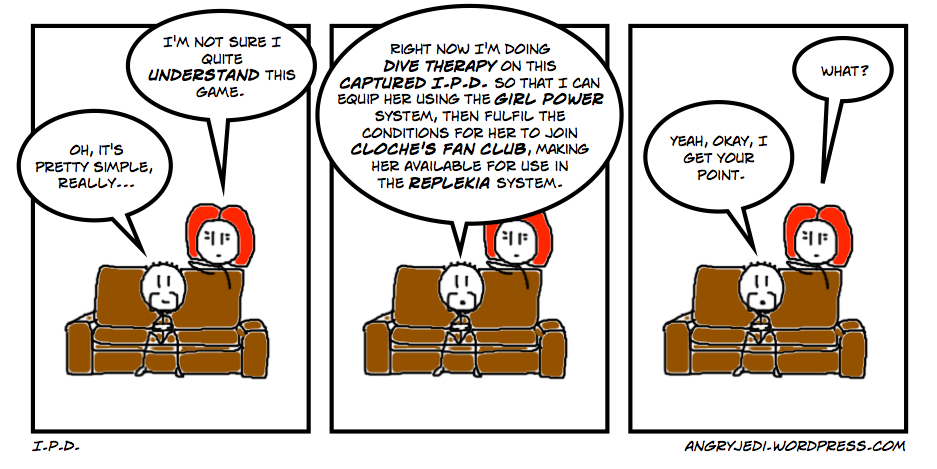
Phase 2 in Ar Tonelico II is a bit different. Rather than, like the first one, being set in the same locations and simply branching off in two different directions, Phase 2 of Ar Tonelico II takes place in a completely different area that works completely differently to the environment you've spent the previous 12 hours in. The early part of the game is, aside from its many and varied peculiar gameplay systems, relatively conventional — you visit towns and do stuff in them, then you go to dungeons. Then you go back to towns. And so on. The linear plotline is broken up by an optional "hunting" sidequest in which you can track down various "I.P.D."-infected Reyvateils to add to your "Girl Power" arsenal (I'm not even going to get started explaining that, I'll be here all day) but for the most part, you're doing the usual JRPG business.

Phase 2, meanwhile, takes place in an environment that changes according to your choices. Early in the Phase, you're introduced to a new mechanic known as the Infelsphere. This virtual world works in a similar way to the "cosmospheres" found inside the heroines' minds, but rather than reflecting their inner turmoil and anxieties, the Infelsphere represents the relationship between the two heroines and how they understand each other. Events unfold in the Infelsphere in which you have to make choices as to how to respond, and the choices you make in the Infelsphere subsequently affect what parts of the "real world" open and close to you. Your eventual goal is to get to a specific location by navigating your way through a maze of these pathways that open and close according to how the Infelsphere events unfold, with each point on the path containing some sort of "trial" to overcome. This might be as simple as defeating a monster, or it might be a challenge such as successfully smuggling biscuits past the penguin-like "Pippen" creatures.

Thematically, in each of these trials, you're "proving your love" to one of the heroines, which subsequently provides you with keys to unlock new events in the Infelsphere, and so it continues. It's a really peculiar, really interesting structure that not only offers some unconventional JRPG gameplay in the "real world" sections, but also provides some intriguing insights into the characters and the way they respond to various situations in the Infelsphere component.

You'll notice I haven't really mentioned the plot in this description, and that's deliberate, as discussing the plot surrounding all this would be a massive spoiler, so I'll spare you that — for now, anyway. What I am finding particularly pleasing about Ar Tonelico II as a whole, though, is that even if it didn't have a compelling plot and awesome characters — which it does — it would still have rock-solid gameplay with an absolute bucketload of things to do. It is just one of the many, many examples out there that prove JRPGs are far more than the "ATTACK, MAGIC, ITEM"-fests that ill-informed detractors of the genre assume these games still are.

They haven't been that way for a long time, people. So if you haven't played a JRPG since Final Fantasy VII I strongly recommend you check out what the genre has done since then — you might just be very pleasantly surprised by what you find.

1144: A Life Without Nerd-Rage

Page_1I haven't even contemplated going back to Twitter yet, but not because I have no desire to run into the scumbuckets who drove me off it in the first place. No, my lack of desire to go back to Twitter stems from my dislike of irrational table-thumping arguments on the most ridiculous of subjects, usually video game-related.

Mr Craig Bamford said it best back in February:

CAN WE PLEASE STOP TRYING TO HAVE SERIOUS DEBATES ON TWITTER OF ALL THINGS?

See title.

No, really. See title. I’m enormously, impossibly tired of how everybody who writes about games seems to think that the best-or-only way to have debates on serious, often wrenchingly-personal issues is on Twitter.

Yes, I’m guilty of this myself. I know. But every single time it happens, I feel like I’ve made a mistake. I’m just reminded of how Twitter is an incredibly dumb way to handle these things. The posts are too short, there’s no proper threading, you can’t follow the discussion properly unless you follow everybody involved, expanding the size of the group makes it even worse, you can barely mention people without drawing them in…

…it’s just a gigantic dog’s breakfast that makes absolutely everybody involved look bad.

Worse, it elevates bad arguments. It seems custom-tailored for dumb appeals to authority/popularity and thrashing of strawmen and misquotation and pretty much everything OTHER than an actual grownup  discussion of issues. It’s absolutely one-hundred-percent boosting the arguments that are “simple, straightforward, and wrong”, as the saying goes. That likely has a lot to do with why everybody seems to rush to the most extreme interpretation of arguments and positions. Extreme arguments tend to be straightforward ones.

Sure, there’s worse. Facebook, for example. But every day I’m more and more convinced that Twitter should really be used to link to  arguments, instead of make arguments. It’s not working. So, please, stop.

I agree with him entirely. Too many times over the last year in particular have we seen game journalists and critics with disproportionately loud online "voices" telling us what to think. Usually these loudmouths are attempting to address the issues of sexism and misogyny in the industry — a noble goal, for sure, as few can deny that women still get treated like shit at times through no fault of their own — but more often than not they get so embroiled in beating their fists on their desk that they lose all track of their arguments and end up coming across as… well, a bit childish really. Often these rants come about when the full information on a given situation isn't available, either — they're a kneejerk response to things which often aren't the "problem" they appear to be at first glance.

Let's take the recently-released Tomb Raider reboot as an example. I haven't played it yet, but I've been discussing it with a friend who has this evening. He's an intelligent sort of chap with a keen critical eye, and he has found himself very impressed with the depiction of the young Lara Croft as a vulnerable young woman caught up in a situation that she isn't entirely comfortable with, and having to do things that she finds difficult or scary. The tale of Tomb Raider is as much one of Lara overcoming her own difficulties at dealing with particular things as it is about… whatever the overarching plot of the new game is. (I'm intending to "go in blind" when I eventually play it, so I have no idea what the actual story is about.) My friend compared it to the movie The Descent, with which it sounds like it shares many of its themes and much of its tone. This means that Lara is frequently put in various types of danger — from the environment, from wild animals, and from other people. This also means that there are times when the wet-behind-the-ears young Lara is absolutely fucking terrified of what is happening to her, and justifiably so.

Is this sexist? No, not really; it's a perfectly human response to shit your pants (not literally… I don't think) at the prospect of having various forms of unpleasantness inflicted upon you, regardless of whether you're male or female. Likewise, as much as we would like to forget it happens, violence and sexual assaults do happen to women — and men too, for that matter — because there are certain portions of human society who are complete scumbags who have no regard for human life, male or female.

Lara happens to be female, which means that the situations she is put in over the course of Tomb Raider have been under a disproportionately greater amount of scrutiny than if she was a male hero — regardless of whether or not said male hero is a realistically-rendered character (as Lara is intended to be in this reboot) or a muscle-bound caricature. Lara is put into some difficult situations over the course of the game, including at least one scene where she appears to be at risk of sexual assault. Much was made of this scene when it was first revealed — particularly comments from the development team that it would make players "want to protect Lara". This was immediately interpreted by the aforementioned loudmouths as being misogynistic and in a sense they're correct to say that — the characters in the game are misogynists who don't care about Lara's wellbeing. But — and here's the thing — this doesn't mean that the developers share these attitudes just because they put these characters in the game. You have to have conflict and tension for something to be exciting. Did it have to be the implied threat of sexual assault? No, of course it didn't, but equally that doesn't mean we should shy away from such subjects in our entertainment — to do so can actually be pretty harmful, as it makes genuine victims of this sort of thing feel like their suffering is something to be ashamed of. It's also just plain insulting to grown-ups who want their entertainment to acknowledge that Sometimes Bad Shit Happens to Good People.

I don't want to get too bogged down in Tomb Raider because it's just one example of this sort of thing going on. I happened to sneak a glance at Twitter earlier out of curiosity and it seemed that the latest controversy to hit the Intertubes related to Sony's new God of War game, which features an automatically-attained story-related Trophy awarded to the player the moment after the lead character Kratos stomps on the face of a Fury following what, I assume, is one of the series lengthy combat sequences. The trophy is called "Bros Before Hos", which is arguably somewhat in bad taste, but we're talking about a series full of a muscle-bound man ripping the eyeballs out of mythological creatures the size of your average Ikea while shouting incoherently, so I think we can agree that subtlety went out of the window a long time ago.

Because a Fury is a woman, this scene (and by extension the Trophy) is now misogynistic. Again, it might well be in the context of the game — I haven't played any of them so I don't know what sort of person Kratos is (besides "the angriest man in Greece") and what his attitudes towards women are — but in the case of the game's development, God of War is based on established mythology (or an interpretation thereof, anyway) in which the Furies were (are?) female, and not very nice things to encounter to boot. If you had the opportunity and the means, you would probably want to stamp on their face too, and that's nothing to do with the fact they are women — it is, however, everything to do with the fact that they are infernal goddesses of much unpleasantness. Do we now have to disregard established mythology because of concerns over violence against women? No, that's ridiculous; that's wrapping the world in cotton wool, which helps no-one.

Note that in all of these cases I am not advocating for people to be free to promote things that are harmful to society. I would feel deeply uncomfortable playing a game in which you were somehow rewarded for inflicting domestic violence on someone, for example — although if tackled with sensitivity and care (which many triple-A developers lack, but which many smaller-scale or indie developers have proven themselves to possess in abundance) it could be possible to create an interesting, if distressing sort of interactive story about domestic violence. (In fact, it has sort of been done at least once, to an extent anyway: for a fascinating and challenging exploration of an abusive relationship through the use of allegory, play the game Magical Diary — which was written by a woman — and pursue the romance with Damien.)

What I am instead saying is that getting outraged any time a female character (or, for that matter, a non-white, young, elderly, homosexual, trans or other "non-white twentysomething cis male" character) is placed in peril, regardless of the circumstances, is counter-productive. It diminishes the value of the arguments as a whole, and distracts attention from content that genuinely is a problem. After the controversy over the Hitman trailer with all its leather-clad nuns and other assorted ridiculousness dreamed up by the 14-year olds in Square Enix's marketing department, I confess I found myself blocking most of the people involved in the "discussions" around the issue on Twitter not because I wanted to deny there was a problem, but because I couldn't deal with the way people were arguing about it. There was no debate, no discussion — nothing but "I'm Right, You're Wrong" for day after day. And as soon as one controversy subsided, another appeared. And so it continued for month after month after month. It made me stop caring completely, which is the complete opposite of what these people presumably intended.

Rage like this doesn't even have to be directed at a sociological issue, though; just recently everyone has been getting extremely angry at EA because of SimCity's online requirement, just like they did with Diablo III. Again, very few people are considering all the facts at play here, which I won't get into now, and instead resorting to kneejerk rage which, if you disagree with, you're somehow an asshole. There always has to be something to be angry about. And it's exhausting.

So, in summary, I am very happy to have now, for the most part, taken a step back from the seething masses — and while said masses are still seething I have very little intention of heading back in a Twitterly direction unless absolutely necessary.

I'll let Irina sum up how I feel about all this with the Understatement of the Century.

President6Quite.


1143: Kilo-Commuter

Page_1My brother posted a link on Facebook earlier about "mega-commuters" — a relatively small number of Americans (about 600,000) who travel more than 50 miles each way to get to work each day. He's one of them.

Sounds hellish, doesn't it? But it doesn't necessarily have to be that bad.

I can't make a claim to be a "mega-commuter" as the longest commute I've done on a daily basis was about 35 miles each way — I guess that makes me a kilo-commuter? — but that was plenty to potentially drive me insane. As it happened, it was the job itself I was doing at the time that did a much better job of driving me insane, but I digress; my distaste for the teaching profession and reluctance to return to it ever again is well-documented elsewhere on this blog. (In fact, it was my growing sense of discomfort at an ill-advised return to the profession that spurred me on to start writing on this 'ere site every day in the first place, so I guess I can't complain too much.)

No, believe it or not that's actually sort of relevant, because my daily 70 mile round trip to get to and from work actually became something of a haven of calm amid the chaos of my professional existence. While I was in my car, no-one could "get" me. (Well, technically, I suppose they could; someone could have crashed into me and injured or killed me. But… oh, shush.) It was some time I had to myself to spend as I pleased… sort of, anyway — I mean, obviously I still had to do the driving bit.

Consequently, I found myself spending my commute doing things that I don't really do any more as a "work from home" person. I listened to the radio. I listened to podcasts. I listened to a lot of music. I sometimes phoned people. (Hands-free, obviously.) I phoned people. Jesus Christ, I never do that now, largely because the telephone tends to fill me with an uncommonly-large amount of dread, but nope, the sheer tedium of driving down the M3 (or sometimes, for variety, the A31) every day was occasionally mitigated by actually talking to someone other than myself. But more often than not it was mitigated by listening to the radio or podcasts. I attribute the fact that I can tolerate (and even enjoy) Chris Moyles' brand of comedy — something that it appears to be fashionable to hate — to the fact he accompanied me to work and made me laugh every morning through what turned out to be a very difficult period of my life. I'm not sure I would have stuck out a job that eventually pretty much gave me a nervous breakdown had I not had something like that to help me mentally prepare myself each morning. (Obviously ultimately it didn't really work, but still.)

While it was nice to spend that zombified period of time driving in a straight line for about 50 minutes, the prospect of doing so every day isn't really the sort of thing that makes you want to get out of bed each morning. You have to really like your job to be able to stick it out for longer than a few months. I somehow managed to convince myself to do it for a total of two and a bit years altogether — eventually I moved closer to the job that eventually saw me escaping the teaching profession, which is probably something I should have done sooner — but that commute was probably one of the contributing factors that made me come over all queer, as a grandmother might say.

Despite that, though, I do sort of miss it. I don't have my own car at all any more — Andie and I share one, as I have no real need for my own now — and so long drives accompanied by the radio or podcasts are now an increasingly-distant, wistful memory for the most part.

Then I remember that I don't have to get up before 6am any more and I don't miss it nearly as much.