 I overheard a Twitter conversation the other day (yes, I'm back on there, largely to make my professional self easier to reach if necessary) in which disparaging comments were thrown around regarding people who "play games for the story".
As someone who primarily plays games for the story, I feel honour-bound to take exception to this line of argument, though I forget exactly what the actual point of the discussion in question was. Anyway. Allow me to describe what being someone who plays games for the story — a self-professed "narrative junkie" — means.
Quite simply, it means that I am extremely forgiving of a wide variety of "sins" on a game's gameplay front if — and it's a big if — the narrative content of the game in question keeps me interested and compelled. (Caveat: the only unforgivable sin that I simply can't get past is a free-to-play game putting up a paywall with an energy system or similar mechanic; no matter how good your narrative is, if you actively stop me from playing your game before I'm good and ready to stop, I'm not coming back. Ever.)
Said narrative doesn't have to be big and clever, or trying to be anything more than a piece of enjoyable entertainment. But it pretty much needs to be there to keep me interested.
Similarly, I can happily take a game with practically no "gameplay" in a traditional sense — see: interactive movies like School Days HQ or any of the myriad visual novels available — so long as the narrative entertains me and keeps me interested.
I'm relatively easily pleased when it comes to storylines. About my only real requirement to enjoy a video game story (or any story in any medium at all, really) is that there are some characters in it that I either like or find interesting — because those two feelings aren't necessarily the same thing. Give me something in which relatively little "happens," but in which I gain a deep understanding of the characters involved, and I'll be very happy indeed.
It's this love for the art of the story that has led me to give a whole bunch of much-derided games the time of day where others would pass them by. The titles which spring most readily to mind are the Hyperdimension Neptunia series, which is riddled with technical flaws, dull gameplay (in the first game, at least; I actually thought the second was genuinely fun, and I'm yet to try the third one) and various other issues; and Nier, which everyone seems to have decided looked drab and boring and thus was unworthy of further exploration. (I never quite understood this; I thought Nier was actually a pretty good-looking game — it certainly had a lot of personality.) Even the Ar Tonelico series, which I've been playing through for the last… quite a while isn't widely regarded as providing shining examples of "good games".
For the record, I found the Neptunia series genuinely amusing as well as being a wonderfully on-the-nose parody of both anime and video game culture; I found Nier a fascinating, deeply moving experience; and Ar Tonelico… well, having known nothing about it when I started playing, this is now a series I would happily defend to the death.
It's this attitude which brought me to the realisation I'm not really a fan of Western-developed role-playing games any more — particularly those of the "open world" variety favoured by Bethesda. I enjoy a good dungeon crawl, sure, but when your lovingly-crafted game world behaves more like a diorama with animatronics than a living world with actual people in it, I get a bit bored.
I realise there's a certain degree of irony in accusing titles like Skyrim of having diorama-like worlds when most JRPG towns are populated by NPCs who constantly stand in the same place and spout the same crap every time you talk to them. But for me, paradoxically, that gives them a lot more personality. Rather than constantly running into the same recycled guard model and wanting to throw a brick through the TV every time someone makes an "arrow to the knee" reference, each NPC is unique and, for those one or two lines they speak, vaguely interesting.
Ar Tonelico handles this rather well by having the NPCs' lines change according to the point in the story you're at. The stories of all three games in the series take place over a relatively small geographical area, so you're revisiting locations a lot; it's a fun little "unofficial" sidequest to check in with your favourite NPCs and see how their own completely irrelevant story arc is progressing. Will the little kid outside the General Store ever get up the courage to ask Sasha to come and play with him? Will Skycat ever actually make a move on Luca or is she just flirting? Will those weird furry creatures ever say anything other than "Poo"?
This is all a matter of taste, of course, and I'm well aware that there are thousands — millions? — of people out there perfectly happy with the way Skyrim does things. And that's fine. Just, as always, be aware that not everyone enjoys the same things in the same way — no-one's way of enjoying a creative work is inherently "wrong", so live and let live.
 I haven't posted about Ar Tonelico for a while, and having just witnessed the "bad ending" of the third game (ooh, it's bad) I feel now may be a good time for a progress report on my thoughts thus far before I jump in and try for the other endings.
 Something sprang to mind for me and Andie while we were over in Toronto. Our friend Mark was taking us out for lunch to an intriguing little Vietnamese place called Banh Mi Boys that served all manner of interesting sandwiches and meat buns and the like, and we suddenly realised that were the roles reversed, there weren't all that many interesting places we'd be able to take visitors to our fair(ish) city of Southampton.
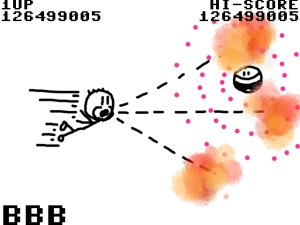 The sole aim in a lot of video games circa the '80s and early '90s used to be to attain a high score. But in all but a few genres of gaming, that simple pleasure of watching a number get steadily higher — a number which proved indisputably how much better than your friends you were — has fallen by the wayside. This is kind of a shame because, having been playing a bunch of games recently in which the old-school objective of "score as many points as possible" is their reason for existence, it's, you know, fun. Lots of fun.
 Those of you who have me on some form of social media will know this already, but I've started my new job. Excitingly, this is the first ever new job I've had that was accompanied by an official press release. Yes, really —
 Way back before I started doing this daily blogging shenanigans — yes, there was a time when I was an erratic blogger, just like normal people on the Internet — you may recall that I once gave a harrowing account of the adventures of Count Kurt von Hellstrom and his merry band of warriors, otherwise known as the characters my friends and I rolled to play a campaign of Games Workshop's tabletop roguelike Warhammer Quest. On the off-chance you haven't been reading this blog since December 2009,
 One of the games I had the chance to try out during my recent trip to Canada was a charming little card game called Love Letter, the brainchild of Seiji Kanai and the fourth entry in AEG's Tempest series of games that share the same setting. Today, my own copy of it finally arrived, so I thought I'd talk about it a bit. I know I already mentioned it a number of posts ago, but I thought I'd dedicate a whole post to it.
 I have been contemplating my own mortality lately.
 I'm exhausted. I'm not quite sure why I feel so utterly exhausted because I slept well last night and today hasn't exactly been a particularly strenuous day. We played a couple of short games this morning before departing the pleasant country farmhouse we'd been staying in over the weekend, drove back, then, presumably, did our respective "Things" once we got home rather than immediately falling into a coma like I feel like doing right now.