1454: Disciple of Magic

Jan 11 -- BLMI've now spent a decent amount of time with all three of Final Fantasy XIV's "Disciples of Magic" classes, and it's abundantly and pleasingly clear that all three of them play markedly differently from one another. Which is great! In a game where you can switch your class pretty much whenever you want to, having something to distinguish between all of them is extremely important. And while they all follow the same basic "hotbar and cooldowns" procedure as one another, their application is very different.

Thaumaturgist, which later becomes Black Mage, is the class I've spent the longest with, and I also find it one of the most fun to play. The core of playing this class involves managing your pool of magic points carefully, but not in the same way as mages typically work in RPGs — no, here Black Mages don't have a single stock of magic points and then they're done; by alternating casting ice spells and fire spells, Black Mages have a potentially limitless stock of magic points. Casting ice spells provides you with the "Umbral Ice" buff, which causes your magic points to regenerate quickly but your damage to be less; casting fire spells first cancels out Umbral Ice and then provides you with the "Astral Fire" buff, which increases your damage and the MP cost of your fire spells, but prevents your MP from regenerating altogether. Consequently, your "rotation" — the set of skills you cycle around by default — tends to involve casting Fire spells until you're low on MP, then casting Ice spells to regenerate, maybe throwing in a Thunder spell (which causes damage over time) while those precious MP are coming back.

Conjurer, which later becomes White Mage, meanwhile, is very different. For starters, it's primarily a healing class rather than a damage dealer, though it does have a number of offensive spells that can be surprisingly effective. Unlike Black Mage, White Mage has no means of quickly regenerating magic points, but to make up for this, its spells are a fraction of the cost to cast. This means that playing a White Mage skilfully involves again managing your stock of magic points — but this time around, bearing in mind that you only get one barful of them for a single fight. As a result, you often need to weigh up what your priorities are — can you afford to throw in a few offensive spells to support your damage dealers? Should you use lots of smaller Cure spells or a more powerful, more expensive higher level spell? Getting better at playing White Mage involves quickly understanding the overall party situation — you spend most of your time looking at the party information box in the corner of the screen rather than what's actually happening — and then responding to it appropriately. So far — up to level 30 — it's been reasonably straightforward, but I'm intrigued to see how different it is in the harder dungeons.

Then finally there's Arcanist, which I've just started playing, because I need to level it to 15 in order to turn Conjurer into White Mage. Arcanist is an interesting one because unlike the other classes in their current form, it can branch of in two different directions at high level — the healing-centric Scholar, or the more offensively-oriented Summoner. All have one thing in common, though; the ability to summon various creatures to support them in combat. As well as siccing your pet on enemies, you also have access to both offensive and defensive spells, including healing, buffs and debuffs. It looks like it has potential to be a complicated but rewarding class to play — and again, very distinct from what Black Mage and White Mage offer.

I haven't really done that much with the melee-based Disciple of War classes as yet, but I have little doubt that they'll be a similar way; I spent a bit of time with Pugilist (which later becomes Monk) in the beta test period, and this played a little like Thief/Rogue does in some other games — positioning becomes important, as you do better damage if you're hitting the enemy in the back rather than taking them head-on. I haven't tried Lancer/Dragoon at all yet, but I'm sure it's in my future.

My priorities in the game are kitting out my Black Mage as well as possible — it's the first class I levelled to 50, so it will probably always feel like my "main" — then get White Mage to 50, then experiment with Arcanist some more. I don't know how confident I'll be with high-level healing, but with supportive guildmates who have helped me through a lot of the game so far, I feel confident and safe giving it a go. But there's a way to go before I have to worry about that; 20 whole levels, in fact, and while they should shoot by more quickly than they did for Black Mage — FFXIV's "Armoury Bonus" system, whereby you gain more experience when you're levelling a new class, sees to that — it'll still be a while before endgame White Mage.

Listen to me. I had a feeling I was going to like Final Fantasy XIV when I first considered playing it, but I never thought I'd be as into it as I am. Great job, Square Enix.

1453: Winding Down

Jan 10 -- WeekendAnd so we come to the end of another week, with the prospect of a nice relaxing weekend sprawling out in front of me.
This week feels like it's been quite a long one. Not really for any particular reason; things have just dragged a little, and I've been quite busy. Still, better that than be twiddling my thumbs or wallowing in a black puddle of depression, right?

Not sure how I'm going to spend the weekend as yet. I'm almost certain there will be some Final Fantasy XIV involved, and probably some Danganronpa — which I'm previewing next week for USgamer — too.

I can't say a lot about Danganronpa at present due to content embargoes and whatnot — though it's the kind of embargo that says I can't talk about content in the game after a certain point in the story, not the kind that gags me until a specific date — but I will say that it's utterly fantastic. If you have enjoyed any combination of Corpse Party, Ace Attorney, 999, Virtue's Last Reward and adventure games or visual novels in general, you're going to have an absolute blast with this one — though bring a strong stomach, because you're going to need it.

Other than that — well, even with all that, really — not a lot of great import or interest has happened this week. I mean, I received my gigantic fabric wall scroll poster of Nepgear from Hyperdimension Neptunia and hung it on my wall having successfully remembered how to use picture hooks after initially forgetting, but that's not all that fascinating, really. (It is a great poster, though.) And I reached level 50 in Weaver on Final Fantasy XIV the other night by discovering an extremely easy repeatable quest and then simply making forty-seven pairs of woolen tights in order to complete it multiple times in rapid succession — I must have looked funny running back and forth between the Levemete and the quest's "target" over and over, with the distinctive "level up" flash surrounding me every few minutes. But again, of all the things I've done in that game to date, that's not one of the more interesting things I've done.

I'm looking forward to next week, though, since Tuesday is our first official board gaming night of the new year, and it's my turn to pick what we get to play. Since I've received a pleasantly large selection of new games through a combination of Christmas presents and Christmas money, I'm taking along a nice taster selection for us to enjoy — and with many of them clocking in at half an hour or less to play through, we should hopefully have time to get plenty of gaming in over the course of the evening. I wonder which of the games will go down the best — or if we'll get time to squeeze them all in? We'll see. I'm particularly looking forward to experimenting with the insanity that is ten-minute real-time dice-rolling game Escape.

Anyway. That is that for now. My working week is over, so I'm going to go and flop on the sofa with a coffee now. Have a pleasant weekend!

1452: What Can You Use Bovril For?

bovril[Note: This was written last night, but for some reason didn't publish. My apologies!]
Inspired by someone who found my blog today by searching for "what can you use Bovril for?" I proudly present to you the Definitive List of Things You Can Use Bovril For.

  • You can make it into a drink. This is supposedly its primary purpose. Essentially you put a dollop of it in a cup and add hot water. The result is a jet-black drink that is somewhat salty, and which is supposed to taste of beef but doesn't really. I'm not really sure what it tastes of. It actually doesn't really taste of Bovril any more, oddly, because I associate the taste of non-drink Bovril with being somewhat… pungent, for want of a better word; the kind of thing that feels like it's stripping the lining of the roof of your mouth off. Bovril as a drink doesn't have that effect, really; it just tastes of salt and disappointment.
  • You can put it in sandwiches. Growing up, this was a mainstay of my school lunchbox, but I genuinely don't think I've had a Bovril sandwich since I was at school. If the idea of putting a thick, sticky, vaguely beef-flavoured salty black paste in a sandwich as its sole ingredient doesn't sound massively appealing, you can also use it as a sort of condiment; cheese and Bovril works quite well, for example.
  • You can put it on toast. This is, for me, the second-most optimum use of Bovril, because toast's relative solidity compared to regular bread ensures that the Bovril remains largely in its natural state and gives your toast a strong, vaguely spicy flavour that is not altogether unpleasant. In fact, it's actually quite nice — but again, be careful with the quantities, since applying too much Bovril to your toast will cause your mouth to feel rather strange for the rest of the day. As a guideline, when looking at your toast, it shouldn't be a solid mass of Bovril; it should instead be smeared across it relatively lightly.
  • You can put it on toast, then dip it in Heinz Cream of Tomato Soup. This is the absolute best use of Bovril, and the discovery of which is one of the very few good things I look back with fondness on from my relationship with an ex-girlfriend. It sounds like it should be disgusting, but trust me on this one; you absolutely won't regret it. Unless, of course, you don't like Bovril, in which case why are you reading this post anyway?
  • It makes a not very effective adhesive. In other words, you probably wouldn't want to stick anything together using Bovril, but in the process of opening a jar that's a few months old you will almost inevitably end up accidentally doing so — usually your fingers to each other, or the spoon to a wall, or your face to a cat. Wash hands thoroughly after preparing any sort of Bovril-based dish.
  • It makes a not very effective fake tan. Again, in the process of opening a jar that has been in your cupboard for perhaps a little longer than it should have — though trust me, unless you leave toast crumbs in it, a jar of Bovril will happily survive the apocalypse — you will almost certainly end up staining yourself with it. For fair-skinned individuals, a light smearing of Bovril over your entire body will equip you with the uneven tan typically sported by Britons returning from a holiday on the continent.
  • It makes for excellent scatological practical jokes. A light smearing of Bovril in the victim's underpants — probably best to do while they aren't wearing them — will make them look like they've shat themselves. Be sure to scoop out any excess Bovril before secreting your victim's underpants back in the drawer, because seeing black sludge that has apparently emanated from their rectum will probably make them want to call the doctor rather than just throw the pants in the bin and/or washing machine.
  • Apparently if you hit Marmite repeatedly with a spoon it turns white. I don't know if the same is true for Bovril, but if you are bored of an evening, the attempts to prove or disprove the theory may prove to be adequate entertainment if the television is showing nothing but reality shows.

I hope you have found this list helpful, mystery reader. Be sure to enjoy your Bovril safely and responsibly, and always remember your safe word.

1451: Learning to be a Better Virtual Person

Jan 8 -- FFXIVContemplating my time in the virtual realm of Eorzea so far, I feel that Final Fantasy XIV has had something of a positive effect on my mental wellbeing in a number of ways. I also acknowledge that it brings with it its own problems and considerations — primarily the fact that what is one of its best qualities — its inherently social nature — is also something that makes it compelling and addictive, and consequently distracts from other things. As with anything, it's all about finding a good balance.

But I don't want to focus too much on the less positive aspects of the experience because they're all things that can be solved with a degree of self-control and discipline. What I instead want to focus on is, as I mentioned at the beginning, the positive impact it's had on me.

I started playing Final Fantasy XIV's new version A Realm Reborn for several reasons: I'd been curious about it for a while, but had never played the much-maligned version 1.0; I'd enjoyed my time in Final Fantasy XI, but had never got that far; and someone I knew via a combination of Twitter, 1up and possibly some other places around the Web too invited me to come and play with a group of like-minded somewhat casual players who were in it to have fun rather than become the sort of people who run tightly-regimented raids and complain about "noobs".

When I fired up the closed beta version of the game, I was instantly smitten, and my love for the game only continued to deepen as the closed beta became open beta, and open beta became live service — with significant, noticeable improvements along the way. But what keeps me playing day after day is the fact that the people whom my friend invited me to come and play with have turned out to also be extremely pleasant virtual company — and while I don't know very much (or indeed anything) about their real-life selves in many cases, in the land of Eorzea I most certainly consider them to be friends.

The growth of these friendships has not only helped me from the simple perspective of making friends and having a reliable group of people to interact and play with every time I log on, but it's also helped me to build up my own confidence slowly and gradually.

As longtime readers will know, I struggle somewhat with social anxiety, particularly from an assertiveness perspective. Even when I'm among friends, family or other people I trust, I find it difficult to be truly assertive and say what I'm thinking or what I want. And indeed I often find myself acting the same way in online games — I find myself apologising in advance for messing things up, or not knowing how something works, or not being as familiar with the challenges ahead as more experienced players.

Over time with FFXIV, however, I've noticed myself changing somewhat. Whereas a month or two ago I'd respond to a guildmate's request for companions to take on a dungeon or boss fight with an "I'll come if you've got room for me" or "I'll come if you don't mind a newbie coming along" whereas now I feel a lot more confident in stepping forward right away without qualifiers. I've even stepped up and led my own expeditions into particular dungeons, or helped provide the impetus for a group excursion into more challenging content by expressing my desire to see it.

There was still the question of strangers to conquer, though. Final Fantasy XIV features a system called the Duty Finder whereby you can queue up to play the multiplayer content by yourself or with friends, then get matched up with other people to fill the spare slots in your party. For someone with anxiety issues about meeting new people and disappointing them, this is a daunting prospect, but again over time I've noticed myself changing. I've not only been happy to queue for the level 50 dungeons I now know quite well by myself, I've become more confident at stepping into the "Duty Roulette" option to challenge a random dungeon with a group of random strangers.

Not only that, but I've started experimenting with party roles other than my traditionally-held post of black mage — a damage-dealing class that specialises in standing back from the main melee, flinging spells, killing monsters and trying not to draw the attention of the more powerful enemies. No, while I still consider Black Mage to be my "main" class — largely because it's the one I've spent most time with, feel most attached to and have consequently kitted out the best — I've been having a lot of fun with playing as a healer, though I haven't yet got to the dungeons where it's a significant challenge to be the healer, and this evening I tried tanking for the first time.

Tanking is a particularly daunting prospect in a game like this because you become the de facto leader of the party. You're the one who goes up front; you're the one who starts fights; you're the one who's supposed to protect everyone else. The tank has important responsibilities — ensure you maintain the attention of the monsters, and don't die. A tank is generally expected to know what they're doing but, of course, everyone has to begin somewhere.

I'd levelled Final Fantasy XIV's "Gladiator" class to level 15 previously, which is the earliest point at which you can take on the game's multiplayer dungeons. But I'd never yet had the courage to step into a dungeon and lead one like a proper tank. The prospect was scary; I was worried about doing a bad job and getting yelled at by my fellow party members. And as such, I'd put it off.

This evening, however, I formed a party with my "real life" friend and board-gaming buddy James, who's recently started playing, and another guildmate who agreed to come along. That only left one slot for strangers, and that helped me feel a bit more confident about using our run through the game's first dungeon as a learning experience.

It didn't start well; I died at the first monster, but that was because James was busy figuring out important healer things like how to target me and how to cast curative magic on me, not himself. As we progressed through the dungeon, I felt myself getting the hang of what was expected of me — still hesitant and keen to get the advice of my comrades, but more confident about being the one standing at the front. By the time we reached the end and successfully beat the boss, I felt like I'd happily take on that challenge again — though I couldn't resist a quick apology to the lone stranger in our party — who was also something of a newbie, as it happened — for my "incompetence".

"It's cool," she said. "We made it through, and that's all that matters."

As any social anxiety sufferer will tell you, the reality of a situation that's been a considerable source of anxiety to you is rarely anything even a little bit like what you've built it up to be in your head. And that's something that Final Fantasy XIV is helping me remember more regularly.

1450: Netrunning

Jan 7 -- NetrunnerPutting the more formal board game posts on hold for a moment because an idle mention of them during a staff meeting yesterday may have led to us doing a bit more board game coverage over on USgamer in the very near future. So yay for that!

I did want to talk a bit about a tabletop game, though — Android: Netrunner, which I got a copy of for Christmas.

Android: Netrunner is a two-player "living card game" based on the customisable card game of the same name from a few years back. (A "living card game", for those unfamiliar, follows many of the same principles of customisable card games — primarily the ability to build your own deck of cards prior to playing a match — but provides additional cards through static, predictable expansions rather than randomly mixed booster packs) It's a particularly interesting concept in that it's asymmetrical — the two opposing "sides" in the game have very different goals, mechanics and even terminology.

The concept of Android: Netrunner is classic cyberpunk: anarchic, rebellious "runners" are attempting to undermine the powerful "corporations" who run the dystopian future in which the game is set. They go about this through hacking into the corporations' systems to disrupt them from advancing their agendas; meanwhile, the corporation is steadily building up its defences against intrusion.

In gameplay terms, this means that the two sides have very different roles to play. The corporation's role is primarily defensive and involves protecting particularly precious pieces of data from the runner player, setting traps and generally messing with the runner's head. The runner, meanwhile, must build up their resources and equipment to such a degree that they can — hopefully — safely bypass the corporation's security countermeasures and steal the precious "agenda" cards required to win the game.

I tried the game for the first time with my friend Tim this evening. We played several games, all of which were over relatively quickly. In the first case, I, playing the runner, was flatlined on my second turn for attacking what I thought was a safe bet to score some points, only to fall foul of a booby trap, lose all my cards and consequently be eliminated. In a subsequent attempt where we swapped roles, Tim successfully managed to acquire the seven points' worth of "agenda" cards required to win, but it was a close-run thing — the server in which the last agenda card was hidden was heavily protected, and if Tim had played just a little less carefully he would have been obliterated by my security measures.

Obviously it's very early days yet, but I enjoyed the game very much. The cyberpunk theme is much more than window dressing — the cards you play are all very much thematically appropriate, and the initially confusing terminology starts to make a lot more sense when you start thinking about what you're actually representing when you play your various cards to the table.

It's going to be a challenge to learn how to play effectively, though, I feel. It's clear that being reckless can result in swift and merciless defeat very quickly, but this is good — it prevents games from dragging on way too long with a foregone conclusion, and instead allows you to gather everything up, shuffle your decks and try again with minimal fuss. This is exactly what this sort of game needs — not everything needs to come in epic packages of an hour or more.

Tim enjoyed himself, though, as did I, so hopefully we're going to be playing it at least semi-regularly. I'm keen to try it with my other friends, too — I think it's the sort of game that will be very interesting to observe how different people play.

1448: New Term

2014Taking a break from the board game posts for today, largely because I've left it a bit late to start faffing around with taking photographs and whatnot. I'm quite tired and it's back to work properly tomorrow; I'd like to try and be up and about at a reasonable time in the morning so I have time to do "stuff" of an indeterminate nature before I have to actually start working, but we both know that's statistically quite unlikely to happen.
This is one of the many problems with working from home. I mean, sure, it's great to not have to commute anywhere. And, theoretically, being able to stay in bed until pretty much whatever time you want so long as you actually get the work done before the end of the day is pretty great.

But it's not, really. The temptation when provided with potentially limitless time to lie in bed in the morning is to… well, lie in bed for a limitless amount of time until you really can't justify lying there any more. To be fair to myself, I have never actually overslept to such a degree that I haven't started working by the semi-arbitrary 11am start time I set myself to knuckle down and start writing, but I've cut it fine a few times.

Getting up is hard, though. I find it quite difficult to get to sleep quickly at night-time — much to my chagrin, Andie can fall asleep in a matter of seconds — and thus I like to enjoy as much restful sleep as I possibly can. Then there's the matter of "morning dreams" — the incredibly vivid workings of my imaginative subconscious that I can usually recall rather well for a few moments after I wake up, and indeed have documented a number of times on these very pages. (Obligatory link to "the poo dream" post for the benefit of my good friend who occasionally comments here.) These are often so compelling that it's difficult to tear myself away from them, even though I know even as they're happening that they're nothing but dreams, and they almost certainly won't conclude in a satisfying manner.

At least I am able to get up, however. When I was going through what I shall euphemistically refer to as my "rough patch" a few years back, I completely fucked up my sleep patterns to such a degree that I actually found it impossible to even wake up before 5pm in the afternoon. I was unemployed, alone and shortly to be without a place to call my own, so there really wasn't very much to get up — or even wake up — for. It was embarrassing to walk into the shop across the road from my flat and be greeted by the guy with the smelly armpits behind the counter with a polite request as to how my day had been when I knew that my day had only started ten minutes ago, despite his working day being almost over. It was frustrating, too, as I felt I should be doing something more productive with my time than sleeping, but, well, I was not exactly of sound mind at the time, and I'm not sure getting up in the morning would have helped all that much at that point.

Thinking back to that time, I should count myself lucky that I'm enjoying a period of stability right now, then. There aren't all that many things I really need to "worry" about right now — though as anyone who's ever suffered with anxiety and depression will know, you don't necessarily need "something" to stress about to feel stressed out. Life at the start of 2014 is pretty good, by all accounts, and hopefully it will only continue to get better as time goes on.

Now, before I pontificate further on matters of the mind, I believe it's probably time to bid you all farewell. I'll see you at the start of the new working week. Don't be late!

1447: From the Game Shelf: Guildhall

Guildhall

Publisher: AEG
Designer: Hope S. Hwang
Released: 2012
Players: 2-4
Recommended Ages: 12+
Play Time: 30 minutes

Theme: Medieval/Dark Ages
Mechanics: Set collection, hand management
Randomness: High
Luck factor: Moderate
Strategy: Moderate
Interaction: High

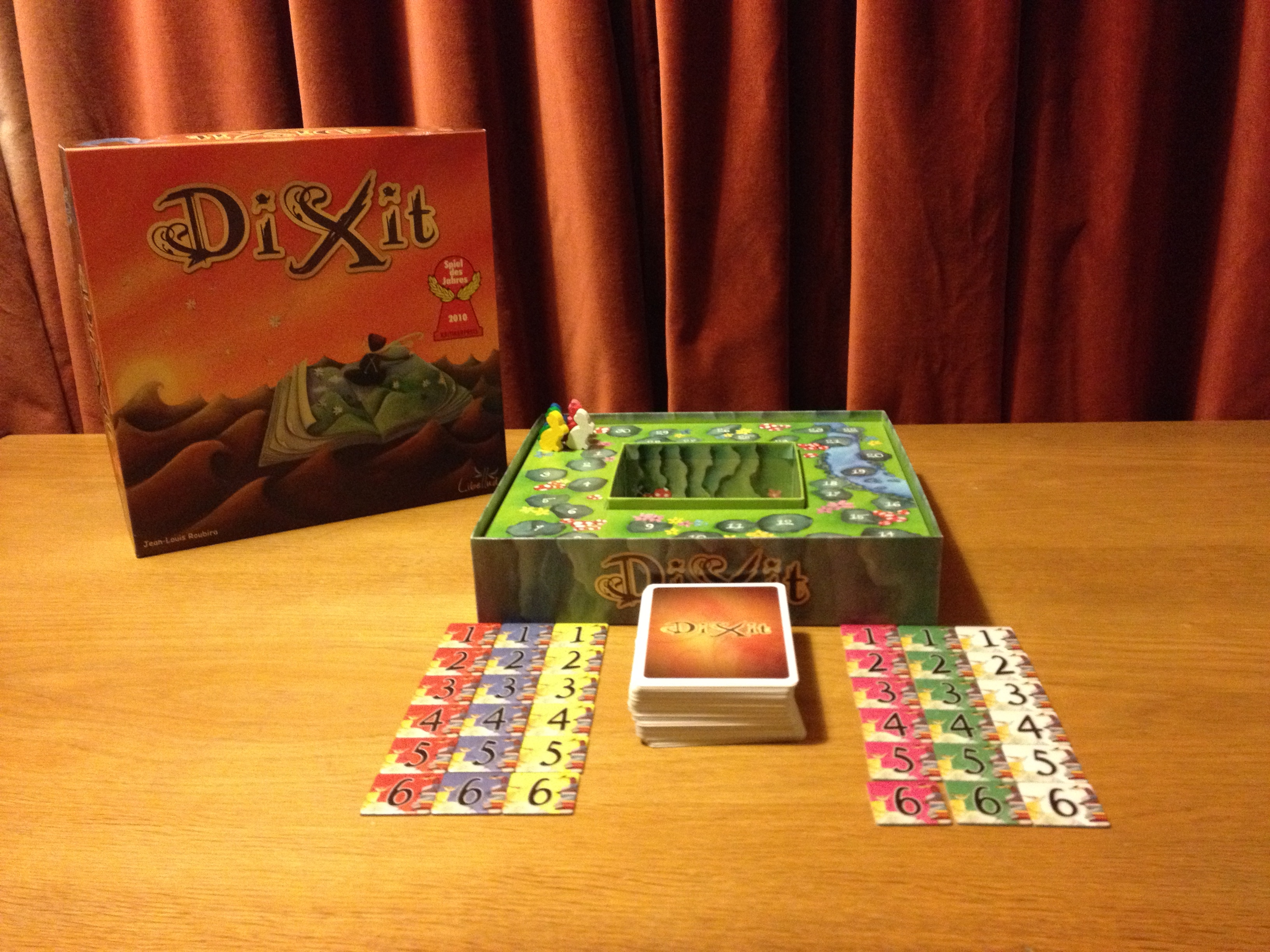
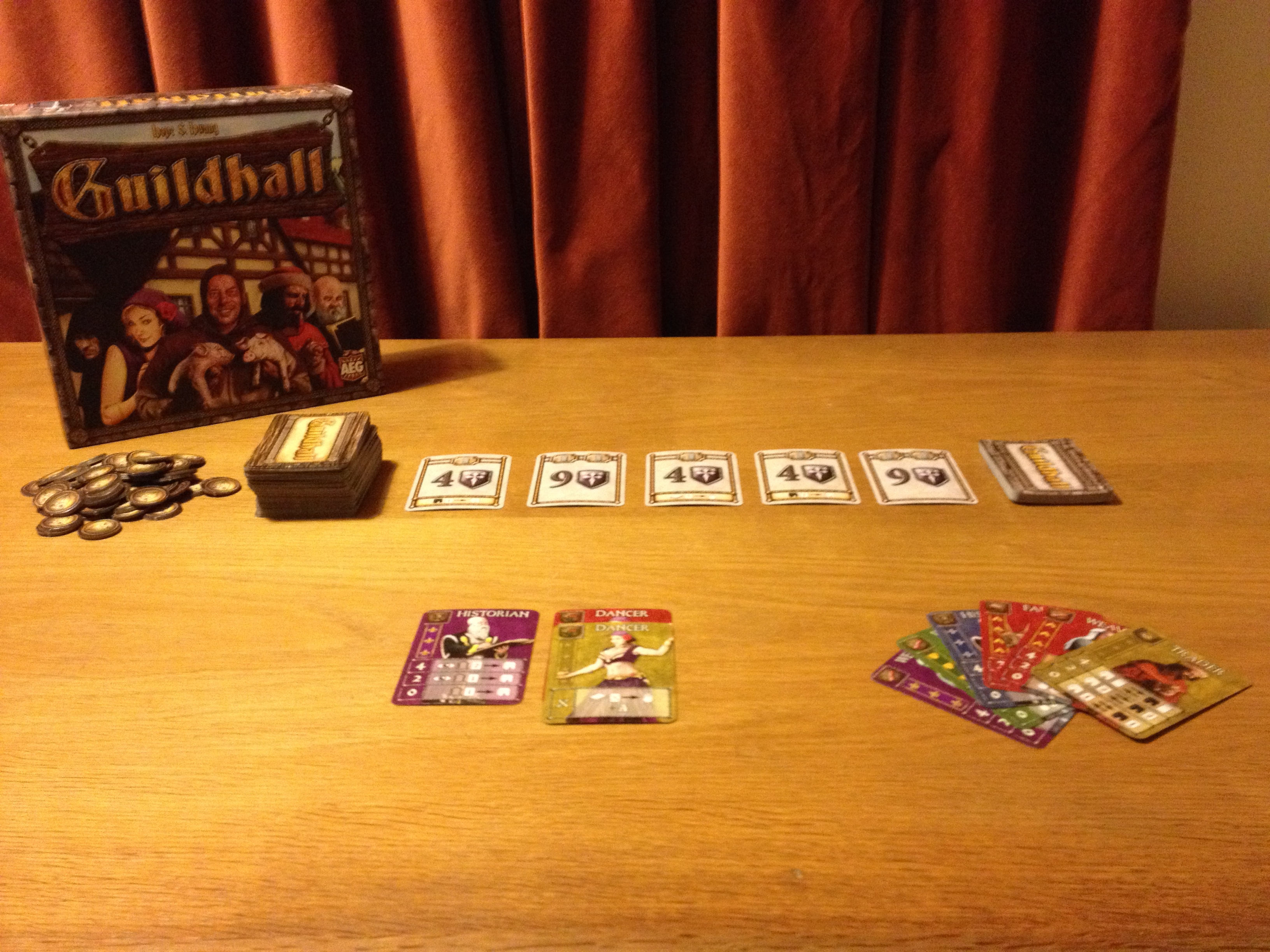
IMG_2717Guildhall is a card game themed around the concept of you opening… well, a guildhall. Your guildhall will play host to a variety of different professions, ranging from dancers to assassins; farmers to traders. The aim of the game is to score 20 Victory Points through a combination of point cards and individual points, and in order to do so you'll need to collect sets of professions. There's six different professions and five colours of each.
The rules of Guildhall are simple, straightforward and easy to follow and all the special mechanics are depicted through simple icons rather than text. Once you have your head around what all these icons mean, play is quick and snappy, making this an ideal filler game.

How it Plays

On your turn in Guildhall, you can take two actions. Your options from each action are to play a card to the table, which may trigger its special ability; to draw cards into your hand; or to use a completed "chapter" of your guildhall (all five colours of a single profession) to purchase one of the victory point cards, five of which are on offer at any one time. You are not allowed to play a card that is identical to one already down on the table — if you already have a red Dancer down, for example, you are not allowed to play another red Dancer, but you may play a blue Dancer instead if you have one.

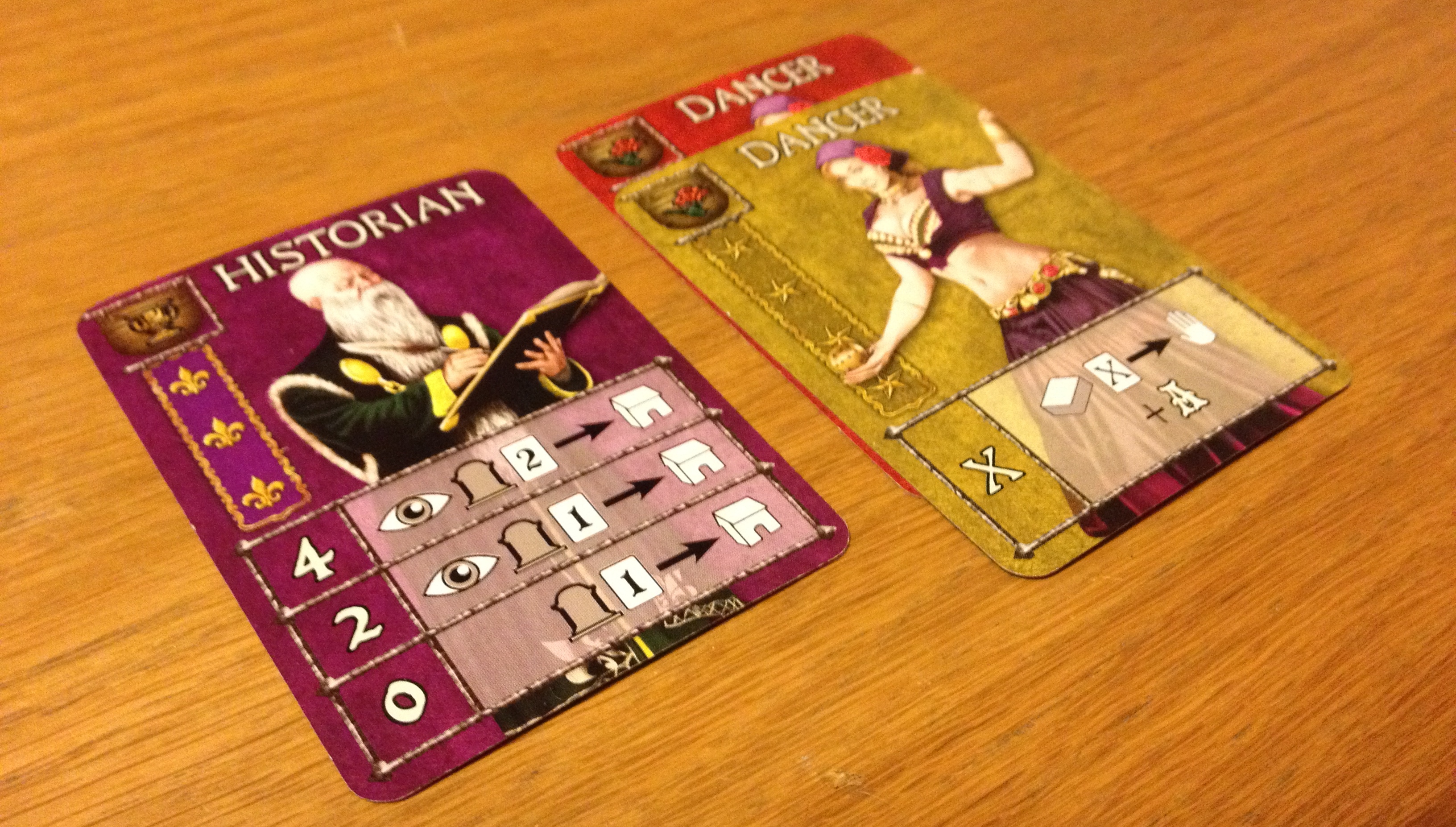
Each of the profession cards in Guildhall has a different effect when you play it to the table, and each becomes more effective — or at least different — when you have more copies of that card in your guildhall already. For example, playing your first Dancer simply allows you to take an extra action; playing a Dancer when you have three Dancers in your guildhall already allows you to draw three extra cards and take an extra action.

IMG_2718

Many of the profession cards allow you to mess with the other players to some degree. The Assassin card, for example, allows you to destroy cards that are in other players' guildhalls, while the Trader forces another player to swap one (or more) of their guildhall's cards with one (or more) of yours. Collecting sets is often a matter of manipulating what other players have available without annoying them too much — piss off an opponent and it's very possible for them to exact amusing revenge on you with some well-chosen cards. If you want a quiet life, the Historian, Farmer and Weaver cards are handy — Historian lets you go through the discard pile, Farmer simply allows you to collect victory points at a slow rate, and Weaver allows you to play extra cards from your hand, perhaps in exchange for picking something up from your guildhall.

Take care with one rule when playing: cards played from your hand to the table do not go into your guildhall until the end of your turn — until that time, they are considered to be in the "action area" and as such chapters are not completed until your turn has ended. This means that you can't play a card to finish a chapter and then immediately spend that chapter on a victory point card of sufficient value to win the game, for example. (You can, however, use special abilities of cards such as Weaver to complete a chapter before the end of your turn.)

Bits and Pieces

Being a card game, Guildhall's box is largely taken up by, you guessed it, cards. There are two decks — a large one of all the profession cards and a smaller one of victory point cards — differentiated from one another by different backs, and separated into two distinct areas of the box insert, which leaves space for expansions. The only other components are a stack of victory point chips, used when playing the Farmer to acquire small quantities of victory points without buying cards.

IMG_2719

The cards are good quality, of a satisfying thickness and pleasingly glossy. They're standard-sized, too, which means they may be sleeved if you so desire. Artwork on the cards is distinctive, attractive and in keeping with the box art, while the lower half of the card is devoted to iconic descriptions of the various special abilities. It takes a little time to learn what all these mean, but there's a handy guide in the instruction leaflet, plus all the card special abilities are helpfully summarised on a single page, too.

Cards can also be quickly differentiated by the icons in their top-left along with their large, prominent title text, and colour-blind players are catered to with the pennant down the left edge of the card, which displays a different piece of heraldry for each of the five colours.

Is it Fun?

Guildhall's theme is mostly irrelevant to its mechanics, but the "collecting professions" concept helps put what you're doing in the game into context, and the professions themselves mostly have thematically relevant special abilities: Assassins "kill" cards; Historians look back at what's come before (i.e. the discard pile); Traders trade cards. Dancers, Farmers and Weavers have a somewhat more tenuous link to the theme of the game, but at least each of their purposes is clear and distinct from one another — every card feels like it has a use, and there's little in the way of underpowered, "dead weight" cards to clutter up your hand — unless, of course, you just can't get your hands on the right colour.

It's a fun game that maybe takes a play or two to get your head around, but once you do it's an enjoyable, quick and surprisingly cut-throat competitive filler game that's well worth having in your collection — it's just a bit of a shame it doesn't support more than four players.


1446: From the Game Shelf: Dixit

Dixit

Publisher: Libellud
Designer: Jean-Louis Roubira
Released: 2008
Players: 3-6
Recommended ages: 8+
Play Time: 30 minutes

Theme: Abstract
Mechanics: Bluffing, communication, description, educated guessing
Randomness: Moderate to high
Luck factor: Depends on who you play it with!
Strategy: Light
Interaction: High

IMG_2713

Dixit is a card-based party game that revolves around the idea of creatively describing images. (Do not confuse it with the 1983 crossword-building game of the same name, as the two are very different!) The aim of the game is to score points — this can be achieved by, depending on what your role is that turn, describing cards in just enough detail that one or two people around the table successfully guess what you were describing, by successfully identifying what that turn's "storyteller" was describing, or by convincing other people that the card you played was the one the storyteller was describing.

It's a quick, easy to learn game that's high on communication and creativity, making it ideal for social gatherings. There are numerous expansions available too, as well as standalone variants that bump up the maximum player count to 8 rather than the original's 6.

How it Plays

The role of "storyteller" is passed around the table one player at a time. On your turn as the storyteller, you must select one of the cards from your hand and play it face-down onto the table, then describe it in any way you please — a word, a phrase, a little song and dance routine.

Once this is done, all of the other players select a card from their hand that they believe would also fit the storyteller's description and play them face-down. The storyteller then shuffles the played cards and reveals them to the table.

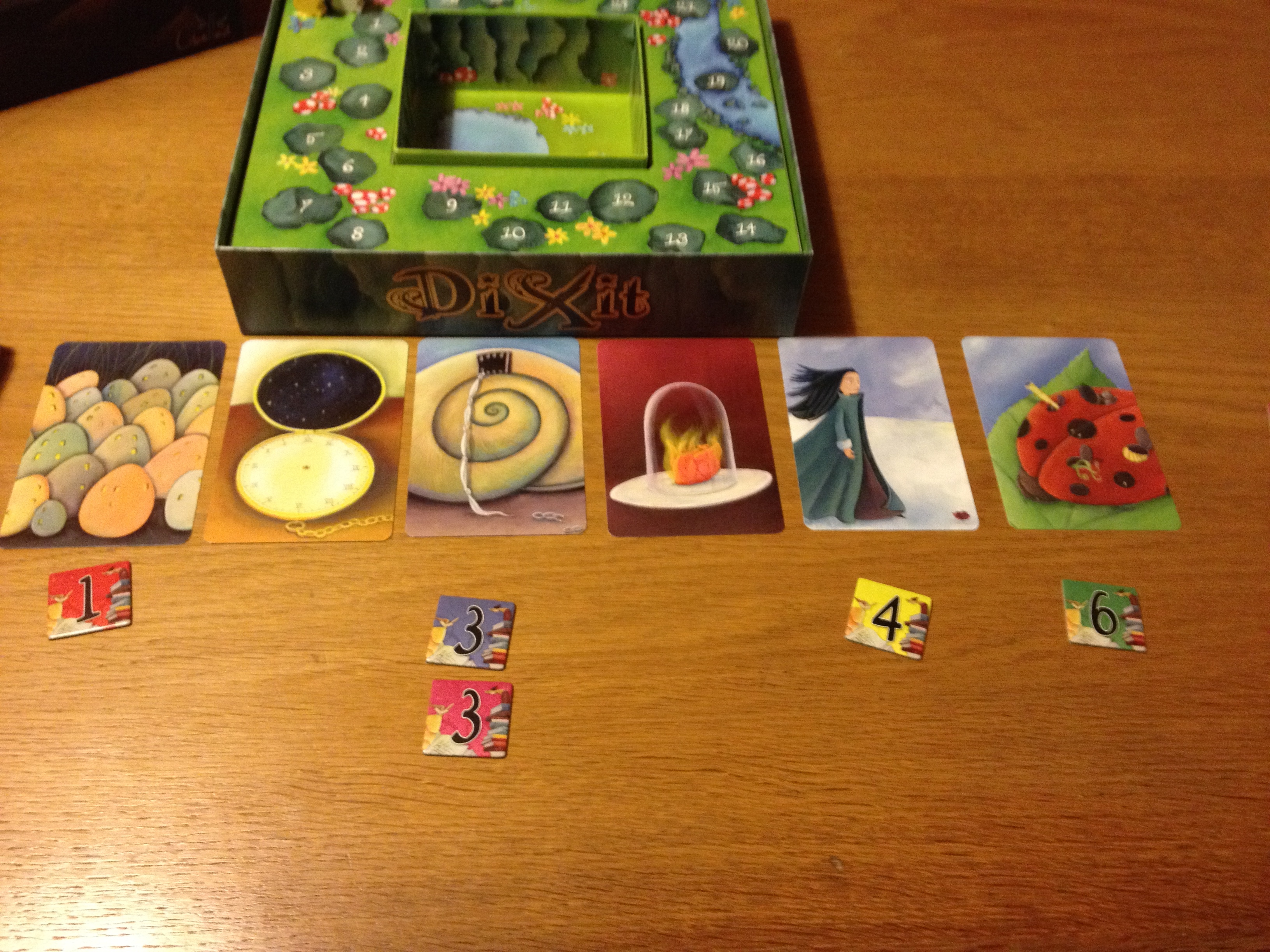
At this point, players secretly vote which one they think was the storyteller's card using cardboard chips with numbers on them. The storyteller does not vote. All votes are revealed simultaneously, and the storyteller then reveals which card was theirs.

IMG_2715

If all players correctly voted for the storyteller's card or if no-one correctly identified it, all players except the storyteller receive two points. In all other cases, the storyteller and any players who successfully identified their card receive three points. Bonus points are awarded for each vote a player received for the card they played when they were not the storyteller. In other words, it's in the storyteller's interest to be slightly obtuse about their clues, but not so obtuse no-one will recognise what they're talking about. Savvy storytellers will make use of references and descriptions they know only certain players around the table will catch.

Players then draw up to a hand of 6 cards, and the role of storyteller passes around the table. Play continues until the deck of cards is exhausted, and the player with the most points at the end is the winner.

Bits and Pieces

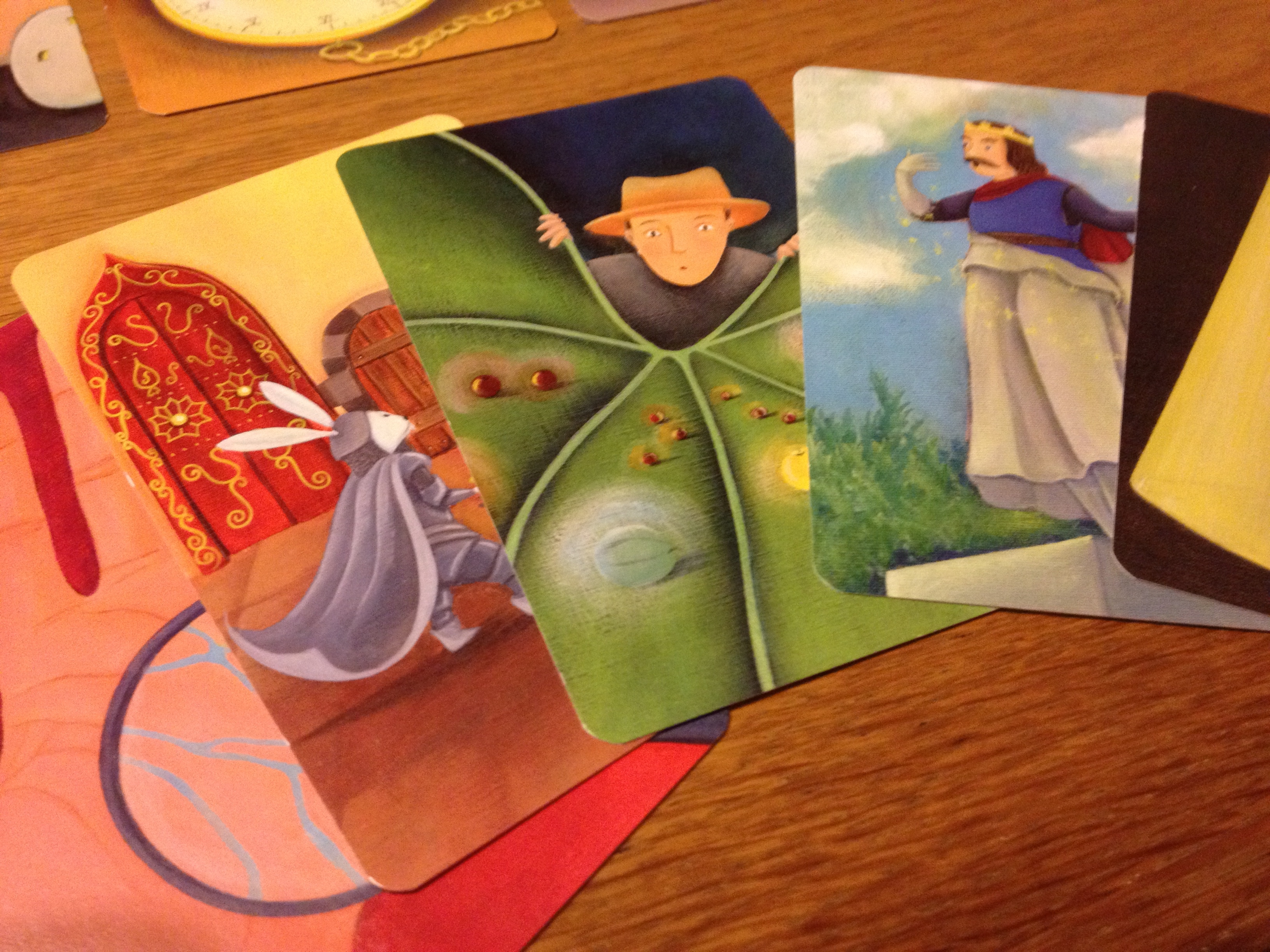
The highlight of Dixit is its 84 oversized cards, each of which depicts a different image. The images — the work of one Marie Cardouat — are all somewhat surreal in nature and deliberately difficult to describe in simple terms, but they have a consistent art style that is pleasingly distinctive and instantly recognisable.

IMG_2714

Scoring is tracked using wooden rabbit markers that proceed around a track printed on the box insert which may be removed if desired. The markers are well-made but their shape makes them somewhat prone to falling over or being knocked around if the table or box is bumped inadvertently, and with the close positioning of the numbers on the board, this can sometimes lead to inaccurately tracked scores. The score tracker also only goes up to 30, and it's possible for games — particularly those with fewer players — to exceed this total, necessitating further "laps" around the board.

Voting is accomplished through coloured cardboard tokens with numbers on one side and the Dixit logo on the back. They're functional but in keeping with the game's playful art style, and the bright, vibrant colours make each player's tokens immediately distinguishable from one another.

Is it Fun?

Dixit's a game you need to play with the right people, and it's also a game that changes over time the more times you play it with the same people. Ideally, you want to play with a group of people who all know each other well so that psychological tricks such as obscure references and in-jokes can come into play. Those who are not very creative or imaginative — or those who find it difficult to grasp more abstract games — probably won't have as good a time playing Dixit.

The more times you play, the more you'll come to recognise various cards as they come up, and how people generally tend to describe them. This forces you to either come up with more creative ways of describing the images — or, of course, to invest in one of the various expansion decks available.

IMG_2716

The game makes for some memorable occasions, however, particularly if someone comes up with a particularly creative (or offensive!) description for one of the cards. It's fun trying to read the other players around the table, and determining how best to bluff your way to victory. It may initially seem like a simple, straightforward party game and indeed there's nothing stopping you treating it as such. But it's also possible to turn the game into a gruelling battle of wits against your rivals as you attempt to take advantage of what you know about all of them.

So yes, it's very much a fun game — and a pleasantly short, light affair that's good for either opening or capping off an evening's gaming. If you have a group of players who would respond well to its creative challenges, it's well worth your time.

1444: 2014 Arrives

…and it was with a bit of whimper, to be honest.

This isn't any reflection on our gracious hosts Tim and Sophie, of course, who not only laid on a sausage-tasting session (no, that's not a euphemism) for us, but also cooked an immense amount of beef and other goodies, but to the fact that we all, as a group, found the moment of that single digit changing on everyone's calendars to be somewhat underwhelming.

Is it cynicism? Jadedness? World-weariness? I don't know, really. Perhaps it's the fact that staying up until midnight isn't really a novelty as a "grown-up", or the realisation we've all had at some point of the fact that a new year doesn't magically mean a new beginning, a fresh start or anything like that.

I mean, sure, the first of January is as good a time as any to say "right, I'm going to get [x] sorted out" but I'd be interested to know just how many people do successfully manage to get [x] sorted out and who are quite happy to maintain the status quo, continuing to allow [x] to do its thing as it's always done.

I don't have many things I'd like to do massively differently this year. I'd like to pick up on the exercise again, even though every time I engage in it I feel like it's an increasingly futile gesture. I'd like to start drawing a few stupid little cartoons on this blog again — not today, though, as it was a busy day; tomorrow perhaps. I'd like to pick up work on my game again. And I'd like to continue learning Japanese.

These are all relatively simple, small and attainable goals. I'm not going to make any grand gestures or promises that are impossible to keep — no "I will be thin in 2014!" bullshit, for example — but I would like my life to continue in a reasonably positive direction, even if my own messed-up brain occasionally gives me days of distressingly dark thoughts.

There's plenty of possible good things to look forward to in 2014, at least, but I shall spare you enthusing about things that may or may not happen for now because… well, they may or may not happen. But we shall see. I'd like to be positive. I'd like for it to be a good year. But I'd settle for it simply to not be a bad one.

Happy new year, everyone; may your 2014 be adequate for your needs.

1443: Death to the Chimera

It's another Final Fantasy XIV post, I'm afraid, but I feel compelled to share the experience I just had, as I think it's something that's going to stick with me for some time.

A bit of context, first, for those who don't play. My character is primarily a Black Mage, which is part of the group known as "DPS" (damage per second" or damage dealers. I don't have a lot of health, but my spells do hit hard and do a considerable amount of damage. When playing as a member of a party, I rely on the "tank" character to keep the enemies' attention off me, and occasionally the assistance of a healer to keep my health topped up if I do happen to get hit by something. For the most part, my responsibility is to avoid getting hit as much as possible, and to simultaneously ensure that I'm doing as much damage as possible.

I'm at level 50 on my Black Mage, which means I'm no longer gaining experience and have instead been gathering better and better equipment. My average item level is now 71, which is significantly stronger than where you are when you first hit 50 — though the effectiveness of all said equipment is scaled down accordingly if you happen to run a dungeon that's lower than level 50.

Which, as it happens, is exactly what I was doing earlier. I decided to run the dungeon Cutter's Cry, because I was well behind on my "Hunting Log" for the Immortal Flames Grand Company, and wanted to actually polish it off and make some progress. (In the game, your Hunting Log is a checklist of specific monsters to defeat, with rewards on offer for completing items on the list, and larger rewards on offer for completing a complete difficulty rank. The Grand Company is an organisation tied to one of the three main city-states in the game, and is effectively where your character pledges their allegiance to.)

Our run through Cutter's Cry didn't go as smoothly as it could have done. Our tank — the guy who stands at the front and gets hit, as well as the guy who generally leads jaunts through dungeons — wasn't especially skilled, and was having trouble maintaining the attention of monsters that really wanted to chomp on our healer's testicles. I spent a lot of the dungeon casting my Sleep spell to take a bit of the heat off the party and allow us to concentrate on a single monster at a time, and it overall seemed to work pretty well, with a few minor mishaps along the way.

We eventually reached the dungeon's boss monster Chimera, albeit with a different healer to the one we started with, who disconnected. Our first attempt failed miserably in a matter of seconds. The second, however, is where things got interesting and exciting.

It was going reasonably well for a while. We were doing decent damage to the Chimera, and the tank was successfully maintaining the attention of the enemy, allowing the party's Bard and I to pelt it from a distance with arrows and fireballs respectively.

Then something went horribly wrong. The tank didn't quite move far enough to get out of the path of one of the Chimera's special attacks, and hit the deck. The Bard followed shortly afterwards, leaving just me and the party's healer to deal with a by now very pissed off Chimera.

I thought this would almost inevitably be the end, but on a slightly selfish whim I decided to see what I could do. We'd already whittled the beast's health down to an amount that certainly looked doable, so I started alternating running away from it and flinging a few spells at it whenever it stopped to try and do one of its special attacks. The healer cottoned on quickly to what I was doing, and supported my efforts while the tank and Bard lay on the floor — the fight's too hectic to make raising party members practical, particularly if the tank's down.

The Chimera's health bar continued to deplete, and I somehow remained standing, successfully dodging each and every one of his special attacks and only occasionally taking damage from an occasional claw swipe. Meanwhile, I'd continue to electrocute him with my Thunder spells — which causes him to continually take small amounts of damage over a short period of time — and pelt him with fireballs whenever I had enough distance between us to make casting practical and safe-ish.

Finally, his health was into the "holy shit, are we actually going to pull this off?" territory — and conveniently, the party's Limit Break bar was fully charged at this point. (The Limit Break bar builds up gradually through combat, and any one party member can trigger it once it's charged high enough for a powerful special ability according to what class they are — in the case of Black Mage, it summons, as you might expect, a devastatingly destructive spell.)

"Limit Break!" called the party members. I was skeptical as to whether or not it would do enough damage, but I put some distance between the Chimera and I, waited for the perfect moment and then began casting.

The screen exploded in fire and my speakers erupted with the sounds of falling meteorites… and then there was a deafening screech as the beast collapsed to the floor and dissipated into a cloud of aether. The Chimera was down!

"Holy shit," said the fallen Bard afterwards as the healer helped him to his feet. "Good job."

I don't often like to toot my own horn, but in this case? Yeah, I have to agree.