1909: How to Black Mage

Following on from yesterday's post summarising what I've learned about playing Paladin in Final Fantasy XIV, I will now follow up with what I have learned about playing Black Mage, the class I initially started playing the game in. Again, I'm not claiming to be the World's Best Black Mage, but this is what works for me.

Golden Rules

As a DPS class, your job is to maximise your damage output as much as possible — but at the same time, you're no good to anyone dead. Black Mages wear light armour and have significantly lower HP values than melee DPS classes, so try and avoid taking damage as much as possible. If it's avoidable, you should be avoiding it — even if this comes at the expense of a spell you're in the middle of casting.

In other words, if you find yourself in an area-effect marker and you're in the middle of casting a spell, don't hesitate, move, even if this interrupts your cast. The only exception to this is if your cast bar only has about 10% or so remaining, in which case the spell will still go off even if you start moving. Learn encounters and be able to anticipate attacks so you know when it's safe to stand still and let off some spells and when you should be prioritising movement. If you outgear content, you may be able to survive some big hits, but this isn't a good habit to get into. Particularly heavy hits will interrupt your cast anyway, so just get out of the way, okay?

Black Mage Basics

Learn how Astral Fire and Umbral Ice work. Astral Fire increases the damage from your Fire spells but nullifies MP regeneration. Umbral Ice increases your MP regeneration at the expense of damage for your Fire spells. Thunder spells are unaffected by whether you're in Astral Fire or Umbral Ice, so should be cast while you're in Umbral Ice and regenerating for your next barrage of Fire spells.

Blowing a Thing Up

Black Mages have two real modes they'll be in depending on content: single-target, used for bosses and individual enemies, and area-effect, used in dungeons and particularly on big pulls.

When attacking a single target, here's the sequence of spells you should be using:

Fire III -> Fire -> repeat Fire until 770MP or less -> Blizzard III -> Thunder I -> Blizzard I -> repeat

This has (apparently) been calculated as the optimum DPS rotation for most Black Mages, since it allows you to cast pretty much continually. The 770MP threshold is there so that you have enough MP to cast Blizzard III once — which puts you into Umbral Ice status and thus starts your MP regeneration — and get off a cast of Thunder I (which deals damage over time) even if you haven't yet had a "tick" of MP replenishing.

Why not Thunder II or Thunder III? Because they cast considerably slower. Once you hit level 50, Thunder II will be largely irrelevant, and Thunder III should be saved for your "Thundercloud" procs, which allow you to instantly cast a Thunder spell to deal all its damage immediately plus the damage-over-time effect it usually does.

On that note, because Thunder III has a stronger, longer damage-over-time effect than Thunder I, if you hit a Thundercloud proc before Blizzard III in the combo above, replace the Thunder I with another Blizzard I or Scathe, since there's no sense "overwriting" the Thunder III status effect with an inferior effect. The only exception to this should be if there's only a couple of seconds left on the Thunder effect.

When to Hit Firestarter and Thundercloud

If the target currently doesn't have a Thunder effect on it, Thundercloud can be hit immediately to bump up your DPS somewhat — remember to use Thunder III rather than Thunder I. If the target does currently have Thunder on it, it may be worth saving it for the Umbral Ice phase; the immediate cast may allow you to get an extra Blizzard I or Scathe in there at the end for a small DPS increase.

Firestarter should be used immediately if in Astral Fire, and never in Umbral Ice. If you get a Firestarter with your last Fire before your Blizzard III and it's too late to cancel the Blizzard III cast, don't panic; cast Blizzard III -> Thunder -> Blizzard I as normal, by which point your MP should be back at full, then drop in a Transpose. This puts you back at Astral Fire I status, which is a slight damage decrease from Astral Fire III, but still enough to make the free Fire III from Firestarter meaningful. After using Firestarter in this way, continue from Fire.

Blowing Several Things Up

When facing three or more targets, it's probably more efficient to use area-effect spells. Here's a sequence of spells that works well and is apparently, again, optimised for maximum DPS.

Fire III -> Flare -> Transpose -> Fire III -> Fire II -> Fire II -> repeat from Flare

This combo allows you to use Flare considerably more often than the frequently seen Fire III -> Fire II until 250MP -> Flare and thus represents an increase in damage potential.

Target an enemy as close to the centre of the group as possible. If the enemy you're targeting is down to about 20% HP or less, switch to another target with more HP so you don't have your cast interrupted by the enemy being killed before you get your spell off.

Double and Triple Flares

Flare normally costs all your MP and requires at least 250MP to cast in the first place. As such, it usually leaves you with 0MP in Astral Fire III status, which is no good to anyone. As such, Transpose is normally used immediately after Flare to regenerate some MP, and indeed this is how the sequence above is built.

However, there's a couple of little tricks Black Mages can use to get more than one Flare off in quick succession. All you need to do is get at least 250MP back, which can be done using either an X-Ether potion or the skill Convert, which sacrifices some of your HP to give you some MP.

To perform two Flares in a row, do one of the following:

Fire III -> Flare -> X-Ether -> Flare
Fire III -> Flare -> Convert -> Flare

To perform three Flares in a row, simply combine the two:

Fire III -> Flare -> X-Ether -> Flare -> Convert -> Flare

Since Flare has a long cast time, it's worth using Swiftcast on the final Flare in one of these sequences to make it cast instantly.

Note that triple Flare in particular generates an enormous amount of aggro, so either warn your tank that you're going to do it, or make use of the level 34 Bard skill Quelling Strikes — which Black Mages can use as a cross-class ability — to reduce the aggro you're generating before you unleash the beast.

Also note that X-Ethers, Convert and Swiftcast all have cooldowns of varying lengths (Swiftcast is back up quickest, then Convert, then X-Ethers), so don't double or triple Flare carelessly; save it for when you're dealing with a large group or need to deal a massive amount of damage very quickly.

Staying Safe

Black Mages have a few skills that help them stay safe, chief among which are Manawall and Manaward. Manawall will absorb two physical attacks before it's dispelled. Manaward will absorb up to 30% of your maximum HP's worth of damage before it's dispelled. Both have a time limit and a moderate-length cooldown, though, so you can't simply keep them up all the time.

It can sometimes be tough to tell which are physical attacks and which are magic attacks. As a general rule, anything that involves elemental damage — fire, ice, thunder, wind, water — is probably magic, while everything else is physical. Note that the earth damage Titan does seems to be considered to be physical damage rather than magic damage despite it being elemental in nature.

One interesting side-effect of Manawall — and the game's damage system in general — is that if you don't take any damage from something, associated Bad Things won't happen either. This means that Manawall, when used effectively, can be used to avoid status effects and knockbacks. Learn which encounters allow you to do this.

Another interesting ability that Black Mage has is Aetherial Manipulation, which causes you to fly through the air to a target player. This is useful for getting out of the way quickly — or in trials like The Whorleater (Extreme) where you're at risk of falling off the platform, it can be a lifesaver.

Finally, squishy party members and tanks alike will thank you for casting Apocatastasis on them, which reduces elemental damage for a short period. Plus it makes a great noise. Note that once someone has had this cast on them, they can't have it cast on them again for a short period. The ability also has a cooldown period, so only use this when it will actually be of benefit to the party member in question!
1908: How to Paladin

Can't think of much to write this evening, so since I was helping some people out in Final Fantasy XIV earlier, I thought I may as well share the things I helped them out with in a more coherent form. That way, if anyone asks in future, I can simply point them to this post. Wild, huh.

Okay. Over the next couple of days, I'm going to share what I've learned from playing Paladin and Black Mage in Final Fantasy XIV. Paladin is a tank class, while Black Mage is a DPS class. Both are very different and have nothing to do with each other; they are collected together here simply because they're the two classes I have the most experience with.

I'm also not claiming to be the be-all, end-all authority on either of these classes; I'm simply sharing what I know in the hope that it will be of some use to other players like me who enjoy the game, enjoy challenging the higher-end content like Coil but who aren't five-days-a-week, six-hours-a-night hardcore raiders.

All right then. Let's begin with Paladin.

Note: The following information assumes a level 50 character with access to all its abilities at the time of writing, but is mostly applicable to lower-level play, too; you simply don't have as many abilities to use.

Paladin

As a Paladin, your job is to get punched in the face in lieu of the rest of your party. This is what tanks do. Paladins differ from the other tanks — Warriors — in that they have a lower amount of overall HP and damage output, but a greater selection of defensive abilities. Warrior, conversely, relies on a combination of self-healing tied to damage output, much higher damage output overall and significantly higher base HP.

Remember, as a tank your job is to maintain "aggro" (also known as "threat" or "enmity" depending on who you're talking to) rather than dealing a lot of damage. You can check aggro in two ways: the coloured gems in the target list on the left of the screen — ideally you want them to be red, indicating that those targets are targeting you and not others — or the little bars that appear over the job icons in the party list in the top-left corner. Know which abilities generate the most aggro: any damage will generate aggro, but Savage Blade and Rage of Halone are specifically designed to generate more than usual. Flash generates aggro over a circular area around you, as does Circle of Scorn. And Shield Lob generates aggro at range. Provoke does something a little different, which we'll talk about later.

Paladin is arguably the "easier" of the two tank classes to play, so for those trying tanking for the first time — like me, when I started Paladin — it's a good choice. Warrior is more complex, with lots to keep track of at once, so if you're uneasy it's a good idea to save that for later.

Getting Ready

In a four-player dungeon, make sure you are in Shield Oath. This makes you take less damage and also increases the amount of aggro you generate. In an eight-player trial or raid, agree with the other tank who will be "main tank" and who will be "off tank". If you're main, go with Shield Oath. If you're off, go with Sword Oath unless you'll both be picking up separate enemies at the same time, as in the Battle in the Big Keep trial, in which case you should both be on Shield Oath in most situations.

The Pull

As a tank, it's usually your job to kick off an encounter. In a four-player dungeon where you are the only tank, you should do this by running towards the group of enemies and using Shield Lob on what you intend to be your initial main target — some tanks like to mark this target to make it clear to their party which target they should attack first. The reason you should use Shield Lob rather than just running in and using a close-range attack is that it allows you to get an immediate, ranged head-start on aggro generation, because once the DPS and healers get going, you're going to need that head-start, particularly if there's a gear disparity between you and them.

Run right through the group of enemies to the other side, then turn around so you are facing the rest of your party and the enemies are facing away from the party. (This is so any enemies with "cleave" attacks — cone-shaped attacks that hit multiple targets — won't hit other party members.) As you do so, use Flash at least twice, and Circle of Scorn if it's ready to use. This extends your head-start on aggro on your main target and also builds aggro on the surrounding enemies.

You Got 'Em, Now Keep 'Em

What you do next depends on how many enemies you're dealing with.

If you're fighting a single enemy — like a boss, for example — then go with Fast Blade -> Savage Blade -> Rage of Halone repeatedly. This is the simplest possible tanking situation, and you are unlikely to lose aggro like this. If you are, make sure you are using Shield Oath.

If you're fighting a small group of enemies (two or three), go with Fast Blade -> Savage Blade -> Rage of Halone on the main target, drop in a Flash every couple of times around the combo and change targets every couple of times to make sure you generate aggro on the whole group. Healers generate aggro by healing, so making sure you hit each member of the group every so often — with your main focus being on the main target — means that enemies are less likely to peel away and clobber the healer.

If you're fighting a large group of enemies (three or more), as you will probably be doing on a "big pull" or a speedrun of a dungeon, go with Fast Blade -> Riot Blade -> Flash. Although Riot Blade produces less aggro than Savage Blade and Rage of Halone, it has the convenient side-effect of regenerating MP, which you'll be expending with every Flash. By doing this combo, you have effectively bottomless MP with which to keep using Flash and keep the attention of the group. Make sure you move so that Flash hits all the enemies, but try and keep all enemies in front of you and facing away from the party as usual.

Getting 'Em Back and Tank-Swapping

Lost aggro on an enemy? This is where Provoke enters the picture. Provoke is notorious for having the worst tooltip in the whole game, so here is how it works: when you use Provoke, your aggro level on the target is set to the value of the person who currently has the highest amount of aggro, plus one. "One aggro" is not very much, so if you don't follow up Provoke with something, you'll lose the target again and have pretty much wasted the ability.

As such, good Provoke practice is to use Fast Blade -> Savage Blade, then Provoke, then Rage of Halone to secure your lead on aggro. Alternatively, you can Provoke then Shield Lob if you need to pull in an enemy that has moved away from you. In a pinch, so long as you follow Provoke with something, you'll probably keep the enemy on you.

Tank-swapping is simply deliberately using Provoke as above — including the follow-up hits — to take another tank's target off them. This mostly comes into play during Coil and Extreme Primal fights, when taking too many stacks of a debuff a boss gives you will cause you to die. You can also use this to switch places with a main tank that seems to be struggling to mitigate the incoming damage if you know you'll be able to handle it better.

Cooldowns and You

Paladin's basic combos are easy to learn and less complex than Warrior's, so much of the skill is in knowing when to use your "cooldowns" — the abilities which have a persistent effect for a short period, then take a short while to "cool down" before they can be used again. Here's what they do:

Fight or Flight increases damage and, consequently, aggro. This is good to use at the beginning of a fight and indeed whenever it's up. You're never going to be going toe-to-toe with a good DPS numbers-wise, but this will help.

Rampart decreases the damage you take by 20%. It has a fairly short cooldown so in most dungeons you can simply use it when it's available. In trials, which tend to be more "scripted" fights, you'll want to save it for when you know big hits are coming. The Triple -> Spark attack the boss in The Chrysalis does is a good example, as is Ravensbeak in Turn 9 (though if you're doing Turn 9, you probably don't need a guide like this); you'll still take a chunk of damage, but your healers will thank you.

Sentinel decreases the damage you take by 40%. It has a shorter duration and a longer cooldown than Rampart, so it's an ability to be used a little more carefully. Again, if you know a big hit is coming, Sentinel is a good ability to use. In long fights, use Rampart first, then Sentinel, then in most cases Rampart will have cooled down by the time you need to soak another big hit.

Convalescence increases the amount you are healed by for a short period. If you are getting low on HP and want to help your healers out, popping this will get you fighting fit in no time, so long as you do it quickly enough. It is worth setting up a short macro to announce when you are using this so that the healers know you need healing in case their attention has been on other party members. That macro looks something like this:

/p Using Convalescence! <se.1>
/ac "Convalescence" <me>

Awareness means you won't take critical hits for a short period. This is most useful during large pulls where you are taking lots of hits in quick succession — an unlucky run of criticals could do significant damage. It's also useful to pop before a big hit if you have time; an already damaging move critting could knock you to the floor if you're not prepared.

Bulwark increases your likelihood to block with your shield, which reduces damage. Again, it's particularly useful to use when lots of hits are coming in at once, but it's also good to use if both Rampart and Sentinel are on cooldown. Unlike those two abilities, it's not a guaranteed damage reduction as there's a degree of randomness as to whether or not you'll block each hit, but it's better than nothing.

Tempered Will doesn't reduce damage at all, but it has two important functions: it cures Bind and Heavy status, and also makes you temporarily immune to any abilities that would normally cause you to move against your will. Titan's Landslide and Leviathan's deck slams are good examples. By popping Tempered Will before these moves go off, you'll be able to continue standing where you are without worrying about being knocked off, but don't get too overconfident with it!

Hallowed Ground makes you temporarily invincible for a very short period. Note that there is a short "animation lock" between triggering the skill and it actually activating, so it's not an immediate "don't lose" button. This is good to use during large pulls if the healer isn't keeping up with the incoming damage, or when you know a big hit is coming and you're not at full HP or your mitigation cooldowns like Rampart and Sentinel aren't available. It also has a very long cooldown, so in most situations you'll get just the one chance to use it effectively. It's also useful to macro this so the healers know they won't have to heal you for a short period; follow the same format as for Convalescence above.

Good Places to Practice

If you're new to tanking, it can be daunting to think about what to try doing — no-one likes to mess up, after all, and if the tank messes up it's pretty obvious. Here are some good fights where you can get some solid practice:

Brayflox's Longstop is a good low-level dungeon to familiarise yourself with tanking effectively. Its final boss Aiatar demands that you both move it out of the pools of poison it spits and keep it facing away from the party. As a low-level dungeon, though, you don't have access to all of your abilities.

Wanderer's Palace is probably the first level 50 dungeon you'll unlock, and it's very easy to outgear it. This is a good place to practice doing larger than normal pulls, though be sure to check with your party if they're okay with this before charging in!

Wanderer's Palace (Hard) has a final boss that is good practice for moving and positioning enemies. Keep it out of the swirly areas on the ground, otherwise he'll be considerably buffed; move him effectively throughout the fight so you don't cover too much of the arena with unsafe areas.

Labyrinth of the Ancients, the first of the 24-player Crystal Tower raids, has far too many tanks, but the first encounters in this dungeon are good for practicing picking up enemies and grouping them together for area-effect classes like Black Mage to kill as a group. The Atomos fight is also good practice if you volunteer to be the one who picks up the additional monsters that appear and bring them to your comrades standing on the pad.

The Chrysalis, a trial towards the end of the main storyline, is good practice at cooldown management. In particular, pay attention to when the boss casts Triple and Spark; that's the time to use Rampart or Sentinel to mitigate the incoming damage.

The Howling Eye (Extreme) is a good fight to learn about how two tanks are used. Not only do you need to keep the two additional enemies Chirada and Suparna away from one another, you'll also need to tank-swap the Spiny Plume enemy to prevent either of you taking too many stacks of the "Thermal Low" debuff and dying.

Thornmarch (Extreme) is another good fight to practice working together with another tank amid absolute chaos going on around you. You'll need to Focus Target your partner, and tank-swap the boss at the appropriate time. At the same time, you'll need to make sure you're positioned somewhere that isn't going to get other people hurt.

The Binding Coil of Bahamut, Turn 1 is pretty straightforward until the last boss. When it splits in half, one of the two tanks will have to Provoke it off the other and drag it elsewhere, positioning it so that neither its frontal cleaves or its tail swipes hit other players. With the enormous "Echo" buff on this content now, there's not much to worry about here.

Good luck! Tomorrow, Black Mage.

1907: Is It Wrong to Try to Pick Up Girls in a Dungeon?

dungeon-girl-newsI have a large backlog of TV, games and anime to plough through, so it's pretty rare that I will come to something the moment it's released, particularly if I have to wait a week between new episodes. The last time I did it was for the first season of the anime Sword Art Online which I don't care what anyone says, I enjoyed a whole lot.
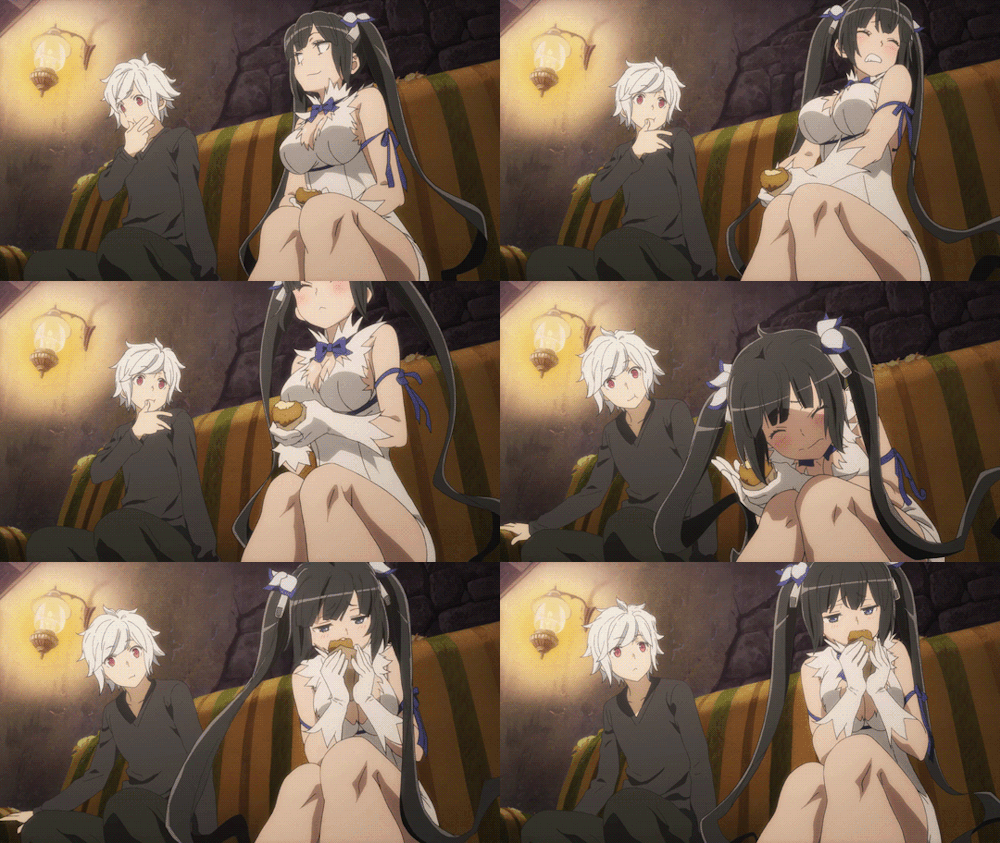

Appropriately enough, it's another anime that's got me doing it again this time: the somewhat cumbersomely titled Is It Wrong to Try to Pick Up Girls in a Dungeon?, also known as Danjon ni Deai o Motomeru no wa Machigatteiru Darō ka or DanMachi for short. (I shall refer to it as DanMachi hereafter for the sake of brevity.)

DanMachi is, like many anime, based on a light novel series, and the first episode of its anime adaptation recently aired. It seems to be picking up a lot of buzz already (some of which is admittedly due to little more than the physical appearance of heroine Hestia) and is looking like it will be one of the "biggies" this season if the early enthusiasm is anything to go by — and judging by the first episode, it looks like being a lot of fun, too.

It's a premise and setting that appeals greatly to me. Set in what appears to be a typical Japanese role-playing game world — complete with various humanoid races including the obligatory catgirls — DanMachi's protagonist is a young man named Bell, a level 1 adventurer and the sole member of the "Hestia Familia". The "Familia" business involves the gods having come down to the mortal realm to give up their powers and live among their people; adventurers pledge allegiance to a particular god or goddess' familia in order to receive special powers to fight monsters and grow stronger through their experiences. Levelling up, in other words.

Young Bell, as previously mentioned, is the sole member of the goddess Hestia's familia. It's not yet clear after one episode why Hestia only has Bell, but she doesn't seem too upset about it; in fact, she seems rather taken with him. Hestia herself is an energetic, impetuous tsundere of a goddess who so far seems to be pretty open about most things but quick to anger, somewhat jealous and rather possessive of Bell.

Hestia is kind of adorable, to be fair; she seems to be the main reason a lot of people have been drawn to the show.

As you might expect, this sets things up nicely for some tension. In the opening moments of the show, Bell is rescued from the fifth level of "the dungeon" — far too difficult for an adventurer of his calibre — by an experienced female warrior named Aiz Wallenstein, whom he is immediately smitten with. His rather hasty obsession with her manifests itself as his first ever "skill", which Hestia immediately does her best to try and conceal the presence of: it allows him to grow in strength considerably more rapidly than other adventurers, so long as his feelings remain strong. Wanting Bell to succeed, Hestia encourages him to do his best, but is somewhat hurt when the huge amount his "stats" jump up by reflect seemingly very strong feelings for Aiz.

Late in the episode, Bell is sitting in a pub enjoying a meal, when Aiz's adventuring party comes in. They don't notice him, but they knew of his initial encounter with Aiz, and one particularly obnoxious member mocks and insults him for being "too weak" for Aiz. While DanMachi isn't explicitly intended to be a reflection of modern online games like Sword Art Online was, it's difficult not to read this as a reference to overconfident elitist players of games like Final Fantasy XIV who see themselves as "superior" to newcomers, even when it's not a fair comparison. I don't doubt that Bell will see this obnoxious scrote of a catboy get his comeuppance before the series is out, and I already know it will be a satisfying moment.

I'm glad I checked out the first episode, then. So far, despite the inane-sounding title (particularly when it's in English, as Crunchyroll has it) it's shaping up to be a really interesting show, and I'm already looking forward to seeing how it develops. Oh, and I want a game of it already.

1906: Tune Out, Jump In

There's something to be said for "unplugging" to various degrees now and again. Some people take this to an extreme and go out into nature without any electronic devices chirruping in their pocket; others might take a more modest approach. But it's a good thing to do now and again, particularly when it comes to the always-on nature of the modern Internet.

I wrote a few days ago about how I'm coming to resent my phone and the compulsions it gives me to pick it up and check it even if nothing interesting is happening on the Internet. Between Reddit and Twitter — I've successfully purged almost all trace of Facebook from my life — I find myself drawn to look at what people have been saying, even if it's been literally minutes since I last did so. There's rarely anything interesting going on, to be perfectly honest, and even on days like today, where there was a temporary brouhaha over one of Polygon's staff members having conveniently acquired the domain name for an upcoming new Lego game the day before it was announced (hmm…) it's questionable as to how much "value" all that sort of thing is actually adding to my life. (Though I guess you could say the same about anything.)

Since my Xbox 360 controller bit the dust last night, meaning I can't play Final Fantasy XIV this evening — I've been playing with controller for far too long to ever be able to switch to keyboard and mouse, even temporarily — I decided to curl up with my Vita and spend some time with a game I've had on the go for quite a while but still not got around to finishing: Senran Kagura Shinovi Versus. I also decided that I was going to sit and play it with headphones on rather than playing through the Vita's admittedly not-all-that-bad-but-still-nothing-compared-to-something-good internal speakers. I also decided that I was going to concentrate on it and not even think about grabbing my phone during loading breaks.

It will doubtless not surprise you to note that the experience was considerably enhanced by the combination of these factors. The use of headphones meant I could enjoy the game's excellent soundtrack and voice acting to the full without disturbing anyone — and also without anyone or anything disturbing me. In turn, this "cutting myself off" from the outside world through headphones made it a lot easier to not give a shit about anything my phone was doing. And by not fiddling with my phone during any sort of downtime like loading breaks or whatever, the whole thing was considerably more immersive.

I've long been a fan of playing games on headphones, ever since I first discovered Wolfenstein 3D and Doom had true stereo sound. It's cool to play on a big speaker system, sure, but sometimes nothing at all compares to being able to completely shut yourself off from everything going on around you and lose yourself in something entertaining and immersive. It doesn't have to be a game, either; it could be a podcast, an audiobook, a favourite album — the important thing is making sure that you're free of external stimuli, and can simply concentrate fully on the thing you're trying to give your attention to.

So now, having broken my concentration to come and extoll the virtues of this practice for you all, I think you all know what I'm going to head back upstairs and do right now.

No, not that, you filthy pervert. (Insert predictable comment about Senran Kagura here.) I'm off to go and see how the Gessen Girls' Academy story of Senran Kagura Shinovi Versus ends. I may be some time!

1906: Waifu Wednesday

There's a sort of tradition among anime and game fans on Twitter — well, game fans who are into the Japanese end of the spectrum, anyway — called Waifu Wednesday, which is often used as a simple excuse to post lots of pictures of anime girls the posters in question find attractive, but sometimes also used as a means of celebrating a favourite character for more than just their physical appearance. Perhaps their story arc resonated with the person who posted it. Perhaps they simply liked them as a person. Perhaps they represented an ideal they wanted to aspire to. Whatever the reasons, Waifu Wednesday is a thing, and, well, why not here too?

Nepgear-mk2For today's Waifu Wednesday, then, I think I want to talk about Nepgear, pictured to the right.

Nepgear, as those of you paying attention to my deviant, disgraceful taste in video games will already know, is the protagonist of Hyperdimension Neptunia mk2 (and its recent remake Hyperdimension Neptunia Re;Birth2) and the sister of series protagonist Neptune. Specifically, she's Neptune's younger sister; in the series' tradition, she is the personification of a specific game platform, in this case the Sega Game Gear to Neptune's… well, Sega Neptune.

Nepgear isn't the only younger sister character to make an appearance in the series. Sony PlayStation personification Noire — who you better believe will be the subject of a future post like this, because she's one of my favourite characters in the series aside from Nepgear here — has a younger sister called Uni, who represents Sony's handhelds the PSP and Vita. Nintendo Wii personification Blanc, meanwhile, has two younger twin sisters called Rom and Ram, who between them represent the two screens of Nintendo's handhelds the DS and 3DS.

The fact that these characters are personifications of well-known brands and platforms is one of the most well-known things about the Hyperdimension Neptunia series, but it's also one of the least important things about them; it makes up little more than their concept and, in some cases, influences aspects of their design or basic personality type.

The reason I like Nepgear so much is because I can see a certain amount of myself in her. Obviously I'm not a young, pretty, skinny girl — I'm pretty much the exact opposite of her in that regard — but I find her personality and the way she goes about her business to be eminently relatable. Why? She's awkward, she's nerdy, she's lacking in self-confidence and often finds herself the butt of jokes: these are all traits I became aware of in myself when I was younger, and which persist to this day.

It's not just about "negative" traits, though. Although often doubting her own abilities, for example, Nepgear is someone who will try her very best and follow through on a plan when she makes it, even if things don't go entirely as envisioned. She tries hard to do the right thing in all situations — though doesn't always succeed — and makes an effort to bring people together and ensure they are getting along with one another. Obviously she then goes on to fight giant robots and evil goddesses and whatnot, which are parts of my life that haven't happened as yet, but, without wanting to sound too arrogant, for the most part she represents some of the aspects of myself that I actually quite like.

Nepgear-full_form-transform_formAside from the relatable aspects, Nepgear is just an altogether pleasingly wholesome character; she's cute, sure, and in her transformed "Purple Sister" form (left) she ups the sexy quotient considerably, but she has never been a character that attempts to take advantage of either her cute or sexy aspects.
Instead, well, I've already used the word wholesome above, but it really is the best way to describe her. She's someone who is very pleasant to spend time in the virtual company of, and she's just plain nice. The kind of person who would always have tea and cake for you if you stopped by; the kind of person who remembers your birthday; the kind of person who does random acts of kindness without any expectation of reward — and who often doesn't receive any kind of reward for her hard work.

In many ways, poor old Nepgear is one of the most "normal" people in the entirety of Hyperdimension Neptunia, and she suffers a bit for it. There's a running gag in the games that followed her starring role in mk2 where she's paranoid about everyone thinking that she's "boring" and, when you compare her to the other characters in the series — particularly the pure, unbridled chaos that her sister Neptune tends to create in her wake — it's perhaps easy to see why she worries.

But even if she goes unappreciated in her own dimension(s), certainly appreciate Nepgear, and thus it's with pleasure that I give her the dubious honour of a Waifu Wednesday post on this little backwater blog.

1905: Gr8 B8 M8

At the time of writing, the biggest hotness in gaming — at least so far as the press is concerned — is From Software's latest game Bloodborne.

Bloodborne is a big release for Sony's PlayStation 4 platform and the latest unofficial installment in the notorious "Souls" series that previously brought us Demon's Souls, Dark Souls and Dark Souls II. (And, if you're a From software purist, the King's Field series, too.)

The Souls series is one that I have tried on a couple of occasions to get into, but never really managed to click with. I played a bit of Demon's Souls when it came out after I heard a friend enthusing about it — I was particularly enamoured with its creative online features — but set it aside quickly after I became frustrated at having to repeat the same 30 minutes of gameplay over and over and over again just for, in some cases, taking a wrong turning and running into an enemy that is, I later learned, intended to act as a signal that You Should Not Be Going This Way. I tried it again recently and got a little further, but didn't really feel much in the way of incentive to go back — it's very light on explicit narrative (although very strong on implied narrative), and I'm someone who pretty much needs an explicit narrative push as an incentive to continue playing something — so I'm probably going to call it a day where I am. I decided to give the series another go when Dark Souls first appeared on PS3 and Xbox 360, but found myself similarly frustrated and not really enjoying myself, and consequently I haven't touched Dark Souls II and have no intention of ever playing Bloodborne.

All this is a little besides the point I want to talk about today, but I just thought I'd slot it in anyway for context. The short version is that while I respect the Souls series for what it's doing, I don't really personally enjoy it. And that's fine; I don't expect everyone to enjoy every game out there, but at least to give things a chance before writing them off. And, for me, the Souls series has had its chance, but I certainly don't begrudge anyone who does enjoy it their enjoyment.

Instead, what I did want to talk about today relates tangentially to the Souls series — and specifically Bloodborne — right now, but is a fairly widespread issue at any given point. And that's the fact that, given the majority of the Internet's continued reliance on ad-based revenue models, if something is the latest hotness, then that thing needs to have the absolute shit covered out of it to ensure people keep coming back day after day to, in theory anyway, devour every little piece of Bloodborne (or whatever the latest greatness is at the time you're reading this if it's far in the future) information that there is out there… even if said information isn't particularly interesting or adds anything meaningful to broader gaming discussion.

The reason I bring this up is today I saw a headline on one site that simply read something along the lines of "You can complete Bloodborne even if you've never beaten a Souls game". Now, that may be true — I can't comment with any authority on whether Bloodborne is more or less accessible than the Souls games — but frankly, I'm not sure I really care, and thus I don't really know who this article is for. The people who like Souls games are probably on board with Bloodborne already, while the people who don't like Souls games — like me — have had three games (plus DLC) to try and learn to love them; in other words, if they're not already on that train, they're probably not taking that trip.

Again, though, the amorphous audience that article is for is besides the point: it's a symptom of the aforementioned issue where whatever is "big" at any given moment has to have hundreds of articles written about it at every opportunity, even if said articles don't really add anything to broader gaming discussion. And the sole reason is to try and attract people to the page and consequently earn some ad revenue. It is, in theory, providing people with the content they "want" to read, but in fact it's more focused on the potential revenue that can be brought in by the eyes on the page.

Clickbait, in other words, though perhaps not in quite such a hyperbolic manner as sites like Buzzfeed and its ilk employ.

For a business, it is, of course, important to try and make money through appropriate means. But in doing this, the online press — and the games press in particular — does a disservice to its audience, because unfortunately when you're writing informative articles or criticism, you can't simply ignore your audience and focus on the bottom line, because otherwise you'll end up without an audience. And it may be the case that the audiences for a lot of sites really are lapping up anything Bloodborne-related with aplomb, however vapid it might be. But I know I'd much rather see two things than the situation we have at the moment, where every major site's front page is practically interchangeable with one another: I'd like to see different sites covering different games at different times, and I'd like to see much broader coverage of the medium as a whole, perhaps with more sites specialising in particular genres, subject matter, types of game or even theoretical/ideological viewpoints.

In order for that to happen, though, we need a fundamental rethink of how we consume content on the Web, and a fundamental rethink of how content creators can make money from that content. Because as wonderful as it is for people to do things "for the love", it would be even more wonderful for people to be able to make a living out of doing the things that they enjoy — and that they're good at. At the moment, people who are writing for sites are mostly slaves to the SEO stats, with occasional exceptions, and that's a real shame.

We are starting to see steps in the right direction, at least. Services such as Patreon, IndieGogo and Kickstarter provide alternative means for people and companies to get some money coming in. Several sites have experimented with subscription models, with varying rates of success. And the audience's growing dissatisfaction with the big names in the business over the course of the last couple of years has encouraged smaller sites to take some bold steps to distinguish themselves and make themselves unique: specialising and declaring that they're going to focus on a particular type of content; listening to what the audience says it wants (and, importantly, doesn't want!) and providing that rather than relying on provocative clickbait or predictable coverage of The Latest Big Releases; exploring alternative revenue streams other than just ads; and giving voices to people — and viewpoints — outside the sometimes rather incestuous-seeming echo chamber that is the inner circle of professional games journalism.

We're certainly a far cry from the golden age of newsstand games magazines, where individual publications had very distinctive voices, styles and ways of covering games. I don't know if we'll ever be able to go back to something along those lines, but I'd much prefer it to what we have today.

1904: 21st Century TV

The Internet has brought with it many things both good and bad, but by far my favourite thing about it is to do with video.

No, I'm not talking about YouTube generally — the whole "anyone with a webcam can make videos!" culture it promotes feeds into modern youth's unhealthy obsession with "being famous" — but rather the fact that, between the various streaming services out there, both legitimate and… less legitimate, there is probably some way of watching all those programmes/adverts/movies you wish you still had 1) the VHS tapes for and 2) something to play them with.

This last week, for example, Andie and I have watched Police Squad!, the TV-based precursor to the Naked Gun movies. Only six episodes were made, and back at university, when I "discovered" the show for the first time, I had a VHS cassette with two of them on it, so I had only ever seen those two episodes. Now, however, some helpful Polish person has kindly uploaded the whole lot onto YouTube for anyone to enjoy at their leisure. No waiting for TV networks to license them and show them again. No tracking down video tapes and VCRs. Just click and go.

The ability to rediscover old favourites is one of the best things about streaming video, then, as my rewatch of Star Trek: The Next Generation for the first time in about ten years will attest. But the fact that streaming services makes new favourites easier than ever to discover, too, is rather wonderful. I doubt I'd have become so interested in anime without my Crunchyroll subscription, for example; prior to widespread streaming video, the only real way to get into anime was to buy VHS tapes or DVDs, and with anime being niche-interest and somewhat "exotic", particularly when it first hit these shores in the mid-90s, it was a rather expensive hobby. Anime DVDs and Blu-Rays still cost up to twice as much as a regular ol' Western film even today, making online services like Crunchyroll much better value.

This is the TV of the 21st century, then; it really is the vision of the future we had twenty, thirty years ago: decide what you want to watch, then just watch it. In most cases, that's possible to do, even if you have strange, bizarre and peculiar tastes. And even if you're more fucked up than most, I can almost guarantee that there's some dark corner of the Internet out there somewhere more than willing to cater to your particular interests, whatever they might be… for better or worse.

In these days of people seemingly constantly yelling at one another on social media and comments sections on large sites being widely (and, sometimes, justifiably) regarded as fetid cesspits, it's easy to forget the great and wonderful things that the Internet has brought to modern life. I'm a strong believer that its ability to "archive" — for future generations to be able to enjoy movies, TV shows, animations and other videos from years ago — is one of the best things about it. And as technology improves and we find more and more ways to interact with this world-wide network, I hope we never lose sight of these simple pleasures that it's allowed us to enjoy like never before.

1903: Easter Sunday

It's Easter today. This is one of those days that declines in importance as you get further away from childhood, until you reach the point I'm apparently at today, where you just ignore it completely.

That's kind of a shame, really, as it was fun to have specific days to look forward to for whatever reason — birthdays and Christmas for presents, Easter for chocolate — but I can't help but feel that most of these occasions are made a big fuss of primarily for the benefit of children.

This isn't a bad thing, of course; in many ways, modern children are being forced to "grow up" much too quickly, and thus allowing them days of unmitigated excitement about imaginary figures and the prospect of presents coming down from on high is an important part of allowing them to cling on to their childhood for as long as possible. There's a difficult balance to strike as well, of course: ensuring that said children don't end up spoiled and turning into those ungrateful (and probably fictional) brats that Buzzfeed et al dig up every so often, who whine on social media about getting the wrong colour iPhone or a car with a sunroof when they wanted a convertible or whatever.

Perhaps it's just cynicism on my part that prevents me from enjoying these occasions as much as I did when I was younger. Perhaps it's my depression contributing to matters, making me either unwilling or unable to just switch off and enjoy myself without worrying about the things that worry me every other day of the week. Or perhaps it really is the case that I'm too old to care about these things a great deal any more, and would rather just take aim at the big picture, the seemingly unattainable aim of having a quiet, peaceful life with no worries.

One thing I will say about ignoring Easter today, though, is that I haven't really missed chocolate. In fact, I haven't really had much chocolate since joining the Slimming World programme a while back. The "syns" system allows the flexibility to have a chocolate bar now and then, and there's some tasty Slimming World-branded chocolate chewy bars that are rather nice, so I haven't had to go entirely without sweet things. But as fun as it was to have a sideboard covered with various shiny eggs come Easter morning — and then to spend the next few weeks getting through them a bit at a time, feeling slightly guilty at ruining its pretty presentation every time I cracked another one open — I can't say I've particularly missed it today. And my waistline will probably thank me for not having temptation lying around the house!

So, then, balls to Easter, I guess, and balls to the bank holiday tomorrow; it's hard to enjoy and appreciate it when you're not really getting time off from anything — but if you're currently enjoying a four-day weekend away from work and the pressures of "real life", I hope you continue to do so tomorrow, and that you, at least, enjoyed stuffing your face with chocolate this Easter Sunday.

1902: Further Adventures in Gamarket

As I continue to make progress through Hyperdevotion Noire, it becomes more and more apparent that the team behind the Neptunia series as a whole simply loves gaming. And there are few places where this is more apparent than in Tsunako's wonderful character designs and the series' trademark sharp writing that brings them to life.

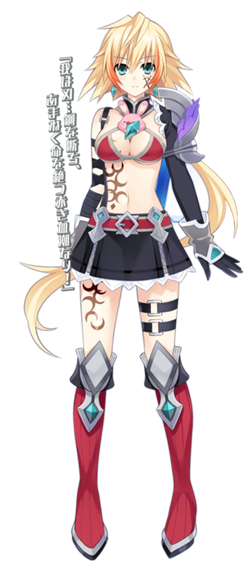
einalTake Ein Al on the right here. As you can probably infer from both her name and design, she is intended to be the personification of the Final Fantasy series.

Her hairstyle and green eyes are intended to call to mind past (and arguably most famous) Final Fantasy protagonist Cloud Strife from Final Fantasy VII, while her asymmetrical costume is reminiscent of the clothes worn by the cast of Final Fantasy X, particularly that of protagonist Tidus (for the asymmetry) and central cast member Lulu (for the use of belts and buckles in places you perhaps wouldn't normally find them).

There's a recurring crystal motif on her jewellery and the accents on her clothes — anyone who has been playing Final Fantasy for some years will be familiar with the crystal imagery used in most installments — and the single "wing" on her left shoulder is presumably a reference to the series' most famous final boss anthem, Final Fantasy VII's wonderful One Winged Angel. Meanwhile, the rabbit-like creature on her chest is clearly an homage to the series' recurring "Moogle" creatures, who often provide some much-needed levity to the games' typically serious storylines.

But Ein Al's homage to her source material doesn't stop with her appearance; as previously noted, it extends to how she is written, too. Introduced to the player as she's partway through a rather childish battle of one-upmanship with the character Estelle, who personifies the similarly long-running game series Dragon Quest, we quickly discover that Ein Al has a flair for the overdramatic — some might call it melodramatic — and often finds herself called out for being incomprehensible due to her insistence on staying "in character" at all costs. It's not a coincidence that both of these things are criticisms that are regularly levelled at the Final Fantasy series as a whole, and of course her intense rivalry with Estelle mirrors the longstanding feud between diehard fans of both Dragon Quest and Final Fantasy, with each believing that their series of choice is somehow "best".

lidHyperdevotion Noire is packed with characters like Ein Al who beautifully encapsulate their source material while being their own entertaining figures in their own right. Lid, pictured to the left, is another great example. She personifies the stealth-centric Metal Gear series with obvious visual elements such as her cybernetic eye, bandana and use of the exclamation mark motif — a recurring visual element in the Metal Gear series, much like Final Fantasy's use of crystals — on her breast tattoo, but also reinforces this with more subtle character traits like her habit of mispronouncing words when she is stressed or nervous — perhaps a reference to Metal Gear Solid 2's notorious "Fission Mailed" section which is deliberately designed to confuse, upset and stress out the player.

Lid's homage to her source material carries across into her game mechanics, too. She's a character who excels at being away from the front line, instead preferring to attack from afar using throwing knives and stun grenades — and, like her counterpart Solid Snake from the Metal Gear Solid series, she makes creative use of cardboard boxes to conceal herself and incapacitate the enemy with surprise attacks. In the mission where you first encounter her before you recruit her, you have to play appropriately stealthily to even get near her; careless movement will put you in the line of fire of devastating cannons, much as not having full awareness of your surroundings in Metal Gear Solid tends to lead to a quick and painful death even at the hands of the game's most "grunt-like" enemies.

Hyperdevotion Noire is a little different from the mainline Neptunia series in that there's a little less focus on the central goddesses — who each personify the major console platforms rather than individual game series or companies — and more focus on a large cast of these incidental characters. Each of the game's chapters focuses on a few of them and explores them in enough detail for those who are familiar with the source material to give a knowing smile while simultaneously making them appealing characters to those who are just enjoying them at face value. After that, they're into your party, and the game moves onwards at a pleasingly brisk pace without getting too hung up on any particular characters. It's a rather "episodic" approach, and it works rather well; those who make use of favourite characters and build up their relationship values in combat are rewarded with short bonus scenes, too, so it's not just a case of the characters joining the party and then being completely forgotten about.

This right here is the main reason I love the Neptunia series. It's easy to dismiss it as silly, boobylicious fanservice, but like so much else tossed aside like that by mainstream critics, there's a hell of a lot more going on there than you might think. And I will continue to enjoy it for as long as they keep making them.

1901: Good Friday? All Right, I Guess

Today is technically a "holiday", though when you don't have a regular job normal days and holidays tend to all blend together somewhat. Still, at least it being a holiday means that I can technically not work and not feel guilty about it, so there's that.

It's been one of those days that has just sort of passed by without any particular incident or noteworthiness, and as such there's not a whole lot for me to talk about today, really. Andie and I both got up late — we were both really tired, so a lie-in until midday was thoroughly needed — and then we've both spent most of the day playing Final Fantasy XIV. I'm almost at level 48 on Bard, which will be my fifth battle class levelled to 50 when it's done — I should hopefully get that finished tomorrow. After that, I have Arcanist and Pugilist to get out of the mid-teens, and Lancer and Rogue to level from scratch. And then all the bloody crafters, though to be honest those aren't very difficult to level, just a bit time-consuming.

I've also been playing some more Hyperdevotion Noire over the last few days, and I'm thoroughly smitten with it. I was initially a little put off by the chibi characters — I prefer more coventionally proportioned characters for the most part — but they actually work well in the battle scenes, making it clear who is where, which way they are facing and so on. Outside of battle, you still get the full-size portraits in story sequences — plus the beautifully drawn event scenes, too — so I'm happy with that. (Also, Chibi Female Solid Snake is adorable. As is the personification of Dragon Quest. As indeed are most of the characters.)

Nothing special planned for tomorrow, it's looking like a lazy Easter weekend. Andie and her mother are going out to town tomorrow, but I will probably stay in. With money a bit tight at the moment, it's probably best I stay away from places that sell things I might want to buy. Like, say, PlayStation 4s. That ain't going to happen until I have some more money coming in, but I'm working on that.

And after that, Sunday is raid night, of course. We will probably be taking our first serious look at the Final Coil of Bahamut, though one of our number still wants to get their own clear of Turn 9, since his unlocking of Final Coil was actually achieved by someone else playing his character. I'm all for that; Turn 9 is a fun, if intense, fight, and the last time we tackled it we cleared it within 3 attempts, making the weeks of practice look somewhat trivial!

Anyway. I've spun this post out for long enough without really saying anything, so it's time to head to bed and maybe play with my beloved Noire a bit. Here's to boring but peaceful days.