1960: Preview a Game Like Polygon

FIFA 16 is a game about football, and you probably want that

FIFA 16 should be celebrated for its inclusion of women players -- better late than never.
FIFA 16 should be celebrated for its inclusion of women players — better late than never.

There's a joyful cheer from the crowd; a roar of approval and a vibrant expression of intense approval. But I can't join in; I know it's not real.

It's literally not real. It's a virtual crowd in a virtual stadium, applauding, cheering and yelling in delight at a goal that didn't happen. But that doesn't stop some of the other real people who are nearby joining in with their own whoops, hollers, shouts and cries.

I'm at Wembley Stadium in London, spiritual home of football — at least in the United Kingdom. Some of my companions clearly feel that coming here is like having the opportunity to visit the Holy Land, particularly as we're in one of the mysterious event rooms that the public don't usually get to see. Even those who aren't looking at the screen seem excited; they're pointing at pictures on the walls, and at the view through the window out onto the pitch.

I envy them a little as I stand back, sipping my fizzy water and munching on a canape, wishing desperately that there was someone else here who wanted to have an open and frank discussion about the situation in Syria. But there isn't. I'm alone; so very alone, even though this room is full of people. I'd find it distressing if I weren't so used to it, but this is my life thanks to the choices I've made: doomed to forever operate on the fringe of events like this, unable to participate or even put up a convincing facade of excitement at the abject tedium I so despise unfolding on the screen in front of me.
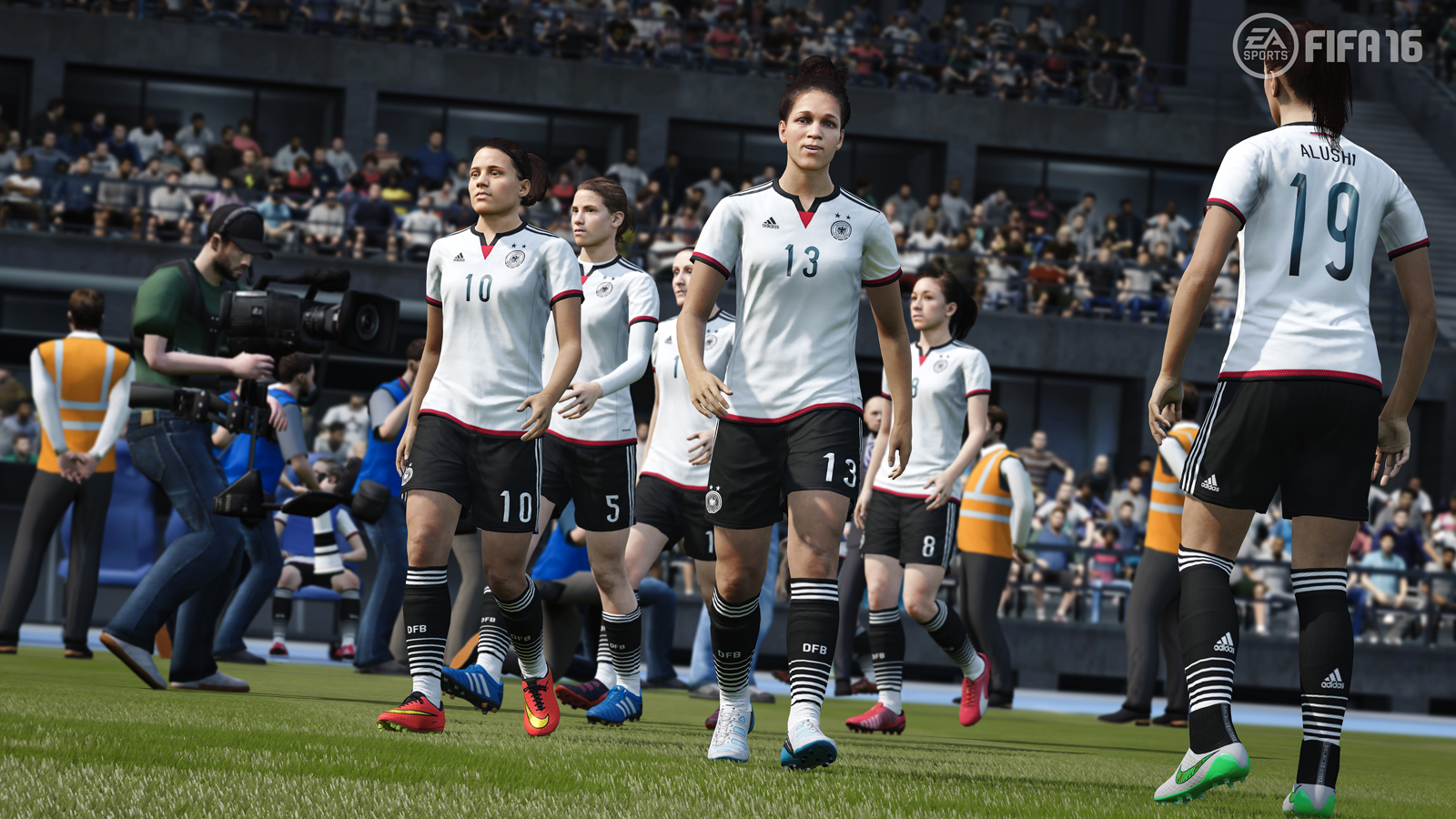
The game at times lacks racial diversity, but the presence of women after so many years makes up for this to a certain degree.

The virtual crowd cheers again, and there's a roar of approval from my assembled colleagues; apparently whoever it is that has the controller right now has scored an impressive goal against the carefully selected PR person: I'm guessing they play well enough to show the game at its best, while simultaneously being able to let my peers win and give them a sense of satisfaction and send them away with a positive impression of this dreadful, interminable, never-changing series of awful games.

But do any games truly change? After all, we're still shooting people of colour in obviously Middle Eastern allegories. We're still relentlessly collecting objects in what is clearly a potent metaphor for capitalism that shoots straight over the head of most people. We're still upholding traditional gender roles and tacitly encouraging the approval of the patriarchal status quo — a status quo that objectifies and exploits women — over more progressive attitudes. And we're still playing the same old sports; outlets for attitudes of toxic masculinity that are only distinguishable from the never-ending stream of games allowing testosterone-fuelled men to indulge their wildest, most perverse of rape culture fantasies by the fact that they are slightly less violent than Call of Duty and Destiny.

There are women in FIFA 16, which I suppose is worthy of some praise, and football games by their very nature include a healthy number of people of colour. But the outcry from the vast majority of the Internet over the inclusion of women's teams in this installment indicates that the world of sports games is still very much a man's world — but only if you're the right kind of man, of course. I'm not the right kind of man, it seems; I'm happy to see women included in the game as a step forward for progressiveness rather than, as some particularly obnoxious Facebook comments had it, the chance to "combine boobs and football".
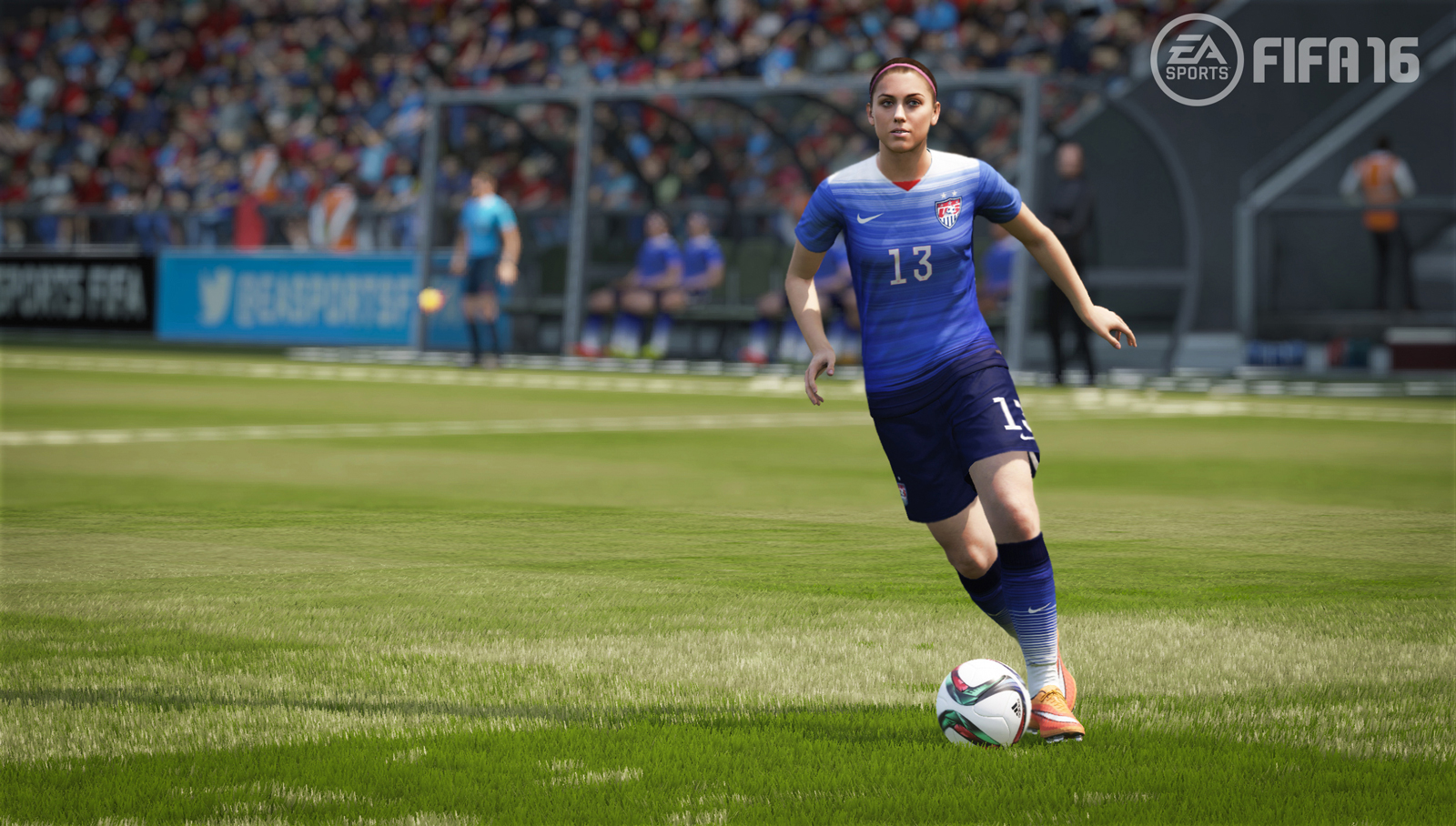
A woman playing football.

I finish my fizzy water and head for the table to pour another. I feel a touch on my shoulder and turn around to see who is trying to attract my attention. It's the PR person who was playing the game a moment ago — I think her name was Ashleigh — and she's giving me a gentle smile.

"You don't look like you're having a good time," she says.

"No," I say. "I'm not."

I want to elaborate, to tell her that attending this event is a living hell for me, that there is literally anything I would rather be doing than taking a look at a game I have no interest in that represents a sport that I despise with absolute passion owing to its use for continuing the dominance of the prevalent toxic patriarchal attitudes in society. But I don't. After my admission, I simply take another sip of water.

"You should give the game a try," she says, still smiling — though I have a feeling that it's changed from a genuinely warm smile to a false one. She proffers a DualShock 4 controller; I contemplate it for a moment, its wonderful ergonomic curves bringing to mind the body shape of a beautiful woman who cares not for whether she's "beach body ready", but then I shake such borderline misogynistic thoughts from my mind lest Ashleigh can see the beast of suppressed lust in my eyes and dismisses me as yet another perpetuator of rape culture rather than the progressive feminist that I actually am. "You might enjoy it."

"I don't think I will," I say, giving her a smile of my own. Then I put down my unfinished glass of fizzy water, head for the door and don't look back.

It's raining outside. The black clouds overhead mirror the darkness in my soul. There's a flash of light and a clap of thunder, and I realise, as if given a message from a non-specific divine entity, that I am wasting my life.


(Disclosure: This article is a parody of this monstrosity that hit the Interwebs yesterday to much well-deserved derision.)


1959: High School DxD is Exactly What I Want From an Anime

For a while now I've been seeing numerous images from the anime High School DxD that were, shall we say, somewhat on the titillating side. I follow a lot of anime and Japanese gaming fans on Twitter; a number of them are fans of this show and rather fond of posting pictures of it. And with good reason: it's a very "photogenic" show. Particularly if you like pretty ladies.

0ejc

Despite the numerous sexy pictures that had been shared, though, one thing was clear: the people who enjoy this show regard it with genuine affection and enthusiasm rather than treating it as the softcore pornography that so many people outside of the various otaku fanbases tend to write Japanese popular media off as. And so I was curious, for several reasons: first of all, who was the intoxicating redhead who seemed to dominate so many of the pictures; and secondly, what exactly was this show all about?

I'd been meaning to check the show out for some time but it's only in the last couple of days that I've finally started investigating it. And, what do you know? Within just three episodes, it's already abundantly clear to me that this is exactly what I want from an anime — and I already understand why those people who are fans of the show are quite so passionately invested in it.

junhyung-highschool-dxd-koneko-chan-136161

The basic setup runs thus: Issei is a particularly obnoxious horny teenage protagonist who is obsessed with breasts, but, as is usually the case with this sort of character, finds himself unable to convince any self-respecting young ladies to show theirs to him. Everything changes for him when he meets a girl on the way home from school, though; she claims to have been watching him, and desperately wants to be together with him. The two begin dating and all appears to be going well for a while — Issei even manages to rein in his baser urges for long enough to appear almost respectable.

Then the shit well and truly hits the fan for our Issei. After a thoroughly enjoyable date, his new girlfriend kills him by stabbing him through the chest with a spear of light, and leaves him to die in the park. It transpires that she was a fallen angel, and that Issei has a mysterious power within him called "Sacred Gear" that the fallen angels very much wanted to dispose of — and for a moment it looks as if they were successful.

Given that all this happens in the first episode, though, that would make for a very short series, and as such it will probably not surprise you to hear that Issei is rescued from his plight by red-haired beauty Rias Gremory, a young woman held in high esteem by everyone at the school they both attend, and president of the school's Occult Research Club.

3338059-5929868530-ibuoVThe Occult Research Club is a not-terribly-subtle front for the fact that Rias and the other members are actually devils, and in allowing Issei "rebirth" from his murder they turn him into one, too — specifically, a servant devil of Rias. From there, Issei gets drawn into a situation that is clearly well beyond his understanding — at least in the early stages of the series — as a three-way holy war unfolds between the forces of Heaven, the devils of Hell and the fallen angels attempting to usurp the devils from Hell to claim it as their own.

What's interesting about High School DxD is that it presents the devils — typically depicted as evil, monstrous creatures prone to the most dreadful acts of depravity in anime — as the most sympathetic, relatable of the characters. Rias and her companions are for the most part very "human" in terms of their attitude towards their situation and towards Issei, with a few exceptions; Issei, for example, is extremely surprised to wake up from his initial ordeal with a naked Rias in his bed next to him, with her seemingly completely unperturbed by the fact that they are both nude. Rias is absolutely in control of herself and clearly takes pride in her appearance — and this sort of overt sexuality is not at all uncommon in numerous mythological depictions of devils. Rias isn't a succubus or anything — I don't think, anyway; I may stand corrected after a few more episodes! — but it's clear that, for her, she has transcended such petty human concerns as being embarrassed about being in the nude, or being seen by someone with whom she doesn't have an "intimate" relationship.

By contrast, the fallen angels and the representatives of Heaven have so far been thoroughly horrible pieces of work, with an exorcist priest in the third episode even going so far as to sadistically murder someone who had attempted to make a pact with one of Rias' household of devils and then threaten to rape his own assistant, herself also a member of the clergy, all because she had met Issei earlier in the episode and believed him to be a "good person" despite being a devil.

Asia_ArgentoThere seems to be a pretty strong anti-religion sentiment underpinning the series — or, to be more specific, an anti-fundamentalist sentiment. The fallen angels and the forces of Heaven — with the exception of Asia, the aforementioned exorcist's assistant — have so far been pretty much psychopathic in how devoutly they follow the tenets of their faith, while the devils themselves are more philosophical and deliberate in the way they go about handling things.

There's a strong amount of chess imagery used throughout the series, too, with it being explicitly lampshaded and spelled out for the viewer in the third episode. Rias is the "king" of her little group of devils, and her companions fulfil the roles of the knight, queen and rook. (Even odds that Asia shows up again later to fulfil the "bishop" role.) Issei is dismayed but unsurprised to discover that even with his mysterious Sacred Gear power, he is no more than a lowly pawn who has yet to prove himself — but even with his low status, it's clear that Rias wants to protect him and help him grow stronger. Whether this is due to her own self-interest — his Sacred Gear would clearly be a potent weapon in the holy war — or whether she actually cares for him remains to be seen, but it's certainly an interesting setup.

Rias_Gremory_7

And my God — no pun intended — is it ever a beautiful-looking anime. Gorgeous women doing sexy things aside — and there's plenty of that — the animation and design is spectacular, with some gobsmacking battle scenes in just the first few episodes. The more monstrous foes Rias and the gang face are truly hideous to behold, but even in its more mundane moments the show simply oozes style.

Wonderful use of colour helps give cues to the viewer as to what is going on, with each of the main factions involved in the holy war seemingly having their own colours associated with them. Most things the devils get up to seem to be bathed in red light, for example, while the fallen angels tend to bring an ominous, sinister, high-contrast purple light with deep shadows in their wake.

This beautiful visual design is perfectly complemented by a Gothic-cum-rock soundtrack — it may be a cliche by now for this sort of "good versus evil" affair (particularly if you're a Castlevania fan) but it really works wonderfully, giving the show a fantastic sense of energy and a feeling that it's had some real love, care and attention poured into it.

Yes, it's dripping in fanservice and I'm disappointed to admit that I know all too many people out there who will write this show off purely on these grounds regardless of whether or not it's actually any good. But there's a strong argument for the heavily overt sexuality of the show to very much be part of its overall aesthetic, with it being used both to reflect Issei's forever sexually frustrated teenage desires — which are still very much intact even after becoming a devil — and the common depiction of devils as something erotic, exciting, tantalising and well and truly off-limits to the "normal" people.

_  ,_Himejima_Akeno

So why do I say it's exactly what I want from an anime? Well, it has all the things I enjoy: light-hearted slice-of-life character interactions (yes, there's time for that between all the Good Versus Evil Versus A Bit of Both shenanigans), thrilling action sequences with kick-ass soundtracks, memorable characters and a whole lot of sexiness. My dream anime, in other words.

I'm really intrigued to see where the show goes from here. After just three episodes, it's already a favourite, and I'm absolutely in it for the long run.

Rias is love, as they say.

1958: The Way to Get Me Interested in Football is Exactly What You Think It Is

Screenshot_2015-05-31-14-09-36

I hate football. Loathe, despise and detest it with a passion only normally reserved for my A-Level four-part harmony teacher (at the time, anyway; I'm sure we'd probably get along just fine now), several of my past managers from previous employment (the same is not true for these cunts) and anyone who uses the term "problematic" more than once a month.

It's not as though I haven't tried to like it over the years. I recall begging my parents to be allowed to go and hang out at the pub to watch some World Cup matches while I was at school (and being turned down, as I recall); likewise, I remember getting so drunk so early in the evening on my brother's stag night in Brighton that I actually quite enjoyed an England vs Poland match; I've bought a few installments in the interminable FIFA series over the years in an attempt to enjoy them with friends; and I even tried picking a team and following their progress for a little while before just getting so completely and utterly bored with the whole thing that I gave up completely.

Turns out what you need to do to get me interested in football is send it to space. And position it so that the fate of the universe rests on the outcome of matches. And make most of the players pretty anime girls, and the remainder pretty anime boys and penguins. And make matches last approximately a minute of real time. And put it on my phone with a rockin' electric guitar soundtrack. In other words, make it almost entirely unrecognisable as football.

Screenshot_2015-05-31-14-07-43

Enter Soccer Spirits from Com2uS, a South Korean mobile game developer-publisher whose past work I have enjoyed to varying degrees. As with most developers from the region, their focus is exclusively free-to-play games, and they have a pretty wide portfolio running the gamut from the ever-popular farming game tapfests to more complex card battle titles. Soccer Spirits falls into the latter category, and it's actually one of the best examples of the genre I've seen to date.

Soccer Spirits places you in the role of… well, it's not entirely clear, since the player's presence doesn't appear to be acknowledged at any point, but I guess you're effectively playing as the whole team. You pick one of two characters to begin with, and these also come with a few friends to start off your team. It's not long before the existence of the Galactic League is revealed, and for some reason that isn't made entirely transparent through the game's borderline nonsensical but nonetheless entertaining story, you and your team are selected as Earth's representatives in these sporting conflicts that are supposedly held in lieu of "proper" wars. In space.

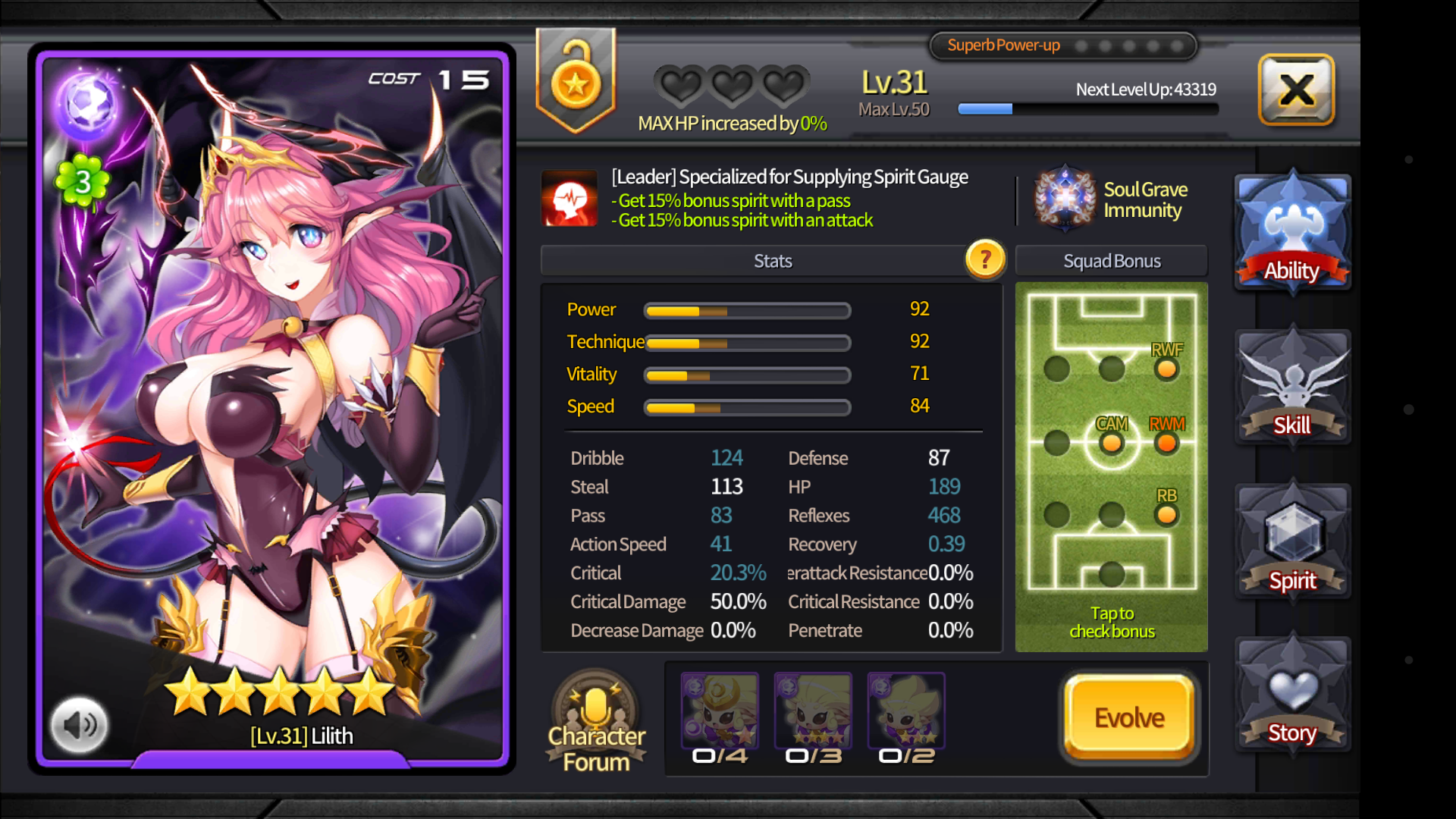
The basic metagame involves the usual process of collecting cards of varying degrees of rarity, "feeding" them other cards that you don't need to power them up, "evolving" them to more powerful forms and attaching various bits and pieces to them to boost their special abilities. This is all executed in fairly traditional fashion — though it must be said, the game does a much better job of explaining things than many of its peers — but it's how you actually use these cards that makes the game so interesting.

Screenshot_2015-05-31-14-08-20

In many mobile card battle games, battles are either abstract or completely non-interactive. There are exceptions — Brave Frontier springs to mind with its JRPG-style turn-based battles, and Love Live! School Idol Festival puts an interesting twist on the formula by turning your cards into the markers you tap on in a rhythm game — but a more interactive style of play is something that some developers still seem to be trying to get their head around a bit. Soccer Spirits succeeds admirably, with an enjoyable, fast-paced game that bears very little resemblance to actual soccer, but is fun nonetheless.

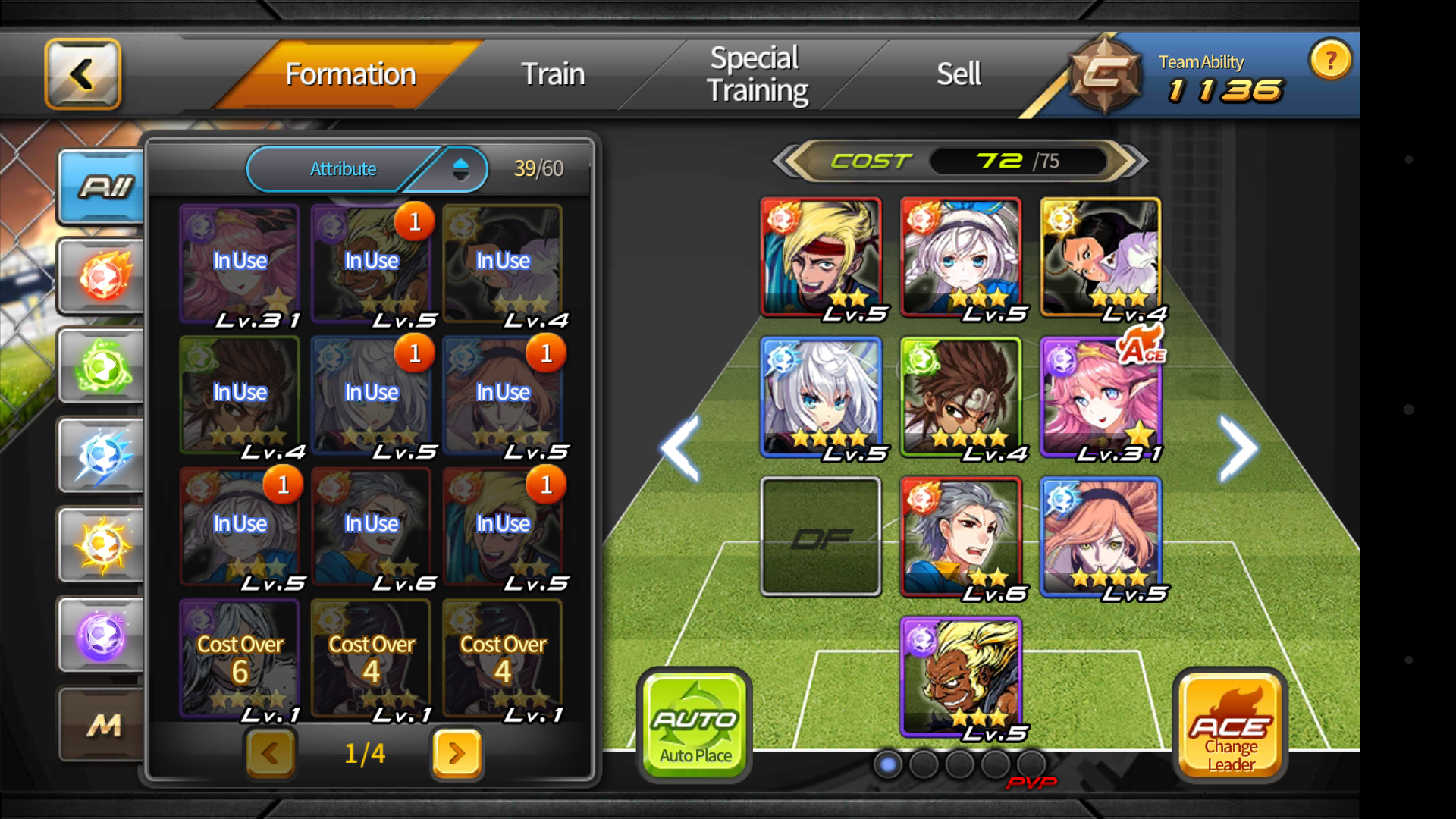
You put your cards into formation on the field. Each card has preferred positions it likes to play in, and putting it in one of them will give it stat bonuses. The match itself is played as a sort of turn-based affair with a bit of Final Fantasy Active Time Battle system going on. Cards gradually fill an "Action" meter over time, and when one fills up, that card gets a turn. Depending on its position, it will have the option to pass the ball to someone on the same line as it, attempt to penetrate the next layer of defensive cards, shoot at the goal or use a skill. Skills vary from attacking skills that boost power to buffs that assist the overall team, and many cards also have passive boosts that help your whole effort out, too, with particular benefits coming from the player you select as your "Ace".

Conflicts on the pitch are resolved as RPG-style battles in which stats, abilities and elemental affinities are compared between the two cards, and they inflict "damage" on one another accordingly. If a card's HP is reduced to 0, it is out of action for a short period — though not eliminated completely — and this allows an ideal opportunity to penetrate or shoot. In many cases, penetrating or shooting is combined with an attack — striker-type characters tend to have skills that enable them to make particularly powerful shots that will usually flatten weaker defenders.

Screenshot_2015-05-31-14-09-01To win a match, someone just needs to score one goal — no playing to 90 minutes here. In many cases, this means that a powerful team of cards can obliterate its opposition in a matter of seconds (though the game represents this as a number of "minutes" of sped-up time) which helps to keep the game admirably snappy, interesting and enjoyable — though given that I was showered with enough goodies to recruit what appears to be a virtually unstoppable team right at the outset of the game, I wonder how much strategy there will be as I progress.

Like many other mobile games that I've been pleasantly surprised by recently, Soccer Spirits is unobtrusive in its use of premium currencies and energy bars — though doubtless this will become more of an issue as I progress further. It's liberal with the rewards, meaning you can get your hands on some decent cards to add to your collection pretty quickly — but there are also a lot of incentives to try and collect as many as possible, particularly if you're able to finish "sets". It's a good use of the formula, and the artwork — clearly the work of several different artists, each with their own very distinctive styles — is absolutely gorgeous.

So there you have it. I'm playing a football game. (Kind of.) And enjoying it. What next? Cricket? Hahahaha.

1957: More Than a Demo

Out of curiosity, I downloaded Dead or Alive 5: Last Round – Core Fighters on PlayStation 4 this evening. Aside from having one of the most cumbersome titles in recent memory thanks to its string of unnecessary suffixes, DoA5LRCF is actually a really good example of something I hope we'll see more of in the near future: cut-down, free versions of games that are more than just demos. The modern equivalent of "shareware" versions, I guess.

For the unfamiliar, Dead or Alive is a fighting game series that has been running since the PS1 era. It's most notorious for its big jiggly bosoms on the female characters — the jiggle factor of which has always been adjustable, and indeed DoA5 is no exception to this — but it's also one of the best 3D fighting games out there, and one of my favourites. I suck at it, of course, but it's a game that I enjoy sucking at, whereas many of the current crop of 2D fighters are now so completely overcomplicated that I just get frustrated at not understanding why I suck.

Anyway, Core Fighters is a special free version of Dead or Alive 5: Last Round that includes just four of the characters from the full version's rather large cast, plus occasional rotating extras every so often. Core Fighters also lacks the full game's story mode, but other than that it is a complete game — you can play arcade mode, survival mode (a long-standing favourite of mine in the series) and even online. It's even got the full suite of tutorials in it, which seemingly do an excellent job of explaining exactly how the game works — something that previous installments have lacked.

Conveniently, Core Fighters includes my favourite game mode — Survival — and my favourite character — Kasumi — and as such it's a package that I'm eminently satisfied with even in its free incarnation. What's nice about it though is that despite the lack of characters, it doesn't feel especially "limited"; it gives an excellent taste of what to expect from the full game, and does a much better job that your typical demo at convincing you to part with your cash.

I'm not sure if I'll pick up the full version of DoA5 at any point — though I do very much enjoy the series — but Core Fighters is a great means of helping me come to a decision one way or another. I'm looking forward to giving it a shot in two-player versus mode at some point, since I splurged on an extra DualShock 4 controller today. Perhaps I'll even be able to drag Andie away from Final Fantasy XIV for five minutes to fight me. Fight me!

Koei Tecmo has also done a similar arrangement for the PlayStation 4 version of Dynasty Warriors 8 Empires. Given that this is a series I've also enjoyed a great deal over the years, I'm thinking I may well check this out now. Well, tomorrow, because it's nearly 1am now and I need to sleep.

1956: Diving into Hell

I grabbed a copy of a game I've been curious about for a little while today: Helldivers, from Arrowhead.

Helldivers is a PS3, PS4 and Vita game (cross-buy, cross-save and cross-play, thank you very much!) in which you take on the role of one of the titular dropship troopers, blow shit up and then get extracted. Except it's rather more likely that you will die in the process.

Arrowhead, you may recall, also developed Magicka, which is a gloriously chaotic "cooperative" multiplayer shooter in which friendly fire is well and truly turned on. In Magicka, a significant part of the fun comes from seeing what happens when your spells interact with other players' spells — there are often unexpected consequences. Helldivers is less explicitly ridiculous than Magicka is, but there's a lot of the same magic — no pun intended — in there.

Yes, friendly fire is turned on in Helldivers. Yes, things that you do supposedly to benefit the group can end up killing them. Yes, it's a rather good time despite the somewhat generic premise of "space marines go places and kill stuff" — the mission objectives and maps are varied and interesting enough to keep things enjoyable. Or so it looks, anyway; I've only played for about half an hour so far, but I enjoyed it a lot.

The interesting stuff in Helldivers, it seems, will come in the form of "Strategems". These are a rough equivalent to the spells in Magicka in that using them requires you to input a particular string of button commands, but the difference is that they don't take effect immediately. Powerful attacks like air strikes take time to reach your location, for example, meaning you'll need to hold off enemies while you wait for support. And then when support arrives, you'd better make sure you're not standing where you dropped the beacon, otherwise the thing you requested will indeed drop on your head and kill you.

There's something understatedly ridiculous about the multiplayer that makes it a joy. Earlier, I played a game with two random people in which one of our objectives was to disarm some unexploded armaments. No further information was given than that, aside from a location on the map that didn't seem to have anything there. Then several of us realised that we had a "metal detector" strategem available, allowing us to call in a supply drop containing a metal detector. When we'd acquired this, we could then sweep the area for the (apparently buried) bombs. Unfortunately, while we were doing so, our beacons attracted the attentions of the Bug hordes, so my two comrades had to fend them off while I was methodically searching the area for unexploded bombs. The juxtaposition was hilarious.

There's also a really interesting metagame going on, too. The concept puts the Helldivers at work in wars on three fronts, with control of sectors and systems being determined by players succeeding in missions they challenge. When the player community as a whole has pushed the front to the alien homeworld, the ability to assault it becomes available, and consequently an opportunity to win that particular war. Then every so often things reset and start again, from what I understand; I'm interested to see how the current war (the 4th, apparently) unfolds over time — it's a really cool idea and a great use of online.

So yeah. Helldivers. It's a good time. And if you're a PlayStation Plus subscriber, it's cheap right now, too.

1955: Always Out of Time

I've become somewhat convinced that I'm doomed to be forever "out of step" with where someone of my age — whatever it is at the time — is "supposed" to be.

I've been aware of this since I was a kid. While I had some friends in my peer group — many of whom are still friends today, and some of whom are even attending my wedding next month — when I was younger, I always found myself gravitating towards people who were older than me.

There were a few reasons for this, depending on who the person in question was, but mostly it was due to the fact that I never quite felt like I "fit in" with my peer group. I wasn't into football, I didn't know much about popular music — I was mercilessly mocked for my first ever album purchase being Oasis' Definitely Maybe literally a day before (What's the Story?) Morning Glory came out — and I was into things that were seen as a bit… I don't know, specialist? Nerdy? Music (i.e. playing and composing, rather than popular) and computer games, mainly — and while I did have some friends who shared at least some of these interests, I always found myself wondering if I was a bit more into these things than they were.

And so it was I found myself being able to relate somewhat better to people who were a little older and less susceptible to that bugbear of adolescence, peer pressure. My brother's girlfriend at the time — some ten years my senior — helped me discover a love for tabletop and role-playing games through Hero Quest and Space Crusade. Certain friends of my parents proved to be more appreciative of my musical skills than my peer group. And I always wanted to hang out with my brother and his friends whenever they were around — even though I was also aware that I was the annoying little brother.

I find myself comparing how I was then to how I am now, and realise that I am now in almost the inverse situation: just recently, I am finding myself relating to and getting along with people somewhat younger than myself rather than, again, my peer group.

At thirty-four years of age, there's less in the way of "peer pressure" in the same way there was at school, but in a way it's still there in a more insidious form. People I know are getting married, buying houses and even having kids — I've done two out of those three things, and don't have any intention of doing the other in the immediate future — and there's always this slight undercurrent feeling like I should be more "grown up" than I am.

Part of this anxiety comes from my woes in the job market over the years. Of my past employment, I was made redundant from one, signed off sick with stress from the next, bullied out of the one after, quit before I killed myself with the following one, made redundant again with the one after that, screwed over at short notice with the one after that and ultimately, again, bullied out of another job, partly as a result of my depression and anxiety issues. So it's fair to say that all that has mounted up somewhat and made me feel more than a bit inadequate and "behind" where I "should" be at the age of thirty-four.

In a way, though, I also don't want to "grow up". I love the things I love, and I feel like the things I've discovered I love most recently are things that speak to me pretty much more than anything I've been into in the past. And exploring those things a step at a time has brought me into contact with a variety of new, exciting and interesting people whom I'm keen to get to know a bit better, as they seem to kind of "get" me. Or, at least, "get" the stuff I'm into.

Thing is — and I don't know for certain, but have strong suspicions — these people are quite a bit younger than me. Oh, they're not schoolkids or anything like that, I hasten to add — most are in their early to mid twenties, I believe — but I am conscious of it. And I'm grateful to them for — so far, at least — accepting me for who I am and not giving a shit about my age as much as I apparently do.

So is all this a problem? I couldn't say. It's just been on my mind a bit recently — I've been meaning to write this post for a while now. Ultimately I can't help but feel that doing things that make you happy and sane are more important than the things society says you "should" be doing at any given age. And so, until I find myself in a situation where it's simply impossible to — and I hope that day never comes — I plan on staying just the way I am for now, and see where life takes me from here.

1954: I Want to Like GTA Online

I want to like Grand Theft Auto Online. But man, does it ever make it difficult.

The frustrating thing, in a way, is that when it works well, it's a lot of fun. 30-player races across an airport in supercars in the pouring rain is incredibly enjoyable. Deathmatches are, for my money, more fun than those in more conventional shooters. Survival events are great. And I haven't even tried a Heist yet.

Unfortunately the whole thing is wrapped up in some of the most poorly implemented online functions that I've ever had the misfortune to endure in a game. And I played Final Fantasy XI with its dumbass PlayOnline Viewer and indecipherable friend request system.

Part of the problem, I think, is to do with how Grand Theft Auto Online is structured. There's the "free mode" stuff, in which you can tool around in the open world with a bunch of other players, all doing your own thing, and there's the "Jobs", which are structured events. And the two clash quite a bit.

In free mode, You can steal cars, buy property, deliver things, clear out gang hideouts, rob stores and a bunch of other things. You can also kill other players, or set Bounties on people, or pursue Bounties yourself. It's enjoyable, if a little directionless and lacking some of the incentive to explore that the single-player mode of Grand Theft Auto V has — there's no collectibles, for example, and while there are occasional weapons scattered around the map, there's considerably less than there are in single-player as, for the most part, in Grand Theft Auto Online you're expected to earn your weapons and pay for them yourself with your in-game money.

So far so good. The problem, then, comes when you launch into one of the Jobs. These effectively become private game sessions in their own right, and much like other multiplayer games out there, feature a system whereby people who want to stay on after an individual race/match/whatever can vote on what the next activity should be, and everyone who does so will be in the next race/match/whatever with one another.

When playing with random people, this isn't a huge issue, though Grand Theft Auto Online is plagued with the same problem a lot of other popular online games have: people joining sessions and leaving either when it's not going their way or, in some cases, if the lobby doesn't fill up in less than five seconds. Multiply this by the number of people who are doing it and it can be a good few minutes before the game manages to successfully assemble a group of people to play a single event — and you can't do anything while you're "queued" like this, though there is an "On Call" system that supposedly alleviates this, though I've never managed to make it actually work as it's supposed to.

The bigger issue comes when playing with friends. There's no "party" system so it's extremely difficult to keep together with the group of people you actually want to play with, particularly if each person has their online matchmaking settings set a little differently. It's also extremely difficult to simply pick up your friends and plonk you all into a single, private session where you won't be bothered by random other public players — in order to do this, you actually have to quit out of Grand Theft Auto Online altogether and go back to Grand Theft Auto V, then rejoin Grand Theft Auto Online using the appropriate setting (Invite Only, Friends Only and so forth). This forces you to sit through one of the game's many, many long and tedious loading breaks. And even then, this setting only seems to apply when you first join; on more than one occasion my friends and I have finished an event only to be dropped into a session with 25 other randos.

The whole system feels exceedingly undercooked, and given how long Grand Theft Auto Online has been, well, online now — not to mention how many other big-budget triple-A games have done multiplayer really well to date — there really isn't much of an excuse for it. And I wouldn't blame some people for giving up on it rather quickly — which is a shame, because as I mentioned above, it's really rather fun when it works "properly".

1953: Still Picking Up Girls in a Dungeon

The anime Is it Wrong to Try to Pick Up Girls in a Dungeon?, better known as DanMachi (because Is it Wrong to Try to Pick Up Girls in a Dungeon? is a stupid title that doesn't really reflect what the show is all about) has been continuing to entertain me with each new installment, and I'm glad that so far it seems to be widely well-received for the most part.

What I've been pleased to see as the show has developed is that it's a lot more than the straightforward harem show its official English title would appear to suggest it is. Sure, there are a lot of female characters, and sure, most of them appear to want to throw themselves at wet-lettuce protagonist Bell for their own mysterious reasons, but with each new episode, we see interesting new developments in the characters — and, this week, particularly in Bell himself.

Bell ran the risk of being a relatively generic anime protagonist character, albeit one with white hair rather than the usual floppy dark brown. He was clearly designed to be somewhat relatable to the audience — socially awkward, not quite sure what to do with himself, lacking in confidence and generally a bit clumsy. But over time, his Badass Quotient has been increasing rapidly, though not in the somewhat overpowered way that Kirito became incredibly tough in Sword Art Online. Rather, as Bell grows in strength — both physical and mental — we start to see him change from a naive boy into a determined young man as he starts to come to terms with his own personal adventure.

The highlight of this week's episode was an unusually violent fight scene between Bell and a minotaur. A minotaur overpowered Bell in the first episode, brought him into contact with the mysterious blonde-haired beauty Aiz Wallenstein and filled him with shame and regret for what he perceived as his own incompetence (rather than simply not being ready for a challenge considerably too tough for him). His battle against the minotaur in this episode showed how far he had come, and indeed during the fight scene, as he strikes back at his foe, determined to knock him down using everything he's learned from his experiences and his time training with Aiz, he's barely recognisable. Covered in blood and obviously using every last ounce of both his physical and mental strength to battle his opponent, Bell clearly reaches a turning point in this episode — and, judging by some of the other things that happened, it was an important moment for the overall narrative, too. Most intriguing!

I'm very much looking forward to seeing what happens next. The show has wisely not focused too heavily on the relationship between Bell and Hestia, despite Hestia clearly being the "poster girl" for the series. Instead, it's very much Bell's story of personal growth and his quest to redeem himself against his own lofty — some might argue too lofty — expectations. And along the way, he comes into contact with a lot of interesting and memorable characters, several of whom, I feel, will have important roles to play in how everything eventually turns out.

So I'm well and truly "in" on DanMachi until the end, then. Hopefully it keeps up the quality of this week's episode, and hopefully we'll see more in the future when this series is over, too.

1952: Orderly Play

With Final Fantasy XIV's first expansion Heavensward coming in about a month's time, I've been doing some thinking, particularly as I've dialled back the amount I've been playing vanilla Final Fantasy XIV during this "lull" between the story finale a while back and the launch of Heavensward next month.

You see, this "lull" period has allowed me the opportunity to get caught up on some other games — or, well, if we're honest, to dive head-first into the rather wonderful Omega Quintet, which I adore — and I've been enjoying that a great deal. This may sound like a "first world problem" of the highest magnitude, but anyone who has ever indulged in an MMO will likely be familiar with how easy it is for such games to "take over" to the exclusion of anything else. It's not necessarily a problem when it happens, but when you have lots of other games that you really want to play, and never really seem to have any time to play them, that's when it needs to be addressed — or you need to make some tough decisions as to what you might "sacrifice".

Anyway. The short version is that I have no intention of stopping playing Final Fantasy XIV completely as I'm too invested in the game experience as a whole, including the friendships I've developed as a result of playing it. But I also have no intention of sacrificing the (probably literally) hundreds of other games I have on my shelves and haven't played yet. As such, then, some sort of compromise would appear to be in order.

Then it struck me — actually not for the first time, since I've had these thoughts before. A relatively straightforward solution to the issue — and one that I'm aware won't be ideal for everyone, but which I think I might be able to stick to — is to treat gaming like any other hobby that requires a significant time investment: schedule and organise it.

This may sound like a bit much for something that many people regard as lightweight, somewhat "disposable" entertainment (though, I hasten to add, I've never been one of those people) — but think about it. Someone who's really into tennis probably doesn't play tennis every time they have some free time. Someone who's a member of a book club isn't constantly attending meetings. Someone who likes live music isn't constantly at concerts. There's balance; you do different things at different times, particularly when there's a social element.

As such, I feel that going into Heavensward, it would probably be a good idea for the sake of my own sanity and satisfaction to specifically set aside times for playing Final Fantasy XIV — as a sort of "weekly event" or meeting — and times for playing other things. And then stick to them. That way, I won't feel the strange "guilt" I feel about not playing Final Fantasy XIV when I'm playing something else, or the corresponding and equally strange "guilt" I feel about playing Final Fantasy XIV as my backlog of PS2, PS3, Vita, 3DS and PC games continually grows faster than I can complete them. The inherent benefit of something like this, too, is that it allows me to set some sort of schedule for experimenting with things that I'd like to explore more, like streaming and recording gameplay videos.

I'm not entirely sure what the right "balance" is as yet, but that's something I can probably work out over the course of the next few weeks as we count down towards Heavensward's launch. It's something I'm keen to get right, though, because as I've already said, I have no intention of giving up Final Fantasy XIV, but I also really don't want to feel like it's eating into opportunities to play other things, too.

So I'm thinking I might experiment a bit starting this week. I'm going to try having maybe two Final Fantasy XIV evenings that are reserved exclusively for FFXIV purposes; one of them will probably be Monday, as that is one of the two nights we customarily raid, and I'm thinking that the other will probably be Friday, since that's the end of the week and consequently a good opportunity to stay up and socialise with others. Weekends I'll take as they come; I'll play FFXIV if I feel like it — and we raid on Sunday nights anyway, even if I don't play any more than that — and I'll play other stuff without "guilt" if not.

If two days midweek doesn't feel like enough time to Get Things Done in the game, I'll consider it again. But we'll see.

This has probably not been a terribly interesting post for you to read, dear reader, and for that I apologise. However, it has been helpful for me to "think out loud" in this way and come to some sort of conclusion. So if you stuck around and watched me do that, uh, thanks for your commitment and understanding, I guess? And perhaps I'll see you in Eorzea on Friday!

1951: Terra Mystica

We gave another new board game a go today — Terra Mystica. This was a game I had heard of but didn't know much about, so I was interested to try it, particularly as I understood it to be a fairly well-regarded game.

First impressions were daunting. It comes with an absolute ton of very nice quality wooden components, stuff to punch out and a rulebook that makes the game look a lot more complicated than it actually is. Once we were underway, though, all became fairly clear, and the game started to take shape. By the end of our "practice" game, we were all agreed that it seemed to be a very good game indeed, and we liked it enough to play it for a second time this evening — a rare occurrence for us, since we usually hop from game to game for a bit of variety.

Terra Mystica is a strategy game focused on empire-building, with pretty much nothing in the way of luck and only a slight degree of randomness in the initial setup. Taking on the role of one of a number of different factions, it's your job to lead them to victory by amassing the greatest number of victory points by the end of six rounds of play, each of which allows all players to keep taking turns in sequence until no-one has anything left to do (or everyone has chosen to end their input this round, at least). Interestingly, and unlike a number of other vaguely similar games, victory points are not necessarily attained for everything you do throughout the game; each round has a specific bonus condition that allows you to earn points for building specific things, and there are a number of randomly selected "bonus cards" that are in play throughout, with one player taking a different one each round.

Instead, the main bulk of your points comes from two sources at the end of the game: the area your empire covers in geographical terms, and your influence with the four main religions of the game world. In both cases, there's a hierarchical scoring system: first place gets a ton of points, second place gets a few less, third place gets a few less still, while anything below that gets nothing. Ties aren't broken; instead, two or more "tiers" of points (according to how many players are tied) are added together then the resulting total divided between those people who are tied; this generally means that everyone involved still gets a reasonably significant amount of points, but it works out slightly less than what they would have had in the case of an uncontested victory. It's an interesting system.

What's interesting about the scoring is that it forces you to prioritise on every turn. Although the first-place bonuses are significant and will probably make the difference between winning and losing, a couple of playthroughs makes it clear that taking aim for the bonus points available on at least some of the rounds is very important to get ahead, too. And it's here where you need to start building your more advanced structures and setting up various "engines" to produce the various resources you need to continue progressing.

Pleasingly, the game isn't overly complicated, though; there's a sort of "tech tree" of buildings that denote the order you're allowed to build and subsequently upgrade them, and a system for "terraforming" the world into your faction's "home" terrain type, but aside from that it's mostly about wisely picking the areas you control and choosing the right buildings to ensure you're generating the resources you'll need each turn. Mechanically, it's quite simple; the challenge factor, however, comes from the application of these mechanics to come out ahead while simultaneously making life a little difficult for your opponents.

There's not much in the way of direct conflict — you can't attack each other, for example — but as with any sort of area-control game, there's an element of getting in one another's way. Interestingly, though, there's an incentive to build close to one another, since someone building or upgrading adjacent to your structures allows you to take one of the resources you need in exchange for victory points. As the game progresses, the map gradually starts to take shape in very interesting ways, with factions carefully building around one another, attempting to put themselves in an advantageous position while trying to limit their opponents' room to manoeuvre.

It's a good game, and because it's mechanically fairly simple I find it somewhat less daunting than something like Agricola and, consequently, feel like with a few more attempts I might even be able to win it, maybe, possibly. (I didn't win it this time around, but I didn't come last in our last game, either.) I'm actually quite looking forward to trying it again; it seems like a good time, and likely one that will hit our table fairly regularly.