Andie and I are getting married at the weekend. That's pretty close!
I'm looking forward to it a lot. It should be a great day. Both our ceremony and reception are fairly straightforward, simple and low-key (aside from the fact the ceremony is taking place in Westbury's mahoosive church) and that fits us just perfectly. Besides the obvious meaning of getting married, the day will be an opportunity for both of us to hang out with a whole bunch of people we, in some cases, haven't had as many opportunities to see recently as we both might have liked.
This week is largely about last-minute preparations, then. My best man Tim and I went to go and pick up our suits earlier today, and we both look pretty great in them. (I do need a haircut, though; that's tomorrow's job!) Getting sized for said suit was pleasant confirmation of my weight loss, too; while I'm still getting stuff from the "big and tall" (fat and lanky) section, the numbers involved are… quite a bit smaller than they used to be, which makes me extremely happy.
Other things I've been up to this week include putting together the music playlists for the reception — one for during the meal, and a more up-tempo one that people might consider dancing to once everyone has finished stuffing their faces. We're not having a DJ because wedding DJs suck; we both decided that we'd much rather have our own music playing without some braying idiot bellowing nonsense as Vengaboys blasts out from his sound system that is turned up too loud. (I know I sound like an old fart. I don't care.) Instead, we're simply having a tablet with some music on hooked up to a PA system generously loaned by my friend Rob. And that means we can have an entertainingly eclectic selection for people to (hopefully) enjoy over the course of the day — something that I feel reflects us pretty well.
Tomorrow is a day for printing things out. Orders of service, table identification card thingies and any other bits and bobs we might need. Andie's spent much of the evening writing people's names and the word "Pavlova" on table-setting cards (assuming they're having pavlova, of course — and what sort of crazy person wouldn't?) and, once I've taken care of business tomorrow, we should hopefully be pretty much ready to go. Hooray!
That's that, then. Now, having stayed up to extremely silly times in the morning for the last few days playing Heavensward (which, by the way, is magnificent, if you hadn't figured that out already) I'm off to bed at a vaguely reasonable hour.
I know I said I wouldn't write about Heavensward again today and I'm not going to focus on it too much, but it will enter into the discussion a little, for reasons that will shortly become apparent.
The separately-sold "expansion pack" as it existed in the '90s and early '00s is something of a rarity these days, typically confined to the MMORPG subgenre, while other types of games tend to leverage the high-speed Internet connections most people have these days by offering lots of smaller bits of piecemeal downloadable content.
In some ways, this works well; the "a la carte" approach of piecemeal DLC means that you can pick and choose the things you want to bolt onto your game for a lower price without potentially being stuck with some things you don't want. On the flip side, however, in my experience, a lot of DLC — though not all — is significantly less substantial in terms of content and value for money than your average expansion pack. There are exceptions, of course — Oblivion's Shivering Isles DLC springs to mind, as does Burnout Paradise's additional island whose name escapes me right now — but those are actually both getting back into "expansion pack" territory again, and thus are outliers to a certain degree.
Bungie's MMO shooter and "thing that isn't Halo" Destiny had its new expansion announced recently, and it's kicked up a bit of a fuss, specifically over its pricing. The base game of Destiny has plummeted in price since its original launch, meaning that the new expansion — which costs the same as a full game at £40/$60ish — will, in most cases, be more expensive than the main game. But that's not what's got people riled up: the problem is that there's a super-expensive "Collector's Edition" coming that features some exclusive content that can only be acquired through this special edition.
Nothing unusual, you might think, until you hear that the Collector's Edition is only available as a bundle deal including Destiny, its expansion and the pieces of DLC that have been released to date. This means that fans of Destiny who want to get their hands on the exclusive content pretty much have to buy the game and DLC again just to play the expansion. And the alternative means of buying the game for new players — a bundle including Destiny and its expansion for around the £55 mark — effectively means that new players are getting the expansion for considerably less than veterans.
I can't say I care a whole lot personally because Destiny simply isn't my type of game, but what surprised and dismayed me a bit about the whole situation was this interview on Eurogamer with creative director Luke Smith — a guy I don't know that well myself, but who used to work with my brother and was, as I recall, part of the 1up crew. Smith was, to my recollection, always rather outspoken about things, particularly when it came to companies doing shitty things, so it was a tad disappointing to read his responses to Eurogamer coming out as little more than PR-fed "we can't talk about this" nonsense. And if it was PR-fed, the PR company wants sacking, because Smith's responses did nothing to alleviate the concerns of players who are upset over all this, and more than likely infuriated them further.
The reason I brought up Heavensward at the beginning is because it's actually in a similar position to Destiny's expansion. Final Fantasy XIV itself can be picked up for a pretty low price these days, but Heavensward is not-quite-full-price-but-nearly. The difference, however, is that both existing and prospective players have plenty of choices of how they pick it up. They can buy A Realm Reborn and Heavensward separately. They can buy a bundle including both A Realm Reborn and Heavensward. They can buy Heavensward by itself, in standard and special editions. And they can buy most of these options in both physical and digital formats.
As such, even though Heavensward might seem expensive for an expansion pack — though it's worth noting that in terms of content, it's seriously rivalling A Realm Reborn's base game, at least in terms of story length, sidequests and open-world areas — the player base has had absolutely no objections to how it's been positioned and sold. In fact, I've seen more new players in the game in the last week or so than I have for a very long time — and those new players won't even be able to touch any of the Heavensward content until they complete A Realm Reborn and its five subsequent content patches.
But they don't mind, because they've been given options, and those options have been made clear. Where Bungie is falling down with Destiny — and where they're going to lose a lot of previously loyal players if they're not careful — is this communication side of things. Smith's responses suggested that Bungie was either unwilling or unable to listen to player concerns on these matters; it may well be a matter of the company's hands being tied by publisher Activision, but still. That's not how you build loyalty. That's how you destroy loyalty.
Level 56 now, and I'm starting to really get a feel for the new skills that have been added to Paladin.
Paladin often drew some criticism — or, rather, accusations of being "boring" — for the fact that it was a relatively straightforward class to play, with only two real combos of abilities to use in different circumstances compared to a much wider array of things to do if you're playing a Warrior. Its main perk over its raging counterpart, however, was its survivability; Warriors have a ton more HP than Paladins, but they also take more damage, while Paladins have fewer HP but a lot more in the way of defensive abilities to mitigate or even nullify damage.
Still, though, I understand the criticisms; once you unlocked all the abilities to form your basic combos, it very much became a case of pressing ability 1, 2, 3 and occasionally stepping out of enemy ability telegraphs. Post-50, though, things get a lot more interesting.
The oddly-named Sheltron, for example, is an ability whose usefulness doesn't become immediately apparent. What it does is guarantee that you will block the next physical attack you take. Blocking an attack is usually determined by random chance, influenced by the stats on the shield you're wielding alongside your sword. Sheltron guarantees a block, and while blocking doesn't nullify damage altogether, it does reduce the damage by a significant amount. It also has the handy side-effect of restoring some of your magic points when the block goes off, meaning that the Riot Blade combo is no longer the only way to regenerate MP.
Blocking also allows you to counterattack with a move called Shield Swipe, which is actually one of the Paladin's more potent offensive moves, and also inflicts a status that prevents the enemy from using abilities of the "weaponskill" type. It's not quite as good as a Stun or Silence, but it can be helpful and give a moment's grace. The damage is very nice, though — particularly as it's been buffed since its original incarnation — and it also now generates aggro, meaning you're not losing out by weaving in a Shield Swipe when it's up.
The other ability I've had the opportunity to play with now is Goring Blade, which follows on from the Riot Blade combo, previously used just for regenerating magic points to allow you to keep casting Flash, your main means of controlling larger groups of enemies at once. Goring Blade, meanwhile, has a solid initial hit followed by a damage-over-time effect. Paladins don't do a lot of damage generally — it's not their role, after all — but adding the ticks of damage to what you're doing anyway — particularly if combined with other DoT effects like Circle of Scorn and Fracture — you can actually put out some fairly respectable numbers. Plus Goring Blade has like the coolest visual effect of all Paladin's moves that I've unlocked so far.
I just reached level 56 this evening, which is a level at which I unlock another new ability. I'm not sure what it is yet, but I'm very much looking forward to finding out and experimenting with it — one of the most exciting things about the new expansion is the fact that everyone is getting these new abilities at the same time, so there isn't yet an established "right way" to do things. As such, experimentation is key, and it's really rewarding to work out an efficient use of abilities for yourself.
But anyway. That's three days in a row I've talked about Heavensward. (It's really, really, really good.) I promise I will attempt to talk about something else tomorrow. Probably. Maybe.
Spent some more time playing Heavensward today and am having an absolute blast with it.
It's been an odd adjustment to move from the rather freeform, "pursue your own goals" gameplay of a level cap character back into the routine of doing quests, exploring and all manner of other things. But I'm enjoying it a lot, particularly as so far Heavensward is proving itself to have a wide variety of things to do and ways to earn those all-important experience points.
The main story quests have been very good so far. They always were mostly quite interesting (though in the post-50 ones there was quite a lot of lugging boxes around and other menial tasks in between the more dramatic moments — not exactly the Warrior of Light's finest hour) but Heavensward has raised the bar somewhat.
One way in which it's done this is through the use of instanced quest battles — scripted encounters that take you out of the main multiplayer world and put you in your own private little area to complete objectives. In A Realm Reborn, these were usually fairly small scale but fun; in Heavensward they're much more ambitious affairs with their own unique mechanics. One particular highlight relatively early on sees you running through one of the earlier dungeons by yourself in the attempt to rescue a prisoner — while you do so, their captors start filling the place with poison gas, so you have to deal with that as well as finding a way to release them.
The main story itself is interesting and feels more focused than A Realm Reborn, too. Taking a somewhat darker overall tone, the plot thus far has seen the Warrior of Light (you!), one of your erstwhile companions and two other characters who each played roles in A Realm Reborn exploring the lands beyond Ishgard in an attempt to stop a war between the Dravanian dragons and Ishgard that will doubtless end with much death and destruction on both sides.
A Realm Reborn set up dragons mostly as fearsome, dehumanised foes to be treated with respect but defeated nonetheless. They played a relatively minor role in the overarching storyline until the latter hours and the Binding Coil of Bahamut storyline, but they were there nonetheless — and as you progressed, particularly through the Bahamut narrative, it became very apparent that they weren't quite the simple foes you might have expected them to be based on their appearances in other fantasy media.
Heavensward runs with this theme, with both the main story and sidequests going some distance to help us understand the dragons a little better. One questline in particular sees you helping out an Ishgardian who is essentially a "racist" of sorts against dragons — he refuses to believe they are anything more than monsters, but as you complete his quests, both you and he come to see that the dragons apparently have feelings and society just like the humanoids of the world.
The sidequests are kind of interesting in that they further your understanding of the game world much like in A Realm Reborn, but unlike the base game, the darker tone seeps in quite often, with many quests ending in less than perfect circumstances. In some regards it feels like some cues have been taken from Nier — also published by Square Enix — by demonstrating that sometimes, even with your best intentions and god-felling skills and abilities, you simply can't bring about a happy ending for everyone. It's sobering, but very much in keeping with the overall tone.
Then you have boss fights in which you and seven friends take on a giant insect god with a penchant for swinging four gigantic swords around at once, and you remember that this is still very much a Final Fantasy game at heart — and oh, do I love it for it.
Well, it's finally here: Final Fantasy XIV opened the doors to its first full expansion Heavensward today — for those who preordered it, anyway — and I've spent literally all day playing it.
It's good.
The story follows on directly from the end of the 2.55 story arc, which I won't spoil here for those who haven't seen it in all its ridiculous and tragic glory. Suffice to say, however, that it provides good reason for the Warrior of Light (that's you!) and occasional companion Alphinaud to head in the direction of Ishgard, a region which had previously been closed off to outsiders, but which became a little more open-minded after seeing how you (and seven friends) fended off an absolutely massive dragon towards the end of A Realm Reborn.
The city of Ishgard itself is beautifully rendered, being somewhat similar in design to a cross between Final Fantasy XI's cities of San d'Oria and Jeuno. It has its own very distinctive character that is separate to the three previous city-states we had the opportunity to visit in A Realm Reborn — the verdant, nature-filled environs of Gridania; the tall towers and tall ships of Limsa Lominsa; and the juxtaposition between extreme affluence and extreme poverty of Ul'Dah — with an austere, almost unwelcoming facade and some beautiful architecture. The kind of place where you'd be slightly afraid to touch anything, lest you befouled or defaced it in some way or another.
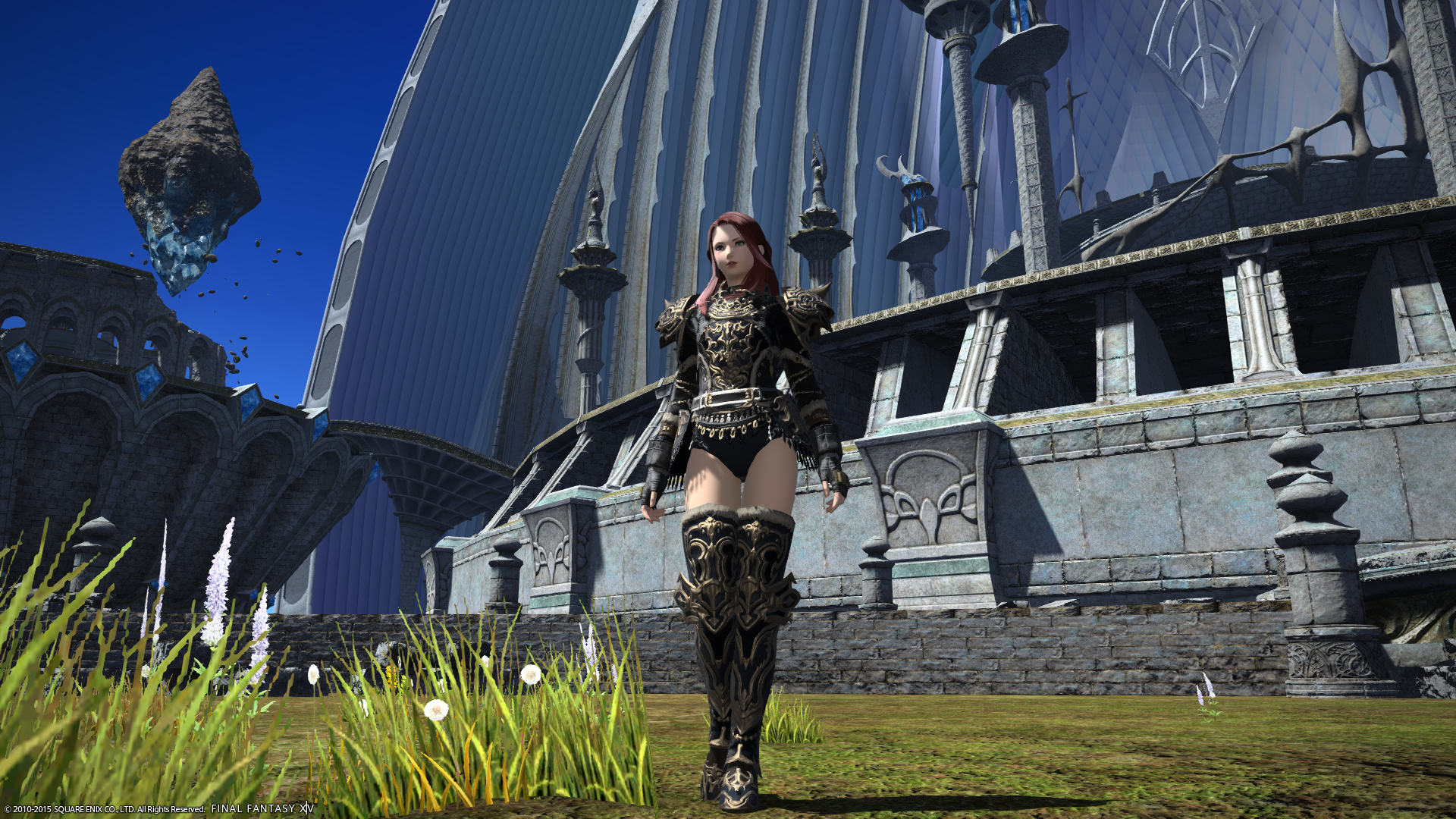
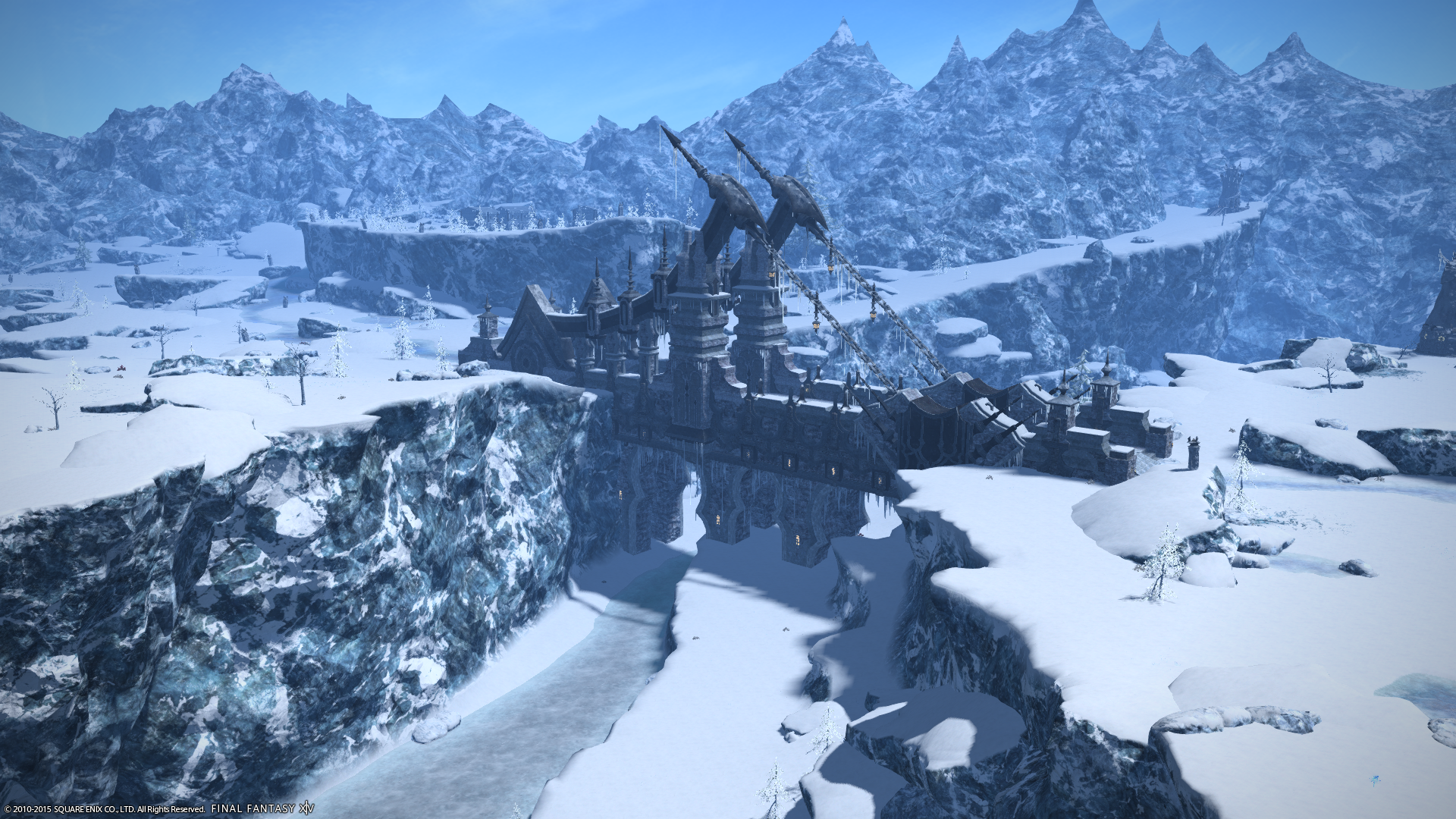
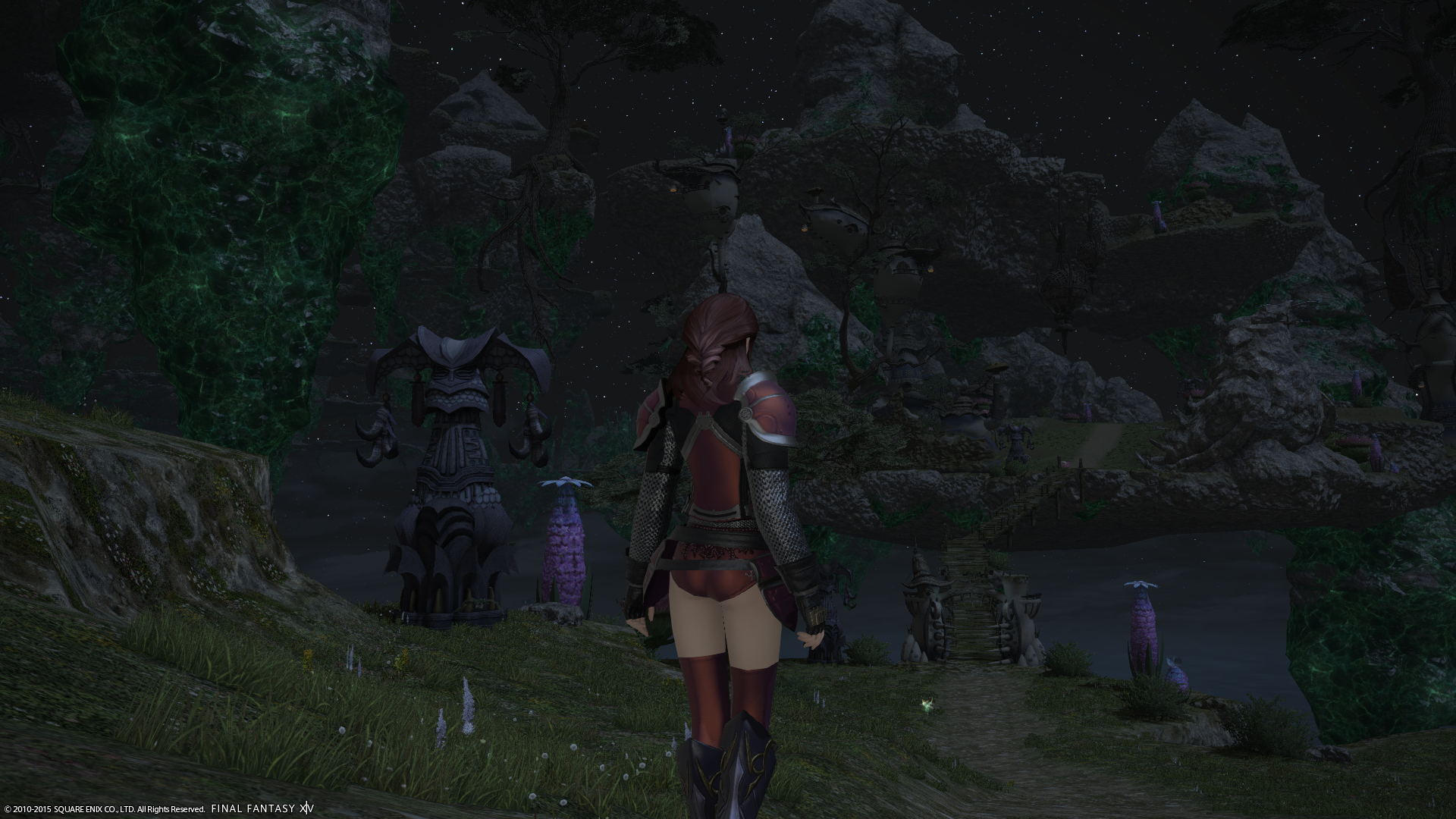
Outside the city, things get interesting. Early on, the main scenario quest sends you off in two separate directions: in one direction lies the Coerthas Western Highlands — a snowy, mountainous region similar to the existing Central Highlands region, but with more in the way of sheer cliff faces and inconvenient but impressive-looking lumps of rock all over the place — while in the other lies the Sea of Clouds, a floating archipelago of islands in the sky where skies are often clear and blue by simple virtue of the fact that the islands are above the clouds, but whose altitude drops the temperature to less-than-inviting levels. There's a huge contrast between these initial two areas; Coerthas is drab, monochromatic and somewhat grounded in reality for the most part (huge dead dragon corpse aside), while the Sea of Clouds is dramatically colourful, the stuff of pure fantasy. I haven't proceeded further afield just yet, but the main story is shortly to have me heading for Dravania, home of the dragons, so I'm interested to see how that compares.
One really striking thing about Heavensward is its sense of scale. A Realm Reborn was no stranger to sprawling environments that were impressive to behold, but Heavensward takes it to a new level. Ishgard is gigantic and imposing in the same way an old cathedral is; meanwhile, the field maps are huge in terms of both surface area and variation in altitude — the latter aspect of which is, in part, designed to accommodate the new flying mounts you can ride around after completing the surprisingly enjoyable task of hunting down a number of hidden "aether currents" scattered around the region.
Another striking thing about Heavensward is nothing to do with its architecture, however: a good 80-90% of the original voice cast appears to have been replaced, meaning some characters sound quite different to how they sounded in A Realm Reborn, with several even having picked up regional accents (primarily Yorkshire so far) in the intervening period. It's initially somewhat jarring, but overall the quality of the voice acting is much better than A Realm Reborn. This isn't particularly difficult, however, because although A Realm Reborn had an excellent localisation (albeit one that diverged quite a bit from the original Japanese script and took on something of a life of its own) its voice acting was passable at best and woefully awful at worst. At least in English it was, anyway; the Japanese voice acting makes use of well-known voice talent like Rie Tanaka (Hyperdimension Neptunia) and Eri Kitamura (Senran Kagura) and as such has always been pretty good, but it's clear that the English dub was perhaps, to put it politely, done a little bit on the cheap side.
It's not entirely surprising, mind you; A Realm Reborn was a huge risk for Square Enix given Final Fantasy XIV version 1.0's critical and commercial failure. As such, the decision to perhaps skimp a bit on the voice acting budget — many scenes in A Realm Reborn and indeed Heavensward also are unvoiced — was understandable. However, since A Realm Reborn achieved the seemingly impossible and rescued an all-but-dead MMO from oblivion, turning it into one of the company's greatest success stories in the process, it's gratifying to see that a bit more effort has been put into aspects of the presentation such as voice acting — even if the change in some characters' voices is a little surprising the first time you hear it.
I'm yet to try out a huge amount of the new gameplay features — I'm concentrating on levelling my main class Paladin to 60 before levelling anything further — but the new skills for existing classes look interesting, and the altogether new classes seem to be really cool, though it looks as if "lolDRK" is going to become the new "lolDRG". (Context for those unfamiliar: for the longest time, Dragoons (DRG) were notorious for dying a lot, due in part to their low magic resistance but also due to awkward animation locks on certain skills making it difficult to move out of the way of attacks; hence, "lolDRG" as the response to a Dragoon's inevitable death; Dark Knights (DRK), however, appear to be ready to take up the mantle for themselves, from what I've heard so far.)
Oh, and the music is amazing. And the story is interesting. And I've fallen in love with this stupid game all over again. There goes the next few years of my life…
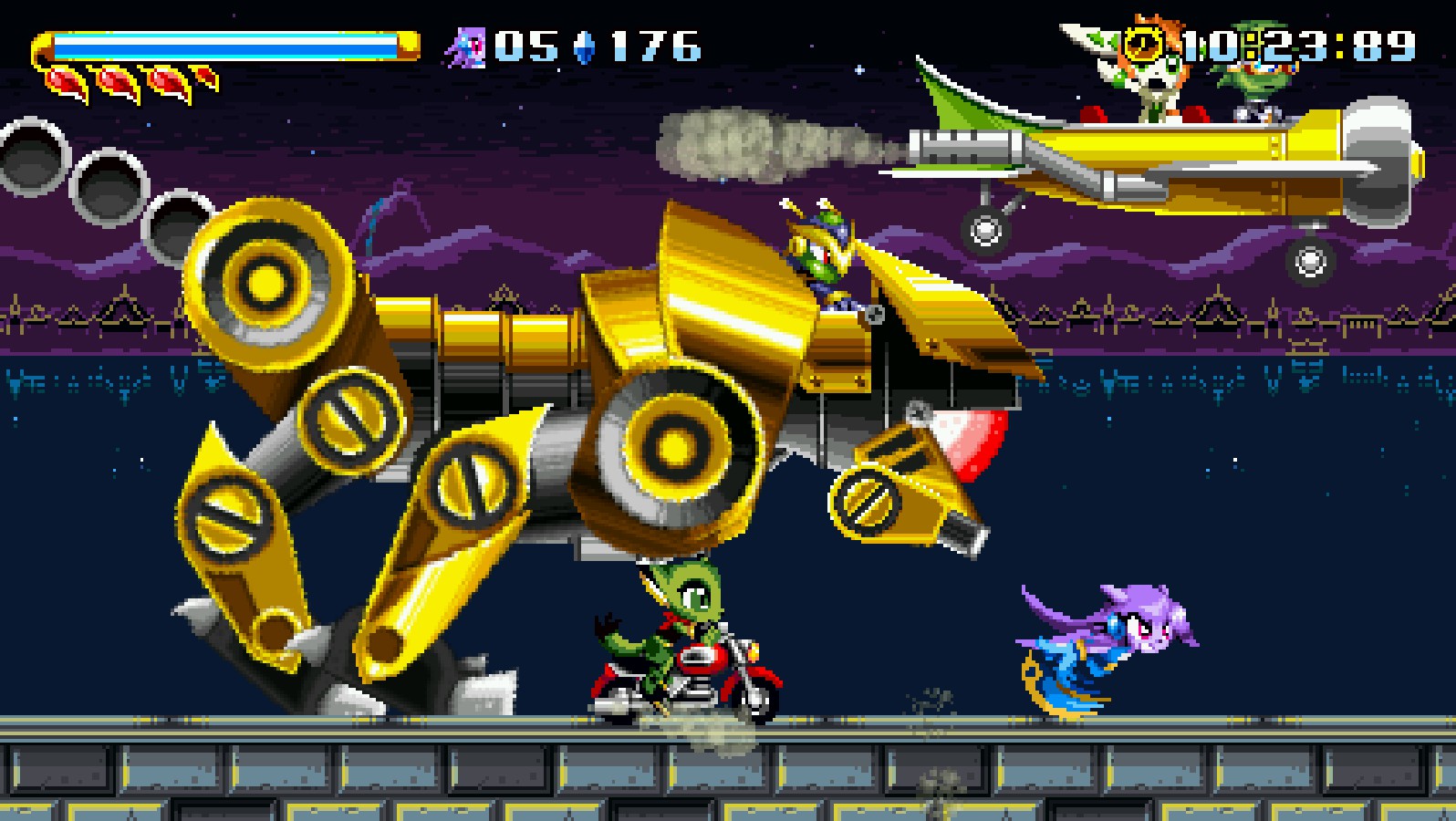
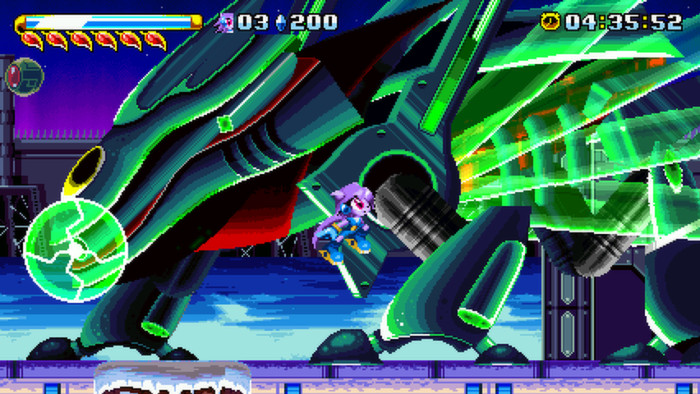
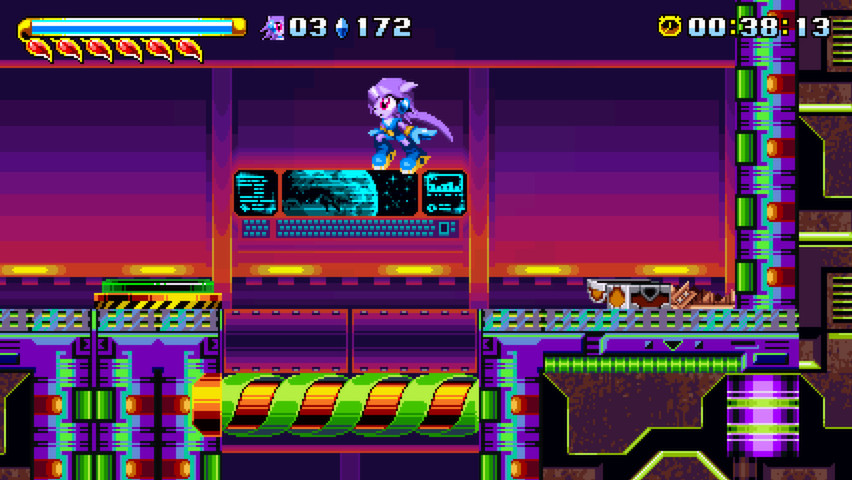
I've been pretty restrained with the current Steam sale, but one game I did pick up today was Freedom Planet, an homage to '90s mascot platformers and particularly to Sonic the Hedgehog-style speedy platformers. And I've only played three levels so far, but I'm already gobsmacked by quite how good it is.
Freedom Planet tells the tale of the Kingdom Stone, a powerful artifact that is stolen by a horrible alien dude, and the quest of a plucky band of heroes to rescue it. The playable cast includes Lilac, a purple dragon that looks like a tsundere female Sonic; a green cat called Carol; and an overexcitable dog-like thing called Milla. There's also an alien who thinks disguising himself as a duck is the best way to blend in — although on a planet of furries, that's probably not all that unfair an assumption.
You can play the game in two ways: Adventure mode punctuates the levels with some lengthy, fully voiced cutscenes that tell the unfolding story, while Classic Mode allows you to play it in authentically old-school fashion without having to worry about narrative. When you're in the platforming segments, you control your chosen character as they run, jump, climb, bounce and kick the shit out of enemies in their way. Each character handles noticeably differently and forces you to approach the levels in a different way, and some hugely enjoyable but challenging boss fights force you to play methodically rather than just mashing the attack button randomly.
It's an absolutely beautiful game. Deliberately taking a low-resolution pixel art aesthetic but running in high definition for some beautifully sharp corners, each and every character is packed full of a ton of visual personality, with lots of different and unique animations for different situations. During the cutscenes, the characters make appropriate poses and animations according to the things they're saying rather than just flapping their heads, and the whole thing is just so full of character that you can't help but be drawn into the rather silly (yet surprisingly dark at times) plot.
And it plays as good as it looks, too; wonderfully tight, responsive controls mean that you never feel like you're battling against the game, and the characters are always doing what you want them to do. Some tweaks have been made to Sonic's basic formula, too; characters can run up walls and even along certain ceilings without too much difficulty, a double-jump special move makes traversal a little more straightforward, and each character has their own unique super-special abilities that help them get around as well as kill things.
I've only played a few levels so far but I like it a whole lot, and am looking forward to exploring it further. That will probably have to wait, however, because tomorrow is Heavensward day, and I've finished my work for the week, so I know exactly what I'm doing all day tomorrow…
In the early hours of this morning, Wuckle and I achieved something I hoped we'd achieve before Friday: we defeated Bahamut Prime in The Burning Heart, bringing our expeditions into the Final Coil of Bahamut to a close — for now, at least; we have some members of our static raid group who are still yet to clear these fights, so we'll be helping them through at some point soon.
As the "true final boss" of the game, I was hoping that the Bahamut Prime fight would be pretty spectacular, and sure enough I wasn't disappointed. Here's a video (from my character's perspective as a Black Mage) of our clear:
The fight is not only a suitably challenging battle to bring the main endgame raid of "vanilla" Final Fantasy XIV to a close, it's also a fitting conclusion for a Final Fantasy game. Japanese role-playing games are often known for getting a little… peculiar in their final confrontations, with final bosses often being fought in space, in clouds of darkness, in strange swirling miasmas or inside the cores of planets. In the case of Final Fantasy XIV, your battle against Bahamut Prime takes place within Bahamut's own heart — Bahamut Prime, it seems, is not literally Bahamut himself (since he is both absolutely massive and in the process of being regenerated by the various Coils) but rather a manifestation of his will and rage.
This doesn't stop him being a formidable opponent, mind you. The fight combines mechanics from a number of earlier battles to create a confrontation where you have to use everything you've learned about handling mechanics to be successful. There's heavy amounts of damage. There's people taking responsibility for ensuring the group isn't wiped out by carelessness or inattention. There's puddles of nasty shit on the floor that you have to drop carefully. And, of course, there are Divebombs, Final Fantasy XIV's most notorious enemy ability, first introduced in the Turn 5 fight against Twintania, later seen in a somewhat different format in the Turn 9 fight against Nael deus Darnus and finally seen from not one but two independent sources in the Bahamut Prime battle.
Divebombs are notorious because in the case of Turn 5 in particular, they were the "roadblock" that stopped a lot of groups from progressing further, simply because they're tricky to handle properly and can have devastating consequences for the whole group if handled incorrectly. Their inclusion in each of the three "final" battles in the three separate parts of Coil shows the battle designers' awareness that they are a challenge — albeit a surmountable one — and a desire to test players' abilities to the maximum, often without the helpful visual telegraphs that many of the other enemy attacks in the game have.
But anyway. You didn't come for a deconstruction of the mechanics of Final Fantasy XIV's raids. (Probably.) You came to hear me enthuse about beating a spectacular final boss fight — and, if you've watched the video, you'll see that it most certainly is.
As I've written about a few times previously on these pages, I'm a big fan of well-done final confrontations, and a big part of an effective one in my book is good use of music. Turn 5 and Turn 9 (the previous "final bosses" of the game prior to the introduction of Final Coil) both had great music that was unique to the fight (or "almost unique" in the case of Turn 5 — it's also used for the final boss of the main 2.0 storyline as well as a later confrontation); Turn 13, meanwhile, makes stunningly effective use of the game's main theme song "Answers".
"Answers" is one of the first things you hear in A Realm Reborn, since it accompanies the dramatic introduction sequence that depicts the end of the 1.0 world through the Calamity — an event that those who played the original incarnation of Final Fantasy XIV actually lived through.
The Calamity saw the descent of the artificial moon Dalamud as a result of the machinations of Nael van Darnus, an overly ambitious Imperial legatus and the main antagonist of the 1.0 storyline. As the moon approached Eorzea, however, an unexpected thing happened: it burst open to reveal a very angry Bahamut, who proceeded to lay waste to the realm in his somewhat understandable rage — after all, you'd be pissed off if you'd been locked inside a moon since ancient times, wouldn't you?
All looks lost for Eorzea, but the intervention of Archon Louisoix, a major character in the 1.0 storyline and quests, sees something mysterious happen that no-one quite understands or remembers. Everyone wakes up five years later in a realm that is somewhat different to what it once was, but still very much intact. This is how A Realm Reborn kicks off, but the main storyline then goes off in its own direction and the truth of what really happened in the Calamity doesn't start to be revealed when (if) you venture into the Binding Coil of Bahamut.
Through your explorations of the three Coils, you discover not only the truth behind the Calamity, but also what happened to a number of important characters who had apparently disappeared or died — most notably, Louisoix himself and Nael. Needless to say, everything comes back to Bahamut in the end — but during your investigations you also discover exactly what it was that led to Bahamut's imprisonment inside the artificial moon, and why he's so full of rage and resentment towards humanity.
Since "Answers" is a song so closely tied to this storyline, it's fitting that it should be the accompaniment for its final conclusion. And it's used beautifully throughout the fight, too, beginning with the mournful baritone lyrics speaking of suffering and pain, moving through the gentler, sweeter female lyrics that speak of "the land's light of justice" and walking free before eventually culminating in the gloriously thick-sounding choral finale. The music isn't just played straight through, though; the simple, sparse baritone singing is used in the fight's first phase, the female lyrics come in in the second phase as you start having to deal with Bahamut's minions as well as the dragon god himself, and the explosion of passion that is the finale comes as Bahamut Prime begins casting his ultimate attack Teraflare: a devastating blast of flaming energy that, assuming you survive, signals the beginning of the end.
Final Fantasy XIV uses music spectacularly well throughout to help with its storytelling. Each of the story's main confrontations are accompanied by their own unique theme tunes, many of which have relevant lyrics. The presentation of the game's absolutely, positively, definitely final battle (until Heavensward, obviously) is no exception to this, and I'm very excited to hear what Soken and his team come up with to accompany our new adventures.
It's now 1am, though, and since I've had like three hours sleep, I think it's probably time I caught up a bit.
I've paid more attention to E3 this year than I have done in recent memory — even when I was actively covering it for publications I was writing for. When I was covering E3 and writing up news, I was often struck with how few of the "big announcements" were of interest to me personally, with the press conferences in particular being full of flashy but ultimately predictable and unsurprising bombast with very little in the way of genuine surprises.
This year it has all changed, though. After a wobbly start — Microsoft, EA and Ubi's press conferences were all decent enough but rather forgettable — Sony pulled a corker out of the bag by revealing that all three of the totally implausible rumours that had been flying around were, in fact true. Yes, Square Enix is doing a complete remake of Final Fantasy VII, coming first to PlayStation 4. Yes, The Last Guardian still exists, and there's gameplay footage to prove it. And yes, Shenmue III is on the way after a very long break — part-funded by Kickstarter (you're damn right I pledged) and part-funded by Sony.
Then today was Square Enix's presentation. In between the flashy but predictable games we all knew were coming — Just Cause 3 in particular is looking like it might be fun — there were some honest-to-goodness genuine surprises, chief among which was the fact that there's a fucking new Nier game on the way, developed by Platinum Games.
This announcement was so out of the blue and unexpected that it genuinely blew people away. People were waiting for something unannounced to be revealed at Square Enix's conference, but many had become convinced it was something to do with Chrono Trigger. Nope; it's a new Nier game featuring a dream team of development talent, including the original producer, director and composer as well as art from the guy behind Bravely Default.
I adore Nier. It's a wonderful, wonderful game that went sadly unappreciated in its own lifetime, ever-doomed to languish with a Metascore of 68 thanks to critics who were more wrapped up in its technical shortcomings than its ambitious and emotional story, wonderful use of the interactive entertainment medium to tell it, unconventional and fascinating characters and at times baffling fusion of game styles. It's a beautiful experience with a narrative that sticks with you long after you've beaten it, and one of the most haunting musical scores I've ever heard in any medium. (I have the piano score for it; it's a delight — and a challenge — to play.)
The news that a new Nier game is on the way is, in short, extremely welcome to me — and the fact that it looks like it will be focusing on the original game's main heroine Kaine, a very angry intersex woman who has a somewhat troubled but oddly touching relationship with the protagonist Nier, is an absolute delight. I can't wait to see what wonders the creative geniuses behind this absolute work of art come out with on new-generation hardware; I don't doubt that it will be warped, full of jank and weird as fuck, but those things are what made the original Nier so utterly fascinating to play and to talk about.
So, in short, this has been the most exciting E3 for some time now. And then Final Fantasy XIV's expansion Heavensward flings open its Early Access doors on Friday… man. What a time to be into video games.
The world and their dog are talking about E3 at the moment, because everyone needs to livetweet the things that everyone else is watching. So rather than add to the noise, I'm going to talk about something completely unrelated to E3 or even video games: Love Live!
I've mentioned Love Live! a few times recently, I know, but the more I watch it the more I adore it. I'm coming up on the end of the second and final season now, and I've been very surprised how genuinely emotional it's been: the premise ("cute girls get together and form an idol group to save their school") is pure fluff, of course, but the amount of heart and soul with which the whole experience is infused with is simply magical.
The first season of Love Live! drew a little criticism from fans for taking quite so long to "get going", as it were; it's about nine episodes before the entire cast is together, and the season is only 13 episodes long, which doesn't leave a whole lot of room for the main thrust of the story: Honoka's (and, later, the rest of the group's) dream to perform at the Love Live school idol festival in front of an army of adoring fans.
I could initially see where these complaints were coming from, but now I'm coming up on the end of the second season, I completely understand why they spent so long over introducing the characters and exposition in the first season: it's so that when the main drama of the latter part of the second season comes along — the impending graduation of three of the characters, and the question of what happens to their group once they've gone — it's all the more effective because you have a deep understanding of these characters and their affection for one another by this point. Love Live! is an immensely popular anime for fans to "ship" favourite couplings in, but it's abundantly clear throughout that the affection — and, possibly, romance — between pairings like Nico x Maki, Rin x Hanayo and Eli x Nozomi was entirely intentional on the part of the writers, and the audience feels like they're a part of this intimacy that the group of nine share with one another.
It tugs at the heartstrings, for sure, and I'm not ashamed to say that a couple of the most recent episodes I've watched may have drawn a tear or two. I will also be very disappointed if the final episodes aren't total tearjerkers.
What's interesting, though, is that Love Live! doesn't elicit this kind of emotion in the same way as notorious "crying anime" such as AnoHana and Clannad: there's no tragedy, there's no real adversity besides the girls having to overcome various challenges on their quest for idolhood, there's no death, pain or suffering. There's just a wonderfully heartwarming sense of love and affection infusing the whole show, and the prospect of that ending is emotional — not because it's sad (though it is that, too, to a certain degree), but because it's a delight to have been able to ride along with these girls as they forged the sort of friendships that last for life.
I'm really intrigued to see how the series ends — and what the recently released movie has to offer if I'm able to track down a means of watching it. Suffice to say, then, that I am very much a Love Live! convert.
Oh, and if you were wondering, my provisional "best girl" ranking — provisional because the season's not over yet, and there's scope for things to change, I'm sure! — is as follows: Maki > Eli > Nozomi > Kotori > Umi > Honoka > Nico > Hanayo > Rin, with the proviso that I don't actively dislike any of them; Rin is simply my least favourite, nya. (Although bonus points to her for the "nya"-ing, a trait that always makes me go a bit weak at the knees.)
You know, I really shouldn't be surprised about this any more, what with us living in the Information Age or whatever it is we're in, with the Internet an omnipresent, omniscient collective of intelligences (in most circumstances) that, as a whole, never sleeps. But it does.
What, I hear you ask? The fact that someone, somewhere in the world, is probably doing the same thing you are at the exact same time as you.
I don't often think about this, but it occurs to me when I fire up a multiplayer game that isn't the current "flavour of the month" or Call of Duty. For example, I downloaded Tetris for my PlayStation 4, as it's a long time since I seriously played Tetris and I fancied something that I could play together with Andie. The PS4 version of Tetris has an online mode where you can play any of the game modes with up to three other people playing at the same time as you. In the case of the "Battle" modes, you can directly interfere with one another, as is the tradition in Tetris multiplayer, but there are also a number of modes where you're pretty much just playing alongside other people, perhaps to compare performance or pick up tips.
Now, Tetris is one of the most well-known, loved and respected games in the world, but I still find it surprising that there are people out there who make time to sit down and compete online. I'd ask "why?" but then I'd be forced to ask myself why I had chosen to play it online, too — and their answer would probably be the same as mine: to have some sort of "connection" with another person, even if it's a non-verbal one that is as simple as a shared interest. (Aside: Online Tetris players are frighteningly good.)
It's not just Tetris, either; I can sit down and play a mobile game like Brave Frontier, Love Live! School Idol Festival or Drift Girls and jump into one of the online modes in those and still find a live opponent to compete against. Again, in most cases, communication isn't direct — most of these games don't have a chat facility due to the impracticality of it in a mobile game — but it's oddly heartwarming to be sharing an experience with other people, even if it's only for a few short minutes as you attempt to full-combo Snow Halation or raise your ranking in the Drift Girls world tour mode.
Anyway. It's kind of cool to occasionally connect with people in passing like this; with gaming often being a relatively solitary pursuit, it is sometimes nice to feel like there are other people out there who are into the same things as you — and perhaps even to share an experience with them.
Now I've probably got time for a quick Love Live! score match…