2001: A Boring World Where the Concept of Dirty Jokes Doesn't Exist

0002_001

I'm keeping up to date with a few current anime series at the moment, partly in an attempt to be able to join in the conversations surrounding them online while they're relevant, and partly because I liked the look of them.

One that I've found particularly noteworthy is called Shimoneta: A Boring World Where the Concept of Dirty Jokes Doesn't Exist, typically shortened to Shimoseka as an abbreviated form of its original Japanese name Shimoneta to Iu Gainen ga Sonzai Shinai Taikutsu na Sekai.

Shimoseka is an interesting concept. At first glance, it looks as if it'll be fairly straightforward slice-of-life material, but there's an interesting dystopian future angle to it. The story is set 16 years after the passing of a law in Japan that made all lewd and coarse material and language illegal, all in the name of public decency and healthy child-rearing. All citizens are fitted with a device which can detect when they're using inappropriate language or even drawing inappropriate pictures. The price for this lack of freedom is a constant connection to the world's information at the tip of your fingers — everyone's wrist sports a neat little holographic computer thingie that acts as the natural extension of today's smartphones.

The protagonist Tanukichi is the son of a notorious "terrorist"; in actual fact, said "terrorist" was guilty of nothing more than expressing his (sexual) frustration at the prudishness of modern society. We're introduced to Tanukichi as he starts his new high school life at an institution he'd chosen primarily because of Anna, a girl he liked: a girl who, unlike much of the rest of society, didn't judge him for being his father's son, but rather appreciated him for who he is. That was many years ago, however, and she doesn't initially remember him, so doubtless the series will explore their developing relationship and why she means so much to him.

shimoseka1

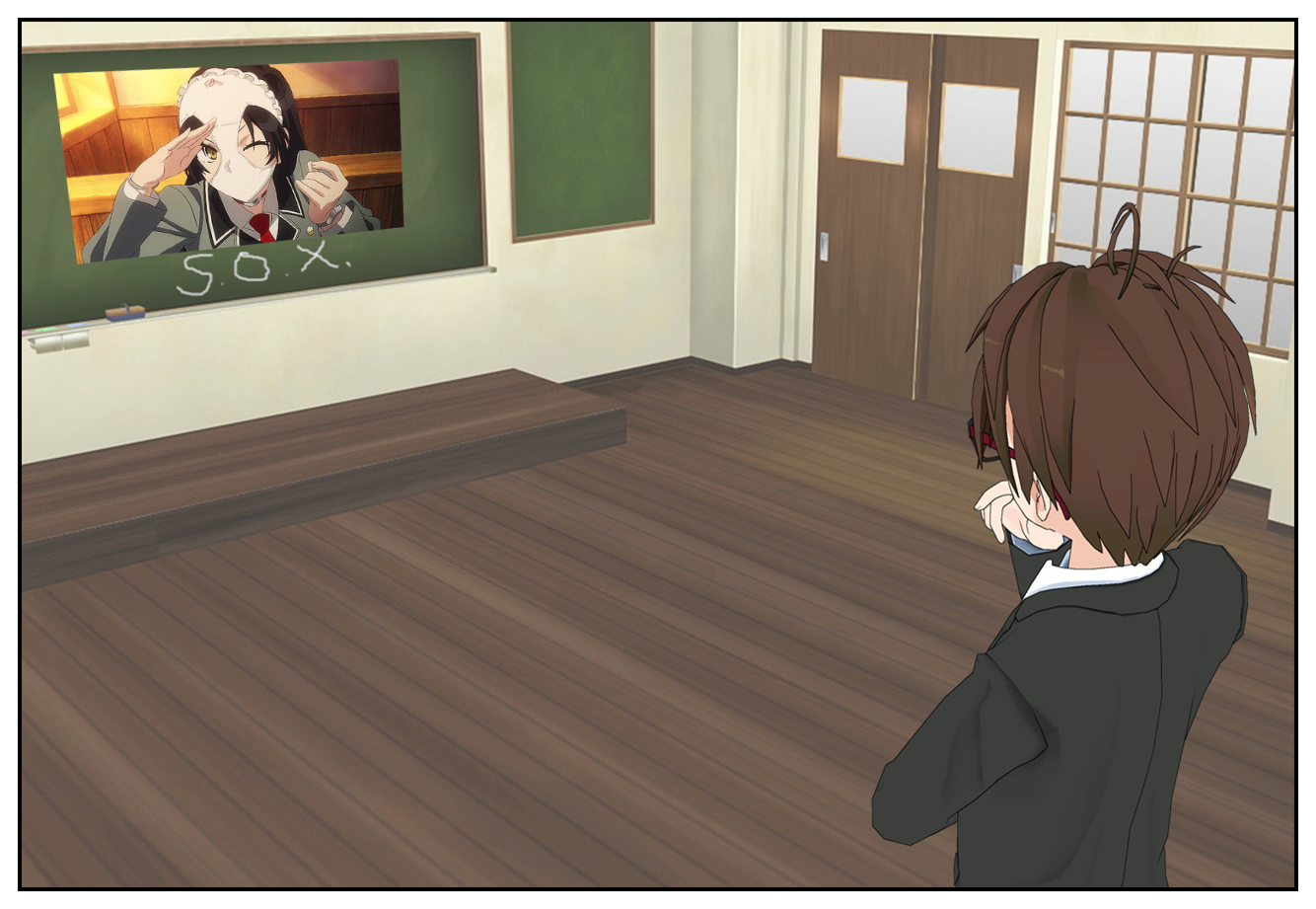
As Tanukichi makes his way to his new school, however, he encounters "Blue Snow", another notorious terrorist who habitually shows up clad in nothing more than what appears to be an artist's smock (with no underwear underneath) and a pair of panties on her face. Blue Snow allows him to flee from an unfortunate misunderstanding on the train to school that could have seen him landed in prison, and Tanukichi is very surprised to later discover that his "saviour" is, in fact, Ayame, a member of the school's student council who presents her public face as being somewhat quiet, stern and hard to approach.

Ayame's "public face" couldn't be further from the truth, however. She has a filthy mind and a foul mouth — plus, conveniently, a device on her elderly flip-phone that allows her to freely use as much coarse language as she likes for just a few minutes each day. Ayame quickly recruits Tanukichi to her cause in an attempt to educate the ignorant masses in the wonders of sexuality and "body-melding", since the student body is so ignorant of basic biology that it's clearly going to be a problem for future generations.

Shimoseka is interesting in that it feels like a direct response to several things. In some respects, it feels like it's an interpretation of Japan's notoriously low birth rate — modern day Japan's enthusiasm for erotically charged and explicit material is often attributed to this. In others, it feels like it's a take on Japan's curious censorship laws, in which sexually explicit material isn't outright banned, but instead makes use of the most half-hearted censorship in which things like penises and vaginas are still clearly visible, but blurred out with mosaics. In another sense still, Ayame in particular feels like a literal interpretation of the concept of honne and tatemae, the division of the "private" (honne) and "public" (tatemae) faces: putting up a respectable façade to the world while being as deviant as you like in the comfort of your own home.

shimoseka2Speaking from a Western perspective, Shimoseka feels even more curiously relevant considering the growth in "moral policing" that there's been over the last few years. Given that Japanese media is often on the receiving end of these tedious tirades from self-appointed "think of the children" moral crusaders, it's entirely appropriate that it would be a Japanese work that shows the inevitable consequences of allowing this sort of behaviour to continue unchecked. It's obviously an extreme example, but it's powerful and relevant given the climate of "criticism" (and I use that term loosely) that we live in today. I find it hard to believe that this angle couldn't have been deliberate; while Japan generally doesn't give much of a shit what prudish Westerners think of their pretty cartoon girls with big tits, many creators have doubtless run into these attitudes at one time or another, and Shimoseka has — so far, after two episodes, anyway — acted as an excellent smackdown to such criticisms, albeit in a fairly heavy-handed manner.

So far it's been a really good show, then. I'm looking forward to seeing more, if only to hear more of the creative obscenities that Ayame habitually hurls forth. Cock-a-doodle-pussy, indeed.

2000: Two Thousand

0001_001Hello! How are you? I'm fine. I hit a milestone today; two thousand consecutive daily posts on this blog. Back when I started doing this, I probably wouldn't have believed that I'd make it this far (or, indeed, that I'd keep count correctly — which I'm still not entirely convinced I have, but I'll take it) but, well, here we are.

I say "we"; I have a feeling that readers have come and gone over the years as I've written about different things, different events have occurred in my life and different interests have come and gone. There's only one thing that's been consistent about this blog over the last 2,000 days (and, indeed, before that, when I posted rather more irregularly) and that's that it isn't really about anything.

Well, that's not quite true, I guess. It's about me, as dreadfully vain as that sounds. But, well, that's what it is.

I resolved shortly after starting the original #oneaday project — the reason I'm doing this whole "daily posting" thing at all — to use this blog as a place where I could always be open, frank and honest, even if I sometimes found it difficult to do so in person. As longtime readers will, of course, know, I struggle somewhat with social anxiety issues, and at times I find it challenging to talk about "difficult" subjects. (The exact meaning of "difficult" varies somewhat from day to day, but rest assured most of them probably aren't what a "normal" person would really describe as in any way challenging to talk about.)

One thing I discovered through the original #oneaday project, though, was that writing is a good outlet. A fantastic outlet, in fact. It allows me to say things that I can't find the out-loud words for. It allows me to express opinions that I'm not sure how to get across in person. It allows me to share things about myself that might otherwise be embarrassing or difficult to share with other people face-to-face. And it allows other people to get to know me a bit better.

One thing is very much for certain; it's helped enormously. Having a reliable, predictable means of expressing myself on a daily basis is something that I've found to be of immeasurable value over the course of the last 2,000 days, and while the same therapeutic effect could probably be achieved by writing in a private journal — and that way no-one has to suffer through my inane ramblings except Future Pete any time he decides to flip back through the pages and decide whether or not Past Pete's inane ramblings are embarrassing enough to warrant throwing the entire book out — there's a little part of me that enjoys the knowledge that other people are reading the things I write. Whether or not they find them helpful or even entertaining is anyone's guess, but, well, as the old #oneaday mantra goes, this blog isn't "for" anyone except myself; the sole purpose of this blog is to get me writing every day.

And I've done that. For two thousand days. In terms of world culture my contribution is questionable at best, but I'm pleased with what I've achieved, anyway.

So looking to the future, then. Regular readers will doubtless have noticed that I've redesigned this place. I did so when I reached 1,000 posts and always intended to when I reached 2,000, too. This time around it's a more drastic redesign, with a new theme, new art style and all sorts of other goodness. The reason I did this was simply because I wanted to, frankly, but I also feel making use of some manga/anime-inspired artwork (courtesy of clunky but fun app ComiPo!, which I haven't used that much up until now) reflects my personality and interests as it exists in 2015. I don't know how ambitious I'll get with the artwork or how often I'll put it in there — I enjoyed doing my old stickman comics and feel they're very "me", but they were surprisingly time-consuming and eventually became a bit of a chore — but it'll show up every so often, at least. Plus, it's an opportunity for my MoeGamer mascots Midori (redhead; I know, I know, she should probably have green hair) and Yumi (grumpy) to put in an appearance on a somewhat more regular basis than they have the opportunity to over on my irregularly-updated Japanese gaming-centric site.

Anyway. To those of you who have been reading since day one, I appreciate your support. To those of you who have been reading for a while, I appreciate your support, too. In fact, anyone who takes the time out of their day — however infrequently — to read the drivel I push out, usually when I'm about to go to bed: I appreciate your support very much indeed.

Here's to another two thousand days… maybe.


1999: Sowing Discord

I'm always interested to find alternative ways to do things when it comes to technology, particularly if a once-reliable tool has become a messy piece of bloated crap.

Such is my feeling towards Skype, the well-known piece of messaging software that old people think is the only means of talking to people in other countries via the Internet.

Skype used to be great. It used to be simple, efficient, easy to use and easy to understand. It was intuitive and worked well. Then Microsoft got hold of it, and the entire application was redesigned from top to bottom and made almost the exact opposite of all the above adjectives. It's now a cluttered, inefficient, clunky and unintuitive pile of hot garbage — and, for many users, a hog on system resources, too. It still does the job — just about — but its frustrating aspects far outweigh its benefits for me these days, particularly when all I really use it for is in-game chat for games that don't directly support voice chat.

I was switched on to an app called Discord by a part-time member of our raid group in Final Fantasy XIV. I've never really looked into gaming-centric VOIP solutions like TeamSpeak or Mumble before, largely because they sounded complicated (and sometimes expensive) to set up. But Discord promised to be free, easy to set up and intuitive.

And what do you know? It really is.

Discord works similarly to services like TeamSpeak and Mumble in that you set up "servers", which are private collections of text and voice channels that can each have their own permissions set. People then join the server's public channels and, where applicable, are invited to private channels as necessary. From there, it's a nicely self-contained system that means you can keep all your in-game friends in one easy-to-manage place, and you can make use of voice chat with them without having to dick around with "calling" each other — you just all join the same communal channel.

Best of all, it's cross-platform, and even works in your web browser if you're on a public computer or don't want to download anything. It has game auto-detection systems that let your friends know what you're playing and if you're online, and some highly customisable notifications and text-to-speech options for true flexibility. In short, it seems like a really great piece of software that is an ideal solution for those who want a means of chatting with one another both in-game and out of the game, and it's certainly a lot better than the big bag of dicks Skype has become over the course of the last couple of years or so.

I'm conscious I sound like an advert here, but, well, if you're looking for something that fits the description I've given above, give it a shot. (If, on the other hand, you're an elderly person looking to talk to your children who live abroad, as the stereotype goes, Skype  probably still fits your needs just fine.)

Find out more here.

1998: Fist of the Father

Final Fantasy XIV's new raid dungeon Alexander launched earlier this week, and our regular raid group (with a few tweaks) took our first steps in there this evening.

I'd heard Alexander was significantly easier than The Binding Coil of Bahamut and was mildly concerned about this, but there are two things that set my mind at rest, having run through the first area now: 1) it's not easy, though it's straightforward enough once you know what to do, and 2) "Savage" mode is coming in a couple of weeks for the truly hardcore. (And it has different loot from the sound of things, too, unlike the Savage mode of Second Coil of Bahamut, which was largely a "bragging rights" sort of situation.)

I wasn't quite sure what to expect from Alexander. The concept itself is pretty weird: an iron giant raises itself out of the water in the Dravanian Hinterlands, but stops moving just as its hand grasps the bank. Through a convoluted series of interactions with the local goblins, you manage to find a way through the portal that is in its hand, and start working your way through in an attempt to find and destroy the core; the giant, it seems, is a Primal, and while it's active, even if it's not moving, it threatens to suck the very life out of the land.

Once inside you're in a cool, mechanical and metal environment. It's a big contrast from the previous raid dungeon, which made heavy use of the neon-glowing Allagan aesthetic, but since Heavensward as a whole has a lot of neon-glowing Allagan stuff just in its normal content, it seems the devs made the wise decision to not continue down this road with the new raid. Fine by me.

The bosses so far are appropriately steampunky in nature, and unlike Coil, which tends to be a short run to a single boss, the first level of Alexander features two bosses. The first is pretty much a pushover, but it's fun that it's more than just a single thing to fight. The main boss of the level, meanwhile, is a fairly involved fight that demands everyone knows what to do and performs their role appropriately. It's a little more forgiving than Coil was — mistakes are less likely to immediately wipe the whole group, though they will put you all at a disadvantage — but still challenging. We managed to clear it within a couple of hours, though, and even went back in to go get some more loot for those who lost the rolls after we'd finished.

We're hopefully going to jump in and see some more of it over in the weekend; I'm curious to see what mechanical mysteries the later levels have in store, and excited to be running with my regular group again.

1997: Chromecast Initial Impressions

Picked up a Chromecast today, Google's little HDMI dongle that you can plug into your TV (assuming you have an HDMI socket) and stream stuff from your phone, tablet or computer to. Andie and I had been thinking about getting one for a while — primarily so if we want to watch TV at night we're not forced to suffer Dave's endless reruns any longer — but hadn't got around to it. Finding myself at a loose end today, I went and forked over £30 (they're the same price wherever you go, which is nice) to pick one up.

Setting it up was pleasantly simple. It was a matter of going to the Chromecast site on my phone, which subsequently redirected me to Google Play to download the Chromecast app. (I could have skipped that first step if I'd known there was an app involved.) The Chromecast app then walked me through the process of setting it up — a process which took about two minutes, the most complicated part of which was going downstairs to find out what the Wi-Fi password was — and it was then ready to go.

Using it is pretty easy, too. There are several ways you can use it: certain apps such as Netflix, YouTube and Crunchyroll (the three sites where I watch most of my videos these days) support Chromecast natively and effectively allow you to use your phone, tablet or computer as a "remote" and beam the video directly to the TV; other services effectively "mirror" what's on your device to the TV, and via the Chromecast app itself (or natively in your phone's OS if it's one of the relatively small selection of phones that support it) you can mirror your whole phone's screen and sound to the TV. (This latter option is perhaps less practical than it sounds; it's no good for gaming, for example, as there's a noticeable lag of a second or two between doing something on the phone and it happening on the screen, but then it probably wasn't really designed for that.)

Alongside getting the Chromecast set up, I finally also set up Unblock Us on my phone. Unblock Us is a service that allows you to "trick" sites such as Netflix, Crunchyroll and the like into thinking you're in a different territory to where you actually are. The reason why this is useful is that different territories have different stuff available — Netflix's American version, for example, has a bigger selection than its British counterpart, though the later has improved significantly over time. It was a bit of a faff to set up on the phone, because you have to set up IP addresses manually rather than simply downloading a little applet to sort it all out for you (which is how you do it on a computer) but once I managed to find the right combination of numbers to put into the various slots on the form, I was happily streaming Bojack Horseman to my TV via my phone.

I'm really impressed so far. The picture quality is excellent and the streaming seems to be reliable, even though our Wi-Fi signal isn't all that strong upstairs. It's definitely going to fulfil our desire for streaming video in our bedroom, and for those of you with a slightly older, non-Smart HDTV, it's a cheap and effective means of getting most of the benefits of a newer unit without having to break the bank or find a space for a 55-inch behemoth.

Thumbs up to Chromecast, then. Looking forward to playing with it some more.

1996: Daylight

I gave the PS4 horror game Daylight a go this evening. It was super-cheap thanks to a hefty discount on PlayStation Plus, and I'd always found the concept to be interesting, so I felt like giving it a shot, even though its reviews hadn't been all that positive. (But when have I, a proud Hyperdimension Neptunia fan, ever cared what reviews thought of a game?)

Daylight's unique selling point is that it's a procedurally generated horror game. What this means in practice is that the various environments you wander through as you piece together the fragmented story are chopped and changed around a bit with each playthrough. I've only done a single playthrough so far — it's pretty short — so I can't say with confidence quite how much it's different each time around, but I can see how it would make changes without altering the fundamental structure and "journey" that the protagonist goes through.

Daylight casts you in the first-person role of Sarah. We don't know much about Sarah upon starting the game, save for the fact that she's woken up in what appears to be a ruined hospital, and some random dude with a frankly villainous voice is talking to her through her cellphone, which she has the good sense to use as a torch to light the darkness. (It's also a handy minimap.)

Gameplay is, I am assured, somewhat of the Slenderman mould, in that the vast majority of what you are doing throughout the game is picking up notes with various bits of Plot on them while attempting to fend off the unwanted attentions of various lurking horrors and ultimately unlocking the way to the next area. In Daylight's, case, you achieve this by collecting a particular number of "remnants" — notes and memos scattered around the area — until a "sigil" unlocks in a creepy room covered in strange symbols, and you must then take the sigil to a locked door to open it and proceed to the next area. The game alternates between these "scavenger hunt" sequences and calmer puzzle areas until you eventually reach the game's conclusion.

There's no combat in the game; this is a horror game in the Amnesia mould, in which just being near an enemy is enough to hurt you. However, there are several means of dealing with them rather than just running away screaming: simply making sure you're not looking at them keeps you safe, for one, but if you do happen to find yourself face to face with one of these bloody horrors, lighting a flare will cause them to combust in a satisfying fwoof of supernatural smoke and fire. These flares are, naturally, in rather limited supply — you can only carry four at once — so on occasion, it's better to try and avoid trouble rather than defeat your foes. You also can't use flares while you're carrying the sigil for an area, so it's a good idea to find the exit before you pick up the sigil just so you can make a break for it.

Like a lot of horror games, Daylight's story is piecemeal and leaves a lot up to interpretation — perhaps a little too much. It's not especially clever like the stories of its genremates in the Silent Hill series, and it's riddled with cliches, but it was enjoyable enough to pick through and come up with a few theories about, and it had a nicely creepy atmosphere to the whole thing.

Not the best horror game I've ever played, then, but an interesting one, nonetheless, and worth giving a shot to while it's cheap on PSN.

1995: Diet-Friendly Snacky Things

Since starting Slimming World, I've had to make a number of adjustments to my lifestyle to ensure that I continue to lose weight. And it's been a lot easier to do than I thought it would be; while there are days when I still miss cake or really, really want a whole bag of Wine Gums, for the most part I'm pretty much okay. And the reason for this is that I've found a number of acceptable "substitutes" for those times when I just want to eat something as a snack — not a full meal, but just something to munch on for whatever reason.

I have a couple of weaknesses that contributed to my weight gain in the first place: firstly, I very much have a weakness for sweet things (such as the aforementioned cake and wine gums) and secondly, I have a tendency to eat when I'm depressed (which is quite often) or when I'm bored (which often leads to depression). These habits are fundamental parts of my character that I can't eliminate entirely, but which I can act upon in a more… responsible manner.

As such, here are some of the diet-friendly snacky things that I tend to make sure I have in the cupboard or fridge at all times, so that any time I'm feeling peckish for whatever reason, I can grab them and enjoy them without guilt that I'm ruining the hard work I've been doing.

Laughing Cow Little Cravings

miniCheese-largeThese things were a revelation. I wouldn't call myself a particular cheese addict — in stark contrast to my wife, who loves a bit of cheese, despite technically being lactose intolerant — but I do like cheesy things now and then. What Little Cravings are is small, bite-size cubes of Laughing Cow cheese spread, optionally flavoured to taste a bit like "real" cheese — in the case of the pack shown on the right, cheddar, smoked processed cheese and blue cheese.

They're surprisingly tasty and satisfy a craving when one comes long. Plus at half a Syn each (you can have 5-15 Syns per day) on Slimming World, they really are pretty much guilt-free, which is exactly what I want from a snack.

Metcalfe's Skinny Popcorn

sweet_nsalt_largeI love popcorn. My favourite is toffee popcorn, which obviously (probably — I haven't checked) isn't at all diet-friendly, but Metcalfe's range of "skinny popcorn" (sometimes found branded as "skinny topcorn" for some reason) is really tasty, comes in a variety of different flavours (I'm a particular fan of the sweet and salty variety pictured here, along with the cinnamon and honey flavoured ones) and is very low on the Syns, at 2.5 Syns per small bag or serving (a little under 20g, which in popcorn terms is actually a reasonably generous portion).

While it's not quite the same as a bag of crisps, a bag of popcorn, I find, satisfies that similar urge for something crunchy and/or salty (or, sometimes, sweet, depending on the flavour) so I'm going to make sure I have plenty of this on hand when I can.

Muller Light

116361011_0_640x640I was never a big yogurt-eater while I was growing up. I had that childish thing where I didn't like "bits" in my yogurt, and while I don't mind it now, I still generally prefer a smooth dessert of some description.

Enter Muller Light, then, which is not only Syn-free for most flavours (there are a couple of exceptions) but which has a range of very tasty smooth flavours, some of which even have sprinkles of dark chocolate on them, helping to satisfy chocolate cravings. It's not a lot of chocolate, admittedly, but it's better than nothing — and it's completely guilt-free, which is just wonderful. I particularly recommend the vanilla with chocolate, orange with chocolate, coconut with chocolate and skinny cappuccino flavours, the latter of which I am disappointed that I haven't been able to find recently.

Fish

ProductLarge_Eng2_AMEND_MackerelFilletsSpicyTomatoSauceI eat a lot more fish than I used to. A quick and easy lunch for me these days is a bowl of rice with some smoked mackerel in some kind of sauce stirred into it. Most of these are Syn-free, too (there are exceptions, but none of them are particularly high — you're safe with the tomato and spicy tomato varieties, which are both Syn-free) and between them and the rice (which is Syn-free if you cook it properly, one Syn if you're lazy and use the Uncle Ben's pouches thanks to the oil in them) they satisfy hunger for a good long period, making them ideal for either lunch or just a snack if you're feeling particularly hungry. You will smell of fish, though, so be prepared to explain that.
1994: The Beginner's Guide to Twitter

Longtime supporter of this blog and regular commenter Jud joined Twitter recently, and seems to be at a bit of a loss as to what to do with it. I remember feeling much the same way when I first joined the site; it was quite some time before I got a feel for what it was all about and how it worked. So with that in mind, today's entry is dedicated to Jud and anyone else who doesn't understand what Twitter is, how it works and how to use it.

What is Twitter?

Twitter always used to position itself as a "microblogging" platform; a means for people to express themselves in deliberately short snippets of text: no more than 140 characters. Over time, it's evolved, and can now be used for a lot of different things: as a means of staying up-to-date on topics that interest you; as a means of socialising with people who share your interests; as a means of staying in touch with friends; and as a means of yelling abuse at random strangers on the Internet.

The most important thing about Twitter is that it is a public means of communication. That means that anything you put on Twitter can be read by anyone on the Internet, and they don't necessarily have to have a Twitter account to do so. There is the option to make your account "private" — which means only people who are already following you or people you specifically grant the ability to follow you after they request it can see your tweets — but using that kind of misses part of the appeal of the site, which is coming into contact with people you may not have otherwise "met".

twitter1

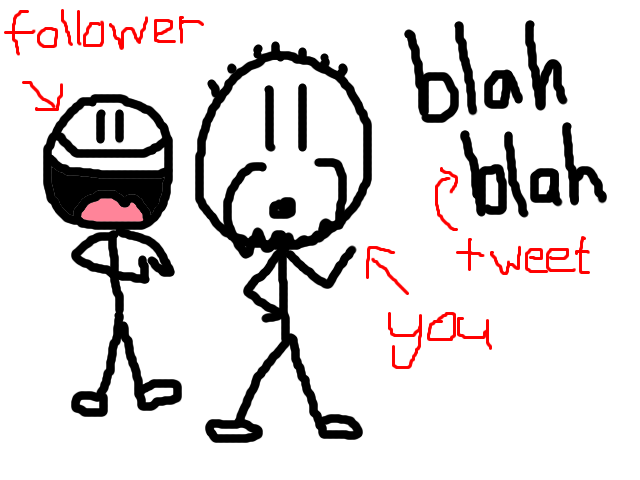
The best way of thinking of Twitter in metaphorical terms is that it's a bit like being at a party, but a rather strange party where everyone present is constantly making speeches in the hope that someone will listen to them. Someone who follows you is someone who is listening to your speech; your tweets themselves make up the speech. This is the simplest possible use of Twitter; use it to express short snippets of thoughts and opinions into the world, and hope that someone, somewhere finds it interesting.

Key terms

  • Timeline: the main screen you see on Twitter, consisting of all the tweets from people you are following. The most recent tweets are at the top, and as you scroll down the page you'll see older and older tweets. The screen will keep scrolling forever in most circumstances, so don't try and reach the bottom, otherwise you'll be there all day.
  • Tweet: A single 140-character public message that may or may not include mentions.
  • Mention: A tweet that includes another user's username.
  • Direct Message: A private message between two or more Twitter users.
  • Profile: An individual user's Twitter page that shows just their tweets along with some brief biographical information they may have chosen to share. You can access any user's profile by going to http://twitter.com/username, replacing username with the username of the user whose profile you would like to see. For example, to see my Twitter profile, you'd visit http://twitter.com/AstralFireIII.
  • Avatar: (also "avi") The small image a user uses to represent themselves on Twitter. The default avatar is an egg on a coloured background. Since a lot of people habitually ignore "egg avatars" as they're a common sign of spammers, it's best to put some form of personalised image here as soon as possible; it doesn't have to be a picture of yourself.
  • Banner: The large image that appears at the top of your profile.
  • Follower: Someone who has chosen to follow you and have your tweets appear in their timeline.
  • Mute: An option that allows you to stop seeing tweets from people or that contain particular terms without outright blocking them.
  • Block: An option that prevents another user from interacting with you or seeing your tweets.
  • Retweet: An option that allows you to reshare someone's tweet onto your follower's timelines (optionally with a comment of your own), even if they aren't following the person you retweet.
  • Livetweet: A slang terms used to describe someone using Twitter to provide "live" updates on a situation that is unfolding. Most commonly used during press conferences or big news events where things can be announced, revealed or happen dramatically and quickly.

How do I interact with people?

There are several ways you can do this:

  • Mention: Also known as "@replies", mentioning someone involves including the "at" ("@") sign followed immediately by someone's username somewhere in your tweet. If you do this, the recipient will receive a notification that you have mentioned them.

    Important to note about mentions is the fact that if you put the @username at the beginning of the tweet, only people who are following the recipient of your mention will see your mention in their timeline. If you want your reply to be more "public" and visible to everyone, even if they're not the recipient, you can either put the @username elswhere in the tweet (at the end is common) or put something before the initial @username such as a full stop. The latter practice is often known as "dot-replying" and is considered bad form by some people.

    In our "party" context from earlier, this is like replying to someone's public speech and having a public discussion that other people can overhear.

  • Subtweet: I include this here only because people complain about it all the time. Subtweeting is a made-up word used to describe passive-aggressive tweets that don't directly mention someone, but which are clearly and obviously about a particular person. While it's delightfully easy to be passive-aggressive on Twitter, subtweeting is considered the height of bad form, so avoid it.

    In our "party" context, this is like making pointed comments about someone without actually mentioning them or talking directly to them. ("Someone should have looked in the mirror before coming out tonight!)

  • Direct Message: Also known as a "DM", a Direct Message is what you use if you want a private conversation with one or more other Twitter users. Direct Messages do not appear on your respective timelines, and instead appear in the Messages tab. To send a Direct Message to someone, either go to a user's profile or the Messages tab.

    In our "party" context, this is like dragging someone off to the bathroom (or room of your choice) for a private conversation.

  • Favourite: Clicking the "star" icon (it sometimes appears as a "heart" on some Twitter apps) under a tweet has a similar effect to the "like" button on Facebook. It's an interaction that basically says "I like this" or "I want to keep track of this for later". You can revisit your favourites from your own profile page, or look at other people's favourites from theirs. Favourites are public!

    In our "party" context, this is like nodding approvingly at something someone has said. Alternatively, some people use it like making a note of something someone said to revisit later.

  • Retweet: If you see a tweet you particularly like, agree with or just want to share for one reason or another, you can retweet it. This means it will appear in all your followers' timelines, even if they don't follow the person you retweeted. You can optionally add a comment to a retweet if you want to add your own thoughts on it.

    In our "party" context, this is like repeating something someone said to you earlier to someone else.

  • Hashtags: Adding the hash sign ("#") to a word (or cluster of words with no spaces) turns it into a hashtag, which your followers (and you!) are then able to click on to see other people talking about the same thing. This is most commonly used by marketers or communities who want to keep track of discussion on a given topic easily without having to follow hundreds of individual users. Some hashtags become mini-communities in their own right.

    In our "party" context, this is like all the jocks clustering in one corner and talking among themselves, all the nerds in another corner talking among themselves, and all the Game of Thrones fans sitting in another corner giving their own play-by-play commentaries of the episode that is currently on the television.

What else can I do on Twitter?

Besides following people and interacting with them via the means listed above, you can also group people (including those you aren't following) into Lists, each of which then gets its own individual timeline — this is useful for collecting together things that you might want to keep track of, but don't want to clutter your main timeline with.

There's also a powerful search function that lets you look for users, hashtags, topics and even specific things people have said.

What should be the first things I do on Twitter?

  • Update your profile. Make sure that you can be found (assuming you want to be found!) by including your name (or a known pseudonym you use) and some biographical information, optionally including your location.
  • Add an avatar. Egg avatars are habitually ignored, so put a new picture in as soon as possible. Go to your profile and hit the Edit button and it's simple to do.
  • Follow some people. Twitter is made for socialising, so follow some people you find interesting or want to stay in touch with. Don't feel obliged to follow all the people they follow, because you may have different interests. Instead, over time, gradually curate your following list until your timeline looks the way you want it to.
  • Interact with people. People won't follow you back unless you give them a reason to. Interact with them, talk with them, engage with the things they're saying.
  • Try not to get into any fights. Twitter's brevity is a blessing and a curse; the 140-character limit protects against waffling somewhat (though many people get around this by simply chaining long strings of tweets together by replying to themselves) but this also means that, on occasion, certain nuances can be lost. Discussions on contentious subjects can escalate quickly!
  • Gratuitous self-promotion. Twitter is used by a lot of people as an important means of getting their work in front of as many people as possible. Don't be afraid to link to things you've written or otherwise produced that you particularly want people to take a look at.
  • Enjoy! Twitter can and should be fun and useful. If it's not, though, don't worry! Some people simply don't get along with it as a means of communication and happily go about their lives without it. Follow the tips above, though, and you should be getting the most out of it in no time.

1993: The Joy of Smaller Games

You know me by now; I enjoy a good 100+ hour RPG that I can sink my teeth into over a long period of time, but I'm often reminded quite how much a short, simple, straightforward game can hit the spot on occasion.

There's a lot of different places you can get this sort of experience, but I've been finding it particularly pleasant on the PlayStation 4 recently — thanks in part to freebies delivered through PlayStation Plus, and partly simply due to the selection of excellent, low-cost indie titles available on the platform.

Triple-A junkies are quick to whinge about the number of indie titles on PS4, particularly when they show up as PlayStation Plus freebies — they're seen as "less valuable" somehow — but, in actual fact, the PS4 is a good home to them. Not only is the Dual Shock 4 eminently suitable for fast-paced arcade games — which a lot of these titles, which tend to channel retro sensibilities somewhat, err on the side of — but social features like the screenshot sharing, online leaderboards and live video broadcasting make otherwise solo experiences into much more compelling prospects that can be shared with others.

Most recently, I've been particularly enjoying a couple of games, and in many ways they are polar opposites of one another.

woahdave

The first is a title called Woah Dave, an Atari 2600-style platformer from the people who created the Bit Trip series a while back. Woah Dave is a deceptively simple but enormously addictive take on the Mario Bros/Bubble Bobble formula in that all you have to do is survive for as long as possible while fending off never-ending waves of enemies. You can jump, you can pick up things, you can throw them. That's it. It gets more frantic as you progress, and the only reason to play is to try and get a high score. And that is reason enough.

Woah Dave is testament to the fact that strong gameplay will always be compelling and enjoyable, regardless of technical proficiency. That said, while the game looks like a mess of gigantic pixels in about 8 colours, it runs at a silky smooth framerate, with extremely responsive controls and a very enjoyable overall "feel" to the whole experience. It's dumb and it's silly and it's shallow, but it's a lot of fun.

Astebreed3

The other game I've been playing a bit recently is a shoot 'em up called Astebreed. I was a big fan of this when it originally released on PC, so I decided to "double dip" on the PlayStation 4 version, and haven't been disappointed.

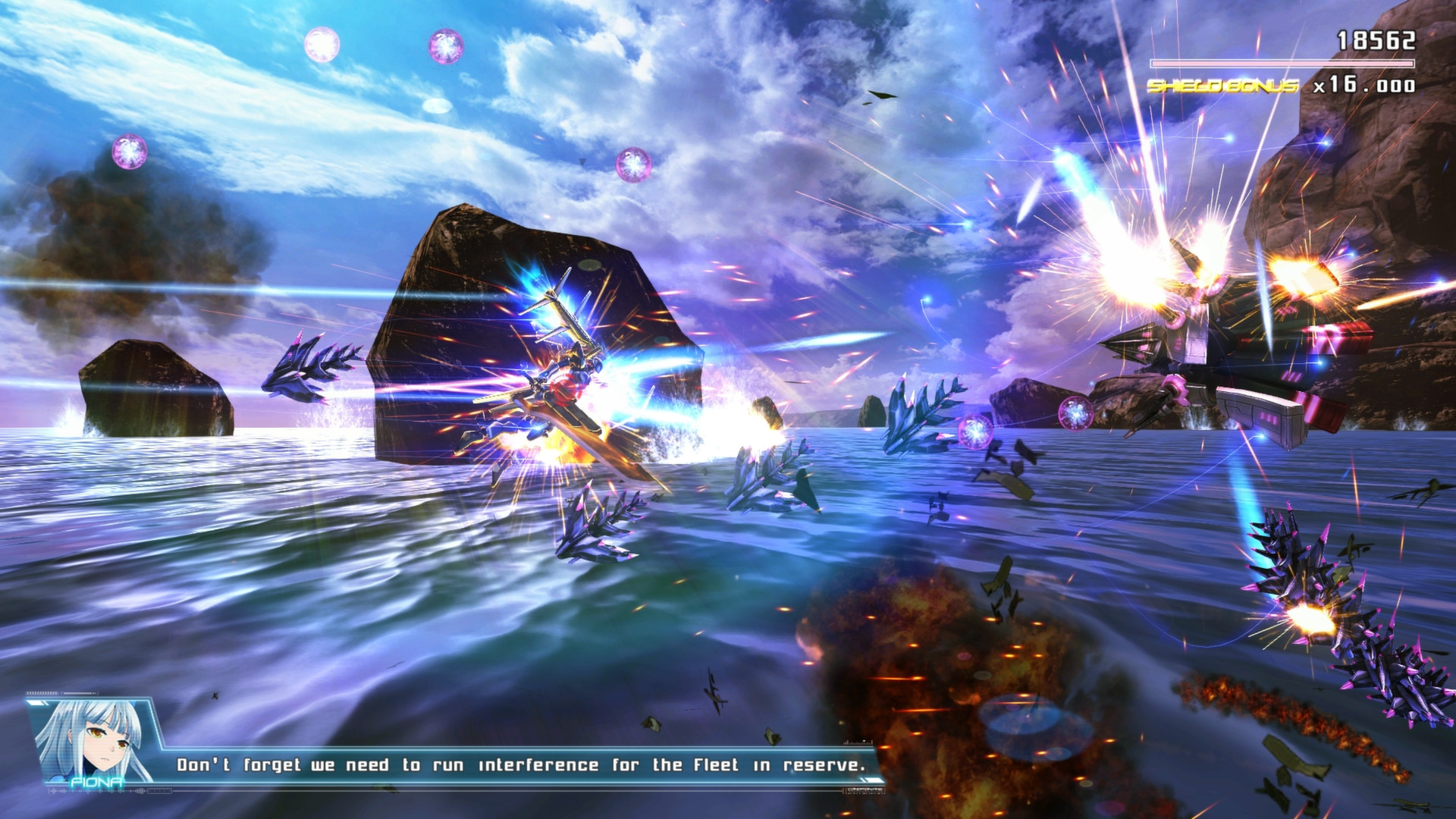
Astebreed is a beautiful-looking, 1080p, 60 frames per second cinematic shoot 'em up in which you pilot a giant mecha with some unconventional weapons systems as you attempt to fend off the unwanted advances of alien race the Filune. Along the way you learn more about their human experimentation and the true fate of your adoptive father and his two daughters, who have been made into living parts of a Filune reality alteration system that has the potential to be used as a deadly weapon.

The plot is pure anime — and, frankly, a little difficult to follow, given that a lot of it unfolds while the action is coming thick and fast on screen, leaving little time to read subtitles — but it's snappy, pacy, dramatic and even a little emotional. Unlockable documents that you can read after clearing the game once show that the game world, setting and backstory have been very comprehensively fleshed out, too, and the whole experience is wonderfully polished until it shines.

I'm still rubbish at it, though.

1992: The Essence of a Great RPG

I've been playing some Omega Quintet and Final Fantasy XIV today. I've technically "finished" both of them from a story perspective, but both have an "endgame" that you can keep playing after the main story is completed. In Omega Quintet's case, it's an opportunity to take on some challenging quests that require you to defeat very strong enemies as well as clean up any loose ends you might have left behind such as the optional "Training Facility" dungeon; in Final Fantasy XIV's case, it's a matter of gearing up and/or levelling other classes, largely in preparation for future content additions such as the imminent raid Alexander.

Playing both of these games from this perspective today made me come to something of a realisation: the essence of a truly great RPG — or, perhaps more accurately, one that I will doubtless think back on particularly fondly long after I've finished, even if it might not be critically acclaimed or widely beloved — is twofold: firstly, it has to draw me in and captivate me with its story and/or characters, then after that, the mechanics have to stand up to hours of play. If both of these things are true, I will happily spend hundreds — even thousands, in the case of Final Fantasy XIV — of hours on the game in question.

There are quite a lot of games that have fallen into this category for me over the years. Gust's Ar Tonelico series is one, for example; while there's not really an "endgame" in any of its three installments, they do have multiple endings that necessitate additional playthroughs (or strategic saving). Compile Heart's Neptunia series is another; with pretty much all of the games in that series (with the exception of the very first and the idol sim Hyperdimension Neptunia PP, which I fully intend to go back to at some point soon) I've seen fit to exhaust absolutely everything they have to offer rather than playing them through once and being done with them. Both Hyperdimension Neptunia Victory and Hyperdimension Neptunia Re;Birth1 took up well over a hundred hours of my life, for example.

Most recently, as previously noted, Omega Quintet has been keeping me busy in this regard. Omega Quintet has such a pleasing blend of story, characterisation and hugely enjoyable mechanics — its battle system is one of my favourite takes on turn-based combat I think I've ever seen — that I find it fun to just boot up and have a few fights in. The fact that the endgame section rewards you with massive amounts of experience for many of the battles, allowing you to level the girls up to ridiculous power levels — there doesn't appear to be the usual level cap of 99 in place — makes for a hugely satisfying experience. Enemies that once caused me considerable grief can now be defeated relatively easily — though pleasingly, Omega Quintet, particularly on its hardest difficulty, isn't afraid to smack you about a bit every so often if you get a bit cocky; I think I've had more "Game Over" screens in the endgame than I did throughout the whole story, and it's usually been because I made foolish assumptions that I was then punished for.

The only trouble with finding games that I want to spend hundreds of hours with in this way is that it means beating a single game to my satisfaction takes a hell of a long time. Still, I guess it means I shouldn't run out of things to play any time soon, huh? And that's quite a nice feeling.