#oneaday Day 407: More Death in Paradise

My slide into middle-age is ongoing as I find myself continuing to watch Death in Paradise, the murder mystery show about a fish-out-of-water detective from jolly old England finding themselves solving murders on a Caribbean island with probably the highest murders per capita figure in the entire world.

I'm up to the fifth season now, which is well into second lead Kris Marshall's tenure on the show. His arrival at the start of the third series, thanks to the impressively ballsy move of murdering the former lead, DI Poole (played with aplomb by Ben Miller), marked a notable shift for the show, but it handles it well. Most crucially, it continues to be enjoyable and appealing for much the same reasons as when Miller's Poole character had the leading role, and I suspect that later changes in the core cast will continue this trend.

It's not just the lead that changes, either. While Danny John-Jules' excellent Officer Dwayne Myers remains in place for a significant portion of the run — I believe he finally stops being a regular around the seventh season or so? — the other "main characters" shift around a bit. The lead detective's second, initially a young woman named Camille (Sara Martins), departs the show partway through the fourth season after having been a failed love interest for both Miller and Marshall's characters, and is replaced by Florence (Joséphine Jobert), who initially takes the place of Fidel, one of the uniformed officers in the show, and is subsequently promoted to take Camille's place after the latter takes a job in Paris. The open "second uniformed officer" slot is then taken up by JP (Tobi Bakare), who stays in place, as far as I can make out, until the end of the show's present run.

Anyway, point is, the cast undergoes some quite substantial changes over the course of the show's complete run to date, but it still feels coherent. There's a good sense of "handover" from prior cast members to new ones, and the overall "feel" of the show remains remarkably consistent.

Part of this is entirely deliberate, and somewhat lampshaded by the structure of the show — especially the denouement, during which the lead detective gathers all the main suspects and witnesses together, then dramatically explains whodunnit, how and why. Early in Marshall's run on the show, he is introduced to this format as being how DI Poole did things, and there are plenty of jokes in subsequent episodes when certain individuals talk about going to arrest a suspect, only to be told "that's not how we do things around here".

It's intensely, extremely formulaic, but in many ways that's what makes it so comforting. The details of each case are different enough to keep each episode feeling fresh, but the structure of the storytelling is always the same. It's a structure that works, and is effective at telling a fun murder-mystery story over the course of each hour-long episode.

I've always had a real spot for detective stories. I read all the Sherlock Holmes stories as a youth, in a book that basically reprinted all the old Strand magazine pages they originally appeared in, in extremely tiny print. I played a bunch of detective-style adventure games with my mother as a kid — and continued to do so into my adult life. And I don't think there's a detective-style TV show that I've watched to date that I haven't enjoyed.

There are some today who would probably argue that this sort of show is "copaganda", and I get that. There are many things one can criticise the real-world police for, and in more recent years I really feel like I understand why some people feel quite so aggrieved at the very existence of police forces.

But at the same time, a good old murder mystery is a classic story format with good reason, and a cast of police officers is an ideal vehicle for telling a story like that. So I don't feel the slightest bit guilty in unironically enjoying shows like Death in Paradise simply for what they are. The real police may, in many ways, suck, but that doesn't mean you can't root for fictional detectives to crack each case!


Want to read my thoughts on various video games, visual novels and other popular culture things? Stop by MoeGamer.net, my site for all things fun where I am generally a lot more cheerful. And if you fancy watching some vids on classic games, drop by my YouTube channel.

If you want this nonsense in your inbox every day, please feel free to subscribe via email. Your email address won't be used for anything else.

#oneaday Day 388: Death in Paradise

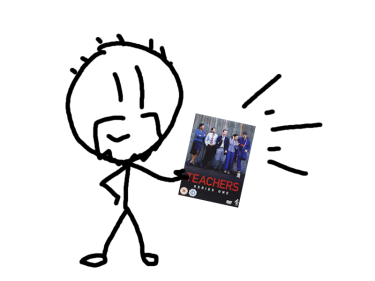
I've started watching Death in Paradise. This is a TV show that my wife watched in its entirety during quiet and boring moments at work a while back (she has a lot of quiet and boring moments at her job) and which I always enjoyed any time I happened to sit in the comfy chair in her study, usually to cuddle a demanding cat.

After watching Shakespeare & Hathaway: Private Investigators and A Good Girl's Guide to Murder, I thought I may as well just watch Death in Paradise from the start. And I'm really enjoying it.

For the uninitiated, Death in Paradise is a heavily formulaic murder mystery show in which a fish-out-of-water detective from Great Britain (or, for a period later in its run, Ireland) finds themselves acting as the Detective Inspector for a little police station in the town of Honoré on the fictional Caribbean island of Saint Marie. Initially, this role is taken up by Ben Miller (of comedy duo Armstrong and Miller fame) who plays Detective Richard Poole, but over the course of the show's complete run to date, the lead role changes several times — including, via a rather ballsy move at the opening of the third series, the murder of said lead. Spoilers, I guess.

Death in Paradsise is not a particularly demanding watch. And when I say it's formulaic, I really mean it; each episode very much has a standard structure, and it sticks pretty rigidly to that format. Sometimes this sort of thing annoys me, as I find myself expecting each of the obvious story beats, but the cases themselves are interesting and varied enough that the repetitive structure of the show has not yet become an issue for me.

The show is helped along very much by its cast. Thus far, I'm coming towards the end of the second season, so I'm still in Ben Miller/Detective Richard Poole territory, but I've caught a little bit of several of the later series, which include excellent comic actors such as Kris Marshall, Ardal O'Hanlon and Ralf Little. The supporting characters are also very good, with Danny John-Jules (best known as Cat from Red Dwarf) putting in a particularly strong performance as one of the station's regular police officers, and Don Warrington as Commissioner Selwyn Patterson steals the show any time he's on screen with his understated, deadpan performances.

The show strikes a great balance between serious drama and entertainment. It's not as explicitly comedic as something like Shakespeare & Hathaway, but it is notably light-hearted — perhaps a strange thing to say about a show in which at least one person gets murdered every episode, but an accurate statement, nonetheless. It captures a good feeling of camaraderie between the core cast, and the growth in Miller's Poole character as the series goes on is endearing to watch, even as he remains steadfastly stiff-upper-lip British about everything.

Like I say, it's an undemanding watch, good to throw on when you don't really want to tax your brain too much, and thus I'm never going to hold it up as The Best Thing Ever or anything. But sometimes that doesn't matter; sometimes you just want something that has enough substance to be genuinely engaging and entertaining, but which doesn't make excessive demands of its audience. Death in Paradise very much falls into that category. No deep lore, no need to listen to podcasts to understand each episode after watching them, no worrying that you've missed out on major serialised storylines — aside from the occasional replacement of the lead role, of course.

It's simple, uncomplicated entertainment, and I'm all for that. So I'll be watching a lot more of it!


Want to read my thoughts on various video games, visual novels and other popular culture things? Stop by MoeGamer.net, my site for all things fun where I am generally a lot more cheerful. And if you fancy watching some vids on classic games, drop by my YouTube channel.

If you want this nonsense in your inbox every day, please feel free to subscribe via email. Your email address won't be used for anything else.

#oneaday Day 379: I watched A Good Girl's Guide to Murder

After enjoying Shakespeare & Hathaway: Private Investigators recently, I found myself hankering after another murder mystery type thing, and BBC iPlayer was good enough to recommend a show called A Good Girl's Guide to Murder, which sounded intriguing. I hadn't heard of the show before but I liked the premise and it sounded like an interesting contrast to the somewhat comedic tone of Shakespeare & Hathaway, so I took a chance on it.

A couple of days later, I've finished watching the full series of six episodes, and I really enjoyed it, so I thought I'd talk about it a bit today.

A Good Girl's Guide to Murder is apparently based on a novel of the same name by Holly Jackson. Specifically, it's an adaptation of the first novel in a series of three and a bit — I say this because the last one is described as a "novella" rather than a "novel" — and it looks as if the show has been renewed for a second season, so presumably the plan, long-term, is to adapt the whole series.

The premise of the show is that A-grade and possibly autistic student Pip is preparing for university admissions, and part of this process involves the preparation of an "EPQ" — an Extended Project Qualification, which some students in England and Wales do to add to their "UCAS Points" total. I'd never heard of this, as it was introduced after my time in the classroom as both student and teacher, but apparently it adds up to about half an A-level points-wise. But I digress.

Pip decides to do her EPQ on a notorious local incident in which a young woman named Andie Bell went missing and was assumed to have been murdered, but her body was never found. Her boyfriend at the time, Sal Singh, was assumed to be the murderer because he was found to have committed suicide shortly after Andie went missing, but something didn't seem right to Pip. She starts investigating and — spoilers, I guess — eventually brings the full truth of the situation to light, though not without encountering numerous roadblocks and a lot of soul-searching along the way.

Being a 17 year old girl, Pip doesn't go about her investigation as a policeman or private detective would. Instead, she engages in the sort of subterfuge only a teenage girl is capable of, aided and abetted in most circumstances by Sal's brother Ravi, who also has doubts about whether his brother was really a murderer. Over the course of the series, she breaks into houses, steals evidence, attends illicit raves, puts herself in mortal peril on multiple occasions and somehow manages to survive the whole experience.

It's very much a "suspension of disbelief" kind of show, because a lot of things just sort of seem to work out quite conveniently for Pip, and there are several instances where she almost gets caught and could quite clearly have been collared after the fact, but manages to escape any real consequences. But once you're immersed in the show, none of this really matters, because it's a really fun ride; you root for the plucky Pip as she repeatedly gets into things well over her head, and come out cheering for her when she finally manages to uncover something missed when the case was originally investigated.

Part of Pip not suffering any real consequences for the things she does stems from the "Good Girl" part of the title; Pip is renowned as a good girl, a straight-A student and someone who has always been well-behaved and sensible. As such, she can get away with a lot of things, even when her parents expressly forbid her from continuing to work on the case on the grounds that it's dangerous and threatens to dredge up terrible memories for several local families.

Towards the end of the series, the show really gets into this theme in a somewhat literary manner: the concept that someone can appear to be a "good person" on the outside, but actually harbour darkness in their heart. Exactly what form this "darkness" can take varies from person to person; in Pip's case, it manifests both through her willingness to flout the "rules" of society to get the job done, and her own sense of guilt over the past. She believes that a chance encounter shortly before Andie's disappearance may have indirectly been a catalyst for all this, so part of her initially altruistic-seeming investigation is to absolve herself of that guilt.

In the case of other characters, the darkness is more obvious. One character, crucial to the eventual outcome of the case, describes himself as being fundamentally a "good person" but having a "dark seed" inside himself; he believes that everyone has such a "seed" inside themselves, and it just takes "the right conditions for it to grow". In his case, it most certainly did grow, leading him to commit unforgivable, unconscionable acts — though to his credit, once he's caught he does appear to be legitimately remorseful — and surprise everyone around him that he was capable of such things.

I don't want to get too much into the details of the story because I think it's worth watching and the twists and turns of the narrative are, of course, part of the appeal. So instead I'll talk a bit about the overall presentation of the show, which is excellent.

The visual direction is striking and dynamic; no scene is truly static, and the show makes great use of close-ups to highlight both characters' emotions and the danger and discomfort Pip finds herself in when getting a little too close to the truth. The actors are all very well-cast — Emma Myers as Pip is particularly excellent, as one would hope for the lead — and manage to nail a feeling of realistic diversity without feeling tokenistic. This is relevant, because matters of racism do play a part in the narrative; as Ravi points out, as enlightened as we might wish we all were, the fact is that certain types of people — particularly middle-class people who live in a small, affluent town — are inclined to believe that a "brown boy" (as he puts it) might not have the best interests of a "blonde white girl" at heart.

The show isn't obnoxious about this message; it only brings it up a couple of times, and it is a worthwhile contemporary talking point. The sort of small town in which the majority of the narrative unfolds is the kind that would be inextricably associated with white, middle-class England, but Pip in particular, as a thoroughly modern Good Girl, is above such things. Part of this is down to the fact that her mother married a Nigerian man after Pip's biological father passed away when she was just a year old, and as such, she has always been exposed to the idea of diversity and tolerance on a daily basis. But it's also a reflection of the modern youth: conscious of social issues, aware that society still has problems, and open about wanting to do their part in making things a little bit better.

Where the show is really striking, though, is in its use of music. There's a lot of contemporary music used on the soundtrack, and it is often used to emphasise powerfully emotional moments; it's always very loud compared to the relatively quiet dialogue sequences, though, making for an attention-grabbing contrast between the more personal, intimate moments and the bigger picture of what is going on.

The contemporary popular music is contrasted with an excellent original score that highlights the tension of numerous scenes, in some cases mimicking "sound effects" to reflect what is going on. During a sequence where Pip's beloved dog Barney goes missing, for example, the soundtrack makes use of a somewhat "sonar"-style motif to reflect the search that is going on; initially, it's almost hard to determine whether the sound is diegetic or not, but as the texture of the track builds up as the tension increases, it becomes clear that it's part of the overall soundscape of the show.

I really enjoyed A Good Girl's Guide to Murder overall. After finishing one episode, I was keen to immediately watch the next, and I must confess I have spent my whole morning watching the final three episodes because I really wanted to see how things turned out. It's compelling, well-crafted and exceedingly well-presented viewing, and while it's perhaps not particularly realistic if you stop to think about things too much, it doesn't take long for that to cease mattering and for you to be drawn in to the narrative.

Yes, it may primarily be aimed at teens — it was a BBC Three show, after all — but don't let that put you off if you're a little older and still enjoy a good murder mystery. I found myself thinking as I watched that it would make a good anime, and I think that's testament to what makes it good — like the best anime series, it's a show that all ages can get something out of; it doesn't talk down to its core audience, and it doesn't feel cringeworthy and insincere to older viewers.

Definite recommend, then. Here's hoping that second series materialises!


Want to read my thoughts on various video games, visual novels and other popular culture things? Stop by MoeGamer.net, my site for all things fun where I am generally a lot more cheerful. And if you fancy watching some vids on classic games, drop by my YouTube channel.

If you want this nonsense in your inbox every day, please feel free to subscribe via email. Your email address won't be used for anything else.

#oneaday Day 366: Bardic Investigations

I have now watched roughly half of the complete run to date of Shakespeare and Hathaway: Private Investigators, and I'm still really enjoying it. It's low-effort TV but not in an "insulting to your intelligence" sort of way; more that it's quite gentle in terms of both it's dramatic and comedic aspects.

A good example of this is the fact that in the 21 episodes I've watched so far, there hasn't been a single fight scene, and action scenes in general are fairly limited. There's been a few car chases and a number of on-foot pursuits, too, but given the two protagonists are neither exactly in the prime of life, they mostly conclude with them outwitting their quarry rather than taking them down dramatically.

There's no swearing, either. I don't mind a bit of effing and jeffing at all — heaven knows I do it enough around here — but it is nice to watch a show that isn't being particularly tryhard about showing the "gritty" side of life.

In fact, as I noted in my first impressions, Shakespeare and Hathaway is mostly rather cartoonish, or perhaps more accurately, theatrical. Villains are unmistakably evil, with most of them practically twirling their figurative moustaches at every opportunity. Far from making the show cheesy and silly, though, this is one of many things that helps it to be so easily digestible and enjoyable without demanding too much of the viewer.

I'm not saying all TV should be like that by any means, but in an age where I know multiple people who won't start watching a new series if there isn't an analysis podcast running alongside it, it is very nice to watch something that just knows what it is, and which delivers consistent, straightforward entertainment.

An easy recommendation, then, if only for the exchange "What's the first rule of stakeouts?" "…no farting?"

#oneaday Day 357: Shakespeare & Hathaway

So, dear reader, you may be wondering: after my frankly unnecessary agonising over whether or not I "should" start watching it, given all the other stuff on my media plate right now, I did, in fact, start watching Shakespeare & Hathaway: Private Investigators. And I'm enjoying it a lot!

For the unfamiliar, Shakespeare & Hathaway (as I shall refer to it hereafter) is a fairly light-hearted crime drama about the unlikely Stratford-upon-Avon-based duo of private detective Frank Hathaway and his partner in crime-solving, Lu Shakespeare. The pair are brought together during the first episode when there is a murder case at Lou's wedding, and they just sort of… stick together after that.

Shakespeare & Hathaway is not a show that concerns itself with small details, such as whether or not Lu would be allowed to work with Frank as an investigator with no experience or qualifications — a quick Google reveals that private investigator licenses are not actually required here in the UK, but they are strongly advised — but rather in simply providing a series of interesting crimes for the duo to solve. And in that, it succeeds pretty admirably.

As with most crime dramas, each episode focuses on a single case. And they're a varied bunch, to be sure. In one episode, the duo are investigating on behalf of an undertaker who has been given 24 hours to live by a pair of sinister hitmen. In another, they look into the case of a boy who has curious blackouts and is convinced that he is going to commit a murder. In another still, a gift shop owner turns up dead after an apparently botched break-in, but something just doesn't quite seem right.

One of the things I really like about the show is how it isn't afraid to be kind of "cartoony", particularly where its villains are concerned. This is a show where the villains don't exactly twirl their moustaches and do full-on evil laughs, but they honestly come pretty damn close on quite a few occasions.

Perhaps it's more accurate (and fitting) to say that the show is rather theatrical, given its setting and title — and the fact that Shakespeare and Hathaway's long-suffering assistant Sebastian is a RADA-trained (but out-of-work, natch) actor. And, yes, he is often convinced to perform (pun intended) undercover assignments that involve him dressing up in elaborate costumes and often playing "characters" that are very different from his rather mild-mannered but camp and sarcastic real persona. The highlight so far was a scene where he attended a cross-dressing bar and made such a convincing woman that he turned everyone's heads — and I suspect more than a few viewers might not have immediately clocked it was him until he opened his mouth, either.

Also, as you might expect given the Stratford setting, the show is riddled with Shakespearean references, both subtle and slap-you-in-the-face obvious. But Bard nerds will be happy.

The show's not going to win any grand awards or be remembered for years to come, I'm sure. But it is an eminently likeable piece of television, featuring a central cast who have good chemistry with one another. This isn't a show about said central cast going through high drama or amazing revelations — at least, it hasn't been yet — but I'm honestly fine with that. Frank is a pleasingly likeable, flawed everyman type — and I appreciate that he's a larger gentleman, played excellently by Mark Benton — while Lu is someone keen to prove her usefulness, yet endearingly ditzy. There's more than a touch of Daisy from Spaced about her in terms of personality and mannerisms.

I'm coming up on the end of the first series, and I've very much enjoyed it so far. If you're a fan of crime drama that doesn't get too grim, and which takes joy in theatrics and comedy, I would comfortably recommend it to anyone. It's not a demanding watch, but it is oddly compelling. And I'm looking forward to watching more!


Want to read my thoughts on various video games, visual novels and other popular culture things? Stop by MoeGamer.net, my site for all things fun where I am generally a lot more cheerful. And if you fancy watching some vids on classic games, drop by my YouTube channel.

If you want this nonsense in your inbox every day, please feel free to subscribe via email. Your email address won't be used for anything else.
#oneaday Day 353: Too much media?

The world can be an overwhelming place for all manner of reasons, and one of the things most likely to overstimulate all of us at one point or another is the sheer amount of media that there is. There is more stuff in the world than one person can reasonably experience in a single lifetime, and most of us likely feel at various times like we're being pulled in multiple directions, the constant threat of Maybe Not Enjoying The Thing You Picked As Much As The Thing You Didn't Pick a common source of analysis paralysis.

Case in point: this evening, I happened to see over Andie's shoulder that she's watching a TV show called Shakespeare & Hathaway: Private Investigators. I can tell from the bits I've watched over her shoulder that I would almost certainly enjoy this show, but is it something that I "should" add to my plate, given I have games on my shelves I haven't played, DVDs and Blu-Rays on other shelves that I haven't watched, and an entire Internet full of possibilities just a click away?

The answer, of course, is "stop overthinking it, and if you think you might enjoy it, watch it". And I think I just might. It's not as if I have to commit to watching it to the exclusion of all else, and it's not as if I have to watch it every day without fail otherwise I'll forget what's going on. As a TV show, it's designed to be inherently "disposable", as horrible as that sounds to say about a creative work; perhaps "transient" is a better descriptor. It's something designed for you to enjoy in the moment, then not think particularly hard about. There are plenty of other TV shows that I've watched in the past that fall into this category — I quite often look back over past entries of this blog and see entries about shows I apparently watched but have absolutely no recollection of whatsoever — and I don't feel too bad about that. I enjoyed them in the moment, which was their purpose.

Not everything needs to have meaning, to be life-changing, or to have a particularly strong and powerful message to deliver. Sometimes entertainment is simply for entertainment's sake, and there's nothing wrong with that.

So y'know what? I think I might just start watching Shakespeare & Hathaway: Private Investigators. It looks like a fun show that I think I will enjoy, and my instincts are usually pretty good on these things. I may not remember it a year or two down the line, but does that really matter? Not at all; if it's enjoyable now, and it helps distract from the shitshow that is life in 2025, bring it on, I say. The planet might have burned down in a couple of years, and when that time comes it's not going to matter one jot what my media consumption habits were.

This isn't even a new problem. For as long as television has existed, people have doubtless agonised over which channel they should watch, or if they should do something other than watching television. That particular problem is compounded for those who had satellite or cable TV, of course, as they had even more choice. And in times before electronic media, were people agonising over which book they should read, which painting they should admire or which sonata they should play on the piano? Entirely possible.

Life is short; much too short to agonise over decisions as ultimately trivial as what you're going to do to entertain yourself of an evening. So if you feel like you might fancy something, just take the plunge and enjoy it. There are no wrong choices. (Well, there are, but that's not the sort of decision we're talking about here.) Taking care of yourself is of paramount importance, and allowing yourself to get trapped into a mental spiral of trying to prioritise things of equal unimportance is a sure-fire way to make yourself miserable.

So, y'know, don't do that. I am going to try and take my own advice here.


Want to read my thoughts on various video games, visual novels and other popular culture things? Stop by MoeGamer.net, my site for all things fun where I am generally a lot more cheerful. And if you fancy watching some vids on classic games, drop by my YouTube channel.

If you want this nonsense in your inbox every day, please feel free to subscribe via email. Your email address won't be used for anything else.

#oneaday Day 323: Bing biddly bing bong bingy bong boooo

Regular readers will recall I started rewatching Friends a while back. I'm up to the fifth season out of ten as of the time of writing, and I'm really enjoying it.

The "culture shock" of watching it for the first time in more than ten years has mostly dissipated now, and the fact that no-one is ever seen fiddling with a mobile phone, looking things up on the Internet or experiencing life entirely through their camera lens feels pretty much natural now. Stop to think about it, and it's still clear that the world has changed a lot — mostly for the worse, I'd say, unfortunately — but after a while, Friends has, for me, shown that it has that magical "drawing you in" nature that means it doesn't matter that it's dated in some ways.

Friends was never really about a specific time period, anyway. Sure, it acts quite nicely as a snapshot of the late '90s and early (pre-smartphone) '00s now, but I'm not sure it was ever intended to be that. Instead, it was a show that was always about the people: specifically, it was about the concept of found family, and how the group of people you chose to surround yourself with was just as important as — or in some cases, more important than — those you were related to by blood.

I must admit to a certain melancholy about viewing Friends in this light, because for all the wonderful conveniences and whatnot we have today, I miss just… hanging out with friends. I miss everything from walking a couple of miles into town during a free period of sixth form in order to get peer pressured into buying a new N64 or PlayStation game. I miss skipping lectures to go play Perfect Dark. I miss Board Game and Curry Night being a regular thing. In short, I very much miss having that "found family", because in 2025… it just doesn't feel like it's there any more, for a whole manner of reasons, not just technology-related.

But at the same time this is why I find an occasional rewatch of something pleasantly familiar like Friends to be extremely comforting. I may not literally be there with the main cast — and I wasn't back at the time, either — but the nice thing about the show is how it makes you feel included. You see the ups and downs of each of the main cast's lives; you see the little in-jokes they have with one another and you understand where they came from, because you were there when they were first coined. And you root for them; even seeing what colossal dildos they all are at various points in the series — particularly both Ross and Rachel — you cannot help but root for them and wish them happiness.

And the nice thing is, you know they get that happiness, because it's that kind of show. Even if you've never seen the show all the way to the end, you almost certainly know what at least some of the main "resolutions" are going to be. Arguably it's only really Joey who is left without a real sense of wrapping things up neatly — and his spin-off series didn't really fix that either, though I must confess I haven't seen it — but even so, one gets the feeling he's probably going to be all right.

It's a bit sad how many of the Friends cast are no longer with us. Matthew Perry was, of course, a tragic loss a couple of years back, and I was sad to learn recently that James Michael Tyler, who played the recurring coffee house barista Gunther, passed away in 2021. Add this to the fact that several people from Star Trek: Deep Space Nine, which I watched all the way through a while back, are also no longer of this world, and it's a little bit sobering. At least they all have a wonderful legacy to leave behind.

This got a little more morbid than intended, but whatchagonnado. Friends is still a wonderful thing, and I am really enjoying my rewatch of it. There's nothing quite like returning to the media you loved in your formative years to bring a teensy bit of comfort to the bleakness of modern existence. If you haven't done it for a while, I highly recommend it.


Want to read my thoughts on various video games, visual novels and other popular culture things? Stop by MoeGamer.net, my site for all things fun where I am generally a lot more cheerful. And if you fancy watching some vids on classic games, drop by my YouTube channel.

If you want this nonsense in your inbox every day, please feel free to subscribe via email. Your email address won't be used for anything else.
#oneaday Day 252: Lighter fare

Whew, that was heavy going yesterday huh? I am pleased to report that it resulted in some healthy and worthwhile discussions, so I'm pleased I plucked up the courage to write it. But I figured I should probably go a little lighter this evening. And not just because I've left it until 1am to write this.

I've been enjoying working my way through the first season of Angel as some bedtime viewing, and I'm now about halfway through the fourth disc of the set. I'm glad that this show is just as good as I remembered; I'm always a little concerned when revisiting an old favourite after many years, but thinking back on things, there's been very few, if any, occasions when I've felt let down by something I used to love.

Perhaps this is because in a lot of ways, I've never really left the past completely behind. I often think back fondly on my school and university days, for example, which is when I was enjoying shows like Friends and Angel, and hell, I still play a lot of the video games I played from before I was even ten years old.

There have only been a couple of things that I'm hesitant to go back to, and they're all things that raging transphobe Graham Linehan was involved in — stuff like Father Ted and The IT Crowd. But then I haven't had a problem going back to Angel knowing that Joss Whedon is a bit of a tool, because "his" shows were much more about the writers, the directors and the actors than just him. So I'm sure if I went back to Linehan's shows I'd be separating art from artist in no time, because they, too, are all about their casts and their performances.

In fact I think these days it's much too easy to get hung up on whether the creator of a former favourite is actually an awful person or not. In some respects, I think I was happier just not really knowing anything about anyone, and just letting the creative works speak for themselves. But that's not really an option these days.

Anyway, regardless of all that, Angel is still good. And I think that's all I really want to say today!

#oneaday Day 248: Bing biddly bing bongy bing boo

I watched the first episode of Friends over lunch today. By my reckoning, it's over 10 years since I last watched Friends all the way through, and I've had a bit of a hankering for it recently. It's nothing to do with the inexplicable rise of Friends merchandise (up to and including Krispy Kreme doughnuts) in the last year or so but rather simply the fact that Friends always was, more than pretty much anything else on television, my "comfort show".

I was always aware that Friends was going to age. Hell, when I first started watching it, the first season in particular already looked very dated in terms of the fashion sense and hairstyles. But there are ways in which it shows its age now that I wouldn't have considered back when I was obsessively watching it as a teen.

The laugh track, for example. Audience or canned laughter has completely fallen out of favour for TV shows over the course of the last 20-25 years or so, to such a degree that there are those who find it (if you'll pardon my use of GenZ vernacular for a moment) "cringe". Even people who were there for it first time around.

Honestly, I've never had a problem with a laugh track. In fact, with Friends, it was part of the experience — as emphasised by the YouTube videos that remove it and make Ross in particular look like a psychopath as a result. But it was more than just a signal of when something funny had happened; I really enjoyed hearing the audience reactions that were other than just laughter.

For example, during that all-important moment in the second season where Rachel learns exactly how much Ross was in love with her in his late teens and ends up kissing him, there's an absolutely glorious moment as she walks across the room to him in complete silence, the only sound being her shoes echoing on the hardwood floor of Monica's apartment. Then, as she comes up to Ross and grabs his face in preparation to kiss him, there's an audible gasp from an audience member that feels completely genuine. Then, when the kiss happens a moment later, there is cheering, screaming and applauding. It's an amazing moment, made all the more amazing by how the audience had clearly been rooting for them, but were unsure if the writers were ever going to resolve that particular dangling thread.

Friends, like many shows of its time, was filmed in front of a live studio audience, and this allowed the cast to work around the laughter and other reactions. Supposedly Lisa Kudrow, who played Phoebe, absolutely hated it when the audience interrupted her lines with laughter, but she never let it show. At the other end of the spectrum, it's abundantly clear that the late, great Matthew Perry adored playing to the crowd, with much of his delivery reliant on pausing for reaction and playing off the audience's response. It's different from what TV shows today do, yes, but it's not an inferior way of doing things by any stretch of the imagination.

Sometimes this backfires for a non-native audience, such as when a guest star shows up to rapturous applause from the American audience, but no-one in the UK has any clue whatsoever who the person in question is. (Okay, I very rarely knew who the person was, outside of a few obvious exceptions like when George Clooney and Noah Wyle, riding the peak of ER's fame at the time, showed up.) But you can get something from that even if your response isn't the same as the audience's; it's a sign that Friends was huge, and Hollywood people were almost certainly queueing around the block to make a guest appearance in what was, for a long time, the hottest sitcom in town.

With the bizarre resurgence in Friends merchandise there has been recently, I wonder how much it really resonates with a modern audience — i.e. those who grew up after the launch of smartphones, and after the ubiquity of the Internet had been well and truly established. Very few people in Friends even have a mobile phone, and computer use is rare to see, often the subject of comedy. The way people develop interpersonal relationships has changed massively since Friends' time. Hell, even the concept of just hanging out with your friends in person at their place is likely to be completely alien to some people — I was there for it, and it even feels like a distant memory to me, to be perfectly honest.

But the strength of Friends wasn't necessarily that it was a snapshot of a time and place — although, many years after it was current, it functions quite nicely as just that — but rather that it was a show with some strong, well-defined and nuanced characters, with a wide array of interesting storylines, many of which were rather boundary-pushing at the time of the show's original broadcast. So far as I'm concerned, it still holds up very well as a "comfort show" for me due to its familiarity — and I suspect, so long as a younger viewer can get around the culture shock of certain ubiquitous aspects of 21st century life just being flat-out absent from much of the show's run, there's still a lot they can get from it, too.

There is, I'm sure, plenty you can criticise Friends for if you want to get on the tedious "everything is problematic" bus, but fuck that. I love Friends, I always have done, and starting this new rewatch afresh this lunchtime, I suspect I always will.


Want to read my thoughts on various video games, visual novels and other popular culture things? Stop by MoeGamer.net, my site for all things fun where I am generally a lot more cheerful. And if you fancy watching some vids on classic games, drop by my YouTube channel.

If you want this nonsense in your inbox every day, please feel free to subscribe via email. Your email address won't be used for anything else.

#oneaday Day 247: Enjoying things as we used to

One thing I'm becoming increasingly conscious of as time goes on is how my attitudes towards enjoying my hobbies have… well, they've stayed the same, really, but other people are changing around me, even people who are older than me who I would have thought would be even more set in their ways than I am.

I'm thinking of two particular examples when it comes to this. First is the "I don't have time to play long games any more" person, who no longer wishes to commit to any game over the 20 hour mark because they'll "never finish it", ostensibly because they are "much too busy" now to be able to commit to it.

In some cases, this may be true, particularly if the person in question has started a family in the interim. But realistically speaking, I know a lot of people who say this actually have pretty much the same amount of free time as they had 20+ years ago, and are thus talking bollocks.

Why do they think they have no time, though? Because daily life has changed. We are so overstimulated with our daily lives — and particularly the ever-present nature of the Internet and its endless reams of Content™ — that it's easy to feel overwhelmed, like you simply don't have time to just switch off from all that and enjoy something that takes your full attention. What if you miss a pithy tweet from someone? (To that I would say "get off Twitter, it's a Nazi bar") What if you don't see breaking news happening as it breaks? (To that I would say "we used to do just fine with news bulletins on the TV at 1pm, 6pm and 9pm") What if you miss a message from someone you like? (To that I would say "most forms of online communication are inherently asynchronous, meaning it doesn't really matter if you reply now or in 6 hours' time")

But I get it. It's easy to get locked into that "loop" of cycling around the same three websites, hoping something interesting happens. And before you know it, several hours have passed — several hours you could have (and should have) spent doing something much more enjoyable. This is one of the biggest reasons I've tried to curtail my own social media activity as much as possible, and why I'm still not entirely convinced that signing up to Bluesky wasn't a big mistake. But we'll see on that. At least Bluesky isn't a Nazi bar now.

The other situation that gives me pause these days is when coming across people who won't even consider starting to watch a TV series if they don't have access to every piece of information ever written about it immediately. In a couple of Discords I'm in, there are people who won't start a new TV show if there isn't also a YouTube channel of some boring GenZ type holding a lapel microphone in their hand (clip it to your shirt, for fuck's sake) giving "summaries" of what went on in a monotone drawl.

This latter one is absolutely alien to me, because it makes watching a TV show into a complete chore — to say nothing of how much time it adds to the complete series' runtime if you insist on watching BrackityPoop420 read out an AI/Wikipedia summary of what you literally just watched along with each episode. I watched all of Star Trek: Deep Space Nine last year and the only time I looked at a wiki or any sort of commentary was to see if the actors I thought I recognised actually were the actors I thought they were. (They usually were.)

I feel like our overall sense of media literacy has taken a real tumble over the course of the last 20 years, and I feel it myself at times, too. Last night, I watched the first episode of The Wire, and I found it enjoyable, but a little hard to follow to begin with. By about halfway through, I'd settled a bit more into the rhythm of things and I think I'll find the rest of the series a little more palatable, but that first half an hour made me think "have I made a mistake here?"

20+ years ago, we would quite happily pick up a box set of some show that we liked and watch it repeatedly. This was partly down to how media was relatively expensive compared to what you can pick it up for these days, but I feel it also helped our overall sense of media literacy to be more willing to do the work ourselves and watch something again to see how we responded to it second time around. Today, there are two things standing in the way of that: one being the crippling fear of spoilers, and two being the constant desire to consume new content.

I've talked before on here about how much I object to the use of the word "content" (and "consume", for that matter) when we're talking about creative works and art. And nowhere is this more apparent than with folks' media literacy. It's not about watching something and understanding it deeply any more; it's about watching as much as possible, as fast as possible.

And this isn't an exaggeration; Netflix has gone on record as saying that numerous shows and movies on its service are specifically designed to be "second screen experiences" that people don't really have to pay attention to, and the proliferation of people who will quite happily admit to watching everything on 1.5x normal speed "just so they can get through more" is… well, I don't like it.

Just recently, I picked up a few box sets of DVDs from CEX because they were dirt cheap. I've grabbed The Wire, Angel, Scrubs and Friends — all complete runs. I already have Buffy the Vampire Slayer and Battlestar Galactica (which, probably 10+ years after acquiring, I must shamefully admit I am still yet to watch) and there's probably a couple of other series I might nab at some point (notably some Star Trek series, maybe Frasier and House) — and then I think I might be happy with just that. Watching new stuff is cool at times, but it can also be overwhelming — and it can also cause things you once loved and thought were a fixture in your head to just… fall out. I can't remember a lot of what happened in Angel, for example, and I fucking adored that series when it first came out.

I think it's okay if you don't "get" something first time you watch it, or if it takes a little while to get into the groove of a new series, like I suspect I'm going to be with The Wire. I'm going to consciously try to resist running straight to a wiki wherever possible, though; we used to live without these things and still be able to enjoy our media, so I'm pretty sure I still can live like that.

Also I still have time to play long RPGs. And I suspect I always will.


Want to read my thoughts on various video games, visual novels and other popular culture things? Stop by MoeGamer.net, my site for all things fun where I am generally a lot more cheerful. And if you fancy watching some vids on classic games, drop by my YouTube channel.

If you want this nonsense in your inbox every day, please feel free to subscribe via email. Your email address won't be used for anything else.