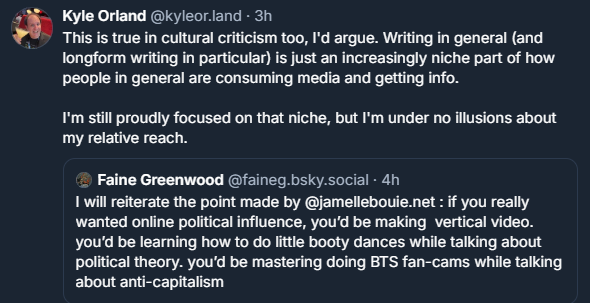
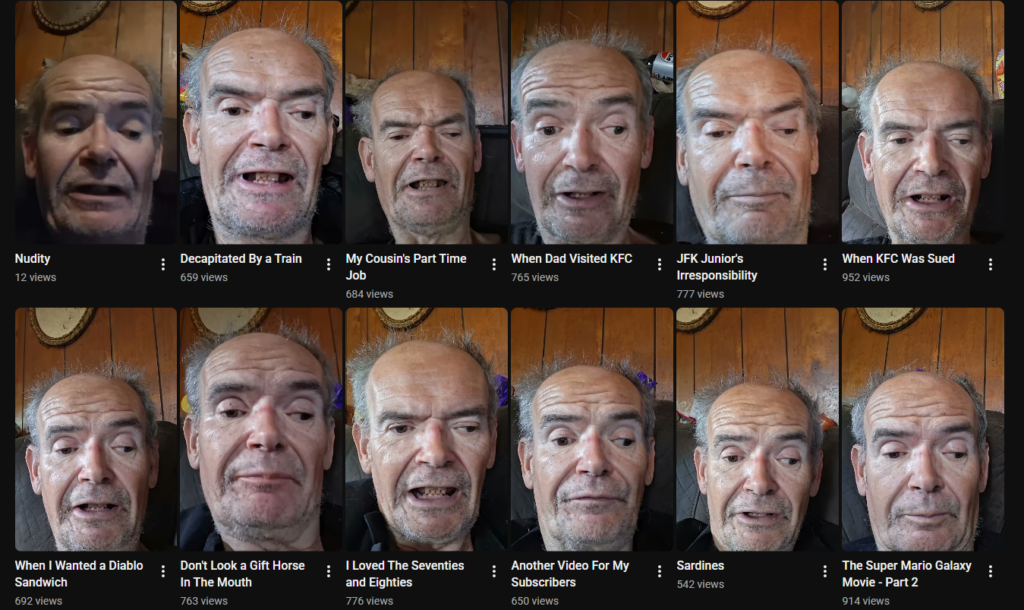
#oneaday Day 656: User error

One reason I absolutely cannot wait to ditch my professional social media responsibilities (which will be at some point in the next few months, in all likelihood) is the phenomenon of users making an error themselves, then yelling at us for their own mistake. There have been two separate examples of this just today, and I'm glad I was too busy to reply to them (the chap who's been helping us out with social media handled them) because I'm not sure I would have been able to resist being sarcastic. (Naturally, I won't name and shame or give the exact examples here, but anyone who has worked in any sort of tech with a vaguely public-facing aspect will likely know the sort of thing I'm talking about.)

Whenever I see something like this, it just comes across as a completely alien way to react. If I'm using a device, and it behaves in a way that I don't expect it to, the first thing I look for is if I'm doing anything wrong — which I inevitably am. I use it as an opportunity to learn exactly what it is that I'm doing wrong, then to never make that same mistake ever again, because I learned what the problem was and how to fix it. The absolute last thing I would consider doing is going on social media and yelling at the company who makes the product in question — particularly when there is absolutely no way of them solving my issue without making me look, at the very least, a little bit stupid.

I get that people are frustrated when things don't work the way they expect and they don't know why. But receiving a message filled with swearing and abuse because you didn't think to press a single button that would immediately resolve the problem you are having — yes, this really was one of the incidents today — does not make the person who has to answer that message feel particularly inclined to want to help you. I mean, most of the time they will go out of their way to help you, even for particularly stupid questions — contrary to popular belief, there are, in fact, stupid questions — but you can rest assured that they're having a good giggle at you behind your back.

Note that I absolutely do not have a problem with someone who does have a question with a simple and straightforward answer, and who asks that question without becoming abusive. I am more than happy to help anyone like that out. But someone who bursts into an inbox with no prior contact and fills their message with "wtf" and "ffs" and all that sort of shit… well, they're not getting their relationship with us off on a particularly good foot now, are they?

The only time I've ever yelled at a company on social media was when CEX missold me an expensive arcade stick with the promise it would work on the consoles I asked if it would work on, and it did not do that. After the staff in the shop refused to help, I had little option but to Karen it up a bit and eventually got the situation resolved. I'm not particularly proud of that little episode, but I did manage to get it resolved without any swearing or abuse at the staff in question — just a lot (a lot) of repeating myself.

Anyway, don't be rude to staff of a company if the fault is actually completely of your own creation. It's not hard.


Want to read my thoughts on various video games, visual novels and other popular culture things? Stop by MoeGamer.net, my site for all things fun where I am generally a lot more cheerful. And if you fancy watching some vids on classic games, drop by my YouTube channel.

If you want this nonsense in your inbox every day, please feel free to subscribe via email. Your email address won't be used for anything else.

#oneaday Day 653: Web best (forgotten) practice

When I was first interested in Making A Website, back in the early days of being able to Go On The Internet, itself part of Going On The Computer, I learned a number of supposed Best Practices that I still habitually follow to this day as much as possible. And yet reading a recent article about how a single article on PC Gamer is a 37MB initial download, followed by nearly 500MB of ads downloaded in the background over the course of five minutes or so, I can't help feeling like a lot of them have been forgotten about.

Here's a few that I can remember off the top of my head:

  • Keep your pages lightweight. Don't be afraid of all-text pages. Compress your images. Don't upload them at an unnecessarily huge size or using a file format that doesn't compress them unless there is some reason for needing to see them at high resolution and lossless quality. Arguably this one is even more important today as a lot of people are looking at websites on phones, but 37MB for an initial download is bananas, even bearing in mind today's average Internet connections, even over the airwaves on your phone, are much faster than they were 20+ years ago.
  • Hyperlinks should be inline rather than an instruction. That means if you're linking to something, you put the hyperlink where you mention the thing rather than spending a whole other sentence saying "Click here to see the thing!" This one is quite often argued against these days in favour of "calls to action", but if your website is not a marketing website, you don't need to give a shit about "calls to action". Save yourself some words, make your writing better and just link to the thing. The "click here" is implied by the text being a different colour. That's how hypertext works!
  • Hyperlinks to other pages on your site stay in the same tab/window. Hyperlinks to other websites go in a new tab/window. target="_blank" is so easy to include, and most CMS packages have the ability to choose whether or not a link opens in a new tab without you having to do any sort of HTML shenanigans yourself. The reasoning behind this is that you actually want to keep people on your website, so if you're linking to something relevant that is not on your site, when the reader closes the tab for that external resource, your site will be right there waiting for them where they left it.
  • Metadata doesn't belong in content. We all know that social media made a real mess of this, but outside of platforms designed around metadata being part of content, you don't need to put things like #hashtags in your articles, because most CMS platforms have some sort of tag facility built-in, and even if you're hand-coding a site, you can still include metadata tags in a way that is invisible to the end user. You are (hopefully) writing a page to be useful to a person, not a machine. In fact, in these days we live in, making a page more friendly to a person than to a robot will make you stand out considerably.
  • Don't interrupt the reader. If someone has clicked on a page, they're there to read the thing they clicked on, not to subscribe to your newsletter, not to watch a video and not to click away to a related article. If you must include those things, put them at a relevant point in the text (e.g. a video showing the thing you're talking about in the article, a link to a source you're quoting) or, if they don't fit into the flow, at the end of the piece so the reader has somewhere to go next. If you're giving the reader "FURTHER READING:" options after just one or two paragraphs, all you're doing is implying to the audience that the rest of the article isn't worth reading.

Most of these are broken on the daily by commercial websites, usually in the name of "SEO best practice" or whatever. The last one in particular drives me bonkers. I just want to read the article! I do not need linking to something tangentially related after I've only read the introduction, and I certainly do not want to subscribe to your fucking newsletter until I have read your entire piece!

Many of these rules were originally put in place because a lot of people were still using dial-up Internet at the time, and if you gave someone with even the very fastest dial-up modems a 37MB single page? Well, they just wouldn't be reading that page. In the process, however, these rules made for a Web that was clean, straightforward to navigate and consistent in its design language. And we've lost a lot of that in the attention-deficit, ad-riddled, bloated mess that the modern Web is.

"I want the old Web back" is a lot more than just starting your own blog in favour of corporate-controlled social media websites. The rules above are a good start. Generally respecting your audience — including their time and network bandwidth — is a good next step.


Want to read my thoughts on various video games, visual novels and other popular culture things? Stop by MoeGamer.net, my site for all things fun where I am generally a lot more cheerful. And if you fancy watching some vids on classic games, drop by my YouTube channel.

If you want this nonsense in your inbox every day, please feel free to subscribe via email. Your email address won't be used for anything else.
#oneaday Day 651: New project idea

I've had an idea for A Creative Project. I get these every so often. Sometimes I follow through on them, sometimes I start them and don't finish them, sometimes I don't even start them. This one is actually one I've been mulling over in my brain for quite a long time, and I think I'm just going to go ahead and do it.

Rather frustratingly for you, I'm not going to give you any details on it just yet because it's something I want to keep secret until I'm ready to launch it. It's the kind of thing that's going to take quite a while to put together, you see, and I want to launch it when it's in a "complete" state rather than doing things piecemeal. It is, however, something that I hope folks will find worthwhile and valuable, and it will allow me to realise something that I have wanted to achieve for quite some time, but have never really quite figured out the best way to go about.

I'll be honest: the reason why my brain is always mulling over Creative Projects is because as I get older, I feel increasingly… I don't know, "concerned" about What I Will Leave Behind. I'm not planning on dying any time soon, I hasten to add, but when I look back over my time on this Earth, I want to feel like I achieved something that mattered. My wife and I have not had kids and are not going to have kids (through mutually agreed choice) and as such any "legacy" I leave behind will have to depend on what I was able to achieve in the time allotted to me.

Now, I'm sure one could say that I have already "left something behind" — several things, in fact. There's this blog, there's MoeGamer, there's the stuff I wrote for various websites (although most of those are now defunct and thus only accessible via the Internet Archive and/or websites that have ingested all the material from a now-dead other site), there's the contributions I've made to magazines over the years, there's my YouTube channel, there's all the Evercade manuals I've had a hand in writing, there's the blogs and videos I've made for Evercade.

And yet, I dunno, I sort of feel dissatisfied. I feel like relatively few people know who I am. When people look back on sites like USgamer and GamePro, I'm never mentioned. Whenever I've launched new Creative Projects, they don't get any buzz from peers I may have worked with or adjacent to. Don't get me wrong, I have absolutely no desire to be "famous" (or "infamous", for that matter) — but sometimes it does just feel like it would be nice to have a little bit of recognition (or, hell, just acknowledgement) for the hard work I've done over the years.

As always, if you're reading this, the above is not directed at you. If you're reading this, you probably Give A Shit about me, and that is nice, so thank you. I'm just talking more broadly. I'm not getting any younger, and it seems that getting vaguely maudlin over whether or not you have "achieved" anything in your lifespan is a natural thing to do when one is not getting any younger.

There's a line from the Final Fantasy IX manual that always sticks with me at times like this. For the longest time I was convinced it was attributed to Zidane, but it's actually attached to Freya's character profile in the original manual. The line is "To be forgotten is worse than death."

I probably don't need to explain myself there, do I…?


Want to read my thoughts on various video games, visual novels and other popular culture things? Stop by MoeGamer.net, my site for all things fun where I am generally a lot more cheerful. And if you fancy watching some vids on classic games, drop by my YouTube channel.

If you want this nonsense in your inbox every day, please feel free to subscribe via email. Your email address won't be used for anything else.
#oneaday Day 646: #justice4rts... again

The thoroughly lovely video maker and online pal RoseTintedSpectrum has just received an unwelcome email from YouTube informing him that his channel is "no longer eligible for monetisation" due to "reused content". A link in the email then goes on to define "reused content" as material that "is not clearly an original creation of this channel and may have been repurposed from another source without adding significant original commentary, substantive modifications or educational or entertainment value."

If you've ever watched any of Rosie's videos, you will know that he absolutely adds "significant original commentary, substantive modifications" and "educational or entertainment value" to every one of his videos. If you're unfamiliar, Rosie's shtick these days is to go through an old TV show and provide acerbic, sarcastic but thoughtful commentary that is frequently hilarious. This commentary is often punctuated with original creative work that Rosie has produced, including remixes of songs in the show, all-original songs that he has created, and sometimes some absolutely brilliant overdubbing and re-editing.

His difficulties largely seem to stem from the fact that he primarily covers old TV shows now, and, as you might expect, making use of clips of these is rife with potential copyright issues. However, YouTube's provisions — and indeed the legal definitions of "fair use" and "fair dealings" — allow the use of copyrighted material, so long as the creator using that work is making substantive changes to them, making it clear that they cannot in any way be confused for the original material.

No-one is going to watch a video on Rosie's channel and say that he is making anything that could be confused for the original. No-one can possibly watch his channel and say that he has not made substantive, creative changes to the stuff he is providing commentary on. He puts in a whole lot more effort than a lot of "reaction" YouTubers — and at the very least, his work could be described as "reaction content". In reality it's much more than that, but since "reaction content" is one of the specific examples YouTube provides of material that can safely be monetised, it's a relevant, absolute bare minimum definition.

The infuriating thing about whenever something like this happens is the completely opaque way in which YouTube communicates these things. There's a problem with "reused content" — sure. Where? When? What video? Why, exactly, is this being picked up on now when it's been fine for several years? None of those questions are answered by YouTube, and you can bet your sweet bippy that they will make it as hard as humanly possible to speak to a living, breathing person who should be able to get this resolved in a matter of minutes.

It's bad enough when something like this happens to small creators who are making little to no money off YouTube. But Rosie, who has found some decent success on the platform over the last few years — and deservedly so — is using YouTube as an important income stream to support himself and his family. For that to be suddenly taken away without warning last thing on a Sunday night, of all times, is completely unacceptable.

At the very minimum, platforms like YouTube should be legally obligated to say exactly what the problem is when inflicting as harsh a punishment as "you now can't make any money from your videos". I suspect the reason they don't is because the majority of this shit is the fault of their "automated systems", and they don't want to admit that sometimes (quite often) they get things very, very wrong.

This is, after all, the second time this has happened to Rosie after a similar incident in November of 2024. Thankfully, that was eventually resolved after a concerted effort by Rosie and people who cared about him — here's hoping that this time is similarly fixed, and our friend can get back to doing what he does best, and what he loves doing.

In the meantime, if you're not subscribed to Rosie, drop by his channel. He's got a lot of great videos there, and deserves your support.


Want to read my thoughts on various video games, visual novels and other popular culture things? Stop by MoeGamer.net, my site for all things fun where I am generally a lot more cheerful. And if you fancy watching some vids on classic games, drop by my YouTube channel.

If you want this nonsense in your inbox every day, please feel free to subscribe via email. Your email address won't be used for anything else.

#oneaday Day 643: An interesting thing for you to try

Today, I'd like to share an Interesting Thing with you. Click here to see what it is. I promise it is neither goatse nor a RickRoll (although I would say that if it was either of those things, wouldn't I?)

No, it's a test to see if you can distinguish between two quite-similar-to-extremely-similar colours. All you have to do is click on the screen where you think the (vertical) dividing line between the two differently coloured halves of the screen is.

Sounds easy, right? To begin with, you probably will find it quite easy. But as it progresses, it becomes really quite challenging — although you'll probably notice some peculiarities as you continue.

For starters, you'll likely notice the dividing line more easily if you move your head or even just your eyes. There's probably a scientific reason behind this, and this makes me feel like I should have probably read the companion blog post to this little test before starting to type here, but oh well. No time like the present, is there?

Okay, I've read it, and it's complicated (but quite interesting). Basically there's a value called the "Just Noticeable Difference" (or "JND") and this determines whether or not we can distinguish two very similar colours as actually being different from one another.

A commonly agreed JND measured on one popular scale (used in the test linked above) is 0.02; colours that exhibit this "distance" between one another are different from each other, but to most people who are just glancing at them, they will look the same. The test introduces slightly artificial conditions by making you actively look for the differences — plus it also depends a bit on how well your display is calibrated — but it's still an interesting way to see quite how solid your perception of colour is — and whether or not that varies between different colour types.

For me, my weakness was bright pinks. I found it quite difficult to distinguish between those, but had much less difficulty with darker, less saturated or overall duller colours. I still scored considerably better than the "average", though — my score was 0.0056.

Give it a go! It's much more interesting than doomscrolling… and definitely a better use of your time and the planet's resources than using Google Gemini if you're bored.


Want to read my thoughts on various video games, visual novels and other popular culture things? Stop by MoeGamer.net, my site for all things fun where I am generally a lot more cheerful. And if you fancy watching some vids on classic games, drop by my YouTube channel.

If you want this nonsense in your inbox every day, please feel free to subscribe via email. Your email address won't be used for anything else.

#oneaday Day 642: I will never use Gemini when I'm bored

yelling formal man watching news on laptop
Photo by Andrea Piacquadio on Pexels.com

The website "Android Police" posted an incredibly stupid article today, headlined "I use Gemini when I'm bored — and it's better than doomscrolling". I'm sure I don't have to tell you that the premise of this article is spectacularly dumb and the author, Anu Joy, should feel bad for having written it… if indeed they are actually a real person. You never can be sure of that with engagement-bait articles these days, and the author's complete lack of online presence beyond LinkedIn doesn't fill me with confidence that they actually exist. But never mind.

I'm not going to link to the article because it doesn't deserve it, but I am going to systematically destroy it for today's post, which features a lot of swearing. Hope you don't mind, about either part of that statement. If you do, well, tough titties.

Cock!

Turning boredom into a 5-minute adventure

The first lake-boiling, environmentally ruinous use of the lying plagiarism machine that Anu Joy cites as an antidote to boredom is "turning it into a mini choose-your-own-adventure generator", with her argument being that "rather than passively consuming content, I now engage with short, interactive stories that unfold in real time, making them ideal for five-minute boredom gaps."

In response to this, I would like to introduce any Gemini-brained fuckwits to the long, rich and deep history of the interactive fiction genre, all of which has been written by actual humans, and designed to occupy you for anything between a few minutes and multiple hours — possibly even days or weeks if you get stuck and have the willpower to not look at a walkthrough.

It's easy to get involved with interactive fiction, too! There are plenty of great standalone games that fall into this category, such as Inkle's excellent titles 80 Days, Overboard!, Expelled! and more, plus their adaptations of actual choose-your-own-adventure-style gamebooks such as Sorcery! The indie marketplace itch.io has a whole tag for titles developed in Twine, which are essentially hypertext-based choose-your-own-adventure games. And if you want to get into the history of the medium and its rich diversity developed over the course of the last 40+ years, the Interactive Fiction Database (IFDB) has more interactive fiction than you can probably get through in a lifetime, much of which can be played online right there in your web browser.

Or you could, I don't know, actually read a Choose Your Own Adventure book. They still exist, you know! And, as an adult, a single "run" through one will probably only take you about five minutes!

"Oh, but Gemini can make me something that's never been done before!" No it fucking can't! That's sort of the problem with LLMs! They will never, ever have an original thought because their entire fucking functionality is built on plagiarising other people's work. So why not actually go and enjoy a human being's work rather than burning down a forest to get the obsequious chatbot to "tell you a story?"

FUCK.

Quizzes, riddles and brain-teasers on demand

Do I really have to dignify this with a response? Okay, here are some places you can take quizzes online that don't involve getting a lying robot to make shit up:

The Encyclopaedia Britannica, the place where we used to go to look things up before the Internet, has a whole page full of quizzes.

Puzzle publishing company Lovatts has a straightforward and flexible quiz you can challenge any time.

Fucking Buzzfeed, the website where clickbait goes to die, has tons of quizzes. They're sort of famous for them! (EDIT: I had forgotten that Buzzfeed "pivoted to AI" a couple of years back. Maybe forget about this one.)

The best news of all is that these quizzes are put together by actual humans, so the answers should be right, which is not something you can guarantee with the garbage LLMs like Gemini spew out!

FUUUUUCK.

Curiosity on demand, without the time sink

"Oooh, but Gemini is so good at research and telling me fun little facts!"

Heard of Wikipedia? They feature a different article on their front page every day. And those articles are written by humans. (They're specifically trying to fend off the lying chatbots right now.) Not only that, if you want to dive deeper, they are sourced, so you can actually follow up on the things they say.

If you really want to surprise yourself, bookmark https://en.wikipedia.org/wiki/Special:Random — that will take you to a completely random page, where you can start a whole new knowledge journey that doesn't involve polluting the drinking water of any communities. (Fun fact: you can use /wiki/Special:Random on any sites that run on the MediaWiki software, not just Wikipedia!)

FUUUUUUUUUUUCK!

Gemini as a creative partner

"Some days, I'll argue whether pineapple on pizza is a culinary crime or a stroke of genius," Joy writes. If that's the level of your creativity, I suggest throwing a dart at Reddit and posting about how cool and random?! you think bacon is, you t3hPeNgU1NoFd00m, you.

If you just want someone to talk to, that is literally what social media is for. I know there are lots of things one can criticise about social media (particularly the Nazi bar that is Twitter in 2026), but if you just want to start a conversation with someone, there are few things easier than typing "@random hello, I disagree with your opinion on the Star Wars prequels, let's have a fight" or some other such bollocks.

If you want to talk to someone you don't know, there are services for that, too! Join a random Discord — or even better, one for something you're interested in! Play an MMO! Go on IRC! Brave Chatroulette! (Omegle apparently doesn't exist any more after some nasty shit went down there, so maybe don't go there.)

Just don't waste your fucking life talking to the cunting chatbot. It doesn't love you. It never will. And you're making the worst people in the world richer just by looking at it.

FUUUUUUUUUUUCCCCCCCCCCKKKKKKKKKKKKK!!!

Boredom doesn't stand a chance

If you are bored in the world as it exists today and can't think of anything better to do than open up Google fucking Gemini, you are a lost fucking cause. There is more entertainment, more media, more games, more reading material, more opportunities for socialising online than there have ever been. Not only that, there are unprecedented opportunities for you to get creative and express yourself in all manner of different ways, regardless of your past experience. You could even start your very own blog where you yell at people who might not exist!

There is no fucking excuse for turning to the chatbot "because you're bored". Even if the absolute limit of your creativity is "debating the merits of pineapple pizza", which Joy mentions twice in that dogshit article.

I realise that I have given the article in question far more attention than it ever deserved. But hey! It was the inspiration for something actually creative. And who knows? Someone might actually find some of the links I've provided useful.

Friends don't let friends use chatbots. So if I ever hear that you, dear reader, have turned to Google Gemini "because you're bored", I will hunt you down, wherever you are, and I will slap you repeatedly about the face with a wet trout.

Here endeth the lesson.


Want to read my thoughts on various video games, visual novels and other popular culture things? Stop by MoeGamer.net, my site for all things fun where I am generally a lot more cheerful. And if you fancy watching some vids on classic games, drop by my YouTube channel.

If you want this nonsense in your inbox every day, please feel free to subscribe via email. Your email address won't be used for anything else.

#oneaday Day 639: The Usborne Big Book of Logical Fallacies

There's a telltale sign you can use in any online argument that it is Time to Step Away From the Computer, and that is someone pulling out what I like to call The Usborne Big Book of Logical Fallacies.

What I mean by this is that point in an online argument where people start going on about "ad hominem", "strawmen", "motte and bailey" and "No True Scotsman". And probably some others.

These are all valid logical fallacies, of course, but the sheer frequency with which they are trotted out by people absolutely desperate to win an online argument makes it absolutely exhausting to even attempt having a discussion about some things. Because more often than not, the person busting out The Usborne Big Book of Logical Fallacies isn't actually interested in getting their point across or changing anyone's mind; they just want to feel like they "won" the argument. And, at the point The Usborne Big Book of Logical Fallacies enters the picture, this is usually part of an attempt to paint themselves as the victim.

Other telltale signs include attempting to argue that positive representation of marginalised groups is actually a form of racism and/or sexism (against straight white men, obviously), taking great offence at the concept of fascism even being mentioned (and often expressing a desire that it be "discussed" or "debated"), using the term "diversity of opinion", claiming that women, non-white ethnic minorities and/or transgender people in leading roles are somehow "unrealistic" and, of course, turning to that old favourite term: woke.

Now, I won't lie. There were a few years where I found myself skating around this territory. I've talked more about that in this post, so I won't repeat the soul-searching and heart-opening from that post (though I encourage you to read it if you would like to know more). However, people can learn, grow and change, and that is exactly what I have done over the years. Across the COVID years and into Trump's second presidency, I have come to see that a lot of the things the people I once dismissed as online firebrands were attempting to warn us all about have actually come true.

And, as an extension of that, I came to see that some of the times I was needlessly defensive and insular, I should have been standing alongside people. After all, my beliefs have always erred on the left-leaning side of things; my frustration from those dark years was, as much as anything, frustration at being lumped in with right-wing-to-far-right-outright-Nazis based on nothing more than the media I enjoyed — particularly anime-adjacent stuff that often took a walk on the lewd side of life.

I knew that I wasn't a bad person, and I knew that enjoying the things I enjoyed didn't make me a bad person; frustration at being assumed to be a bad person based on those tastes was what caused me to lash out and, at times, do and say things that I regret. And yet even back then, I could see those deploying The Usborne Big Book of Logical Fallacies as what they were: people who didn't really care about anything other than scoring imaginary Internet Points. They were not my allies. They were not my friends. They were insufferable dickheads.

Today, I recognise that it is, in fact, possible to have the interests and tastes I do and not find yourself drifting towards the shit-encrusted mouth of what is typically referred to today as "the alt-right pipeline". There are lots of left-leaning folks who do love sexy stuff, and one thing I will say for online discourse is that discussion over such things has improved over the course of the last ten years or so. There's still a way to go, but it's better.

As part of that, it's important to recognise that certain parts of popular media do have a far-right problem. And as part of that recognition, it's important to stand up and say that you will not stand for tossers ruining the thing that you love, rather than being frustrated at feeling like you're getting lumped in with said tossers. You probably aren't, so long as you're not using their talking points.

Such as, you know, The Usborne Big Book of Logical Fallacies. There really is only one type of person who busts out The Usborne Big Book of Logical Fallacies during an online discussion. And believe me, you don't want to be that person.


Want to read my thoughts on various video games, visual novels and other popular culture things? Stop by MoeGamer.net, my site for all things fun where I am generally a lot more cheerful. And if you fancy watching some vids on classic games, drop by my YouTube channel.

If you want this nonsense in your inbox every day, please feel free to subscribe via email. Your email address won't be used for anything else.
#oneaday Day 637: Slow Roads

I'm very fond of weird little software toys that don't really have a point, but which have obviously had some love, care and attention devoted to them. One of my favourites in this regard is a Web-based driving "sim" of sorts known as Slow Roads. You can fiddle around with it here.

Slow Roads isn't really a "game". There's no objective, no win state, no fail state, no punishments for doing things "wrong" and indeed no "right" way to do things, save for the implied suggestion that you stay on the road. As you can see from the screenshot above, this is not mandatory.

Slow Roads plops you into a procedurally generated world based on either the rolling English countryside — the sort of undulating terrain you'd see if you were driving around the Peak District, say — and invites you to just drive. There's no other cars on the roads so you can drive as safely or unsafely as you like; this is a pure playground in which you can take your electric car, bus or futuristic motorcycle and just go. It's a pleasantly liberating, relaxing experience that I find myself turning to in quiet moments when I just want to do something, but I don't want to have to think about it too hard.

I forget who first pointed me in the direction of Slow Roads and even when it was. I've definitely had it on my bookmarks bar for several years at this point, and over the course of those years it has continued to evolve gradually. The first version I tried only had the car and the countryside terrain in the daytime. Over time, more features have been added, including the ability to adjust the countryside scene between four different seasons and four times of day and set the weather conditions, choose how winding (or not) you want the road to be, how wide you want it to be and a variety of characteristics about how the controls handle.

The game has somewhat sim-like tendencies in how it handles. You have to slow down for corners, and the three different vehicles have a very different feel to how they handle; the bus, for example, appropriately feels like a large, lumbering vehicle that it's probably not a good idea to throw into a corner at 80mph, while at the other end of the spectrum, the bike provides a frighteningly fast thrill ride, and could probably get you around the most twisty roads at high speed once you learn how to handle it.

That's it. That's all Slow Roads is. There's no point to it. And yet I love it. It's not trying to be anything that it's not. It's not being designed for "player retention" or "monetisation". It just is. It's a lovely little thing, and if you've never spent any time fiddling around with it, I highly recommend it.

The one long-term goal for Slow Roads appears to be for it to have a standalone Steam release, which looks set for April of this year (2026 if you're reading in The Future, assuming we're not all dead by then), with a demo towards the end of this month. It will be great to see this project finally come to some sort of "fruition", such as it is, and I have whiled away more than enough hours in the Web-based version to quite happily toss the developer a few quid when the full version finally arrives.

Now, maybe just a few miles before bed…


Want to read my thoughts on various video games, visual novels and other popular culture things? Stop by MoeGamer.net, my site for all things fun where I am generally a lot more cheerful. And if you fancy watching some vids on classic games, drop by my YouTube channel.

If you want this nonsense in your inbox every day, please feel free to subscribe via email. Your email address won't be used for anything else.
#oneaday Day 630: Mr Cellophane

Cellophane, Mister Cellophane
Shoulda been my name, Mister Cellophane
'Cause you can look right through me
Walk right by me
And never know I'm there

(Mister Cellophane by John C. Reilly, from the musical "Chicago")

I don't wish the following to sound like self-pitying or a cry for attention, but it will almost certainly come out that way, and for this I apologise in advance.

Do you ever have days where you feel like you're "invisible"? Like, if you just weren't there, no-one would notice? I seem to be feeling this a lot more as I get older, but it's something that has always followed along with me to one degree or another.

As young as my teenage years, I remember, on several occasions, feeling like I wasn't sure if my friends really liked me, or if they were just putting up with me as a sort of "attachment" to one of their other friends. Given the oddly volatile nature of hormonal adolescent friendships, this is perhaps not a surprising way for someone to feel — I recall multiple other occasions where, for one reason or another, several of us who were, under normal circumstances, best friends, suddenly just… weren't any more for a little while. This normally only lasted a day or two, and it usually involved the one who instigated the temporary "split" trying to get "in" with some of the cooler kids. I don't recall any occasions where something like this resulted in a member of our mutual circle of friends completely abandoning us, but it is this sort of thing that made me uneasy and anxious at times.

At university, I had friends and acquaintances I attended my course with, but again, there were times where I felt like if I just wasn't there, nobody would really give a shit.

A lot of this stems from what I now know to be social anxiety caused by autism, but that unfortunately doesn't make it much easier to deal with — because I still feel this sort of thing to this day. I find it difficult to "maintain" relationships because I get overly worried about being a bother to someone who, in my mind, I have built up to be someone who resents my presence. And, on occasions where I feel like I have been someone who has been making that effort, it's hard not to feel rejected when the other parties involved aren't as interested in maintaining the relationships as you are.

The reason I'm talking about this today is because, once again, a video game site has been suffering layoffs — this time the long-established Eurogamer. And as the various people announced that they were no longer working there, and that they were looking for employment, lots of other people piped up and said how important their time together had been, how much they enjoyed working together, what fond memories they had of various projects they collaborated on.

I saw that and I felt painfully conscious that, when my career in the games press came to an unceremonious end, I didn't really feel like any of that happened for me. I feel like very few people really noticed my time on USgamer, let alone GamePro before that, and very few people spoke up for me to say that they had enjoyed my work. I certainly didn't get a string of adulation from former colleagues waxing poetic about past collaborations. And all that kind of hurt, frankly; I had made that site my life for the time I was there, and I was immensely proud of all that I had done. And yet when people look back on USgamer's existence now, I'm not even a footnote; I doubt anyone other than the few people who did regularly read my work there — most of whom are still online friends, I should add — would even be able to tell you that I was a founding member of the site.

I feel this under other circumstances, too. There are several Discords I'm a member of where I feel like my presence and existence is often forgotten about. I don't really have an online community that I feel like I can call "home" any more, and that is, I think, where a lot of this stems from; it's that age-old fear that, if you were to drop dead tomorrow, no-one would notice or care. (My wife, at least, would. Hopefully.)

And I don't really know how to "fix" this. As I say, my social anxiety makes it very difficult for me to step up and say "hey, hello, please pay attention to me" without feeling like I'm inconveniencing or annoying people, and as such, I continue to just sort of quietly exist in the hope that I don't get forgotten entirely.

If you're reading this, none of the above applies to you. I am grateful for your presence, your support and your friendship — because if you are reading this at this point, you are someone who is present in my life; you are someone who has, in one way or another, supported me at some point over the years; and you are someone that I'm happy to call a friend. I thank you, sincerely, from not letting me become completely invisible to the world at large.

And perhaps I should be content with that.


Want to read my thoughts on various video games, visual novels and other popular culture things? Stop by MoeGamer.net, my site for all things fun where I am generally a lot more cheerful. And if you fancy watching some vids on classic games, drop by my YouTube channel.

If you want this nonsense in your inbox every day, please feel free to subscribe via email. Your email address won't be used for anything else.

#oneaday Day 629: Another site falls to AI

Earlier today, a review was being shared around. It was a featured review on Metacritic for the new Resident Evil Requiem, and it was very obviously AI-generated — both in terms of the review text itself, and the image and biography of the completely fictional author.

Now, I know there is plenty we can criticise Metacritic for, but to the site's credit, after being made aware of the situation, the review was not only pulled from Metacritic, but the site in question was blacklisted from being featured on there for future reviews, too.

The site in question was VideoGamer.com — not a site I ever particularly frequented, but one that has been around for many years, and one of many, many old games press brands that have been bought up by private equity and turned into sites filled with AI-generated drivel, usually in the form of undisclosed advertorial features pointing people towards shady gambling sites. VideoGamer is not the first site to fall in this way; previous victims have included AdventureGamers and The Escapist, and there are almost certainly countless more that we haven't found as yet.

My initial reaction to anything like this happening is to ask "why?"

Why are once-good sites being replaced with AI-generated drivel? Who do they think is reading this stuff? Why do the people in charge of these hollowed-out husks of websites think this is, in any way, a good idea?

The answer, of course, is that this is the natural endpoint of SEO-driven online writing. The sole reason these articles exist is to get people to click on them and generate advertising revenue for the site's owners. And if they can do that without having to do anything silly like pay actual people to write actual articles, so much the better! (Although the more astute among you out there may well point out that being an AI power user probably doesn't end up much cheaper than hiring an actual person — particularly in the games press, where, as Mat Jones of IGN put it earlier today, "games freelancers will turn in 2,000 words for an egg sandwich". I wish it wasn't true.)

Couple this with the news that Eurogamer and surrounding sites are suffering some considerable layoffs and things do not look altogether rosy. I also learned that VG247 is now little more than an SEO guideslop site; I never really liked that site all that much, but since most of my USgamer stuff ended up archived there after USgamer itself closed down, I do have a certain attachment to it.

The frustrating thing for me is that all this seems so unnecessary. Video games, as an industry, creative medium, art form, whatever you want to call them, are huge. One would assume that would mean they would need a specialist press around to cover them effectively, but given that so many sites have been gutted over the last few years — and, in many cases, replaced with AI slop — something doesn't quite seem to add up.

Sure, we've seen the rise of sites like Aftermath, who do good work, and it was gratifying to see Giant Bomb successfully extricate themselves from their former corporate overlords — full disclosure: I subscribe to both to support them — but neither of them quite take the place of what we used to have. And you can interpret that however you will, because the same is true if you think I'm referring to traditional "news, previews and reviews" websites, or if you think I'm referring to magazines. (Spoiler: I'm talking about both.)

Part of this feels like an extension of the whole "New Games Journalism" discussion we had in the latter-day 1up years. And while that discussion went to some odd places, I do acknowledge that there is some valuable work going on over at a number of worker-owned, reader-supported sites, particularly when it comes to telling the stories of people who work in games. But sometimes you just want to read something simple like what someone thought of a game you're interested in, y'know? And that side of things seems to very much be a dying breed.

One might argue that there's less need for that, what with social media, online discussion and "influencers" (you will never get me to not use scare quotes around that odious term) dominating the way games are promoted online these days. But I still like to read a straightforward review of something — and the continued existence of Metacritic, as flawed as it is as a concept, suggests that there's still a place for that sort of thing.

I can't help but wonder where all this will end up. With people starting to get interested in physical media once again, I would love to see proper magazines become a thing again. I suspect that won't happen, but we certainly can't go on like this. Can we? This feels like how you actually end up with a completely dead Internet.


Want to read my thoughts on various video games, visual novels and other popular culture things? Stop by MoeGamer.net, my site for all things fun where I am generally a lot more cheerful. And if you fancy watching some vids on classic games, drop by my YouTube channel.

If you want this nonsense in your inbox every day, please feel free to subscribe via email. Your email address won't be used for anything else.