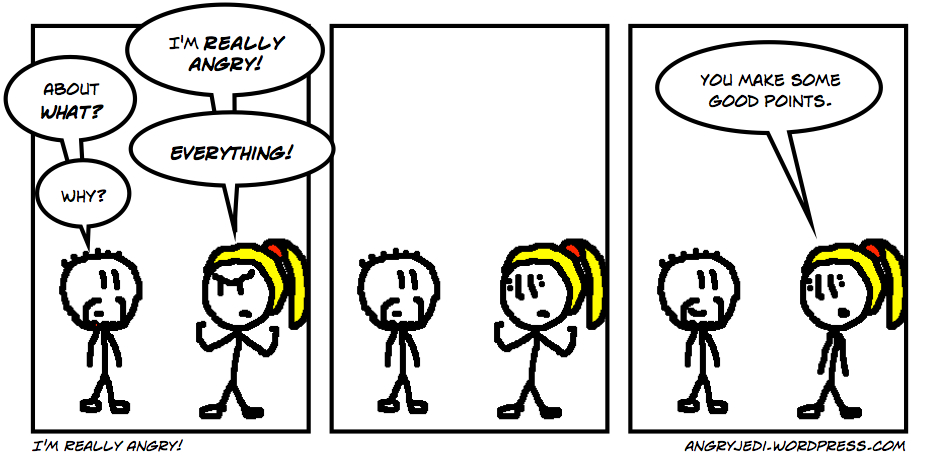
Just slightly over two years ago (really quite surprisingly close, now I look at the dates), I pondered the subject of how I Don't Care about certain social issues.
That particular rant — kind of shocked how little things have changed in two years, to be honest — was inspired by the amount of time certain people spent pontificating on Twitter about how awful certain groups were towards other groups. Whether it was racism, sexism, ableism or any of the other bad -isms, there was always someone on hand to loudly denounce anyone who displayed one or more of these traits as The Worst Person Ever.
I've tended to find over the years that the more I find myself seeing the same things said over and over — and the more hyperbolic those things are — the less I'm inclined to care about them, until eventually you cross some sort of apathy event horizon and find yourself feeling completely and utterly unmoved by even the most tragic of human suffering. Desensitisation is very much a real thing — although I'll qualify that at this stage by saying that I am by no means desensitised to things like violent imagery or things happening to those who are close to me and that I care about.
I was reminded of this feeling today when a friend got in touch and told me about some dude I'd never heard of supposedly sexually assaulting a whole bunch of people, the dodgy things he'd said on Facebook and the rather specific, creepy details that his alleged victims had said independently of one another. Now, I knew that I was probably supposed to feel outraged about this apparent miscarriage of justice, but the fact is, I just couldn't bring myself to care even a little bit about it. I couldn't bring myself to Google who this dude I'd never heard of was; I couldn't bring myself to look at the news stories; it just didn't matter to me.
And, you know what? I don't actually think that's necessarily a bad way to be thinking about things. While it would be nice if all the good people in the world could wave their respective magic wands and make all the bad people's dicks fall off (where applicable), we all know that isn't the way things work. And it's all very well and good and probably morally admirable to get upset on other people's behalf, but there are an awful lot of bad people out there and only so many hours in the day. I know I'd much rather be concentrating on my own life and the wellbeing of those immediately around me (in social, not necessarily geographical terms) than wasting time — yes, I do think it is a colossal waste of time — getting angry on behalf of people I've never met, will likely never meet and have absolutely no means of relating to, helping or indeed having any impact on the lives of whatsoever.
Why do I say this is a good thing? Doesn't that make me some sort of woman/ethnic minority/disabled person-hating narcissist? Well, no, of course not — although a woman/ethnic minority/disabled person-hating narcissist would say that, wouldn't they? The simple fact is this: very few people are real "heroes". Very few of us have the power to make a true difference in the lives of people we've had absolutely no contact with whatsoever. And it's not good for one's mental health to continually get upset and angry on behalf of everyone who is wronged in the world. I've seen one friend go down that road, and frankly they became rather insufferable as a result. More than that, though, it seemed impossible for them to ever be happy, because there was always something new to get upset and angry about; they were perpetually in a state of anguish and fury, because there was no way to fix this broken world we live in. It was heartbreaking to see, and there was nothing I could do to help them.
Ultimately all most of us do is try to be the best people we can be to the people who do matter to each of us: family, friends and the acquaintances we come into contact with on a regular basis through work or other activities. If everyone simply tried to be a bit more excellent towards one another in their own social circles, the world would probably be a much more pleasant place overall.
Unfortunately some people simply appear to be hard-wired to be as un-excellent as possible to the people around them. And that's not at all cool, but if you have nothing to do with those people, harsh as it may sound, they're not your problem. They have to either recognise the problems they have themselves and do something about it, or the people who are close to them and care about them have to take action. You, as some random stranger on the Internet, have no influence, no power and, moreover, no real right to interfere with that person's life. Concentrate on dealing with your own issues, because everyone's got them to varying degrees, and if you're one of the lucky few to be in a place of relative contentment? Enjoy it, for fuck's sake; don't go looking for trouble.
So, to sum up: I Still Don't Care. And, I have to say, ditching social media has made it a whole lot easier to do just that. While my own issues mean that I'm still a way off feeling truly, completely 100% happy and content with my own life, I sure feel a lot closer to that ambition than I once was. And, should I ever reach it? I'm damn well going to enjoy every minute of it.
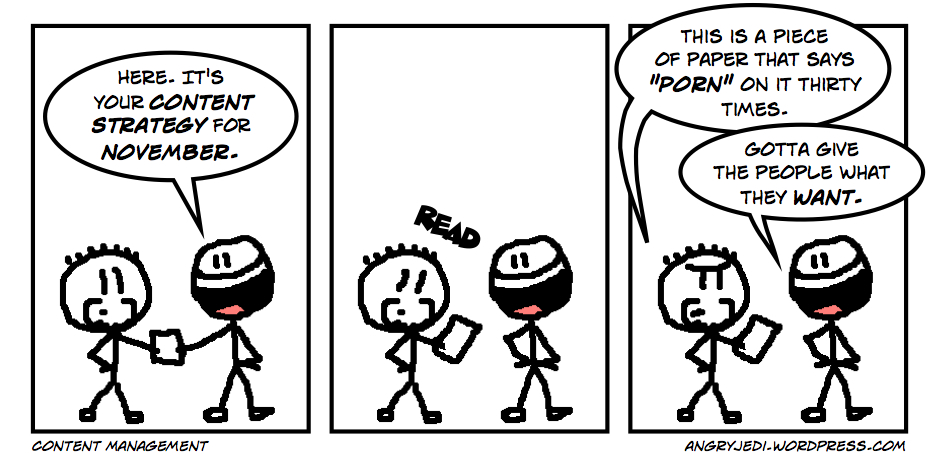
It is traffic that drives the modern Web, whether we're talking about a commercial site or a personal social media page, but I'm gradually coming to regard the relentless pursuit of this easily measurable but sometimes quite misleading metric as something I'm keen to step as far away from as possible.
Why? Because the behaviour of the Internet hivemind — they who create the traffic — is predictable. Write something interesting and compelling — but, crucially, not controversial — that you've poured blood, sweat and tears into and came away from feeling yes, this is one of the best things I've ever written, and you'll inevitably barely register a blip on the graphs. On the flip side, write something controversial or angry — preferably with plenty of finger-pointing — and you'll get hundreds, thousands of hits. But are they the kind of people you want to be attracting to what you're writing?
In the case of a commercial site, it doesn't actually matter all that much; in the case of the biggest sites like IGN, the comments section moves so quickly with all the commenters' vapid nonsense that there's no time for anyone to be able to fixate on the actual people who have been reading it in most cases — unless, of course, it becomes clear that the community at large has an opinion contrary to that of the writer, in which case it usually degenerates into a battle of snark via Twitter within hours of publication. But even on smaller sites, comments sections are easily ignored; ultimately, it is those traffic figures that are totted up at the end of each week to determine how "well" things are going — the theory runs that if you lure people in with more "clickbaity" stuff, they will hopefully enjoy it and stick around to click through to some other, less controversial but much better pieces. It doesn't necessarily work like that, sadly: bounce rates are high, and tricky to "fix", particularly if you contemplate how your own personal browsing habits tend to go.
In the case of a personal site like this one, however, it very much does matter who you're attracting to read the things you've written. I have a small group of semi-regular to regular commenters on this site, all of whom I've gotten to know and come to regard as friends. When someone new shows up, their first comment is important; it determines whether or not I actually want to engage with them, or whether I never want to speak to them ever again. It's nice when the former happens; when the latter happens, however — something which is seemingly exponentially more likely on a high-traffic day — it can be anything from mildly annoying to actually quite scary, particularly for someone with anxiety issues around certain social situations.
It's for this reason that I've come to dread the WordPress notification that reads "Your stats are booming!" because it means that, for whatever reason, lots of people have come to my site and are doubtless just itching to leave a comment on something and tell me how much I'm wrong. (The side effect of the aforementioned anxiety is that one negative comment counts for about 20 positive comments, making it very hard to get a nice, calming balance, and making me very anxious and nervous about the possibility of arguments, even over the smallest of things.) Today was one of those days: something I wrote a little while back — something which I stand by, but am also keen to put behind me now my life is moving forwards — got linked a whole lot. Judging by my stat reports, it seems it was linked from Twitter, Reddit and a few other places and, at the time of writing, has produced my "best" traffic day for a very long time.
I can't say I'm particularly happy about that, though, because all it means is that I've written something contentious that I anticipate those who agree will stay quite and maybe give a Like, while those who disagree will jump in the comments and yell at me. (The comments on the aforementioned piece are now closed, so this makes prospective yellers' lives at least a little bit more difficult, which is something.)
Since ditching the hustle and bustle of social media, with its constant pursuit of validation through Likes and Comments, I've become much more content to simply continue along on my way without interference from wider society. And while you may point your finger at me and say that I'm just trying to live in a bubble or an echo chamber, to that I simply say so what? We don't need to open everything we say and do up to public scrutiny, and just because you publish something online for family and friends to read doesn't mean that you particualrly want it shared with the wider world.
It's a fact of life, however, that with this modern, connected world, if you publish anything online, whatever it is, you open yourself up to it being shared more widely, possibly well outside of your own safe place, and consequently run the risk of attracting… undesirables, shall we say. And that sort of thing is starting to make me increasingly uncomfortable — particularly after I've been the victim of an organised Twitter harassment campaign in the past; something I'm really not keen to repeat in any shape or form through any online medium.
Oh, don't worry, this blog isn't going anywhere; personally speaking, it's been a valuable outlet and almost a form of "therapy" for me over the course of the last four and a bit years, so I can't seem myself giving it up any time soon. I would, however, ask anyone reading any post on this site and contemplating sharing it or leaving a comment to take a step back for a moment and think about the person behind the words: a 33-year old dude who is just now finally starting to get his life moving in a vaguely normal direction after numerous years of upheaval, disappointment, upset, anger and chaos; a 33-year old dude who, after 4+ years of working "on the Internet" is now keen to have a bit of a quiet life. I'm not saying don't share; I'm not saying don't comment; I'm not sure what I am saying, really, if I'm perfectly honest: just please take what I've said above into account. That's all I ask.
I read an interesting piece on The Guardian earlier regarding "the age of loneliness" killing us bit by bit. And while I feel the piece is, on the whole, doomsaying somewhat, there's also a lot of truth in there.
I've become a lot more conscious of all this since starting my "new life" a little while ago — working a "proper job" with three-dimensional people all around me, ditching most of social media for my own sanity and generally trying to "unplug" a little bit from my utter dependence on the digital realm.
The biggest change has been the opportunity to interact with real people on a daily basis. Sometimes those people are asking me to do things as part of my job, but at other times it's a simple social interaction where we share things with one another: the problems we had with a retailer; what we had for dinner last night; our pets having various illnesses; what we think of this weather we've been having, gosh, it's been really variable, hasn't it?
I hadn't realised how much I'd missed this, but being fully immersed in the digital realm for several years had proven an adequate substitute for human interaction at the time. It wasn't until towards the end of my time with USgamer that I was starting to feel a little dissatisfied with spending all day every day "on my own" (despite hundreds, possibly thousands of people being on the other end of an email or tweet) and, once I was made redundant, it truly dawned on me that I was indeed living through my own personal "age of loneliness".
It's often been said that social media ironically contributes to feelings of loneliness and isolation, and it's a difficult one to win. Without social media, it can be difficult to feel connected to other people — though there are alternative, more focused solutions for communication that rely less on shouting into the ether and more on more direct interactions. But with social media, despite all these connections to other people, it's equally easy to feel isolated, too; the constant races for oneupmanship on Facebook and Twitter — the race to be the first to post a pithy comment in response to a tragedy; the race to post the coolest photo of an event; the race to get the most Likes and comments on a passive-aggressive statement — all detract from meaningful social interaction, instead turning communication into a competition. That doesn't feel especially healthy to me.
Like I say, though, it's difficult to find that balance. At present, I feel like I'm having a reasonable time of it — I get along well with the people I work with during the day; I spend time with Andie in the evening and, on certain occasions such as tonight, get to spend time with friends — but I do often still find myself wondering if I'm "missing out" on anything by not checking in on Facebook or Twitter. (I actually closed the latter account altogether after the post the other day, which got shared more widely than I intended and consequently attracted ire I didn't really want to deal with at the time; I haven't felt the need to reopen it yet, and should I ever decide to return to Twitter I think it will be with a brand new "fresh start" account)
I am not, however, missing that urge to take a photograph of everything that happens in my day and then post it online as if anyone would give a shit about what the sunset looks like from where I'm standing right now (probably quite similar to the sunset from where you're standing right now) or what my lunch looks like (pretty much like lunch). I find myself longing for the days when things like photographs were more permanent and more meaningful; everything in the digital age feels so utterly disposable, and that's probably where a lot of the whole loneliness thing stems from: you can be the centre of attention one minute and utterly forgotten about the next. The modern world is fickle indeed.
Anyway. It's 1am and I'm doing that thing where I ramble only vaguely coherently as I try not to fall asleep in front of my screen. So I think it's probably time to go and get some sleep; I have a very long day ahead of me tomorrow, so plenty of rest beforehand would probably be a good idea!
What I'm about to write would have been enormously unprofessional a few months ago, but since I'm no longer a member of the games press, nor do I have any intention of going back any time soon, I am more than happy to express myself freely.
My statement is simple: If you're that cynical about video games, find something else — anything — to write about.
I say this after a day in which not one but two utterly dreadful articles were brought to my attention — I'm not going to link to either; you can seek them out yourself if you're that interested.
First up was the review of Fairy Fencer F over on my former stomping grounds of USgamer. After witnessing… the reviewer in question's review style on a couple of other Japanese role-playing game titles — most notably the actually rather excellent Tales of Xillia 2, which he panned — and the fact that, back when I was still on the staff, he wouldn't review Atelier Rorona Plus on the grounds that a Google Image Search for the game looked "creepy", I wasn't altogether surprised to see that he tore this title to shreds, also. And he did so in such a way that told me three things: 1) he had a pre-existing dislike of the company that produced the game (Compile Heart) 2) he hadn't taken the time to engage with the game on anything more than the most superficial level and 3) he simply didn't give a shit about JRPGs as they exist in 2014.
I haven't yet played Fairy Fencer F, but given the way in which the review in question was expressed — telling people who might actually be interested in the game absolutely nothing about the game, its story or its characters and instead bashing Compile Heart and its parent company Idea Factory, bemoaning easily ignored technical issues and generally looking down its nose at people who might want to play it — I don't have much faith in it as a whole. I intend to give the game a fair shot myself once I have time to settle down with it, and when I do I intend to provide some detailed thoughts on the subject over at MoeGamer, much as I did with Tales of Xillia 2 recently.
Now, games journos will often point out how stupid it is to disagree with a review, which is, after all, a subjective opinion. And it kind of is; if you like something which someone else hates, then great; more power to you. But what we had here was more than that — it was an outright unhelpful review, instead more concerned with scrawling "I Hate Compile Heart" over everything than actually providing any sort of interesting, helpful analysis or criticism. It actually felt borderline insulting at times — though thankfully not so much as the site's notorious Hatsune Miku Project Diva F review, which was so offensive to fans of Japanese games that emphatic complaints from me and my then-colleague Cassandra led to the formation of my JPgamer column.
If this was a one-off, I wouldn't mind so much, but the reviewer in question has now done this several times — leading me to question the motivations for assigning him (or him stepping forward; I don't know which way round it was) to these titles in the first place. As the former staffer who single-handedly built up a ton of goodwill with fans of niche titles that get ignored at best, marginalised or even ridiculed at worst by other sites, I can't deny that it smarts a little to see all that goodwill getting well and truly pissed up the wall by giving the sort of games that I would have been all over — and that my fellow enthusiasts would have loved to hear more about — to someone who clearly and obviously hates them. Something that helped make USgamer unique has been lost; now it's just another site with a predictable "loljapan" attitude about it. I would rather the site simply didn't review these titles at all than let this joyless arse anywhere near one ever again, but sadly it's not up to me. How very disappointing.
But let's not get too hung up on Fairy Fencer F because this was, surprisingly, not the most stupid thing posted today. No, that honour goes to the epic-length editorial over on Polygon about finding the tutorial to the new Lord of the Rings game troubling. Why? Because at one point, you sneak up on your wife and kiss her, using the same control scheme and animations as you use later in the game to assassinate people and monsters. Somehow this bizarre objection was spun out to somewhere in the region of 1,500 words — an impressive achievement on the part of the author to take that long to say absolutely nothing, I must admit. (Although frankly, given the state of some of the entries on this blog, I'm probably not one to talk. But eh; there's a difference between a professional, commercial games site and a personal blog I use as an outlet for mental detritus.)
Polygon has been going down the toilet for a long time; I can't say I've ever been a particular fan of their uniquely pretentious brand of games journalism, nor the sanctimonious attitude of several of its staff writers, but since ditching their features staff a while back — the one part of the site that actually had anything meaningful or interesting to say — it really has been circling the drain. I wasn't surprised or angry to read this article today after someone pointed me in its direction earlier; my only real reaction was a sigh and a shake of the head. Games journalism in 2014, ladies and gentlemen; better to say 1,500 words of nothing at all about the week's big release than, you know, say nothing at all. Because if you make people angry you'll at least get some page hits as people share it indignantly.
Today has been one of numerous days that I've looked back on my time with the games press and thought "That was fun while it lasted, but I don't want to go anywhere near that ever again." If a prerequisite for being a member of the games press of 2014 is being a joyless wanker who can't find the fun in anything, then count me out. Give me a call when you ditch the clickbait business model, fire all these miserable tossers and start bringing on board people who are actually enthusiastic — even passionate — about this exciting medium. I won't be sitting by the phone waiting for your call, however; I've got better things to do.
You know, like playing games… and actually enjoying them.
During a quiet — and, I won't lie, somewhat bored — moment today, I decided to take a look back in my GMail archive and see exactly when I started using that account. I've had a number of different email accounts over the years, some of which have lasted longer than others, but I had a feeling that GMail had stuck with me longer than anything else. (Except perhaps for Hotmail, which I keep around to sign up for things I don't want to sign up my "real" email address for. And for my Xbox Live account, because in Microsoft's wisdom, they don't allow you to change the email address associated with your account, meaning I was forever stuck with it, not that email really matters to Xbox Live anyway.)
Sure enough, my GMail account has been with me for somewhere in the region of four or five years or so. Prior to that, I made use of a .mac/MobileMe/iCloud account (the name has changed several times since I opened the account in 2007 as part of my employment at the Apple Store), and before that, I was using Yahoo. Prior to that, I was using various different proprietary addresses that I got with Internet service providers, and since I moved every year while I was at university — and quite frequently thereafter, too — I changed email address a lot, much to, as I recall, the annoyance of my brother, who never knew which address to contact me on.
Anyway, I digress; my GMail account hails from 2009, and it was interesting to take a look back to what was going on in my life around then. I can use this blog for that too, of course — and often do, as narcissistic as that might sound — but looking back at past emails is a little different because it's not just a record of my thoughts spilling out on the page as I saw fit to express them; it's my thoughts spilling out on the page as I saw fit to express them to another specific person.
As those of you who have been reading this blog for a few years will recall, 2010 was Not A Good Year for Pete, and indeed the early pages of my email history reflect that to a certain degree.
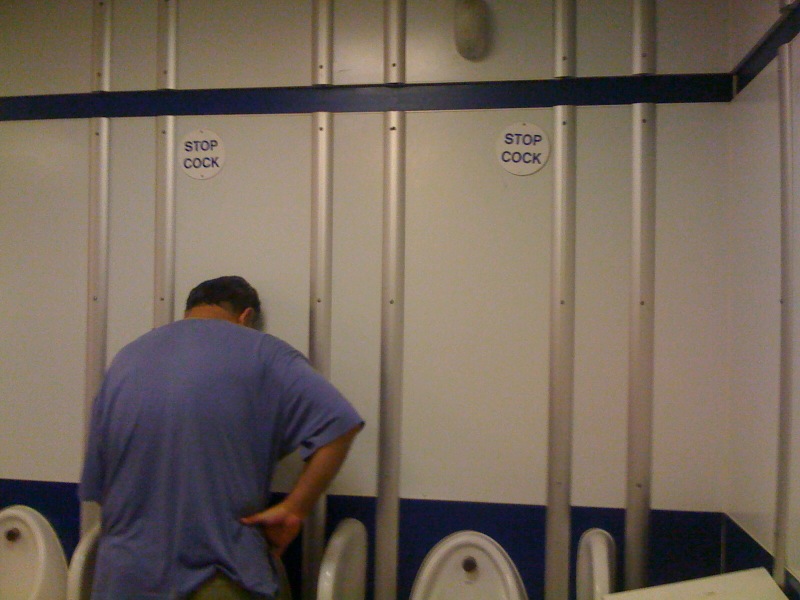
Before that, however, was an email from a former colleague containing nothing but this image:
It still makes me giggle.
Anyway, the first few pages of my GMail are actually made up of messages imported from my .mac/MobileMe account, which I was running in parallel with GMail for some time (and indeed still am, though I don't really use it any more). In those early messages, I can see the first time I was hired as a professional games journalist — Joey Davidson and Brad Hilderbrand were good enough to take a chance on me and hire me for the now sadly defunct Kombo.com. The pay was crap, but it was something at a time when I had nothing else, and I got something far more valuable out of that experience: friends. People I still speak to today — indeed, just today I had a quick chat with Joey via instant message, which was nice.
Around that time, I was preparing for a trip to PAX East in Boston, at which I'd have the opportunity to meet a number of members of the Squadron of Shame for the first time — and to catch up with some I'd had the pleasure of meeting once or twice before. I was also looking forward to the opportunity to cover a big event as a journalist, though sadly I wasn't enough of a bigshot at this time to be able to score a proper press badge, and as such had to write about things at the show largely from a consumer perspective.
Shortly after my return from PAX East, you may recall that my life fell to pieces, and you can see almost the exact moment this happens, since there's a sudden flurry of sympathetic messages from friends and family alike. Thus began a very dark period in my life, and one that still, I must admit, brings tears to my eyes to relive, even when looking at it through the cold, clinical view of plain text.
So let's not do that.
Instead, fast forward a bunch of pages and I was very surprised to spot an email from a familiar name: Shahid Ahmad, who is now best known as Sony's most enthusiastic employee, and champion of the Vita. Shahid apparently commented on one of my posts somewhere — I can't quite tell where from the email exchange, but it was a post about the game Mr. Robot, which I recall enjoying a great deal — and we'd evidently had a discussion about Chimera, a game which he made back in the days of the Atari 8-bit and Commodore 64 home computers, and which he has trying to remake ever since. (He was talking about a remake a while back on Twitter; apparently, he's been trying to make this happen since at least 2010.)
Somewhere around the 37,000 email mark (still in 2010), I seemingly start using GMail a bit more for communicating with people and signing up for things. There's still a bunch of stuff coming in via MobileMe, but messages without that tag are starting to appear more and more.
Around the 35,000 email mark, I start working for GamePro. Of all the sites I've worked on over the years, I think GamePro is the one that I think of most fondly and am most proud of. I feel I struck a good balance with my news coverage, and there was tangible proof that I — specifically me — was responsible for bringing in a significant amount of new traffic with the work I was doing. Unfortunately, this seemingly wasn't enough to prevent the site from being unceremoniously wiped off the face of the planet some time later, but it was nice to know at least.
Aside from my own developments, it's also interesting to see what names I still know today have been up to over the years. It's nice to see Tom Ohle of Evolve PR's name crop up a bunch of times, for example — that man's one of the hardest-working PR folks in the business, and also someone who always put across the impression of genuinely believing in the games he was representing — as well as folks I've worked alongside moving from outlet to outlet.
And then, of course, there's the first appearance of Andie in my Twitter direct messages (Twitter's email notifications used to look a whole lot different!) and… well, we all know what happened there. (She's sleeping upstairs in the house we own together right now as I write this.)
So anyway. Having rambled on for over a thousand words about nothing more than my email archives, I think I'm ready to call that a night. It's been an interesting trip back along memory lane — not always pleasant or comfortable, but certainly interesting — but I think I've sated my curiosity for now, at least.
So what's the earliest email you still have, dear reader?
Something a friend of mine said in an online chat earlier made me think about the way we, humanity, use the Internet on a daily basis — and particularly the role that social media plays in many of our lives.
He said that as human beings, we crave information. It doesn't matter what that information is, we're just hungry for it; forever consuming, devouring any input we can get our brains wrapped around, however mundane, stupid or fury-inducing.
After he said this, I took stock of my online existence since leaving Facebook and Twitter behind. I still haven't looked at the former at all; I've peeped at the latter once or twice to see if I had any mentions or direct messages — I didn't (apart from a share of this post by a dentist who clearly hadn't read it at all), which, I won't lie, smarted a bit, but I'll live.
What I have done, however, is almost immediately replace them with other things. I was always intending to make more active use of the Squadron of Shame forums, for example, but they have become my primary go-to hangout online — which makes their occasional lack of activity a little frustrating. (Come join up and talk in a chin-strokey fashion about games!) But that's not all I'm doing: instead of relying on what Twitter is talking about for a picture of the day's news — a practice which tends to give you an inherently biased picture of what is going on, due to the political tendencies of some of Twitter's most vocal users — I'm specifically seeking out sites like the BBC and the Guardian to read about stories at my own pace. (I still skip over anything that just offers me a video and no text, though; fuck video.)
I am not, however, reading a great deal about video games. This is less about losing interest in them — which my marathon Xillia 2 session this evening will emphatically attest that I am not — and more about feeling there aren't really any sites out there that speak to (or for) me. I've discussed this with a number of people with whom I share similar proclivities, and many of us tend to feel the same way: while the ad-based revenue model for these sites continues to be in place, we're never going to see the sort of coverage that we're interested in seeing. Those sites that do try different things — like Polygon with its now-defunct features section, or 1up with its community-driven nature — end up either closing down altogether, or at the very least shedding the things that made them unique and becoming yet another identikit site of daily triple-A and indie darling news churn.
But I digress. The point is, the information void I left when I cut social media out of my life was immediately filled by something else. It's a compulsion; an uncontrollable urge. As a human being, my brain demands information; it needs input. More input.
I'm not entirely sure if that's a healthy compulsion, since as I noted above, the 21st-century brain doesn't appear to be all that selective about what it wants to absorb into itself. Perhaps if the brain craved nothing but new knowledge — information that would allow it to let its host function as a better human being — that might be absolutely fine.
The human brain is a mysterious thing. Whatever you may feel about the information you stuff into it on a daily basis, though, I think we can probably all agree that the Internet has had a profound impact on how we perceive, seek out and consume information these days, hmm?
Given the ubiquity of technology these days, there's a lot more competition between apps and online services than there ever was in the past. This means that all of them have to stoop to increasingly low levels in order to get people to "engage" with them, leading to a situation we've simply not had prior to the last few years.
That situation comes in the form of apps and services begging you to use them. It's obnoxious, obtrusive and, more to the point, makes me disinclined to make use of that app or service ever again. In fact, in most cases, if an app or service begs me to use it or come back, I will simply uninstall it or unsubscribe from their mailing list.
The most egregious example I can think of recently was an app called TuneIn Radio. I was recommended this as a good means of listening to both streaming Internet radio and podcasts, but was dismayed to discover after firing it up just once that it then insisted on reminding me of its own existence at least once a day via a push notification that was usually recommending something I had absolutely no interest in whatsoever. ("Listen to TalkSport!" Oh, how little you know me.) However good the app is, notifications bug me enough at the best of times, so in the bin it went.
I'm still getting email messages from services I had to sign up for when I was reviewing endless reams of shitty mobile-social apps for Inside Mobile Apps, too. Eventually I simply registered for these services with an email address I don't use any more, and this mitigated the problem somewhat, but there are still times where there are services that I haven't touched for a year or more feel the need to email me and remind me that they exist.
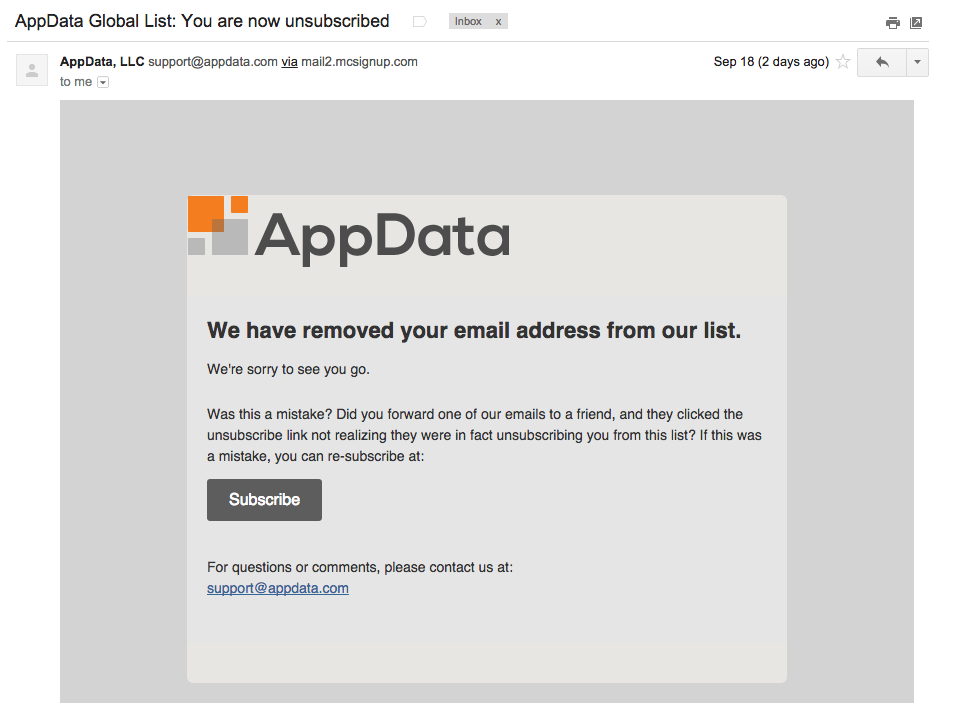
Worse, when you unsubscribe from these mailing lists you inevitably end up signed up to, you're often questioned as to why you'd ever want to stop your inbox being cluttered up with this meaningless crap. I had one email the other day from a service called AppData, a ludicrously expensive analytics service that was attached to the Inside Social Games and Inside Mobile Apps sites I used to write for, which asked whether I had unsubscribed "by mistake". Seriously. Look.
The sheer arrogance of this is absolutely astonishing. "Oh, no, whoops, I unsubscribed from your marketing spam by mistake. I actually do want you to try and sell me things! Sign me back up, quick!" Or, indeed, "oh no, the pointless marketing spam I forwarded on to my friend [who does this?] annoyed them so much that they tried to unsubscribe themselves and instead unsubscribed me! Sign me back up, quick!"
I kind of understand why this happens. As I said at the beginning, the sheer amount of competition between mobile app and online service providers these days is ridiculous, so they have to resort to ever more drastic measures to retain their users, and hopefully convert them into paying customers — or at least people who will click on ads.
I can't say I feel much sympathy, though. Surely having to resort to this is not a signal that you should market harder. Surely having to resort to this is, instead, a sign that there is far too much pointless, useless crap on the market, and maybe you should try a bit harder to come up with an idea that is actually innovative and helpful to people rather than a rehash of other things people already use? Harsh as it may sound, these days I find myself smiling a little with every email I receive that informs me a pointless, stupid mobile-social service that I reviewed a year or more ago is closing down. I'm glad; there's too much noise in our lives anyway even with just the well-established services like Twitter and Facebook, so stop adding to it.
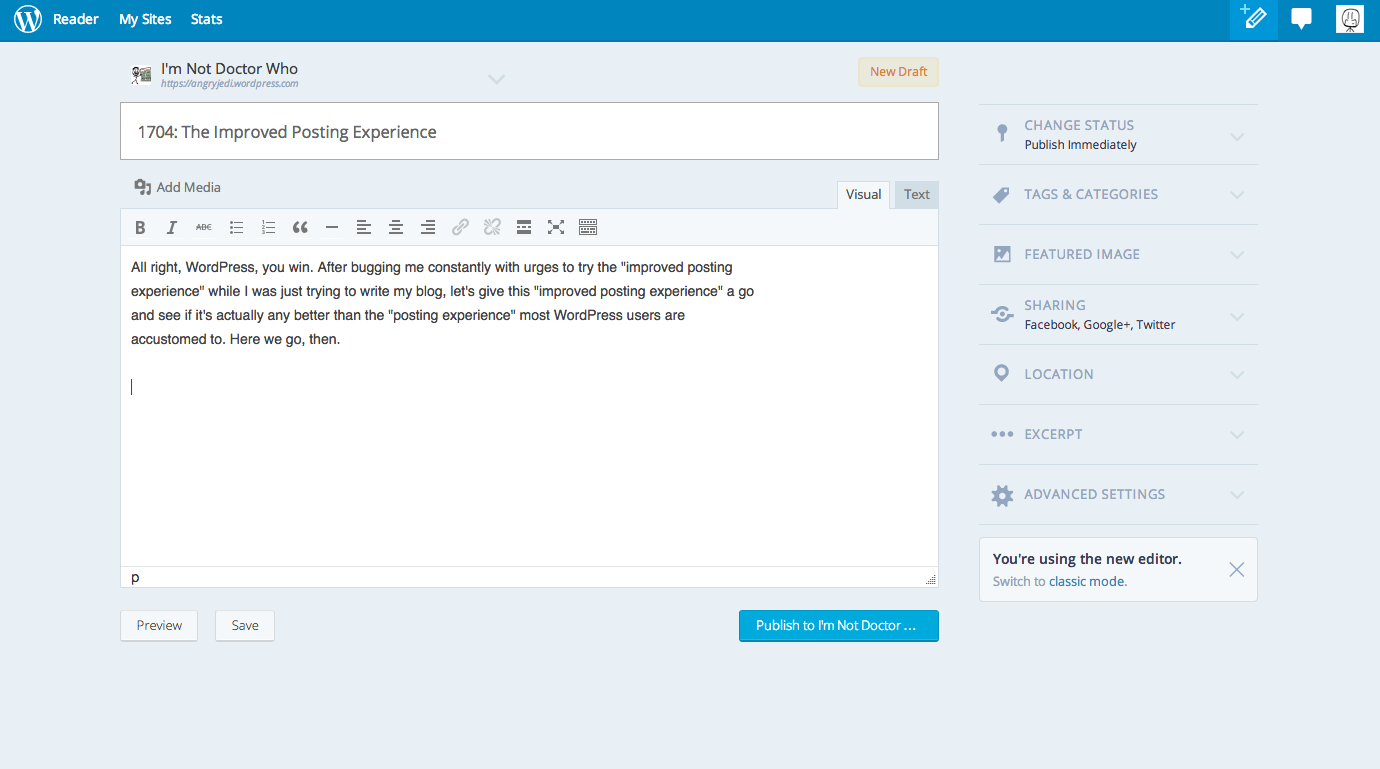
All right, WordPress, you win. After bugging me constantly with urges to try the "improved posting experience" while I was just trying to write my blog, let's give this "improved posting experience" a go and see if it's actually any better than the "posting experience" most WordPress users are accustomed to. Here we go, then.
So first up, it's pretty blue. This puts it in line with the main WordPress.com site, where those using WordPress.com to manage their blog and/or be part of the WordPress community of bloggers can tweak their blog settings, fiddle with multiple sites and subscribe to other people's blogs. In that sense, it's consistent; however, where it's inconsistent is with the rest of the WordPress dashboard, which is still the black and grey it's ever been.
Let's take a look at functionality.
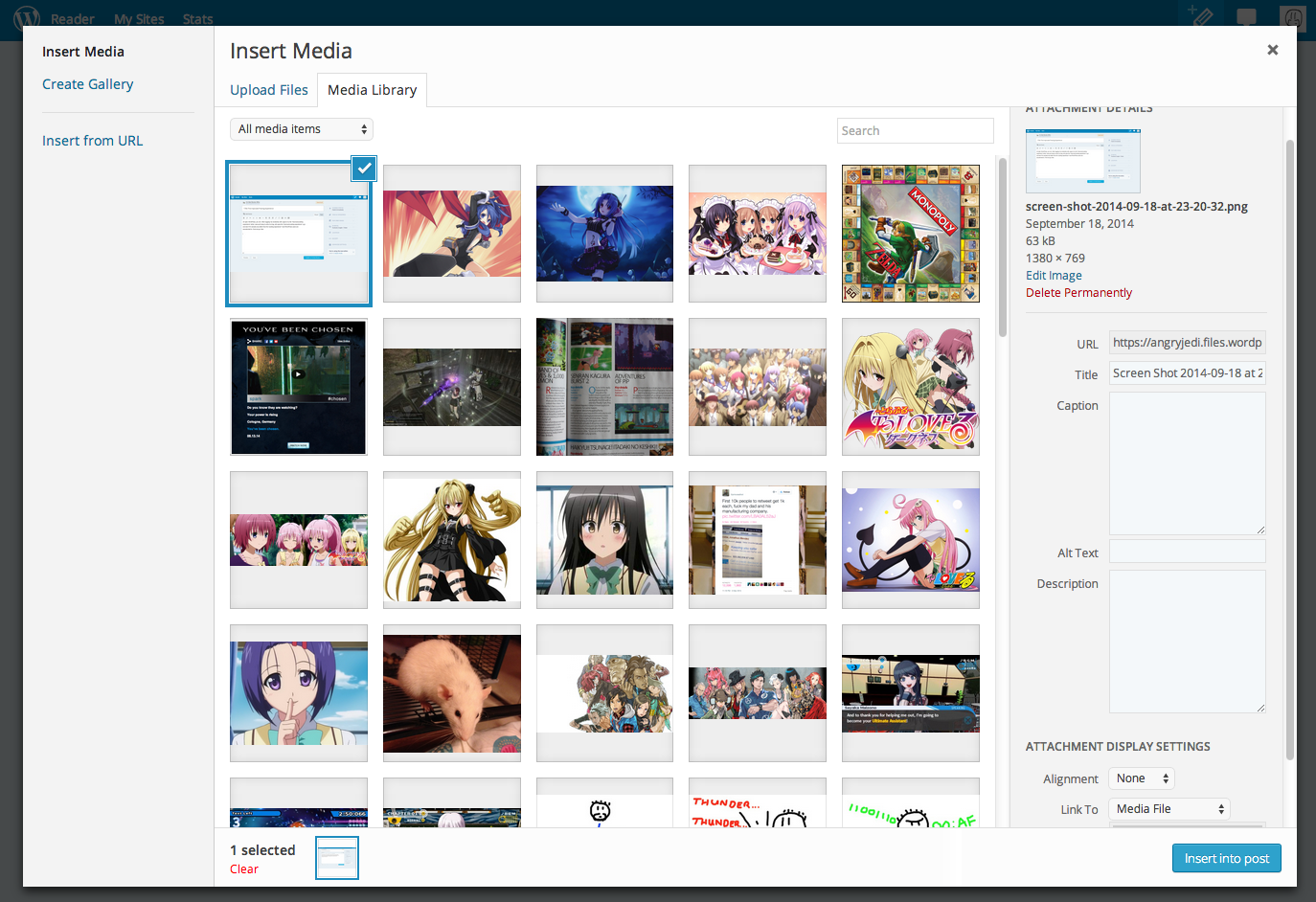
There's drag and drop for images… sort of. You can drag an image file onto the post editor, but this doesn't automatically insert it into the post at the point where you drop it, disappointingly; rather, it simply brings up the regular media browser (which now doesn't match the new editor) and uploads the image, at which point you can insert it into the post where you left the cursor. (This didn't work first time I tried; I had to close the media browser, reposition the cursor, then open it again and then insert.) It also inexplicably forgets the default setting for image size that you might have been using in the "classic mode" (ugh) "posting experience".
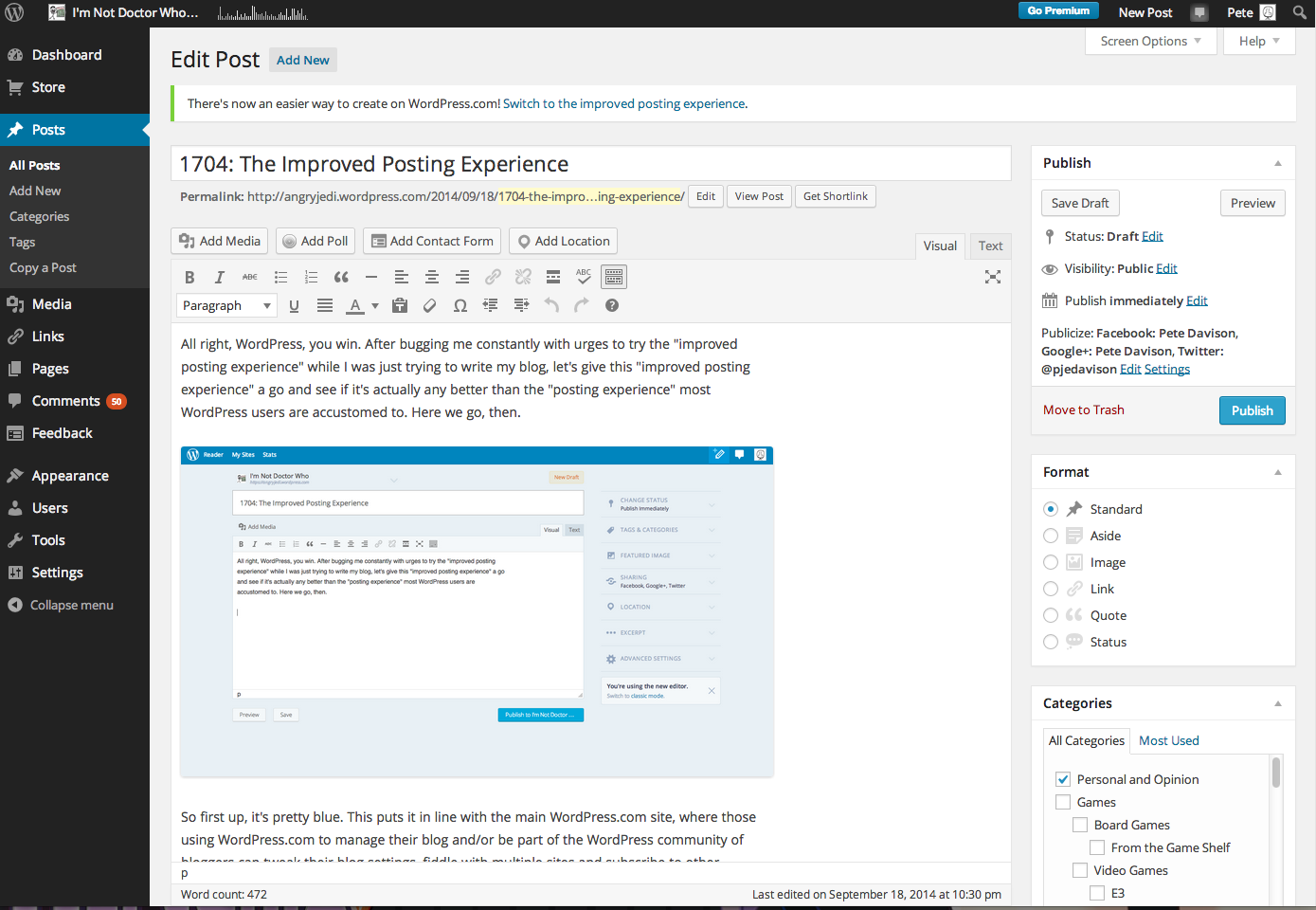
As for other functionality, there's the same toolbar as the regular WordPress "posting experience" (no, I'm not going to stop the sarcastic quotation marks around that phrase anytime soon) but, like the media browser, it forgets your default settings, in this case whether you have the "kitchen sink" second row of buttons (allowing access to styles, underline, justification, text colour, special characters, indents, undo and redo — all pretty useful stuff) open or not.
Over on the right of the editor, there's a bunch of pop-open menus for the post's status (draft, scheduled, published), tags and categories, a featured image, whether the post will be shared on social media (and whether there will be a custom message), an attached location, a front-page excerpt, and the mysterious "advanced settings", which include… drum roll…
…a custom slug, the author of the post, the format of the post, its visibility, whether or not it's a sticky, and whether it allows likes, shares, comments and pingbacks. Hmm. Not all that advanced, really.
I can't really tell what's better about this "improved posting experience" to be honest, and in a number of ways it's actually inferior. It certainly looks quite nice — the pop-open menus on the right keep things very neat and clean, for example — but it has this improved look at the expense of ease of access to information and settings.
The standard WordPress editor may be more cluttered and rather more clinical-looking than the soft blues of the "improved posting experience", but it's also considerably superior. Information and settings can be popped open and closed at will — it's all open rather than closed by default — and the screen gives you much more information, most notably on the status bar at the bottom of the editor, where you have a word count and a "last edited" date — both of which are completely absent from the "improved posting experience". There's also easy access to all other aspects of your site via the left-hand side menu.
Also worthy of note: when I started writing this post, there was a button to switch back to "classic mode" which promptly disappeared when I saved a draft. Getting back to the standard editor required logging back into this site's dashboard, going to the post list and then choosing to edit my draft. Somewhat cumbersome.
I can see the intent behind the "improved posting experience" — it's to strip out all the stuff that might prove daunting to those less familiar with technology and software such as WordPress. It's an attempt to make it into a simple and clean blog editor along the lines of Tumblr. Trouble is, that's never what WordPress has been about; WordPress has always been the blog solution to go to when you want customisability and a lot of control over what you're posting, when and how — and without having to mess around with HTML and CSS for styling.
Perhaps the "improved posting experience" will encourage more new users to give blogging a serious go. And that's ultimately a good thing. For people like me, though, who have been using WordPress for years now, it's very much a step backwards rather than forwards.
Posts that essentially boil down to "I'm Leaving [insert site name here] And Here's Why You Should Care" are the very worst kind of egocentric narcissism, as most of you probably know. This is because they usually amount to someone attempting to attract attention to themselves flouncing off in a huff after they feel they've been slighted, only to return a week/month/year later to repeat the cycle anew. If you've had the patience and willpower to follow Fez developer Phil Fish over the last couple of years, you'll have witnessed this action firsthand.
And yet here I am making a largely similar post, and not for the first time. I shall try and keep the egocentric narcissism to a minimum, however — though I'm making no promises.
This post is about two things: 1) why I don't intend for Twitter, Facebook and Google+ to be part of my daily routine any more, and 2) how you can reach me if you'd still like to talk to me online — because despite the things I'm going to say under heading 1, I can't deny that I've made a lot of good friends across all three networks over the years, and it would be a shame to abandon that completely.
To begin at the beginning, then. There are a lot of words ahead, but I would appreciate you sticking around to read them — particularly the last section about keeping in touch.
Don't worry, there will be pictures. They'll be irrelevant pictures, but there'll be pictures.
Why I don't intend for Twitter, Facebook and Google+ to be part of my daily routine
Those of you who have been following this blog recently will know that I decided to subject myself to a voluntary social media blackout this week. Specifically, I logged myself out from Twitter, Facebook and Google+, deleted the relevant apps from my phone, ensured that anything that might bug me with notifications from them was well and truly switched off and finally settled down to a week of peace.
It's now a week since I started that blackout, and the time at which I decided I was going to review whether or not I needed social media in my life any more. And the conclusion I've reached is that I don't think I do. I opened Twitter earlier today to see how I felt, and felt no urge to scroll down to see if I'd missed anything — I closed it straight away without even scrolling off the first page of tweets. I didn't even feel the urge to open Facebook or Google+ at all. I have broken the "habit", it seems, and I don't feel like I "need" to develop it again.
Because it is a habit. It's compulsive behaviour — at least it was for me. You may do it yourself without realising it; you reach a quiet moment in the day, and out comes the phone or up comes the web browser, and you do your "rounds" of your social networking sites of choice. You scroll through the reams and reams of content the millions of members of these sites worldwide have made, rarely taking anything in, rarely stopping to appreciate, say, the composition of a photograph on Instagram, or the witty headline that someone came up with for a news story on Facebook. It's page after page of noise, little of it meaningful, all of it vying for your attention with equal fervour. And yet still around and around and around you go.
Some people deal with this noise better than others. Some people can discipline themselves to set aside a little bit of time to check their networks, then put them aside for hours or even days at a time. That can be a valid strategy, but with the speed at which modern social networks move, if you're not there when something happens, your contribution to the "discussion" — and I use that term loosely — is likely worthless, since conversation will have moved on by then.
This matter of "discussion" is worthy of consideration, so let's ponder that a minute.
The approach most people tend to take to discussion online.
One of the things that drove me to start my week-long blackout a couple of days earlier than I intended was the whole #GamerGate thing on Twitter. For those who don't follow the video games field — or those who simply aren't on Twitter — in simple terms, this was an argument between video game journalists (particularly those who err on the "feminist" side of the sociopolitical spectrum) and those who self-identify as "gamers", i.e. people who play, enjoy and are passionate about video games and would rather not be told they're awful people whenever possible.
I don't really want to get into the details of the events surrounding #GamerGate as that would be long, tedious and, more to the point, has already been summed up in a great amount of detail elsewhere on the Internet. (As always, note that there are two sides to every story — something that both sides on this particular argument have been guilty of forgetting.)
Suffice to say, however, that #GamerGate brought out the very worst in a lot of people. It brought out some of the most unpleasant trolls the Internet had to offer, who, predictably, went after a number of people who — let's be honest here — often court controversy to make a point. On the other side, those loud-voiced members of the press and their numerous sycophants continued down a path that I've been unhappy to see them proceeding down for the last year or two: belittling, ridiculing, publicly shaming and even outright insulting the very people they are supposed to be writing for.
Whatever fair points both sides had — and make no mistake, both sides had fair points — were lost amid the noise, and discussion never got anywhere. It was frustrating to watch; I tended not to participate as much as possible as I learned a while back that any attempts to call for moderation in such matters tended to result in accusations of "tone policing" — which, ironically, is itself a form of deflection attention away from a point being made — rather than genuine attempts to calm down and discuss things like rational adults. And thus nothing was ever resolved.
As I said above, different people deal with different things in different ways. My frustration with these endlessly circular arguments — in which no-one was really listening to anyone else and in which any fair points were inevitably lost in all the blind anger and insults being thrown in both directions — manifested itself as anxiety, stress and depression. I was genuinely afraid to contribute to these discussions for fear of attracting the wrath of one, the other or both of the angry mobs involved. And it was having an effect on my mental health.
If you can take yourself out of a situation that is causing you problems with your mental health and not cause yourself further problems, you should do. So that's exactly what I did. I extracted myself from the whirling miasma of rage, quietly slipped away for a while to reflect, contemplate and heal — and now, here I am, a week later, with no desire to jump back into the fray.
This isn't to say that Twitter, Facebook and Google+ are nothing but whirling miasmata of rage and other negative emotions, but frankly, the other stuff there has seemed of little value to me for some time, too. There's only so many "You Won't Believe What Happened Next!" videos you can take seeing before you just don't care What Happened Next; only so many "adorbs" pictures of cute things you can see before you never want to see another squirrel again; only so many baby photos you can scroll past before your only reaction to a friend enjoying a new addition to the family is… well, nothing.
It's all noise to me, in other words; an overwhelming swathe of constant content; a never-ending stream of consciousness in which meaningful life events are ascribed equal importance to a video of a cat drinking water from a squirt bottle. I don't need that. I've always been one for social anxiety, but right now I'd rather hear important things from the lips of the people involved rather than read it on Facebook or Twitter; I'd rather actually hang out with friends than hope I get more than a couple of "Likes" on the picture of the bag of chips I'm about to eat, or a couple of comments on a post I made about how much I'm enjoying Tales of Xillia 2.
I'm not saying there's no place for these sites in society at all — clearly a lot of people get great joy, excitement and enjoyment out of them. But for me, their value has dwindled significantly over the last year or two, so it's starting to make sense to cut them out of my daily routine and instead seek other means of staying in touch with the people I actually care about.
Which brings us neatly on to the second part of this post.
Well done for reading this far. Have a cake.
How to stay in touch with me
I'm not retiring from the Internet altogether. Rather, I'm being more selective with how I communicate and with whom. Consequently, I'm focusing on ways of communicating that allow me to take more control over my online presence, and which are more inherently personal than just shouting into the void of social media.
Note that I'm not closing down my Twitter, Facebook and Google+ accounts — they'll be used to broadcast these blog posts — but I won't be actively checking any of them, so please don't @mention or comment via any of those means if you want a reply from me.
Here are the main ways through which you'll be able to contact me in future:
This site. I post one blog entry here every single day, and have done for the last 1,699 days. Leaving a comment on my most recent post is a good means of getting a message to me. I'll try and be better about replying than I have been in the past!
Email. Close friends probably already have my email address. I don't mind sharing it, but I'm not putting it out in the open on this site. If you'd like to chat via email, you can start a private conversation via the contact form on my About Pete page and, assuming you're not some sort of crazy stalker, I'll probably get back to you.
Google Hangouts. For real-time chat, I use Google Hangouts almost exclusively. I don't do voice and I don't do video, but text chat is something I'm happy to engage in with you, assuming I know who you are before you just pop up saying "hi" and nothing else. If you don't already know my Google Hangouts info, drop me a message via the aforementioned contact form.
The Squadron of Shame forum. Most of my "public" conversations — "broadcast-type" messages, I like to think of them as — will now be found over on the Squadron of Shame forum. Although the Squad was originally set up as a small but well-formed group back in the 1up.com days, the modern Squad is very open to new members, with the only requirements for membership being that 1) you're interested in games, particularly those a little off the beaten track and 2) you're respectful to other people's tastes in games, even if they don't coincide with your own. Come and sign up and say hello, since that forum is where I'll be spending most of my online "social" time these days.
Final Fantasy XIV. If you happen to play Final Fantasy XIV and find yourself on the Ultros server, look up Amarysse Jerhynsson and say hello.
Thanks for taking the time to read this post; I appreciate it. To those of you that I've only interacted with on social media in the past: I'm sorry to leave you behind just as, in some cases, we're starting to get to know one another (I'd like to give particular, specific shoutouts to @FinalMacstorm and @SonyofLastation here, both of whom I've very much enjoyed talking to recently) — but I hope you'll consider staying in touch via one of the means above, and I hope you understand my reasons for wanting to eliminate stressful, anxiety-inducing and unnecessary noise from my personal life. To those of you who are already firm friends beyond the boundaries of social media — well, the same, really; I hope you'll respect my decision here, and that you'll stay in touch via other means.
Onwards to a brighter future, then: one largely free of pop-up notifications, pointless arguments and unnecessary stress. I'm looking forward to it very much indeed.
I've decided to go through with a week-long social media blackout. (By "social media" I mean "Twitter and Facebook", just to clarify; I'm not breaking my own rules by posting here.)
I was originally intending to start it off on Monday, but then yet more nonsense in the whole Zoe Quinn thing kicked off this morning and I just didn't want anything to do with it whatsoever — either the inevitable abuse she would receive for the things she was posting, or the unbearable smugness of her supporters.
So I started it today, cold turkey. And I'm serious about it. I deleted the Facebook and Twitter apps from my phone. I logged out of the sites on all my browsers. I removed the bookmarks from Chrome, the browser I use most frequently. And I haven't looked at either all day.
While I won't pretend I haven't felt a few urges to pop my head in and have a look, I haven't acted on these urges at all. I haven't felt the need to. I know that, going by what I saw this morning, something would just irritate and annoy me. And I don't need that.
I'm not going to cut myself off completely, though. For the week, my online socialisation will be through email, instant messaging (Google Hangouts), comments on this site and the Squadron of Shame forums. All of these are environments where I have much greater control over my socialisation, and which are populated by far smaller groups of people. And they are all people with whom I know I get on and can enjoy conversation with.
One may argue that there's a danger of creating an echo chamber when you simply surround yourself with people that you're 100% comfortable with, but in reality it's actually rather desirable to have a friendship group that understands you. It's an admirable goal to attempt to understand and ingratiate yourself with groups that you don't know a lot about, or whom you probably wouldn't hang out with in "real life", but eventually it just all starts to feel a bit high school, what with all the cliques, cool kids and groups that end up being the butt of everyone's jokes — often without justification.
Ponder how your friendships work in real life. Chances are that over your lifespan, you've met a significant number of people. Some of these became friends because you had things in common or enjoyed spending time together. As time passes, the number of true friends you likely have has probably dwindled as everyone's lives start to move in different directions. That's a bit sad when it means you lose touch with people with whom you used to spend a lot of time, but it's also part of the natural "filtering process" our real-life social lives go through over time.
With social media, this filtering doesn't happen automatically, so unless you take the time to actually go through and prune your friend and follower lists every so often, over time the noise just builds and builds and builds, often with disparate groups ending up butting heads with one another in your timeline or news feed. If you stand on the periphery of a few groups that, for whatever reason, end up at each other's throats, it can put you in a very awkward and undesirable situation, as we've seen with the whole "Gamergate" thing over the last week or so. To use my own personal situation, I identify with the games journalists who are undoubtedly frustrated at the constant accusations of "corruption" being levelled at them, but at the same time I also identify with the gamers who are sick of journalists talking down to them as if they're some sort of superior moral arbiters. Both sides say and do some regrettable things, and even if you're not directly involved — as I've taken care not to be — it can be anxiety-inducing to see what's going on.
That's not what the original promise of social media was. I recall signing up for Facebook for the first time and being amazed by the prospect of being able to easily stay in touch with people. Twitter, meanwhile helped me make a ton of new friends and discover people with common interests all over the world. Since I first signed up for both of them, though, their place in society has changed; Facebook has become little more than a link repository for endless "You Won't Believe What Happened Next!" clickbait bullshit, while Twitter has become a place where they who shout the loudest get to be "right", and whoever is right gets to declare anyone who disagrees with them as some sort of awful deviant.
As such, then, we come to my blackout. I feel positive that it will have a good effect on my mental health. And when it comes to next weekend, I'll make some more permanent decisions about my online existence.
I may have already made up my mind. But we'll see.
 Just slightly over two years ago (really quite surprisingly close, now I look at the dates), I pondered the subject of how I Don't Care about certain social issues.
 It is traffic that drives the modern Web, whether we're talking about a commercial site or a personal social media page, but I'm gradually coming to regard the relentless pursuit of this easily measurable but sometimes quite misleading metric as something I'm keen to step as far away from as possible.
 It still makes me giggle.