I've done a lot of work on my Secret Creative Project over the course of the last few days. I am feeling a strong amount of Autistic Hyperfixation Energy on it right now — even if I do often have to juggle this with the equally autistic tendencies to fiddle around with the bits I've already created over and over rather than continuing to make new bits.
Thus far the project is standing at 16,826 words. I anticipate that by the time I finish this — which will be a pretty long time from now — that number will be in the high six digits at the very least. There's a lot of work still to do, but I feel good about this; I feel like this is a worthwhile undertaking, and one that I'm enjoying doing.
It's not something I plan to make any money from; it's not something I plan to plaster ads all over; it's not something I'm doing to "be famous" or anything like that. It's just a project based on something I enjoy that I think will help others to enjoy said thing as much as I do. Plus it's an excuse for me to dive down some thoroughly interesting research rabbit-holes.
Doing this is reminding me that I love writing, particularly about the things I'm passionate about. (Go on then; I'll give you a little hint as to what the project is about: it is, perhaps unsurprisingly, about games.) I love the little journeys that bits of research take you on; I love trying to craft a narrative from those nuggets of information you find; I love trying to get my enthusiasm across in a way that is hopefully enjoyable for the reader to engage with.
I don't know if I'll ever finish this. I would certainly like to, and while I'm feeling the strong Autistic Hyperfixation Energy, I intend to keep taking advantage of it as much as possible. I reached what I consider to be the first major milestone in the project this evening… out of many milestones along the way, yes, but a significant one, nonetheless. It feels like finally cresting a particularly steep hill, so I am going to "reward" myself with some nice relaxing time tomorrow. I haven't played Pragmata for a few days and need to get back on that, but this has been taking priority while I've been feeling very much in the mood for it.
On that note, though, it's after midnight, and I think I should probably get some sleep now.
Want to read my thoughts on various video games, visual novels and other popular culture things? Stop by MoeGamer.net, my site for all things fun where I am generally a lot more cheerful. And if you fancy watching some vids on classic games, drop by my YouTube channel.
If you want this nonsense in your inbox every day, please feel free to subscribe via email. Your email address won't be used for anything else.
It seems another gaming outlet has bitten the dust — in this case, the gaming part of The A.V. Club, which at various points has been part of Paste Magazine, a standalone site called Endless Mode and perhaps some other incarnations before that. (And no, I will never call them a "vertical"; we all took the piss out of Polygon being called a "vertical" when it was first announced and I have no intention of stopping now.)
At this point, I'm not even surprised any more. The broad concept that is "the video games media" is almost completely gutted at this point, with only a few sites still holding on. IGN and Gamespot still exist; Polygon still (kind of) exists; smaller, platform-centric sites like Push Square and NintendoLife still exist; and Kotaku has come back from the "dead" more times than I can count at this point.
I find myself pondering a few things about the whole situation. First of all, given that gaming is bigger than ever, how on Earth are we unable to sustain a specialist media sector focusing on it? Someone on Bluesky suggested it was because a significant number of the people who "play games" are little more than "content consumers", just "consuming" the latest thing that comes along and then banishing it from their mind; not taking the medium seriously as an art form, in other words. There's certainly an element of that, but I don't buy that it's a satisfactory explanation for what has been going on with the media over the course of the last few years.
Perhaps it's some sites discovering that certain "types" of games journalism just don't work? Those of you of a certain age will probably remember discussions over "New Games Journalism" and the question of whether we would ever have a "Lester Bangs of Games Journalism". These discussions were happening back in the late '00s, and centred around the idea of games journalism and criticism in particular moving away from the bog-standard news, preview, review, guide format in favour of something that was more… experiential, I guess you'd call it. Treating games more akin to how literary and artistic criticism treats other, more well-established art forms. "Telling the stories of the people behind the games", all that sort of thing. Things that look like they might be admirable when you look at them as part of a mission statement.
Thing is, I'm not sure that's what the readers want. The one thing you might notice about all the sites that have managed to survive for decades at this point is that they are, for the most part, still beholden to the same old news, preview, review, guide cycle that has been in place since the days of print. And my theory is that this is, as stale as it might be, what people still want from games journalism. "The stories of the people behind your favourite games" can be interesting, but when all a lot of people want to know is whether or not Pragmata is any good, I feel like those articles — which often take a hell of a lot of research, networking and general access to their subjects — may not be entirely sustainable, particularly on a site that needs to keep the lights on through ad revenue.
I'm not saying this is a particularly desirable situation. The overreliance on ads has lead to the "guideslop" era we're in at the moment, where every game that looks even vaguely likely to attract a few clicks gets three thousand pieces of "guide content", each one focusing on a single hyper-specific thing about the game in question, rather than a single, quality, well-crafted walkthrough. This is a load of old shit; there are a lot of writers who could be doing much more interesting work stuck on the guides beat, and I'm very much willing to bet they are some of the hardest working but lowest paid people in the business.
But I think back to old games magazines and why I enjoy reading them, and it's because each of them captures a moment in time. Times when we were excited for games that we knew the name of, but very little else about besides a couple of tiny, fuzzy screenshots; I think some mags got pretty much a full year of news stories out of two "Zelda 64" screenshots back in the day. Times when we were excited for the new possibilities that seemingly mind-blowing new platforms would offer us — and then the crushing disappointment when they turned out to not be that good after all. (Philips CD-i and 3DO say hello.) Times when an amazing new game would be the cover star of a magazine and turn out to be even better than we had ever hoped for — or in some cases, catastrophically bad.
I'm not sure sites writing about labour conditions in the industry, unions and quarterly financial results are really what gaming enthusiasts want from the press that supposedly represents them. I know it's certainly not what I'm particularly interested in.
I don't really read any gaming sites any more, and I often ask myself why that is. There are still quite a few out there doing good work, and there's a decent amount of diversity in the types of coverage out there, still… at the moment, anyway. I'm just not sure some of it is sustainable in the long term, and I wonder if a desire to focus on that unsustainable stuff just because it seems like "the right thing to do" — which it very much is in many cases — is what has got the games media as a whole into the messy position it's in today.
So what's the answer? I have no idea, really. In my ideal world, we'd go back to reading magazines every month, but despite the fact some magazines do still exist in print — I recently resubscribed to Retro Gamer, for one — it seems that is perceived as even more unsustainable than everything I've described above.
As someone who, as a young 'un, wanted nothing more than to follow his brother's footsteps into video games media, it's extremely sad to see all this happen. But I'm also kind of glad that I'm no longer directly in that space, because it seems like a hell of a bad time to be a video game specialist writer right now.
Want to read my thoughts on various video games, visual novels and other popular culture things? Stop by MoeGamer.net, my site for all things fun where I am generally a lot more cheerful. And if you fancy watching some vids on classic games, drop by my YouTube channel.
If you want this nonsense in your inbox every day, please feel free to subscribe via email. Your email address won't be used for anything else.
I won't lie, after pretty much falling off Final Fantasy XIV post-Dawntrail, I haven't really felt in any great hurry to return. Not because I didn't enjoy Dawntrail, mind — in fact, I enjoyed it very much! — but rather because I felt like it was getting increasingly difficult to juggle Final Fantasy XIV and the ability to play anything else at the same time.
However, the recent news that has come out about the upcoming expansion, Evercold, has me thinking that I might return. There are a few reasons for this.
First and foremost is the social angle. I like the people that I used to play with. It would be fun to be able to hang out with them again. There are also people I know who are vaguely interested in giving Final Fantasy XIV a go, and shortly the legendary Free Trial will be adding everything up to and including the Shadowbringers expansion, commonly agreed to be one of The Best Bits, which may make it easier to convince people to join in.
Secondly, I do miss the game a bit. I have had some special times in Final Fantasy XIV over the years, and I will always, always love the soundtrack. Soken has worked miracles with that game, and I feel almost like I'm letting him down to not be playing. He has no idea who I am, of course, but still. He is a wonderful person and a brilliant composer, and enjoying his stuff in context is great.
Thirdly, the changes that are coming to Evercold sound really interesting. I'm particularly intrigued by the "Evolved" battle system, which promises to reduce the number of actions you'll have to assign to your hotbars by having more of the dynamically changing buttons that were introduced with Dawntrail's new jobs. Supposedly most jobs will be able to function perfectly well with 16 action bar slots in Evolved mode, which means a lot less in the way of remembering some obtuse button combinations, particularly when returning to the game from a long break. (Of course, it means learning some new button combinations, but they will, at least, be simpler.)
I'm also interested in the move away from "endgame currency" as a progression system. I don't think we've really had it explained in much depth how exactly the new "seasons" system is going to work, but Yoshi-P seemed determined to emphasise the point that it's not a Battle Pass or free-to-play type "pay to win" situation. What it looks like is a flexible system where you earn points for doing… stuff. And rather than being forced into grinding the same old Roulettes and high-level stuff, it looks like you might have the opportunity to do a broader range of activities, which will be nice.
Perhaps I will hop back in once the new patch arrives tomorrow. There's the new Beastmaster job to explore, plus I didn't do much with Blue Mage, and of course I have plenty of other jobs still to level too — as well as just re-learning the game after so long away.
I think I probably will go back. I'm just not sure quite when yet, or how it will fit into my life more broadly. But we'll see. We'll see.
Want to read my thoughts on various video games, visual novels and other popular culture things? Stop by MoeGamer.net, my site for all things fun where I am generally a lot more cheerful. And if you fancy watching some vids on classic games, drop by my YouTube channel.
If you want this nonsense in your inbox every day, please feel free to subscribe via email. Your email address won't be used for anything else.
Today was our trip to The Cave and Arcade Archive, part of the Retro Collective organisation. As I've explained a few times previously, and for the benefit of those who might have missed those posts, The Cave is an interactive, hands-on computer and video game museum, while the Arcade Archive is a similarly interactive, hands-on free play arcade museum. The Retro Collective as a whole encompasses these two museums, the company Heber Electronics, who make the MiSTer Multisystem 2 console, and the Retro Collective YouTube channel, fronted by retro tech enthusiast and historian Neil Thomas.
I will be peppering today's post with photos from today's trip.
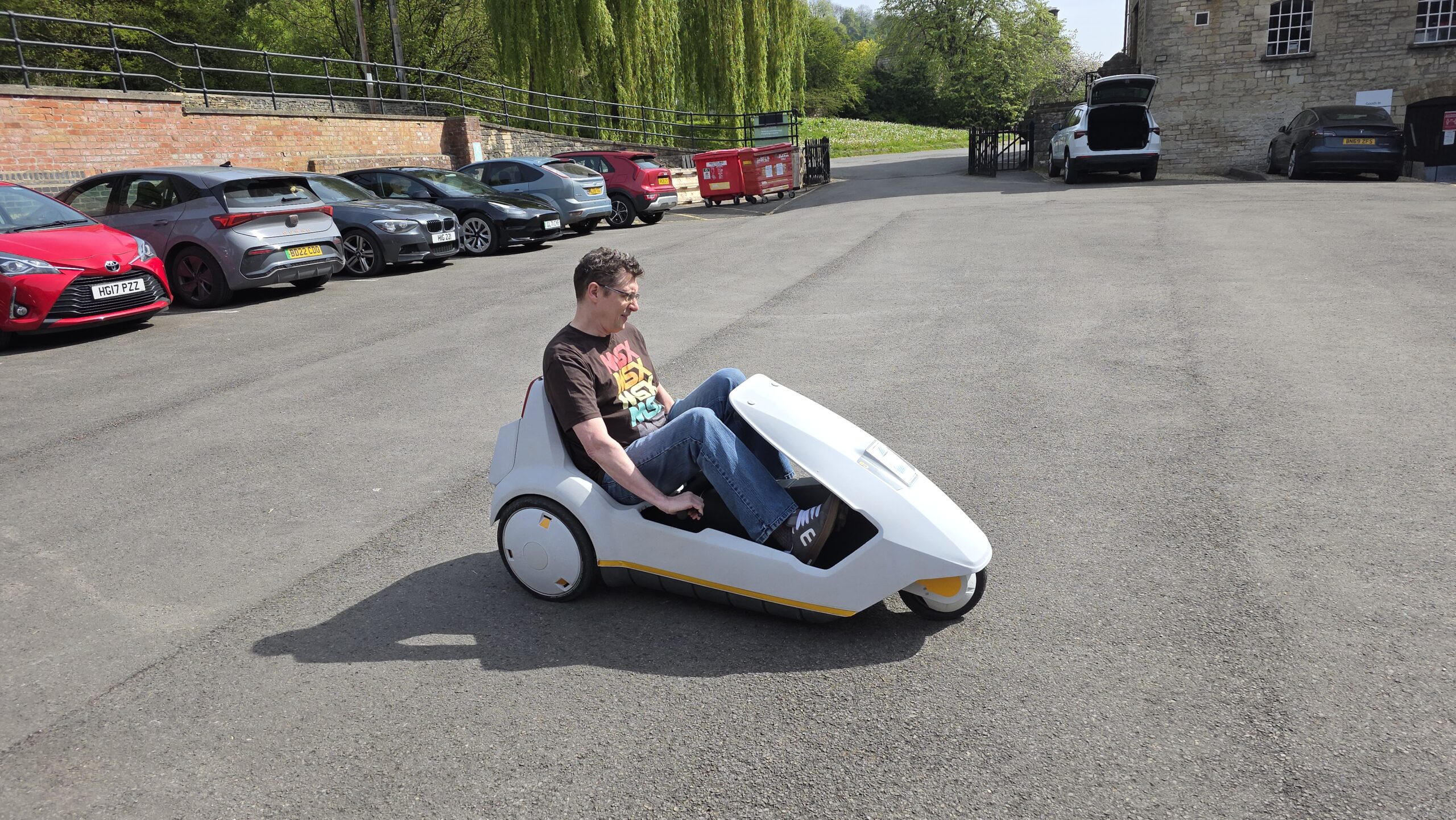
Demoscene veteran, ace retro coder and composer Ian "h0ffman" Ford getting to grips with a Sinclair C5.
The event today centred around a talk by Ian "h0ffman" Ford, a veteran of the Amiga demoscene who returned to coding and composing on classic computer hardware back in 2010, and has been spending much of his time since COVID fiddling around with disassembling and porting classic games from one platform to another. To date, he has ported the MSX2 version of Metal Gear to Amiga, the MSX game Knightmare (no relation to the TV show) to Amiga also, plus Shinobi and Golden Axe from Sega's System 16 arcade board to NEOGEO, plus the modern Unity game Cecconoid to Amiga. His talk explored how most of these projects came about because of repeatedly falling down rabbit holes while satisfying his own curiosity.
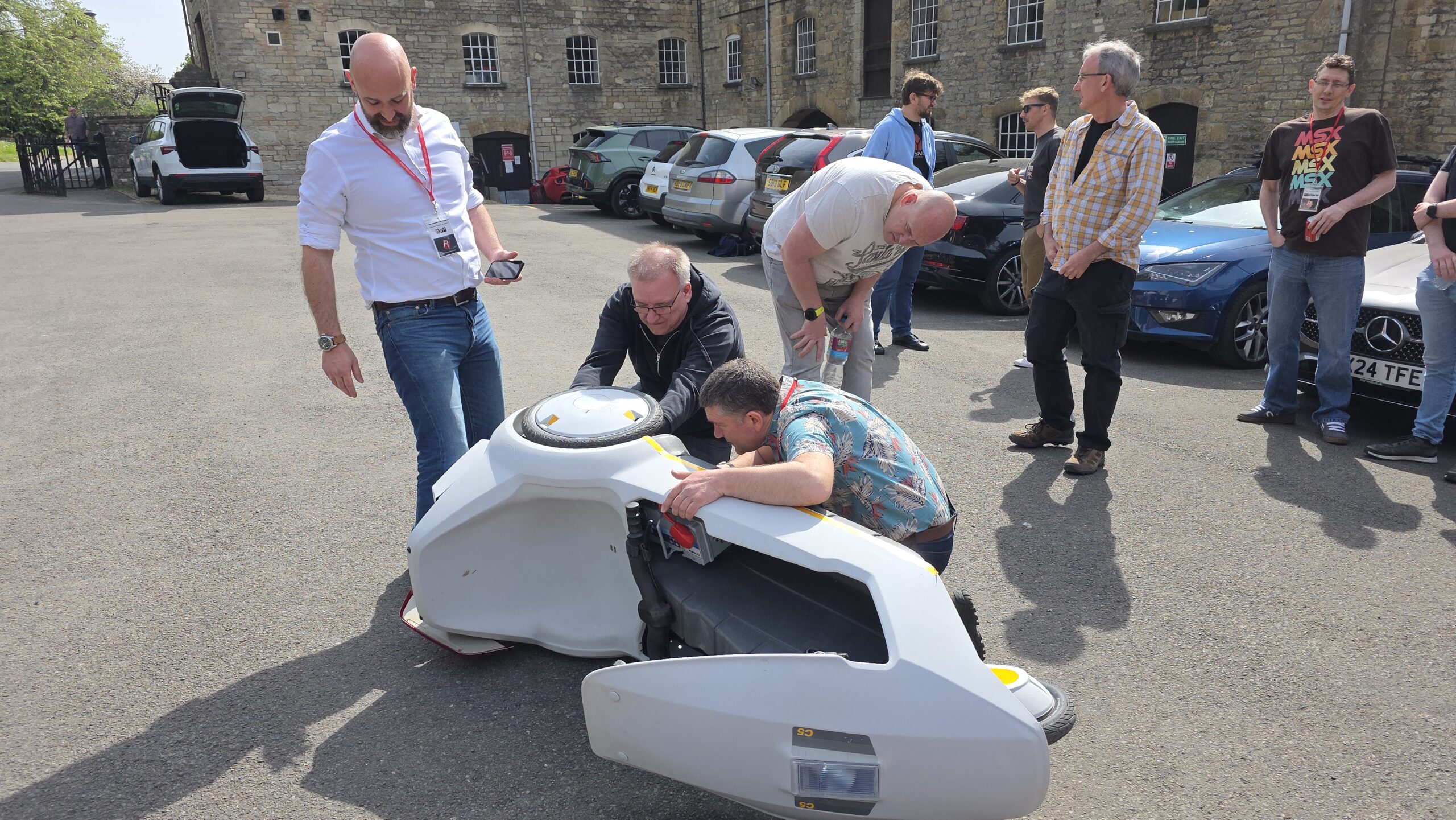
True to form, it didn't take long before the C5 broke.
Outside of h0ffman's talk, which happened after lunch, all of us in attendance were free to explore The Cave, the Arcade Archive, and the organisation's newly renovated workshop space, known as the Pump House. (The entire operation is in an old mill, and the Pump House used to be part of the site's earlier purpose; it's not just a funny name they gave it.)
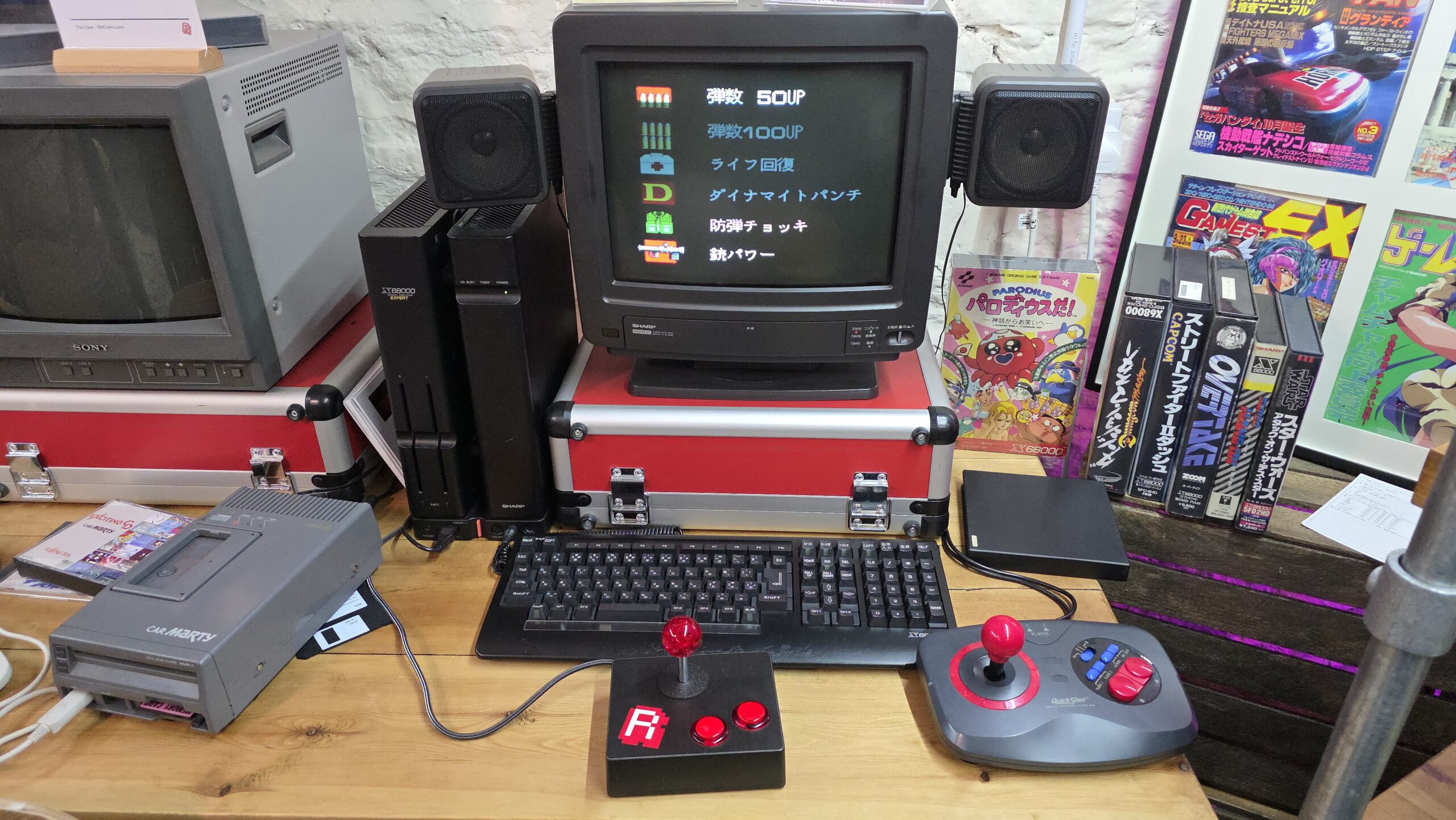
Sharp X68000, my beloved
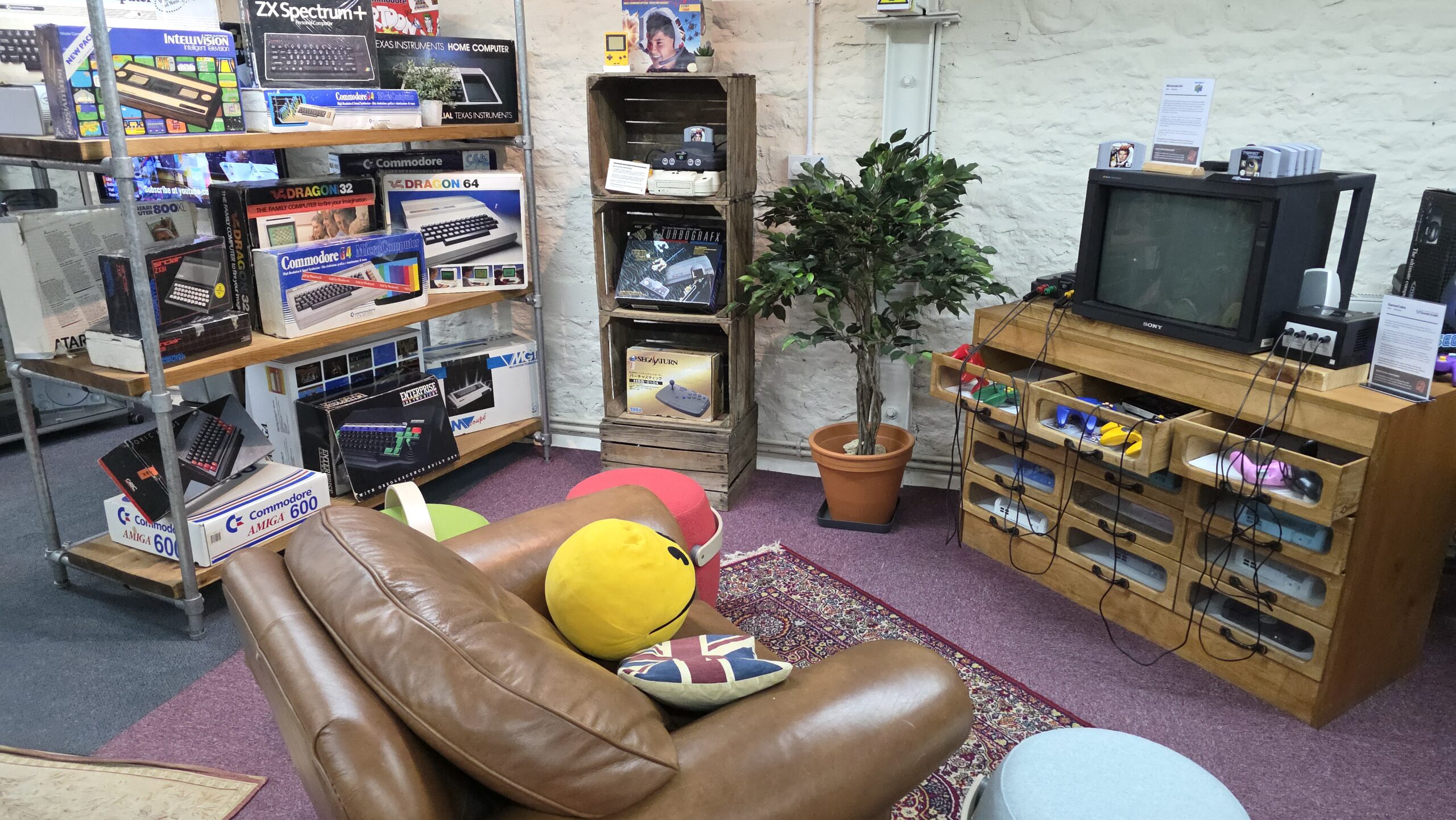
The Cave is up on the top floor of the mill, and is a large, open-plan room filled with old computers and consoles of various descriptions, including some fairly exotic machines from outside of the UK, Europe and North America, such as the beautiful Sharp X68000 from Japan. This is an absolutely gorgeous machine that, if money were no object, I would very much have in my collection. If you've never come across one, it's a 16-bit computer that has the audio-visual capabilities of its console contemporaries, meaning it plays host to a lot of excellent games, including some near-perfect arcade ports.
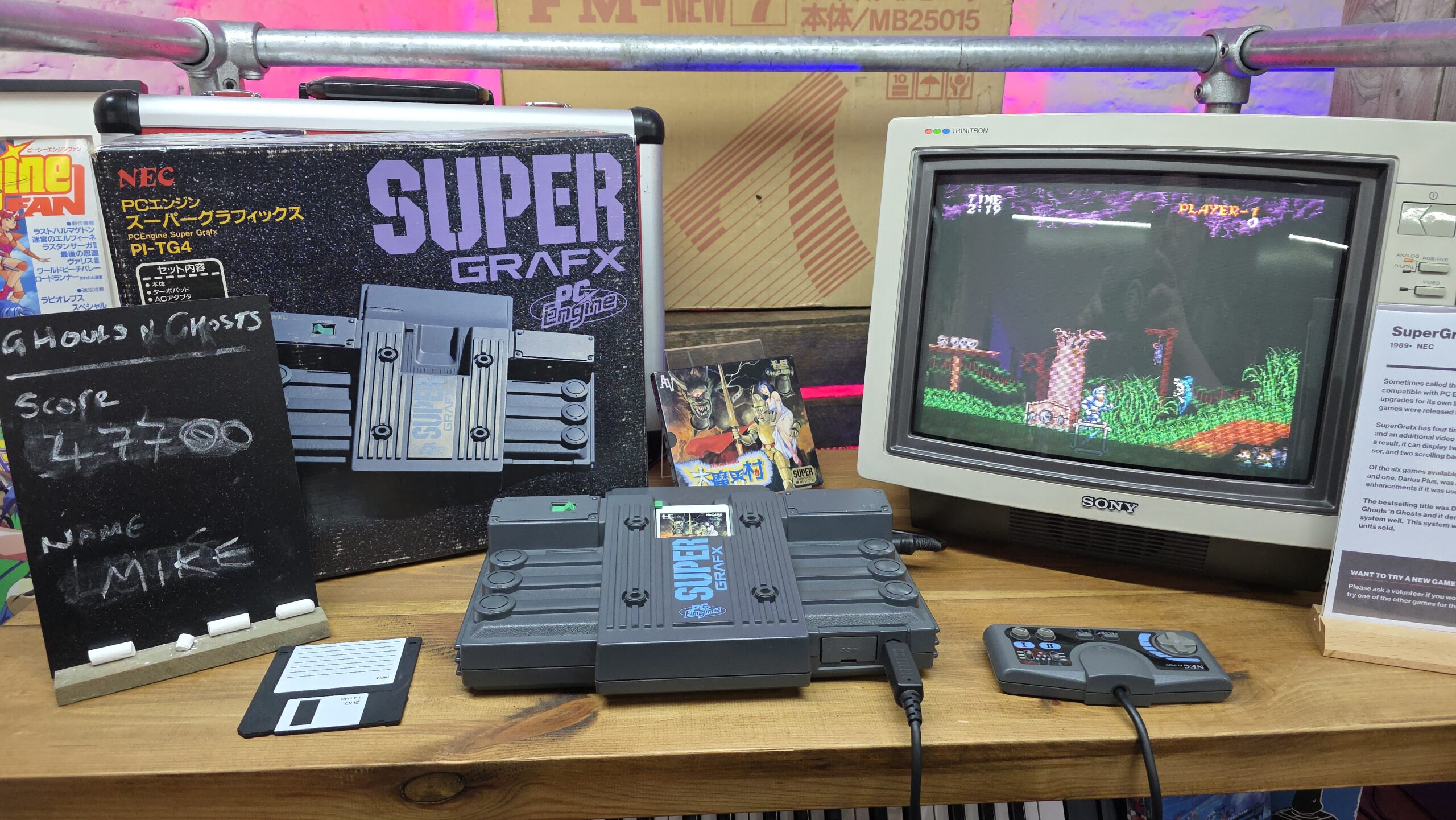
We barely knew ya.
There's also lots of interesting console obscurities, too, such as NEC's ill-fated PC Engine spinoff, the Supergrafx, a console noteworthy for, outside of backwards compatibility with the aforementioned PC Engine, only having five titles in its library. And you thought the Wii U was a flop. Despite this, it's an exceedingly cool little system worth having a play with in an environment like The Cave!
I didn't contribute to the Duck Hunt high scores.
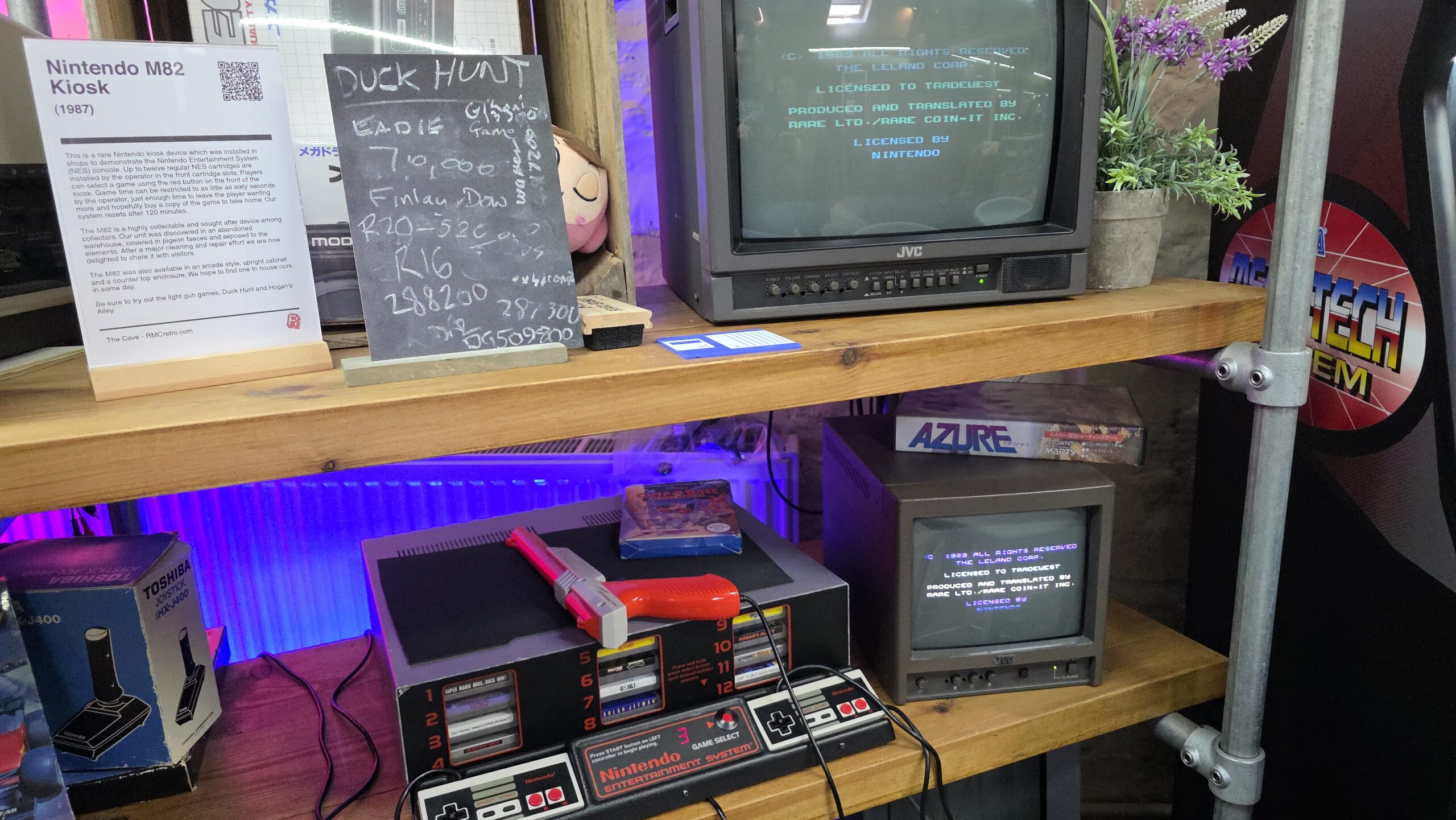
Another nice thing about The Cave is that it acknowledges well-known, popular hardware in unusual configurations, such as this kiosk multi-game version of the NES that you would have found in electronics stores back in the '80s. All the stuff at the Cave is hooked up to great quality screens, too, with many of them being professional video or broadcast monitors, Sony Trinitrons and the like.
Yes, that is a Casio Loopy lurking in the background there.
Here's another one: Sega's Mega-Tech arcade system, which was basically a Mega Drive you bought time on back in the day. Here, as with all the other arcade machines in The Cave and the Arcade Archive, it's set to free play, so you can enjoy a selection of 16-bit classics in the arcade form factor.
Well, that's one way of proving your ports are "arcade perfect"
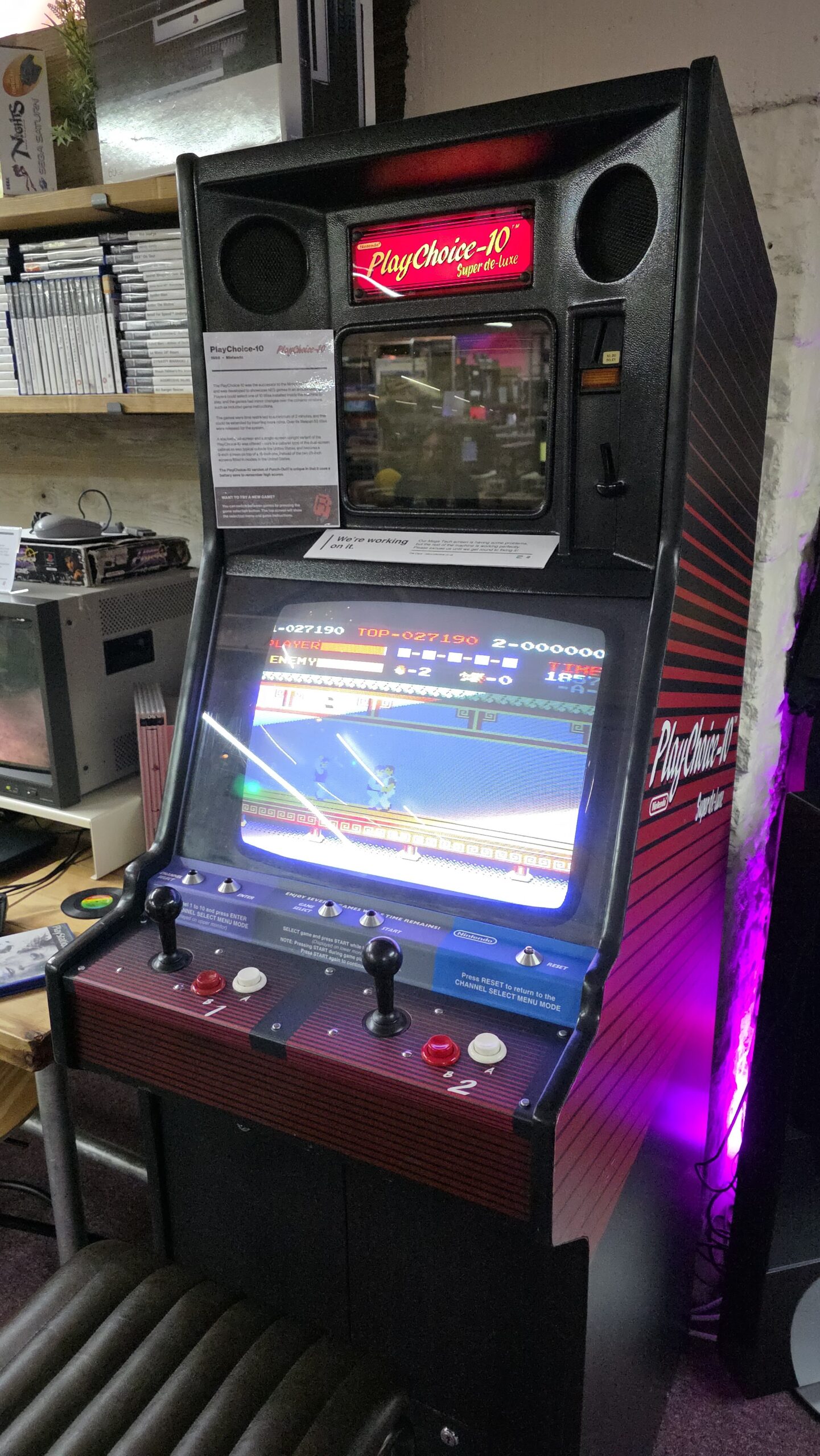
Nintendo had done something similar with the PlayChoice-10 machine, which provides you with a selection of NES games to play using arcade controls. It's a very strange feeling to play the original Super Mario Bros. with a stick and arcade buttons, but it works pretty well! Not surprising, really, since so many games from that era were at least inspired by arcade games if they weren't direct ports.
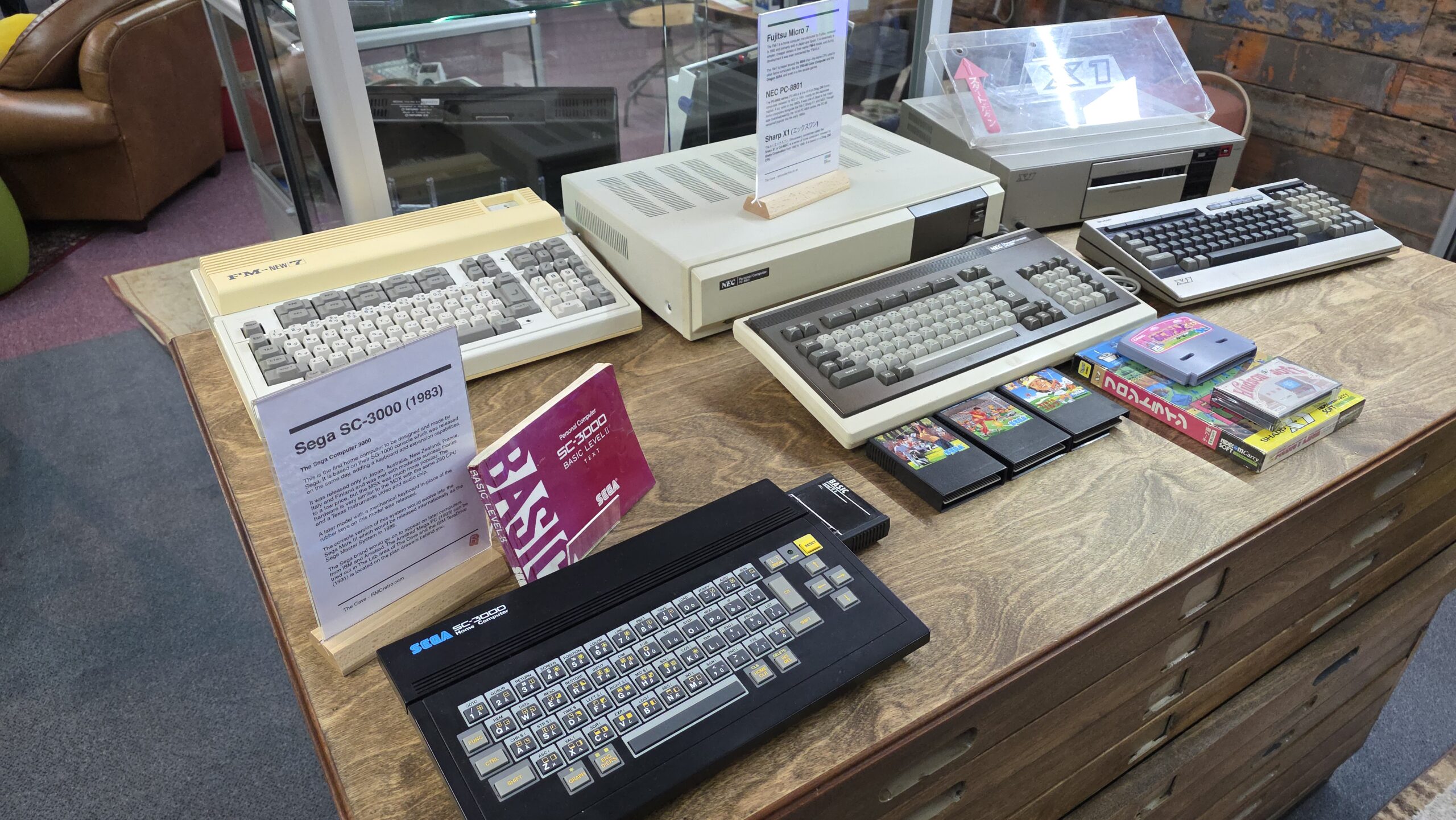
Here's a selection of obscure Japanese computers, including one from Sega. I don't know much about these, but they all look lovely, and it would be fun to have a fiddle around with them one day.
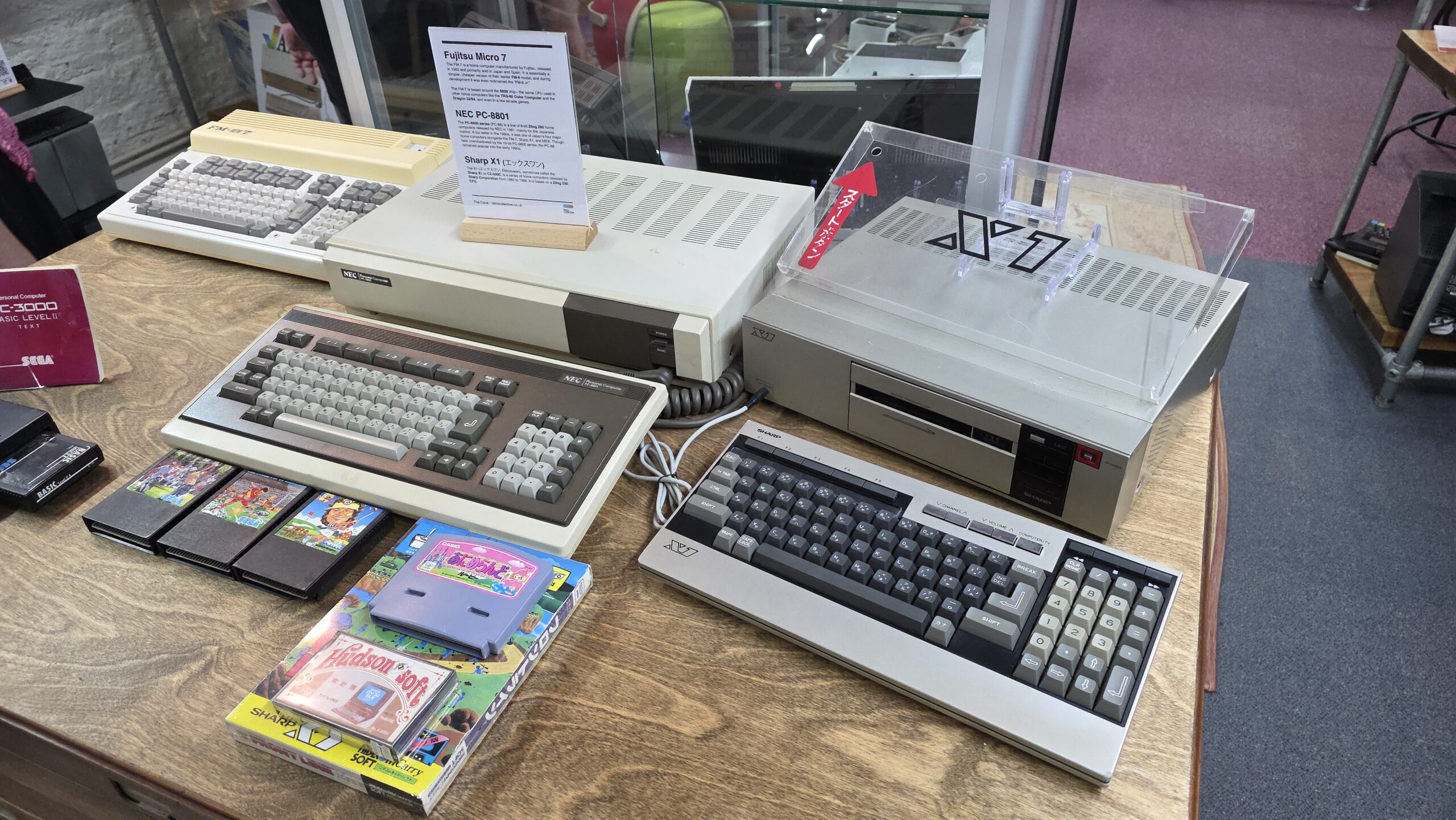
Here's some more obscure Japanese computers, just because. That Sharp X1 is a lovely looking thing. I actually didn't give the keys a clack, but it looks like they would feel nice to type on.
A little closer to home, here's a selection of lesser-known home computers, including the Oric-1, Tatung Einstein, Dragon 64 and Sam Coupé. A lot of these are lovely looking machines; they just failed to make the same impact as the bigger hitters of the era like the Spectrum and Commodore 64.
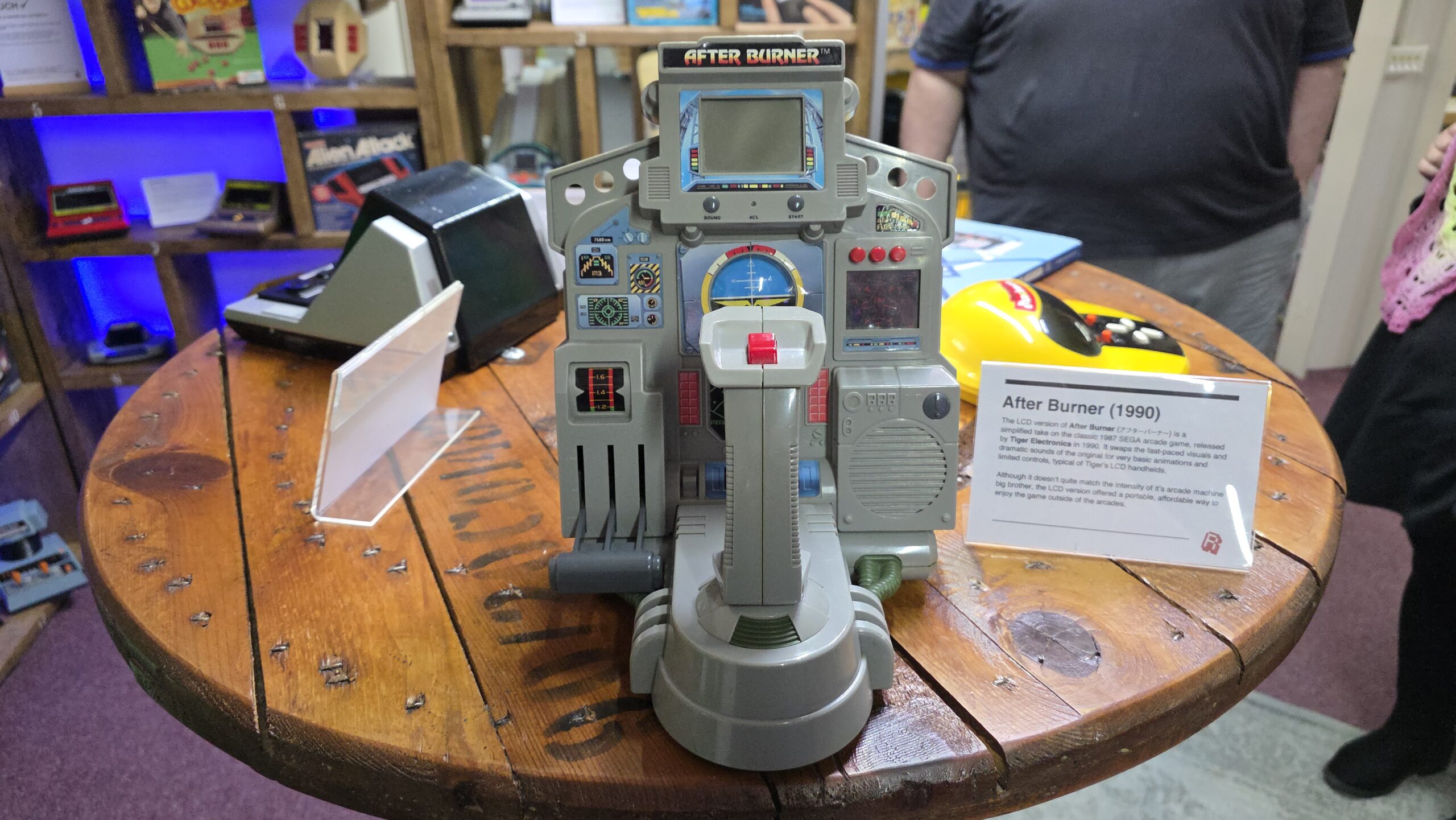
Here's a thing that I really wanted as a kid, but never managed to get hold of (i.e. convince my parents to get for me). It's an LCD game adaptation of Sega's After Burner, but with an elaborate control panel that makes the game feel a lot cooler than it actually is. The joystick is satisfying to grapple with the throttle control makes a pleasing "clunk" when you move it between speed settings, and a cool thing I've not seen before is that the LCD screen has an LED behind it so when you destroy enemy planes, there's a red "flash" where they're exploding. It's a pretty neat toy, but, given that we had computers at home that could play much more interesting and complex games, I'm not surprised that my parents never bought me one of these — and I'm not mad about that, I hasten to add!
There are lots of things to play at The Cave. This lovely setup has a selection of consoles hooked up and ready to play multiplayer just like we used to back in the day. The Gamecube and N64 were most readily accessible today, and they looked great on the Sony monitor.
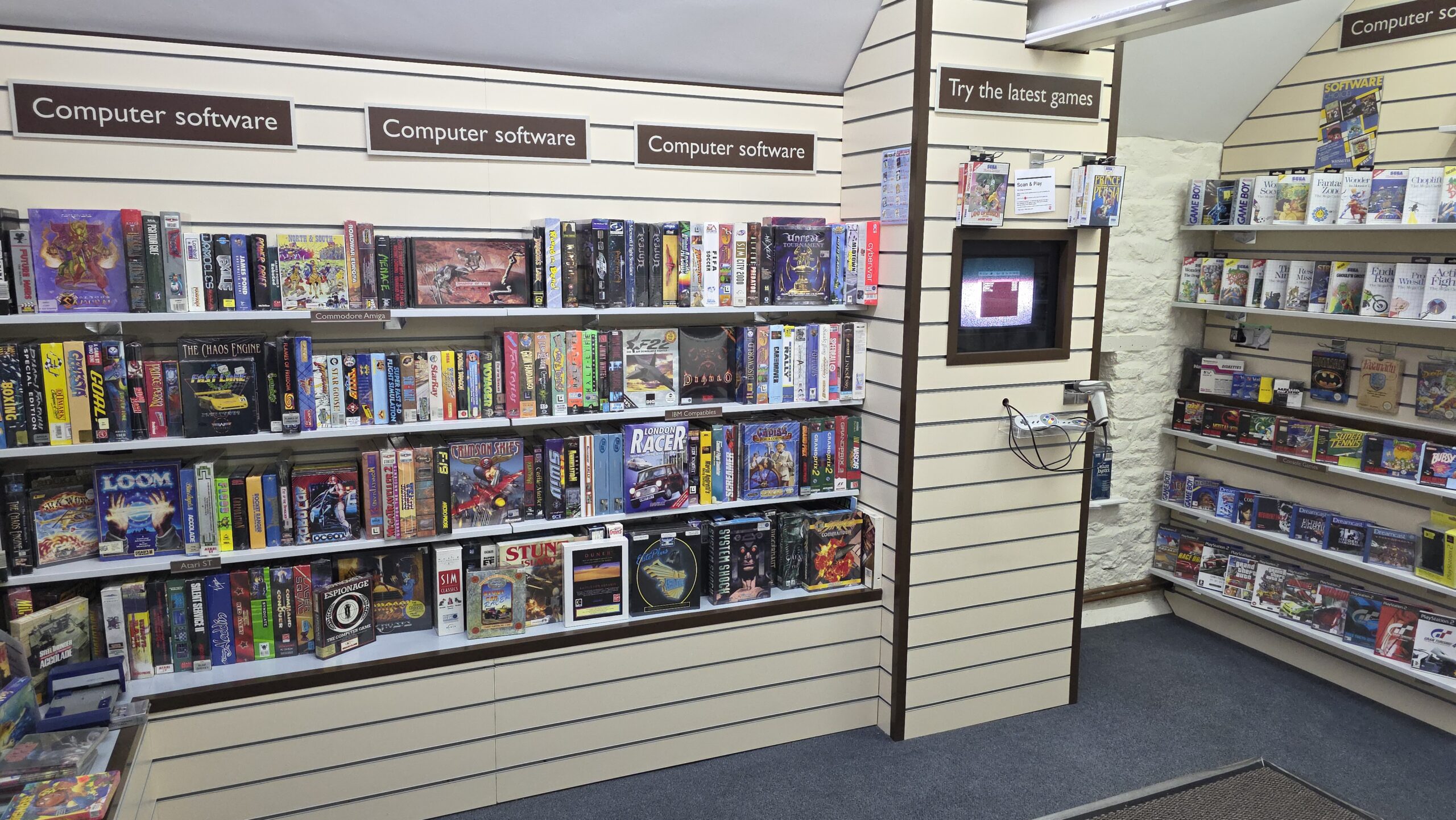
One of my favourite parts of The Cave is the fake "software shop", set up to look like an old WHSmith upstairs. For any non-Brits reading, WHSmith was a shop that was mostly known as a newsagents where you'd buy magazines and newspapers, but also tended to carry stuff like stationery, art and craft supplies and, in the 1980s, computer and video games. There were a lot of shops like this in the '80s that performed what I would argue was their "primary function" downstairs, then they'd do computery stuff upstairs — one of my favourite examples in this regard is Boots, which is a pharmacy. Why would a pharmacy sell ZX Spectrum games on cassette? Same reason they'd process your photographs or sell you picture frames, presumably — to make a bit of extra cash from jumping in on popular hobbies and pastimes.
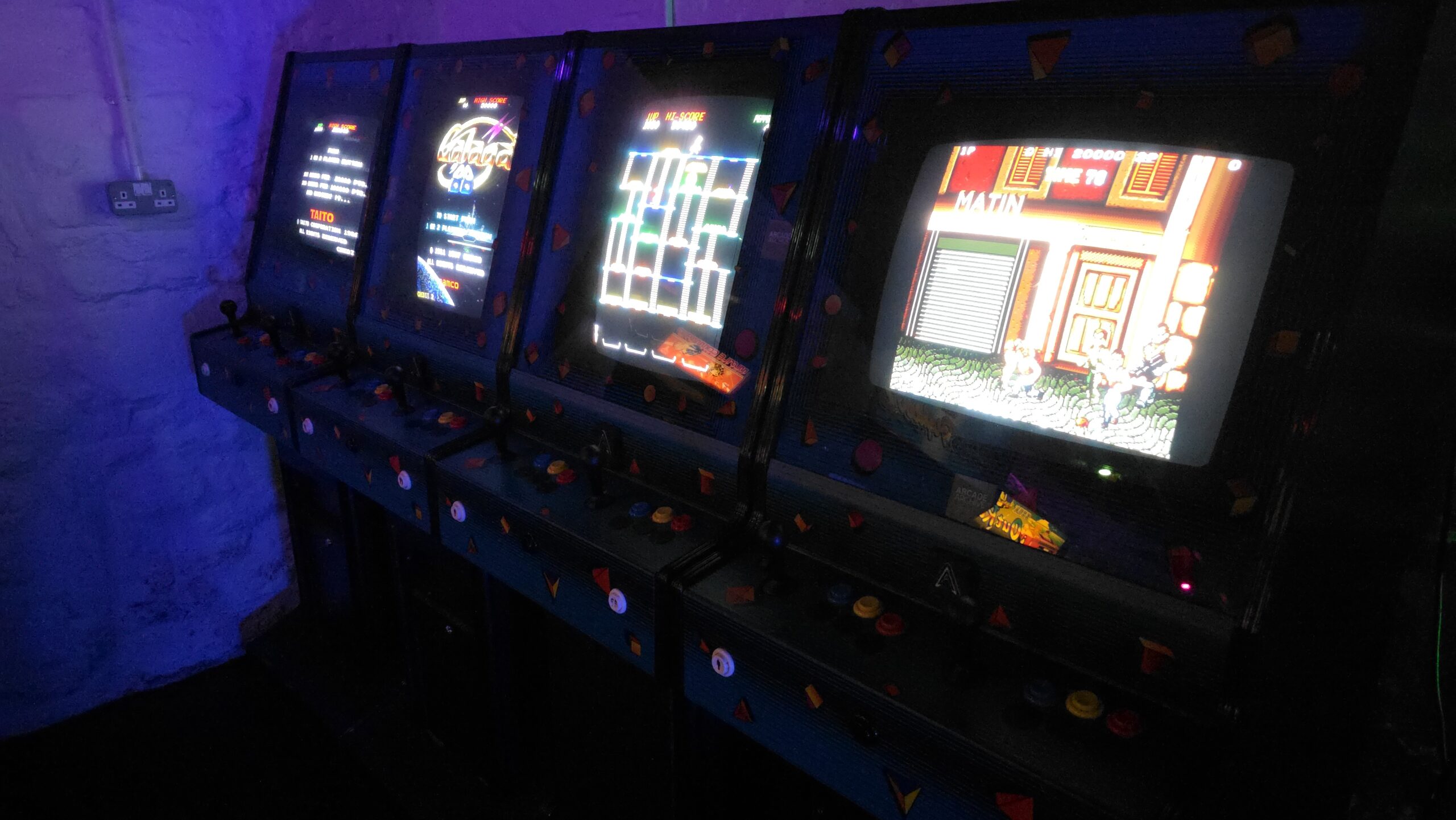
It's tricky to get good shots of them by the very nature of the environment, but on the ground floor of the mill is the Arcade Archive, a noisy room full of classic arcade machines, many of which have been lovingly restored to fully working condition by the Retro Collective folks, and some of which make use of modern solutions such as the MiSTer. These cabs — from left to right, Bubble Bobble, Galaga '88, BurgerTime and Double Dragon, all in the sort of generic cabinets you'd see in a fish and chip shop in a town centre circa 1989 — are, as far as I'm aware, restored originals.
Conversely, there's a NEOGEO MVS cabinet that I forgot to take a photo of that is running off the new MiSTer Multisystem 2's JAMMA arcade cabinet incarnation, which allows you to use plastic NFC cards to switch games as if you're swapping out cartridges. You get the enjoyment of playing with "four bright buttons and two joysticks" on a CRT, along with the modern conveniences of the MiSTer such as the ability to easily swap games, or play the console versions of games on the arcade cabinet.
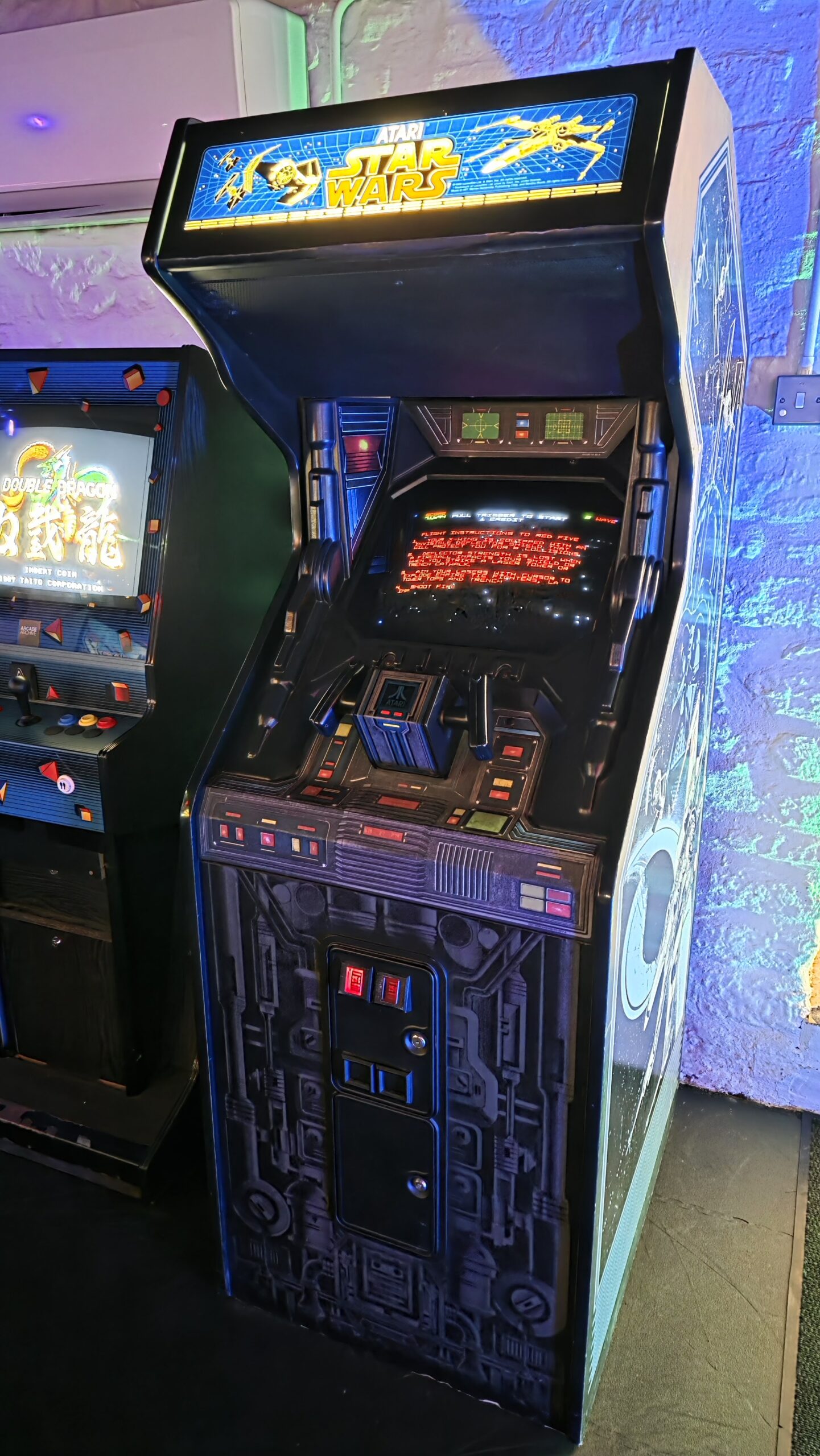
Here's a lovely thing, showing up much better thanks to its position near the door to the outside: Atari's Star Wars arcade game. This is still a supremely playable 3D shoot 'em up with beautiful vector graphics and a wonderfully immersive, involving analogue yoke control system. Great fun to play — just a pity there's no sit-down version in the Archive, though I don't think there'd be room for one at the moment anyway!
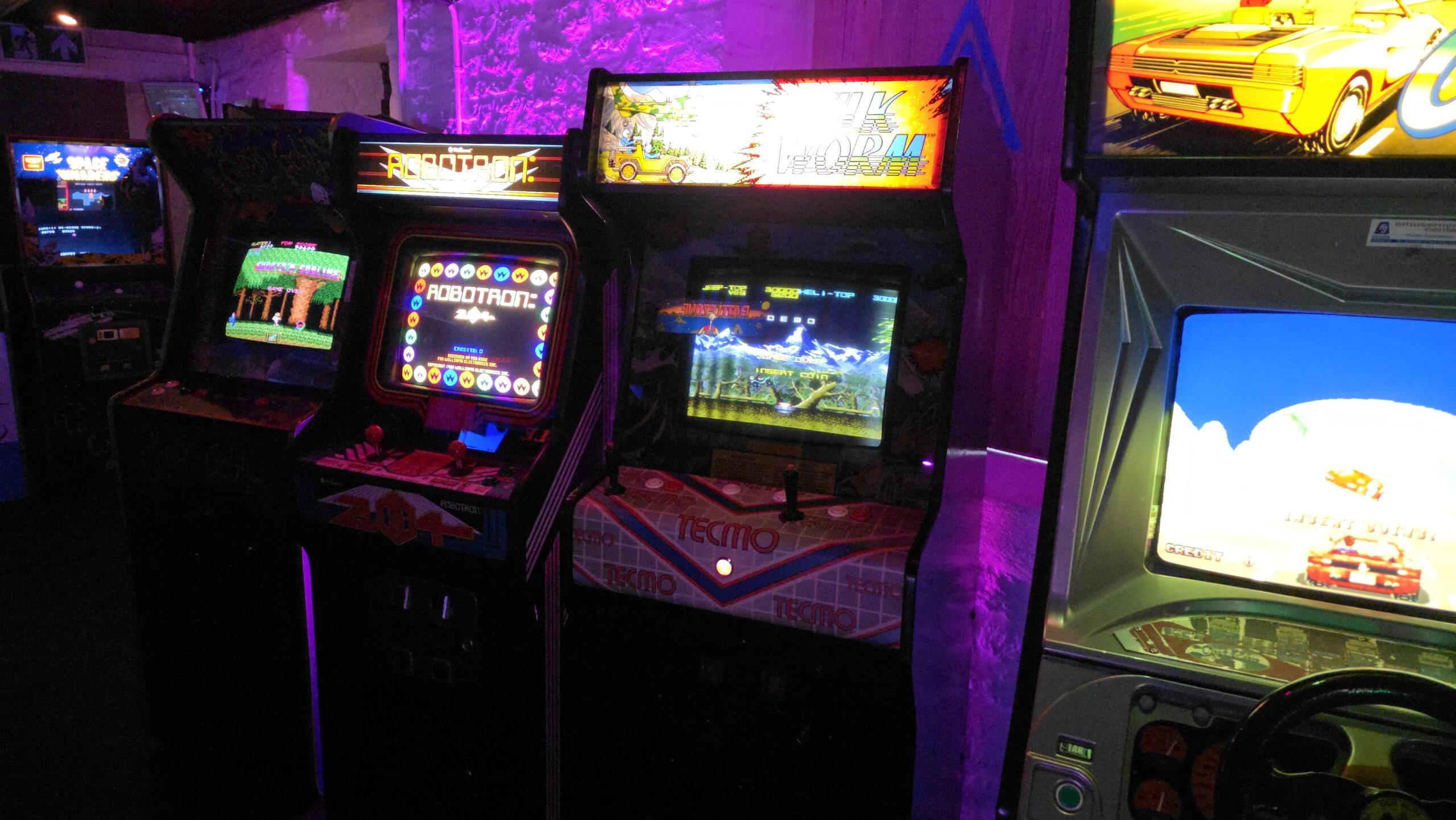
Here's a few more machines in the Archive, including OutRun on the right, then Silkworm, Robotron 2084, Ghosts 'n' Goblins and, back in the corner, the original Space Invaders. I realised I'd never actually played Robotron in its original twin-stick arcade incarnation, so I took the opportunity to rectify this. It's a lot of fun!
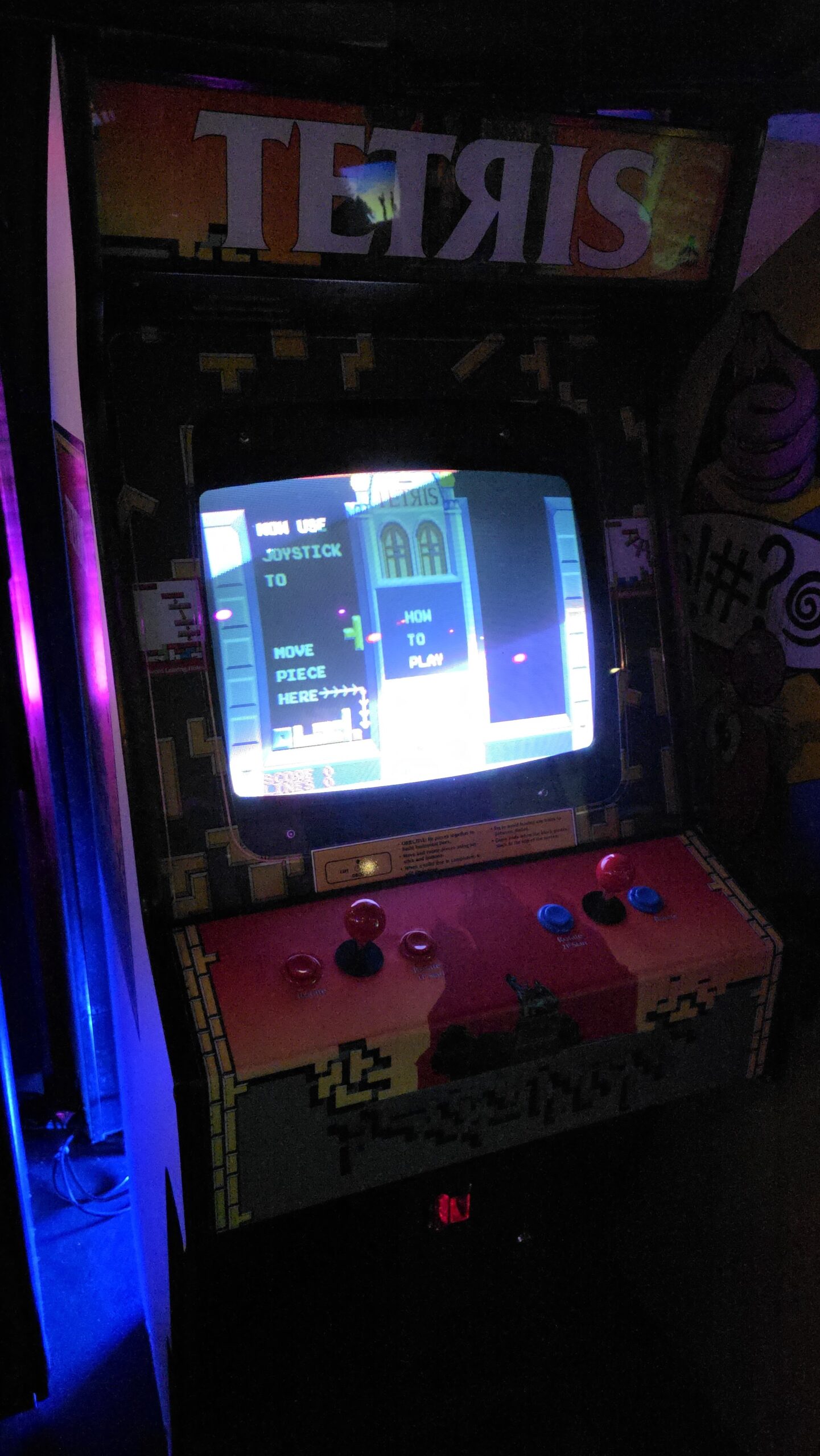
More interesting and unusual things with this Tetris arcade machine. I'm not sure of the origin of this, but it was a nice looking machine, and Tetris' gameplay is, of course, a great fit for the arcade.
And that's pretty much that for now. It was a thoroughly lovely day that I enjoyed a lot. h0ffman's talk was interesting — even if some of the more techie stuff went over my head a bit! — and it was nice to see some people I haven't seen for a while. I even met someone who actually watches my YouTube videos! I guess I better make some more then, huh.
Right, on that note, I'm knackered, so I'm going to go and collapse into a puddle of goo for the remainder of the evening. Visit The Cave if you get the chance — it's a truly lovely day out that I can highly recommend.
Want to read my thoughts on various video games, visual novels and other popular culture things? Stop by MoeGamer.net, my site for all things fun where I am generally a lot more cheerful. And if you fancy watching some vids on classic games, drop by my YouTube channel.
If you want this nonsense in your inbox every day, please feel free to subscribe via email. Your email address won't be used for anything else.
I've been absolutely exhausted all day. I feel like I got a decent night's sleep, particularly after the tiring day I had at work followed by the long drive home, but also feel like I could have done with approximately 12 hours more sleep. I actually managed to get a fair amount done today, but right now I just feel like I could shut my eyes and fall asleep right here on the sofa.
With that in mind, I'm probably going to have an early night tonight. I'd like to get back into Pragmata, which I'm enjoying a lot, but I'm also not sure my brain is up to playing anything too complex this evening. Perhaps this would be a good evening to do a bit of retro gaming, with an emphasis on something that isn't too challenging or complex to deal with.
I actually have the next two Evercade cartridges that haven't been released yet, which I'm kind of dying to talk about but can't because although I have them in my hands, we haven't even announced them yet. That will be happening soon, however, and when it does I will have plenty to enthuse about, believe me. They're not the biggest releases of the year, by any means, but they are some of my favourites.
No; I'm thinking this evening might be a good opportunity to settle down with something comfortably familiar, but which I perhaps haven't played for a while. I'm hoping in the process of typing this, something will come to mind that feels like it might be fun to spend my evening playing. Maybe Starwing? I haven't played that for a while. Last time I tried it, the MiSTer SNES core was having issues with the SuperFX chip, but I believe that's been resolved at this point, so that might be a good shout. I do love a bit of Starwing, and it is actually quite a long time since I've played it.
I'm going to get back into doing some videos soon, for those who have been wondering why it's been all quiet on that front for a while. I just haven't really felt an urge to do that for a little while, and forcing yourself to do something you're not really feeling is a sure-fire way to get yourself feeling burnt out. I won't have time to do any this coming weekend, as we're taking a trip to The Cave, but I have a few days off for my birthday at the start of next week, so I might take a day or two to record a few things over that period. Exactly what, I have no idea just yet; I have a few things in mind that I might like to explore, but haven't decided firmly on when or how to tackle them. This upcoming bit of free time might be the ideal opportunity to jump into them.
Anyway, I think I might have made a decision on what to do with my evening — although at the rate I'm going, I may well be asleep before I've got anywhere. If that's the way it goes, though, that's the way it goes!
Want to read my thoughts on various video games, visual novels and other popular culture things? Stop by MoeGamer.net, my site for all things fun where I am generally a lot more cheerful. And if you fancy watching some vids on classic games, drop by my YouTube channel.
If you want this nonsense in your inbox every day, please feel free to subscribe via email. Your email address won't be used for anything else.
I started playing Pragmata yesterday, because some people whose opinions I trust had been saying very appealing things about it, and I thought it might be nice to play something "current" for was.
Pragmata is very, very good.
I'll go into more detail about this over on MoeGamer once I've beaten it (because I most certainly am going to beat this) but I thought I'd post a few initial thoughts over here for now.
For the unfamiliar, Pragmata is a game that Capcom has apparently been working on for a very long time indeed, which might account for why so many people have been saying that it sounds like a game somewhat "out of time"; depending on who you talk to, you will almost certainly hear the opinion that it is "like a PS2 game" or "like an Xbox 360 game". (Of the two, I think the latter is probably more accurate, for what it's worth.)
The reason for this is that it thumbs its nose at a lot of today's gameplay conventions. It's not open world. It's not an RPG in disguise. Its controls are extremely simple and straightforward (move, aim, shoot, interact, plus moving the little cursor thingy during the hacking minigame). It's not belabouring how emotionally resonant it is through overwrought, manipulative writing. It's not trying to be all things to all people. It's just trying to be one thing, and to do that thing really, really well.
And it succeeds! If I had to pigeonhole it I'd say it's a third-person shooter, but it's not a constant, all-out action sort of affair. There's a lot of exploration, with plenty of hidden rewards for those willing to get curious — but those "hidden" areas are always possible to stumble across without relying on a guide. There's an element of survival horror, in that all weapons but your standard sidearm have severely limited ammo, and you only have limited healing opportunities per expedition.
Mostly it's just an extraordinarily well-designed game. You have a companion character who is actually useful — both in terms of her mechanical function, and in that her "barks" during combat are actually helpful audible cues for things like dodging attacks. The levels are beautifully designed to have a grandiose sense of scale at times, but never overwhelm you with possible ways you can go. It controls well. It looks great. It runs great. It's just great. Really, really great.
I think that's probably all I want to say about it for now, because honestly I'm just eager to get back to it. I've completely cleared out the first two levels (aside from two hidden chests in the second level that I will need to come back with a new ability for) and am just going into the third. I also suspect it's not going to be an obscenely long game, which, honestly, I'm 100% fine with.
Anyway. It's time to hop back into the Cradle and see what new horrors await me and Diana…
Want to read my thoughts on various video games, visual novels and other popular culture things? Stop by MoeGamer.net, my site for all things fun where I am generally a lot more cheerful. And if you fancy watching some vids on classic games, drop by my YouTube channel.
If you want this nonsense in your inbox every day, please feel free to subscribe via email. Your email address won't be used for anything else.
I was randomly reminded of the existence of Robot Unicorn Attack this evening, and I am pleased to report that despite Flash being long-dead, you can actually still play the original (complete with Erasure soundtrack) over at CrazyGames. We are officially living in an age where Flash, as a platform, is old enough to have Web-based emulators. Not only that, this blog is old enough to have posts referring to the original incarnation of Robot Unicorn Attack, along with its excellent Facebook-based incarnation. Now there's something I don't say very often.
For the unfamiliar, Robot Unicorn Attack is a simple, "endless runner" game with just two buttons: one to jump (which can be used again in mid-air for a double-jump), and one for a rainbow attack dash move that can break through crystal stars. Your one and only goal in Robot Unicorn Attack is to survive as long as possible and score as many points as you can across three "wishes" (lives). As the game says when you start it, "you will fail". And indeed you will. But then you will try again, and again, and again.
It's a potent example at arcade-style game design at its absolute best: provide an experience that is extremely easy to understand, even for those who don't play a lot of games, and then balance it just well enough to make it inordinately compelling rather than frustrating, but still challenging. It is unironically one of the most well-crafted games of the 2010s, and I'm glad that people have found a means of preserving it — and in a fashion that is true to its original incarnation, no less. As a Flash game, originally published by Adult Swim, Robot Unicorn Attack's home is very much on the Web, and while I certainly wouldn't be averse to having an offline version I could play at any time I want, you can't get much more convenient than just going to a website and playing using nothing more than the Z and X keys on your keyboard.
Web games are in such a strange place right now. There's always been a certain amount of cloning and overly derivative stuff, but this seems to be particularly rife these days. There are about a billion variations on the "run down the path and go through gates with numbers on them" game. I don't know what the original and first one of those was; I just know there are now so many of them it is, at times, difficult to find anything else.
It doesn't help that a lot of today's Web games are adaptations of mobile games, with all the obnoxious predatory monetisation and infestation with adverts that entails. But, like I say, I'm pleased to see that some of the all-time classics are preserved through emulation — and best of all, no-one can bitch at you about not playing on "original hardware" if you play Robot Unicorn Attack on CrazyGames, or anywhere else it might be hosted, because it always was intended to just be played right there in your browser.
Now that I've rediscovered it, I think it might be time for a high score run or twenty before bed. Sing it with me, now… always, I want to be with you, and make believe with you, and live in harmony, harmony, oh love…
Want to read my thoughts on various video games, visual novels and other popular culture things? Stop by MoeGamer.net, my site for all things fun where I am generally a lot more cheerful. And if you fancy watching some vids on classic games, drop by my YouTube channel.
If you want this nonsense in your inbox every day, please feel free to subscribe via email. Your email address won't be used for anything else.
On something of a whim — and after seeing a number of people whose opinions I generally trust enthusing about it — I decided to pick up the new Tomodachi Life game for Switch. I didn't really know much about it going into it, and I bounced hard off the two separate attempts I've made to get into Animal Crossing, so it's not a decision I took lightly. But I'm pleased to report after a brief play at lunchtime — and a much, much longer play this evening — I'm well and truly charmed.
This is Nintendo at its most "software toy" I think I've ever seen them — although I say this with the caveat that I never played the 3DS version of Tomodachi Life. It's a delight. It's like playing The Sims without having to do the boring and annoying bits. It's like playing a citybuilder without having to worry about complicated management things. It's what mobile and social games might have been if they had never been corrupted by greed and predatory monetisation strategies.
Above all, though, it's a medium through which you can express and play with your creativity and imagination, and I love that. While the first couple of hours or so are deliberately constrained to introduce you to the basic features of the game and its interface, it doesn't take long to get to a point where you've unlocked most of the main "mechanics", such as they are, and can start using them to play with your creations in the little world you gradually build for them.
It's possibly the best use of the "Miis" that Nintendo have had on their consoles since the Wii days, and the delightfully lo-fi synthesised speech they talk in — no AI-generated voices here — is a pleasant reminder of a more innocent age.
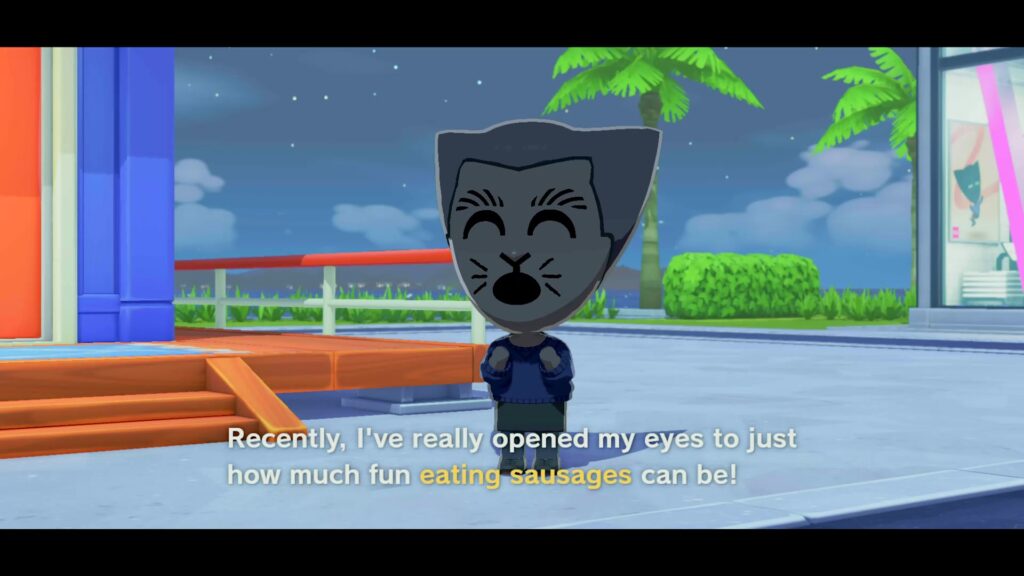
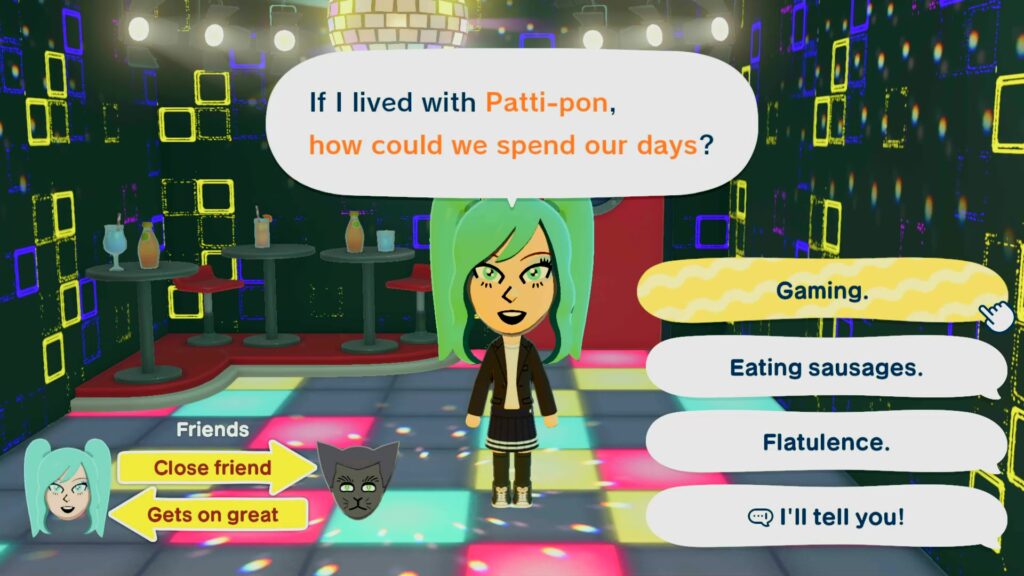
That can be said about the whole experience, really. It's a reminder of when we all had the capacity to play imaginatively, only now our imaginations can be supported by interactivity. No longer do you have to pretend your dolls are talking to one another, because now they actually do talk to one another — although you're not always privy to the details of all their conversations. (Rather charmingly, you can catch the odd word here and there, and most of these are things that you've previously entered into the game as subjects for them to talk about with one another, meaning my little collection of Miis likes talking about flatulence, eating sausages, cats and F-15 Strike Eagles.
I'll have some more to say about this delightful little game over on MoeGamer when I've spent a bit more time with it. But for now I can say confidently that I'm glad I decided to take a punt on this silly little game. The kind of silliness it offers is precisely what the world needs right now — much as Animal Crossing came along at the exact right time when the pandemic hit. (Even if I didn't get along with Animal Crossing personally, I at least appreciate what it represented.)
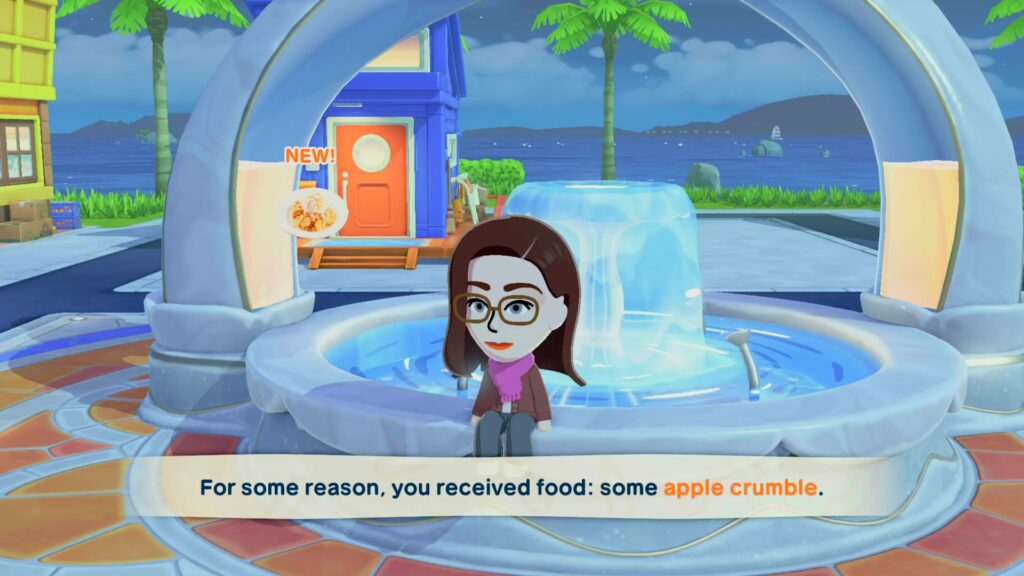
Anyway, I've peppered this article with a few screenshots from this evening's session. As I say, I'll have much more to say in the near future, but for now, I should probably go to bed rather than checking in on everyone one last time this evening…
Want to read my thoughts on various video games, visual novels and other popular culture things? Stop by MoeGamer.net, my site for all things fun where I am generally a lot more cheerful. And if you fancy watching some vids on classic games, drop by my YouTube channel.
If you want this nonsense in your inbox every day, please feel free to subscribe via email. Your email address won't be used for anything else.
I happened to see some Discourse earlier — I know, I know, I'm trying to give it up — that centred around someone taking the piss out of a random Backloggd user's list of the "worst JRPGs ever". The list itself was stupid, of course — even leaving aside factual inaccuracies like Senran Kagura being on there (Senran Kagura, for the unfamiliar, is a beat 'em up and/or arena fighter, depending on which entry you're playing), there were some atomic-level bad takes involved — but what stank always as much were the responses to it.
One that jumped out at me was someone saying that "everything Persona post-3 is abysmal" in response to the first Revelations: Persona game being on the list. And just… come on. Those games are some of the most well-regarded examples of their genre ever. Sure, you might not jive with them personally, particularly if you're not someone who gets on well with lengthy, primarily text-based story sequences, but to stretch that out into those games being "abysmal" is… well, it's an absolutely abysmal take, it has to be said.
The trouble is, this kind of shit is engagement bait. I'm engaging with it by talking about it, even if I'm not linking directly to it, when the sensible thing to do would have been to just go "huh", close the tab and then never think about other people with Bad Opinions ever again. Negativity is engagement — and, to paraphrase an excellent video I watched earlier today (thanks, Chris), it's actually one of the most potent forms of engagement there is. So it should probably be little surprise that we're constantly bombarded with takes about the "worst [x] ever" rather than enthusiasm about cool things.
I always make an effort not to do this with my own material — that which is on a specific subject, anyway. I know I can get a tad negative on this here blog at times, but that's part of the point of this place — for it to be a place where I can vent off some steam, express my frustrations and get things out of my head rather than letting them fester. On MoeGamer, my gaming website, and my YouTube channel, however, I make a point of always trying my very best to "find the fun" — even in stuff which is well-known as being "bad". My proudest achievement in that regard was successfully finding genuine enjoyment in the notorious Sonic the Hedgehog reboot from 2006, a game which, for a while, Wikipedia described (without citation) as "considered to be one of the worst in the entire video game medium". (That line isn't there any more.)
But what is the result of that? For the most part, probably a fraction of the visibility that I'd get if I just put out a video on how "bad" Amiga platform games are, or how "terrible" the graphics on Atari 2600 are, or how much of a waste of time existing in this miserable world is. I don't have any intention of changing, however; if I'm feeling like this, I'm sure at least a few other people are feeling like this, too. And if, through the things I do online, I can provide those people with an escape from the constant bombardment of negativity and "worst thing ever" content, I consider that a success, regardless of anything the numbers say.
Most of these people saying something is the "worst [X] ever" have no real frame of reference of what "the worst" really looks like. What they really mean is either "I, personally, did not like this" or, more commonly, "popular opinion suggests that this game is not very good and I am not going to argue against that". And I'm so very, very tired of it. I want to sit anyone who thinks something like Persona 4 or 5 are bad down with some long-defunct mobile game shit like Rage of Bahamut and show them what a really, genuinely, actually bad game is.
But I better not. I can see the thumbnails already. Although for some reason, gacha games have remained curiously immune to being branded "bad" games, despite a lot of them really, genuinely being not only absolutely terrible from a design and mechanical perspective, but actively hostile to their players. That's probably something to talk about another day, though.
Want to read my thoughts on various video games, visual novels and other popular culture things? Stop by MoeGamer.net, my site for all things fun where I am generally a lot more cheerful. And if you fancy watching some vids on classic games, drop by my YouTube channel.
If you want this nonsense in your inbox every day, please feel free to subscribe via email. Your email address won't be used for anything else.
Since starting Resident Evil 7 in VR a little while ago — after discovering that our carefully cable-managed solution for PSVR did not, in fact, work due to using a USB extender that didn't do data — I've been getting a bit back into VR stuff. And the good thing with the original PSVR is that because its games are a few years old now, they're exceedingly cheap. I picked up Wipeout Omega Collection, Battlezone, No Man's Sky (I know what I said a couple of days ago, but… c'mon) and Ultrawings to give a try, and add these to the several VR games already on my shelf that I haven't got around to playing yet, such as the second Summer Lesson game, and the PSVR visual novel, Tokyo Chronos.
I'm installing Wipeout as we speak. I suspect this will be the most… challenging to deal with, shall we say, but I'm also looking forward to giving it a try. I love thrill rides, but as a fat person I cannot ride real ones, so I'm hoping that something like Wipeout will scratch that itch somewhat. And even if it doesn't, I've been meaning to try Wipeout Omega Collection for a long time anyway.
The others I know a bit less about. I know Battlezone was quite well-regarded when it first launched quite early in the PSVR's lifespan, No Man's Sky should hopefully be quite an experience — though I do wonder how its more complex gameplay elements will translate to VR — and Ultrawings I know nothing about, but it was three quid so even if it's rubbish I don't mind.
VR has its flaws, particularly with earlier implementations like the first PSVR. But I do like it. It's an interesting way of experiencing things, and it's kind of a shame that it has never quite taken off in the way anyone really hoped it would — largely due to those flaws, in many cases, and the expense in others. (That said, I bet you could probably grab yourself a PSVR relatively cheap now. PSVR2 is still pricey though.) I will be interested to see what the supposed "Steam Frame" does for VR, if anything; saying that, I will be interested to see whether it launches at all, given the, uh, "challenges" that tech is facing right now as a result of ongoing AI cuntishness and… various geopolitical events, shall we say.
Anyway, Wipeout has finished installing, so I'm off to give it a quick blast before my dinner and to see if my stomach contents remain intact. Wish me luck!
Want to read my thoughts on various video games, visual novels and other popular culture things? Stop by MoeGamer.net, my site for all things fun where I am generally a lot more cheerful. And if you fancy watching some vids on classic games, drop by my YouTube channel.
If you want this nonsense in your inbox every day, please feel free to subscribe via email. Your email address won't be used for anything else.