1965: Some More Words About Vita

I feel like I've written this post a number of times before — indeed, I had to search my own blog just to make sure — but I feel it's time we talked about the PlayStation Vita. Again, because the issues I described last time really haven't improved a great deal — at least not so far as the press is concerned.

Sony's handheld is a wonderful platform. It's arguably the most distinctive of all the currently available platforms — with the possible exception of Nintendo's 3DS — thanks to its unique library of titles, and it's very much carved out its own niche.

By virtue of this, however, the platform is, by definition, not ideal for everyone. Despite originally being marketed as the most powerful handheld on the market — and I don't have the tech specs to hand, but certainly from casual observation I don't doubt that claim — Vita is not a platform on which you should expect to play a lot of "triple-A" games. And this is what has led some people to regard it as a "failure"; a seeming lack of the big hitter franchises like Call of Duty, Assassin's Creed and Battlefield on the platform coupled with the apparent lack of support from both triple-A studios and, at times, Sony itself doesn't paint a particularly rosy picture.

But here's the thing: it doesn't matter. It may not be entirely what Vita was originally positioned as, but Vita's niche serves a passionate market. Several passionate markets, in fact: specifically, the market that enjoys localised Japanese games (or, indeed, those who like to import, since Vita is region-free, unlike the 3DS) and the market that enjoys interesting, creative and/or experimental independently developed Western games. Between those two niches — which have a certain degree of crossover — Vita has an astonishing library of quality games, even without the heavy hitters of the industry.

And who wants to play visually spectacular triple-A games on a tiny screen, anyway? Triple-A isn't playing to the platform's strengths at all, which explains why since an initial few attempts — most notably an Uncharted game that apparently wasn't all that bad but not as good as the PS3 installments, and an absolutely terrible Call of Duty spinoff — triple-A developers are paying the console little to no mind. (Ubisoft is something of an exception to this, though their smaller titles are very much designed with an "indie" philosophy in keeping with the Vita anyhow.)

Vita's strength is its portability, and its best games are those that cater both to short play sessions and longer marathons. The many, many quality role-playing games that grace the platform are testament to this: although RPGs are typically regarded as somewhat slow-moving, in most cases those that have been designed specifically for Vita have been put together in such a way that you can fire them up for a few battles and still feel like you've had a worthwhile experience. The Neptunia games are a good example; their dungeons are short and their battles super-quick, but if you want to sit down with them for a few hours at a time as opposed to a few minutes, there's plenty of depth to explore there, too.

So what's my point? Well, mostly bafflement, as expressed by a number of us Vita enthusiasts on Twitter earlier today when we saw yet another article snippet berating the handheld for no particularly good reason. We found ourselves questioning exactly why it's treated this way, and why it's still regarded as a "failure" or "dead". The misinterpretation of Sony's recent "legacy platform" comments certainly didn't help, though one can lay at least part of the blame at the feet of the press for that one for poor reporting.

Another possible perspective is to do with what I've just talked about: the niches that Vita serves. A while back, Polygon's Phil Kollar — a supposed JRPG expert and enthusiast — posted a particularly obnoxious article berating Atlus for localising Dungeon Travelers 2, a dungeon-crawling RPG starring a cast of cute girls that has a lineage which can be slightly indirectly traced back to an eroge called To Heart 2. (Read my response here, if you're bored.) Kollar lambasted the game while clearly having little to no knowledge of it whatsoever and no desire to explore or investigate it, and he's not the only one to post such a piece. In other words, it's little surprise that popular perception of Vita suffers when it's typically ignored in favour of the big-budget PC and console triple-A flavours of the month — except, of course, when something "problematic" rears its head and gets all the "progressive" types in a tizzy.

It's probably a gross oversimplification to consider that Vita might be suffering at the hands of the press because many of its games don't fit neatly in with the "progressive" ideology that most mainstream gaming sites are presently trying to peddle — this viewpoint ignores the numerous successful Western indie games, including the more experimental, arty end of the spectrum, for example — but I can't help but feel there's a bit of truth in there. To return to Neptunia, for example, we're talking about a series of games that has grown from very humble beginnings in 2010 into one of the most popular, recognisable, prolific and varied series in the whole Japanese niche gaming market, but is it ever acknowledged by the big sites? Is it bollocks.

Anyway, fortunately, despite the perpetuation of the "Vita has no games, Vita is dying/dead" narrative, the platform is very much alive, well and beloved by those who have taken the time to understand what it's doing and engage with it. I have a healthy collection of Vita games in both physical and digital format; a somewhat more dedicated friend on Twitter has over a hundred games for his Vita in both physical and digital format, and the new releases out of Japan don't look like slowing down any time soon.

One thing that's become increasingly clear to me as the years have passed is that the press is rapidly losing relevance, and the numerous "social commentary" pieces that regularly rear their ugly heads are an attempt to move with the times and evolve. Fair enough, but that's not what I want to read in most cases; meanwhile, that which I used to get from games magazines and websites — enthusiastic discussion of games I've played, and recommendations of games I might like to play — I now get from social media, via personal interactions with the people who actually matter when it comes to this sort of thing: the people who are actually playing them.

As a former member of the games press, it's a slightly frustrating and disheartening situation to see. But so long as Vita keeps coming out with great games that I want to play — and two new ones arrived just this week (Moe Chronicle and Operation Abyss), so I don't think that will be a problem — I'll keep talking about it, and I'm far from the only one who feels this way, thankfully. It's just a pity it's so hard to make people outside our circle of enthusiasts listen.

1964: 95 Hours With the Idols

My game clock in Omega Quintet now reads somewhere in the region of 95 hours. I'm now about three-quarters of the way through my New Game Plus run and attempting to get the True Ending, and then there's a bunch of post-game stuff, too, so that timer's going to tick well over 100 by the time I've finished, I'm sure. This officially makes Omega Quintet certainly the Compile Heart game I've spent the longest on, and probably getting on for the overall RPG (Final Fantasy XIV excepted, of course) that I've spent the longest on. The previous record holders were Hyperdimension Neptunia Victory from Compile Heart, and I think I took slightly longer than the 100 hours I took for Victory over Xenoblade Chronicles on Wii — and didn't see anywhere near everything.

Anyway. I don't want to dwell on how long this game is — I could have been done long ago, since I've technically already "cleared" it once and I'm doing all of the optional side quests — but rather on something that I noticed as I was playing today: after nearly 100 hours, I'm still spotting new things about the mechanics and working out ways to leverage them to my advantage.

Compile Heart games are often quite mechanically interesting. The original Hyperdimension Neptunia, for example, featured a combat system in which I spent hours assembling combo attacks that would neatly chain into one another, swap out characters mid-combo and do all sorts of other cool things. The later Neptunia games took a different approach to battle, with freedom of movement, area-of-effect attacks and different types of strike. Hyperdevotion Noire is a solid strategy RPG with easy to understand but tricky to master mechanics involving elemental affinities, range, height and areas of effect. Moe Chronicle — my copy of which arrived today, hooray! — sees you equipping stereotypically moe traits onto a range of monster girls to give them various special abilities. And there are a few I'm still yet to play, too.

One thing that the Neptunia series in particular lacks a bit, though, is customisation. The characters aren't completely fixed in their abilities — you have some flexibility in the combo attacks you can equip each character with, and it's possible to customise the special attack combo-finishers they use, too — but so far as their main special abilities go, they're fixed.

Enter Omega Quintet, then, which offers more customisation than I think I've ever seen in a Compile Heart game, with the possible exception of the original Neptunia. And it's far, far slicker than that game — much as I love it, it was very, very flawed in many places.

The early part of the game sees you assembling the titular Quintet, and various mechanics are locked out until you've assembled them all and you've read all the tutorials (which are thankfully skippable, so you don't need to read them again on a second playthrough). When the team is assembled and all the mechanics are in place, the default setup gives each of the five girls a different weapon and a basic few skills that they've already learned.

Skills fall into three broad categories: Elemental Skills (or E Skills) are magic-like abilities that either attack with elemental affinities or provide beneficial effects such as healing or buffing. Mic Skills — the weapons are known as "Mics", because they're idols, after all — are attacks that are tied to an individual weapon type, so the character must have the appropriate weapon equipped in order to use them. And Special Skills are character-specific attacks that require "Voltage" built up through performing well in combat to be able to pull off.

Of these abilities, only Special Skills are fixed on a per-character basis; everything else is fully customisable. The girls each clearly have a favoured weapon — the one they start with — but there's nothing stopping you from levelling their proficiency in other weapons, too. In fact, it's beneficial to do so, since levelling up a weapon proficiency provides you with additional "Disc Analysis" points besides those you already get from increasing the character's overall level.

Disc Analysis is Omega Quintet's main progression and customisation system. Each character has a large diamond-shaped grid with lots of nodes on it. Each node represents a new skill, an upgrade to an existing skill or a buff to the character such as additional E Skill slots or increased stat growth when levelling up. Spending the Disc Analysis points acquired through levelling and increasing in proficiency unlocks new abilities and opens up new nodes, since some nodes have prerequisites before you can use them or require you to "approach" them from a particular direction on the grid.

In my first playthrough, I wasn't terribly careful with how I organised my characters' development. I kept long-term goals in mind — "I want that ability that's all the way over there" — and attempted to take the most direct routes across the grid to where I wanted to go, picking up any necessary prerequisites along the way. This mostly worked, but it left each character feeling fairly "generic", since a lot of them had ended up learning the same or similar skills, and none of them were particularly playing to their strengths.

This second playthrough, I've been more focused, since I'm playing on the Advanced difficulty. (It hasn't been too difficult yet, but that may be something to do with the fact I carried over my weapons and items from my first playthrough, making me a powerhouse in the early game) I've been specialising my characters and paying more attention to the "Chain Skill" system, which allows multiple characters to trigger more powerful special attacks if they perform the right skills in the right order using the "Harmonics" (simultaneous turn) system.

Kyouka, for example, has high Vitality — Vitality in this game is your speed stat, for some reason, rather than its more common usage as "ability to take punishment" — which means she usually acts first in a fight. This puts her in an ideal position to be a "buffer", so I've given her all of the stat-boosting spells and, using her four actions per turn, she can increase any four of the party's Song Power (physical attack), Stamina (physical defense), Knowledge (magical attack), Divinity (magical defense/healing power), Technique (accuracy) or Vitality (speed). Alternatively, she can use her spear skills to attack; she has a couple of useful area-of-effect attacks as well as one which draws enemies closer, helping to negate the damage penalty for attacking something at the "wrong" range for your weapon or ability.

Aria, meanwhile, has high Divinity, putting her in a good position to be a healer. So I've given her the healing spells. Her high Divinity also means that she can shrug off magical attacks quite easily — sometimes they even miss her altogether, and she has good resistance to status effects. When she's not healing, her combat fan skills have some large area-of-effect attacks as well as two skills that steal items from enemies, making her very useful indeed for farming items.

Nene has the highest Knowledge in the party, making her the "mage". Most of the other characters have fairly woeful Knowledge stats, making their E Skill attacks next to useless for anything other than the status effects or stat penalties most of them come with. Nene, however, probably does more damage with her E Skills than with her gun, so I've given her the most powerful, most costly area-of-effect offensive E Skill spells, making her a powerhouse for blowing things up. She's also very useful for item farming, since her Special Skill comes with a "Rare Steal" effect attached, allowing you to acquire items that you can't get otherwise. In the case of the powerful bosses in the Training Center optional dungeon, these rare items are extremely profitable, though you can seemingly only fight each of these bosses twice before they're gone for good, so no endless farming!

Otoha and Kanadeko are more "average" characters, with their main strengths stat-wise being Song Power, Stamina and, in Kanadeko's case, Vitality. This makes them solid physical attackers, and in Kanadeko's case, her high Vitality means that she usually acts immediately after Kyouka, allowing for some quick hits before the enemy gets started on pummelling the party. The two of them are distinguished by their Mic Skills, however; Otoha has two large area-of-effect attacks and a huge area-of-effect Special Skill, while Kanadeko has some smaller area-of-effect attacks and a single-target Special Skill, but does considerably more overall damage and also has the ability to delay enemy turns with many of her skills.

Things get even more interesting when you throw the Chain Skills into the mix. Because Chain Skills necessitate each "step" being performed by a different character, this makes each individual character's arsenal of E Skills important to consider to give access to the widest possible variety of Chain Skills at any given moment. But then you need to consider that character acting by themselves, too, since you can't always guarantee you'll be able to get the turn order to line up just the way you want it in order to pull one off.

Then you have the Neptunia-esque guard break system, whereby each enemy has a "magnetic field" surrounding them that weakens to varying degrees with each hit they take, and which replenishes fully when the enemy's turn next rolls around. When the field is broken, not only does the enemy take more damage, but certain abilities — particularly Chain Skills and Special Skills — activate a special mode called Pursuit, which extends the usual animation for the skill and does additional hits, usually for quite a bit more damage. As such, it's in your interest to try and batter the magnetic field down as efficiently as you can with low-cost skills, then unleash the powerful Chain Skills and Special Skills when the field is already broken, since Pursuit will only activate if the field is broken at the start of the move in question.

Sound complicated? It kind of is; the game does explain each of these individual elements to you on your first playthrough, but it doesn't really tell you how to apply them to your advantage. That part is entirely up to you to figure out, and after nearly 100 hours I think I've pretty much cracked it. We'll have to see if these tactics will take me safely to the end of the game and beyond, or whether I'll have to have a strategic rethink at some point!

Anyway, I've been playing the damn thing all day so I'm going to bed now.

1963: Cold Steel

XSEED Games, localisation specialists extraordinaire, made a number of delightful announcements for fans of Japanese games earlier today. Firstly was the entirely expected but now thankfully confirmed news that Senran Kagura Estival Versus is coming to Western PS4s and Vitas later in the year — I'm supremely happy about this, as Senran Kagura is a fantastic series with some of the best characterisation out there.

Secondly, the more "major" news for many was the announcement that Trails of Cold Steel — known to Japanese fans as Sen no Kiseki or its previous unofficial English moniker Trails in the Flash — is also coming West. Not only that, the first of its two chapters is pretty much finished and almost ready to go.

For the unfamiliar, Trails of Cold Steel is part of the Legend of Heroes series by Falcom, a long-running and deeply, deeply respected series of role-playing games. We haven't had a lot of them over here in the West, but PSP (and later PC) installmentTrails in the Sky First Chapter came out a few years back to critical acclaim — I wrote some words about it here — and its own Second Chapter is coming shortly having nearly killed poor Andrew Dice of Carpe Fulgur, who worked on the mammoth job of translating its extremely substantial script.

After the initial joy at the announcement came some concern from long-standing series fans who had played Trails in the Sky's follow-up games Zero no Kiseki, Ao no Kiseki and Trails in the Sky Third Chapter. Unlike many of the previous Legend of Heroes games, the Kiseki games have a deep relationship with one another, with each of the three "groups" of games (Trails in the Sky, Zero/Ao no Kiseki and Trails of Cold Steel) unfolding on a different part of the same continent. The games all refer to one another and act as "prequels" to one another, so some fans were concerned that newcomers to Trails of Cold Steel would be thrown in at the deep end having missed three whole games' worth of lore and background. And the Kiseki series is not what you'd call light on lore; in fact, it features some of the most well-realised worldbuilding of any RPG I've played.

Brittany "Hatsuu" Avery of Xseed, one of my absolute favourite people in the games industry, took to the Xseed blog to address some of these concerns. And she's certainly set my mind at rest.

To summarise, the reasons why we're not getting Zero and Ao — yet, anyway, since there's a strong suggestion that they will come at a later date, probably on PC — is partly due to technological and marketing concerns. Zero and Ao are PSP games, you see, and while there are still a few PSP games trickling out here and there due to their Vita compatibility — Trails in the Sky Second Chapter will be one — the PSP as a platform has technically been "dead" for some time. As such, it makes sense to push out Trails of Cold Steel for PS3 and Vita, since both of those platforms are still relevant at this time — PS3 is on the decline somewhat, but while developers such as Idea Factory/Compile Heart, Nippon Ichi and Square Enix have made the transition to PS4, there are still a number of PS3 titles incoming for the next year or two at least. Vita, meanwhile, for all the press' attempts to declare it "dead" every few weeks, is enjoying a small-scale but successful existence as the go-to platform for fans of role-playing games and other Japanese fare.

Hatsuu also notes that Xseed took this decision with the full approval of the games' original developers Falcom, whose original intention was always that the three sub-series of the overarching Kiseki storyline could stand on their own and be played in any order. In fact, what you'd get from playing them "out of order" would be an experience and perspective on the overall story unique to Western players and different to what Japan had. Kind of like the difference between watching the Star Wars films in chronological order of release or watching them in "canonical" order from I-VI.

Trails in the Sky First Chapter was a stunning game that I enjoyed very much, and I'm glad to see the rest of this highly regarded series is coming West. It may not be in the "right" order and that may have a few snooty fans being a bit salty, but I'm more than happy to support Xseed taking on ambitious projects of this magnitude and delivering them with aplomb. Xseed are one of my favourite developer-publisher-localisation outfits right now, and they deserve the support of anyone who loves Japanese games.

1962: Great Title Sequences (From My Living Memory)

Re-watching Star Trek: The Next Generation and Deep Space Nine recently has made me more conscious of something that had been on my mind for a while: the fact that TV doesn't really seem to do lengthy credits sequences any more.

This isn't necessarily a bad thing, as in the case of Star Trek you're sitting there for a good few minutes watching swirly space and Patrick Stewart as Capt. Jean-Luc Picard and Avery Brooks as Commander Sisko (still in season one at the moment) and, consequently, without a credits sequence the show itself has a few more minutes to play with. But does that few minutes really make a difference? Perhaps when the show is a short 20-minute affair, but when it's 45 minutes or more there's a strong argument for saying the writers should maybe look at where a few bits can be snipped.

But anyway. Whether or not credits sequences are a good thing isn't really what I want to talk about today, since that would be a short discussion — yes, they are — but what I did want to talk about is the ones that have stuck in my head over the years. A good credits sequence is strongly iconic and does a good job of summing up what the show's all about — either literally, by introducing characters, or sometimes in a more abstract sense by using representative imagery.

These are in no particular order. Given how I'm attempting to call them up from my living memory, they'll probably in roughly chronological order, but I am making no promises. I'm simply going to provide them for your delectation, with a few words about why I like them, why they're important to me or why I simply find them memorable.

Henry's Cat

I hadn't thought about Henry's Cat for the longest time, but a brief Twitter discussion with the fine Mr Alex Connolly the other day reminded me of both its existence and its terrible but strongly iconic credits sequence.

I honestly don't remember much about Henry's Cat beyond the title sequence and the little bit of an episode I watched out of curiosity on YouTube the other day. But I do suspect it's rather a product of its time, and not the sort of thing that kids are watching on TV these days.

Count Duckula

Whoever uploaded this gets bonus points for including the "Thames" logo at the beginning. Ahem. Anyway. Count Duckula was brilliant. And I've watched a few episodes recently and it's still genuinely quite amusing thanks to some wonderful voice work and characterisation… not to mention its baffling premise of a vegetarian vampire duck voiced by David Jason.

Unlike Henry's Cat, the Count Duckula theme and intro has stuck with me all these years. However, I did not know until two minutes ago when I looked at Wikipedia (to make sure it really was David Jason who voiced Duckula) that Count Duckula was actually a Danger Mouse spinoff series. TIL, and all that.

Star Trek: The Next Generation

You can't really get more iconic that Star Trek when it comes to title sequences, and there's really not much more that needs to be said about The Next Generation — aside, perhaps, from the fact that when you look at it, it's actually rather basic. Once the credits themselves start rolling, it's little more than text and the Enterprise occasionally hurling itself at the screen.

Star Trek: Deep Space Nine

I didn't like Deep Space Nine all that much when I was younger; its relatively "static" nature of being set on a space station rather than on an exploratory starship made it feel a bit more "boring" to the young me. Revisiting it recently has made me realise (or remember?) that it's actually really rather good — and certainly a lot more consistent than The Next Generation was in its early seasons.

I like the theme very much. It's one of those pieces of music that just sounds satisfying. What I did find interesting, though, was when they changed it very subtly starting in the fourth season:

It becomes faster, I think it's in a different key, the orchestration is different and the accompaniment is less "bare". It accurately reflects the show's noticeable change in direction from the fourth season onwards, not to mention the changes in the cast: Commander Sisko becomes Captain Sisko, The Next Generation's Worf joins the crew and Shit officially Starts Getting Real with regard to interstellar conflicts.

Friends

Friends was everywhere when I was a teenager, and I didn't mind because I enjoyed it a whole lot. The credits sequence was simple and straightforward, accurately summing up each character with a selection of season-unique snippets of their most iconic moments. It was fun to try and identify which episode each of the snippets had come from… you know, if there wasn't anything better to do.

Angel

Ah, Angel. Probably one of my favourite TV shows of all time, next to its companion piece Buffy the Vampire Slayer (which is also one of my favourite TV shows of all time, but whose credits sequence I never really rated all that much). Angel's intro was great in that it reflected the dark, brooding nature of its title character, but it also allowed the show to pull off one of its best features: the unexpected and surprising fact that while it wasn't afraid to deal with some seriously dark themes, it was very happy to poke fun at itself and show the silly side of the supernatural as well as the scary. The intro helped with this in that it set the expectation for a very "serious" and dark story, then in true Whedon fashion, it often subverted these expectations with the actual content of the episode.

Yuru Yuri

(This was the best video of the intro I could find that hadn't been snagged by YouTube's copyright laws. You'll just have to deal with the Spanish subtitles.)

I love Yuru Yuri. It's such a delightfully mundane and silly anime; very little actually happens in it, but by the end you have such a wonderful understanding of these loveable characters that it doesn't matter that they haven't done anything of note. The opening titles complement it perfectly, introducing the characters visually and setting the energetic, joyful tone for the rest of the show.

Love Live!

You'd hope a show about music would have a catchy theme tune, and Love Live! doesn't disappoint. This video (which repeats several times; you're not going mad) is from the first season and, like any good opening sequence, neatly summarises the show and its characters without them actually "saying" anything (although one could argue the lyrics of the song have a certain degree of meaning). Also it's just plain catchy.

Akiba's Trip

One thing I really like about Japanese games is that they treat them the same as anime — and that means that a big deal is made out of the opening credits, with music that is often released as a single in its own right. Akiba's Trip had a particularly strong opening with a catchy theme song, a good introduction of all the characters and, again, a summary of what to expect from the next few hours of your life.

Hyperdimension Neptunia Victory

The Neptunia series has some excellent songs throughout, but the opening theme for third game Victory is one of the stronger ones. It does a great job of capturing the games' energetic, joyful spirit and acknowledges their origins as a parody of the video games industry at large through heavy use of electronic effects and synthesised sounds. It also makes a point of demonstrating the extremely strong friendship between the core cast members — they may not see eye-to-eye about everything (or anything) but they stick together and help one another out.

Omega Quintet

Last one for now, otherwise I'll be here all night and I quite want to go to bed. I wrote a few days ago about how I like the fact Omega Quintet treats its episodic story just like an anime series, complete with opening and ending credits sequences. Here's the opening sequence, which you see not just at the beginning of the game, but at the start of every chapter. It's as delightful as the game itself.

1961: Sound Shapes

I remember first seeing Sound Shapes at a Gamescom I was covering for GamePro back when GamePro was still a thing. I found it immediately intriguing — partly because it was a game on the then-new-and-shiny Vita, but also because it looked to have some interesting ideas. Now, some several years later, thanks to a significant PlayStation Plus discounted price, I've finally played it. And I've been quite surprised by what I found.

Sound Shapes, if you're unfamiliar, is ostensibly a platform game, but with a few peculiar twists, the first of which being that you don't play as a "character" as such, instead this weird sort of ball thing that can switch between "sticky" and "non-sticky" states at will. When in its default sticky state, it can stick to certain walls and even ceilings; when in its non-sticky state, it moves faster and can jump further. These are the only controls you use in Sound Shapes; where the game gets interesting is in the sheer variety of ways it uses these very simple mechanics.

The "sound" part of the title comes from the fact that the game is heavily music-based. Elements of each screen you visit — no scrolling here; only old-school 8-bit style flick screens — move in time with the music, and the collectible objects in each level are "notes" that affect the soundtrack once you've picked them up. Indeed, when you make use of the level editor, you're not only putting together some fiendish platforming puzzles, you're also composing a piece of music.

And there's a surprising amount of variety, too. Shipping with a number of different "albums" and providing plenty more to explore online, Sound Shapes sees you exploring a number of different environments according to special guest musicians and artists. The first "world"'s art is done by Capy, for example, while the second is a collaboration between Jim Guthrie on music and Superbrothers on art. The two contrast hugely; Capy's world is very organic and smooth, looking like it's been drawn in flat-shaded vector graphics. Guthrie and Superbrothers' world, meanwhile, looks very much like their well-known game Sworcery, but appears to be some sort of introspective reflection on the futility of modern everyday office life.

What I like about Sound Shapes is that it's arty without being pretentious about it. You can treat it as a straightforward platformer if you like, or you can treat the stages as works of interactive art, where the overall multimedia experience has been crafted to put a particular image in your mind, or make you feel a particular way. Some are more successful than others, but all are satisfying and fun to play.

I've been really surprised at quite how good Sound Shapes is. It's a shame I didn't pick it up sooner, really, but I'm having fun with it now, at least; I can recommend it if you're in the mood for some straightforward, pick-up-and-play platforming with a very distinctive, striking audio-visual aesthetic.

1960: Preview a Game Like Polygon

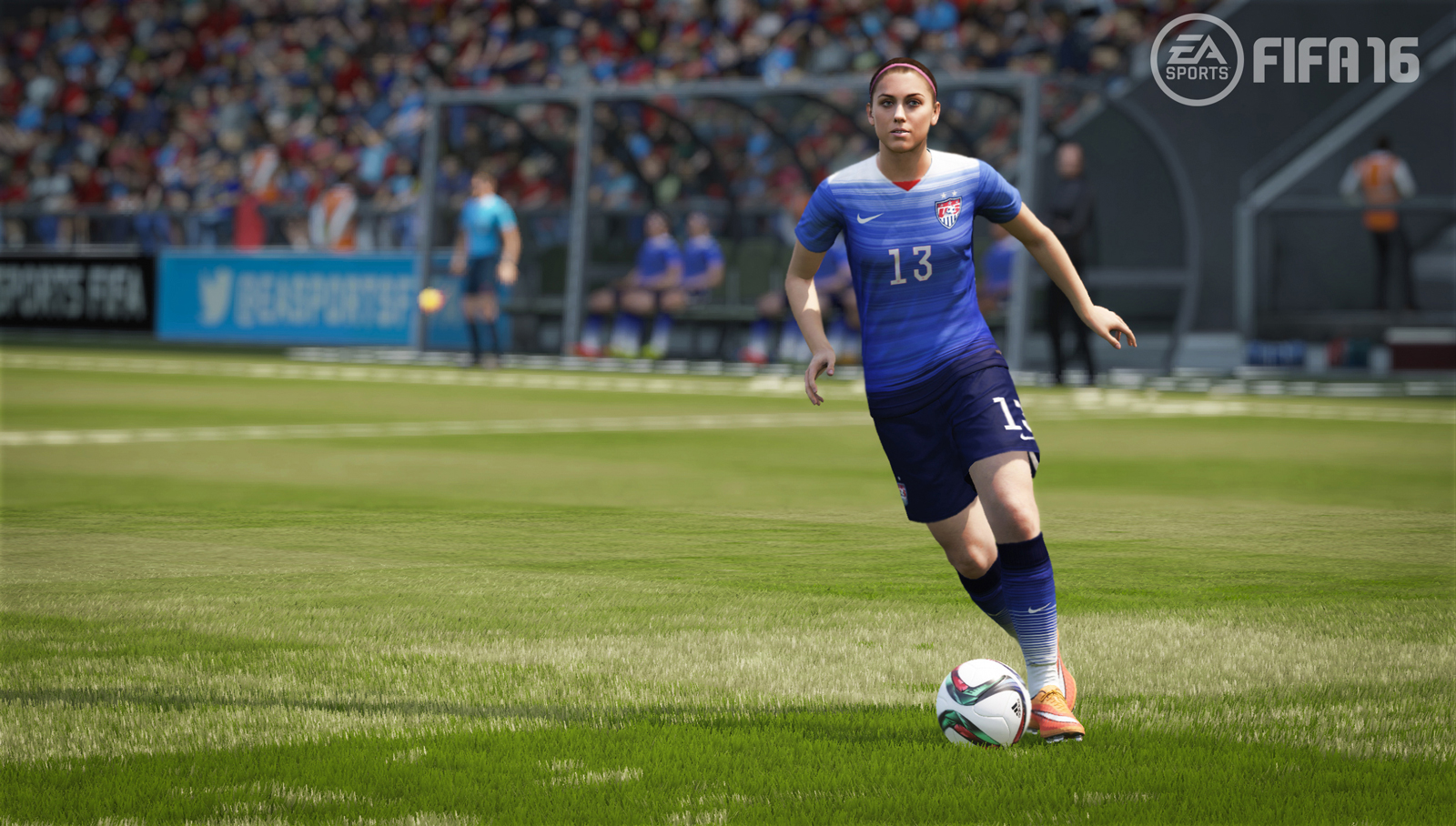
FIFA 16 is a game about football, and you probably want that

FIFA 16 should be celebrated for its inclusion of women players -- better late than never.
FIFA 16 should be celebrated for its inclusion of women players — better late than never.

There's a joyful cheer from the crowd; a roar of approval and a vibrant expression of intense approval. But I can't join in; I know it's not real.

It's literally not real. It's a virtual crowd in a virtual stadium, applauding, cheering and yelling in delight at a goal that didn't happen. But that doesn't stop some of the other real people who are nearby joining in with their own whoops, hollers, shouts and cries.

I'm at Wembley Stadium in London, spiritual home of football — at least in the United Kingdom. Some of my companions clearly feel that coming here is like having the opportunity to visit the Holy Land, particularly as we're in one of the mysterious event rooms that the public don't usually get to see. Even those who aren't looking at the screen seem excited; they're pointing at pictures on the walls, and at the view through the window out onto the pitch.

I envy them a little as I stand back, sipping my fizzy water and munching on a canape, wishing desperately that there was someone else here who wanted to have an open and frank discussion about the situation in Syria. But there isn't. I'm alone; so very alone, even though this room is full of people. I'd find it distressing if I weren't so used to it, but this is my life thanks to the choices I've made: doomed to forever operate on the fringe of events like this, unable to participate or even put up a convincing facade of excitement at the abject tedium I so despise unfolding on the screen in front of me.

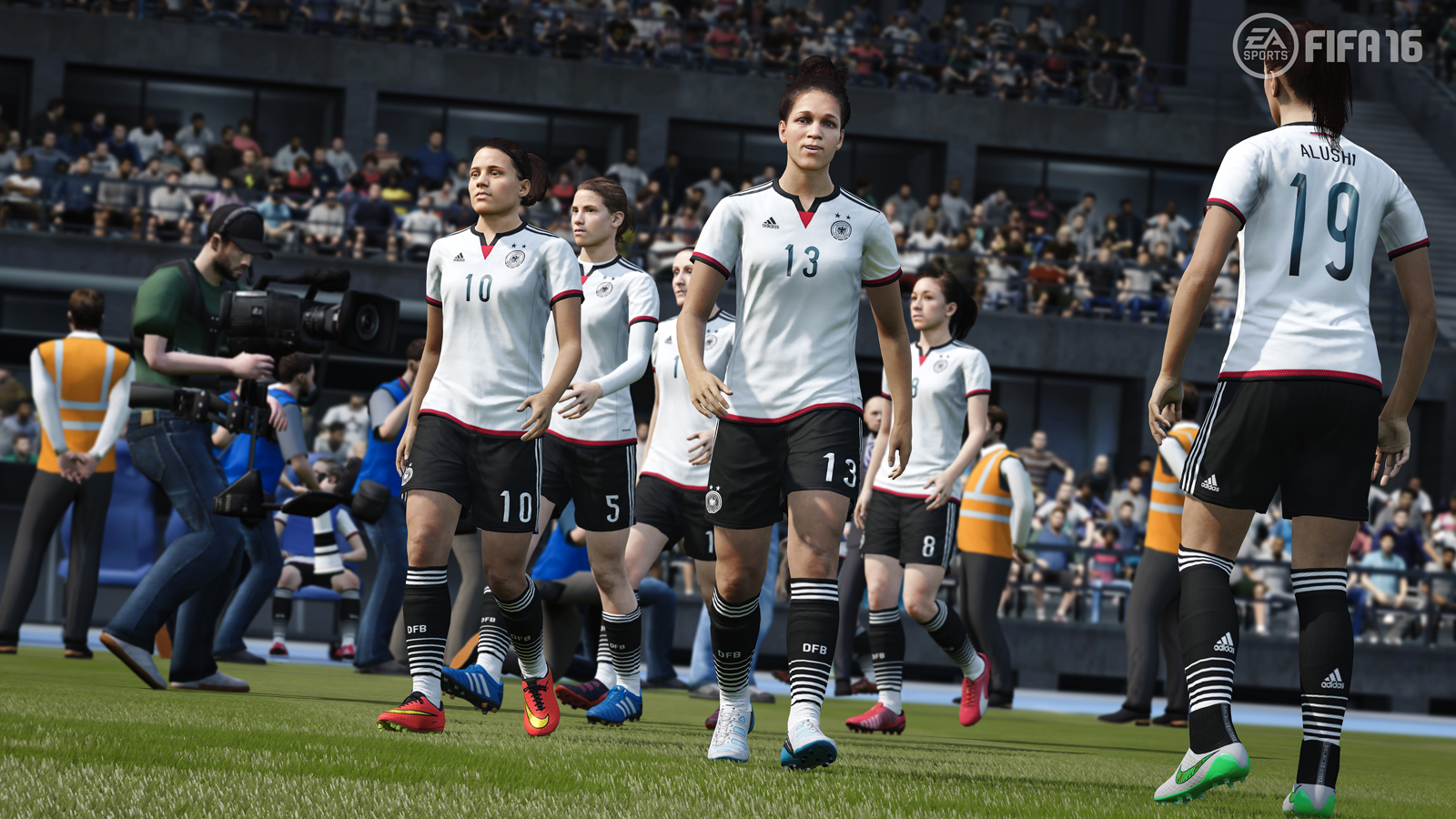
The game at times lacks racial diversity, but the presence of women after so many years makes up for this to a certain degree.

The virtual crowd cheers again, and there's a roar of approval from my assembled colleagues; apparently whoever it is that has the controller right now has scored an impressive goal against the carefully selected PR person: I'm guessing they play well enough to show the game at its best, while simultaneously being able to let my peers win and give them a sense of satisfaction and send them away with a positive impression of this dreadful, interminable, never-changing series of awful games.

But do any games truly change? After all, we're still shooting people of colour in obviously Middle Eastern allegories. We're still relentlessly collecting objects in what is clearly a potent metaphor for capitalism that shoots straight over the head of most people. We're still upholding traditional gender roles and tacitly encouraging the approval of the patriarchal status quo — a status quo that objectifies and exploits women — over more progressive attitudes. And we're still playing the same old sports; outlets for attitudes of toxic masculinity that are only distinguishable from the never-ending stream of games allowing testosterone-fuelled men to indulge their wildest, most perverse of rape culture fantasies by the fact that they are slightly less violent than Call of Duty and Destiny.

There are women in FIFA 16, which I suppose is worthy of some praise, and football games by their very nature include a healthy number of people of colour. But the outcry from the vast majority of the Internet over the inclusion of women's teams in this installment indicates that the world of sports games is still very much a man's world — but only if you're the right kind of man, of course. I'm not the right kind of man, it seems; I'm happy to see women included in the game as a step forward for progressiveness rather than, as some particularly obnoxious Facebook comments had it, the chance to "combine boobs and football".

A woman playing football.

I finish my fizzy water and head for the table to pour another. I feel a touch on my shoulder and turn around to see who is trying to attract my attention. It's the PR person who was playing the game a moment ago — I think her name was Ashleigh — and she's giving me a gentle smile.

"You don't look like you're having a good time," she says.

"No," I say. "I'm not."

I want to elaborate, to tell her that attending this event is a living hell for me, that there is literally anything I would rather be doing than taking a look at a game I have no interest in that represents a sport that I despise with absolute passion owing to its use for continuing the dominance of the prevalent toxic patriarchal attitudes in society. But I don't. After my admission, I simply take another sip of water.

"You should give the game a try," she says, still smiling — though I have a feeling that it's changed from a genuinely warm smile to a false one. She proffers a DualShock 4 controller; I contemplate it for a moment, its wonderful ergonomic curves bringing to mind the body shape of a beautiful woman who cares not for whether she's "beach body ready", but then I shake such borderline misogynistic thoughts from my mind lest Ashleigh can see the beast of suppressed lust in my eyes and dismisses me as yet another perpetuator of rape culture rather than the progressive feminist that I actually am. "You might enjoy it."

"I don't think I will," I say, giving her a smile of my own. Then I put down my unfinished glass of fizzy water, head for the door and don't look back.

It's raining outside. The black clouds overhead mirror the darkness in my soul. There's a flash of light and a clap of thunder, and I realise, as if given a message from a non-specific divine entity, that I am wasting my life.


(Disclosure: This article is a parody of this monstrosity that hit the Interwebs yesterday to much well-deserved derision.)

1958: The Way to Get Me Interested in Football is Exactly What You Think It Is

Screenshot_2015-05-31-14-09-36

I hate football. Loathe, despise and detest it with a passion only normally reserved for my A-Level four-part harmony teacher (at the time, anyway; I'm sure we'd probably get along just fine now), several of my past managers from previous employment (the same is not true for these cunts) and anyone who uses the term "problematic" more than once a month.

It's not as though I haven't tried to like it over the years. I recall begging my parents to be allowed to go and hang out at the pub to watch some World Cup matches while I was at school (and being turned down, as I recall); likewise, I remember getting so drunk so early in the evening on my brother's stag night in Brighton that I actually quite enjoyed an England vs Poland match; I've bought a few installments in the interminable FIFA series over the years in an attempt to enjoy them with friends; and I even tried picking a team and following their progress for a little while before just getting so completely and utterly bored with the whole thing that I gave up completely.

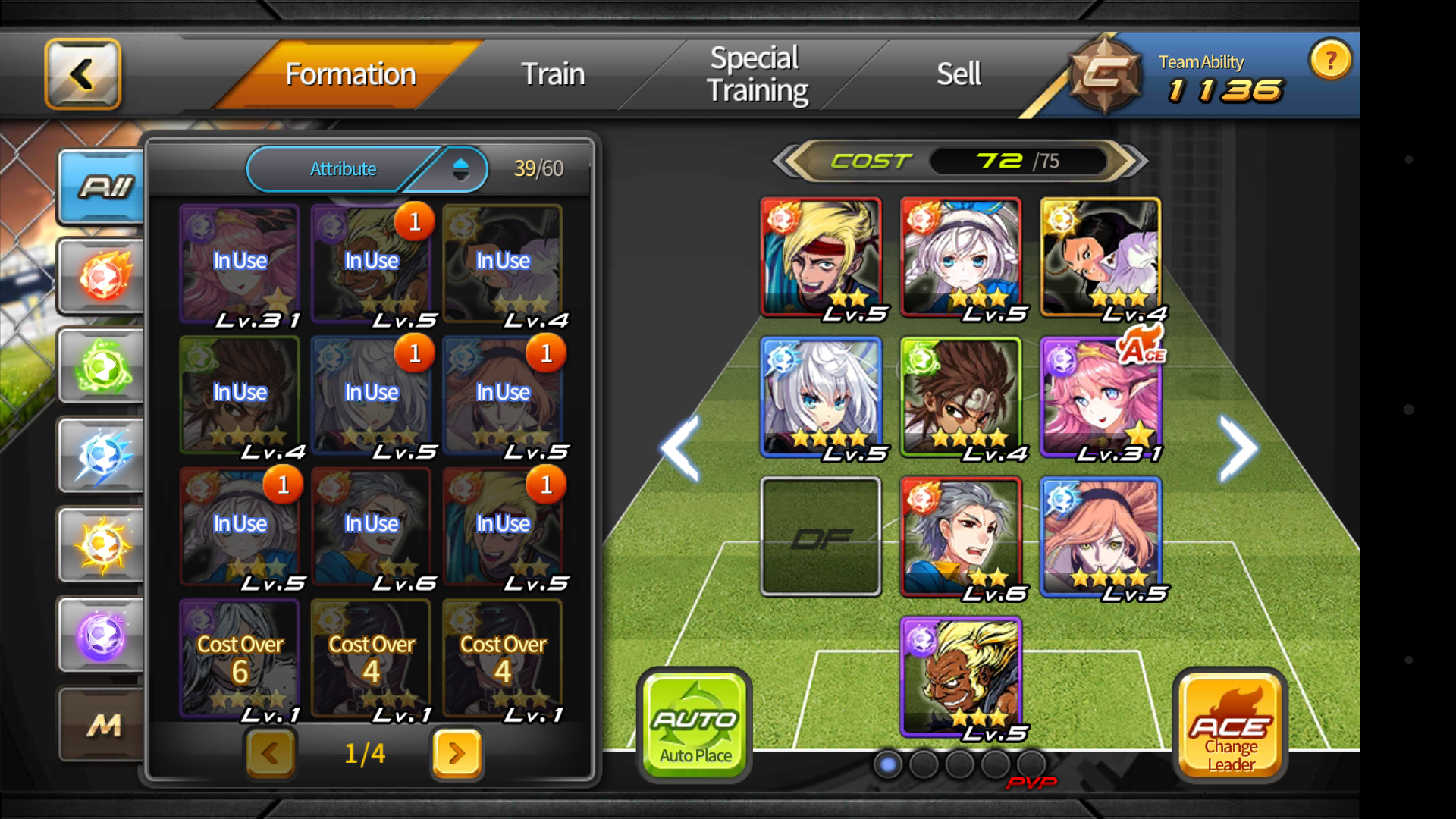
Turns out what you need to do to get me interested in football is send it to space. And position it so that the fate of the universe rests on the outcome of matches. And make most of the players pretty anime girls, and the remainder pretty anime boys and penguins. And make matches last approximately a minute of real time. And put it on my phone with a rockin' electric guitar soundtrack. In other words, make it almost entirely unrecognisable as football.

Screenshot_2015-05-31-14-07-43

Enter Soccer Spirits from Com2uS, a South Korean mobile game developer-publisher whose past work I have enjoyed to varying degrees. As with most developers from the region, their focus is exclusively free-to-play games, and they have a pretty wide portfolio running the gamut from the ever-popular farming game tapfests to more complex card battle titles. Soccer Spirits falls into the latter category, and it's actually one of the best examples of the genre I've seen to date.

Soccer Spirits places you in the role of… well, it's not entirely clear, since the player's presence doesn't appear to be acknowledged at any point, but I guess you're effectively playing as the whole team. You pick one of two characters to begin with, and these also come with a few friends to start off your team. It's not long before the existence of the Galactic League is revealed, and for some reason that isn't made entirely transparent through the game's borderline nonsensical but nonetheless entertaining story, you and your team are selected as Earth's representatives in these sporting conflicts that are supposedly held in lieu of "proper" wars. In space.

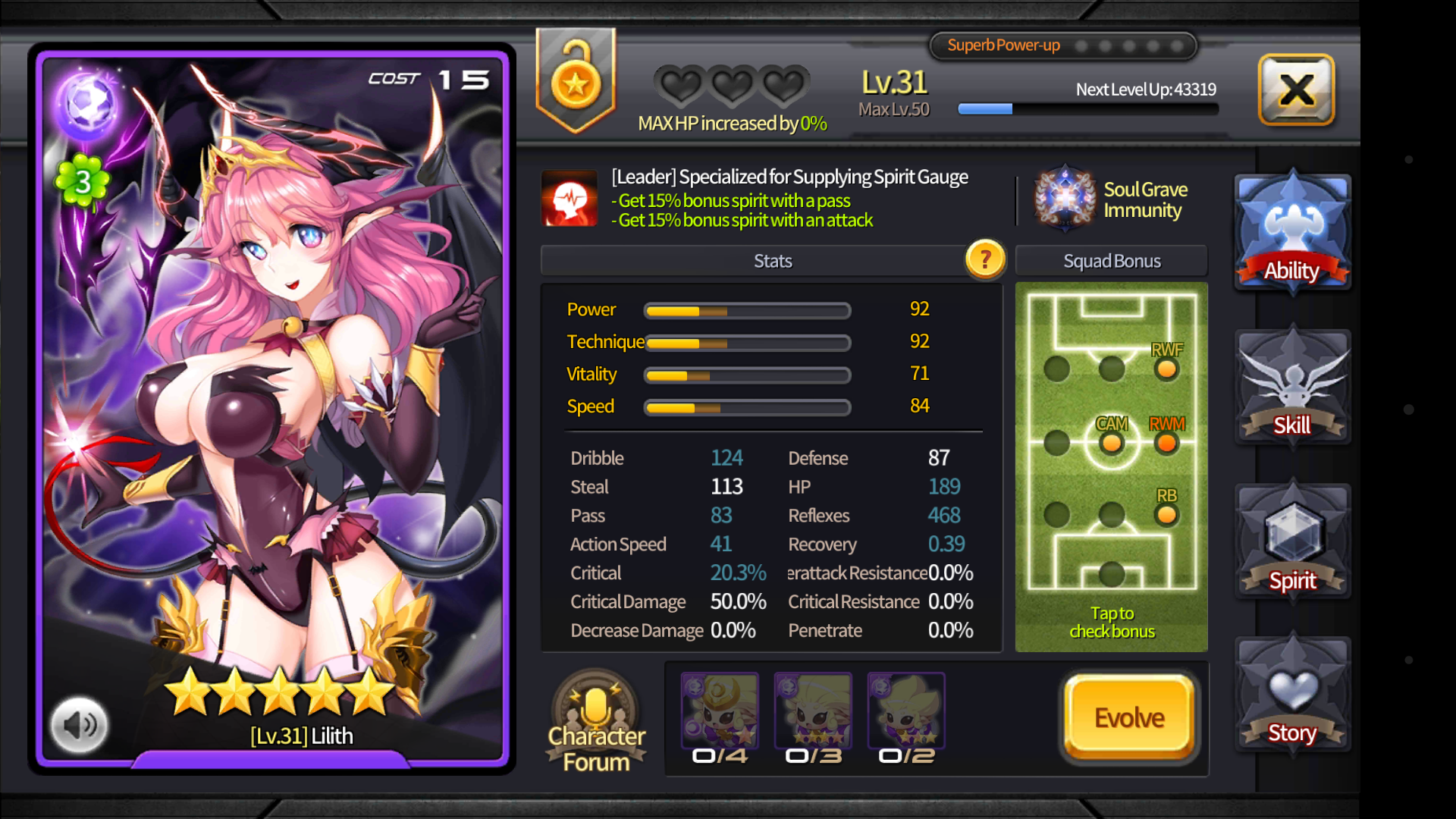
The basic metagame involves the usual process of collecting cards of varying degrees of rarity, "feeding" them other cards that you don't need to power them up, "evolving" them to more powerful forms and attaching various bits and pieces to them to boost their special abilities. This is all executed in fairly traditional fashion — though it must be said, the game does a much better job of explaining things than many of its peers — but it's how you actually use these cards that makes the game so interesting.

Screenshot_2015-05-31-14-08-20

In many mobile card battle games, battles are either abstract or completely non-interactive. There are exceptions — Brave Frontier springs to mind with its JRPG-style turn-based battles, and Love Live! School Idol Festival puts an interesting twist on the formula by turning your cards into the markers you tap on in a rhythm game — but a more interactive style of play is something that some developers still seem to be trying to get their head around a bit. Soccer Spirits succeeds admirably, with an enjoyable, fast-paced game that bears very little resemblance to actual soccer, but is fun nonetheless.

You put your cards into formation on the field. Each card has preferred positions it likes to play in, and putting it in one of them will give it stat bonuses. The match itself is played as a sort of turn-based affair with a bit of Final Fantasy Active Time Battle system going on. Cards gradually fill an "Action" meter over time, and when one fills up, that card gets a turn. Depending on its position, it will have the option to pass the ball to someone on the same line as it, attempt to penetrate the next layer of defensive cards, shoot at the goal or use a skill. Skills vary from attacking skills that boost power to buffs that assist the overall team, and many cards also have passive boosts that help your whole effort out, too, with particular benefits coming from the player you select as your "Ace".

Conflicts on the pitch are resolved as RPG-style battles in which stats, abilities and elemental affinities are compared between the two cards, and they inflict "damage" on one another accordingly. If a card's HP is reduced to 0, it is out of action for a short period — though not eliminated completely — and this allows an ideal opportunity to penetrate or shoot. In many cases, penetrating or shooting is combined with an attack — striker-type characters tend to have skills that enable them to make particularly powerful shots that will usually flatten weaker defenders.

Screenshot_2015-05-31-14-09-01To win a match, someone just needs to score one goal — no playing to 90 minutes here. In many cases, this means that a powerful team of cards can obliterate its opposition in a matter of seconds (though the game represents this as a number of "minutes" of sped-up time) which helps to keep the game admirably snappy, interesting and enjoyable — though given that I was showered with enough goodies to recruit what appears to be a virtually unstoppable team right at the outset of the game, I wonder how much strategy there will be as I progress.

Like many other mobile games that I've been pleasantly surprised by recently, Soccer Spirits is unobtrusive in its use of premium currencies and energy bars — though doubtless this will become more of an issue as I progress further. It's liberal with the rewards, meaning you can get your hands on some decent cards to add to your collection pretty quickly — but there are also a lot of incentives to try and collect as many as possible, particularly if you're able to finish "sets". It's a good use of the formula, and the artwork — clearly the work of several different artists, each with their own very distinctive styles — is absolutely gorgeous.

So there you have it. I'm playing a football game. (Kind of.) And enjoying it. What next? Cricket? Hahahaha.

1957: More Than a Demo

Out of curiosity, I downloaded Dead or Alive 5: Last Round – Core Fighters on PlayStation 4 this evening. Aside from having one of the most cumbersome titles in recent memory thanks to its string of unnecessary suffixes, DoA5LRCF is actually a really good example of something I hope we'll see more of in the near future: cut-down, free versions of games that are more than just demos. The modern equivalent of "shareware" versions, I guess.

For the unfamiliar, Dead or Alive is a fighting game series that has been running since the PS1 era. It's most notorious for its big jiggly bosoms on the female characters — the jiggle factor of which has always been adjustable, and indeed DoA5 is no exception to this — but it's also one of the best 3D fighting games out there, and one of my favourites. I suck at it, of course, but it's a game that I enjoy sucking at, whereas many of the current crop of 2D fighters are now so completely overcomplicated that I just get frustrated at not understanding why I suck.

Anyway, Core Fighters is a special free version of Dead or Alive 5: Last Round that includes just four of the characters from the full version's rather large cast, plus occasional rotating extras every so often. Core Fighters also lacks the full game's story mode, but other than that it is a complete game — you can play arcade mode, survival mode (a long-standing favourite of mine in the series) and even online. It's even got the full suite of tutorials in it, which seemingly do an excellent job of explaining exactly how the game works — something that previous installments have lacked.

Conveniently, Core Fighters includes my favourite game mode — Survival — and my favourite character — Kasumi — and as such it's a package that I'm eminently satisfied with even in its free incarnation. What's nice about it though is that despite the lack of characters, it doesn't feel especially "limited"; it gives an excellent taste of what to expect from the full game, and does a much better job that your typical demo at convincing you to part with your cash.

I'm not sure if I'll pick up the full version of DoA5 at any point — though I do very much enjoy the series — but Core Fighters is a great means of helping me come to a decision one way or another. I'm looking forward to giving it a shot in two-player versus mode at some point, since I splurged on an extra DualShock 4 controller today. Perhaps I'll even be able to drag Andie away from Final Fantasy XIV for five minutes to fight me. Fight me!

Koei Tecmo has also done a similar arrangement for the PlayStation 4 version of Dynasty Warriors 8 Empires. Given that this is a series I've also enjoyed a great deal over the years, I'm thinking I may well check this out now. Well, tomorrow, because it's nearly 1am now and I need to sleep.

1956: Diving into Hell

I grabbed a copy of a game I've been curious about for a little while today: Helldivers, from Arrowhead.

Helldivers is a PS3, PS4 and Vita game (cross-buy, cross-save and cross-play, thank you very much!) in which you take on the role of one of the titular dropship troopers, blow shit up and then get extracted. Except it's rather more likely that you will die in the process.

Arrowhead, you may recall, also developed Magicka, which is a gloriously chaotic "cooperative" multiplayer shooter in which friendly fire is well and truly turned on. In Magicka, a significant part of the fun comes from seeing what happens when your spells interact with other players' spells — there are often unexpected consequences. Helldivers is less explicitly ridiculous than Magicka is, but there's a lot of the same magic — no pun intended — in there.

Yes, friendly fire is turned on in Helldivers. Yes, things that you do supposedly to benefit the group can end up killing them. Yes, it's a rather good time despite the somewhat generic premise of "space marines go places and kill stuff" — the mission objectives and maps are varied and interesting enough to keep things enjoyable. Or so it looks, anyway; I've only played for about half an hour so far, but I enjoyed it a lot.

The interesting stuff in Helldivers, it seems, will come in the form of "Strategems". These are a rough equivalent to the spells in Magicka in that using them requires you to input a particular string of button commands, but the difference is that they don't take effect immediately. Powerful attacks like air strikes take time to reach your location, for example, meaning you'll need to hold off enemies while you wait for support. And then when support arrives, you'd better make sure you're not standing where you dropped the beacon, otherwise the thing you requested will indeed drop on your head and kill you.

There's something understatedly ridiculous about the multiplayer that makes it a joy. Earlier, I played a game with two random people in which one of our objectives was to disarm some unexploded armaments. No further information was given than that, aside from a location on the map that didn't seem to have anything there. Then several of us realised that we had a "metal detector" strategem available, allowing us to call in a supply drop containing a metal detector. When we'd acquired this, we could then sweep the area for the (apparently buried) bombs. Unfortunately, while we were doing so, our beacons attracted the attentions of the Bug hordes, so my two comrades had to fend them off while I was methodically searching the area for unexploded bombs. The juxtaposition was hilarious.

There's also a really interesting metagame going on, too. The concept puts the Helldivers at work in wars on three fronts, with control of sectors and systems being determined by players succeeding in missions they challenge. When the player community as a whole has pushed the front to the alien homeworld, the ability to assault it becomes available, and consequently an opportunity to win that particular war. Then every so often things reset and start again, from what I understand; I'm interested to see how the current war (the 4th, apparently) unfolds over time — it's a really cool idea and a great use of online.

So yeah. Helldivers. It's a good time. And if you're a PlayStation Plus subscriber, it's cheap right now, too.

1952: Orderly Play

With Final Fantasy XIV's first expansion Heavensward coming in about a month's time, I've been doing some thinking, particularly as I've dialled back the amount I've been playing vanilla Final Fantasy XIV during this "lull" between the story finale a while back and the launch of Heavensward next month.

You see, this "lull" period has allowed me the opportunity to get caught up on some other games — or, well, if we're honest, to dive head-first into the rather wonderful Omega Quintet, which I adore — and I've been enjoying that a great deal. This may sound like a "first world problem" of the highest magnitude, but anyone who has ever indulged in an MMO will likely be familiar with how easy it is for such games to "take over" to the exclusion of anything else. It's not necessarily a problem when it happens, but when you have lots of other games that you really want to play, and never really seem to have any time to play them, that's when it needs to be addressed — or you need to make some tough decisions as to what you might "sacrifice".

Anyway. The short version is that I have no intention of stopping playing Final Fantasy XIV completely as I'm too invested in the game experience as a whole, including the friendships I've developed as a result of playing it. But I also have no intention of sacrificing the (probably literally) hundreds of other games I have on my shelves and haven't played yet. As such, then, some sort of compromise would appear to be in order.

Then it struck me — actually not for the first time, since I've had these thoughts before. A relatively straightforward solution to the issue — and one that I'm aware won't be ideal for everyone, but which I think I might be able to stick to — is to treat gaming like any other hobby that requires a significant time investment: schedule and organise it.

This may sound like a bit much for something that many people regard as lightweight, somewhat "disposable" entertainment (though, I hasten to add, I've never been one of those people) — but think about it. Someone who's really into tennis probably doesn't play tennis every time they have some free time. Someone who's a member of a book club isn't constantly attending meetings. Someone who likes live music isn't constantly at concerts. There's balance; you do different things at different times, particularly when there's a social element.

As such, I feel that going into Heavensward, it would probably be a good idea for the sake of my own sanity and satisfaction to specifically set aside times for playing Final Fantasy XIV — as a sort of "weekly event" or meeting — and times for playing other things. And then stick to them. That way, I won't feel the strange "guilt" I feel about not playing Final Fantasy XIV when I'm playing something else, or the corresponding and equally strange "guilt" I feel about playing Final Fantasy XIV as my backlog of PS2, PS3, Vita, 3DS and PC games continually grows faster than I can complete them. The inherent benefit of something like this, too, is that it allows me to set some sort of schedule for experimenting with things that I'd like to explore more, like streaming and recording gameplay videos.

I'm not entirely sure what the right "balance" is as yet, but that's something I can probably work out over the course of the next few weeks as we count down towards Heavensward's launch. It's something I'm keen to get right, though, because as I've already said, I have no intention of giving up Final Fantasy XIV, but I also really don't want to feel like it's eating into opportunities to play other things, too.

So I'm thinking I might experiment a bit starting this week. I'm going to try having maybe two Final Fantasy XIV evenings that are reserved exclusively for FFXIV purposes; one of them will probably be Monday, as that is one of the two nights we customarily raid, and I'm thinking that the other will probably be Friday, since that's the end of the week and consequently a good opportunity to stay up and socialise with others. Weekends I'll take as they come; I'll play FFXIV if I feel like it — and we raid on Sunday nights anyway, even if I don't play any more than that — and I'll play other stuff without "guilt" if not.

If two days midweek doesn't feel like enough time to Get Things Done in the game, I'll consider it again. But we'll see.

This has probably not been a terribly interesting post for you to read, dear reader, and for that I apologise. However, it has been helpful for me to "think out loud" in this way and come to some sort of conclusion. So if you stuck around and watched me do that, uh, thanks for your commitment and understanding, I guess? And perhaps I'll see you in Eorzea on Friday!