2211: On "Burn in Hell, Yarny"

0211_001

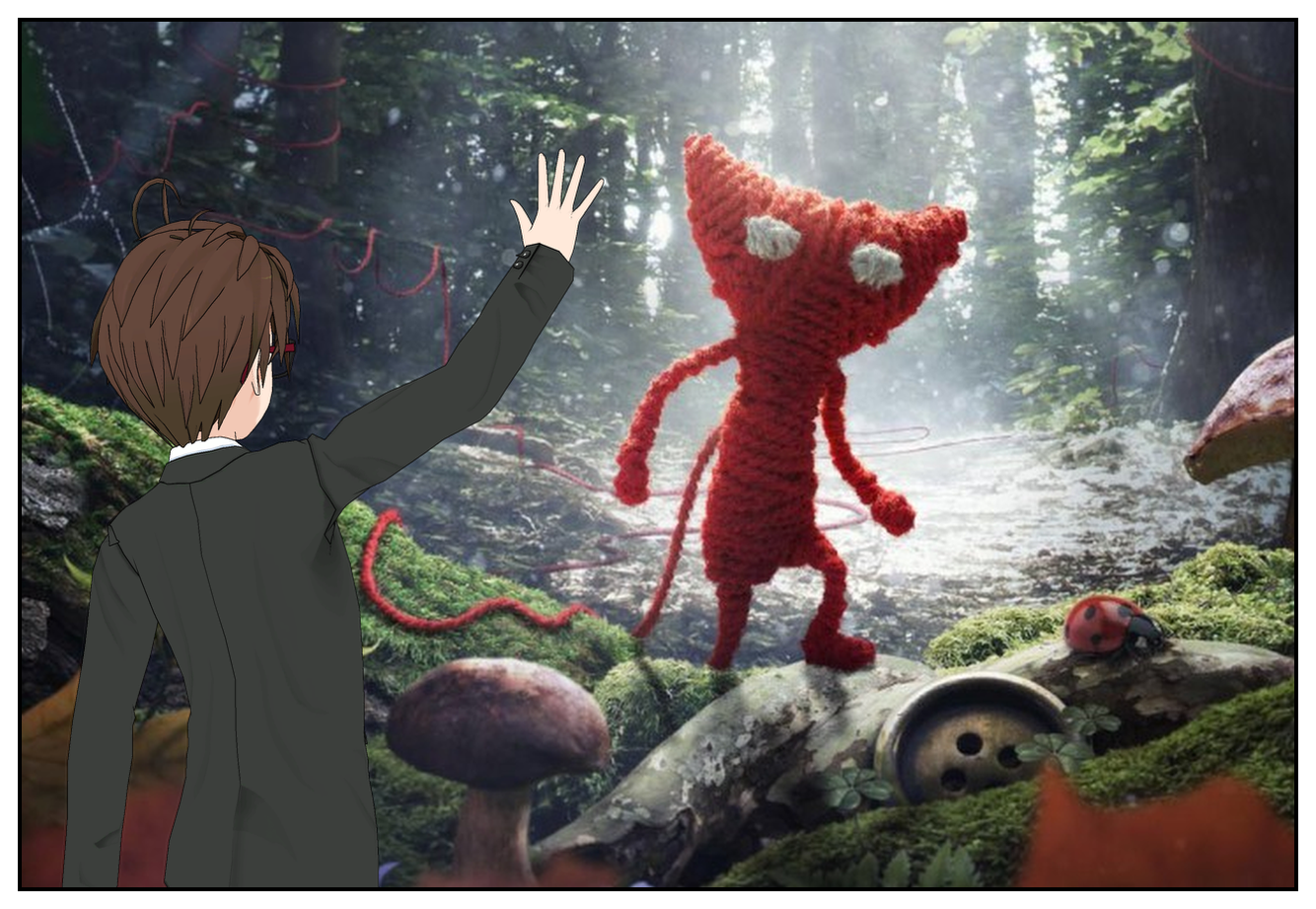
A videogame called Unravel will be released tomorrow. It may be a good game, and it is certainly a good-looking one, with a soft focus and hazy depth of field; tree leaves rustle convincingly and thick snowflakes pile up as the camera pans ever right-ward. It appears to make use of this tactile world for a series of physics-based puzzles, like moving rocks to get up on ledges and creating makeshift vines with which to soar across little ponds. These may be very clever puzzles, building toward a resolution that is very satisfying, but I will never know, because I will never play Unravel, and that is because its protagonist, a little red yarn-man named Yarny, can go fuck himself.

This was the opening to an article from Kill Screen, a site that originally positioned itself at the very spearhead of "new games journalism", boasting both a print magazine and an online component that would offer something a little different from the usual consumer advice/PR/news, previews, reviews cycle that most games-focused sites had provided up until that point.

I remember Kill Screen launching; it was actually at the first PAX I went to — I even still have a copy of their "Issue Zero" that I picked up at the show somewhere. It looked like it was going to be a great read, and a bold new frontier for games criticism.

Look at that opening paragraph again. Look at the last half of the last sentence.

"I will never play Unravel, and that is because its protagonist, a little red yarn-man named Yarny, can go fuck himself."

Needless to say, I do not feel the same way about Kill Screen as I did when it was first launched. I hadn't felt the same way for quite some time, to be honest, since its take on intelligent criticism had started to veer rather too heavily in favour of heavily ideological-based arguments rather than actual analysis of the art on its own merits — a scourge that the entire games press has been afflicted with for the past few years — but this article today has cemented my feelings.

What I did want to talk about, though, is the staggering hypocrisy of some people — within and outside games journalism — when censuring this article, and it most certainly has received almost universal censure from all angles. Deservedly so.

The key thrust of the article is that the author has no plants to play Unravel because he doesn't like the look of it. He doesn't like the look of the protagonist, and he doesn't like the fact that the game looks like it's going to be a narrative-centric, emotional experience that emphasises artistry (in the traditional sense) over game design.

You know what? Those are perfectly valid reasons to not want to play a game. There are lots of games I don't want to play because I don't like the look of them, because I don't like that type of game, because the subject matter doesn't appeal or because I know people I don't like love them. Rational or not, pretty much any reason you can think of not to play a game is an absolutely valid one from your own personal perspective: we're already living in an age where it's literally impossible to play every single game out there, even if all you did all day every day was play games, so everyone, consciously or not, has their own set of selection criteria for what they put on their plate at any given moment.

What isn't okay, though, is then picking on something that 1) you confess doesn't appeal to you and 2) you admit you have no intention of playing (and therefore speaking from a position of authority on) anyway — and then writing a critical article about how it's symptomatic of everything wrong with modern gaming. The author has some fair points — that some developers believe emotional manipulation of the player is an end unto itself, and that this isn't the same as creating something truly artistic — but they are completely invalidated by the position of ignorance from which he is speaking: he's criticising Unravel and games like it without any knowledge of what they're actually like — he's speaking on the basis of assumptions, not taking the time to research it for himself.

Where else have we seen this happen? Oh, right, with pretty much every niche-interest Japanese game released over the last few years. We've seen series like Senran Kagura berated for having boobs in them, but little to no discussion of their more progressive aspects such as homosexuality, sexual kinks, forming friendships across ideological barriers and accepting people for who they are. We've seen my longstanding favourite Hyperdimension Neptunia all but rejected from any cultural significance for being "hypersexualised" and having characters that both possess breasts and breathe, with little to no mention of the series' perpetually on-point satire of games and game culture, excellent writing and characters strong enough to carry games in a wide variety of styles. We've even seen people branding the "Amie" feature from the Japanese version of Fire Emblem Fates as "creepy" and expressing pleasure that it had been removed, despite displaying no understanding of its context, either in-game or within the Japanese cultural context of "skinship" or "naked association". And I could go on. For pages.

Sound familiar? Why, yes, in all the above cases, the critics of these titles were speaking from spectacularly ill-informed, ignorant positions — in some cases not even playing the games, or barely playing them for more than a few minutes in the instances where they did bother to boot them up at all — and, thus, were speaking from a position where they were unqualified to offer meaningful, trustworthy criticism of these games. And yet because games journalism is very much a cult of personality, people who didn't know about these games already take these critics' words at face value — assuming they're a high-profile critic like Jim Sterling, or at least from a site seen as "reputable" (i.e. big) by the masses — and don't bother to question them. And this leads to these games being pushed further into the niches they're already in, and to a lot of people missing out on experiences that they may well find themselves pleasantly surprised by.

The worst thing it does is contribute to the overwhelming air of negativity and cynicism that pervades modern games writing. Many members of the press are extremely burned out on the increasingly penny-pinching tactics of triple-A publishers — day-one DLC, preorder incentives, platform-exclusive content, betas-that-are-not-betas-they're-demos-that-you-can-only-play-if-you-preorder — and this causes the exhaustion and cynicism to infect their explorations of anything that might be just slightly outside the norm. Oh, sure, there's plenty of indie darlings that get elevated to "gaming Messiah" status — Undertale, The Witness and Firewatch all spring to mind in recent months — but poor old Japan repeatedly gets shafted by people who, like the author of the Kill Screen piece, have no intention of exploring them in sufficient detail to provide adequate comment and criticism on them.

Life is too short — and there are too many games out there — to waste time on negative articles about "why I don't like this" or "why I don't want to play this" or "why this doesn't appeal to me". So why does it keep happening? I'd much rather read a games press that is more positive in tone: willing to criticise where appropriate, but where the thing first and foremost in every critic's mind is the celebration of this amazing, growing, constantly changing medium that shatters cultural borders into something the whole world can truly understand and enjoy together.

You don't have to love everything. I certainly don't. But how about we think about keeping our mouths shut about the things we hate, let the people who do love them enjoy them, and we focus on the things that we love, too. Doesn't that sound much nicer than "I have no intention of playing this game because I don't like the look of the protagonist"?

(Oh, and for the record, I have no interest in playing Unravel either; Braid and Limbo were enough to put me off arty platformers for quite some time. I would not, however, dream of attempting to offer criticism on it having not played it — and I wouldn't even feel comfortable commenting on Braid and Limbo because I don't feel I played them enough to be well-informed before tiring of them. Now, I'm off to go and play some disgusting degenerate pervert Japanese role-playing games and probably fap myself into a frenzy in the process. Or perhaps just enjoy the things I love rather than bitching about things I hate and have no intention of trying to enjoy.)

2209: Exploring the Cosmos

0208_001

Been playing a bit of Elite Dangerous: Horizons this evening and realising the "dream" of something I've wanted to do since I started playing: hop in a ship, point it in a particular direction and just go see what's out there.

I haven't got that far yet, to be honest — I'm still in populated space, albeit getting down to the dregs of the tiny factions rather than the warring empires of the PowerPlay system — but I can see interesting things on the galactic horizon, and I fully intend to check them out and see what's there.

The nice thing about Elite is that you can do this and it's a viable way to play the game. Its exceedingly freeform nature — more freeform than pretty much any other game I think I've played outside of Minecraft — allows you to play how you see fit, and enjoy it how you want. If you want fast-action combat dogfighting, it's there. If you want to run courier missions, that's there. If you want to collaborate with other players to strategically expand the influence of one of the major powers in the galaxy, that's there, too. Or, as previously mentioned, if you just want to hop in a ship, point it in a particular direction and just go see what's out there… well, you can do that too, because the galaxy is one hell of a big place.

Exploration gameplay is relatively straightforward. Equip a ship with the appropriate scanners — basic versions of which come as standard — and when you hyperspace into a new system, you can scan for astronomical objects. Once you've located some, either via your scanners or visually, targeting them and flying close-ish to them allows you to run a detailed scan of them and record the information in your ship's computer. You can then sell this information when you get to a suitable space station or colony that is at least 20 light years away from where you acquired the data — it's assumed that most areas are familiar with the region immediately around them — and profit accordingly. It's a valid career path with its own progression and the opportunity to make your own distinctive mark on the game universe: whenever someone visits something that you were the first one to discover, they'll see your name there, proudly recorded for all time as the first person to find that thing, whether it's a big burning ball of fiery sun, an unremarkable lump of rock or a spectacular planetary system.

I haven't travelled far enough to be one of these pioneers as yet, I don't think, but I'm already getting into a region of space that is less populated, both with the computer-controlled factions and players. The station my ship is currently parked at as I type this has seen just 12 player-controlled ships pass through in the last 24 hours, compared to the hundreds or thousands the more "core" stations in the centre of the populated area see every day.

I find the exploration aspect inherently satisfying for some reason, despite the fact that objectively speaking it's quite boring and repetitive — although I did get interdicted by an unpleasant NPC called "Starquake" earlier, who battered my ship about a bit before I was able to activate my Frame-Shift Drive and jump away from him — but mostly I'm curious to see what's out there, if anything. The original Elite had some strange things going on in the far reaches of the galaxy — most notably the spectacularly irritating Thargoids, who had a habit of pulling you out of hyperspace and killing you horribly — so I'm curious to see if there's anything interesting hidden in the furthest reaches of the galaxy.

There are a bunch of places I'm just curious to see, too. The "Coalsack" area looks most intriguing, what with its ominous black cloudiness, and, of course, the immense density of the galactic core is surely worth trying to see. Of these places, the Coalsack is probably reachable relatively easily; the galactic core perhaps less so, but I'm interested to see how far I can go. Theoretically, my current ship has infinite range thanks to its Fuel Scoop hardware, which allows me to refuel by harvesting the gases of appropriate stars, so as long as I don't get stranded in a region with crap stars and/or blown up by pirates or aliens who are hiding deep in "unpopulated" space, I should be good to go for quite some time. And think of the money I'll make when I eventually get back to human space to sell all this exploration data.

Oh, God, I have to fly back as well, don't I… Maybe I shouldn't go too far…

2207: Proudly Flying the Flag for the Magazine Format

0207_001

Ladies and gents, I'm pleased to announce the very first issue of Digitally Downloaded: The Magazine, put together as a collaborative effort between me and Matt Sainsbury, head honcho of the site of the same name.

You can read the issue here for free, or hopefully it will embed below if the magic of the Internet does its thing properly:

The magazine is something Matt and I have been kicking around for a while now. We both have a background in print publications, and both have a strong preference towards the sort of long-form pieces you get in magazines. This kind of format is something which clickbait sites tend to discourage these days unless they're being particularly provocative with the things they're saying at length, so really starting this magazine was an opportunity for us to create something that we would want to read.

The broad intention behind the magazine is to "theme" each issue around a particular subject, then focus in on that subject with a main feature and a series of articles about games that typify the subject. In the inaugural issue, we went for the concept of the unreliable narrator: an established trope in literature, but one that games are just starting to get to grips with. Our investigations took us across the world, from Japanese visual novel Steins;Gate to "walking simulator" Everybody's Gone to the Rapture via the chaotic genius of Deadly Premonition.

There are doubtless some kinks to work out (most notably the fact that the web-based reader appears to inexplicably cut some of the letters off on some of the page footers, seemingly at random, despite the source PDF looking just fine) but we're planning on making this a regular — hopefully monthly — thing going forward, and we hope you'll support and enjoy it.

A pre-emptive thank you for taking the time to read through our hard work, then, and we look forward to having more to share with you in the near future!

2204: Elite

0204_001

I spent a chunk of today trying out Elite Dangerous: Horizons. This was actually pretty much my first experience with Elite: Dangerous generally, aside from giving the tutorials a go yesterday, but I felt I was long overdue to try it out, particularly as I had bemoaned the lack of a good Star Trek game the other day. Elite is not a good Star Trek game, but it is one hell of a space sim. And, for once, that "sim" part seems apt; this certainly isn't an arcade-style dogfighting game, as evidenced by the fact that in several hours of play today, I didn't fire a single shot.

I used to really enjoy space games back in the 16-bit era — particularly those of a more free-form nature such as Paul Woakes' Mercenary series, Rainbird's Starglider series (particularly the enormously ambitious second installment) and, indeed, the original Elite. I say that — Elite is actually one that I never quite managed to get my head around when I was young, because there was a lot of things to think about while you were playing, and pages full of numbers that confused and bewildered me. Also docking with those spinning space stations was fucking impossible, so every time I tried I usually ended up quitting in disgust after smashing my ship to smithereens on the space station you start near.

I made the mistake of reading a few Steam reviews of Elite: Dangerous before giving it a go; while there are a few fair criticisms there, there's also a whole lot of whining about 1) not knowing what to do and 2) Frontier's business model for the game which, if you're unfamiliar, sees them essentially re-releasing the game at full price each year with the promise of a year's worth of major updates to the game systems. It's perhaps better to think of it as a yearly subscription fee, particularly as the game has a significant massively multiplayer element for those who care to engage with it.

Anyway. Discarding the Steam reviews and jumping in to try things out for myself, I was quickly enraptured by the feeling of flying my Sidewinder. I even unplugged the 360 controller and plugged in my 11-button joystick; it's no full HOTAS (Hands On Throttle And Stick) setup, admittedly, but it feels great when used in a game like this, particularly with the lovely visual feedback the game gives you with regard to movement: unlike the original Elite, whose cockpit was a static bitmap with a viewport into the flat-shaded 3D polygonal universe outside (I was playing the Atari ST version, so it had colours!), Elite: Dangerous' cockpit is set up to feel like you're actually sitting in it. Handling the controls causes your viewpoint to shift slightly according to how you're moving; it tilts when you roll, pulls forward and back when you speed up and slow down, and pulls up and down when you pitch. Given the game has been designed for virtual reality headsets from the get-go, it's understandable that the game would model head movement pretty well, but I'm glad to see that even when playing on a flat (admittedly large) TV screen it still looks very convincing.

What I've found most satisfying about the game so far is the moment-to-moment simulation of flying your ship. Everything you do is just satisfying to pull off, just for the sake of doing it. Especially fun is taking off and landing from various structures and space stations — and, in Horizons, you can now land on planets, too, either at settlements with dedicated landing facilities or just on the ground if you find a suitably smooth patch of terrain to set down. The handling of the ship is beautiful; pulling the stick around feels like you're wrenching a big, slightly unwieldy lump of metal around in zero- or low-gravity, and the sound design, where you hear your thrusters firing and your engines throbbing according to whatever you're doing, is absolutely impeccable. There's even a wonderful crescendo of your engines reverberating off the ground and surroundings as you set down for landing; it is, I think, the most convincing depiction of plausible pure sci-fi space travel I've seen for a very long time, perhaps ever.

The most common criticism of Elite: Dangerous is that it's "a mile wide and an inch deep", and I can kind of see where that's coming from: interactions with NPCs are rather sterile and menu driven, though later updates look set to put "faces" to significant characters in the universe. There's no prescribed narrative, either; you can get involved in the PowerPlay mechanic to swear allegiance to one of the various factions attempting to control the universe, which actually has a significant effect of the game for all players, but there's no "story" to follow as such besides that which you make for yourself.

In many ways, I think I sort of prefer that for Elite, though; while I do love a bit of story in my space games a la Wing Commander and the like, when playing something as freeform as Elite a story can kind of get in the way a bit, making you feel obliged to go and do certain things rather than exploring the galaxy at your own pace, making a name for yourself however you see fit.

I'll be interested to see if Elite holds my attention, but for now, it certainly feels like the space game I've wanted to play since I was a kid.

2202: Three Games I'd Like to See Made

0202_001

Posting my piece about Neptunia games I'd like to see the other day got me thinking more broadly about other interactive experiences I'd like to indulge in, should they ever be made. (Or perhaps they already exist, in which case please do let me know in the comments and I will investigate!)

The following games either don't exist at all, or the last time they were properly explored in gaming — in my opinion, anyway — was far too long ago for my liking. So here we go, then:

A proper spy game

I downloaded Sid Meier's Covert Action from GOG.com a while back when it was on sale for some ludicrously low price, and discovered that it was an immensely satisfying, fascinating game with a number of distinct facets. I wrote in detail about the game a while back, but for those of you too lazy to click through, the elevator pitch is thus:

You are Max (or Maxine) Remington, an agent. A Dastardly Plot is about to unfold in the world, and it's up to you to stop it. Ideally, you will find out what is going on before it happens, arrest everyone involved and follow the trail of clues to find the Mastermind behind it all. You will then repeat the process until all the Masterminds there are in the world are behind bars — or until you give up at the ludicrous level of difficulty the game escalates to on its higher settings.

Covert Action incorporates a variety of game styles ranging from puzzle (phone tapping) to code-breaking, car chases and top-down action-stealth-adventuring. While clunky by modern standards, it's an extremely clever game that, in true Sid Meier tradition, is busily simulating a whole bunch of things happening in the background while you appear to be doing something relatively simple. None of it is pre-scripted, either; each case you get is randomly generated, so there's no easy way to find the solution other than putting in the hard graft yourself.

To cut a long story short, we need a new Covert Action. There have been spy-themed games, sure — the most memorable of which for me is, without a doubt, Alpha Protocol — but these tend to be more scripted and action movie-like, rather than focusing on the interesting but perhaps less glamorous aspects of the job. I want a spy game where it's rare you'll pull your gun on anyone; I want a spy game that's more about setting up surveillance and investigating than shooting terrorists; I want a spy game where it feels like I'm a spy, not an action movie hero. (To put it another way: I want a spy game where it feels like I'm old-school James Bond, rather than new-school James Bond.)

A good Star Trek game

There's plenty of space games around, since they've been making a bit of a resurgence over the last few years. With the success of Elite: Dangerous and the anticipation for No Man's Sky, the time is surely ripe for a new Star Trek game to hit the market.

Oh, there are a couple of relatively recent Star Trek games around, of course, but neither of these quite scratch the itch I have. Star Trek Online is a massively multiplayer online RPG, with everything that entails — including lots of grinding and free-to-play monetisation that requires you to pay up for the coolest ships rather than earning them — while Star Trek Timelines is a mobile game with everything that entails — including lots of grinding and free-to-pla… you get the idea.

Neither of these games are particularly bad as such — though Star Trek Timelines' use of the obnoxious playtime-limiting "Energy" system that I really wish would die a horrible death is something I find hard to forgive — but neither of them are quite right. Both have good aspects: Star Trek Online has a great feeling of taking your ship around the galaxy, exploring uncharted areas and engaging in battle, while Star Trek Timelines presents you with some interesting non-combat scenarios to deal with, albeit only in text form. The trouble is, neither of them go far enough in simulating what it's like to be a crewman on a Starfleet vessel.

There are a few approaches I'd like to see a new Star Trek game take. Firstly and perhaps most obviously is a starship bridge simulator. I know these exist and are available on GOG.com, but with modern technology it would be possible to do something far more impressive — and perhaps even multiplayer, a la Artemis Starship Bridge Simulator.

Another possible approach is something along the lines of Spectrum Holobyte's elderly Star Trek: The Next Generation – A Final Unity, which combined starship operations (including combat and power management) with point-and-click adventuring down on planet surfaces. While the combat and engineering sections on the ship ended up feeling a little superfluous when compared to the game's narrative aspects — particularly as you could put them both on automatic without penalty — the whole thing felt suitably authentic as an interactive episode of The Next Generation, and ripe for updating.

I guess one of the main issues with the Star Trek license is that there's not a current TV series running to tie it in with, so it would probably have to be an original work, perhaps with guest appearances from established characters. That's not an issue for me, so long as it feels like Star Trek, but for some fans it may not be acceptable.

I believe there is talk of a new Star Trek series of some description coming soon, though, so it will be interesting to see if anything interactive comes of it. Anything's better than that dreadful third-person shooter that came out for consoles a year or two back and was promptly completely forgotten about…

A game about running a school

There are tons of management games out there, but outside of an extremely peculiar mobile game by Kairosoft called Pocket Academy, I don't recall all that many that focus on educational institutions, and I think this is something that would be ripe for the interactive treatment.

SimSchool, as we'll call it, has a considerable degree of scope to be a much more "personal" strategy game than many other management sims, since although running a school does include the standard stuff like budgeting, staffing and training, a key part of what keeps a school running effectively is interpersonal communications, rapports and morale.

In SimSchool, you'd play the new, young headmaster of a school that was struggling, and you'd have a certain amount of time to set things right. In true strategy game tradition, you'd be able to set up various conditions at the beginning of the game such as the affluence of the area the school is in, the size of the school, when it was built, its condition and suchlike, and have the game create a challenge for you accordingly.

As you worked your way through a campaign, you'd not only have to perform managerial duties to keep the establishment in the black and keep an eye on the day-to-day operations of the school, but you'd also have to interact with students, staff and parents in order to keep them happy. There'd be dialogue sequences in which you'd have to negotiate things and determine the best way to handle problem children — sometimes you'd even have to convince the local authority that the decision you'd made was the right one for the greater good. And, on the harder difficulty levels, you'd also have to contend with various "disasters" that make your life more difficult — this is a Sim game, after all!

My time working in schools was hellish, and I have no desire to return — but that doesn't mean I don't still find them interesting places. A game like this has a lot of scope to be an interesting twist on the strategy-management genre, and I'd certainly love to play it.

2201: Game Time is Precious

0201_001

As I get older and — when I'm working, at least — find myself with less time on my hands to devote to gaming, I've found myself having to make tough decisions about what I do and don't play. Having taken a step back from my beloved Final Fantasy XIV and found myself surprised at how little push I'm feeling to go back, even if a new content patch were to drop tomorrow, I find myself feeling disinclined to check out things that are very obviously timesinks and nothing else.

This doesn't mean I'm not interested in long games; on the contrary, the games I tend to gravitate towards tend to be Japanese role-playing games that are often in excess of 100 hours in length, and I don't begrudge them being that long, particularly as I've come to enjoy the pursuit of Platinum trophies in many cases.

No; I'm referring more to games that either artificially constrain your progress, or which don't feel like they have a real point to existing beyond being something to do with your hands if you have nothing better to do.

MMOs certainly fall into this category, but these at least have a skill-driven aspect that makes them satisfying: the best gear in the world won't let you clear Alexander Savage in Final Fantasy XIV if your skills aren't up to the job.

No, I'm largely referring to mobile games here: a phenomenon that I've been becoming increasingly aware of in recent years, and which was painfully obvious when I took a casual browse through the Google Play store earlier today and found nothing whatsoever that I wanted to download and play on my phone, for various reasons.

By far the most common type of mobile game we get these days is based on the "gacha" principle, whereby at regular intervals or by spending in-game currency, you have the opportunity to "draw" new "cards" (I put that in inverted commas because sometimes they're units, characters, weapons or whatever) and add them to your collection. You can then form a "hand" of these "cards" and use them in whatever the game's core mechanic is — usually some form of combat. Between fights, you can generally use additional, unneeded or weak cards to power up your main cards, allowing you to take on stronger and stronger challenges as you go.

A lot of these games are well-presented and initially appear to be reasonably fun. But there's so little depth to them that I find them ultimately unsatisfying — particularly when, as with something like previous favourite Brave Frontier, the mobile game that I've spent the most time with, they become extremely time-consuming to play for very little feeling of reward.

When I play a game, I like to feel like I'm achieving something, at least partly through my own knowledge and skills. I like the feeling of progressing against a difficult encounter, beating a difficult dungeon, clearing a complicated quest. And while many of these mobile games do pay lipservice to a feeling of progression through any combination of advancing through a linear world map, levelling up your character or levelling up your characters, I never, ever feel like they're rewarding anything other than persistence — and, in some cases, a willingness to pony up cash to guarantee the best possible draws.

These games pale in their unappealingness when compared to the new sensation that is "idle games", though, the appeal of which utterly eludes me. My wife Andie has been "playing" Clicker Heroes recently, and I don't understand why; I tried Sakura Clicker a while back, and despite me clearly being its target audience, found it utterly tedious and pointless.

For the uninitiated, an idle game is one that you start playing and then don't have to do anything with, outside of occasional upgrades and suchlike. In Clicker Heroes, for example, killing monsters earns gold, which allows you to hire heroes, who automatically deal damage to monsters, allowing you to just leave them to it while you go off and have a big poo or something; you can also upgrade your heroes in various ways, largely by throwing more money at them. The sole appeal element of these games appears to be making numbers as big as possible — which, as an RPG fan, I do totally understand the appeal of — but the trouble is, I personally don't feel any sense of accomplishment from making those numbers get bigger, because I know that I haven't really "earned" any of those rewards through anything other than remembering to check in on it every so often. I'm sure there is some sort of appeal factor that I'm missing somewhere along the line, since I know numerous people who spend a hell of a lot of time playing Clicker Heroes and its ilk, but… well, I just don't get it, and not through lack of trying. Sorry!

To return to my original point, the feeling that my gaming time is precious has only grown over the last few months in particular, and so every time I find myself tempted to download a new mobile game, or try out another clicker game to see if I can understand why so many people are seemingly addicted to them, I hit a new mental checkpoint in my head that reminds me how many unplayed games stretching back to the PS1 era I have on my shelves, and suggests that I should probably work my way through those rather than wasting my time on something that has no real sense of closure or completion.

With that in mind, I'm heading back into the world of Hyperdimension Neptunia Re;Birth2; gotta get through that before V-II arrives on the 12th!

2200: Happy Birthday, Tsunako

0200_001

Tsunako is the artist responsible for the character designs in the Hyperdimension Neptunia series, and consequently she is responsible for bringing more joy into my life than pretty much any other visual artist I can name. (Which isn't all that many, admittedly, but from the moment I got into Neptunia I liked the art enough to find out who was behind it.)

In celebration of it being Tsunako's birthday today, I thought I'd take the opportunity to share a selection of favourite images. Most of these are from the Neptunia series since I haven't yet got around to experiencing other series she has worked on such as Fairy Fencer F or Date A Live and thus don't know enough about them to be able to comment with any real authority.

Without further ado, then…

companep
The first image you see in the original Hyperdimension Neptunia and its Re;Birth1 remake. Pretty much sets the tone of what to expect.
cpus
This image, from the alternate universe in which Hyperdimension Neptunia Victory and Re;Birth3 take place, pretty much sums up the relationship between Neptune and the rest of the cast.
candidates
The "CPU Candidates" — little sisters of the main characters, representing the PSP/Vita (top left), Game Gear (top right) and DS (the twins)
makers
These characters, from Re;Birth1, are the "Makers", personifications of various software companies. Like most characters in Neptunia, their designs beautifully encapsulate their source material.
kiss
mk2 and Re;Birth2 made the implied yuri in the series a little more up-front.
nepschool
For me, one sign of a good character is being able to put them in a new situation/outfit and they still be recognisable; I think you'll agree that the goddesses in school uniforms still have very clear personalities.
noire
One of my favourite images of Lastation's leader Noire.
purpleheart
Neptune's transformed CPU form Purple Heart, demonstrating Tsunako's biggest strength, so far as I'm concerned: her ability to draw curves to die for.
vert
While much of Neptunia is self-consciously moe, there's little denying that Vert goes beyond "cute" into "beautiful".
neppurp
This image is not lewd at all, and if you think it is you are the one who is the pervert.
miku
And here's a Tsunako-drawn Hatsune Miku, just so this gallery isn't entirely Neptunia.

2198: Petting Waifus and Gay Conversion

0198_001.png

It came to light today that Nintendo of America apparently hasn't stopped with the localisation edits to the upcoming Fire Emblem Fates that had already been revealed: it seems that the "petting" minigame, during which you can directly interact with the characters in your party — male and female — and improve your relationships with them has been excised completely. Kotaku described this as a "minor change in the name of localisation".

Perhaps it is "minor". Perhaps it is an unnecessary part of the game. Perhaps those who are unaware of the Japanese version won't even know it was there to be missed. But none of this changes the fact that a feature of the game — with this being the first Fire Emblem game where you could directly interact with party members in this way — has been removed entirely from the Western release, giving English speakers a version of the game which is comparitively gimped when placed alongside its original Japanese source material.

Before I go any further, I'd like to talk a little about my general views on localisation. In short: localisation can be helpful and sometimes necessary to ensure that the right audience can access a work. The Ace Attorney series, for example, benefited considerably from its rather drastic localisation, opening it up to a much broader audience than those who would have been comfortable with a protagonist called Naruhodo Ryuuichi rather than Phoenix Wright.

For me, the key thing when considering how drastic localisation changes should or could be is the question of cultural context. Sometimes the inherently Japanese context of a work is important — key examples include titles like the Persona series, which is set in and around Japanese high schools; the Shenmue series, whose entire first game was set in a few lovingly rendered regions of a Japanese town; the Yakuza series, which is about as accurate a simulation of Japanese nightlife as you're going to get, regular street brawls aside; the Senran Kagura series, which is steeped in both Japanese mythology and cultural peculiarities such as student rivalries and, you know, being a ninja; and any number of visual novels you'd care to mention, which often rely heavily on conventions of Japanese culture, particularly with regard to interpersonal relationships.

For other titles, though, it's less important to keep this authentically Japanese feel to it. Something like my perennial favourite the Hyperdimension Neptunia series, for example, works well with the breezy tone of its localisation, though more diehard fans remain dissatisfied with character traits introduced through NIS America's original translations of the PlayStation 3 games prior to Idea Factory International taking matters into their own hands. Likewise, the localisation of Final Fantasy XIV was excellently handled, featuring some well-done and deliberately flowery — almost Shakespearean at times — dialogue that many have noted added considerable depth to the original source's writing. Indeed, in Final Fantasy XIV's case, many of the things introduced through its localisation have found themselves "backported" to the Japanese version, so well-received were they — though I will admit if you know even a bit of Japanese, playing the game with Japanese voices and comparing to the English subtitles can be a little jarring.

Anyway: the point is, I'm not opposed to localisation where it's appropriate or necessary to broaden a work's appeal, and particularly if said work is aimed at mass market but is still riddled with Japanese cultural references no-one but 1) Japanese people and 2) weeaboos will recognise. Where a specifically Japanese tone and feel is necessary to an authentic translation of the work, though, I'd rather the translation be as literal (but readable) as possible where it can.

And so we come to Fire Emblem Fates. What we have here is a title that isn't particularly Japanese in feel or tone, since Fire Emblem has always erred on a stereotypically Western approach to fantasy at times. As such, I wouldn't be opposed to localisation changes that help a broad audience to access, understand and appreciate the work as a whole by toning down its "Japaneseness".

That's not what we're getting though. Fire Emblem Fates' most drastic localisation edits are nothing to do with helping people understand and access the work, but they are everything to do with minimising offense. Take the notorious "gay conversion" scene, for example: the original hoohah over this came about as a result of some Tumblrina spilling her spaghetti everywhere over what she perceived to be a male protagonist spiking the drink of a lesbian character and "converting" her to being straight enough to marry him. In actuality, the scene is about nothing of the sort: not only is the "magic powder" used to improve her battle effectiveness rather than get her into bed — fainting the moment you get close to a man isn't a good way to wage war — but the female character in question, Soleil, might not even be gay in the first place, if the Fire Emblem Wiki is to be believed: all Soleil's romantic interests are male, making the matter perhaps more one of something related to androphobia rather than homosexuality.

And as for the removal of the "petting" minigame, it just feels like a "mother knows best" moment; like we Westerners are somehow expected to be shocked and appalled enough at the prospect of physically interacting with a video game character and faint on the couch in protest.

I don't like this trend. It feels like a reversal of all the good work that was done in the late '90s and early '00s, where games were regularly praised for having the guts to include adult content other than the "usual" violence. I vividly recall Sierra's adventures Police Quest 4 and Gabriel Knight being highlighted as examples of the medium maturing because of their willingness to include the word "fuck" in their scripts, previously never heard in a game; and likewise I remember PC Zone magazine running a feature in one of its early issues about Megatech's hentai games, noting that their willingness to tackle adult themes — just like anime, which was starting to become popular and fashionable in the UK around the same time — was a sign that some game makers were finally starting to acknowledge that games weren't just for kids.

I'm no fan of Fire Emblem generally — largely due to a lack of experience with the series rather than an actual dislike of it — but these types of big changes made for the wrong reasons make me somewhat uncomfortable, because they're sanitising works of art in the name of appeasing small but loud groups of people, many of whom likely wouldn't have played the game in the first place. It's babying the Western audience, protecting them from things that might "offend" us, whereas one of the best things about art — any form of art, whatever the medium — is its ability to challenge us and get us to think about things in a different way. If you wipe out everything that might offend someone somewhere from art, you're left with a castrated culture that increasingly wants to retreat into its "safe spaces" rather than explore the strange, wonderful, terrible and fascinating things writers come up with.

Not to mention the inherent hypocrisy: Western games don't get butchered in this way in the name of "think of the children". Grand Theft Auto features strip club scenes where you can have a first-person view of a lap dance, which provides no gameplay benefits whatsoever. The recent Thief reboot featured a level where you could peek through a hole in a wall and witness an explicit BDSM sex scene — again, for no real reason other than for background decoration. One of the Far Cry games from a while back opened with a first-person sex scene. And there's the multitude of banging scenes in the Witcher series.

I don't object to any of the above — I'm of the opinion that it's nice for games to treat me like an adult who can handle seeing sexual material. But when Western games get away with stuff as explicit as this, whereas Fire Emblem Fates gets butchered for something far tamer than anything the aforementioned games included, I cry foul. It makes me particularly uncomfortable as a fan of Japanese games to feel that titles from certain publishers or localisation teams aren't providing me with an experience that's completely true to the source material. It may still be great, sure — and everything seems to indicate that Fire Emblem Fates is an ambitious, excellent game — but the experience is somewhat marred by the knowledge that I'm missing out on something that other regions are more than happy to include.

I hope this is a trend which fizzles out quickly; the sooner we get over this inane desire to "protect" people from content they might want to see, the better; in the meantime, I'm more than happy to continue supporting developers and publishers who bring titles over mostly if not completely unscathed: groups like Idea Factory International, Marvelous Europe, Koei Tecmo (with the exception of Dead or Alive Xtreme 3, of course), XSEED Games and latter-day NIS America.

"Gaming needs to grow up," the argument frequently runs. Well, for that to happen, you need to start acknowledging players like adults first.

2196: Starward Rogue, a Game About a Severed Head in a Mech

0196_001

I took a look at Arcen Games' latest today. I've followed this interesting developer for a few games now, most notably A Valley Without Wind and its sequel: two games that fused, oddly enough, turn-based strategy with Metroidvania-esque platform shooting. Arcen's latest game Starward Rogue continues the dev's tradition of fusing disparate genres together, in this case arcade shooters and roguelikes.

I say "disparate"; Starward Rogue isn't the first game to combine roguelike elements with a shoot 'em up core, but it is the first I recall seeing designed around the principles of Japanese-style arcade shooters, particularly those of the "bullet hell" variety. That means intense, complex bullet patterns that you need to navigate through as well as enemies to defeat, and it makes for an exciting, very interesting take on a genre that all too often coasts along without any real innovation.

Starward Rogue casts you in the role of a severed head in a mech as you attempt to rescue someone called Rodney from the depths of a dungeon called the Megalith. I believe these two elements are a reference to one of Arcen's other games, but it's one I'm not familiar with at this time. Fortunately, no real knowledge of whatever the other game it's referring to is required; it's simply a bit of fanservice for those who have played the game's spiritual predecessor. Rodney is an entertaining character in his own right, though my only direct contact with him so far has been in the tutorial sequence.

Starward Rogue's gameplay is balanced nicely between exploration and action. Each level of the Megalith is split into discrete rooms, each of which has to be cleared of enemies before you can move on to the next one. Unlike similar games such as The Binding of Isaac, though, Starward Rogue's rooms are often more than a screen wide and tall, and there are a number of unique designs and layouts that you'll encounter over the course of the game, which are then combined with various enemy and trap waves — the latter tending to be non-destroyable obstacles or gun turrets that will spew out hot fiery death as you try and take down the enemies, then deactivate when you've cleared the room.

Levelling up is a simple process: no stat allocation here, simply pick one of three randomly selected perks. These vary from increased damage to having a full map available from the start of the floor — and even being able to skip the rest of the floor you're on. Alongside these passive bonuses you get from levelling, you can also equip and upgrade your infinite-ammo main gun, your recharging Energy-based weapon (which recharges when you enter a new room) and your limited-ammo Missile weapon. There are also various other passive upgrades you can collect, and one-shot consumable items that generally have some sort of "smart bomb" effect.

Much like the aforementioned The Binding of IsaacStarward Rogue is a game intended to be replayed and rechallenged. There are a number of different mechs with which to play the game, and there's a checklist of enemies and items you've found over the course of all your runs. There are also five difficulty levels to choose from, with Very Easy all but guaranteeing a full clear run unless you are the very worst kind of incompetent moron, and the highest difficulty claiming to offer difficulty on a par with the legendary Touhou series. And on top of that there are a bunch of achievements to earn, too, so it's very much a game that will keep you busy for a long time if you get it — though it's accessible enough to be able to pick up every so often for a quick blast even if you've left it alone for a while.

I completed a Very Easy run earlier — there's no shame in starting either a roguelike or a shoot 'em up on the lowest difficulty, and this game is both! — and am already looking forward to giving it another shot soon. If you're a fan of The Binding of Isaac and its ilk — "roguelites", to use the popular term — then you could do far worse than give Starward Rogue a look.

2194: Second Re;Birth

0194_001

Having beaten Hyperdimension Neptunia U Action Unleashed to my satisfaction by successfully attaining the Platinum trophy, I immediately started on Hyperdimension Neptunia Re;Birth2, the Vita-based remake of Hyperdimension Neptunia mk2, previously my favourite game in the series, if not mechanically then certainly in terms of story and characters.

Re;Birth2 is less of a drastic difference from its predecessor because mk2 was already using the initial, slightly unrefined version of the systems seen in Hyperdimension Neptunia Victory and beyond. Re;Birth2 is still worth playing if you're already familiar with the original, however — not only has the battle system been updated to be in line with the solid, enjoyable mechanics of the later installments of the series, the game has also been updated with new scenes and new characters, including the welcome reappearance of RED, one of the best characters from the very first Hyperdimension Neptunia game, and one who was sadly absent from Re;Birth1. Not only that, but the presentation has been brought in line with the rest of the series, too — rather than mk2's somewhat muddy character models used in dialogue sequences, Re;Birth2 makes use of the beautiful Live2D incarnations of Tsunako's art like the other games.

Also added to the base game is the Remake system previously seen in Re;Birth1. This is essentially a crafting component, but as well as crafting items — which you do to make them available in shops rather than adding them to your inventory — you can also craft new game mechanics and visual options. Re;Birth1 had a few interesting options in this regard, but Re;Birth2 takes the idea and really runs with it, going so far as to add everything from a whole real-time passive minigame called Stella's Dungeon that you set running in the background while you play the rest of the game to the ability to make the girls' eyebrows stand out more on their 3D models so they look more like the 2D artwork.

As is tradition for most of the Neptunia series, Re;Birth2 is a gradual evolution rather than a dramatic reinvention, but some of the new additions and changes are very welcome. One of the craftable Plans in the Remake system, for example, allows you to obtain items and experience points from enemies you "symbol attack" on the field screen. In the original mk2, if you attacked an enemy that was significantly lower level than you on the map, they'd simply die and you wouldn't get anything. It was for clearing your way through a dungeon rather than grinding, but it actually wasn't all that useful, since you often wanted to fight enemies in order to collect their drops for various purposes. Re;Birth1 added the option to turn this off via its Remake system, which was a start, but the ability to get rewards from this is new for Re;Birth2, and extremely welcome in the late game, where you're likely to completely destroy most enemies as you grind out Lily Ranks and rare drops.

Coming to this game straight off the extremely light-hearted and silly Hyperdimension Neptunia U Action Unleashed was quite surprising: the overall tone of the whole experience is very different. It's significantly darker, particularly in the opening sequence, and it features some of the best villains the series has seen, each of whom are complex and interesting characters. The use of the extremely girly Nepgear as protagonist was inspired in this instance, since the juxtaposition of her innate sweetness and naive nature with some of the nasty shit that goes on — particularly in the Conquest ending path — is very effective indeed.

I'm only in Chapter 2 of Re;Birth2 so far, but I'm already having a blast with it and reminding myself how and why I love this series — particularly its mainline games. It's going to be a Nep-Nep-filled few months, I'm afraid, since there's Hyperdimension Neptunia Re;Birth3 to go after this, by which point a lovely shiny copy of the actually-brand-new-and-not-a-remake Megadimension Neptunia V-II for PlayStation 4 will finally be in my grasp. Can't wait.