2428: Seal the Vile God... For Good!

0428_001

I finished my first playthrough of Fairy Fencer F: Advent Dark Force tonight. I completed my first playthrough, as I'm sure most people do, on the Goddess route, which is (mostly) the same as the PlayStation 3 original. Having never quite gotten around to the PS3 original, it was all new to me, so it was an exciting journey to take.

I found Fairy Fencer F  — the Goddess route, anyway — to be an interesting experience because it's by far the most "traditional" RPG that Compile Heart has put out, in that it has a spiky-haired male protagonist who goes on an Oprah-worthy journey of personal growth over the course of the entire story, a band of plucky companions that he attracts to his cause through his own charisma and personal magnetism, a plot that involves aspects of faith and religion, and a suitably climactic battle against a supernatural being at the end.

This is in stark contrast to, say, the Neptunia series, where the overall plot is often the least important aspect of the game (though MegaDimension Neptunia V-II placed greater emphasis on the overall plot and was one of the best Neptunia games I've played as a result) and instead the main attraction is the developing relationship between the recurring cast members.

Fairy Fencer F is ample proof that Compile Heart has what it takes to butt heads with the masters of the genre, though, at least in terms of characterisation and storytelling. Their method of interacting with the game world affords it fewer opportunities for demonstrating the sheer level of detail Falcom puts into works such as the Legend of Heroes series — Compile Heart RPGs typically flow like visual novels punctuated by dungeon crawling rather than the more free-flowing experience that is a Falcom RPG — but the game nonetheless manages to paint a convincing picture of the world in which the story takes place, and the people who make the story happen. It achieves this by taking an approach Compile Heart also adopts in many of its other games: keeping the scale of things relatively small. Fairy Fencer F features only one town and a few dungeons in its immediate (rather geographically diverse) vicinity, and consequently you get to know the area and the people in it pretty well, both through the main story and the optional interactions with incidental characters around the town and its various locations.

Of particular note in the story as a whole is the protagonist Fang and his relationship with the two leading ladies of the piece: his fairy Eryn, with whom he constantly bickers but obviously trusts absolutely, and Tiara, whose first encounter with Fang and Eryn comes when she tricks them into drinking paralytic tea so she can steal the Fury the duo were in pursuit of. Tiara in particular demonstrates herself to be a complex character over the course of the complete narrative, and while the big "revelation" about her identity may not be a big surprise to those who have played a lot of RPGs, the story takes some very surprising twists and turns, particularly immediately leading up to the "split point" where the new version diverges into three different narrative paths.

Also noteworthy is the game's tendency to demonstrate that people aren't necessarily always as "good" or "evil" as they might immediately appear. Indeed, one of the most squeaky-clean characters in the game turns out to be a bit of a bastard, while overtly playing for Team Evil is a noble swordsman whom Fang can eventually recruit to his cause (fail to do so and he kills himself, a shot of darkness I'm not entirely used to seeing in Compile Heart games!), a young woman who spends her free time caring for orphans using the Obligatory Big Bad Corporation's funds, and a salaryman who is only perpetrating less-than-noble deeds to care for his wife and child, whom it is clear he genuinely loves a great deal.

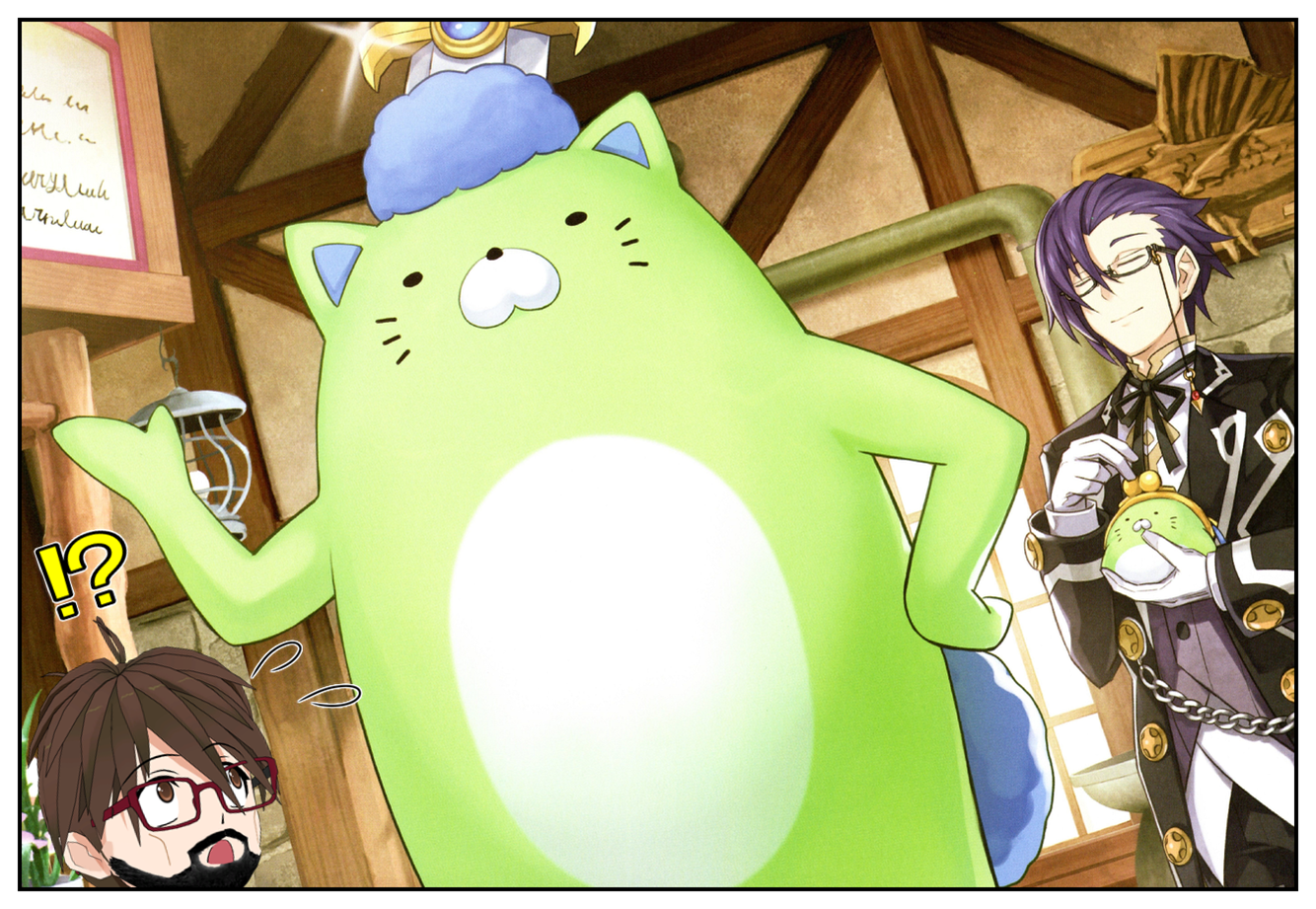
This "people aren't exactly what they seem" theme is also seen to a lesser extent through Tiara, who acts like a "proper lady" — her Japanese speech is riddled with watakushi and desu wa, both of which are verbal signals that we're dealing with someone who either is "noble" or at least wants to put across the impression that they are — but is actually, as Fang puts it, "nasty" underneath. And the trope is explicitly lampshaded in the form of the character Pippin, who appears to be a strange green cat-like creature, and who constantly extols the virtues of not judging a book by its cover. Indeed, Pippin remains something of an oddball enigma right up until the very end of the game, but after a while you just start thinking of him as an odd person, not an odd green cat-like creature.

All in all, my 50-hour first playthrough of Advent Dark Force leaves me feeling like it's Compile Heart's strongest game to date — yes, even better than the already excellent MegaDimension Neptunia V-II — and hungry for more. Fortunately, there is more — I have two more narrative routes to play through, plus a Platinum trophy to chase. I'm particularly interested to see how the two other narrative routes differ from the Goddess route — whether it's a few changed events or a complete restructuring of the story. I'm kind of expecting the latter based on what I've seen people discussing, but either way, I'm looking forward to spending more time with this great cast of characters.

Serious talk: if you're still rejecting Compile Heart games just because they're Compile Heart games, you're missing out on some truly great RPGs. Including this one.

2427: 10 Atari 8-Bit Classics*

0427_001

Still curious about the Atari 8-Bit? Here are 10 classic games.

River Raid
river-raid-1

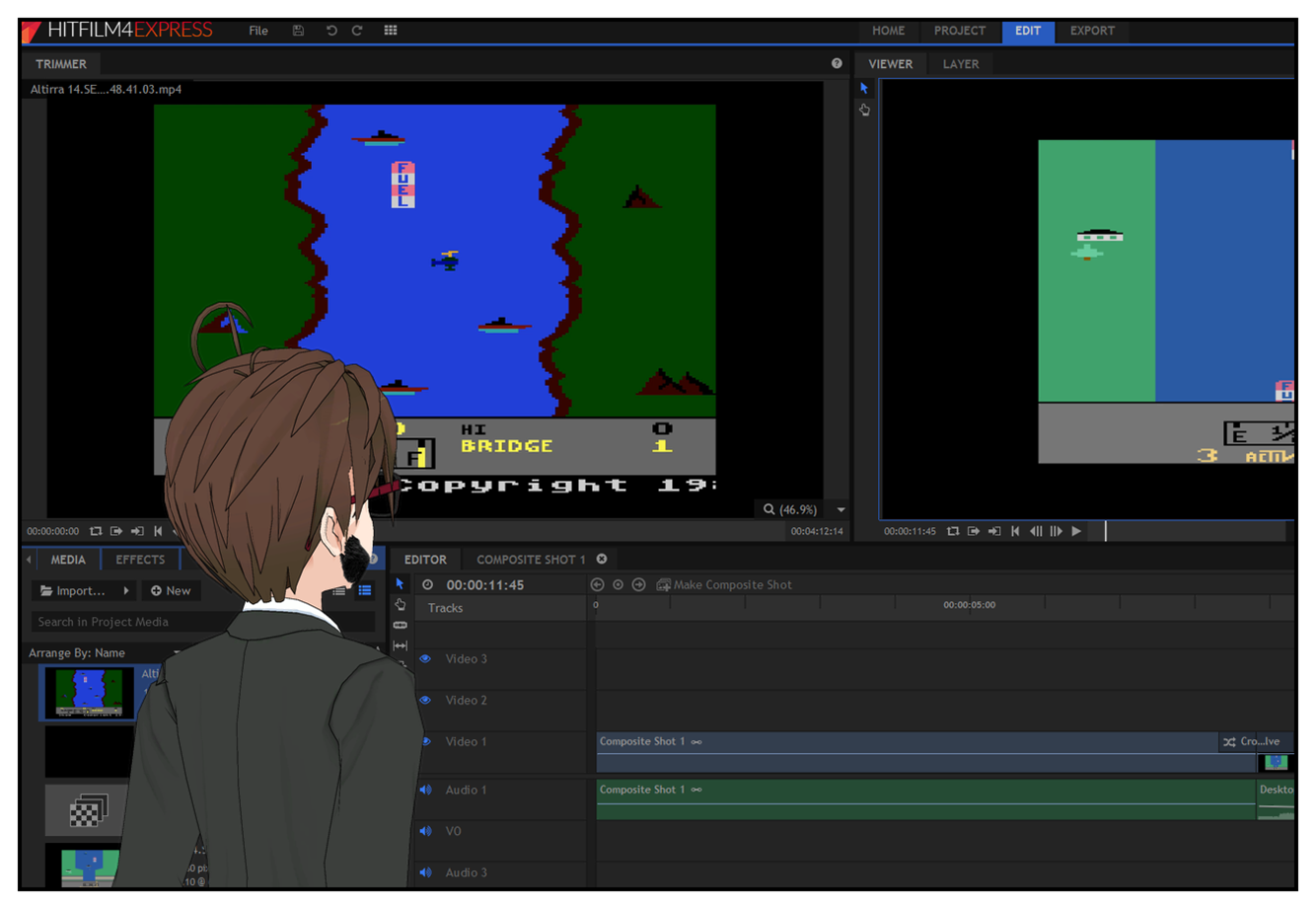
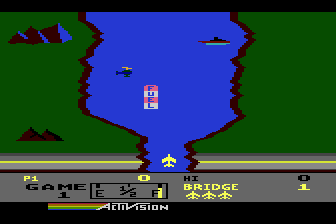
The 2600 version of River Raid has been whored around the place numerous times over the last few years, but the infinitely superior Atari 800 version never gets any love.

While the formula remains the same — fly up the river, don't crash into the sides, don't run out of fuel, blast any helicopters, ships and bridges in your way — the execution is better thanks to the addition of numerous features that use the additional power the 8-Bit computers had over the 2600.

Atari 8-Bit River Raid also had tanks, hot air baloons, jet planes that flew across the screen ignoring the river boundaries and more complex level designs. It's still a top-notch shoot 'em up today.

Miner 2049'er
s_miner2049er_4

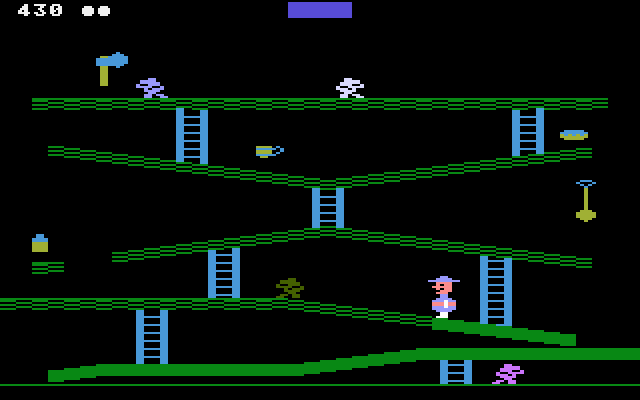
Any self-respecting Atari enthusiast will almost certainly put this game near the top of their "favourite games" list, though interestingly I didn't warm to it much first time around. Replaying it again now, however, I see its appeal — it's a well-crafted platform game with interesting environmental puzzles that never gets too complicated for its own good.

Playing the role of renowned (and rather chubby) mountie Bounty Bob, it's your job to make your way through a uranium-infested mine in search of the nefarious Yukon Yohan. In order to do this, you need to "paint" every platform in each screen by walking over it, while simultaneously avoiding the mutant uranium beasties that prowl the platforms. But in true Pac-Man tradition, grabbing a bonus item allows you the temporary ability to turn the tables on the meanies, eliminating them from the screen and helping to clear a path for you.

Star Raiders
star-raiders-perfectten

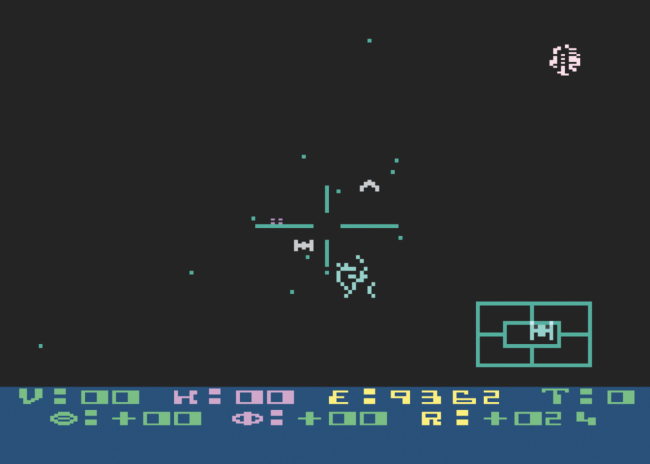
Again, the 2600 version of this has been re-released time after time, but the Atari 8-Bit version is much better. It's the original 3D space sim, essentially being a more action-oriented take on the traditional grid-and-vector-based "Star Trek" game that can be played on anything from a mainframe to a graphic calculator.

Aliens are invading the galaxy. You need to stop them. You do this by reviewing the galactic map, determining which of your starbases are in most immediate need of attention, then warping to the aliens' location, blasting them to smithereens and then repeating the process until the galaxy is safe once again.

Notable for being more complex than simply "point and fire", you had to manage your energy levels by determining when was (and wasn't) an appropriate time to switch on systems such as your shields and targeting computer.

Star Raiders II
star_raiders_ii

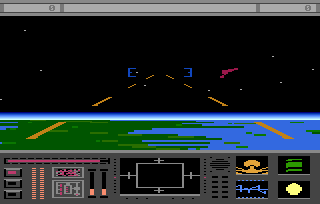
Not perhaps as fondly regarded as the legendary original, I still loved Star Raiders II (originally intended to be a licensed game of the movie The Last Starfighter), because to me it kept what made the original great while improving almost every aspect of it.

Instead of a grid-based galactic map, you now had a convincing looking solar system map and could even orbit planets. The enemies you confronted were more than just fighters that went down with a single shot, too; in one of the earliest examples of boss fights, Star Raiders II often put you up against enemy destroyers and battlecruisers, requiring you to change tactics somewhat.

Star Raiders II also saw you going on the offensive rather than playing strictly defensively, too; when you thought you saw an opportunity, you could warp into the aliens' star system and bomb their planets in an attempt to stop their invasions once and for all.

Oh, and you could fly your ship into the sun and the on-screen cockpit would melt.

Ballblazer
ballblaster

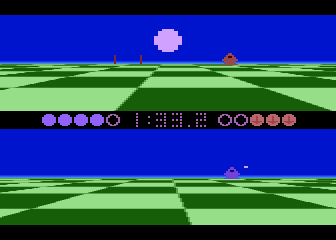
An early Lucasfilm game, Ballblazer was a split-screen arcade sports game for one or two players. The basic premise was similar to soccer in that you had to gain possession of a ball and shoot it between the opponent's goal posts, but there was only one person on each team and the goalposts moved.

Ballblazer made use of a convincing first-person 3D perspective using a patchwork grid effect on the ground and automatic 90-degree turns whenever you needed to face the ball. Despite its simplicity, the game was fiercely competitive, and had some fantastic music, too.

Rescue on Fractalus
rescue_on_fractalus_atari_us_8

I mentioned this the other day, but I can't talk about 8-Bit classics without discussing Rescue on Fractalus, another early Lucasfilm game.

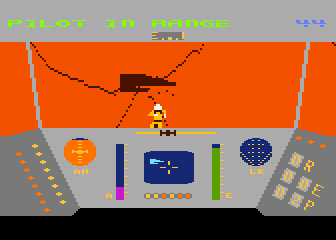
Unfolding from a first-person in-cockpit view, you were sent down to the planet Fractalus (so named because its 3D landscape was generated using fractals) to rescue crashed pilots and fend off the evil Jaggi forces. The game was remarkably complex for its time, featuring numerous keyboard commands that made it feel like a proper simulation of flying an advanced spacecraft, and the 3D graphics were extremely impressive.

Rescue on Fractalus was most noteworthy for its little touches: the sound of a pilot banging on your airlock door would get more and more faint if you failed to open it for him in a timely manner; if you switched your engines back on before the pilot was on board, you'd fry the poor bastard to a crisp; and occasionally on later levels, the downed pilots would turn out to be aliens that would leap up and hammer on your windshield. Absolutely terrifying… until you switched the engines back on for their benefit and watched them fry.

M.U.L.E.
mule_colony

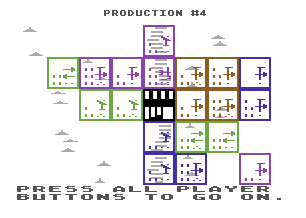
One of the finest multiplayer games of all time, and one of the finest strategy games of all time. Accessible and understandable yet filled with complexity, M.U.L.E. was — is — an absolute masterpiece.

Marooned on the planet Proc Irata (seriously) for six or twelve months depending on the difficulty you were playing on, it was up to you to make the most of the situation by making use of the land that was granted to you and which you bought at auction. You could assign land to harvest food, energy, smithore or, on the higher levels, a "cash crop" called crystite. The type of terrain determined what type of facility a plot was most suitable for, with the river running down the middle of the map being the most abundant for food, while mountains were best for smithore.

M.U.L.E. challenged you to combine cooperative play with competitiveness — while you were competing against three other players, all of whom could be human-controlled if you had an Atari that supported four joysticks, if you didn't all work together to ensure the colony as a whole had enough food, energy and smithore to survive the next month, you'd all be in trouble.

The game made use of an interesting graphical depiction of negotiating prices by allowing buyers and sellers to "walk" up and down the screen to determine the prices they were willing to buy or sell at. By meeting another player — or the colony store — you could buy and sell goods as you saw fit — stockpile for later or sell for a high price right now?

Final Legacy
final_legacy

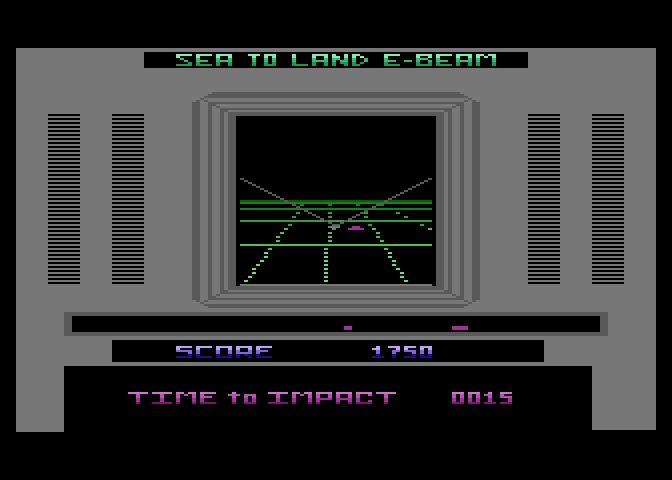
A lesser-known game, this one, Final Legacy was a strategic shoot 'em up with elements of Missile Command to it, and, like many other games of the period, was the embodiment of Cold War paranoia.

In Final Legacy, you were in charge of the good ship Legacy and were tasked with destroying the nasty horrible enemy missile bases that were pointing their nasty horrible missiles at your cities. You had to torpedo enemy ships, blast the enemy bases with your laser cannon and shoot down the missiles that inevitably got fired the moment you started attacking a base.

Later difficulty levels added some interesting mechanics such as having to destroy "Intelligence" ships in order to find out the locations of the enemy missile bases, but mostly the game was about frantically zipping back and forth between four different screens and hoping you didn't accidentally let anyone get nuked.

Batty Builders
battybuilders

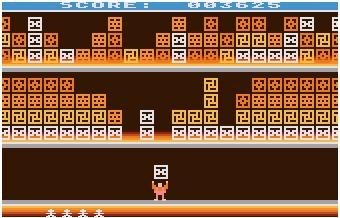
Another lesser-known game, this time from the once-prolific English Software. Batty Builders saw you in the role of a builder attempting to build a wall. In order to do so, you'd have to catch bricks falling from the conveyor belt at the top of the screen, then toss them into place in the wall, all without killing yourself in the process.

That's pretty much all there was to it, but it was enormously addictive, and is noteworthy for being one of the earliest examples of a frantic puzzle game I can remember.

Bruce Lee
bruce_lee_4

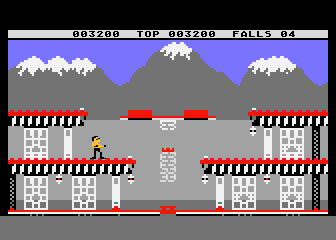
An interesting and peculiar game, Bruce Lee combined elements from a number of different game types, most notably beat 'em up and platform adventure.

As Lee, you'd have to make your way through each screen collecting lanterns. Attempting to stop you from doing so were an anonymous ninja and The Green Yamo, both of whom would pursue you around each screen with a surprising amount of simulated intelligence (or, in the case of Yamo, who could be controlled by a second player, actual intelligence), making your life miserable. Fortunately, you could deal with them by giving them a smack in the chops or a flying kick to the face, though they'd always be back.

Bruce Lee remains one of the finest licensed games out there, thanks in part to the fact that it's not trying too hard to follow any particular movie. It's still a fun platformer today.


* your definition of "classic" may vary, but I enjoyed all these.
2426: If You're Going to Play Multiplayer, FFS Stick it Out Until the End

0426_001

I played my ten placement matches for season 2 of Overwatch's Competitive mode earlier. Nine out of those ten games featured at least one salty asshole quitting the game early because their team lost a round — both on the team I was on and on the opposing team on different occasions — and in Competitive mode, the game doesn't backfill positions with people queued up to play like it does in Quick Play; when you queue for a Competitive game, you're put into a game from the very beginning rather than immediately joining one in progress if a space is available.

This was mildly annoying the first time it happened, but with each subsequent time it got more and more irritating. It's not only bad sportsmanship to strop off in a sulk if you're losing, it's also a major pain in the ass to the rest of your team. It would be akin to Wayne Rooney suddenly deciding that he doesn't feel like playing any more and wandering off the pitch in the middle of a football match. Except in Overwatch, the teams are only six people, so the loss of just one person is keenly and immediately felt.

The trouble that these early leavers have is that they can't handle losing. They're unwilling to accept the possibility that the team who just "lost" could enjoy a comeback in the subsequent round — this can and frequently does happen in Overwatch, which is mostly very well balanced like that — and instead ditch the match altogether, leaving their team a man or more down and on the way to what is now pretty much a guaranteed loss rather than something that could be fought back from.

What's particularly dumb about early leavers is that when they leave a game, the match is counted as a "loss" in their records anyway, so they're taking the worse option — a 100% chance of getting a loss versus a less-than-100% chance of getting a loss by staying and trying to help the rest of the team to a comeback.

I sort of understand. It can be demoralising to feel like you were steamrollered by another team who perhaps genuinely were more skilled than you. But it's the very height of special snowflake syndrome to believe that you are entitled to win every game you play — perhaps these players were the kids who grew up in schools that had sports days with "participation trophies" rather than actual winners. And clawing your way to a victory when the jaws of defeat were closing on you is immensely satisfying — my favourite games of Overwatch are the ones that end up being really close, not the ones where my team smashes our opponents into the ground.

Blizzard have penalties in place for those who leave matches early, but they're clearly not severe enough. For the Competitive scene in Overwatch to succeed, early leavers need to be actively discouraged through harsh punishments. I hope that the Overwatch team are paying attention to this problem and that it gets resolved in the next season of Competitive play.

In the meantime, if you're an online player, do the decent thing and see your matches through to conclusion, even if they don't seem to be going all that well. As I say, you keep playing, you have a less than 100% chance of getting a loss recorded on your all-important statistics. Leave early, however, and you absolutely definitely will get that loss. So stop being selfish pricks and play your damn matches to completion.

2425: Life in the 8-Bit Era

0425_001

I've been on a proper nostalgia trip with my old magazines and retro machine emulation recently, so I thought I'd share some memories and factoids about growing up in a household filled with home computers rather than games consoles.

This post was inspired by a conversation with my friend Chris earlier today, who noted that it's an area of gaming history that he's not as familiar with as the consoles of the time.

I'm writing this from the perspective of someone who grew up with the Atari 8-Bit range of home computers. Your experiences may vary if you were a Commodore 64 or Spectrum child!

The early machines were massive

The Atari 400 and 800, the first models of home computer released by Atari, were absolute behemoths — the size and weight of a typewriter. The reason for this was that due to FCC regulations regarding signal leakage protection, their innards had to be encased in solid aluminium.

This is the Atari 400.

SONY DSC

And this is the Atari 800.

atari_800_closed

There were a few differences between the two. The 400 was originally set to ship with 4K RAM and the 800 with 8K, but by the time they hit the market, the price of RAM had already come down enough to outfit them both with 8K. The 800, which had expandable memory, eventually underwent numerous upgrades to end up with a then-massive 48K of RAM.

The 400 had a horrible membrane keyboard (which many users, including our family, replaced with mechanical keys) while the 800 had mechanical keys as standard. Both featured a then-revolutionary bit of kit called Serial Input/Output or SIO, which could be regarded as a modern precursor to USB in that it allowed the connection of multiple, automatically configuring devices to the computer. It was mostly use to connect tape decks and disk drives.

The later machines were smaller and looked a bit nicer

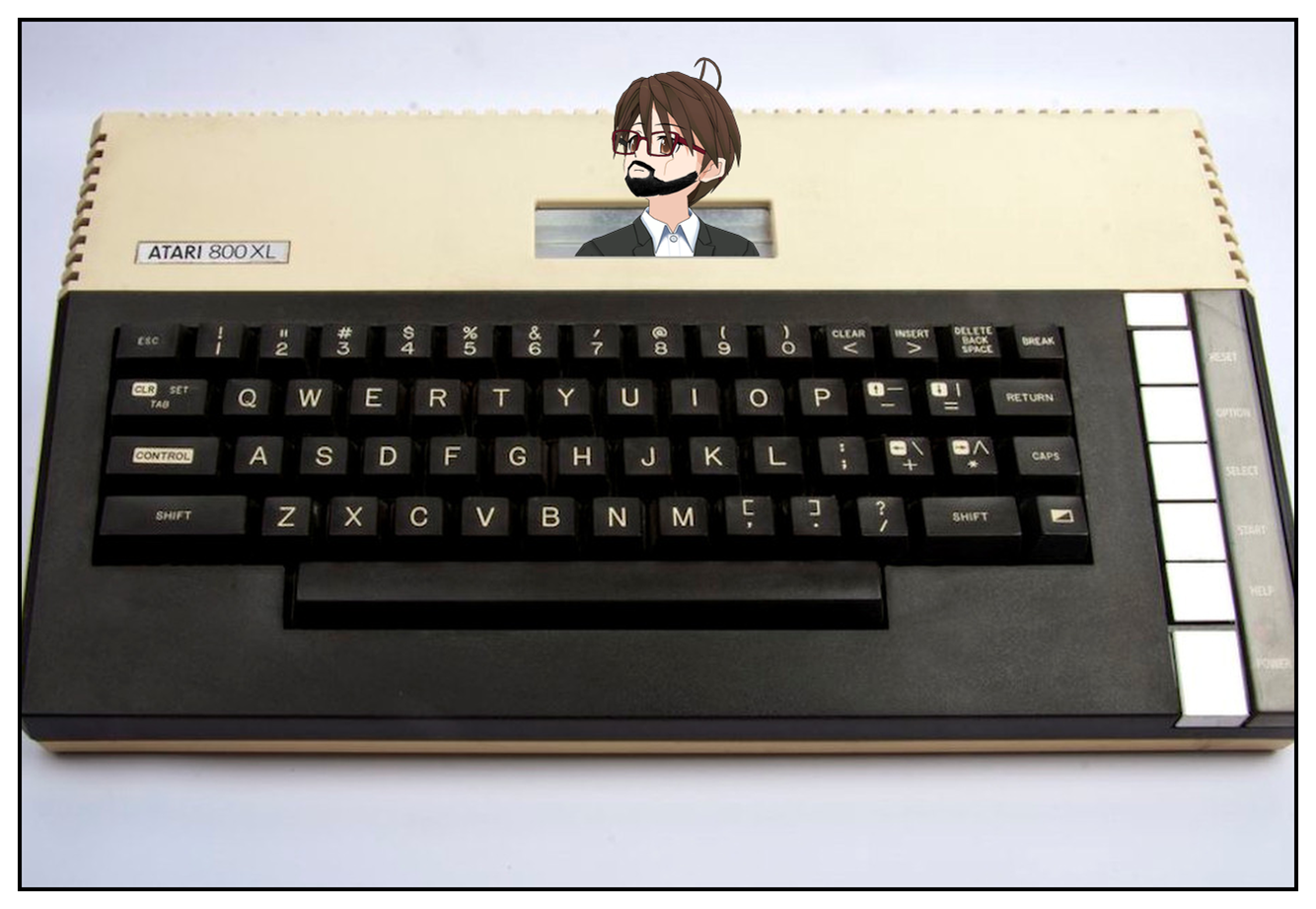
Here's the 64K 800XL, probably the most direct competitor to the Commodore 64:

1920px-atari-800xl

And the 128KB 130XE, whose extra power went largely unused due to it coming out pretty late in the 8-Bit life cycle; its resemblance to the 16-bit Atari ST is no coincidence.

1920px-atari-130xe

(Here's the ST, for comparison's sake:)

1920px-atari_1040stf

Early games came on cartridge

Part of the thinking behind the early systems was that they should be as user-friendly as possible. With that in mind, the very simplest method of getting a program up and running on the 400 and 800 — and indeed all subsequent Atari 8-Bits — was to plug in a ROM cartridge, turn on the power and enjoy the instantaneous load times of the format.

Many of the 8-Bit's earliest and most well-regarded games — most notably the excellent Star Raiders, one of the first 3D space sims, and still a great game today — came on cartridge, but eventually games got big enough that they needed to be distributed on cassette tape or 5.25" floppy disk instead.

The 400 and 800 had four joystick ports

…but very few games used them. However, one of the very best games on the system, Electronic Arts' highly competitive strategy game M.U.L.E., allowed for four players simultaneously. Later versions of the Atari 8-bit only had two joystick ports, so true four-player titles remained rare.

Programming for the Atari and other 8-Bit machines was a big British industry

A lot of the software companies that are doing proud business today — Eutechnyx (formerly Zeppelin Games), Rare (formerly Ultimate Play the Game), Codemasters (still Codemasters) and Electronic Arts began their lives in the 8-bit era, and many of them (all of the above except EA, among others) started in Britain.

The 8-Bit era saw the birth of what we would now call the indie games industry. Single programmers or small teams of friends would assemble games in school holidays or during free time and release them on cassette at budget prices. Many would go on to become hugely popular. And many of them chose to create extremely creative titles rather than lazy copycat clones of arcade shoot 'em ups — though make no mistake, there were plenty of lazy clones around, too.

The reason why so many people got into programming on their Atari is that when you booted it up you were straight into Atari BASIC and could start writing code straight away. Granted, BASIC wasn't the speediest language in the world, but learning it formed a great foundation for discovering more complex languages.

Loading from tape took ages

This can't be overstated. It's a well-known fact that loading a game from cassette took a long time, but really. It took a long time. In the case of the Atari, you'd have to ensure the system going "BURRRRRRRRR, BURRRRRRRRRR!!" over and over while the data loaded from the cassette.

Loading from disk made a great noise

One thing I really miss from the original 8-Bit days when using an emulator is the sound that loading things from disk made. There was this weird farting sound when the machine started up, then loading combined the whirring snark of the drive's mechanisms with a weird "BLBLBLBLBLBLBLBLBL" noise, punctuated by zurbits from the drive. I was always a bit disappointed when developers poked the appropriate memory location to make loading quieter. (And yes, "poke" actually is the technical term.)

And of course someone's made a YouTube video featuring that noise. It's number 4 in this video:

Magazines were a key part of the ownership experience

Getting copies of Analog, Antic, Atari User and Page 6 each month meant that we were never short of toilet reading material. And as I noted yesterday, the articles you got in these old mags ran the gamut from in-depth technical explorations of the systems themselves (and how to harness that technology) to the sort of game reviews we're familiar with today.

The Atari sound chip was awesome

Commodore's SID chip gets all the love these days, but Atari's POKEY was no slouch either. Here's a selection of fine tunes from renowned composer Adam Gilmore.

Piracy was rife

It's a wonder we didn't kill the fledgling games industry completely in the '80s, since very few people seemed to purchase original games; I know it was certainly a rare treat in our household.

Instead, bootleg cassette tapes and floppy disks did the rounds in the schoolyard, at workplaces and even at gatherings specifically for people to swap dodgy copies of the latest goodness. I was too young to attend at the time, but I remember my father and brother attending a local "computer club", which was the source of most of the boxes full of floppy disks I still own today.

Interesting, for the pirates themselves, piracy was less about getting something for free and instead all about proving their worth. "Cracked" games often came with elaborate introduction sequences (typically including some great chiptune music) and made use of advanced compression technologies to fit multiple games on a single floppy disk. Today, retro enthusiasts are as keen to preserve cracked versions of games as they are originals.

The systems weren't as powerful as consoles, but they tried hard

Being general-purpose computers rather than dedicated games machines, the Atari 8-Bit range struggled to keep pace with the specialist machines from Sega and Nintendo, but that didn't mean developers would rest on their laurels. Particularly late in the 8-Bit's lifespan, developers were squeezing every possible ounce of graphical power they could out of the little machine's chips, and the results could be both impressive and heavily stylized. Check out Lucasfilm's games in particular, which featured full 3D fractal landscapes and detailed sprites.

Here's strange action adventure The Eidolon, in which you travelled through time, fought mushrooms and battled rather arrogant-looking dragons:

eidolon_4

Here's wonderful flight sim/first-person Defender-alike Rescue on Fractalus, surprisingly one of the most terrifying games in existence for reasons I'll leave you to discover if you ever play it:

rescue_on_fractalus_atari_us_8

And here's the rather strange (but impressive) Koronis Rift:

koronis_6


I don't think it's an exaggeration to say that the 8-Bit era was probably one of my favourite times to be into computers. It was exciting, it was accessible and it felt like these machines could do anything; there was none of the cynicism or taking things for granted that we have today.

Oh to go back, eh.

2423: 15 Reasons Moe is Awesome

With love to The Mary Sue

Apropos of nothing, here are 15 reasons moe — the art of character design intended to instill empathy, sympathy and feelings of affection in the audience — is awesome.

1. Colours!

It's become increasingly fashionable to use what is often mockingly referred to as a "grimdark" aesthetic these days — all dark blues, browns and greys. Moe anime and video games are a stark contrast to this by remembering what primary colours are and how nice they can make you feel.

2. Characters!

Moe anime and games tend to have deliberately exaggerated rather than realistic characters, but these exaggerated characteristics can make for highly impactful, emotional moments when they reveal their deeper secrets. And it's pretty rare to find a character in any anime who is exactly what they seem — even in the most fanservicey, perverted, filthy ecchi thing you can possibly think of.

3. Girls!

You want awesome female characters? Look no further. Many moe anime and games feature all-female casts running the gamut from confident, loud types to introverted, intellectual types. The whole point of many of these shows is to demonstrate that these all-girl groups are capable of doing absolutely anything from winning a local talent show to saving the universe — and they certainly don't need no man to do their thing.

4. Story!

Related to the characterisation issue, it's hard not to get drawn in to a moe anime or game due to the emotionally engaging stories they typically include. A core part of the "empathy" part of moe is making the audience root for the characters, and there's no better way to do this than seeing them overcoming all manner of adversity to come out on top.

5. Mood!

Miserable? Watch an episode of Love Live! and I defy you to still be miserable afterwards. (NB: do not apply this challenge to Clannad or Ano Hana.)

6. Easily parsable visual language!

(I knew I'd regret doing the "one-word heading" thing as soon as I started it.) Moe anime is easy to understand, even for beginners to Japanese media, because it makes use of such clear visual language alongside its writing. Everything from hair colour to eye shape is designed to give us an immediate understanding of a character — and perhaps subvert our expectations at a later time.

7. Blurring gender lines!

Here's a contentious one for you: looking at moe anime through less enlightened eyes, it would be easy to consider it somehow "girly" — compare and contrast toys "for boys" and "for girls" in the '80s and '90s for a good example of what I mean. "Boys'" toys would use muted, dark or aggressive colours whereas "girls'" toys would use bright, vivid colours. Moe is something that, according to this stereotype, should be "girly", but there's enough to appeal there to men as well as (not instead of!) women.

8. Always something new!

You'll never run out of moe stuff to enjoy. In fact, you'll almost certainly never be able to catch up on all the moe stuff that already exists, even if Japan in its entirety stopped producing it altogether.

9. Music!

Moe anime has some of the most catchy, memorable music in existence, even if you don't speak Japanese. Doubly so if it's a music-themed anime such as Love Live!

10. Talking about stuff that doesn't normally get talked about!

Moe anime isn't all ditzy girls blathering on about bullshit in an airheaded manner — though, of course, such examples do exist and can be enormously entertaining in their own right (hello, Yuru Yuri). Nope, sometimes moe works can deliver an emotional gutpunch by combining cute, cheerful visuals with surprisingly dark, even harrowing storylines. See The Fruit of Grisaia for a masterclass in how this is done.

11. Community!

The community of moe fans on the Internet is one of the most passionate, enthusiastic communities around; become a part of it and you'll always have something to talk about and someone to talk about it with.

12. Waifus and husubandos!

For those who like to pin their allegiance to a particular person or thing, moe as a cultural phenomenon has you thoroughly covered. Declare a waifu and/or husubando and you're making a clear but light-hearted statement about yourself. (Declaring everyone else's waifus as "shit" optional.)

13. Cultural osmosis!

While exaggerated media such as anime and video games can give you a somewhat distorted view, they can be a catalyst for the audience to learn more about a culture other than their own, in turn leading to greater mutual understanding.

14. Relatability!

Tied in with the waifu/husubando equation is the fact that most moe anime will feature at least one character that at least one member of the audience will relate to in some way or another. By extension, this can help some people feel more comfortable talking about certain issues by being able to put them in some sort of context rather than feeling like they're dealing with them alone.

15. An international cultural phenomenon!

Moe anime has given broader culture a lot of things to chew on — mostly with regard to character and narrative tropes. It can be particularly interesting to see people from outside Japan attempt to make use of these tropes and put their own spin on things — the wonderful visual novel VA-11 HALL-A from Venezuelan developers Sukeban Games is an excellent example of this.

2422: A Different Time

0422_001

I've been doing some retro gaming stuff recently which involved trawling the AtariAge and AtariMania forums for information, and as it happened, one game I was looking for information about — the rather peculiar Pondering About Max's [sic] — linked to a scan of an old edition of New Atari User magazine, the very publication that I, my brother and my father all used to contribute to.

I spent quite a while distracted by the format of the magazine, because it's a relic of a very different time indeed. New Atari User — or its former incarnation Page 6 — wasn't a games magazine per se, though coverage of the latest video game releases on Atari 8-Bit and ST formed a core part of each issue. What I found much more interesting was the inclusion of other features. I was well familiar with the Making Music with Your Atari column that my Dad used to write, as I think our whole family remembers numerous MIDI incarnations of various '60s and '70s classics blaring out from the studio at all hours of the day — but I was surprised to see quite how… specialist some of the other articles were.

Take the issue I was looking at earlier, for example. There's a three-page feature in this issue about maths. Just maths, and how to make use of it in Atari BASIC. The article begins with an exploration of the use of the RND function in BASIC, which generates a random number between 0 and 1, expands on this by describing how using multiplication allows you to generate random numbers between 0 and much higher upper limits, and concludes by using the INT function to generate only whole numbers. This is stuff that most bedroom programmers were already familiar with, but the article then goes on to look at powers and roots, signs and absolute values, logarithms and exponentials and finally probabilities — each of which was punctuated with a short BASIC listing for you to type in on your own computer to see how the functions worked in practice. I've never seen anything quite like it.

Elsewhere in the same issue there's four pages devoted to making the Atari 8-bit display an 80-column text screen — this was deemed exciting enough to get a mention on the front cover of the magazine, which is unthinkable these days — an in-depth exploration of the AtariLab computer-aided scientific experimentation kits, and plenty of other things besides. It really is a fascinating relic of a period in computer media that I thought I remembered pretty well, but evidently have forgotten more than a few things about over the years. Looking back on it now… I miss those times a lot.

If you want to enjoy a bit of nostalgia — or are just curious what computer and games mags used to look like back in the early days — then AtariMania has a substantial collection of scans that you can enjoy right here.

2421: Go 8-Bit

0421_001

A new TV show launched on well-known Freeview channel Dave this evening: Dara O'Briain's Go 8-Bit.

It's a type of show we haven't seen since the days of GamesMaster, only now everyone who used to watch GamesMaster is in their 30s and 40s and enjoys knob gags. Yes, it's a show that focuses primarily on competitive computer game challenges.

A bit of cursory research reveals that it's actually an adaptation of a live show also called simply Go 8-Bit, the creation of Steve McNeil and Sam Pamphilon, who take the role of regulars on the TV incarnation. O'Briain occupies the host's chair, while McNeil and Pamphilon each have one special guest each — in the case of the first episode, topical comedian Susan Calman and England goalkeeper David James, both of whom are proud gamers in their own right. The cast is rounded out with the inclusion of journalist and podcaster Ellie Gibson, who has contributed to Eurogamer on numerous occasions in the past.

O'Briain is a natural fit for the show's host, because his enjoyment of video games is well-documented, usually using this still-entertaining six year old clip from Live at the Apollo as evidence:

He's proven himself to be a capable host of a variety of different shows over the past few years, ranging from the topical Mock the Week to the educational Science Club. His role on Go 8-Bit is, as you might expect, closer to the former than the latter, and for the historical and cultural context and significance of the games covered on each show, he defers to Gibson, who is the resident "expert" — she's the show's Richard Osmond to O'Briain's Alexander Armstrong, for those who watch the surprisingly addictive Pointless.

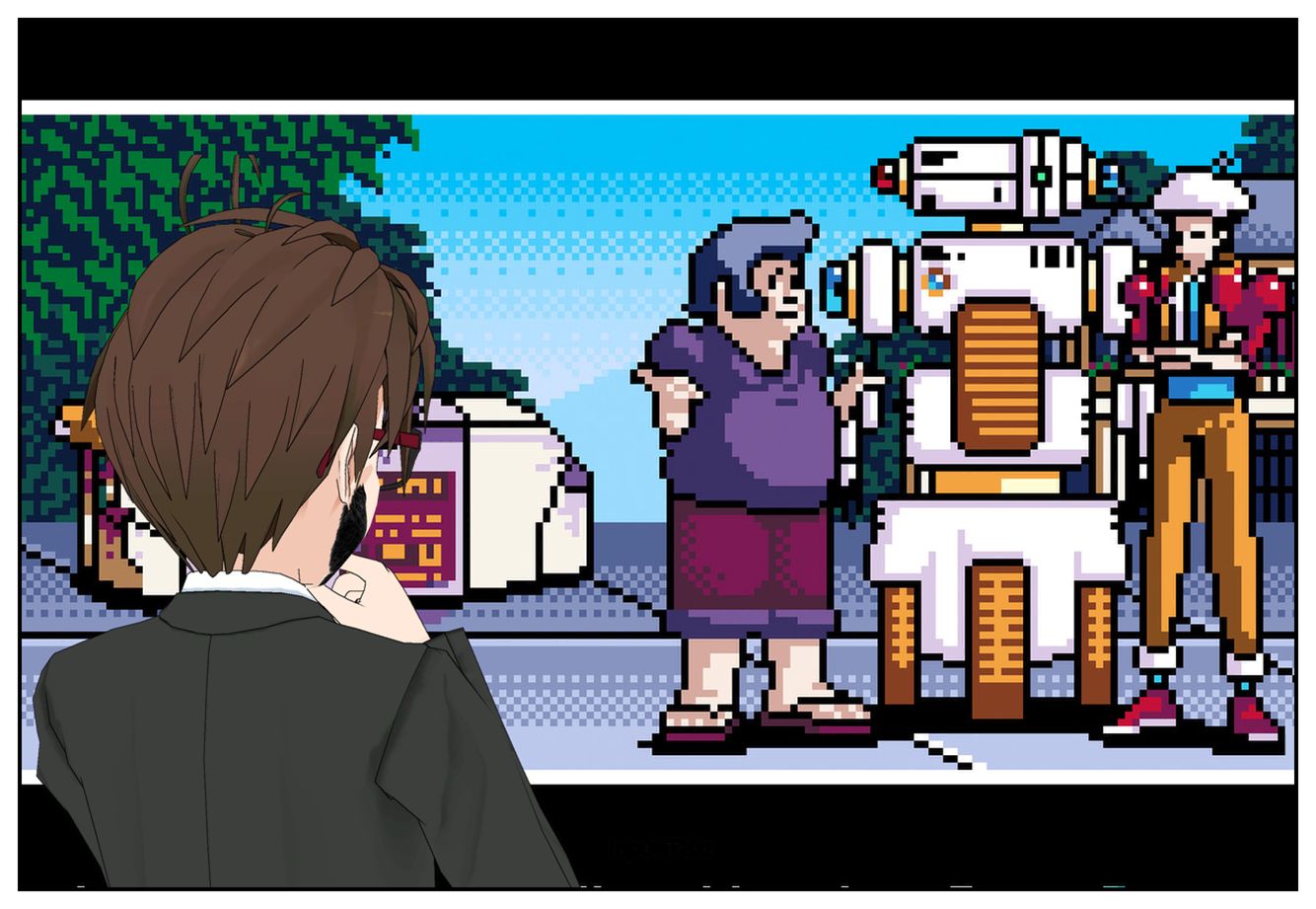
The first episode featured a pleasingly diverse mix of titles, beginning with classic puzzler Tetris, continuing with Chuckie Egg, then on to TekkenStar Wars Battlefront (the new one) and closing proceedings with a custom version of Bust-a-Move specifically created for the show, and for use with the custom Makey Makey controller, a kit which can turn anything which conducts electricity into a game or computer controller. Since their custom version of Bust-a-Move was entitled Bust-a-Moob, the custom peripherals attached to the Makey Makey were, as you might expect, human beings — specifically, an old man with an impressive beard sporting a questionable Dr. Robotnik cosplay; an old lady with an even more questionable Chun Li cosplay; a skinny, hairy dude in his pants forming a rough approximation of Zangief; and, um, a Cher impersonator.

The show made for genuinely enjoyable entertainment. The banter between O'Briain and the guests was amusing, and the trash-talk during the games was fun. It was also wise to focus the show around people who are enthusiastic about games but not necessarily good at them, too, because this made for some hilarious sights, such as an epic Tekken match largely decided by the old faithful sweep-kick to the shins move over and over and over again. There could be value in a show about e-sports professionals playing one another, of course, but it wouldn't be Go 8-Bit; it would be an altogether more serious affair, and a scene that is already pretty well covered by the online streaming scene rather than television.

The show was, so far as I'm concerned, a resounding success: genuinely amusing, entertaining to watch, even for non-gamers, and just enough tidbits of gaming history to keep enthusiasts happy, too. And best of all, it wasn't trying to be cool, young, dudebro or in any way hip — it understands that a significant chunk of the gaming audience these days is over 30, perhaps because most of the people involved with it are over 30.

It's not, by any means, an in-depth documentary about the history of gaming, but it's not trying to be — it's simply a new format of show that, as I say, we haven't really seen anything like since GamesMaster. The only thing I'd change, if anything, would be the slightly cringe-inducing big deal they make out of their rotating stage every time they spin it through 90 degrees so the players can face the game screen at the back of the stage, but that might just be me being a miserable old git.

That aside, it was a great show, and one that I look forward to tuning in to watch each week.

Go 8-Bit is on Dave on Thursday nights at 10pm UK time. You can find out more and watch the recently aired first episode here. (You may need to fiddle around with VPNs and whatnot if you're watching from outside the UK.)

2420: Gaming History and Archiving

0420_001

At the time of writing, the copy of Launchbox on my computer is loaded with over 16,000 games across a number of different platforms ranging from the early days of computing right up until (relatively) recently with some PlayStation 1 titles.

I can happily lose several hours going back through some of these games — particularly those which I used to enjoy when I was young, and which I am now better equipped to fully understand. The advent of the Internet also means that any games which are somewhat obtuse or abstract can be researched easily, which is something we simply didn't have access to back in the '80s and early '90s — many of the games we had on home computer platforms in particular were copies of questionable origin and consequently didn't have any instructions included, and as such you had to either figure out how to do things yourself or already know how the game worked.

Games were often simpler back then, of course, although there are plenty of examples of titles that pushed their hardware to the limits in an attempt to simulate something with a reasonable degree of accuracy — Sublogic's Flight Simulator II on the Atari 8-bit springs to mind, as does MicroProse's submarine simulation Silent Service on the same platform. Even among the simpler titles, though, there are plenty of games whose abstract goals aren't necessarily very clear, or there might be a few hidden controls on the keyboard the game doesn't explicitly tell you about — we were in the age of both "joysticks with one button" and "games without tutorials" at this point, remember.

Playing these old games always gets me to thinking, though. While there are a number of websites out there cataloguing and in some cases even hosting dumps of these old games, is anyone doing anything more than saying "this game came out in 19xx, it was released on [platforms]?" Is anyone approaching the subject with a bit more of an eye to historical interpretation, rather than just plain cataloguing and archiving?

Some people out there probably are already, but I feel like it's time I added my unique perspective to the mix. I feel like this every time I have a conversation with someone where I have the opportunity to bring up games like Star Raiders II and Final Legacy. I want to do something about it.

I'm currently determining the best way to go about it, but I'm very interested in the idea of some sort of project to highlight and explore noteworthy games from history — particularly those on more (relatively) obscure platforms such as the Atari 8-bit and ST. Whether this takes the form of a website, a book (or several books), a series of videos or all of the above is something I haven't quite determined yet, but while I have some time on my hands it would be something for me to sink my teeth into and keep me occupied, much like MoeGamer has been.

I have some thinking to do, it seems!

2419: Happy Anniversary, Titan Quest

0419_001

Titan Quest Anniversary Edition is currently just £5 on Steam, and it's completely free if you own any other Titan Quest products already. You should go buy it and play it, because I have spent most of the evening doing so and I like it a whole lot.

Titan Quest Anniversary Edition combines the original Titan Quest and its expansion Immortal Throne into one package, cleans the whole shebang up for modern computers — the original came out in 2006, hence the "anniversary" thing — and unleashes it on the world for existing fans and newcomers alike to enjoy.

Having never played Titan Quest, I fell into the latter category. It had just never quite appealed to me for some reason, despite it being the sort of hack and slash loot-whoring game I enjoy coupled with Greek mythology, which I was in love with as a child — and despite the game often being discussed in hushed, reverential whispers any time anyone brought it up.

£5 for a remastered version of the game and its expansion in one complete edition was too good an offer to turn down, though, so I took the plunge and gave it a go, partly to sate my own curiosity and partly to have something to play online with my friend Chris, who had also been going back and forth about whether or not he wanted it.

If you, like me, have never played Titan Quest, here's the deal. You play a male or female Greek person who initially has no character class. You save a farmer's horse from being eaten by satyrs, then you embark on a journey to cleanse the land of evil seemingly for no other reason than "because why not". Your character is given precisely no backstory and no real motivation to do their thing, but in this sort of game that's probably a good thing. While the lore in the Diablo games is substantial and interesting, its execution in-game leaves a lot to be desired, and in latest installment Diablo III in particular, by far the most enjoyable way to play the game is in "Adventure Mode", which dispenses with the narrative and linear structure altogether in favour of giving you freedom to go anywhere at any time to chase down various objectives.

Titan Quest doesn't quite go that far in abandoning the traditional narrative structure — you still progress from "unknown Greek person" to "hero of legend" over the course of the game — but the plot is very much de-emphasised in favour of the excellent mechanics.

At level 2, you unlock a "specialism" — essentially a character class with its own skill tree plus a mastery meter you need to pump skill points into in order to unlock the next "tiers" of skills. (Said meter isn't entirely useless; each point you put into it gives you a substantial increase to your base stats.) Then at level 8, you unlock another specialism and can start pumping skill points into that as well, allowing you to effectively mix and match skills from two entirely different classes to create your own custom build.

And these classes aren't your usual warrior-thief-mage trinity, either — they're all interesting, and all present interesting combinations when combined together. All together, there is a caster type that specialises in cold and electricity; another caster that specialises in fire and earth; a close-range physical attacking type person; a highly defensive physical attacker (who can apparently do some tremendous things with shields later in the game); a tree-hugging hippy that can summon wolves, heal things and infect enemies with plague; a hunter type that is good with bows and spears; and a backstabby thiefy rogue type deal that is good at inflicting pain but not so good at taking it.

The great thing about this system is that you can make a variety of different character types — all together, there are 36 different combinations, each of which has its own unique name. You can combine the Defense and Warfare masteries to create Conqueror, for example, which is a tank that also hits incredibly hard. Or you could combine the Earth and Nature masteries to create Summoner, a character that is able to summon a variety of different minions to do their bidding, including an earth golem, some wolves and a nymph, and be able to sit back, pelt the enemies from a distance and heal their minions as needed.

The combat itself is fundamentally satisfying. Humanoid enemies are thrown around with satisfying ragdoll animation; birds explode in a shower of feathers; skeletons shatter into pieces. The variety of skills mean that there are a lot of different ways you can protect yourself or go on the offensive, too, and so far I haven't felt like there's a "bad" combination; with two different masteries, you can either cover the weaknesses of the first with the second, or enhance the first's strong points with the second.

Then, of course, there's just something wonderfully enjoyable about hacking and slashing through recognisable creatures from mythology. The game appears to act as pretty much an Ancient Greece's Greatest Hits, promising confrontations with Medusa, the Hydra and numerous others over the course of the adventure — and I believe you also take a trip to ancient Egypt and China later, too, which opens up possibilities for all manner of interesting confrontations.

I hadn't expected to like the game quite as much as I did when I booted it up for the first time. But, well, the 5 hours of playtime Steam has already recorded for me — I bought it earlier this evening — probably speaks for itself.

2418: The Bonds of True Friendship

0418_001

As someone who, for the most part, tends to put narrative concerns front and centre when considering what to entertain himself with, it probably won't surprise you to hear that the main thing that draws me to my favourite genre of video game — RPGs — is not the stat-crunching mechanical goodness that goes on behind the scenes (though good mechanics can make a game I'm already emotionally invested in even more satisfying) but the almost overwhelming sense of camaraderie and "all being in it together" that a good ensemble cast brings to the table.

When considering narrative tropes, this sense of comradeship is regarded as "true companions" or sometimes nakama, from a Japanese word that translates to "friend" or "comrade". Indeed, if you turn the Japanese voices on in many JRPGs, you'll hear the word nakama used pretty liberally when characters are talking about their friends and travelling companions in the party; it's a contrast to another Japanese term referring to friendship, tomodachi, which is typically used when talking about friends in a more social, casual manner. To put it crudely, your nakama friends are the ones who travel with you, who will go to the ends of the earth with you, the ones who are closer than family; your tomodachi friends are the ones you go down the pub with once or twice a month and talk about girls or football.

This sense of true companionship is, for me, what defines a great RPG story, and it's a big part of why I find solitary experiences like Skyrim and Fallout — which, mechanically at least, ought to be right up my alley — so fundamentally unsatisfying: you don't get that sense of being part of a group of people with complex and interesting relationships.

So with that in mind, I thought I'd share some of my favourite ensemble casts from the past few years. You can probably guess at least one of them.

Neptune and the gang

Yup, you were right! The biggest thing that keeps me coming back to the Neptunia series time after time — and the thing that kept me persevering with the shaky first game in the series — is the wonderful sense of camaraderie between the characters.

Interestingly, Neptunia's cast can be split into a few different elements, each of which overlap a little and which all have Neptune as their common element.

First up, you have IF and Compa, who will always have an important place in any Neptunia fan's heart due to them being pretty much the first characters you have a meaningful conversation with in the series. IF and Compa are friends, but also a study in contrasts; IF is somewhat sullen and tsundere (with a secret otaku side) while Compa is feminine, ditzy and honest. They're good foils for one another, and with the chaotic personality of Neptune in the middle, just these three make for a good cast by themselves, and indeed a significant portion of the original Hyperdimension Neptunia consisted of just these three core cast members fighting alongside one another.

Then you have the more well-known faces of the series, the CPUs Blanc, Noire and Vert. These were introduced in the original Hyperdimension Neptunia almost as antagonistic characters, but over time their personalities have softened somewhat, and the four of them (including Neptune) have become very close friends with one another. Once again, they work as a group because of how they contrast with one another. Noire is determined and driven to a fault, but secretly wishes for close friendships; Vert likes to play the older sister but in many ways is one of the most immature of the group, often disappearing for days at a time to indulge in her hobbies rather than doing her job; Blanc, meanwhile, despite her youthful appearance, seems calm and mature until something — it doesn't take much — attracts her ire, at which point she becomes a devastating force of fury.

mk2 onwards introduced the sisters of the CPUs to the series, and again, they made heavy use of contrast to make them stand out from one another. Neptune's sister Nepgear, for example, is the opposite of Neptune in almost every way: she's smart where Neptune is dim; she's articulate where Neptune tends to let her mouth run away with herself; yet she's timid where Neptune is (over)confident. Blanc's twin sisters Rom and Rom contrast both with each other and with Blanc, with Rom being quiet and shy, while Ram is loud and rambunctious. And Noire's sister Uni, in her own way, contrasts with the rest of the group altogether by actually being similar to her sister — a little too similar at times, so closely does she follow in her sister's footsteps.

All together, you have a substantial ensemble cast with a variety of contrasting character types. They often clash with one another, as contrasting personalities tend to do, but their shared hardships and common goals bring them together time after time. The particularly dark mk2/Re;Birth2 story is arguably the catalyst for their closeness, thanks to the especially unpleasant events that occur therein, but by now their relationship has grown so close that each new Neptunia game feels like being reunited with a group of old friends. It's a delight.

The Witcher

The Witcher series is an unusual case in that they're not party-based RPGs, but they nonetheless carry a strong sense of camaraderie, friendship and even romance between their major characters. This is helped along in part by the fact that the games are based on some already extensive pre-existing lore from the original novels, but even if you're unfamiliar with the source material, The Witcher's relationships are a real highlight of the whole experience.

For starters, despite protagonist Geralt usually working alone for each of the games, there's a strong sense of comradeship between him and his fellow School of the Wolf witchers, some of the last remaining witchers in the world. Months or even years can pass between them seeing one another in some instances, but when they do meet up with one another, it's like no time has passed. The Witcher 3 in particular plays with this delightfully in a scene where Geralt and his witcher buddies get absolutely hammered before going to try on the fancy outfits of sorceress Yennefer, Geralt's significant other (or onetime squeeze, depending on how you've chosen to play that particular subplot out) and play with her megascope. In game terms, it's utterly irrelevant to the main plot and doesn't give you any mechanical benefits, but it's a beautifully captured moment that emphasises the fact that despite the work of witchers typically being solitary, they, too, still have need of the ties of friendship.

Then there are the recurring characters like Dandelion the bard and Zoltan Chivay the, um, dwarf. These characters show up throughout the novels and all three games, and their relationship with Geralt is likewise one of close friendship and trust. Indeed, the bond between Dandelion and Geralt is so seemingly close that all the in-game journal entries tracking your quests are written not from Geralt's perspective or even that of an omniscient third-person non-participant narrator, but as if Dandelion is narrating Geralt's tale in the past tense to an eager audience. It's a nice touch.

The Witcher prides itself on shades of grey, though, and this is true for Geralt's relationships, too. In The Witcher 3 in particular, Geralt will come into contact with a number of people with whom he's had dealings in the past, many of whom will seem like unquestionable friends if you're unfamiliar with their history. Yet depending on the choices you make and Geralt's subsequent actions, their relationships can take some very surprising — sometimes tragic — turns. The arc with former spymaster Dijkstra in The Witcher 3 is particularly interesting to see play out.

The Witcher, then, definitely has an ensemble cast of the kind I find particularly appealing, even if they're not all there obediently running along behind Geralt for the whole game. In the case of The Witcher 3 in particular, it's proof positive that it's more than possible for the Western open-world RPG to pull off this sense of "true companionship" — even without a persistent party — and that Bethesda should consider trying a bit harder in this regard with future Elder Scrolls and Fallout games.

Tales of Xillia

Two of my favourite RPGs in recent years were Tales of Xillia and its sequel, and the strong ties between the party members in those games are what made those games special for me.

The first Xillia had two overlapping storylines that were mostly identical apart from their very beginning and a significant chunk in the middle. The two protagonists were Jude, a somewhat idealistic young medical student who gets swept up in a series of rather peculiar events, and Milla, a mysterious young woman who claims to be the earthly incarnation of the deity Maxwell.

The journey through the two Xillias is very long, but its epic nature works to its benefit, because it allows us to get to know the two protagonists and the party members they gather around them very well indeed. There's Jude's childhood friend Leia, who is clumsy but charming; there's butler Rowen, who turns out to be a highly regarded former general; there's the cynical mercenary Alvin who seems like a pleasant enough "big brother" type but is clearly hiding something; and there's young girl Elize, who captures the feeling of a young girl being alone in the world and finally finding people who understand her perfectly.

Xillia's cast works because of the game's frequent use of "skits", where action stops for a moment and the party members have a quick chat about something. This might be important to the plot, or it might be seemingly irrelevant information, but all of it is essential to the characterisation of the group as a whole. In the first game in particular, Milla is the centrepiece of the group, and we come to understand the world of Rieze Maxia through her eyes, with her party members explaining and supporting her along the way. That said, Milla isn't a helpless waif by any means; on the contrary, on more than one occasion her companions have to hold her back from getting a little too inappropriate with her explorations of life among the humans.

Xillia 2 takes an unusual step in this day and age by actually being a direct sequel to the first game. All the characters from the original make a reappearance, along with a couple of new ones — just enough to keep it feeling a bit different from the original, while still familiar and recognisable as a continuation of the same story. Interestingly, Xillia 2 introduces a new protagonist named Ludger, and for your first playthrough he's an almost entirely silent protagonist, his contributions mostly being limited to grunts and gasps. (Calm down.) There is a narrative-related reason for this that I shan't spoil for you here, but the use of a silent protagonist is also often a way of making the player feel like "they" are in the world rather than just controlling a character who isn't them.

Regardless of the reasons for his silence, Ludger forms a suitable nucleus for the party in much the same way as Milla did in the first Xillia game, and once again we're treated to a variety of enjoyable skits on a variety of subjects, both plot-relevant and inconsequential. By the end of the two games, you really feel like you've been on a lengthy journey with a group of people who have come to be close friends.

Persona 3 and 4

Shin Megami Tensei purists may thumb their nose at the later installments in the Persona series, but for me the thing that made them special to me is their strong emphasis on the bonds between people.

In both Persona 3 and 4, these bonds take many forms. They might be the bond between the protagonist and a member of an extracurricular club he attends, who gradually grows comfortable enough to open up a bit about their own concerns. Or they might be the bond between party members who come to understand one another as events start spiralling out of control around them.

In Persona 4 this latter case is particularly true, given that the majority of the dungeons are themed around one of the characters confronting their "true self" and admitting something that they would previously rather keep quiet about for one reason or another. The game goes to some surprisingly daring places in terms of subject matter, though it also leaves a few bits and pieces just ambiguous enough for you to come to your own interpretation of what you just witnessed.

Like Xillia, one of the biggest strengths of both Persona 3 and Persona 4 is the sheer amount of time their respective quests take — and the fact that, in both games, you can actually see how much virtual time you've spent in the world thanks to the ever-present readout of the in-game date, which also acts as a reminder that each month, you are on a tight deadline to ensure things don't go horribly wrong for someone you know.

The sheer amount of time you spend with the characters in both Persona 3 and coupled with the game's setting in a school and its surroundings means that you really come to think of these characters as friends by the end of the game. This makes a relatively minor aspect of Persona 4's ending, where you leave on a train and see all the people whose lives you touched standing on the platform to see you off, incredibly touching and borderline heartbreaking. It is likely no coincidence that one of the most frequently heard pieces of music on the soundtrack is called Heartbeat, Heartbreak.

The Witch and the Hundred Knight

This is an unusual one in that it's an action RPG in which you play a distinctly non-human silent protagonist and don't actually have a party gathered around you at all times, but nonetheless it manages to have that strong sense of "true companions", with numerous characters who go through significant developmental arcs over the course of the complete narrative.

In The Witch and the Hundred Knight, you play the Hundred Knight, a mythological creature that turned out to be a bit disappointing in the flesh. You were summoned by the witch Metallia, who lives by herself in a swamp and is pretty much a psychopath. Your stated aim at the outset of the game is to spread Metallia's swamp across the land so she is able to move freely and dominate the world — she can't go far from her swamp — but over time things become much, much more complex.

The Hundred Knight, despite being the playable protagonist, is in many ways the least important part of the plot, though his actions do serve as the catalyst for most of the major plot beats throughout the narrative. Instead, the story is about Metallia: why she is so angry, why she is so violent — and why she is so sad. The tale itself features some gut-wrenchingly horrible moments to depict Metallia's seemingly "beyond redemption" status, but her growth as a character across the entire narrative — a process witnessed and helped along by a young cursed noblewoman called Visco, who eventually becomes very important to Metallia — and the three possible finales, none of which can be called particularly "happy", makes for a game that takes the unusual step of being an outright tragedy in terms of its narrative.

The story works, once again, because of the close bonds between the characters. We see how horrible Metallia is at the beginning of the game, and we see how poorly she treats Visco. But we see how Visco keeps coming back for more, obviously seeing something in Metallia that others don't, and we see how Metallia, despite continuing to be foul-mouthed and aggressive, softens a little as she realises that she is developing feelings of friendship — arguably more — for this young woman cursed with the face of a dog. I shan't spoil the "bad" ending (which is actually the most significant ending, despite the game's terminology) but suffice to say the Metallia at the end of the game is a completely different person from the one at the beginning, and as the Hundred Knight, we've been there to see that whole process.

Fairy Fencer F

And perhaps most relevantly, given that I'm still playing through it at the moment, I was delighted to discover that Fairy Fencer F has a wonderful ensemble cast, too — and despite its aesthetic similarities to the Neptunia series thanks to artist Tsunako on character design duty, it has an overall darker tone to its stablemate, allowing for its characters to share hardships and sadness as well as good times with one another.

Like Neptunia, FFF's cast can be split into a number of components. There's the core cast of playable characters who centre around protagonist Fang, who is initially lazy and cynical, but later turns out to be far more responsible and caring than he would care to admit. Then each of these characters has a companion fairy, who form a sub-cast of their own who are usually with their human partners, but sometimes get the chance to do things by themselves. Then there's a cast of villains, too, but without spoiling too much, let's just say that on the Goddess route, at least — the narrative path that comprised the original Fairy Fencer F, rather than one of the two new ones introduced for the PlayStation 4 version — the lines between "good" and "evil" are frequently blurred to quite a significant degree.

An crucial moment at the midpoint of Fairy Fencer F carries more emotional weight than I've ever seen from a Compile Heart game, eschewing the company's usually breezy comedy and satire — both of which are present in Fairy Fencer F when appropriate, make no mistake — in the name of something truly awful happening as a catalyst for one of the three subsequent divergent narrative paths that follow. This moment only works because of the first half of the game, in which we get to know Fang and his ragtag group of companions very well indeed, and because of its sharp, surprising contrast with what we, the player, had been led to expect would happen at that point in the story.

I haven't yet seen how things turn out. I can guess, but given that this game has already surprised me more than once with the direction its narrative takes — mostly with regard to how dark it gets at times — I'm not going to believe it until I actually see it. It's been an enjoyable journey so far, though, so I'm looking forward to seeing how it ends. And then seeing the other two ways in which it ends after that.