#oneaday, Day 332: Fire The Canon... He's Not Pulling His Weight

What are those games you have to play?

The answer, of course, is none at all, but there are plenty of people out there who believe that you can't call yourself a "true gamer" (whatever that means) unless you've played this game or that game. And for sure, at one point that was true, simply because the volume of games being released was such that it was easy enough to keep up to speed on at least all the big releases, if not absolutely everything that was available.

Nowadays, though, gaming is such big business that it's impossible to keep up with triple-A releases, let alone delve into the increasingly-awesome pool of independent and/or smaller titles out there.

Rather than this being a frustrating thing, though, this is a very positive sign. Speak to someone who's a film snob and they will probably turn their nose up at the prospect of a Michael Bay film, yet there are plenty of people out there who go and watch various childhood-raping movies that ensure you can never look at Transformers in quite the same way ever again.

And it's the same with gaming. There is no one set "canon" of games that you absolutely must play. I've come around to this idea, having had it first mooted by my good buddy and fine, upstanding gentleman Calin. There are games that are important to the history of gaming, sure. But they're not things that everyone has to play. If everyone plays all of the stuff from history that is supposedly "important", they'll never get to anything from today. It's a balancing act.

What I've been wondering is if it's possible for someone who is a full-on gaming enthusiast to spend their time playing nothing but non-triple A titles. Surely there are enough indie and "cheap-fu" titles out there now to enable someone to have an enjoyable experience without having to spend $60 a time for the privilege? And yes, I'm using dollars to illustrate my point because I'm in the States. When in Rome and all that.

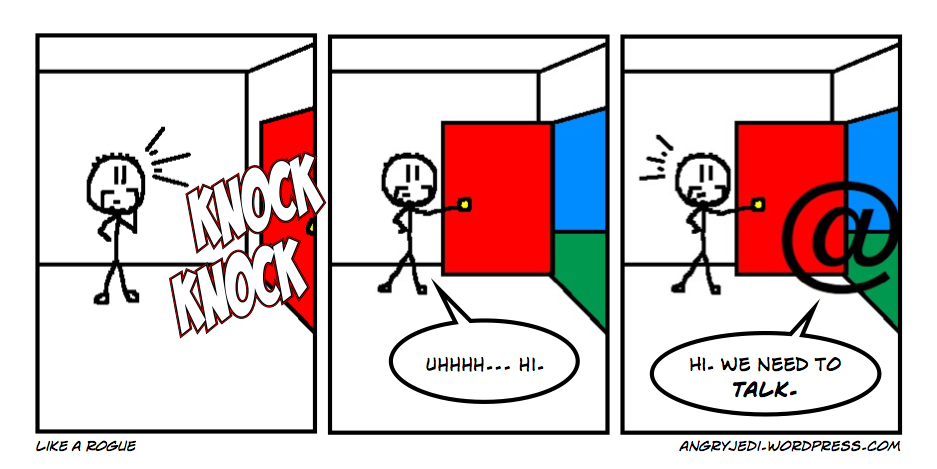
This approach isn't for every gamer, just like watching only foreign and/or arthouse movies isn't for everyone who purports to "like movies". I love ASCII-based roguelike Angband, for example, and have sent any number of heroic @-signs to their death now, but I don't expect everyone to find that sort of experience palatable. I can certainly play that game and find it enjoyable, however, and there are times when I'd pick playing that over something like, say, Halo. I'd certainly always pick it over Call of Duty.

But there are people who feel the opposite too. And it's pretty cool that we've reached a stage where we can say that about the gaming industry. The only difficulty that comes with this territory is the fact that the gaming press is not able to cover everything that is out there, meaning some spectacular stuff can get completely overlooked, or sell poorly, or be unfairly judged.

This is where word of mouth comes in. You found something awesome you think friends might enjoy too? Tell them. Don't keep it to yourself. I know that I've convinced at least a few people to play Recettear: An Item Shop's Tale since I started banging on about it a few weeks back, and I'm sure there are others out there who might be interested in trying other things I've mentioned. Similarly, my obsession with Persona 3 and 4 can be entirely attributed to a blog post my friend Mark wrote extolling the virtues of Persona 3, a post which was enough to make me think "I have to play this game."

We're in an age of active involvement and active socialisation. The gaming press still certainly has a place—I should hope so, anyway, since I'm involved in it—but there's just as much importance, if not more, on word-of-mouth recommendations and discussion.

Think about the last game you played. Was it something you played because reviews were good? Because people were talking about it? Or something you took a chance on and then felt like telling everyone how good/bad it was?

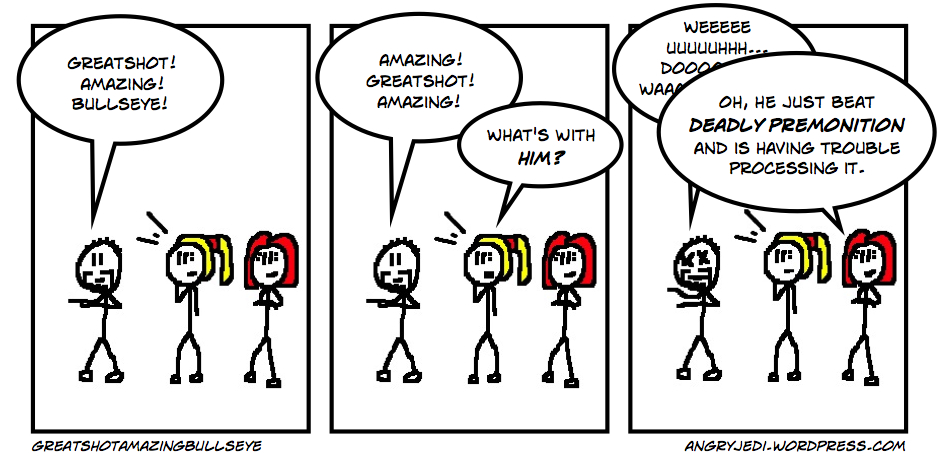
In my case, the last two games I played (Recettear and DEADLY PREMONITION) were the latter two. I took a chance on Recettear and adored it. And I couldn't not play DEADLY PREMONITION after hearing some of my closest friends discussing it in appropriately reverent tones. I actually can't remember the last time I bought a game purely on the strength of a review.
#oneaday, Day 331: Like A Ro-ogue, Killed For The Very First Time

Horatio Spankington was one of several children to a Serf, and a credit to his family. He had brown eyes, curly red hair and a dark complexion, lending him a somewhat distinctive look that his father often joked would probably "end him up in some freak show somewhere".

He joined the ranks of the Paladins at an early age, and by the time he was 18 he had determined that it was time to go dungeon-delving. He rented a room in a small village above a notorious dungeon, and prepared for the long quest ahead.

One morning, he awoke, and his God spoke to him, granting him the power to detect evil things. Rushing straight for the stairs down into the dungeon, he was eager to try out his new power. Concentrating as hard as he could, he prayed fervently for sight beyond sight, to see where the evil things dwelled.

The effort caused him to faint out cold for a few minutes. When he awoke, all was as it was before, though he wasn't in a hurry to ask his God for anything else for a little while.

He pulled out the makeshift weapons and armour that he had acquired, and lit his torch. He looked around.

"What a boring place," he thought.

He looked around the room he found himself in and found a curious scrap of paper on the floor. It read "pro redam."

"Pro redam," he said out loud. Suddenly, he felt more knowledgeable, and figured that he could probably figure out exactly what the next thing he looked at was, whatever it might turn out to be. He stowed the magic scroll in his pack and headed for a tunnel in the wall nearest to him.

The tunnel was quite long, and went around several twisting corners, but eventually led him to a long, narrow room. There was a curious smell in the room. He gazed around, looking for the source of the stench and eventually found it in the form of a patch of grey mould. Figuring that he may as well cleanse the dungeon of filth as well as evil, he strode boldly toward the grey mould, broadsword in hand.

The mould let out a cloud of spores, which tickled his nose and made him sneeze. Undeterred, he whacked the patch of mould with the flat of his sword, dispersing it.

He looked around the room. There was nothing of interest here, save several tunnels in the walls. He chose one and strode valiantly into it.

After a couple of twists and turns, he came to a closed door. Trying the handle, he found it to be unlocked, so he opened it carefully and peered into the room beyond. He couldn't see anything in there, so he stepped through the archway and took a look around.

The room was pretty dark, so he walked along the walls, using the light from his torch to get his bearings. His first impressions were correct; there was little of note here. In fact, the room was more of a wide corridor, with two tunnels leading off in different directions at one side, and another closed door at the other.

He tried the handle on the door, and found it to be locked. Pulling out a safety pin he always kept for emergencies such as this, he inserted it into the lock and fumbled around inexpertly and to his surprise, succeeded in opening the door. He stepped through the doorway cautiously, unsure what he might find beyond.

The corridor beyond the door extended for a short distance and turned a few corners before opening up into a large, light room. This, too, was empty of interesting details, but there were tunnels leading off in a number of directions, along with another door in one wall.

Figuring that the doors hadn't steered him wrong yet, he headed for the door and tried the handle. It was locked, but again he tried his safety-pin trick and to his surprise, it worked.

Beyond the door was a long, twisting and turning corridor that seemed to go on forever. Eventually, it opened up into a long, thin room, and there was that terrible smell again. Another patch of mould sat waiting for him. Feeling bold, he charged for it.

Suddenly, an acrid black smoke filled his nostrils and stung his eyes. He tried to brush it away, but he couldn't. He tried to blink his eyes clear, but he couldn't see anything. The smoke was too thick. He staggered around blindly, setting off the trap several more times, stinging his eyes more and more each time.

The stench of the mould was getting stronger and stronger. He flailed wildly at the mould, trying to destroy it, but he felt the spores blow up his nose, into his throat, filling his lungs. He began to feel sick.

Something crawled on him. It felt blubbering and icky, and he heard a chewing sound. He still couldn't see, and the foul smell and darkness were confusing him.

He felt weak. Finally, coughing up blood and vomit, he barged head-first into a granite wall, collapsed onto his back and whimpered.

Horatio Spankington died just 50 feet below the surface of the earth. Few people mourned his passing, least of all the family of the drooling village idiot he claimed to have "accidentally" killed upon leaving a shop one morning.

The dungeon lay unconquered still. Many had come to tackle its dangers. None had survived so far.

Try it for yourself if you can stomach a bit of hardcore ASCII dungeon-crawling. Download Angband here.

#oneaday, Day 330: On Death And Videogames

Kids today, huh? Don't know they're born. Want everything on a plate. In my day, we died by touching a piece of wall that was the wrong colour. And then we had to start all over again!
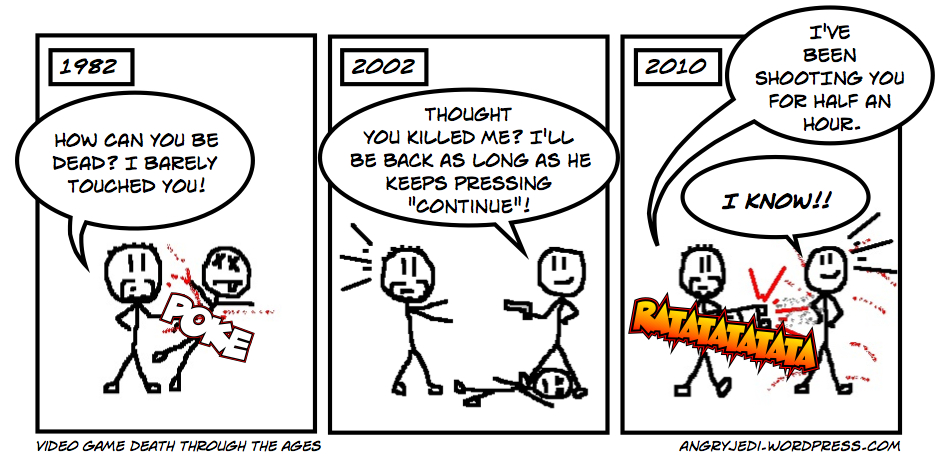
I am, of course, referring to the changing face of failure in video games. Failure happens these days, particularly in shooters, but nowhere near as much as it used to. And certainly the penalties are far less harsh than they used to be. In days of yore, you ran out of lives, that was it. A few years later, we started to see the arcade-style "credits" system in our home games. Later still, we had games in which you could continue indefinitely. And today, we have games in which it is almost impossible to fail because of the abundance of checkpoints, regenerating health and the like.

I picked up the Sly Cooper Collection for PS3 this week, and I've been playing through Sly Cooper 1. I was a little surprised to discover that it is a pretty punishing game. Our hero doesn't have a health bar and dies at the faintest hint of water, spiky things, fire or dogs with giant hammers. This was initially frustrating, but it was a simple matter to readjust to the way we did things in 2002. It was also marginally less frustrating in the fact that this was the era of unlimited continues, making the use of "lives" almost irrelevant.

I say "almost", because running out of lives does send you back to the start of the level instead of your last checkpoint, so there is incentive to take a bit more care. But it's not frustrating, particularly as the game is designed so well that any screw-ups are usually the player's fault, not the game's.

It got me thinking, though. The Sly Cooper Collection is bringing this style of gameplay to a whole generation reared on regenerating health—heroes who can simply hide behind a pillar until they wipe all the jam off their eyeballs—and is a very different approach to what people might be used to. While many modern games encourage experimentation and exploration, Sly Cooper punishes stupid moves by killing you immediately. This has the side-effect of keeping the player on track and discouraging them from going too off-piste or attempting to "break" the game (or, heaven forbid, encouraging those assholes who use the word "glitch" as a verb) but I can imagine it would be frustrating to "modern" gamers.

I understand the later Sly Cooper games do have a health bar, suggesting that the latter years of the PS2 may have started gamers' shifting towards being the pussies they are today.

Yeah, you heard me. Pussies. You don't know pain until you've got to the last level of Castlevania only to lose all your lives and have to start all over a-fucking-gain.

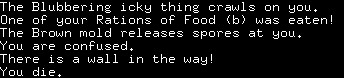
The nearest to this experience we have these days is in the humble roguelike, which has the decency to delete your save game once you die. Better not get too attached to that awesome set of armour you found, because this might happen:

And no-one likes to die by stumbling drunkenly into a wall, having had a blubbering icky thing crawling on them and brown mold spores spurting up their nose.

#oneaday, Day 329: Be A Dick Mode

With the increasing mechanical complexity and narrative ambitiousness of many modern games, it's easy to forget the purity of how gaming used to be. Just a player, a joystick, and an arbitrary number representing how "good" the player was at the game. In other words, the score.
Games with scores aren't dead, though. Far from it. And in this age of global communication thanks to the Internet, one could argue that games with scores are more relevant than they've ever been.

The reason for this? The hidden option that you won't find on any game's menu. The mode that allows you to compete against your friends and mercilessly taunt them when you prove yourself—with numbers—to be objectively better than them.

I am talking, of course, about Be A Dick Mode.

Be A Dick Mode crops up in many game, though it's not just any game with a score and leaderboards that it works with. Shatter on PSN and Steam, for example, is not an example of a game featuring a Be A Dick Mode, despite being in possession of leaderboards and scores which frequently extend into the hundreds of millions. Geometry Wars 2, conversely, has Be A Dick Mode in spades. After Burner Climax? No dick action there. Pac-Man Championship Edition DX? Dickishness in spades.

There are few games with a more powerful, potent Be A Dick Mode than Adult Swim's seminal two-button masterpiece Robot Unicorn Attack, however. It was bad enough when the game was first released on Adult Swim's website. Twitter became awash with screenshots of everyone's latest and greatest high scores.

But now, they've gone and embraced Be A Dick Mode with open, err, arms.

How have they done this, you may ask. Simple: put it on Facebook.

For all Facebook's faults, privacy concerns and stupid, stupid UI redesigns, the one thing that it is magnificent at is promoting friendly (and not-so-friendly) competition between diverse friends across the globe. The ability for Facebook applications to access your name, profile picture and activity in applications you have in common with your friends was a masterstroke, privacy concerns aside. There's nothing better than looking at a leaderboard filled with the real names and photographs (or avatars) of your friends and seeing yourself at the top of it.

And there's nothing worse than seeing yourself in second place, with first place tantalisingly out of reach. There's nothing worse than knowing that the next time you log onto Twitter, there will be an @mention in your direction inviting you to check out Facebook and suggesting you might want to play some Robot Unicorn Attack instead of whatever it was you were planning on doing.

And then you play Robot Unicorn Attack. And you fail to beat your friend. And then you play it again. And some more. And then you get annoyed, so you go and play Bejeweled Blitz instead, but then you realise that someone else has pipped you to the top of the scoreboard on that too, so you go back to Robot Unicorn Attack and play it until that Erasure song has burnt itself into your memory and you can't see a field of horses without wanting to sing and fart rainbows at them.

In short, Be A Dick Mode will ruin your life and the lives of your friends. But you know you wouldn't have it any other way.

#oneaday, Day 323: A Little Balance On The Gaming Issue, Please

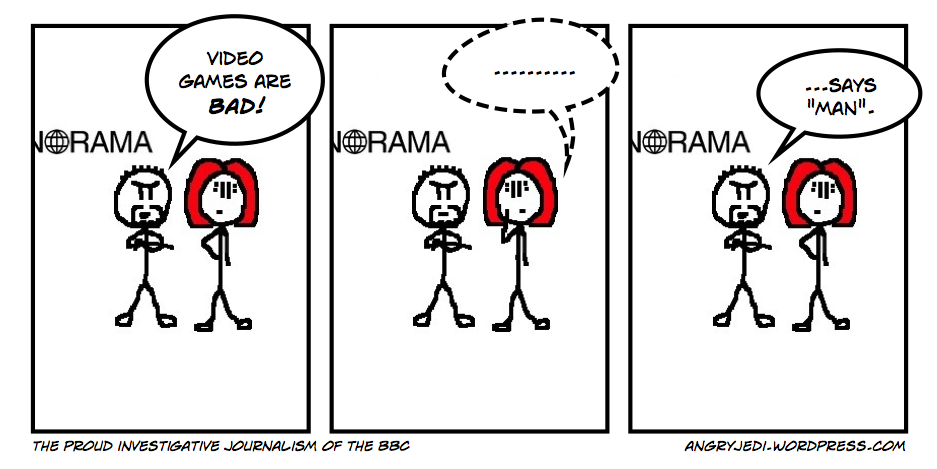
An hour ago, the BBC aired an episode of Panorama, our go-to investigative journalism programme, on the subject of video games. The subject, predictably, was the ever-present "are video games addictive?" question that has been raised and not answered many, many times prior to now.

The programme made a few fair points that are more common sense than anything else. Firstly, those with addictive personalities are prone to becoming addicted to games. Many games have in-built reward mechanics which those who get easily addicted to things will… well, get addicted to. Social games like Farmville, MMOs like World of Warcraft and popular multiplayer titles like Call of Duty all take great pains to ensure a regular stream of rewards and gratification being sent in the player's general direction. Whether it's a "medal", a "completed quest" or simple experience points, there's a constant flow of something that leads the player to believe they're achieving something. Those who become addicted to things easily can use that as a justification.

Secondly, the programme pointed out that parental controls need to be used more effectively. Many children and teenagers are given free reign on their use of video games and as such don't limit themselves on how much to play, to the exclusion of other things. Parents need to get better-informed about the facilities available to them to control their children's playing habits. This is, sadly, something that many parents are very resistant to, despite the fact that the tools are there for use, particularly on the Xbox, which offers some of the most robust family controls that there are—as does the Mac, oddly enough.

There were no concrete conclusions drawn, however. The "conclusion", if you can call it that, was that more research was needed from an independent body.

The thing is, this discussion has been going on for decades now, and no-one has thought to actually do that research in an appropriately investigative and non-biased manner.

I was reading through a few Formspring answers from Leigh Alexander (I think) the other day and she made the very good point that those of us out there who write about games can't be called "journalists" in the same sense as those who write for, say, national newspapers on breaking stories. Our role as members of the games press involves reporting on carefully-disseminated information provided by PR companies, critiquing products on general release (occasionally before general release) and sometimes interviewing a developer from the industry. There's no real "investigation" there, there's no hard-hitting stuff. That's not necessarily a bad thing, but given that mainstream media tends to come down on the more negative side of the fence when investigating gaming, I think there's certainly scope for a counter-argument: someone who does know the industry well investigating the burning issues. And investigating them thoroughly using established journalistic, sociological research techniques.

Who's going to be the first person to step up and do that, though? More to the point, would anyone read it or take it seriously? Gamers, by their very nature, are defensive creatures, having been made out to be "the bad guys" by the mainstream media once too often. And those not "in the know" are often inclined to have their minds made up by sensationalist stories in the aforementioned mainstream media.

What we need is balance. What we need is a hero.

Wait, what?

#oneaday, Day 320: Achievement Locked

I've just done something I haven't done for a while. I've beaten a game with no Achievements. No, I don't mean that I played the game so terribly that I didn't get any Achievements (I don't think there's a single Achievement-supporting game out there that will allow you to do that)—I mean I started, played, enjoyed and beat a game which did not support Achievements of any kind, be they Steam Achievements, Xbox Achievements, PSN Trophies or a built-in Achievement-like system.
Said game was Recettear: An Item Shop's Tale, which I enthused about at some length a few days ago. I beat it tonight, but there's a load of stuff after the ending, too, so this isn't the end of my time with the game. I am, however, glad that there were no Achievements along the way.

Achievements are generally considered to be a good thing. And for some games, they are. Freeform games like Crackdown use Achievements to encourage players to try crazy things that they might not have thought to do otherwise. Skill-based games like Geometry Wars use Achievements to display player skill. But when you get into the territory of "Fire your gun 500 times", you know it's getting a bit silly.

I played Oblivion a while back and greatly enjoyed it. I got all 1250 Achievement points in it. The thing is, though, that wasn't the whole game. There are tons of sidequests in Oblivion which don't have associated Achievements. How many people do you think bothered to do them? Not many, I'd wager.

Achievements often direct your experience and encourage you to play in a specific way. For some types of game, that is good. In others, it's not. Part of the joy of Recettear is the discovery of how different things in the game work. Over time, you naturally figure out which customers you can get away with charging a bit more to, which ones will come in at what times of the day, which products appeal to which people and all manner of other things. Even the adventurer characters you can take into the dungeons have their own individual quirks for you to learn. As soon as you add Achievements like "Sell 20 Baked Yams" to that mix, you start playing differently in order to get that Achievement. You start focusing on becoming the best damn Baked Yams supplier there ever was, to the exclusion of more profitable things like treasure and adventuring equipment.

Achievements are, on balance, a good idea, I think. They provide an additional reward mechanic above and beyond that which the game should be offering anyway. But it's when they start to take over, to become the most important reward mechanic—more than the inherent rewards built into the game itself—that things aren't quite right with the world. It's a fine line, and I don't think making the support of Achievements mandatory is the correct way to be. Or if there's no way around that, let's see more games like DEADLY PREMONITION, which simply has an Achievement for beating each chapter, one for each difficulty level and one for 100%ing the game. Nothing more. Nothing more needed. Even then, I'm pretty sure there will be at least one person out there who will go back and replay the whole game just to get all three difficulty level Achievements. That shouldn't be why you replay DEADLY PREMONITION. You should replay it because it's awesome.

So, anyway. Don't be afraid to pick up a game with no Achievements. You might be surprised. Games can be fun without having to tell you how awesome you are every ten minutes.

#oneaday, Day 319: Report This Post, It Contains Opinion

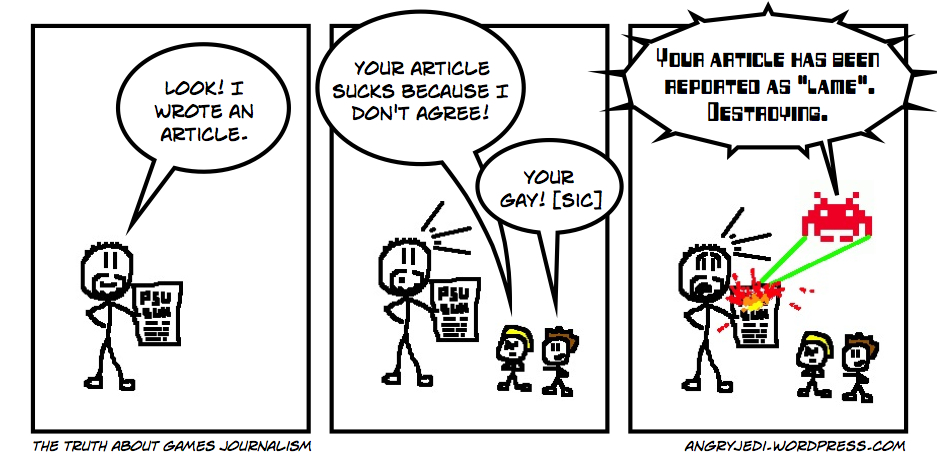
There is an increasingly popular—and increasingly worrying—tendency for games journalism and writing about games (which some people are keen to point out are two different things) to be judged as "broken" or "lame".

On paper, you can perhaps understand why this is. Gaming is one of the most popular subjects for wannabe writers to pebble-dash the Internet with, and there are so many people out there who want to do it "professionally" that a good 90% (I made that up) of gaming-focused sites out there can't even pay their writers, however awesome they are. As such, there is a lot of crap out there, but it's generally quite easy to spot, and there's certainly no need for sites like this.

Fellow #oneaday-er and all-round lovely grumpy chap Ian Dransfield of Play Magazine wrote an impassioned rant on this subject. I highly recommend you go and read it. Now. Go on.

I agree with the Dransfield. No kind of journalism should be homogenised, automaton-written garbage. It should have scope for individual opinion and comment, and certain outlets should have the opportunity to develop distinctive "voices" on the matter. It's worked for our newspapers for years, after all—for all the shit everyone gives the Daily Mail about their bizarre and often misguided opinions, at least they stick to their guns. Similarly, were the Daily Express ever to write about anything other than Princess Diana, the nation would be in uproar.

One of the things that bugs me most about today's games journalism is the plague that is N4G. For the uninitiated, N4G is a community-driven news-aggregation service. Community members may post articles to a "pending" queue, and they then have to get ten "approvals" in order to show up in the main news feed.

Fair enough, you might say. It separates the wheat from the chaff, surely. And surely the people who have approval rights must all be published professionals, right?

Wrong. Anyone can submit any page to N4G with no requirement that the article be your own. Get three articles approved by the community (a simple case of rounding up ten Twitter/Facebook friends to help you) and voila—approval rights. This then means that your opinion has as much weight as someone who's been doing the job for fifteen years.

This may still not sound unreasonable. So let me show you the drop-down menu of options available for "reporting" an article if you believe it to be "inappropriate":

Yes, you have read that correctly; one of the options for reporting an article as unworthy of appearing in the N4G news feed is that it is "lame".
N4G is seen as a primary means of promoting games-related articles, and sure enough, it does seem to generate a lot of hits for sites, so I can't fault those people who do take advantage of it to get more readers to their sites—fair play to you. I can say with some honesty, though, that I have never used it as a place to go to find out the latest news. The whole thing is too chaotic, too run by people who write comments after reading only the headline and not the article and—ugh—it makes me mad, I tellsya. I can't take it seriously in the slightest.

My main issue with it is one of the things Dransfield points out in his article: who are these people to say what is and is not "relevant"? What gives them the right to brand something as "lame" simply because it doesn't have "HALO IS A REALLY COOL GUY" in the headline? What gives them the right to ignore a supposed "duplicate article" on a subject which offers some opinion or additional facts over and above what has already been written first, in haste?

Absolutely nothing. Traditional news outlets and even longer-established specialist press (such as publications for music and films) aren't held to account in the same way. But games journalism, being a younger industry, seems to be held to entirely different standards, and judged unnecessarily harshly. There is a lot of negativity surrounding the games press, and not enough positivity. Trolling and flame wars are particularly prevalent on articles about games, and platform-specific articles seem to bring out the very worst in the community.

Here's food for thought then: in a world where we're so concerned about free speech a goodly proportion of the Twitter population in the UK (and beyond) is supporting the legal fees of someone they've never met, why are we so harsh on this particular breed of writers? Why shouldn't they be able to write what they feel, rather than what will "get hits"?

If you would like to share this post with the community, then please feel free to make use of the buttons below.

#oneaday, Day 318: One Day in Gameland

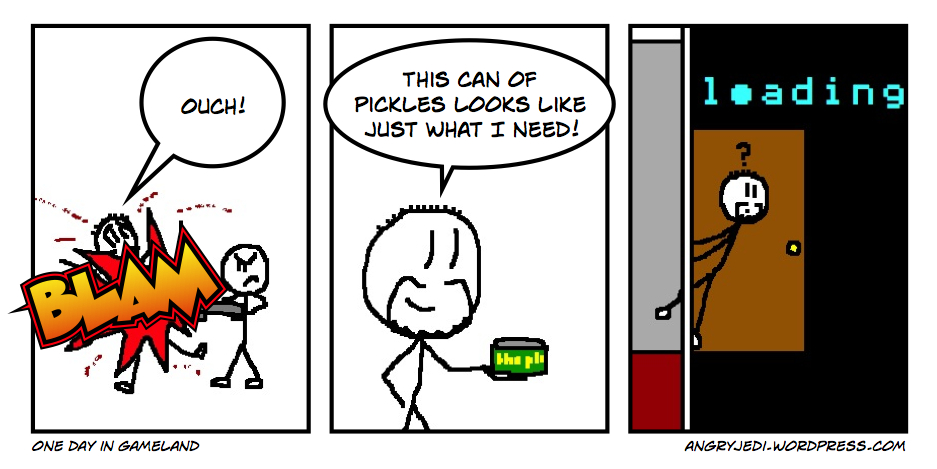
In discussing Deadly… I mean DEADLY PREMONITION with a couple of others recently, we came to the conclusion that the universe of games has such a distinct logic, such a distinct culture, that you could probably write an entire treatise on the culture, physics, metaphysics and theology of Game-Land.
I will settle for one blog post.

  • When you wake up in the morning, any and all injuries, however serious, will be completely healed, unless you make your home in a post-apocalyptic wasteland, in which case you will either need to give yourself an injection in the affected limb or visit a doctor, who will be able to heal absolutely any injury and make you completely intact within a matter of minutes.
  • If there is food on a shelf, pick it up. No-one but you needs to eat.
  • By extension, eating food also heals injuries, unless you're in Greenvale.
  • If you're in Greenvale, no-one gives you a second glance if you're standing in the middle of the road chugging back a can of Hollandaise sauce followed by wolfing down a turkey sandwich which cost $75.
  • People only open doors if they absolutely have to and frequently just walk through them instead. This includes you. If you were planning on going outside, open the door, wait for 30 seconds, then step outside. Otherwise there will be nothing to walk into and you'll simply fall into the void, never to be heard from again.
  • You can survive approximately 1.5 point-blank shotgun blasts directly to your face without permanent disfigurement.
  • In fact, you can survive any injury without permanent disfigurement.
  • If something "really important" is about to happen, no-one will mind if you do something else—anything between popping out to shop for some groceries to going on holiday to the other side of the world. The "really important thing" will still be "about to happen" when you get back. Enjoy yourself for a while.
  • After completing a repetitive task such as stuffing envelopes or chopping onions, you will notice yourself getting noticeably better at said task at increasingly-longer but predictable intervals.
  • Chop 200 onions in a row without hurting yourself for a special prize!
  • Sometimes when you talk to people you will have to read something they've written on a piece of semi-transparent plastic while they flail their arms around like a Thunderbird.
  • Occasionally, people will sound like they are speaking Japanese at you, but the semi-transparent piece of plastic will have English writing on it.
  • All shops you visit will sell exactly four items in an extremely niche category, but will purchase anything you have in your pockets/backpack/suitcase/on the back of your pack mule.
  • On that note, you will own a backpack which is capable of holding twenty suits of armour, four hundred weapons of different varieties and up to 99 bottles of each and every liquid you find. This backpack is invisible.
  • You will never, ever need to go to the toilet, even if you have drunk all 99 bottles of one particular liquid, unless 1) you feel like you are being forced by a giant green diamond above your head to do things in your own home that you probably would have done anyway, 2) your son has been kidnapped or 3) you know, or are about to come into contact with, someone whose son has been kidnapped.
  • Anything red will heal all your injuries if you imbibe it somehow.
  • Anything blue will make you less tired if you imbibe it somehow.
  • People with long white hair are always evil, even if they seem to be quite nice chaps.
  • People with short white hair are often sullen, but good people.
  • People with spiky hair or who are bald are probably on the way to save the world, especially if they are carrying a sword and/or a gun. Be nice to them.
  • Be careful when stacking shelves: lining up three or more of the same thing in a row always causes them to disappear. Stack tins of soup in a checkerboard pattern to prevent this from happening.
  • Pick up every flower, bird feather, human-looking bone or flag that you see: there will be someone somewhere in your neighbourhood who will give you "something good" if you bring them enough.
  • Having a conversation with someone doesn't require any actual interaction on your part. Just bump into them and they'll tell you something about the nearby caves, forest and/or the local big corporation.
  • Talking to yourself is absolutely fine. You may either do this by voicing your internal monologue, especially when looking closely at inanimate objects, or keeping a semi-transparent piece of plastic and a marker pen in your invisible backpack at all times.

Sounds like a simple life, doesn't it? Ah, if only we could apply game logic to the real world sometimes…

#oneaday, Day 316: Pity The Poor Shopkeeper

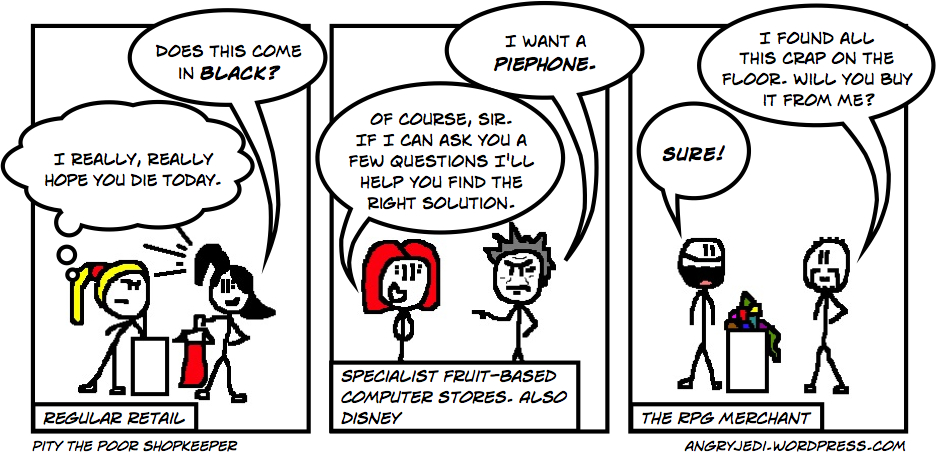
The poor shopkeeper doesn't have it easy, whatever form they take. If they're a retail monkey working for minimum wage in some sweaty hell-hole where chavs repeatedly come up and ask if the nearly-black garment they have in their hands is available in black, then they're probably losing the will to live by the second. If they're working in a, shall we say, "premium" retail environment they're probably having a better time but rapidly growing sick of the fixed grins they're forced to wear, not to mention the stock phrases that spew forth from their mouths like some form of verbal effluvia.
And then there's the poor, downtrodden RPG merchant, forced to sell all manner of crap, apparently only to adventurers, who then helpfully restock them with an endless supply of boar intestines, bits of wood, crystal chippings and used swords that they don't need any more. It must be a difficult life. And frequently a tedious one, as anyone who entered the online world of Ultima Online with lofty ambitions of owning a huge retail empire will attest.

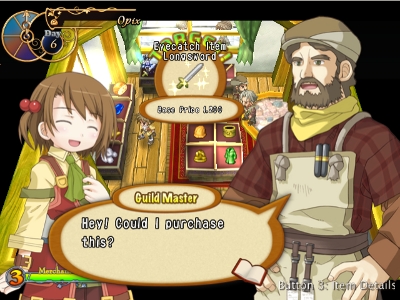
It's this odd premise that quirky Japanese indie game Recettear: An Item Shop's Tale (available on Steam, as well as directly from the distributor's website) decides to explore in great depth. Playing the role of Recette, an adorable young girl with an absentee father, it's the player's job to help her run a successful RPG item store and make enough money to pay off the debt her father left her with. She's not in it alone, of course. She has a fairy assistant named Tear. Tear works for the financial institution with which Recette's father took out the loan, "because fairies are good at administration" and is there to help Recette pay off the debt she's been saddled with. The two become friends quickly, but should Recette be unable to make any of the weekly payments she's required to, Tear will quickly repossess her house and leave the poor girl living in a box.

So far, so Animal Crossing, you might say. And you'd kind of be right. Except not. There really isn't another game quite like Recettear out there. There are games which focus on individual elements of the game, sure. But none which blend together such peculiar and diverse elements with such successful results.
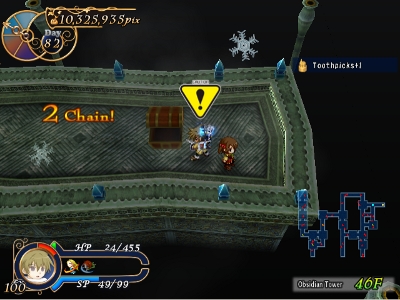
The game is split into three main sections. Firstly, there's the item shop itself. Recette can dump anything from her inventory onto the shelves in the store. Stuff in the window is likely to attract customers. If she chooses to open the shop, she has to deal with a flow of customers coming in and asking for things. If they're on display, all she has to do is agree a suitable price with the customer. If they agree, cha-ching. If they disagree, Recette has one chance to make a more reasonable offer before they leave.

Simple enough. As the game progresses, though, more elements are added to this formula. For starters, in true RPG tradition, people start selling stuff to Recette, too. This can be a good way for her to build up stock, as she can often get stuff for knock-down prices with a bit of shrewd haggling. Then people will place special orders, requesting that she deliver, say, three hats in two days' time. Recette has to not only make sure she has the hats in stock but also remember to have the store open when the customer plans to return. And finally, some customers will come in not quite sure of what they want, and Recette will have to make recommendations from the stock she has on display and in her inventory.

It's a straightforward mechanic, and you soon get to know how much certain customers are willing to pay over base prices. A few twists come in later with a news ticker informing Recette of increased or decreased prices in the market, but it's mostly a case of buy low, sell high.

If Recette chooses to leave the store, she can wander around town and occasionally bump into the people who frequent her store. These come in the form of random townsfolk and adventurers. Completing requests for adventurers will sometimes net her their Guild Card, which enables her to make use of them for expeditions to the local dungeons.

Yes, there are dungeons. Because sometimes the local markets just don't have the things people want to buy. When that's the case, Recette is free to pop down to the local Adventurers' Guild and hire one of the guildies she's made friends with. It's then into an action-RPG dungeon crawler to kick monster booty and gather lots of crap that people might want to buy.
It works, brilliantly well. The item shop stuff occurs quickly enough that it never gets tiresome. The storytelling scenes feature attractive artwork and a truly excellent localisation from the Japanese. And the dungeon-crawling, while simplistic, is fun and satisfying, broken up by regular boss battles and in-dungeon special events.

The whole game is distinctly adorable, but deceptive. The artwork, music and squeaky-voiced Japanese girls make it look like something which should be incredibly embarrassing and cringeworthy to play. But in fact, there's a distinctly acidic sense of humour underneath all the sweetness, and a large number of the dialogue exchanges are genuinely laugh-out-loud funny. The kawaii presentation coupled with fairly sophisticated, intelligent humour and a wonderfully self-aware nature reminds me a lot of the Disgaea series.

I'm probably about halfway through the game now, having made two of Recette's repayments successfully. There's the hints of a bigger plot at work, and a bunch of new characters have been introduced, most of whom will presumably end up being playable adventurers for the dungeoneering sections.

If you're after something that is both comfortably familiar and quite different to any JRPG you've ever played, then Recettear: An Item Shop's Tale is well worth checking out. I fully intend on posting a full review somewhere once I've beaten it.

#oneaday, Day 314: In Which I Spoil The Crap Out Of DEADLY PREMONITION

I beat DEADLY PREMONITION tonight and made the confident announcement that it was, barring any last-minute wonders, very much my Game of the Year for 2010. It won't be everyone's Game of the Year for 2010 by any means, for various reasons. But personally speaking, it's very much the most satisfying gaming experience I've had all year. Which is nice.

Throughout the course of this post, I am going to spoil the crap out of the game, so if you haven't beaten it and are intending to, you may wish to skip this one. If you have no intention of beating the game, feel free to stick around. And if you have beaten the game, you're probably in a similar position to me right now.

I can pin down DEADLY PREMONITION's appeal to me on a personal level very simply. It takes elements from two of my favourite game series of all time—Silent Hill and Persona—and blends them together to produce a game which skitters precariously along the boundary between madness and sanity and somehow doesn't ever completely fall into the trap of "indecipherable nonsense".

First, the Persona angle. DEADLY PREMONITION's world of the town of Greenvale is a well-realised one. As you progress through the game, you get to know the layout of the town and the routines of its residents. You also get to know each and every one of the residents throughout the course of the story. If you choose to take on the 50 "side missions", then you get to know many of the characters very well indeed. This is just like Persona's Social Link system: optional material which fleshes out the game world and its characters enormously. If you take your time to enjoy this material, then events which occur later in the story take on much greater emotional significance as you really "know" the people concerned. It also means that when the time finally comes to say goodbye to Greenvale at the end of the game, it's a difficult thing to do.

Next, the Silent Hill angle. It becomes very apparent early in the game that protagonist Francis York Morgan is not all he seems. For starters, he spends a huge amount of his time conversing with someone you can't see named Zach. For much of the game, it seems that "Zach" is a cypher through which York can communicate directly with the player. Indeed, it certainly seems that way when York asks a question of Zach and it's up to the player to choose Zach's response.

But the wonderful thing about DEADLY PREMONITION's story is that we get to know York very well as the narrative progresses. It becomes apparent that he is scarred mentally by something terrible which happened in his past—his father killing his mother, and then himself. As the investigation into the murders in Greenvale proceeds, it becomes apparent to York why this incident took place. He accepts why his father did it when he is put into the exact same situation—the person he loves is "soiled" with the red seeds the murderer is so obsessed with. With this acceptance, York also admits who he really is—he is Zach, and York is the dual personality he invented to deal with the situation, not the other way around.

York's mental scars show themselves in other ways, too—any time he begins profiling the killer and tracking down clues with which to determine what happened, he lapses into a dark "Other World", much like Dark Silent Hill. It's never explained exactly why this happens, but my belief upon beating the game is that the things seen as York and Zach aren't to be taken literally. We can tell this by the fact that Zach fights a giant, monstrous version of Kaysen at the end of the game as the town's iconic clock tower lies in ruins, yet when everything gets back to "normal", the clock tower is perfectly intact. Similarly, after fighting George as a giant, muscular "immortal" monster, he dies as a normal man. My guess is that York and Zach view these monstrous people simply as monsters, perhaps to distance him/themself from their "humanity". This is also borne out by the fact that when York visits Diane's art gallery with George and Emily and Greenvale apparently becomes "Other Greenvale", they don't comment on it at all—because they don't see it.

Of course, a question is raised when Emily has to rescue York from the clock tower—she sees the Other World and the creatures. Why? Is it because she has come to understand and love York and is seeing things the way he does? Perhaps. The fact that this isn't explained may be unsatisfying to some people, but I like the fact that there are some questions which are open to interpretation.

I could be wrong about all of this, of course. I'm sure there's plenty of interpretations all over the web by now—I haven't looked at them yet. But the fact that a game offers such scope for discussion and interpretation is admirable.

Deep part over. Let's also talk about some of the quirky things that make DEADLY PREMONITION such a memorable game. For one, the music. There are several points throughout the game where the only rational explanation for the choice of music is to be as inappropriate as possible. Take, for example, Emily following the dog Willie to track down the missing York. This sequence is accompanied by what can only be described as Latino J-hip-hop-electronica. Somehow it works.

By far the most striking use of bizarre music, though, is a flashback sequence where the player controls the Raincoat Killer, who is running through the town of Greenvale slaughtering anyone who gets in his way with a gigantic axe. The musical accompaniment to this scene? A really quite beautiful version of Amazing Grace. The juxtaposition between the music and the horrors taking place on screen actually ends up being profoundly emotional, and sets the tone for the last part of the game, which is a veritable rollercoaster of drama and emotion.

I think my favourite thing, though, is that despite the fact the game appears to be a horror/crime story, there's a convincing love story element to it, too. The growing feelings between York (or, specifically, Zach) and Emily throughout the course of the game is handled incredibly well. The love story reaches its peak just as Emily is killed, making what could have been a ridiculous scene—she pulls a whole tree out of her stomach, for heaven's sake—one with considerable impact and shock value, and one which spurs the player, York and Zach on to see the whole debacle through to its conclusion. It's also refreshing to see a game which isn't afraid to end some of its story threads in tragedy for principal characters.

I could rabbit on about this game for hours, but at a little over 1,000 words I'll end that there. Several members of The Squadron of Shame are interested in recording a special DEADLY PREMONITION podcast at some point. If you've beaten it and you're interested in joining us for some discussion (I'm looking at you, Raze, Schilling) then let me know and perhaps you can be a special guest. You can also drop by the Squawkbox and share your thoughts there, too.

So with that, then, it's back to Fallout: New Vegas as the next entry in the Pile of Shame, I believe I said.