Earlier today, this animated image from Insomniac Games' Resistance 3 did the rounds. Impressive. But also rubbish.
Ooh, controversial.
But seriously, look at it again. What is the one thing that sticks in your mind after watching that short clip? You probably answered either "post-apocalyptic", "monster" or "brown".
The trouble with things like this is that they completely lose their impact after a time. I'm sure Resistance 3 is technically very proficient, particularly if that clip was rendered using the game engine, which I'm guessing it was. But the fact it looks like Gears of War meets Fallout meets any other post-apocalyptic brown "destroyed beauty" sort of environment completely kills any interest for me—there's just too much of it around. And not just in the sci-fi genre; I haven't played Modern Warfare 2 for months (I traded it in after I got bored and decided I had no interest in the rest of the Call of Duty series after it) but my one enduring memory of that game, too, is that there was a lot of brown around.
This is nothing new, of course. I vividly remember getting all excited over the original Quake, the first high-profile "true 3D" first-person shooter. My brother, obviously already sick of it having been exposed to it every day on PC Zone, referred to it as "oh, the brown game". And yes, Quake was overwhelmingly brown, though there were a few blue bits in it too. This was just the beginning, though.
Yes, post-apocalyptic environments probably are going to be grey, brown and miserable. Although one thing that Halo: Reach shows is that it is possible for armageddon to be happening and it still be a vibrant place filled with colour. In the case of that game, it's arguable that the impact of the destruction is all the more profound because of the splashes of bright colours that are everywhere.
Or alternatively, developers, how about fewer games involving things that have collapsed or are in the process of collapsing? Fewer games where there's nothing but rock and stone? More games in organic, natural environments that aren't dead. More games that aren't afraid to take a few risks and be a bit more stylised rather than "gritty" and "realistic". Some of my favourite games of all time are the Timesplitters series, proving once and for all that I don't hate FPS games, I am just very tired of them all being identikit and boring. Timesplitters was colourful, distinctive and humorous but still managed to be atmospheric. And the news that CryTek are considering resurrecting the series fills me with an enormous amount of joy… and hope that they don't fuck it up.
Perhaps this is why I like JRPGs at a time when more and more people seem to be getting switched off by them. They may be their own particular kind of generic, but at least they offer some colour as part of their aesthetic.
The other night, I posted a question on Formspring. I thought I sent it to just a couple of friends but apparently somehow shared it with the entire Internet, as a lot of people, some of whom I hadn't come across on Formspring before, appeared to be very enthusiastic to answer it. I was somewhat surprised at the amount of depth people were putting into their answers, because it was, after all, a somewhat flippant question that I wasn't expecting people to take seriously at all. How wrong I was.
This was the question:
Out of The X-Factor/American Idol and equivalents; Jersey Shore; the music of Girls Aloud; the Call of Duty series; and cakefarts (don't look it up, it's exactly what it sounds like), which has had the most beneficial impact on society, however small?
My thinking behind it was this: here is a list of arbitrarily-chosen things that are all either irritating, disgusting, amusing or awesome depending on your outlook. Is there one that people see as significantly "better" than the others?
Turns out not, actually. Everyone had some good points to make.
Cakefarts by far. Yes, I am familiar. And yes I've gotten a lot of friends with it.
It's probably important to choose who you're going to show Cakefarts to carefully, because after all, it is exactly what it sounds like. But it's the sort of thing you can show to people and they certainly won't forget it in a hurry. (If you're not familiar, seriously, don't look it up, especially if you're at work; the clue's in the name) If you are acquaintances with people who don't "get" the Internet, you'll be an Instant Legend.
@Cidergirli agreed with AJ, but for different reasons:
I'm going to have to go with cakefarts, purely because it's the only one which appears to be open and honest about its use of cake. Also: cake.
@MJPilon had a thoughtful take on the issue and came out in favour of American Idol/X-Factor:
The answer I have off the top of my head is American Idol and equivalents because despite all the craziness that has sprung up around these shows, at their heart, these shows demonstrate that people should not give up on their dreams and that if they work for it, they can achieve what they desire. Anything which can still evoke these feelings and notions in people are beneficial for society.
He was concerned immediately after that he may have missed the point of the question, but I think that's a decent answer; though personally I feel that "ambition" shouldn't require a TV show to inspire people to reach for the stars.
@C64Glen came out in favour of Girls Aloud, though not for the reasons you might expect. Or possibly the reasons you might expect, given his username. I wasn't familiar with the factoid he shared, though. TIL.
Girls Aloud easily, some of the tracks and production on the 'Out of Control' album is great. Some of it by former C64 musician Matt Gray. E.g. Untouchable (instrumental)
@Shinogu showed where his priorities lie with his response:
Jersey Shore? They were the only people of that selection at the LittleBigPlanet 2 World Record event.
@Cilllah, ably aided by @Culley25, got straight to the point of the matter:
All of them prove one very important fact – mental illness makes money.
Fair point. @Bungiesgirl then came up with an image that you will either find delicious or nightmarish depending on your opinion of two of the things mentioned in the original question:
Surely it is a combination of Girls Aloud and Cakefarts?! Girls aloud because they have a hot(ish) redhead, cakefarts just for the LOL! preferably these two things should be brought together into one super site of Girls Cakefarts Aloud.
I like the redhead in Girls Aloud. Nicola. She has a name. Nicola. I like Nicola. I understand she's not the most popular option. That's just fine by me.
Sorry, where was I? Oh, right. @minifig came up with some fair points in favour of Girls Aloud and Call of Duty, with a disclaimer:
Call of Duty probably wins it, since the development of the game has at least pushed a few technological boundaries a little way, and probably just enough to outweigh the huge timesink it is for the people that play it. However, I think Girls Aloud probably come second since:
1. They have a couple of songs that aren't too offensive and
2. The amount of masturbation they've induced may well have had an impact to reduce the fertility of large numbers of men, thereby reducing the world's already excessively large population.
Not that I like either CoD or Girls Aloud.
It was around this point that the answers started to gradually increase in length, depth and intensity of feeling. Here's @docbadwrench:
Thankfully, I only know what a few of those things are. However, I think I get the general point.
Based upon the available data, I would have to conclude that Call of Duty has the most beneficial (though incredibly small) impact upon society. It encourages aiming, which is highly important if you use a gun.
In fact, if all fans of the aforementioned list could improve their aim, then they might kill one another; this could be another net gain for society. Perhaps, if we could plant subliminal messages into Call of Duty games encouraging people to buy guns. Then, extending the message further, perhaps their American Idol viewing parties would include handguns, just lying around on the table, in case there's a conflict about whether the latest off-key primadonna is the bestest of them all.
Definitely Call of Duty.
"allpointsnorth", whom I'm not sure I know on Twitter (apologies if I do) had this to say:
I suppose the knee jerk and natural response is that none of those programmes have any beneficial impact, but that would be a touch lazy and, not really fair.
Like most things it depends upon how you measure it. If we take beneficial to mean that more people enjoyed it so it must be more beneficial then I suppose I'd have to say Call of duty? 55 million sold worldwide. I guess Call of Duty would also fall into the 'brought economic rewards to many' view of beneficial too, though I'm sure that Jersey Shore brings in the cash too as will Girls Aloud.
However, I'm not really a big fan of measuring society against some sort of scale. I don't think it really works like that. To break society down in such binary ways is tempting as it allows us to explain and comprehend the world around us so much more simply. However, society isn't simple and what benefits one, no doubt, harms another. Even if that harm falls into a socially acceptable form of harm that we ignore.
Of the things here I'd say that Girls Aloud benefited me most as I've enjoyed a selection of their poptastic hits and the videos to go with them more than Jersey Shore, Call of Duty or Cakefarts – none of which I have seen. So, clearly, the music of Girls Aloud is the winner here and has done the most to benefit society at large.
Interesting point. What is "beneficial" to society? Is it something that brings economic rewards? Something that benefits art and culture? Something that makes people happy?
@planetf1 had a simple but accurate answer to my question:
I'd go for xfactor/idol simple as it's given a lot of people pleasure, helped many with a career/breaking into the music industry, has stimulated discussion & allowed many people to share a common experience.
Discussion there certainly is; like it or hate it, during any high-profile "reality" show on TV, Twitter will be abuzz with discussion about the show in question, whether it's in-depth debates about which floppy-haired twat is the "best" or people ranting and raving how much they don't care about whatever programme it is.
Two more, then we're done. @MituK had this wonderfully analytical, scientific approach to share on the subject:
Ooh, interesting. Well, let's assume that 'beneficial impact' can go into negatives, and assess each accordingly.
I know that there is a difference between X-Factor-type-shows and Jersey Shore, but both seem to elevate fame for it's own sake; even where hard work and talent are not what is being rewarded. This has led to a whole generation(s) of kids valuing fame for it's own sake, rather than as a consequence of hard work. Definitely negative impact. We'll give this a -5 rating for 'beneficial impact'
Similarly, the music of girls aloud – this has created tunes I can happily bop along to when in the mood, but it's also meant Cheryl Cole, who most little girls (according to a recent survey) would like to grow up to be, so this creates the same problem as described in the first paragraph. We'll give this an arbitrary rating of -0.5, weighing up those two things…
The CoD series – hmm, perhaps there has been no negative impact other than the already-existing self-perpetuating desire for studios to churn out yet more of these types of games. HOWEVER, it's existence has no doubt also inspired some of the many smart people interested in game design to want to create more interesting video game experiences (think indie scene). So, perhaps in a way this has had beneficial impact of +2 (of course I'm being idealistic here).
Cakefarts get a 'beneficial impact' rating of 0, because that is precisely how long I want to think about cakefarts.
So, on that scale, CoD wins, I guess!
And finally, @jennfrank shares a convincing argument in favour of Jersey Shore:
I've had more conversations about Jersey Shore than I've ever had about Idol or Talent or Call of Duty, and while these are all legitimate cultural milestones, OH MY GOD, don't get me started on all the million reasons Jersey Shore is my heart and soul.
I love these earnest people earnestly, without a wrinkle of irony–I do!–and I love their passion for life and their perfectly foreign codes of morality and chivalry and fashion. But it's this amazing anthropological study that no other show dares attempt, which is edgy in its way, and the cast, in turn, are these amazing actors who improvise their warts, these utterly authentic famewhores who relish in their own faults and even explain them all out, looking directly into the camera in partial states of drunkenness and undress.
Watching the show, for me, reproduces much the same crackle I felt as a tween watching early Real World, but instead of feeling a voyeur's envious thrill at the specter of adults away from home for the first time, I instead know the envious thrill of watching kids away from home for the first time. So it's the same, and it's not the same.
Also, these folks are classy: Snooki is a NYT bestselling author, and Jenni "JWOWW" Farley is a spectacularly talented painter.
So there you have it. Points in favour of all of them, and proof positive that easily-derided cultural phenomena sometimes carry more significance than you might think personally.
On the Internet, opinions exist in a binary state for many people. There is your opinion (1), and there is everyone else's opinion (0). Sometimes other people's opinions coincide with your own, meaning they can join you in the happy 1 gang, while the 0-toting losers get to stand over there being Wrong.
It's strange, though, really, isn't it? People develop such strong feelings about particular issues, and these opinions spread virally very quickly via all forms of the media. I remember reading about this in A-level Sociology and forget all the names and dates of studies concerned, but since this isn't an essay I'm not going to go and look them up. What I do know is that nowadays, such opinions spread far quicker than they have ever done before thanks to the immediacy of online social interactions, meaning that in some cases people may end up feeling that they should change their opinions on things in order to remain somehow "credible".
'Twas ever thus, of course, with the school bullies always listening to the most badass music out there whilst the flute-playing pansies amongst us voluntarily listened to—or even played—classical music. (Guess which of the two categories I was in, though I didn't play the flute. Flutes are for girls.) One group tended to kick the shit out of the other on a fairly regular basis, and it was usually a pretty one-sided battle.
You shouldn't start actively hating something just because other people say so, though. You should take pride in your tastes, however idiosyncratic or separate from the supposed "norm" they are.
Let's take a few examples of Things I Like That Should Be Embarrassing To Admit But Really Aren't, Honestly, No, Stop Looking At Me Like That And Please Don't Unsubscribe, Think Any Less Of Me Or Be Any Less Likely To Do Nice Things For Me (Like Buy Me Cake, Give Me A Big Wet Snog Or Make Me A Delicious Roast Dinner) Should The Opportunity Come Up.
Okay. I can do this.
(takes deep breath)
I like Robbie Williams. I also enjoy the comedy of Michael McIntyre, the radio show of Chris Moyles, the bubblegum pop music of MIKA and think Ke$ha's album is a work of quirky genius that I believe I have described as "sounding like Kelly Clarkson being forcibly inserted into a NES" on several occasions. I voluntarily bought both Dead or Alive Xtreme games and played them a lot, and not just for the bazongas involved, I enjoyed the dumbass illogical "dating sim" mechanics that were in there too. I follow Katy Perry on Twitter and find her music cheerfully uplifting. And I own two Spice Girls CDs.
Tastes change over time, of course, but who's to say that I'm "wrong" for liking any of those things just because the popular opinion is to hate them and deride those who enjoy them? I'm just as guilty as anyone else, of course; I find myself hating shows such as The X-Factor, Strictly Come Dancing and the like irrationally and automatically. I loathe Call of Duty. I would rather gouge my own eyes out than watch anything involving Piers Morgan (I think we can all agree on that one, surely).
The world would undoubtedly be a nicer place where everyone could feel more confident in themselves if our personal preferences stopped being scrutinised so much, and assumptions made based on those preferences. Take the recent announcement of Final Fantasy XIII-2, for example, a sequel to one of the most controversial Final Fantasy games there has ever been. Not because of the content, but because of the gameplay, which wasn't to everyone's liking. There are people out there who assume that because Final Fantasy XIII wasn't to their taste, XIII-2 is going to be shit as well. Justifications range from "Square have lost their way" (well, perhaps, but can't they pick it up again?) to "it's the same team, of course it's going to be rubbish" (because everyone is always universally good or universally bad?) and it's nonsense. Nonsense I tell you!
Basically, do your blood pressure a bit of good and start concentrating on the things you like a bit more. Tell people how much you like them, by all means. But let's all make a pact to stop making people feel bad about things that you, personally, "hate".
Unless it's terrorism, AIDS or Piers Morgan. You can hate those as much as you like.
Bloody MMOs. They seem to be something of a weakness of mine, despite the fact that I've never been what I'd call a "hardcore player" of them. To whit, the character I started on the launch day of World of Warcraft only hit level 80 towards the end of last year, and I haven't gone back to it since Cataclysm hit store shelves. Over the years, I've tried Everquest (crashy), Dark Age of Camelot (bewildering and intimidating), Ultima Online (slooooow), Everquest 2 (pretty), City of Heroes (super-fun), Final Fantasy XI (<Incredibly tough><Galka><rod>+<Mithra>=<Help me out!>), Star Trek Online (space combat! Yay!), EVE Online (WTF am I supposed to be doing?) and probably a few others besides.
The thing I love about them is creating a character that is your representation in the world. In single-player games with character creators, you tend to either play the game from a first-person perspective or spend the majority of the game staring at your character's arse. But in an MMO, your carefully-crafted character can be appreciated by other people, and earn you compliments and friends, especially if you play as a woman with boobies.
I enjoyed City of Heroes from the above list particularly; there's something very satisfying and fun about the superhero genre, and the MMO format seemed to fit surprisingly well with it. So I'd been keeping a cautious eye on DC Universe Online, but hadn't thought that much about it. Until it came out, several of my friends started playing and had many positive things to say about it. Friends that didn't particularly play MMOs, in some cases. Even Jessica Chobot's playing.
Now I'll preface the following with the confession that while I like comics and graphic novels, I'm not by any means a comic nerd. I don't know the backstories and histories of the DC Universe characters, and I couldn't name that many if prompted to. But from what I can gather, this is arguably a benefit in DC Universe Online's case, as a few people are getting a bit snobby about some of the power sets and weapons on offer for players. Fair play to them. I don't care.
You know why I don't care? Because DC Universe Online is super-fun. One important thing sets it apart from the vast majority of "me too" RPGs out there, and that's the console-friendly action-game combat system. Instead of hitting the "auto-attack" button once and waiting for either your enemy or your character to fall over first, occasionally triggering skills on cooldown timers that are slightly too long to be comfortable, you feel like you're part of the action, setting off a variety of ridiculous combos with what you've chosen to be your character's signature weapons. So far I've tried a character with a sword and one with twin pistols and they play significantly differently from one another, which is nice. The primary weapon can then be combined with a "power set", which determined what your more spectacular powers involve and your role in the group, and a "movement power"—flight, super-speed or acrobatics.
Now, the key difference that sets DC Universe Online apart from, say, City of Heroes is the fact that the things you're doing from the very beginning seem to actually matter. There are plenty of "go here and kill [x] things" quests, but they make up part of an overarching storyline that culminates in a proper boss fight between hero and villain, usually with the support of some other characters from the DC universe. Contrast this with World of Warcraft, which, pre-Cataclysm (I haven't tried it since, remember) didn't let you into the interesting dungeons prior to gaining a significant number of levels. In DCUO, you're straight into the action. And it's great fun.
The fun factor is helped along by some decent presentation—there's some great-sounding music and plenty of voice acting, too, which is unusual for an MMO. Although the game was supposedly rushed out of the door to meet a deadline (and has a few rough edges here and there as a result—nothing which can't be fixed with a patch, though) it looks good, sounds good and feels like a "proper" game—something which many MMOs forget to do, making the experience feel more like work.
It's also great to see an MMO working well on a console. The control scheme for the PS3 pad keeps everything within easy reach and makes it feel like an action game. It's worth having a keyboard on hand for easy chatting, but there's plenty of predefined chat macros and emotes you can use, so it's not essential. There's also a voice chat facility built in, too, so those of you who want to broadcast the fact that your hot lady hero is actually being played by a 29-year old man (*whistles innocently*) can do so.
I haven't played enough to comment at any great depth on whether or not it gets old or boring later. But there certainly seems to be plenty of content—besides the main missions, there's lots of "collections" and "investigations" to complete, encouraging exploration of the world. There are also races, PVP arenas, "Legends" battles (where you can play as iconic DC heroes and villains) and all manner of other goodies too. So, hopefully, there'll be 1) plenty of things to do for some time yet and 2) a long period of support for the game.
The fact that the PS3 version has sold out in many places is encouraging—even though it's probably simply due to short stock. What it does mean, though, is that people are open to the idea of an MMO on PS3 and are enthusiastic about giving it a chance. This is a good thing, and hopefully the game will enjoy the success it deserves.
Further reports will doubtless follow in the coming weeks as I explore the game further. For now, let it be known that if you're looking for a decent superhero game, DC Universe Online might just fit the bill for you.
(But if you do play it, for heaven's sake come up with a name more imaginative than"Súperman", "Róbin" or "Warcraft", all of whom I've seen today. Seriously. Imagination is free. Use it.)
Anyone who's had any kind of interaction with any kind of online community and wanted to take your relationship with the people you know to the "next level" will have dealt with the situation above at some point or another in their life. You're sure you recognise someone from their avatar, but you're not quite sure if you should go over and say hello to them or not, even though you might have been exchanging filthy penis anecdotes online for the last two years. (Filthy anecdotes about penises. Not anecdotes about filthy—oh, you know.)
Then, once you finally do summon up the courage to walk over and say hello to this person that you might have thought you were quite close to until you were faced with the terror of spending time in physical proximity to them, you are faced with a very difficult question, and one which has baffled philosophers throughout the years.
"Who am I?"
There's a moment of silence when time seems to freeze. It occurs right after you say the words "Hello, I'm" and is a moment that seems to last forever. You have an important decision to make at this point—a decision which will determine your conversational partner's immediate reaction to you.
That decision is whether to introduce yourself as your username or your actual name. For people whose usernames are their real names, this isn't an issue (though it does often prompt the overly-formal seeming "introduction using both first and last names, occasionally including middle initials" situation rather than the more casual "Hey. I'm Pete.") but for those of us who picked ridiculous usernames and are now stuck with them, known better as our self-appointed, perfectly-justifiable-to-ourselves-but-harder-to-explain-to-others monikers than our actual names? It's a difficult decision to make.
"Hello, I'm Pete," assumes that your conversational partner has paid attention to your profile (assuming you put your real name on it, which some people don't) and carries the risk of them looking at you blankly and going "Who?" while walking up to someone and cheerfully announcing that "I'm angryjedi!" could simply prompt a look of bewilderment, a cry of "No, I'm angryjedi!" to start echoing around the room or someone laughing in your face.
In my experience, it's often best to do both. "Hello, I'm Pete—@angryjedi from Twitter." This is usually followed by a "Well, you don't look very angry to me!" (obviously they haven't read this blog enough) which we all have a good titter about and then move on to actual proper grown-up conversation. Or possibly shouting "COCK!" at each other, depending on the appropriateness of doing so in the context.
Last night, I attended an event at which a number of people I knew from Twitter, including several other One A Day Project bloggers, were in attendance. It was probably the smoothest this particular exchange has ever gone, with the possible exception of PAX East last year, an environment that positively embraces nerdism and encourages you to cry "I am xXSanguine-Warrior69Xx!" from the rooftops.
I was actually surprised at myself. Confronted with a room full of those that I see as SUPA IMPOARTANNT PEEPLE FOR MUCH RESTECP (including Ian Livingstone, Jon Hare, Richard Wilson of TIGA, Andy Payne of UKIE, a whole mess of MPs and a variety of journo types) I was expecting to freeze up and/or drink myself into oblivion with the graciously-provided free refreshments. It was not to be, though. I schmoozed with the best of them, got some great interviews (the iPhone is fantastic as a portable recorder, if you've never tried it, incidentally) and had a brilliant time.
I came out of the whole thing thinking "Yeah. This is something I want to do." Which is nice.
A lot of my fellow One A Day bloggers are avid video gamers. Many of them even write words about them on a professional basis. But there are others, like Pete Fraser, who are understandably bewildered by the whole thing. Sure enough, it's a fast-moving, exciting medium which many believe is difficult to penetrate if you haven't been along for the whole ride.
To that I say: pish, pfaugh and nonsense. There's never been an easier time to get into video games and find out more about them. Let me explain why.
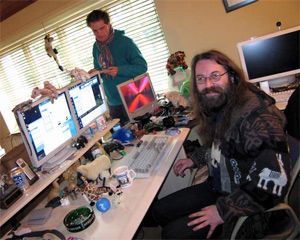
It's unfortunate that the early days of gaming were plagued with stereotypes (which some people, see the delightful Jeff Minter, pictured to the right, are still more than happy to live up to) and this put a lot of people off getting into the hobby. It wasn't a "cool" thing to do. It was the thing that "nerds" did, and the sort of thing that could potentially get you beaten up at school if you were in a particularly rough and less-enlightened place.
The thing is, though, at least some of the stereotypes had partial basis in fact. Early gaming demanded many things. Patience. An understanding that you were dealing with a brand new technology that wasn't particularly refined yet. In many cases, a mathematical mind. A willingness to practice things until you got better. Early games were frequently simple affairs that artificially inflated their playtime by being ludicrously difficult. This made the hardcore gamers very happy when they were able to finally beat a particularly difficult level, but for people who might be interested in passing? They didn't want to spend that much time in front of a TV listening to the whining and squeaking of a cassette deck loading games.
Over time, though, games have become more and more sophisticated, family-friendly and accessible. A big part of this movement has come via games consoles, which have actually been around almost as long as home computers. Games consoles are made to be hooked up to "the big television" of the house and, in the early days at least, were often filled with experiences made to be shared—indeed, the very first gaming machines were primitive multiplayer "tennis" affairs. Later, we got many arcade conversions, and TV advertising, particularly the cringeworthy efforts from Atari, encouraged family participation and friendly competition.
As consoles became more and more sophisticated, developers started experimenting with a greater focus on developing narratives throughout their games. We saw titles such as the ambitious Final Fantasy series telling surprisingly mature, sophisticated (if now clichéd) stories through the SNES and PlayStation 1 periods having graduated from their primitive roots on the original NES. Graphics improved at a rapidly-increasing rate, giving us games that wanted more and more to be like the movies. But still they were tied to arbitrary control schemes that required practice; there was still a barrier of entry: "you must be this skilful to enjoy this medium".
Until we get to this generation. This generation of gaming has exploded. We're at a stage now where gaming is accessible to pretty much anyone. We're at a stage where gaming is no longer confined to one specific demographic. We're at a stage where you don't even need a controller to work your Xbox if that's the route you want to take.
Love them or hate them, several things have done a huge amount to make gaming more accessible to the masses. The Wii and the variety of plastic-instrument music games such as Rock Band brought family-friendly, "lifestyle" and party gaming back, reminding people how much fun it was to get together with friends and play in the same room. Kinect for the Xbox provides entertaining, active games that kids and adults alike can enjoy without having to remember which button does what. Facebook games like Farmville, while shallow to people who have been playing games for years, provide bored office drones and soccer moms with fun things to do on the Internet. Call of Duty lets the frat boys (and girl-equivalents) of the world blow seven shades of shit out of each other whilst shouting racial epithets at one another. And the blossoming independent development scene sees digital artists and creative minds pushing the boundaries of what "interactive entertainment" really means.
Games may or may not be art—that's an interminable question that may never be answered conclusively. But one thing games aren't? Just for teenage boys. Give 'em a shot. You might surprise yourself.
In an attempt to batter the shit out of my Pile of Shame, I'm playing Final Fantasy XII, a game which I bought upon its initial release—just like every Final Fantasy—and have spectacularly failed to finish—just like every post-IX Final Fantasy. (I have since finished X and X-2 and maintain that X-2 is an excellent game despite being almost—but not quite—as gay as Space Channel 5)
The thing is, FFXII is good. Really good. Like, "it's a Final Fantasy for people who hate JRPGs" good, in that it dispenses with all the usual bullshit (rigid linearity until the last hour, when saving the world can be inexplicably put on hold to go and raise some chickens, endless random battles) and provides an experience that is altogether more "Western" in its feel. We have a much more open world. We have enemies wandering around in the field. We have immensely satisfying combat which takes place in the field. We have sidequests with a bloody quest log and we have an interesting, if unconventional, character development system.
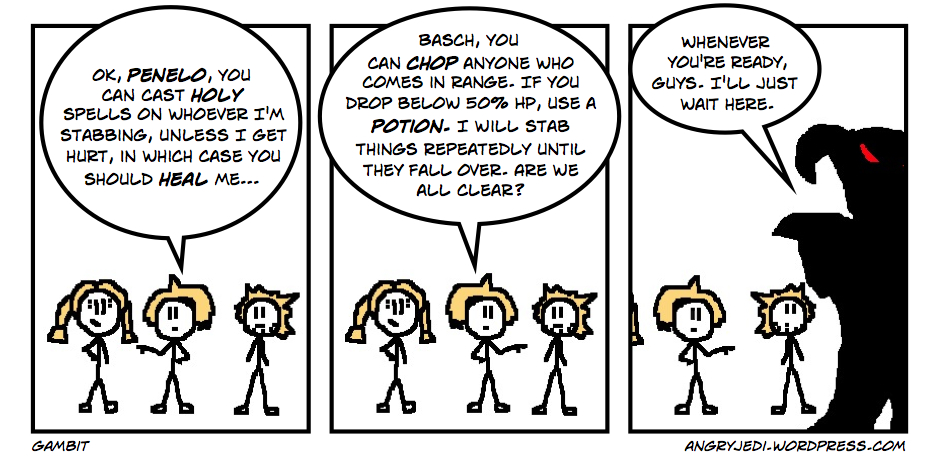
And we have Gambits. I was all set to dismiss Gambits as a means of getting the game to play itself. But having played it for about twelve hours now (coming up on the point that I originally got distracted by something else on my initial partial-playthrough, so we're nearly into new territory) I've discovered something: Gambits are awesome.
If you passed on FFXII, let me enlighten you. A Gambit is a means of "programming" your party members to act in particular ways. You give them a particular condition, such as "Ally has less than 50% HP", and then give them an action, like "Cure". You can prioritise the actions, too, so certain things will take precedence when more than one of the conditions are true. And as such, you can plan out the way you'd like a battle to unfold before it starts.
In many senses, it's like that "group huddle" you have in something like World of Warcraft before you take on a dungeon's boss. Everyone has a role to play, and it's important that people stick to that plan where possible, but be able to adapt to the situation if necessary. That's why FFXII gives you the opportunity to immediately issue direct commands, too, which override any and all Gambits in play. In fact, it's technically possible to play the entire game by micromanaging every action all your characters do, but it would probably take you approximately ten times longer to play the game if you chose to do that. Gambits aren't letting you leave the game on autopilot—they're letting you plan out a battle before it happens and then just focus on responding to situations as they arise. You'll frequently have to switch them out to take advantage of particular enemies' weaknesses, and I've noticed myself spending a lot more time in the menu in FFXII than I would do in earlier, more traditional entries in the series. Planning out the way the characters will respond is interesting and addictive, and immensely satisfying when it goes right.
In fact, the only thing which may be a bit off-putting to some people about FFXII these days is the graphics. In this HD age, FFXII looks pretty ugly, and ironically this is because it was a pretty good-looking PS2 game. There is a lot of detail in both the textures and the characters, but the low resolution which the game runs at gives the whole thing a very "muddy" and flickery look which some people may find a bit difficult to deal with. It's certainly not unplayable, though, and spending a bit of time in the company of the PS2 serves as a reminder that games didn't always need HD graphics and Achievements to be good.
(Interestingly, FFXII does actually feature a proto-Achievement system in the form of the Sky Pirate's Den, which fills with trophies as you fulfil certain accomplishments in the game.)
So, if you're hungering for a great almost-Western-style RPG with a JRPG aesthetic? Give ol' FFXII a chance. If FFXIII didn't push your buttons with its "here's a straight line to the finish, apart from this bit" mentality, FFXII is what you need. Join me in my quest through my Pile of Shame!
Christmas is over for another year, and so here we are on Boxing Day (or actually the day after if you're operating on UK time)—a day which apparently isn't particularly well-known in the US. In all honesty, it's not particularly well-known in the UK, either, aside from the name. It's just "the day after Christmas".
There's plenty of things that can be done on Boxing Day, and they tend to vary according to your age.
If you're a young kid, Boxing Day is a day to spend playing with all the presents you got and suffering from some pretty severe analysis paralysis while you work out what to do next. When you have the amount of choice most kids get these days after receiving a veritable truckload of presents, it's easy to see how they might get overwhelmed with things to choose from.
If you're a bit older, Boxing Day is probably a day for a hangover, whether it be caused by excess of alcohol, excess of food or, more likely, both. It also marks the beginning of The Great Leftovers Season, by the end of which you will never, ever want to see turkey ever again, whether it's on a plate with potatoes and gravy, stuffed into a sandwich, made into a curry or whatever vaguely inventive ways you've come up with to use turkey. Turkey is, of course, a meat which barely gets eaten throughout the rest of the year. Is this because it's just like an enormous dry chicken? Or is it because we eat so much of it throughout the holiday season that no-one can bear the thought of eating it again at any point in the rest of the year?
It's a pretty universal constant whatever your age, though, that the day after Christmas is for resting, sleeping, lolling on the couch (the original meaning of lolling, not the Internet meaning) and watching the DVDs that were inevitably in your Christmas stockings.
There's an exception, though: households which got a Wii or Kinect for Christmas. The Wii and Kinect get people up and about a little bit more than they would otherwise be, since they're popular gifts with kids and adults alike, and they require that you get off your turkey-filled ass and jump around. Quite literally in the case of Kinect.
Incidentally, if you are still a Kinect doubter, I defy you not to at least find the damn thing clever as hell. Yesterday we were trying it out and didn't have enough space to play with two people on Kinect Adventures, so we moved the couch back a bit. By the time we'd turned back to the screen, the game was asking if we'd like to play two-player mode. Without us telling it. Witchcraft and sorcery!
Hope you've all had a suitably festive festive season and have some appropriately awesome plans for the new year. 2011 better not suck as much as 2010, though I recall saying something very similar at the end of 2009 so I'm not going to hold my breath until something actually awesome happens!
I think it's pretty much a given now that I'm a fan of creative indie games, particularly ones that put unusual twists on established formulae. There's one I haven't really talked about here yet, and I feel I should rectify this forthwith.
My brother (John Davison of GameSpot, for those three of you who haven't realised that yet and are now going "Oh, yeah!") mentioned on Twitter the other day that asynchronous multiplayer was "multiplayer for grown-ups". Or specifically, multiplayer for people with little to no free time. Eminently suitable for those with jobs. Or those with families. Or those who simply suck at action/skill-based multiplayer titles.
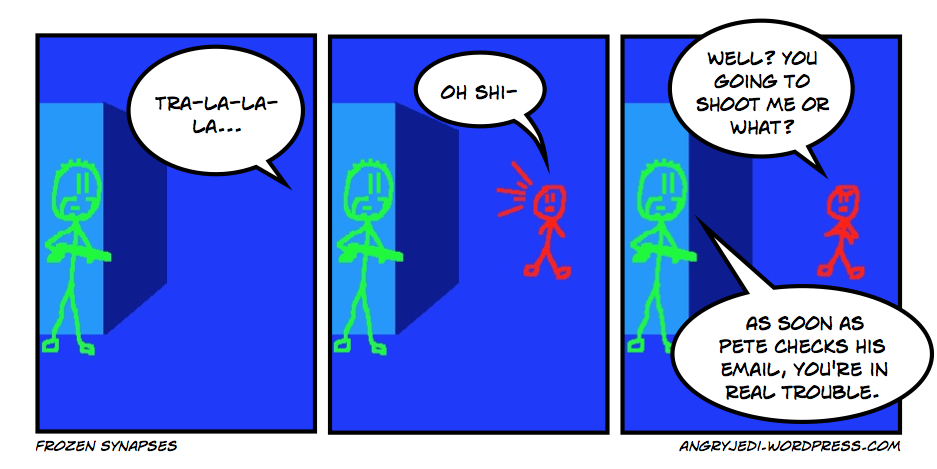
Mode 7 Games' Frozen Synapse caters for this crowd, specifically the subset of it who wish that they could pull off a headshot at a hundred paces but no longer have the reflexes of a twelve-year old with too much sugar and caffeine in their system. Frozen Synapse is, at heart, a team-based first-person shooter, albeit one represented from a top-down view played in turns by only two people. So not a lot like a first-person shooter at all, really.
Except that it kind of is. For the uninitiated, Frozen Synapse features a wide selection of different game modes, many of which will be familiar to players of shooty-shooty-bang-bang games. The simplest is Extermination mode, which simply tasks one team with killing the other team before five turns are up.
Each turn represents a five-second period of time, during which your little people can run, walk, duck, crawl, aim, shoot and focus on specific targets. It's your job to set up a plan of action for them by setting waypoints and actions, then testing your plan to see where they'll end up after five seconds, then committing your plan. At the same time, your opponent is also doing this, and when both of you have committed your plans, the outcome is shown, and it may not be what you had anticipated.
The cool thing about it, though, is that you don't both have to be online to play. It's essentially play-by-email, with the game sending a message to your opponent when you've taken your turn and it's time to check out the carnage. This means that you can have a whole bunch of games on the go at the same time, and be able to rattle through them all in a matter of minutes. It's a great idea, and it's awesome to see this kind of idea work in a setting other than a game with With Friends in the title.
Best of all, the game plays well and it's not even finished yet. The final product promises a single-player campaign mode, puzzle mode and all manner of other goodies. Those who are keen to support the game can pre-order and play the beta version right now, though, and you get a free copy to give to a friend, too. Which is nice.
Even better than that, the game is 30% off until Christmas. So if you're the slightest bit interested in the unusual concept—and it genuinely does work really rather well—I'd encourage you to support the hard-working three-man team that is Mode 7 and pre-order a copy now.
If you do, be sure to send me a challenge. I cordially invite you to the turn-based bloodbath.
Those who doubt the value of the iOS platforms as serious gaming devices should take a look at some of the stuff that's come out recently. The iPhone and iPod touch are becoming gaming powerhouses, and not just for portable versions of timewasters like Bejeweled Blitz and Farmville.
No, in just the last couple of weeks, we've seen some spectacular games show up. Epic's Infinity Blade, for example, provides spectacular graphics and a cool update on, of all things, Punch-Out!! Trendy Entertainment's Dungeon Defenders gives us an interesting multiplayer twist on both the action RPG and tower defense genres, despite being a little bit too ambitious for its own good on the small iPhone screen. (Stick with it past the tutorial, though; once you're done with the screen-filling tutorial text, the interface is still a little bit cluttered, but less burdensome). Lara Croft and the Guardian of Light provides the same experience as the console and PC versions—complete with co-op. And Aralon is pretty much Oblivion in your pocket.
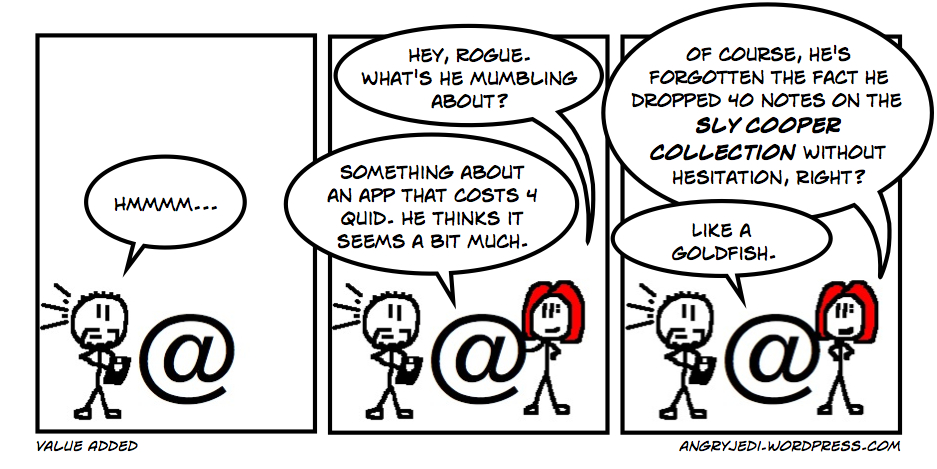
Stop and think about those for a minute. Those are all pretty fucking impressive games to run on a phone. Things get even more impressive when you look at the prices for each—the most expensive of those mentioned is Aralon, which is three English pounds and ninety-nine pence. Compare and contrast with Oblivion, which launched at £40 on consoles.
The thing is, though, the App Store and its customers appear to operate in some sort of weird parallel economy. Aralon's predecessor, Ravensword, sells for 59p and offers a pretty thorough RPG experience. And yet there are reviewers who say that they have "wasted their money" because it didn't have one feature they thought it should have in it.
Seriously. These people need to get a little perspective. 59p for 20-30 hours of entertainment is pretty outstanding value whichever way you slice it. £3.99 for the same amount of gameplay is still pretty fucking amazing value. There are games that are considerably technically inferior to these games we're getting on iOS devices now selling for £20-35 on the Nintendo DS. Ace Attorney on the iPhone is a tenth of the price it is on the Nintendo DS, and it's the same game. Lara Croft and the Guardian of Light is 1200 Microsoft Points on XBLA, whatever that means. It's 4 quid on the App Store. And again, it's the same game—except it actually shipped with co-op built in.
iOS gamers, you've never had it so good. At some point, developers will figure out that they're vastly undercharging people for these awesome games, and prices will rise. So stop bitching and make the most of these incredible experiences while they're still the price of a coffee in Starbucks.
 Earlier today, this animated image from Insomniac Games' Resistance 3 did the rounds. Impressive. But also rubbish.
 The other night, I posted a question on Formspring. I thought I sent it to just a couple of friends but apparently somehow shared it with the entire Internet, as a lot of people, some of whom I hadn't come across on Formspring before, appeared to be very enthusiastic to answer it. I was somewhat surprised at the amount of depth people were putting into their answers, because it was, after all, a somewhat flippant question that I wasn't expecting people to take seriously at all. How wrong I was.
 On the Internet, opinions exist in a binary state for many people. There is your opinion (1), and there is everyone else's opinion (0). Sometimes other people's opinions coincide with your own, meaning they can join you in the happy 1 gang, while the 0-toting losers get to stand over there being Wrong.
 Bloody MMOs. They seem to be something of a weakness of mine, despite the fact that I've never been what I'd call a "hardcore player" of them. To whit, the character I started on the launch day of World of Warcraft only hit level 80 towards the end of last year, and I haven't gone back to it since Cataclysm hit store shelves. Over the years, I've tried Everquest (crashy), Dark Age of Camelot (bewildering and intimidating), Ultima Online (slooooow), Everquest 2 (pretty), City of Heroes (super-fun), Final Fantasy XI (<Incredibly tough><Galka><rod>+<Mithra>=<Help me out!>), Star Trek Online (space combat! Yay!), EVE Online (WTF am I supposed to be doing?) and probably a few others besides.
 Anyone who's had any kind of interaction with any kind of online community and wanted to take your relationship with the people you know to the "next level" will have dealt with the situation above at some point or another in their life. You're sure you recognise someone from their avatar, but you're not quite sure if you should go over and say hello to them or not, even though you might have been exchanging filthy penis anecdotes online for the last two years. (Filthy anecdotes about penises. Not anecdotes about filthy—oh, you know.)
 A lot of my fellow
 It's unfortunate that the early days of gaming were plagued with stereotypes (which some people, see the delightful Jeff Minter, pictured to the right, are still more than happy to live up to) and this put a lot of people off getting into the hobby. It wasn't a "cool" thing to do. It was the thing that "nerds" did, and the sort of thing that could potentially get you beaten up at school if you were in a particularly rough and less-enlightened place.
 In an attempt to batter the shit out of my Pile of Shame, I'm playing Final Fantasy XII, a game which I bought upon its initial release—just like every Final Fantasy—and have spectacularly failed to finish—just like every post-IX Final Fantasy. (I have since finished X and X-2 and maintain that X-2 is an excellent game despite being almost—but not quite—as gay as Space Channel 5)
 Christmas is over for another year, and so here we are on Boxing Day (or actually the day after if you're operating on UK time)—a day which apparently isn't particularly well-known in the US. In all honesty, it's not particularly well-known in the UK, either, aside from the name. It's just "the day after Christmas".
 I think it's pretty much a given now that I'm a fan of creative indie games, particularly ones that put unusual twists on established formulae. There's one I haven't really talked about here yet, and I feel I should rectify this forthwith.
 Those who doubt the value of the iOS platforms as serious gaming devices should take a look at some of the stuff that's come out recently. The iPhone and iPod touch are becoming gaming powerhouses, and not just for portable versions of timewasters like Bejeweled Blitz and Farmville.