I've been off work ill for the last three days, and not the fun kind of ill where you can just lie in bed and have people bring you food and drink without really having to "suffer" very much. No, I've had a rather unpleasant stomach bug of the — if you'll pardon the graphic detail for a moment — "I need to go to the toilet roughly every half an hour and now my arse is burning with the fury of a thousand angry suns" variety. And it doesn't seem to have shifted itself just yet, which means I'm probably in for another rough night if the noises my stomach is currently making are anything to go by.
But I digress somewhat; taking the time off to recover has allowed me to catch up on some handheld gaming, because we all know handheld gaming is the best gaming when you're ill, because it's easily portable for those circumstances like, say, when you need to urgently rush to the toilet to fire off another salvo of acidic excrement that would probably make a pretty solid special move in combat were it not for the searing pain it temporarily inflicted on the origin point.
Um. Anyway. Yes. Handheld gaming. Specifically, I took the opportunity to try and beat Hyperdimension Neptunia Re;Birth1, which I've been playing for a while now. Like most Neptunia games, I found myself not really wanting it to end, but I also eventually reached a point where I was running out of things that it was possible to do in a single playthrough, and so I powered on to the ending, beat the final boss, saw the credits (which, in typical Neptunia tradition, are accompanied by a glorious, lovingly rendered pixel-art, game-style synopsis of what you've just played) and promptly started a New Game + with a mind to cleaning up the last few Trophies I hadn't quite finished off. Specifically, I had four characters to recruit — Nepgear, Uni, Rom and Ram, the four "CPU Candidates" who were originally introduced in Hyperdimension Neptunia mk2 — and 100 million Credits to acquire via some means, but I decided to take a momentary detour to the game's optional "Colosseum" mode to fight some tough battles with the promise of various characters' ultimate weapons as a reward.
And hoo boy. Ultimate is the word. Rather than the gradual creeping up of stats that most weapons provided over the course of the normal game, the various characters' ultimate weapons boost their stats by a ridiculous degree, making even the toughest bosses melt like butter beneath your relentless onslaught. Couple this with the Celestia Bangle armour that you get for beating the game with the True ending — only one, sadly; if you want more you need to beat it multiple times — and you have a nigh-unstoppable fighting force.
Or so you'd think, anyway; pleasingly, even when geared up with this array of "best in slot" equipment, there are still plenty of stiff challenges throughout the game — challenges that were simply insurmountable when tackled with regular equipment, but which merely become quite difficult when equipped to the max in this manner. In the meantime, it becomes possible to hack and slash through the main story in a couple of hours (assuming you're skipping dialogue sequences) rather than the 55 hours or so it took me to beat it the first time — with story bosses that once proved a roadblock to progression falling after just one or two attacks in most cases. Eminently satisfying.
This is something that developer Compile Heart is good at, in my experience; while the difficulty curve throughout the game may be more of a pit of spikes of varying height on your first playthrough, breaking through the initial barrier and coming around for a second pass gives you a glorious feeling of power and supremacy over almost everything in the world — though there's still the odd enemy here and there that is more than willing to knock that cocky smile off your face if you're getting a bit too confident.
So far my post-game cleanup is going well; I've just unlocked Nepgear and almost have enough MB left to unlock either Uni or Rom and Ram (they come as a pair) by the end of this second playthrough. Then the only thing left is a whole lot of fighting one of the toughest foes in the game in the hope of acquiring 100 million credits. After that, I'll be happy to add Re;Birth1 to my list of "100% completed" (or at least Platinum trophied) games — a sure sign that I've had a blast with it.
I wouldn't say by any means that I'm a die-hard petrolhead, but I do enjoy a good driving game, with the emphasis on game. That is to say, I tend to find the more hardcore driving "simulations" such as Forza Motorsport and Gran Turismo to be hard going, slow paced and more difficult than is enjoyable; I'd much rather play something where the "correct" way to play is to fling your car sideways around a corner, not caring if you're smashing street lights and fencing all over the shop, not worrying about fucking your car's performance up after a few bumps and scrapes, not having to engage in anything even remotely resembling "sportsmanship" when racing against other cars, be they computer- or player-controlled.
One of the driving game series that I did find myself enjoying a whole lot over the years was Bizarre Creations' Project Gotham Racing series, which actually began with the venerable (and awesome) Metropolis Street Racer on Sega's ill-fated 128-bit console, the Dreamcast. Project Gotham as a whole occupied a curious middle-ground between serious sim and arcadey racer; on the one hand, you were racing real cars around realistic environments and it wasn't really a "smash and bash" racer — in fact, Metropolis Street Racer even penalised you if you crashed too much, though this harshness was toned back a little in the later games, since they were already difficult enough — while on the other, you were flinging your car around with gay abandon, swinging its back end out whenever possible, darting between cone gates and playing chicken with upcoming walls as you tried to build up enough speed to actually leave the ground when racing down San Francisco's hilly streets.
In other words, Project Gotham demanded some genuine driving skill, but also knew that people liked having fun in cars, too — the sort of fun that would quickly get you arrested were you to try it… well, anywhere, really. Project Gotham allowed a safe environment for you to hop into various high-spec sports cars (and a few low-end crap cars towards the beginning) and just have some fun. It was later taken to the next extreme by the rather wonderful commercial flop Blur, which combined Project Gotham's semi-realistic racing (and real cars) with the stuff of pure fantasy — neon-coloured Mario Kart-inspired weapons that allowed you not only to race aggressively against your opponents, but to fire various explosive devices up their tailpipe, too. How sad that it wasn't more of a success than it was.
But I digress. Today I've been playing The Crew from Ubisoft, a game that I've been cautiously curious about ever since I first heard about it a year or two back. Promising a (somewhat scaled-down) recreation of the entirety of the United States of America, a variety of different mission types and a strong focus on working together with actual, real-life other people, it sounded like a natural evolution of the direction racing games had been moving in for a while.
Need for Speed Underground 2 introduced us to the idea of a racing game set in an open world. And boy did it work well. It worked so well that pretty much every Need for Speed game since has had some variation on this formula, with you driving around a vast (and suspiciously geographically diverse) map to discover events, take them on and complete them — or just to drive around for the fun of it. These open worlds didn't have the same level of detail about them as something like Grand Theft Auto, but they didn't need to; you only saw them from behind your windshield, and you never left your vehicle, unlike in Rockstar's classics. They did the job, though, and that was to provide you with an interesting environment in which you could get to know your car and the various roads, then challenge you with various events that would test your knowledge of both these things in a practical sense.
Later racing games played with this formula in different ways: Need for Speed Most Wanted had a strong emphasis on dramatic police chases, for example, while Need for Speed Hot Pursuit (the more recent version) actually allowed the choice of whether you were cops or street racers. Burnout Paradise, meanwhile, took that series' typically exaggerated crashes and built a whole game mode out of them, where you'd have to crash and then bounce your car along the street for as long as possible, hitting as many things as possible along the way. (Oh, you could race a bit, too.)
The reason why I'm bringing up all these other games is that The Crew, so far, feels like an entertaining mishmash of all of them. It has Burnout's crashcam, Project Gotham's driving through gates and beating speed milestones, Need for Speed's police chases. All of these different strands of DNA are very much apparent as you play, but for some reason it's Project Gotham I keep thinking of as I play, even though they're very different games; Project Gotham may have unfolded in realistic environments like The Crew does, but it took place entirely on enclosed courses rather than in open-world environments where it's possible to find shortcuts and go off-piste.
I think it's the variety of events which brings this to mind: most open-world racers in the last few years have included some sort of variation on the "race, destroy, time trial" formula, but The Crew adds a number of additional elements to the mix in the form of small, short skill challenges dotted around the various maps. Bringing to mind some of Project Gotham's short but teeth-gnashingly difficult challenges, the skill tests task you with everything from remaining above 50mph for as long a distance as possible in a time limit to slaloming around posts. And, of course, just completing these tasks isn't enough; there's bronze, silver and gold levels of completion to take on, plus online leaderboards.
Perhaps the most interesting thing about the game, though, is the "co-op" multiplayer, as this adds a strange and welcome twist to the usual online racing formula. Instead of everyone jockeying for first position as usually happens — or, more accurately, the person with the best car screaming off ahead, never to be seen again, as everyone else fights for second — these events just require that someone wins. Everyone else's job then effectively becomes ensuring that the computer-controlled racers don't have the opportunity to catch the person who is screaming off ahead, hopefully never to be seen again; it becomes a team effort, and when it works, it seems like a whole lot of fun. Unfortunately, I've only had the opportunity to try event in this manner so far, but hopefully as more people pick up the game there'll be more chances to enjoy the game the way it was clearly designed to be played.
The Crew is often described as an "MMO", though at present that's not altogether accurate. The execution is somewhat like Test Drive Unlimited, in which you'll be driving around minding your own business and occasionally see other people in the area. When you reach an event, you have the option to "quick invite" anyone in the vicinity to join you, or you can pre-form a crew of up to four people to tackle challenges in a more organised manner. There don't seem to really be enough players online as yet — at least not on the PC version — to make this feature shine as it should, but I'm interested to see how — or indeed if — it grows in the coming weeks.
Even if it doesn't, the single-player offering seems fairly solid, and it has so far made a good start at fulfilling my wish of a racing game with a semi-decent story, so I'm intrigued to see what happens next. I'm also pleased to see the protagonist is a bespectacled, bearded Gordon Freeman lookalike rather than the usual self-consciously cool douchebags that usually populate this sort of game.
First impressions are pretty good then; more will doubtless follow very soon.
Well, if it's good enough for Sony — they are celebrating the 20th anniversary of their console, after all — it's good enough for me.
Here are my top three original PlayStation games.
…Shit.
There are too many. There are way too many to choose from that I've played over the years. Some of them are incredibly obvious choices. Others are games that I have but a dim memory of playing, but which have stuck in my brain ever since. I can't choose three. I can't.
So I won't. Instead, I'm going to present some fake awards for the games that have stuck in my mind ever since I first played them. In some cases, it may have been 15-20 years since I played them, but they still carry significant meaning to me for one reason or another. In many cases, they may not even be among the best games on the platform, but for whatever reason I have remembered them fondly ever since.
Here we go then. The first one is an obvious one, but I don't think many people will argue against it.
The "wow, this is better than anything I've ever seen before" award
What other game could this go to than the original Ridge Racer?
The word "revolutionary" is thrown around far too much with regard to games these days, but Ridge Racer was genuinely revolutionary. It clearly demonstrated the vast difference in power between the 32-bit PlayStation and the 16-bit Super NES and Mega Drive that had come before.
Its slick 3D graphics and unapologetically arcadey handling — remember this was in the days when we were still using digital control pads rather than analogue sticks — made it an absolute joy to play. And despite a relative lack of content compared to modern games — there really weren't very many tracks at all, and all of them were based in the exact same environment — it was a game that could keep you occupied for hours as you tried to beat the irritating yellow car and its even more irritating later counterpart, the black car: an adversary so cocky that it often parked on the side of the road in order to allow you to catch up a bit.
A not-particularly-interesting anecdote about Ridge Racer is that it also kind of introduced me to electronic music. Prior to that game, I'd dismissed a lot of electronic music as being just noise — at least partly due to my parents regarding it as such — but over time I came to appreciate the weird and wonderful accompaniments to the racing on the soundtrack, and was much more open to the idea of listening to electronic music outside of games as a result.
The "holy crap, this is on the same system?" award
It would be remiss of me to talk about Ridge Racer and not mention the much later Ridge Racer Type-4, a game which came out much later in the PlayStation's lifespan but which still plays like a dream today.
Ridge Racer Type-4 was noteworthy not just for being a great game — and a great-looking game with what passed for "photo-realistic" visuals at the time of its release — but also for being beatifully designed, too. Take a look at the video above and tell me that those bright yellow animated menus aren't immediately distinctive and memorable — and instantly recognisable as being from Ridge Racer Type-4.
Everything about Ridge Racer Type-4 fitted together perfectly. The hour-long Grand Prix campaign gave you several mini-stories to follow through as you challenged various races in various vehicles. The vehicles you unlocked ran the gamut from the relatively sensible to the ridiculous, such as the jet-propelled monstrosity you unlocked later that really, really didn't like going around corners.
And the music. Oh, the music. At the time Ridge Racer Type-4 came out, my friends and I had discovered a genre of music known as acid jazz — a blend of jazz, funk and hip-hop typified by artists such as the Brand New Heavies and Jamiroquai. We would listen to pretty much nothing other than this type of music, and so we were delighted to discover that Ridge Racer Type-4's soundtrack consisted almost exclusively of music of this ilk — certainly a far cry from the early-'90s electronica of the first game — and even more delighted when we found that Namco had very much made this distinctive sound part of their in-house "style" for a while, as other games such as Anna Kournikova's Smash Court Tennis (an honourable mention in this list) also had a rather jazz-funk flavour about them.
Racing games have come a long way, but few modern titles provide the same degree of satisfying arcade fun that Ridge Racer Type-4 still does. And now you can download and play it on PSP and Vita. And typing this, I'm very tempted to go and do that after I'm done here.
The "so I like RPGs now" award
Final Fantasy VII. I don't think I really need to say anything else about this, so here's the intro — still one of my favourite game openings of all time.
The "inexplicably burned into my memory" award
I played a lot of role-playing games on PlayStation — at least, after I discovered Final Fantasy VII and the genre as a whole — but I actually have a pretty good memory of most of them, and indeed enjoyed most of them, too, even those that were objectively lower-quality and lower-budget than other games available at the time.
One such game that has stuck in my mind for a long time is The Granstream Saga.
I remember only a few very specific details about The Granstream Saga: it had some lovely anime cutscenes; it had a great battle system that was somewhere between a traditional RPG and the real-time combat of games like Zelda; it featured two heroines called Arcia and Laramee (the latter of whom donates her name to my custom characters in games any time "Amarysse" is not available); and that none of the polygonal models had any faces.
I'm not sure why The Granstream Saga has burned itself into my memory quite as much as it has, but of all the RPGs I played on PlayStation, it's one of the ones I remember most fondly. I'd be interested to replay it sometime and see how it holds up, graphics aside.
The "I like this more than Zelda" award
Yes, I like The Adventures of Alundra more than pretty much any Legend of Zelda game I've played to date. (Disclosure: I only played a couple of hours of Wind Waker and Twilight Princess, and haven't played Skyward Sword at all.)
Alundra surprised me, because it came along at a time where, so far as many teenage gamers were concerned — teenage gamers like my school friends and I, for example — it was 3D or nothing. 2D games were things of the past; it was all about the 3D now, and preferably games that came on more than one disc. (My friend Woody believed for many years that it was physically impossible for a game to be as good as FInal Fantasy VII, which came on three discs, if it only came on a single disc. This was despite me pointing out that the three discs of FInal Fantasy VII all included the exact same game data, and the only thing different between them was the prerendered cutscenes. I could never convince him.)
Alundra was staunchly 2D, though. It wasn't even a little bit 3D — games like Castlevania: Symphony of the Night (which we'll get onto in a moment) supplemented their beautiful 2D art with 3D backdrops and other scenery elements, whereas Alundra was a pixel-art labour of love, with hand-animated characters, a distinctive and consistent aesthetic and the feel that, aside from the screen resolution, it may well have been possible to recreate on the Super NES.
After I got over my initial culture shock at playing a 2D game, though, I discovered something wonderful: a beautifully designed Zelda-style action RPG with, to date, some of the best-designed puzzles I've ever solved without the aid of GameFAQs. Alundra's puzzles were difficult — more difficult than that which Zelda typically offered — but never insurmountable, and consequently they gave a wonderful feeling of achievement when you successfully solved them.
The plot was pretty cool, too. In fact, it went on to inspire a story that I've had half-finished in my head and various word-processing documents ever since. One day I should probably finish that.
The "Hmm, 2D platform games are still relevant" award
2D platformers have had something of a resurgence in recent years thanks to the indie scene, but in the early years of the 32-bit era, developers and players alike were thoroughly enamoured with 3D, with everyone trying to recapture the magic of Super Mario 64.
Castlevania: Symphony of the Night proved that 2D still had a place, however. And what a game it was.
The game was immediately striking thanks to its intro, seen in the video above. The beautiful pixel art, the incredible soundtrack — by gosh, I miss old-school Castlevania music — the cringeworthy but memorable voice acting and script… all of it combined to make the second-most badass intro sequence after Final Fantasy VII in my book.
What was perhaps most interesting about the Symphony of the Night intro, however, was the fact that it was actually the last level of the previous game. Only after you beat Dracula — in a fight that you couldn't lose this time around — did the game proper begin, and then you were in to one of the earliest examples of the "Metroidvania" genre: a type of 2D platformer where you could freely explore a single, huge world split into distinct areas, some of which were blocked off by the requirement for you to unlock specific abilities first.
Symphony of the Night as a whole was so great because it was designed well, played well, treated the player fairly and didn't outstay its welcome. It was over and done with in about 10 hours — including the "secret" second castle — and by that point you'd had an eminently satisfying experience filled with thrilling boss fights, challenging platforming and, of course, amazing music. It's no surprise that this Castlevania above all others is the one that keeps getting re-released.
The "this game is broken as hell, but I still love it to pieces" award
Bust-a-Groove took up a considerable proportion of one of our summers. Why? Because it was brilliant.
Bust-a-Groove was one of the earliest examples of "rhythm action" games that I remember playing, and took the unusual approach of being somewhat like a fighting game — it had different characters, each of whom had their own iconic stage, and you worked your way through them to a non-playable final boss. The whole thing was over in the space of about 20 minutes or so — a single playthrough was, anyway — but it was the kind of thing we all enjoyed playing over and over again with different characters.
Why was it broken as hell? Because of its multiplayer mode, and because of the nature of its gameplay. By requiring the player to input specific button sequences in time with the music, it was possible to get a "perfect" score on a level, and if two evenly matched players squared off against one another, it almost always ended in a stalemate. The game's answer to this was to provide a couple of special attacks that could be triggered in time with the music, but there was also a dodge button and a very obvious cue that these attacks were coming so, again, two evenly matched players would more than likely end in a draw, while two players of different skill levels would be a foregone conclusion.
As dumb as it was, the personality-packed characters, the detailed stages and the incredibly memorable soundtrack made this one of my favourite games of the PlayStation era.
The "I like this more than Zelda, too" award
Here in Europe, we got screwed over on the RPG front for a good few years, with many localised titles not making the hop across the pond from America. Fortunately, I had a modified PlayStation capable of playing imported games, so when I visited my brother in the States on one occasion, I took the opportunity to pick up a selection of games I couldn't get back home, one of which was Squaresoft's Brave Fencer Musashi.
Brave Fencer Musashi was a funny game. And I mean that in several senses. It was clearly Japanese through and through, but an excellent job on the localisation filled it with exaggerated Western stereotypes such as the valley girl princess (who calls the protagonist a "little turd" within two minutes of them meeting), the mystic who overdid it on the archaic English and the distinctly camp scribe named Shanky.
Structurally, it was peculiar, too. It had many of the trappings of an RPG — levelling up, HP, MP and the like — but the feel of a 3D platformer, with you exploring a world of gradually increasing size and getting into various setpiece scrapes against bosses and special events. I never got around to beating it, but it was a lot of fun, and I still have a copy on my shelf, so… hmm.
The… hmm.
I've gone on for over 2,000 words and I think I could probably continue if I tried. But I'm going to hold it there for now and perhaps revisit some more PS1 classics tomorrow.
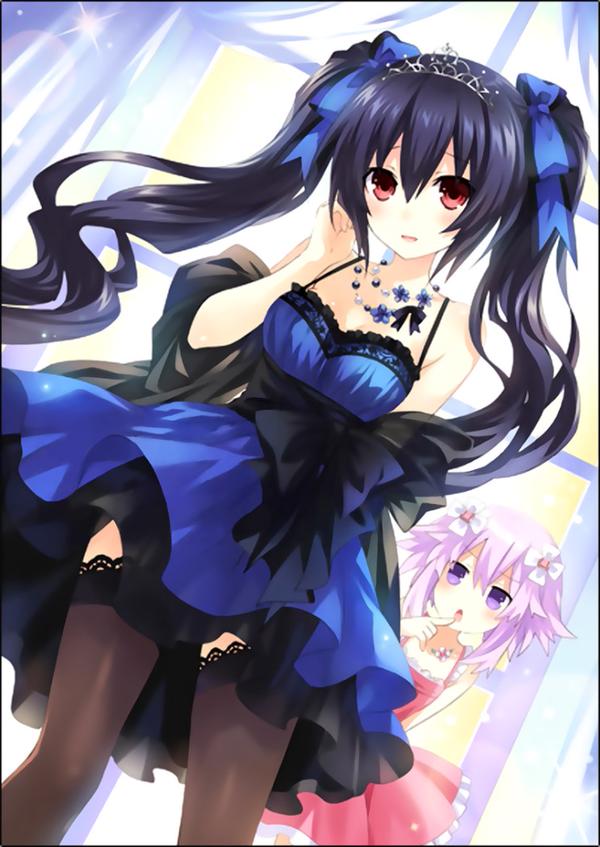
The PlayStation is celebrating its 20th birthday in Europe today. What better way of celebrating than with a rather lovely picture of Hyperdimension Neptunia's Noire, personification of the PlayStation brand and platform, dressed up to the nines and clearly in slightly awkward party spirit?
Hnng, I'm sure you will agree.
Lovely Noire aside, the PlayStation's 20th anniversary feels like a suitable occasion to share some fond memories of my time with Sony's platforms over the years, and what PlayStation has meant to me. I realise that by doing this I am, of course, falling into Sony's cunning marketing trap, but since I'm not a professional games journalist any more I can say whatever the fuck I want, not to mention post pictures such as that seen above.
Anyway.
My first memory of PlayStation is much like my first memory of many consoles from the SNES and Mega Drive era onwards: a unit came home with my brother, courtesy of his work on games magazines, accompanied by a few games, and thus I had the opportunity to try it out well before any of my friends ever did — though I would find myself biting my lip and never being sure whether or not five minutes after the poor chap had arrived was too soon to go rifling through his bags in search of technology and game cases.
The first three games I ever played on PlayStation were Ridge Racer, a pre-release version of Tekken (which had a bug or two here and there) and Raiden Project. Ridge Racer was, of course, absolutely gobsmacking at the time (though I still find it amusing that it upstaged itself with its fourth installment coming bundled with a remake of the original that ran at twice the resolution and twice the framerate) and Tekken was one of the most "physical"-feeling fighting games I'd ever encountered. (That cracking sound Paul Phoenix makes when he throws someone still makes me wince.) Conversely, I was initially unimpressed by Raiden Project owing to the fact that its 2D sprite-based graphics looked like the sort of thing the SNES and Mega Drive had been offering us for years by this point. (I later realised that I was being somewhat blinded by the then-revolutionary 3D graphics of the former two games, and came to enjoy Raiden Project a whole lot.)
Ridge Racer and Tekken were both noteworthy for incorporating something that I haven't really seen since: games to play while you waited for the main game to load. Ridge Racer offered Galaxian — and unlocked bonuses if you managed to complete it before the main game loaded — while Tekken offered Galaga. Both were impressive, arcade-perfect ports that ran flawlessly while the game loaded in the background, and I'm sad that this concept didn't take off more, perhaps due to Namco remaining somewhat tight-fisted with the technology. These days the best we get is an interactive loading screen that lets us practice our moves or something, but these tend to only come up once the game has already loaded, not the moment you put the disc in.
Eventually, for some reason, I came into possession of that same (Japanese) PlayStation that had originally come home with my brother. I forget the exact circumstances — I imagine it was due to him getting an official local model — but I was certainly extremely grateful for it. Unfortunately, as still happens with many console games today, the PlayStation was region-locked, meaning that it would only run Japanese games straight out of the box; running European games required you to either install a mod chip (which also enabled piracy, since it effectively bypassed the console's internal copy-and-region-protection systems) or make use of a somewhat questionable trick involving a piece of Blu-Tac, a pen lid, a Japanese game disc and the European game disc you were actually trying to play.
Oh yes, the disc swap trick: most PlayStation owners of the late '90s at least tried it at one point or another. Essentially the trick involved allowing the console to read the copy protection and region info from a disc it would normally accept, then quickly swap this disc out for the game you were actually trying to run. It was a somewhat perilous process that required you leave the lid of the console open at all times (propped open by the pen lid, which was also pressing down the button that told the console the lid was closed) and then whip out the first disc the moment it stopped spinning quickly. It often took a few attempts to get right, but my gosh, the first time I got Final Fantasy VII running in this way was an exciting day indeed.
Ah, Final Fantasy VII. I've waxed lyrical about this game many times on this blog, so I won't reiterate that here, but I will say that at the time it was hyped up to me as "a game that will actually make you cry" and it did not disappoint. It introduced me to the wonderful world of roleplaying games, and gave my friends and I many, many hours of entertainment, since we all finished it several times over. In retrospect, I have no idea how we had the time to do this, but I do know that to date, I have played Final Fantasy VII from start to finish at least ten times over.
Even in those early days, I was someone who enjoyed investigating interesting-looking and strange games, particularly those of Japanese origin. I recall spending a whole lot of time playing the wonderful dance-off game Bust-a-Groove as well as cracking RPGs such as Breath of Fire III, Star Ocean: The Second Story and, of course, subsequent installments in the Final Fantasy series. Visiting my brother over in the States also saw me picking up a number of games that, for whatever reason, never made it to the UK's shores: titles like Brave Fencer Musashi, Parasite Eve, Xenogears and Lunar: Silver Star Story.
Have another Noire to break things up a bit.
I was well into university by the time I joined the PlayStation 2 generation. I wasn't an early adopter, but I was intrigued by this new console and the supposedly immense power it had. But once again when I picked one up, it was not to grab the latest and greatest new titles — the game I chose to purchase my console with was a little-known adventure by Konami known as Shadow of Memories, to date one of the most interesting narrative-based games I think I've ever played.
For the uninitiated, Shadow of Memories casts you in the role of Eike, a man who keeps getting murdered and then having the opportunity to go back in time and save himself. The solutions to the situations become increasingly convoluted as you progress through the story, occasionally involving travelling back hundreds of years in order to, say, prevent a tree from being planted and, by extension, removing the place your assailant was hiding. I'd encountered strong stories in games before — particularly through the aforementioned Final Fantasy VII and adventure games on PC — but Shadow of Memories was noteworthy for me in that it was a console game that had taken the bold step of having neither attack nor jump buttons — it was simply about exploring, enjoying the story and working your way to the truth. (To date, I still haven't seen the game's true ending; I should probably rectify that at some point.)
Shadow of Memories aside, it took me a while to come around to the PlayStation 2, largely due to the fact that for a little while, there didn't seem to be that many role-playing games available for it. I later discovered that this was an inaccurate assessment, of course — and in fact am still discovering great RPGs on the platform today, two hardware generations later — but it took me a little while to warm up to it.
Outside of RPGs, though, the PlayStation 2 did play host to some wonderfully memorable games. The Timesplitters series provided some of the best local multiplayer shooting since GoldenEye — largely due to being developed by the same people — while many a drunken evening was spent with my friend Sam post-Poundstretcher (the regular "everything is really, really cheap" evening at the Student Union) playing various incarnations of the Grand Theft Auto series. And some strange things from that era have remained in our collective vernacular ever since; if we'd never played State of Emergency (not Rockstar's finest hour, but actually a surprisingly fun game) we'd never have come across the phrase "[do something] for BOOOONUS SCOOOOORE!", which is frequently still used among our friendship group whether we're cooking, playing a video game or gathered around the tabletop for a board game.
Have some more Noire. And yes, that brooch is supposed to look like the old Sony Computer Entertainment logo.
I've had an interesting relationship with the PlayStation 3. Initially, I didn't quite see the point of it — in fact, I vividly recall doing some podcasts with my friends Edd and Woody where we were fairly merciless about that big ol' lump of black shiny plastic, but then we were all fairly obnoxious Xbox 360 fanboys at that point, too.
I forget what caused me to pick up one in the first place. I think it was simply a pretty good deal — the console and three games for an eminently reasonable price. The games were Ghostbusters, Fight Night and something else I've forgotten. I played about ten minutes of Ghostbusters, booted up Fight Night once and didn't play it, then quickly found that downloadable games like Flower were much more interesting than many of the retail titles available at the time. My Xbox 360 still got considerably more use — primarily due to the fact that multiplatform titles were often better on 360, and that my friends would typically play multiplayer on 360 — but I always held on to the PS3.
These days, the situation is a complete reversal. I haven't turned on my Xbox 360 for a very long time now — I don't think it's been a whole year, but it's certainly been a good few months — whereas my PS3 still gets regular use, largely due to the fact that, as has been the PlayStation platform's wont ever since its inception, it's still the best place to go for Japanese role-playing games, including titles like the Neptunia series which have since become some of my favourite games of all time. (Yes, really.)
And this isn't even getting into Sony's portable platforms the PSP and the Vita, both of which are criminally underrated platforms full to absolute bursting with top-quality entertainment to cater to all tastes and play styles. My Vita is getting more use than any of the other gaming platforms I own right now thanks to games like Hyperdimension Neptunia Re;Birth1 and Senran Kagura Shinovi Versus, and there's plenty more queued up beyond those two titles, on both PS3 and Vita.
As for the now year-old PlayStation 4? Well, I still don't have one yet, but frankly, with new Neptunia and Senran Kagura games both on the horizon for the new platform, it's clearly only a matter of time before I cave and grab one, isn't it? It just remains to be seen how long I can hold out. I've been doing all right so far, but it only takes one game — perhaps something unexpected — that I really have to play right now for me to take that plunge. Soon. But perhaps not just yet.
Anyway. Happy birthday, PlayStation. You — and let's not forget the myriad developers behind all the games I've talked about today and more — have brought my life great joy over the years, and you continue to fill my free time with fun and frolics even now, 20 years later. Long may it continue — for another 20 years and beyond, maybe?
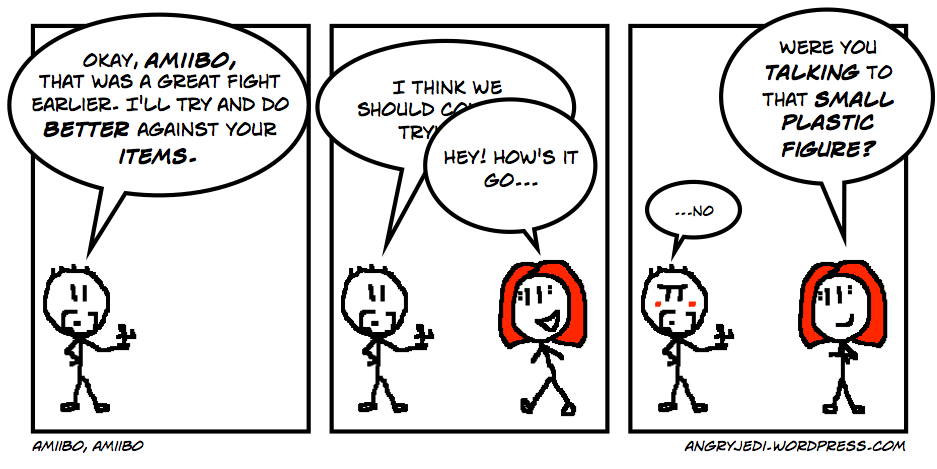
One of the most peculiar things about the new Wii U version of Super Smash Bros. is the compatibility with the "Amiibo" figurines that are sold separately.
During the run-up to release, I'd misunderstood their reason for existence, assuming them to be a means of effectively customising an individual fighter to your liking, then being able to take it around to a friend's house and use your own custom character in multiplayer battles.
I had my concerns about this; any time you introduce an element of customisation to something — particularly if said customisation involves "growth" of power and abilities — you run the risk of giving an unfair advantage to anyone with the customisations, and a disadvantage to anyone playing with stock characters. I had a vision of someone coming over with a level 50 Amiibo and repeatedly kicking my arse with it, not necessarily because they were actually any good with the character, but because they'd simply levelled it up enough.
I needn't have worried, because Amiibos don't work like that. What they do instead is provide you with a computer-controlled opponent that plays alongside you, learns over time and levels up its abilities, gradually becoming stronger and more powerful. You can customise it by feeding it equipment and choosing the special moves it is able to use, and level it up simply by allowing it to participate in games — be it as an opponent in a free-for-all multiplayer battle (you can even go one-on-one against it) or as a teammate in cooperative or team-based modes.
What's interesting about this is that because there's a physical object involved as well as persistence — after you've finished a play session, you write the data back to the Amiibo simply by plopping it on your GamePad for a moment — there's a much stronger relationship between you and this small lump of plastic. I'd even go so far as to say you may well develop a kind of rivalry.
It sounds odd, but it's absolutely true. Andie and I were playing some multiplayer earlier, and we had the Amiibo as a third player for a while — although I took it out for a bit when she started winning pretty much every match. After Andie stopped playing, I brought the Amiibo back in for some one-on-one battles, and it's actually been a lot of fun trying to figure out how to beat her, because as she's levelled — a process which is pretty quick up until about level 30 or so — she's gradually become better and better at playing, and is now a rather challenging opponent that I can still beat, but who certainly doesn't go down without a fight. Victories against her feel somehow more meaningful than a battle against random computer opponents.
While I'm not sure how much the Amiibos add to the experience as a whole — I'm interested to take mine over to my friend's house to bring her into his game and see how that works — they're an interesting little twist, and the figurines themselves are attractive and eminently collectible. I'm not sure whether or not I'll collect them, but they're inexpensive and decent quality, so I'm not ruling out maybe a couple more, particularly if a Shulk one decides to make an appearance any time soon…
Not realising that Black Friday has apparently become A Thing over here, I went into town to pick up a copy of Super Smash Bros. for Wii U earlier. It took over half an hour of queueing in Game to pick up a copy, but at least I didn't get to the front of the line and find there were none left. (I didn't get a Gamecube controller adapter, though; stupid "preorders only" rule.)
Most of you reading this probably know what Super Smash Bros. is, but on the offchance you don't, it's become one of Nintendo's flagship series over the years thanks to it essentially being a disc full of Nintendo fangasms. It's sort of a fighting game — though nowhere near as technically demanding as more traditional fighting games — that stars a wide variety of characters either from Nintendo's own lineup or from games that have appeared on Nintendo consoles at some point or another, as well as one or two special guests.
I've been playing a bit of the new game this evening and like its predecessors, it appears to be a lot of fun, if somewhat overwhelming in terms of the sheer number of different things available to do. There's a straightforward Smash battle, Classic Mode, All-Star Mode, Events Mode, Stadium Mode, online and probably several others I've forgotten, each of which are subdivided into various other things and most of which can be played either solo or with friends. Some can be played cooperatively with a partner against the computer, others are purely competitive. The most extreme multiplayer offering the new game has is an utterly chaotic 8-player mode in which it's nigh-impossible to tell what the fuck is going on, but it's an enjoyable sort of nonsense nonetheless.
There are some interesting additions, too. The ability to create your own fighter using any of the Miis on your Wii U console makes for some entertaining possibilities, particularly since they're customisable with three different fighting styles, selectable (and unlockable) special moves, equipment, costumes and headgear. The Amiibo functionality, where you can use small figurines to communicate with the game via the Near-Field Communication panel on the Gamepad, is fun, too, and not quite what I expected; rather than your Amiibo containing a fighter than you personally use, it instead acts as more of a sort of virtual pet that you can feed equipment to (don't think too hard about how that works), customise the special moves of and gradually level up by allowing it to participate alongside you in battle. Because the figurine itself holds data, you can then take it to a friend's house and bring your Amiibo into their game, too, so they can face off against the fighter you've been training up to be an unstoppable killing machine.
I'm really happy to see slightly lesser-known games such as Xenoblade Chronicles getting headline character love, too. Xenoblade's protagonist Shulk is an enjoyable, interesting character to play as, and the Xenoblade stage is challenging and cool-looking. (Plus it features recurring villain Metal Face showing up to cause mischief throughout, which is a lot of fun.) It sure makes me pretty hungry to see the new Xenoblade game in action on Wii U, though…
Aside from that, the customisation of the game has never been better. You can tinker around with how frequently items appear, which music plays in which stage and how often and even switch levels to a stripped-down, simplified "Omega Mode" (essentially little more than a floating platform) for a true test of your skill without environmental hazards being a pain. There's even an online mode — "For Glory" — where you play without items on Omega stages, and I have a feeling this is where the true Super Smash Bros. legends will learn to shine.
It's unfortunate that none of my friends are around this weekend as I was hoping to have a good session of local multiplayer with them. Still, I shall console myself with the vast amount of other content in the game — and perhaps attempt to give some online friends a kicking — and smile as the Wii U once again shows that it has some of the most enjoyable, most interesting and most polished games in all of the "next" generation of console hardware.
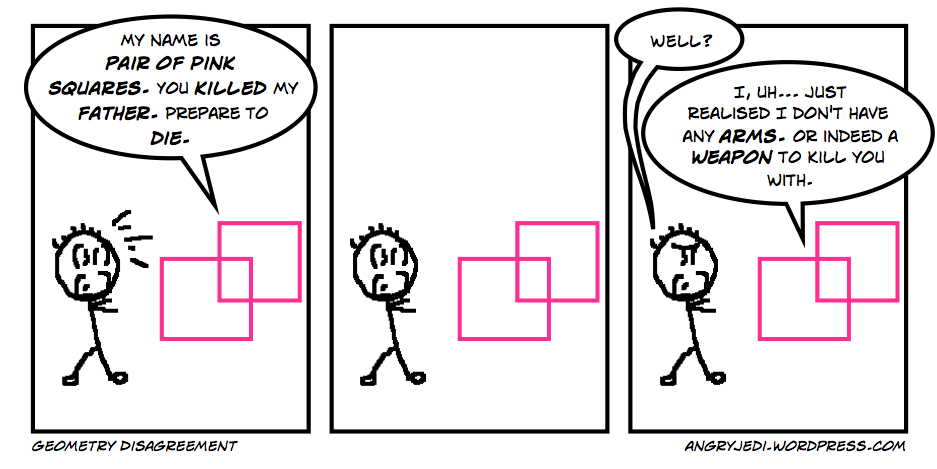
I never thought I'd get to write the following sentence: I played a bunch of Geometry Wars 3 tonight.
Geometry Wars 2 was an absolute masterpiece, and one of my favourite games from one of my favourite studios — the sadly defunct Bizarre Creations, who were also behind some of my favourite racing games (the Project Gotham series and the wonderful Blur). It struck a perfect balance of challenge and instant gratification, allowing anyone to pick it up and play, but only those who took the time to concentrate on what they were doing to truly master it and attain the most astronomical scores. It also featured one of the finest implementations of online leaderboards of any game, ever. And the dissolution of Bizarre made me think that we'd never see a new game in the series. Here we are, though.
Is Geometry Wars 3 the masterpiece that its predecessor was? To be honest, it's a bit early to tell yet. I wasn't immediately taken with its new aesthetic — the old-school neon vector art has been toned down a bit in favour of a new (and still distinctive) look that I have a feeling will probably grow on me in time — but then I sat down to "try out" Pacifism mode (one of my favourite modes from 2, in which you may not fire your weapons and can only defeat enemies by dodging through exploding gates when they pass nearby), looked up and realised I'd spent somewhere in the region of an hour staring glassy-eyed at the screen just like I used to do with Geometry Wars 2. So that's a good sign, then.
Here are some further observations, bullet-pointed for your convenience.
It has 3D levels. The flat plane is still there for "Classic" mode — essentially a retooling of Geometry Wars 2's modes — but in the main single-player "Adventure" mode you'll find yourself fighting on spheres, cubes, dishes, sausages, flat planes with holes in, circles with spinning walls and all manner of other peculiar arrangements. And it really adds a different spin (no pun intended) on the gameplay; having to consider the ability to "wrap" around a 3D shape forces you to think about your strategy somewhat differently to being enclosed in an arena. Not only that, but moving around on irregular shapes (such as the aforementioned sausage) can lead to you having to play with the battlefield skewed at some crazy and challenging angles if you're not careful about how you move.
The music has been remixed. The tunes are all based on the various themes from Geometry Wars 2's various modes, but I think I preferred the old mixes. The new versions have suitably thumping bass and drum parts, but the mix of the Geometry Wars 2 versions just sounded "fuller" and more satisfying to listen to.
There are bosses. In "Adventure" mode, anyway. Said bosses have a habit of 1) sitting on an awkwardly shaped playfield (the second boss, whom you fight on a cube, is a particularly troublesome chap) and 2) launching hundreds of enemies at you while you're attempting to fill them full of hot plasma death. Naturally, you only get one life for boss levels, too, so no fucking it up and hoping for the best.
There's a progression and upgrade system. Again, this only applies to "Adventure" mode. Early in the game, you'll unlock a "drone" that follows you around and behaves in various ways according to which one you've selected. You can upgrade both your drone and its special attack using the little diamond-shaped Geoms you collect in the levels, which are normally used simply to increase your score multiplier. Additional drones and special attacks are unlocked by progressing through the levels in "Adventure" mode and by attaining a particular number of stars by beating target scores in each level.
There's a weird new mechanic called Super State. The clichéd computerised voiceover will occasionally say "Super State" and inform you that there's an arrangement of static targets somewhere on the playfield. Destroy them all and you get a powered-up weapon for a brief time, rather than the approach from previous games where once your shots were powered up, they stayed powered up. It's a fun little twist that forces you to weigh up whether it's worth the risk of trying to destroy the targets, or simply muddle on with your regular weapon. It can be particularly perilous on "Adventure" mode's 3D stages.
Leaderboards are still awesome. In the "Classic" modes, you can always see your nearest rival in the corner of the screen, and at the end of a session you can see how you stack up against your friends and the global leaderboards. In "Adventure" mode, each level has its own individual leaderboard for you to take on, giving you something to strive for even if you've cleared every level with three stars.
There's an online mode. There are two ways to play, only one of which I've tried so far. Summoner splits players into two teams and then puts them in a Domination-style game where you have to capture towers by shooting them, and then the towers start coughing up enemies for you to destroy with your teammates. Highest score at the end of a short time limit — matches are really short and snappy — wins. Die and your team suffers a penalty to its score multiplier. It seems like fun, but unfortunately in the matches I've tried so far all of my opponents (and teammates for that matter) have just sat there and not done anything. This did mean I won by default, however, which was nice.
There's a local co-op mode. I haven't tried it yet, but this was quite fun in Geometry Wars 2.
That's about it for my initial impressions, then. I'll undoubtedly play some more in the next few days and have some more detailed thoughts to ponder, but for now I'm quietly impressed. As I noted above, I'm not quite sure yet whether or not it's as good as Geometry Wars 2 was, but it's certainly a solid, enjoyable game that I'm looking forward to getting to know a bit better.
(Oh, and if you're playing the PC version, I recommend playing in Borderless Windowed mode; the full-screen mode inexplicably caps the frame-rate at 24fps, which is just baffling.)
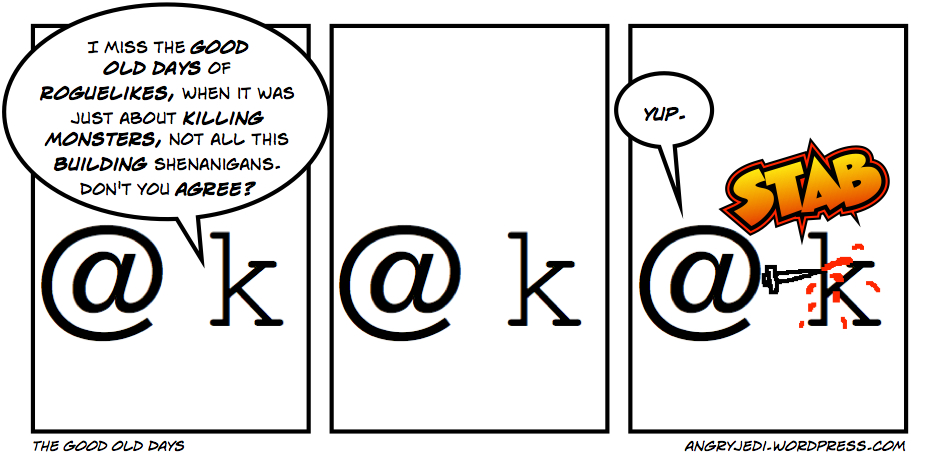
Before I left my friend Tim's yesterday, I quickly gave him a tour of Amplitude's Dungeon of the Endless, one of the three games in the studio's Endless series of sci-fi strategy games and, I think, my favourite of the three overall. Demonstrating the game to Tim reminded me how much I like it, and thus I spent a fair amount of time both last night when I got home and today playing it.
For the uninitiated, Dungeon of the Endless is a peculiar affair somewhere between roguelike, real-time strategy game, turn-based strategy game, tower defense game and board game.
Here's how it works. Your party of heroes (initially two, but expandable up to four by finding and recruiting additional characters as you progress) have crash-landed in a dungeon. The only way out is to use the otherwise destroyed spacecraft's energy crystal to power the ancient elevators which proceed upwards through the twelve levels of the complex. Inconveniently, of course, these elevators only go up one floor at a time, so on every level you have to go through the same process of exploring, finding the exit and then transporting the energy crystal from the start point to the exit. Do this twelve times and you win; let the crystal be destroyed or all of your heroes die and you lose.
Each level is randomly generated, and they get larger and more complex as you progress, but still follow the same basic formula. A level is constructed out of individual rooms separated by doors, and opening a door is akin to starting a new "turn" in Dungeon of the Endless' stablemates Endless Space or Endless Legend. Upon opening a door, you produce a particular amount of Food, Science and Industry, with the exact amount dependent on various conditions, including the heroes you have on your team, the modules you've built around the dungeon and whether or not there's anyone trained to operate said modules and improve their output.
Food is required for healing, levelling up and, occasionally, recruiting new heroes. Science is used for researching new modules to construct and resetting ability cooldowns. Industry is used to actually construct things. There's also a fourth resource called Dust, whose main use is to increase the power capacity of your crystal. Every ten units of Dust you acquire, you earn the ability to power an additional room. Powered rooms — which have to be connected to the crystal or to other powered rooms — can have modules built in them. Unpowered rooms have the chance of spawning waves of monsters every time you open a door — or indefinitely once one of your party members picks up the crystal and starts transporting it.
Playing the game effectively involves carefully strategising how you can balance exploring the dungeon to find the exit, constructing defensive positions to protect the crystal from attack, and powering rooms in such a way as to prevent enemies spawning in inconvenient locations — or perhaps to funnel them towards an easily-defended position. It's initially overwhelming, but once you master the basic strategy — power rooms along the path to the exit, place heavy defences in between where the enemies are likely to spawn and where you're going to be heading — it's satisfying, but still challenging. As the game progresses, the enemies get stronger and come out in greater numbers, so you'd better have levelled up your heroes and researched some better modules in preparation for the increasing intensity of the assaults.
Being inspired by roguelikes, Dungeon of the Endless has a pleasing amount of replayability thanks to random elements that make each playthrough a little different. The maps are different each time, for starters, but there are also more subtle changes like the technologies available to research. In the last game I played, for example, I had access to the "Knowledge is Power" turrets, which power themselves up significantly according to how much Science you've collected. I stockpiled an enormous amount of Science in the earlier levels, meaning that these relatively inexpensive turrets got me through a lot of the game thanks to their astronomical stopping power. (They didn't help me finish the last level, however, in which you're very short on power and other resources and powerful monsters just seem to keep coming.)
I haven't yet tried the multiplayer mode, in which you each control a single hero, but it has the potential to be interesting in a slightly different way to the single-player. I'm interested to try it sometime soon; hopefully the opportunity will arise!
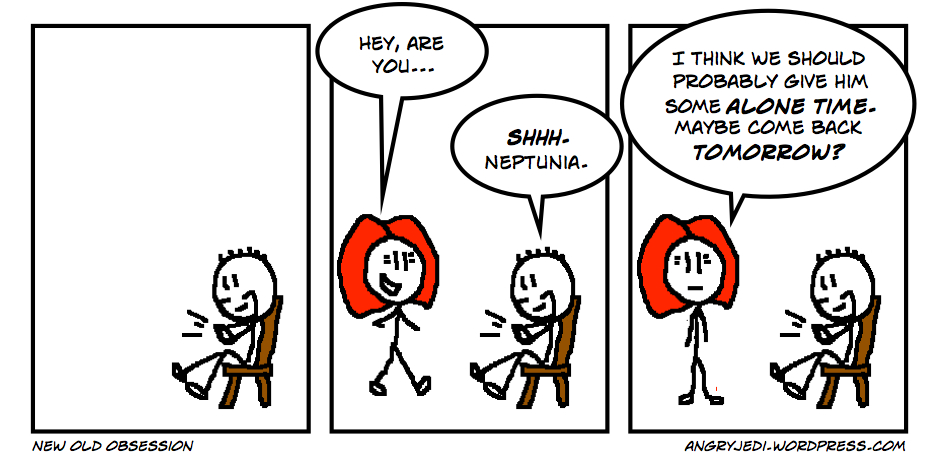
Having beaten Senran Kagura Burst recently at last, I've been turning my attention back to Vita title Hyperdimension Neptunia Re;Birth1, the "remake" of the original Hyperdimension Neptunia — a series that I first discovered in January of last year and promptly fell head-over-heels in love with.
I put the word "remake" in inverted commas because to call Re;Birth1 a remake is to do it something of an injustice. This is a complete and total overhaul of the game from top to bottom — graphics, gameplay, mechanics, story, characters, music, everything. In essence, it's a completely new game that even those who played and enjoyed the original — I know there's some of you out there, even though it was the weakest in the series by a very long shot indeed — can get a huge kick out of.
All of the above said, Re;Birth1 does also recycle a whole ton of material from previous two games Hyperdimension Neptunia mk2 and Hyperdimension Neptunia Victory — principally dungeon aesthetics and layouts, monsters and music. Consequently, those of you who played mk2 and/or Victory will probably find a lot of familiar material in Re;Birth1 but that's not actually a bad thing; the comfortable familiarity of the recycled material gives the game a feeling of consistency with its predecessors (for obvious reasons) while the new stuff that is included — no, it's not identical to its predecessors — stands out all the more for being a big contrast to the material that's been used in three games now. In essence, the game represents a refinement of the Hyperdimension Neptunia formula that developer Compile Heart has been experimenting with over the course of the previous installments and, while not completely perfect — a couple of minor elements from the previous games that I really liked have been ditched for Re;Birth1 — it is, by far, the definitive Neptunia experience, and a game that is beautifully designed for portable play.
Neptunia games have always been about two things: a silly, enjoyable, well-written and witty story coupled with some surprisingly compelling, grind-and-farm-heavy dungeon crawling. Re;Birth1 is no exception; its narrative retells the story of the original Hyperdimension Neptunia with a few twists here and there as well as a host of new characters, while there's plenty of incentive to dungeon crawl thanks to its quest system and one of the main mechanical highlights: the sprawling Remake system.
Remake allows you to craft various things. So far so conventional, but unlike many other crafting systems, Remake allows you to craft game mechanics as well as items, weapons and armour. Finding the game a bit challenging? Dig up a programmer's plan to weaken all the enemies and hack it into the game to make things a bit easier for yourself. Want to find the hidden treasures more easily? Build your own treasure scanner to enhance the minimap. Annoyed at that age-old RPG problem, "You Failed to Escape"? Craft yourself the ability to escape from battle with a 100% success rate.
Of course, all this makes it sound a lot easier than it actually is; to complete these plans you'll have to first of all find the plan in the first place — they can be anywhere from inside treasure cubes in dungeons to held by various NPCs around the world map that pop up after every major story beat — and then collect all the ingredients, most of which tend to come from monsters. The game doesn't hold your hand with this; if you want to craft a plan, you'll have to figure out where on Earth you're going to get all the bits from, though thankfully a straightforward dungeon and monster encyclopedia in the menu allows you to see which enemies haunt which areas, and what they might drop when you kill them — assuming they've already dropped it for you at least once. Through this system, you're encouraged to explore the various dungeons and fight as many different enemy types as possible in order to fill out that monster guide — the more complete it is, the less you'll have to look up on the Internet later.
The nice thing, though, is that it's all completely optional. There's no obligation to go fiddling around with plans at all — though your life will be significantly easier if you do — so if you simply want to plough through the main story as quickly as you can, that option is always open to you. Likewise, there's no obligation to complete quests, unlock optional dungeons or kill boss monsters — though failing to do so may well leave you a bit underlevelled come story boss time, at least on your first playthrough.
As with previous installments of the Neptunia series, the game is absolutely dripping with personality. Each character is a clearly-defined — though often (deliberately) tropetacular — person in their own right, with many of them poking fun at established video game and anime characters. Indeed, a number of the new characters for Re;Birth1 are direct references to game series and developers such as Steins;Gate creator MAGES., Senran Kagura publisher Marvelous AQL and legendary fighting game series Tekken. Each of these characters is beautifully designed to encapsulate the very essence of the thing they're supposed to be referencing; MAGES. wouldn't look out of place in Steins;Gate herself, for example, and even has alternate colour schemes that directly reference the characters Mayushii and Faris, while Marvelous AQL has costumes based on the Senran Kagura girls' iconic outfits.
It's a cliché to describe something as a "love letter" to something else, but I'm going to do it anyway. Hyperdimension Neptunia has always been a love letter to fans of Japanese video games and anime, being packed full of references both obvious and incredibly subtle, and Re;Birth1 very much continues that. It's a game that celebrates the joy of having fun with interactive entertainment, and I defy you to play through it with anything other than a huge smile on your face.
Except, of course, when Killachine flattens your party for the fifth time in a row because you didn't prepare properly and ended up with everyone stunned and clustered together, just waiting to be cleaved. You don't have to keep smiling then. But you'll probably try again rather than flinging your Vita across the room.
My only trouble with it is that I don't really want it to end. Although when those end credits do eventually roll, I can console myself with the fact that there are three new Neptunia games out there that I haven't played yet — strategy RPG Hyperdevotion Noire: Goddess Black Heart, the rather Senran Kagura-esque brawler Hyperdimension Neptunia U and probably the most exciting offering: PS4 title Hyperdimension Neptunia Victory II, a game that, if I don't own a PlayStation 4 by then, will almost certainly make me go out and buy one immediately the moment it is released.
Yes, I'm a fan. And unashamed of that fact. It's a series that consistently makes me smile; given how much I love it now, it's rather odd to (re)discover today that I've only been playing these games since January of last year. But I hope I'll be able to continue enjoying them for many years to come yet.
One of the best things about the Japanese games I tend to play in preference to anything else is simultaneously one of the most frustrating things.
I'm referring to the question of game length.
In an age where the public are seemingly ever more likely to rate interactive entertainment in terms of a "money per hours" ratio — look at the drubbing Gone Home got from certain quarters who felt that $20 was too expensive for the 2-3 hours of gameplay it offered — it should be abundantly clear to anyone who plays them that Japanese games, for the most part, consistently offer the absolute best value in terms of bang for your buck on the market.
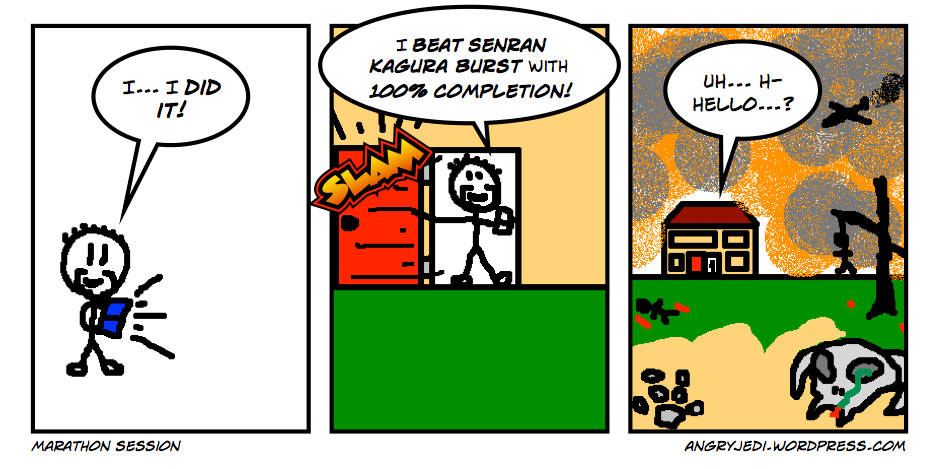
Take Senran Kagura Burst, for example, which I finally pummelled into submission and 100% completion over the weekend during downtime between activities. This is a game that is essentially a spiritual successor to the arcade brawlers of yore — games like Final Fight, Streets of Rage, Teenage Mutant Ninja Turtles, Asterix: The Arcade Game and The Simpsons Arcade Game, to name but a few favourites from my own youth.
Unlike those brawlers, however, which typically tended to be no more than four or five levels long — they needed to theoretically be completable on a single coin credit and in a single sitting, after all — it took me in excess of 50 hours to complete all the levels in Senran Kagura Burst, and there's plenty more I could do after completing all the levels once: try for an A-rank on all of them; try and level up all the characters to 50; try and unlock all the characters' "balance" modes through using them in different ways; try to complete all the levels in the challenging "Frantic" mode; try to beat all the bosses with special moves; and try to see all the bosses' special moves without dying. Were I to tackle some of those additional challenges — and I'm not ruling out the possibility, as I enjoyed Senran Kagura Burst one hell of a lot — I'm sure that could easily put a significant number of extra hours on the clock.
Notably, though, a lot of this "extra" stuff is optional. You can romp through the main storyline of Senran Kagura Burst, ignoring all side missions and some of the clever things you can do with the characters, in probably about 10 hours or so, if that. (Most of that time will be reading the game's lengthy visual novel sections, which are skippable after you've completed that mission at least once.) And in doing so, you'll have had a satisfyingly complete experience from start to finish — particularly as the game's structure effectively feels like you're getting two (rather similar) games for the price of one thanks to the story unfolding from two different, parallel perspectives that meet up at various points.
The same is true for many other Japanese games, with RPGs being the clearest example. Your average Japanese RPG these days will take anywhere between 20 and 100 hours to clear first time through, assuming you don't just plough straight through to the ending, and that you take on a bit of side content and spend a bit of time fine-tuning your characters. After that, though, you have a choice: set it aside, satisfied that you've seen the conclusion to the story, or continue playing in the hope of enjoying everything else the game has to offer — often referred to as "post-game". Many modern RPGs also offer a "New Game Plus" mode, in which you can carry across certain things from your previous playthrough into a new run — the exact things you can carry across vary according to the game, but often include things like character levels, unlocked skills, equipment, secret areas uncovered and all manner of other goodies. This tends to turn you into a satisfyingly unstoppable powerhouse at the outset of your second playthrough as your buffed-up character cuts through enemies like butter, but is often necessary to take on some of the biggest challenges the game has to offer. Some games even withhold their toughest bosses and dungeons until post-game or New Game Plus, providing you with an incentive to continue playing even after the credits have rolled.
Even seemingly "short" Japanese games have a massive amount of longevity, too; take your average "bullet hell" shooter, for example, which typically follows the arcade machine structure of theoretically allowing someone to clear it on a single credit and in a single sitting. The true challenge of these games, however, comes from perfecting your game — achieving that single-credit clear (often known as a 1CC — 1 Credit Clear), beating your last high score, topping the worldwide leaderboards. The latter aspect in particular can become enormously competitive, and in the case of many shmups, requires you to fathom out an initially Byzantine-seeming scoring system in order to take maximum advantage of it.
And this isn't even getting into the truly, directly competitive titles such as fighting games, which have potentially limitless replayability if you're actually any good at them. (I am not, so I tend to play through the story mode, if there is one, and then be done, perhaps with an occasional two-player local match with friends if they're up for it.) Or driving games with ongoing online competition. Or all manner of other joyful experiences.
I'm not saying Western games don't offer any of this longevity — anyone who's super-into Call of Duty's multiplayer mode is doubtless raising their hand and going "Um…" right now — but for my money, and particularly in the single-player space, Japanese games can't be beaten for value in terms of how much entertainment you'll get for your £40.
 Hnng, I'm sure you will agree.

 One of the most peculiar things about the new Wii U version of Super Smash Bros. is the compatibility with the "Amiibo" figurines that are sold separately.
 I never thought I'd get to write the following sentence: I played a bunch of Geometry Wars 3 tonight.
 Before I left my friend Tim's yesterday, I quickly gave him a tour of Amplitude's Dungeon of the Endless, one of the three games in the studio's Endless series of sci-fi strategy games and, I think, my favourite of the three overall. Demonstrating the game to Tim reminded me how much I like it, and thus I spent a fair amount of time both last night when I got home and today playing it.
 Having beaten Senran Kagura Burst recently at last, I've been turning my attention back to Vita title Hyperdimension Neptunia Re;Birth1, the "remake" of the original Hyperdimension Neptunia — a series that I first discovered in
  One of the best things about the Japanese games I tend to play in preference to anything else is simultaneously one of the most frustrating things.