1798: Starlight Vigil

Today I participated in something that I had only previously heard about: an entire online community coming together to pay its respects to someone.

That "someone" was a person whom I only knew as Codex Vahlda, a Final Fantasy XIV player on the Gilgamesh server whom I became aware of this morning after a casual browse of Twitter.

I didn't know Codex at all. I don't even play on his server, so it's unlikely I would have come into contact with him unless he randomly showed up in a Duty Finder group for running a dungeon, since those pull players from several servers to make complete groups.

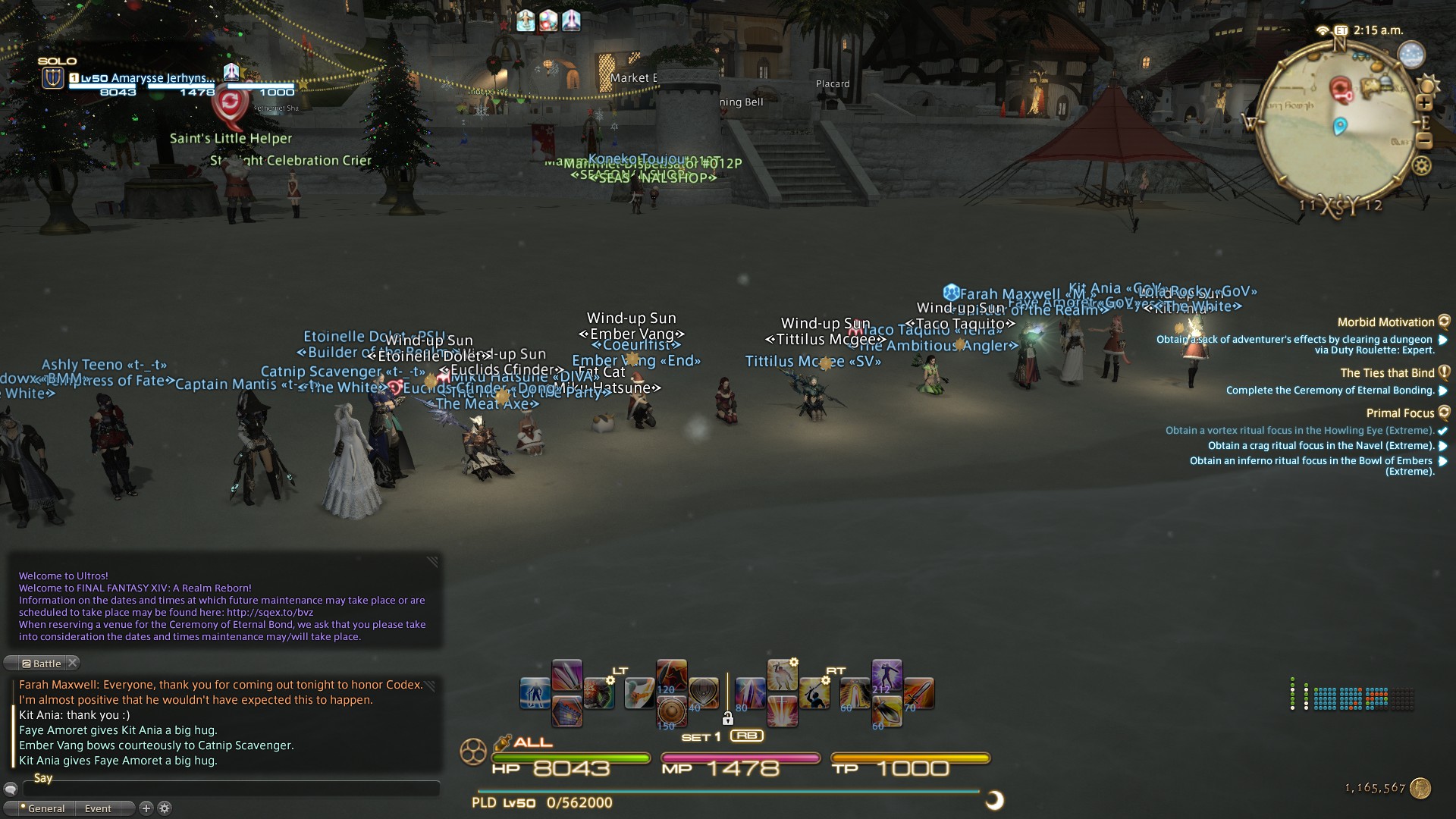
Sadly, I'll never have the opportunity to know Codex, as he passed away recently due to complications from renal failure. Both he and his family and friends seemingly knew that he was going to pass on, and it was as he lay on what was to become his deathbed that Final Fantasy XIV players from around the world, and from several different servers, all gathered in the same place — the beach in Ward 1 of the player housing district Mist — and held their own vigil for our fallen adventuring comrade.

Normally, this sort of thing is an event that you tend to hear about after the fact, but I happened to be online just as someone on Twitter was posting about the vigil taking place on Ultros, the Final Fantasy XIV server which I call home. Largely out of curiosity, I logged in to take a look at what was happening, ran down to the beach and, sure enough, found a line of players facing out to sea, "wind-up sun" minions out, bathing the group in a soft light, contemplating whatever they chose to be contemplating as they paid their respects to Codex. I joined them.

17754480252836380672_screenshots_2014-12-21_00001

After a moment of quiet reflection, people spontaneously began letting off fireworks and balloons — these are items you can acquire in the game and are intended for use upon celebratory occasions such as seasonal events or the newly added "Eternal Bond" wedding system. It was a celebration not only of Codex's life, but also of how one stranger could bring all these disparate people from all over the world together in one place to do the same thing. It was a really, really beautiful moment, and extremely moving.

It's easy to think of the Internet at large, social media and online games in particular, as utterly "toxic" (that's a favourite word of critics at the moment) environments in which everyone is constantly at one another's throats. But every so often something happens that reminds you that an awful lot of human beings are fundamentally decent people, and that regardless of where you're from or what — if anything — you happen to believe in spiritually, the cycle of life and death is, pretty much without fail, something that will always bring us closer together with one another.

Rest in peace, Codex; I never knew you, but I hope wherever you are now, you feel the love of all the strangers who came together to celebrate your life today. May you forever walk in the light of the crystal.

1798: Chaos Reborn

I was pleased to see the other day that Julian Gollop's reimagining of his ZX Spectrum classic multiplayer strategy game Chaos has finally hit Steam. The version of Chaos Reborn currently available is, sadly, only an Early Access version containing nothing but online multiplayer and 7 levels of progression — no sign yet of the ambitious-sounding single-player mode and massively multiplayer/persistent elements — but despite this, it's already looking really rather good.

The original Chaos, for those unfamiliar, was a turn-based strategy game for up to 8 players, both human- and computer-controlled. The aim was simple: destroy your fellow wizards via any means you had available to you, be it direct-damage spells or an array of weird and wonderful creatures you were able to summon.

The "Chaos" of the title came in the form of a balance meter that tipped either towards law or chaos according to the specific spells that various players cast. As the balance tipped in one direction or another, the spells of that respective alignment became easier to cast, while their polar opposites became more difficult. Canny players could manipulate this to their advantage, though the ability to summon creatures as illusions meant that you could never quite be sure if your opponent had really summoned that Manticore or not… were you willing to potentially waste a turn attempting to "Disbelieve" it?

Chaos Reborn stays remarkably true to this original formula, albeit with a few changes. The maximum number of players is now 4 rather than 8, for one thing, and this is primarily to keep play sessions short and snappy — not a pair of adjectives you'd typically associate with turn-based strategy games, but having played a few games today, this particular approach is very welcome indeed, especially when I bear in mind so many multi-hour multiplayer Civilization games that never, ever reached any sort of satisfying conclusion.

Another core difference is the way spells are distributed. Rather than being given a random selection at the game's outset and then tasked with using them as effectively as possible, you now have a deck of "cards" depicting various spells and summoned creatures, and as you level up you'll gain access to more of these — though it's worth noting that these cards aren't necessarily "better", just different, so a level 1 player can still take on a higher-level player without the confrontation necessarily being a foregone conclusion.

This "cards" aspect looks to be interesting, as it promises the ability to build your own decks of spells as you unlock new creatures and attacks. There's a lot of potential to build your own personal play style, and it will be interesting to see how different people approach the game, how to build their decks and how to use the cards therein most effectively.

Chaos' roots are very much in board gaming — the original Spectrum version was even published by Games Workshop — and this aspect very much comes to the fore in Chaos Reborn. Between the deckbuilding and the ability to play games in an asynchronous manner as well as against live opponents, the game has a huge amount of potential, and I'm very much looking forward to seeing how it develops over time. For now, the Early Access version is a decent, if slightly limited package, but exciting things are on the horizon.

1794: Oppai Fightin'

Alongside Senran Kagura Bon Appetit, which I talked about a bit yesterday, I've also been playing some Senran Kagura Shinovi Versus. I haven't delved into it particularly deeply so far, having only played through three of the Hanzo girls' short mini-arcs (effectively an "arcade mode" of sorts, challenging you to complete five stages of gradually increasing difficulty in succession while working through an eminently silly side story) and spent far more time than I'd care to admit gambling in-game currency on the "Lingerie Lottery", but I've enjoyed what I've played so far.

The thing I liked about Senran Kagura Burst on 3DS is that it was a thoroughly modern take on Streets of Rage-style brawlers — you know the kind: walk from left to right punching things in the face and trying not to get punched in the face yourself. I was a little worried about Shinovi Versus, to be honest; I liked the simple but satisfying button-mashy gameplay of Burst so much that I was concerned the shift to 3D wouldn't be quite as enjoyable to play, what with those pesky extra degrees of freedom to worry about.

Turns out I needn't have been too worried. While the 3D gameplay does have its own idiosyncrasies — the camera can be a pain on occasion — at heart, it still feels very much like Senran Kagura. That means obscenely huge… combos (it's not at all unusual to see combo counts numbering into the hundreds or thousands — though with the more sprawling nature of most stages now, it's significantly more challenging to chain one long string of connecting attacks together without a break), single characters wading into swarms of enemies and punching them into orbit, special moves that range from the faintly plausible to the utterly ridiculous and, of course, ninja girls fighting until each others' clothes fall off.

Senran Kagura Burst felt a tad button-mashy at times, with the Hanzo girls in particular suffering a little from the "hammer the light attack button" syndrome. To be fair, as the girls levelled up, new combos became available that often required you to carefully time your use of the heavy attack button as well as the light attack, but for the most part you could get through a lot of the game with a single button.

Shinovi Versus initially feels a little like this, but try a few different characters and their differences start to become apparent. Poster girl Asuka is very much of the "hammer the light attack button" mould and consequently is suggested as a beginners' character, for example, while Hanzo's resident adorable character Hibari serves up an array of difficult-to-use but effective close-range slap and kick attacks, plus the strange little quirk that it's actually quite tricky to get her out of the air and back onto solid ground once she's up there, thanks to the fact that her aerial light attack appears to cause her to trampoline up and down on whoever happens to be unfortunate enough to be underneath her.

Your opponents are more than simple damage sponges, too. They block, they parry, they counterattack and you need varying approaches to even get near them in some cases. Unlike Burst, there's not really one simple strategy that will serve you well for the whole game; instead, you'll have to assess the situation on the fly and determine whether you're best off charging head-on, trying to get behind them, attacking them from above or waiting to counter them when they approach you. It makes for some enjoyable and thrilling battles that are a lot of fun to take part in.

I haven't got far in the story yet but the early chapters of the Hanzo girls' narrative appear to pick up nicely where Burst left off, with the group's now well-established character traits now more evident than ever before. The rather quiet Yagyuu's obsession with Hibari is kind of adorable to see, particularly as Hibari is a complete contrast to her in almost every way: Yagyuu is reserved and uncomfortable with expressing her emotions, even as it's clear she genuinely loves Hibari, while Hibari is very loud, emotional and open with her affections. I can see there being some potential for interesting situations between the two of them as the story progresses, and I'm looking forward to seeing it.

So far it seems to be a worthy successor to a game I ended up enjoying a lot more than I expected — a game whose appeal goes far deeper than the fanservice and smut it's primarily known for. It's a fine addition to the Vita library, and a great example of how to use a recurring ensemble cast very effectively. I feel it's going to keep me busy for a good few hours yet.

1793: Oppai Cookin'

Been playing a bit of Senran Kagura Bon Appetit! over the last couple of days as a precursor to delving properly into Senran Kagura Shinovi Versus. And I've been pleasantly impressed.

For those unfamiliar with the series as a whole, here's a breakdown: Senran Kagura Burst on Nintendo 3DS was the first game in the series released in the West, encompassing what were two separate releases in Japan: Senran Kagura: Skirting Shadows, and Senran Kagura Burst, which incorporated the story of Skirting Shadows and another full story with the five "antagonist" characters from the original. The two stories run in sort-of parallel — there are a few differences in terms of the events which occur, but they end up in the same place and conclude with the same events from different perspectives. The game itself is a modern-day take on brawlers like Streets of Rage and its ilk: you run from one end of a level to the other, beating up groups of enemies in order to proceed, occasionally squaring off against bosses.

Vita installment Senran Kagura Shinovi Versus is regarded as a "spinoff" — the numbered sequel Senran Kagura 2 is a 3DS title — but it follows on from the events of Burst and introduces numerous new characters as well as following the stories of the original cast further. It's still structured like an old-school brawler, but this time gameplay is in full 3D, lending the gameplay a feel somewhere between Streets of Rage, Dynasty Warriors and Power Stone.

Bon Appetit, meanwhile, is a "true" spinoff in the sense that it's not intended to be "canonical" to the main storylines of the other games, which are all fairly serious affairs about what it means to be a ninja, and how difficult it can be to grow up with all manner of difficult responsibilities and expectations thrust upon you. Bon Appetit, conversely, is about cooking, boobs and arses. Pairs of girls from the previous games pair off and engage in a cooking battle against one another, represented as a rhythm action music game played over the course of three rounds, with the loser of each round suffering the indignity of damage to their clothing — the iconic feature of the series as a whole is clothing destruction — and a comprehensive drubbing resulting in being stripped completely naked, covered in tactfully-placed whipped cream and chocolate sauce in order to pose provocatively atop the world's largest cake.

Bon Appetit has absolutely no shame whatsoever, and it's immensely enjoyable as a result. It's lewd and it's rude, but it's also a lot of fun to play, feeling very much like PS1-era rhythm games such as Parappa the Rapper and its ilk. There's a decent selection of catchy tracks — all originals, once again calling to mind PS1-era music games, particularly those with "character songs" such as Bust-a-Groove — and these vary from the fairly straightforward to the extremely challenging, with the two-lane note charts often being composed in such a way as to deliberately confuse you, a process made significantly easier by the backdrop occasionally being filled with giant gyrating bottoms and titties, particularly if you hit the single "heart" note in the song correctly.

In many ways, Bon Appetit is absolutely indefensible. It's pretty much fanservice in its purest form — in fact, it's striking a double fanservice whammy by being a particularly fanservicey game in a series already notorious for its fanservice — but in being this way it's doing exactly what it sets out to do: to provide a fun, silly and enjoyable opportunity to play with a cast of characters who are genuinely beloved by many in a context significantly far removed from their normal situations. The game states up front that it's not intended to be taken seriously, but manages to provide the player with an addictive and strangely compelling experience in the process, even once the initial appeal of "life and hometown" wears off.

So whatever you may find yourself thinking of it after what I've written above, I'm having an absolute blast. And you know what? I think I'm going to go and play a bit more right now.

1792: Company of Players

One interesting thing I've noticed in several games I've played recently — primarily those of Japanese origin that err towards the moe/fanservicey end of the spectrum, unsurprisingly — is what appears to be, or what I'm choosing to interpret as, inspiration from the theatrical world.

Take Hyperdimension Neptunia Re;Birth1, for example, which I finally achieved the Platinum trophy for last night and consequently am (probably) done with for the moment. The Neptunia series as a whole is pretty self-referential, with protagonist Neptune in particular frequently breaking the fourth wall to address the player directly, and various other characters making it abundantly clear that they're aware of the numerous tropes that they embody and that the narrative as a whole is based around.

In spite of all this, though, it plays things fairly straight (well, as straight as it can when Neptune is involved) right up until the final encounter between the goddesses of Gamindustri and the villainous Arfoire. Spoiler: the heroines prevail, justice is served and peace returns to Gamindustri, with a happy ending for all — even more so if you pursue the "true" ending — prior to the credits. And in typical Neptunia tradition, the credits roll is a loving pixel-art homage to classic games of yesteryear, simultaneously recapping several major points in the main game's story while demonstrating the developers' encyclopaedic knowledge of classic game titles.

It doesn't end there, though; after the credits comes a wonderfully heartwarming little sequence in which all the major characters in the game address the player directly and thank them for playing. It feels very much like the video game equivalent of a "curtain call" in the theatre, with each character stepping forward in turn to, effectively, take a bow and allow the player a sense of closure — at least until the next game they feature in. Once that sequence finishes and you save your clear data, that's it; the curtains go down, the lights come up and it's time to leave the theatre.

But like the best theatrical productions and the actors who bring them to life, Neptunia's cast is bigger than the individual games they star in. Rather, despite the games not really having a coherent, canonical chronology of what happens when — the series is very fond of rebooting itself on a regular basis — these recognisable characters simply come together to do different things every so often, whether it's another big RPG adventure, attempting to make it as idols or fighting bad guys in a distinctly Senran Kagura-esque fashion.

The idol game Hyperdimension Neptunia: Producing Perfection in particular is an interesting take on the series in that it's the first in which rather than the characters glancing sidelong at the player and making witty asides to them, the player is actually a participant in the ongoing story. In many ways it's an opportunity to "meet" your favourite characters in a far more intimate manner than previous installments have offered; in fact, it's rather more of a dating sim than an idol management game, since it largely revolves around building up your relationships with the four goddesses as opposed to actually trying to make their careers a particular success. To continue the theatrical comparison, it's like having the opportunity to appear in a production alongside a high-profile star — though the game does take great pains to note at its outset that its events are not "canonical", insofar as anything in the Hyperdimension Neptunia series is "canonical".

I mentioned Senran Kagura above, and this, too, presents an interesting example of how a stable of characters can be reused in a variety of different situations. First game Senran Kagura Burst — actually a compilation of the first two Senran Kagura games originally released in Japan — tells a self-contained story whose visual novel sequences give us some uniquely personal insight into the way the various characters think and feel about what is going on. This format is continued somewhat in Senran Kagura Shinovi Versus, officially a "spin-off" but actually following on from Burst's story.

And then you have Senran Kagura Bon Appetit, also known as Dekamori Senran Kagura. This game is, like Producing Perfection, a spin-off that is not intended to be taken seriously. An overblown, dramatic introductory sequence mirrors that seen in Shinovi Versus, before quipping at the end that you probably shouldn't take everything quite so seriously, so here is a game about large-breasted girls attempting to cook each other's clothes off in time to music.

Yes, you read that correctly; although Senran Kagura is most notorious for its large boobs and clothes-ripping mechanics, for the most part the storylines in Burst and Shinovi Versus are fairly serious in nature, exploring everything from young people coming of age, with everything that entails, to finding the true meaning of one's chosen path in life. Bon Appetit, meanwhile, does have a story — one that I haven't delved into yet, having only tried the "Arcade" mode so far — but largely revolves around the aforementioned cooking so hard your opponent's clothes fall off. And then admiring them covered in chocolate sauce and whipped cream afterwards.

It should be jarring; it should be weird, but somehow — assuming you're already on board with the series — it's not. It works. These characters are being treated more like "actors" performing different roles, albeit as the same people. It brings a sense of comfortable familiarity to the game — like seeing a favourite actor on stage or on TV — even as the games go into all sorts of weird territory, both in terms of subject matter and game styles.

I think right here is one of the reasons I find myself gravitating so strongly towards this style of game more than anything else: I'm a sucker for good characterisation, and if I find a particularly loveable group of characters that I enjoy spending virtual time with, I'll happily take that time together in any form it might happen to take — be it fighting monsters, training to be an idol, being a ninja or having a cook-off. Fortunately, I don't see the Senran Kagura or Hyperdimension Neptunia series going away any time soon, so I look forward to spending many more hours in the company of these virtual young ladies as time goes on.

Sad? Perhaps. But here's the thing: I've come to regard all these characters with genuine affection, even with the awareness that they're all exaggerated anime-style tropes on legs. And that, really, is the essence of moe: the feelings of love or affection towards fictional characters who are specifically designed to elicit such a response. I'd say their creators have done a pretty good job on that front, really.

1790: The Second Re;Birth

I was surprised and dismayed to discover that Hyperdimension Neptunia Re;Birth2 is out in January. Or at least, it was supposed to be: the European version has apparently been delayed by a week, with the physical release (yes! Unlike the previous installment, this one is apparently getting a retail release) now coming on February 6 and the digital version coming slightly later on February 11. So says Gematsu.

I'm dismayed not because I don't want more Hyperdimension Neptunia goodness to feast on, but rather because I didn't know that Re;Birth2 was coming quite so soon — although in retrospect, Re;Birth1 has actually been out for quite a while already, and I just took my sweet time over finishing it. I'm also somewhat dismayed due to the fact that Hyperdevotion Goddess Noire, a spinoff strategy-RPG take on the series starring my favourite character (the eponymous Noire) is, according to a good friend, coming in February — though with Re;Birth2 being delayed a week in Europe I wonder if this will affect Noire too.

I'm actually very curious to see how Re;Birth2 is treated. Re;Birth1 was an obvious massive jump from the original Hyperdimension Neptunia, with a completely rebuilt game system based on that seen in Hyperdimension Neptunia Victory, the third game in the series on the PlayStation 3 and, until Re;Birth1 came out, the best installment by far.

Re;Birth2, meanwhile, is a game that is a remake of a title that was much better in the first place. Hyperdimension Neptunia mk2 was a lot closer in execution to what would become Victory; its battle system is similar (though not identical) and its game structure is, again, much more like what we see in Victory and Re;Birth1.

This leaves the story as the main thing that will probably be worked over. I enjoyed mk2's original story; it was perhaps a little heavy-handed at times with its anti-piracy message — even more so than the original game — but it featured some entertaining and adorable characters getting into a variety of scrapes, including some surprising and even quite disturbing situations. (The "Conquest" ending of mk2 is particularly notorious for not only being a "bad" ending that takes significantly more effort to get than the "true" ending, but also for taking a turn for the seriously grimdark in comparison to the rest of the game's candy-coloured shenanigans.) I find myself wondering whether it's going to have as significant of a rewrite as Re;Birth1 did, or if it's simply going to be revamped in terms of presentation — unlike other installments in the series, which used gorgeous 2D character art in dialogue sequences, mk2 used 3D polygonal models that looked significantly inferior to the 2D artwork.

I also find myself wondering whether or not there will be such a strong focus on Neptune's sister and mk2's protagonist Nepgear this time around; subsequent installments in the series have made a joke over Nepgear being "boring" in comparison to the lively, spunky Neptune and the poor girl — actually one of my favourite characters, since she's just so adorably earnest about everything — frequently ends up the butt of everyone's jokes.

I realise a lot of these questions are probably already answered by people who have played the Japanese version, but I've been doing my best to remain unspoiled and have so far succeeded. I'll be very interested to see the new game when it arrives, and I'll most certainly be continuing to support the series with my hard-earned money and play time. So bad luck, reader; you'll almost certainly be hearing more about it early in the new year!

1789: Broadcasting Live

In case you weren't aware — and indeed cared — the latest beta version of the Steam client software features broadcast functionality, which means that anyone else out there who is also running a copy of Steam's beta version (or possibly via the Web too; I haven't tried yet) can drop in and start watching the game you're playing at a moment's notice.

This is noteworthy for one important reason: you don't have to set anything up. It's just there. It just, seemingly, works. And, unlike other, dedicated streaming solutions like Twitch and Hitbox, Steam's streaming is intelligent, only actually actively broadcasting when someone shows up and clicks the "Watch Game" button. This means that you can enjoy full performance when no-one is watching — streaming can cause a slight hit to graphics performance in some games — but seamlessly start sharing what you're playing with friends without having to do anything, and without compromising the experience with tiny windows, huge chatboxes and all manner of other rubbish.

This, to me, is the optimum solution for streaming — at least for me. It wouldn't work particularly well for professional streamers or those who run to more of a schedule, but for more casual players who simply want to use streaming as a means of showing other people what a game is like, it's absolutely ideal. I mean it when I said there was absolutely no setting up required, too: no buggering around with encoding, no worrying about bitrates, no creating application sessions or whatever. It just, as they say, works.

I'm still not the sort of person who will sit down and watch a scheduled stream of someone else playing a game — I'd much rather spend my time playing games myself — but that's not really what Steam's broadcasting system is for. Instead, as I noted above, its ideal functionality is for demonstrating games to one another, and pleasingly, it works with anything you run through the Steam client, not just games sold via Steam's storefront. In other words, any game that you've added to Steam via the "Add Non-Steam Game…" option in the menu — and which supports the Steam overlay, allowing you access to your friends list and chat functionality in-game — can be easily broadcasted using the new functionality.

But don't worry; if you're concerned about your lack of skills being shown off to the world and everyone showing up to laugh at you, you do have control over who can watch you. The first time someone requests to watch your game, you have several options — broadcast openly to anyone who wants to watch; broadcast to friends; or don't broadcast at all.

So far the only thing missing from the functionality seems to be some sort of record or archive function, though with the system's seemingly intended use as described above, I'm not sure we'll get that. I'm not too worried, though; I doubt there are many people who would want to watch three hours of prerecorded video of me grinding for my Relic Nexus weapon in Final Fantasy XIV — though there may be some people who have seen me playing it and are interested in taking a look for a few minutes just to see how it plays, as my friend Bowley did this evening.

I'm quietly impressed with the system, then; it'll be interesting to see how much it gets used once it rolls out into the Steam client proper.

1787: Eternal Bond

I'm pleased to report that today went somewhat better than yesterday. I feel like I'm still shaking off the aftereffects of the stomach bug I've had, but things aren't quite as bad as they have been, which is nice. I also bought some new headphones (which I promptly forgot to take with me today) and got a new ID card lanyard, which was also nice.

Andie and I got engaged, too.

Hah! That made you look twice, huh. We didn't really. Well, we sort of did, though not in the traditional sense. Instead, taking full advantage of the new Final Fantasy XIV patch which came out today, we both signed up for the new Eternal Bond ceremony: Eorzea's take on marriage, with no restrictions on the genders or races of the two people involved. We didn't actually get "married" in-game today; doing so is more than a simple throwaway thing to do when you feel like it. Instead, it involves a number of different steps, none of which are difficult, but which do demand you demonstrate a certain amount of willingness to help each other out as a couple, which is nice.

First up you have to acquire "Promise Wristlets" by signing up for the ceremony on the game's website. There are three tiers of ceremony, ranging from the free one (where there's only limited customisation of the ceremony available) to Platinum tier (where you have the most possible customisation options, a prettier dress and free gifts to offer your guests). Gold and Platinum weddings cost real money, though not very much, and because Andie and I are both idiots, we went for the Platinum ceremony.

After making our intentions clear and being issued with our respective pretty dresses, we were informed that we'd need to prepare our own wedding rings. We worked together to acquire the materials necessary to do so — thankfully the ring itself isn't difficult to create — and soon enough we were ready to begin our preparations in earnest.

What followed was an enjoyable if straightforward "pilgrimage" quest where we had to visit all the main regions of Eorzea together, find the symbols of the Twelve — the gods of the lands — and pray before them. In doing so, we blessed our respective wedding rings with divine power, ready for the ceremony. We then had the opportunity to talk over what kind of ceremony we wanted and given the ability to customise the chapel to our liking. We had to actually agree on what we wanted, too, otherwise when the big day comes the officials simply pick one of your options and run with it.

That's all we could do for now; bookings for the actual ceremony — yes, you have to actually book — open on Friday, so we're going to have to get in when we can and find a suitable time and place to get virtually hitched and invite our virtual friends to come and watch and cheer us on. I'm actually very curious to see how the whole thing goes down; I know a number of massively multiplayer online games in the past have had the ability to get married in them, but I've never been in a position where I was actually able to get married to someone, whether "seriously" as Andie and I are doing so, or just to see how it worked with a friend. (I'm a bit of a traditionalist, though; while a virtual marriage isn't legally binding, of course, I do actually kind of believe it has a certain degree of meaning, and as such I'm glad to be able to do it with Andie; it wouldn't have felt right even just "trying it out" with anyone else if, say, she wasn't playing.)

I tell you what, though, even with all the charging past hordes of kobolds on chocoboback on the way to find another pilgrimage stone, getting virtually married is nowhere near as stressful as arranging the real thing!

1785: Smashing Fun

After an enjoyable online session with one of my Final Fantasy XIV guildies the other night, I sat down to spend a bit more time with Super Smash Bros. for Wii U earlier today.

My hesitance to play that much until now has largely been due to the fact I hadn't really picked a "main" — that is to say, a character I would generally play in preference to anyone else, given totally free choice. Maining a character involves learning their moves and the best situations in which to do them, and is a bit more effort than just bashing buttons and hoping for the best — a playstyle I'm not quite convinced I'm entirely beyond just yet.

A bit of play with Zero Suit Samus (of Metroid series fame) against my friend the other night as well as today has me thinking that she'll be a solid choice, however. She's a speedy character, and I'm a fan of being able to quickly dodge out of the way of trouble, and her moves are all pretty easy to understand. She has a medium-range projectile attack, a slightly shorter range electric whip jobby plus a few satisfying combos, uppercuts and the like. Her dashing regular attack is a powerful kneebutt to the chest (or face for the shorter characters) which is simple enough to understand, and in modes such as Multi-Man Smash, where your opponents are significantly weaker than normal but come in much greater numbers, this is more than enough to send your foes flying into the distance for a satisfying knockout.

I got in some good practice with Zero Suit Samus (distinguished from her fully armoured counterpart) in the Multi-Man Smash modes, which I cleared for the first time with her, as well as the arcade-style All-Star Mode, which sees you fighting your way through Nintendo (and guest) characters from throughout the ages in reverse chronological order, beginning with recent additions to the roster such as Wii Fit Trainer and working all the way back to classic characters like Pac-Man and Donkey Kong.

Super Smash Bros. for Wii U really is a somewhat daunting package when you first pick it up, much like its predecessors. The sheer wealth of different ways to play is bewildering and baffling at first, but it won't take long for you to find your favourite modes — and, pleasingly, there's no obligation to play the modes you don't particularly enjoy, since most of the unlockables can be obtained in several different ways ranging from simply playing a certain number of matches to completing specific modes or achievements. Today I unlocked a couple of extra characters, including Mr. Game and Watch — the poorly animated silhouetted figure from Nintendo's early '80s LCD game-clocks, complete with bip-bip-boop sound effects — and R.O.B., the ill-fated plastic robot that would supposedly "play" with you on the 8-bit Nintendo Entertainment System on games like Gyromite. (Turns out he's much better at fighting than he is at wielding a controller.)

I've enjoyed the Smash Bros. games over the years, but I wouldn't say they've been absolute favourites. This latest installment, however, is proving to be an addictive little beast, and I'm looking forward to learning more about how to take my game to the next level. Then one day, I might be able to actually beat my friend Tim, who is frustratingly and irritatingly good at it, assuming you let him play as his mains (inevitably, as a Zelda fan, he mains Link and Ganondorf.) In the meantime, however, I'll be continuing to grapple with Zero Suit Samus until I've got that flying knee timing just so.

1784: Follower of Black Heart

It was Sony's PlayStation Experience keynote presentation today. I haven't yet caught up on all the bits of news that came out of it, but the snippets I have heard so far all confirm something that I've been thinking for quite a while now: in the new generation of gaming hardware (PlayStation 4, Xbox One, Wii U) Sony is going to be the one to beat. And the other two (well, one; we've established Nintendo likes doing its own thing and bugger what the other two are up to) are going to have their work cut out for them.

Sony's got a pretty comprehensive-looking gaming package at present, and one that covers a number of different markets. Speaking as someone who has not yet jumped into the next generation of hardware wholeheartedly — though I do own a Wii U — the PlayStation 4 is an infinitely more enticing prospect than the Xbox One. It's still not quite enough to make me want to rush out and buy one just yet — I'm still waiting for that absolute must-have game that I can't get anywhere else, and bear in mind my definition of "must-have" is somewhat different from the mainstream — but I'm getting closer and closer with every new announcement that comes out of Sony.

Speaking more objectively, though, the PlayStation 4 has a solid lineup of titles. Many of them are available on Xbox One as well, of course, but the PS4 versions are, in most cases, technically superior, running at better resolutions in many cases. As for exclusives, Sony has this pretty much stitched up. The Xbox One lineup of exclusives is a moribund array of unimaginative titles that tend to fit into the neat triple-A pigeonholes of "killing things", "driving things" or "doing sports with things" — there are a few exceptions, of course, such as SWERY's intriguing new project — whereas the PS4's lineup is vibrant, interesting and, importantly, worldwide, with Japanese developers rapidly jumping on board Sony's train even as they continue to eye Microsoft warily after the Redmond giant's two abject failures in the Far East.

The PS4 has the mainstream market pretty well stitched up, then, it seems — although with titles like Hyperdimension Neptunia Victory II and its ilk coming to the platform, it looks set to follow in the PS3's footsteps and provide a great home for more niche titles, too, not to mention the array of excellent independent titles that are making the jump from PC to PS4, too.

And then there's the Vita. Sony still doesn't make a big deal about the Vita at events like this, which annoys some people, but really, a big keynote speech isn't the place to shout about how great the Vita is. The reason? Vita has carved out a rather wonderful little niche for itself as arguably the best place to go for… well, niche games. Highly creative indie titles? Check. Fanservicey Japanese games? Check. Non-fanservicey Japanese games? Check. Access to a staggering back catalogue of brilliant games from the PS1 and PSP eras? Check.

Developers and publishers alike are really starting to get a handle on what makes the Vita tick, and what those who own one like doing with their time. Rather than attempting to continue pushing the frankly dumb "triple-A in your pocket!" angle — the whole point of triple-A is that it's spectacular, and consequently built for the big screen — Vita devs and publishers are now embracing the fact that Vita is a handheld device whose players like the freedom to play either for a short session over lunch, or for more protracted periods of free time. The best Vita games are built with this in mind: FuturLab's Velocity 2X, for example, features lightning-fast, short levels that encourage you to replay for the best times and scores; even Hyperdimension Neptunia Re;Birth1 which I've been playing recently is eminently handheld-friendly thanks to its short and snappy dungeons punctuated by clearly signposted event scenes that you move onto when you're good and ready rather than when you least expect it.

And let's not forget the PS3 in all this, still managing to remain relevant despite its successor having been on the market for a year now. Today we learned that Sega is bringing the much-requested Yakuza 5 to the West next year, and the new installment in the Persona series is coming to PS3 as well as PS4. On top of that, publishers like NIS America, Xseed Games, Aksys Games and their ilk are continuing to localise a wealth of interesting (and occasionally outlandish) Japanese titles for the Western market, so while those continue to flow in my PS3 won't be getting put away any time soon.

All this may sound rather fanboyish and perhaps it is, but the fact is, Microsoft has consistently failed to make me want to pay any attention to the Xbox One whatsoever — the first thing that still springs to mind when I think of the Xbox One is the stupid "Snap" functionality, which is something I don't think I've ever felt I wanted from a console — while Sony continually intrigues and excites me with each new announcement they make.

All it'll take is one great game to get me to grab an Xbox One, though, but at the moment I see that happening on PS4 first, by quite a considerably margin.