#oneaday Day 154: Shame on You

Have I told you about The Squadron of Shame? If you're a long-time reader, then I probably have, several times. But if you're here by chance, you might not be familiar with our little group.

Born in the dim and distant past of 1up, before the various 1upocalypses which have hit the site since then, The Squadron of Shame came about as a result of a podcast feature dubbed "The Pile of Shame". The concept of The Pile of Shame seems to have entered into popular consciousness in recent years, but the first time I ever heard it was on 1up Yours, when it was used to describe that ever-growing pile of shrink-wrapped games (or, these days, things in your Steam Library) that you somehow never get around to playing for one reason or another.

The 1up Yours guys agreed to play Tim Schafer's Psychonauts, which was widely regarded as being "good" and somewhat overlooked by the masses. They lasted a week before they gave up, so a number of members of the community stepped up to the plate in an attempt to succeed where they had failed.

Putting together forum threads and a 1up Club page to discuss the game, we found a number of like-minded gamers who enjoyed coming together to discuss games at considerable length, and in a markedly more intelligent manner than many of the "lol noob"-type people out there on the Internet. Over time, we took on a wide variety of other "missions" — taking on games which the masses had passed by and delving into them to discover whether it was actually worth going back and exploring them. Sometimes it was, sometimes it wasn't.

The turning point came when 1up merged its largely-disparate forums into just three general-purpose areas. The formerly intelligent discourse found on the 1up Radio boards was drowned out by the million voices of 12 year olds who thought Master Chief was da bomb, and our experiences were sullied by trolls coming on to our threads, criticising us for "walls of text" and completely derailing the discussion.

Before UGO took over 1up, we decided it was time to leave once and for all. We took to Twitter for a while, but we were scattered, and not everyone in our group used Twitter. It felt too "public" — although we always were a public group, there was an element of the "book club" mentality about it — a group of friends who knew each other well and enjoyed each other's company, but were still welcoming to newcomers.

Over time, we tried to come up with a way to resurrect the Squad formula. Thus, the Squadron of Shame SquadCast was born. Beginning as a game-focused podcast in which we concentrated on a single game and discussed it at great length and morphing into the topic-led discussion show we have today, the show has always been an enjoyable thing to be part of — and to listen to. We also have a small but active community at our "temporary" home: the Squadron of Shame Squawkbox. And we've all remained fast friends through thick and thin, through everything life's thrown at each one of us.

This, ladies and gentlemen, is what the Internet is all about. And you can be part of it, too — our latest episode was released today, with a discussion of game worlds. You can check it out by paying the Squawkbox a visit, and there are links to subscribe there if you so desire, too. If you have a WordPress account, too, you can join the discussions on the 'box, too — don't be shy. We like new people, and we also don't mind "walls of text". So long as you use paragraphs. So far as conditions for entry go, that's not an unreasonable one, I don't think.

Anyway. There you have it. They're my favourite group of people on the Internet, and I haven't given them a plug for a while, so there you are. Join us. Or at least listen to our new episode.

#oneaday Day 148: People, The Mutant's Pursuing Me!

It's been a very long time since a game has genuinely gobsmacked me with its obvious technological marvellousness, but The Witcher 2 has gone and done a sterling job of it so far. I beat the first game this morning and enjoyed it so much I wanted to go straight on to the sequel, which I'd had the foresight to download in advance from Good Old Games.
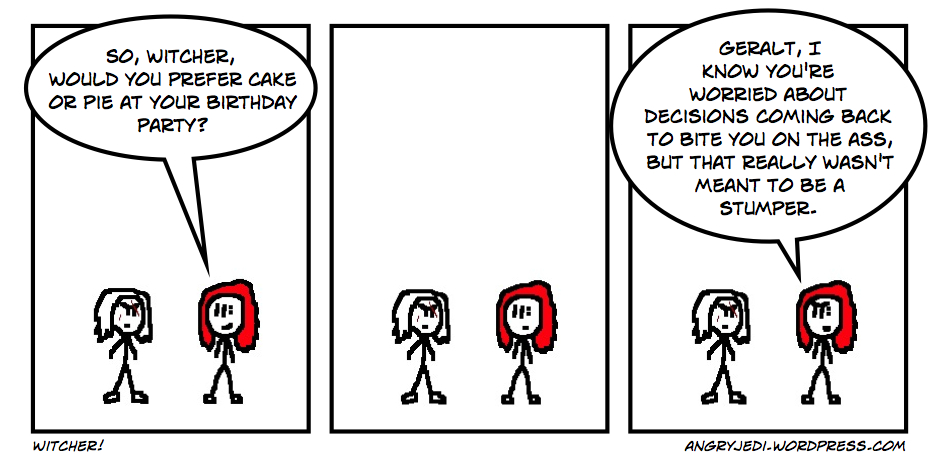
I wasn't quite ready for the leap in graphical fidelity between the two. I thought the first game looked pretty good — it used to bring my old computer to its knees, after all, and it was one of the first games I installed on my new computer to enjoy in its "full glory" — but wow. The Witcher 2 makes its predecessor look decidedly primitive in many respects.

Gone are the stilted, uncomfortable character animations when people are standing around talking to each other. Gone are people's inability to remain seated while talking to you. Gone are the sex cards (replaced with good, old fashioned full frontal nudity — are you paying attention, BioWare?) and gone is the fun but arguably overcomplicated combat system. (Also gone are some of the original voice cast, which is a little disappointing, but perhaps understandable given the amount of time between the two games.)

In is a decidely cinematic presentation (including an entertaining ability to wiggle the camera around veeery slightly using the mouse in conversation scenes, giving it a "hand-held camera" look). In are more than five different character models. In is background scenery featuring realistic foliage best described as "lush". In is a motion blur effect that makes rotating the camera look infinitely more realistic than in 99% of other games out there. And in is a Demon's Souls-style combat system that at first appears to be hack and slash, but isn't afraid to punish you mercilessly for thinking so until you learn that it's actually based on timing, patience, blocking and carefully watching your opponents to look for an opportunity. A combat system which has divided people somewhat, with many impatient types upset that it's "too hard". Hard it may be, but there's nothing wrong with a challenge.

One of the things that has impressed me most so far, though, is the potential for the branching of the plot, with different resolutions to problems and different major and minor choices. Already in discussion with a friend, I've seen that at least four or five parts of just the prologue branch off into alternative paths — some of which meet in common places, others of which diverge. And, like the original The Witcher, there's no obviously "right" choice in many situations. This is a Good Thing, as it makes you think about what you're doing, and also forces you to live with consequences which don't necessarily make themselves obvious until much, much later.

In short, The Witcher 2 is looking like being an absolutely amazing game. A lot of people have been quietly anticipating it for a long time — this is a game from a company that doesn't saturate the market with announcements of TV ads for their games, after all — and it's gratifying to see firstly that they've made an excellent game, and secondly that a lot of people seem to be thinking very highly of it. It deserves it, and CD Projekt Red deserves a huge amount of success for creating such an excellent RPG franchise.

#oneaday Day 145: Wotcher, Witcher

I've been playing a shit-ton of The Witcher recently, and if you haven't played it, you probably should. Unless you have a PC that won't run it very well. And even then, you should at least try and play it, because even on low detail it's still an excellent game — as is the sequel, from what I've heard… though the sequel is significantly more demanding on your poor old graphics card and processor than its predecessor.

But anyway. Why is The Witcher good? Many reasons. Sure, it has approximately ten different character models, many of which are used for both major NPCs and minor ones, making visual identification of characters a bit jarring sometimes. And sure, some of the animations are a bit clunky, and characters standing talking to each other look distinctly uncomfortable, unintentionally. And the interface isn't wonderful, though I've seen worse. But despite these little flaws, the game is a genuine gem.

Probably the biggest selling point is the titular Witcher himself, Geralt of Rivia. PC RPG purists often baulk at the idea of playing a fixed, non-customizable protagonist, but the (slightly cliched) amnesia subplot helps go some way to justifying the player moulding Geralt into the protagonist they'd like him to be. More than that, though, it's the fact that The Witcher features choices with genuine consequences, and a complete lack of an oversimplified "good/evil" or "paragon/renegade" meter. Simply put, there is no good and evil in the world of The Witcher, only shades of grey. Geralt is often thrown into awkward situations and asked to make a decision to side with one or the other of the parties involved — but notably, abstention is often an option, also, and that, too, carries with it consequences.

The best thing about these choices, though, is that the consequences don't make themselves immediately apparent. This helps get around the "quicksave/try out dialogue options" problem that some games are plagued with. In The Witcher, you have to make choices, and live with the consequences of those choices — because said consequences might not become obvious until a good 5 or 6 hours of play later.

This is a Good Thing. If nothing else, it forces players to immerse themselves in the role of the protagonist and decide What Would Geralt Do? on a regular basis. But beyond that, it neatly sidesteps the accusations of overly-simplified morality systems that are sometimes levelled at BioWare's otherwise-excellent games.

Then there's the fact that the game treats you like a grown-up. Sure, there's the notorious "sex cards" (abolished in the sequel in favour of some good old-fashioned full frontal nudity) but besides that, characters speak to each other in an unashamedly adult way that never feels forced. There's some very strong swearing from a number of characters, but it's worked into conversations in a pretty natural way, rather than a Kingpin (the game, not the movie) sort of way. It's nice to see a game have the guts to unashamedly use the word "cunt," for example, and it's also nice for the sequel to avoid BioWare's prudishness when it comes to sex scenes. There's no keeping underwear on and dry-humping here. Gratifyingly, in the first game, there's even a Captain Kirk-style "let me show you that sex without procreation can be good" scene with a thoroughly naked dryad. And for those who feel that Geralt's naked adventures are a bit gratuitous — well, there's always the option to not shag your way around Temeria.

I haven't finished the first game yet but I'm looking forward to seeing how it concludes. The story so far has been interesting, combining political intrigue, magic, monsters and world lore into an engrossing "dark fantasy" setting that — dare I say it? — is much better than Dragon Age. If you've never spent a night with Geralt, then what are you waiting for? Get thee over to Good Old Games and score yourself a copy for just $9.99 — bargain.

#oneaday Day 139: Tr-Tr-TrackMania

Those who have — ooh. Hold on. [gets momentarily distracted by the new WordPress interface that has apparently launched today.] Pretty.

Ahem. What was I saying?

Oh yes. Those who have known me for a while will know all about my love affair with Trackmania United Forever Star Edition, née Trackmania United Forever, née Trackmania United. And indeed my Steam usage statistics would seem to back this up — with 24 hours' playtime recorded on it, and nothing else close. Granted, Steam doesn't seem to have tracked my playtime on quite a few games I know I've played through to completion, but 24 hours on a silly driving game is pretty substantial, and it just doesn't get old.

Yes, it's unpolished. Yes, certain aspects of it are inaccessible. Yes, it doesn't tell you about a good 95% of the possibilities it offers anywhere in the documentation — but somehow, despite all this, a huge, dedicated community has sprung up around the game and has been supporting it and driving it forward ever since its release. So much so, in fact, that it's spawning a proper, bona fide sequel, along with two exciting-sounding companion games.

TrackMania 2 Canyon looks like it will be a lot of fun from what I've seen so far — though the Canyon subtitle does make me wonder if it'll have the variety of environments and vehicles that United offers, but it's the other two ManiaPlanet games that intrigue me more, if anything. The possibilities on offer in ShootMania and QuestMania, offering the facility to create FPS levels and RPG games respectively, are potentially limitless. And while little has been revealed about how — and if — the three games will interact, the fact that they share a common community portal in the form of ManiaPlanet is immensely intriguing and offers some very exciting possibilities for those, like me, who are interested in game design but whose experience with building tools is limited to Lego, Scalextric and the Wolfenstein 3D map editor. (I remember trying to make a Duke Nukem 3D level once. That didn't end well, much like several efforts to make a Doom level work in any shape or form. And those games weren't even proper 3D. I like tiles. Tiles are good.)

For those who have never experienced the joy of TrackMania, it's worth remembering that the game's probably most oft-used environment — the stadium — is available as a completely free game to download, with a significant amount of content and the ability to make your own tracks as well as play online. It's not often you see that sort of generosity from a developer offering what is essentially a "demo", but there you go. Steam users? Knock yourself out.

Okay. That's enough TrackMania ranting for this year. See you next year.

So I'll see you on the loop-the-looped circuits, no?

#oneaday Day 131: Thoughts on Star Raiders

1979's Star Raiders and its 1986 sequel are, to me, two of the most memorable games I've ever played. The original Star Raiders was notable for being a pretty convincing simulation of what it might like to be to fly a spaceship and defend a galaxy that absolutely, 100% wasn't ripped off from Battlestar Galactica, oh no, from the "Zylons". Sure, it had crude graphics and sound, but its interesting blend of spaceflight, combat and light strategic elements made it a compelling example of early gaming that is actually still perfectly playable today, unlike many other retro "classics". It also taught me what "red alert" meant long before I ever saw my first Star Trek episode.

Its sequel upped the ante with better graphics, a wider variety of foes to battle against and more things to do than just fly around and shoot Zylons in space — you got to orbit planets, take on motherships, bomb bases and all sorts of things.

Now, some 25 years after the last Star Raiders game made an appearance, we have a brand new one for both Xbox 360 and Windows (and, if Sony ever gets PSN up and running again, PS3.)

I will preface this by saying that if you are thinking about playing this game on a console, just don't, all right? If you never played Wing Commander III on PlayStation 1, you've never known the horror of having too many controls and not enough buttons on your joypad. Hint to developers: if you need to include a "shift" button in your joypad-based control scheme, you may wish to rethink it somewhat.

Try it on a PC with a proper Giger alien-penis joystick and some not-inconsiderable control redefining, though? Now that's more like it. What we have here is a relatively simplistic space game that, unlike many recent examples, remembers that space is three-dimensional, and that it is, in fact, possible to "loop the loop" in space, along with go up and down, turn left and right and roll around your axis.

A good start. Add a transforming ship to that mix and you have some interesting possibilities. Your all-new Star Raiders ship (called, inexplicably, "Jasper") can transform between "Attack" (constant forward movement, high top speed, poor turning, guns and missiles), "Assault" (mech-like move-and-strafe, lower top speed, excellent turning, guns and heavy laser beam) and "Turret" (rapid aiming, snail's pace movement, super-powerful heavy weapons) modes. When I first started playing, I wondered why you'd ever want to switch out of "Attack" mode, until I realised that I was spending an awfully long time chasing down Zylon fighters that were more manoeuvrable than me. So I switched to "Assault" mode and found that I could kill them rather more easily. And "Turret" mode came in handy for dealing with capital ships.

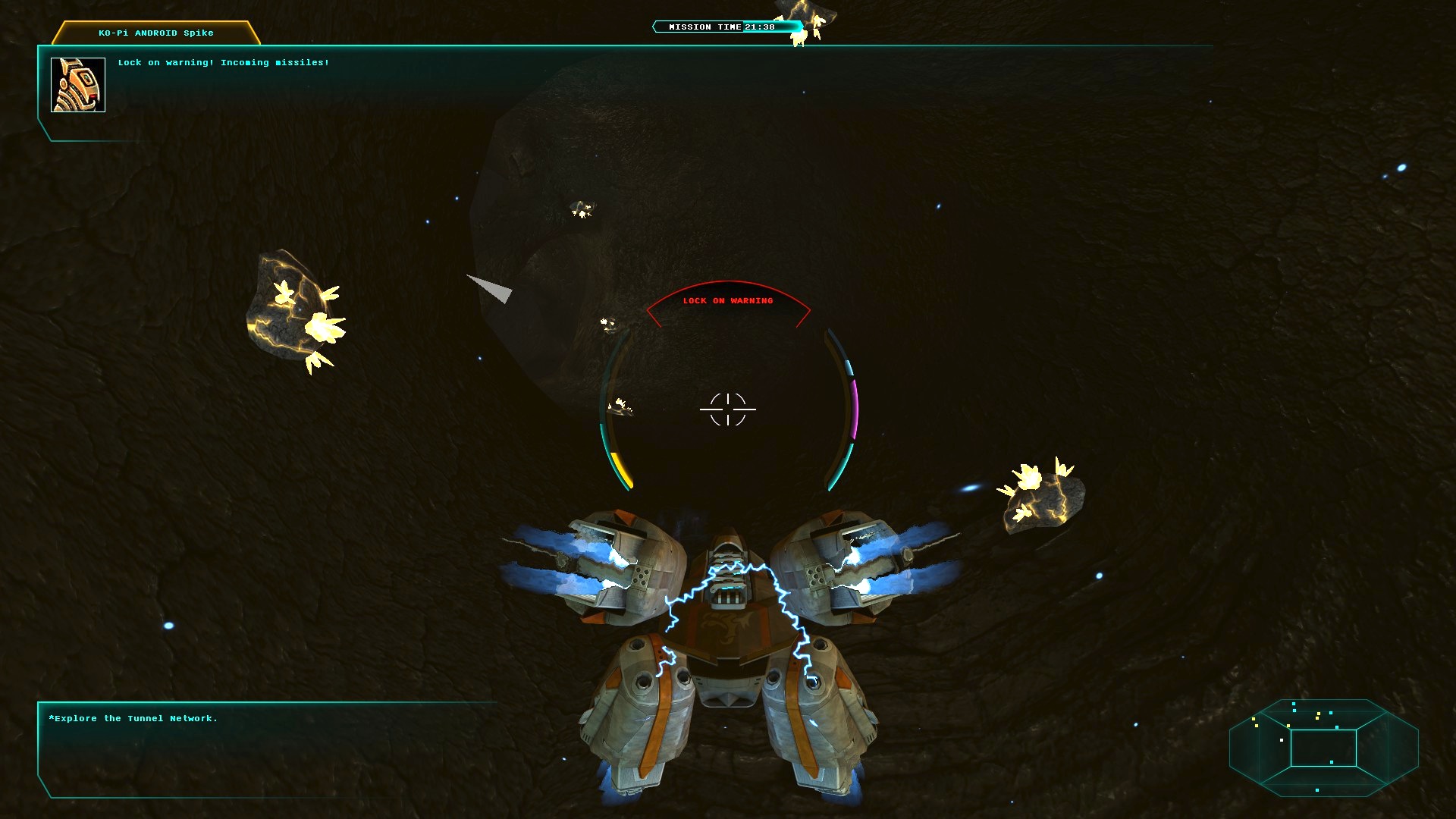
The first few missions were a bit samey, despite claiming to be "recon" and "combat" missions — they all seemed to involve "destroy [x] number of Zylon fighters", possibly against a time limit. But then the fourth "story" mission came along, which tasks you with finding a piece of a secret weapon that will help you deal with a Zylon secret weapon. Said piece of secret weapon is stashed somewhere in an asteroid. And this asteroid is pretty big. So big that when you're flying over its surface, you'd be forgiven for thinking you were conducting a planetside mission. Not only that, but part of the mission involves going inside the asteroid, at which point switching to Assault mode effectively turns the game into Descent, which is awesome. I'll ignore, for now, the fact that the game crashed on me at this point just as I was about to finish that mission.

I wasn't sure what to think of Star Raiders when I first started playing it. Then I looked at the clock and realised I'd been playing for nearly two hours. So something must be right somewhere. It's clearly not the original game in any shape or form — the "galactic map" interface in the game is a glorified mission select screen rather than the strategic overview of the original — but what it does offer is a good, fun, if simplistic space combat game with some nice ideas and a horrendously poor control scheme on console.

At £6.99, though, you can probably afford to take a chance on it, though, right?

Oh, if you're interested, then…

Old:

New (previously-mentioned Descent bit):
#oneaday Day 96: Don't Take It Personally, Babe

The thing I like about games that are a bit off the beaten track is the fact that they're not afraid to break with every gaming convention under the sun in order to try something a bit different. Objectively, sometimes they're not great "games" in the traditional sense, but they are definitely worthwhile experiences that explore interesting new ways of telling stories.
One "author" who produces such games is Christine Love, who is fond of creating ren'ai titles. For the uninitiated, ren'ai games have strong plot elements of romantic love. They're not necessarily dating sims or hentai games—though some are—but all of them have a narrative which explores love and emotions. Final Fantasy VIII, for example, is regarded as a ren'ai game. Stretching the definition somewhat, you could even argue Silent Hill 2 has elements of the genre.

The appropriately-named Love's titles, however, are much more up-front about their intentions. Digital: A Love Story and the oddly-named Don't Take It Personally, Babe, It Just Ain't Your Story are two games which go about telling a ren'ai tale in similar, though markedly different fashions. Both of them revolve heavily around the use of technology and its role in interpersonal relations.

I'll resist spoiling either of them, but I think they're well worth exploring for anyone interested in the "visual novel" genre—anyone who liked games such as the Ace Attorney series, 999 or Hotel Dusk, for example.

Digital: A Love Story sits you at the desk of an Amiga (or rather, a non-copyright infringing equivalent) five minutes into the future of 1988. Purely by interacting with your computer and dialling up a number of virtual BBS systems, a genuinely compelling tale is told without any graphics whatsoever. You don't "break character" for a single instant in the game, and it's this gameplay "hook" that keeps you playing to see what's going on. I'll say nothing else, as that would spoil it. But it's excellent—if only for nostalgia value. It happens to tell a good story, too.

Don't Take It Personally… is a little different. Taking a more Japanese style to its art, it looks like a dating game, though it isn't one. Casting players in the role of John Rook, a 38-year old double divorcee who came to high school teaching in 2027 as part of a mid-life crisis, it tells a tale which explores interpersonal and social issues that you don't generally see in games. It's a relatively simplistic visual novel in terms of gameplay, with only a few choices to make, but like Digital, it's the story that matters. And it's told in a very interesting way through three different "layers". There's the face-to-face action, where the player, as John, sees and hears what's going on in front of him. John also has access to his students' Facebook-like social network, though, and is able to read any of his students' communications—even the private ones—giving an ethically-questionable insight into what they're thinking and what is really going on behind the dramas that unfold. And thirdly, this game features possibly the only time you'll ever see 4chan (sorry, "12channel") being used as a Greek chorus.

Both games have a "message" and while Don't Take It Personally in particular is a little heavy-handed with it towards the end, it's cool to see games trying to say something a little more than the usual melodrama.

So check 'em out. They take, like, two hours at most each. And they're free. You love free stuff, right?

#oneaday Day 76: The Alternative Video Game BAFTAs

So the BAFTA Video Games Awards happened. Last night, in fact. And while the nominations were fairly predictable, there was a relatively pleasing spread of different titles that actually won. In fact, I did a lovely writeup over at GamePro that you should probably go read.

But enough of that. Those awards are all very conventional. So I thought I'd come up with some of my own. Without further ado, I present the Alternative Video Game BAFTAs.

Most Opportunities To Go To The Toilet In A Video Game

Winner: Heavy Rain, where despite the fact there is no logical reason for you to make your characters go to the toilet, you find yourself doing so anyway.

Honourable mention: The Sims 3, which only didn't win because it didn't come out in 2010, unless you count the console version, which I don't, except when putting it in as an Honourable Mention.

Game No-One Had Heard Of When I Played But Now Most People Have Heard Of

Winner: Recettear: An Item Shop's Tale, one of the most charming games I played last year, promptly got very excited about and some months later everyone else seemed to discover.

Game That Has Been On My Shelf The Longest, Unopened

Winner: Resident Evil 4 on PlayStation 2, which I'm not sure counts any more because I started playing it last night.

Former Winner: Final Fantasy XII.

The "MMO That Isn't Boring" Award

Winner: DC Universe Online, which I am aware came out in January of this year, not last year, but these are my awards, so my rules.

Game Most Likely To Make You Feel Uncomfortable If Someone Walks In On You Playing It

Winner: Deathsmiles, for reasons that are well-documented.

Runner-Up: Recettear: An Item Shop's Tale. "That looks shit and cheesy and their voices are really annoying and my God that music!" "No, but it's really funny! Seriously!" "Shut up. I'm going to go and play Starcraft."

Honourable Mention: Dead or Alive Xtreme 2, the most summery game in the Universe. I know it didn't come out last year, but I still play it in the summertime because it's like being on holiday with improbably-proportioned women who like jetskiing. I have an Achievement and everything.

Sadomasochism Award

Winner: Castlevania: Harmony of Dissonance, a game which enjoys kicking you in the balls so much that it's enough to put most people off within a matter of minutes. I, on the other hand, have sunk over 20 hours into it and have just started playing it again.

The "I Love You But You Make Me Angry" Award

Winner: Mass Effect 2, for being a magnificent game that I finished before all the DLC came out and considered going back to just to play the extra stuff but then decided to wait for the "definitive" PS3 version, which then has some extra DLC announced for it, too. STOP IT. STOP MAKING THAT GAME. YOU FINISHED IT. MAKE THE SEQUEL. AND DON'T FUCK IT UP OR RUSH IT OR POST REVIEWS FOR IT ON METACRITIC.

The Game I Keep Forgetting Exists But Is Actually Really Good

Winner: Frozen Synapse, a wonderfully inventive take on the competitive shooter that is turn-based and play-by-email. And awesome.

The Game I Got Best At While I Was Really Totally Off My Face On Expensive Cider

Winner: Joe Danger, a game which my friend Sam and I started playing early in the evening, got drunk and accidentally played for over 3 hours. Highlight of the night was when I discovered how to get massive scores while Sam was in the toilet, meaning that when he came back my average score was roughly 1,000 times more than when he left.

Best Game

Winner: Deadly Premonition. No further explanation required.

Best Video Game Podcast

Winner: The Squadron of Shame SquadCast. Of course.

The Alternative BAFTA Fellowship

Winner: @SpaceDrakeCF from Carpe Fulgur for the magnificent localisation job on Recettear. We're talking a translation of Phoenix Wright quality here. Not only that, but he was consistently entertaining to follow during GDC and provided some excellent "liveblogs" of the sessions he attended.

#oneaday Day 69: PAX Bostona

PAX East is happening tomorrow, and I'm not there. This makes me inordinately sad for a number of reasons. Firstly, PAX East last year was the last time I could legitimately say that I was 100% completely, totally and utterly happy. For those few days, I had left all my growing troubles behind in the UK and was able to immerse myself in the culture that I loved so much. I was able to be an unabashed nerd and surround myself with thousands of other people like myself.

Secondly, PAX East represented the last time I had the chance to see some of the people I consider to be my best friends in the world. It sounds sappy, I'm sure, but the relationships I've cultivated online over the last few years are some of the strongest friendships I've ever had—and in some cases, I've met these people once or twice… and in many cases, not at all.

Thirdly, PAX East last year pretty much marked the start of the career path that I'd very much like to follow full-time, given the opportunity: being part of the games press. At the time I was writing for Kombo.com and between meeting up with people and seeing cool panel discussions (some of which didn't feature my brother) I was hunting down interesting stories and reporting on them. I'd been writing the news for a little while by then, but attending an event and spotting the new hotness was a lot of fun, and something I want to do more of in the future.

The best thing about PAX East, though, I've already touched on, and I blogged about at length last year. It's a place to call home. A place where people who enjoy video games can come together and nerd out to their hearts' content without fear of judgement, without feeling like they have to "hide" their hobby or play it down. No, this is a place where girls could dress as Bayonetta without (much) shame, where people could experience new aspects to their hobby, where people could meet some of their idols and where people could get together and meet each other.

In short, it was awesome. And that's why right now I am very much wishing I was there in Boston, scoping out the nearest coffee shops and Dunkin' Donuts to the convention centre, arguing about which places to go for food and playing "spot the influential industry figure".

So to all of you over there in Boston right now, I hope you have the best time of your lives over the next few days. Because if you don't have the best time of your lives, I could clearly have had your tickets and had the best time of my life instead. (Assuming I could have actually flown over to Boston, of course. Planes are expensive. But that's beside the point.)

Yeah. I JELLY. Deal with it.

Have an awesome time, PAX East. Wish I was there.

#oneaday Day 67: Cultural Differences

Games are a fairly unique medium in that they allow pretty much anyone easy access to material from other cultures without the language barrier necessarily getting in the way. A book in a language you don't understand, for example, is pretty much useless. A film can be appreciated for its direction and cinematography if not understood. Music can be enjoyed on a certain level. But a foreign game, assuming its not too story-heavy, can be enjoyed by anyone.

It's here that we run into the East-West divide. Both parts of the world enjoy producing games with stories, though Western stories often tend to err on the side of "gritty" while Japanese tales tend for the most part to be more on the colourful, melodramatic side, often derided by people who don't enjoy them as being "emo". Let's leave narrative-heavy games aside for a moment, though, and look at games that are "gameplay experiences" first and foremost.

For comparison purposes, I'm going to take dear departed Bizarre Creations' Geometry Wars 2 for the Western front, and CAVE's Deathsmiles for the Eastern front. Both are Xbox 360 titles, both released at a low price point, though Deathsmiles saw a retail release as opposed to Geometry Wars 2's Xbox LIVE Arcade-only release. This, in itself, is somewhat telling.

Let's consider the games' respective aesthetics first. Geometry Wars 2 is, as you may expect from the title, abstract in nature. There are no "characters", there's no "story", it's just a bunch of neon shapes against one little white abstract "ship", and everything explodes into a shower of beautiful fireworks. It's spectacular to behold (assuming the person playing is any good) and recognisably "next-gen" (or "current-gen" if you prefer, since it's technically more accurate).

Deathsmiles, on the other hand, looks like a SNES game, albeit one with enough things on screen to make the little Nintendo box explode. It's all sprite-based, it has chunky pixel-art backgrounds that have been upscaled to HD but not quite by enough, it has animations done by hand rather than generated procedurally and suffers from occasional slowdown due to the sheer amount of shit happening on screen at once.

Not only that, though, but Deathsmiles has "character". Rather than the abstract appearance of Geometry Wars 2, the player "ship" in Deathsmiles is a person. Specifically, it's one of four underage Gothic Lolita angels dressed in borderline-inappropriate costumes accompanied by a familiar. Similarly, all the enemies are recognisable as "monsters", be they humanoid, dragons, flying eye things with bat wings, spiders or indeed the wonderfully named final boss, Tyrannosatan.

The key thing about the two games' respective aesthetics, though, is that Geometry Wars 2 is consciously trying to look shiny and new, while Deathsmiles is more than happy to look like an arcade game from at least 10 years ago—the "if it ain't broke, don't fix it" approach. Neither approach is necessarily more or less valid than the other, but it's an interesting contrast.

Then we come to how the two games play. Geometry Wars 2 has a variety of modes, all of which can be explained very easily. They all involve killing things before they touch your ship, with only a couple of modes (King, in which you may only fire while sitting in certain temporary "zones"; and Pacifism, in which you can't fire at all and can only destroy things by detonating "gates" by passing through them) varying even slightly from this formula.

Deathsmiles, on the other hand, should be a simple matter to explain. It's a shoot 'em up, after all—how complicated can it be? But I attempted to explain it to a friend earlier and ended up confusing both myself and him. The game's tutorial makes it sound rather straightforward—fire in either direction, use a smart bomb, charge up shots or use a lock-on attack—but in fact there's a surprising amount of hidden depth.

Firstly, since it, like Geometry Wars 2, is a game about getting high scores, there's a somewhat intricate method to attaining the highest scores that involves destroying the correct enemies with the correct type of shots. The game mentions this in passing, but it's up to the player to determine what it actually means. Geometry Wars 2, on the other hand, is about shooting shit and using a bomb if you're in an inescapable situation.

Secondly, there's the key element of the "bullet hell" shooter—the hitbox. Graze any enemy in Geometry Wars 2 and your ship explodes. But the same isn't true in Deathsmiles—mercifully, since the player sprite is relatively large. No, instead there's a pulsing "heart" symbol in the middle of your characters chest and that—and only that—is the thing that can be damaged. Because this is so small, it means you can navigate your player character through intricate arrangements of bullets that initially seem impossible to avoid. Much of the game becomes about less about shooting things and more about learning how and when these patterns appear, and finding an appropriate path through them. The patterns are the same each time, too, so you certainly can "learn" the game, as opposed to Geometry Wars 2's more random chaos.

Then there's the matter of replay value. Both games are designed to be replayed in a "score attack" style. But Geometry Wars 2's sessions tend to be rather short for the most part—a few minutes at most. In most modes, the game ends when you're dead. More skilled players get to play for longer in most cases.

Deathsmiles, on the other hand, takes you through at least 6 levels, the order of which you can select to a certain degree, and offers you unlimited continues. The whole game takes about 20-30 minutes from start to finish. This means that "beating" the game is within the reach of absolutely anyone, even on the hardest difficulty settings. Sure, you'll get crap scores, since your score resets to zero every time you continue, but you can at least reach the end and whore for Achievements if that's your bag. The sign of a skilled Deathsmiles player, then, is not how long they play for, but how long they can survive without their score resetting. This doesn't necessarily have to be from the beginning of the game, as tackling the levels in different orders can provide optimum bonus-point scoring potential, but then we get into a whole other order of depth.

It's interesting to see two wildly different approaches to what is essentially the same genre—the shmup—and contrast them. I like both games very much, but I feel that most people will probably find themselves favouring one or the other, much like game design philosophy in general.

I'll leave you with one of the most interesting things to ponder: whether Deathsmiles' character designs would have ever been green-lit by a Western developer, even knowing the fact that the arguably "sexualised" nature of them doesn't factor into the game itself at all? I somehow doubt it. Don't believe me? Take a look:

Cute, right? Bit of a stockings and thighs and boobs theme going on. We've seen self-consciously sexy Western female characters before, so surely nothing new there. How about if I tell you how old they're all supposed to be?

Yeah. Pervert.

#oneaday, Day 44: The Late Review - Final Fantasy XII

Since I'm currently going through my backlog of games and beating them one at a time, it seems only fitting that I should write a sort of "review" of each one as I come to their (hopefully inevitable) conclusion. So tonight it's the turn of Final Fantasy XII, one of several "black sheep" of the series thanks to its complete defiance of established series conventions and adoption of a quasi-Western RPG style of gameplay. I will try and avoid as many spoilers in this post as possible.

I will preface this by saying, as always, that I am a total Final Fantasy fanboy. I don't care if they're clichéd, I don't care if big tentacley angel monsters as final bosses are overdone, it's what I expect from a JRPG, and it's what I inevitably get from the Final Fantasy series in particular. Overwrought melodrama, gratuitous and unnecessary love stories and the inevitable destruction of the world that only a plucky band of teenagers (and one guy in his twenties who inevitably gets referred to as "old man" throughout) can prevent? Sign me up. I love it.

So it was something of a surprise that Final Fantasy XII eschews most of these things. The melodrama is kept to a minimum, any romantic subplots are handled with the subtlest of nudges and winks rather than faintly embarrassing scenes accompanied by someone singing and the small ensemble cast is likeable, realistic and "human", typically ridiculous Final Fantasy costumes aside. (Penelo must be really sweaty by the end of the game.)

In fact, for once in a Final Fantasy game, the plot almost takes a back seat to the gameplay. There are large tracts of the game where you're given a lot of freedom—something happens, the party comes to the conclusion that what they really need to do next is travel to something that is inevitably on the complete opposite side of the game world to where they are right now and then it's up to the player how to proceed. They could go straight there using the various means of fast travel. They could walk straight there. Or they could wander off and go and do some of the many, many sidequests, most of which are available throughout the game rather than the usual Final Fantasy trick of saving them all until just before the world really needs to be saved right now please. Granted, you still have the somewhat silly opportunity to go and do all these things while the final confrontation patiently waits for you right in the middle of the map, but you just know that people would bitch and moan if you didn't have the opportunity to do this. It's also worth noting that the amount of time between the "point of no return" and the ending of the game is actually pretty short, so it's not as if you have to go off and do all the sidequests then spend 6 hours battling through the final dungeon. This is a refreshing change.

By far the most refreshing thing about the game is the battle system, though. I waxed lyrical about this back on Day 5, but it's worth mentioning again. The combat system, combining the best bits of a quasi-real-time MMO-style combat system and the "active pause" style of a BioWare RPG whilst keeping it optimised for a console, works astoundingly well, especially once you get the hang of using Gambits. By automating common actions such as curing and buffing, you're not making the game unnecessarily easy, you're making your play more efficient. Are you really getting any more from a game where you're manually selecting to cast "Haste" on your attackers every few turns?

I described the Gambit system as being akin to the "huddle" you have when playing an MMO with a well-organised group. The best way to use it appears to be to give everyone clearly defined roles. For me, this means one tanking attacker, one who solely focused on healing HP and status effects and a third who focused on buffing the tanking attacker with Protect, Shell, Regen and Haste. All of them got stuck in hitting things with sticks and hammers when they didn't have anything else to do, but this setup worked extremely well and saw me through most of the game. Any mishaps could be quickly dealt with by popping up the menu and dealing with them manually. And in boss battles where circumstances suddenly shifted, such as them suddenly becoming immune to physical attacks? Well, that was just a case of popping open the main menu and adjusting the attacking Gambits to use Magicks instead.

It's a great-looking game for a PS2 game, too. Sure, there's rough edges when playing on an HDTV, but it's clear to see this is a well-crafted, well-designed world with distinctive-looking characters. The animations in cutscenes are excellent, too, with some high-quality facial animations doing a great deal to help forget the laughing scene in Final Fantasy X. One tiny bugbear with the graphics is that all the FMV sequences are in 4:3 while the game itself happily runs in 16:9 but this is a minor issue, as the vast majority of story sequences are rendered in-engine.

The sound is probably the weakest bit of the game. The voices are heavily, heavily compressed, though the acting itself is generally very good. The music is unmemorable, however, which is quite unusual for a Final Fantasy game. It has character, and sounds like Final Fantasy Tactics (which is understandable, given their common setting) but there's nothing anywhere near as iconic as One Winged Angel on display here, which is a shame. There's also a couple of areas that repeat music from earlier in the game, too, which seems a little lazy, given that the vast majority of areas have unique music. It's hardly a deal-breaker, though.

Final Fantasy XII is often described as the FF for people who don't like FF. And it's absolutely true—the crushing linearity of earlier entries in the series is nowhere to be seen (although the main plot is firmly on rails, you're free to wander off and do your own thing at any time right up until the finale) and there's very little need to "grind" by running around in circles waiting for random battles to happen. In fact, it's possible to "grind" without noticing simply by travelling from one place to another—the numerous long-distance journeys that the plot tasks you with seem to set you up to take advantage of this fact.

At the same time, these elements may put some people off. Some people enjoy the tight focus that a strictly linear plot gives, and indeed in FFXII it's very easy to lose track of what happened in the story when your last cutscene was eight hours ago. The plot picks up pace towards the end, though, and you find yourself wanting to press forward and see things through to their conclusion. How quickly you choose to do so is entirely up to you—so if you're a fan of a tight plot, you could probably romp through fairly quickly. If you're a completionist, though, there's plenty to keep you occupied here. I beat the game after 98 hours with barely half of the sidequests completed. Then there's secret weapons to find, a boss with 35 million HP to take down, secret Summons, optional areas to explore and doubtless many other things besides.

So in summary then, I was very, very impressed with the whole game. As a Final Fantasy fanboy, I enjoyed the fact that it still felt like a Final Fantasy game whilst playing very differently to the more "traditional" entries in the series. And as a fan of good games? Well, this is very much a Good Game.

The only thing that makes me a little sad is how few people will probably be inclined to play it these days. With the lack of backward-compatibility on new PS3s, playing it will either involve tracking down a PS2 or using an emulator. It's wholly worth it, though, as it is without doubt one of the best RPGs I've had the pleasure to play for a long time, and certainly one of the finest entries in the Final Fantasy series. A pity we probably won't see its like from Squeenix again.