1236: On Being That Guy Who Picks 'Japanese' in the Sound Menu

Jun 07 -- AaaaaaaaI always used to be one for having my game's voices in English. I liked being able to understand what they were saying as well as reading the subtitles on screen. In some cases, I didn't have the option; I'll always associate Persona 3 and 4 with English voices, for example, even though, in retrospect, it would probably be better with Japanese voice acting. In others, the English voiceover job was so genuinely good that I didn't want to try the Japanese version — Xenoblade Chronicles springs immediately to mind in this regard.

I can remember the moment that I realised Japanese voice acting was something worth exploring even though I didn't speak the language, though. It was while I was playing the utterly terrifying PSP visual novel/adventure game Corpse Party — one of my favourite games on that platform, and legitimately one of the most disturbing games I've ever experienced — that I realised that, frankly, Japanese video game voice actors aren't afraid to let rip with the utterly raw emotion. They'll shout until their voice cracks; they'll scream; they'll cry. And by God, they sound like they mean it.

It was around one of the many points in Corpse Party where one of the characters is bawling their eyes out and screaming in terror at the horrific situation they've found themselves in that I realised when it comes to voice acting in games — which are typically accompanied by subtitles, particularly in the visual novel and JRPG genres — it's not about the words that are being said, but about how they're being said. It didn't matter that I didn't understand the Japanese words that were being screeched into my ears (seriously, play that game on headphones and you'll never want to turn the light out again) — the meaning was all too clear simply from the tone of voice.

Those who have been reading regularly will know that I've been playing Ar Tonelico 3 recently. I played the first game in that series in English, largely because I found the English voices in the video cutscenes too jarring when paired with Japanese speech in the main game. I played the second in Japanese because I'd been warned that the English dub, much like the overall translation job, was somewhat questionable. And I started the third in English, but after not very long I switched to Japanese. It is a decision I did not regret.

It's very obvious from the huge rift in quality between the English and Japanese voice tracks in something like Ar Tonelico 3 that the English actors are, for the most part, phoning it in somewhat, while the Japanese actors care about what they're doing. In many cases, it is the difference between a rush job (English) and having well-known professionals handle the voices.

I witnessed a scene this evening — no spoilers — that had me more than a little choked up due to the amount of raw emotion and passion that the actress playing one of the characters was throwing into the delivery of her lines. I believed that she meant what she was saying. This character was supposed to be upset, and I believed that.

The other thing that comes into play is that when a game's dialogue has been translated relatively literally from the original Japanese rather than fully localised, reading it out loud in English often sounds very stilted and artificial, simply because that's not how English people talk. We don't say things like "what is this, all of a sudden?" and start entire conversations with "By the way". We don't refer to ourselves in the third person to be cute. (Usually. Saki will do it!) And we don't use the term "lovey-dovey" anywhere near as much as Japanese people apparently do.

There's nothing wrong with doing a literal translation from the Japanese — so long as you do it with enough care to make it understandable, of course — but if you're going to take this approach to translation, I've come to the conclusion it's best to leave the voices as they are. If, on the other hand, you're going to take the Ace Attorney/Cherry Tree High Comedy Club/Recettear approach to localisation and actually make the dialogue significantly and noticeably more "Western" in the process, then we can talk about English voiceovers.

I must confess to always having found an attitude like the one I just described a little snobby in the past. Having immersed myself in this side of gaming (and anime) culture for this long, though, I totally get it. Once you get used to the infinitely more professional job Japanese voice actors do on productions like Ar Tonelico (and even on lighter fare like Hyperdimension Neptunia, for that matter) you'll likely never want to go back.

1233: Playing It for the Articles

Jun 4 -- StoryI overheard a Twitter conversation the other day (yes, I'm back on there, largely to make my professional self easier to reach if necessary) in which disparaging comments were thrown around regarding people who "play games for the story".
As someone who primarily plays games for the story, I feel honour-bound to take exception to this line of argument, though I forget exactly what the actual point of the discussion in question was. Anyway. Allow me to describe what being someone who plays games for the story — a self-professed "narrative junkie" — means.

Quite simply, it means that I am extremely forgiving of a wide variety of "sins" on a game's gameplay front if — and it's a big if — the narrative content of the game in question keeps me interested and compelled. (Caveat: the only unforgivable sin that I simply can't get past is a free-to-play game putting up a paywall with an energy system or similar mechanic; no matter how good your narrative is, if you actively stop me from playing your game before I'm good and ready to stop, I'm not coming back. Ever.)

Said narrative doesn't have to be big and clever, or trying to be anything more than a piece of enjoyable entertainment. But it pretty much needs to be there to keep me interested.

Similarly, I can happily take a game with practically no "gameplay" in a traditional sense — see: interactive movies like School Days HQ or any of the myriad visual novels available — so long as the narrative entertains me and keeps me interested.

I'm relatively easily pleased when it comes to storylines. About my only real requirement to enjoy a video game story (or any story in any medium at all, really) is that there are some characters in it that I either like or find interesting — because those two feelings aren't necessarily the same thing. Give me something in which relatively little "happens," but in which I gain a deep understanding of the characters involved, and I'll be very happy indeed.

It's this love for the art of the story that has led me to give a whole bunch of much-derided games the time of day where others would pass them by. The titles which spring most readily to mind are the Hyperdimension Neptunia series, which is riddled with technical flaws, dull gameplay (in the first game, at least; I actually thought the second was genuinely fun, and I'm yet to try the third one) and various other issues; and Nier, which everyone seems to have decided looked drab and boring and thus was unworthy of further exploration. (I never quite understood this; I thought Nier was actually a pretty good-looking game — it certainly had a lot of personality.) Even the Ar Tonelico series, which I've been playing through for the last… quite a while isn't widely regarded as providing shining examples of "good games".

For the record, I found the Neptunia series genuinely amusing as well as being a wonderfully on-the-nose parody of both anime and video game culture; I found Nier a fascinating, deeply moving experience; and Ar Tonelico… well, having known nothing about it when I started playing, this is now a series I would happily defend to the death.

It's this attitude which brought me to the realisation I'm not really a fan of Western-developed role-playing games any more — particularly those of the "open world" variety favoured by Bethesda. I enjoy a good dungeon crawl, sure, but when your lovingly-crafted game world behaves more like a diorama with animatronics than a living world with actual people in it, I get a bit bored.

I realise there's a certain degree of irony in accusing titles like Skyrim of having diorama-like worlds when most JRPG towns are populated by NPCs who constantly stand in the same place and spout the same crap every time you talk to them. But for me, paradoxically, that gives them a lot more personality. Rather than constantly running into the same recycled guard model and wanting to throw a brick through the TV every time someone makes an "arrow to the knee" reference, each NPC is unique and, for those one or two lines they speak, vaguely interesting.

Ar Tonelico handles this rather well by having the NPCs' lines change according to the point in the story you're at. The stories of all three games in the series take place over a relatively small geographical area, so you're revisiting locations a lot; it's a fun little "unofficial" sidequest to check in with your favourite NPCs and see how their own completely irrelevant story arc is progressing. Will the little kid outside the General Store ever get up the courage to ask Sasha to come and play with him? Will Skycat ever actually make a move on Luca or is she just flirting? Will those weird furry creatures ever say anything other than "Poo"?

This is all a matter of taste, of course, and I'm well aware that there are thousands — millions? — of people out there perfectly happy with the way Skyrim does things. And that's fine. Just, as always, be aware that not everyone enjoys the same things in the same way — no-one's way of enjoying a creative work is inherently "wrong", so live and let live.

1232: Knell of Ar Ciel

Jun 03 -- Ar Tonelico 3I haven't posted about Ar Tonelico for a while, and having just witnessed the "bad ending" of the third game (ooh, it's bad) I feel now may be a good time for a progress report on my thoughts thus far before I jump in and try for the other endings.
Ar Tonelico Qoga, as the third game is known, is a peculiar beast. While it's the most outright "perverted" of the series — the previous two games had plenty in the way of innuendo but stopped short of being overly fanservicey, a couple of scenes where the heroines were clad only in towels aside — it's also probably the most open-minded of the three with regard to the subject matter it tackles. This is a game that revels in sexuality in all its forms as one of its themes, and if you feel somewhat uncomfortable playing it, I feel I know Gust's work well enough by now to say that it's probably intentional that you feel that way.

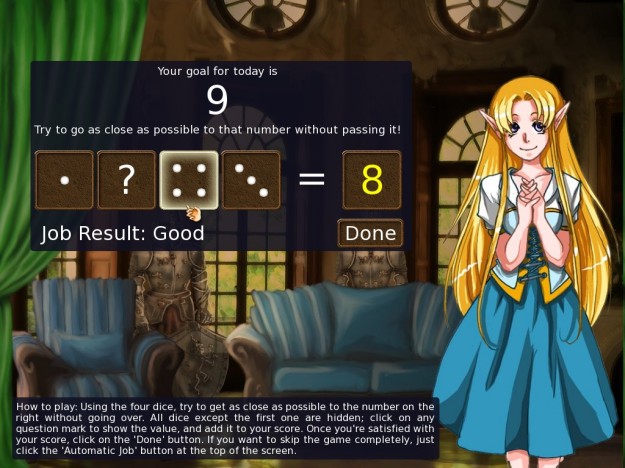
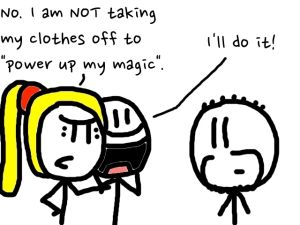
Let me qualify the above statements a little. Insofar as the game is "perverted", one of its core gameplay mechanics involves the female "Reyvateil" characters (essentially glass-cannon mages if you want to assign them a traditional RPG party role) stripping off their clothes throughout the course of battle. While, yes, this is gratuitous and unnecessary and etc. etc. (for the record: I am an unabashed (well, mildly abashed) pervert and have no issue with pervy fanservice in my entertainment) they do at least make an attempt to justify the reason for this happening to a certain degree in a narrative sense: Reyvateils are artificial human-like life forms that are basically equipped with Wi-Fi (bear with me) and communicate wirelessly with the titular tower of Ar Tonelico in order to produce the magic-like effects of their Songs. By stripping — or "purging", as the game calls it — the Reyvateils are able to get better reception, so to speak, and can absorb more magic from the tower. This translates, in gameplay terms, to the "Burst" gauge, which represents how powerful the Reyvateil's spell will be if you set it off right now, increasing at a much more rapid rate according to how few clothes she is wearing. (They stop short of her getting fully naked, I might add — after purging three levels of clothing, she's down to her skimpies, and purging a fourth time triggers her powerful (and surreal) "Flipsphere" über-attack, at which point her clothes magically reappear.)

Read all that back again, and I'd forgive you for never wanting to give this game the time of day. A game whose female characters strip off in exchange for increased magical capabilities? Sounds like some sort of Male Power Fantasy™. And perhaps it is.

Thing is, though, Ar Tonelico Qoga is far more interesting and intelligent than just pretty girls getting almost-naked. For starters, it's worth noting that after a certain point in the game, all the male characters will strip off at a moment's notice too — performing each character's best attack causes all their clothes to fall off and for you to get a good look at what each of them are packing underneath their armour. Doctor Hikari Gojo's fundoshi in particular is a sight to behold.

But no. It's not even about characters getting naked. Much like the previous two games in the series, the really interesting stuff comes about thanks to the "Dive" mechanic — a system whereby you can increase the power of the two Reyvateils by taking a wander through their "Cosmosphere" — a multi-level psychic world that exists within their subconscious. By exploring the two heroines' Cosmospheres, you learn a great deal about them — facts that simply don't come up explicitly in the game's "normal" plot, but which can help inform your reaction to things that go on once you know them.

As is par for the course in the series, each level of the two heroines' Cosmospheres focuses around some sort of problem that they are having — be it a difficulty coming to terms with who they are, the strange influences other aspects of their personality have on them, or simply something they're having trouble admitting or dealing with. By interacting with the Reyvateil and the other characters in her Cosmosphere, the protagonist Aoto forges an incredibly strong, incredibly intimate bond with the heroines and gets to know them in a way that no-one else in the world does.

This leads to some really interesting scenes, many of which are touching on territory I can't recall exploring in a game before. And unlike the gaudy excesses of the strip-centric battle system, they're handled sensitively and with care; clearly composed by someone who knew what they were talking about.

I'm trying not to spoil anything here for those of you who are reading this and intend to play through this fascinating game, but I feel I should give one example to highlight what I'm talking about, and that is the character who, in one of her Cosmosphere levels, essentially "comes out" as being a submissive or "bottom" with somewhat masochistic tendencies. Given what you know about this character by this point, her confession is not altogether surprising, but what is surprising is that it is actually referenced and explored through more than simple innuendo.

"Don't take off the chains," she says after a convoluted, embarrassing and humiliating sequence of events for her, where Aoto is about to give her her freedom. "I feel safe when I'm in the chains, so long as you're there."

I'll confess to not knowing anything about BDSM and related sexual preferences, but I found it fascinating to see this character opening up about her secret passions and desires like this. It wasn't treated as a kind of "wish fulfilment" scene for male players, either; it was simple, to the point and helped me to understand one aspect of this particular character. In short, it's the sort of thing I'd like to see explored in more games; sadly, it's abundantly clear that very few "triple-A" producers would greenlight a game that delves into such subject matter, though thankfully there's always the "lower-tier" games such as Ar Tonelico willing to step up to the plate and try something new.

As guilty as I feel for what occurred in the bad ending, I should probably go to bed now and absolutely not try to get a better ending now. Right? Right. Suuuuuure.

1222: Stupid Acronym, Great Game

May 24 -- FEARI've been playing First Encounter Assault Recon, or F.E.A.R. to its friends, recently. And while its acronym-based title is mildly cringeworthy — look, it must be scary, it's called F.E.A.R.! — what I've discovered is that it's actually a rather magnificent game that I'm sorry I haven't got around to sooner.
I'm not normally a big fan of first-person shooters because all too many of them these days follow the Call of Duty model — linear pathways with no divergence punctuated with predictable shooting galleries coupled with a story which neither I nor the developers could give a shit about because the focus of the game is squarely on multiplayer. That's not to say Call of Duty is necessarily a bad thing, of course — the millions of people who buy every single installment prove this fact — but it's just not for me.

For me, however, I grew up with first-person shooters as single-player experiences: Wolfenstein 3D, Doom, Quake, Duke Nukem 3D, Shadow Warrior, Blood, SiN, Half-Life… the list goes on. And while many of these had a multiplayer component, it was only really Doom and Quake that (arguably) pushed it to the forefront. Given the time they came out, it wasn't practical for me to explore multiplayer at all due to the poor quality of your average Internet connection — most of us here in the U.K. were still using dial-up at that point, after all. As such, I still tend to prefer the solitary experience of a good first-person shooter.

Which is why I'm enjoying F.E.A.R. so much. While it did launch with a (now-defunct, save for a fan-run service) multiplayer component, the focus of the game is very much on its single-player story. While perhaps a little slow to get started, after playing for a few hours last night, I found myself well and truly enraptured by the curious tale it has to tell.

To say too much about the story would be to spoil it, but suffice to say all is not as it first appears, as you might expect. The story is paced extremely well, flip-flopping between relatively conventional "military types barking orders at each other" and some seriously weird shit going on. Monolith, the developers of F.E.A.R., clearly played a lot of System Shock 2 at some point as a lot of the "weird shit" going on in F.E.A.R. is of a similar ilk to the "weird shit" that goes on in System Shock 2 — hallucinations, ghosts and all manner of other quasi-supernatural phenomena, all of which is kept tantalisingly mysterious throughout most of the game.

F.E.A.R.'s protagonist is the very embodiment of a silent protagonist the player is supposed to superimpose their own personality over the top of. He doesn't even have a name, for heaven's sake, being referred to only as "point man". Unlike many other first-person shooters, however, Point Man very much has a sense of presence in the game world — look down and you can see your feet; wander into an area where you're backlit and you'll project a shadow in front of you. While you never see your character from outside the first-person perspective, this gives a much better feeling of being "part of the world" than many other games of this type.

F.E.A.R. adopts a similar storytelling style to Half-Life in that the story unfolds as you play, and you never "break character" to see things from a third-person perspective. Much of the narrative is revealed through rather one-sided radio conversations between Point Man and other members of the F.E.A.R. team, but there are also numerous things throughout the game's levels that let you delve deeper into the details of what is actually going on. By hacking laptops to recover data files and listening to voicemails, you gradually start to get a very strong sense of who is who in this game world, even though you meet relatively few of the characters involved face-to-face. While I initially thought the story was going to be somewhat throwaway when I started playing the game, after about 6 hours of the campaign mode, I'm genuinely interested in what is happening and what will happen next.

The voicemails and laptops are, of course, simply variations on the oft-derided "audiologs" that are found in games like the aforementioned System Shock 2 and Bioshock, but somehow they seem to make a lot more thematic sense here. Because you're listening to messages — fragments of conversations — between people rather than someone inexplicably babbling all their innermost thoughts into a tape recorder, there's a much better sense of context, and of these characters having relationships. Similarly, the laptops simply contain data files that gradually reveal the facts of the events rather than incongruous audio logs or personal diary entries. It makes a lot of sense, and gives you a very strong feeling of "following the trail" to unravel the mystery of the game's strange goings-on.

I mentioned earlier that I disliked the Call of Duty way of doing things in single-player campaigns — linear corridors punctuated by shooting galleries — and it is in its level design that F.E.A.R. really shines. Most of the levels take place in realistic environments such as office blocks and service tunnels, but it rarely feels like you're being pushed down a single path, because there's often more than one. Charge into an enemy encounter and get shot to ribbons and it's probably because there's a better way to approach it. Come to a junction and choose one of two or three ways to get to your destination, some of which might offer some hidden goodies. Levels often require that you double back on yourself and discover pathways that have opened up as a result of various events, too, so there's a real sense of being in a real place rather than simply running forwards until the end. Likewise, it's not non-stop action — many levels feature long expanses of simply running around exploring and admiring the environment before coming across another squad of enemies. It's hard to explain how excellent and satisfying the pacing is without simply plopping you down in front of it to experience it for yourself.

And my God, you don't realise how much fun waypoint markers suck out of first-person exploration-based games until they're not there any more — F.E.A.R. doesn't once patronise you with a "FOLLOW" marker over anyone's head, and instead trusts that you have the intelligence to explore the level for yourself and determine what the correct route is. While this could easily lead to confusion and running around in circles, F.E.A.R.'s levels are so well-designed that the correct way to go tends to feel very "natural" — highlighted in subtle ways through environmental cues rather than big flashing arrows or golden breadcrumb trails. It's a good way of doing things, and one I wish modern first-person shooter makers would go back to.

Suffice to say, I've been having a blast (no pun intended) with F.E.A.R. and if you, like me, are weary of modern military shooters but still enjoy occasionally shooting the heads off people with a shotgun in slow motion, then I strongly recommend you check it out — particularly if you're a fan of intriguing, creepy horror as well as action. I haven't yet finished the game, but I'm hooked on the story. It's dangling enough clues in front of me to keep me interested, yet keeping me in the dark enough that I can't quite tell where it's going. I'm looking forward to seeing how it ends, and if the expansions and sequels are even half as good as this, I'll be very happy indeed.

1218: Sins of the Fathers

May 21 -- Gabriel KnightI've been replaying Gabriel Knight: Sins of the Fathers recently. I've been meaning to do this for some time now and have in fact restarted it several times, but never got around to finishing it for various reasons. This time is "the charm", though, and I intend on running through the whole series — I can't remember much about The Beast Within (except, bizarrely, for the puzzle solution "Thomas? Thomas? Herr Doktor Klingmann here. Show our wolves to Mr. Knight.") and I've never finished Blood of the Sacred, Blood of the Damned. Perhaps more impressively, I've managed to survive this long without having the latter spoiled at all, though I do know it ends on an apparently-infuriating cliffhanger that will likely never be resolved. Oh well.
Back to the subject, though: Sins of the Fathers is still a cracking good time, and one of the best adventures that ever came out of the Sierra stable. Sure, it's not quite as elegant as LucasArts' best work — the lack of smart cursor is still somewhat exasperating when hunting for teeny-tiny interactive hotspots on the screen and the game has a peculiar habit of adjusting its animation speed seemingly at random occasionally — but the important thing is that it tells one of the best stories ever seen in video games. And it's a well-written story, too, because having a good story and being well-written aren't necessarily the same thing.

I first played Sins of the Fathers when I was but a teenage whelp. I enjoyed it a lot and have thought back fondly on it and its successors ever since, but playing it now at the age of 32, I find myself wondering how much I truly appreciated it when I first played it. Playing it now, it's abundantly clear that it's a genuinely mature game, written for adults. This doesn't mean it's full of sex, violence and bad language — though it does contain all three to varying degrees — but that it doesn't treat its audience as idiots. The characters are written in such a way as to be realistic and believable, even once the plot starts entering its stranger territory in the latter half of the game.

It's also a wonderful example of pacing. By splitting the game into "days", it has a somewhat episodic flavour that helps structure the story and gradually ramp up the intensity as it progresses. The activities you're doing on Day 1 of the game are rather mundane — they're the interactive equivalent of "establishing shots" — but by the end of the game, you're thoroughly immersed in the game's small world, feel like you know the game's cast of characters extremely well and you're emotionally invested in seeing things through to their conclusion.

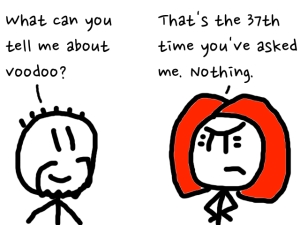
The amount of detail in the setting is impressive, too. The topic-based conversation system allows you to quiz most of the game's characters on any of the subjects Gabriel has found out about throughout the course of the plot, and most people have something to say about most of them. Whether it's discovering Gabriel's family history or delving into the historical roots of Voodoo, there's a massive amount of obviously well-researched material in the game — much of which can be safely skipped past if you just want to get to the meat of the plot, but much of which provides some wonderfully flavourful background information on the game world, plot, characters and real-life concepts on which the narrative is based.

Also, mid-'90s all-star voice cast? Tim Curry! Mark Hamill! Leah Remini! Michael Dorn! Efrem Zimbalist Jr!

In short, if you haven't yet played Sins of the Fathers, you should rectify this as soon as possible. It costs just $5.99 over at GOG.com, so there's really no excuse. Get to it, Schattenjäger!

1214: Inner Sanctum

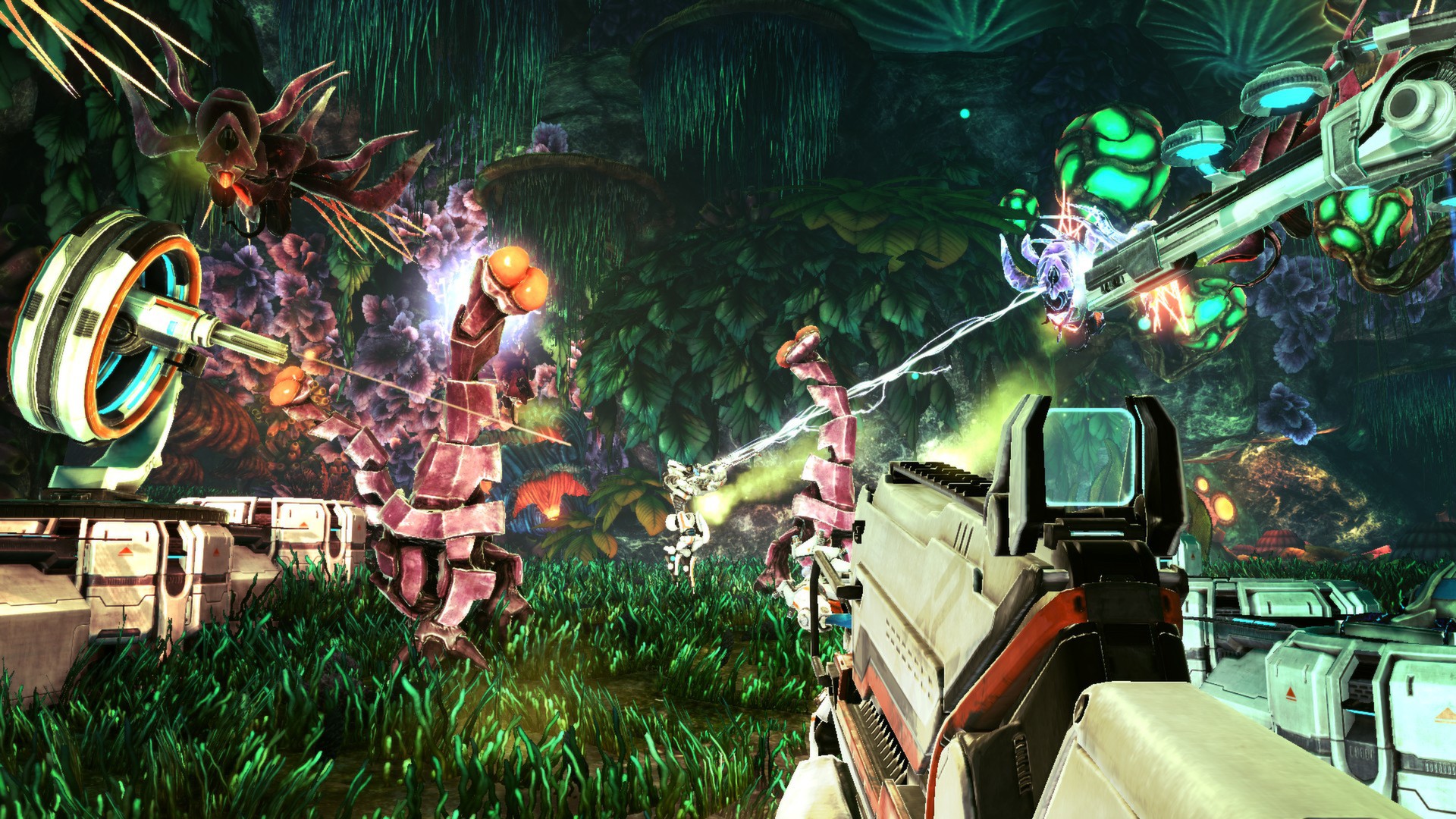
ss_41673936cf0df5cdf2b4c0549e118829730d8e88.1920x1080Mark and I played a bunch of a recently-released indie game today. That game is Coffee Stain Studios' Sanctum 2, which I purchased a copy of for Mark as a thank-you present for putting us up for the last couple of weeks, and which I was also interested in playing. I enjoyed the original game's interesting fusion of tower defense and first-person shooter mechanics as well as its distinctive presentation and excellent music, so I was actually quite interested to try the second game, and purchased a copy without a second thought.
Then the game was released, and I decided to take a peep at the Steam Community page to see what the rest of the world thought of it.

Big mistake.

It seems that Sanctum 2 is the latest victim of elitist players expecting one thing from a game and getting something slightly different, then throwing all their toys out of the pram, demanding refunds and hurling abuse at the developers. Because Sanctum 2 is not the same game as the original Sanctum, it seems, it is worthy of scorn and vilification. Because Sanctum 2 incorporates a number of features that not only make it workable on console — it's also being released on Xbox Live Arcade — but change the game balance significantly from the original, apparently it is worthy of review-bombing on Metacritic and endless, endless whining on forums.

ss_18b928231ce4b8b50c8e6f1bd11e9ef7cbd88164.1920x1080You know what, though? I've played a good 4 or 5 hours of Sanctum 2 today in total, and it's great. It isn't the original game, no, but why would you want it to be? Sanctum is still available for download, so if you like that, go play that. Sanctum 2 is a distinctive experience that, while in possession of a couple of strange design decisions, is a lot of fun to play both solo and cooperatively with other people. It is both strategic and action-packed; challenging and fun; and it offers a significantly greater amount of content and depth than the original game did when it came out of the gates.
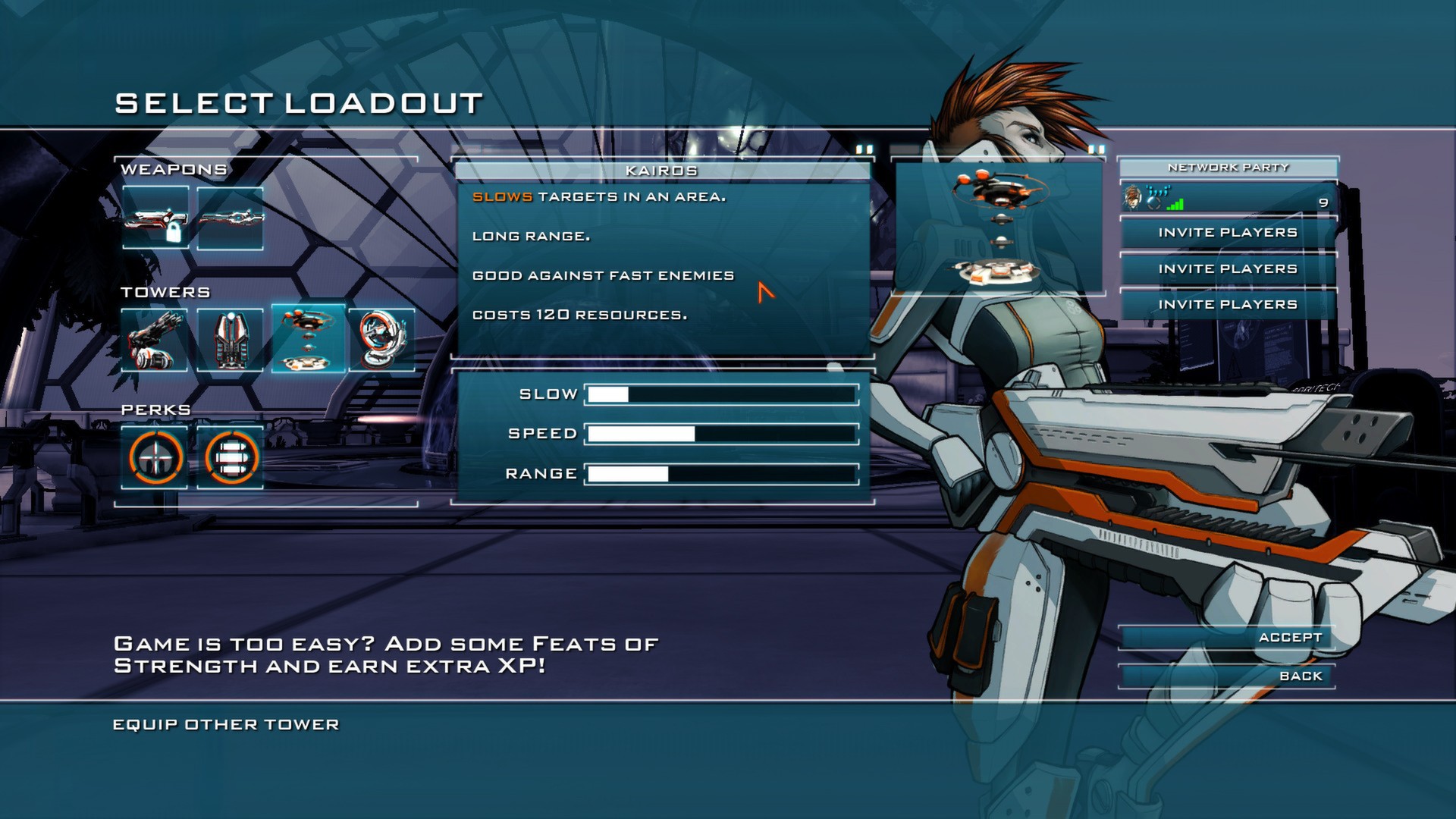
The complainers' biggest issues with the new game seem to be the fact that resources to build towers are now delivered as "drops" that have to be picked up manually, and that there is a hard limit of ten towers per level. The "drop" system means that everyone playing has to either agree on who is going to be in charge of building what — or charge off and race to be the first to pick up the resources. If you're playing with friends or people with whom you can communicate well, no problem. If you're playing with griefers and trolls, potential problem, but not insurmountable. (For what it's worth, I always prefer playing cooperative games with people I actually know anyway, and I'm sure I'm not the only one — and as such I probably won't run into this problem personally.)

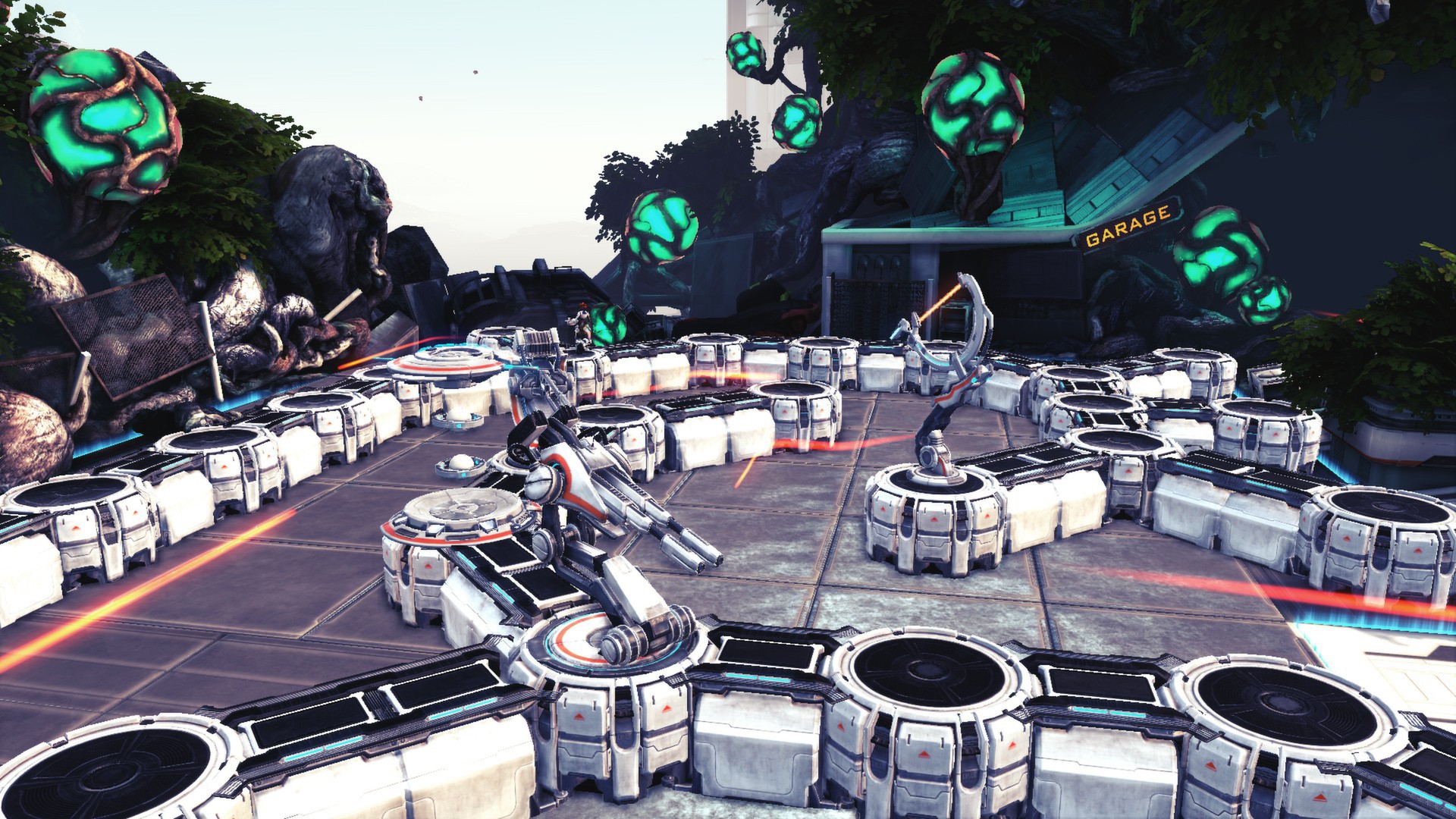
The ten-tower limit also simply isn't an issue in practical terms. I am yet to hit said limit, because plonking down "tower base" blocks to create a maze to hold up enemies does not count towards this limit, and the limited quantity of resources on hand means that it's only really practical to build a few towers per level anyway — you have to support your towers with your own gunplay in order to succeed. It's a true hybrid, in other words; you can't win without your towers, and your towers can't win without you.

Some complainers have also whinged about the fact that you supposedly can't make complex mazes in this new game. To those people, I would invite them to have a go at the level Mark and I were playing before we wrapped up for the evening, in which we were defending two cores simultaneously from assault, and built impressive mazes on both sides of the level in order to keep the enemies away from our precious charges as long as possible. Careful tower placement and resource management was a must, and the nature of many of the enemies that came along made it necessary to cooperate, communicate and use skill and tactics to take them down rather than simply firing blindly at anything moving.

ss_8a9cbab892d41cb1734508a572f1471a5b5a2117.1920x1080In short, Sanctum 2 is a very good game if you enjoy both first-person shooters and tower defense games that demand a slightly heavier degree of thought and strategy than normal. It's an excellent fusion of two fairly disparate game genres, and while there are a few things that could be tweaked here and there, it's perfectly enjoyable as it is. Not only that, Coffee Stain Studios have demonstrated that they are open to constructive feedback, too, and will likely continue to improve the game after its release. Given the abuse and vitriol that has been hurled their way today, they would be perfectly within their rights to just say "fuck you" to all the ungrateful gamers who are bitching about their new release, to be honest, so I have to admire them for their self-restraint in dealing with these people.

It is, essentially, yet another case of a not-insignificant number of people suffering under the assumption that Their Way is the Right Way, and that anyone who disagrees with them is somehow an awful person. These people preferred the original Sanctum to its sequel and that's absolutely fine; their behaviour towards Coffee Stain Studios and anyone who has expressed a liking for the new game is not.

1210: Reppin' the Squad

Those of you who know me well will probably know that Mark and Lynette, the people Andie and I are staying with on our vacation in Toronto, are members of the Squadron of Shame. The Squad is, of course, a ragtag group of gamers who came together back in the heyday of 1up.com to champion the underdogs of the games industry, and we've been doing an admirable job of that ever since through a combination of online discussion, podcasting and playing games together.

One of the reasons I've been enjoying this vacation so much is because as well as getting out and about a bit to see some of the city — something we'll be doing a lot more of in the coming week — I've had the chance to hang out with people who have very similar tastes in games to me; people who understand why JRPGs and visual novels are awesome, and why a middling-to-low Metacritic rating isn't necessarily something that should put you off playing a game if you like the look of it.

In the last week or so, we've been repping the Squad pretty well between the games we've been playing. Mark has been playing a lot of Fire Emblem on 3DS, of course, since he's been glued to it since it was released back in February, but we've been exploring some other interesting games together, too. As I type this, we're enjoying the distinctly Canadian flavour of Sang-Froid: Tales of Werewolves, a very strange game that combines elements of tower defense, strategy games, role-playing games, action games and survival horror to create something quite unlike anything any of us have ever seen before. Meanwhile, I've completed three playthroughs each of Long Live the Queen and Spirited Heart, two extremely interesting if somewhat unpolished "life sims" in which you build up stats in an attempt to complete various tasks and/or romance any of the in-game eligible bachelors and/or bachelorettes.

ss_3e43f0db754a065088488400eb23a1321c7c5172.1920x1080

Sang-Froid (above) is an interesting game. At the outset, it looks like a rather ordinary third-person action game with a distinctive aesthetic, but as the levels progress it grows in complexity a bit at a time until — I assume, anyway; we haven't got that far yet — the game you're playing at the end of the story is virtually unrecognisable from the hack-and-slash it appeared to be at the very beginning. I haven't played it myself yet, but it looks like a challenging game with a huge amount of depth. The two different playable characters allow you to enjoy the game in two distinctive styles, too — one has better combat skills, making the action sequences easier, while the other is weaker, meaning that the strategic sequence where you lay traps and build structures is considerably more important to get right before the hordes of darkness come running.

But I digress. Allow me to talk about the games I have been playing personally.

llq-ss6I've already talked about both Long Live the Queen (above) and Spirited Heart (below) in two previous posts, but they both bear mentioning again, I think. Both games are examples of the "life sim" genre — a style of game which is rarely explored outside of low-budget indie games. I guess you could count The Sims as a life sim, but it's not quite the same thing — The Sims is a detailed simulation of social interactions and other related business, but both Long Live the Queen and Spirited Heart are more like role-playing games in which you're not travelling the world in order to save humanity, but instead trying to eke out the best possible existence for your (female) protagonist.

newjobsystemBoth Long Live the Queen and Spirited Heart differ considerably, however, despite having fundamentally similar mechanics. Long Live the Queen sees you playing a predefined character — the titular Queen — and then sending her down the path of your choice, while Spirited Heart allows you a lot more freedom to design your own character and choose what your goals are, be they romancing a specific character or attempting to accomplish a mission set for you by your race's goddess. While neither of these games are particularly shiny or exciting to look at, I've found them surprisingly compelling, and they make me want to check out more games of a similar ilk.

trueloveOne reason I've been enjoying them a lot is due to their similarity to an old favourite visual novel/dating sim known as True Love (above). I first played this back in probably 1999-2000 and still think of it very fondly today, despite the fact it is an absolute bugger to get running on modern machines. Like the life sims I've been playing recently, True Love saw you managing your time carefully in an attempt to build up your stats enough to attract one or more of the game's heroines and make her your "true love". I attribute my present-day love of games like the Persona series to my earlier experiences with True Love, and I'm getting a lot of the same feelings from titles like Long Live the Queen and Spirited Heart, too, which is nice.
The other interesting thing about them is that these are games obviously designed with a primarily female audience in mind, and that in the case of Spirited Heart at least, they're gay/bisexual positive. Long Live the Queen doesn't have a strong romance component, whereas it's a key focus of Spirited Heart. In Spirited Heart, you even have the option to turn the girl-boy and girl-girl romances on or off independently of one another — in fact, it's sold as two separate "games" that bolt on to each other, so if you want to play an all-yuri life sim, simply pick up the Girl's Love version by itself and go nuts.

And the one final reason I'm mentioning these games is that there doesn't seem to be an awful lot of discussion about them online generally. I'm a strong believer that great games should be celebrated and appreciated as much as possible, regardless of their budget or where they hail from, and thus, well, I'm doing my bit.

You can grab Long Live the Queen from Hanako Games' website, Spirited Heart from Winter Wolves' website, and Sang-Froid from Steam.

1208: Spirited Heart

Inspired by my recent excursion into Hanako Games' Long Live The Queen, I decided to check out another "life sim" game that has been sitting in my virtual pile of shame for some time, ever since I picked up a "Manga Bundle" from Hanako and Winter Wolves a while back. Spirited Heart is a very similar sort of game to Long Live The Queen, only instead of playing as a princess-slash-queen-to-be, you're playing a "normal" person in a fantasy world. Specifically, you're playing as an 18-year old human, elf or demon woman coming to "the big city" for the first time and trying to "make it" before she turns 30. Just like real life, then.

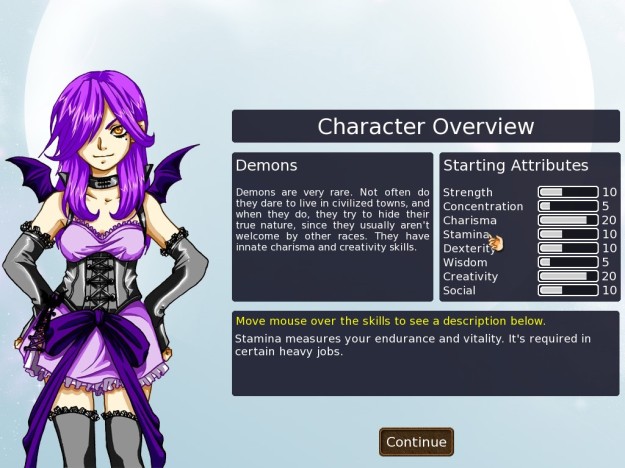
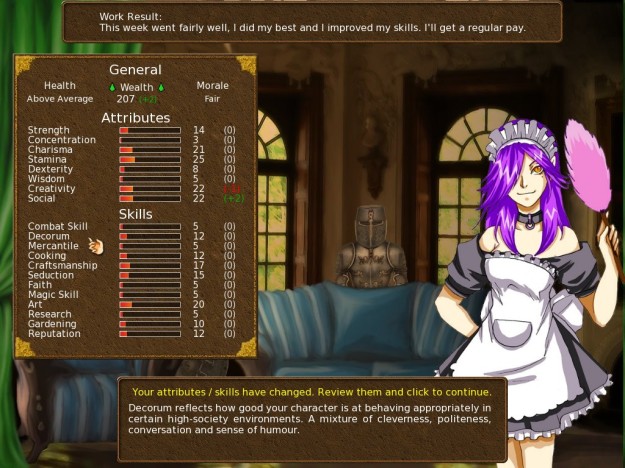
03_characteroverviewSpirited Heart does a number of interesting things that distinguishes it from Long Live The Queen. Chief among these is the fact that you're not playing a fixed character — you're playing one of your own design, to a certain extent anyway. There isn't any option to customise your character's appearance, for example, but the way you play does determine what sort of person your character ends up as.
This starts right from the beginning of the game. Choosing a race sets your initial basic statistics, and you can then tweak this starting set of abilities by "role-playing" a few simple scenarios with multiple-choice questions. By the time you've answered these basic questions about your character's childhood and adolescence, you have a good idea of who they are and what kind of person they can be, and can start working on their statistics further.

06_demoncleanerThe way the game works is that each week, you choose whether your character goes to work or takes a week off. Going to work allows you to choose any occupations you meet the prerequisite stat requirements for, while resting allows you to restore your health and morale, which can often be negatively impacted both by going to work and through random events that occur. You can't go to work if you're too unhealthy or if your morale is too low, so sometimes you need to take a week off in order to progress. Working, meanwhile, often improves your stats and allows you to earn money, which can be used on more effective vacations when required.
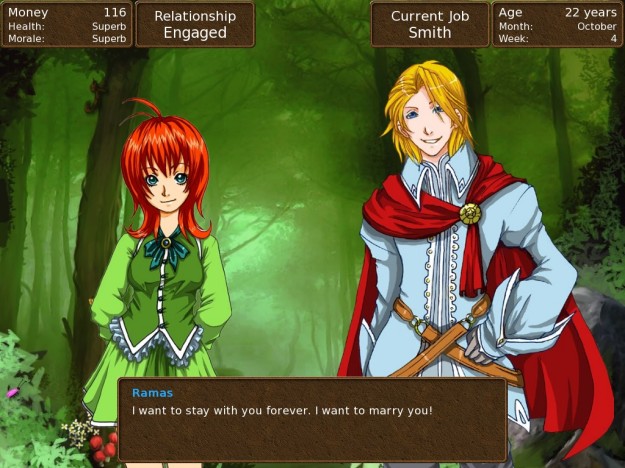
Occasionally during your work day, you'll have "random encounters" with the game's other characters. These visual novel-style scenes see your character interacting with these other potential love interests — both male and female (assuming you've bought both the basic heterosexual game and the standalone Girl's Love expansion) — and occasionally offer you a choice to advance your relationship.

This is probably the most interesting thing about the game: the emergent narrative created through the stat-building gameplay combines with the prescripted narrative of the visual novel-style romance scenes to create something that is much more than the sum of its parts. For example, in the game I'm currently playing, my character is a strong young woman who grew up on a farm and thus doesn't have a lot in the way of social graces. In her career so far, she has worked as a farmer and a builder. In the latter case, she encountered a young and somewhat clumsy elf noble whom it transpired she was building a house for. Somewhat later, after improving her skills enough to become a maid in a noble house, she ran into this elf maiden once again and discovered that she was betrothed to a fat, unattractive nobleman who obviously didn't give a shit about her. And thus we're into a pleasing "star-crossed lovers" sort of situation as my commoner character attempts to prove herself worthy to this noble elf maiden and her family. I don't yet know how that ends yet, but I'm curious to see.

11_marriageproposalJust to confuse matters, partway through the game, my character was visited by her Goddess and tasked with attaining a particular "title" by the time she reaches the age of 30. Unfortunately, pursuing the elf of her dreams and following the Goddess' quest are not really compatible, since the Goddess' quest requires me to become an Artist, while pursuing the elf requires me to continue working as her maid. CHOICES. DECISIONS. CONSEQUENCES.
Like Long Live The Queen, Spirited Heart is a fairly no-frills production with minimal graphics, animation and sound, but like Long Live The Queen, it's also a surprisingly compelling game if you take it in the spirit in which it is intended. It's a role-playing game in which you're not battling monsters or going on epic quests; you're living a (relatively) normal life in a fantasy world and trying to make the best of your situation. It's an interesting little game, and one which I see myself playing through a few times.

Find out more here.

1205: Long Live the Queen

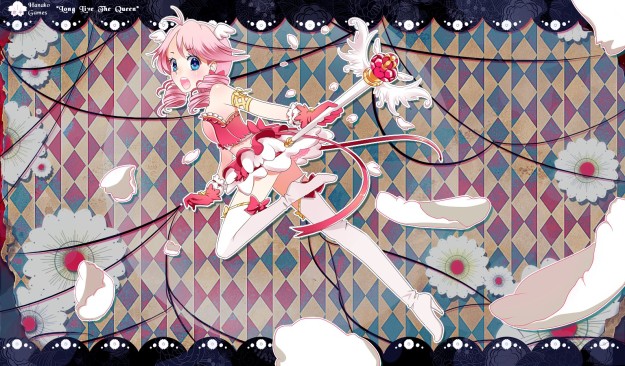
lltq_wallpaperA short while back, a few indie developers that I enjoy the work of very much released a bundle of games that looked interesting. Among this selection of games was a title known as Long Live the Queen by Hanako Games, developer of Magical Diary, a game which I enjoyed very much. I picked up the bundle and, as tends to happen frequently with this sort of thing, forgot all about it completely until recently.
The specific circumstances which caused me to remember the existence of Long Live the Queen as a Thing were catching a glimpse of it on Steam Greenlight earlier. The premise of taking a young anime girl, dressing her up and then watching her die horribly sounded appealing and interesting, so I decided to check the game out for myself.

What I discovered was a very interesting "life sim"/strategy game with a surprising amount of hidden depth. Since Hanako Games is a small developer with only a couple of people to its name — creator Georgina Bensley and one or two others — it's a game that was obviously made relatively "on the cheap," as it were, with relatively little in the way of graphics and sound/music, but that doesn't stop it from being very interesting indeed.

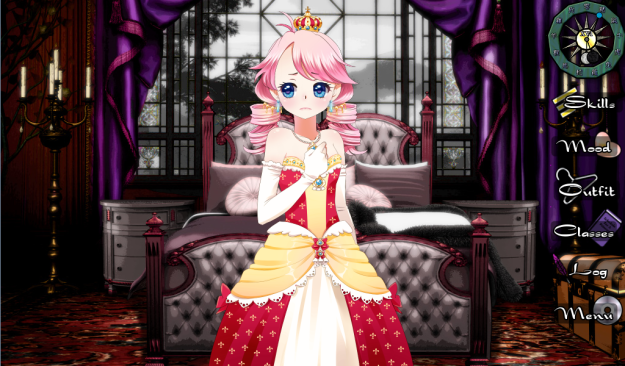
steamworkshop_webupload_previewfile_142369710_previewEssentially, Long Live the Queen is a game somewhat akin to old Japanese games like Princess Maker, in that you have a young anime girl to take care of and must train her up to deal with various situations appropriately. The course which the game's plot takes depends on the skills which you choose to train up, and the skills which you can train most effectively are determined by Our Heroine's current mood — for example, if she's depressed, she's particularly wont to express herself through things like music and singing, whereas if she's angry, she can channel her aggression into training in things like military strategy and proper use of weapons. Training to particular levels in things unlocks various costumes appropriate to the skills she's learning — for example, learning a lot of spiritual skills unlocks a priestess outfit, while becoming a "Lumen" and awakening to her family's magical heritage unlocks a particularly awesome "magical girl" outfit.
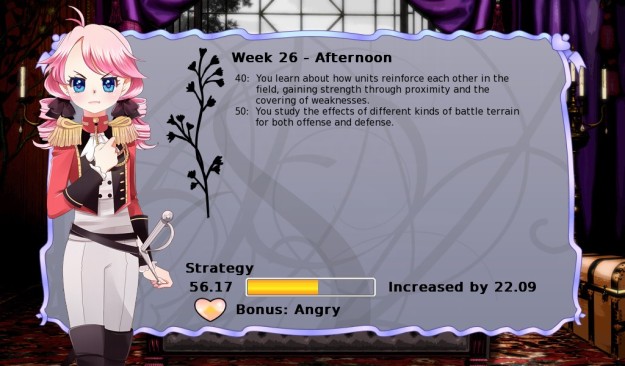
These skills aren't just for bragging rights, though. Each in-game "week" sees various events happening, many of which require a skill check to successfully resolve. Failing the skill check isn't necessarily a bad result, though — it simply means that Our Heroine doesn't have the requisite skills to resolve a situation in a particular way. For example, early in the game, she's sent a necklace by a Duke who is proposing marriage to her, but having a distinct lack of knowledge of the way things work in the royal court means that she doesn't recognise the gift for what it is and instead responds with a rather unqueenly "Oooh! Sparkly!" — but it cheers her up.

steamworkshop_webupload_previewfile_142369710_previewMaking it through the game without dying horribly is a case of carefully making decisions and levelling up skills appropriately, and it's not at all uncommon for Our Heroine to meet a sticky end — in fact, it's positively encouraged via the "collect them all!" death checklist in the game's main menu. It's almost preferable to play the game like a roguelike — starting from the beginning, only saving when you're stopping playing rather than before you make a critical decision, and dealing with the consequences of your actions. In a nice touch, reaching the end of a game — whether with Our Heroine's coronation as Queen or with her death — allows you to export a complete log file of everything that happened so you can perhaps figure out what on Earth went wrong.
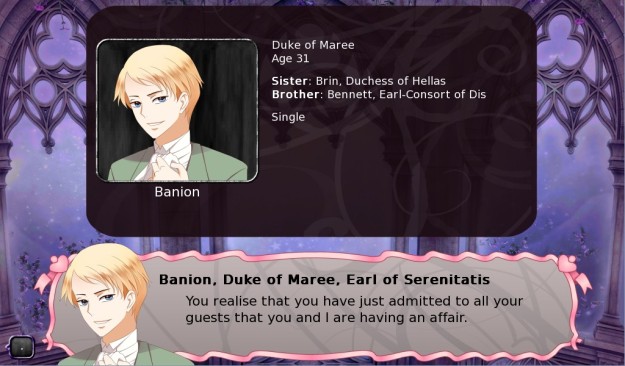
In short, it's a very interesting game, and well worth checking out. Don't go into it expecting something spectacular — the music loops are nice, but very short and repetitive, and there's not a lot of variation in the graphics (though Our Heroine's various costumes are all great) — and you'll have a great time building your own custom princess and seeing how she survives in the world.

steamworkshop_webupload_previewfile_142369710_preview (1)

Find out more here.

1203: Back to the Mansion Again

I played a bit more Luigi's Mansion 2 earlier. Haven't played it a lot yet, but I'm really liking it for a number of different reasons.

Firstly, the single-player mode has a very strong "adventure game" feel about it. Specifically, it features frequent occurrences of getting "stuck" — something which is not altogether common in modern games that hold your hand quite a lot. Luigi's Mansion, though, despite appearing quite tutorial-heavy in the first couple of levels, very quickly turns into a game where you're expected to work things out for yourself, to remember things from earlier and to explore thoroughly rather than just following the handy glowing trail of breadcrumbs on the map.

Secondly, the multiplayer mode is awesome. It hadn't occurred to me that multiplayer in Luigi's Mansion 2 might actually be good, but by golly, it really, really is. I've only tried the "Hunters" mode in Download Play so far — this apparently means it's a "limited" form of the full multiplayer experience — but it was a blast by itself.

Essentially, the multiplayer mode is a cooperative ghost hunt for up to four players at once. Before starting the game, the players choose how many floors of a mansion they want to tackle and must then clear each of them against a strict time limit. Each level is randomly generated, requiring methodical exploration to locate where all the ghosts are and then to take them down. Communication between players is also helpful, but for those who don't want to actually talk to each other — or those who are unable to due to playing online, for example — there's a handy little "quick chat" thingy on the D-pad, allowing you to make Luigi say various things, but more importantly, display a callout on the map indicating that the other players' attention is required in a specific location.

It's a really interesting mode because it's simple but extremely flexible. If you want a short game, you can play just 5 floors. If you want a longer game, you can play up to 25 floors, and successfully clearing this opens up an "Endless" mode, which sounds like a lot of fun. Within the individual play session, players earn points towards upgrades that are valid just for their single play session, making a single multiplayer game feel like a microcosm of the main game's upgrade and reward structure. It's really, really neat and I can actually see myself playing it quite a bit.

The Download Play functionality also reminds me of one of the great unsung features of Nintendo's handhelds. It is absolutely awesome to be able to wirelessly beam a limited version of a game over to your friends and play them without them having to own the game. Wireless multiplayer on its own is great — remember the awkwardness of hooking up link cables? — but when your friends don't have to have their own copy of the game? Brilliant. The only thing about this that I hate is the fact that the 3DS' stupid region locking prevents handhelds from different regions downloading these multiplayer-specific packages. Sometimes. (If it was consistent, I might not be quite so mad about it, but still.)

Anyway. Luigi's Mansion continues to be an entertaining experience, and I'm looking forward to investigating it further. For now, however, I bid you good night!