1621: Requiem for a Dead Game

Pour one out, if you will, for Blur.

Longtime readers may recall that I was rather enthusiastic about Blur when it first came out — largely for what I thought at the time was a good example of how to use "social features" effectively. Of course now, in 2014, "social features" are everywhere in games and have a habit of getting in the way more often than not, so I'm not entirely sure I still feel the same way, but Blur certainly had a lot going for it.

Looking back on my past entries, I realise that I never really waxed lyrical about what a remarkable game Blur truly was, though. I talked a bit about its developer Bizarre Creations — Blur was to be one of its last games — but not about what made Blur special.

For the unfamiliar, Blur was a racing game. Nothing unusual for Bizarre Creations, who had previously given us the wonderful Metropolis Street Racer on Dreamcast, which was succeeded by the Project Gotham Racing series on Xbox platforms. Both Metropolis Street Racer and Project Gotham Racing struck a good balance between the realism of "driving simulator" games such as Gran Turismo and Forza Motorsport, and the more arcadey thrills of titles like Ridge Racer and its ilk. Stuffed full of real-world cars screeching around beautifully depicted real-world locations mapped in what was considered for the time to be almost "photo-realistic" detail, both Metropolis Street Racer and Project Gotham in its various incarnations places a strong focus on driving stylishly in order to gain "kudos". Powersliding around corners, overtaking your rivals, getting air off the crest of hills — all of it would add to your kudos bank, and there was an extremely addictive high score-chasing thrill to it all.

Blur, meanwhile, took the Project Gotham formula and added a twist that took it further from sim territory and well into the realms of arcade silliness. Although still involving real-life cars screeching around real-world locations, Blur went that extra step and incorporated power-ups too. Powerups that let you shoot homing missiles at your opponents, or rapid-fire bullets, or send out devastating shockwaves, or simply boost past your rivals while flipping them off.

Sound familiar? Sound a bit like Mario Kart? That's because Blur pretty much was Mario Kart, albeit with much more realistic visuals and less fantastic tracks. It was genuinely something that hadn't really been done before — there had been automotive combat games, but they tended to focus on destruction derby-style gameplay rather than racing with powerups — and thus it was immediately memorable.

And the multiplayer! My goodness, what a fantastic experience that was. Shamelessly lifting Call of Duty's system of experience levels and unlocks, Blur's multiplayer rewarded repeat play by providing you with all manner of ways to customise the way you play, as well as a selection of new cars to enjoy. The game was well-balanced, though, in that having a high rank didn't necessarily confer you an advantage as such, just more options from which to choose. It was enormously addictive and, for someone like me who generally doesn't enjoy competitive multiplayer games all that much, enjoyable for a surprisingly long time.

I booted the PC version up today after having a bit of a hankering to play again, and out of curiosity I fired up the multiplayer mode. There were four people online. Not four hundred, not four thousand; four. These people appeared to be actively playing, mind you, but it was certainly a far cry from the hundreds of people who used to populate the game. I admire their dedication to the game, but I also feel a bit sad that here we have an unfortunate aspect of the fast-moving nature of the modern games biz: Blur is unlikely to ever see a great deal of action as a multiplayer game again, making one of its best features now almost worthless. It's a crying shame; Blur was sent out to die by Activision rather than being promoted properly — conspiracy theories have it that the company wanted an excuse to get rid of Bizarre Creations — and consequently never really had a chance to develop an active, long-life multiplayer community.

If I had a tad more influence, I'd do my best to try and gather people together for one last race around the game's courses. But given that the PC version no longer appears to be available anywhere and the Xbox version requires an Xbox Live Gold subscription — which I no longer have — that's something easier said than done.

I guess, then, that the good experiences of playing Blur multiplayer will have to live in my memory. The single-player is good — and still playable — but nothing quite compared to the thrill of taking on human opponents. It's a pity very few people will have the opportunity to enjoy that, and I'm glad I had the chance to do so when the game was most active.
1620: Community Matters

The Squadron of Shame, the "gaming book club" that was born on the 1up Radio message boards and has subsequently lived in several places across the Internet, has moved house again. We now have our own forum here — though if Squad co-founder "Beige" gets things sorted, we'll have either that forum or a variation thereof on our own domain before long, which will be nice.

Forums aren't all that fashionable these days, though they are still used somewhat, particularly for communities relating to specific software companies or even individual games. I can't say I've used one for a very long time indeed now, but having gotten back into the swing of posting on one thanks to the new Squadron of Shame boards, I can honestly say I've missed them.

The reason? They're completely different to the way modern social media works. While you may think that social media would be the ideal place to begin discussions and have in-depth conversations, in actuality modern social media is not at all well-suited for this task. Whereas many forums have long-life conversational threads that stick around for months or even years, the very nature of social media means that posts are transient — they're there one moment, gone the next, replaced by a cat picture, some vapid meme or One Of Those Clickbait Headlines That Makes Poor Use Of Headline Case And You Just Won't Believe. And while certain social media posts can attract a long string of comments and stick around for a while due to consistent interest — the reason why Facebook steadfastly refuses to organise posts in chronological order is because of this, if you were wondering — they'll still fall away far quicker than an equivalent topic on a forum.

This is fine for the sort of vapid nonsense that people post on Facebook and Twitter on a daily basis, but less ideal for more long-form discussion on more specific topics — such as the sort of thing we like to stroke our collective chins over at the Squadron of Shame. Now I know that many existing, well-established forums in 2014 — long-standing gaming forum NeoGAF is a good example — have proportions of the community that do not like seeing "walls of text" (even when they use paragraphs and punctuation and everything), but the fact is that forums are ideally suited to long-form discussion and thoughtful discourse. They're not instant messages, they're not time-sensitive, they're not places to post "fire and forget" comments that you never look at the responses to — they're places for asynchronous communication between people of similar interests, and an excellent means of having far more detailed discussions than is possible on social media in its current form.

Social media is crowded. Social media is noisy. Social media is like stumbling into the middle of a party, slightly drunk, and shouting whatever you feel like and hoping someone hears it. And, sometimes, that's fine, and can lead to beautiful interactions, friendships and even relationships. (I'm sitting in this house with the person I own it with because of Twitter.)

But a forum is like getting together a group of people with common interests — depending on the number of participants, it can be like a book club, a seminar or a large-scale gathering — and having a civilised, peaceful, thoughtful discussion on a particular topic. (Usually, anyway. This isn't to say forums are drama-free, but there's a lot less of the attention-seeking passive-aggression that's often seen on social media for the most part in my experience.)

As I said above, I'm not sure whether the Squadron of Shame will be staying on that free forum software for now or whether we'll be moving to our own site. But either way, the shift — or should I say shift back, since that's where the group was born — to a forum-based means of discussion has so far proven popular, and I think it will be good for the group in the long term.

If you're interested in joining us to talk about underappreciated and overlooked games, both new and old, drop by our new home and say hello.

1619: Reflections on Working in the Games Press

As I've noted a few times recently, my time with the games press is shortly coming to an end and, short of an amazing offer coming my way that I'd be a complete idiot to turn down, I'm not going to be pursuing further work in that enormously competitive industry. It's fairly unlikely I'll be pitching many freelance pieces, either, although I may find the time to do a few in between other things.

Since this is largely, then, the end of my career in the games press, I feel it's probably an appropriate time to reflect back on my time doing it and what, if anything, I've gained from it.

Let me preface this by saying that working in the games press was something of a lifelong dream for me, ever since I grew up with both my father and brother working for Atari magazines. My brother John, when he left home, began working on various magazines over the years and built a career for himself that eventually culminated in high-profile positions at 1up and Gamespot as well as the launch of his own site, the sadly defunct What They Play. His career was an inspiration to me that I hoped, one day, to be lucky enough to follow in the footsteps of. Because, frankly, there's a significant amount of luck involved in getting anywhere in the games biz… much as there's a significant amount of luck involved in not suddenly finding yourself without a place of work.

I contributed a number of pieces to various publications over the years as I proceeded through school and on to university. I wrote reviews and articles for the same Atari magazine my father and brother did; I wrote reviews and walkthroughs for UK games magazine PC Zone (may it rest in peace); I wrote tips books and guides for The Official UK Nintendo Magazine, in the years before… well, let's just say we don't see eye to eye. But I didn't seriously pursue a full-time career in the business — it didn't seem like something feasible, and in the meantime I was at university studying and trying to work out what I was going to do with my life. (I opted for teaching, which turned out to be a Bad Choice from a mental health perspective.)

Whizz forward a number of years and I'm in a bad place. My wife has left me and I'm staring down the oblivion of my life as I knew it. But there was a small glimmer of hope — I was writing for a small site named Kombo. Kombo didn't pay particularly well — certainly not enough to live on — but it was something. I was writing professionally, gaining some important and helpful experience and getting great feedback. It was a start.

Eventually, Kombo folded and, through various combinations of circumstances, I found myself working for GamePro, a site and magazine that my brother had been in charge of previously, but had since moved on to pastures new. My work for GamePro was initially sporadic and occasional, but over time it grew to a proper part-time gig and eventually a full-time position on a wage I could actually live on.

I had to make a choice partway through my time with GamePro, though. I had an interview with a software company in London, who actually offered me the job. At the same time, GamePro offered me the full-time position. The wages were similar, but the software company required me to move to London (expensive, plus not exactly friendly to my then-burgeoning relationship with Andie, with whom I now own a house) whereas the GamePro gig allowed me to work from home.

It seemed like a simple choice. I turned down the software company and told GamePro I'd continue working for them full-time. Eventually, I got to a position financially where it was practical for me to leave home again and start living with Andie.

All appeared to be going well for a while, until the collapse of GamePro one December. It was a quiet death; I came down to start work one morning, checked my email and discovered a message thread already in progress with everyone seemingly panicking about what was going on. The site was closing, it seemed, and so was the magazine. Everyone was being laid off. There was nothing we could do.

Thankfully, a former colleague at GamePro was working for a business-facing site that focused on mobile and social games, and she offered me regular work for a very generous pay package indeed. Mobile and social are two of the most objectionable parts of the video games industry for numerous reasons, but work was work and the pay was great for what I had to do, so I sucked it up and continued, happy that I had the opportunity to write and still leave myself time to pursue other interests.

But it didn't last.

I realised something was wrong with the site when all my colleagues suddenly announced their departure within a day or two of one another. The new management who had taken on the site were… not great, to say the least, and it was looking very likely that the generous pay packet I'd become accustomed to every month was soon to shrink to literally less than a tenth of its size.

I jumped ship. Fortunately, around the same time this was all happening, a former colleague from GamePro got in touch about USgamer and, well, you know the rest. Now, almost exactly a year after the site officially launched, I'm staring down unemployment, again through no fault of my own, but due to a shift in the way the site is doing business.

I've worked hard for every outlet I've had the privilege to work for professionally. I've graciously accepted feedback to improve my work — a particular shout-out to Mr Jason Wilson (formerly of GamePro, now of VentureBeat) here, whose copy-editing skills helped me refine my craft in a way no other editor had done in the past — and made an effort to improve and challenge myself as and when I can.

And yet even with a work ethic like that, there's no guarantee of a stable job. Each time a site folded or restructured and left me without a position, I've effectively had to start again from scratch, often with a big gap of unemployment leaving an unsightly hole on my CV in the meantime.

For me, this isn't an acceptable or desirable way to live. I cannot, in good conscience, look for another job in the games press knowing the inherent instability and volatility of the business, particularly now I'm a homeowner and having no money has even more severe consequences than in the past. My dream is crumbling into dust, but it's been crumbling that way for a while now; what I really wanted to do, it turns out, was to write for magazines, but that hasn't been an especially viable option for many years now, thanks to the Internet and the way in which we consume media these days.

More importantly, the way in which outlets make money — you know, with which to pay their staff — has changed. Readers on the Web expect their content for free — attempting to get people to pay money for text is a losing battle. As such, there just isn't the same amount of cashflow coming in as when a magazine is pulling in money from every sale from the newsstands. It also leads to "clickbait" articles, whether these are top 10 lists designed to encourage readers to read, agree and/or disagree, or provocative, inflammatory op-eds about whatever social justice issue is on the Tumblr sociologists' radar this week. Overall quality of content suffers as a result, and good quality writing about specific subjects goes all but ignored, leaving the games press a shadow of what it could be, and all outlets looking like slightly reskinned versions of each other.

And then there's the growth of video to consider, too, but that's probably a matter to discuss another day.

In other words, then, a career in the games press is simply not a viable option for me any more. Eternal respect and well-wishes to my peers out there who can make it work — whether on a salaried or freelance basis — but I simply can't do it any more with my current life situation. It's sad, but oddly I'm less cut up about the death of my dream than I thought I would be; it's become increasingly apparent over the course of the last four years that the games press I've been working in is not the same games press that I wanted so desperately to be a part of for so long. That games press is long-dead, replaced by something very different that I'm not entirely sure is sustainable in its current form.

But it's not my problem any more. I wash my hands of it all. I'll continue to write about games on my own time, for the love of it, and if I can make a bit of money off it, so much the better. But career-wise? I'm looking elsewhere. And I'm not looking back.

1618: The End of a World

I've never been present at the end of a massively multiplayer online RPG. I've never even been present at the end of a beta testing period, which is usually marked by some sort of special event that, thematically, wipes the world "clean" and ensures that everyone starts on a level playing field when active service starts.

So, given Final Fantasy XIV's curious development history — for those who don't know, it originally launched in 2010, was heavily criticised for its numerous flaws, then closed in 2012, only to reopen as its current, completely revamped and considerably better-received form A Realm Reborn last August — I was curious to see exactly what the shutdown of the original version looked like. The shutdown of version 1.0 is crafted into the narrative of A Realm Reborn as an event in the game world known as The Calamity. During the events of The Calamity, there was a large-scale battle between the Eorzean Alliance (the three nations that player characters represent) and the Garlean Empire (the villains of the piece, who reprise their role in the main scenario of A Realm Reborn) and the moon Dalamud — actually a weapon created by the ancient Allagan Empire — was pulled down from the sky by dark magic. Dalamud broke open and revealed Bahamut, the giant and extremely pissed-off dragon god. Bahamut's rage pretty much obliterated most of Eorzea, forever changing the landscape, but not before the heroes of Eorzea — the players of version 1.0 — were pulled into "The Rift" outside space and time, to be released only once peace had returned to the realm… or once A Realm Reborn had been released.

With that in mind, then, here's how it went down from the perspective of several friends who apparently decided to see the apocalypse through together.

Although a simple event — it's just players standing around with some haunting music playing in the background for much of the video above — it genuinely feels like something momentous is coming to an end; like the world is really ending. The players know there's nothing they can do about it; they know that their (virtual) lives are shortly coming to an end, so all there is to do is to spend their final moments in the company of people that are important to them.

Watching the video made me want to shed a few tears, even though I didn't know the people involved. The quiet melancholy of the scene was surprisingly touching; as the time until the end of the world ticked down, the gathered friends started using their emotes and aesthetic items — fireworks and the like — to mark the end of their time together as a celebration, not a tragedy. Strange server messages started punctuating the chat log, and someone in the area was counting down the minutes until the switch was flipped and Eorzea would cease to be — at least temporarily.

Then, eventually, it happened; the world ended. It was marked not with a huge cataclysm in the game world, but with a simple change to a tiny element of the on-screen interface: the data transfer meter in the top-right corner of the screen changed from green to red, and the "R" number, indicating the rate at which data was being received by the player's client software from the game servers, dropped to zero. There was a moment of quiet as nothing happened — nothing could happen, as client and server were no longer communicating with one another — and then a black screen and a loading break, followed by the spectacular cutscene that closed Final Fantasy XIV's initial incarnation once and for all — and which also opened A Realm Reborn.

Prior to last August, I couldn't even begin to imagine what sitting through an event like this must be like for people who have been actively playing the game which it concluded — flawed or otherwise. Now, I can't help but think the whole thing would be an absolutely heartbreaking experience; although true friendships will persist outside of the game in which they were, in many cases, forged, the next time you see those people — whether it's in reality or in a new game altogether — they'll likely be very different. And those elusive moments you had together in your previous forms will be forever be trapped in the past — but they'll live on in your memories, as trite as that might sound.

I hope A Realm Reborn stays healthy and lively for many years to come yet — at its current rate, things are going to be fine for quite some time, I'd say, thankfully — but when it eventually does come to an end, I hope I have the opportunity to see its final moments through with those whom I've come to know through playing. We'll laugh, we'll cry, we'll perform the Manderville, we'll set off fireworks — whatever we do, I can see it being a special but sad moment that will live with each of us in a way that very few other video games will be able to replicate. (Unless they're another long-running MMO, of course.)

Still, let's not be melancholy; patch 2.3 of A Realm Reborn is coming early next month, and it's bringing with it a continuation to the game's excellent and enjoyable story plus a whole host of other content. I and my Free Company are really looking forward to it — and if you're interested in joining, may I point out that it's currently available at a discount on PC as part of the Steam Sale?

I'll see you on the Ultros server, non?

1617: Uninformed Hate

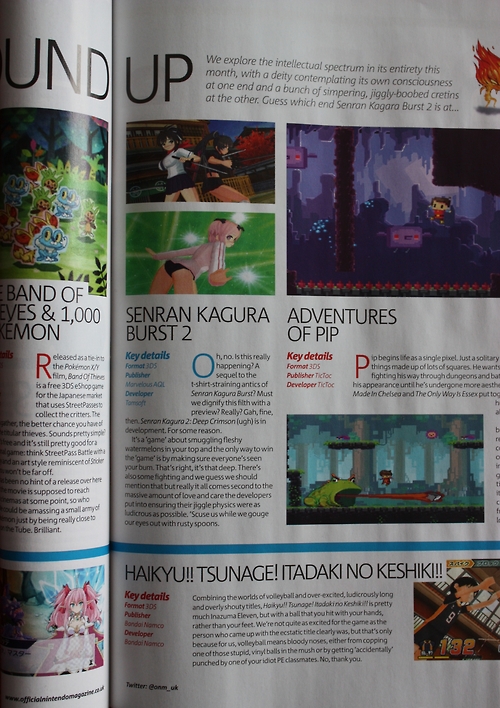
This photo of a copy of the UK's Official Nintendo Magazine did the rounds earlier.

tumblr_n7li4auQH41smnt4ao1_500

Take a look at the small preview for Senran Kagura 2 in the middle. Now imagine that you work for Xseed Games, the company that did an excellent job on the localisation of Senran Kagura Burst for 3DS a while back, and that looks likely to bring Senran Kagura 2 to Western audiences in the near future.

Well, you don't have to imagine; Xseed's outspoken Production Coordinator Brittany "Hatsuu" Avery had a few choice words to say on the subject:

https://twitter.com/Hatsuu/statuses/480921145445609472

https://twitter.com/Hatsuu/status/480921515215437824

https://twitter.com/Hatsuu/status/480922219652972544

(Yes, it was; here's the piece in question, itself a needlessly inflammatory and ill-informed rant.)

https://twitter.com/Hatsuu/status/480923786846289920

https://twitter.com/Hatsuu/status/480923975682252802

https://twitter.com/Hatsuu/status/481109395963936768

https://twitter.com/Hatsuu/status/481110060555575296

Senran Kagura, lest you're unfamiliar, is a series of games that centre around the exploits of some rival schools that train ninjas. In the first game, released as Senran Kagura Burst in the West, the story followed both the "good" ninjas and their rivals at the "evil" ninja academy, in the process delving into the personalities and histories of characters in a far deeper manner than many other games. The all-female cast is made up of distinct characters, none of whom are downtrodden or defined by the way men have treated them in the past, as some Western critics have complained of games as a whole recently. The story itself sees these characters grow, develop and change, and by the end you have a very good idea of who these girls are, how they relate to one another and their place in the world.

Senran Kagura is also somewhat notorious for its costume damage system, that can leave player characters and bosses alike battling in increasingly tattered (and revealing) clothing as their fights progress. There's also a magical girl-esque "transformation" system whereby the girls can unleash their full hidden ninja skills by stripping down to their swimsuits, then magically re-robing themselves in a new costume. The transformation sequences are cheeky and sexy — unashamedly so — but the girls are, throughout the whole game, depicted as individuals who are firmly in control of the way they choose to present themselves  to the world. As anyone who has played and enjoyed Senran Kagura will tell you, there isn't a single piece of maliciousness in the game towards the characters; it simply revels in its sexy elements, and is rather refreshing as a result.

Now, as Avery says in her tweets above, people are free to dislike Senran Kagura for whatever reasons they like. But the Official Nintendo Magazine preview — and the editorial linked above — come across as not only needlessly spiteful, but also completely ill-informed. It focuses entirely on the fanservice element of the game — one of the most visible aspects, sure, and one deliberately played up in some of the game's marketing — and completely ignores the rest, writing off the enormously fun Streets of Rage-style brawling as "there's also some fighting and we guess we should mention that."

This is a problem — regardless of the intention with which the piece was written, whether it was intended to be "satirical", as some people have argued, or not — and not just for fans of Senran Kagura and its ilk. Writers for publications are tastemakers, and are in positions of power to dictate what their audience's opinions might veer towards. This is a simplification of how things actually work, of course — there are usually a lot more steps in the flow rather than a straightforward "hypodermic" model — but the fact remains that people who write things for high-profile publications have a lot of influence on how certain things are perceived. And when pieces like this get published, they cement popular perceptions — even if those perceptions are unfair or wrong.

Because ultimately Senran Kagura is pretty tame, when it comes down to it. As Avery writes on her personal blog in response to a fan question, Senran Kagura Burst was only rated "T for Teen" by the ESRB in America because there's really nothing in there that warrants a Mature 17+ rating. To suggest that having pretty girls with large breasts in a game makes it somehow unsuitable for younger players is to be exceedingly prudish — not to mention the fact that the game takes considerable care to depict all these characters as far more than simply large-breasted women.

Why are these popular perceptions a problem? Because they stop people from discovering cool games. I've lost count of the number of times I've seen people dismiss colourful Japanese titles as being "creepy" or "for paedos" simply due to their aesthetic, when in many cases these games address many of the most common things that people complain about in the games industry today. Not enough female protagonists in games? May I point you to Hyperdimension Neptunia, Atelier, Tales of Xillia and numerous other Japanese games with fantastically memorable female leads? Too much brown, grey and dark blue? May I point you to the vibrant, bright colours of most modern Japanese role-playing games? Juvenile attempts at being "mature" ultimately boiling down to people saying "fuck" a lot and being able to peep in on people having sex? May I point you to the Ar Tonelico series, which features some of the most in-depth explorations of characters' personalities — including respectful treatments of their dark sides and sexual fantasies — that I've ever seen? Or if that doesn't appeal, may I point you to the piece that prompted this post in the first place, Senran Kagura Burst?

Fun fact: I reviewed the wonderful Atelier Rorona Plus this week. I was the only one who volunteered to do so. In the email thread discussing who wanted to take it on, one reason for turning it down included the fact that one person had looked at Google Image Search and it "didn't take long to find the creepiness". Atelier Rorona, for those who don't know, is one of the most charming, sweet and overwhelmingly nice games you'll ever play — it's not a fanservicey game by any means, yet the perception from someone who doesn't know about it is that there's "creepiness" involved. That's what we're dealing with. That's where these ill-informed rants by people who don't know what they're talking about lead to. That's why the games press could really do with specialist writers… and that's why I'm pissed off that I, someone who could more than ably step into that specialist role — and indeed have been doing so up until now — am shortly to be out on my ear.

Thankfully for people like Avery and companies like Xseed doing their best to bring niche titles to the West, there are plenty of people out there — fans — who do treat these games with the respect they deserve. It's just a shame so few of them are part of the professional games press in 2014.

Humour or not, I'm extremely disappointed in the UK Official Nintendo Magazine for the pieces mentioned above, but at least ignorance like that won't stop me from enjoying the games I enjoy. The frustrating thing, however, is that pieces like those mentioned above make it considerably more difficult to attract new people to these games; stigma is a powerful thing, and it's tragic to see it applied unnecessarily.

1616: Ascension + Dominion = Thunderstone

That's something of an oversimplification, of course, but it's not inaccurate; the card game Thunderstone Advance (of which I have the set themed around Monte Cook's Numenera setting) very much combines elements of the two distinct deckbuilding games Dominion and Ascension to create an experience that is altogether its own thing, rather challenging, enormously variable and a whole lot of fun.

Thematically, the game represents you and your friends each commanding a band of heroes as they attempt to storm a dungeon and defeat a Thunderstone Bearer, a powerful boss monster that triggers the end of the game if they are either defeated or reach the top level of the dungeon. In order to best your enemies, you'll have to recruit new heroes to your cause, gather a suitable source of income with which to equip them, level them up and proceed on regular expeditions into the dungeon to stomp all over monster faces and plaster their entrails all over the walls.

There's a strongly thematic RPG feeling, in other words, but the deckbuilding aspect brings up some interesting new twists. The Dominion side of things comes from the "Village" phase of the game, whereby you can use the cash value on the cards you have in your hand — you draw a completely new hand from your deck every turn — to either hire new heroes or purchase items. These are then added to your discard pile, which means they'll start coming up in your hand the next time you cycle through your whole deck. As with any deckbuilder, though, cluttering up your deck with too much chaff makes it less likely that you'll pull a killer hand with a brilliant combination of cards to use together, so at times it's necessary to exercise a bit of restraint and determine the most efficient way to proceed — that or look into acquiring cards that let you draw more from your deck once your turn has begun.

The Ascension side of things, meanwhile, comes in the dungeoneering side of the game, where you'll take your hand into the dungeon instead of the village and attempt to defeat the monsters therein. This is mainly a simple task of ensuring you have enough light to deal with a monster in a particular "layer" of the dungeon — deeper levels require more light, or you suffer an attack penalty — and then having enough attack score to equal or beat the monster's health value. The difficulty comes in the monsters' various special abilities, and each monster mini-deck, three of which are shuffled together at the start of the game, is themed around a particular style of opposition to the player. One set of monsters, for example, demands that you not only equal or beat the monster's health value with your attack, but ensure that you do not exceed a particular value, either — or, in a couple of particularly unpleasant cases, you have to get an exact match. Another becomes more powerful if certain types of card are in your hand; another still focuses on forcing you to discard (temporarily) or destroy (permanently) heroes and items you have in your hand. Nasty stuff.

Defeating monsters awards you experience points and victory points. Victory points are how you win — whoever has the most when the Thunderstone Bearer either goes down or escapes the dungeon wins — while experience points can either be used to level up your hero cards into more powerful versions, or expended as "cyphers" to give you small, but often extremely helpful benefits during a turn.

There's a nice balance of strategy and luck in the game. You can build a great deck but be stymied by a string of tough monsters storming through the dungeon. Alternatively, you can have a seemingly mediocre hand, decide to take a chance on a few extra-draw abilities and end up absolutely kicking arse. Either way, it's a lot of fun, and it never feels like games are a foregone conclusion.

I've only had the opportunity to play the game twice so far — four times if you count the two solo games I've played — but I've really liked it every time. Hopefully I'll get the chance to give it another go at some point in the near future.

1614: Remastered

One thing I'm growing to quite dislike about the new generation of games consoles is the number of times it seems they're going to try and sell us the same games we've already played under the pretense that it'll somehow be a new experience to see them in slightly higher resolution and at a better framerate. (Pro-Tip: if you played them on PC — obviously impossible for exclusives, but for everything else, a viable option — then you have already had this "new" experience.) It's already happened with Tomb Raider, it's happening soon with The Last of Us, Halo and numerous others.

There's a sound argument for these releases, of course: some people might be coming to video games with the new generation and thus may have never had the opportunity to play things from the PS3/360 era — so why shouldn't they be able to play these games in their "definitive edition", as Tomb Raider called it? In the case of Halo, the upcoming Master Chief Collection will bring together games from two generations of consoles on one platform and allow players to jump straight to favourite moments rather than having to play all the way through four games. (It also misses out the two games widely regarded to be among the strongest installments in the series — ODST and Reach — but never mind, eh.)

I do find myself resenting the idea of a game that didn't come out all that long ago — The Last of Us — getting a "remastered" release, though. As I say, I understand the reasons for it, it just feels a little… I don't know, cheap. Particularly given that most of the truly exciting, original titles for PS4 and Xbox One aren't coming until next year at the earliest — this leaves 2014 as, as one of my soon-to-be-former colleagues put it, The Year of the Remaster.

Twist: At least, I thought I resented the idea of a remaster. Until I purchased a copy of Atelier Rorona Plus recently — a remake of a game that didn't come out all that long ago that hasn't even jumped generation: it's being released on the same platform it was originally released on!

Atelier Rorona Plus is, as the name suggests, a rerelease of Atelier Rorona, the alchemy-themed RPG/strategy game from Gust that I started playing a while back then had to stop due to review commitments. But this is far from a straight remaster — there would be little point rereleasing it on the same platform otherwise. No, Atelier Rorona Plus instead rebuilds pretty much the whole game in a number of ways.

Visually, it's had an overhaul. While the environments and 2D art are mostly the same, the 3D polygonal characters have been totally revamped to be more in line with their 2D counterparts — in the original, the polygonal characters looked far too young in comparison to the hand-drawn art and, while it wasn't a dealbreaker by any means, it was a little distracting. The new character models look gorgeous, and bring the game much more in line with its more recent sequels.

But, notably, it's not just the visuals that have had an overhaul. The gameplay has been tweaked and adjusted, too, with a whole ton of nice little features that make the whole experience more streamlined and smooth to play without sacrificing any of its depth. The battle system has been redone, the crafting system around which the game revolves has been revamped, the quest system is clearer, there's less aimless running around… basically everything that needed fixing has, so far as I can make out, been fixed.

Now that's how you do a remake. Full review coming soon as one of my last pieces on USgamer.

1611: Look in the Middle

I was pointed in the direction of this post earlier by a retweet on Twitter, and while I agree with some of its points — the games press needs to embrace the ever-growing diversity continually exhibited by the development sector — I feel like it's not quite got its priorities right.

The angle on display in the piece is that press should pay more attention to the sort of things that were exhibited at IndiE3, an alternative presentation put on by the independent developer community during E3 — which is, as you may know, the busiest time of the year for both the mainstream games press and mainstream games publishers.

The games on display at IndiE3, judging by the description in the article linked above, were all highly unusual, creative games — often lumped together as "art games" — and, for sure, their existence is worth exploring and celebrating. They're often very personal works put together by small teams — even individuals in some cases — and, in many ways, they're probably the closest we have to true "works of art" in the medium in the traditional sense.

But I kind of have to disagree with the assertion that they're the ones suffering the most from the mainstream press' obsession with whatever the Top Three Triple-A Titles Right Now are at any given moment. In recent years, we've started to see the phenomenon of the "indie darling", for example, whereby mainstream press and gamers alike suddenly all jump aboard the same small-scale title and champion it until they're blue in the face. Not only that, but we've seen a significant growth in indie-specialist sites in the last couple of years; whether or not those sites make any money or not is another matter altogether, but they exist, and those are the places that are celebrating these highly creative, original and often very affecting titles — far better than the broad brush-strokes of the mainstream outlets can.

No; the field that is suffering the most from the mainstream press' attention deficit disorder is that of mid-tier games. Barely acknowledged at the best of times and sort of waved away with a dismissive air of "this doesn't really need to be explored in detail" at others, mid-tier games are often where the most interesting, accessible work is going on in the video games business. In contrast to the often self-consciously "arty" world of the aforementioned indie games — a style of development that makes them less accessible to those who prefer somewhat more "conventional" (for want of a better word) titles — mid-tier games often make use of recognisable gameplay tropes and conventions and marry them to subject matter that is more creative, inventive and risk-taking than that seen by big publishers. It's mid-tier games that gave us titles like Deadly Premonition, the Twin Peaks game that never was. It's mid-tier games that gave us series like Atelier, an unconventional take on role-playing games that requires a different way of thinking and which is still, to date, something of a trailblazer in its prominent use of female protagonists. It's mid-tier games that gave us titles like Murdered: Soul Suspect, a game that was actually a whole lot more compelling and interesting than its mediocre reviews made out. I could go on all day.

These are the games that the mainstream press is truly neglecting. But with the ever-increasing focus on clickbait and ad revenue — both GameTrailers and Polygon, both high-profile online outlets, let a number of people go in the last couple of weeks, not to mention my own redundancy a short while back — this is a situation that's only going to continue to get worse, until all big-scale games sites are going to be identikit news feeds with slightly different CSS.

That's not an acceptable means of celebrating a medium with as much diversity as video games. That's not an acceptable way to treat the talent in the industry, both on the development and press sides. That's not a sustainable way for the business to continue to operate, surely. Surely?

1610: Titan Falls

Just wanted to share my enthusiasm for what I felt was a significant (gaming) achievement this evening: finally successfully toppling Titan's Hard Mode incarnation in Final Fantasy XIV without dying, without being blown up by bombs, without getting hit by Weight of the Land (too many times) and without doing anything stupid. The secret? Zoom out the camera.

For those unfamiliar with Final Fantasy XIV's endgame, Titan Hard Mode was formerly one of the hardest encounters in the game, taking the form of an 8-player variation on one of the main story's 4-player bosses. Mastering (or at least clearing) the fight is an important part of endgame play, since acquiring your class's "Relic" weapon requires you to beat him along with the other two Hard Mode primal fights and two original bosses Dhorme Chimera and Hydra.

The actual battle against Titan bears some resemblance to its story mode counterpart in that Titan makes use of many of the same abilities throughout. The main difference is that the fight is overall a lot longer and incorporates a few new mechanics — most notably the addition of "Bomb Boulders" that drop down from the sky in set patterns and then explode in sequence, requiring the party to quickly and carefully manoeuvre from position to position in order to avoid damage — and while avoiding Titan's other abilities such as Landslide, which can knock you off the arena and out of the fight completely if you're not sharp enough.

Like the other Hard and Extreme mode Primal fights in Final Fantasy XIV, Titan Hard is quite a "choreographed" fight that requires the party be in the right place at the right time, and respond quickly to prompts on the screen. Titan always uses the same abilities in the same order, so there's very much a sequence and timing you can learn, though there will be slight variations on exactly what you need to do each time you play owing to people standing in different places.

It may sound odd to say, but it's a strangely beautiful sight to see a party pulling off a fight like Titan Hard efficiently and effectively. The group moving as one from place to place in response to the incoming threats is a very satisfying thing to watch, particularly when you're part of it. It's a hard thing to convey to anyone who hasn't experienced it for themselves, but in many ways it's like pulling off an impressive "dance" as a group — eight people working as one (for the most part… there's usually at least one person who falls off remarkably quickly, and up until tonight it's usually been me) to achieve a common goal.

I must confess to feeling pumped up and happy about my victory this evening — and, now, much more willing to jump into the Trials Roulette mode of the Duty Finder, which I'd previously been extremely hesitant about making use of despite the helpful rewards on offer. The Extreme Mode primals may still be a while off before I can confidently tackle them — same for Twintania, the notorious boss that guards the end of the first super-tough endgame dungeon The Binding Coil of Bahamut — but for now, I feel I have conquered Titan Hard and can move on to stiffer challenges.

Oh, and I should give a shout-out to Andie, too, who has been playing Final Fantasy XIV and has just got her first character to level 50, putting my friend James — who has been playing a lot longer — to shame. Nice job, W'khebica (an authentic Miqo'te name, apparently) — I look forward to enduring the endless Myth grind with you at my side.

1609: In Custody

Finished Murdered: Soul Suspect this evening. It's not a long game, which may cause consternation among some people wondering whether to splash their hard-earned cash on it, but I found it didn't outstay its welcome, and it was an eminently satisfying experience. (I am also of the age when I remember paying £30-40 for titles like Resident Evil and Silent Hill, which are about 2-3 hours long apiece, so I don't mind too much when something clocks in at 10 hours or less. In fact, given the number of absolute behemoths I play on a regular basis, it can be quite refreshing to play something short.)

I won't spoil the story here, but I was pleased to see that it didn't end up being quite as predictable as I initially believed it would be. Those with a better mind for this sort of thing than I — I'm thinking mainly of my friend Lynette here, who can spot a plot twist coming a mile off, however well the author might have obfuscated it — may still find it to be predictable, but I found that there were a few interesting surprises along the way, and the conclusion was satisfying and, well, conclusive.

I stand very much by my feeling that it had the atmosphere of a 1990s PC game, and I've been trying to figure out quite what I mean by that. It's a combination of things, I think: the use of "real world" settings with various obstacles in the way so they don't end up having to render the entire interior of a building; the way that NPCs sort of mill around and occasionally have conversations with one another that occasionally give you little hints about the plot; collectible bits and pieces that help flesh out the world; and gameplay that is less concerned about being overly "cinematic" or based on spectacle than it is about using its mechanics to make the player feel involved in what is going on.

It is not a hard game, and since the protagonist is already dead at the outset, there are relatively few situations in which you find yourself in peril, making it a mostly fairly cerebral experience. Even the few instances in which you find yourself threatened by angry spirits (known in the game as demons) are more environmental puzzles than fast-action combat — you don't actually "fight" the demons as such; instead, the only way to defeat them is to sneak up behind them and "execute" them. Alternatively, in pretty much any situation where you're threatened by them, you can just sneak past, too, which is nice.

This latter aspect of the game called to mind a slightly more recent game: Silent Hill: Shatered Memories, a retelling of the first Silent Hill game that replaced the PS1-era "survival horror" gameplay with something a bit different, a bit more modern, and entirely combat-free. In Shattered Memories, the most you can do with the monsters that inhabit the dark world of Silent Hill is to block their path with something heavy — for the most part, you're simply fleeing from them, attempting to make your way back to the exit as quickly as possible. Murdered: Soul Suspect isn't quite that non-violent — you can defeat the demons through the aforementioned sneak attacks, after all — but playing a game that doesn't have a straight "attack" button that causes you to flail wildly at enemies is always a pleasant surprise.

It may sound contradictory to compare Murdered: Soul Suspect to late-'90s PC games and Shattered Memories, a title I described above as being "modern", but there are certainly elements of both in there — the atmosphere and structure of a '90s game; the unconventional approach to gameplay of Shattered Memories.

Ultimately, the whole thing ended up being a game that I'm very glad I played, and one which I have absolutely no hesitation recommending to anyone who enjoys a good ghost story, a good detective story or a bit of both. It's an enjoyable tale told well, and a worthwhile investment of 10 hours or so of your life.