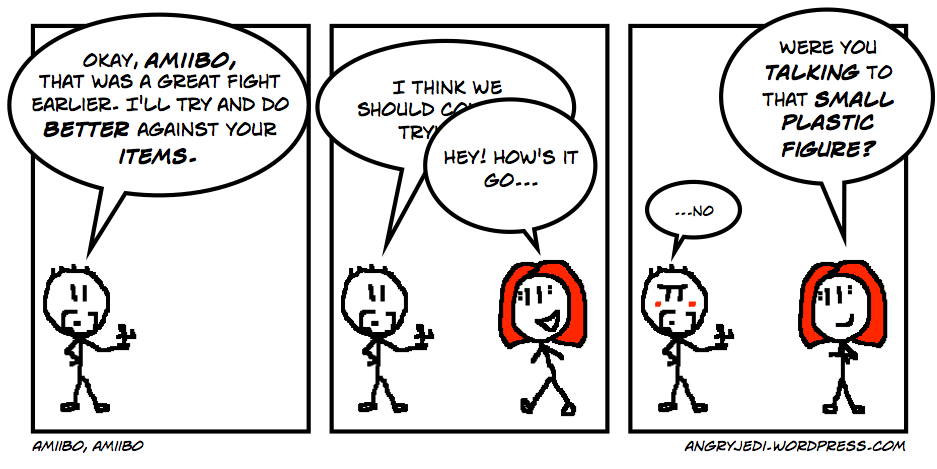
One of the most peculiar things about the new Wii U version of Super Smash Bros. is the compatibility with the "Amiibo" figurines that are sold separately.
During the run-up to release, I'd misunderstood their reason for existence, assuming them to be a means of effectively customising an individual fighter to your liking, then being able to take it around to a friend's house and use your own custom character in multiplayer battles.
I had my concerns about this; any time you introduce an element of customisation to something — particularly if said customisation involves "growth" of power and abilities — you run the risk of giving an unfair advantage to anyone with the customisations, and a disadvantage to anyone playing with stock characters. I had a vision of someone coming over with a level 50 Amiibo and repeatedly kicking my arse with it, not necessarily because they were actually any good with the character, but because they'd simply levelled it up enough.
I needn't have worried, because Amiibos don't work like that. What they do instead is provide you with a computer-controlled opponent that plays alongside you, learns over time and levels up its abilities, gradually becoming stronger and more powerful. You can customise it by feeding it equipment and choosing the special moves it is able to use, and level it up simply by allowing it to participate in games — be it as an opponent in a free-for-all multiplayer battle (you can even go one-on-one against it) or as a teammate in cooperative or team-based modes.
What's interesting about this is that because there's a physical object involved as well as persistence — after you've finished a play session, you write the data back to the Amiibo simply by plopping it on your GamePad for a moment — there's a much stronger relationship between you and this small lump of plastic. I'd even go so far as to say you may well develop a kind of rivalry.
It sounds odd, but it's absolutely true. Andie and I were playing some multiplayer earlier, and we had the Amiibo as a third player for a while — although I took it out for a bit when she started winning pretty much every match. After Andie stopped playing, I brought the Amiibo back in for some one-on-one battles, and it's actually been a lot of fun trying to figure out how to beat her, because as she's levelled — a process which is pretty quick up until about level 30 or so — she's gradually become better and better at playing, and is now a rather challenging opponent that I can still beat, but who certainly doesn't go down without a fight. Victories against her feel somehow more meaningful than a battle against random computer opponents.
While I'm not sure how much the Amiibos add to the experience as a whole — I'm interested to take mine over to my friend's house to bring her into his game and see how that works — they're an interesting little twist, and the figurines themselves are attractive and eminently collectible. I'm not sure whether or not I'll collect them, but they're inexpensive and decent quality, so I'm not ruling out maybe a couple more, particularly if a Shulk one decides to make an appearance any time soon…
Not realising that Black Friday has apparently become A Thing over here, I went into town to pick up a copy of Super Smash Bros. for Wii U earlier. It took over half an hour of queueing in Game to pick up a copy, but at least I didn't get to the front of the line and find there were none left. (I didn't get a Gamecube controller adapter, though; stupid "preorders only" rule.)
Most of you reading this probably know what Super Smash Bros. is, but on the offchance you don't, it's become one of Nintendo's flagship series over the years thanks to it essentially being a disc full of Nintendo fangasms. It's sort of a fighting game — though nowhere near as technically demanding as more traditional fighting games — that stars a wide variety of characters either from Nintendo's own lineup or from games that have appeared on Nintendo consoles at some point or another, as well as one or two special guests.
I've been playing a bit of the new game this evening and like its predecessors, it appears to be a lot of fun, if somewhat overwhelming in terms of the sheer number of different things available to do. There's a straightforward Smash battle, Classic Mode, All-Star Mode, Events Mode, Stadium Mode, online and probably several others I've forgotten, each of which are subdivided into various other things and most of which can be played either solo or with friends. Some can be played cooperatively with a partner against the computer, others are purely competitive. The most extreme multiplayer offering the new game has is an utterly chaotic 8-player mode in which it's nigh-impossible to tell what the fuck is going on, but it's an enjoyable sort of nonsense nonetheless.
There are some interesting additions, too. The ability to create your own fighter using any of the Miis on your Wii U console makes for some entertaining possibilities, particularly since they're customisable with three different fighting styles, selectable (and unlockable) special moves, equipment, costumes and headgear. The Amiibo functionality, where you can use small figurines to communicate with the game via the Near-Field Communication panel on the Gamepad, is fun, too, and not quite what I expected; rather than your Amiibo containing a fighter than you personally use, it instead acts as more of a sort of virtual pet that you can feed equipment to (don't think too hard about how that works), customise the special moves of and gradually level up by allowing it to participate alongside you in battle. Because the figurine itself holds data, you can then take it to a friend's house and bring your Amiibo into their game, too, so they can face off against the fighter you've been training up to be an unstoppable killing machine.
I'm really happy to see slightly lesser-known games such as Xenoblade Chronicles getting headline character love, too. Xenoblade's protagonist Shulk is an enjoyable, interesting character to play as, and the Xenoblade stage is challenging and cool-looking. (Plus it features recurring villain Metal Face showing up to cause mischief throughout, which is a lot of fun.) It sure makes me pretty hungry to see the new Xenoblade game in action on Wii U, though…
Aside from that, the customisation of the game has never been better. You can tinker around with how frequently items appear, which music plays in which stage and how often and even switch levels to a stripped-down, simplified "Omega Mode" (essentially little more than a floating platform) for a true test of your skill without environmental hazards being a pain. There's even an online mode — "For Glory" — where you play without items on Omega stages, and I have a feeling this is where the true Super Smash Bros. legends will learn to shine.
It's unfortunate that none of my friends are around this weekend as I was hoping to have a good session of local multiplayer with them. Still, I shall console myself with the vast amount of other content in the game — and perhaps attempt to give some online friends a kicking — and smile as the Wii U once again shows that it has some of the most enjoyable, most interesting and most polished games in all of the "next" generation of console hardware.
I never thought I'd get to write the following sentence: I played a bunch of Geometry Wars 3 tonight.
Geometry Wars 2 was an absolute masterpiece, and one of my favourite games from one of my favourite studios — the sadly defunct Bizarre Creations, who were also behind some of my favourite racing games (the Project Gotham series and the wonderful Blur). It struck a perfect balance of challenge and instant gratification, allowing anyone to pick it up and play, but only those who took the time to concentrate on what they were doing to truly master it and attain the most astronomical scores. It also featured one of the finest implementations of online leaderboards of any game, ever. And the dissolution of Bizarre made me think that we'd never see a new game in the series. Here we are, though.
Is Geometry Wars 3 the masterpiece that its predecessor was? To be honest, it's a bit early to tell yet. I wasn't immediately taken with its new aesthetic — the old-school neon vector art has been toned down a bit in favour of a new (and still distinctive) look that I have a feeling will probably grow on me in time — but then I sat down to "try out" Pacifism mode (one of my favourite modes from 2, in which you may not fire your weapons and can only defeat enemies by dodging through exploding gates when they pass nearby), looked up and realised I'd spent somewhere in the region of an hour staring glassy-eyed at the screen just like I used to do with Geometry Wars 2. So that's a good sign, then.
Here are some further observations, bullet-pointed for your convenience.
It has 3D levels. The flat plane is still there for "Classic" mode — essentially a retooling of Geometry Wars 2's modes — but in the main single-player "Adventure" mode you'll find yourself fighting on spheres, cubes, dishes, sausages, flat planes with holes in, circles with spinning walls and all manner of other peculiar arrangements. And it really adds a different spin (no pun intended) on the gameplay; having to consider the ability to "wrap" around a 3D shape forces you to think about your strategy somewhat differently to being enclosed in an arena. Not only that, but moving around on irregular shapes (such as the aforementioned sausage) can lead to you having to play with the battlefield skewed at some crazy and challenging angles if you're not careful about how you move.
The music has been remixed. The tunes are all based on the various themes from Geometry Wars 2's various modes, but I think I preferred the old mixes. The new versions have suitably thumping bass and drum parts, but the mix of the Geometry Wars 2 versions just sounded "fuller" and more satisfying to listen to.
There are bosses. In "Adventure" mode, anyway. Said bosses have a habit of 1) sitting on an awkwardly shaped playfield (the second boss, whom you fight on a cube, is a particularly troublesome chap) and 2) launching hundreds of enemies at you while you're attempting to fill them full of hot plasma death. Naturally, you only get one life for boss levels, too, so no fucking it up and hoping for the best.
There's a progression and upgrade system. Again, this only applies to "Adventure" mode. Early in the game, you'll unlock a "drone" that follows you around and behaves in various ways according to which one you've selected. You can upgrade both your drone and its special attack using the little diamond-shaped Geoms you collect in the levels, which are normally used simply to increase your score multiplier. Additional drones and special attacks are unlocked by progressing through the levels in "Adventure" mode and by attaining a particular number of stars by beating target scores in each level.
There's a weird new mechanic called Super State. The clichéd computerised voiceover will occasionally say "Super State" and inform you that there's an arrangement of static targets somewhere on the playfield. Destroy them all and you get a powered-up weapon for a brief time, rather than the approach from previous games where once your shots were powered up, they stayed powered up. It's a fun little twist that forces you to weigh up whether it's worth the risk of trying to destroy the targets, or simply muddle on with your regular weapon. It can be particularly perilous on "Adventure" mode's 3D stages.
Leaderboards are still awesome. In the "Classic" modes, you can always see your nearest rival in the corner of the screen, and at the end of a session you can see how you stack up against your friends and the global leaderboards. In "Adventure" mode, each level has its own individual leaderboard for you to take on, giving you something to strive for even if you've cleared every level with three stars.
There's an online mode. There are two ways to play, only one of which I've tried so far. Summoner splits players into two teams and then puts them in a Domination-style game where you have to capture towers by shooting them, and then the towers start coughing up enemies for you to destroy with your teammates. Highest score at the end of a short time limit — matches are really short and snappy — wins. Die and your team suffers a penalty to its score multiplier. It seems like fun, but unfortunately in the matches I've tried so far all of my opponents (and teammates for that matter) have just sat there and not done anything. This did mean I won by default, however, which was nice.
There's a local co-op mode. I haven't tried it yet, but this was quite fun in Geometry Wars 2.
That's about it for my initial impressions, then. I'll undoubtedly play some more in the next few days and have some more detailed thoughts to ponder, but for now I'm quietly impressed. As I noted above, I'm not quite sure yet whether or not it's as good as Geometry Wars 2 was, but it's certainly a solid, enjoyable game that I'm looking forward to getting to know a bit better.
(Oh, and if you're playing the PC version, I recommend playing in Borderless Windowed mode; the full-screen mode inexplicably caps the frame-rate at 24fps, which is just baffling.)
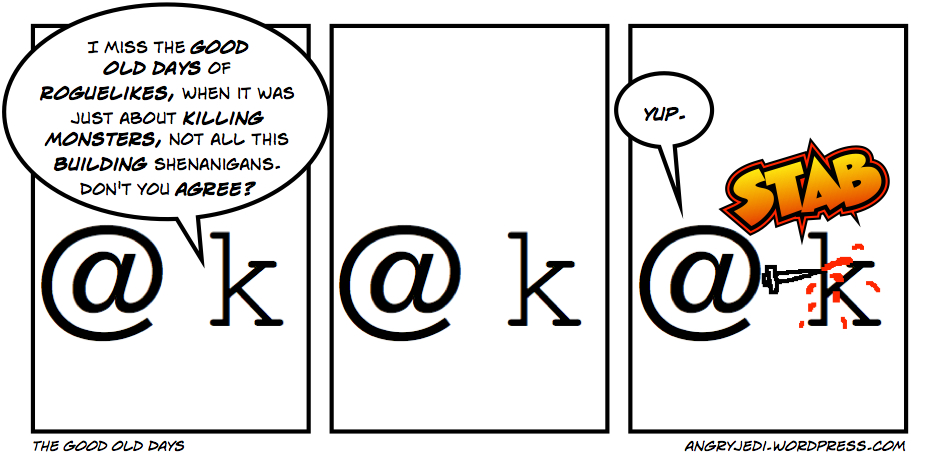
Before I left my friend Tim's yesterday, I quickly gave him a tour of Amplitude's Dungeon of the Endless, one of the three games in the studio's Endless series of sci-fi strategy games and, I think, my favourite of the three overall. Demonstrating the game to Tim reminded me how much I like it, and thus I spent a fair amount of time both last night when I got home and today playing it.
For the uninitiated, Dungeon of the Endless is a peculiar affair somewhere between roguelike, real-time strategy game, turn-based strategy game, tower defense game and board game.
Here's how it works. Your party of heroes (initially two, but expandable up to four by finding and recruiting additional characters as you progress) have crash-landed in a dungeon. The only way out is to use the otherwise destroyed spacecraft's energy crystal to power the ancient elevators which proceed upwards through the twelve levels of the complex. Inconveniently, of course, these elevators only go up one floor at a time, so on every level you have to go through the same process of exploring, finding the exit and then transporting the energy crystal from the start point to the exit. Do this twelve times and you win; let the crystal be destroyed or all of your heroes die and you lose.
Each level is randomly generated, and they get larger and more complex as you progress, but still follow the same basic formula. A level is constructed out of individual rooms separated by doors, and opening a door is akin to starting a new "turn" in Dungeon of the Endless' stablemates Endless Space or Endless Legend. Upon opening a door, you produce a particular amount of Food, Science and Industry, with the exact amount dependent on various conditions, including the heroes you have on your team, the modules you've built around the dungeon and whether or not there's anyone trained to operate said modules and improve their output.
Food is required for healing, levelling up and, occasionally, recruiting new heroes. Science is used for researching new modules to construct and resetting ability cooldowns. Industry is used to actually construct things. There's also a fourth resource called Dust, whose main use is to increase the power capacity of your crystal. Every ten units of Dust you acquire, you earn the ability to power an additional room. Powered rooms — which have to be connected to the crystal or to other powered rooms — can have modules built in them. Unpowered rooms have the chance of spawning waves of monsters every time you open a door — or indefinitely once one of your party members picks up the crystal and starts transporting it.
Playing the game effectively involves carefully strategising how you can balance exploring the dungeon to find the exit, constructing defensive positions to protect the crystal from attack, and powering rooms in such a way as to prevent enemies spawning in inconvenient locations — or perhaps to funnel them towards an easily-defended position. It's initially overwhelming, but once you master the basic strategy — power rooms along the path to the exit, place heavy defences in between where the enemies are likely to spawn and where you're going to be heading — it's satisfying, but still challenging. As the game progresses, the enemies get stronger and come out in greater numbers, so you'd better have levelled up your heroes and researched some better modules in preparation for the increasing intensity of the assaults.
Being inspired by roguelikes, Dungeon of the Endless has a pleasing amount of replayability thanks to random elements that make each playthrough a little different. The maps are different each time, for starters, but there are also more subtle changes like the technologies available to research. In the last game I played, for example, I had access to the "Knowledge is Power" turrets, which power themselves up significantly according to how much Science you've collected. I stockpiled an enormous amount of Science in the earlier levels, meaning that these relatively inexpensive turrets got me through a lot of the game thanks to their astronomical stopping power. (They didn't help me finish the last level, however, in which you're very short on power and other resources and powerful monsters just seem to keep coming.)
I haven't yet tried the multiplayer mode, in which you each control a single hero, but it has the potential to be interesting in a slightly different way to the single-player. I'm interested to try it sometime soon; hopefully the opportunity will arise!
Went over to my friend Tim's today, and we played a bunch of Wii U games (he's now finding it very difficult to resist the allure of Nintendo's underrated little console, particularly with a new Super Smash Bros. on the horizon) as well as some tabletop stuff, too.
One of the games we gave a shot was something that's been on my shelf for a while, but which I've only had the opportunity to play once: The Legend of Drizzt. Our regular group as a whole has a bit of a mixed opinion on cooperative games and dungeon crawlers, and The Legend of Drizzt is most certainly both of those things, although it does have a few scenarios that are competitive or team-based in nature as well as pure co-op action.
I own quite a few dungeon-crawlers, ranging from Milton Bradley's original Hero Quest through Games Workshop's follow-ups Advanced Heroquest [sic] and Warhammer Quest to more modern fare such as Descent: Journeys in the Dark Second Edition and, of course The Legend of Drizzt. Of all of these, Descent appears to have fared the best with the group as a whole, but it's also one of the most complex affairs thanks to its campaign rules and myriad tokens and pieces. Consequently, it doesn't hit the table as often as I'd perhaps like, and we're yet to run a whole campaign through to completion.
The nice thing about The Legend of Drizzt is that its adventures are all standalone affairs that can be run pretty quickly, and which form a coherent narrative if you choose to play through them in order. It does lack campaign rules, sadly, which means each time you start a new quest you're effectively starting from scratch with your chosen character, but this does mean you potentially have the opportunity to try out all the different characters and combinations of skills rather than being railroaded down a single development path. I'm unsure as to which route is better; while the ongoing increase in power of a lengthy campaign is fun, it's also essential to have a group with full commitment to seeing it through to completion and, much as I don't like to admit it, I'm not sure I have that right now. One day, perhaps.
But anyway. The Legend of Drizzt.
Drizzt, as it shall be known for the rest of this post, is one of the Dungeons & Dragons Adventures series of board games. All three of these games are very similar, and, in fact, are fully compatible with one another, so it's perfectly possible to mix and match elements from all of them to create custom character builds, adventures and scenarios. I only have Drizzt for now, but I'm tempted to pick up at least one of the others at some point, too.
The essence of the Dungeons & Dragons Adventures series is to provide a lightweight dungeon-crawling experience inspired by the 4th Edition rules of the Dungeons & Dragons role-playing game. For those who aren't well-up on their pen-and-paper role-playing games, D&D 4th Edition was interesting in that it placed a much stronger focus on tactical, board game-style combat than previous incarnations, in which it was perfectly possible to perform abstract combat sequences. (You can do this in D&D 4th Edition, too, but it's not really designed for it.) It also gave each character a very clear set of things that they could do, known as Powers. These fell into a few different categories: At-Will Powers could be performed every turn without penalty, and tended to be the character's main attack skills, each of which with its own benefits and drawbacks; Utility and Encounter Powers, meanwhile, could be performed once per "encounter" (essentially a self-contained sequence in the game, often — but not always — a battle) and were a bit more powerful and situational; while Daily Powers represented the character's most devastating (or helpful) abilities, but which could only be performed once per in-game day (or, more accurately, once per period between "extended rests").
Drizzt isn't anywhere near as complex as the main D&D 4th Edition rules, but it pulls some of its main features — most notably the use of Powers. When you start a scenario, you pick a character, and from there you're given access to at least one deck of cards from which you can pick a certain number of At-Will, Utility and Daily Powers. These will then be the abilities that you will have to use to progress through the scenario — though if you're lucky enough to level your character up in the middle of a scenario (a situation which isn't guaranteed) you tend to get access to at least one extra one as a reward.
Since the concept of "encounters" and "days" doesn't really exist in Drizzt, the Utility and Daily powers are effectively one-shot abilities that you need to think very carefully about when you use. There are a couple of Treasure cards you can score by defeating monsters that allow you to "recharge" these powers, but they are few and far between; you're best off saving your most powerful Powers for when you really need them.
Interestingly, unlike many other dungeon crawler games, Drizzt doesn't require an adversary (or "Dungeon Master") player. Instead, the game makes use of a clever system whereby when you explore a new area, you draw a monster card and then activate any monsters of that type on the board (including the one you just drew and placed) according to specific conditional rules on the card. In essence, the game itself runs the monsters automatically, and the players have to deal with them accordingly. This is somewhat similar to how Warhammer Quest works, though in Drizzt each monster has its own unique rules and special attacks that you'll come to recognise — and, hopefully, learn how to deal with over time.
I really enjoyed our game of it today, and I hope I get the chance to play it again sometime soon. It's an enjoyable, lightweight and, perhaps most importantly for our group, quick dungeon-crawler with a lot of flexibility, and I'm looking forward to having the chance to play it a bit more.
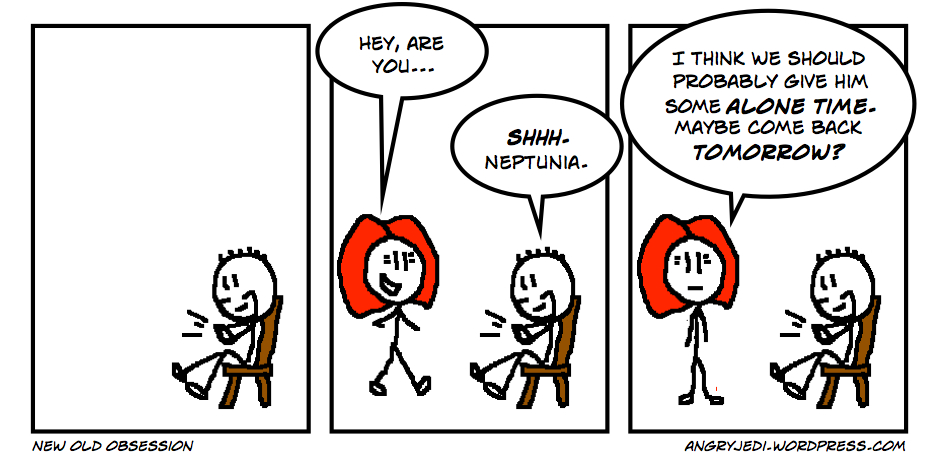
Having beaten Senran Kagura Burst recently at last, I've been turning my attention back to Vita title Hyperdimension Neptunia Re;Birth1, the "remake" of the original Hyperdimension Neptunia — a series that I first discovered in January of last year and promptly fell head-over-heels in love with.
I put the word "remake" in inverted commas because to call Re;Birth1 a remake is to do it something of an injustice. This is a complete and total overhaul of the game from top to bottom — graphics, gameplay, mechanics, story, characters, music, everything. In essence, it's a completely new game that even those who played and enjoyed the original — I know there's some of you out there, even though it was the weakest in the series by a very long shot indeed — can get a huge kick out of.
All of the above said, Re;Birth1 does also recycle a whole ton of material from previous two games Hyperdimension Neptunia mk2 and Hyperdimension Neptunia Victory — principally dungeon aesthetics and layouts, monsters and music. Consequently, those of you who played mk2 and/or Victory will probably find a lot of familiar material in Re;Birth1 but that's not actually a bad thing; the comfortable familiarity of the recycled material gives the game a feeling of consistency with its predecessors (for obvious reasons) while the new stuff that is included — no, it's not identical to its predecessors — stands out all the more for being a big contrast to the material that's been used in three games now. In essence, the game represents a refinement of the Hyperdimension Neptunia formula that developer Compile Heart has been experimenting with over the course of the previous installments and, while not completely perfect — a couple of minor elements from the previous games that I really liked have been ditched for Re;Birth1 — it is, by far, the definitive Neptunia experience, and a game that is beautifully designed for portable play.
Neptunia games have always been about two things: a silly, enjoyable, well-written and witty story coupled with some surprisingly compelling, grind-and-farm-heavy dungeon crawling. Re;Birth1 is no exception; its narrative retells the story of the original Hyperdimension Neptunia with a few twists here and there as well as a host of new characters, while there's plenty of incentive to dungeon crawl thanks to its quest system and one of the main mechanical highlights: the sprawling Remake system.
Remake allows you to craft various things. So far so conventional, but unlike many other crafting systems, Remake allows you to craft game mechanics as well as items, weapons and armour. Finding the game a bit challenging? Dig up a programmer's plan to weaken all the enemies and hack it into the game to make things a bit easier for yourself. Want to find the hidden treasures more easily? Build your own treasure scanner to enhance the minimap. Annoyed at that age-old RPG problem, "You Failed to Escape"? Craft yourself the ability to escape from battle with a 100% success rate.
Of course, all this makes it sound a lot easier than it actually is; to complete these plans you'll have to first of all find the plan in the first place — they can be anywhere from inside treasure cubes in dungeons to held by various NPCs around the world map that pop up after every major story beat — and then collect all the ingredients, most of which tend to come from monsters. The game doesn't hold your hand with this; if you want to craft a plan, you'll have to figure out where on Earth you're going to get all the bits from, though thankfully a straightforward dungeon and monster encyclopedia in the menu allows you to see which enemies haunt which areas, and what they might drop when you kill them — assuming they've already dropped it for you at least once. Through this system, you're encouraged to explore the various dungeons and fight as many different enemy types as possible in order to fill out that monster guide — the more complete it is, the less you'll have to look up on the Internet later.
The nice thing, though, is that it's all completely optional. There's no obligation to go fiddling around with plans at all — though your life will be significantly easier if you do — so if you simply want to plough through the main story as quickly as you can, that option is always open to you. Likewise, there's no obligation to complete quests, unlock optional dungeons or kill boss monsters — though failing to do so may well leave you a bit underlevelled come story boss time, at least on your first playthrough.
As with previous installments of the Neptunia series, the game is absolutely dripping with personality. Each character is a clearly-defined — though often (deliberately) tropetacular — person in their own right, with many of them poking fun at established video game and anime characters. Indeed, a number of the new characters for Re;Birth1 are direct references to game series and developers such as Steins;Gate creator MAGES., Senran Kagura publisher Marvelous AQL and legendary fighting game series Tekken. Each of these characters is beautifully designed to encapsulate the very essence of the thing they're supposed to be referencing; MAGES. wouldn't look out of place in Steins;Gate herself, for example, and even has alternate colour schemes that directly reference the characters Mayushii and Faris, while Marvelous AQL has costumes based on the Senran Kagura girls' iconic outfits.
It's a cliché to describe something as a "love letter" to something else, but I'm going to do it anyway. Hyperdimension Neptunia has always been a love letter to fans of Japanese video games and anime, being packed full of references both obvious and incredibly subtle, and Re;Birth1 very much continues that. It's a game that celebrates the joy of having fun with interactive entertainment, and I defy you to play through it with anything other than a huge smile on your face.
Except, of course, when Killachine flattens your party for the fifth time in a row because you didn't prepare properly and ended up with everyone stunned and clustered together, just waiting to be cleaved. You don't have to keep smiling then. But you'll probably try again rather than flinging your Vita across the room.
My only trouble with it is that I don't really want it to end. Although when those end credits do eventually roll, I can console myself with the fact that there are three new Neptunia games out there that I haven't played yet — strategy RPG Hyperdevotion Noire: Goddess Black Heart, the rather Senran Kagura-esque brawler Hyperdimension Neptunia U and probably the most exciting offering: PS4 title Hyperdimension Neptunia Victory II, a game that, if I don't own a PlayStation 4 by then, will almost certainly make me go out and buy one immediately the moment it is released.
Yes, I'm a fan. And unashamed of that fact. It's a series that consistently makes me smile; given how much I love it now, it's rather odd to (re)discover today that I've only been playing these games since January of last year. But I hope I'll be able to continue enjoying them for many years to come yet.
Over the weekend, mankind enjoyed a significant step forward in the field of space travel. Unmanned spacecraft Rosetta successfully detached its probe, named Philae, and landed on Comet 67P, aka Chryumov-Grasimenko. It was the culmination of a ten-year mission for Dr Matt Taylor and his colleagues at the European Space Agency, and a historic moment for humanity: we finally had the chance to examine a comet up close, and perhaps make some steps forward in understanding the way the universe works; how the solar system formed; perhaps even how there came to be life on this planet.
As much as it was a historic moment for humanity, then, imagine how Dr Matt Taylor felt as a significant portion of his life's work finally came to fruition as the probe successfully touched down and began transmitting data back to Earth.
Then imagine how Dr Matt Taylor felt when confronted with a giddy press more concerned with his sartorial choices than with the scientific milestone he had just passed — the shirt in question being a rather loud Hawaiian-style number featuring rather vivid, camp, retro-style imagery of women in PVC outfits shooting guns and generally looking pretty badass. (A shirt, I might add, made for and given to him as a gift by his friend Elly Prizeman.)
"I don't care if you landed a spacecraft on a comet," read a headline on The Verge put together by the two-person team — yes, this garbage took two people to put together — of former Polygon editor Chris Plante and his colleague Arielle Duhaime-Ross, "your shirt is sexist and ostracizing." And this was far from the only article published that day attacking him and his wardrobe rather than celebrating his achievements.
We don't have to imagine how Dr Matt Taylor felt. Because it was captured on film.
Can you imagine. Can you imagine reaching the culmination of a ten-year project, making such a significant step forward, and then some blowhard on the Internet telling you that your shirt is directly responsible for women not wanting to enter the fields of science, technology, engineering and mathematics? Can you imagine having to deal with abuse seemingly supported by the mainstream media, whom you previously thought would be keen to celebrate your achievement but now are, quite rightly, somewhat wary of?
Welcome to a world dominated by bullies.
The Internet has brought with it many great things, one of the most powerful being the principle that "everyone has a voice". The Internet has done more to advance the concept of free speech than pretty much anything else in the world, but while some people use this for good — to share information, to reach out to people who need help, to make friends in far-flung corners of the world without having to physically travel there — there are others who use it for ill. To lie, to cheat, to accuse, to blow things out of proportion, to bully.
This particular breed of unpleasant individual has been seemingly growing in numbers — or, if not numbers then certainly prominence — in the last few years, largely thanks to social networking sites Twitter and Tumblr. Ostensibly concerned with admirable-sounding concepts such as "social justice" and feminism, these individuals purport to be progressive thinkers who want to make the world a better place for everyone, but in actual fact are nasty, narrow-minded bullies who simply attack anyone who doesn't see the world in the same way they do.
The mission is a colossal achievement. Millions of us have been watching Philae's heart-stopping journey. Everyone in this country should be proud of Dr Taylor and his colleagues, and he has every right to let his feelings show.
Except, of course, that he wasn't crying with relief. He wasn't weeping with sheer excitement at this interstellar rendezvous. I am afraid he was crying because he felt he had sinned. He was overcome with guilt and shame for wearing what some people decided was an "inappropriate" shirt on television.
Why was he forced into this humiliation? Because he was subjected to an unrelenting tweetstorm of abuse. He was bombarded across the Internet with a hurtling dustcloud of hate, orchestrated by lobby groups and politically correct media organisations.
And so I want, naturally, to defend this blameless man. And as for all those who have monstered him and convicted him in the kangaroo court of the Web — they should all be ashamed of themselves.
Sadly, Dr Matt Taylor's trials were far from the first time this sort of outrage has erupted, and it will be far from the last time this happens, too. These supposed advocates of social justice — referred to in the vernacular by their opponents as "social justice warriors" or "SJWs" — are renowned for two things: taking offence at everything it's possible to take offence at, and then bullying people into submission, often until those suffering the bullying end up apologising, as Dr Taylor did.
This sounds ridiculous, but it's all too painfully familiar for me. I was bullied repeatedly throughout primary and secondary school — and once again at one of my previous workplaces — and the execution was exactly the same. Wear down the victim's defences with repeated, unprovoked, unwarranted attacks until they snap in one way or another — be it violently, at which point the bullies can point at the victim and say "look how violent they're being!", or tearfully, as in Dr Taylor's case, at which point the bullies can point and laugh at the victim and claim that they're only upset because they know they did wrong — and then move on in the knowledge of a job "well done".
It keeps happening, too, and these people never get called on it because they wield a considerable amount of influence and power — influence and power that lets them get away with a whole lot of nonsense.
Consider, if you will, the recent case of Independent Games Festival judge Mattie Brice, an outspoken, anti-men feminist who has claimed to be "leaving" the games industry on several occasions due to the abuse she was supposedly receiving.
Brice tweeted that she was "automatically rating low any games with men in them" during the course of her IGF judging duties and that she was "loving all this power". Understandably, this tweet — whether or not made in jest — upset a number of people, who complained to the IGF, who subsequently, admirably and promptly asked politely that she, you know, stop doing that lest people think that their judging was rigged. Brice then complained publicly to her Twitter followers about how she was being "harassed" and how the IGF were treating her poorly, and continued until the IGF issued an apology, not her. Her defence in all this? "It was a joke" — the last fallback of the bully, and an excuse I heard many a time when working as a teacher. It was never, ever, true, and you'll forgive me for being skeptical of this particular instance being a "joke" when we're talking about a person who made a game called "Destroy All Men" and has often posted anti-men rants on Twitter.
And lest you think I'm singling out Brice here, she is far from the only one; she's simply one of the most recent examples. I've thankfully remained largely free from this sort of nonsense up until now (though it remains to be seen if this blog post will attract zealots) but I've witnessed friends and former colleagues being attacked too many times over the last few years for me to sit here continuing to bite my lip.
YouTuber and PC gaming enthusiast TotalBiscuit demonstrated a good understanding of the issue in a recent post, and came to what is quite possibly the crux of this whole social justice thing and why it bugs me so much:
It's so goddamn American.
A lot of this social justice stuff seems to be focused on a very American set of ideals and circumstances that doesn't take into account much going on outside the country's borders. I mean the idea that racism against white people doesn't exist: let's take that one on for a second. [Fellow YouTuber and Irishman] Miracle of Sound accurately pointed out the genocide perpetrated against a portion of the Irish population and the hundreds of years of oppression that they suffered under the English. Sounds pretty damn racist to me.
The concept of white privilege is very American, too. You'll find a lot of British people, particularly Northerners like myself, bemused by it. I grew up in pit towns, or should I say, ex-pit towns, because Thatcher destroyed our economy when she broke the miners' unions and put a lot of people out of work. Our towns were vast white majorities but I can safely say we had no privilege, no advantages for being white. Some of the richest and most successful people in our towns were Indian and Pakistani.
He's absolutely right. These social justice types take a very American — specifically, West Coast — view of the world and assume it is the correct one, then shout down anyone who doesn't agree with them. They release the hounds on Twitter; they publicly shame them on Tumblr; they encourage the media to buy in to the narrative, and, worryingly, they succeed. Compare, for example, the media portrayal of consumer revolt "Gamergate" as a misogynist hate campaign that wants to drive women out of gaming with the reality of it being one of the most articulate, passionate, genuine, diverse, intelligent and inclusive — albeit at times somewhat ill-focused — groups of gamers of all genders, races and creeds that I've ever observed. (As an aside, I haven't involved myself in Gamergate's activities — as a former member of the press I don't agree with everything they stand for, though I feel they do have a number of fair points to be made — but I have spent a couple of weeks lurking around their regular online haunts to see what made them tick. It's been eye-opening to see the dissonance.)
It is worth clarifying at this juncture — and it pisses me off that I have to add this disclaimer — that I am not against the concept of "social justice" or, more accurately, equality. Quite the opposite; I believe in equal opportunities and equal, fair treatment for everyone, and my behaviour towards other people in my own life reflects this. Meanwhile, however, these keyboard crusaders make themselves immune to criticism by simply responding to any critics with "so you're against social justice, are you? You're against progressiveness?" but there is a right way and a wrong way to go about things — and bullying people until they seemingly agree with you is very much the wrong way to go about it. That is what this post is about, not about standing against the very principles of progressiveness.
All this has been going on for several years now — longtime readers will doubtless recall a number of posts where I've alluded to this in the past, and I've seen more friends than I'd care to mention either fall victim to these Internet bully mobs for a careless word at the wrong time or get swept up in their twisted ideology, never to have a rational word to say ever again — and it's time it stopped.
Why do I bring this up now? Why do I feel that this one lone blog post can make a difference?
Well, frankly, I don't; I am but one voice shouting into the void, and I would doubtless be argued to be a textbook example of a white cishet male privileged neckbeard shitlord (yes, this is genuinely something that these believers in "social justice" call people), but it's worth mentioning — particularly as the debacle over Dr Matt Taylor's shirt has brought this whole sorry situation very much into the public eye. I hope that this helps more people to see what has been brewing in online culture for a few years now — and I hope it helps put a stop to it.
This is not a move towards a progressive society. It's a move towards 1984-style Thought Policing, and it's not the direction that we as a society should be moving.
The bullying needs to stop. And it needs to stop now.
One of the best things about the Japanese games I tend to play in preference to anything else is simultaneously one of the most frustrating things.
I'm referring to the question of game length.
In an age where the public are seemingly ever more likely to rate interactive entertainment in terms of a "money per hours" ratio — look at the drubbing Gone Home got from certain quarters who felt that $20 was too expensive for the 2-3 hours of gameplay it offered — it should be abundantly clear to anyone who plays them that Japanese games, for the most part, consistently offer the absolute best value in terms of bang for your buck on the market.
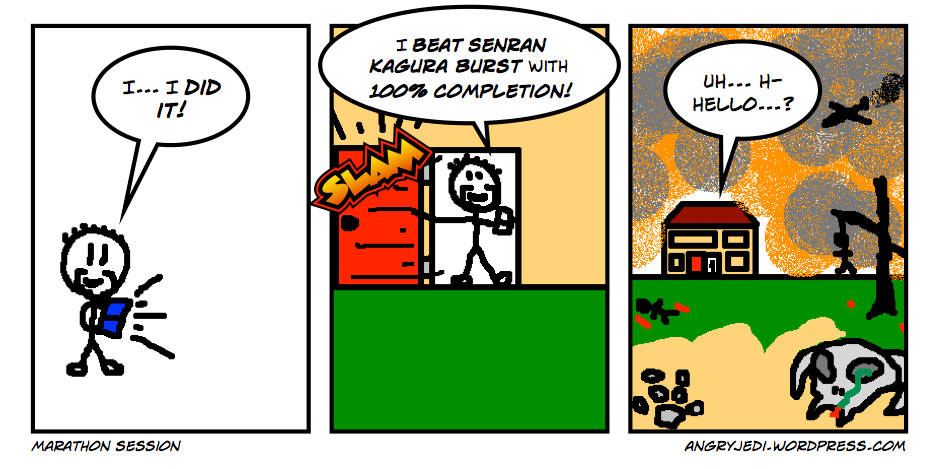
Take Senran Kagura Burst, for example, which I finally pummelled into submission and 100% completion over the weekend during downtime between activities. This is a game that is essentially a spiritual successor to the arcade brawlers of yore — games like Final Fight, Streets of Rage, Teenage Mutant Ninja Turtles, Asterix: The Arcade Game and The Simpsons Arcade Game, to name but a few favourites from my own youth.
Unlike those brawlers, however, which typically tended to be no more than four or five levels long — they needed to theoretically be completable on a single coin credit and in a single sitting, after all — it took me in excess of 50 hours to complete all the levels in Senran Kagura Burst, and there's plenty more I could do after completing all the levels once: try for an A-rank on all of them; try and level up all the characters to 50; try and unlock all the characters' "balance" modes through using them in different ways; try to complete all the levels in the challenging "Frantic" mode; try to beat all the bosses with special moves; and try to see all the bosses' special moves without dying. Were I to tackle some of those additional challenges — and I'm not ruling out the possibility, as I enjoyed Senran Kagura Burst one hell of a lot — I'm sure that could easily put a significant number of extra hours on the clock.
Notably, though, a lot of this "extra" stuff is optional. You can romp through the main storyline of Senran Kagura Burst, ignoring all side missions and some of the clever things you can do with the characters, in probably about 10 hours or so, if that. (Most of that time will be reading the game's lengthy visual novel sections, which are skippable after you've completed that mission at least once.) And in doing so, you'll have had a satisfyingly complete experience from start to finish — particularly as the game's structure effectively feels like you're getting two (rather similar) games for the price of one thanks to the story unfolding from two different, parallel perspectives that meet up at various points.
The same is true for many other Japanese games, with RPGs being the clearest example. Your average Japanese RPG these days will take anywhere between 20 and 100 hours to clear first time through, assuming you don't just plough straight through to the ending, and that you take on a bit of side content and spend a bit of time fine-tuning your characters. After that, though, you have a choice: set it aside, satisfied that you've seen the conclusion to the story, or continue playing in the hope of enjoying everything else the game has to offer — often referred to as "post-game". Many modern RPGs also offer a "New Game Plus" mode, in which you can carry across certain things from your previous playthrough into a new run — the exact things you can carry across vary according to the game, but often include things like character levels, unlocked skills, equipment, secret areas uncovered and all manner of other goodies. This tends to turn you into a satisfyingly unstoppable powerhouse at the outset of your second playthrough as your buffed-up character cuts through enemies like butter, but is often necessary to take on some of the biggest challenges the game has to offer. Some games even withhold their toughest bosses and dungeons until post-game or New Game Plus, providing you with an incentive to continue playing even after the credits have rolled.
Even seemingly "short" Japanese games have a massive amount of longevity, too; take your average "bullet hell" shooter, for example, which typically follows the arcade machine structure of theoretically allowing someone to clear it on a single credit and in a single sitting. The true challenge of these games, however, comes from perfecting your game — achieving that single-credit clear (often known as a 1CC — 1 Credit Clear), beating your last high score, topping the worldwide leaderboards. The latter aspect in particular can become enormously competitive, and in the case of many shmups, requires you to fathom out an initially Byzantine-seeming scoring system in order to take maximum advantage of it.
And this isn't even getting into the truly, directly competitive titles such as fighting games, which have potentially limitless replayability if you're actually any good at them. (I am not, so I tend to play through the story mode, if there is one, and then be done, perhaps with an occasional two-player local match with friends if they're up for it.) Or driving games with ongoing online competition. Or all manner of other joyful experiences.
I'm not saying Western games don't offer any of this longevity — anyone who's super-into Call of Duty's multiplayer mode is doubtless raising their hand and going "Um…" right now — but for my money, and particularly in the single-player space, Japanese games can't be beaten for value in terms of how much entertainment you'll get for your £40.
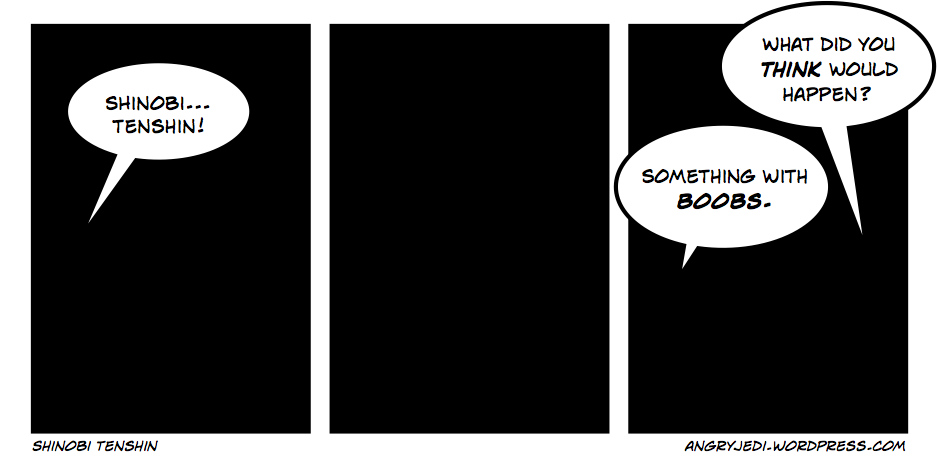
After a while off, I've been revisiting Senran Kagura Burst on the 3DS. I played through the Hanzou storyline to refresh my memory, and I'm currently just starting the third chapter of the Hebijou side. And I'm reminded of just how excellent this game genuinely is.
The Hanzou side of the story, which focused on the life and times of a group of female classmates in the Hanzou academy for "good" ninjas, was a lot of enjoyable fun, helping to make the already visually distinctive characters into interesting individuals that the player would want to find out more about. There's the leader of the group Asuka, who gradually grows in confidence and assertiveness as the story progresses; class rep Ikaruga, who is initially portrayed as the more "motherly", sensible figure of the group, but gradually steps aside as Asuka grows in strength; Katsuragi, who is very much the "older sister" of the group — and a character unabashedly comfortable with both her own body and her seemingly somewhat fluid sexuality; Hibari, who is immature and filled with self-doubt until she goes on a significant personal journey — an important part of the overall plot; and Yagyuu, whose quiet, understated love for Hibari is extremely touching to see.
Over the course of the Hanzou story, the girls encounter the girls of the Hebijou "evil" school for ninjas on several occasions, culminating in a final conflict against them at the conclusion of the story. Initially set up to be complete antagonists for one another, the final chapters of the Hanzou storyline take steps to humanise the Hebijou, showing both the player and the Hanzou girls that despite being on "opposite" sides, it's possible to find common ground and be friends.
This theme is explored in greater detail in Hebijou's own story. A key concept when considering Hebijou is the idea that the concept of "good" is selective and has stringent criteria to be accepted, while the darkness of "evil" will accept anyone. Consequently, a significant part of the Hebijou story that I've played so far centres around a disparate group of girls from wildly different backgrounds — most of whom have some sort of difficulty or tragedy in their past that they're trying to escape — coming together and finding this common ground; this reason to work together, even though they're "evil".
In fact, throughout the Hebijou storyline, it's easy to forget that these girls are supposed to be "evil" at all, and that's entirely the point the game as a whole is making: regardless of what "side" you're on, it's important to surround yourself with people that you trust and love. People that are true friends; people that can help you through your problems; people that, in some cases, know you better than you know yourself.
Hebijou's cast are an interesting bunch — perhaps even more so than the Hanzou girls. Leader-type Homura — a rough analogue to Hanzou's Asuka — is a girl of relatively few words who is good at being serious but tends to try way too hard when attempting to be "fun". Hikage, meanwhile, is a mysterious young woman who claims to have no emotions — so, as you might expect, cue plenty of scenes with the other girls trying to make her feel things. Mirai, on the other hand, is a young, painfully insecure girl who believes herself to be inferior both physically and in terms of ability to her peers. Next is Yomi, who uses the mannerisms of a privileged rich girl, but actually grew up in poverty, tends to have little to no money even now and who refuses all but the most very basic of charity. And finally Haruka, who is one of the most overtly sexual characters I think I've come across in any game in recent memory, aptly demonstrates that being "sexy" doesn't necessarily mean you have to sacrifice the elements of your personality that make you into a normal human being. You can embrace your sexuality and your own particular tastes without letting them define you, in other words.
I've been really enjoying the Hebijou story so far and I'm looking forward to seeing how it develops. Rather than simply presenting the events of the Hanzou side from an alternative perspective, it's an enjoyably distinct story in its own right, and, like its Hanzou counterpart, gives us an enormous amount of insight into some of the most well-defined characters I've come across in recent memory. I'm glad there's plenty more adventures of the Senran Kagura girls to come in future — in the immediate future, there's Senran Kagura Shinovi Versus for Vita, Senran Kagura 2 for 3DS and rhythm game spinoff Senran Kagura Bon Appetit. And you can bet your life and hometown I'll be playing them all.
We played the board game City of Horror earlier today. I'm never quite sure whether or not I genuinely like this game as, frankly, it's a horrible little game that actively encourages its participants to backstab, lie and cheat one another under the pretenses of working together to survive a zombie apocalypse.
At least, that's what I thought it was prior to our game today.
A little background for those unfamiliar: City of Horror casts players in the role of several zombie apocalypse clichés and tasks them with surviving from midnight until 4am — just four turns, which doesn't sound like all that much — until the arrival of the rescue helicopter, at which point the survivors need to take an antidote in order to survive, and whoever has the most points worth of surviving, non-zombified people remaining at the end — plus any bonuses — wins the game.
Now, what normally happens with this game — which we tend to play with our full regular group of five people — is that we start out with relatively good intentions, but before long someone does something unpleasant. It might be a little white lie that gets a character killed; it might be refusing to help in a dangerous situation; it might be completely reneging on a deal previously made, since there is no rule that says you have to keep up your end of the bargain when you make an arrangement with another player. Ultimately, there is only one "winner" on points, and so much of the interest in the game comes from determining how to get yourself into an advantageous situation while simultaneously making life awkward for other players.
It's an interesting game in that it's highly social and based on interaction. The mechanics are relatively simple, and a lot of the time things boil down to taking a vote on things — whether that's choosing who gets thrown out of the window to sate the zombies' hunger this turn, or who gets the supplies that had been air-dropped into a particular location. There's a surprising amount of flexibility, and the game is wonderful for creating emergent narratives surrounding the various characters, all of whom are B-movie archetypes of various descriptions.
Now, the interesting thing that happened today is that we played it short one regular team member — the one who is often at the centre of the backstabbing and unpleasantness that typically accompanies a game of City of Horror. This may paint him in a somewhat unfavourable light, so I'll qualify this by saying that he's actually a very nice guy with a fine sense of humour, but something about this game brings out something very primal in him; a desire to win without caring who he has to tread on on the way to the top.
Halfway through the game we played today, which was, as previously mentioned, lacking this troublesome teammate, we realised that none of us had lost any survivors. This is particularly unusual, as City of Horror is a somewhat cutthroat game, even if you're cooperating fully with one another and not attempting to screw one another over. But we'd somehow made it to halfway through without anyone causing anyone else's death, and without any unfortunate circumstances leading to anyone's death, either.
We jokingly suggested that we should try and make it to the end of the game with everyone surviving. No-one around the table was initially sure whether or not everyone else really intended to hold true to this promise, but as the game continued, it became clear that people were actively working together rather than against one another. Discussions happened about the best course of action. Information was shared that could easily have been kept secret. Opportunities to get one up on the other players were cast aside in the name of cooperation and collaboration.
This doesn't mean that there was no tension, of course. There was mistrust, somewhat mitigated through some of the game mechanics that allow you to take a degree of "insurance" against anyone messing with you. In my case, I came into possession of some information that would have been of use to the group as a whole, and I was very tempted to lie completely about it — an action that would have probably got several of my opponents' characters killed. And in the last turn, it would have been extremely easy for one player to run away with things and take the complete victory.
The strange thing is that these things never happened. We cooperated and collaborated right up until the end, and the eventual result was that all sixteen characters who started the game were still alive at the end — well, with the exception of one, who didn't have an antidote and consequently died after we'd "won" as a group.
It was a peculiar experience, unlike anything I've encountered in City of Horror before, and I really enjoyed it. One of my tablemates, who typically prefers competitive games rather than cooperative experiences, commented that he didn't find it quite as fun as usual, but he was impressed that we'd managed to maintain our uneasy four-way alliance up until the end. Mostly, it was interesting to see that it is possible to complete a game of City of Horror without anyone dying, because the game's general difficulty level makes it seem as if that simply wasn't the case.
But, well, it turns out it is. I don't know if we'll ever see that happen again, because after all the nastiness of City of Horror is one of its main gimmicks that makes it appealing to our group. But for now, it was good to see that even given plenty of opportunities to be assholes to one another, we all took the noble route and helped one another out to ultimate victory.
 One of the most peculiar things about the new Wii U version of Super Smash Bros. is the compatibility with the "Amiibo" figurines that are sold separately.
 I never thought I'd get to write the following sentence: I played a bunch of Geometry Wars 3 tonight.
 Before I left my friend Tim's yesterday, I quickly gave him a tour of Amplitude's Dungeon of the Endless, one of the three games in the studio's Endless series of sci-fi strategy games and, I think, my favourite of the three overall. Demonstrating the game to Tim reminded me how much I like it, and thus I spent a fair amount of time both last night when I got home and today playing it.
 Having beaten Senran Kagura Burst recently at last, I've been turning my attention back to Vita title Hyperdimension Neptunia Re;Birth1, the "remake" of the original Hyperdimension Neptunia — a series that I first discovered in
  One of the best things about the Japanese games I tend to play in preference to anything else is simultaneously one of the most frustrating things.
 After a while off, I've been revisiting Senran Kagura Burst on the 3DS. I played through the Hanzou storyline to refresh my memory, and I'm currently just starting the third chapter of the Hebijou side. And I'm reminded of just how excellent this game genuinely is.
 We played the board game City of Horror earlier today. I'm never quite sure whether or not I genuinely like this game as, frankly, it's a horrible little game that actively encourages its participants to backstab, lie and cheat one another under the pretenses of working together to survive a zombie apocalypse.