
#oneaday Day 142: StarCraft: The Board Game (Part 2)

[Compromise: Have decided on a new format. Weekends will have individual pictures like what I used to do. That way I can do them in Paint if I'm away from my Mac.]

So we finally got through a complete game of StarCraft: The Board Game. And after a bit of initial confusion over a few rules-related bits and pieces, the three of us found ourselves understanding the way things worked quite well. It'll probably take a few more games for us to be able to strategise with any real effectiveness, but for a first game, we didn't do too badly — and more importantly, it didn't last for six hours like we were expecting it to. In fact, due to the "Special Victory" conditions, the whole thing ended up being over a little quicker than we anticipated. No bad thing — it means that it doesn't go into that pile of "games that are good but take hours and hours to play" and will hopefully be trotted out relatively often.

It's an interesting game, really, with elements of Risk and Civilization present. There's empire and unit building, conquering opponent territories, researching technologies, and an interesting card-based combat mechanic that gives something of an element of chance without making it completely random. There's also a very wide array of possibilities for things to do, and this coupled with the randomly-generated game board will make for a game which is unlikely to be the same twice in a row.

Things we have learned so far, then:

  • If someone has a Z-Axis Navigation Route (or "warpgate" as we kept calling them) linking to one of their own planets from one of their own planets, you'd better assault them sooner rather than later, otherwise you'll find them building up an unassailable fortress.
  • Building the Air Support module which, among other things, prevents people from landing troops directly on your base, is an expensive investment that is very worthwhile as it makes life quite inconvenient for invading armies.
  • Ultralisks are tough.
  • Archons are tougher, especially if they have some fortunate combinations of Reinforcement and Event cards.
  • Obstructing another player's orders isn't necessarily a good course of action, because it lets them draw Event Cards, which are quite powerful and also act as the game clock.
  • Knock people off Conquest Point spaces as soon as possible rather than trying to do something clever like cut off someone's supply line. If someone has captured conquest point spaces worth a total of 3, it takes them just 5 turns to win.
  • Attacking is better than defending to quite a significant degree, so it pays to go on the offensive.
  • Force-mining someone's resources then retreating is a petty and amusing way to wreak revenge without destroying your own units.

I'm looking forward to trying the game again soon. It was a lot of fun and despite its apparent complexity (this is a game that easily takes up all of a large table with board, figures, cards and lots of chits) it's relatively straightforward to play once you get how the rules work. Approve, then!

#oneaday Day 141: StarCraft: The Board Game (Part 1)

[I'm away for the weekend so am away from comic-making tools. I could use Windows Paint, but I'm not going to. So there.]

We tried StarCraft: The Board Game for the first time tonight. My brother got it for me for my birthday back in April and I know he has been quite curious to hear about it, and I've been pretty interested to see how it plays, too.

Tonight, we spent a little while going through the basic rules and figuring out how everything works, but didn't play a complete game. As is our norm for starting a brand new game — especially a complex one — it took us quite a while to get through even a single turn, so we decided it would probably make sense to treat tonight's session as a learning experience, then have a proper game of it tomorrow.

As with many games, the rules initially seem quite complex but once you get them figured out, it's fairly straightforward. Turns are split into three phases — planning, execution and regrouping. Planning involves every player assigning orders to the game's planets, and these orders can either be "mobilise" (move units either between areas on one planet or from one planet to another, assuming you've built a transport covering the necessary navigation lanes first), "build" (build stuff, be this new bases, units, workers or upgrades) or "research" (acquire new tech and/or provide yourself with additional options should combat become a possibility). Execution involves taking it in turns to make these orders happen — but the order in which the, err, orders were laid down on the board is important here, as it's possible for players' orders to "obstruct" each other at times. Finally, regrouping involves "cleaning up" everything, making sure everyone has the right resources, and so on. Then you repeat. In theory, it's relatively simple. In practice, there are a lot of variables to consider.

For starters, there's combat. Combat is resolved through the use of cards which display two different attack and health values, along with a picture of one or more units. If the unit you're using matches the one on the card you're using, you use the higher attack and health values. If it doesn't, you use the lower ones. Then there's all manner of special abilities along with technologies that reinforce and upgrade your units to be more badass. It'll take a while to figure out all the possibilities, but it looks like there's lots of potential for strategic play with enough randomness to keep things interesting. Which is nice.

Anyway. It's about 2:20am right now so I should get some sleep. We'll be trying a full game tomorrow, so I'll report back on how that goes tomorrow evening.

#oneaday Day 139: Tr-Tr-TrackMania

Those who have — ooh. Hold on. [gets momentarily distracted by the new WordPress interface that has apparently launched today.] Pretty.

Ahem. What was I saying?

Oh yes. Those who have known me for a while will know all about my love affair with Trackmania United Forever Star Edition, née Trackmania United Forever, née Trackmania United. And indeed my Steam usage statistics would seem to back this up — with 24 hours' playtime recorded on it, and nothing else close. Granted, Steam doesn't seem to have tracked my playtime on quite a few games I know I've played through to completion, but 24 hours on a silly driving game is pretty substantial, and it just doesn't get old.

Yes, it's unpolished. Yes, certain aspects of it are inaccessible. Yes, it doesn't tell you about a good 95% of the possibilities it offers anywhere in the documentation — but somehow, despite all this, a huge, dedicated community has sprung up around the game and has been supporting it and driving it forward ever since its release. So much so, in fact, that it's spawning a proper, bona fide sequel, along with two exciting-sounding companion games.

TrackMania 2 Canyon looks like it will be a lot of fun from what I've seen so far — though the Canyon subtitle does make me wonder if it'll have the variety of environments and vehicles that United offers, but it's the other two ManiaPlanet games that intrigue me more, if anything. The possibilities on offer in ShootMania and QuestMania, offering the facility to create FPS levels and RPG games respectively, are potentially limitless. And while little has been revealed about how — and if — the three games will interact, the fact that they share a common community portal in the form of ManiaPlanet is immensely intriguing and offers some very exciting possibilities for those, like me, who are interested in game design but whose experience with building tools is limited to Lego, Scalextric and the Wolfenstein 3D map editor. (I remember trying to make a Duke Nukem 3D level once. That didn't end well, much like several efforts to make a Doom level work in any shape or form. And those games weren't even proper 3D. I like tiles. Tiles are good.)

For those who have never experienced the joy of TrackMania, it's worth remembering that the game's probably most oft-used environment — the stadium — is available as a completely free game to download, with a significant amount of content and the ability to make your own tracks as well as play online. It's not often you see that sort of generosity from a developer offering what is essentially a "demo", but there you go. Steam users? Knock yourself out.

Okay. That's enough TrackMania ranting for this year. See you next year.

So I'll see you on the loop-the-looped circuits, no?

#oneaday Day 131: Thoughts on Star Raiders

1979's Star Raiders and its 1986 sequel are, to me, two of the most memorable games I've ever played. The original Star Raiders was notable for being a pretty convincing simulation of what it might like to be to fly a spaceship and defend a galaxy that absolutely, 100% wasn't ripped off from Battlestar Galactica, oh no, from the "Zylons". Sure, it had crude graphics and sound, but its interesting blend of spaceflight, combat and light strategic elements made it a compelling example of early gaming that is actually still perfectly playable today, unlike many other retro "classics". It also taught me what "red alert" meant long before I ever saw my first Star Trek episode.

Its sequel upped the ante with better graphics, a wider variety of foes to battle against and more things to do than just fly around and shoot Zylons in space — you got to orbit planets, take on motherships, bomb bases and all sorts of things.

Now, some 25 years after the last Star Raiders game made an appearance, we have a brand new one for both Xbox 360 and Windows (and, if Sony ever gets PSN up and running again, PS3.)

I will preface this by saying that if you are thinking about playing this game on a console, just don't, all right? If you never played Wing Commander III on PlayStation 1, you've never known the horror of having too many controls and not enough buttons on your joypad. Hint to developers: if you need to include a "shift" button in your joypad-based control scheme, you may wish to rethink it somewhat.

Try it on a PC with a proper Giger alien-penis joystick and some not-inconsiderable control redefining, though? Now that's more like it. What we have here is a relatively simplistic space game that, unlike many recent examples, remembers that space is three-dimensional, and that it is, in fact, possible to "loop the loop" in space, along with go up and down, turn left and right and roll around your axis.

A good start. Add a transforming ship to that mix and you have some interesting possibilities. Your all-new Star Raiders ship (called, inexplicably, "Jasper") can transform between "Attack" (constant forward movement, high top speed, poor turning, guns and missiles), "Assault" (mech-like move-and-strafe, lower top speed, excellent turning, guns and heavy laser beam) and "Turret" (rapid aiming, snail's pace movement, super-powerful heavy weapons) modes. When I first started playing, I wondered why you'd ever want to switch out of "Attack" mode, until I realised that I was spending an awfully long time chasing down Zylon fighters that were more manoeuvrable than me. So I switched to "Assault" mode and found that I could kill them rather more easily. And "Turret" mode came in handy for dealing with capital ships.

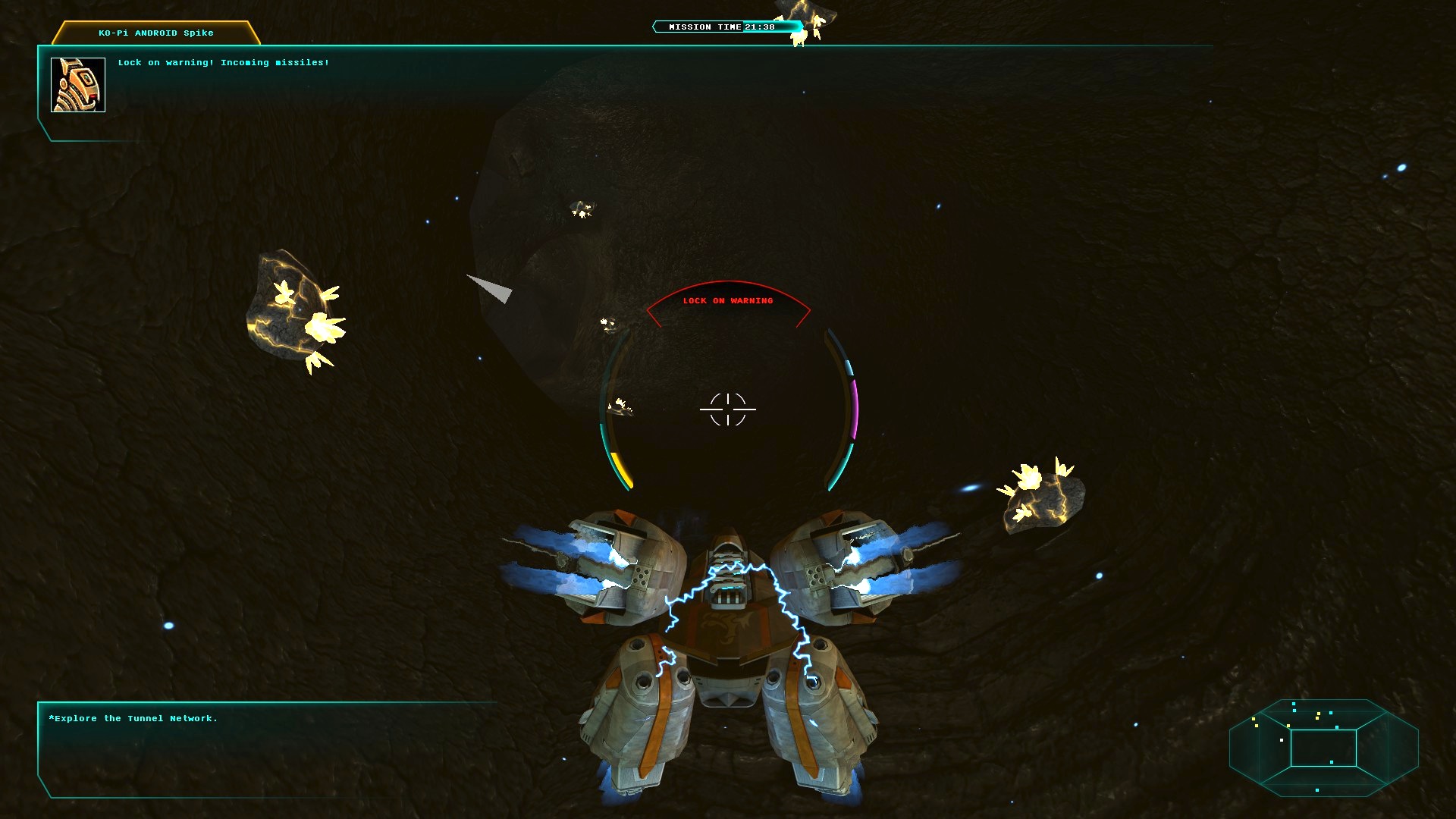
The first few missions were a bit samey, despite claiming to be "recon" and "combat" missions — they all seemed to involve "destroy [x] number of Zylon fighters", possibly against a time limit. But then the fourth "story" mission came along, which tasks you with finding a piece of a secret weapon that will help you deal with a Zylon secret weapon. Said piece of secret weapon is stashed somewhere in an asteroid. And this asteroid is pretty big. So big that when you're flying over its surface, you'd be forgiven for thinking you were conducting a planetside mission. Not only that, but part of the mission involves going inside the asteroid, at which point switching to Assault mode effectively turns the game into Descent, which is awesome. I'll ignore, for now, the fact that the game crashed on me at this point just as I was about to finish that mission.

I wasn't sure what to think of Star Raiders when I first started playing it. Then I looked at the clock and realised I'd been playing for nearly two hours. So something must be right somewhere. It's clearly not the original game in any shape or form — the "galactic map" interface in the game is a glorified mission select screen rather than the strategic overview of the original — but what it does offer is a good, fun, if simplistic space combat game with some nice ideas and a horrendously poor control scheme on console.

At £6.99, though, you can probably afford to take a chance on it, though, right?

Oh, if you're interested, then…

Old:

New (previously-mentioned Descent bit):
#oneaday Day 128: That's Not Very PC

I just bought a new PC. Well, technically, I bought a case with a motherboard, processor, RAM and PSU pre-installed along with a graphics card, the wrong wireless adapter, a hard drive, a DVD drive and a few other little bits and pieces. Technically speaking, it cost a lot of money that I don't really have, but while I can at least "sort of" afford it (that's the closest I'm going to get for a while) I figured I'd take the plunge as a birthday treat to myself.
I have it hooked up to my HDTV and it looks glorious at 1080p. Naturally, the first thing I did was download a bunch of stuff from my Steam account that used to run like ass on my Mac and see how well it works on the new machine. Here are my findings so far:

  • Mass Effect – Silky smooth, character models are blurrier than I remember from the Xbox version, but the gorgeous framerate makes up for that.
  • The Witcher – Super-sexy hi-res, though the frame rate chugs a bit if there's a fancy magical effect taking up a lot of the screen. It otherwise looks great, though.
  • Crysis – Bought for £2.50 in the EA sale the other day even though I have been fairly anti-Crysis in the past — granted, I haven't played it and was ready to dismiss it as a shooter. But by God that game looks fantastic. Am actually intrigued to play it, too — it seems to be rather different from your typical corridor shooter.
  • Left 4 Dead 2 – Silky-smooth. Hi-res. Actually playable rather than borderline unplayable.
  • Borderlands – My God why did I ever play this on a console? (Although the PC interface is a bit crap in the menus.)
  • Magicka – actually runs and looks like fun. Bit juddery at times though I think that is more down to its questionable programming than performance issues.
  • TrackMania United – Looks great on a 40" HDTV and is just as fun as ever. Looking forward to TrackMania 2 now.
  • Amnesia: The Dark Descent – Had a copy of this for ages, just started. Looks utterly terrifying. Looking forward to it.

So. Looking forward to playing some games the way they are meant to be played. And of course, if any of you want to add me on Steam, you can feel free — Steam community username is, as always, "angryjedi". Say hey and feel free to send me a message or send me an invite to a game.

Now I'm off to go and shit my pants at Amnesia. See you in the morning. Maybe.

#oneaday Day 125: He's Having an Episode

Episodic gaming is, for many publishers, the "holy grail" of digital distribution. If they can figure out a way to hook a player in and keep them interested in their piece of interactive entertainment, there's no reason why it shouldn't keep going and going and going until people lose interest — like a TV show.

But the trouble is, a lot of developers have great difficulty releasing episodic content in a timely manner. Valve are obviously right out with their years elapsed between Half-Life 2 episodes and the conspicuous lack of Episode Three. Telltale are closer, with their monthly episode, but it's still not quite the same as a TV show.

Oddly enough, the games that have pretty much got it spot on are two games buried deep in the heart of the App Store that you'll probably never pay any attention to. But I'm here to tell you that if you're the slightest bit interested in exploring a bold experiment in episodic interactive content, then you really, really need to try out Cause of Death and Surviving High School, two games built around the same basic visual novel-style engine but which manage to be very different from one another.

Cause of Death is a full-on interactive detective show. It's presented very simply with static backdrops, text narration and character portraits, but it works extremely well thanks to the attractive artwork, well-written (if overly-peppered with exclamation marks) dialogue, strong characters and excellent music. It's also interesting in that you regularly switch between different characters — including the victims of crimes, which is an interesting approach. Gameplay is extremely simple, consisting of reading text and occasionally making choices, some of which are against a time limit (and for some of which the correct option is to not make a decision) and acquiring "Detective Score". Acquiring enough points in each chapter unlocks bonus scenes, so there's plenty of incentive to do your best.

Surviving High School, on the other hand, is very different, despite using the same game engine. It's more of a social/dating sim, based around a character you name and choose the appearance of yourself. There's a lot more "branching" to the story depending on who you talk to, who you choose to date and decisions you make. And there's a lot more minigames which would be pretty cheesy in a computer-based adventure game (wordsearches, pop quizzes, that sort of thing) but work extremely well on the iPhone's touchscreen. Again, it's written with some very appealing (if stereotypical) characters who all have a story to tell. Plenty of replay value, too, as decisions you make mean that you'll see certain scenes and not others.

But that's the game you download. The really interesting thing comes in the episodic content. The app you download is "Season One" of the respective game, which tells a complete story and is a satisfying experience in itself. Beyond that, though, there's a new episode that "airs" every week and can be downloaded for free while it's available. And past episodes are available "on demand" for a fee — in the case of Cause of Death, you can buy the whole of Season Two for under two quid and it's then 59p per pair of episodes after that. Haven't checked Surviving High School yet but it's probably something similar.

This, right here, is the correct way to do it. Weekly updates mean that people will stay engaged with the game, especially as they're free while they're "airing". Episodes on demand allow the developers to make some money from the games, which can then be ploughed back into development of further episodes or new titles. And because the tech of the games is so simple, it probably doesn't cost that much to make new episodes — meaning both games are probably nice little money-spinners for EA.

Regardless of how much money EA is making off them, though, they're both excellent titles for fans of the visual novel style of gameplay, and I will certainly be exploring the further episodes in more detail. Both games have free, ad-supported versions available (and they're only 59p each for ad-free versions, so they don't exactly break the bank) so why not check them out?

#oneaday Day 116: Hacked Off

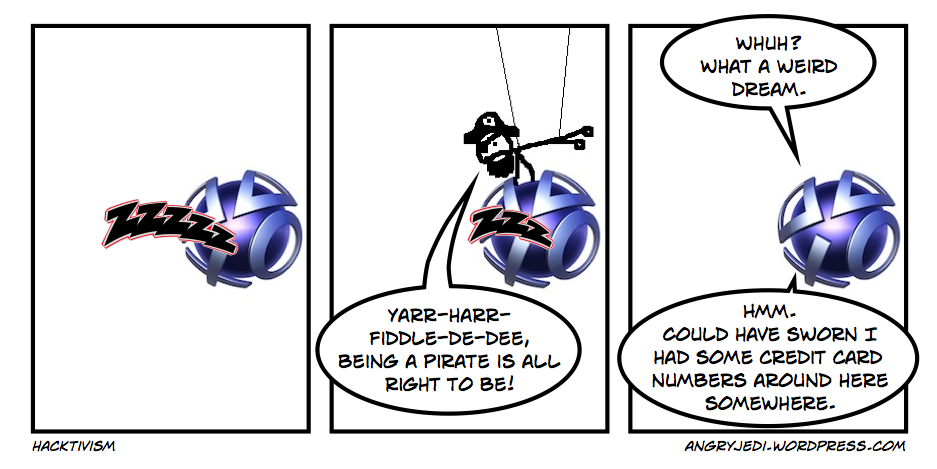
So, Sony fucked up. Pretty bigstyle. And yet I find myself less angry at them and their incompetent handling of the situation and more angry at the fact this situation even arose in the first place.

I'm talking, of course, about hackers. Hacking, despite people not really knowing what it is outside of representations that they've seen in movies, is one of the things people are most paranoid about in the online age — and with Sony's PR disaster in full swing at the minute, it's easy to see why, as people frantically cancel their credit cards and change all their passwords on the offchance that some bearded, smelly loser (not me) may pick their personal details to commit fraud with.

In practice, it seems that a lot of hacks are committed to make a point rather than cause damage as such, whatever Introversion Software's excellent Uplink might have you believe. But for a service as inoffensive as PSN, it just seems spiteful to attack it. Anonymous had its high-profile throwing-toys-out-of-a-pram moment a week or two ago but they claim they're not responsible for this latest incident as they're supposedly "on the side of the consumer". That and everyone was yelling at them for fucking up PSN when people just wanted to get online, play stuff and buy stuff.

I guess it's just like any other crime — crime shouldn't happen, but it does, whether it's in the real or virtual world. However nice it'd be to imagine a Star Trek-esque future where crime and war between humans is a thing of the past, it's not going to happen — or at least, not for a long time. As long as there are people out there who feel a misplaced sense of "entitlement" — whether it's to get their hands on software they haven't paid for, to steal people's personal information or just to fuck everyone else's enjoyment up — then we can never feel completely "safe" and confident.

Which is a shame, really, isn't it? So much of new technology is genuinely awesome when used properly. Were the threat of hacking and other technology crime not present, the capabilities of devices could be even more awesome. But as it is, so much time and money has to be spent on installing cutting-edge security into every single device we own that things are probably held back from where they could be if security wasn't such an issue.

Oh, I know. It's nice to want things, and some sort of Utopia would supposedly get boring quite quickly, but I'd certainly like to enjoy it, if only for a while. But it's never going to happen — the world is full of just enough arseholes to make life less enjoyable for the majority, non-arsehole population out there.

So, arseholes, a big fuck you, and I hope your cock falls off. Into a fire. Which someone then douses with acid, mistaking it for water. And then feeds you the remains. And then jams a really sharp spike right up your bum-hole.

Yeah.

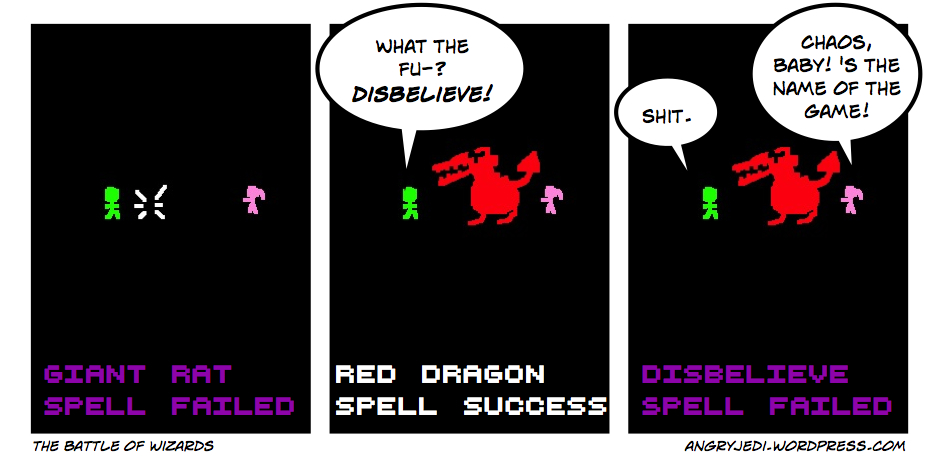
#oneaday, Day 111: Chaos, The Battle of Wizards

It's a sad but true fact that returning to the games of your youth usually ends in disappointment as you realise that gaming has moved on a lot, and those games never got a re-release on Xbox Live Arcade or the like for a very good reason — they're not very good.
But there's a few exceptions. Specifically, anything made by Julian Gollop is still just as fresh as it was back then.

How do I know this? Thanks to the Elite ZX Spectrum Collection app for iPhone. This app features a decent Spectrum emulator and a selection of games, most of which can be bought via in-app purchase in packs of six. One such pack is a Julian Gollop pack, which contains five fantastic strategy games and one utterly awful bouncy-ball atrocity, the less said about which the better. At least — hopefully — after that, Gollop figured out what he was good at and what he wasn't.

The games included in the pack are Chaos, Lords of Chaos, Rebelstar and its sequel and Laser Squad. I can't remember what the bouncy one is called but it involved catching balloons and wasn't fun at all.

The strategy games, on the other hand, are another matter. Chaos is the simplest of the bunch, with Teletext-quality graphics and feeble beep-and-fart type sound effects, but it's an immensely competitive game that supports up to eight players. It works well as a "pass the phone" game, too. And casting a Gooey Blob that gets out of hand never gets old.

The remaining games are all fundamentally very similar, featuring the same basic gameplay mechanics and gradually-improving graphics. In fact, if you've played the X-COM games, you've played these games too. That's no bad thing, though, because X-COM is awesome. Featuring turn-based multiplayer action, they're, in many ways, virtual boardgames that don't demand any throwing of dice or getting out a billion pieces or avoiding bumping the table or spilling curry on them or anything like that. And the Spectrum controls, while a little clunky, manage to work pretty effectively on the iPhone app. It helps that the keys are labelled, rather than my first experience with Chaos on a PC based emulator, where my friend Sam and I spent a good half an hour or so attempting to work out by trial and error what keys did what.

So if you're jonesing for more X-COM and don't object to playing on a touchscreen, then grab the Elite ZX Spectrum Collection and the Julian Gollop pack. I can guarantee that you won't be disappointed, and you'll be surprised that retro gaming can still be fun, deep and rewarding rather than vaguely upsetting.

Day 459

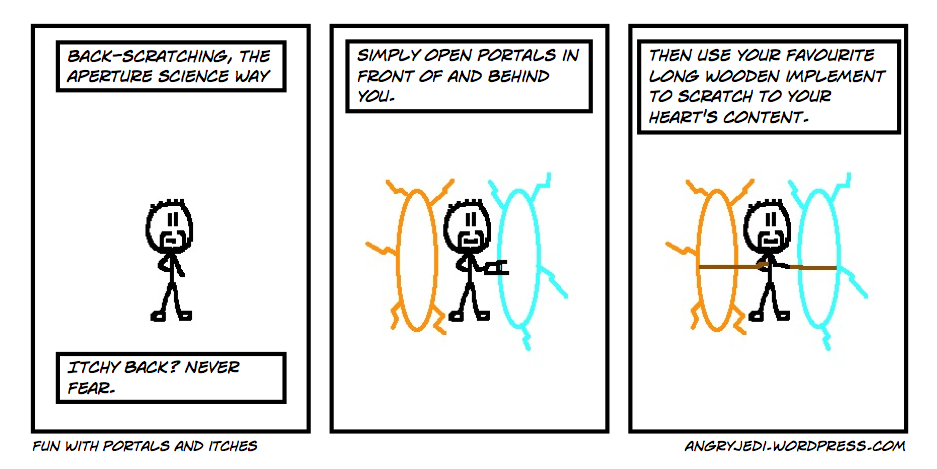
#oneaday Day 108: Fun with Portals

So everyone's going mental about Portal 2's imminent release. And with good reason—Portal was awesome, after all, and evidence that a good quality game that tells an interesting story doesn't have to be long and drawn out. Many called it a "gaming short story" and no-one seemed to mind the fact that it was maybe just 3 or 4 hours long.

The fact that it used the first-person perspective to make something that didn't involve killing things was perhaps the best thing. It was a genuine bona fide puzzle game that used some creative game mechanics to get you thinking about things in ways that you probably hadn't done since the days of Spectrum games where you fell off the bottom of the screen and reappeared at the top.

I thought I wasn't that interested in the sequel, but everything Valve's been doing with their ARG and the Potato Sack Pack nonsense has got me pretty fired up about the whole thing. So I guess their marketing works. Kudos to them for both being clever, and double kudos to them for highlighting the great work of today's indie developers as part of the marketing effort. The fact that I apparently accidentally set my phone alarm to be Still Alive from Portal probably hasn't helped matters. Have I been viral-marketing myself? Apparently so.

Trouble is, of course, that Portal 2 is a new game and, as you know, I have an enormous backlog to get through that wasn't helped by the fact that Dragon Age II proved to be just a little bit too much to resist. But then Portal 2 is short. And it has co-op, so it's sociable. Also, it is Portal, which despite being from one of the most successful developers in the universe has the feeling of an indie title about it and therefore feels like it should be supported whenever possible.

Dilemmas.

Also, my birthday is coming up. It's on the 29th. I will be turning 30. If anyone is looking for inspiration for exciting presents to buy me to celebrate the survival of three decades, I certainly wouldn't object to a copy of Portal 2 on PS3. Just tell me if you're doing that, though, so I don't feel the inexorable draw towards my nearest game retail establishment to procure my own copy in the next few days.

In the meantime, I will be sitting here listening to Jonathan Coulton music and singing along. And possibly replaying Portal. Several times. And each time wishing that I was actually playing Portal 2.

I'm really not helping myself here. GLaDOS is in my brain. Singing.

Day 456

#oneaday Day 106: A Wealth of Useless Knowledge

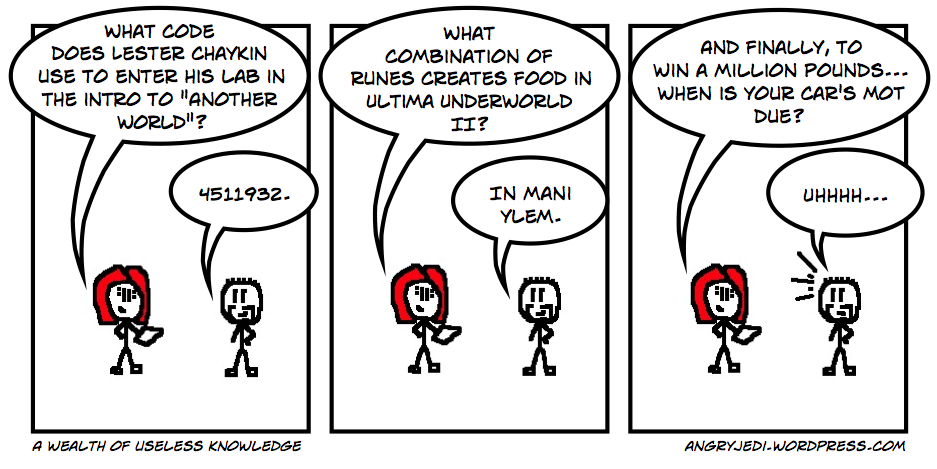
The above comic isn't actually that far from the truth. (I remembered the code from Another World but had to look up the Ultima Underworld II spell. I at least remembered that "ylem" was one of the runes, however.) All this leads me to the conclusion that our brains are clearly wired up all wrong, and we need some sort of GMail Labs-style multiple inbox feature in order to appropriately prioritise the things that enter our brain and the things that we can safely delete when there's something very important to remember, such as girlfriends' birthdays. (November 19. I sacrificed the cheat code for Sonic 2 to make way for this information.)

I'm not sure if everyone else's brain works in this way or if it's just a side-effect of being a massive nerd. But most people have something that they're extremely interested in, and will remember all sorts of useless facts about to bore their friends with down the pub. If you're lucky, you'll be friends with people who also know useless facts. If you're unlucky, you'll have all this knowledge squirrelled away with no-one to share it with—which is why the Internet exists, of course. And if you're particularly unlucky, you'll be friends with someone who's an even bigger nerd than you and is fond of correcting you every time you slightly misquote Ghostbusters. (Seriously. Fuck that guy.)

But I don't think it's necessarily a bad thing. Imagine how dull life would be if the only things wedged into your long term memory were your unique taxpayer reference number, your national insurance number, every password you've ever used and the sites they work for, and those arbitrary user IDs online banks insist on you using rather than allowing you to pick your own ID that you might be able to remember. And, of course, your car's MOT expiration date. (Sometime in August. I think.)

No. I'd much rather have cool stuff lodged in my brain that I can surprise and delight people with. (I have nerdy friends who find the fact I can remember Lester Chaykin's keycode from Another World immensely amusing… possibly at my expense, but I don't care at this point. Embrace who you are, I say.) Cool stuff in your brain allows you to become An Authority on a subject. And being An Authority is fun, because it means people come and ask you stuff about things you're interested in. It's like having people respect you and your opinions.

And sure, not everyone necessarily understands why you're so obsessive about Buffy the Vampire Slayer/Final Fantasy/Dungeons and Dragons/the collected interactive works of Jane Jensen/Minecraft/Twilight/Formula 1/porn stars of the 1980s/the board game Agricola. But it's important to you, and it gives you something to explore when you haven't got anything better to do—and something with which to bond with like-minded people via the Internet (or even real life if you're very, very lucky.)

It must be kind of sad to not have anything to obsess over. Do those people have any fun?