#oneaday Day 638: Idiots of the App Store

Everyone knows that you shouldn't read Internet comments where the public has been allowed to voice its opinions without any filtering. It's why sensible people avoid looking at 4chan, YouTube comments and App Store reviews. But, like a car crash, sometimes you just can't look away from these comments sections, no matter how infuriating they might end up being.

I made the mistake of browsing the App Store tonight and perusing a few obviously stupid apps which, inevitably, had rather low ratings. Let's see what the reviewers had to make of them, shall we?

First up is Mario and Friends. This decidedly copyright-infringing app makes it very clear in its description that it is a soundboard featuring music and sound effects from classic titles such as Mario, Zelda and Sonic. Let's take a small sample of the reviews:

"This is not a game. Where is my money?" — Cheat11111111

"Please do not buy this app does not work my young grand daughter was so disappointed !!" — ena Sproule

"Thought this was the game what a load of rubbish I mean why wud we want the listen to the music without playing the actual game?? Waist of 69p!!!" — lisa green

"None of the buttons work so it's impossible to play waste of money" — Al24467

What you'll see from most App Store reviews of this type are a few consistent features: overuse of exclamation marks, an inability to know when one sentence ends and another begins, and an inability to use the correct homophone.

Let's take a look at another excellent example: Unlock It! which promises new lock themes for your iPhone and, again, in the description makes it clear that it's a spoof app, not an actual means of overriding a fundamental way the iPhone works. Here are some choice reviews:

"I was so happy that I would be able to Chang e the lock screen but then it turned out to be a scam! I doesn't let you change the lock screen! Do not get it! SO UNHAPPY!!" — Kezmatron

"Should've read the reviews – this is tripe!!" — Jonzo15a

"Don't get it.. I was so happy with idea.. Then so upset with the lies that lied deep inside!! C***S!!" — Bleepsound

"This app is a complete con. Do not buy it. It does not have any of the functionality it claims to offer it simply takes a photo which you can save as your background to imitate a security function. Very poor." — Black and White Army

"A new this app sounded 2 gd to be true" — Dj disco dave

What have we learned from all this? That the sort of person who leaves App Store reviews probably hasn't read the app description before downloading. This type of person can be regularly seen elsewhere on the Internet indulging in very similar behaviour in other places — commenting on N4G having only read the headline, not the whole article; commenting on a YouTube video without watching the video; commenting on a news story without reading the story; commenting on a Facebook page without looking to see what kind of page it is; and numerous others.

It's very simple, people. Slow down. Read things. If you're looking at something, look at it properly. You've taken the time to click a link to something or other — why not check it out properly rather than immediately flying off the handle and crying "scam!"/"fake!"/"bias!"/"fanboy!"/"bullshit!" etc.

Ahhh. It's nice to want things, isn't it?

#oneaday Day 637: Card-Carrying Lunatic

I like card games. I'm not sure why. It's one of those things where something indefinably pleasant goes through my head when I think of holding cards, seeing (hopefully) gorgeous artwork and enjoying a game that (in most cases) combines elements of luck with skill and strategy. It may be something to do with the fact that, statistically, I appear to be better at card games than I am at some full-on board games — particularly Agricola and Power Grid, it has to be said — but I'm not sure that's quite the right reason.

I've started playing a couple of good games on iOS recently. One, Ascension: Chronicle of the Godslayer is, I believe, an adaptation of an actual proper physical card game. It's one of those games that initially sounded horrendously complex, with all manner of stats and numbers floating around to make lesser men and women tremble in their +5 Boots of Courage. But, in fact, it's a rather simple game with very straightforward mechanics and, like the best games, it's all about what you do with those mechanics that makes it interesting to play.

Essentially, the game revolves around building a deck of cards and making use of their various abilities to score as many points as possible. Points are scored by purchasing cards using the Runes stat, and by defeating monsters using the Power stat. Both Runes and Power are acquired by playing thematically-appropriate cards and adding up their totals to provide a pool of points to "spend" each turn — for example, Apprentices add Runes and allow you to purchase additional cards, while Militia adds Power and allows you to kick the bottom of monsters.

Points are acquired as you go along but also tallied up at the end of the game, so there's an element of uncertainty as you go along — additional points are added according to the value of purchased cards at the end, while defeated monsters and cards with point-scoring special abilities grant their rewards immediately.

That's about it — you buy cards, you kill monsters, repeat until the available pool of points is depleted. Then, if you're anything like me, repeat until bored, which is, in my experience so far, a very long time away.

My experience with the iOS version has certainly made me curious to check out the physical version, though I hear its components aren't up to much. Based on this and Dominion, which I do own a physical copy of and which seriously needs an iOS adaptation, however, I think I can say with some confidence that I enjoy deck-building games.

The second game I've given a shot is a slightly different deal. Shadow Era is more along the lines of a CCG like Magic: The Gathering rather than using the preset cards of Ascension. As such, there's (arguably) a lot more variety, and the game involves a lot more in the way of direct conflict between players than Ascension does — the latter involves a number of cards which indirectly screw over other players rather than attacking them directly, while Shadow Era is an outright fight between the two participants.

I've only had one game of Shadow Era so far but it seems like a solid game, and props to it for offering virtual cards for either real money or, for the more patient, from in-game soft currency, or hard acquired through levelling up. I'll report back further on it when I've given it a bit more time, along with Kard Combat, codesigned by Richard "Magic: The Gathering" Garfield.

#oneaday Day 636: A Vote for Fitocracy is a Vote for... Wait, No

Andie and I joined the local gym yesterday, and had our induction sessions today. All is good and we're feeling suitably motivated to proceed. This will likely mean leaving EA Sports Active 2 by the wayside — boo, no PSN trophies for me, but seriously, who gives a toss? — in favour of using actual proper exercise machines. And also not having to strap on those motion sensors which occasionally disconnect for no apparent reason.

Don't get me wrong, EA Sports Active 2 is great, and it offered enough to get me motivated to start gymming it again, but there's no substitute for the "real thing".

The thing with being a member of the gym is, of course, maintaining your motivation factor. There are lots of ways you can do this — going along with a friend, keeping a log of your progress or, increasingly, using some form of website or app to both track your progress and brag about how awesome you are and how swell your guns are looking.

There are plenty of these available — Runkeeper Pro is my app of choice on my iPhone — but a lot of them are relatively simple affairs that just track what you've done without any particular form of motivation bar what you make up for yourself. Runkeeper does email you every time you break a personal record, but that's about it.

Enter Fitocracy, an up-and-coming website that's still in beta. Fitocracy takes the concept of fitness tracking and jams it firmly up the arse of social gaming. This means that every time you track some fitness, you get points. Points mean levels. Levels, as we've seen from fifteen billion social games that really don't need a levelling system, are a powerful motivational tool — and, as each level gets progressively harder to achieve, they inspire you to push yourself a little bit further, whether that's demonstrating your patience with clicking on a Facebook game, or feeling the burn a little bit more with your workouts.

There's also a Quests function, which is an awesome idea. Take on a Quest and you'll challenge yourself to do a specific exercise or combination, with points on offer as a reward upon completion. Obviously a large amount of this is down to your own honesty — but then so is fitness tracking itself, and the only person you're cheating if you lie is yourself. Levels don't get you anything per se, they simply provide a degree of motivation to the whole experience.

I will be trying out Fitocracy with some interest over the next few weeks — and possibly longer if it turns out to be awesome. It's invite-only at the minute, but if you'd like to try it out for yourself, get in touch and I can hook you up with one of my remaining ones so you can check it out.

In the meantime, I have some grinding to do.

#oneaday Day 633: Your Mine!

Been playing some more Minecraft, and I noticed something interesting. It's possible to play it in all sorts of different ways, depending on your own personal take on what it's all about.

You can play it as a survival sim — foraging for food, fending off the unpleasant beasties who would like nothing more than to fill you with holes, poison, fire or gunpowder.

You can play it as a creative canvas on which you create blocky 3D models of whatever you desire.

In multiplayer, you can play it as a crazy sort of real-time variant on Catan, staking your claim to areas of the map that are rich in a particular type of resource and collaborating with your friends to ensure everyone has access to what they need.

You can play it as a city-building sim, only instead of raising money from taxes to pay for new structures, you have to locate or create the resources you need to put together facilities yourself.

Or you can play it as a role-playing game — and by that I don't mean "battle through a storyline until facing a final boss, levelling up in the process", though a (currently useless and occasionally game-breaking) level-up system was added in the last major patch. Rather, I mean play it with a "character" in mind — or at least a concept for what you want to build. Do you want to play a hermit who lives in the woods in a tiny little cabin with an extensive and terrifying network of tunnels beneath his abode? Do you want to play the ostentatious Duke who lords it over the rest of the kingdom from his mountaintop palace? Do you want to play the adventurer, charting the world as he goes, staking his claim to various locales with some well-placed signs? Do you want to play the terrorist, building vast quantities of TNT and then setting them off in a chain reaction that lays waste to the nearby landscape?

The more I play Minecraft, despite being aware of the fact that it's still fairly pointless as there's no way to "win", the more I like it. When you're not being accosted by monsters, it's a relaxing game to play — harvesting enough stone to put together your next big structure, for example, is a repetitive task that somehow manages to be fun, as you find yourself naturally carving out shapes in the rock, creating corridors and chambers underground until you realise you've actually built a rather extensive dungeon into which you could easily lure some unsuspecting adventurers.

Mojang has hit on to a winning formula. By combining the joy of exploring uncharted, randomly-generated worlds (there's a lot of "Ooh! That looks cool, I'll run towards it" in Minecraft) with the joy of constructing things and seeing the world change according to your actions — for better or worse — they've put together something really rather special. And for those who want to take matters further, there's the frightening-sounding Nether and The End realms to explore, too — and eventually there'll be a dragon to contend with, too.

Notch and his team claim they're going to stop adding new stuff to the game on October 18, then make sure everything works properly prior to the "official" release in November. Beyond that, the game will likely continue to change and evolve — and I'm certainly very interested and excited to see what the future holds. Notch is a developer who loves his work, loves playing with interactivity and cool new "toys", then sharing them with his community — and not being too proud to take things that don't work away again. A lot of big-name professional developers and publishers could learn a lot from the way Mojang is doing things — but, despite the ludicrous amount of money Minecraft has drawn in so far, I doubt they will.

#oneaday Day 632: Safety and Peace, My Friend

So I beat Assassin's Creed. Yay! I'm glad I finally did this, as it was rather enjoyable. The game's flaws are very much apparent, but the narrative was enough to keep me wanting to play through to the end.

The game is a completionist's nightmare. It's full of progress bars and things to fill in that are completely unnecessary. Most people who have played it will, by now, know that there is absolutely no purpose whatsoever to collecting all the flags in each city, or killing all the Templars, or even doing every "Investigation" side mission when preparing for each chapter's assassinations. Fortunately, I knew this already going into the game — it didn't stop me from completely clearing the first few chapters, but then my copy of Assassin's Creed II, the game from the series that I was really interested in playing, showed up. So, naturally, I just wanted to finish it.

The ending of the game was… a little odd. (Spoilers ahead.) While the majority of the game was pretty realistic in tone and obviously based on historical events (with, I imagine, a bit of artistic license taken) the final battle was rather odd. I wasn't expecting a "fight every boss again at the same time" sort of situation, nor was I expecting a final boss with quasi-magical powers able to split himself into multiple forms.

Following the credits, the stuff you can read about on the Abstergo computers does, however, make it clear that we're dealing with sci-fi here. The material about orbital satellites for mind control, the fact Africa was wiped out by a plague and. obviously, the technology on display — it makes it clear that all is not exactly what it seems.

I dug the story though. I enjoy a good conspiracy theory tale and even if it's somewhat unsurprising to see the Templars involved in this sort of behaviour yet again, the way the story unfolded was interesting and kept me guessing up until the end, were it not for the fact that I inadvertently spoiled who the final boss was before I got to it. Oh well.

The thing I like most about it, though, is the fact that there's a ton of possibilities for the series. Desmond is a likeable enough character, and the "exploring memories" angle leaves things nicely open for travelling through lots of different time periods. In some ways, it's a bit of a shame that we've only seen Altair and Ezio so far — I'm hoping I'll see the apparent appeal of the latter once I make a start on II tomorrow. Something must have inspired Ubi to keep on with him for three games. (Money, probably — but most layers of the series I've spoken to seem to be a fan of the character.)

Ubisoft has said that Desmond's story will have to be wrapped up by the end of next year, however, but that doesn't (and likely won't) mean the series will be over. Desmond is, of course, "Subject Seventeen" — there are, then, sixteen subjects prior to him to explore, including at least one of whom that went completely mental and splattered conspiracy theories all over the walls in blood. That could be an interesting story to follow up on — or perhaps the end of Desmond's cycle will leave things open for another subject.

I can't really comment any more because I know literally nothing about what happens in II, Brotherhood and Revelations. Having beaten the first game now, however, I am very much looking forward to finding out.

Safety and peace, my friend.

#oneaday Day 629: The Hypocrisy of Isaac

I've posed this question on a couple of social networks today, but I thought I'd discuss it here, too. I'm not sure what the "right" answer is, if any, but I'd be interested to hear anyone else's thoughts on the subject.

This year, two games have come out that feature gross, puerile humour and content obviously deliberately intended to offend, shock or make people guiltily laugh. Those two games are the high-profile, legendarily-delayed Duke Nukem Forever, and independent developer Edmund McMillen's latest opus The Binding of Isaac, which I discussed a little here. Despite both featuring extreme gross-out humour, one of them was lambasted as being a smear against all that is good and pure, while the other has been praised and hailed as being daring, forthright and all manner of other superlatives expressing positivity towards its utterly shameless nature.

Those who are gamers will already know that Duke Nukem, the high-profile, well-known title, was the one which got seven shades of shit beaten out of it by the press, while McMillen's more recent The Binding of Isaac has been hailed — by the same critics who ripped Duke a new one in some cases — as something excellent.

Those readers who are not gamers may not already be familiar with the content of both of these games, so permit me a moment to summarise both titles in an attempt to compare and contrast the type of material on display therein.

Duke Nukem Forever is the fourth in a very long-running series of games which stars the titular Duke — a parody of 80s action heroes with a flat top, an arsenal of bizarre weaponry and a fine line in one-liners. The first two Duke Nukem games were very simple and featured no offensive content whatsoever. From Duke Nukem 3D, the third in the series, the developers let loose and had Duke raising hell in all manner of locations that had not previously been seen in many games — strip clubs, porn theatres, dodgy "rent by the hour" hotels and, eventually, space stations, moon bases and strangely organic alien vessels. Dotted through the bloody carnage — which was all against alien villains — were women. These ranged from strippers in the strip club, who'd flash their pasties at you if you walked up to them and pressed the "Use" key, to women imprisoned by the aliens, who were all nude and typically tied down to something with plant-like tendrils snaking around them, conveniently covering their lady-parts.

The sequel, some 13-plus years in development, featured a lot of similar content, only with the vastly improved graphics that 13-plus years of development will give you. (Some would argue that the game's visuals don't represent 13-plus years of progress, but that's not the matter we're discussing here.) The game, once again, features the grittier, seedier side of human existence, with one non-violent dream sequence taking place in a strip club. At various other intervals, numerous things happen: it's implied that Duke is getting fellated by a pair of twins dressed as schoolgirls who may or may not be incestuous lesbians; Duke has the opportunity to pick up a piece of poo and fling it around; Duke can draw whatever he likes on a whiteboard and in the book of a fan who asks him to autograph it; there's numerous groanworthy puns throughout; there's a lot of swearing; and one level, dubbed "The Hive" and representing by far the most infamous piece of offensive content in the game, features women very much like those in Duke Nukem 3D tied to things with alien tentacly things wrapped around them, evidently being raped and impregnated with alien offspring. At one point during this level, Duke comes across the twins from earlier in the game, who are caught in this inescapable situation. There's a wince-worthy joke about them losing pregnancy weight, then they explode as their alien offspring burst forth and attack Duke. (Later in the same level there's also, inexplicably, a set of tits on the wall, which Duke can wander up to and slap to watch them wobble, giggling as he does so.)

Pretty offensive — or at least of questionable taste — I'm sure you'll agree. Now, what about The Binding of Isaac?

McMillen's game is a parody of the '80s Nintendo Entertainment System game The Legend of Zelda. It features a top-down view of a randomly-generated dungeon which players have to explore, kill monsters, retrieve special items and make their way to the level's boss and, subsequently, exit.

So far so good. Nothing to worry about here, right?

Wrong.

The Binding of Isaac's protagonist is the titular Isaac who, as in the Biblical story, was about to be offered up to God as a sacrifice from his apparently insane and abusive mother. Isaac decided not to stick around to find out if God would stay his mother's hand so instead escapes, naked and crying, into the basement of the house. Said basement is inexplicably filled with monsters, most of which resemble Isaac to one degree or another, all of which bleed copiously when attacked. Most of these monsters have a degree of "body horror" about them, with swollen heads, growths, body parts such as eyes missing, blood dribbling from places that it shouldn't dribble from, and all manner of other things. One boss monster attacks you by pissing on you, while others bleed, vomit, bite and shit on you. Isaac attacks his enemies by firing his tears at them.

Isaac can upgrade his abilities by picking up special items which randomly appear on each level. Each one of these has an effect on Isaac's appearance as well as his abilities. For example, taking growth hormones causes his head to swell up with tumorous growths, while finding a wire coat hanger (a possible reference to abortion) sees Isaac jam it through his head to make him cry more. He gains health by eating dog food, as he is obviously used to it from his abusive mother, and special weaponry on offer include a suicide bomber vest, a sanitary towel, the Anarchist's Cookbook, a glass of lemonade which immediately causes him to piss himself and numerous other items.

The eventual aim of The Binding of Isaac is to kill Isaac's mother. By the end of the game, the crying infant of the outset is usually unrecognisable, clad in the random combination of special items he has picked up on his quest — on one occasion he might be wearing his mother's pants, have horns growing out of his head, be crying blood from his bleeding eye sockets and have a beating heart strapped to his chest. On another, he might have made a pact with the Devil and turned completely black. On yet another, he might have cybernetic implants and vampiric teeth.

The main point is, though, The Binding of Isaac is pretty consistently horrifying and amusing at the same time. Like Duke Nukem Forever, the offensive, horrifying content is in there quite deliberately to provoke a reaction — to attempt to provoke a guilty laugh, or if not, to offend and repulse. If anything, I'd argue that Isaac's content is more repulsive than that of Duke Nukem Forever, but this fact seems to have been totally skimmed over in many critics' appraisals of the game.

Note that I'm not arguing in favour of censorship of either game here. I have played and enjoyed both, and found both amusing in a very dark sort of way. Duke's humour was mostly lowbrow and silly, with the exception of the Hive level, while The Binding of Isaac consistently mixes the lowbrow poo and fart jokes with sadistic body horror elements.

So, then, given that these two games are arguably on a par with each other in terms of "offensive" content, why did Duke get his ass handed to him by critics? It can't surely be because of the quality of the game, can it?

Well, perhaps it can. Duke's gameplay was regarded as too little, too late by many critics, and roundly panned as a result. (I liked it precisely because it was like old shooters, but you know me, ever contrary.) Smelling blood, said critics decided to denounce it as The Worst Thing Ever, drawing particular attention to the Hive level and declaring it morally bankrupt, seemingly losing their black senses of humour in the process.

Along comes The Binding of Isaac, meanwhile, and it can do no wrong. It's a potent allegory, say the critics. It's refreshingly brave. It's up-front and honest. That's as maybe, but those things you're laughing at — poo, wee, farts and some gross bloody violence — are pretty similar to those you denounced Duke Nukem for. But The Binding of Isaac is a good game, they argue, meaning that the questionable content can be taken in your stride.

To that, I say simply this: one of the most common reasons Duke Nukem was panned was because it felt dated. However, as I said earlier, The Binding of Isaac takes inspiration from The Legend of Zelda, a game from 1986. It couples this inspiration with material from roguelikes (Rogue itself also appearing in the mid-80s) and Gauntlet (1985). Hmmmm.

As I said at the start, I'm not sure there's a right answer to this, as your take on both games' content will be largely subjective — and, like it or not, will seemingly depend on how much you like the game as well — but to me, it certainly smells like there's more than a whiff of hypocrisy about the whole thing. Do indie developers get a free pass to be more gross and offensive/"daring" simply for being indie developers who aren't tied to a big publisher?

Oh well. I shan't worry too much. I have played and enjoyed both games and, for me, that's the important thing. 
#oneaday Day 628: Roleing Wit Da Players

Reading a little about Corvus Elrod and Zakelro's innovative storytelling game Bhaloidam over on Kickstarter brought to mind my past experiences with tabletop roleplaying. I haven't done as much of it as I'd have liked to over the years, but the few experiences I have had were excellent ones.

I was a member of a Dungeons and Dragons campaign at university for a while. My character, a thief named Singol Nithryan, was something of a cheeky chappy and there was some excellent banter and rivalry between him and my friend Tim's character, who was a pompous prig who thought himself better than everyone else. The characterisation of the rivalry between these two characters was completely unscripted, but with each session the plans to outfox each other (well, mostly for Singol to outfox the other chap, whose name I have sadly forgotten) became more and more elaborate. Most times the party settled down to camp tended to end up with Singol cutting his compatriot's purse and "borrowing" some money — the absence of which his companion often didn't notice for some time. They weren't enemies, though — it was good-natured friendly rivalry for the most part, and it made for a fun inter-party dynamic.

To be honest, I can't remember a lot about the campaign itself and I'm not sure we ever finished it — but we certainly had a blast along the way, and that's sort of the point. While computer RPGs are all about powerlevelling and reaching the cap as soon as possible, a tabletop experience is all about the storytelling, the interacting and the emergent gameplay that results from cutting loose and improvising a little bit.

The best example of this came with what our mutual friend Will called his "freeform" roleplaying system. It was a system he'd come up with by himself, and it was very simple, requiring, as I recall, only three stats: attack, defense and power. According to the situation, points from each of these stats were spent on various actions, with more points (usually from the power pool) meaning a greater chance of success.

Again, though, it wasn't about the mechanics, which were almost irrelevant. In fact, the simplicity of the mechanics meant that it was possible — and indeed encouraged — to play bizarre, leftfield characters that simply would have no place in a traditional, say, D&D campaign. As such, our adventuring party — whose backstories we each provided to Will beforehand for him to weave an improvised campaign around — was not your typical RPG lineup to say the least. No, it was a wildly disparate group of… things, that I'd hesitate to call "adventurers" even.

Probably the most normal of the bunch was my character, Rush Hurin, who was born from my wondering what might happen if you combined traditional fantasy tropes with sci-fi. Rush was the last of the elves, and he came from a futuristic Deus Ex-style setting. As the last of his kind, he was a highly sought after commodity. People wanted to do research on him, in other words, but he had absolutely no desire to submit to the demands, prods, pokes and scalpels of some scientists. Consequently, he spent a lot of his life on the run, but, being an elf, had immense agility and was a badass with a sword.

Alongside Rush came Tyrael, played by my friend Tim who was (is) somewhat obsessed with Diablo at the time. Tyrael was a fallen angel in human form who had the ability to, I quote, "go all big and flamey" and also suffered from something of a lack of self control. In one memorable sequence, Rush was fleeing from a skyscraper while Tyrael was turning into his full, multi-storey "big and flamey" form in order to cause some chaos and allow me to escape. That was interesting.

Next up was Arryth (I don't know how you spelled it), who was an animated suit of armour. Was he a ghost possessing the armour? Was he a sentient suit of armour? We never quite found out, but he proved to be a valuable ally on more than one occasion.

Not as valuable as the Luggage from Discworld, however, who had a predilection for devouring our enemies and, occasionally, spitting them back out again, somewhat confused, into the midst of a tricky situation. He also proved useful for carrying our gear.

Finally came a character I can't remember the name of, and who was simply an amorphous cloud of pink gas. It didn't talk much, but it made a good spy and also had the useful ability for flying down opponents' windpipes and choking them from the inside.

Together, we endured some bizarre adventures which Will was clearly making up as he went along, placing signs in rooms he wasn't ready for us to visit yet which said "come back later!" and getting his mental challenges from one of those massive puzzle books your parents would buy you on holiday to keep you quiet — before handhelds and smartphones came along, of course. To call our adventures chaotic would be an understatement, to say the least.

But you know what? Those are some of the fondest memories I have of my few sessions roleplaying. It wasn't about grinding for experience points, making use of my abilities or powergaming — it was about improvisatory, collaborative storytelling, and it was one hell of a lot of fun.

The reason that Bhaloidam has given me such cause for curiosity is that it sounds like something strangely along the same lines to Will's system. It's a little more complex, sure, featuring a system to determine how much players influence the game world (and each other) prior to "performing" their actions, but at heart it's, like our experiences, designed for freedom. It has the scope for telling interesting stories that move far beyond traditional fantasy and RPG tropes and into something that's not quite roleplaying and not quite improvisatory theatre. It's a highly interesting concept, is what it is, and I'll be very curious to see how it turns out in the final project.

If you're interested, too, check out the Kickstarter page for the project here — you can even help fund its first production run. If you're a Google+ user, I also strongly recommend popping designer Corvus Elrod and his amazing moustache in your circles.

#oneaday Day 627: Hashashin

Finally started playing Assassin's Creed again tonight — yes, the first one, and yes, I know the later ones are much better, but I want to know the story from the beginning.

Assassin's Creed is a story whose premise intrigued me immensely as soon as the details of its now well known "meta plot" leaked out. I mean, sure, simply leaping around various cities and stabbing people in the neck is fun, but having a context for your actions that went beyond just Altaïr's story was a cool idea — and I'm looking forward to seeing what they do with the upcoming Revelations.

Assassin's Creed the first has its problems, sure, mostly relating to the "investigation" segment of the game, which tends to get a bit repetitive. (Also, the sheer pointlessness of the flag-collecting, which needless to say I shan't be bothering with.) But it does so many things right. It has a wonderful sense of scale and height. Freerunning across rooftops and nimbly hopping from beam to beam never gets old. And the combat system, though relatively simple, is cinematic and satisfying.

I'm not sure why I didn't finish it first time around — I think something "higher priority" came around and I never got around to returning to it — but I'm looking forward to seeing how the series pans out. I know Assassin's Creed II and Brotherhood are better, for example, but I don't know how. Since I've managed to find super-cheap copies, I will shortly be finding out.

The thing that's struck me the most from playing this first game though is how much you can forget that top-tier games can feel truly "alive". When you spend all day reading the marketingspeak that publishers of said top-tier games spout in press releases (coupled with utterly meaningless quotes from their VP of Talking Nonsense In As Many Words As Possible) it's easy to forget that these games are exciting creative works, and the teams who work on them treat them as such.

Assassin's Creed, for example, is awash with gorgeous details in its graphics and sound. Its cities are satisfying to explore and climb all over, even if there's not really any incentive to beyond "woo, look at that view!" But if all the information you had on the game came from Ubi press releases, you wouldn't know it, because they describe it as a product to be sold, not a creative endeavour to be enjoyed. And that's kind of sad — though somewhat inevitable given the times we live in.

I shall be romping through the Assassin's Creed series alongside Xenoblade at present. Maybe I'll finish all of them before Revelations comes out. Or perhaps if I take my time a bit I can finish them all by the time Revelations gets a bit cheaper!

Oh, and if you spoil anything about any of the series, I will kill you dead.

#oneaday Day 624: Genre-Bending Hogs

These days, there's a whole lot more game genres than there once were. Whereas in the "olden days" we had shoot 'em ups (which no-one would dream of shortening to "shmup"), platform games, beat 'em ups (which no-one would dream of referring to as "fighting games", and which had not yet begat the distinction between "fighting game" and "brawler"), adventure games and, occasionally, RPGs. Nowadays, the growth in gaming amongst people who aren't white spotty nerds with malodorous armpits has meant a corresponding growth in genres which aren't quite so rooted in gaming convention.

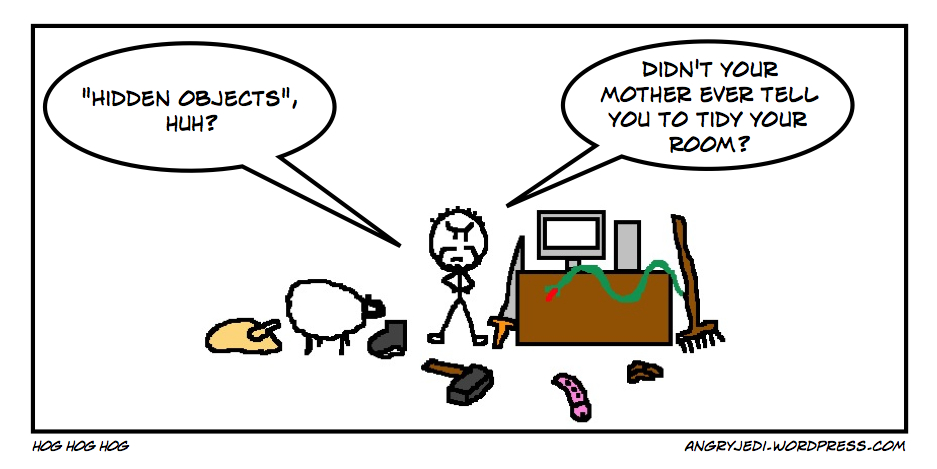
We've had the "match 3" puzzle genre — itself an evolution of earlier puzzle titles such as Klax. We've had the "time management" game — itself a super-super-super lite version of the real time strategy genre. And we have the "hidden object game", also known as the "HOG". (For some reason this annoys me. I'm not sure why. Call me irrational. [You're irrational. — The Audience.] Thanks.)

I hadn't tried a hidden object game prior to tonight, but since my BT Broadband account comes with three free months of OnLive's PlayPack I figured I'd try some of the obscure titles on offer. A game called Elizabeth somethingorother M.D. caught my attention, so I jumped in, not knowing quite what to expect thanks to OnLive's not-particularly-good job of describing what games are in its catalogue. I was hoping for something more like Trauma Center (itself an example of a new genre) but instead I was confronted with a rather bizarre experience.

If you've never tried a hidden object game, here's how they work: Plot Happens, like in a point and click adventure game (or, more accurately, like in a visual novel, since your interactions in the story are typically fairly limited.) Then, suddenly, for no discernible reason whatsoever, you are tasked with finding the aforementioned hidden objects in a scene, sometimes against a time limit, in order to advance the story.

Now, this sort of "puzzle book" gameplay would be absolutely fine if it made any sort of sense whatsoever. If I was looking for items to use in an adventure game style I would have no problem with suspending my disbelief while Doctor Elizabeth thingummybob faffed around trying to work out why she'd left her forceps on the bookcase. But instead you're tasked with finding completely incongruous objects that have no bearing on the scene whatsoever.

I'll give you an example: in the first interactive scene of Doctor Elizabeth Investigates or whatever it was called (I'd look it up, but I can't be bothered — there's your journalistic integrity for you right there) I was tasked with taking the patient's heartbeat using my stethoscope (fair enough, good start) and testing his reflexes with a hammer (similarly doctor-y). However, I was then challenged to find — in a hospital ER, I might add — three beetles, two statues, a club symbol, a gift-wrapped box, a plunger, a dinosaur and several other bizarre items which, oddly enough, vanished as soon as more Plot needed to Happen.

Now, I wouldn't call the experience "bad" as such, since hunting for the objects on the screen had a certain addictive quality to it similar to that which kept you fumbling around in puzzle books before anyone knew what handhelds or iPhones were. But it's the sheer bizarreness of interspersing a fairly serious-sounding plot with the complete flippancy of hunting down bizarre objects against a time limit — and that's not even beginning to consider the hospital's cleanliness record if it's letting that many giant beetles into its emergency room. That said, I guess the combination of elements is no more bizarre than Puzzle Quest.

I'm not sorry I tried it, but the genre's apparent popularity is somewhat bewildering. Hidden object games are seemingly only slightly less prolific than match-3 puzzle games with the casual market — which suggests that people are buying them. This means that they either don't notice the incongruity of the gameplay and the narrative — or they don't care. Which is fair enough, I guess — it all depends on what you want to get out of your gaming experience.

#oneaday Day 619: Bound by Isaac

Edmund "Super Meat Boy" McMillen and Florian "I Work With Edmund 'Super Meat Boy' McMillen Quite A Bit" Himsl have a new game out — you may have heard of it. It's called The Binding of Isaac and it costs just £3.59, or $5 to you American types. It's also a prime example of a project that would never have got greenlit by a large publisher, for many reasons.

These reasons start with the very premise of the game — you play a nude, crying child attempting to escape from his mother who has been hearing messages from God and believes that she must rid her child of corruption by, as in the Biblical story, killing him. Little Isaac isn't willing to stick around and wait and see if God stays his psychotic mother's hand, however, so he escapes into the basement, only to be confronted with numerous manifestations of his own fears and nightmares. What follows is a genuinely horrifying yet darkly amusing quest through a series of Zelda-inspired randomly generated dungeons where Isaac dispatches his enemies by crying on them and powers up through a series of items, most of which affect his appearance in some sort of particularly grotesque and inappropriate manner. Sound fun? Or just plain weird? It's both.

The exact items you'll encounter are different on each playthrough, making each run through the game's short dungeons a genuinely unpredictable experience. On one run you might come across a syringe full of steroids first of all, which beefs up Isaac and makes his head swell in an unpleasantly tumorous manner. On another run you might come across a wire coat hanger which, revoltingly, he impales through his own head and increases his capacity for crying. On yet another run you may find something else — there's about 100 different items to find and discover the uses of, and every one of them affects little Isaac's appearance in one way or another.

This being a game from McMillen, it's got a distinctive art style that is entertaining, amusing and horrifying all at once. Cute little worms slither around, only to come flying at you with fang-filled maws agape as soon as they become aware of your presence. Nightmarish clones of Isaac with no eyes in their sockets stagger around — and continue to do so even after Isaac has blown their heads off. And flies buzz around destructible lumps of shit before turning on Isaac in anger.

It's an utterly bewildering game, but strangely compelling and addictive. The fact that a single death forces you to go back to the start of a new dungeon and try again means potentially limitless replay value, and a huge number of unlockable items — including extra characters — only add to this. The game parodies the NES original Zelda dungeons perfectly, right down to the mostly mute shopkeepers with just three wares lined up before them — only in the case of Isaac's adventure, the shopkeepers are effigies of him that have been strung up by their necks and hang from the ceiling.

At $3.50, it's certainly worth giving a shot, even if you play it once and are too horrified and disgusted to play it ever again. If nothing else, it's refreshing to see fairly traditional play mechanics married to an aesthetic and setting which is utterly shameless and doesn't hold back from showing things that are either darkly hilarious or stomach-churningly revolting — I haven't quite made my mind up yet.

One thing's certain — for more reasons than one, you're never going to see this one on Xbox Live Arcade.