#oneaday Day 897: Dungeon Crawling

20120704-013250.jpg

I'm a big fan of board games, as regular readers will know. And I have fairly diverse tastes, too — I like everything from Eurogames such as Catan to theme-heavy Ameritrash like Last Night on Earth. Exactly what I want to play at any given moment is largely determined by my mood at the time, but I can pretty much always muster up enthusiasm to play a dungeon-crawling game.

I own several dungeon crawlers, but I'm planning on picking up the very interesting-looking Descent: Journeys in the Dark Second Edition when it releases, as it sounds like just the sort of game I want to play. It also sounds like it's been improved significantly over the original edition, which could take up to 4 or 5 hours to complete a single quest. The new version reportedly keeps play sessions down to much more manageable lengths while incorporating a solid "campaign" system for character advancement and a branching narrative. I'm looking forward to it a lot.

As for the ones I already own, each of them have their pros and cons, and I like them all.

Starting at one end of the spectrum we have Games Workshop's Dungeonquest, which saw a rerelease by Fantasy Flight Games recently. Dungeonquest is gloriously random and is best left on the shelf if you like to plan out what you're doing well in advance, because progression is determined largely by the luck of the draw. Consequently, it is a very difficult game to "succeed" in — even the instruction manual helpfully informs you that players have approximately a 34% chance of survival in any given playthrough.

In Dungeonquest, players take it in turns to draw dungeon tiles from a pool in order to build the dungeon as they go. If it's a corridor, they get to move again. If it's a room, things happen, determined largely by drawing cards and making skill checks. If it's a special room, super-special things (usually bad for the player) happen. Many of these things end in instant death for the player, meaning games can be over relatively quickly if you're unlucky.

The aim of Dungeonquest is to make it to the middle of the board to raid the slumbering dragon's massive treasure pile, then make it out again before the sun rises — the time limit in question being represented by an ever-advancing "track" at the side of the board. If players don't get out before sunrise, they die. If they run out of health, they die. If the fall down a bottomless pit, they die. Hilarity (and, usually, frustration) ensues. It's not a great game, but it is an entertaining one.

Moving up somewhat is MB and Games Workshop's Hero Quest. This was my introduction to fantasy role-playing when I was a kid, and it still holds a very fond place in my heart to date. It's an adversarial game where a team of up to four "hero" characters of varying classes take on the forces of darkness, controlled by a single "evil wizard" player. The evil wizard has a book of preset quests with which to challenge the heroes, and following these through in sequence provides a rather loose narrative. The game was later expanded with a number of additional packs that broadened the scope somewhat with new monsters, traps and additional rules to make things more interesting.

Hero Quest is good because it bridges the gap between traditional "family-friendly" board game conventions and the more abstract, strategic nature of role-playing games. It's accessible enough for pretty much anyone to understand, has high-quality components and a wide variety of things to do — plus is very expandable and customizable.

Advanced Heroquest not only changed the "correct" way to punctuate the phrase "Hero Quest"/"Heroquest" but also revamped the game completely to be significantly closer to a Dungeons & Dragons-style role-playing game. It also incorporated rules for limitless replayability including random dungeon generation, character advancement and a heavy emphasis on customization. While the original Hero Quest released an expansion allowing players to create their own adventures, Advanced Heroquest practically demanded that the Games Master (or "GM" — effectively the "evil wizard" player by another name) come up with some of their own creative, fresh ideas. And it was up to the GM in question how far they wanted to take it — Advanced Heroquest's rules catered for simple story-free "hack and slash" dungeons as much as elaborate, story-driven scenarios featuring light role-playing. The game even came with full rules for solo play, which was a godsend for me when I was a kid, as short on nearby friends as I was.

Then came Warhammer Quest. This is pretty hard to find now, which explains why I paid nearly £100 for a copy on eBay. Warhammer Quest takes the formula of Advanced Heroquest and shoots off in a different direction rather than necessarily making it more complex. Warhammer Quest has a lot more in the way of random elements, but also features a lot more rules to prevent the game from running away from the players. Where Advanced Heroquest often had dungeons that spiralled off into myriad dead ends, Warhammer Quest's dungeon generation rules ensure that players move quickly from encounter to encounter on a much more linear path, giving the game a much faster pace. That's not to say that either approach is "better" as such — Advanced Heroquest had the thrill of exploring the unknown, while Warhammer Quest always had something interesting through the next door — but it marked a significant difference between the two.

Warhammer Quest contains a fairly heavy degree of luck. If you were playing a campaign, after completing a dungeon you then had to roll repeatedly on a table to determine the events that happened during the journey back to town. These frequently got rather ridiculous, as demonstrated abundantly through the adventures of Kurt von Hellstrom and his friends.

Warhammer Quest has one cool thing over its two predecessors, however — it can be played without a GM/evil wizard. The base rules for the game include an artificial intelligence system for the monsters that determine how they move and attack, allowing all the players at the game table to cooperate and take on the dungeons together rather than one being forced to constantly be "the bad guy." Rules were there to allow the game to be played with a GM, too, but for those craving a purely cooperative experience, Warhammer Quest was a great one.

I don't get to play these games nearly as often as I'd like to. I'm hoping that I'll be able to get Descent out regularly once I get my hands on a copy — and I'm also pretty curious about the Dungeons & Dragons boardgames, too. Full reports on each and any of those I get the chance to play will, naturally, follow.
#oneaday Day 896: Gravity Rush

20120703-010706.jpg

I've been playing a fair ol' bit of Gravity Rush on the Vita recently. My feelings about it are somewhat mixed, but on the whole it's a very good game, and certainly one of the most impressive handheld games I've ever played.

Of all things, my least favourite thing about it is the name. "Gravity Rush" is not the name of an epic, sprawling, visually sumptuous adventure. "Gravity Rush" is, to me, the name of an iPhone game — perhaps an Angry Birds Space ripoff — or an obscure downloadable console title at best, perhaps. (Or perhaps I'm just associating it too much with Gravity Crash on PSN, which is nothing to do with Gravity Rush.)

That aside, though, there's a lot to like.

For the uninitiated, Gravity Rush is ostensibly an open world… platform game, I guess you'd call it if you had to pin it down to an established genre, but to pigeonhole it thus is to do it a gross disservice. It's a platform game. A racing game. A mindbending puzzle game. An air combat game. And plenty of other things besides. It actually has a surprising amount in common with underrated open-world gem Crackdown, of all things. Oh, and it was designed by Keiichiro Toyama, who true game geeks will know is the creator of the Silent Hill series. According to Wikipedia, Gravity Rush was the first game he ever wanted to create, but was only able to bring his vision to fruition recently.

In Gravity Rush, you play Kat, a young amnesiac girl with red eyes, blonde hair and surprisingly dark skin for an anime-style character. Kat is also clad in an outfit best described as "bizarre", and is accompanied by a black cat. Oh, and she can shift gravity at will with the assistance of said black cat, allowing her to "fall" in any direction she pleases, stick to walls, skid along the ground and do gravity-defying flying kicks.

Kat is far and away the highlight of the game. Despite her hackneyed amnesiac introduction, she quickly proves herself to be a fun character to play with. She's a bit dizzy, she's confused, she's obsessed with her own appearance and appeal to the opposite sex, and she's easily distracted. But despite these flaws, she has a noble streak — she wants to do the right thing and use her powers to help people, despite not really understanding where they came from or what they're for. As the game progresses, the residents of the city where the majority of the game is set go from fearing her strange powers to respecting and appreciating her talents.

Gameplay in Gravity Rush is mission-based, but it's up to the player when they want to trigger each subsequent mission. Between missions, it's possible to tool around any of the unlocked city areas collecting gems (which can be used to level up Kat's abilities), talking to residents to gain a greater understanding of the strange world the game is set in and taking part in "challenge missions." The latter are very difficult timed tasks of various kinds — some might see Kat having to defeat as many enemies as possible in a time limit, others see her racing through a series of checkpoints, perhaps with some limitations on her abilities in place. Each challenge has three tiers of rewards, with increasing numbers of gems available for completing these tricky tasks by more impressive margins.

This may all sound relatively unremarkable so far, but it's the excellent way that Gravity Rush makes use of the Vita's distinctive capabilities that make it interesting. The "gravity shifting" mechanic is a prime example. By tapping the R button, Kat floats up into the air; tapping it again causes her to "fall" forwards according to where the screen is pointing, regardless of which way is "up". The specific direction she falls can be controlled using the Vita's right analogue stick, but a surprising degree of precision can be attained by combining the stick controls with the tilt sensors in the Vita. If you're feeling completely un-self conscious, you can completely control the direction of the camera in these floaty bits by tilting and rotating the Vita, but that would be both impractical and undesirable for most people, so the combination of stick and tilt works very well.

Similarly, when Kat uses her "slide" move (accomplished by pressing and holding on the bottom two corners of the touchscreen), it's possible to steer her by tilting the Vita side to side and jump by "flicking" the device. You can also "drift" in a Wipeout style by releasing one corner of the touchscreen as Kat goes around a corner.

A more subtle use of the Vita's capabilities comes in the comic-style cutscenes that punctuate each mission. Tilting the device causes the perspective on the comic panels to shift slightly — unnecessary, but cool — while swiping with a finger advances to the next panel, just like in an iOS/Android comic reader app. These little touches arguably don't add much to the experience, but they certainly don't hurt it, either.

The game is a joy to navigate — gravity shifting and "falling" through the skies towards your destination is thrilling every time, and the world is an interesting, beautifully-designed environment to explore — but things do fall apart a little when it comes to combat. On the ground, Kat is limited to a not-particularly-effective kick attack as well as a useful "dodge" move achieved by swiping on the touchscreen. In the air, Kat can do a "gravity kick" manoeuvre where she "locks on" to an enemy then flies through the sky with high heel outstretched, with more damage being done if she "falls" on the enemy from a greater distance.

This is all very well and good and would be absolutely fine were it not for the fact that every enemy is only vulnerable in specific weak spots. Crash into an enemy anywhere other than their obvious glowing weak spots and you'll do no damage. Early in the game this isn't an issue, because the weak spots are in easily-accessible locations, but later enemies have multiple weak points all over their body and often thrash about, making it difficult to hit them. One boss in particular will have you flinging your Vita in frustration as it seemingly always dodges aside just as you get lined up perfectly. None of these challenges are insurmountable, but it does sometimes give the game some rather artificial-feeling difficulty spikes, which is a bit of a shame.

The game's considerable charms (mostly in the form of Kat and the interesting, mysterious story she becomes embroiled in) outshine its flaws, however — at least to me. I've been playing it quite a bit today and I've found it an engrossing, immersive experience. I think quite a bit of that is due to the fact it's a handheld game, which surprised me — traditionally, I've regarded handheld experiences to be less immersive, not more — but Gravity Rush draws you in like few other games I've played recently, and then doesn't let go.

If you have a Vita, be sure to grab a copy. If you don't have a Vita, it's certainly a great example of what the system can do. Is it a "killer app" for the system? Perhaps — it's certainly not perfect, but I can't imagine it working quite the same on, say, a console. The touch and tilt controls are excellently integrated into the more traditional button-based commands, and the whole thing feels like it was designed specifically for the Vita rather than envisaged as a console title with Vita features shoehorned in later. The gorgeous cel-shaded graphics, heavily influenced by a combination of French comics and anime, also make it one of the most distinctive-looking games I've seen for a long time.

If nothing else, it's a game I'd certainly like to see a sequel to in the future, so let's hope it enjoys some success.

#oneaday Day 893: The One Thing That Would Make Me Play a Sports Game

20120630-002820.jpg

I'm not a fan of sports, as I believe I've made abundantly clear on numerous occasions. Consequently, I'm not a big fan of sports-based video games either (though I am rather more tolerant of them than televised sporting events, largely because I get to interact with them and have fun with friends — but the point stands).

It doesn't have to be that way, though. I think there's scope for sports games to reach out to people like me and provide an accessible experience that I could enjoy — and potentially learn to be interested in the sport itself over time. I caught a glimpse of such a concept in practice today when checking out a Facebook-based game called I AM PLAYR, a rather nifty little game that casts players in the role of an individual player on an up-and-coming (and fictional) football (soccer) team. The game focuses on the life of the player's character both on and off the pitch, splitting the player's time between 3D training minigames, text-based matches punctuated by interactive 3D attempts on goal by the player character and full-motion video sequences with occasional moral choices to make. While the latter may sound rather late-90s CD-ROM in nature, it added a huge amount of personality to the experience and actually made me interested to play more.

The reason I don't find sports games very interesting, you see, is that there's no sense of narrative or drama. Sure, there's an argument to be made for emergent narrative in sports games just as there is in abstract strategy games, but when I'm not interested enough in the source material I'm never going to become invested enough in the game to start thinking of things in emergent narrative terms. As such, it turns out that the very thing I needed to get me interested in playing a sports game was a story.

I AM PLAYR sees the player character following a number of off-pitch narrative threads alongside the season's fixtures. We see the behind-the-scenes drama as the team's lead striker who claimed he was fighting fit was actually receiving injections from the team's therapist. We see rivalry between teammates — practical jokes, drunken nights out, ill-advised encounters with vapid glory-chasing women. We see the team's manager trying to stay positive even as the drama unfolds within his team. And amid all this, the player character makes choices that determine how different characters react to him — including his girlfriend, who is more than a little concerned that his new-found fame will see him drifting away from her.

It's a really neat system and made me feel far more attached to my character and the team than if they were simply a collection of stats and a polygon representation on a virtual pitch. I don't know enough about how to play football effectively to be able to play a full match and win, so I'm grateful that the actual "sport" element of the game simply focuses on set-pieces and chances on goal, and then allows me to get back to the clubhouse intrigue.

After playing the game for a while I was struck with how rarely this sort of thing is seen. I AM PLAYR has high production values — all of the video is shot with real people on location, including some actual real footballers, for example — but there's no reason a team couldn't do it slightly more on the cheap with CG characters and text-based dialogue if the budget wasn't there. So why aren't more people doing it? I'd certainly play it, and I'm willing to bet there are plenty of people out there who have a casual interest in football (but not enough to play a full simulation of it) who would join me.

It doesn't just have to be limited to football, either. This formula would work for pretty much any sport. You could have the motorsports game where you developed rivalries in the pit lane. The baseball game where you're trying to follow in the footsteps of a childhood hero. The tennis game where you're struggling to come to terms with your own anger management issues. (You cannot be… etc.)

There have been examples in the past — On The Ball from Ascon for MS-DOS computers springs immediately to mind, and apparently New Star Soccer for iOS follows a similar template — but I want to see more of this kind of game. They could be the catalyst to actually get me interested in a sport and be able to participate in a conversation come international tournament time, rather than simply wanting to snap off every England "car flag" I see.

The trouble with Arsenal, you see, is they always try and walk it in.

#oneaday Day 892: In Memory of Floppy Drives

20120629-015705.jpg

I was struggling to think of something to write about until an offhand comment on Twitter got me thinking about, of all things, floppy disk drives.

I miss floppy disk drives.

No, wait. Bear with me. Not in practical terms — I'm sure no-one misses the days when games had a whole disk just for their intro sequence, or the era when Microsoft Office came in a box roughly the size of a Borg Cube — but in terms of… of… you know what? It's hard to describe exactly, so let me just wax nostalgic about a few things.

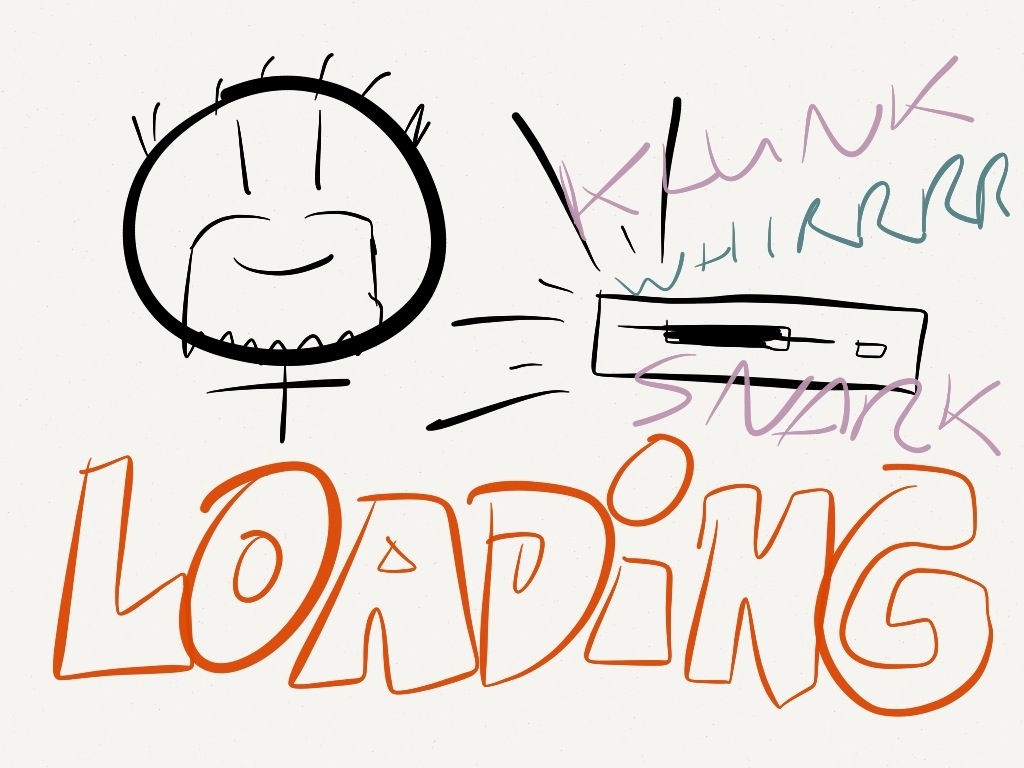
I used to find something oddly comforting in the sound of floppy drives whirring away doing their thing. Every floppy drive sounded different, too — the ridiculously huge 810 drive for the Atari 8-bit computers snarked and farted; the later 1050 was a little quieter (though had squeaky mechanical parts sometimes); the external floppy drives for the Atari ST made a pleasant frog-like croaking noise; the internal Atari ST drive was subtler, giving the occasional chug; and the drives in our first PCs were pretty quiet, putt-putt-putting away, usually installing something.

Their uses varied over the years, too. Up until DOS and Windows-based PCs started to take off as a serious gaming platform and required you to install everything, pretty much all software ran directly from floppies, making it necessary to have lots of those big plastic disk boxes (inevitably full of pirated software) — organised alphabetically if you wanted to remain sane. In practical terms, this meant things often took quite a long time to load, which brings us to something that is all but forgotten these days except in the most inefficiently-programmed and/or massive video games: the loading screen.

Loading screens used to be the place where the graphic artist for the game could really let rip and show off what they could do with the limited colour palette and resolution of the hardware they were working on. My most fondly-remembered loading screens were the work of Herman Serrano, a dude who could really make the Atari ST sing. (Visually. Whatever the visual equivalent of singing is. Oh, be quiet.) He did good loading screens for companies such as Argonaut and Psygnosis, and always signed his name prominently on them, which is something you don't see these days, either. Often they were just pixel-by-pixel recreations of the box art, but sometimes there were variations, and it was fun to look carefully at them, pick out the details and spot the occasional Easter eggs. You didn't have much choice, really, since there was nothing else you could do while it was loading.

While games still ran from floppies, loading breaks — now considered to be a thing of great evil that should be avoided at all cost — were considered something of a perk, as they generally indicated that you had done something good. This was true whether you were playing an Infocom text adventure on the Atari 8-bit or a LucasArts adventure on the Amiga. If the disk started chugging immediately after you did something, you were usually on to a winner. (Unless you were playing a Sierra game, of course, in which case it was entirely possible it was simply loading one of its many elaborate death scenes for your long-suffering character.) Some emulators of old systems even allow for the simulation of these loading breaks for the fully-authentic experience — though without the sound of a disk drive chugging away it loses something.

So yes. I miss floppy drives. I don't begrudge the 21st century's massive storage capacities and lightning-fast access, of course, but I do miss that comforting feel of sliding a disk into a slot with a satisfying "clunk", turning the computer on (yes! Remember having to turn the computer off every time you wanted to run something else?) and then sitting listening to the distinctive mechanical whirrs, groans and farts of the disk drive as it loaded whatever it was you wanted to play or use.

Rest in peace, floppy drives. You're missed!

#oneaday Day 890: Glorification

20120627-011456.jpg

I'm probably about halfway through Quest for Glory IV so far and I have to say, I'm a big fan of the series. Back in "olden times" our family were pretty big fans of Sierra adventures, but the Quest for Glory series was one which passed us by for some reason. While the games have aged better in some respects than others, one thing has become very clear from playing them: the combination of adventure game and RPG works. And it works very well indeed.

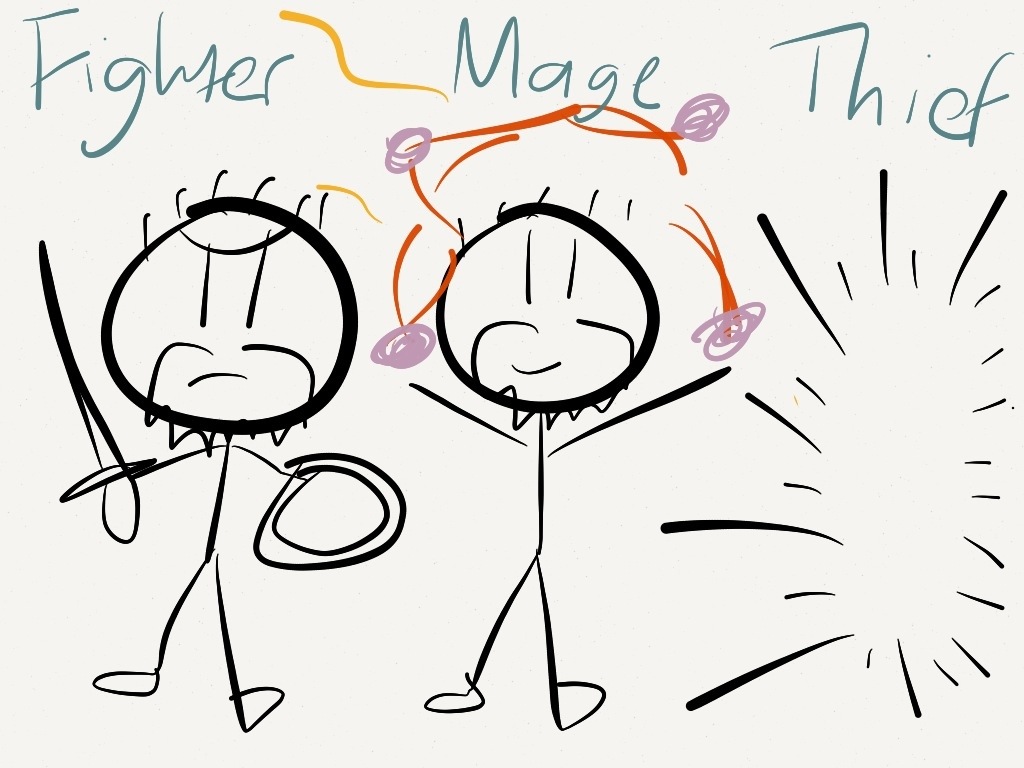
The reason it works so well is because the two aspects are intertwined so seamlessly with one another. Rather than being an interactive storybook with battles (as I once heard Final Fantasy VII described ) the RPG elements are woven into the adventure gameplay. Your character's stats are for more than simply how tough they are in battle — and in fact, combat plays a relatively minor role in most of the series. Instead, standard adventure game actions in Quest for Glory often involve a behind-the-scenes "skill check", with the on-screen character either succeeding or failing at the action in question according to his skill levels. What this means in practical terms is that there are multiple solutions to every problem according to the player's chosen play style and character class. A wizard might get through a problem relatively simply with a flick of the wrist and the cast of a spell; a fighter might have a more direct approach; and thieves have plenty of their own nefarious plots to get up to at night. Yes, here we have a thief character who is actually a thief rather than simply a DPS.

In terms of mechanics, the closest equivalent today would probably be one of the Elder Scrolls series, though it's not a great comparison. In both series, you gain in power simply by practicing skills; in both, there are multiple solutions to problems that are often related to skills; but where the two diverge is in the amount of character and personality they're infused with — not to mention the fact that The Elder Scrolls' idea of a puzzle is rarely anything more complicated than switch-flipping.

The Elder Scrolls has rich lore but I've never felt like I was a particularly important part of the story. I was just "that guy" who turns up and solves problems whom everyone then promptly forgets about — in Oblivion, for example, you do all the hard work but then Sean Bean gets to do all the spectacular stuff at the end. Meanwhile, in Quest for Glory you are the hero. You are the most important person in the room when you walk in, and the game's characters quite rightly come to love and respect you as you systematically sweep through, right all their wrongs and proceed on to your next adventure.

There's a number of contributing factors as to why this works so well in Quest for Glory yet feels so bland and uninspiring (to me, anyway) in Bethesda's epics. The main issue is one of scale — while it's unquestionably impressive to explore all of Skyrim, Cyrodiil, Morrowind or the other provinces seen in the earlier Elder Scrolls games, this vast scale means that you never really get to know the locales and the people therein. The vast majority of characters are templates who say the same thing to you, and most of them have no personality whatsoever, acting simply as walking quest-giving machines and information kiosks.

Contrast with each Quest for Glory game, each of which is set in a very tightly-focused locale — usually simply a single town and its surrounding environs — and it becomes abundantly clear why it has that much more personality. Because there's not so much vast empty space to fill with NPCs, quests and random events, everything was hand-crafted rather than resorting to templates. As such, everyone you meet in Quest for Glory is an interesting character — often with hidden depths. The plot for each game manages to remain mostly non-linear, with the required steps to proceed to the climactic "endgame" scenario in each usually completable in any order, but somehow it manages to provide a far more satisfying, compelling experience than I ever got from 50 hours in Skyrim.

The comparison between these two series isn't fair at all, of course, as I've already said, but it's somewhat telling that the closest equivalent to Quest for Glory I can find in modern gaming is so vastly different from these fascinating old titles. Why did the adventure/RPG crossover never take off? It's clearly a combination that works, and imagine what a great job we could do of it today. One could argue that games such as Dragon Age and Mass Effect from BioWare take heavy cues from the adventure game genre, particularly with regard to interpersonal interactions, but even in those indisputably excellent games it's still pretty rare that you'll find yourself solving problems in creative, class-specific ways. They're still stat-based, combat-focused RPGs first and foremost (with Mass Effect becoming more of a shooter as time went on) rather than adventure games that use RPG mechanics to help colour and direct the experience.

Part of the reason we haven't seen more of this type of game is, of course, due to the supposed "death" of the adventure game as far as the press and, presumably, publishers are concerned. But look around for a moment; the adventure game most certainly is not dead. High-profile developers such as Telltale are putting out some high-quality, well-written point and clickers. The genre is having something of a resurgence on touch-based devices such as the iPad. And some developers are even still releasing 320×200 super-pixelated traditional point-and-clickers like the recent Resonance. Why hasn't anyone just lifted Quest for Glory's system and applied it to a whole new adventure, perhaps in a new setting? I'd play a Quest for Glory in space, or in a 1920s noir style, or… you get the idea. The stat-based adventure game where the outcomes of your actions are determined by your skill values has a lot of scope for exploration, and I really wish we'd see more of it. Unfortunately, it seems that despite the universal adulation the Quest for Glory series receives, no-one is willing to defile its long-dead corpse and resurrect this fascinating subgenre for a modern game.

The first developer who does shall most certainly be in receipt of some of my money.

#oneaday Day 888: Avatars, Masculinity, Femininity, Wish-Fulfilment, Self-Expression and Fantasy

20120625-020219.jpg

My fine friend Jenn Frank (for my money, one of the most interesting people on the Internet, given the many and varied conversations we've had over the years) reminded me of a discussion we had back in 2009. You can find it in the comments here.

Basically, the discussion centred around "avatars" — custom characters that you design to represent yourself online or in a video game. I raised the point that, generally speaking, if given the option, I would go for a female character. There then followed a discussion about the reasons for this.

I'm trying to pin down the reasons for this in my own head and there are lots of them. It's not a simple thing. I can't discuss any of this from a feminist perspective as I'm not well-read enough in feminist theory, nor indeed do I know enough about gender studies and whatnot to draw any firm conclusions. I do, therefore, apologise to those more "in the know" than me if any of this post comes across as ill-informed — but I'm not trying to write an academic paper, here. What I am trying to do is "think out loud" and explain myself a little. Then doubtless someone will come along and make some incisive interpretations of my words. (That or call me something uncomplimentary. Or both.)

Let's start with a little context. I am a man. I identify myself as male and have all the appropriate dangly bits to back up this assertion. (Actually, I feel weird when I hear parents talk to their kids and refer to me as "that man" but that's a whole other issue to do with how mature I do/don't feel.)

Despite my self-identification as male, I don't do many things that I (personally, I mean) would equate with the amorphous and stereotypical concepts of "masculinity" or "maleness". I don't like sports (I particularly loathe the soccerball), I have only a passing interest in cars, I prefer to avoid conflict (and particularly the threat of physical violence) whenever possible, I am not very assertive and I have never been sexually aggressive. On the flip side, I like "geeky" things, I certainly wouldn't turn down the opportunity to drive a fast "small penis compensation" vehicle such as a Ferrari and I find "traditionally beautiful" women sexually appealing. Naturally, there is nothing to stop women from liking any of those things I've just described (and indeed I know plenty of women who do), but let's, for the sake of argument, call them stereotypically "masculine" or "male" things.

Conversely, I do do many things that I (again, using my own personal definitions, stereotypes and prejudices rather than more fair and balanced definitions thereof) would regard as "feminine" or "female". I am emotional and sensitive (though I find expressing some emotions such as excitement to be difficult), I like to talk about feelings and innermost thoughts with people I trust, I enjoy My Little Pony, I respond strongly to works of art (particularly music, film and games) designed to elicit an emotional reaction and, as a child, I always preferred solitary imaginative "narrative-style" play rather than group physical activities.

Somewhere between those two extremes, too, is the fact that I am extremely introspective — to a fault, sometimes — and find myself relentlessly examining myself (not physically, except, you know, every so often to make sure I don't have bollock cancer), attempting to predict the future of social interactions or going over past interactions in my head. I'm not sure if that's a stereotypically male or female thing to do, so I'll call that a neutral influence for now.

On the whole, though, I think the more "feminine" influences in terms of the way I do things and respond to things tend to win out. As a result, despite being comfortable, secure and happy in the fact that I am male (there are things about myself I am not happy about, of course, though those have nothing to do with gender) I find myself somewhat drawn to the female perspective on things. Not exclusively, obviously, but that influence is most certainly there.

Now let's look a little about avatars and what they mean.

An avatar is how you choose to represent yourself. It might be in public if you're playing an online game or using a social network, or you might be the only person seeing it if you're playing a single-player role-playing game such as, say, Dragon Age.

There are several ways you can approach the creation of an avatar, and I find myself doing them all at different times.

Firstly, there's self-expression. Your avatar is used as a means of expressing something about yourself. It could be simply depicting yourself as literally as possible, or it could be using an image to demonstrate how much you like something.

Secondly, there's wish-fulfilment — using your avatar to change your self-representation or idealise yourself.

Thirdly, there's pure fantasy — going completely off-piste and into the depths of your own imagination.

For self-expression, I can think of a number of examples. I use my real picture in a few places, though as someone who is not overly confident in their own appearance I generally try and avoid this whenever possible. Instead, very often I'll use images of things I like to represent myself as — the most frequent ones to appear in the last few years being Phoenix Wright from the Ace Attorney series and Fluttershy from My Little Pony. I use Phoenix Wright simply because I think he's a great character and love the series he's from; I use Fluttershy as a projection of my own real-life social anxiety.

For wish-fulfilment, the best example I can think of is back when I used to spend a fair amount of time in online virtual world Second Life. My avatar there was like me, but not quite. He had a skin that looked like me, but his body shape wasn't as fat. He had hair that I could plausibly pull off, but would never have the guts to ask a hairdresser for. Personality-wise (for it is impossible to play Second Life and not find yourself playing a role to at least a small degree) he was like me — open and honest, a bit shy in new situations — but more confident in who he was than the "real" me. In short, he was my own idealised view of myself — the person I wanted to be. I learned a few things from him, though not enough to overcome my considerable arsenal of neuroses. I was happy inhabiting his skin, because he was me, with a few tweaks here and there.

For fantasy, I turn to everything else. The first time I played a female character in a video game was the original Baldur's Gate. At the time, I didn't have any sort of ulterior motive in mind, I just thought it would be an interesting change from the usual musclebound male hero. Of course, in Baldur's Gate, your choice of avatar is largely confined to the portrait you use, the colours you have on your armour and the voice set you use, but nevertheless, this is where it started.

Thus "Amarysse" was born, and this remains the name I have used for pretty much all my female protagonist characters in every RPG I have played since. (If she has a surname, it's always "Jerhynsson", because "Jerhyn" was the name of the only minor character from Diablo II I could remember. There is literally no logic more complicated than that at work, though I'm not sure why I chose Diablo II as source material.)

Amarysse doesn't have a specific personality as it depends entirely upon how the protagonist character in these RPGs has been written, but, depending on the customisation options I have access to, she usually has long red hair, a curvy (though not fat) figure, a lot of charisma (in BioWare titles, this means taking as many points in Persuasion as possible… always) and a seductive voice. She is several things to me: firstly, and most shallowly, she's my fantasy woman in every respect; secondly, she is all the things that I am not. She is female, attractive (according to self-perception — I have a distorted and negative view of my own aesthetic value meaning I consider myself unattractive even though I know there are people who disagree), confident, assertive, dominant, in control, flirtatious and often sexually aggressive should the game provide the option to act in such a manner. She kicks ass, takes names and isn't afraid to say exactly what she wants, in short. I admire her a great deal, both from a shallow, libido-led red-blooded heterosexual male perspective, and from the angle that I wish I "was her".

I've taken this somewhat further on a couple of occasions in Second Life (though not for a good couple of years now) by creating a female avatar alongside my "regular" male one. (She's not called Amarysse Jerhynsson there, though, so don't go looking for her.) This female avatar began as an experiment. Second Life is about doing whatever you want, after all, so I decided I wanted to see what life was like as a woman. I wasn't going to be a man playing a woman; so far as everyone who met my female avatar was concerned, I was all woman. No-one ever called my supposedly female gender into question once, despite the fact that I said prominently in my profile that I would not talk about my "first life" (a Second Life term to describe "reality") at all — which, in the strange world of Second Life, usually means that people have something to hide. I even made a few friends (all female — or at least represented as such) in the process, though eventually I felt bad about deceiving them and disappeared quietly.

My conclusions from playing this female avatar were interesting. Like Amarysse's many forms, this avatar was pure fantasy. But since there was no prescripted "narrative" to follow, I had to choose how I was going to represent her. This attractive, curvy redhead didn't look like the sort of person to be a shy, retiring wallflower (especially not in the clothes she tended to wear in the locales she frequented) so it made no sense to overlay my real-life (or wish-fulfilment) personality over the top of her. Instead, I decided that here was a woman who was confident in herself and assertive enough to walk into the middle of a room and simply start talking to someone she liked the look (or profile) of. Sometimes she was ignored, sometimes she got into a good conversation, sometimes things took an altogether different turn which we shan't get into here. The important thing is that it felt different to be her. I wasn't me, suffering from crippling social anxiety when faced with the prospect of talking to strangers. I was this strong, confident woman. When ignored or rejected, it didn't hurt, because that wasn't what she would feel — even if it was what I would feel. She was not only my fantasy woman, but she was also my own fantasy personality — perhaps the person I wished I could be, or simply a person I knew that was very different to who I was. I'm not sure.

Anyway. There is a point to all this, at least I think there is: the reason I like to play female characters. I've already said it, actually, but I'll repeat it for good measure. There are two reasons, in fact: firstly, it's a simple, shallow expression of my own fantasy woman; secondly, it allows me to truly be someone that I am not in almost every way possible. I habitually use games as my primary form of recreation and a means of escapism, so I find a good way of escaping everyday life and the things I don't like about myself is to play someone that is so completely different from me. I don't feel any "dissonance", though; it simply becomes an alternate persona.

Perhaps the character traits of my fantasy female characters lie dormant within me after all, and all I need to do to feel better about myself is figure out how to coerce them to the surface. I did, after all, say at the beginning of all this that I identify more strongly with the stereotypically "feminine" aspects of my personality than the "masculine" ones (and, as I've said, I use those terms loosely as gender definitions are somewhat fluid in this more enlightened world we live in today) so perhaps there's something to this.

Working all that out, however, is probably something best left to someone with a qualification in psychology!

#oneaday Day 886: King's Space Police Quest for Glory Suit Larry

20120623-032608.jpg

I've been playing through the Quest for Glory series recently for the Squadron of Shame's upcoming podcast. I'd never played them before, and it turns out they're rather good — particularly once you get on to number 4 and you get John Rhys-Davies on narration duty. I shall refrain from further discussion of that particular series for now, however, as that would get into spoiler territory.

I do want to talk about Sierra in general, however. Sierra, if you're unaware/a young whippersnapper, was the developer and publisher of these games, and was notorious for being one of the "big two" names in adventure games in the '80s and '90s. The other was, of course, LucasArts.

Sierra and LucasArts took wildly differing approaches to what was ostensibly the same genre — the point and click adventure. While LucasArts embraced movie-style presentation and player-friendly interface features such as an intelligent cursor (i.e. one that automatically highlighted interactable objects for the player), Sierra games were punishing. LucasArts made a point in their game manuals to say that they wouldn't kill off the player character unnecessarily, and indeed in most of their games it was impossible to die or even fuck things up beyond all recognition. The exception to this was the Indiana Jones series, in which Indie found himself in danger and could indeed die — but generally only if the player really messed up.

Sierra games, meanwhile, at least in the early days would kill players if they took a wrong step on a mountain path. Or if they said the wrong thing to another character. Or if they got caught by a wandering monster. Or… you get the idea. They were hard, and not necessarily fair about it either. But the constant sense of peril that you felt a Sierra protagonist was in (at least until later games such as King's Quest VII and Gabriel Knight, anyway) provided a very distinctive flavour.

This isn't the only way in which Sierra adventures were unique. They're some of the earliest "auteur" games I can think of, where a selling point of each game was who it was written by. Each of Sierra's stable of game designers had their own specialisms — Roberta Williams handled the fairytale King's Quest series, Lori and Corey Cole handled the adventure/RPG hybrid Quest for Glory series, Mark Crowe and Scott Murphy worked on Space Quest, Al Lowe was in charge of the smutty Leisure Suit Larry series, and Jane Jensen worked on a variety of titles including the seminal Gabriel Knight. Each had their own distinctive "voice" and "style" that was all over their respective work, despite the things all the games had in common.

Different people were drawn to different series for different reasons — King's Quest provided a Disneyesque take on popular fantasy and fairytale tropes, for example, while Space Quest was a self-consciously silly sidelong glance at the world of sci-fi. Despite the early titles all being very clear parodies or homages to existing work, each series evolved over time to develop its own unique flavour — and, curiously, pretty much all of them managed to self-destruct with disastrously awful final instalments, the most notorious being King's Quest VIII's inexplicable shift into becoming a Zeldaesque action RPG rather than the gentle, light-hearted and family-friendly adventure it had been before.

Despite the fact that each series managed to commit seppuku in its own distinctive way, that doesn't make the earlier titles in the series any less worth checking out. Sure, many of the early entries have graphics that weren't exactly bleeding-edge even at the time of their original release, but their gameplay is solid, and their stories are the sort of thing I'd describe as being part of a gaming "canon" if such a thing existed. (It doesn't, making that whole statement pretty much redundant. But they're certainly fondly remembered by pretty much everyone who played them — even with the frequent and frustrating deaths taken into account.)

They're a reminder of a simple time when there weren't quite so many new games being released each month, and "a new game from Roberta Williams" was an exciting prospect. That excitement is still present in gaming to a certain extent today — many people are keen to see what auteurs like Jane Jensen (who's still steadfastly producing adventure games), Nintendo's Shigeru Miyamoto, Hideo "Metal Gear Solid" Kojima, Swery65 (Deadly Premonition) and Suda51 (No More Heroes, Lollipop Chainsaw, Shadows of the Damned) are up to today. The difference is that these "auteur games" are regarded as niche interests or cult hits today rather than big releases.

If you've never tried any of Sierra's games, head over to GOG.com and check 'em out now.

#oneaday, Day 881: Vita Killed Mobile Gaming for Me

20120618-003330.jpg

I wanted to expand on a few things I talked about in my Vita post yesterday, specifically with regard to the differences between mobile (i.e. smartphone/tablet) and handheld (i.e. dedicated game-playing system) gaming.

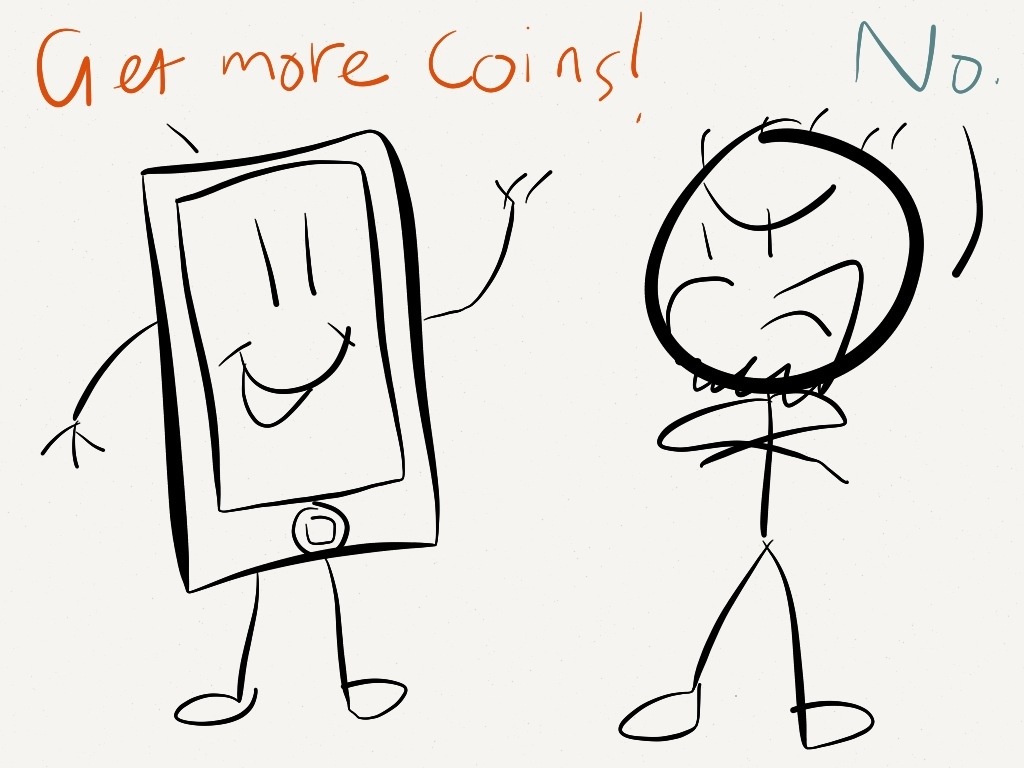
A single day with the Vita has been utterly refreshing. I've played a number of games on the system, including Everybody's Golf, Lumines Electronic Symphony, PS mini Velocity, Frobisher Says! and a couple of augmented-reality titles. Frobisher and the AR titles were free, Velocity was about 3 quid (PS minis are Sony's "app-tier" games — in fact, many iOS and Android games are ported to the PS minis catalogue) and the other two are "full-price" titles (though Everybody's Golf currently sells for a very reasonable 8 quid on PSN right now). In every instance, I was able to start up these games and enjoy them without being nagged to buy additional content or "Get More Coins!" even once. There were no exhortations to share things on Facebook or Twitter (though PSN can automatically share Trophies to Facebook) and no demands on the player that detracted unnecessarily from the immersion factor of the games in question.

This was the most striking thing about the whole experience. It's practically a given that a mobile phone game will have some form of "Pay To Win" button these days, usually in the form of the ability to purchase in-game money, items or even experience points using real currency. These are usually positioned as "timesavers", preventing players from having to "grind" to earn these things in the first place, though the fact is that the games themselves are very often designed in such a way that grinding (or paying) is necessary to progress. The game is designed to fit the business model, in other words.

Now, let's look at Everybody's Golf as a case study here. In Everybody's Golf, you earn points through play. Skilful shots, sinking the ball under par and winning tournaments nets you varying amounts of these points, which can be used as a cumulative expression of your skill and the currency through which you unlock additional content in the game — characters, costumes, equipment, courses and other bits and bobs. In other words, the better you are at the game, the more quickly you can progress at unlocking stuff. This is a simple "carrot and stick" approach, but it provides a powerful motivation for the player to actually work hard to improve their game — particularly when coming up against an apparently-notorious difficulty spike partway through the single-player component of the game. If the player was simply able to drop a few quid on purchasing additional points (which, thankfully, is not an option), all meaning of the content they acquired using these points would be lost. The unlocked characters, the new costumes, the new equipment — none of it would be a trophy of the player's achievements any more. Instead, it would simply be something that the player had thrown money at. Not only that, but the player's cumulative score would cease to be an accurate depiction of their skill and play time. It would simply become just another meaningless currency — one with an exchange rate with real-world money.

This might not sound like a massive issue but the difference is profound. When playing a mobile phone game, the near-constant presence of "shop" buttons or "Get More Coins" interface elements makes it abundantly clear to the player that they are making use of a service rather than enjoying a creative work for art's sake. That questioning feeling — "am I being screwed while I play for free? Should I pay for some coins?" — is ever-present in the player's mind. In the most egregious cases, developers even make the "cash shop" option glow or flash on screen to deliberately distract the player and draw their eye to it. (This happens in free-to-play PC titles, too.)

Now, I will point out at this juncture that I am not condemning this business practice as "wrong" necessarily — when you release your game for free or a ridiculously low price on the App Store or Google Play, you need to take steps to ensure that you at very least break even. Rather, I am saying that it has had a significantly negative impact on my personal enjoyment of mobile games of late. I find a game which doesn't ask me for more money after installing to be a pleasant surprise these days, rather than the norm. It wears you down after a while, particularly when you play as many iOS and Android games as I do — it is, after all, my job — and when I sit down to play a game just for fun, I simply don't want to be bugged by the "business" side of things.

Everyone plays games for different reasons. Some play games as simple timewasters while they're in a boring meeting, sitting on the toilet or waiting for a bus. Others use them as a high-tech equivalent of fiddling with a pencil. Others still want to compete against their friends, or express their creativity, or as a social outlet, or… you get the idea. There are probably as many reasons as there are people.

I play games purely for enjoyment and entertainment, usually in substantial, continuous sessions. Games are my primary form of recreation — where some people watch movies or TV, I play games. As such, in most cases, I'm not in it for a few seconds at a time — I'm there for an hour or more at once. During that time, I want to be immersed in the game experience without interruptions, particularly if I'm playing a story-heavy game. I do not want to be reminded that I'm playing a game if at all possible — unless it's built in to the experience in an entertaining, self-aware sort of way — and I certainly do not want to be reminded that making games is big business. I know this. I read all about it most days. I do not need to be reminded of it during play. Because there is nothing more immersion-breaking for me than exhortations to "Share this with your friends! Buy more coins now! Play again tomorrow for bigger daily rewards! Try our other games!" Even popups demanding that I rate an app 5 stars "now" or "later" have a negative impact on my enjoyment of a title.

This is where the Vita has provided the most pleasant surprises of all for me. Across everything I have played, I have been left alone to simply enjoy the game for what it is. In some cases, where competition is an inherent part of the game (like in Lumines), I am informed of my friends' high scores, but I'm not invited to brag to them. I'm certainly not confronted with half-finished games sporting interface elements that just say "Coming Soon!" and big flashing buttons to "Add Cash". It's been a blessed relief.

Couple that with the fact that the Vita games I've played so far are all deeper experiences designed to be played for longer periods at a time rather than five-minute timewasters, and a lot of the anxiety-inducing sense of ADHD that the diversity of mobile gaming offers is gone. I had to give up playing asynchronous iPhone games with friends because I found that keeping up with them was genuinely stressful. It felt like work, and it wasn't fun any more, so I stopped. I am sorry to any former Draw Something or Hero Academy players, but once something stops being fun, there's no point dragging it out unnecessarily.

All this may be painting an unnecessarily negative view of mobile gaming, but that's not the case at all — this is purely a personal response with regard how I want to spend my own free time. These ADHD games have a place and a massive audience — much larger than the audience the Vita currently boasts, as it happens. There's a lot of money to be made through "cash shops" and "get coins" buttons, so I can't blame publishers and developers for wanting to capitalise on this, whatever my own personal opinions on the matter.

Alongside this, there are some genuinely good games on iOS and Android that don't fall into these excessive monetisation traps — though interestingly, even Epic's Infinity Blade, one of the most impressive and supposedly "hardcore" games on iOS, now boasts the facility to purchase in-game currency with real cash, as do otherwise-excellent titles like Hunters 2. Equally, some free-to-play games — like the excellent Pocket Planes I talked about a couple of days ago — leave the decision of whether or not to pay entirely in the player's hands, and are generous enough to make the game perfectly playable to those who do wish to play for free.

A single day with the Vita, though, has been enough to convince me that dedicated handheld gaming most certainly still has a place, and I'm more than happy for it to be a part of my life. I can see myself leaving the vast majority of iOS gaming behind — board game adaptations and Pocket Planes (until it gets boring) excepted — in favour of the deeper, more rewarding, less skeezy-feeling experiences that Vita titles offer.

And let's not even get started on how fucking nice it is to have buttons again. Or how nice it is to have an online store that is not filled with endless regurgitations of the same FarmVille formula with zombies/fantasy kingdoms/monsters/pets attached. Or… I could go on. But I won't.

#oneaday Day 880: Not Going To Make a "Livin' La Vita Loca" Joke

20120617-012047.jpg

I bought a PlayStation Vita today. I'd had my eye on one for a little while, but having successfully paid off my credit card for the purchase of my new Mac, I decided a little treat was in order, so I did a bit of research as to what the fine folks of the Internet thought was good games-wise, and grabbed one today. I was fortunate enough to be able to snare a preowned but unused model from Game in Southampton today, which cut down the price considerably, allowing me to also grab an (overpriced) 32GB memory card along with a copy of Everybody's Golf to enjoy for about £270 in total.

I've only spent one round with the latter so far (but it's bringing back pleasing memories of Tee Off on the Dreamcast) so I won't comment on that too much, but I did want to talk a little bit about the system itself, as I believe it's worthy of note.

The Vita distinguishes itself from its predecessor the PSP immediately with its touchscreen-friendly interface. Featuring an icon-based homescreen somewhat akin to modern smartphones, the Vita invites you to touch, swipe, flick, peel and all manner of other things. You can reorganise your homescreen icons as you see fit, and even set backgrounds for different pages. You can't organise things into folders, though, which is a bit of a shame, but I can cope with that. PlayStation Network (sorry… Sony Entertainment Network, which still amuses me because its abbreviation is the same as Special Educational Needs) provides plenty of downloadable goodness, ranging from complete games that you could also buy as physical products at retail to smaller, cheaper, download-only titles and even free apps for access to Twitter, Facebook, Skype and Flickr.

The downloadable side of things has, for me, always been a big strength of Sony's systems from the PSP onwards. The PlayStation Store is a veritable treasure trove of underappreciated and overlooked gems as well as some of the most memorable "art games" (for want of a better term) in the business — games like Flower and Journey, for example. PlayStation Minis, too, provide portable-friendly experiences akin to what you might play on a smartphone, only with dedicated controls to enjoy them with, which is a big boon to anyone sick of poorly-implemented touch controls.

Besides the games themselves, though, Vita has a number of interesting and intriguingly noteworthy features. For starters, the system actually does multitasking considerably better than both iOS and Android. A tap of the PlayStation button freezes whatever you're doing and takes you immediately back to the "OS". From here, you can "peel" the app off the screen to close it completely, switch to something else (like, say, the settings app, or Twitter) and then be back into your game without any messing around. This is particularly beneficial when you want to browse the PlayStation Store for addon content, for example — even the PS3 requires a quit out of a running game to access the Store, whereas Vita manages to seamlessly switch to it, let you browse as you see fit, then switch back. This functionality also allows you to effectively do what the Steam Overlay does for PC gamers — while running a game, you can pop open a browser window and, let's face it, look at GameFAQs.

Vita's interface is gorgeous, too. The big, high-resolution LED screen makes things look great anyway, but the design of the OS just begs to be played with, too. On the homescreen, flicking between screens causes the icons to wobble like they're hanging on pegs. Rather than "slide to unlock" if the machine goes into standby, you use the same "peel" motion that is used for closing apps. And the soft keyboard is pretty good, too, with a decent predictive text dictionary built in — though the size of the screen and its position means that "thumb typing" as on a smartphone is next to impossible. Fortunately, as the Vita is primarily a gaming platform, you won't be doing that much typing on it, so it's a design flaw I can forgive.

The built-in apps are interesting, too. Near allows you to see other Vita owners in your nearby vicinity, see what they've been playing and their responses to them. (I was surprised to see quite a few Vita owners living near me — I was expecting it to be a virtual ghost town around here.) Welcome Park introduces the system's little quirks — the multitouch screen, the rear touchpanel, the two cameras and the built-in microphone — through a series of simple but surprisingly engaging minigames, all of which have Trophy support for those who care that much. There's also a pleasing number of free downloads from the PlayStation Store, including a selection of social apps, a simple finger-painting app and even some games, including the hilarious and WarioWare-esque Frobisher Says.

All in all, I'm very pleased with my purchase so far. I've become somewhat disillusioned with iOS gaming recently — perhaps due to the fact I get to see some of the very best and worst titles as part of my day job — so I've been surprised how good it feels to have a dedicated handheld system again, particularly one that doesn't possess an app ecosystem that encourages developers to include "Get More Coins!!" options even where they're not wanted/needed. I shall look forward to many Everybody's Golf sessions on the toilet in the near future as well as a thorough exploration of the myriad joys the PlayStation Store has to offer me.

#oneaday Day 879: Flying Away

20120616-014758.jpg

Having gone off on one somewhat about the fetid pile of toss that is Rage of Bahamut yesterday, it's only fair for balance's sake to talk about a free-to-play game that is well-designed, player-friendly and actually rather fun.

I am referring to Pocket Planes, the newest game from Nimblebit, developers of the astronomically popular Tiny Tower, a game which made "tap, tap, tap" gamers out of even the most jaded hardcore members of the games industry.

Tiny Tower, as most people realised after varying amounts of time, was little more than a mindless busywork generator, as RedSwirl over the on Squadron of Shame Squawkbox puts it. You built floors, you attracted people, you stocked up your floors with stuff that made money, you went away, you waited for your phone to shout at you that something needed restocking, you tapped on it to restock it and repeated the entire process for more hours than you really should until you either keeled over dead or got bored.

Tiny Tower, then, had very little in the way of strategy and certainly wasn't a modern-day SimTower, as some referred to it on its original launch. It was an interesting little timewaster with an adorable pixel-art aesthetic, however, and crucially, it allowed the player to make progress without battering them over the head to invite friends, share achievements or purchase things with real money every five minutes. The game featured a premium "hard currency" that allowed you to do things quicker or rapidly acquire more cash, but it was handed out fairly generously just through play, so those who wanted to play for free could.

Pocket Planes builds on this formula and puts a more complex game atop it. There's still not a huge amount of depth there, but it's definitely more than simple busywork now.

In Pocket Planes, you run an airline company, and your goal is to own all the airports in the world. (This alone distinguishes the game from Tiny Tower, which had no long-term goal besides "build a fucking huge tower") You begin the game in one of several regions around the globe with a small fleet of rather crap planes and a desire to make money. Fortunately, there are plenty of jobs waiting for you that want to give you money, so getting started is a simple matter of loading up your planes with passengers, cargo or both (depending on what type of plane it is) and setting them on their merry way.

It's here that an element of very light strategy comes into play. Sending your planes off costs money, and you don't receive payments for flights until they're completed. To be efficient, you might want to try and hit several stops in a single run, but when doing so you need to note whether there's a big enough profit margin to make it worthwhile. Sometimes leaving passengers behind rather than fully loading is more profitable, and scoring a jackpot of customers who are all going to the same place nets a 25% bonus on the income attained.

That's it for the basics of gameplay. Beyond that, once you've earned enough money you can purchase new airports, which allow your flights to go further afield and also provide you with plane parts which can be subsequently assembled into new members of your fleet, assuming you have space for them. Old, crap planes can be retired to make room if you don't have the capital to expand your fleet's maximum size, or you can simply try to get as many aircraft in the air as possible. Plane parts and complete planes can also be purchased through the Market page, which restocks with a random selection of items every few minutes, and parts can also be traded with friends for a small fee.

Like Tiny Tower, a lot of these actions use the game's "hard currency", or "Bux" as they are known, but again like its predecessor, Pocket Planes is generous about handing these valuable commodities out through play. If anything, Pocket Planes is more generous than Tiny Tower, rewarding the player with Bux simply for completing certain jobs, levelling up and various other actions. Sometimes they even just float past the planes in flight, to be collected with a simple tap.

Pocket Planes also includes an interesting social mechanic in the form of its "Flight Crew" system. By simply typing in the same crew tag as other airline tycoons, players can team up in an attempt to complete as many jobs in special global events as possible, with flight crews ranked on a worldwide leaderboard and prizes awarded when the time expires. You can also see how you stack up to the rest of your crew and figure out who needs to pull their weight more — though those players who join your crew but aren't on your Game Center friends list simply show up as anonymous benefactors, which is a shame.

The interesting thing with Pocket Planes' social mechanics is that it assumes the player already knows how to socialise. There are no screen-filling exhortations to share achievements with friends; no "friend gating", where progress becomes impossible unless you have a certain number of friends playing; no demands that you "visit" friends and "help" them. In fact, the game's social mechanics are kept pleasingly minimalist — most screens offer the facility to tweet a screenshot using iOS 5's built-in Twitter functionality, but in the case of Flight Crews and the like, it's up to the player to encourage their friends and acquaintances to join in the fun however they see fit rather than spamming them in-game. This is a Good Thing.

Pocket Planes is, at heart, a simplistic game with very little substance, but it offers the same sort of idle satisfaction that Tiny Tower did with a bit more sense of structure. It will undoubtedly be another big success for Nimblebit and fair play to them for that — their recent games are proof that you can adopt a free-to-play business model without being jerks about it. The goodwill that builds will likely encourage many more people who wouldn't think to purchase virtual goods otherwise to dip into their pockets purely to show the developer their support.

Pocket Planes is out now for iOS. An Android version is following in the near future, but a release date hasn't been announced yet.