#oneaday Day 931: Pure Profit

The more doublespeak I hear from industry analysts and company executives on earnings calls, the more and more glad I am that companies such as Atlus, Carpe Fulgur, Xseed et al exist. (Though Atlus should really pull their finger out and open a European office. I'll happily run it. Single-handedly. Gladly. Just bring fucking Trauma Team out over here and we'll be cool, Atlus. Why you gotta be that way?)

Why? Because these are companies whose primary motivation is not profit, it's pleasing their customers. They accept that they are catering to niche interests and accept that they are not going to create games that sell millions of copies.

Here's an actual quote from Aram Jabbari of Index Digital Media, Atlus USA's parent company:

"With the launch of the strategy RPG Growlanser: Wayfarer of Time, an iteration in the popular franchise never before released in North America, Atlus demonstrates the continuation of its proud heritage of supporting niche titles aimed at the core gamer. We are not intimidated by the challenges of servicing a smaller audience or pursuing more modest success with a given project. Our fans are excited for a new Growlanser title and we are excited to be able to bring one to them."

What a great attitude to take. A bold, proud statement that Atlus specifically isn't going after the quick buck, but is instead aiming to build long-term loyalty with its customers by giving them the things that they have been asking for.

Note: this is not the same as pandering to the whims of crybabies. It is a case of listening to your customers and providing them with things that they will appreciate, which in turn builds up a strong and significant base of loyalty which can be drawn upon in the future. I know plenty of people who will happily pick up anything that has the Atlus stamp on it purely because of the goodwill the company has built up over the years (goodwill which they're at risk of losing with the whole Persona 4 Arena region-lock business, but that's another matter entirely).

It's the same with Carpe Fulgur, whose dedication to their craft shines through in every one of their three releases so far. While RecettearChantelise and Fortune Summoners may not be the most technologically-stunning or even best games in the world, they feature a top-quality localisation job the likes of which we haven't seen since the days of Victor Ireland and Working Designs on the PS1. They work on niche titles that players might not have heard of, but built up a solid foundation of brand loyalty with Recettear and have continued to provide memorable experiences since.

Then there's Xseed Games, whom I have to admit I'm not as familiar with, but who are noteworthy for bringing excellent PSP action-RPGs Ys Origin and Ys: The Oath in Felghana to PC, and are also handling the North American release of the fantastic The Last Story(C'mon, guys, pick up Pandora's Tower, too — your fans will thank you.)

And then there's the even smaller niche developers and publishers like Mojang, Gaslamp Games, Zeboyd Games — too many to mention. Not one of these companies is responsible to shareholders and investors, which means they can take a much more "human" approach to business. Their team members can speak as individuals and freely give their opinions rather than stock, robotic "we do not comment on rumours and speculation" responses that frustrate journalists and public alike so. They can enthuse about their products in human terms rather than spouting bollocks like this actual quote from Ryotaro Shima, senior vice president the EML business department at GREE Inc and CEO of GREE UK Limited:

"The formation of a UK studio is strategically significant on many levels. Primarily it will allow us to focus on Western content, keyed to local social trends, as well as tailoring content for global propositions. It also reinforces GREE's commitment to growth within European markets."

Besides the fact that these smaller companies tend to have job titles that are less of a mouthful, there's a clear disparity in the language used. Let's take a look at another quote that is more roughly equivalent to the one from Jabbari I posted at the beginning of this piece — this one's from Paul Nicholls, sales and marketing director at Koch Media, annoucing Andrew Lloyd Webber Musicals: Sing & Dance (yes, that is a game that is actually coming out, and you bet it's a game being made primarily as something that will sell rather than a great creative work):

"This is a fabulous signing for us. Andrew Lloyd Webber and his creations are a British institution that have been enjoyed by generations across the world. The chance to bring this product to market for the Nintendo Wii is both an honour and hugely exciting."

Note the difference in the language used. Jabbari refers to "our fans"; Nicholls talks of "bringing this product to market". Jabbari speaks of "servicing a smaller audience", "pursuing more modest success" and emphasises what Atlus is doing for its fans; Nicholls speaks of what a "fabulous signing for us" the Andrew Lloyd Webber license is — no mention of customers at all.

Obviously those two aren't exact equivalents — one is a rather niche PSP release while the other is a Wii game based on the music of Andrew Lloyd Webber. But the point stands — personally speaking, I'm much more inclined to respect companies that have a "human" face; companies who make it clear that their first priority is not shifting as many copies as possible, but pleasing, surprising and delighting their fans.

Obviously it would be nice if the niche titles were multimillion-sellers, but that would somewhat diminish their "niche" status. What the continued existence of smaller outfits like Atlus, Xseed and the like proves, however, is that you don't have to be focused on big business and the bottom line to be successful — it is possible to please your customers and have a company that performs well.

It's also, I'd argue, a sign that going public is a terrible, terrible idea for a company supposedly based around creative ideas. As soon as "what would be cool?" becomes "what would sell?" or "what will make the investors happy?" I, for one, am no longer interested, because I'm being treated as a bag of money rather than a human being. For all I know, Atlus et al may be laughing all the way to the bank, but because they put such a human, consumer-friendly face on the way they do business, I'm more than happy for them to take all of my monies while I consistently give companies like EA, THQ and Activision the finger until they start speaking English.
#oneaday Day 929: PC Gaming: The 'Master Race' For A Reason

I finished Fortune Summoners tonight. (Go play it, it's great.) I am not going to talk about Fortune Summoners, however; I am instead going to talk about something which came to mind while I was playing it.

PC gaming.

There's still a bit of a funny attitude surrounding PC gaming. Some console players and commentators refer disparagingly to those who do the bulk of their game playing on personal computers using phrases such as "the Master Race", and actively refuse to participate in it. The reasons for this are many, but the most commonly-cited ones include the supposed "expense" of getting started and the misconception that some things are just "better" on console.

Let's address both of these points before moving on to the real reason I started writing about this.

Firstly, the cost issue. Yes, depending on what sort of games you want to be playing, there will probably be a higher up-front cost to get a gaming PC. But, realistically, this startup cost is not significantly more than a new console costs upon its first launch. And for that price you're getting something that significantly outstrips current-generation games consoles in terms of performance — and will continue to do so for quite some time.

My current PC cost in the region of £650 to put together and is what I'd describe as "mid-range". It plays most games at 720p (the resolution most Xbox 360 and PS3 games tend to run at — sometimes less) at 60 frames per second or more without breaking a sweat. At 1080p, it can handle most stuff you can throw at it without issue — it's only really demanding stuff like The Witcher 2 and Crysis that will make it struggle a little. In short, stuff looks good on it — significantly and noticeably better than on Xbox 360 and PS3 — and given that the next generation of games consoles are yet to be announced, this system is going to maintain a comfortable lead for a year or two at least. We have no idea how much these new systems are going to cost at this juncture.

Insofar as the console experience is "better", I agree to a certain extent, in that sitting on a couch with a controller in your hand is, for most types of game, much more appealing than hiding in your computer room with the screen a few inches from your face. However, there is a very straightforward way to solve this issue: connect your PC to that big-ass HDTV you have in your living room, and you immediately have the world's best games console that also does all that "multimedia" shit far better than Microsoft's gradually-worsening Xbox interface ever will — just compare the experience of using Netflix on the Web to Netflix on Xbox and you'll see what I mean. Add an Xbox 360 controller and you can play sitting slumped back on the couch just like a console, but you have the added option of playing with mouse and keyboard for when accuracy and/or lots of buttons are required.

Take this approach and you'll be set — you practically won't need a console, except for exclusive games. Multiformat games are generally best on PC — even the worst console port is usually able to take decent advantage of your computer's hardware, allowing you to run it at crazy resolutions and deliciously butter-smooth frame rates. Online communities are generally lively and active. And the vast mod community allows games to maintain their "life" long after console players have moved on to the next big thing.

The thing I really wanted to talk about, though, is diversity. There is no other platform on which you can have such diverse experiences as the PC. iOS certainly has a good go, but as days go on it's abundantly clear that the mobile market is shifting very much in favour of "freemium" social games rather than truly inventive experiences. On the PC, meanwhile, the fact that it is such a free market out there — and easy to develop for (relatively speaking) — means that if you can imagine an experience you want to have, you can probably do so on PC.

Fortune Summoners is a prime example. Fortune Summoners is a Japanese platform RPG that combines elements of Castlevania, Zelda II, Demon's Souls and '90s arcade games to produce something that is endearing, charming and bastard hard. That certainly wouldn't get a retail release on consoles (not that it did on PC, either) but even if it were to be released on a service such as Xbox Live Arcade or PlayStation Network, it wouldn't be an easy title to come across accidentally thanks to the closed nature of both Microsoft and Sony's networks and their rigidly-defined criteria for advertising products. And would it even be released at all? A translation of a 5 year old Japanese game that was the start of a series that never continued? Would that be profitable? Would that be worth promoting? These are the questions that get asked when it comes to console games, whereas the PC marketplace has a lot more small-scale "enthusiast" developers and publishers more than happy to cater to "niche" markets — if not through Steam (which is generally pretty good anyway) then directly to their customers.

And there are plenty of niches catered to. "Grand Strategy" buffs can enjoy titles like Crusader Kings II and Civilization V. "Bullet hell" shooter fans can take on Gundemonium Recollection and those three games that Capcom released on Steam recently that I've forgotten the name of. Adventure game fans can enjoy pretty much the entire history of the genre, from King's Quest I right up to more recent titles like Resonance or Telltale's episodic work. Japanese visual novel enthusiasts can delve into JAST USA's vast library of translated titles, and within that collection there are plenty of dirty and non-dirty titles. Simulation fans can drive anything from a First Great Western train to a garbage truck.

This isn't even getting into the rich back catalogue of gaming that the emulation scene offers. While downloading ROM files for old consoles puts you on shaky ground legally, let's face it — pretty much everyone occasionally has a hankering to play, say, Super Mario World or Blast Corps and thus finds themselves digging around in one of the dark corners of the Internet. While there's a certain magic to playing it on old hardware, that's not always practical. Old hardware breaks down; old cartridges lose their batteries; old CDs get scratched or broken. Through the magic of emulation, your PC is not only a bleeding-edge games console, but it's also an archive of all the console games you owned in your youth, too. And an arcade machine. And a means of playing Web-based games.

So if PC gaming is considered to be "superior" by some, it's certainly not without reason. Nowhere can you get the same diversity of experience that a PC offers. Nowhere else can you finish a game of Civ V and then have a quick rag on Dr. Mario to cool down. Nowhere else is there such an incredibly useful, multi-functional device that is ready and willing to hook up to your TV and serve pretty much all of your entertainment needs — both interactive and non-interactive.

So if you're one of those people who dismisses the PC platform out of hand without even an iota of interest in engaging with it, I'd urge you to reconsider. You'll be surprised how little it is about editing AUTOEXEC.BAT and CONFIG.SYS or slotting cards into slots these days, and how much it is about enjoying some of the finest digital entertainment experiences on the planet.

Join us. Join us.

#oneaday Day 928: Begun, The Clone Wars Have

EA has filed a copyright infringement lawsuit against Zynga. The reason? The uncanny resemblance between Zynga's latest "invest-and-express" game (their term, not mine) The Ville and The Sims Social. I won't cover the case in detail because my friend and colleague Mr Mike Thompson has already done a fine job of doing so over at Inside Social Games.

Despite the clash between EA and Zynga looking to many like Darth Vader fighting Sephiroth (I know that would actually be awesome, but it's more the "evil" thing I'm going for) I'm actually sort of glad that this is going ahead, even if EA is actually on shaky ground due to, as Zynga's general counsel Reggie Davis noted, the uncanny resemblance between EA's own SimCity Social and Zynga's CityVille.

But then Zynga doesn't exactly have the best track record. FarmVille, one of the company's biggest hits, was accused of being a clone of Slashkey's Farm Town on its original release. Its iOS title Dream Heights was rather publicly called out by Tiny Tower developer Nimblebit for being a ripoff. CityVille's roots can be traced back to a number of similar titles. And… you get the picture. Zynga is good at one thing: marketing. They are not good at thinking up original ideas, as we've seen a number of times previously.

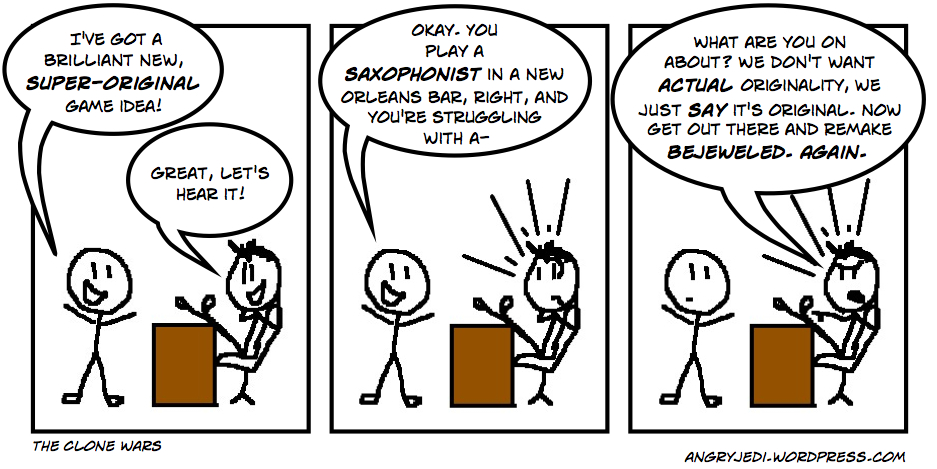
Zynga is by no means the only one to blame in this situation, however. It is a widespread problem that is simply brushed under the carpet by developers, publishers, press and public alike. Clones are taking over the market and oversaturating it. At some point, we are going to reach critical mass, and there's the potential for a real mess when that happens.

I review mobile and social games every week. In any one week I can guarantee that I will come across at least one of each of the following:

  • An isometric-perspective citybuilding game where you have to complete quests and construct buildings to increase your population cap. More effective buildings either cost real money or require you to bug your friends for "materials" before you can construct them. Usually involves farming.
  • An isometric-perspective ranching game where you have to complete quests and construct buildings to allow you to expand your territory in several directions by clearing mist/chopping down forest/"exploring". Usually involves farming.
  • An isometric-perspective farming game where you have to complete quests and construct buildings to allow you the ability to plant and harvest better crops. Almost definitely involves farming.
  • An isometric-perspective pet/monster care game where you have to complete quests and construct buildings in order to attract various different pets/monsters, which you can then care for and/or sell by clicking repeatedly on them. Usually involves farming.
  • A slot machine simulator where you can pay real money in order to win virtual money which cannot be used for anything except playing that particular slot machine simulator. Does not usually involve farming.
  • A "match-3" puzzle game in which you create horizontal or vertical lines of three or more like-coloured gems (always gems) in order to make them disappear and score as many points as possible in 60 seconds. Rarely involves farming.
  • A "match-3" puzzle game in which you create horizontal or vertical lines of three or more like-coloured gems (always gems) in order to make them disappear and complete a linear series of levels. Almost never involves farming.
  • A "match-3" puzzle game in which you create horizontal or vertical lines of three or more like-coloured gems (always gems) in order to make them disappear and either score as many points as possible in 60 seconds or complete a linear series of levels. (Yes, some games feature both modes!) Does not generally involve farming.
  • A "match-3" puzzle game in which you click on groups of three or more contiguous like-coloured gems to make them disappear and score as many points as possible in 60 seconds. Usually free of farming.
  • A "match-3" puzzle game in which you click on groups of three or more contiguous like-coloured gems to make them disappear and complete a linear series of levels. Generally lacks a farming component.
  • A "match-3" puzzle game in which you click on groups of three or more contiguous like-coloured gems to make them disappear and either score as many points as possible in 60 seconds or complete a linear series of levels. (Yes, some games of this type also feature both modes.) Usually lacking in the farming department.
  • A "bubble shooter" puzzle game in which you fire coloured bubbles from the base of the screen in an attempt to attach groups of three or more like-coloured bubbles together and make them disappear in order to score as many points as possible in 60 seconds. Generally farming-free.
  • A "bubble shooter" puzzle game in which you fire coloured bubbles from the base of the screen in an attempt to attach groups of three or more like-coloured bubbles together and make them disappear in order to complete a linear series of levels. No farming here, no sir.
  • A "bubble shooter" puzzle game in which you fire coloured bubbles from the base of the screen in an attempt to attach groups of three or more like-coloured bubbles together and make them disappear in order to either score as many points as possible in 60 seconds or complete a linear series of levels. (You're getting the picture now, huh?) Farming? Nope.
  • A hidden object game where your uncle has gone missing in time and/or space and the only way to save him is to build a mansion and then repeatedly search the same rooms over and over for a selection of arbitrarily-discarded bric-a-brac which, for some reason, you need to find as quickly as possible.
  • A hidden object game where your uncle has gone missing in time and/or space and the only way to save him is to repeatedly search the same rooms over and over for a selection of arbitrarily-discarded bric-a-brac which, for some reason, you need to find as quickly as possible — but hey, you don't need to build a mansion.
  • A hidden object game in which your uncle has not gone missing in time and/or space, but in which your mansion has become invaded by ghosts and the only way to get rid of them is to build a mansion (again, presumably) and then repeatedly search the same rooms over and over for a selection of arbitrarily-discarded bric-a-brac which, for some reason, you need to find as quickly as possible.

Of course, you can probably boil most of gaming down to a selection of basic formulae like this, but for some reason the issue of cloning is always particularly apparent in the social and mobile gaming space. Perhaps because the developers of these titles generally make no attempt to hide the fact that they're simply cribbing from the unwritten template. (Currency, energy and experience meters go at the top. The Shop button goes at the bottom right. You must start your game with a non-skippable tutorial that treats the player like a complete idiot. You must present map screens from an isometric perspective. GOD HELP YOU if you go top-down or — heaven forbid — 3D.)

In mainstream gaming, the closest we get to a "cloning" problem is the number of similar first-person shooters we have on the market, but in this case, these titles do enough to distinguish themselves from one another with their aesthetic, narrative, gameplay modes and general "feel" to make them unique from one another. Call of Duty: Modern Warfare 3 and Battlefield 3 may both be brown-coloured manshoots, for example, but play them both and it's clear that there are marked differences between the two of them, because they're different games that just happen to be in the same genre, not clones.

Play something like CityVille then SimCity Social, however — or indeed The Ville then The Sims Social — and you'll be hard pushed to tell them apart.

This is not a positive direction for one of the most exciting, creative industries in the world to be moving. There's a huge amount of potential in both the social and mobile gaming markets, and only a few developers tap into this. Most, sadly, choose to take the path of least resistance and make one of the games on the list above.

Come on, folks, we're better than this. Stop trying to tell me that your isometric-perspective FarmVille clone is somehow "innovative" and make something that actually is innovative.

#oneaday Day 927: On Stickmen

I draw stickman primarily for one reason: I'm not very good at drawing anything more complicated. I've never practiced drawing particularly hard — I've always enjoyed doodling and drawing stupid things, but I've never tried particularly hard to actually practice good technique or anything. I spent a few weeks reading up on how to draw manga-style characters a few years back, but never really got the hang of drawing things that look particularly "convincing". My manga-style drawings always end up looking like the sort of thing a 12-year old kid scrawls in their art book in an attempt to look cool, rather than anything particularly convincing. So no, you won't be seeing any of those here for the moment.

And then I inevitably run into various other issues if I do decide to draw more detailed characters, which I shall now demonstrate for you forthwith. Note: I am not doing this to solicit feedback, nor am I fishing for compliments (not that these pics deserve any) — simply to demonstrate a point.

Let us begin.

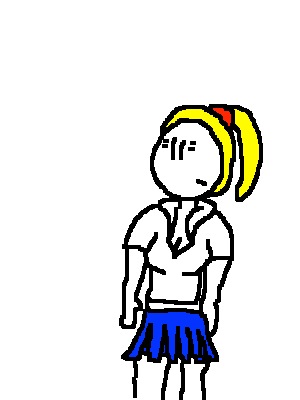
The first question I inevitably end up asking myself regards body image. I put "myself" in my cartoons frequently, and drawing a body makes me ponder whether or not I should draw an "idealised" version of myself (right, obviously) or a more… ummm… "accurate" depiction.

This also raises difficult questions when a friend of mine asks for a guest appearance, as I then have to make the same decision regarding how I represent them — I don't want to cause offence, but at the same time I want them to be recognisable, and their "shape" is often a part of that factor. It's just easier to do a stick body because everyone is equal, then, and the main distinguishing factor between characters is not something people (including me) can be particularly sensitive about, but instead the part that really matters to their "character" — their face.

Also, I'm not very good at drawing fat people. Or boobs.

Another thing I am not very good at is posing characters, as the slightly uncomfortable-looking Alex above will attest. I am fond of "arms folded" and "hands on hips" as strong poses, but these are tricky to draw. In the case of "arms folded", I have no idea where the fuck to put people's hands, and I'm not even entirely convinced I know where people's arms go. I then run into mild perspective issues as I try to figure out what would be behind those arms, and it all just gets to be a bit of a mess. (I should probably do it the other way around — body first, then overlay arms on top.)

Questions of clothing then rear their head. What should characters wear? Should they wear the same thing all the time as part of their "look", or should they switch things up occasionally? Will I ever learn how to draw bare legs beneath a skirt?

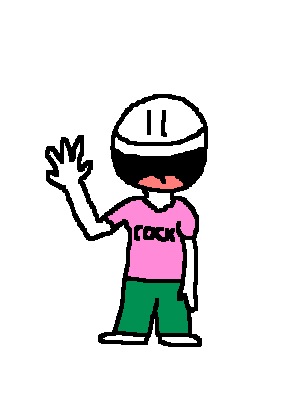
Finally, I have to figure out what on Earth to do with more bizarre characters such as Phillipe here. Phillipe works as a stickman because stickmen can get away with exaggerated expressions such as his perpetual gurning. But does that really work when placed atop a more "normal" (i.e. not stick-figure) body?

Looking at the pics I've drawn above, it actually sort of does. (Also, I can take further advantage of Phillipe's perverted nature with offensive T-shirt slogans.) But I still find myself looking at drawings like that and thinking to myself that they're crap, whereas I'm much happier with the way these characters come out as stick figures. Stick figures can be easily posed, manipulated, mangled and otherwise abused. As soon as you add a "proper" body to the mix, you have to think about things a little more. They're not as bendy. Well, that's not true, you can do whatever you want with them. But contortions are easier to draw on a stick figure than on a character with a body. Also you don't have to worry about lighting with stick figures, whereas cartoons with "proper" bodies inevitably look better if there's a sense of light and shadow in there.

Why am I thinking about this now? Well, every so often I get a hankering to write a visual novel, but the one thing that usually stops me before I even start is thinking "I'll never find anyone to draw some good-looking graphics, and I certainly can't do it myself." I've contemplated making a visual novel using just stick-figure characters and I think it might sort of work — it'd certainly be a distinctive aesthetic — but then I lose confidence and think it would be the rubbishest idea ever.

What I should actually do, of course, is actually script the thing for myself and then see if I can actually recruit someone who can Do Drawing afterwards. But then I go and get into a loop where I want to "see" the character as I'm writing their dialogue, and I go around and around and around and don't do anything at all.

Screw graphics, basically. They just get in the way.

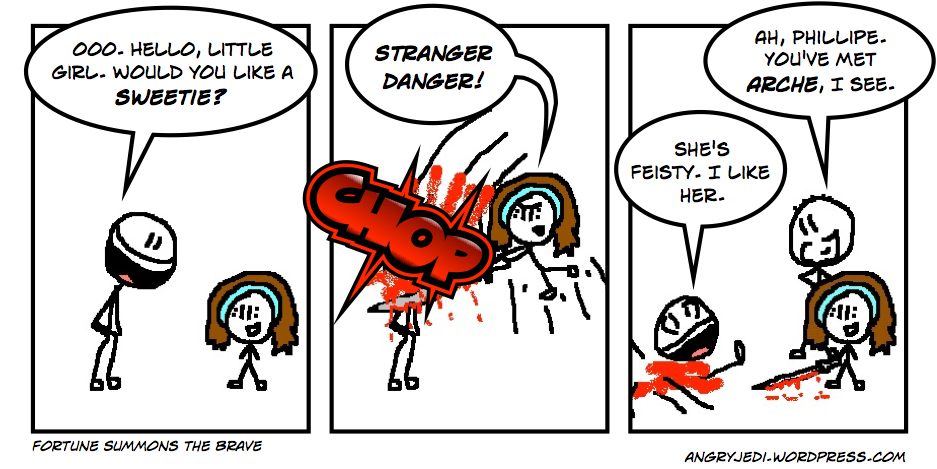
#oneaday Day 926: Fortune Summons the Brave

Having finished Chantelise the other night I decided to move straight on to the latest of Carpe Fulgur's translated Japanese titles, Fortune Summoners: Secret of the Elemental Stone. Unlike Chantelise and RecettearFortune Summoners was not originally developed by EasyGameStation, so I knew it was going to have some significant differences from the previous two games — I was curious to discover exactly what.

Fortune Summoners is a side-scrolling platform-RPG in which you play a prepubescent girl named Arche. Arche has moved to a new town with her family, and her father — an ex-adventurer — has decided to settle down with his wife and daughter, and open an item shop.

Arche is an endearingly ditzy little girl, charmingly naïve in the ways of the world. She's not very bright, she's terrible at arithmetic and she comes to her new magic school woefully unprepared, lacking the one component necessary for her to be able to begin her magical studies — an Elemental Stone. She does, however, have a strong sense of Doing What Is Right, and so decides not to mention the fact that she needs a stone to her family — who are somewhat lacking in funds due to their move and the start of their new life — and seek out one for herself. Thus begins an adventure that sees Arche discovering a great deal about the true power of the Elemental Stones and the origins of magic, accompanied occasionally by two equally prepubescent little girls.

If this all sounds terribly adorable, you'd be absolutely right. Like Carpe Fulgur's previous releases — and despite originating from a different developer — Fortune Summoners is awash with bright colours, squeaky Japanese voices and well-defined characters who all have their own distinctive personalities. Witnessing Arche's endearingly naïve responses to life-threatening situations never gets old, and her interactions with her party members and other characters is always a joy.

But beneath this brightly-coloured, charming exterior beats a heart of pure evil. Like ChanteliseFortune Summoners isn't afraid to drop-kick the player into a dirty toilet full of acid-tipped spikes and expect them to come out unscathed, undiseased and smelling of roses. This game is hard, and it is the very definition of "don't judge a book by its cover."

Each of Fortune Summoners' three characters has their own unique abilities. Arche specialises in swordplay, while her companions Sana and Stella provide backup with water/ice and fire magic respectively. It's possible for the player to switch between these characters at will, and during the game's dungeons this frequently becomes essential to progress. Sana, being a water mage, is able to breathe underwater using her magic, for example, while Stella is able to burn down obstacles with her command of the fire element. Arche, meanwhile, doesn't have access to magic for the vast majority of the game and thus is the "tank" of the group (and yes, the concept of a little girl being a tank is hilarious), with a higher hitpoint value, better defensive capabilities and an array of fighting moves designed to go toe-to-toe with the various horrible monsters that wander the countryside — and that none of the game's cast seem particularly concerned about. ("Watch out for the slimes on your way home!" says their teacher at the end of a school day. You'd think they'd arrange a bus service or something.)

Each of the game's characters make use of their abilities in a different manner. Arche, for example, can only swing her sword if she has drawn it first, which takes a valuable couple of seconds and thus is best done before combat rather than during. Following this, she can unleash various attacks by using Street Fighter-style direction and button combinations, allowing her to slash, thrust, use combination attacks, roll to evade, cartwheel backwards out of harm's way and leap down on an enemy from above for unblockable damage. There's a level of depth to combat that you don't normally see in 2D-perspective role-playing games — and the game will most certainly punish you if you don't get the hang of it, because wildly flailing at enemies will not get you far.

Sana and Stella, on the other hand, are better at hanging back and unleashing their magic from a distance. Sana has access to an icicle-flinging spell, for example, while Stella is able to create fire walls and homing fiery missiles. Sana also has a healing spell, which means she is really missed when you don't have her. Spells are cast by making them active from a "hotbar" (or toggling through them with a controller button) and then holding down the "attack" button until a magic circle appears. Getting struck while casting causes the spell to fail, so it's essential that Arche keeps the enemies occupied — or that the mages hang back before attempting to cast if, for whatever reason, they're going solo.

The surprising complexity of the combat system really gives the game a pleasing amount of depth, where it could have been something very "hack and slash". Instead, the game's sword-and-magic play becomes very technical, and almost Demon's Souls-esque at times. Different enemies require different strategies, and blocking is essential — though thankfully the game does come with a helpful "auto-block" option if you're not performing any other actions, which does make things slightly easier — though not by much. Once again, though, like Chantelise, this means that Fortune Summoners is only going to appeal to a particular type of person — the type of player who doesn't mind taking a bit of abuse from their games, and the type of player who doesn't mind practicing in order to get better. (They also have to be the type of player who doesn't mind playing as an adorable little girl, either, and there's not always crossover between all of the above criteria. I happen to find the concept of a monstrously difficult game starring three very girly young girls hilarious, however, so I'm sure there are plenty of other people like me out there.)

Fortune Summoners, then, is not for everyone — and unashamedly so. This is, of course, no bad thing, as we all know by now that attempting to appeal to everyone is a lost cause that ends up with you making the most generic, inoffensive thing possible as you pander to everyone's sensibilities. Fortune Summoners is for those who like a challenge from their games; for those who enjoy old-school sensibilities combined with the more complex gameplay or modern titles; and for those who have absolutely no issue with their on-screen protagonist being a loli.

If that sounds like you, then be sure to check it out here. (There's a free demo, too, and you can even transfer your progress from said demo into the full game.)

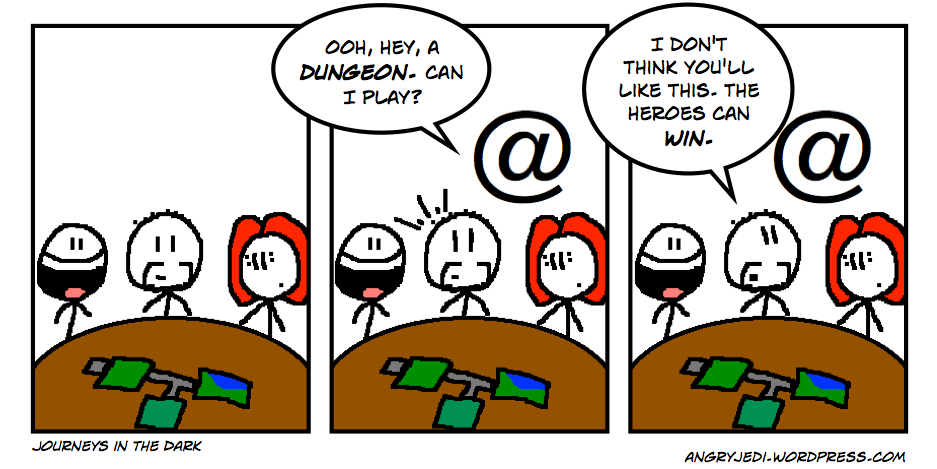
#oneaday Day 925: Journeys in the Dark

I remember catching a glimpse of the first Descent: Journeys in the Dark a good few years back now. It was when my friends and I were just starting to discover the joy of board gaming, and had been experimenting with everything from Risk to Space Crusade via Catan and several others. Descent was noteworthy for 1) coming in a massive box and 2) costing £60, which put it slightly out of "impulse purchase" territory. I mean, if it sucked, that was a lot of money and shelf space to have wasted.

I did some reading up on it, though, and found that it seemed to be a well-regarded game, and one of the favourite "dungeon crawlers" among the community. I kept an eye on it with interest, but never got around to picking up a copy.

A month or two back, I decided that I really actually quite did want to give it a try, so I paid a visit to a couple of online UK board game distributors that I knew of and tried to order a copy. It was, as Sod's Law tends to have it, nowhere to be seen.

A little research, and I discovered that the reason it was no longer available was because publisher Fantasy Flight Games was beavering away on a brand new edition. Descent: Journeys in the Dark Second Edition to give it its full, and rather grandiose title, in fact — hereafter referred to as Descent 2 to save my sanity. (Not to be confused with the video game Descent 2, however, which is something entirely different.)

Descent 2, it seemed, was to be a complete reimagining of the original game. The core mechanics had been overhauled entirely, a variation on the "campaign" rules from the original game's Road to Legend expansion were to be included as standard and a whole new series of quests was produced. And the whole thing somehow came in a box half the size of the original while still cramming in a ridiculous amount of cardboard and plastic.

I haven't played the original Descent so I can't comment with any authority on the differences between it and the follow-up. But I can comment on how Descent 2 plays, because we gave it a try last night.

I honestly wasn't quite sure what to expect. From reading the rules, it was clear that Descent 2 would be a little different from the other "dungeon crawlers" I've played in the past. It didn't appear to have the sheer brutality of DungeonQuest, the heavily random nature of Advanced Heroquest and Warhammer Quest, or the purely cooperative "GM-free" gameplay of Legend of Drizzt. And it was considerably more complex than Hero Quest, a game which brought many people to the genre in the first place — and one which they should really rerelease for the modern world.

In fact, I'd argue that calling Descent 2 a "dungeon crawler" is actually rather inaccurate. It's a competitive scenario-based strategy game in which a team of players (the "heroes") take on a single opponent (the "overlord") over a series of quests, with both sides gradually growing in strength as the campaign proceeds. (It's also possible to play the game's quests as "one-shot" adventures, but one would argue some of the satisfaction of watching your characters grow and evolve over time would be lost.)

Each of Descent 2's quests is actually made up of two separate encounters, with a couple of exceptions. Each encounter takes place on a prebuilt map, the entirety of which is visible to both sides from the start. Both sides are also fully aware of the victory conditions for the map, rather than the heroes having to explore and uncover the mysteries of the quest for themselves. And once play begins, it is full-on competition between the overlord and the heroes for supremacy.

That latter aspect right there is the key difference between Descent 2 and the previously-mentioned dungeon crawlers. In most cases, the "evil" player (the respective games' overlord-equivalent) acted as a facilitator, pushing the story forward and occasionally bending the rules in the player's favour if things looked like they might be getting out of control. (After all, where's the fun in composing an epic five-act quest if the heroes just get killed by goblins in the first dungeon?) In Descent 2, meanwhile, the overlord is trying their best to accomplish their own victory conditions, rather than simply trying to stop the heroes from accomplishing theirs. Notably, knocking a hero's health down to zero does not kill them off (unless the group is playing the final battle of the campaign) — it simply causes them to spend a turn knocked to the ground, hopefully allowing the overlord time to gain an advantage.

The campaign unfolds over the course of two three-quest Acts, with additional shorter introduction, interlude and finale quests at appropriate points. For each quest, the victor (be it overlord or heroes) is recorded, with the available quests in Act 2 being determined by who won corresponding quests in the first Act. It all comes down to the final battle in the end, though, because victory for the entire campaign can be secured by either side in both of the two finale quests, regardless of how well (or badly) they have done up until that point. A poor performance could put one side or the other at a disadvantage come this final battle, however, so it is in the interests of everyone to give each quest their all.

In terms of base mechanics during play, they are relatively simple but very flexible. Weapons and skills provide players with varying numbers of dice to roll in combat, with some dice having the potential to deal more damage, others specialising in "surges" (which can trigger special abilities) or ranged combat. There's a heavy degree of tactical play during each scenario, particularly in those where the heroes are accompanied by civilian characters and are also able to use them to their advantage. Should they get a civilian to close the door, forcing the slobbering monster outside to waste one of its two actions opening it again? Should they run away? Should they hide behind a hero or get as far away from the action as possible? Should the heroes defeat the monsters, or focus on the objectives? Is there time to pick up the hidden treasures scattered around the map? A Descent 2 encounter is a series of decisions like this, culminating in a charge for the finish.

So far we've played the introduction quest (which is very short and simple) and one of the Act 1 quests. Both seemed to be slightly weighted in favour of the hero players (though I may just be saying that because Overlord Pete lost both quests) but I'll be interested to see how the game evolves over time — both heroes and the overlord have the opportunity to spend experience points on new skills between quests, and the overlord's forces get an appropriate jump in power between Act 1 and 2. The game is also pretty well balanced according to the number of hero players, and from next session onwards we'll have an extra hero in play, so it will be interesting to see what effect that has, too.

The game was a big hit with the two other participants I played it with last night, and I'd only describe one of them as a particular enthusiast of the dungeon crawl genre. But there's the point, really — despite Descent 2 featuring a variety of dungeons, and quests, and equipment, and monsters, and experience points — all things readily associated with "dungeon crawling" — it's really more of a scenario-based battle game. And it's all the better for it. It's easy to understand, surprisingly quick to play, and very satisfying. Also, the dynamic nature of the campaign means that it has a lot of replay value, too. A single campaign playthrough is supposed to take about 20 hours in total — multiply that by all the possible combinations of quests that you can play throughout and there's an impressive amount of content in that box. And, if Descent 2 is anything like its predecessor, it will enjoy a healthy amount of official expansions and fan-created content, making it all but certain to keep a regular place in gaming groups' rotations for months and years to come.

#oneaday Day 923: A Tale of Two Sadistic Sisters

Something convinced me that it was time to finally go back and finish Chantelise: A Tale of Two Sisters. It's been almost a year since I actually purchased that game, and it's been mocking me from my Steam list ever since, reminding me of how much I loved Recettear: An Item Shop's Tale, which was developed by the same team, and localized by the (different) same team.

For those unfamiliar with Chantelise, it's a peculiar beast indeed. In its native Japan, it was Recettear's predecessor, but localization team Carpe Fulgur brought it to Western audiences after Recettear. This had the unfortunate side-effect of giving people perhaps unreasonably high expectations for it when it came out, since Recettear was pretty much universally loved by everyone who has ever come across it. In Japan, there was a noticeable upswing in quality and creativity between the two games; over here, people misinterpreted Chantelise as being a step backwards, since it appears at first glance to be much simpler and shallower than its shop-running successor.

After over 12 hours with it (probably about 15 in total — I started again for this play sesssion) I can say with some confidence that Chantelise certainly isn't a shallow game, it's just very, very different from Recettear. You can see how people would get confused, however, since a good 90% of the graphical assets are shared between the two games, and  the music for the final dungeon in both games is almost (but not quite) identical. When you consider this, it becomes easier to see why everyone had such lofty expectations for Chantelise and were then disappointed when it wasn't what they expected.

Note: "not what they expected" is not the same as "inferior", though some chose to interpret it that way. While Recettear was an accessible, adorable game combining action-RPG dungeon crawling elements with a simple business management sim (and a surprising amount of hidden depth for those willing to jump down that rabbit hole), Chantelise initially appears to be a rather straightforward action-RPG. Hack, slash, rinse, repeat. Job done.

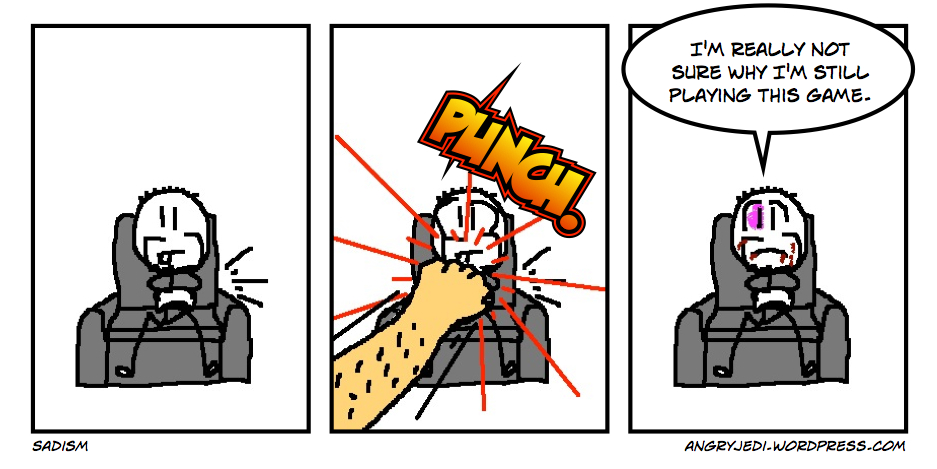
And while there certainly is an element of mindless hack and slash to Chantelise's gameplay, the game has a sadistic streak in it that I haven't seen since Dark Souls. If you do not learn to play Chantelise properly, the game will punish you and send you back to the start of the area you've been challenging, effectively putting a big red "X" through your homework and telling you in no uncertain terms to "DO IT AGAIN! BETTER!" And, assuming you're not the sort of player who gives up after suffering a setback like this, you will get better, because the game will keep punching you in the face until you understand what it's trying to tell you.

You see, while Chantelise may initially appear to be a simple hack-and-slash RPG there's actually a considerable amount of depth that many commentators don't give it credit for. The fact that protagonist Elise doesn't level up traditionally, for example — all modifications to her stats are achieved through equipment, and she gains HP through finding or purchasing special medicine. Finding the correct combination of equipment to make it through a particularly challenging stage is key to victory in Chantelise — some stages will require that you buff up your physical defense; others will practically require the use of an elemental crystal to defeat monsters with resistances; others will need you to focus on magic. As you progress through the game and defeat bosses, Elise gains the ability to equip more items simultaneously, allowing her a substantial increase in power.

The game's magic system is an interesting aspect of gameplay, too. Rather than simply allowing Elise and her companion fairy Chante to cast spells as they please, they have to pick up coloured magic crystals in order to cast spells. Each crystal corresponds to an element — red for fire, blue for water and so on. The twist comes when you use more than one crystal at the same time. Using two, three or four of the same colour produces different spells with different effects — for example, one yellow crystal produces a metal ball that spins around Elise for protection, two causes her to gain a great deal of defensive power and resistance to being knocked back, three causes her to drop a giant boulder on her enemy and four summons an earth elemental who casts the other three spells at random for a short period.

But then there's spells the game doesn't tell you about. Augment the "two yellow" Super Armor spell with two red crystals, for example, and Elise gains a large amount of both attack and defensive power. Use of this spell is an absolute necessity in the later stages of the game, but it will only be discovered through experimentation (or reading an FAQ), because the game sure isn't going to let you know about it. Similarly, the game doesn't tell you that equipping a Darkness Crystal and hitting a baddy with a "charged" attack will drain health from the enemy and give it to you, making it a very efficient means of staying alive against baddies who do lots of damage.

All these factors — the surprisingly brutal difficulty; the uncompromising, punishing nature of the game; the hidden depths of the game's various systems — combine to make a game that is very much an acquired taste, but one that is infinitely more satisfying than it first appears, assuming you find those aspects of it palatable.

In short, it's not Recettear. It's not easy (not that Recettear was, particularly — though with enough determination and patience you'd make it through eventually). It's not traditionally "accessible" despite the simplicity of its controls. It doesn't give up its secrets easily. And it wants very much to hurt you, make you scream, and cackle maniacally as you fling your controller across the room at your fifteenth death that session. Yet it does this with the same veneer of adorable characters and a compelling "small-scale" plot, just as in Recettear. You can see why people got confused.

In summary, then, is Chantelise a bad game? Its Metacritic score certainly seems to suggest so, but as we established a while back with Nier, a Metacritic score is absolutely not a reliable metric as to whether or not a game is "worth playing". And such is the case here — though I certainly wouldn't recommend the game to everyoneIf, however, you fall into that category of gamers who enjoy being punished by their games and figuring out how best to make use of the seemingly-simple systems with which you've been presented, then you should certainly check it out. If you feel like doing so, here it is.

#oneaday Day 922: Interactive Tales

As you may have realised if you read my lengthy series of pieces about Katawa Shoujo (and one about Kana Little Sister, which I really must get around to replaying), I am a big fan of the "visual novel" genre, a style of video game that tends to be big on story and light on interaction.

I came to this genre through the Ace Attorney series, which remains one of my favourite video game franchises of all time. (Hurry up and release those iOS remakes, Capcom!) Phoenix Wright and its sequels combined the strong sense of narrative, puzzle-solving and dialogue choices from adventure games with a style of presenting the story that really allowed you to get in close with the characters, giving you a real sense of what made them "tick". Audio-visual presentation was very simple, with detailed anime-style characters overlaid over static backdrops, and a large degree of imagination on the part of the player being required.

Ace Attorney is a relatively good entry into the visual novel genre because it's fairly family-friendly (despite being based around solving a variety of murder cases) and doesn't delve into the less salubrious side of things that some of the more "niche" titles explore. There's no fucking in it, basically, despite Franziska von Karma's clear tendencies towards S&M.

I've talked extensively about Katawa Shoujo in the past, so I won't delve into that too much here, but I did want to mention a new acquisition which showed its face on my doorstep today. School Days HQ from JAST, which is apparently a remake of an earlier title of the same name, and an adaptation of an animé I know nothing about aside from something to do with "nice boat". Or possibly some other combination of those things. I'm not sure.

School Days is an unusual visual novel in that it's fully animated. Yes, rather than watching static images and reading mountains of text, the game is essentially an interactive, episodic animé series, where the player watches what unfolds and occasionally makes choices that direct the path of the story — choices that, unusually for the genre, can include remaining silent through inactivity. Structurally, it's identical to something like Katawa Shoujo — decision points branch the narrative down various "paths" leading to either "good" or "bad" endings, and the game client is set up in such a way as to easily allow players to "rewind" and try other choices — the virtual equivalent of putting your fingers in the possible pages you could turn to in a Choose Your Own Adventure book.

I've only played the first of the game's episodes so far, but the setup is intriguing — and, as with most visual novels, pleasingly mundane. Makoto likes Kotonoha. Kotonoha likes Makoto. Both of them are too shy to do anything about it, so in steps Sekai, Makoto's classmate, who manages to get the two of them together but steals a kiss from Makoto as "payment" for her services. Already there have been a couple of hints about Sekai being dangerously unhinged, so I will be very curious to see how the inevitable love triangle unfolds.

But anyway. I'm not here to talk plot. I'm here to talk about this style of game, and wonder what happened over the course of the last twenty years to make it "okay" to develop a narrative-focused game in which the player's interaction is largely limited to occasional choices.

You see, I vividly remember back in the late '90s when the CD-ROM revolution started. The vastly-superior storage capacity of CDs allowed developers to put a whole bunch more content in their games than was previously possible. One of the most common uses of this space was full-motion video — real actors performing scenes in games. And thus, the "interactive movie" was born. The exact implementation of the "interactive movie" genre varied from traditional adventure games which happened to include full-motion video (Sierra's Phantasmagoria and Gabriel Knight: The Beast Within spring to mind here) to titles which already had designs on movies taking the next step (say hello, Wing Commander III and IV) and, at the far end of the spectrum, games that were quite literally movies that sometimes stopped for — you guessed it — the player to make a choice. (Submarine-themed game Silent Steel is the first game of this type that I remember.)

At the time, the latter option was ridiculed for offering only the most rudimentary of gameplay while flaunting the new technology unnecessarily — and often making it painfully apparent that most game developers didn't have the same budgets as movie studios. (How times change, huh?) But now, this style of gameplay has become a firmly-established genre, particularly in the Japanese market, with a little spill-over into the West thanks to publishers like JAST and hard-working enthusiasts like Four Leaf Studios, the crowdsourced team behind Katawa Shoujo.

I'm not complaining, really — I must confess that even in the late '90s I found interactive movies to be something of a guilty pleasure, despite their poor reviews — but I find it interesting that a style of play which many commentators at the time believed would be nothing more than a passing fad is now a firmly-entrenched part of the landscape of gaming. A niche part, sure, but one that certainly doesn't appear to be going away any time soon. School Days is an interactive movie, and unashamedly so — it has rewind and fast-forward buttons at the top of the screen, for heaven's sake — and there certainly seems to be plenty of people clamouring to play it.

Naturally, the apparently popularity of School Days is nothing to do with the fact that it, unlike Ace Attorneydoes have fucking in it. (I also discovered post-install that it supports a USB-connected wanking machine (yes, really, and no, you probably shouldn't click that link at work), which is a mildly terrifying prospect in and of itself. No I don't have one.) Actually, it might be, though perhaps not for the reasons you're doubtless thinking of right now. The visual novel genre represents a sector of gaming that is absolutely unashamed to deal with issues that would be unpalatable to mainstream publishers (and possibly consumers, too). It tackles adult issues — sexuality in its many forms, violence and people acting like people rather than game characters — and does so without patronising the player or being "preachy", unless of course the story calls for it to do so for whatever reason. While there will undoubtedly be those who come to School Days purely to get their rocks off — and the game caters to those people by allowing the sex scenes to be viewed again once they have been "unlocked" in the story (that and the wanking machine compatibility, of course) — I have a sneaking suspicion that a lot of people are attracted to titles like School Days and indeed the visual novel genre in general because, for the most part anyway, it treats them like adults.

Which, coincidentally, is something that a lot of interactive movies failed to do. The lack of budget that many of these titles suffered caused them to feel cheap and nasty, and any violent, sexual or otherwise graphic scenes tended to come across as rather laughable rather than an integral part of the story. Phantasmagoria, for example, featured a "rape" scene that was badly handled and clearly put in purely for shock value. Mention of this notorious scene made up a significant proportion of the game's viral marketing, though when it actually came down to it, it was terribly executed, poorly acted and had the complete opposite effect to what such a scene should have. Instead of being horrifying, traumatic and, most importantly, mature, it was just laughable, embarrassing, dumb. Compare and contrast, meanwhile, with a number of very uncomfortable scenes in, say, Katawa Shoujo (and I'm guessing the later stages of School Days, given the fact that it carries a warning for "violence" as well as "sexual content" on its box), all of which were thought-provoking, respectful of the player's intelligence and had a strong, real impact.

As I drift further and further away from the "blockbusters" of the games industry to get my entertainment, it pleases me that certain barriers seem to be gradually collapsing. While once the prospect of playing an "eroge" visual novel would be shameful, now people will happily and freely admit to it — thanks, at least in part, to a much better cultural understanding of the difference between "porn" and "containing erotic content". (That said, people are a lot more open about their porn consumption these days, too.) While I wouldn't recommend titles like School Days or Katawa Shoujo to someone not mature (or open-minded) enough to be able to handle their content, I'm very happy that they exist, providing true entertainment for adults without any of the associated skeeziness of porn.

(I can't get away from that wanking machine option in the menus, though. That's just odd. Does the game prompt you when to get your knob out? And how do you… oh, no. Never mind. Probably best not to think about it too much.)

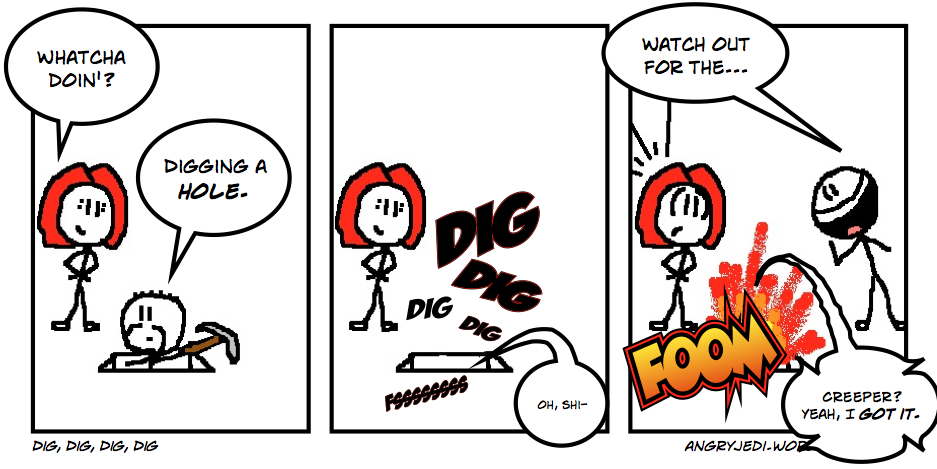
#oneaday Day 918: We Dig, Dig, Dig, Dig...

Yes, I've been playing Minecraft again, thanks largely to several members of the Squadron of Shame finally biting the bullet and jumping on the bandwagon. And, once again, I am rediscovering the sheer joy of that game.

The first time I played Minecraft I wasn't overly enamoured with it. Not because of the deliberately lo-fi graphics — on the contrary, I found them highly endearing — but because I had literally no idea what I was supposed to do, and at the time I started playing, it was largely up to the player to either work things out for themselves or refer to a wiki. Nowadays, of course, there are achievements to guide your early days in the game and basic techniques are practically common knowledge — the Xbox version also removes the need to remember the specific "patterns" to craft tools altogether, making it even more accessible and a great jumping-on point for those who have no idea what Minecraft is all about.

After spending a hefty proportion of time in Minecraft's many pixelated, blocky worlds, however, that sense of "what on Earth do I do now?" is, as it turns out, precisely what appeals to me about the game. I have no goals aside from the ones I set for myself. There is no "end" to the game aside from the time when I wish to stop playing. (Well, technically that's not quite true — you can "finish" Minecraft through a long and convoluted process culminating in a difficult boss battle against a giant evil dragon thing. But you can carry on playing after that.) The world is different each time I start a new game. And therein lies Minecraft's biggest joy.

Minecraft is like being a kid again, assuming you were a kid who never had to get home in time for dinner, and a kid who was trusted with various sharp implements. Minecraft taps into that youthful desire to explore, to discover, to see what's over that next hill, around that corner, on the other side of that sheer rock face. It taps into that youthful fear of being lost in the middle of nowhere and having no idea of how you're going to get back home. And, like those youthful expeditions into forests and caves, it's much more fun with friends.

Minecraft is what you make of it. I currently play on two multiplayer servers — one with a small group of "real-life" friends and the other with a group of people I primarily know online — the aforementioned Squadron of Shame. The differing approaches we take on each server are very interesting, and represent two very different social dynamics.

On my "real-life friends" server, everyone quickly staked their claim to their "territory" and built something big and impressive there to mark it. Tim built a huge castle; James built a wizard's tower and network of connected walkways with giant mushrooms (plus a huge tree made of trees); Andie built some quaint (and practical) little houses; and I built a large, experimental pyramid-like structure and enormous, intricately-carved bridge.

On the Squadron of Shame server, meanwhile, things were a lot more cooperative from the get-go. I was one of the first people on the server, so I took the time to establish a basic base camp — wooden hut with crafting table and furnace, sufficient to last the night. Over time, and with the assistance of others, this hut expanded with an extra room containing beds, and a large mine beneath it. Other structures sprang up nearby until our improvised "base camp" started to look like a small village. I built roads in every direction as I explored, and others followed suit to help us find our way to various impressive landmarks. When we found a cool piece of randomly-generated scenery, we talked about it as if it was a real place. Other "citadels" sprang up around the map, and we as a group went further and further afield. I constructed some kick-ass bridges.

In both cases, the world feels alive — because it is alive. It's constantly growing and changing according to how far people have explored and what they have built. It's an immensely satisfying experience to know that you've played a part in the shaping of a virtual world, whatever your contribution and whatever your particular skill sets might be. In many ways, it's similar to the satisfaction of playing an active role in something like Second Life, which I've been known to spend time in in the past, and which I once referred to as "taking a walk through other peoples' imaginations". The key difference here, though, is that Minecraft has a great deal more immediacy than Second Life — and considerably fewer prostitutes.

So if you've been holding off on playing Minecraft, I suggest you give it a shot — preferably with friends. If you have no idea what you're letting yourself in for, fire up the Xbox version and play online or in split-screen. When you're ready, grab a copy of the full experience on PC and prepare yourself for the most immersive game world you'll ever experience — the one you helped create.

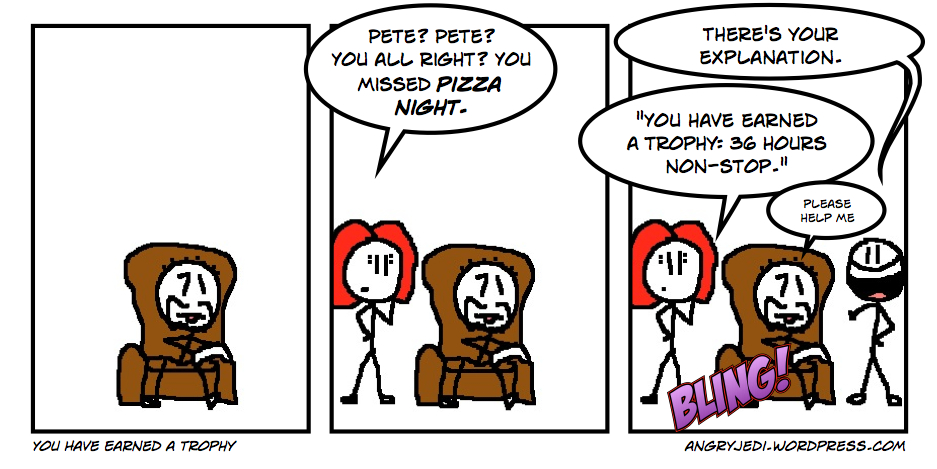
#oneaday Day 916: You Have Earned a Trophy

I go back and forth on whether or not I like Achievements/Trophies/equivalents. Sometimes I like them. In Diablo III, for example, they became an addictive metagame once you'd ploughed your way through the main (rather predictable and marginally disappointing) story. In World of Warcraft, they provide a wide variety of things to do that reward you with tangible things with which to outfit your character. In The Secret World, they're a handy way of tracking what you have and haven't done.

But in other cases — typically in story-heavy games — they just make the sense of ludonarrative dissonance even more pronounced than it needs to be. The most egregious example I can think of was Oblivion, in which I raced through the various Guild questlines in order to get all the achievements, then the Shivering Isles expansion, then the main quest. By the end, I had all Oblivion's achievements, but had completely lost all sense of that thing that made The Elder Scrolls series special — that sense of you being a character and forging your own path in the world as if you "lived" there. Instead, all I had done was follow a checklist. It ruined it. And it soured me on Skyrim somewhat. (Well, that and the realisation that Bethesda RPGs have great worlds but some of the worst characters and storytelling in all of gaming. But that's another matter altogether.)

At the moment, I'm playing Yakuza 3. The joy of the Yakuza series is, like its spiritual predecessor Shenmue, exploration and discovery giving you a sense of immersion in the game world. What's down this side alley? Oh, it's an arcade! I wonder if I can play the arcade machine? Oh, I can! That's kinda cool. I wonder if the crane game works? Yes it does! Awesome! Oh, hey, there's an irritable-looking lady, I wonder what's wrong with her? Oh, she's had her bag snatched… etc. etc.

Since Yakuza 2, the series has had a "completion" menu that taunts players with how many sidequests they've completed, how many cabaret girls they've romanced and what foods they've eaten in restaurants. After 40 hours of Yakuza 2, I had beaten the main plot but apparently only "beaten" 33% of the game. I didn't feel short-changed, as a lot of the stuff I'd missed was simply eating as much food as possible and playing some minigames that, while fun, weren't the reason I was playing Yakuza.

Yakuza 3 compounds this problem with a Trophy list. Not only do you have a "completion" menu now, but you also have an actual checklist of Things to Do. I wouldn't mind so much if these trophies simply tracked your progress through the game, but when they demand that you spend time playing indecipherable Japanese board, dice and card games in order to score some sort of virtual trophy, that pulls me right out of the experience. It puts me in a quandary while I'm playing — "should I go and do this stuff I don't really enjoy just to get a trophy?"

The answer, of course, is "no". There is no sense in playing a game if it's not enjoyable — unless, of course, it's something like Pathologic, in which case its sole reason for being is to be less than enjoyable — but I continually see people who insist on "Platinuming" or "1000Ging" their games and feeling like they've short-changed themselves if they don't. That's fair enough, and of course it's their call if they choose to do that, but the fact is that in most cases, it becomes abundantly clear that these people are not having any fun. By following these arbitrary checklists, they are voluntarily sucking the fun out of a game that might have been a favourite.

"Oh, but chasing the trophy list is fun in itself," you might say. And for some people it might be. But for the trophy whores I follow online — who, for all I know, could be in the minority, I'll admit — pretty much every single one refers to their relentless pursuit of Platinum/1000G as "work", a "slog", a "grind", and they express relief rather than joy when it's done. That, to me, is just bizarre. Why continue doing something long after it has ceased to be fun in the pursuit of something intangible that, in most cases, doesn't benefit your in-game experience at all? Are we so vain that we need to brag about the fact that we started ten fights in first-person mode (an actual achievement in Yakuza 3) or that we spent three hours mastering an ultimately-irrelevant darts minigame just so that we could get a "hat trick" (another actual Yakuza 3 achievement)?

Apparently we are. I'm not judging you if you're one of those people who likes (if that's the right word) chasing Platinum trophies. I'm saying that I find it completely unfathomable. I have no desire to grind my way through abject tedium purely so I can get a differently-coloured virtual trophy that no-one will look at or care about. I don't beat a game, look at that trophy list and feel I've not had my money's worth if I haven't got 100% of the game's trophies. I beat a game, roll the credits and then, in most cases, move on to any one of the bajillion other titles waiting on my Pile of Shame — which, I have to admit, has only got bigger during the recent Steam summer sale.

It's easy enough to ignore Achievements and Trophies, I guess, and they certainly don't hurt anyone. But I kind of resent the "torn" feeling they give me when playing a title like Yakuza 3. I'd much rather they not be there at all than pull me out of the experience by making me wonder whether or not I should be seeking out locker keys, cabaret girls, karaoke bars, dartboards… you get the idea.

My favourite implementation of achievements in a narrative-based game? Deadly Premonition, which rewarded you with one achievement per completed chapter, one for completing 100% of its sidequests and one for completing it on each difficulty level. That's how it's done. I don't need any more incentive than that. Build your reward structure into the game and build the achievements around that — don't give me a list of arbitrary objectives that don't actually improve my game experience at all.

Achievement whores, I salute you. I'm a patient sort of guy in most cases, but you guys must be like saints.