1445: From the Game Shelf: Dungeonquest

[As promised, here is the first instalment in a series of posts exploring my collection of board games. I'm not making any promises as to how regular these will be since they're a fair amount of work to put together, but ideally I'd like to cover everything on my shelf and hopefully provide a few of you with some ideas as to what games you might want to try with your friends sometime. Here we go with the game that happened to be in the top-left corner of the shelf, Dungeonquest.]

Dungeonquest ('80s Version)

Publisher: Games Workshop
Designer: Dan Glimne and Jakob Bonds
Released: 1987
Players: 1-4
Recommended ages: 12+
Play Time: 1 hour

Theme: Fantasy
Mechanics: Tile-laying, exploration, press-your-luck, player elimination
Co-Op or Competitive: Competitive, asymmetrical player abilities
Randomness: Very high
Luck factor: Very high
Strategy: Minimal
Interaction: Moderate

IMG_2708

Dungeonquest is a simplistic dungeon crawler originally from Games Workshop back when they still made board games. It is a dungeon crawler in the purest sense of the word, though it bears little relation to Games Workshop's other well-known dungeon-centric games such as Hero Quest, its Advanced counterpart and the later Warhammer Quest aside from a heavy focus on random generation and a necessary reliance on luck. The version I'm exploring here is from the late '80s; Fantasy Flight Games have since revamped the game to a considerable degree and set it in their "Terrinoth" campaign setting along with tweaking, improving and outright changing a number of the mechanics described here.

In Dungeonquest, you take on the role of one of four different heroes who are attempting to raid the ruins of Dragonfire Castle. As you might expect, Dragonfire Castle plays host to a dragon — and as every good adventurer knows, where there's a dragon, there's treasure. As such, your aim is to get in to Dragonfire Castle, pinch as much loot from the dragon as you can and get out again without getting horribly killed by something or other.

It is, of course, not that simple, and more often than not you will find yourself getting horribly killed by something or other.

How it Plays

The basic mechanics of Dungeonquest involve drawing a face-down tile and placing it off one of the entrances to the room you're in, then moving into it. According to the type of room drawn, various things might happen. Normal rooms have nothing special about them, but may be searched. They also force you to draw a Room card, which may force you into combat against a monster. Certain Room cards allow you to draw other cards relating to looting corpses or crypts for treasure — but there's no guarantee you'll find anything, and there's a chance you'll end up hurting yourself in the process.

IMG_2711

Combat is resolved through a rock-paper-scissors contest against another player — you and your opponent each have a choice of three moves, and the combination of your two respective choices will determine who gets hit and how much damage they take according to a chart on the board. Depending on the group you play with, this will either end up being completely random or a brain-frying battle of wits.

Special rooms vary from a bottomless pit — which you must pass an Agility test using the dice to survive, else forfeit the game — to rotating rooms that immediately spin through 180 degrees once you enter, potentially trapping you in a dead end.

The aim of the game is to make your way to the dragon's lair at the centre of the board — not necessarily as easy as it looks, depending on the room tiles you draw and the merry path they lead you — and steal its treasure. Acquiring treasure is a press-your-luck challenge in which you take treasure tokens and then draw dragon cards, hoping that the one you draw doesn't depict the dragon awakening. The longer you stay gathering loot, the fewer cards there are to draw and consequently the greater chance you'll be roasted alive.

IMG_2710

Once you've stolen the treasure, in order to be credited for it and potentially win, you have to get back out of the dungeon before the turn timer expires. This makes for a minimal amount of strategy — in other words, determining how many turns' grace period you have before you need to start heading homewards. Alternatively, you can risk trying to escape via an alternative route. Both options usually end in failure.

The winner of the game is whoever is not dead when all players have either escaped or died, and who has most treasure out of the survivors. Since it's rare for anyone to survive, you may wish to implement a house rule determining who the winner is in case of everyone being dead.

Bits and Pieces

As you might expect from a Games Workshop game, Dungeonquest features some high-quality miniatures to depict the heroes, but these are by far the best quality components in the game.
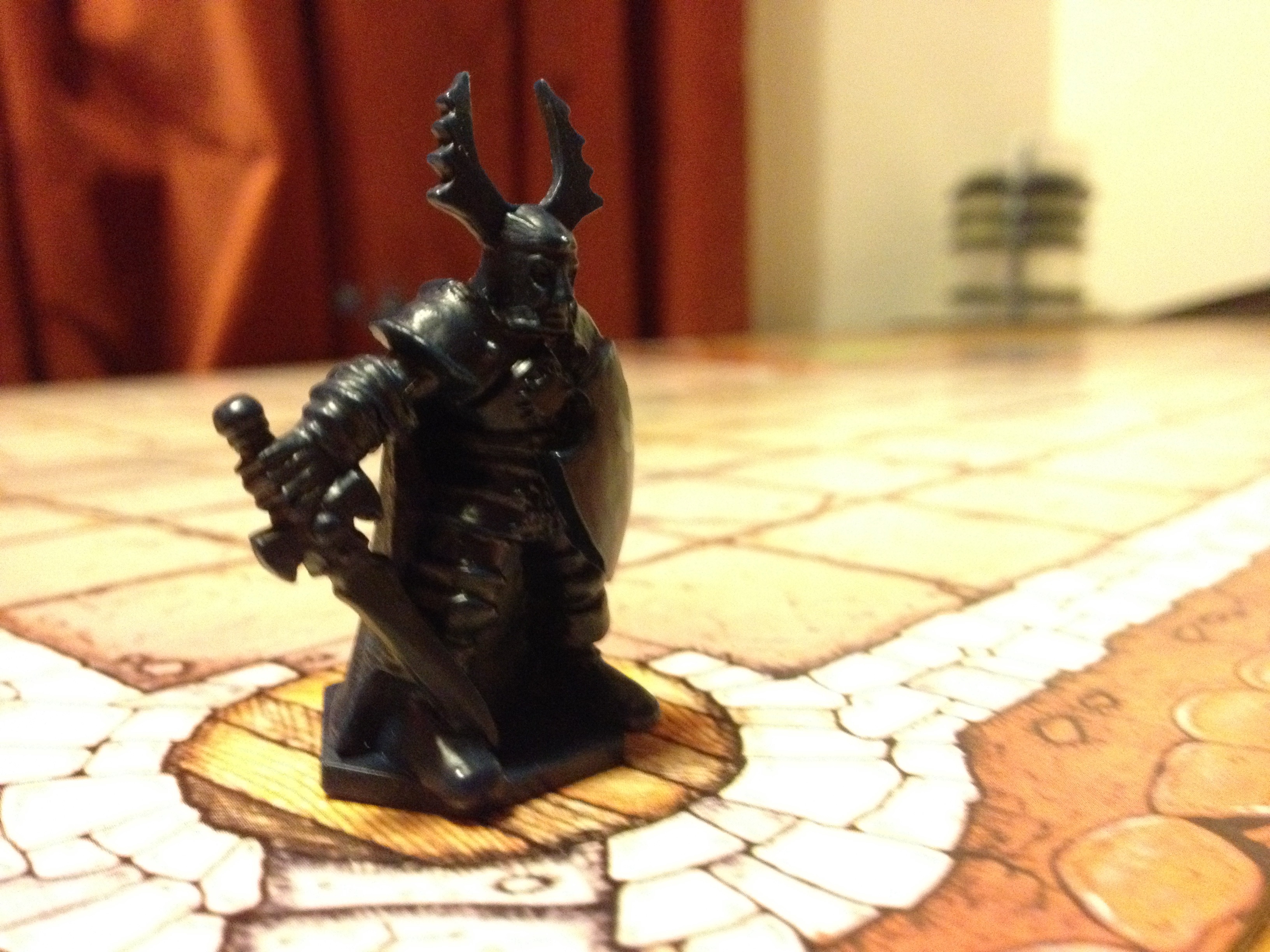
IMG_2709

The board itself is made up of six interlocking pieces, and its rather thin nature makes it somewhat prone to warping. This is a bit of a problem considering the number of things you need to lay on top of it over the course of a typical game.

The cards, which sport some gloriously '80s fantasy artwork, are made of thin, flimsy cardboard and are all a little too small to be comfortable. Each deck is its own distinctive shape, too, and while it is thematically rather fun to draw "crypt" cards from a coffin-shaped deck, this makes storage of the cards a little awkward, particularly given the lack of an insert in the box. This is a game in which all its components absolutely need to be bagged and stored separately from one another if you don't want to spend longer setting up than playing.

Is it Fun?

Dungeonquest is not a game to be taken seriously. There's no persistent progression of characters — they don't survive long enough for that — and there's nothing to do with the treasure save winning the game. Its highly luck-based nature makes it impossible to devise strategies for, so it's more a game for groups that don't mind a high amount of randomness — and groups that don't mind losing.

It's also not very well balanced. Certain characters have a significantly higher chance of survival than others — there's one for whom a bottomless pit tile is almost-guaranteed unavoidable death, for example, and others who have a tough job surviving the amount of damage the average player takes on a run into the castle.

IMG_2712

The game makes for good stories when everything goes wrong if nothing else, and it's undoubtedly fun from a "one disaster after another" perspective, but for those players who want to get their teeth into something a little meatier or more strategic, it's probably one to pass by.

So yes, it is fun; it's just not something you'll probably want to play week after week. It's an enjoyable game for a drunken beer-and-pretzels sort of evening; just be sure to have something with a bit more depth up your sleeve to play afterwards. Or perhaps before!
1441: Panic!

Having tried Escape yesterday, Andie and I gave Castle Panic a go earlier. Despite the title, it's a somewhat more sedate affair than Escape, though you're still dealing with difficult odds and a distinct chance of being horribly defeated at any point.

Castle Panic is a cooperative game in which you and up to five other players are tasked with defending your castle from an incoming onslaught of goblins, orcs and trolls. Your castle is made up of six towers, each of which has a wall protecting it. Lose all the towers (but not necessarily the walls) and everyone loses; get through all the monster tokens and kill everything and everyone wins, but whoever scores the most points wins slightly more than everyone else.

Gameplay is pretty straightforward. The board is split into three coloured sections, each of which is subdivided into two numbered areas and five different rings. The outermost ring is the "forest" surrounding the castle area; the next three rings represent the effective ranges of your archers, knights and swordsmen respectively; the innermost ring is inside your castle walls and is where you're trying to prevent the beasties getting to.

In order to deal with the incoming hordes, you need to play cards from your hand. Many of these take the form of a coloured archer, knight or swordsman, which means you can deal one point of damage to a monster in the appropriately coloured section of their respective ring on the board. Different types of monster take different amounts of damage — goblins only take one, for example, while trolls and some "boss" monsters have three and orcs have two.

There's a selection of special cards in the mix, too — a "lucky shot" card allows a monster to be outright killed rather than damaged when used in conjunction with an appropriate card; "hero" cards can attack any ring in one coloured area of the board; barbarians can attack enemies who have managed to breach the castle walls.

Each turn, more and more enemies show up to make life difficult, and the enemies already on the board move in by one ring. If they hit a wall, they destroy it and take a damage, and likewise for the towers. Certain monster tokens cause more monsters to show up, or move further than they would normally, or rotate around the board. Giant Boulder tokens roll across the board, killing everything in their path but also destroying the first wall or tower they meet, making them something of a mixed blessing.

Andie and I won the game we played earlier, which surprised me somewhat — I'm used to cooperative games smacking me about somewhat more than this one did, but it may have been a lucky combination of card and monster token draws.

I'm interested to try the game with more people, since then you have smaller hands of cards but are able to trade more cards with people at the start of your turn.

It's an interesting take on cooperative because there's a competitive element, too — while you're all working together for a common goal, there is a scoring mechanic to encourage you to try and be the "best", too. This somewhat discourages the "alpha player" problem that some cooperative games suffer from, in which one player takes charge and orders everyone else around. In Castle Panic, there's not so much scope for that to happen and turns are pretty quick, so everyone can feel like they're contributing.

It's a good game, in short. I'm looking forward to trying it some more.

Talking about all these board games has given me a blogging idea for January — I'm thinking I might go through my collection and compile some detailed posts on selected (or perhaps even all!) of the games I own, sharing some thoughts, images and details on them for those curious. I have a pretty decent collection now, and it would be nice to do it justice with some more detailed posts. So look forward to that!

1440: Escape!

I spent some of my Christmas money today on some board games — I grabbed Castle Panic, which I've never played but which I understand is an enjoyable moderate-length game that isn't horrendously complicated, and Escape, which I hadn't heard of prior to today, but which came recommended by some board gamers I follow on G+.

Escape is a really interesting game, as it happens, and I'm looking forward to trying it out with various different group sizes. Andie and I gave it a shot today, initially not quite sure what to make of it, but after a third playthrough — a game is only ten minutes long — we nailed it.

Escape is a cooperative game that unfolds in real time. You and your compatriots play intrepid explorers who have gone and got themselves stuck in the middle of a temple, with no idea of where the exit is. (Presumably they fell in through the ceiling or something.) It's your job to find the exit, then exit through it. Simple, right? NOPE.

The temple, being a mysterious old temple, is cursed, and in order to be able to escape you need to not only find the exit, but also activate some magical gems along the way. Each gem you activate makes it easier to escape, but attempting to activate them takes up valuable time.

Almost everything you do in Escape hinges on the roll of the dice. Each player has five dice they can roll, and there's no need to take turns — you just keep rolling until you get what you want, and you can set aside dice that you haven't used to perform an action. Roll a black mask, however, and that die is out of commission until you roll a golden mask to return up to two of your dice to play. If you're in the same room as another player, you can use your golden masks to "heal" another player's dice, too, so it's in your interests to team up rather than get too far apart.

Activating the gems is generally a matter of rolling a certain number of either torch or key symbols. Certain rooms allow you to activate multiple gems in collaboration with other players by pooling your dice, but obviously rolling 10 of one symbol is going to be a little more time-consuming than rolling, say, 4, so you have to weigh up the risks and potential rewards.

Just to add a little more stress to the mix, at two points during the ten-minute play session, a gong sounds, and then you have a short span of time to get back to the central chamber or lose one of your dice permanently. Conversely, if you manage to escape before someone else does — by both finding the exit and then rolling as many keys as there are gems left in the pool, plus one — you can give one of your dice to another player. If you haven't all escaped by the time the third gong and countdown ends, you all lose, regardless of how many people have escaped.

Escape makes use of an audio CD to manage the time limit, but also provides a sand timer for when you're playing in quieter environments. The CD is a lot of fun, though, being full of ambient noise and dramatic stabs when you're all racing back to the central room. It reminds me of the somewhat more complicated Space Alert, another cooperative game that involves working together against a tight time limit — unlike Space Alert, however, which unfolds in hilariously painful slow motion after the CD is over, Escape happens in completely real-time, which takes a certain degree of getting used to but gives it a pleasingly enjoyable, frantic feel to it.

Looking forward to trying it some more and adding the "Curse" and "Treasure" modules for additional complexity and strategic options. In the meantime, if you're looking for a super-quick game to hit your table as a filler or warmup, it's well worth a look.

1429: Call me Farmer Heathcliff

Before we get started, a shout out to the person who found this blog by searching for "are there any games on facebook that arent crap" [sic]. In answer to your question, good sir and/or madam, the answer is "no". Thank you for your time.

Right then, to business.

Tonight we played a game of Agricola: Farmers of the Moor, the expansion to Agricola. Agricola is still not my favourite game in the world, but the expansion does add some interesting new elements to it — and, crucially, multiple ways to do well. By way of example, the top two players out of our four-player game this evening scored 61 and 60, adopting two totally different approaches to one another. (I came third, with 27 points, but at least I didn't come last, which I count as a personal victory.)

My difficult with Agricola is a matter of prioritisation, and of finding an efficient strategy to do the things I want to do. I get that you should spend the early game building a house, the mid-game building up your family and the end-game racking up as many points as possible, but I find it very difficult to determine what are the best possible actions to achieve those things, and on top of that, what the best Occupation and Minor Improvement cards to achieve those things might be. My tablemates are always talking about "synergies" and "combos" but I have real trouble spotting all but the most obvious combinations.

I know that part of the problem is that I just haven't played it enough compared to them. I should get in more practice with my own copy — yes, I own a copy, despite having somewhat mixed feelings about it — or the iOS version. But it's one of those things that when I consider actually sitting down to play it, I start thinking I'd rather do something else instead. Not in the "I'd rather light my own eyeballs on fire" sense; it's just something fairly low down the list of things I feel like doing, somewhere behind "playing Bravely Default", "playing Final Fantasy XIV until 5 in the morning" and "watching several episodes of The Office back-to-back". (Incidentally, The Office — the American incarnation — is something I'd very much like to talk about, but I'll save that for another day.)

On the whole, we had a decent game this evening and I was reasonably pleased with most of my game — right up until the last turn where my lack of contingency plan was brought into stark focus by someone taking the one space that would screw me over almost completely. Consequently, I spent the last turn frantically gathering the food needed for survival rather than racking up points — and even then, I forgot the fuel needed to heat my home and took a two-point hit for having a sick person. Bollocks.

Oh well. Fortunately, I managed to get Yeoman Farmer (take no negative points, except for unused farmyard spaces and Begging cards — of which I had neither) out when things looked like they might go a bit pear-shaped. If I hadn't managed to get that out, my pathetic farm at the end of the game would have had a truly embarrassing score; possibly my worst of all time.

Still, as my tablemates say, it was a training game — it's only the second time we've played with the expansion — and so we all probably have a lot to learn, still.

1415: Return to Normality

Whew. There we go. That was, as I previously mentioned, a bit of an ordeal to write. Perhaps not my best piece of creative writing, but certainly one of the more therapeutic ones. Now I can get back to posting about random crap only I care about. Something something Hyperdimension Neptunia.

So, what to write about this evening? It is late in the day but I'm not all that tired just yet, thanks largely to the vast amounts of coffee I inevitably consume whenever I go over to my friend Tim's for a board game evening. And this evening I went over to my friend Tim's for a board game evening.

My local friends and I have been playing board games together for quite some time now, and our tastes have gradually evolved over time. Our tastes haven't always necessarily evolved in the same directions, however, which isn't always easy to deal with, but we're currently trialling a new system whereby we 1) get to play regularly rather than semi-regularly and 2) pick games in such a way that no-one is ever waiting for too many sessions before they get to play something that would be high up on their list of personal preferences.

One of the issues we have is that two of our number (two out of five) are big into fairly hardcore strategy games that require a degree of mathematical, analytical thinking that, as a largely creative, artistic person, I'm ill-equipped to deal with as well as them. I would love to get better at this sort of game, but I'm just not very good at being able to look several moves ahead or have contingency plans if the things I want to do suddenly become unavailable. Perhaps I should start playing with a notepad to hand so I can scribble things down and work them out as I go. (Actually, that's not a terrible idea. I may try that at some point in the near future.)

Another two out of our group — including me — tend to prefer cooperative games, particularly those that enjoy either dungeon crawling or battling eldritch horrors from beyond time and space. These games tend to have a longer run time, be more heavily thematic and, in many cases, have a stronger element of luck involved. I love them, at least in part due to the fact that they have a much stronger sense of "narrative" than the often drier world of Euro-style strategy games.

Ultimately I just like the opportunity to get some boards, cards and chits onto the table, really, so I don't mind all that much what I play despite my regular protestations against Agricola. I'm grateful to have a group of friends I can share that with on a regular basis, and if you're looking for something fun, enjoyable and highly social to do with your friends, I can't recommend the wonderful world of board gaming enough.

1301: Eclipse of an Empire

My regular group of board gaming buddies and I finally got around to trying a game of Eclipse today. We didn't finish it, but we all had a pretty firm grasp of what was going on, so the next time we play things will hopefully run a little more quickly and smoothly. It's very much a "weekend game," though, due to its length, so I find myself wondering how often it will hit the table.

Eclipse, lest you're unfamiliar, is a sci-fi empire building game in which you take control of one of several spacefaring civilisations (human or alien) and then proceed to attempt to score as many points as possible over the course of the game's hard time limit. Scoring is achieved through controlling sectors, winning battles, forming trade agreements with other players and researching new technology.

The nice thing I found about Eclipse is that its sheer number of components make it look hideously complicated at first glance — and the rulebook perhaps doesn't help matters, either — but its mechanics are actually pretty simple to understand once you get into it. It is essentially a game of resource management and ensuring you don't overstretch yourself — there's a lot of having to restrain yourself from doing too much too soon, lest you find yourself having to undo all your hard work in order to, well, pay for your hard work.

Eclipse works with three currencies — money, science and resources, each of which are produced each turn in varying amounts according to which planets you've colonised. Each planet has a particular colour according to whether it's a money, science or resource planet, and one or more "slots" for adding population cubes to them. Taking a population cube off your civilisation's reference sheet reveals your new income level while simultaneously giving you the means to mark your ownership of a planet. It's an elegant system, albeit one that requires a lot of "bits" to function.

The main mechanic of Eclipse involves making use of your "influence" to perform various actions. By spending an influence point, you can take another action in the current round of the game, but the more influence you use, the more money you're going to have to spend at the end of the round. Influence is also used to take control of sectors (and indirectly, by extension, colonising planets) and thus you can find yourself running up a significant bill rather quickly if you're not careful. This is where the "pacing yourself" thing comes in — you need to balance a series of productive actions with ensuring that your expenses are kept at a manageable level.

Eclipse has a great research system, whereby you use collected science units to purchase technologies, and then, using another action, use your researched tech to upgrade the blueprints for your various types of ship. Your civ's reference sheet has a "blueprint" for each of the ships and starbases, and adding new tech is a simple matter of laying tiles over the existing stuff to upgrade them. You can customise each ship a huge amount in this way, though you have to do things like ensure there's enough power available to power the massive cannons you've just strapped onto the hull.

I enjoyed what I played. I sometimes get a bit weary during games like this as they can sometimes be a bit too heavyweight for my distinctly non-strategic brain, but Eclipse seems to strike a good balance between accessibility and depth. Plus the excellent iPad version means I can practice whenever I like!

1238: Inns and Cathedrals and Traders (and Builders), Oh My!

Jun 09 -- Carcassonne(Aside: I usually hate it when people use the "x and y and z, oh my!" trope for titles, but I couldn't resist this time. "Keep Calm and [insert humorous thing here]" can still fuck off, though.)
Andie and I played a game of Carcassonne this evening. It's one of our favourite games, both in physical format and on iOS, and it's probably the one we play together most, with Ticket to Ride being a close second.

Recently, I picked up two of the expansions to Carcassonne as I'd heard that they added some interest to the base game. Not that there's anything wrong with the base game as is, but it can sometimes be interesting to add some additional mechanics, or change a few things around. And sure enough, Inns & Cathedrals and Traders & Builders both change Carcassonne to a noticeable degree — and, for my money, make it a considerably better, more interesting game in the process — without breaking what makes the original game so good.

For the uninitiated, Carcassonne is a tile-laying game in which you and up to five other players take it in turns to draw tiles representing areas of French countryside out of a bag, then place them in such a manner that you gradually build up a map. When you place a tile, you can put one of your little wooden "followers" (affectionately referred to as "meeples" by most board game geeks) on one of the tile's features to "claim" it. When you finish the feature in question — making a completely enclosed wall for a city, having something at both ends for a road, completely surrounding it with other tiles for a monastery — you score points. At the end of the game, you score additional points for any half-finished features, and also for any "farms" you have claimed — these are fields in which you've placed a follower, in which you gain an additional 3 points for every completed city that borders that field.

The fun in Carcassonne is in strategically placing the tiles in such a manner that you can complete features while simultaneously screwing over your opponents. The "farmers" mechanic in particular is highly competitive, but focusing too much attention on it can cost you the game.

What Inns & Cathedrals and Traders & Builders do is add a few little twists on these basic mechanics.

Inns & Cathedrals is the simpler of the two expansions. In the additional tiles that make up the expansion, there are several road tiles that have an inn on them. If you add an inn to a road that you've claimed, you get 2 points per tile instead of the usual 1 when you complete it, but to balance out the increased reward, there's an additional risk: if you fail to complete it, at the end of the game, you get nothing for that road instead of the usual 1 point per tile. Similarly, if you place a cathedral in a city, you get 3 points per tile and flag in that city when you complete it instead of the usual 2, but nothing at the end of the game if you fail to complete it. Starting one of these features can be a gamble — particularly as the cathedral pieces are among the most awkward city tiles available — but can be enormously lucrative. Alongside these new tiles, there's also a "big meeple" piece for each player that has the strength of two normal followers — great for aggressively stealing territory from other players.

Traders & Builders, meanwhile, adds three distinct mechanics. Firstly, the "trader" mechanic means that if you finish a city (by laying the last tile), you claim all the "goods" represented on the various city tiles, even if you don't have any followers in the city. At the end of the game, the player who has the most of a type of good gains 10 bonus points, and there are three different types of goods, allowing for a potential bonus of up to 30 points for a savvy trader.

Meanwhile, a new "builder" piece can be placed in a city or on a road that you've already claimed. On subsequent turns, if you add to the city or road the builder is on, you immediately get an extra turn. Careful placement of the builder is a must, as it's quite easy to get him "stuck" and be unable to enjoy his benefits.

Finally, a new "pig" piece can be added to a farm you already control, and this means that if you're still in control of that farm at the end of the game, you'll gain 4 points per city in that field instead of 3. This can potentially be quite a big difference.

Both expansions also include a selection of new tiles with interesting new designs that add intriguing strategic possibilities.

What we found with the two expansions was a much higher-scoring game than usual, with much bigger "swings". In other words, the fact that things like the inns and cathedrals let you score considerably more points than usual meant that it was much more possible to "catch up" to a player who is seemingly screaming ahead in the points stakes; at the same time, the "goods" mechanic can completely change the standings at the very end of the game, as happened this evening, when I was all set to win and then Andie's monopoly on all the goods in the kingdom caused her to snatch victory from my clutches by a measly two points. Dammit!

Anyway, I'm glad I picked up these expansions; they add a lot to the base game, and I can see why a lot of board game geeks out there never play without them. I'm interested to try it out with more than two people — with the expansion, the game now supports up to six players altogether, which sounds like a recipe for disaster in the best possible way.

Anyway. E3 starts tomorrow, and I'm spending the day with the fine folks at Eurogamer, so I'm looking forward to that. I'm also proud to announce that USgamer, my new professional home, will be launching tomorrow, so watch this space! That space. Whatever.

1228: Dungeon Delving

May 30 -- ChopWay back before I started doing this daily blogging shenanigans — yes, there was a time when I was an erratic blogger, just like normal people on the Internet — you may recall that I once gave a harrowing account of the adventures of Count Kurt von Hellstrom and his merry band of warriors, otherwise known as the characters my friends and I rolled to play a campaign of Games Workshop's tabletop roguelike Warhammer Quest. On the off-chance you haven't been reading this blog since December 2009, here's a link for your delectation.

I greatly enjoyed my experiences with Warhammer Quest, though it hasn't hit the gaming table for a good few years now, which is a shame. It takes quite a long time to set up, you see, and the heavily-random nature of the game's encounters wasn't altogether to the taste of a couple of our group; our more recently-acquired Descent: Journeys in the Dark 2nd Edition is scratching the dungeon-crawling itch a bit better for the group as a whole. Despite this, I still consider myself highly privileged to own a copy of this much sought-after collector's item, and one that is in pretty good (certainly playable) condition, too.

As such, it will probably not surprise you to hear that when Rodeo Games, developer of the excellent Hunters series of XCOM-style turn-based strategy games for iOS devices, was working on a digital adaptation of Games Workshop's classic, I sat up and paid attention. Hunters and its sequel already played more than a little bit like Games Workshop's Space Marine-based board games such as Space Hulk and Space Crusade, so I was confident that they were a good team to take on the challenge of porting Warhammer Quest to the small screen.

And you know what? They've done a great job. The iOS version of Warhammer Quest, which hit the iOS App Store around midnight last night, is a fantastic adaptation of the board game and its various foibles, tweaked just enough to feel like an original video game rather than a straight-up port of the board game's mechanics.

The iOS version of Warhammer Quest features a substantial single-player campaign in which the player's party of heroes moves between various towns in the Warhammer Old World, and takes on quests, as all good heroes should do. Most quests are introduced by some well-written text that gives a good feel of context to the dungeon crawling, and these are supported by various encounters in the dungeons themselves.

The actual dungeon-crawling gameplay is very similar to how the board game works. Characters have a particular move allowance for each turn, and a certain number of ranged and melee attacks available, assuming they have the appropriate weapons equipped to perform these. The wizard character may cast spells on his turn as well as moving and attacking, and all characters may also use items or certain other special abilities as well as moving and attacking.

Fans of the board game will recognise certain specific quirks of the tabletop version — for example, rather than having a set pool of magic to cast spells at will, the wizard character is dependent on the randomly-determined Winds of Magic that change each turn and provide the power required to cast spells. Likewise, the satisfying "Deathblow" rule is in effect, which means any time a character defeats an enemy in a single mighty blow, they can automatically attack any other adjacent enemies and sometimes clear out a room rather quickly.

A few changes have been made, however. The level-up system, which was simply based on the amount of gold acquired in the board game version, takes the form of a more traditional experience point-based system in the iOS version. This works just fine, and a helpful breakdown of who killed what (or healed whom) at the end of a quest helps you easily figure out which of your characters is pulling their weight and which ones need to step up to the plate a bit more readily in the next adventure.

There's a couple of frustrating bugs present in the current version, which mars the experience a little — firstly, occasionally the game will get "stuck" while resolving an encounter upon entering a new room tile and require a restart to proceed. (Thankfully, the game autosaves regularly, so you'll be back before the move you made that froze the game.) Secondly, the game's "hardcore" mode, in which characters can die permanently, doesn't appear to work correctly at present — I lost a character in an early quest, completed the rest of it and was very surprised to discover them waiting for me back in town when I returned.

The game also falls into the trap of offering obnoxious "Get more Gold" in-app purchases for players too lazy to earn their way to higher-tier equipment. Not only does the ability to purchase in-game currency remove all need to manage your finances carefully — an important part of the game if you're playing it properly — but it also raises questions over how well-balanced the in-game economy actually is. Is the rate of gold acquisition in the game deliberately slow in order to push players in the direction of the in-app purchases? It's hard to say at this early stage, but it's something that will be on the mind of some players.

The game also includes a selection of day-1 DLC — three new characters and a bolt-on series of quests. Normally, I object thunderously to day-1 DLC but when the game itself is just £2.99 it's hard to get too mad, particularly when each package adds a significant amount of cool stuff to the game and is still pretty cheap even if you buy all of them.

Despite these issues, the iOS version of Warhammer Quest is well worth your time if you're a dungeon-crawling fan. An update should hopefully fix the bugs described above, and with any luck Rodeo will continue to support the game with new content over time. As it stands, they claim there's 25-30 hours of single-player content in the game already, which should keep you busy for a while.

Download it here.

1227: Cards of Love

May 29 -- Love LetterOne of the games I had the chance to try out during my recent trip to Canada was a charming little card game called Love Letter, the brainchild of Seiji Kanai and the fourth entry in AEG's Tempest series of games that share the same setting. Today, my own copy of it finally arrived, so I thought I'd talk about it a bit. I know I already mentioned it a number of posts ago, but I thought I'd dedicate a whole post to it.

In Love Letter, players take on the role of potential suitors to the princess of Tempest. Unfortunately, grieving for her arrested mother — presumably an event which occurred in one of the previous games — the aforementioned princess has locked herself in the castle and is not receiving visitors, let alone missives declaring various eligible bachelors' undying love for her.

Or is she? Fortunately, there is a selection of people around the castle who are able to get your sweet words of love to the princess, and it's entirely possible that you might be able to get her to come out of her room, if only you can just get that message to her.

These people — including the princess herself — are represented by the 16 cards that make up the complete Love Letter deck. Each is marked with a number, which denotes how "close" that person is to the princess, and each number also corresponds to a particular type of character. All the "1" cards are guards, for example, while number "8" is the princess herself. Certain cards, such as the princess, her best friend the Countess, the prince and the king, only have one card each; others have several duplicates, with the most numerous being the guards.

A round of Love Letter runs thus: first a single card is removed from the deck, without anyone seeing what it is. Following this, each player is dealt a single card, which becomes their hand. On each player's turn, they draw a card from the communal stack of remaining cards and either discard it or the other card in their hand. When a card is discarded, its special ability must be resolved. If a player discards the princess, they are out of the round as the princess has thrown their letter into the fire. Other cards are laid face-up in a stack in front of the player, allowing the others to see which cards have been discarded already, and thus deduce which ones are probably in the other players' hands.

Knowledge of the other players' hands is extremely important, as several of Love Letter's cards have special abilities that can knock out players if you correctly identify their cards. Guards, for example, allow you to ask another player if they have a specific card in their hand, and if they do, they are caught by the guards and are out of the round. The Baron, meanwhile, sees you compare your other card's rank with that of another player, and the highest rank wins. This has the unfortunate side-effect of also revealing your hand to the player you're comparing against, so you'd better be sure you'll win before pulling out the Baron.

It quickly becomes apparent after a short session that Love Letter is a game about bluffing. Certain cards are clearly designed with this in mind — for example, the Countess card, which is second only to the princess in terms of rank, must be discarded if the player has the prince or king as their other card, since they don't approve of her. However, there's nothing stopping you from discarding the Countess when you don't have either of these cards in hand — purely to make people believe that you do.

The round ends either when all players except one have been eliminated, or if the draw deck is exhausted, at which point all surviving players reveal their hands, and the highest-ranked card wins a token of the princess' affection. The cycle then repeats until someone gains the required number of tokens, determined by how many people are playing.

Love Letter is a simple production, but it's, if you'll pardon the phrase, lovely. It doesn't come in a standard game box — rather, it comes in a charming little red velvet bag with the game's name embroidered on it. The cards themselves are of decent quality and sport some lovely artwork, and the tokens of the princess' affection are that kind of little coloured transparent plastic cube that look like they'd be delicious but will actually probably cause you to choke.

The game itself is ideal filler material, as it's over and done with within about 15-20 minutes, which makes it a great pre-dinner game, or a great game to play while you're waiting for one of the rest of your group to finish having a long poo or something. It's also quite ridiculously cheap, though it is a tad hard to find at present due to its sudden explosion in popularity.

In the meantime, find out a bit more about it over at BoardGameGeek, the best resource for board game information on the whole Internet.

1224: The Clue is 'Tits'

I'm away on an (almost) full weekend of board gaming fun as I write this. Today we were particularly pleased that we actually managed to finish a complete game of Mage Knight — albeit the "quick" scenario, which still took from 10am until 6pm. (Granted, we did go out to the pub and have lunch halfway through, but still.)

What I really wanted to talk about today, though, was an interesting little game I picked up having heard it was good, but not really knowing a great deal about it. That game is Dixit, and I can see now why it's so highly-regarded by many gaming groups.

Here's the gist. You're dealt a hand of six oversized cards, each of which depicts some gorgeous storybook-style imagery that doesn't necessarily tie in with a specific concept — instead, they're all deliberately ambiguous. The reason for this is that it's up to the players to come up with descriptions for them.

Each turn, the player assigned as the "storyteller" must secretly pick a card from their hand, then lay it face-down on the table. They must then describe it using a word, sentence, phrase or even guttural noise, at which point the other players at the table pick the card from their hands that they think most closely fits the storyteller's description. The submitted cards are then jumbled up and revealed, and everyone except the storyteller has to secretly vote on which one they think was the original card. If either everyone or no-one gets it right (indicating that the storyteller was either too obvious/specific or too vague respectively) then the storyteller scores no points, while everyone else scores two points plus another one per vote that was on their card. If at least one person got the storyteller's card right, both they and the storyteller get three points each, and the other players still get one point per vote on their card.

Play then proceeds until you've exhausted the deck, at which point whoever has the highest score wins.

It's a really interesting game. The mechanics are super-simple and for some groups it might be kind of a hard sell, because it sounds like fluffy filler with no real substance. And perhaps in some respects it is. But on the other hand, it's also an extremely clever game about bluffing, misdirection and understanding the people who are sitting at the table with you. As storyteller, your ideal approach to your turn is to play a card and make an appropriate reference that only one other person at the table — preferably the person in last place — will get. Too obvious and you'll score nothing; not obvious enough and, again, you'll score nothing. It's a fine line.

Where the strategy of the game, such as it is, comes in is in the combination of playing appropriate cards and giving appropriate clues while simultaneously getting your head around how the other players are playing. Do they tend to make literal references? Do they try and be deliberately obtuse? Are they obviously trying to pander to someone else's sensibilities? In short, can you figure out how they think?

It may sound like a somewhat flimsy premise for a game, but we played two full games this evening and it became clear very quickly that you could spot patterns in people's behaviour and adjust your own play style accordingly — while the mechanics are simple, the real complexity of Dixit comes in reading your fellow players and determining what they're likely to do next. Knowing the people at the table obviously helps, as this enables you to describe a card using carefully-selected words or phrases that will mean something to some, but not all of the people you're playing against.

I was very pleasantly surprised at how enjoyable the game was, and I'm looking forward to playing it again sometime — its simple nature means that it's particularly well-suited to both those who are unfamiliar with more complex board games as well as established gaming groups who are looking for something a little "lighter" between bouts of Power Grid or Agricola.