1491: The Wiz

There's a board game group here in Southampton that meets regularly — most weeks, from the sound of things. I've never quite mustered the courage to go along, what with the whole social anxiety thing, but tonight Andie thought it might be a good idea for us to go together. I agreed, on the condition that she was the one who said hello and introduced us to begin with — that's always the hardest part of meeting new people, after all.

And, against all the irrational scary thoughts my mind throws at me when confronted with a social situation like this, we both had a good time. We didn't even "need" to stick together; Andie went and played some interesting looking card games, while I joined in on a five-player bout of a game I'd heard of but never played: Wiz-War.

Wiz-War, in case you've never come across it, is a relatively simple idea, executed beautifully well. You play a wizard, and your goal is to attain a target number of victory points (two in our first game; three in our second, for we played twice) by either pinching one of the other players' treasure chests and returning it to your own starting location, or by killing your rival wizards.

The mechanics are simple and elegant. You can move three spaces per turn, and you can perform one "attack" per turn, which may either be a simple melee attack (or slap in the face, as it came to be referred to) or an offensive spell. Aside from that, you're free to cast spells from the cards in your hand at any point in your turn, and this is where things get interesting. The spells are far more than simple attacks, in many cases. Some allow you to set traps; others allow you to temporarily control the minds of other player characters; others still allow you to impact the board in various ways such as rotating its various sections or applying environmental effects. Taken as standalone events, most of these spells can have an amusing impact on another player, but when you find a great combination of things — or when something backfires spectacularly — that's when this game gets really amusing.

It's a brilliant game for griefing one another, with tons of the spells seemingly built for the express purpose of being a bastard. One great example in our game involved one of the players backing himself into a corner, casting a "Prismatic Mist" spell, which enveloped two spaces in a magical effect that had random, mostly unpleasant effects when stepped into, then casting a "Swap Places" spell on me, causing me to be the one stuck behind the Prismatic Mist. (Fortunately, I had a Dispel spell in my hand, so it caused me few difficulties, but the setup was most entertaining at least.)

I'd be interested to play it again; I feel it's something that my more regular gaming group would probably respond well to, particularly as it's a purely competitive game. It's dripping with theme but also has a decent amount of strategy to it, so it's something I may well look into trying again — or nabbing my own copy — in the future.

1481: Faceoffs are Magic

Picked up a copy of the My Little Pony Collectible Card Game the other day, and Andie and I gave it a shot tonight. After some initial confusion over some of the rules and how it all worked, I think I've grasped how the flow of play goes now, and I'm interested to try it again.

I haven't played a CCG since the name Portal was primarily associated with Magic: The Gathering rather than Valve. I never really got hugely into Magic (or the game I half-heartedly started collecting but never once played before, the Star Trek: The Next Generation Collectible Card Game) but recently, with some attempts at Netrunner (not technically a CCG, but it was originally) and now this, I'm interested to play more.

Being based on My Little Pony: Friendship is Magic, the My Little Pony CCG isn't based around direct conflict. Rather, it's based on the rather family-friendly premise of solving problems and giving "troublemakers" the boot before they cock up your plans to solve the aforementioned problems.

The mechanics are relatively straightforward, though not introduced massively clearly in the rulebook. Essentially, each turn you have a certain number of action points to spend, which is determined by the player with the highest score. Consequently, a trailing player has the potential to catch up somewhat by the fact that they'll still have the opportunity to play more cards.

During your turn, you can play "Friends" either directly to one of the two Problems in play, or into your Home, from which they can later be moved at a cost of two action points per card. Cards often have prerequisites and costs in order to play — for example, in order to play one card, you might need to spend two action points and already have two yellow Power points on the board.

Once you've spent all your action points, you check to see whether you've amassed enough Power of the appropriate colours to "confront" a Problem and score a point for it. If two players both have enough power to confront a Problem, after you score a point, you have a Faceoff over it, where you compare your respective Power levels, replace the Problem and score bonus points. On the off-chance you've scored from both Problems in play at once, you have a Faceoff, even if your opponent doesn't meet the requirements for either. Again, this replaces the problems, sends all the Friends home and discards any other cards, meaning both sides then have to start building up Power again to confront the next Problems.

What's difficult to judge from just one play of the game is how the different colour decks play. It seems apparent that the Fluttershy starter deck is concerned with amassing strong amounts of Power very quickly — the Caretaker ability that pops up quite often allows certain cards to boost the power of other ("Critter") cards, for example, which means you can quite easily muster an unassailable force of Friends to hoover up Points nearly every turn — while the Pinkie Pie starter deck is more concerned with fucking over your opponent by reducing their power or removing certain cards from the board.

There's a couple of aspects of the game that appear to be fairly key to strategy — firstly, how you "flip" your main character card, and secondly, how you use Troublemakers.

To the first point, "flipping" your character card involves meeting a specific condition, after which you can turn the card over and use its more powerful "Boosted" side for the rest of the game, which generally has a higher base Power level, a special ability and fewer restrictions on the cards you can keep in your Home area. Fluttershy seemed quite easy to flip, since she simply needed to confront a Problem with another Critter in tow, whereas Pinkie Pie seemed significantly harder to flip — she has to confront a problem unopposed by any of her opponent's cards, which means she probably has to make a bee-line for her own starting Problem before things get too hectic.

To the second point, Troublemakers are cards you play and flip over on your next turn, which then block your opponent from being able to confront a problem, since they first need to beat the Troublemaker at a Faceoff. The flip side of this inconvenience you give them is that if they do beat the Troublemaker in a Faceoff, they score points for doing so, then can potentially pick up some points for the Problem too. With some Troublemakers worth 3 points, that's potentially a gain of 4 or more points in a single turn, which has the potential to completely swing a game from one way to another — you play to 15.

Anyway. To cut a long story short, I won, 15-3, though I'm not sure it really counts since it was a training game. I'm intrigued to try it again, and potentially to try out some of the other character decks and see how they work. Looking at discussion of the game online, its apparently simplicity appears to be somewhat deceptive — there's a fair amount of deep strategy possible to incorporate, as with any good CCG, though naturally there's always the question of who has the "better" cards if you've started delving into the world of booster packs.

There will be more ponycards in the near future!

1475: Thundercards

Feb 1 -- ThunderstoneWe've finally got our Internet back after it being down for most of today as well as last night — not to mention BT's site noting that the problem was reported at 4:30 am and would be fixed by 12 am (errr…) — but yes. Internets we have. Woo!

While it was down, Andie and I went out for a bit, initially to have a scary grown-up talk with a mortgage advisor. We're well on the way to owning our own house, though I'm hesitant to talk too much about it right now in case it all falls through. Exciting, though.

Anyway, Andie buggered off after lunch to go and see a friend in Portsmouth, so I thought I'd have a wander into town and see what was what. Actually, I had a vague idea in mind that I wanted to pick up a copy of the board game Mage Knight that I could play solo while the Internet was down — while our regular gaming group is hesitant to return to the game again since our last 5-player game took literally all day, I do like the idea of the solo game, which is much shorter owing to the lack of downtime.

Long story short, I went to Forbidden Planet (which appeared to be playing host to a Magic: The Gathering tournament of some description — interesting to know) and had a browse of their board games. There was no Mage Knight — they haven't had that in for a while, I don't think — but they did have a game called Thunderstone which I recalled seeing positive comments about in the past.

I didn't know much about Thunderstone, but a quick browse of its BoardGameGeek page revealed that it was very positively received by the community as a whole (an average rating of 8.1 is very high for that notoriously picky community) and was something that may indeed be worth picking up, particularly since it was £10 off as part of Forbidden Planet's sale. So I grabbed it, took it home and gave its solo version a go — yes, the fact it supports solo play is one reason I was willing to give it a shot.

Many board games take a significant amount of time to "unpack", what with all the counters and tokens you need to pop out, but Thunderstone takes the cake in that there are about a bajillion cards, all of which need to be sorted into their own little compartments — though thankfully the game does include special "divider" cards to make organising the box pretty straightforward.

The game itself is a deckbuilding game with elements that are similar to both Ascension and Dominion, but with enough unique flavour and mechanics to make it clearly its own beast. The gist is that you're a faceless hero attempting to save the realm of Numenera — a setting I'm not familiar with, but which I understand is relatively popular in fantasy enthusiast circles — from "Doom," some sort of amorphous unpleasantness that has been hopping through dimensions from the original incarnation of Thunderstone to the version I bought today.

Your "goal," such as it is, is to defeat an evil horrible Thunderstone Bearer, a powerful monster who shows up later in the game, and one who brings about the end of the game if you allow him to advance far enough. In order to do this, you'll need to recruit heroes, purchase equipment and then tonk a whole load of monsters on the head with various blunt and sharp implements until Big Bad comes out, you tonk him on the head and save the day. (Or until Big Bad comes out, you fail to tonk him on the head and the world is swallowed by eternal darkness, or something.) Victory is determined not by whether or not you beat the Thunderstone Bearer, but by the number of Victory Points you've earned at the end of the game — this is a competitive game at heart, though in solo play you are playing against the game itself rather than simply attempting to amass as many points as possible.

Each turn, you can either visit the village or delve into the dungeon. Going to the village allows you to spend money up to the value of the cards in your hand to purchase various items or the services of local heroes. You can also use XP tokens gathered through previous successful combats to level up your existing heroes — so long as they're in your hand on that turn.

Yes, this being a deckbuilder, you're somewhat at the mercy of the cards you draw, though through careful use of various abilities that let you "discard" (remove temporarily) or "destroy" cards and manage your hand more effectively. Although there's a random element that can, at times, be frustrating when you don't quite get what you want, as with most deckbuilders it's about considering what you might need a little way down the road, and planning accordingly. It's all very well recruiting a deck full of "Strong" heroes (massive Physical damage, may only level up after combat instead of in the village) but as soon as a monster that requires you to twat it with Magical damage at least once shows up, you're buggered if you haven't allowed for that eventuality.

The monsters all have interesting abilities. Some force you to destroy cards in your hand before you can confront them, some provide benefits after you've killed them — you add them to your deck as trophies rather than keeping them separately as in Ascension — and one particular category, known as Ultraterrestrials, all have an infuriating special ability where if your total damage exceeds — or, in some cases, is not exactly — a particular value, then you simply can't kill them, even if you would have otherwise obliterated them off the face of the planet. This makes for more interesting strategies than simply acquiring as much power as you possibly can — it's worth your time to gather some abilities that will let you reduce the amount of damage you inflict, too.

Anyway, I played a solo game and lost to the game. It was reasonably close, though — I think it was 54-46 in favour of the game, if I remember rightly — which isn't bad for a first attempt. I'd be interested to see how the dynamic changes with more than one player, so hopefully I'll have a chance to get it to the table at some point in the near future.

1471: Netrunning, Again

Jan 28 -- NetrunnerIt was supposed to be one of our regular gaming evenings tonight, but two of the usual five participants were unable to make it, so the remaining three of us decided to try something a little different — concentrate on a single, two-player game and really get a feel for it.

The game was Android: Netrunner, which I talked about a short while back, and after tonight I feel I have a stronger grasp for the "feel" of the game and how it works.

In particular, what I've found interesting is quite how different the various factions play. The recommended starter decks — Jinteki for the Corporation player, Shapers for the Runner player — include an interesting balance of abilities, but can often see a game ending somewhat quickly. The Jinteki deck in particular is rammed with traps to set for the Runner player, most of which do various types of "damage" to him, causing him to discard cards and lose the game completely if he has to discard more cards than he has in his hand.

A key part of the Jinteki deck strategy appears to be making good use of these traps. One, known as Project Junebug, is particularly deadly in that it can be quite well "disguised" as one of the point-scoring Agenda cards by spending credits to "advance" it, then unleashed when an unsuspecting Runner hacks into it, only to discover an ambush waiting for him that does more damage than your maximum possible hand size early in the game. I won a game in this way this evening; my friend Tim likewise won one against my other friend Sam by making use of a similar strategy, though this time by simply setting two identical traps, luring Sam into the belief that one was an Agenda and the other was not, but actually revealing after the fact that both were deadly Project Junebug cards. Nasty.

Part of what is clearly the most interesting thing about Netrunner came out in our game this evening: it's as much about reading your opponent's psychology as it is about playing the optimum cards. In my game against Sam, for example, I left an Agenda card completely unguarded for a significant part of the game, building up defences in front of my other cards — including Project Junebug, which I then proceeded to "advance" in order to further cement the appearance that it was, in fact, an Agenda. By the time I laid some defenses in front of the previously unprotected Agenda and started to advance it, Sam was firmly of the belief that the more well-guarded card was the more valuable one — and from there, I was able to eliminate him easily.

Conversely, when Sam and Tim played one another, they tried different decks. Tim tried the Criminals Runner deck, while Sam went for the Haas-Bioroid corporation. It was quite hard to get a feel for how the Criminals deck played — it appeared to be quite focused on attaining a decent amount of wealth, which can subsequently be spent to enhance your capabilities during a "run" — but the Haas-Bioroid deck was a clear contrast from Jinteki. While Jinteki is all about bluffing and setting traps, Haas-Bioroid is all about setting up impenetrable defenses that are quite difficult for the Runner to get through. Conversely, a Criminals vs Haas-Bioroid match went on for significantly longer than the Shaper vs Jinteki matches we had previously tried — and rather than the games ending quite quickly, this matchup resulted in a much more protracted battle in which either side could have feasibly won.

I'm yet to delve into the more complicated side of building your own deck to play the game with, but even the differences between these starter decks are fascinating. I'm really looking forward to having the opportunity to play the game again and see how differently the other factions play to one another.

1457: Escape, Again

escapeEnjoyed our bi-weekly board gaming session with some of my local friends tonight, and it was the first opportunity to get a number of games to our communal table — though sadly we didn't quite have time to get to play all of them.

I was particularly curious to see how Escape: The Curse of the Temple played with more than two people, though, and as predicted, it's incredibly chaotic — at least initially. After a while, you start to realise you don't necessarily have to be as quick as possible, you simply have to be methodical and careful.

For those unfamiliar with Escape and/or those who didn't read my original post on the subject, it's a real-time cooperative board game in which the group of players has ten minutes of real time to escape from a collapsing temple. In order to do so, they need to activate a certain number of "magic gems" along the way — and, of course, find the exit, which is somewhere among the randomly generated complex of rooms.

Gameplay in Escape is initially bewildering if you're not ready for it. Being a real-time game, you don't take "turns" as such; everyone is doing their thing at the same time — primarily rolling dice. In order to reveal new rooms, for example, you need to roll two "adventurer" symbols; in order to move into a room, you need to roll a specific combination of two symbols. Rolling black masks temporarily puts dice out of commission, and rolling golden masks "heals" up to two black masks, and other players in the same room as you are able to use their golden masks to heal you.

Given the seemingly short span of time in which you have to escape the temple, it's easy to run around in a blind panic and lose track of what everyone else is doing. But success in Escape is more contingent on cooperation than the initially chaotic-seeming premise may lead you to believe. It rewards teamwork and communication, with the most efficient route to success appearing to be to split into teams and work together to discover the rooms that allow you to acquire the greatest number of magic gems as efficiently as possible.

Despite its heavily random nature — it's all about rolling dice as quickly as possible — there's a surprising amount of depth to this fast-paced game. The ability to "hold" dice you haven't used to perform an action allows you to reduce your chances of rolling symbols you might need to achieve something in the name of being prepared for something else. And if you play with the optional "Curses and Treasures" modules included in the base set, there's even greater depth — curses provide distractions from your main task, while treasures offer you alternative means of achieving your goals.

It's a really interesting game and all the more notable for unfolding in just ten minutes. We got two games of it in tonight, and I'm really keen to play it again soon.

1455: LF FLGS

Jan 12 -- FLGSI often see board game enthusiasts talking online about their "Friendly Local Game Store" (FLGS) for short, and I can't help feeling a bit annoyed that for all the stuff Southampton does have, an FLGS is one of the things that is distinctly lacking.

We have a Forbidden Planet, of course, which is a pretty neat geek superstore — though very expensive for things like anime DVDs and the like — and shops like bookseller Waterstones have now started selling board games as well as books. But we're still short of an absolutely dedicated FLGS, and I feel like it's something that's sorely lacking from the city centre — or even one of the areas a little further out, such as studentsville Portswood.

I think back to my time in Toronto and the few visits we had to the board game café Snakes and Lattes and I wonder if such a venture could work in a place like this. I know that Southampton has a reasonably active board gaming scene — enough to support a regular meetup at a pub in the centre that I've not yet had the courage to go along to, for one thing, and I believe my friend Tim also goes to a regular meetup one night a week elsewhere — so is it much of a stretch to wonder if players in the area would respond well to a dedicated space for buying, talking about and possibly even playing board and card games?

I wonder if it's a cultural thing. Near where my brother lives in California, there's an excellent board game shop called Gamescape that has tons of the latest releases in the front, an ample collection of "classics" further back, plus roleplaying sourcebooks, miniatures, supplies and all manner of other things — plus tables with ample space for playing games at the back of the store. There's always plenty of people in there on the few occasions I've been lucky enough to pay it a visit, and I'd imagine it makes a fair amount of money from enthusiasts. So why don't we seem to see more places like that here, in built-up areas like Southampton?

If I knew anything about business, I'd contemplate opening one myself. Unfortunately I don't, so I won't. Which is sort of a shame, really, because I can't help thinking that something like this is the kind of project that needs as much passion as it needs business acumen. And I certainly have one of those two things; it's a pity it doesn't really go hand-in-hand with the other.

Perhaps I should play more games about business. Who fancies a game of, uhh, Power Grid or something?

1450: Netrunning

Jan 7 -- NetrunnerPutting the more formal board game posts on hold for a moment because an idle mention of them during a staff meeting yesterday may have led to us doing a bit more board game coverage over on USgamer in the very near future. So yay for that!

I did want to talk a bit about a tabletop game, though — Android: Netrunner, which I got a copy of for Christmas.

Android: Netrunner is a two-player "living card game" based on the customisable card game of the same name from a few years back. (A "living card game", for those unfamiliar, follows many of the same principles of customisable card games — primarily the ability to build your own deck of cards prior to playing a match — but provides additional cards through static, predictable expansions rather than randomly mixed booster packs) It's a particularly interesting concept in that it's asymmetrical — the two opposing "sides" in the game have very different goals, mechanics and even terminology.

The concept of Android: Netrunner is classic cyberpunk: anarchic, rebellious "runners" are attempting to undermine the powerful "corporations" who run the dystopian future in which the game is set. They go about this through hacking into the corporations' systems to disrupt them from advancing their agendas; meanwhile, the corporation is steadily building up its defences against intrusion.

In gameplay terms, this means that the two sides have very different roles to play. The corporation's role is primarily defensive and involves protecting particularly precious pieces of data from the runner player, setting traps and generally messing with the runner's head. The runner, meanwhile, must build up their resources and equipment to such a degree that they can — hopefully — safely bypass the corporation's security countermeasures and steal the precious "agenda" cards required to win the game.

I tried the game for the first time with my friend Tim this evening. We played several games, all of which were over relatively quickly. In the first case, I, playing the runner, was flatlined on my second turn for attacking what I thought was a safe bet to score some points, only to fall foul of a booby trap, lose all my cards and consequently be eliminated. In a subsequent attempt where we swapped roles, Tim successfully managed to acquire the seven points' worth of "agenda" cards required to win, but it was a close-run thing — the server in which the last agenda card was hidden was heavily protected, and if Tim had played just a little less carefully he would have been obliterated by my security measures.

Obviously it's very early days yet, but I enjoyed the game very much. The cyberpunk theme is much more than window dressing — the cards you play are all very much thematically appropriate, and the initially confusing terminology starts to make a lot more sense when you start thinking about what you're actually representing when you play your various cards to the table.

It's going to be a challenge to learn how to play effectively, though, I feel. It's clear that being reckless can result in swift and merciless defeat very quickly, but this is good — it prevents games from dragging on way too long with a foregone conclusion, and instead allows you to gather everything up, shuffle your decks and try again with minimal fuss. This is exactly what this sort of game needs — not everything needs to come in epic packages of an hour or more.

Tim enjoyed himself, though, as did I, so hopefully we're going to be playing it at least semi-regularly. I'm keen to try it with my other friends, too — I think it's the sort of game that will be very interesting to observe how different people play.

1449: From the Game Shelf: Ascension: Storm of Souls

Ascension: Storm of Souls

Publisher: Gary Games
Designer: Justin Gary, John Fiorillo
Released: 2011
Players: 1-4 (1-6 with expansions)
Recommended Ages: 14+
Play Time: 30-60 minutes

Theme: Fantasy
Mechanics: Deckbuilding
Randomness: Moderate to high
Luck factor: Moderate
Strategy: Moderate
Interaction: Low

IMG_2721

Ascension: Storm of Souls is one of several games in the Ascension series of fantasy-themed "deckbuilding" card games. In contrast to "customisable card games" (CCGs) such as Magic: The Gathering, Ascension: Storm of Souls comes with everything you need to play in a single box without the necessity of purchasing booster packs, and you build your deck naturally through the course of gameplay rather than prior to beginning play. This means that each time you play, things will likely proceed noticeably differently to previous encounters.

The rules of Ascension are also considerably simpler than games such as Magic and its ilk, making this an easy game to pick up and play, and a potential gateway into more complex card games.

How it Plays

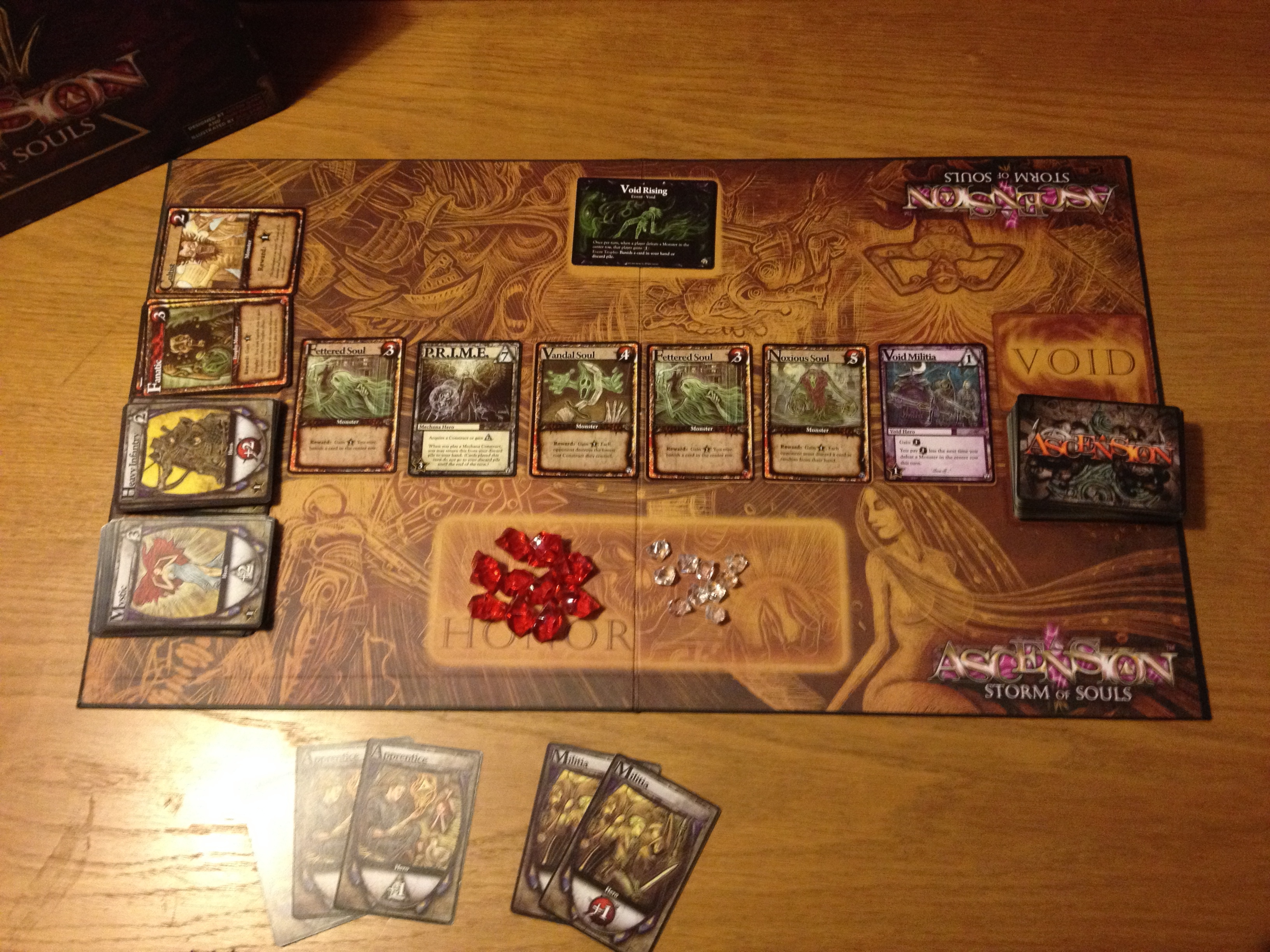
In Ascension, you deal with two main resources: runes and combat power. Most of the cards you play will provide you with either or both of these resources, which may be spent on your turn but not stockpiled. Runes are generally used to purchase cards to add to your deck that will be of benefit to you in the future; combat power is used to defeat monsters, which are immediately worth "honour points", and in some cases may be kept as trophies to be cashed in for an additional benefit later. There's a set stock of honour points available at the start of the game according to the number of people playing, and when this is depleted, the game ends.

The cards that you either purchase or defeat are placed in the centre row on the game board, meaning that six are available at any one time. Purchasing or defeating a card immediately replaces it with another one, and there are several cards that are always available regardless of what is in the middle row. These are generally less effective than the more specialised cards from the middle row, but acquiring some of these is often a sound early-game strategy.

IMG_2725

Since there are only two real mechanics to learn — how to buy things and how to kill things — and the remainder of the game involves reading the cards themselves to make use of special abilities, Ascension is a very quick and easy game to learn. The Storm of Souls version adds a couple of additional elements to the basic Ascension game that began with Chronicle of the Godslayer — specifically, the addition of "Event" cards, which stay in play until replaced by another one and have a constant effect on gameplay in some way, and the aforementioned "monster trophies" rule. These additions aren't hard to learn, though it's easy to forget the effect an Event card has, so be sure to check it each time your turn comes around.

At the end of the game, players add up the honour points they have earned through killing monsters and add the number of points they have on the cards they have purchased, and whoever has the most is the winner.

Bits and Pieces

Ascension's main component is, of course, its deck of cards, which are made of good quality material, stand up to repeated shuffling and are of a standard size, so may be sleeved if you wish to protect them. The cards are designed in a similar way to standard customisable card game cards such as those seen in Magic and its ilk, with artwork at the top and descriptive text explaining special actions at the bottom. Iconography used is clear, simple and easy to learn, so most players will be able to pick up and play fairly quickly.

IMG_2723

Aside from the cards, many new players' eyes are drawn to the plastic gemstones that represent the pool of available "honour points". These look nice, and it's satisfying to acquire your own little collection of them — plus they provide a clear and simple means of determining how many points each player has earned through combat, though of course it's important to try and remember how many points each player has on their cards, too — something which can only be determined by keeping an eye on which cards they buy and play.

Ascension also includes a pleasantly chunky gameboard with appropriately labelled spaces for the middle row of cards, the always-available cards, the draw deck, the event cards and the "void" (discard pile). This isn't really necessary, but it provides a nice centrepiece to the game, makes setup easier and is also helpful when teaching the rules.

Is it Fun?

The deckbuilding nature of Ascension leads to a strong degree of randomisation, which makes the game very replayable. As with many other deckbuilding games, however, it's more difficult to come up with a long-term strategy if you're not sure exactly which cards are going to come up when — it's not like Magic where you know what cards are going to definitely come into your hand at some point regardless of what you do.

This may frustrate players who like to come up with strategies in advance, but it does help level the playing field somewhat: everyone has an equal chance of getting their hands on the "best" cards, and it's still possible to focus on purchasing specific cards with a particular strategy in mind rather than simply grabbing the first ones that become available: the various different categories of cards each have their own specialisms, so the most effective decks will take advantage of this.
IMG_2722

Ascension is a satisfying game to play. There's a wide variety of different cards that will come up over the course of the game, and playing a particularly devastating combo of cards that allows you to score a huge number of points in a single turn is very enjoyable. For those who find the base game getting a little stale, however, it's possible to combine any of the Ascension games together for a wider selection of cards and some potential rules tweaks — later expansions and standalone sets add additional rules, while earlier sets simply add more cards and consequently more variety. Adding more cards to the mix also allows the game to support more players — up to six maximum — though it does significantly slow down with more players, and with interaction practically non-existent this can lead to some downtime.

Ascension actually plays best with just two players, because the more players you add, the more the centre row changes before it comes around to your turn again, making it harder to devise long-term strategies and turning the game into one where you're more responding reactively to the situation you're currently in rather than trying to think a few turns ahead. Playing this way isn't necessarily a bad thing, but it is worth noting that it's a very different experience to duelling it out with just two participants.

Overall, Ascension is a fun, lightweight card game that's easy to learn, quick to pick up and speedy to play, making it ideal either as a filler game or an option for impromptu multi-game tournaments.
1447: From the Game Shelf: Guildhall

Guildhall

Publisher: AEG
Designer: Hope S. Hwang
Released: 2012
Players: 2-4
Recommended Ages: 12+
Play Time: 30 minutes

Theme: Medieval/Dark Ages
Mechanics: Set collection, hand management
Randomness: High
Luck factor: Moderate
Strategy: Moderate
Interaction: High

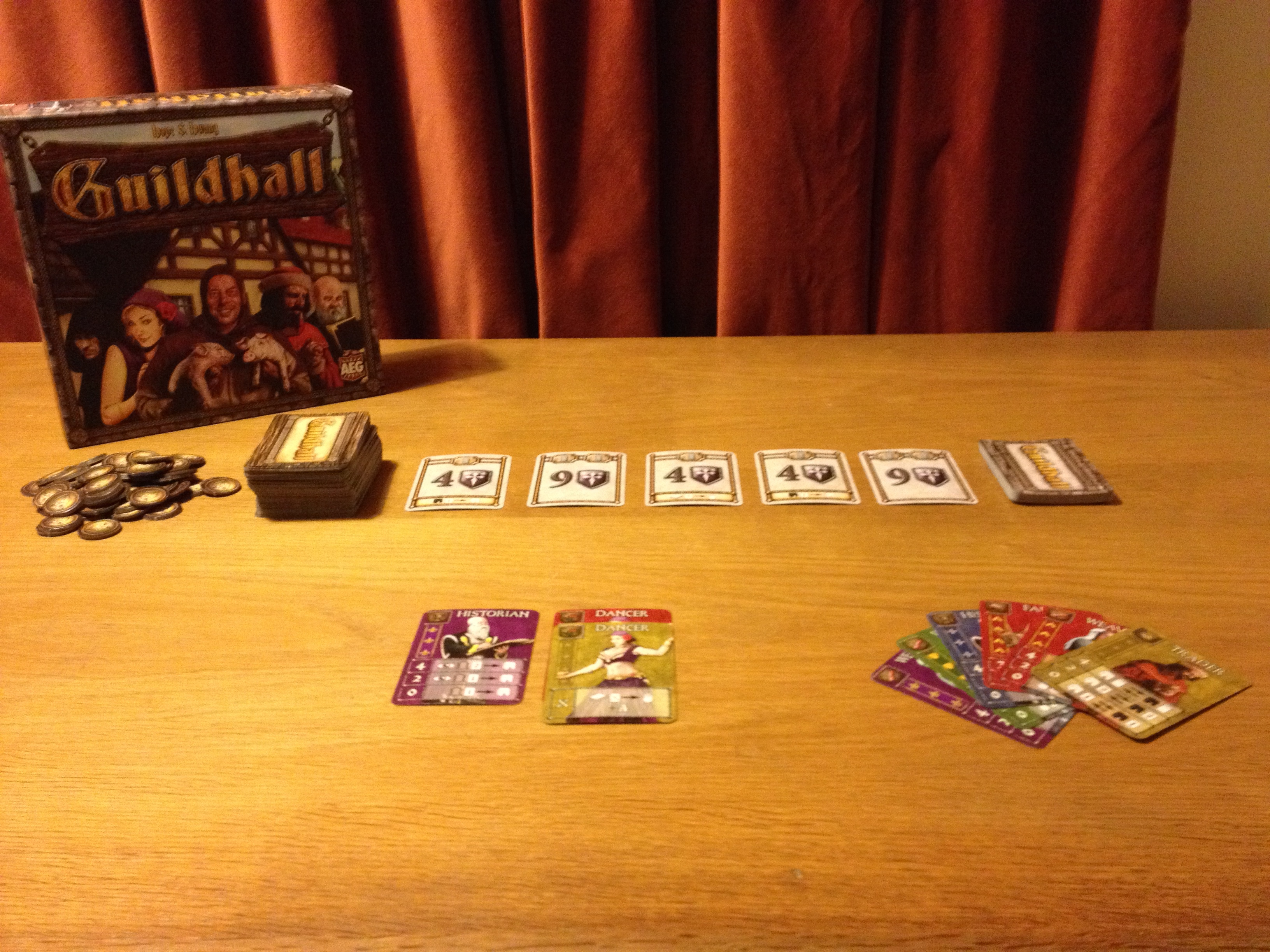
IMG_2717Guildhall is a card game themed around the concept of you opening… well, a guildhall. Your guildhall will play host to a variety of different professions, ranging from dancers to assassins; farmers to traders. The aim of the game is to score 20 Victory Points through a combination of point cards and individual points, and in order to do so you'll need to collect sets of professions. There's six different professions and five colours of each.
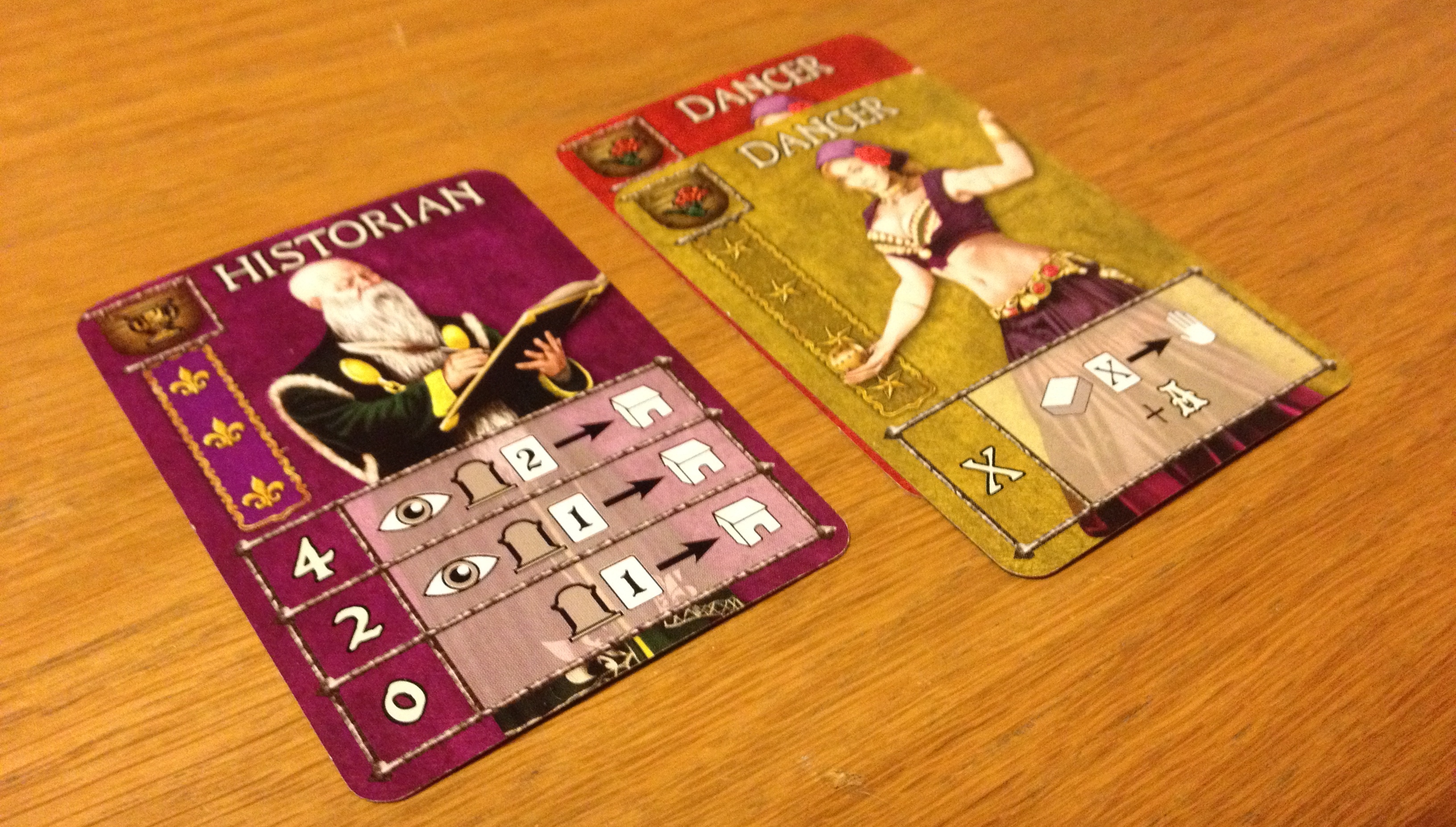
The rules of Guildhall are simple, straightforward and easy to follow and all the special mechanics are depicted through simple icons rather than text. Once you have your head around what all these icons mean, play is quick and snappy, making this an ideal filler game.

How it Plays

On your turn in Guildhall, you can take two actions. Your options from each action are to play a card to the table, which may trigger its special ability; to draw cards into your hand; or to use a completed "chapter" of your guildhall (all five colours of a single profession) to purchase one of the victory point cards, five of which are on offer at any one time. You are not allowed to play a card that is identical to one already down on the table — if you already have a red Dancer down, for example, you are not allowed to play another red Dancer, but you may play a blue Dancer instead if you have one.

Each of the profession cards in Guildhall has a different effect when you play it to the table, and each becomes more effective — or at least different — when you have more copies of that card in your guildhall already. For example, playing your first Dancer simply allows you to take an extra action; playing a Dancer when you have three Dancers in your guildhall already allows you to draw three extra cards and take an extra action.

IMG_2718

Many of the profession cards allow you to mess with the other players to some degree. The Assassin card, for example, allows you to destroy cards that are in other players' guildhalls, while the Trader forces another player to swap one (or more) of their guildhall's cards with one (or more) of yours. Collecting sets is often a matter of manipulating what other players have available without annoying them too much — piss off an opponent and it's very possible for them to exact amusing revenge on you with some well-chosen cards. If you want a quiet life, the Historian, Farmer and Weaver cards are handy — Historian lets you go through the discard pile, Farmer simply allows you to collect victory points at a slow rate, and Weaver allows you to play extra cards from your hand, perhaps in exchange for picking something up from your guildhall.

Take care with one rule when playing: cards played from your hand to the table do not go into your guildhall until the end of your turn — until that time, they are considered to be in the "action area" and as such chapters are not completed until your turn has ended. This means that you can't play a card to finish a chapter and then immediately spend that chapter on a victory point card of sufficient value to win the game, for example. (You can, however, use special abilities of cards such as Weaver to complete a chapter before the end of your turn.)

Bits and Pieces

Being a card game, Guildhall's box is largely taken up by, you guessed it, cards. There are two decks — a large one of all the profession cards and a smaller one of victory point cards — differentiated from one another by different backs, and separated into two distinct areas of the box insert, which leaves space for expansions. The only other components are a stack of victory point chips, used when playing the Farmer to acquire small quantities of victory points without buying cards.

IMG_2719

The cards are good quality, of a satisfying thickness and pleasingly glossy. They're standard-sized, too, which means they may be sleeved if you so desire. Artwork on the cards is distinctive, attractive and in keeping with the box art, while the lower half of the card is devoted to iconic descriptions of the various special abilities. It takes a little time to learn what all these mean, but there's a handy guide in the instruction leaflet, plus all the card special abilities are helpfully summarised on a single page, too.

Cards can also be quickly differentiated by the icons in their top-left along with their large, prominent title text, and colour-blind players are catered to with the pennant down the left edge of the card, which displays a different piece of heraldry for each of the five colours.

Is it Fun?

Guildhall's theme is mostly irrelevant to its mechanics, but the "collecting professions" concept helps put what you're doing in the game into context, and the professions themselves mostly have thematically relevant special abilities: Assassins "kill" cards; Historians look back at what's come before (i.e. the discard pile); Traders trade cards. Dancers, Farmers and Weavers have a somewhat more tenuous link to the theme of the game, but at least each of their purposes is clear and distinct from one another — every card feels like it has a use, and there's little in the way of underpowered, "dead weight" cards to clutter up your hand — unless, of course, you just can't get your hands on the right colour.

It's a fun game that maybe takes a play or two to get your head around, but once you do it's an enjoyable, quick and surprisingly cut-throat competitive filler game that's well worth having in your collection — it's just a bit of a shame it doesn't support more than four players.


1446: From the Game Shelf: Dixit

Dixit

Publisher: Libellud
Designer: Jean-Louis Roubira
Released: 2008
Players: 3-6
Recommended ages: 8+
Play Time: 30 minutes

Theme: Abstract
Mechanics: Bluffing, communication, description, educated guessing
Randomness: Moderate to high
Luck factor: Depends on who you play it with!
Strategy: Light
Interaction: High

IMG_2713

Dixit is a card-based party game that revolves around the idea of creatively describing images. (Do not confuse it with the 1983 crossword-building game of the same name, as the two are very different!) The aim of the game is to score points — this can be achieved by, depending on what your role is that turn, describing cards in just enough detail that one or two people around the table successfully guess what you were describing, by successfully identifying what that turn's "storyteller" was describing, or by convincing other people that the card you played was the one the storyteller was describing.

It's a quick, easy to learn game that's high on communication and creativity, making it ideal for social gatherings. There are numerous expansions available too, as well as standalone variants that bump up the maximum player count to 8 rather than the original's 6.

How it Plays

The role of "storyteller" is passed around the table one player at a time. On your turn as the storyteller, you must select one of the cards from your hand and play it face-down onto the table, then describe it in any way you please — a word, a phrase, a little song and dance routine.

Once this is done, all of the other players select a card from their hand that they believe would also fit the storyteller's description and play them face-down. The storyteller then shuffles the played cards and reveals them to the table.

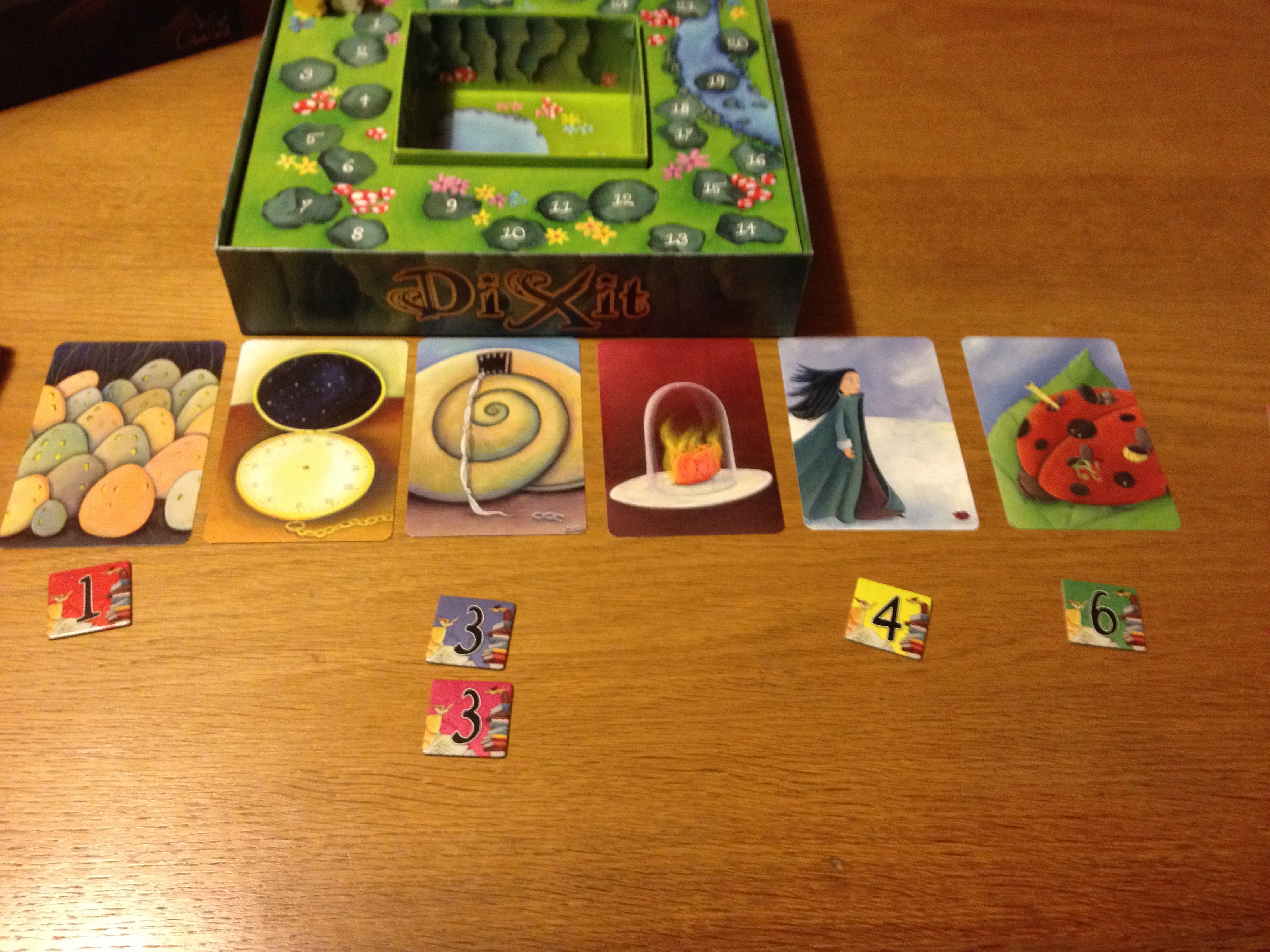
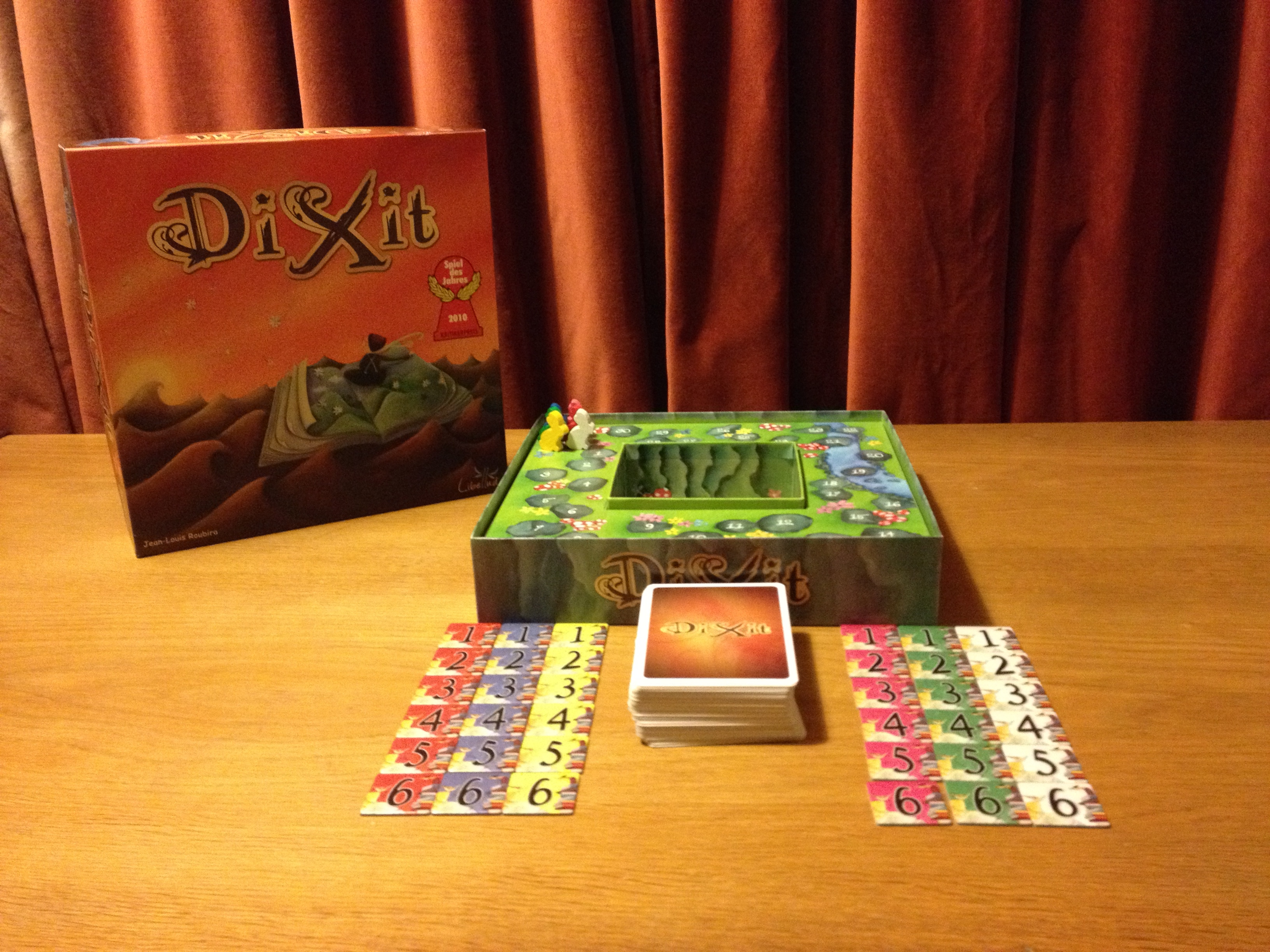
At this point, players secretly vote which one they think was the storyteller's card using cardboard chips with numbers on them. The storyteller does not vote. All votes are revealed simultaneously, and the storyteller then reveals which card was theirs.

IMG_2715

If all players correctly voted for the storyteller's card or if no-one correctly identified it, all players except the storyteller receive two points. In all other cases, the storyteller and any players who successfully identified their card receive three points. Bonus points are awarded for each vote a player received for the card they played when they were not the storyteller. In other words, it's in the storyteller's interest to be slightly obtuse about their clues, but not so obtuse no-one will recognise what they're talking about. Savvy storytellers will make use of references and descriptions they know only certain players around the table will catch.

Players then draw up to a hand of 6 cards, and the role of storyteller passes around the table. Play continues until the deck of cards is exhausted, and the player with the most points at the end is the winner.

Bits and Pieces

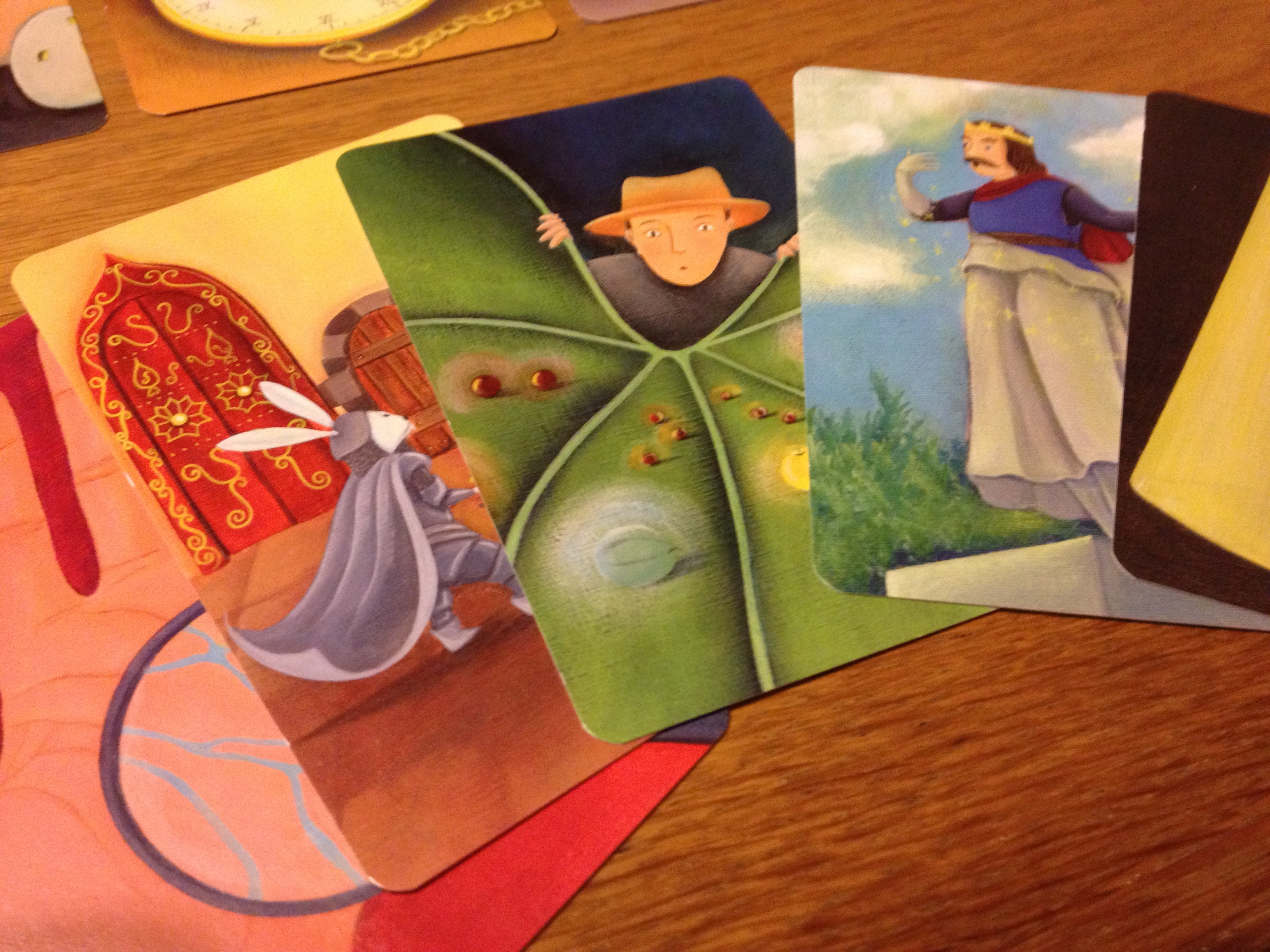
The highlight of Dixit is its 84 oversized cards, each of which depicts a different image. The images — the work of one Marie Cardouat — are all somewhat surreal in nature and deliberately difficult to describe in simple terms, but they have a consistent art style that is pleasingly distinctive and instantly recognisable.

IMG_2714

Scoring is tracked using wooden rabbit markers that proceed around a track printed on the box insert which may be removed if desired. The markers are well-made but their shape makes them somewhat prone to falling over or being knocked around if the table or box is bumped inadvertently, and with the close positioning of the numbers on the board, this can sometimes lead to inaccurately tracked scores. The score tracker also only goes up to 30, and it's possible for games — particularly those with fewer players — to exceed this total, necessitating further "laps" around the board.

Voting is accomplished through coloured cardboard tokens with numbers on one side and the Dixit logo on the back. They're functional but in keeping with the game's playful art style, and the bright, vibrant colours make each player's tokens immediately distinguishable from one another.

Is it Fun?

Dixit's a game you need to play with the right people, and it's also a game that changes over time the more times you play it with the same people. Ideally, you want to play with a group of people who all know each other well so that psychological tricks such as obscure references and in-jokes can come into play. Those who are not very creative or imaginative — or those who find it difficult to grasp more abstract games — probably won't have as good a time playing Dixit.

The more times you play, the more you'll come to recognise various cards as they come up, and how people generally tend to describe them. This forces you to either come up with more creative ways of describing the images — or, of course, to invest in one of the various expansion decks available.

IMG_2716

The game makes for some memorable occasions, however, particularly if someone comes up with a particularly creative (or offensive!) description for one of the cards. It's fun trying to read the other players around the table, and determining how best to bluff your way to victory. It may initially seem like a simple, straightforward party game and indeed there's nothing stopping you treating it as such. But it's also possible to turn the game into a gruelling battle of wits against your rivals as you attempt to take advantage of what you know about all of them.

So yes, it's very much a fun game — and a pleasantly short, light affair that's good for either opening or capping off an evening's gaming. If you have a group of players who would respond well to its creative challenges, it's well worth your time.