1835: More Five Tribes

Got the chance to break out my new board game acquisition Five Tribes at our fortnightly gaming evening tonight, and it seemed to go down pretty well. It's also an intriguingly different experience when played with four people compared to just two.

One nice thing about the game is that there's not really any randomness once you're into the game itself — with the exception of the available cards — but the setup is totally random, making for a very different experience each time you play.

This time around, it just so happened that a couple of the tiles we laid out at the beginning of the game had three of the same coloured meeple on them right at the start, meaning these spaces could be immediately claimed for some early points. This made for a peculiar dynamic that was something of an inversion of what you might expect from your typical Euro-style game: normally, the early stages of a Eurogame see you building up and preparing for the mid-to-late game, where you'll be scoring the majority of your points. This formula is clearly seen in everything from Settlers of Catan (early game: building roads; late game: building cities) to Agricola (early game: OMG HOW DO I FEED MY FAMILY; late game: OMG HOW DO I FEED MY FAMILY NOW IT'S EVEN BIGGER THAN IT WAS) but our playthrough of Five Tribes this evening proved to be the opposite: there was a lot of early point-scoring, and then things tailed off somewhat as "good" moves became harder and harder to spot, and play became a lot more strategic.

Five Tribes is apparently quite well known for inciting that perennial bugbear of board game gatherings, "analysis paralysis", or certain players' inability to take a turn without considering every possible option and all the potential consequences. Indeed, I can see how that would be the case — we saw a certain amount of it this evening — but at least the straightforward, simple game mechanics mean that actually taking your turn is quick and easy with minimal housekeeping required.

I like the game a lot. It's interesting, simple to understand but strategically complex. I don't think I've quite got my head around what winning strategies for it might look like, but I'm glad it went down well with the group, and I hope it hits the table again sometime soon. Its relatively short duration would seem to make it an ideal weeknight game, and everyone seemed to both pick it up quickly and enjoy themselves overall. So I call that a success.

I think I'm going to be seeing coloured meeples in my sleep tonight…

1832: Five Tribes

I got a belated Christmas present the other day: a new Days of Wonder board game called Five Tribes.

Days of Wonder games are always a pleasure to behold. They include high-quality components, look great on the table and, more often than not, feature a nice balance between simple, straightforward rules that anyone can understand and some complex strategy that will get your brain chugging away. Five Tribes appears to be no exception.

Unfolding on a randomly-generated map of a fictional sultanate in the lands of the 1,001 Nights, Five Tribes tasks you with taking control of as much of the map as possible, perhaps with a little supernatural assistance. This is achieved through an interesting mechanic slightly akin to how you move armies around in Risk.

Each tile begins with a few coloured meeples on it. These are drawn from a bag at the start of the game, so the arrangement of both the tiles that make up the map and the meeples on them is different each time you play. On your turn — the order for which is determined by a simple bidding system — you can grab a whole tile's worth of meeples and then move one tile at a time, dropping one meeple on each tile you pass through. The last tile you land on has to have at least one meeple of the colour you're trying to put on it already, and you then claim all meeples of that colour from the tile. If this empties the tile, you take control of it with a natty little wooden camel game piece.

That's the basic mechanic, and by itself this would make an interesting and strategic game. But things get interesting when you throw the different colours' special abilities into the mix. Yellow meeples can be kept and scored for points at the end of the game, for example; white meeples can either be kept for scoring at the end or spent on certain benefits throughout the game; red meeples allow you to either assassinate a meeple a certain number of tiles away (potentially allowing you to take control of another tile in your turn); blue meeples allow you to score points immediately according to how many specially marked spaces are surrounding the tile you finished on; green meeples allow you to take cards from the "market", which are either slaves (which can be expended in much the same way as the white meeples) or various luxury goods.

Then each space has a special ability that you use if that's where you finished your move: some force you to place a palm tree or palace marker on that space, making it worth additional points at the game's end for whoever ends up controlling the space, if anyone; others allow you to acquire the services of one of several different djinni, each of whom has their own active or passive abilities to further your own plans for domination.

The aim of the game is to score more points than anyone else; a nice twist on this is that your points is also how much money you have on hand to do things. There isn't a lot to spend your money on — it's mostly used on bidding for turn order at the start of each round — but there are plenty of means of acquiring more money as you progress. The cards depicting the luxury goods are particularly important here: selling a "suit" of these cards (a set where every card contained therein is different) allows you to earn amounts of money according to how many cards you get rid of at any one time. Some djinni can help you earn money, too; others provide a passive bonus that can make the difference between winning or losing.

It's an interesting game. My first game with Andie saw us flailing around a bit to begin with as we had no real idea of how it worked or what we should be trying to do. But it became clear as the game progressed, and I'm looking forward to trying it again sometime now I have a better understanding of how it all works.

1821: Interlude at the House on the Hill

It's late and I'm very, very tired so I will continue the creative writing tomorrow. Apologies to anyone following and absolutely desperate to know what happens next. (This also gives me a day to figure out what happens next, which is probably "cheating", but whatever.)

Instead, I wanted to talk a little about a board game I got for Christmas and had the opportunity to try out for the first time this evening. It's called Betrayal at House on the Hill, and it's a game I've had my eye on for a while since seeing it on Wil Wheaton's board gaming show Tabletop.

Betrayal at House on the Hill is an unusual and peculiar game in that it's sort of two games in one. The first part is purely exploration and treasure hunting: you and up to five friends explore a creepy old randomly-generated house, collecting treasures and "omens" and having various events occurring — some good, some bad, some strange.

At a particular point, "the haunt" begins. The longer the initial phase goes on, the more likely the haunt becomes, since its likelihood of occurring is tied to the number of omen cards in play at any one time. (Omens, despite their, well, ominous name, often take the form of useful items, so it's actually in your interest to collect them, even with the inherent risk they carry.)

When the haunt begins, several things happen. First of all, one of fifty different scenarios is chosen according to the omen drawn and the room it was discovered in. Next, at least one of the players becomes a traitor. In most scenarios, it's known which player is the traitor, but there are a few examples of "hidden traitor" scenarios where one person is secretly working against the others.

At this point, the remaining players and the traitor are, as you might expect, in direct opposition to one another, but the interesting thing when compared to other, mechanically similar games such as Descent or other dungeon-crawlers with an "evil" player is that the two groups don't have all the pertinent information about one another: each side has a book revealing only information relevant to their side, and the rest they must figure out themselves. This includes, in the heroes' case, how strong, fast and intelligent the monsters they're facing are, and even what the traitorous player's end goal might be. Likewise, the traitor doesn't necessarily know what the players are up to, though his material might give him a bit of a clue — and the players' behaviour might give him even more of a clue.

As an example, the scenario we picked this evening saw one player come across a madman in the house's basement, which triggered the haunt. Zombies rose from the dead, and the original player character was killed, leaving the traitorous player in control of the madman and the zombies. His objective was simply to kill all the other players — a task which he completed fairly effectively and efficiently. Our objective as the heroes, meanwhile, was to trap the zombies by luring them into rooms that had been important to them in life — we knew which rooms these were, but the traitor did not, and there were specific rules about how the zombies moved that allowed us to "pull" them in particular directions through careful, strategic movement.

Unfortunately, things did not go all that well. My character died almost immediately after the haunt began having been flung into the basement earlier, not being able to find the way back up the stairs, getting surrounded by zombies and finally, embarrassingly, succumbing to nothing more than the heat from a furnace beneath the mansion. The others, variously, were eaten by zombies and brutalised by the madman, leading the traitorous player to a convincing victory.

I enjoyed the game a lot. The rules are straightforward and quick, turns are snappy and the split-personality nature of the game makes it very interesting. The 50 different scenarios coupled with the randomly generated nature of the house means that there's a whole lot of replay value, too, so I'm looking forward to giving it another go sometime soon.

1795: Thoughts on Roll20 and Other Board Game Apps

Longstanding Internet friend Matt Mason sent me this link earlier. For those too lazy to click, it's an article about an app called Roll20 that is, so far as I can make out, designed for two main things: to facilitate online "remote play" of tabletop role-playing games between players who are scattered around the globe, and to support the "local" experience of those playing together in the same room by making the housekeeping and paperwork required for playing and running a tabletop role-playing game electronic.

It's a good idea, and indeed many role-playing groups already use various electronic solutions to support their sessions, whether it's simply firing up iTunes or equivalent to provide a musical backing to a dramatic encounter, or having an indexed, searchable copy of the rules on hand to save leafing through weighty tomes in the midst of what is supposed to be frantic combat.

The Kill Screen article is a little confused, so far as I can make out; it goes on to mention what it calls "Boardgamegeek-type board games" (with the implicit definition that these are things somewhat more complicated than entry-level fare like Ticket to Ride and Settlers of Catan) and suggests that an app such as Roll20 would provide an adequate solution to what a "pain" many modern boardgames are.

I can't argue that there are certain games out there which are a bit of a pain at times. Stuff like Arkham Horror and Descent have so many cards, chits and tokens that it's 1) difficult to keep the box organised and 2) rather time-consuming to set up and put these games away. Arguably, though, the setup and pack-away time is part of the experience: there's the tactility of punching out all those tokens in the first place, and the satisfaction of laying them out in pleasing arrangements on the table during play — there are plenty of people out there who "pose" their game boards to make good photographs. There's also something inherently satisfying about picking up and playing with physical items: slamming down a card in front of an opponent when you pull off a satisfying move; shuffling through a treasure deck to get your reward from a tough encounter; hoping that the deck of event cards will be kind to you this time around.

I also have mixed feelings about electronic versions of board games. It's cool to be able to play many titles online with far-off friends, but the experience just isn't the same, particularly when playing asynchronously. A single game of Ascension or Carcassonne can take weeks if you let it — and it's very easy to let these things slide, even when they're right there in your pocket on your phone — and it just ends up feeling more like work than fun, particularly if you have a number of games on the go at once. These days, if I'm going to play a board game, I want to do it face-to-face.

That doesn't mean that apps like Roll20 don't have a place, however. In fact, we're already starting to see some interesting examples of technology being used to support — not replace — game components, the most notable of which is the upcoming board game adaptation of classic PC strategy game XCOM, which effectively casts an app in the role of the antagonist "player" or "game master", deals with all the heavy lifting with regard to tracking things and provides suitably randomised elements for which no-one can complain that the decks of cards haven't been shuffled well enough.

There's scope for plenty of other types of things, too; the aforementioned Arkham Horror and Descent would both benefit enormously from phone or tablet character sheet apps, allowing players to keep track of their health, fatigue, equipped items, treasure and all manner of other things without having to gradually take over their corner of the table with cards, chits and all manner of other gubbins. Games like Mage Knight would benefit from their randomised elements being automated and made truly (or as near-as-dammit) random.

I'd never want to give up the physical element of board games altogether. But I think we're starting to move into an interesting new era where traditional physical components and digital elements will come together to produce truly interesting experiences. I'm excited to give them a try.

1770: Drizzt's Grand Adventure

Went over to my friend Tim's today, and we played a bunch of Wii U games (he's now finding it very difficult to resist the allure of Nintendo's underrated little console, particularly with a new Super Smash Bros. on the horizon) as well as some tabletop stuff, too.

One of the games we gave a shot was something that's been on my shelf for a while, but which I've only had the opportunity to play once: The Legend of Drizzt. Our regular group as a whole has a bit of a mixed opinion on cooperative games and dungeon crawlers, and The Legend of Drizzt is most certainly both of those things, although it does have a few scenarios that are competitive or team-based in nature as well as pure co-op action.

I own quite a few dungeon-crawlers, ranging from Milton Bradley's original Hero Quest through Games Workshop's follow-ups Advanced Heroquest [sic] and Warhammer Quest to more modern fare such as Descent: Journeys in the Dark Second Edition and, of course The Legend of Drizzt. Of all of these, Descent appears to have fared the best with the group as a whole, but it's also one of the most complex affairs thanks to its campaign rules and myriad tokens and pieces. Consequently, it doesn't hit the table as often as I'd perhaps like, and we're yet to run a whole campaign through to completion.

The nice thing about The Legend of Drizzt is that its adventures are all standalone affairs that can be run pretty quickly, and which form a coherent narrative if you choose to play through them in order. It does lack campaign rules, sadly, which means each time you start a new quest you're effectively starting from scratch with your chosen character, but this does mean you potentially have the opportunity to try out all the different characters and combinations of skills rather than being railroaded down a single development path. I'm unsure as to which route is better; while the ongoing increase in power of a lengthy campaign is fun, it's also essential to have a group with full commitment to seeing it through to completion and, much as I don't like to admit it, I'm not sure I have that right now. One day, perhaps.

But anyway. The Legend of Drizzt.

Drizzt, as it shall be known for the rest of this post, is one of the Dungeons & Dragons Adventures series of board games. All three of these games are very similar, and, in fact, are fully compatible with one another, so it's perfectly possible to mix and match elements from all of them to create custom character builds, adventures and scenarios. I only have Drizzt for now, but I'm tempted to pick up at least one of the others at some point, too.

The essence of the Dungeons & Dragons Adventures series is to provide a lightweight dungeon-crawling experience inspired by the 4th Edition rules of the Dungeons & Dragons role-playing game. For those who aren't well-up on their pen-and-paper role-playing games, D&D 4th Edition was interesting in that it placed a much stronger focus on tactical, board game-style combat than previous incarnations, in which it was perfectly possible to perform abstract combat sequences. (You can do this in D&D 4th Edition, too, but it's not really designed for it.) It also gave each character a very clear set of things that they could do, known as Powers. These fell into a few different categories: At-Will Powers could be performed every turn without penalty, and tended to be the character's main attack skills, each of which with its own benefits and drawbacks; Utility and Encounter Powers, meanwhile, could be performed once per "encounter" (essentially a self-contained sequence in the game, often — but not always — a battle) and were a bit more powerful and situational; while Daily Powers represented the character's most devastating (or helpful) abilities, but which could only be performed once per in-game day (or, more accurately, once per period between "extended rests").

Drizzt isn't anywhere near as complex as the main D&D 4th Edition rules, but it pulls some of its main features — most notably the use of Powers. When you start a scenario, you pick a character, and from there you're given access to at least one deck of cards from which you can pick a certain number of At-Will, Utility and Daily Powers. These will then be the abilities that you will have to use to progress through the scenario — though if you're lucky enough to level your character up in the middle of a scenario (a situation which isn't guaranteed) you tend to get access to at least one extra one as a reward.

Since the concept of "encounters" and "days" doesn't really exist in Drizzt, the Utility and Daily powers are effectively one-shot abilities that you need to think very carefully about when you use. There are a couple of Treasure cards you can score by defeating monsters that allow you to "recharge" these powers, but they are few and far between; you're best off saving your most powerful Powers for when you really need them.

Interestingly, unlike many other dungeon crawler games, Drizzt doesn't require an adversary (or "Dungeon Master") player. Instead, the game makes use of a clever system whereby when you explore a new area, you draw a monster card and then activate any monsters of that type on the board (including the one you just drew and placed) according to specific conditional rules on the card. In essence, the game itself runs the monsters automatically, and the players have to deal with them accordingly. This is somewhat similar to how Warhammer Quest works, though in Drizzt each monster has its own unique rules and special attacks that you'll come to recognise — and, hopefully, learn how to deal with over time.

I really enjoyed our game of it today, and I hope I get the chance to play it again sometime soon. It's an enjoyable, lightweight and, perhaps most importantly for our group, quick dungeon-crawler with a lot of flexibility, and I'm looking forward to having the chance to play it a bit more.

1756: City of Slightly Less Horror Than Usual

Page_1We played the board game City of Horror earlier today. I'm never quite sure whether or not I genuinely like this game as, frankly, it's a horrible little game that actively encourages its participants to backstab, lie and cheat one another under the pretenses of working together to survive a zombie apocalypse.
At least, that's what I thought it was prior to our game today.

A little background for those unfamiliar: City of Horror casts players in the role of several zombie apocalypse clichés and tasks them with surviving from midnight until 4am — just four turns, which doesn't sound like all that much — until the arrival of the rescue helicopter, at which point the survivors need to take an antidote in order to survive, and whoever has the most points worth of surviving, non-zombified people remaining at the end — plus any bonuses — wins the game.

Now, what normally happens with this game — which we tend to play with our full regular group of five people — is that we start out with relatively good intentions, but before long someone does something unpleasant. It might be a little white lie that gets a character killed; it might be refusing to help in a dangerous situation; it might be completely reneging on a deal previously made, since there is no rule that says you have to keep up your end of the bargain when you make an arrangement with another player. Ultimately, there is only one "winner" on points, and so much of the interest in the game comes from determining how to get yourself into an advantageous situation while simultaneously making life awkward for other players.

It's an interesting game in that it's highly social and based on interaction. The mechanics are relatively simple, and a lot of the time things boil down to taking a vote on things — whether that's choosing who gets thrown out of the window to sate the zombies' hunger this turn, or who gets the supplies that had been air-dropped into a particular location. There's a surprising amount of flexibility, and the game is wonderful for creating emergent narratives surrounding the various characters, all of whom are B-movie archetypes of various descriptions.

Now, the interesting thing that happened today is that we played it short one regular team member — the one who is often at the centre of the backstabbing and unpleasantness that typically accompanies a game of City of Horror. This may paint him in a somewhat unfavourable light, so I'll qualify this by saying that he's actually a very nice guy with a fine sense of humour, but something about this game brings out something very primal in him; a desire to win without caring who he has to tread on on the way to the top.

Halfway through the game we played today, which was, as previously mentioned, lacking this troublesome teammate, we realised that none of us had lost any survivors. This is particularly unusual, as City of Horror is a somewhat cutthroat game, even if you're cooperating fully with one another and not attempting to screw one another over. But we'd somehow made it to halfway through without anyone causing anyone else's death, and without any unfortunate circumstances leading to anyone's death, either.

We jokingly suggested that we should try and make it to the end of the game with everyone surviving. No-one around the table was initially sure whether or not everyone else really intended to hold true to this promise, but as the game continued, it became clear that people were actively working together rather than against one another. Discussions happened about the best course of action. Information was shared that could easily have been kept secret. Opportunities to get one up on the other players were cast aside in the name of cooperation and collaboration.

This doesn't mean that there was no tension, of course. There was mistrust, somewhat mitigated through some of the game mechanics that allow you to take a degree of "insurance" against anyone messing with you. In my case, I came into possession of some information that would have been of use to the group as a whole, and I was very tempted to lie completely about it — an action that would have probably got several of my opponents' characters killed. And in the last turn, it would have been extremely easy for one player to run away with things and take the complete victory.

The strange thing is that these things never happened. We cooperated and collaborated right up until the end, and the eventual result was that all sixteen characters who started the game were still alive at the end — well, with the exception of one, who didn't have an antidote and consequently died after we'd "won" as a group.

It was a peculiar experience, unlike anything I've encountered in City of Horror before, and I really enjoyed it. One of my tablemates, who typically prefers competitive games rather than cooperative experiences, commented that he didn't find it quite as fun as usual, but he was impressed that we'd managed to maintain our uneasy four-way alliance up until the end. Mostly, it was interesting to see that it is possible to complete a game of City of Horror without anyone dying, because the game's general difficulty level makes it seem as if that simply wasn't the case.

But, well, it turns out it is. I don't know if we'll ever see that happen again, because after all the nastiness of City of Horror is one of its main gimmicks that makes it appealing to our group. But for now, it was good to see that even given plenty of opportunities to be assholes to one another, we all took the noble route and helped one another out to ultimate victory.

1702: Scoundrels

Gave my copy of Lords of Waterdeep and its expansion Scoundrels of Skullport another outing tonight, and it was pleasingly different from the first time we played. Less pleasing in that I lost by a considerable margin — I struggled to get a good means of income going at any point throughout the game, and the board as a whole ended up pretty "dry" — but interesting to see quite how much a difference there can be between two different playthroughs.

We've been playing the game in its most advanced form — that is, incorporating the two "modules" that form the complete Scoundrels of Skullport expansion. One of these, centring around iconic Dungeons & Dragons locale Undermountain, focuses on high-value quests — the most valuable quests in the base game were 25 points, while the Undermountain module beefs this up to an impressive 40 — while the other, centring around Skullport, allows you to perform numerous powerful actions in exchange for "corruption", a resource that is worth a variable amount of negative points at the end of the game according to how much is in play at any given time.

Aside from the new mechanics — all of which blend beautifully into Lords of Waterdeep's base game without forcing players to learn hundreds of new rules — Scoundrels of Skullport also incorporates numerous new quest and intrigue cards (the latter of which are used to either give yourself an advantage or mess with other players) as well as a substantial selection of new buildings (which can be purchased to add to the number of possible actions players can take on each turn, with the building's "owner" receiving a benefit every time another player uses it). And the fact that there are so many of each of these components — far more than you need for a single game — means that, judging by our recent playthroughs, there's a significant amount of variety and replayability going on. Some games will be very heavy on the monetary income; others will be strong on the corruption; others still will see players playing a lot more intrigue cards than usual.

It's good to see a game have such flexibility and variety while still maintaining relatively simple base mechanics. All you essentially do in Lords of Waterdeep is collect various coloured cubes and tokens, then use them to complete quests and score points. At the end of the game, you score bonus points according to the conditions on your secret "Lord" card, which usually reward you for each quest of a specific type you successfully complete. That's essentially all there is to the game, but the variety of different possible actions offered by the action spaces and cards — particularly once you start throwing in the press-your-luck aspect of the corruption tokens — means that one game has the potential to play out very differently from another. And it doesn't feel like you're relying on luck; rather, it's a type of randomness that keeps things fresh and interesting without putting certain players at an arbitrary disadvantage.

We've still only played it a few times to date, but Lords of Waterdeep remains one of my favourite titles in my collection. I'm sure it'll be hitting the table fairly frequently.

1685: Murder on the Mystery Express

Today's afternoon and evening was spent playing board games, beginning with a go at Lords of Waterdeep with both components of the Scoundrels of Skullport expansion — an essential addition for anyone who likes the base game — then following up with some Love Letter, Boss Monster and finally a Days of Wonder game I've had on my shelf for nearly 5 years now and never played a complete game of: Mystery Express.

Mystery Express is a "whodunnit" game with unsubtle Murder on the Orient Express influences. Thematically, you're attempting to solve a murder on the train before it arrives in Istanbul; mechanically, you're using various means of acquiring and sharing information to make deductions about the perpetrator, their motive, their modus operandi, the location of the crime and the time it took place.

Each turn in the game represents a leg of the journey from Paris to Istanbul, and permits players a certain number of in-game hours to perform various actions, represented by the different carriages of the train. In one car, you all pass cards around the table in a big circle; in another, you ask everyone to publicly reveal a card of a particular type; in another still, you're able to gamble on a 50/50 chance — your opponent hiding a little miniature bag in one of their hands — in order to outright take one of their cards.

The cards each include the pieces of information necessary to solve the crime, with the exception of the time. The twist is that there are two copies of each card, so rather than just attempting to figure out which one is completely absent, you're attempting to figure out which one there's only one of. This can be extremely tricky due to the fact that cards get passed around the table throughout each turn, so the only means of reliably guaranteeing that something is definitely not relevant to the crime is seeing two copies of it on the same turn. There is, however, an interesting discard mechanic in place to prevent a player simply showing you the same card over and over again — or indeed you passing a card you just took from a player back to them — but this has the intriguing side-effect of meaning that information becomes more and more scarce as each round progresses.

The time of the crime, meanwhile, is represented by 24 cards, each of which have an analogue clock printed on them. There are three of each of the eight possible times in the deck, and one of them is hidden under the board as the truth, meaning in this case you're looking for the one time there are two, not three copies of. And, unlike the other types of card, you only get three chances to look at these throughout the game: the first time, one player gets to flip over one card at a time at a rate of their choosing; the second time, another player deals out the whole deck to everyone, then tells them when to pass their part of the deck around at the rate of their choosing; the third and final time, a player reveals the cards one at a time into three stacks at a rate of their choosing. If, as happened tonight, the player in control of the time cards is lucky enough to be absolutely sure of the right time early in the game, they can then whip through the subsequent time phases extremely quickly, thereby giving themselves an advantage while putting those who are still trying to work it out at something of a disadvantage.

I enjoyed the game overall. The instructions are a little overwhelming initially — as is the iconography on the board — but after a little while it all becomes second nature, particularly as each player has a handy reference guide to help them out. I like deduction games a lot — another Days of Wonder favourite is the excellent Mystery of the Abbey — and this provides enough twists on the usual formula to keep things interesting.

Mostly, though, I'm just glad I finally got to play a game of it to completion. Turns out it's pretty good; hopefully I'll have the opportunity to play it again at some point in the near future.

1669: Lord of All the Land... Well, City

Haven't added to my board game collection for a while, so I treated myself to a copy of Dungeons & Dragons board game Lords of Waterdeep and its expansion Scoundrels of Skullport.

For those unfamiliar, Lords of Waterdeep eschews the dungeon-crawling of the other Dungeons & Dragons games available at present in favour of a competitive strategy game where players challenge one another to score as many points as possible through completing quests.

At heart, Lords of Waterdeep is a worker-placement game somewhat akin to Uwe Rosenberg's well-respected Agricola. Each round, each player has a number of actions to take (here represented by "agents" that you place in buildings around a map of the city of Waterdeep) that allow you to do various things: collect resources (here in the form of money and adventurers of various classes), pick up quests for later completion, build new buildings to add new action spaces to the board, or play "Intrigue" cards to either benefit yourself or directly screw over your opponents.

It's this latter aspect in particular that means I like Lords of Waterdeep quite a bit more than Agricola — there's a lot more direct player interaction thanks to the "attack" cards that usually allow you to directly impact another player's collection of money and/or adventurers, but even without direct conflict I find the game tends to put people on a much more even playing field than Agricola's enormous decks of cards tend to.

For those less familiar with Agricola, the full version of the game gives you a hand of "Occupation" and "Minor Improvement" cards at the start of the game; our gaming group likes to distribute these through draft, a process which gives an immediate advantage to those who have played the game more and learned the decks more thoroughly. Lords of Waterdeep eschews this system in favour of a combination of things: the constructible buildings, which provide a benefit to their "owner" any time another player takes them, and the quest cards you're completing throughout the course of the game. Most of the time, these simply award victory points to help determine a winner, but a number of them are dubbed "Plot Quests" and provide ongoing benefits over the course of the game. In other words, you very much "earn" these benefits through play rather than being dealt or drafted them at the start of the game and then simply having to find the perfect moment to play them, and when they become available — all available quests are public knowledge — everyone has a fair crack at them.

Lords of Waterdeep also isn't as stressful as Agricola in that there's no race to feed your family (or equivalent) every few turns; in other words, the game is more about earning victory points rather than attempting to avoid losing them. That is, until you add the Skullport module from the Scoundrels of Skullport expansion, which provides various new action spaces and quests that net you "corruption", which is worth a variable amount of negative points at the end of the game according to how much corruption is in circulation around the table.

There's still an element of scarcity and a scramble for resources, however, particularly if you indulge in the Undermountain module of the Scoundrels of Skullport expansion, which, besides adding a few new action spaces, focuses on high-value quests that require a huge amount of resources to complete successfully. You need to quickly prioritise which quests are worth working on and which are not — taking into account the fact that your secret character card provides you with a bonus at the end of the game according to the types of quest you completed — and hope, pray that your opponents don't hit you with a Mandatory Quest card: a quest that you have to complete before any others, which is typically very low-value and low-requirement, designed simply to get in your way and waste a turn or two.

I haven't yet had the chance to try the Scoundrels of Skullport expansion, but I'm looking forward to breaking it out in the near future. We had a game of the base game a short while ago and enjoyed it, and it inspired me to pick up my own copy. I'm looking forward to playing again.

Oh, and if you're curious, there's a good version available for iOS.

1660: Stop Wasting Cool Licenses on Monopoly

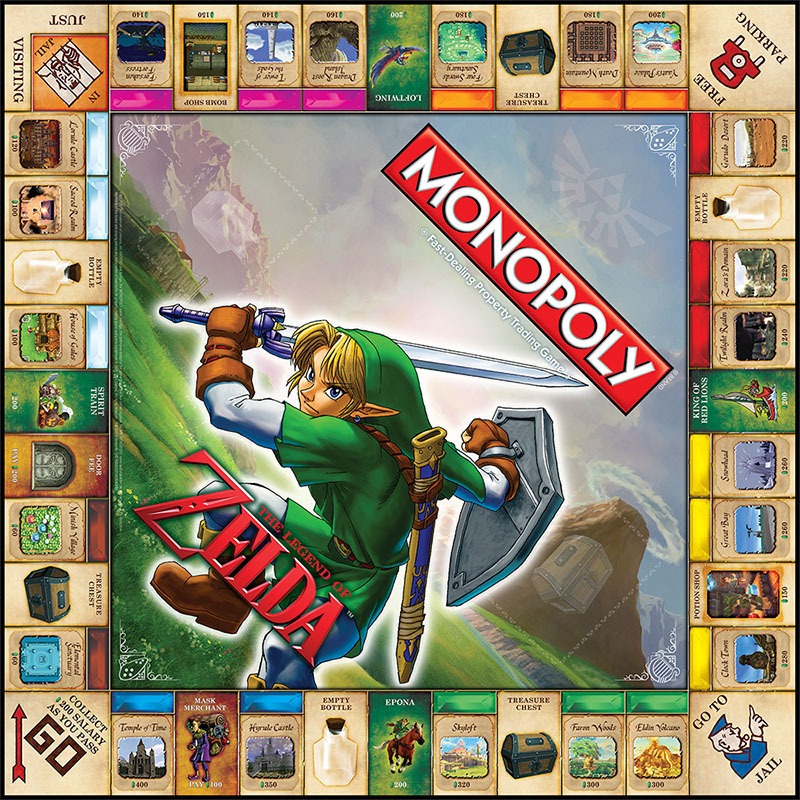
Hey! Listen! There's a Legend of Zelda board game coming! Awesome! Take a look!

zelda-board-monopoly…Oh. Monopoly. Again. Great.

Yes, indeed: the latest in a long-line of quick-and-easy cash grab Monopoly sets is one based on Nintendo's Legend of Zelda series, a franchise that has been running almost since the dawn of gaming, and one which has consistently provided gamers with some of the most enchanting interactive adventures of all time, blending childlike wonderment with epic heroic fantasy.

The Legend of Zelda, meanwhile, has not been particularly known over the years for its protagonist Link's desire to build up a sizeable portfolio of property, nor has Hyrule society ever been particularly dependent on capitalism. Link, more often than not, does good deeds out of a sense of altruism, or occasionally for the promise of "something good" (inevitably in bold print) — said "something good" is rarely financial reward, with questgivers instead tending to give him something of much more practical use.

I'm a bit annoyed about this. I'm not a particularly huge Zelda fan myself, but this is, without a doubt, a colossal waste of an awesome license. Monopoly is a terrible board game to shoehorn the Zelda license into. It's a terrible game in its own right, too, but I'm aware some people still like it, so I'm not going to push that angle too far — besides, my own personal dislike of Monopoly isn't why I'm frustrated to see Zelda squandered like this.

No, instead I find myself wishing for a more appropriate use of the license. It doesn't have to be an original board game in its own right — though that would be cool: spectacular Polish RPG series The Witcher is soon to get its own cool-looking original board game, so it's not without precedent either — but surely, surely there are better ways that Zelda could be adapted for tabletop play?

Here's just a few suggestions:

  • The Legend of Zelda: Carcassonne — Standard Carcassonne, except the tiles are all made up of actual tilesets from past Zelda games — A Link to the Past's 16-bit top-down graphics would be ideal for this. Meeples could be replaced by the different, distinctive races of creatures you come across in a typical Zelda game — one player could have a set of Gorons, while another could have Zoras, another still could have the Kokiri, and so on.
  • The Legend of Zelda: Catan — Much like Carcassonne, the bare minimum you need to do to make a convincing Zelda Catan set would be to redo the tile artwork in an authentically Zelda-esque fashion. You could incorporate some of the new rules and tweaks from things like Star Trek Catan — variable player powers is neat, for example — and Catan's numerous expansions for different scenarios.
  • The Legend of Zelda: Talisman — Talisman is, while flawed as a game, a decent depiction of an epic quest to achieve something. Reskinning this would be a more appropriate use of the license than Monopoly.
  • D&D Adventures: The Legend of Zelda — The dungeon-crawling co-op adventure games carrying the D&D brand are ripe for adaptation with Zelda artwork, enemies and items. You could even do a "Four Swords" thing, with each player having a differently coloured Link to control.
  • Arkham/Eldritch Horror: The Legend of Zelda — Okay, stretching things a bit here in terms of theme, but the mechanics of Arkham and Eldritch Horror are ripe for adaptation into a Zelda-style epic quest. There's exploration, treasures, character progression, battles, boss fights… everything a good Zelda game would need.

And this is just off the top of my head. All of the above would need very little adaptation in order to create a more convincing tabletop Zelda experience than Monopoly ever will. Come, on, Zelda Monopoly even still has "salaries", "Go To Jail" and "Free Parking", the latter of which in particular is completely incongruous with the setting.

So, this is pissing in the wind, I know, but please, please, license holders: when considering whether or not to license your awesome property for tabletop adaptation, please look a little further than Monopoly. It may be one of the most well-known games in the world, but there are hundreds, thousands of other, far better board and card games out there, most of which would be much better-suited for adaptations of this kind.