#oneaday, Day 89: No, It's Like "Poke-A-Nose"

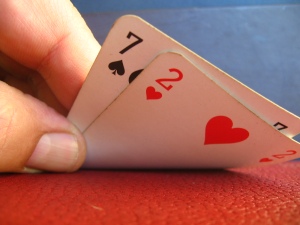
I played poker for the first time tonight. Specifically, the Texas Hold 'Em variant that became inexplicably popular a few years back and has shown no signs of going away ever since. I never quite understood why it suddenly shot to prominence, given that it's surely a game that's been around for a long time. Anyway, at the time I first noticed a growing national obsession with the game, I put it down to just a fad and never bothered to get involved or learn how to play.

After tonight, I'm wishing I'd started playing sooner! That game is fun. We weren't playing for big money – a £5 buy-in got us 8,000 chips, and the last man standing would get everyone else's fivers. But the money didn't matter. It was the game itself that mattered. I found it pretty amazing how a simple game largely dependent on luck (or card-counting) can have such moments of drama and enormous satisfaction in it. Obliterating opponents with a hand that is just better enough than theirs to screw them over completely is enormously satisfying. Perhaps not for our gracious host, who was one of the first out, quickly relegated to a "kiss of death" advisory role.

I came second in our game. Considering I'd never played before, I thought this was pretty good going. I managed to bluff my way through to some storming victories on a few hands, but was ultimately defeated in the last few hands by a straight vs my two (high) pairs.

I'm not sure if I was just getting lucky, or if I was actually "playing the game" correctly. But there were a number of occasions where the choices I made paid off bigtime for me, in some instances even allowing me to knock another player out. I'd be curious to try again to see if it was just beginners' luck. I know it certainly wasn't the others going easy on me. Although perhaps the fact that none of us were particularly experienced helped me out somewhat!

The best thing, though, was to find a game that I was actually good at. I like stuff like Agricola and Power Grid, but as I wrote a short while back, I am generally pretty terrible at them due to something of a deficiency in the strategic parts of my brain. I don't know what it is. But apparently, it seems, I have a decent poker face. I'm not sure how to take this news. Is it such a good thing to be a good liar?

Well, in the case of a game like poker… of course it is!

You look great in that shirt, by the way.

#oneaday, Day 73: Strategic Mind

I'm shit at strategy games. I mean really shit. That doesn't stop me playing and enjoying them, but I am just awful at them. I think it's an inability to think ahead or do those mind-fucking mental calculations required to predict what situation you'll be in ten turns down the road. If I start getting into thinking about that, I end up suffering from analysis paralysis and have to lie down for a little while afterwards.

This is frustrating when playing board games which you know are supposed to be really good, like Agricola and Power Grid. But I find myself consistently losing at them. Agricola is more of a problem than Power Grid, which I can normally do respectably in.

It could well be difficulty in prioritising things. In Agricola I'm never sure what action is the best thing to take, and seeing my regular opponents playing I'm always pretty sure that they are doing some sort of black magic to convince me I've had the same number of turns as them but in fact knocking me out for three rounds, getting into an extremely advantageous position and then waking me up as if nothing had happened. Of course, I know that's actually not happening, that it's just a case of me making poor choices. But it's immensely frustrating, and prevents me from enjoying the game as much as I should – because, I hasten to add, it's a great game.

Now games like Warhammer Quest and Arkham Horror? Fine. I work well as part of a team, so co-op games are good for me. Even Catan is fine, as the semi-randomised nature of the game means that I'm not totally reliant on my non-existent strategic brain. Ticket to Ride, too, is great. But as soon as the game comes down to nothing but my own skill and chance is kept to a minimum? I suck. Hard.

Perhaps I should find a way to practice strategic thinking. Does anyone have any suggestions?

One A Day, Day 47: And... Collapse

How I made it through this week without suffering a complete nervous breakdown I'll never know, but here I am. I am exhausted though, so this entry is going to be rather short.

Just got back from another game of Dungeon Lords. Fun game, but we're clearly still learning the ropes. Like Space Alert, though, it remains quite entertaining even when things are going horribly wrong. And that's good – games where you get behind and are then stuck there are less fun. To me anyway. Probably because I'm usually the one in last place!

I'm so knackered I can barely keep my eyes open. Time for bed now I feel, and a well-earned lie-in tomorrow morning.

One A Day, Day 46: Dungeon Lords

One of the group of friends I semi-regularly play board games with shared a new acquisition tonight – a game called Dungeon Lords. It's a fairly lengthy game to play, but it's bursting with character and fun, despite it being a self-confessed game for "hardcore gamers".

Dungeon Lords casts you in the role of one of the titular evil overlords. It's your job to build a dungeon, populate it with monsters and traps and then settle down to watch the heroes try their hand at fighting their way through it. If it sounds like Bullfrog's ageing PC game Dungeon Keeper to you, you'd be about right.

The game is split into two phases, each of which you play through twice. The premise is that you have two years to prove yourself as a Dungeon Lord and acquire your Dungeon License. To do this, you spend each year building and populating your dungeon, followed by a period of defending it against a party of adventurers who have gathered to face your challenges. In the second year, the adventurers are tougher, but you have slightly different options at your disposal for building.

Gameplay is based on players simultaneously choosing actions by laying cards face down. Two of your possible actions per round are laid face up as "forbidden" actions that you can't do. At the end of each turn, two of your actions that you took become next turn's "forbidden" actions, meaning a degree of forward planning is required for success. The actions allow you to do a number of things – collect resources, manage your reputation, hire imps (who are used for building the dungeon, mining gold and staffing the various rooms in the dungeon), hiring monsters or building rooms. All of these things are important – resources are needed to extend your dungeon and hire creatures, your reputation affects how powerful the adventurers who attack you are (a more evil reputation leads to tougher adversaries, leading up to an almost-invincible paladin as the ultimate challenge) and everything has the potential to score you points.

Once actions have been chosen, they are resolved in turn order. Up to three players can take the same action in a round, but the precise nature of the action varies slightly depending on who gets there first. Sometimes it's the cost of things that vary according to turn order, sometimes it's how effective the action is. It's an interesting system that forces you to consider what your opponents are likely to do carefully, as well as prioritising your own needs for victory.

Eventually, you'll have a "working" dungeon featuring a collection of corridors and rooms, and some monsters and traps to put in them. At that point, combat starts. Adventurers attack you as a traditional RPG party, with a tanking warrior at the front and rogues, wizards and priests at the back. Each type of adventurer has a particular special ability – warriors always go at the front, rogues reduce damage from traps, wizards can cast rather inconvenient spells and priests can heal the damage you've caused to the party. It's up to you to carefully use the monsters and traps you've collected to try and slow their progress through your dungeon. It's pretty much impossible to halt their progress altogether, but it is possible, with careful planning, to minimise the damage they cause. The game has some excellent tutorial scenarios to play through that are more like logic puzzles, and these give you an opportunity to see the sort of tactics you should be considering in the game proper.

Similar to farming sim Agricola, Dungeon Lords is a game where you mostly focus on your own efforts, but have to pay attention to what others are doing. There's no direct interaction with other players, but your own actions can indirectly influence their success. For example, carefully managing your reputation to ensure you always get weak adventurers attacking can cause other players to take a beating. After one game, it's clear that there are a lot of tactical considerations to learn.

It's a really interesting game, and I'm looking forward to giving it another shot. It took a good few hours to play, but it didn't drag – while actions are resolved one player at a time, there's not much downtime before someone else gets a chance to do something. Plus the theme of the game coupled with the excellent artwork gives it a huge amount of character, encouraging a bit of improvisatory storytelling about what's going on in the players' respective dungeons. Check it out if you're looking for something a little bit different.

One A Day, Day 13: Round Midnight

Yes, I'm aware it's after midnight. But the official One A Day rules clearly state (somewhere… possibly not on that page, but I can't be bothered to look it up right now) that the "day" is from when you get up until when you go to bed. And I'm not in bed yet. So there.

It is, however, late, so this entry is going to be somewhat phoned in. Fortunately, there's not a great deal to talk about today. Got up, played some Mass Effect in preparation for the sequel, played some Star Trek Online (which the official Head Start has now begun for) and went to my buddy Sam's for some board games, Chinese and booze. We played Power Grid. I lost. Then we played Carcassonne, and I also lost. Still, never mind. It's the taking part that counts, and all that.

We did rediscover the wonder of gin and tonic though. In recent years, I've found that a lot of booze leaves me with an unpleasant feeling of heartburn very quickly, meaning I can't drink much of a lot of things and when I do, I don't enjoy them that much. The G&Ts we had tonight went down rather too smoothly if anything, and made the already-lengthy game of Power Grid last even longer than usual. That's no bad thing, though, since it's a fun game that taxes your brain.

Tomorrow I may be taking a trip with Sam to take some photos. Haven't got my camera out to take some proper photos for ages, so if we do go it'll be good to get back into it. Interesting ones will, of course, be shared here.

Right. Now it's time for bed. G'nite.

The Adventures of Count Kurt von Hellstrom and Company, Part The First

[Note of explanation: I recently acquired a copy of Games Workshop's classic dungeon-crawler Warhammer Quest, which is notoriously brutal on its players – though not quite so much as their earlier title Dungeonquest. What follows is a report of our first adventure together as a party – myself as the Elf, my friend Sam as the Dwarf, my friend Tom as the Wizard and my friend Tim as the Imperial Noble.]

"You must defeat the demon in the temple before it escapes and wreaks havoc across the land!"

The situation sounded serious. Count Kurt von Hellstrom stroked his beard absently, looking at the writ which had been pushed into his hand some hours earlier. He was expecting some companions to join him, but wasn't sure what to expect. This was, after all, the first time he'd been out adventuring properly. It was time to see if those years of rapier training and pistol-shooting were good for anything.

An Elf was the first to arrive, hooded and mysterious.

"Hello," said the Elf bluntly. "You're Kurt?"

"I am, my good Sir!" said the Count with a flourish. "Count Kurt von Hellstrom, at your service!"

"Good," said the Elf, then looked around him without another word.

There was an awkward silence. The people of Marienburg went about their business as usual, and here, in this alley behind the Beer and Boar Tavern, the two strangers eyed each other up.

"Might I know your name, my good sir?" asked Kurt finally, twiddling his beard around his fingertip.

"I'd… really rather not," said the elf.

"Now come, come, sir," said Kurt with a wry smile. "One should never be embarrassed about one's heritage." He flashed a sparkling medallion around his neck. "This has been in my family for generations. It gives me strength."

The elf sighed and dropped his hood. Beneath it was a mane of long, blond hair.

"All right," he said. "But if you laugh, I promise I'll run you through."

I'd like to see you try, thought Kurt, his hand instinctively moving to his rapier and the muscles in his legs tensing, but then he realised this was probably what passed for elven humour.

"I'll be careful," he said with a grin. "Now come on man, spit it out!"

"Tinkleblossom," the elf replied, grimacing. "Tinkleblossom Feypants."

There was another awkward silence. This time, the elf was the one to break it.

"I know, right?" he said. "You can just call me 'elf' if it's easier for you to deal with."

"No, no," said Kurt. "Tinkleblossom is just fine."

Tinkleblossom muttered something under his breath and raised his hood again – a clear signal that this conversation was, for now, over.

At that point, there was a raucous shout from around the corner and the sound of clattering metal.

"Ach!" cried a gruff voice. "Ye'd think ye'd never seen a chap who wanted tae defend his family honour before! Well sod ye, buddy!"

Tinkleblossom and Kurt both peered around the corner curiously, only to see a short, stout figure staggering up the alleyway towards them.

"Ach. Just on time. Ye'd be th' adventurin' types, aye?"

"Yes," said Kurt. "I am Kurt von Hellstrom. This is… an elf. Who might you be?"

"Jizzmatron Drizzlecock at yer service, laddie." He belched thunderously, then hiccuped, sneezed and wiped the snot which had escaped from his nose on the back of his hand. It was lost somewhere in his beard. Kurt grimaced. Tinkleblossom just shrugged and made a noise that sounded distinctly like "Meh."

"Well, pleased to meet you," said Kurt, regaining his composure quickly. "I believe we're expecting one more."

A booming voice echoed around the alleyway and smoke appeared as if from nowhere.

"That would be me!" thundered the voice, though there was apparently no-one else in the alley save the strange, wispy smoke. Suddenly, in a flash of light, another figure appeared and the smoke was gone.

"I'm Marlon," said a somewhat less thunderous voice which came from an old-looking man with a lengthy white beard. "Scholar of magic. I believe you were looking for someone with my talents."

"Aye," said Kurt, smiling. "That I was. Now that we're all here, I believe you should all take a look at this." He brandished the writ.

"Ach," grunted Jizzmatron. "Readin's fer sissies. Just give us th' short version, laddie."

"Oh," said Kurt, then shrugged. "All right then. Demon. Sealed in dragon statue. Deep in a dungeon. Protective magics weakening. Destroy it or die."

"Aye! Now that sounds like some fun!" cried Jizzmatron.

Tinkleblossom glowered at the writ for a moment before handing it back to Kurt.

"We should get moving," Kurt said. "It's quite a trek."

Four weeks passed as the adventurers picked their way to the abandoned Dwarven temple. It was an uneventful journey – led there by a local who knew the land well, the journey passed without incident. It was when the party descended the steps into the darkness that things began to get a little less straightforward.

"This is as far as I go. Oh, and you'll need these," said their guide, tossing a bundle of four dully-glowing swords to the floor. "They should make short shrift of that demon. Apparently. I don't know. Good luck."

The guide tossed his torch onto the cold flagstones at the bottom of the stairs and left the bewildered-looking party to their fate.

"So, err," began Jizzmatron. "What now?"

"We explore, of course!" cried Kurt. "Riches await!" He pulled out a lantern from his pack and lit it.

"You've got the light," said Tinkleblossom. "That means you get to go up front."

"I wouldn't have it any other way!" said Kurt, spinning around to face the corridor into the blackness with an overdramatic flourish. He was about to step forward, when Marlon spoke up.

"Wait," he said. "I feel the winds of magic. I should draw upon their power in case we need some… firepower."

Marlon closed his eyes and grimaced. Jizzmatron stifled a snigger and whispered "He looks like 'e's shittin' 'imself!" to Tinkleblossom. The elf ignored him.

As suddenly as he had closed them, Marlon opened his eyes again and looked at Kurt. He looked a little concerned.

"Um," he said. "I have a bad feeling."

"What do you mean, a bad fe-"

At that moment, a stone block started sliding across the archway at the bottom of the stairs. Tinkleblossom and Kurt both lunged for it to try and brace it with something, but it was too late. Now they were trapped.

"Oh well," said Kurt, unconcerned. "I'm sure there'll be another way out."

"Ye don't know Dwarven construction, clearly, lad," muttered Jizzmatron, but it was true – there wasn't much option for the adventurers but to go onward.

"Let's investigate this room a little," said Kurt, holding up the lantern. "It's… oh my."

As the adventurers' eyes slowly became accustomed to the gloom, they saw by the dim light of the lantern that the walls of this first chamber were lined with chests, suits of armour and piles of gems.

"We've hit gold!" yelled Jizzmatron. "Treasure!"

"Be careful," said Tinkleblossom quietly. "It could be a-"

Sure enough, it was. Just as the dwarf was about to reach for the nearest pile of gold, there was a scuttling sound and suddenly a huge number of giant spiders dropped from the ceiling. The adventurers gave a shout as one, but they were too late to react and were soon engulfed in sticky webbing. Tinkleblossom, Marlon and Kurt managed to break free but Jizzmatron remained stuck. The others drew their swords and made short work of the spiders just as the dwarf managed to extricate himself from the sticky threads that bound him.

"Ach," he spat. "Ye could have saved me one."

"I'm sure there'll be more," muttered Tinkleblossom, wiping spider ichor from his blade and replacing it in his scabbard. "For now, we should search this room and see if there is anything useful."

Ten minutes later, the adventurers stood up, covered with dust and a few last sticky bits of webbing.

"This ain't no soddin' treasure!" bellowed Jizzmatron. "It's all fake!"

"What did you expect?" said Kurt. "Would you store your riches just inside the entrance?"

"Well, lad, ye coulda said somethin' sooner if ye thought that!"

Kurt twiddled his beard a moment, then looked at the dwarf with a smile.

"Well," he said, "There might have been something!"

Tinkleblossom sighed.

"Let's move on," said Kurt, brushing himself off and gesturing to the archway which was now visible.

The adventurers made their way onward into the darkness, slowly and carefully. Just as they were about to step through the archway, though, there was a gibbering sound and some knee-high green things skittered out of the inky blackness.

"Snotlings!" yelled Tinkleblossom, drawing his sword again. "This should be easy."

Sure enough, the adventurers made short work of the greenskins thanks to some fancy swordplay from Kurt and some lightning magic from Marlon.

"Now," said Marlon, "May we please move on?"

The adventurers stepped forward. Beyond the archway, the corridor they were in continued into darkness.

"What's that sound?" asked Kurt, holding up the lantern. "Uhoh."

There were tiny holes lining the walls of the corridor, and a soft swishing sound was slowly getting louder, until sand started seeping out and over the floor. It kept coming until it covered the floor. The section of corridor was completely covered with undulating sand. Jizzmatron slipped over and landed flat on his face just as a low gurgle announced the arrival of more guards – this time, orcs. The battle was made much more difficult by the undulating, shifting sands of the floor, with Jizzmatron and Tinkleblossom spending much of the fight face-down on the floor cursing and, on one occasion, at the bottom of a spike-filled pit which had managed to conceal itself beneath the sands.

The orcs were soon joined by some goblin spearmen – practically as soon as the first wave was dispatched, Marlon gave another "Uhoh" and the creatures leapt out from whatever shadows they were hiding in. Eventually, the party picked their way carefully away from the shifting sands, with Tinkleblossom dragging himself along the floor to get the last few feet, the number of times he had fallen over not doing wonders for his temper.

The corridor continued further and curved around to the left. With a roar, yet another band of orcs burst out of the shadows and attacked the party, this time accompanied by a small group of archers. One of them knocked Kurt to the floor, causing the rest of the party some concern, but Kurt managed to knock back a swig of a strange blue potion he'd found on the body of one of the goblins before he passed out. He immediately started to feel better – even more so once Marlon muttered an incantation and a strange green light enveloped him, knitting his wounds together and rejuvenating him.

"Aha!" cried Kurt. "A second wind! Take this!"

Kurt leapt to his feet, jumped back, drew his dueling pistol and fired a shot at a nearby orc, hitting it square between the eyes. Spurred on by the rejuvenation of their companion, the others made short work of the remaining greenskins and looked around the room.

"Do ye smell something?" asked Jizzmatron. "And it ain't me farts. Not this time."

"Mm," said Tinkleblossom. "Sulphur. Certainly smells like them."

"Was that a joke from ye, elf? Ah didnae expect that outta you."

"I'm full of surprises," muttered the elf. "This way."

Tinkleblossom led the party through another archway where the corridor split in half.

"Which way?" said Kurt. Jizzmatron sniffed the air, and pointed to the left branch of the passageway.

Sure enough, the corridor opened out into a huge chamber filled with a dull red light that was coming from a huge crack in the floor. At the far end of the chamber was an enormous statue of a dragon. It wasn't moving, but it almost seemed to be watching the warriors as they peered into the room.

Then, there was a roar, and a wall burst open. A huge brown shape charged into the room accompanied by a horde of greenskins.

"Minotaur!" yelled Jizzmatron. "Get back!"

The party steeled itself for what was likely to be a tough battle. Jizzmatron flung himself into the fray with aplomb, taking down orc after orc with his great axe. Tinkleblossom stood back and fired arrows into the fray accurately and carefully, eventually felling the minotaur with a lucky shot between the eyes. Marlon muttered incantations and lightning flashed through the air, striking orcs down left, right and centre.

Eventually, the bodies piled up and the warriors were victorious. But there was one thing left to do – and it was on the other side of a rickety-looking rope bridge.

Jizzmatron bravely volunteered to go first and stepped carefully onto the bridge. It wobbled under the weight of him and his equipment, but it held firm and he made it across, only to be face-to-face with the dragon statue. He drew the faintly-glowing sword that the guide had left the party with at the entrance of the dungeon and squared up to the statue.

"Make that hit count!" cried Kurt. "People are depending on-"

Jizzmatron didn't need telling twice. He swung the sword in a wide arc at the statue's head. The sword shattered, but not before the blade had struck true. There was a loud rumble and the whole room shook, but then the statue broke into pieces. Flames blew across the room, lighting a tapestry on fire and allowing the heroes an escape route. They ran through the dark tunnels as the rumbling grew louder and louder and escaped just as the "back entrance" to the dungeon collapsed behind them.

But now where were they? The landscape was unfamiliar. Kurt pulled out a pocket compass and pointed.

"That way," he said. "If my calculations are correct, that way should get us back to civilisation."

"Ach, let's hope they are," said Jizzmatron.

A week later, the adventurers were lost. Eventually, they came to a small village that wasn't on their map and stopped for the night, deciding to continue on their way in the morning.

It wasn't an easy journey. Marlon got struck by lightning on top of a mountain, meaning he spent the remainder of the journey naked, which certainly got him some funny looks from passing travellers. Tinkleblossom got swept off a cliff by a tornado and broke both his legs, but survived. Jizzmatron broke his ankle. And they got lost not once, but twice more.

Eventually, they made it back to a populous-looking town, with a wandering minstrel that they'd picked up along the way in tow. The guards were unimpressed with the minstrel's performance at the gates, but they allowed the ragtag band of adventurers in to the town. Before they sorted out accommodations, they decided to fix the various problems that they had encountered on the journey, fixing Tinkleblossom's broken legs, Jizzmatron's broken ankle and Marlon's singed robes. This ate into a considerable portion of the profits from their adventure, but by the time all was as it should be, the adventurers realised that they had enough to pay for some training.

Marlon, Jizzmatron and Kurt locked themselves away in the training camp for a week while Tinkleblossom went into the wilderness to be amongst nature for a while. Not one of them could possibly imagine where their adventures would take them next…

[So there you have it. A lengthy description of our first game of Warhammer Quest. All of the above events were randomly generated – as if that wasn't already obvious! But the real strength of the game is that it keeps up its "theme" and "feeling" throughout. Two of the three people I was playing with aren't big roleplayers, but the disaster-after-disaster thing that went on in the dungeon and on the subsequent journey home made it feel like the whole expedition had a real "story", however nonsensical.]
Board Gamery

Happy December, everybody, and I hope all you vidyagames fans out there survived the November onslaught of awesomeness. I plumped for Fallout 3 and played it from beginning to end, loving every minute… but more on that another day. There have been plenty of "November games" blog posts all over the place so I thought I'd take a step back and blog about something different for a change.

I've mentioned board gaming before but I think it's time we had a full-on post devoted to it. So here goes.

I've been a fan of tabletop gaming for many years, ever since my then-teenaged brother's then-girlfriend introduced me to Hero Quest and Space Crusade, games which captivated me not only with their cool, super-detailed little Citadel Miniatures pieces but the fact that they told a story and did something far beyond games that I had played in the past had done. They had interesting mechanics that went beyond "roll and move", they had an interesting twist on the traditionally competitive nature of other board games by pitting up to three players (the Heroes or the Marines, depending on if you're talking about Hero Quest or Space Crusade) against one more powerful player (the Dungeon Master or the Alien).

I was so captivated by Hero Quest and Space Crusade that I managed to convince my folks to get me a copy of Advanced Heroquest for one Christmas/birthday/present-receiving opportunity – this despite the fact that I didn't really have anyone to play with on a regular basis. AHQ took Hero Quest and took it to the next level, with a more "RPG" style system involving character statistics, equipment, hit rolls and all sorts of other interesting rules. More intriguingly, it featured both random dungeon generation, meaning a different experience every time, plus a comprehensive set of rules for solo play, so that my lack of gaming friends living nearby wasn't an issue.

Fast forward a few years and we reach the present. At some point last year, my buddies Sam and Tom and I decided to sit down and play some board games. We started with Risk and then, following some lucky victories on eBay, we dug out Hero Quest and Space Crusade.

This was the beginning of things – that and discovering Board Game Geek, a site with a big, lively community that discusses board games in great detail and offers excellent, articulate community reviews. (Board gamers seem to be typically rather more articulate than many video gamers, I've noticed.) Over time, we started to amass a collection of interesting and out-of-the-ordinary board games. I'd like to share my thoughts on a couple of them with you now.

Pandemic

Pandemic is a peculiar game from the off in that it's not competitive at all. It pits two to four players against the game itself. The premise is that the players are all members of an elite disease-fighting organisation and have been tasked with curing four deadly diseases that are sweeping the planet. Each player has a unique "role" which gives them a special ability – the Medic, for example, is better at "cleaning" a city of disease, the Scientist discovers cures easier than the other characters, the Dispatcher can move other players on their turn to put them into a strategically advantageous position, the Researcher can exchange information (coloured cards that have to be collected as a set to discover a cure) with other players easier than the others and the Operations Expert can build a Research Facility (a location where cures can be discovered, and also a means of "fast traveling" between locations) anywhere at no cost.

It's the balance between these roles and the strategy which you have to develop that makes this game so interesting… and it's the random element thrown up by the fact that the diseases spread a certain amount each turn that makes it exciting and difficult. It often seems relatively easy to get to the "halfway" point with two of the four diseases cured before an epidemic sweeps through an area which had looked somewhat "quiet" before, leading to a situation difficult or even impossible to recover from.

Pandemic is simple to learn and encourages a huge amount of communication and strategising between players. I really like it, even though the "Heroic" game we've been playing recently (which makes the game more challenging by throwing more "Epidemic" cards into the mix) kicks our ass every time we play it. It's the kind of game where you think "well, next time if we do this…" every time.

Our worst game lasted two turns. That's two players' turns, not two rounds of the table.

Check it out on Board Game Geek.

Agricola

I mentioned this on the recent Squadron of Shame podcast (see links to the right if you want to listen or subscribe) but it's worth mentioning again. Agricola is currently one of the Geek's top-rated board games. Players take on the role of a 16th-century German farmer struggling to get by in difficult times. Throughout the course of the game, you have to try and feed your family, grow your family (more family members means more actions per turn), plough fields, sow crops, breed animals and ensure that your farmyard is as full as possible.

The difficulty comes in the fact that all this has to be done in the space of 14 turns, which never seems to be quite enough time.

Each turn, players use one of their "family members" to take an action from the "action spaces" on the board in the middle of the table. This could be anything from taking resources, required for building pretty much everything, to actually building said structures, to baking bread to produce food. The interesting way the game works is that as it progresses, more and more action spaces become available so it gradually increases in complexity as time goes on – that and the fact that once one person has taken an action, no-one else can on that turn.

I am shit at Agricola. I'm not sure what it is – perhaps it's an inability to look as far ahead as my buddies – but I enjoy it nonetheless as it's satisfying to put together your farm, however feeble it ends up looking at the end of the game!

Check it out on Board Game Geek.

Mystery of the Abbey

Describe Mystery of the Abbey to someone and the first thing everyone says is "Oh, that sounds like Clue(do)". Try it – here's a description.

There's been a murder at the Abbey. The players have to discover the identity of the culprit by gathering information, eliminating suspects through questioning and deduction before finally revealing the identity of the perpetrator.

It's more interesting and thought-provoking than Clue, though, in that it requires you to spend a little time formulating your questions. Rather than simply "calling Colonel Mustard into the library with the candlestick", you have to actually ask your fellow players questions, being careful to phrase them in such a way that reveals information to you and not to others. Players that you question can either take a vow of silence, in which case no information is exchanged, or answer your question, which gives them the automatic right to hurl a question straight back at you.

The Abbey setting provides scope for a number of interesting rules, too. Every four rounds, the investigative monks have to tromp back to the Ecclesia to take Mass. At Mass, as everyone knows, monks gossip, so players have to pass a particular number of cards (each card representing a monk who DIDN'T commit the crime) to the next player on the table. In this way, it becomes another challenge to conceal certain innocent monks from the other players for as long as possible.

Then there's the Penance rules. These are some vaguely-defined but incredibly harsh rules that punish not following the way of the Abbey. If a player moves out of turn, or breaks a rule, or forgets to move the little bell that marks progress towards the next Mass, then the other players can call "Penance!" (by common agreement) and send the monk back to the Ecclesia to miss a turn atoning for their sins. The Penance rules are particularly harsh, especially given the fairly mild-natured manner of the rest of the game, but it gives the whole thing a slight air of tension which is enormously entertaining.

Check it out on Board Game Geek.

So there you have it. Three great games that I highly recommend you check out if you're the slightest bit interested in going beyond what more "traditional" games like Monopoly can offer.

Return to Form

Hello again! After a short break it's time to jump back on the blog train. Today I thought I'd talk about board games, a passion that I rediscovered relatively recently with the aid of local friends Sam and Tom, and occasionally my wife-to-be Jane.

We've played a number of games in our now-regular Tuesday night sessions and it became clear to us very shortly after we started (with Risk, of all things) that there is much to explore that goes well beyond Monopoly – a game which is subject to a fair bit of snobbery from the people who are very much into the hobby. Saying that, having explored a number of less "mainstream" games now, I have to agree that Monopoly does lots of things wrong.

I thought I'd take a moment to share a little about our recent acquisitions.

Firstly, Pandemic. Pandemic is unusual in that it is a cooperative game where all players are striving towards the same goal – to beat the game. And this is very much a game that does not want to be beaten!

Players are assigned one of five random roles at the beginning of the game and are tasked with defeating four deadly diseases which are sweeping the globe. Each role has a particular special ability which is helpful in certain situations – the Medic is better at curing diseased locations, for example, so plays a key role in avoiding "outbreaks" – a location overflowing with disease to such a degree that it spreads further and takes the players one step closer to failure.

Each turn, players take four actions, which can involve moving through various means, treating patients to prevent outbreaks, researching cures by trading in cards and building research stations which help others to get around easier. At the end of the turn, the diseases spread further, potentially causing outbreaks, so it's important to ensure areas are "secured" quickly.

The difficulty comes in keeping up with the game. Do you treat patients or try and collect cards to develop the cures -the sole victory condition being the development of all four cures? What should others do? Do you have enough time?

It's a challenging game, even using the "easy" variant we started with. But it's fun. It encourages discussion and strategic thinking and is genuinely cooperative. I like it a lot, and it helps that the components of the game are of extremely high quality. So if you're looking for a challenging yet quite simple-to-play game that encourages teamwork rather than being at each others' throats, Pandemic is a great game to play.

Later: Puerto Rico.