#oneaday Day 142: StarCraft: The Board Game (Part 2)

[Compromise: Have decided on a new format. Weekends will have individual pictures like what I used to do. That way I can do them in Paint if I'm away from my Mac.]

So we finally got through a complete game of StarCraft: The Board Game. And after a bit of initial confusion over a few rules-related bits and pieces, the three of us found ourselves understanding the way things worked quite well. It'll probably take a few more games for us to be able to strategise with any real effectiveness, but for a first game, we didn't do too badly — and more importantly, it didn't last for six hours like we were expecting it to. In fact, due to the "Special Victory" conditions, the whole thing ended up being over a little quicker than we anticipated. No bad thing — it means that it doesn't go into that pile of "games that are good but take hours and hours to play" and will hopefully be trotted out relatively often.

It's an interesting game, really, with elements of Risk and Civilization present. There's empire and unit building, conquering opponent territories, researching technologies, and an interesting card-based combat mechanic that gives something of an element of chance without making it completely random. There's also a very wide array of possibilities for things to do, and this coupled with the randomly-generated game board will make for a game which is unlikely to be the same twice in a row.

Things we have learned so far, then:

  • If someone has a Z-Axis Navigation Route (or "warpgate" as we kept calling them) linking to one of their own planets from one of their own planets, you'd better assault them sooner rather than later, otherwise you'll find them building up an unassailable fortress.
  • Building the Air Support module which, among other things, prevents people from landing troops directly on your base, is an expensive investment that is very worthwhile as it makes life quite inconvenient for invading armies.
  • Ultralisks are tough.
  • Archons are tougher, especially if they have some fortunate combinations of Reinforcement and Event cards.
  • Obstructing another player's orders isn't necessarily a good course of action, because it lets them draw Event Cards, which are quite powerful and also act as the game clock.
  • Knock people off Conquest Point spaces as soon as possible rather than trying to do something clever like cut off someone's supply line. If someone has captured conquest point spaces worth a total of 3, it takes them just 5 turns to win.
  • Attacking is better than defending to quite a significant degree, so it pays to go on the offensive.
  • Force-mining someone's resources then retreating is a petty and amusing way to wreak revenge without destroying your own units.

I'm looking forward to trying the game again soon. It was a lot of fun and despite its apparent complexity (this is a game that easily takes up all of a large table with board, figures, cards and lots of chits) it's relatively straightforward to play once you get how the rules work. Approve, then!

#oneaday Day 141: StarCraft: The Board Game (Part 1)

[I'm away for the weekend so am away from comic-making tools. I could use Windows Paint, but I'm not going to. So there.]

We tried StarCraft: The Board Game for the first time tonight. My brother got it for me for my birthday back in April and I know he has been quite curious to hear about it, and I've been pretty interested to see how it plays, too.

Tonight, we spent a little while going through the basic rules and figuring out how everything works, but didn't play a complete game. As is our norm for starting a brand new game — especially a complex one — it took us quite a while to get through even a single turn, so we decided it would probably make sense to treat tonight's session as a learning experience, then have a proper game of it tomorrow.

As with many games, the rules initially seem quite complex but once you get them figured out, it's fairly straightforward. Turns are split into three phases — planning, execution and regrouping. Planning involves every player assigning orders to the game's planets, and these orders can either be "mobilise" (move units either between areas on one planet or from one planet to another, assuming you've built a transport covering the necessary navigation lanes first), "build" (build stuff, be this new bases, units, workers or upgrades) or "research" (acquire new tech and/or provide yourself with additional options should combat become a possibility). Execution involves taking it in turns to make these orders happen — but the order in which the, err, orders were laid down on the board is important here, as it's possible for players' orders to "obstruct" each other at times. Finally, regrouping involves "cleaning up" everything, making sure everyone has the right resources, and so on. Then you repeat. In theory, it's relatively simple. In practice, there are a lot of variables to consider.

For starters, there's combat. Combat is resolved through the use of cards which display two different attack and health values, along with a picture of one or more units. If the unit you're using matches the one on the card you're using, you use the higher attack and health values. If it doesn't, you use the lower ones. Then there's all manner of special abilities along with technologies that reinforce and upgrade your units to be more badass. It'll take a while to figure out all the possibilities, but it looks like there's lots of potential for strategic play with enough randomness to keep things interesting. Which is nice.

Anyway. It's about 2:20am right now so I should get some sleep. We'll be trying a full game tomorrow, so I'll report back on how that goes tomorrow evening.

#oneaday Day 106: A Wealth of Useless Knowledge

The above comic isn't actually that far from the truth. (I remembered the code from Another World but had to look up the Ultima Underworld II spell. I at least remembered that "ylem" was one of the runes, however.) All this leads me to the conclusion that our brains are clearly wired up all wrong, and we need some sort of GMail Labs-style multiple inbox feature in order to appropriately prioritise the things that enter our brain and the things that we can safely delete when there's something very important to remember, such as girlfriends' birthdays. (November 19. I sacrificed the cheat code for Sonic 2 to make way for this information.)

I'm not sure if everyone else's brain works in this way or if it's just a side-effect of being a massive nerd. But most people have something that they're extremely interested in, and will remember all sorts of useless facts about to bore their friends with down the pub. If you're lucky, you'll be friends with people who also know useless facts. If you're unlucky, you'll have all this knowledge squirrelled away with no-one to share it with—which is why the Internet exists, of course. And if you're particularly unlucky, you'll be friends with someone who's an even bigger nerd than you and is fond of correcting you every time you slightly misquote Ghostbusters. (Seriously. Fuck that guy.)

But I don't think it's necessarily a bad thing. Imagine how dull life would be if the only things wedged into your long term memory were your unique taxpayer reference number, your national insurance number, every password you've ever used and the sites they work for, and those arbitrary user IDs online banks insist on you using rather than allowing you to pick your own ID that you might be able to remember. And, of course, your car's MOT expiration date. (Sometime in August. I think.)

No. I'd much rather have cool stuff lodged in my brain that I can surprise and delight people with. (I have nerdy friends who find the fact I can remember Lester Chaykin's keycode from Another World immensely amusing… possibly at my expense, but I don't care at this point. Embrace who you are, I say.) Cool stuff in your brain allows you to become An Authority on a subject. And being An Authority is fun, because it means people come and ask you stuff about things you're interested in. It's like having people respect you and your opinions.

And sure, not everyone necessarily understands why you're so obsessive about Buffy the Vampire Slayer/Final Fantasy/Dungeons and Dragons/the collected interactive works of Jane Jensen/Minecraft/Twilight/Formula 1/porn stars of the 1980s/the board game Agricola. But it's important to you, and it gives you something to explore when you haven't got anything better to do—and something with which to bond with like-minded people via the Internet (or even real life if you're very, very lucky.)

It must be kind of sad to not have anything to obsess over. Do those people have any fun?

#oneaday Day 88: Help Wanted II: The Helpening

After the resounding success of the Help Wanted post from a few days ago, here's another challenge for you all. This time, the ads are all in an attempt to recruit the parts people play in various board games, making them either more or less obscure depending on where you're sitting. Or anyone who knows any of the answers to either post a massive geek.

So without further ado, here we go:

WANTED: Exploratory self-starter with keen negotiation skills required for this exciting new opportunity. Play a key role in the challenges of running a successful startup. Candidates with an nderstanding of mining, logging, agriculture and bricklaying will have a distinct advantage. £DOE

WANTED: Keenly creative cartographer sought for the mapping and development of a potentially affluent French region with ties to the monastic orders. Forward planning an essential quality. £good

WANTED: Programmer with experience of languages such as LOGO required for exciting new factory-based robotics project. £OK

WANTED: Investigator sought for project in Massachusetts. Background and past experience not important, but an open-minded nature and desire to explore the supernatural is essential. Some risk of death and/or mental disorders. £excellent

WANTED: Crew for spaceship. Must deal well with crises under immense pressure and be able to tell their left from right. Good communication skills, forward planning and a collaborative nature are essential roles for the successful candidate. £allrightIsuppose

WANTED: Crew for spaceship. Must deal well with crises under immense pressure and not be a cybernetic sleeper agent. £fairlygoodish

WANTED: Family-focused agricultural type with good time management sought for ambitious farming project in 13th century Germany. Accommodation provided. £good with significant bonuses for good performance.

WANTED: Spatially-aware type with fondness for single colour required for immediate start in collaborative, decorative block-laying art project. Must be focused on own contribution, potentially to the detriment of other collaborators' work. £awesome

WANTED: Are you a bit like Brother Cadfael? Then perhaps you belong with our monastic order. We seem to suffer a bit from violent crime and are in urgent need of new members of the Order to keep the peace. £voluntary

WANTED: Travel enthusiasts sought for railroad excursions across the United States, Europe, Scandinavia and Germany. Must have a knack for booking entire routes and then inexplicably blocking them off for anyone else's use. £pro rata

WANTED: Bean farmers urgently required for spectacular new bean-farming opportunity. Type of beans unimportant. £dependent on performance

WANTED: Electricity enthusiasts with good mathematical and financial skills sought for employment in Germany and the United States' national grids. Must be able to count. Forward-thinking skills a distinct benefit. £good, but in a weird currency you've never heard of.

WANTED: Ambitious megalomaniac type sought for systematic conquest of provinces by fair means or foul. This is a somewhat unpredictable position where you can be sure of a new experience every day. £variable

WANTED: Warlike conquistador sought for conquest of entire world and/or stalemate situations with similar types. Must have considerable amount of patience and competitive nature. Would particularly suit people with too much time on their hands. £spectacular

So, any ideas? Make your guesses in the comments.

#oneaday, Day 342: Family Games: The Addendum

Merry Christmas from California, everyone. Having spent the day playing a selection of games that various members of my family purchased for various other members of my family, I feel I should add a few picks to yesterday's post.

First up is Apples to Apples, which is an entertaining, silly game that could easily descend into drunken arguments between consenting adults. For the unfamiliar, the game tasks players with picking a card from their hand which is "most like" a card with an adjective on it that is placed in the middle of the table. Players take it in turns to be the "judge" of what is the best fit—and can be persuaded by other players—and the first person to "win" four hands wins.

It's very simple, not very strategic and silly enough for kids to join in with. Good stuff.

Next up is Fluxx, which is a card game that people who haven't really got into the board game hobby probably won't have heard of. But the beauty of Fluxx is that it is simple to understand and full of random stupidity.

The reason it's simple to understand is the fact that there are only two rules to remember—draw a card, then play a card. Everything else comes out of the cards played. New rules, victory conditions, limitations on how many cards players can have in their hand, how many cards can be laid in front of them, the works.

It may appear to be light on strategy, but once a few rule cards have been played allowing people to draw and play more cards at once, picking the right order to use the cards becomes increasingly important. It's also very easy (and satisfying) to screw over your opponents throughout the course of the game.

Most importantly for family games suitable for holiday consumption, though, games never last longer than half an hour and more typically last around the 10-minute mark. Because it's so heavily (though not completely) based on chance, everyone has a shot at winning, and it's difficult to figure out exactly how to be "good" at it. This certainly keeps things interesting, and prevents my Agricola situation, where I like the game but get tired of playing it because I can pretty much guarantee I will never win. I know, boohoo, right?

Anyway. Today has been a pretty nice day all told. I got a nice watch, a nice shirt and some nice chocolates. Niceness. As I said a few days back, I kind of miss the days when Christmas was exciting rather than exhausting, but at least I'm old enough to drink myself into a stupor in the corner if it all gets a bit too much now. And there's always iPhone and PC games to jump into and hide if necessary.

Later tonight, I will finally be seeing Inception, which I have somehow managed to avoid all spoilers about, even though the statute of limitations appears to be up. Looking forward to it, as it's a movie I've been meaning to see for ages and never got around to. I also saw Tron: Subtitle I've Forgotten the other night, too, which is worthy of an entry all of its own, I feel.

For now, merry Christmas to all, and to all a good night. Enjoy your hangovers.

#oneaday, Day 341: The Five Best and Worst Holiday Board Games to Teach Your Family

As the Coca-Cola advert says, holidays are comin'. (To go off on the earliest tangent I've ever gone off on, the word "Coca-Cola" is seemingly indecipherable to Americans when pronounced with a British accent, as I discovered at the cinema the other night.) In fact, holidays are pretty much here, what with it being Christmas Eve and all. Actually, by the time you UK types read this, it is Christmas Day. Happy holidayweenukkahmas. Fuck it. Happy Christmas.

Anyway. You may be currently locked in a house with the rest of your family, in which case it will at some point become necessary to devise some form of entertainment in order to prevent you all from killing each other. It is probably a little late to recommend things to go out and buy right now, but you'll know for next time. In the spirit of List Season, which always seems to coincide with holiday season, here are the five best and worst board games to break out during a lull in the conversation and/or turkey consumption. Well, maybe not the "best" and "worst". But five good ones and five less appropriate (though still good) ones, in the order that I thought of them.

The Best

Ticket to Ride

Ticket to Ride is a relatively simple game. The basic goal is to collect sets of coloured cards in order to claim train routes on a board representing America, Europe, Scandinavia or one of the many other variants out there. Bonus points can be attained for claiming the longest continuous unbroken route as well as completing specific "point-to-point" routes between two cities across the board via any line. It all seems very simple until near the end of the game, when a lot of blocking each other's routes comes into play. It's simple enough for kids as young as 7 to understand and enjoy, yet there's enough strategic play in there for the adults to appreciate, too.

Carcassonne

Carcassonne is a game about laying tiles on the table to build up a map of a geographical region featuring cities, roads and fields. Points are scored by claiming these regions with little wooden people commonly referred to as "meeples". It's another simple game that is expandable with about a bajillion optional expansion packs. There's only one rule—the "farmers" rule—that is a little difficult to explain to everyone. The rest is very simple. There's also a great iPhone and iPad version for those lucky enough to have Apple products under their tree, and there's a similarly great version on Xbox LIVE Arcade, too.

Settlers of Catan

Catan is a game about building and trading. There is lots of interaction between players as you attempt to collect combinations of resources for building roads, settlements and cities. There's also an element of luck thanks to a roll of two dice determining which resources are "produced" each turn, though the luck factor never overwhelms the strategy element. Catan is perhaps a bit complex for young kids, but is a lot of fun for older kids and adults. It's also expandable with several additional packs, though not quite as many as Carcassonne.

Robo Rally

Robo Rally tasks players with racing through a series of checkpoints using their robots. Robots can be programmed using "instruction cards", which allow the 'bot to do things like turn 90 degrees left or right, move forward a certain number of spaces and a few other things. Each turn, players can give 5 instructions to their 'bots from a pool of cards in their hand. It becomes a game about planning where you'll end up and making the best of the options available to you. It's simple to play, with lots of different variations and tracks included in the box.

Space Alert

Space Alert is a thoroughly silly game where you start by listening to a CD filled with sci-fi alerts telling you where threats are appearing around your spacecraft. Using hands of "order cards" (a bit like Robo Rally's instruction cards) players plan in advance how they're going to take care of all the threats and keep the ship running smoothly. The twist is the amount of time they have to plan all this is determined by the length of the track on the CD. If they dawdle too much, jobs won't get done, normally with disastrous consequences. Said potentially disastrous consequences are revealed after the CD has finished, when the orders laid down are revealed and resolved on a turn-by-turn basis. It's genuinely horrifying to see a well-laid plan screwed up and resolve itself in turn-by-turn slow motion, but it's hilarious.

The Worst

Arkham Horror

Arkham Horror is a brilliant co-operative game set slap bang in the middle of HP Lovecraft's Cthulhu Mythos. However, its shortest variant takes three hours to play, with more difficult opponents taking four or five hours to take down and usually ending with the players' defeat. It also has a bajillion rules to learn, which are easy enough to remember once you've played a game or two, but nightmarish to explain to newbies. Save this one for gaming nights with plenty of time to spare.

Power Grid

Power Grid is an in-depth simulation of competing electric corporations attempting to supply power to cities in either Germany or America. It has a few elements in common with Ticket to Ride but also has an in-depth simulation of supply and demand in its resource market, as well as a requirement to be good at both maths and forward planning. It's quite heavy going for newbies and is rather depressing for people who don't do well with numbers.

Monopoly

When was the last time you finished a game of Monopoly? Exactly. The simple reason for this is that people always forget two things: firstly, that the "you can take all the tax money if you land on Free Parking" rule is complete bollocks and was never in the game in the first place, and secondly, if you don't buy a property when you land on it, it's supposed to be auctioned off. Following these rules (which no-one ever remembers to) makes games a lot quicker. Alternatively, you could download the Board Game Remix Kit and make Monopoly worth playing again.

Warhammer Quest

Warhammer Quest is awesome, but has a big-ass rulebook, hundreds of bits of cardboard, cards, counters, miniatures and all manner of other things to deal with. While it makes an awesome Christmas present, it's best saved for a night you can devote to it with a group interested in taking part in a full campaign.

Agricola

Agricola is a great game (that is a lot more interesting than its concept—"a game about 13th century German agriculture"—sounds) but takes approximately a thousand years to set up thanks to its hundreds of little wooden bits, thousands of cards and board that comes in far too many pieces for its own good. I also hate it because I never win and that means it's bullshit.

So there you go. All of the above are worth spending some Christmas money on. Not all are worth trying to explain to your grandma, unless she has a particular interest in trying to take down Cthulhu.

#oneaday, Day 294: Filthy Rogue

The roguelike genre is one I only discovered relatively recently. In fact, I was a relative latecomer to the whole RPG genre, only getting to grips with it for the first time with Final Fantasy VII. As such, for a good few years, I felt that RPGs were all about strong stories, interesting (and sometimes clichéd) characters, a buildup to an epic final conflict and some of the best music you'll ever hear.

As such, when I played an RPG that wasn't so strong on the story and focused more on loot-whoring or level-grinding, I found myself losing interest quickly. It was long after its release that I finally beat Diablo II and, to this date, I've never beaten it on anything other than the normal difficulty level.

That changed when I came across Angband, though. Angband looks like the sort of game you used to play on Teletext. Sure, there are graphical tilesets you can customise it with. But at its heart, it's a text-based game with about a bajillion keyboard commands.

But you know what? The kind of emergent narrative that came out of several intense Angband sessions rivalled any pre-scripted tales that Squeenix have ever come out with. Largely because it was so unpredictable, and that any screw-ups were inevitably your fault for failing to prepare adequately, rather than the fault of the game mechanics itself.

Take the time my oil lamp ran out on the fifth level of the dungeon. This meant, in gameplay terms, that I couldn't "see" new passageways ahead of me—namely, they weren't revealed on the map—unless I banged into a wall, which then helpfully revealed said wall on the map for me. My first reaction in this instant was, of course, to panic. Death in Angband doesn't mean restoring a saved game. Oh no. Death in Angband means your save game getting deleted and you having to start all over again. This adds an enormous amount of pressure on you, the player, to get it right. And it also makes you kick yourself when you realise that you didn't bring enough oil to fuel your lamp.

So off I went, slowly "feeling" my way along the walls of the corridors in an attempt to find the stairs up… for five floors. This sounds like an impossible task. But after a fairly lengthy period of methodical, careful searching (and a few terrifying combats in the pitch darkness) I finally managed to emerge victorious to town level, stock up on oil and provisions and jump back into the dungeon with renewed fervour.

Of course, I promptly got twatted by an Ogre, making all that work utterly meaningless. But it didn't matter—it was a fun experience unlike anything I'd experienced in a game before. And I've struggled to repeat it with any game since then.

Not through lack of trying, though. There are some great roguelikes out there, many of which are a lot more accessible than Angband. I have three favourites I'd like to share with you right now, one of which is, of all things, a board game. The other two are iPhone games.
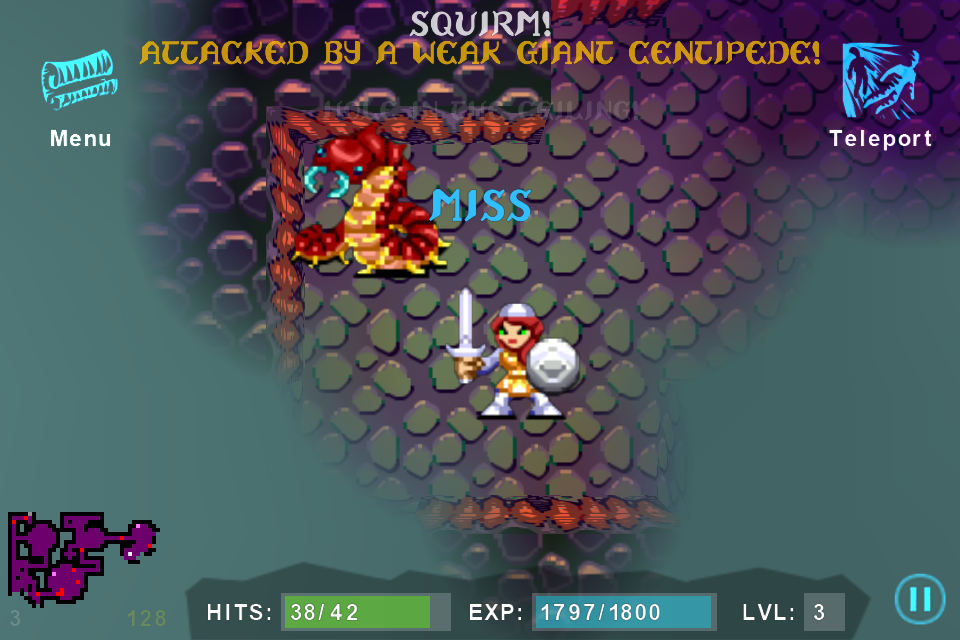
Sword of Fargoal is actually a remake of an old Commodore 64-era title which didn't look like the picture above. No, it looked like this:
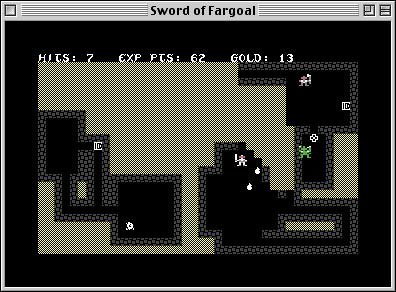
The best thing about Sword of Fargoal is its simplicity coupled with a surprising amount of hidden depth. While Angband is rather intimidating to get started with, with pretty much every key on the keyboard (shifted and non-shifted) mapped to something, Fargoal simply requires that you get to grips with moving and using a context-sensitive button in the top-right corner. And keeping an eye on the text display at the top of the screen for hints and cues, too. Combat is a case of running into an enemy—the player and monster will then take turns bashing each other until one or the other falls over or one runs away. Gold is collected to sacrifice at altars throughout the dungeon for experience point bonuses. And the rest is left to the player to discover. The more you play, the more you start to notice little graphical details and cues tipping you off to the location of traps or treasure.

And it's challenging, too. There are 15 levels to explore, all of which are sprawling monstrosities with several areas. And when you make it to the bottom to recover the titular blade, you then have to escape again. I haven't even made it to the bottom yet. It's a lengthy, challenging quest. And despite the fact that death is permanent, it's addictive and easy to return to.
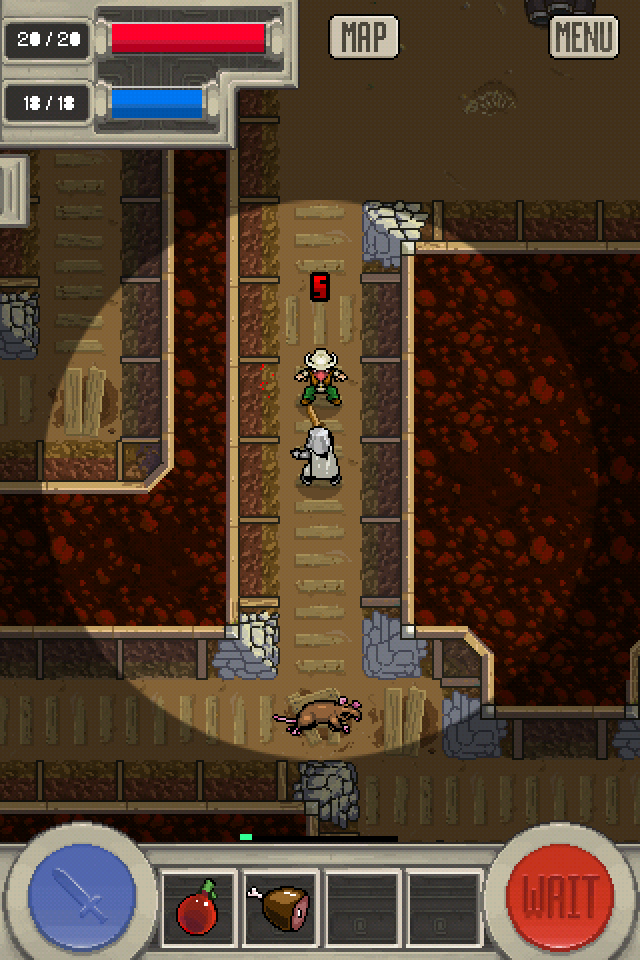
Then we have 100 Rogues, which takes a slightly different approach to that of Sword of Fargoal. While Fargoal's quest is lengthy, 100 Rogues can potentially be beaten in one sitting. Key word here being "potentially". 100 Rogues is particularly brutal, fond of surrounding the player and battering them to a pulp. Fortunately, the player also has a Diablo-style skill tree at their disposal, including a number of attacks that can beat back several enemies at the same time.

It's very difficult, though, and the descriptions of the game on the App Store don't even try and hide the fact that you will die. A lot. In fact, there's even a Game Center Achievement for having sent the titular 100 rogues to their eventual demise.

I only picked this up recently, but it's immensely appealing due to its 16-bit graphics and soundtrack. It looks and plays like a Genesis/Mega Drive game, in a good way. It's a bit buggy in places but the author appears to be committed to regular updates.
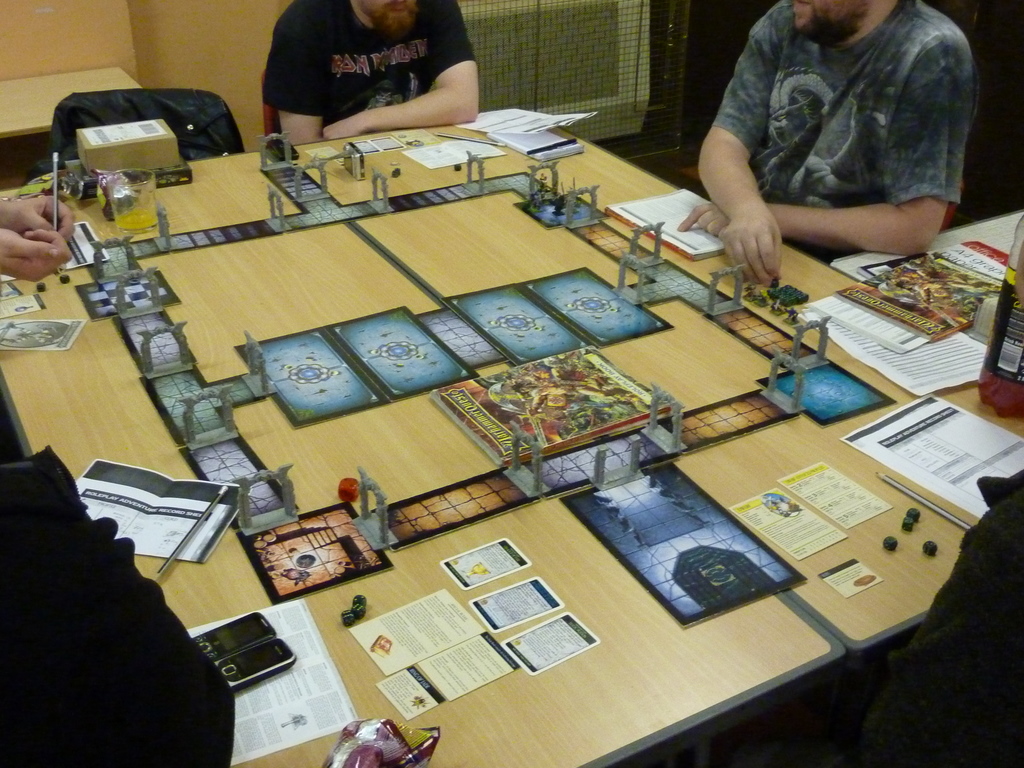
Finally, one of my favourite roguelikes of all time is Warhammer Quest, a game that involves you having people you actually don't mind being in the same room with. Featuring all the genre staples—a randomly generated dungeon, permadeath, brutal difficulty, vast amounts of phat lewt—it's very much the board game equivalent of Rogue et al. Even better, everyone gets to join in on the fun—there's no need for a Game Master player (unless you really want to use one) as the rules cater fully for monster "behaviour".

Couple that with the game's immense customisability (it's a word) thanks to its use of Games Workshop Citadel Miniatures line of figures and you have a game with limitless potential. And hundreds—hundreds—of tiny pieces of card and plastic.

So there you go. A whistlestop tour of the roguelike genre. And I didn't even mention Moria or NetHack once.

#oneaday, Day 286: Murder and Mystery

Tonight's activity was an entertaining affair–a murder mystery dinner party in celebration of my good friend Sam's 30th birthday. (Sam, incidentally, does not know anyone called either "Don Woods" or "Pook" and would like to make that fact abundantly clear.)

For those who have never attended a murder mystery party, it's an enormously fun opportunity for a bunch of people to get together, eat, drink, dress up in silly costumes and then make twats of themselves with each other. Ostensibly, it's a game where everyone is supposed to "role-play" their characters and through careful questioning, determine who the murderer was.

In practice, it's an excuse for people to talk in silly accents, overact and generally lark about. It's a pretty far cry from what tabletop enthusiasts would call "traditional" role-playing, but in actuality it's pretty close to what your common or garden D&D group gets up to. Only probably with more comedy French accents and less in the way of dice-rolling. Which is good. Because the dice-rolling bit of role-playing is often seen as the "geeky bit", whereas with a bit of encouragement, most people can enjoy a bit of impromptu improvisatory theatre, especially when their confidence glands have been appropriately lubricated via the judicious application of alcohol.

Tonight was no exception to the above rules. A diverse group of people attended and hammed it up through three acts of questioning, accusations and gradually-escalating amounts of backstabbing, espionage and clandestine affairs. As the evening went on, people gradually grew much more comfortable with the whole experience and started ad-libbing somewhat. Mostly, it has to be said, with some fairly filthy comments. But that added to the fun. Particularly as the amount of wine consumed throughout the evening meant that everyone's accents suffered somewhat.

So if you're looking for an opportunity to get some people together, dress up in silly costumes and engage in a spot of light role-playing (of the non-filthy kind) then a murder mystery party is the way to go. The set we played–The Brie, The Bullet and The Black Cat–was structured pretty well, with handouts and helpful prompts for all characters, meaning that no-one was left flagging and having to come up with questions all by themselves. It worked well, even though only one amongst our number managed to correctly identify the murderers by the end of the whole experience.

It was a good laugh, though, and surely that's the point of any game when it comes down to it.

The group are now settling down to a game of Eat Poop You Cat! which I discovered the other day can be referred to as Broken Telephone in polite circles. Wine has been consumed, so I anticipate that the sentences and drawings produced throughout the course of the game will be somewhat spectacular.

It's up and out early tomorrow morning for a run, with a change of scenery for once as I'm in Winchester instead of back home. I hope it's not cold.

#oneaday, Day 174: Stag of the Dump

Congratulations, if you please, to my good friend Mr Samuel T Ewins, who is getting married in a few weeks' time. Whatever my own feelings on the institution of marriage and the people who enter into it right now, it's always a good thing to see two people find each other, fall in love and want to publicly declare their intention to spend their lives together. So congratulations to Sam and Helen, who will be tying the knot very soon.

Tonight it was Sam's stag night. Rather like myself on my own stag night, Sam had no desire to end up chained to a lamppost, vomiting blood, resisting arrest and babbling about invading aliens, or whatever it is that stereotypes do on their stag nights. Instead, he decided he wanted to gather together a bunch of friends and do some of the things we mutually love the best. This meant board games, curry and poker, interspersed with wine, Coke and coffee.

We started the day with a friendly game of Ticket to Ride. After I purchased it on a whim some time back now, it's become one of our most consistently-played games. This is thanks in part to its simplicity to play but its surprising depth. It's also a completely different experience depending on how many people you have to play with. And not only that, its simplicity means that it's easy to teach to new people, making it an excellent gateway game for people who've never gone beyond traditional staples such as Scrabble and Monopoly.

I won. This is cause for celebration, as I don't often win. And in a five-player game, too. Five-player Ticket to Ride is a pretty fraught experience, as the board fills up a lot quicker than it does usually. This means that rather than taking your time to amass a huge number of cards as you can in a three-player match, you generally have to jump in and claim the important routes quickly whilst taking care to not broadcast your intentions to the other players. This isn't always easy. There's an element of poker-face amongst experienced players, but sometimes you can't resist yelling an obscenity into an opponent's face.

Next up we played Agricola. I'm normally complete shit at this game, so I tried a new tack to what I normally do, which clearly doesn't work. I ended up coming second for once. Of course, this may have had something to do with the very different dynamic the five-player game has. I'm chalking it up to my new strategy. Which inevitably won't work next time I try it. But oh well; I have to take what I can get in that game! It's a great game, I just suck at it pretty consistently.

Then we went for curry. We tried a new place in town called the Coriander Lounge (I think) which was quite expensive but really, really good. Took quite a while for the food to arrive, but it was good when it did. I had a lamb madras which was just the right level of spicy, and the lamb in it was cooked to perfection. Lamb in takeaway curries is often rather tough and overcooked, but this was beautiful. Flaked apart with a touch of the fork and was lovely and juicy.

A couple of the others went for a dish I forgot the name of, but which was served on a large plate with lots of smaller dishes atop it. Each dish contained what was basically a "sampler" for several different curries. It was a nice idea and I found myself wishing I'd had that when I saw it! The madras was good, though. (Do you capitalise "madras"?)

Then we went back to play some poker. I fared less well than last time thanks to some unfortunate draws and more than a couple of things weighing on my mind at the time. But at least I wasn't first out. I was, um, second. Still, it remains good fun. And the experience of playing in person truly makes me wonder how it is in the slightest bit possible to play online, given that you have no real way of reading other people or "bullying" them. Still, online poker is a hugely successful industry and popular pastime, so perhaps there's something I'm missing.

So it was a good night all round. Managed to keep my mind off things that are bothering me. And I think Sam had the night he was hoping for. I call that a success.

#oneaday, Day 102: Many Happy Returns

As you get older, some things become less and less sacred.

You realise the Tooth Fairy isn't real when you catch one of your parents sneaking in to collect the tooth and drop off 20p. (It was the 80s. Kids in the class I used to teach get a quid now. Inflation at work!)

You realise Santa isn't real. (I don't remember how this happened.)

You realise the Easter Bunny isn't real.

You start to care less about "big" annual events like Christmas and Easter. Especially given that the shops start selling crap for each of them earlier and earlier each year.

In short, things start to matter less. But for me, one thing which will always be absolutely sacrosanct is one's birthday. Your birthday is a day when you should be immune to all harm, be it physical or mental. Of course, in reality it's a day just like any other, but to me, something always feels special about my birthday, and I always respect this feeling towards other people too. I feel particularly sorry for people who have bad things happen to them on their birthdays. I'd feel sorry for them anyway, but to me, having something terrible happen on your birthday just seems like kicking someone when they're down.

I'm also firmly in favour of people not having to work on their birthdays. Like a personal Bank Holiday, if you will. It's your day, it should be yours to do with as you please.

But unfortunately, the world doesn't quite work like that. Other people don't care that you're a year older. In fact, most people don't even know that you're a year older, as one of the things that ceases to happen as you get older is the wearing of badges to helpfully inform those around you that "I AM 6". And so when something doesn't go your way on your birthday it feels like an enormous injustice has taken place.

Fortunately, that hasn't happened today. It's been a pretty quiet one for me. I wrote a few articles, drank some coffee, ate some cake and then went to see some friends and try out new board game Mystery Express, a Murder on the Orient Express-style deduction game. We didn't get time to finish the whole game before some people had to leave and head bedwards (the perils of having a regular day job) but we got a good grasp of the rules and it seems like an interesting game. I'm looking forward to giving it a proper try sometime when we have a bit more time to spare.

So, I'm 29. So far it doesn't feel that different. I wonder if next year will feel different. 30 feels like it should be some sort of milestone, but at the moment I feel rather like I'm drifting and haven't found my true path yet. Well, as it stands, I have 364 days left to get that sorted. That's doable, right?