#oneaday Day 795: Thick Skin

20120324-011709.jpg

They say that in order to "make it" in many industries, you need to have a thick skin. To be able to suck it up, take your medicine, be ready for anything. This is particularly true if you do anything that involves facing the public — and especially true if said public is hiding behind the anonymity of the Internet.

I've come to the conclusion over the years that I do not have a thick skin. I feel bad if someone disagrees with me and argues their point a little too aggressively. I feel bad if I'm criticised when I don't feel it's warranted. And I feel absolutely fucking terrible if someone insults me directly. Basically, I'm a big wuss, and I've come to terms with the fact I'm a big wuss, though it doesn't particularly help me when these situations do inevitably arise at times.

It's a side effect of various things, really: anxiety, depression, being an introvert. I always like to feel like I'm trying my best at everything I do, and to have something come along and suggest that no, my best might not actually quite be good enough on this occasion can instantly sour my mood, even after a good day. And even if the criticism, argument or insult is clearly complete nonsense. It just feels bad.

My comments on this are prompted by a discussion that @JimSterling was having on Twitter earlier. He noted the following:

Forbes thinks game reviews fail readers because there's no dissenting opinion. I should tell them what readers *do* to a dissenting opinion. People always blame reviewers being too nice or too close to PR. I think it's more they don't want their audience to harass them. We're in an industry where gamers personally attack people for giving 8/10 scores, but somehow it's *all* the reviewers' and PR's fault. There's faults and imperfections on *all* sides, but I'm sick of pundits ignoring the bullshit that the game community itself perpetuates.

Jim's comments brought to mind a particular incident which arose while I was working on GamePro, may it rest in peace. I wrote a news article about a new game which had been produced by students and faculty at an educational institution in America. (I forget which one, and the article is no more, sadly.) Said game was narrative- and character-heavy and was designed to be an in-depth interactive exploration of LGBT issues — a topic area typically shied away from by many developers and seemingly almost completely taboo in the mainstream. (No, I don't count the nonsensical, ridiculous "gay" content in BioWare's recent titles which I have a strong suspicion was added purely for marketing purposes. But I digress.)

The game sounded interesting, and I knew from past comments and engagement with the GamePro community that there was a diverse array of people from all backgrounds reading my news stories, so I figured this would be an interesting thing for people to look at — evidence that interactive entertainment was helping to challenge taboos and break down barriers, in short.

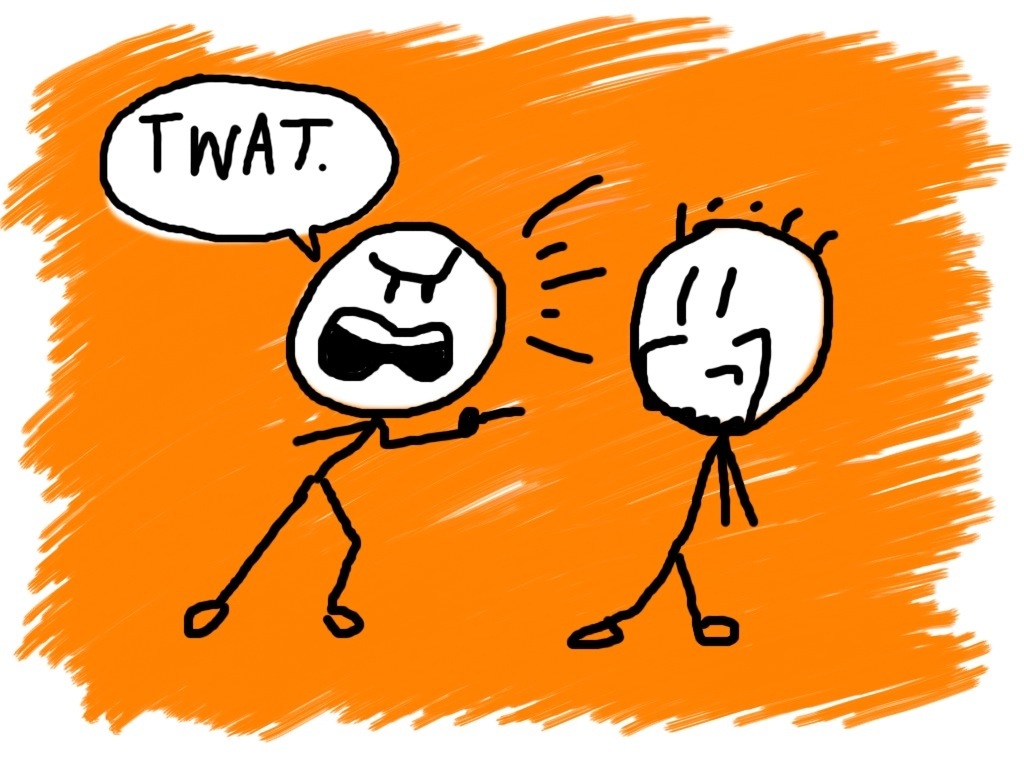
The article was reasonably well-received by most commenters, until one thoroughly obnoxious person came along. He'd shot his mouth off a little on the GamePro Facebook page previously, but it was mostly the gibberings of a paranoid madman who believed that debit cards were out to get him. (I'm not making this up.) This time, though, his gibberings got personal. He called me a paedophile, a pervert, a deviant and all manner of other names. He threatened to organise his supposedly huge group of friends (I doubt the honesty of this claim) to do unpleasant things. He harassed me via Facebook, Twitter and the GamePro comments section — or at least he tried to. He got promptly blocked on Twitter and subject to the Ban Hammer I had the satisfaction of wielding both on GamePro.com and its companion Facebook page.

But the damage was done. I was devastated. I'd never had anyone throw such vitriolic, furious, personal attacks at me before. The article itself had nothing offensive in it whatsoever, and it was neither pro- or anti-LGBT, simply noting the existence of an interesting sounding sociological project that involved interactive entertainment. This was seemingly enough to light the fuse, however, and it completely ruined my day at the time.

I should grow a thicker skin, I know, particularly if I want to get anywhere in online media. But I'm just not sure I have it in me. I just want people to be nicer, to be decent human beings. Is that too much to ask?

Perhaps it is. You can't change human nature, after all, and after many years of observing behaviour on the Internet it's clear to me that a lot of people turn into complete dicks when provided with the protective shield of anonymity. As someone who was bullied a great deal when I was back at school, I can't even imagine how difficult it must be for teens these days considering how easy it is to anonymously "cyber-bully" someone.

Or perhaps they've just naturally evolved that thick skin I so desperately need over the last decade or two.

Either way, dear reader, go be nice to someone today. And always follow Wheaton's Law.
#oneaday Day 794: Brilliant Game Idea, No Technical Talent? No Problem!

20120323-001935.jpg

I've mentioned a number of times on this 'ere blog that I don't really have the knack of programming. I can sort of do it if I have plenty of reference material to hand or if I'm following a tutorial, but it's the sort of thing that if I don't do it regularly, it just all falls out of my head and makes a mess on the carpet.

Despite not being able to program, however, that hasn't stopped me from wanting to make my own games at times, and I know at least a few of you reading might be interested in how to go about doing that for yourself. So I thought I'd gather a bit of information regarding game maker packages that I've used in the past (or at least heard of) in the hope that you might find something that tickles your fancy.

So without further ado, then, here goes.

Clickteam products: Games Factory, Multimedia Fusion

My first experience with making games that weren't written in Atari BASIC was with Clickteam's Klik and Play, an application for Windows that allowed you to create games without any knowledge of programming whatsoever. The program actually contained everything you might need to get creating straight away — it included basic art tools, a library of sound effects and music to use in your games as well as plenty of example sprites, background art and interface elements.

Klik and Play's strength was in its ease of use. Handling all aspects of how a game worked was very much like a logic puzzle, or a series of "If… Then…" statements. For example "If" the player presses the fire button, "Then" the spaceship they control should shoot a missile. "If" an enemy collides with the spaceship, "Then" a fart sound should be played and the player's lives should be reduced by one.

One great thing that Klik and Play did was provide several means to determine all the possible conditions you might want to test for in your game. You could create the statements manually if you knew in advance what was going to happen, or you could enter the "Step Through Editor", start your game running and every time something that hadn't happened before happened for the first time, Klik and Play would ask you what you wanted it to do. After a short while of using this tool, you started to think logically about all the possible things that might happen throughout the course of a single screen of the game you were making, and your efficiency would skyrocket. Of course, even when you know what you're doing this is still considerably slower than a C++ wizard coding their own routines, but for those of us who always put curly braces in the wrong place, it was a godsend.

The only downside to Klik and Play was that it was fairly limited in what it could do. There weren't many global variables to store information in, for example, making more complex games difficult to create. And file management for save games and the like was practically non-existent. You were pretty much limited to making simple arcade games — not that this was necessarily a bad thing.

Many of these issues were resolved by subsequent releases in the series. First came The Games Factory, which added more global variables, the ability to have a scrolling screen for levels that were bigger than a single screen in size, and more sophisticated event handling. This was then followed by Multimedia Fusion, which added even more high-end features designed for people who wanted to build full applications and screensavers rather than just games. Most recently, Clickteam have launched The Games Factory 2 and Multimedia Fusion 2 as two separate products (with Multimedia Fusion having a pro-level "Developer" version available) which are available from their official website. The latest versions feature the ability to export to Flash for publication on the Web, and iOS app format. Android and XNA (Xbox 360) support is reportedly on the way.

RPG Maker

I mentioned this yesterday, but it's worth putting in this list simply because of how full-featured it is. Having gone through a number of previous iterations on both PC and consoles, Enterbrain's role-playing game construction kit RPG Maker is now one of the most flexible but easy-to-use game making tools on the planet. It doesn't even have to be a role-playing game that you make with it — if you're looking to create a visual novel or top-down perspective adventure game, it's a great solution for that, too.

RPG Maker comes with a ton of preset graphics, sounds and music for you to use in your own games allowing you to get started straight away. All you need to do is draw the maps, write the story and test it out, all of which can be done via the program's simple interface. Meanwhile, more advanced users can easily add custom graphics, sounds, music, enemies, items, equipment and characters, and people who actually know a bit of coding can even rewrite the game engine using the program's "RGSS" scripting language to create brand new menu and battle systems. And don't worry if you don't have a clue how to do that yourself but find the built-in systems to be not so good — using community-developed scripts has long been an expected part of RPG Maker development. The community is lively, helpful, full of ideas and covers a broad range of talents — so if you have a great idea for a story but have no idea how to write original music or draw custom graphics, you can probably find someone to help you out.

RPG Maker's latest version is known as RPG Maker VX Ace and is the version to go for out of the three currently available on the official website.

Adventure Game Studio

Free tool Adventure Game Studio allows you to create point and click adventure games of the LucasArts or Sierra ilk. There's a little bit of a learning curve involved in getting started with this one, and it doesn't come with many sample resources to get started with, so you'll have to draw your own graphics (or recruit a friend who knows what they're doing).

Once you get the hang of it, though, you'll be able to create convincing point-and-click adventures featuring plenty of dialogue (fully voiced if you have friends willing to step in for voice acting duties) and object-based puzzles. Lest you worry about the quality of a free tool, Adventure Game Studio has been used to create a number of very well-received projects, including the popular Ben There, Dan That! games.

AGS is free, unlike the previous titles on this list. Get it here.

Ren'Py

Ren'Py is a visual novel engine designed for creating combinations of text, music, sound effects and visuals to tell a story. It's relatively simple to use to get a basic non-interactive story up and running, and a bit of experimentation will get you putting together multi-path adventures with plenty of choices in no time. Like AGS, though, it doesn't come with many sample resources, so you'd better get handy with a Wacom tablet and scribbling some art before you get started on putting your game together. That or, again, ask a friend.

Despite the inherent (and usually deliberate) limitations of the visual novel genre, Ren'Py is a surprisingly flexible tool. For some great examples of what's possible with it, check out Christine Love's three games Digital: A Love Story, Don't Take It Personally, Babe, It Just Ain't Your Story and Analogue: A Hate Story, all of which were created using Ren'Py (and all of which employ some fascinating storytelling techniques that are unique to the interactive medium).

Ren'Py is also free. Grab it here.

Other stuff I haven't tried

There's a wealth of other free and paid game making software out there, most of which I haven't tried. Here's a few you may want to take a look at.

Game Maker from YoYoGames is well-regarded as a flexible tool which can be used to make a wide variety of different games for the Web, standalone release or mobile release.

Stencyl is a tool designed to make it easy to create Flash, iOS and Android games without the need for coding.

GameSalad is a Mac-only product similar to Stencyl, designed for making iOS, Web and standalone games without needing to know coding.

The Game Creators carry a range of products for aspiring developers of various experience levels, ranging from those who have an idea of how to work with BASIC to those who simply want to draw a map for a first-person shooter and run around in it.

If you've come across any more, feel free to share in the comments for the benefit of anyone else who may be interested.

#oneaday Day 793: It Takes More Than Seven Days to Build a World

20120322-012449.jpg

I'm making a game. This is not the first time I have said these words, nor will it be the last time, but I have a good feeling about this one. A vision. Only one past amateur development project I worked on (known as Pie-Eater's Destiny) was ever completed (twice if you count the subsequent "Gold Edition" remake) and a third (The Adventures of Dave Thunder) was going extremely well but then unfortunately lost when an old computer died without warning. (Note to self: BACK THE FUCK UP) This one, though, feels like an idea that has legs, and I'm looking forward to bringing it to life, to mix metaphors for a moment.

No, you won't be getting any details on what this project is just yet save for the fact that I'm using it as a means of trying out the latest version of Enterbrain's excellent RPG Maker software, RPG Maker VX Ace. I've used several iterations of this package over the years and each has its own quirks and foibles. Previous version RPG Maker VX turned out to be a bit of a misstep which seemingly stripped out features rather than adding them, but from my limited experience so far, VX Ace seems to be an excellent piece of software with plenty of flexibility.

One of my favourite parts of creating a game — or indeed any story, since I typically have aspirations to create narrative-focused games, even if I never finish them — is creating the world and the characters who populate it. When building a map in RPG Maker, I'll find myself visualising its context in the world — in the case of a village or town, I'll think to myself "right, this person lives here, this person runs this shop, follow this path and you'll get to…" and so on. In the case of a dungeon I'll resist the temptation to use the random map generator and instead design a dungeon which makes some degree of contextual sense, even if it may descend into bizarreness at times. (The lava flow in the opening "wine cellar" dungeon at the beginning of The Adventures of Dave Thunder was a particular highlight, which our hero lampshaded quite nicely at the time he came across it for the first time, as I recall.)

I've always been this way with level construction. The earliest instance I can remember was Wolfenstein 3D, whose map editor gave me many, many hours of enjoyment and, thanks to CompuServe, even netted me $200 when ten of my levels were included in the official Apogee "Super Upgrades" expansion pack for the game. When building my selection of maze-like levels for id's Nazi-bashing shooter, I enjoyed thinking of the "real" context for these rooms and tunnels. As such, I ended up with some memorable "setpiece" confrontations (or as close as you could get to a "setpiece" in Wolf3D's limited engine, anyway) — the one that sticks in my mind most is the one where you've crept through some moss-filled corridors in search of a Nazi secret base and open a door only to discover that a briefing is apparently in progress. One of the "officer" enemies was standing at the front of the room next to a "map" texture, and the rest of the room was full of the standard trooper soldiers all facing him. (I wasn't a monster for game balancing; I provided the player with a chaingun and plenty of ammo before sending them in to mow down this little gathering. Hey, I was a teenager. Subtlety wasn't in my vocabulary.)

The point is, I found myself thinking carefully about every block I put down, every object on the map. Everything had a purpose, a place, a story behind it. I enjoyed visualising that world in my mind and then bringing it to life on my computer screen. It was inordinately satisfying to be able to hoon around a world of my own creation and think this came from my BRAIN. I feel the same way every time I create a new map in RPG Maker, every time I make a track in TrackMania, every time I build something in Minecraft. And if I had any clue whatsoever how 3D level editors worked (I've tried and failed numerous times) I have no doubt I'd feel the same way there too.

As you may have gathered, today has been about world-building. I've only created a tiny, tiny piece of what will eventually become this game's world, but already it's bringing those old feelings back. Hopefully they'll provide the motivation to take me through to actually finishing a game project for once.

#oneaday Day 792: When Play Feels Like Work, It's Time to Stop Playing

20120321-002219.jpg

Asynchronous games are a great idea. At the time of writing, everyone is jizzing all over Draw Something (and quietly hoping that Zynga doesn't acquire the developer in order to monetize the game out of the arse even more than it is already) — the latest in a long line of successful mobile asynchronous games that include Hero Academy, the With Friends series and, on a smaller scale, various board and card game adaptations.

Now, in theory, the fact that you can play a turn-based game with someone on the other side of the world at a pace which suits both of your busy lifestyles is a great one. And sure enough, it most certainly is a great thing. Games which previously proved impractical to organise when players span various different timezones are suddenly accessible to all and sundry, and your mobile device becomes a portal to a wide variety of social, multiplayer experiences that you can share with your friends.

Trouble is, everyone wants to get in on this action, meaning that whatever flavour of the month asynchronous hit there is will promptly bombard you with notifications and game requests as absolutely everyone on your Facebook friends list suddenly wants to play. And God help you if you post your username for such a game on Twitter.

Now, having a bunch of people to play against should be a great thing, particularly in a game that occasionally offers such a fascinating glimpse into people's minds as Draw Something does. But, you know, it all gets a bit too much sometimes. When you have twenty people taking their turns in Draw Something, twenty more begging you to play Words With Friends, twenty more wanting you to play Hero Academy, it's easy to find yourself overwhelmed with notifications and game requests, and find yourself spending hours at a time just catching up with games — and meanwhile your opponents are also taking their turns, meaning sometimes it's almost impossible to catch up. You can always exercise self-control, of course, and only accept the number of games you know you can handle — even going so far as to uninstall the games you know you don't want to play, perhaps — but there's always that element of peer pressure going on.

I can't help feeling that developers of these games could do a bit to help out here. The simple addition of a "privacy" button that automatically blocks all new game requests but allows current games to continue would be a good one, for example, or perhaps a hard (and reasonable — perhaps user-customizable) limit on how many games can be running concurrently. At the moment, I often find myself letting games expire accidentally due to the fact that a bajillion notifications come in at once, I have no time to deal with them at the time, and they form a backlog which would require a considerable number of minutes to clear. It's at that point that play starts to feel like work, and that's a situation you shouldn't find yourself in.

When something becomes an effort to play and there's no discernible payoff for doing so, that's when you have to question why you're playing in the first place. The thing with all these asynchronous games is that victory is a very hollow experience — win or lose, after a brief "You Win!"/"You Lose!" message, the first thing most players will do is immediately hit the "Rematch" button. Most don't even do any particularly detailed stat-tracking, meaning you can't even gloat over your winning streak against your friend. Some, like Draw Something, don't even make it clear whether or not you're supposed to be competing against or cooperating with your friend, and then patronise you with primary school-esque "Good Try!"s when you get one wrong. (Notable exceptions: the adaptations of card and board games such as Carcassonne and Ascension do a good job of both stat-tracking and providing a good victory screen for winners to gloat over and losers to quickly skip past.)

These games have their markets, though. They let people connect with one another in new ways, and they open up the medium of gaming — specifically, multiplayer gaming — to massive new audiences. That's a great thing for the industry as a whole, but there's only so many "It's your turn!" notifications I can take before I go completely mental.

#oneaday Day 791: Give Me More J

20120320-013144.jpg

The Squadron of Shame recently tackled the subject of Japanese role-playing games in the first of a new format show that we're experimenting with. You can check out the show here, or if you're on something Flash-enabled, you can use the fancy-pants player below. (If you're not, you'll simply see a white space, for which I apologise.)

If I had to pick a favourite genre of interactive entertainment, it would, without doubt, be the Japanese role-playing game. I came to the genre relatively late (yes, I was one of those people who discovered RPGs in general through Final Fantasy VII) so I didn't really have the NES-era epiphany of realising that RPGs were the only genre of games that were attempting to tell a story — for a while, at least. I also didn't discover the earlier Final Fantasy games until much later, though I have, to date, played every one of them (except XIV) and have finished most of them. I still have V and VI outstanding. Shameful, I know.

There's something about the JRPG genre that has resonated with me ever since I first got off that train in Midgar and that awesome music started up, though. For one, I find the sort of over-the-top wackiness and melodrama that typifies the genre to many people to be entertaining and fun to get invested in. For another, I have absolutely no objection to a bit of moe in my games, and generally find anime characters of this type very appealing despite the fact that in many ways they're just as generic and widespread as the bald space marine with no neck. And for yet another, I enjoy the creativity frequently on display in the genre, both from an artistic and a narrative perspective.

It's a cliché to say that Japanese RPGs are clichéd, and a lot of people who accuse the genre of that probably haven't played one for a while. Sure, there are certain thematic elements and tropes which many of them have in common, but all are unique in some way. I can remember pretty much every JRPG I've played over the years in great detail — contrast this with the fact that there are a whole bunch of shooters I struggle to distinguish from one another, and it's pretty rare than I can even remember characters' names from Western RPGs like The Elder Scrolls. Each JRPG has its own unique cast of characters who are (in most cases) well-developed and display plenty of growth and change over the course of the story. Sure, some of them start their journeys as unlikable arseholes (Squall from FFVIII and Neku from The World Ends With You spring immediately to mind) but having a strong emotional reaction to a character — "I really don't like this guy" — is surely a sign that the writers have done their job well. It's sometimes a difficult experience to play a game with a seemingly dislikable protagonist, but often this is a sign that he's going to go through some experiences to soften that stony heart of his, and I'm a big fan of that particular narrative trope.

Leaving narrative aside, I've always been a fan of the often abstract, creative battle systems that populate Japanese role-playing games. This is perhaps best exemplified by the Final Fantasy series, which significantly shakes up its core mechanics with every single instalment. Don't believe me? Here's how the battle system and related mechanics differ from game to game:

  • Final Fantasy — Traditional D&D-style turn-based combat without movement. Spells split into levels, like D&D, and characters have a limited number of casts per level that increases with their character level. Characters have set classes and, later in the game, may promote these to "prestige" classes.
  • Final Fantasy II — Turn-based combat, but progression is tied to an Elder Scrolls-like system whereby using something makes it improve. Whack things with a sword and your sword skill will increase. Take a lot of damage and your hit points will increase. Use a lot of magic and your magic points will increase. This system proved rather divisive at the time, and predated Bethesda's implementation of a very similar levelling system into its flagship Western RPG series by six years.
  • Final Fantasy III — Turn-based combat, with progression tied to a "Job" system where characters could switch classes almost at will, allowing players to dynamically build a party to fit the situation at hand.
  • Final Fantasy IV — The first appearance of "Active Time Battle", the almost-real-time-but-not-quite system which has been present in most of the subsequent titles. Progression and skill unlocks were static and unique for each character.
  • Final Fantasy V — The Job system returns in a much more well-implemented fashion. Players may develop Jobs at will, and may also equip certain skills that they have learned from another Job to build multi-purpose characters.
  • Final Fantasy VI — Each character has unique special abilities but everyone has the opportunity to learn the same spells by fighting with "Espers" equipped.
  • Final Fantasy VII — The Materia system allowed for deep customisation of characters with a slightly puzzly element — how best to fill the available slots in a character's weapon and armour?
  • Final Fantasy VIII — By drawing magic out of enemies and "junctioning" these spells to statistics, players could create powerhouses that made their character level practically irrelevant. A bizarre and abstract system that didn't quite work.
  • Final Fantasy IX — Characters learned skills from their equipment. Once they had learned the skill, they could use it any time, otherwise they had to keep the equipment in question in use to perform the action.
  • Final Fantasy X — A brief break from the Active Time Battle system brought a clever turn-based system where certain actions could rearrange the turn order. Also saw the first appearance of a non-traditional levelling system in the form of the "Sphere Grid"
  • Final Fantasy X-2 — A return to the Active Time Battle system and a variation on the Job system came with X-2's Dressphere setup, whereby each of the game's three playable characters could equip several Jobs and switch between them mid-battle.
  • Final Fantasy XI — The first MMO entry in the series had another variation on the Job system whereby a single character had levels in every Job, but could only have one active at a time, with a "Sub-Job" becoming available after some progression had been made and allowing characters to use skills from this second Job.
  • Final Fantasy XII — Taking the combat of XI and applying it to a single-player game allowed XII to have a real-time feel while still feeling strategic, as players were able to pause the game to issue commands to characters while battling without being sent to a separate screen. Progression was split between a traditional levelling system and the "License Grid", whereby characters had to purchase licenses to use specific pieces of equipment and abilities, then purchase the equipment and abilities separately.
  • Final Fantasy XIII — Active Time Battle on a separate combat screen returns, this time with players taking control of a single character in fights that focus more on carefully-timed Paradigm Shifts (effectively Job changes by another name) rather than using specific abilities. Had a distinctly unconventional levelling system whereby characters could gain levels and abilities from six different classes independently.
  • Final Fantasy XIII-2 — Similar to XIII, but with only two characters available. Players could catch various monsters to fill the third party slot. Characters could once again develop down the six different paths, though monsters had a fixed class which could also be developed. Unlike XIII, where you were stuck playing as the party leader, in XIII-2 you could switch between the two characters at will, and one of them getting knocked out did not mean failure.

As you can see, Final Fantasy is a series which has evolved significantly over the years, and yet many accuse Square Enix of letting it stagnate. Sure, they've arguably made a few missteps over the years — XII, XIII and XIII-2 have all proven somewhat divisive in particular (though I enjoyed all three of them) — but one thing that the Final Fantasy team really can't be accused of is sitting on their laurels and churning out the same old thing year after year. The same is true for many other JRPG developers. It's one of the richest, most creative genres out there.

So why has it fallen from grace? A combination of factors. With the increasingly-busy lives people lead today, a 100-hour game is no longer necessarily seen as a good thing. Budgets for high-definition games spiral out of control, making the production of an HD JRPG an impractical prospect for many studios, particularly when they can't necessarily count on huge sales numbers to recoup their expenditure. (This is perhaps why MonolithSoft and Mistwalker chose to release the gobsmackingly brilliant Xenoblade Chronicles and The Last Story on the Wii rather than the more popular/"hardcore" Xbox 360 and PS3.) And the eye of "the average gamer", whoever that might be, has drifted towards the West these days for the majority of their gaming fixes, rather than the East as once was.

There's still a rich back catalogue of excellent titles out there to explore in this deep genre, however — even more so if you learn Japanese. I'm making a point to go back and revisit some titles I missed the first time around at the moment — having recently played Shadow Hearts I'm now on to its excellent sequel, for example — and I'm having a great time. For the vast majority of these games, they're a reminder of a simpler time — no "Your friend is online!" notifications, no party chat invites, no DLC, no controversy over endings even when they sucked — and they're great.

So while the rest of the Internet yells and screams about each other about Mass Effect 3 (still!) I'm more than happy to immerse myself in a world of HP, MP, Attack, Magic, Item, Escape.

#oneaday Day 790: Mess

20120319-004443.jpg

I honestly don't understand how mess builds up. It's a pain in the arse. Because when it builds up, you then have to clean it up. And that, as we all know, is a task which most people would carve neat slices off their own elbow to not have to undertake.

Take our living room. Both of us regularly make an effort to clean it up, tidy up, hoover, put stuff away, but somehow it still gets back into the state it's in at the time of writing: various bits of crap scattered around the place; a coffee table with a variety of discarded (and empty) crisp and ice lolly wrappers in attendance; coffee cups in every nook and cranny it's possible to secrete a cup — a likely familiar story for many of you.

It's often born of good intentions, ironically. You put something down on, say, the coffee table, telling yourself (or possibly someone else who is also present) that you'll "clean that up in a minute", that you'll "do it when Pointless has finished" or that you're "just finishing this cup of coffee". Inevitably you then get immersed in Pointless/your cup of coffee/watching the small insect that is crawling around on the wall in the corner of the room and you forget to do it. The process then repeats itself, leading to a buildup of crap.

Staying tidy, then, is a matter of actually following through on these good intentions rather than simply postponing the implementation until an indefinite period "later". It's a matter of finishing a bag of Quavers and then putting it straight in the bin; of washing up a coffee cup as soon as it's been used; of re-using coffee cups rather than getting new ones every time.

But it's hard. Cleaning up is boring. Washing up is a dirty, smelly task. Doing laundry means you have to hang up all the wet crap before you can put another load on, and preferably before it's sat stagnating in the washing machine for a week going all whiffy. None of these are appealing tasks at the best of times, and throw in the negative mental attitude which being surrounded by squalor fills you with and it's, as you might expect, very difficult to get started.

One thing that I've tried in the past is to plan out and schedule my day to include set times for tidying up and whatnot. Having worked as a teacher in the past, working to a "timetable" worked quite well for me, and if you're just doing it for yourself in your own house then there's no running to the opposite end of the school to find that Year 7 class you found out five minutes ago that you're supposed to be teaching a cover lesson for.

This is actually quite a good productivity approach all round. And not just for housework, either; if you have any personal projects on the go, whether they're technical, creative, DIY or fitness-related, it's dead easy to let them slip and simply not do them. Scheduling your day to include specific (but slightly flexible) time blocks where you're supposed to do [x] is a good approach for those whose mind and/or attention span isn't too chaotic to cope with it. The downside to it is, of course, that everything you do has the possibility of starting to feel a bit like work. The way round this is to ensure that you don't schedule absolutely everything, just the things that you really want or need to do. Do those things when you say you will, and the rest of the time is free to spend as you please. Do those things early, and those scheduled slots magically become free time. And as any teacher worth their salt will tell you, one of the best feelings in the world is discovering you've got a free period when you thought you'd have to deal with 9VN.

#oneaday Day 789: Servicebot 9000

20120317-233622.jpg

Andie and I bought a new sofa today. (All right, Andie did all the talking and I sat on the sofa we were purchasing tweeting.) It was not a terribly exciting process, though the fact that in twelve weeks (three months!) we're getting a comfy new sofa bed to put in our living room and replace the not-quite-as-comfy-as-it-should-be-and-slightly-stained-sofa we currently have is pleasing. Later on, we went to Nando's for dinner.

I provide these details for context on what I'm going to discuss today, which is the concept of "customer service" as it stands in 2012.

When you're looking for a good experience at a shop or restaurant, you generally want several things: to not be hassled, to get help when you need it, and to resolve any transactions involved in the encounter as quickly as possible. Ideally, we'd have an RPG shop setup, where you walk in, select the items you want and walk out again a few thousand gold pieces lighter. Unfortunately, it doesn't quite work like that as sooner or later you'll have to deal with people.

Or, more accurately, salespeople or waiting staff. I provide this distinction because interacting with one of these people is, a lot of the time, a very frustrating experience. This is largely due to the fact that they inevitably have some sort of "script" to follow and are obliged to mention certain things. In the case of the sofa salesman today, we had the spiel about the five-year stain protection, the "Special Cream" that we needed to take care of our new acquisition, the special things they could put on the feet to make it easier to move because sofas don't have castors these days, and all manner of other shenanigans. In the case of the Nando's waiting staff, we received our meals and within a minute of picking up our cutlery were already being asked if our food was all right.

Now don't get me wrong, I'd rather have attentive staff ready to put things right if necessary, but when it feels like you're talking to a robot it often has the opposite sort of effect. While we were going through the purchasing process for the sofa, every step was punctuated with a "I'm just going to tell you about the slightly more expensive leather you could have on it/the five-year protection plan/the Special Cream/the fact you should wipe it with a cloth every so often" when all I really wanted him to do was say "You want this? Fine. Sign here," and be done with it. When I'm eating a meal, I just want to eat it rather than deal with someone buzzing around my ears asking if everything's all right. If something's not all right, I'll make sure you know about it, chum.

It's a fine line to tread, and one which not many retailers have quite got right just yet. The Apple Store probably comes the closest, since its Specialists are generally quite happy to have a natural-ish conversation with any customers in attendance, but they're still obliged to mention the various services that the store offers — AppleCare, One to One, the Genius Bar and the like — meaning there's always that slight element of roboticness there. They're better than most, though, and can usually pick up on when you're in a hurry and just want to choose something, give them extortionate amounts of money and get out before you decide that yes, that new iPad with the retina display really is very shiny and something that you want more than anything else in the world.

It's difficult to know exactly how this question of "human" customer service can be resolved. Clearly, scripting employees' conversations is not the way to go. That way lies the Path of the Telemarketer, and we all know how well-received those phone calls usually are. But if you leave people to their own devices to handle interactions, you get the sullen, grumpy, silent assistants who work in places like Primark and Dorothy Perkins. (To be fair, I can empathise; I'd be sullen, grumpy and silent if I worked somewhere like that.)

What needs to be taken into account to provide the best possible customer service, then, is the person themselves. When hiring someone to fulfil a customer-facing role, employers shouldn't be looking for someone who can recite scripts from memory. They should be looking for someone who can develop a rapport with their customers; someone who makes people walk away from that shop or restaurant thinking "wow, I really liked that person, I'm glad they helped me."

That takes time and effort, though, and a lot of customer service roles are seen as a relatively low tier in the hierarchy of an organisation — meaning that said time and effort isn't always expended on finding the best possible people. Perhaps it should be, though — corporate culture and business-speak may be overly prevalent in society, but that doesn't mean it's a particularly positive development. After all, who would you rather buy an expensive thing from — someone who appears inherently trustworthy, friendly and knowledgeable; or someone who can recite a finance agreement from memory?

#oneaday Day 788: From the Depths of the Subconscious

20120317-015032.jpg

Analysing your dreams can probably tell you a lot about yourself. If that's the case, though, I'm not sure I want to know what my most recent vivid imaginings say.

I dream best in the morning after I've woken up once. At least, those are the dreams I remember. If I wake up when Andie leaves for work and promptly fall back asleep again (which, to be perfectly honest, I usually do) then I'll often have incredibly vivid dreams which, more to the point, I tend to remember pretty clearly. They're certainly not conscious imaginings, because there's no way I'd choose to think of a lot of the things that flit through my mind. Rather, it appears to be a completely automatic process, presumably based on anxieties or thoughts already stuck in my head.

This morning, these bizarre "snooze dreams" were — and I apologise for what I'm about to recount — rather lavatorial in nature. To begin with, I found myself sitting on a toilet in an upstairs hallway of a house. It wasn't my real-life house, though I think it might have been my own house in the dream. Quite why there was a toilet in the upstairs hallway was anyone's guess. And quite why I was sitting on it when the house was clearly playing host to a large party is an even bigger mystery.

Despite the fact I had clearly just had a dump in front of all the passing partygoers — most of whom seemed oblivious to my presence and activities — for some reason (and again, I apologise) I found myself unable to… uhh… "clean up", as it were. I found myself panicking and wishing all these people weren't in my house, screaming at them to get out of the way, but still no-one paid me any heed.

I ran downstairs and found myself in the house I lived in for my fourth year of university. I knew there was a nice, quiet toilet in the back where I could complete my business, so I opened the door. I found a toilet all right, but it wasn't the one I was expecting. Rather, it was in a large, L-shaped room whose walls and floor were all made of ceramic tiles. There was no ceiling to the room, and outside I could see that we appeared to be floating in space. Worse, there was no bog roll here, either, only three circular red buttons next to the toilet.

I left, and the subsequent journey was a blur, but I ended up in what appeared to be an aeroplane bathroom, albeit one with a sloping roof that met the wall behind the toilet, and a large skylight in it. When standing in front of the toilet, I could look out through the skylight, and I saw that we were in some sort of rural area. Outside the skylight, men in peculiar costumes were being shepherded away by strange figures I can't remember any details about. For some reason, I thought nothing of this strange and slightly sinister behaviour, because I had more pressing matters on my mind.

There was a toilet paper dispenser on the wall, so I pulled the handle to dispense some, but the string of sheets went down a small hole underneath the dispenser. When I retrieved the paper from the hole, it was completely covered in a weird black sludge which was then all over my hand. After going "urgh" for a little while, I simply washed it off, finally wiped my arse (noting with some surprise that my underpants had not been soiled despite all the running around) and then woke up slightly worried that I might have shat myself in my sleep. (I hadn't.)

This particular incident follows a long stream of other bizarre "snooze dreams" I've had which include being unable to go through with a sexual encounter because I didn't have the sheet music for it; starting to read the TV Tropes page for my own life and being literally unable to look away from it; and a particularly unpleasant one where I lived in a big house with all my friends and we all suddenly started hating each other for no apparent reason.

My subconscious is fucked, basically. Oh well, at least it keeps things interesting. And the fact I can remember all this nonsense gives me good fodder for when I actually do want to do something creative and imaginative… though I can't see a novel about someone who might have shat himself catching on, really.

#oneaday Day 787: Shadow Hearts: A Scoreless Review

20120316-014112.jpg

Shadow Hearts for the PS2 is a game which seems to be almost universally adored by everyone who has played it. It's certainly a far cry from the reaction its PS1 predecessor Koudelka got, for sure, proving that yes, sometimes developers do learn from their mistakes.

Is it worth playing in 2012, though? That's one of the questions I set out to answer when I eschewed the latest and greatest in fancy-pants HD gaming and booted up Sacnoth's classic for the first time. I'd never played it before, so coming to it as a 2012 gamer would be my first experience — hopefully allowing me to determine whether or not it's still worth your time.

First impressions are striking, and not necessarily in a good way. We're in full-on old-school JRPG mode here, with polygonal characters wandering around on top of pixelated prerendered backdrops, occasionally stopping to perform a canned animation and generally not looking overly natural in their surroundings. Couple this with that much-maligned mainstay of Japanese roleplaying games, the random battle, and you have an experience which takes a little getting used to if you're accustomed to the ways in which the genre has grown, changed and adapted over the years.

Once you get your head into the mindset of how things work, though, all that culture shock quickly fades away. The characters may have somewhat wooden animations, but they're detailed 3D models with plenty of personality, and they provide the party you eventually assemble over the course of the game's 30 hours or so with a distinctive look. When combined with the good quality localisation job which has been done on the game's dialogue, the game's cast comes together as a loveable, memorable crew of misfits that is all the more notable for not relying on traditional JRPG archetypes.

The plot, too, is interesting and unconventional, blending real-world events from the early 20th Century with pure fantasy that occasionally drifts into Lovecraftian "it came from beyond the stars" territory, though with a slightly light-hearted edge on everything. It works well, and all the more so for the fact that it doesn't feel the need to necessarily spell things out for the player. You can tell that we're dealing with some sort of twisted alternate history here when we see how comfortable everyone is with the use of magic, for example — there are no exaggerated "Wow, you have amazing special powers!" scenes when new characters join the party, even when protagonist Yuri reveals the ace up his sleeve: his ability to transform into slobbering death monsters.

The characters' special abilities are what provides depth to the game's combat system. Characters tend not to be single-minded specialists, but often have a range of skills that unlock over the course of the game which can be applied to a variety of situations. Even leading lady Alice, who is set up pretty early on to be your stock "healer" character, has some entertaining tricks which she can perform — and she's not the only one with the ability to heal, either. Even some of Yuri's monster forms have the ability to heal, meaning the player can stick with a party arrangement that works for them — or that is simply made up of characters they find appealing. Given Yuri and Alice's importance to the overarching plot, however, most players will likely find themselves spending the majority of their time in the game with these two and one of the four other characters in the third slot.

Combat unfolds via a rather sedate turn-based system. There's no time bars here, just a simple behind-the-scenes initiative calculation determining who gets to go next. There are two twists on the traditional turn-based combat formula, however: sanity, and the Judgement Ring.

Sanity points gradually drain over the course of a fight, reflecting the mental strain battling horrific eldritch monsters has on the human psyche. Running out of sanity points causes the character to go Berserk, attacking enemy and ally indiscriminately accompanied by the word "Violently" curiously emblazoned in the air over their head. In a nice nod to characterisation through statistics, different characters have varying pools of sanity points according to their own mental faculties. Alice, for example, being a bit of a scaredy-cat girly-girl at times, has a very small pool of sanity points, while Yuri, who is wandering around with a variety of monsters living in his psyche, has a very large pool which he expends any time he turns into a monster — presumably a rather traumatic experience.

Meanwhile, the Judgement Ring is the mechanic which drives the whole game. Rather than simply hammering the Attack button to get through fights as quickly as possible, the Judgement Ring is a timing-based system that requires players to accurately tap the X button on their controller in time with a predefined pattern. Said pattern varies according to what the player is trying to do — using an item only requires one tap, for example, while the characters' later special abilities may require three or four carefully-timed taps in total. It's a simple means of making combat feel significantly more interactive than turn-based titles otherwise can, and it's also used outside of combat to resolve situations which would be handled by a dice-based "skill check" in a tabletop RPG — kicking down a door, negotiating for better prices in a shop, perfomring a task which requires endurance.

Whether or not you'll find Shadow Hearts to be a palatable play experience in 2012 will depend a lot on your patience. While the random encounter rate isn't overly high, you can expect exploration of the game's world to be frequently interrupted by battles with enemies — and, as is common for this breed of role-playing game, you'll see the same enemies and groups of enemies quite a lot over the course of a dungeon. Boss battles, meanwhile, are generally fairly lengthy experiences, partly to put a bit of pressure on the game's sanity system. Later conflicts can feel like they're dragging on a bit, particularly once you've managed to acquire some equipment for the party which allows them to shrug off things like status effects. The requirement to use the Judgement Ring with each ability use and attack helps keep things moving, but a few of the later bosses just go on a little bit too long to be comfortable or fun. The final boss is particularly prone to this, it has to be said, as it's something of a damage sponge. In a game where three-figure damage is considered a strong hit, taking down something with over 10,000 hit points is a task you'd better set aside plenty of time for.

Presentation has also moved on significantly since the game's original release back in 2001. Video sequences feature characters with that obvious sort of "rendered on the cheap" animation, and the voice acting is woefully inconsistent. Some English characters speak with an American accent, and others speak English at times and then yell something in Japanese in the middle of battle. The slightly rough edges do give the game a certain degree of charm, however, and the lengthy sequence where an old lady reads you a ghost story — complete with vocalised sound effects — is extremely memorable.

All in all, though, Shadow Hearts' charms considerably outweigh its idiosyncracies, and the game remains fun, entertaining and engrossing today. While it's not the most technically polished, high-budget JRPG — something which was apparent even back on its original release, especially when compared to Final Fantasy X, which came out the same year — it's certainly one of the most memorable. And, crucially, by clocking in at around 25-30 hours, beating the game is well within the reach of even people who like to go outside sometimes. In these days of everyone seemingly being increasingly busy, the importance of brevity shouldn't be underestimated.

So should you check it out in 2012 if you've never played it? Sure, but do be prepared for that initial culture shock as you adjust to the Way We Did Things over ten years ago. Times have changed, for sure.

#oneaday Day 786: On Endings

20120315-010927.jpg

I'm not going to discuss Mass Effect 3's ending here, largely because, as you all know, I have not played the game, nor will I be doing so. I have, however, been reading up on it and I understand that it is SUPER-MILD SPOILER rather bittersweet — or just plain bitter, if you prefer to look at it that way. /SUPER-MILD SPOILER

There's been a ton of coverage regarding fan outcry over the ending. For the most part, those complaining about the ending (and even, in some cases, petitioning BioWare to change it) have been held up as figures of ridicule, the exemplification of that overused and increasingly meaningless word "entitlement". Some professional industry commentators have even taken to insulting and verbally abusing people who believe that the ending is "wrong", with one notable example referring to anyone who had criticised either Mass Effect 3's controversial DLC strategy or its ending as "whiny fucking babies". (That netted an instant total loss of respect and an unfollow from me, incidentally, not that the person in question likely cared.)

Other outlets took a slightly more measured approach to criticising this group, noting that forcing BioWare to change its creative work according to public opinion rather than steadfastly sticking to the ending it chose to write would cause Mass Effect to cease being art and to simply be another product. (I would argue — and have done — that it's already there, but that's a whole other issue.) Meanwhile, articles like this one, that offer a well-considered message of support to disenfranchised fans, are rather more rare.

I'm not quite sure where I stand on the debate. From what I understand of the ending, the thing that people are most upset about is the fact that it appears to render most of the decisions made throughout the course of the entire three-game series completely irrelevant. Given that this "decision-making, choose-your-own-adventure then deal with the consequences" nature has been a key selling point for the entire Mass Effect series, I can see why people would be pissed off about it. And if this truly is the case (still haven't played it, remember) then I'd be inclined to come down on the side of supporting those who are upset at the ending.

On the flip side, I have nothing against a bittersweet ending. In fact, some of my favourite endings over the years have been bittersweet ones. (Spoilers ahead. Highlight the text to read it. Mobile users, copy and paste the white text into a note or something.) Take Conker's Bad Fur Day, for example, where despite kicking all kinds of ass throughout the course of the game, culminating in an epic battle spoofing Alien, Conker's girlfriend, whom he has simply been trying to make it home to for the whole game, is still dead. Or Final Fantasy XIII-2 (another game which saw a bit of fan upset regarding the ending, though not to the degree of spawning a petition) where Serah dies in Noel's arms, having suffered a vision just like all the Yeuls the duo had seen throughout the course of the game — a possibility which the game had set up and repeatedly reminded the player of throughout. Or To The Moon, where the old man dies and it's still massively upsetting despite the fact you've known for the whole game it's going to happen. Or how about Persona 3 (I haven't played FES yet so don't spoil it if I'm wrong here!) where it's rather strongly implied that the protagonist dies peacefully on the school rooftop surrounded by his friends. Or Persona 4, where after spending a year with people, building up close friendships, solving a series of horrible murders and eventually saving the world, you have to leave them all behind by getting on a train and not looking back. I even loved Fallout 3's original ending, where the player character dies a horrible, painful death in a radiation-filled room while saving everyone else. Or… you get the idea by now, surely.

I liked all of those endings. I thought they were effective and, in many cases, quite moving. I think the difference we're seeing with Mass Effect 3, however, is that the ending is being seen as rather at odds with the way the rest of the game — nay, series — has played out to date, and fans feel that they are being cheated out of the choice of ending that they want, deserve, whatever you want to call it. Of course, there is a very complicated flowchart in a ring binder somewhere in BioWare HQ that maps out all the possibile decisions players might have made over the course of the three Mass Effect games, and attempting to untangle that in order to produce an ending that would satisfy everyone would be absolutely impossible.

Without getting into spoiler territory here, though, I feel it would at least have been possible for there to be one or two alternative ways for the saga to end besides those which are already there — and which are, from what I've read, relatively similar in their execution, if not their consequences and eventual outcome. It seems very strange for BioWare to do this given that they've been so good at endings in the past — look at the variety of ways Dragon Age: Origins can conclude, for example, whereby the player is pushed towards the final battle of the game, making it seem like a linear run to the finish, but is then thrown a number of massive decision points that significantly affect exactly how the ending goes down. The outcome is the same in each case, but the means by which it is achieved is enormously different — and, more to the point, is dependent on player choice as well as how they have played their character up until that point, factors which Mass Effect fans feel that the trilogy's conclusion is not taking into account.

Basically, I can see both sides of the argument here, though both sides also have a lot to learn about respectful debate. Many in each camp are making valid points which then have all credibility removed when someone causes things to descend into name-calling and hair-pulling. A debate over something like this should be interesting and exciting, not leaving everyone involved and any onlookers feeling faintly disgusted and ashamed. A game provoking such discussion should be celebrated; instead, this whole episode is proving to be something of an ugly blot on gaming history.