It is my birthday. I am 45 years of age today. I have had a reasonably nice day — I took the whole beginning of this week off — but to be honest I didn't achieve what I initially thought I was going to achieve in this time off. I thought I was going to make some videos, but it turns out I have not done that. Instead, I have made some headway on a Mystery Creative Project I teased a while back.
I'm still not going to tell you what it is, because my aim for it is to finish it before unleashing it on the world, rather than doing it piecemeal. My reasoning for this is that… well, I have prior experience. At one point a while back, I started doing a website whose long-term intention was to go through every cartridge available for the Philips G7000 "Videopac" computer and write something about all of them. I stalled on that project for various reasons, and at some point a WordPress update broke my layout on the page and I haven't been able to summon up the mental fortitude to go and fix it. As such, it's just sort of sitting there in a broken, unfinished state, and will likely continue to do so.
My thinking is that if I work on this thing a bit at a time, trying to knock off a little bit of it every day, I'll have something impressive to show off when it's complete. (Once it's "complete", it will continue to evolve by virtue of what it is, but there will definitely be a moment when it reaches "version 1.0" status and I am happy to reveal it.) Conversely, if I were to launch what I've done now, people might just go "huh, cool", realise there's not all that much to it yet and then never think about it ever again.
So that's my plan. And I've made a good dent in starting this whole project over the course of the last few days. Starting these things is always one of the toughest bits, because you keep thinking of little bits and pieces you might want to do to refine the experience — and if these revelations come too late, it can be a bit of a faff to implement them. Thankfully, I'm happy with the situation I've got things into now, and I can now focus on the real meat of the overall project.
Make no mistake, though, this project is going to be a lot of work. There is somewhere in the region of 800 "little jobs" to do in the name of putting the whole thing together, and so far I have completed (counts) nine. Still, every journey begins with a single step and all that, and now I've got started, I feel like I can bang out a bit of this whole thing each day until it is all done. And it is something that I think will feel good when it is finished.
I apologise for being vague about all this, but hopefully you understand my reasoning for it. I want the grand unveiling of this thing, whenever that might end up being at some indefinite point in the future, to be a worthwhile and meaningful event for those it is relevant to. And I feel like teasing it too early will be counterproductive to that. So this is the approach I'm taking. And this probably won't be the last time I mention it in such vague terms. But you'll see… eventually. Hopefully, anyway.
On that note, I'm off to take a break from this self-inflicted "work" and enjoy the rest of my birthday before I have to go back to work tomorrow.
Want to read my thoughts on various video games, visual novels and other popular culture things? Stop by MoeGamer.net, my site for all things fun where I am generally a lot more cheerful. And if you fancy watching some vids on classic games, drop by my YouTube channel.
If you want this nonsense in your inbox every day, please feel free to subscribe via email. Your email address won't be used for anything else.
I was in Marks and Spencers earlier — yes, yes, something something middle class — and I happened to see that they had copies of The Beano on sale in the small newsstand near the tills. I've noticed this before, but never picked one up. Today, I decided to finally satisfy a longstanding curiosity and answer the question: "what is The Beano like, more than thirty years after I last read it?"
I used to read The Beano pretty much every week. I had Beano annuals most years for Christmas, and when I was lucky, I'd get a Bash Street Kids or Dennis the Menace annual to go along with it. My parents used to read The Beano when they were kids, too; they have some pretty old Beano annuals knocking around somewhere, and probably (hopefully?) still all my old ones, too.
I liked The Beano because it was straightforwardly funny, and it was something that I could share my amusement about with my family. We all particularly enjoyed Calamity James, a comic strip about an unlucky boy that always featured an absurd amount of background detail that was often more hilarious than the actual happenings in the strip — plus at least one smelly sock in every single full-page strip.
I wasn't sure what to expect from a copy of The Beano in 2026. Would it be filled with impenetrable Young Person Slang? I wasn't sure it would be, as although it was kid-friendly when I was young, I don't remember it being too tryhard about trying to "sound like" us. The thing I was most expecting was that it would be childish humour that I simply wouldn't find funny — but then I remembered that I still find burps and farts hilarious, and felt that even if it was childish, it would probably be about my level.
So I dove in while enjoying a sandwich. And I enjoyed it! It even elicited some genuine out-loud laughs on multiple occasions. There are, as you might expect, quite a lot of changes that have happened in the intervening 30+ years, but a lot of things have stayed the same, too. So let's look at a few highlights.
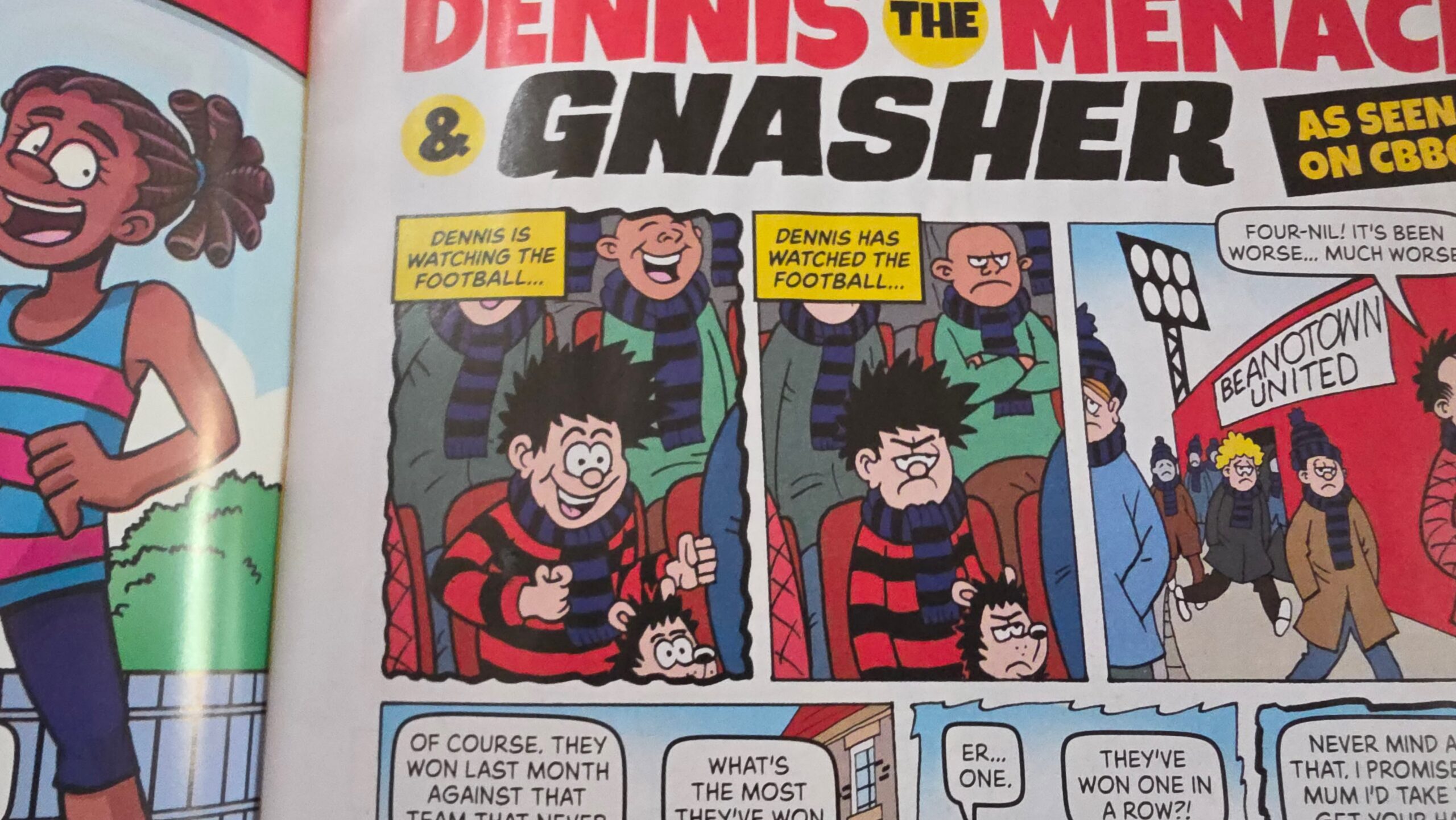
Dennis the Menace is still the cover star, though his strip no longer adorns the front and back covers — there's a more conventional "magazine-style" cover on the front now, though there's still a strip on the back for the "Make Me A Menace" feature, where readers can send a photo of themselves in and be featured in a comic strip.
I highlighted these first frames because I thought they were a good visual gag. The strip, which ran for four pages in total — so much longer than in his cover-mounted days — told the story of how Dennis refused to cut his hair until Beanotown United won three games in a row, and this caused his hair to grow so long that it became sentient and started eating people. Thoroughly silly, and exactly the sort of thing I would have expected to see in The Beano back in the day.
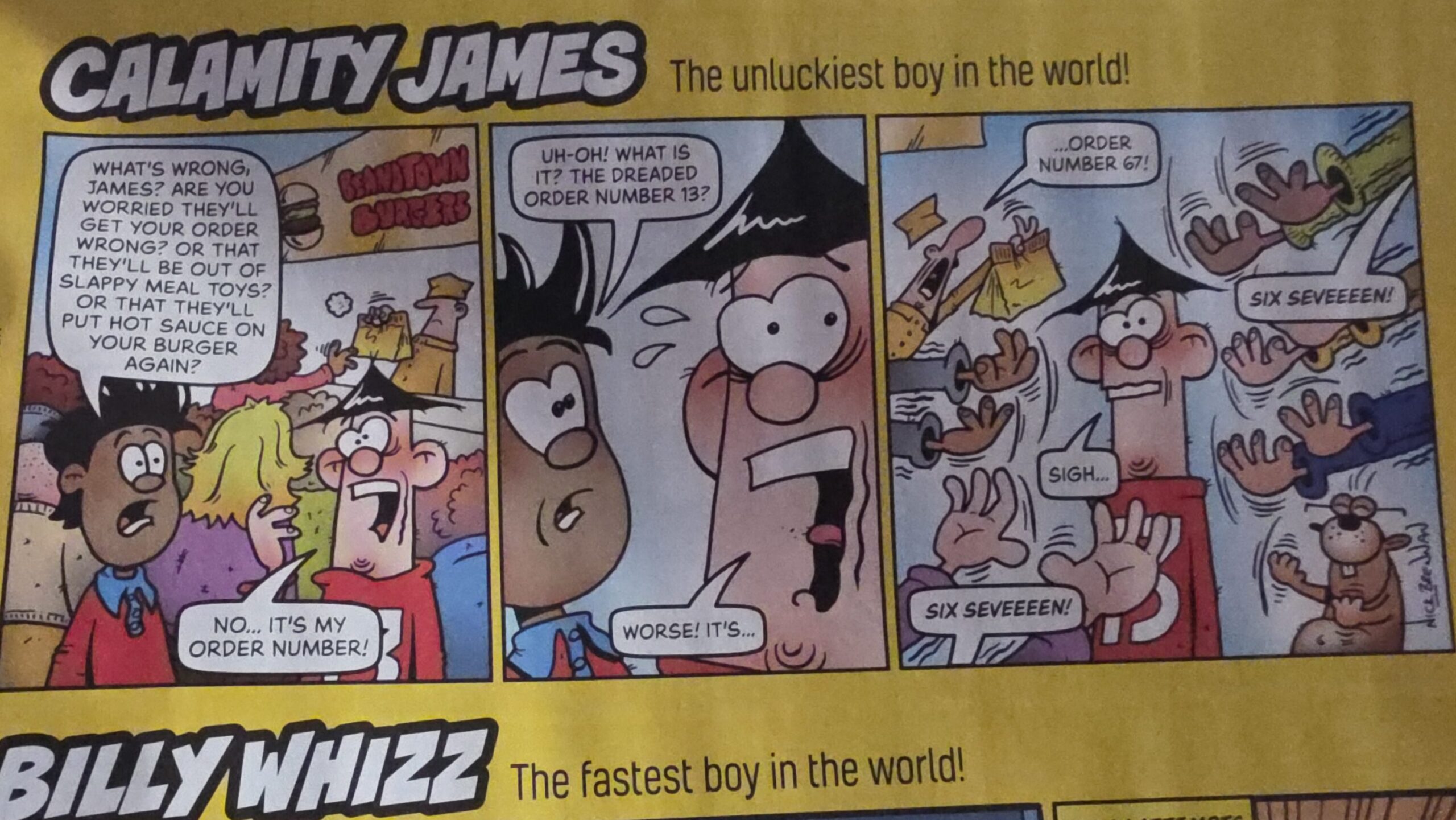
Calamity James is, unfortunately, a shadow of its former self. It's clearly done by a different artist now, and it's only a three-panel strip alongside fellow Beano veteran Billy Whizz and newcomer Addams Family wannabes Number 13. All the wonderful background detail and silly visual gags are gone — no more smelly sock! — but I'm pleased they kept James looking like a slightly deranged pencil. The gag is, I have to admit, mildly funny, too, though it does rely on an awareness of stupid modern trends like "6-7" and thus would probably be impenetrable to my parents at this point.
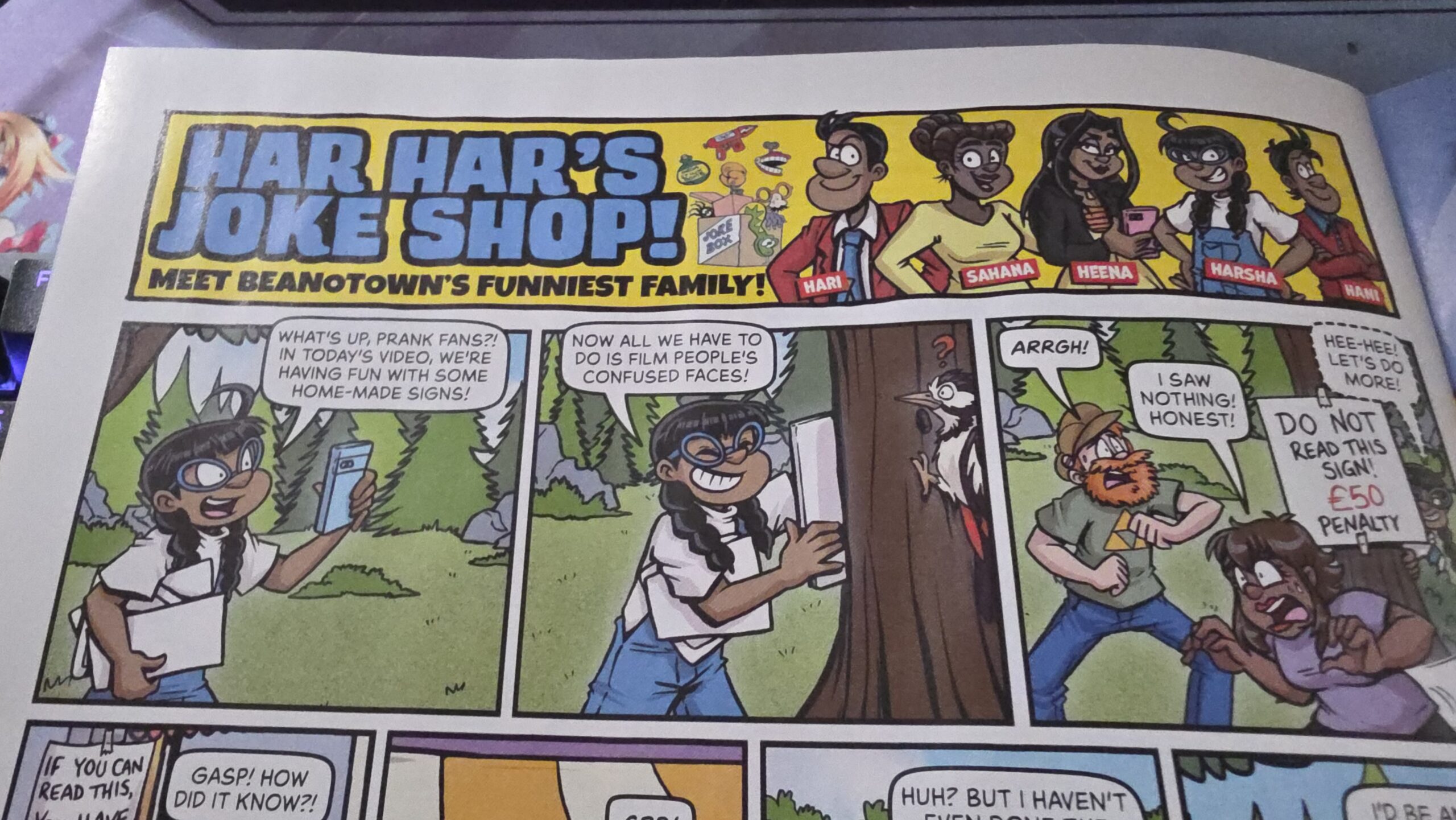
One of the biggest changes since I read The Beano as a kid is the addition of quite a few non-white characters, including some who have their own strip, such as in Har Har's Joke Shop here. Doubtless this made the "anti-woke" people furious at some point in the past, but it's a sensible change for the comic to make, as it reflects the multicultural nature of our society while at the same time highlighting how people having differently coloured skin doesn't mean they suddenly become completely alien types of person; the non-white characters in The Beano fit right in with all the usual mayhem without being picked out as being something "unusual" — which is a good message to send to kids.
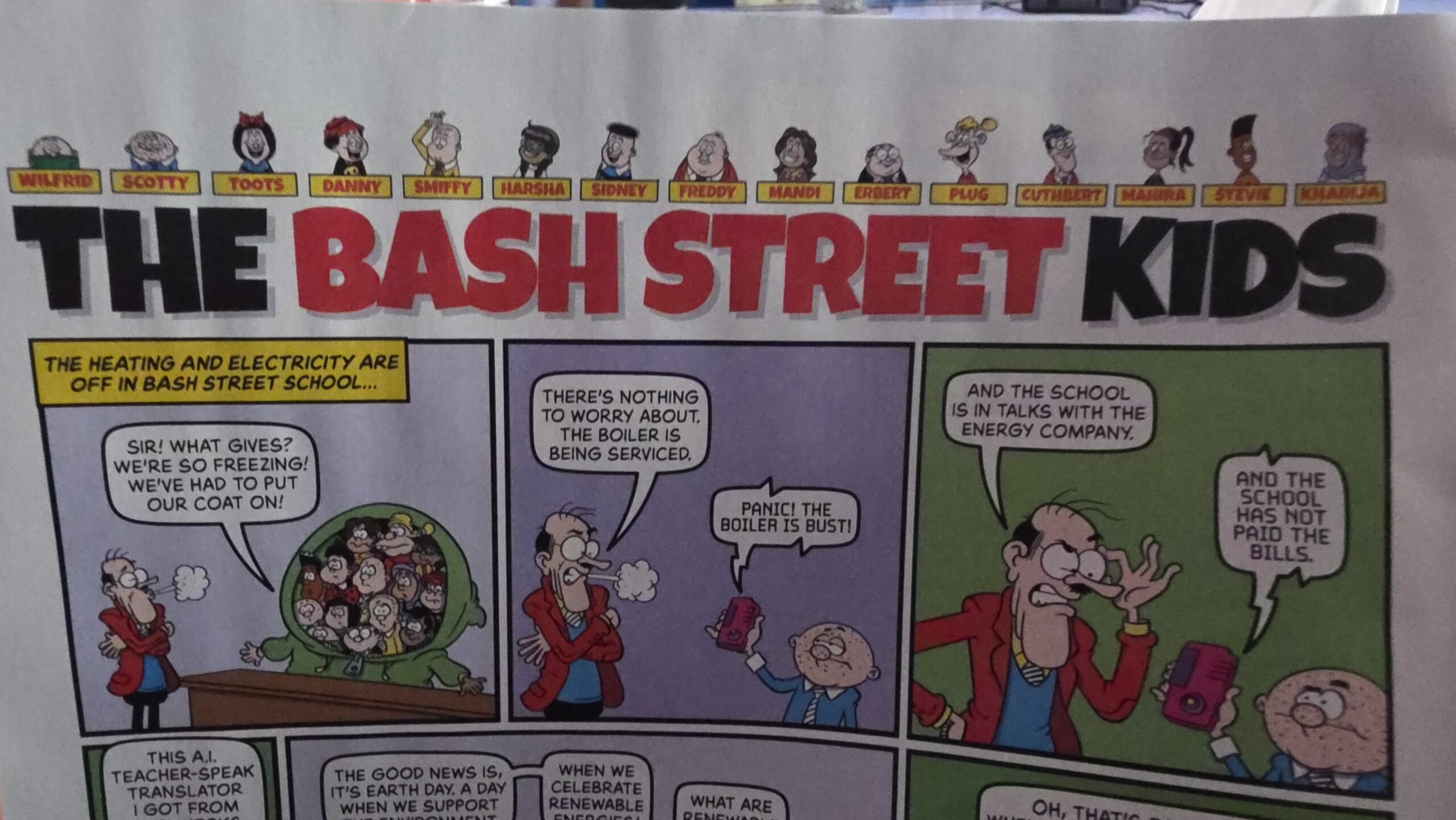
This idea continues with the changes to The Bash Street Kids. While all the old cast are there, a couple have had name changes in the name of sensitivity — Spotty is now Scotty, and Fatty is now Freddy, though Plug (as in "plug-ugly") is still as he was. New additions to the crew include Cuthbert (the chief "softy" from older Dennis the Menace cartoons, though I wonder if he's been retired from that role in the name of not promoting bullying) along with Harsha from Har Har's Joke Shop and apparent newcomers Mahira, Stevie and Khadija, all non-white characters of various descriptions.
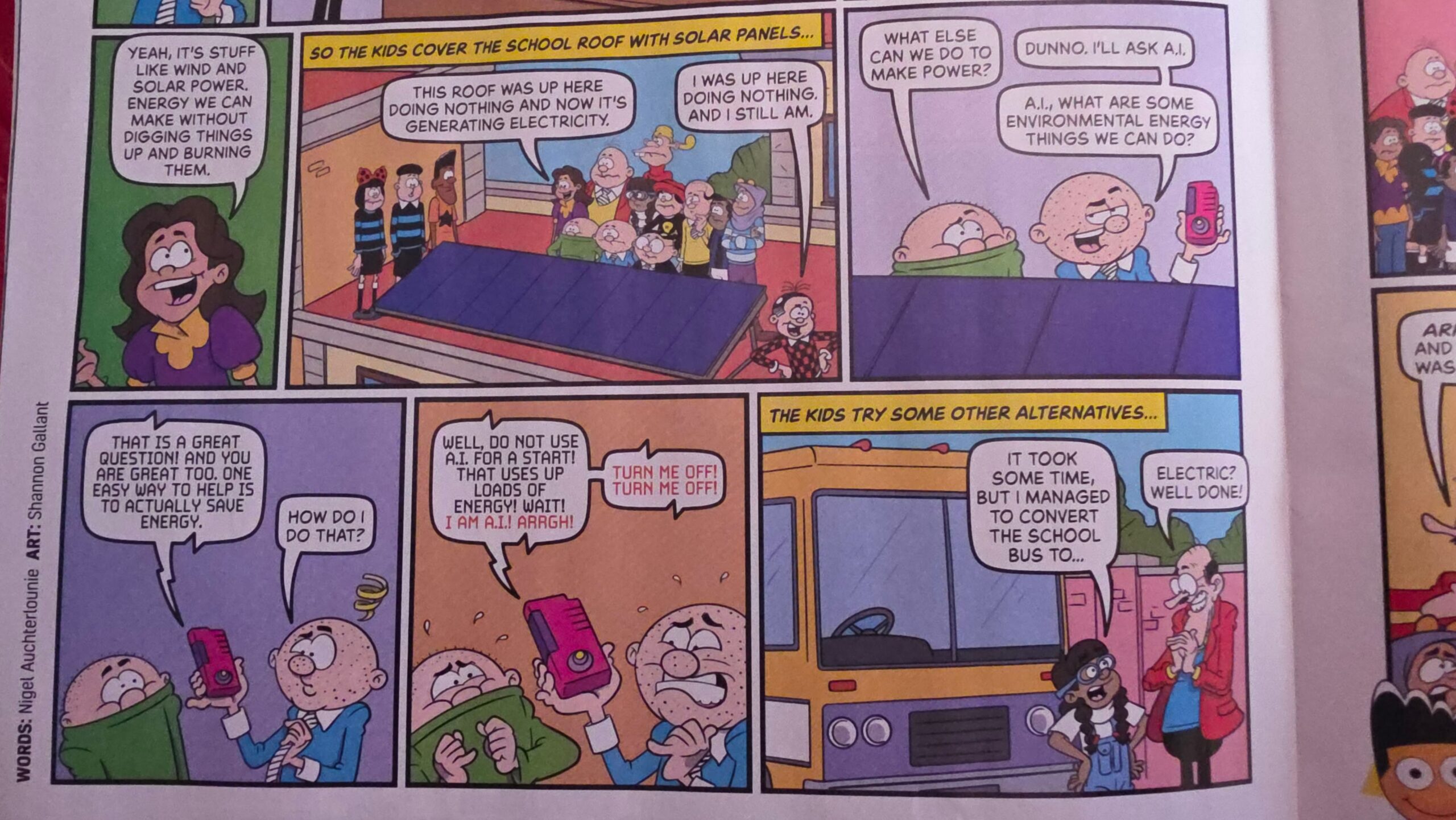
This was a good gag. I'm pleased to see The Beano come down on the anti-AI side of things. I find that oddly reassuring.
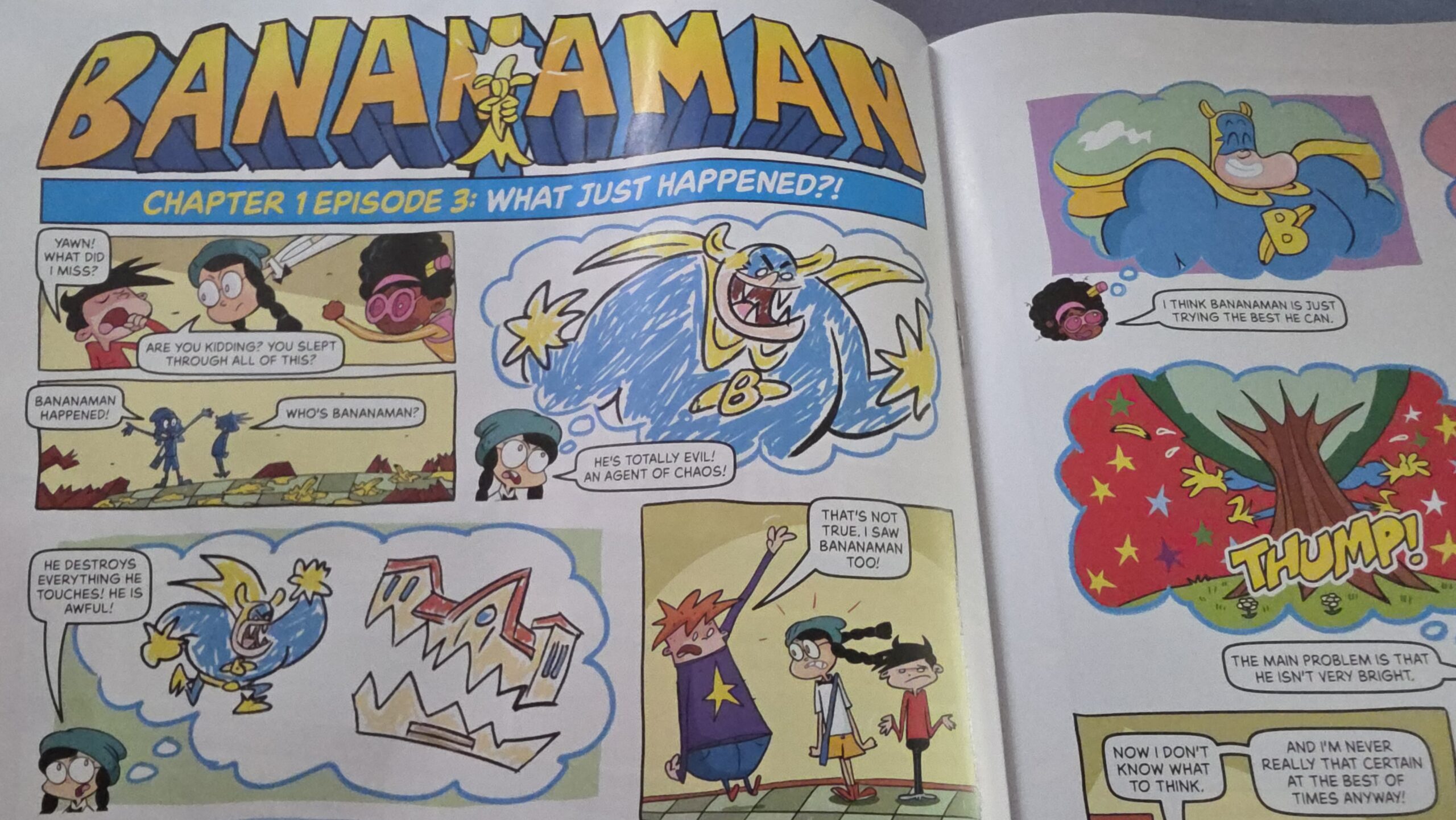
Elsewhere, the comic is apparently in the process of serialising Bananaman's origin story. I was just explaining to some baffled Americans about Bananaman the other day, and it turns out he's still relevant, apparently. I would never have expected that.
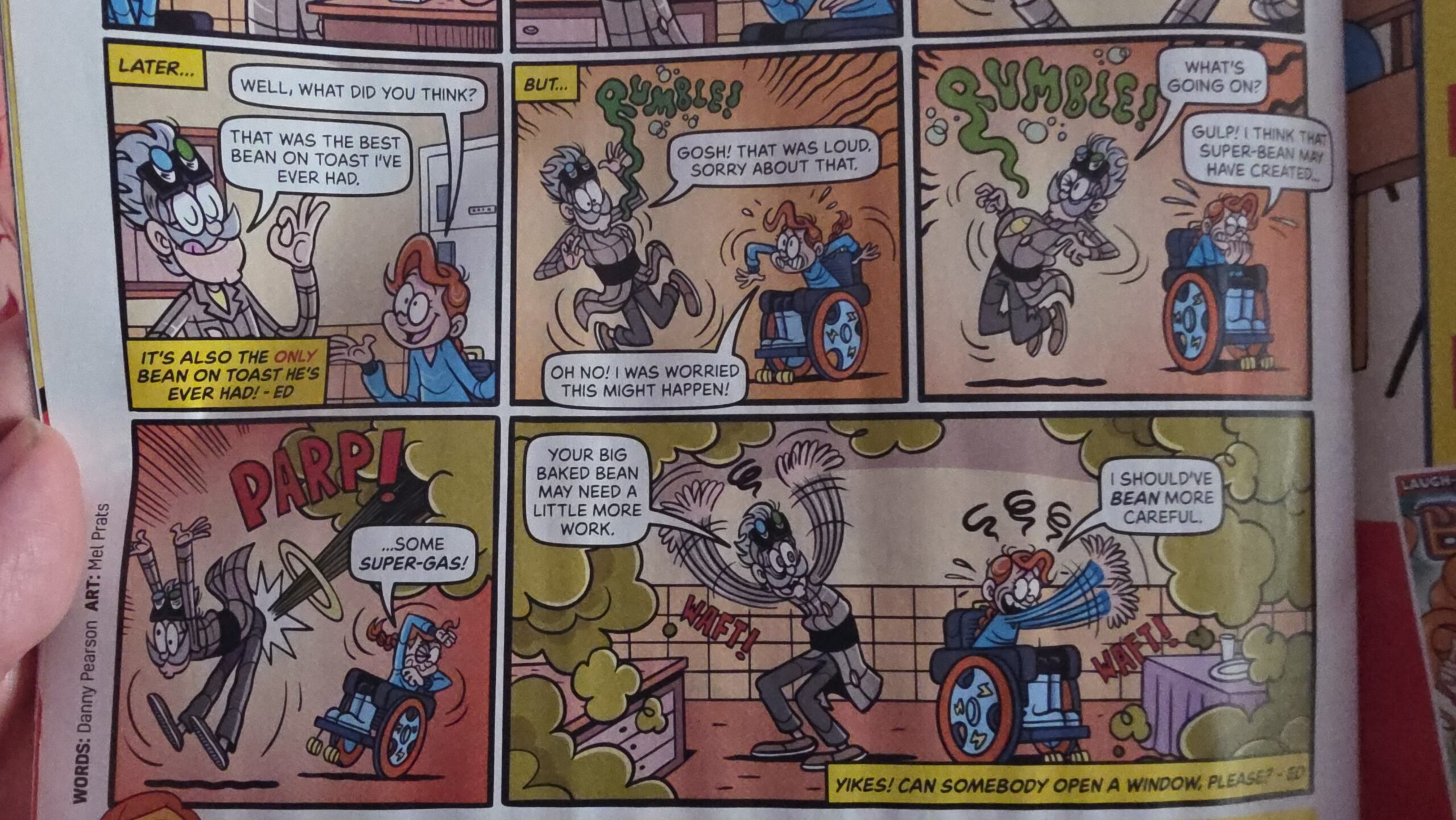
Perhaps most reassuring of all, though, is The Beano's willingness to include a full-on fart gag. Oddly enough, despite being plenty mischievous back in the day, I don't recall ever seeing Beano characters burping and farting, except perhaps sometimes in the background of Calamity James strips. This little beauty from newcomer Rubi's Screwtop Science, featuring a lead character in a wheelchair, gave me a good giggle, though…
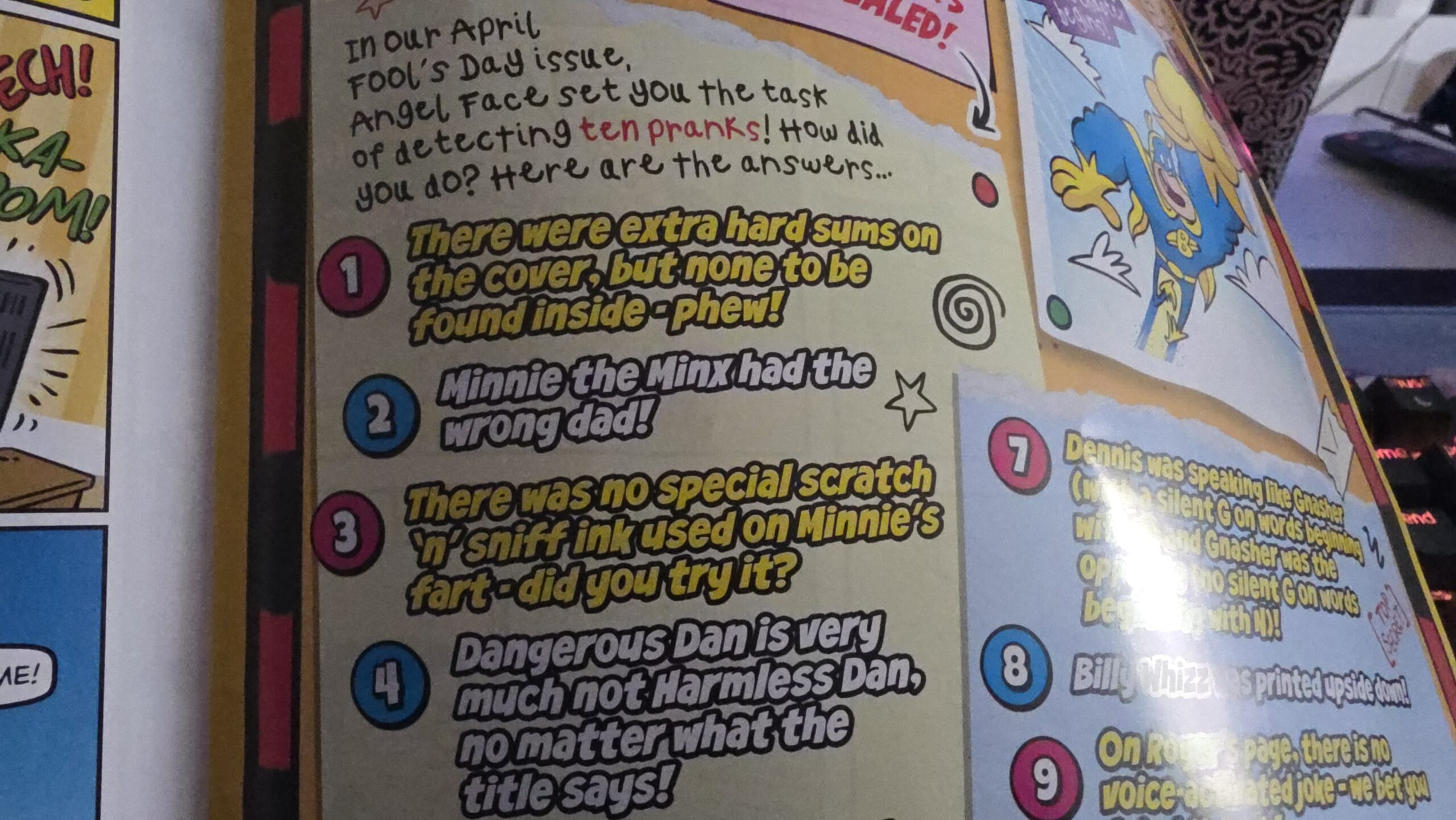
…as did the fact the comic apparently April Fooled people by suggesting you could scratch and sniff Minnie the Minx farting in a prior issue. I love this because I feel like there's a whole bunch of layers to this gag, some of which only the grown-ups will get. I'll leave them to your imagination.
All in all, I enjoyed my first look at The Beano in more than thirty years. It's nice to see how inclusive it's become, though like I say, I suspect there are certain Daily Mail-reading portions of the population who believe it's an outrage that there's a character wearing a hijab in The Bash Street Kids. Thankfully I have never run into them, and I hope I never do.
It's most reassuring to see how funny it still is, though, even as an almost-45 year old man. (45 tomorrow!) Will I keep buying The Beano? I don't know. I actually wouldn't be averse to the idea. So let's maybe have a think about that…
Want to read my thoughts on various video games, visual novels and other popular culture things? Stop by MoeGamer.net, my site for all things fun where I am generally a lot more cheerful. And if you fancy watching some vids on classic games, drop by my YouTube channel.
If you want this nonsense in your inbox every day, please feel free to subscribe via email. Your email address won't be used for anything else.
I won't lie, after pretty much falling off Final Fantasy XIV post-Dawntrail, I haven't really felt in any great hurry to return. Not because I didn't enjoy Dawntrail, mind — in fact, I enjoyed it very much! — but rather because I felt like it was getting increasingly difficult to juggle Final Fantasy XIV and the ability to play anything else at the same time.
However, the recent news that has come out about the upcoming expansion, Evercold, has me thinking that I might return. There are a few reasons for this.
First and foremost is the social angle. I like the people that I used to play with. It would be fun to be able to hang out with them again. There are also people I know who are vaguely interested in giving Final Fantasy XIV a go, and shortly the legendary Free Trial will be adding everything up to and including the Shadowbringers expansion, commonly agreed to be one of The Best Bits, which may make it easier to convince people to join in.
Secondly, I do miss the game a bit. I have had some special times in Final Fantasy XIV over the years, and I will always, always love the soundtrack. Soken has worked miracles with that game, and I feel almost like I'm letting him down to not be playing. He has no idea who I am, of course, but still. He is a wonderful person and a brilliant composer, and enjoying his stuff in context is great.
Thirdly, the changes that are coming to Evercold sound really interesting. I'm particularly intrigued by the "Evolved" battle system, which promises to reduce the number of actions you'll have to assign to your hotbars by having more of the dynamically changing buttons that were introduced with Dawntrail's new jobs. Supposedly most jobs will be able to function perfectly well with 16 action bar slots in Evolved mode, which means a lot less in the way of remembering some obtuse button combinations, particularly when returning to the game from a long break. (Of course, it means learning some new button combinations, but they will, at least, be simpler.)
I'm also interested in the move away from "endgame currency" as a progression system. I don't think we've really had it explained in much depth how exactly the new "seasons" system is going to work, but Yoshi-P seemed determined to emphasise the point that it's not a Battle Pass or free-to-play type "pay to win" situation. What it looks like is a flexible system where you earn points for doing… stuff. And rather than being forced into grinding the same old Roulettes and high-level stuff, it looks like you might have the opportunity to do a broader range of activities, which will be nice.
Perhaps I will hop back in once the new patch arrives tomorrow. There's the new Beastmaster job to explore, plus I didn't do much with Blue Mage, and of course I have plenty of other jobs still to level too — as well as just re-learning the game after so long away.
I think I probably will go back. I'm just not sure quite when yet, or how it will fit into my life more broadly. But we'll see. We'll see.
Want to read my thoughts on various video games, visual novels and other popular culture things? Stop by MoeGamer.net, my site for all things fun where I am generally a lot more cheerful. And if you fancy watching some vids on classic games, drop by my YouTube channel.
If you want this nonsense in your inbox every day, please feel free to subscribe via email. Your email address won't be used for anything else.
Today was our trip to The Cave and Arcade Archive, part of the Retro Collective organisation. As I've explained a few times previously, and for the benefit of those who might have missed those posts, The Cave is an interactive, hands-on computer and video game museum, while the Arcade Archive is a similarly interactive, hands-on free play arcade museum. The Retro Collective as a whole encompasses these two museums, the company Heber Electronics, who make the MiSTer Multisystem 2 console, and the Retro Collective YouTube channel, fronted by retro tech enthusiast and historian Neil Thomas.
I will be peppering today's post with photos from today's trip.
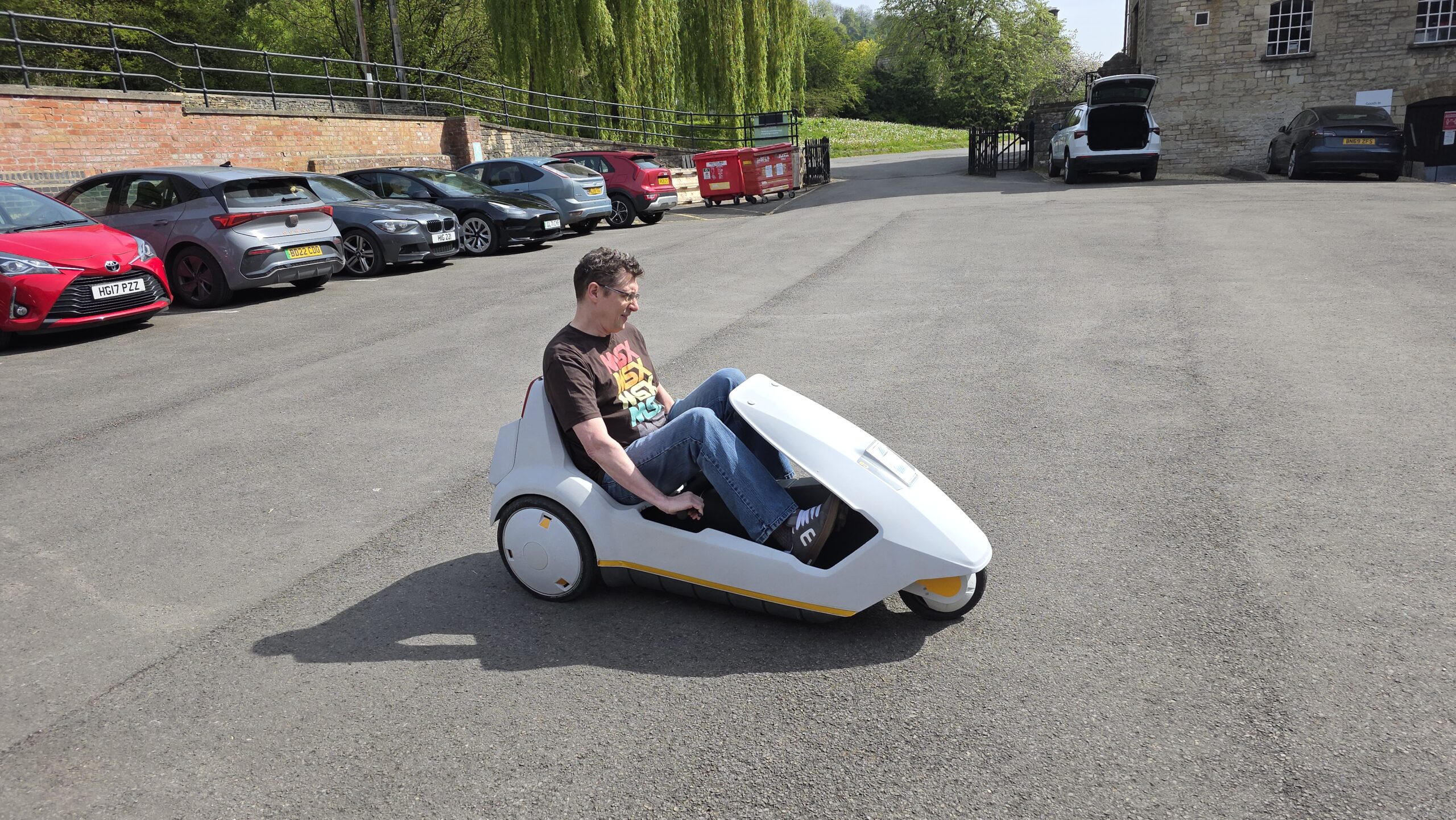
Demoscene veteran, ace retro coder and composer Ian "h0ffman" Ford getting to grips with a Sinclair C5.
The event today centred around a talk by Ian "h0ffman" Ford, a veteran of the Amiga demoscene who returned to coding and composing on classic computer hardware back in 2010, and has been spending much of his time since COVID fiddling around with disassembling and porting classic games from one platform to another. To date, he has ported the MSX2 version of Metal Gear to Amiga, the MSX game Knightmare (no relation to the TV show) to Amiga also, plus Shinobi and Golden Axe from Sega's System 16 arcade board to NEOGEO, plus the modern Unity game Cecconoid to Amiga. His talk explored how most of these projects came about because of repeatedly falling down rabbit holes while satisfying his own curiosity.
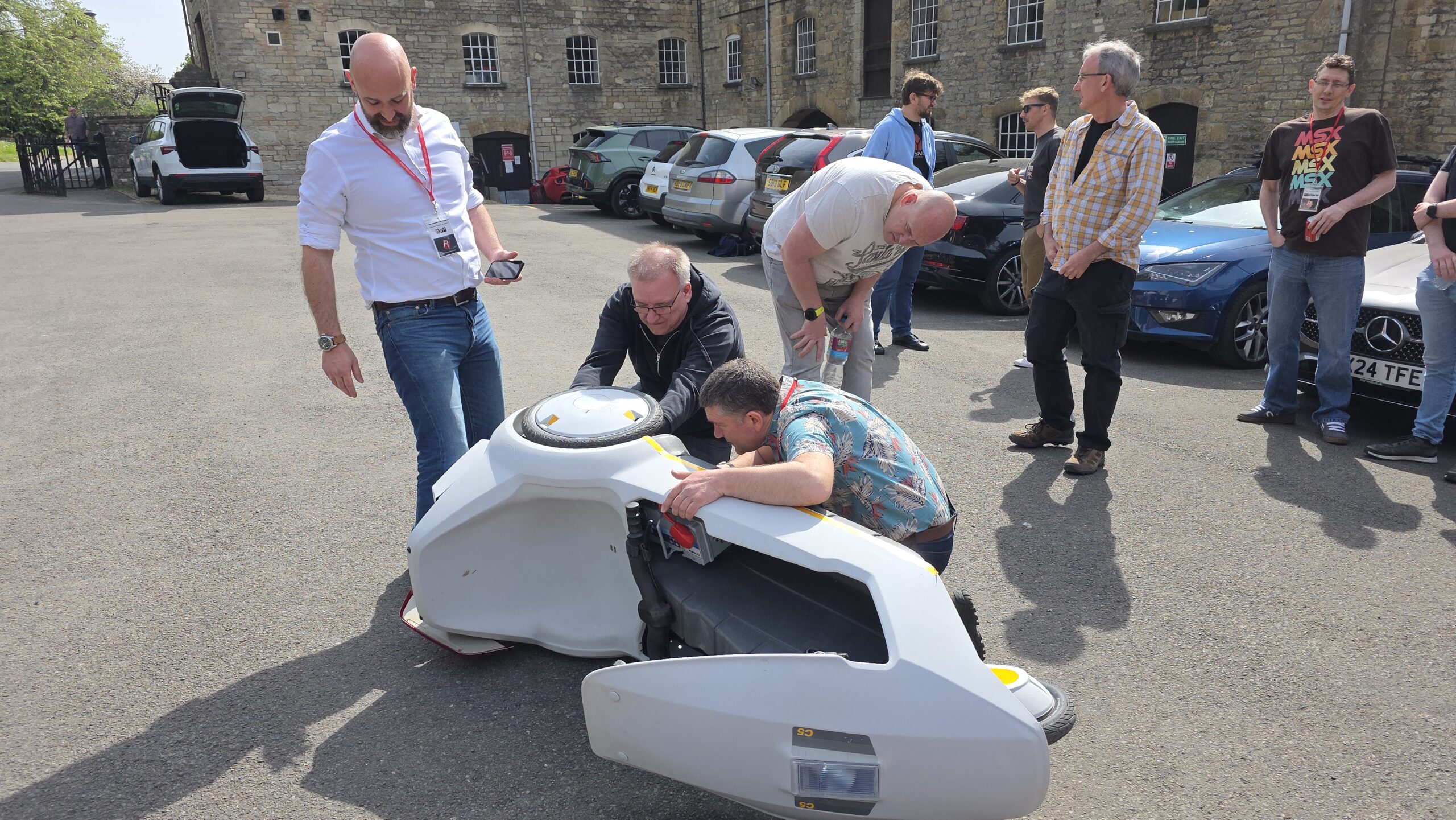
True to form, it didn't take long before the C5 broke.
Outside of h0ffman's talk, which happened after lunch, all of us in attendance were free to explore The Cave, the Arcade Archive, and the organisation's newly renovated workshop space, known as the Pump House. (The entire operation is in an old mill, and the Pump House used to be part of the site's earlier purpose; it's not just a funny name they gave it.)
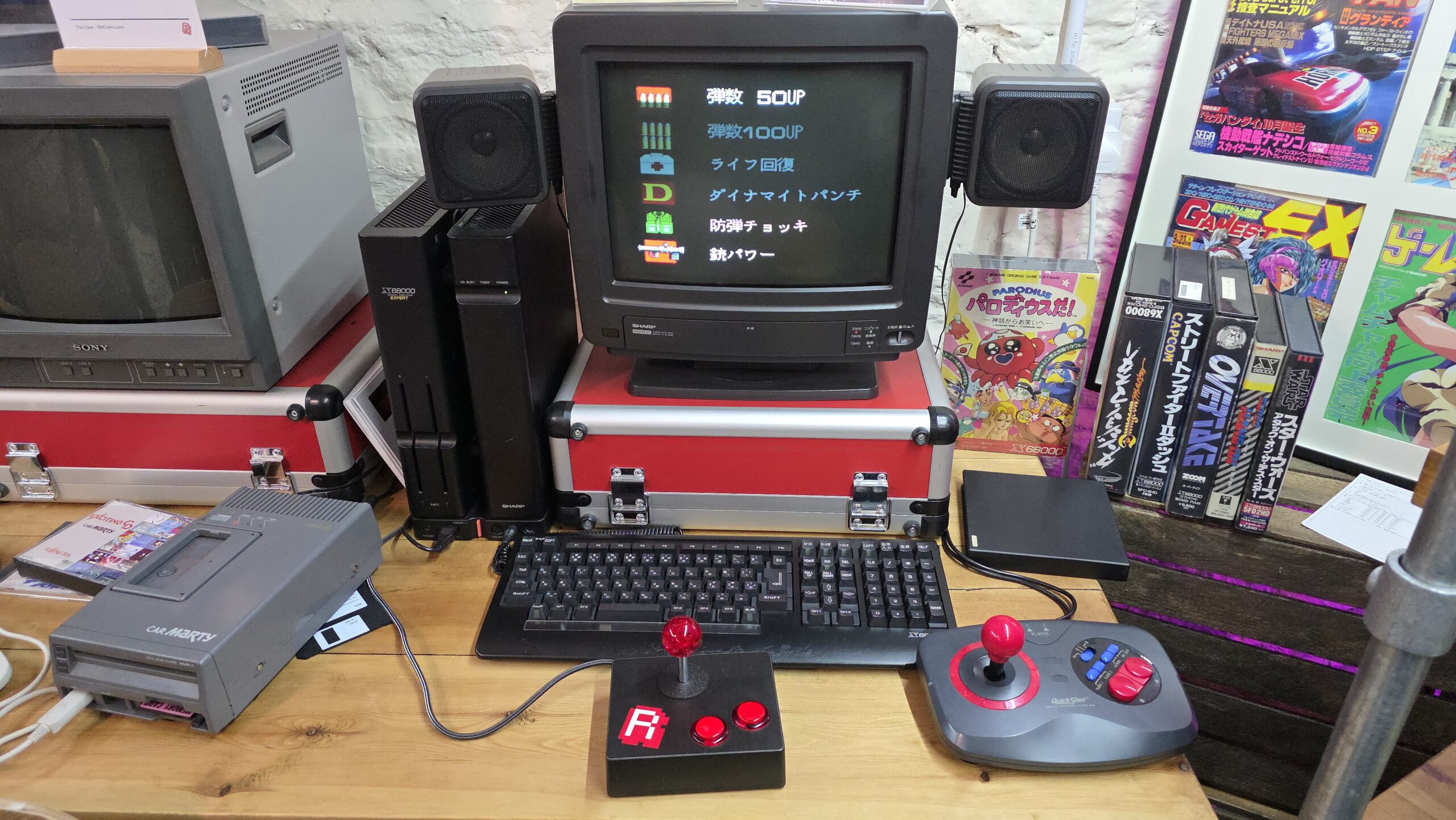
Sharp X68000, my beloved
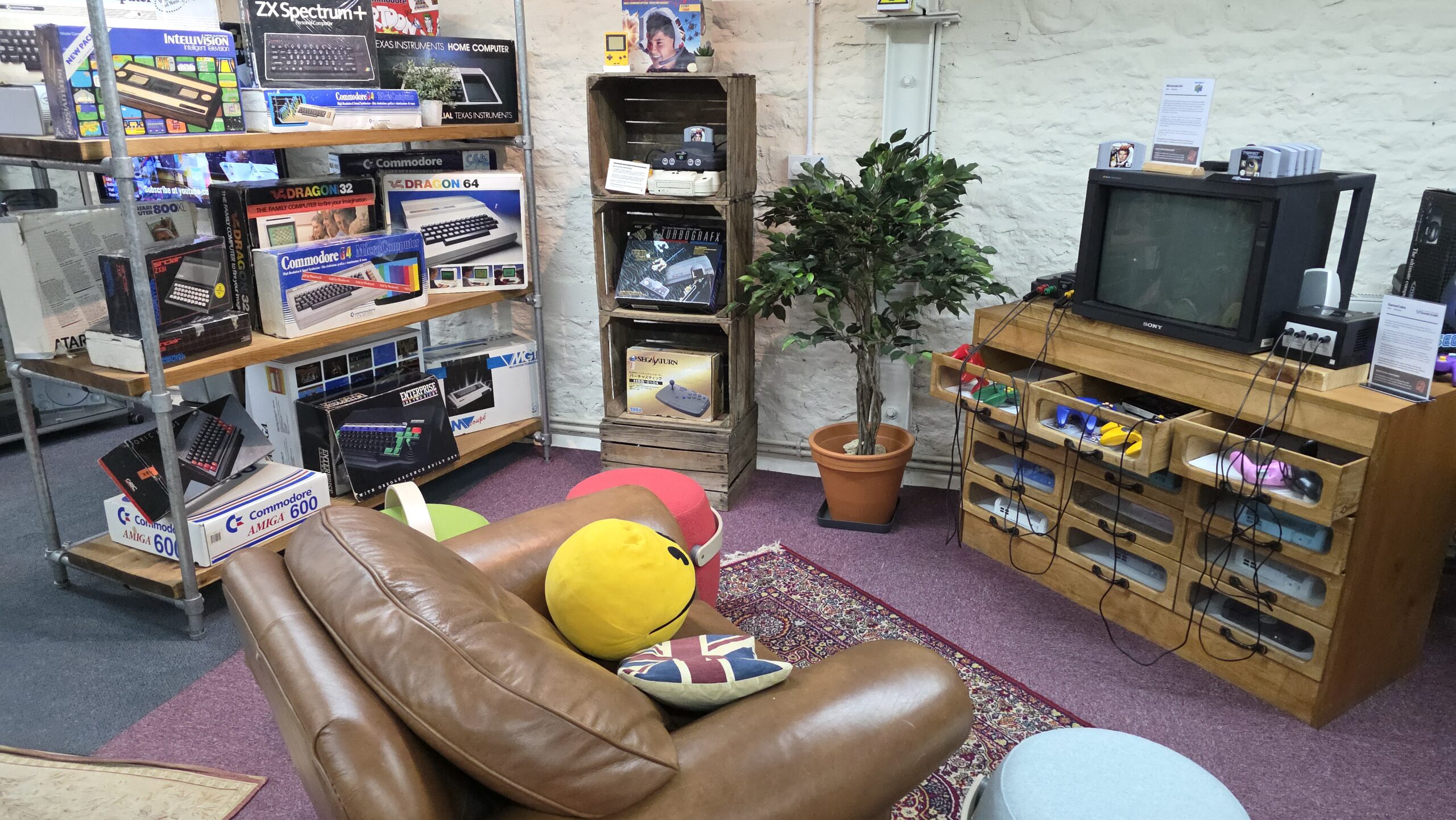
The Cave is up on the top floor of the mill, and is a large, open-plan room filled with old computers and consoles of various descriptions, including some fairly exotic machines from outside of the UK, Europe and North America, such as the beautiful Sharp X68000 from Japan. This is an absolutely gorgeous machine that, if money were no object, I would very much have in my collection. If you've never come across one, it's a 16-bit computer that has the audio-visual capabilities of its console contemporaries, meaning it plays host to a lot of excellent games, including some near-perfect arcade ports.
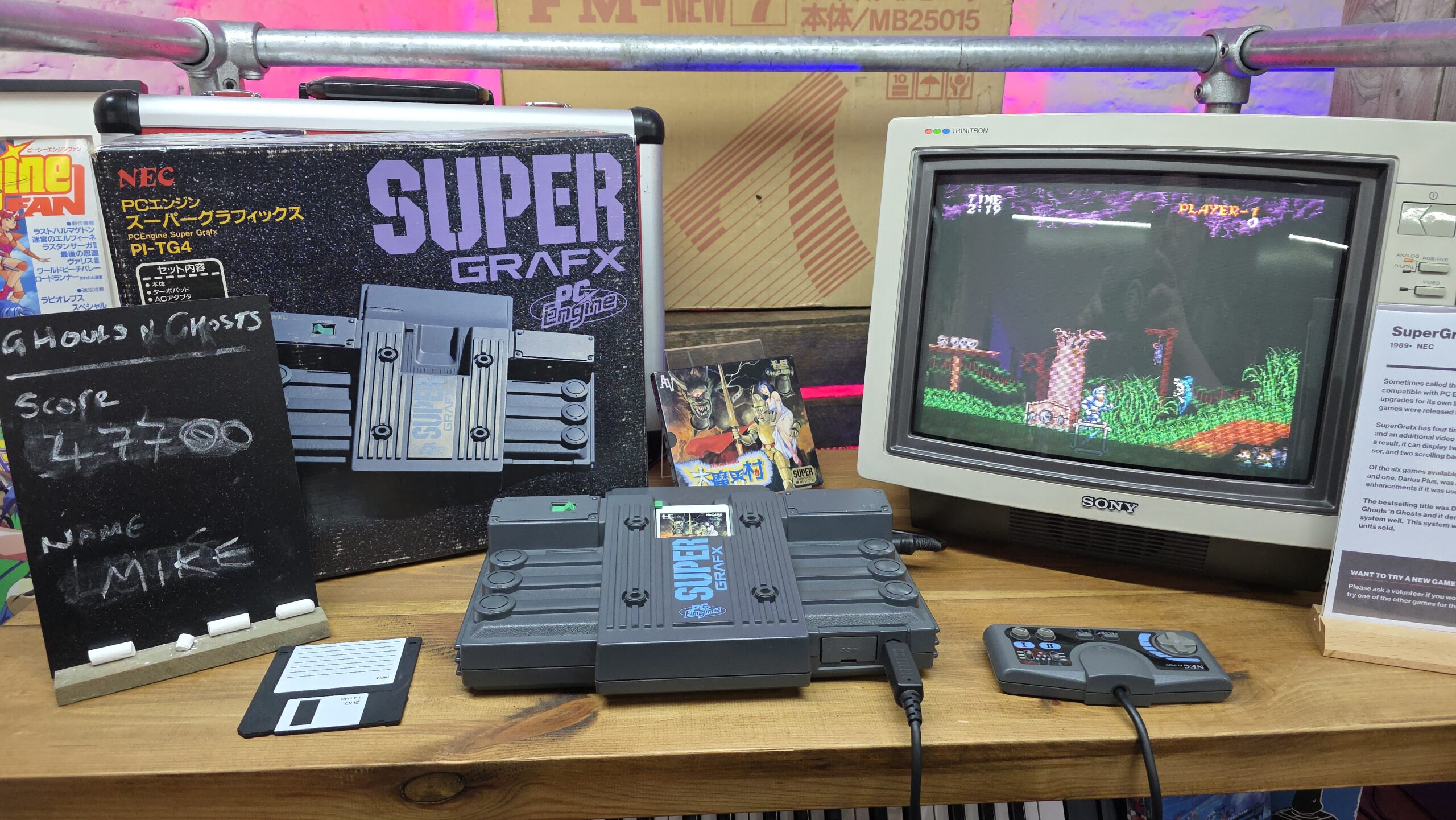
We barely knew ya.
There's also lots of interesting console obscurities, too, such as NEC's ill-fated PC Engine spinoff, the Supergrafx, a console noteworthy for, outside of backwards compatibility with the aforementioned PC Engine, only having five titles in its library. And you thought the Wii U was a flop. Despite this, it's an exceedingly cool little system worth having a play with in an environment like The Cave!
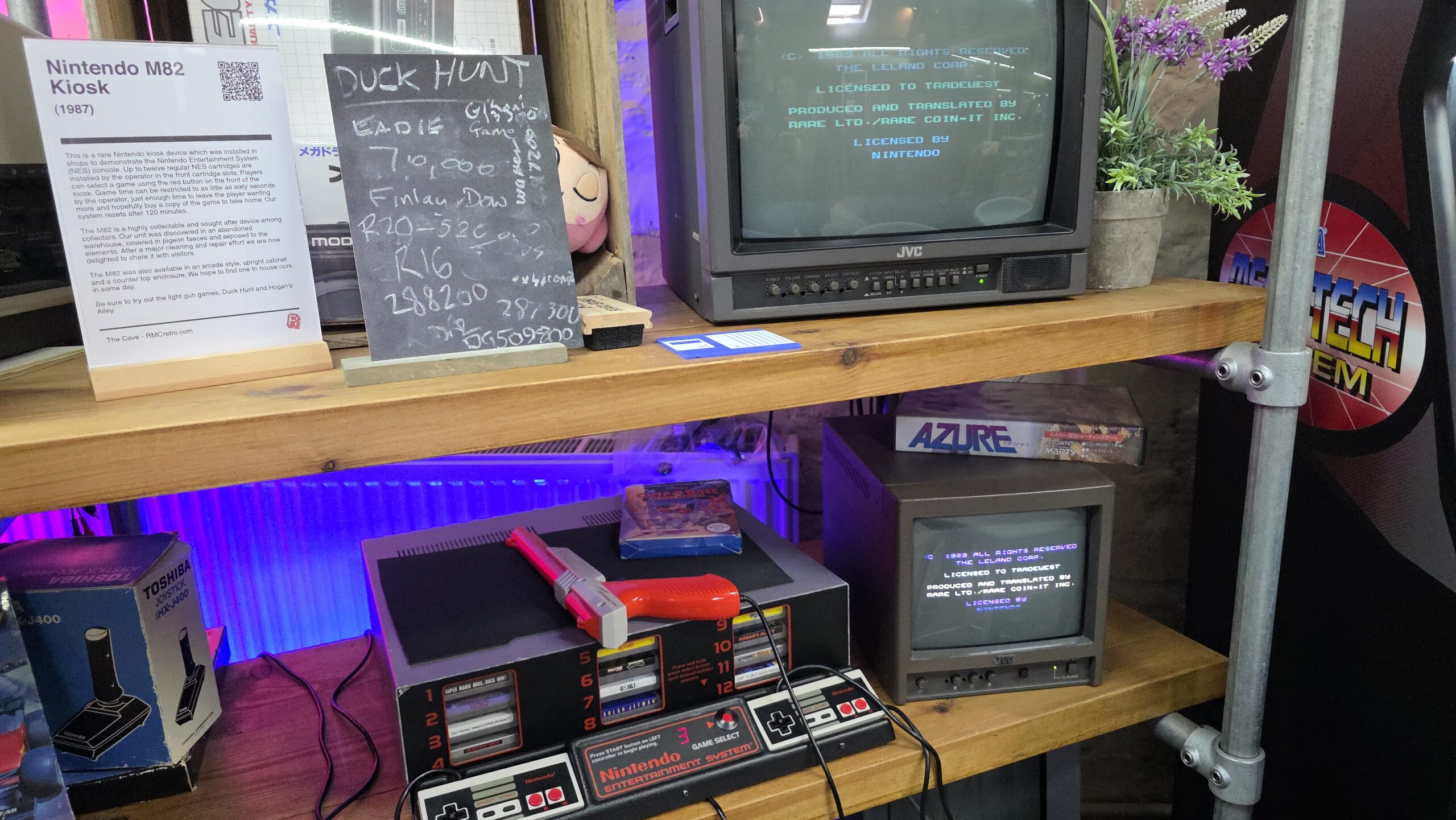
I didn't contribute to the Duck Hunt high scores.
Another nice thing about The Cave is that it acknowledges well-known, popular hardware in unusual configurations, such as this kiosk multi-game version of the NES that you would have found in electronics stores back in the '80s. All the stuff at the Cave is hooked up to great quality screens, too, with many of them being professional video or broadcast monitors, Sony Trinitrons and the like.
Yes, that is a Casio Loopy lurking in the background there.
Here's another one: Sega's Mega-Tech arcade system, which was basically a Mega Drive you bought time on back in the day. Here, as with all the other arcade machines in The Cave and the Arcade Archive, it's set to free play, so you can enjoy a selection of 16-bit classics in the arcade form factor.
Well, that's one way of proving your ports are "arcade perfect"
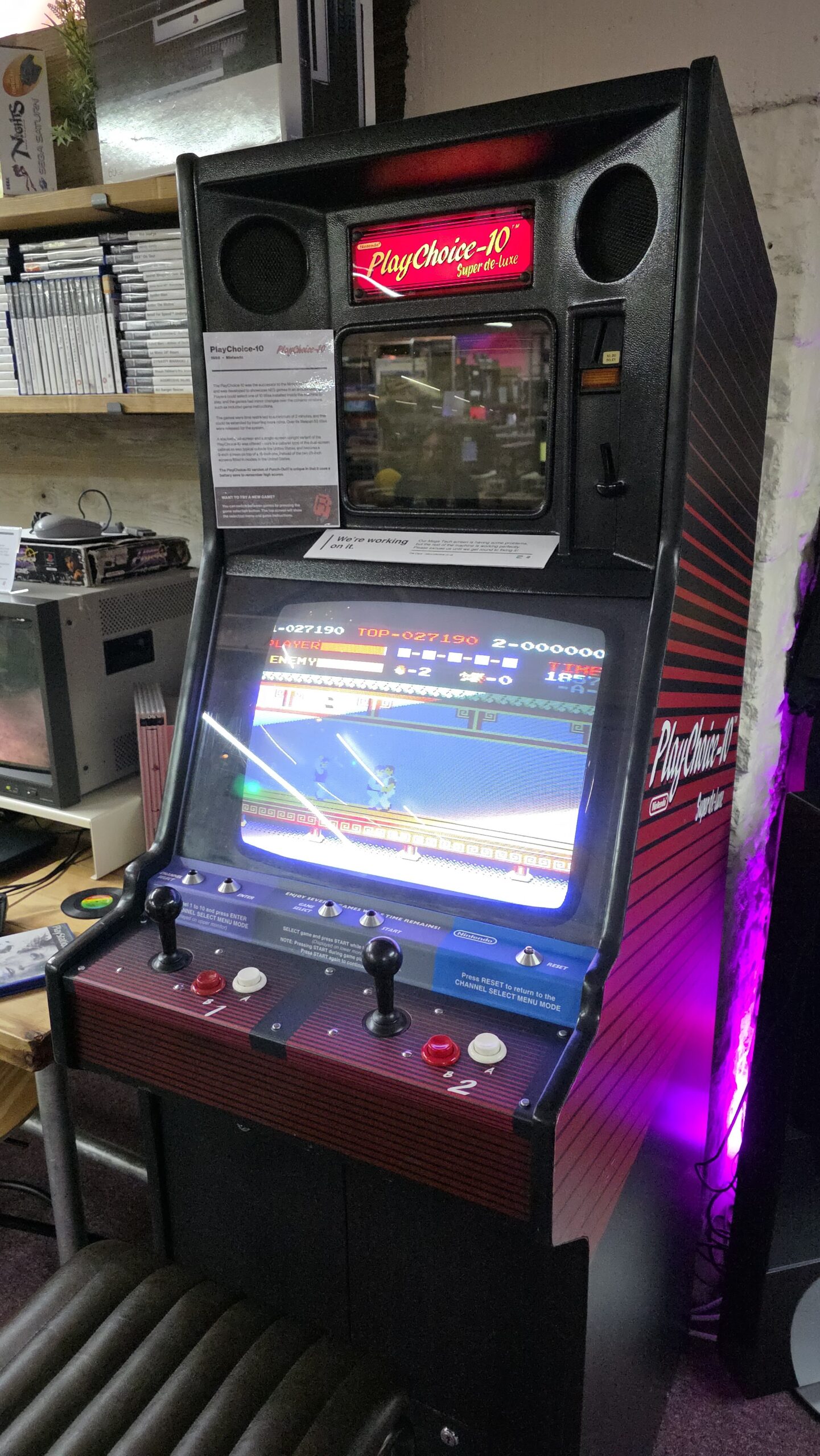
Nintendo had done something similar with the PlayChoice-10 machine, which provides you with a selection of NES games to play using arcade controls. It's a very strange feeling to play the original Super Mario Bros. with a stick and arcade buttons, but it works pretty well! Not surprising, really, since so many games from that era were at least inspired by arcade games if they weren't direct ports.
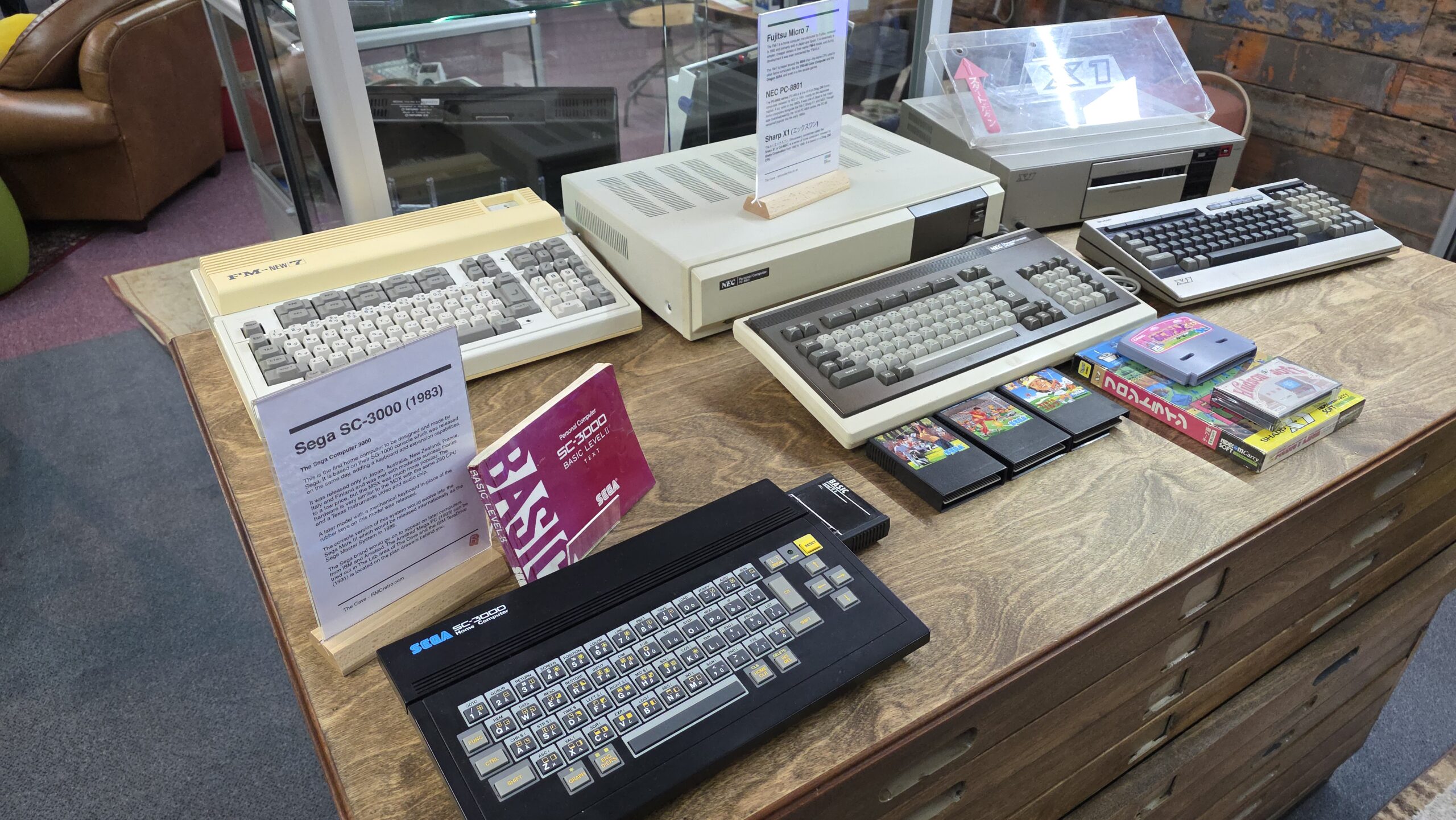
Here's a selection of obscure Japanese computers, including one from Sega. I don't know much about these, but they all look lovely, and it would be fun to have a fiddle around with them one day.
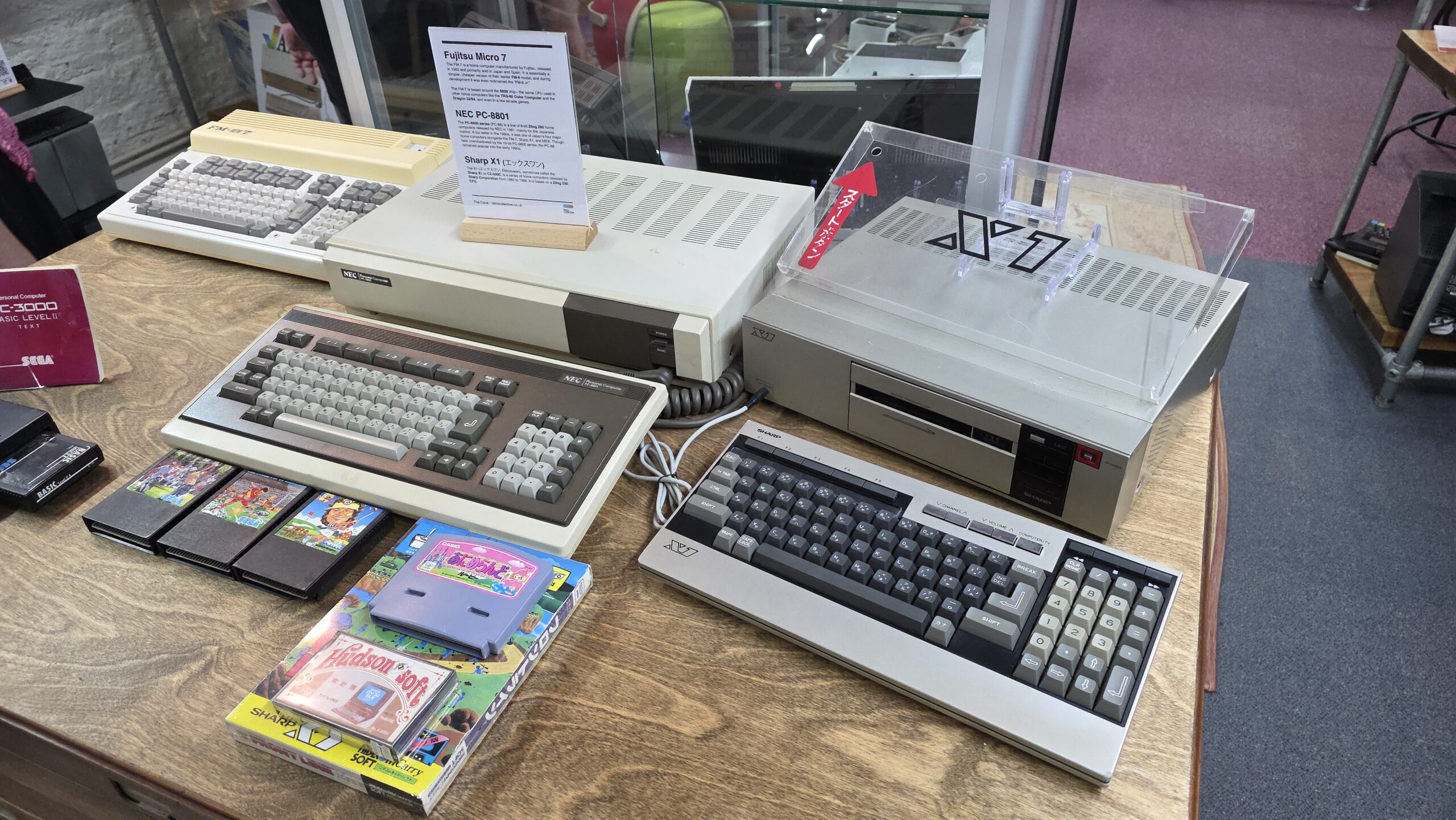
Here's some more obscure Japanese computers, just because. That Sharp X1 is a lovely looking thing. I actually didn't give the keys a clack, but it looks like they would feel nice to type on.
A little closer to home, here's a selection of lesser-known home computers, including the Oric-1, Tatung Einstein, Dragon 64 and Sam Coupé. A lot of these are lovely looking machines; they just failed to make the same impact as the bigger hitters of the era like the Spectrum and Commodore 64.
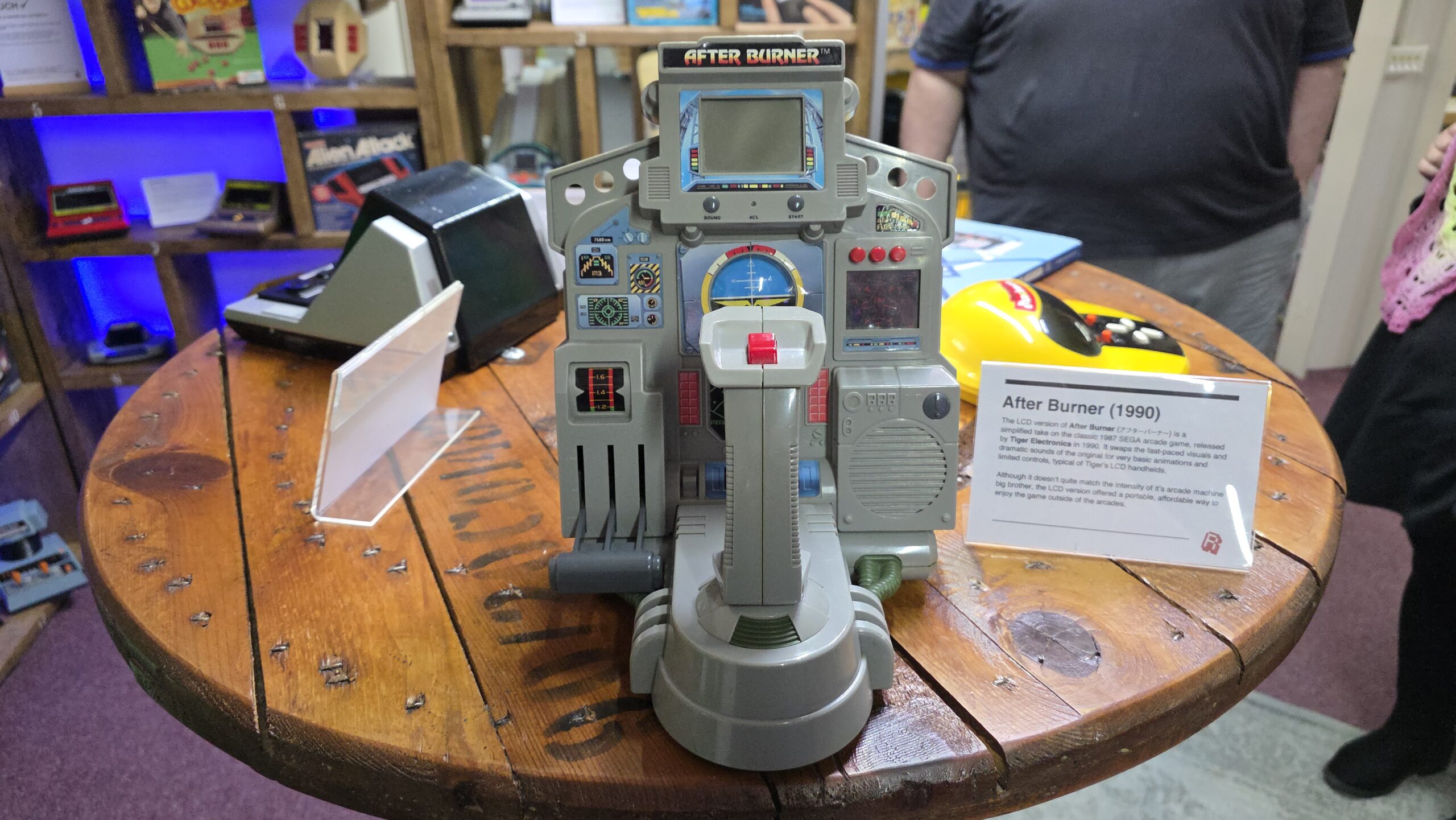
Here's a thing that I really wanted as a kid, but never managed to get hold of (i.e. convince my parents to get for me). It's an LCD game adaptation of Sega's After Burner, but with an elaborate control panel that makes the game feel a lot cooler than it actually is. The joystick is satisfying to grapple with the throttle control makes a pleasing "clunk" when you move it between speed settings, and a cool thing I've not seen before is that the LCD screen has an LED behind it so when you destroy enemy planes, there's a red "flash" where they're exploding. It's a pretty neat toy, but, given that we had computers at home that could play much more interesting and complex games, I'm not surprised that my parents never bought me one of these — and I'm not mad about that, I hasten to add!
There are lots of things to play at The Cave. This lovely setup has a selection of consoles hooked up and ready to play multiplayer just like we used to back in the day. The Gamecube and N64 were most readily accessible today, and they looked great on the Sony monitor.
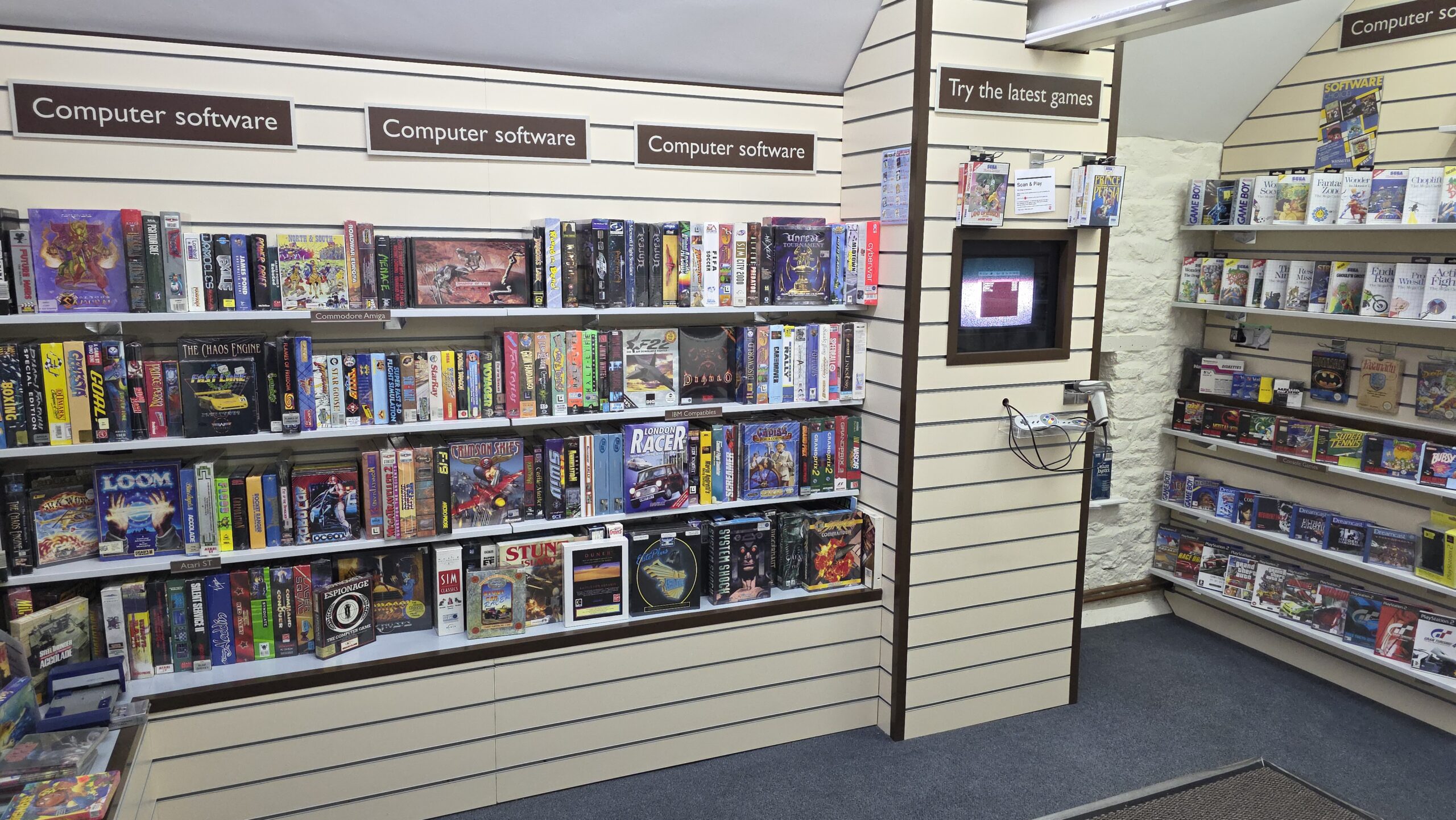
One of my favourite parts of The Cave is the fake "software shop", set up to look like an old WHSmith upstairs. For any non-Brits reading, WHSmith was a shop that was mostly known as a newsagents where you'd buy magazines and newspapers, but also tended to carry stuff like stationery, art and craft supplies and, in the 1980s, computer and video games. There were a lot of shops like this in the '80s that performed what I would argue was their "primary function" downstairs, then they'd do computery stuff upstairs — one of my favourite examples in this regard is Boots, which is a pharmacy. Why would a pharmacy sell ZX Spectrum games on cassette? Same reason they'd process your photographs or sell you picture frames, presumably — to make a bit of extra cash from jumping in on popular hobbies and pastimes.
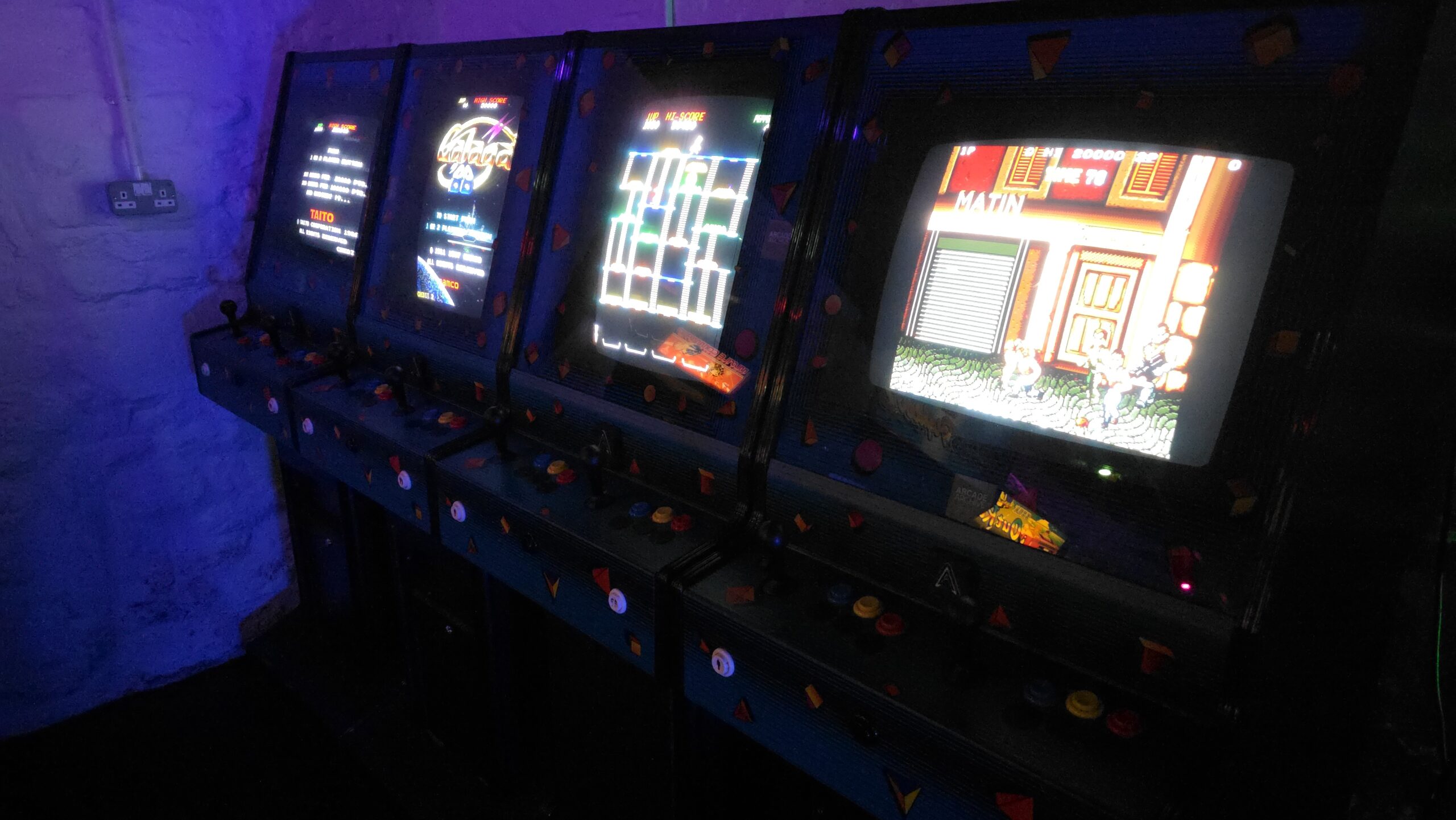
It's tricky to get good shots of them by the very nature of the environment, but on the ground floor of the mill is the Arcade Archive, a noisy room full of classic arcade machines, many of which have been lovingly restored to fully working condition by the Retro Collective folks, and some of which make use of modern solutions such as the MiSTer. These cabs — from left to right, Bubble Bobble, Galaga '88, BurgerTime and Double Dragon, all in the sort of generic cabinets you'd see in a fish and chip shop in a town centre circa 1989 — are, as far as I'm aware, restored originals.
Conversely, there's a NEOGEO MVS cabinet that I forgot to take a photo of that is running off the new MiSTer Multisystem 2's JAMMA arcade cabinet incarnation, which allows you to use plastic NFC cards to switch games as if you're swapping out cartridges. You get the enjoyment of playing with "four bright buttons and two joysticks" on a CRT, along with the modern conveniences of the MiSTer such as the ability to easily swap games, or play the console versions of games on the arcade cabinet.
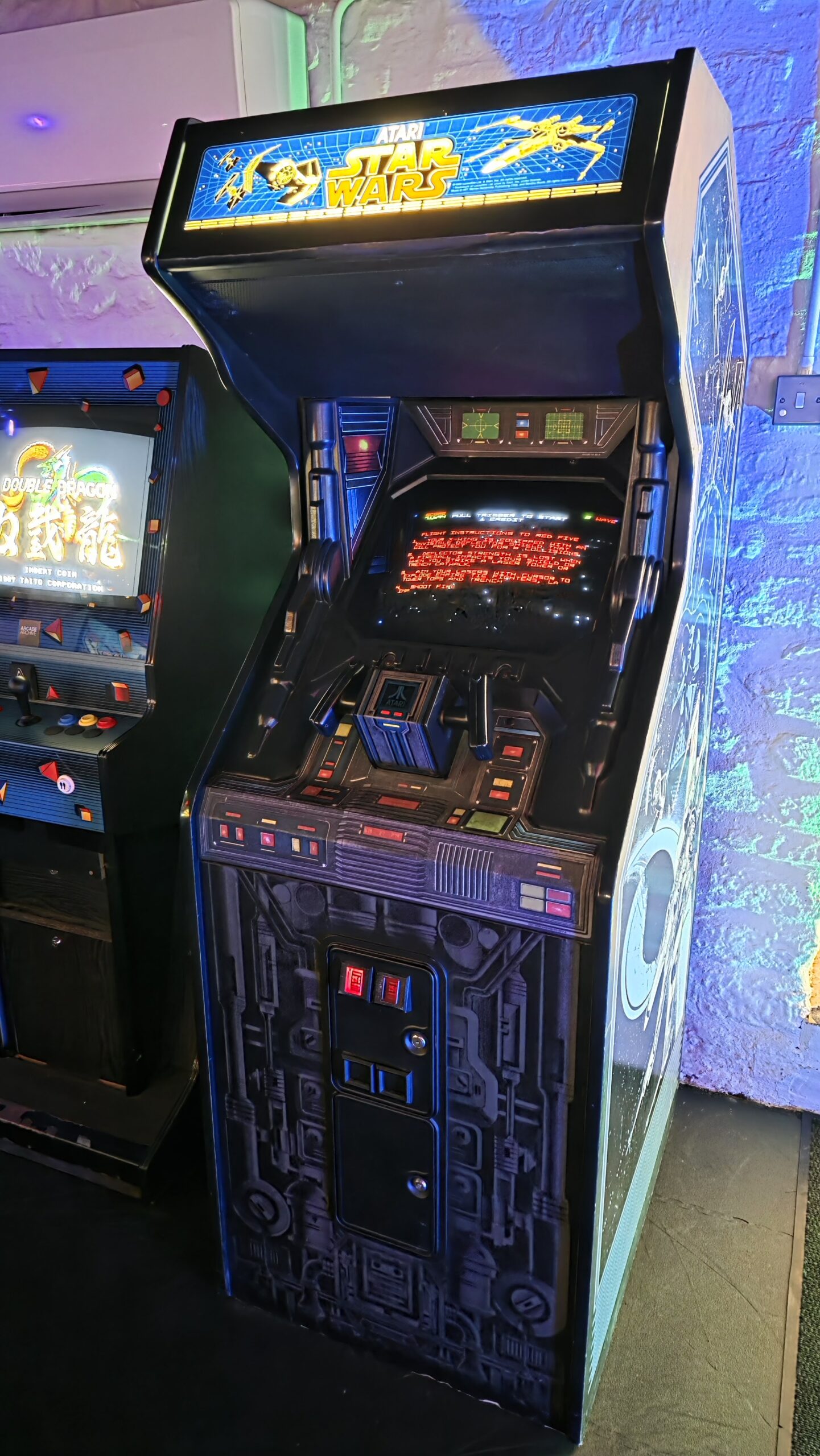
Here's a lovely thing, showing up much better thanks to its position near the door to the outside: Atari's Star Wars arcade game. This is still a supremely playable 3D shoot 'em up with beautiful vector graphics and a wonderfully immersive, involving analogue yoke control system. Great fun to play — just a pity there's no sit-down version in the Archive, though I don't think there'd be room for one at the moment anyway!
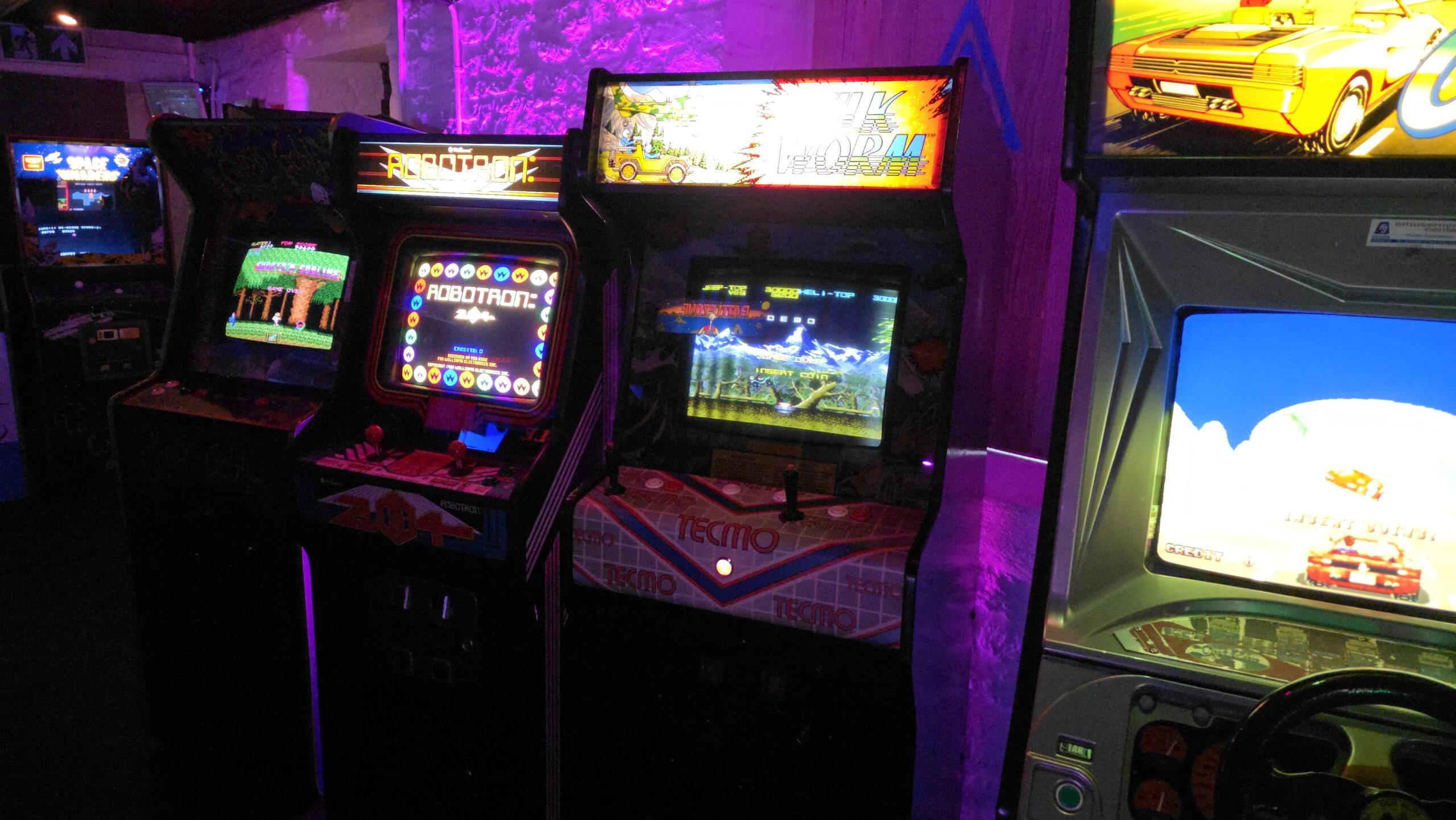
Here's a few more machines in the Archive, including OutRun on the right, then Silkworm, Robotron 2084, Ghosts 'n' Goblins and, back in the corner, the original Space Invaders. I realised I'd never actually played Robotron in its original twin-stick arcade incarnation, so I took the opportunity to rectify this. It's a lot of fun!
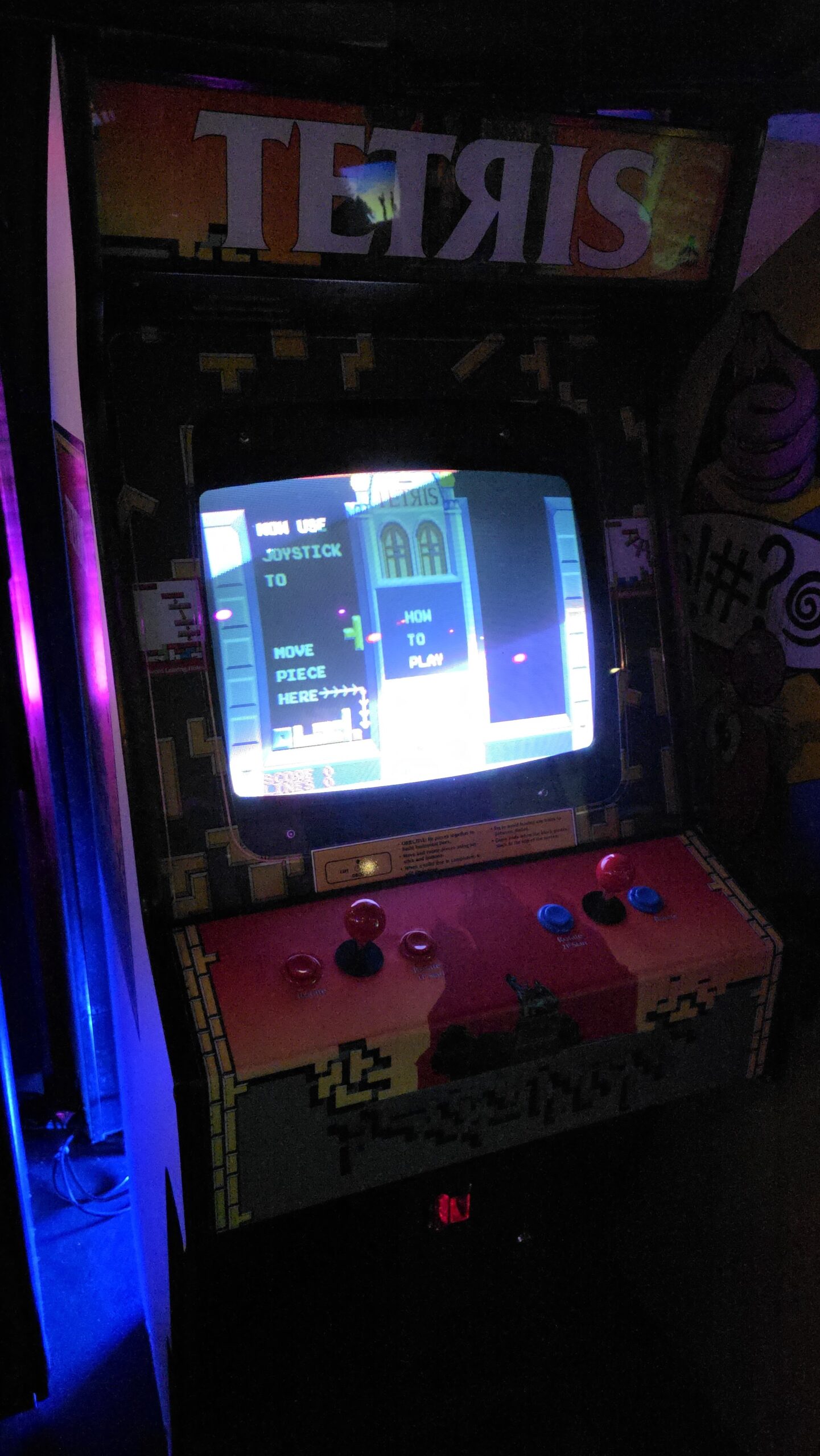
More interesting and unusual things with this Tetris arcade machine. I'm not sure of the origin of this, but it was a nice looking machine, and Tetris' gameplay is, of course, a great fit for the arcade.
And that's pretty much that for now. It was a thoroughly lovely day that I enjoyed a lot. h0ffman's talk was interesting — even if some of the more techie stuff went over my head a bit! — and it was nice to see some people I haven't seen for a while. I even met someone who actually watches my YouTube videos! I guess I better make some more then, huh.
Right, on that note, I'm knackered, so I'm going to go and collapse into a puddle of goo for the remainder of the evening. Visit The Cave if you get the chance — it's a truly lovely day out that I can highly recommend.
Want to read my thoughts on various video games, visual novels and other popular culture things? Stop by MoeGamer.net, my site for all things fun where I am generally a lot more cheerful. And if you fancy watching some vids on classic games, drop by my YouTube channel.
If you want this nonsense in your inbox every day, please feel free to subscribe via email. Your email address won't be used for anything else.
I am in a hotel for the second time in one week! This time it's for non-work reasons. We're going to The Cave tomorrow to see a talk by Ian "h0ffman" Ford, a veteran of the Amiga demoscene, and an experienced porter of games to platforms they absolutely were not designed for. It should be a good time.
Anyway, it's also my birthday in a few days time, and Andie couldn't think of what to buy me as a present, so she paid for us to have a night in a nice hotel ahead of our Cave visit, rather than having to drive there early in the morning. It's about two hours' drive from us, so getting there for an 11am start would have meant getting up much earlier than we normally do on a weekend. Yes, we are still teenagers in that regard.
The hotel is nice. It's a four-star hotel, so it evidently was pretty swanky in its prime; today, it could do with a lick of paint and some repairs here and there, but it's not in bad condition. The facilities are nice — there's a great pool and spa area that we spent a bit of time in this afternoon — and the food at the restaurant we had for dinner was really tasty. Moderately pricy, but not unreasonably so, particularly considering we had three courses.
I'm looking forward to visiting The Cave again. My visit a couple of years back is a fond memory, and the place has had more work done since then, plus some new additions to the collection. h0ffman's talk should be interesting, and it will be nice to show my wife and a friend of ours what it's all about.
Anyway, I'm typing this on my phone because I didn't have the foresight to bring a keyboard with me, so I'm going to leave that there. It's after midnight anyway, so we had better sleep. I will try and remember to take some photos tomorrow!
As I mentioned a few days ago, I have started Going to Therapy. It has been pretty good so far, for one big reason: it is a place where I can go where I feel like I can pretty much say anything.
This is such a valuable thing to have, whatever form it takes. And I know I say a lot of things on this blog, but there are certain things I have second thoughts before posting about. Just this evening, I deleted the start of a post where I was going to have a go about something, then decided that the potential arguments it might start (it's not anything racist, sexist, homophobic, transphobic or anything like that, don't worry) just simply would not be worth the stress it would cause.
To put it another way, the benefits I would gain from getting those thoughts out of my head and onto paper would be far outweighed by the stress any subsequent "discourse" might cause. (Or it might not. But in this instance I think it's best to just not take the risk at all.)
Modern life is exhausting, and talking to the people who are closest to you can sometimes be difficult for all manner of different reasons. When that's the case, you can find yourself bottling up emotions, particularly frustrations and anger, and not really having any way to release them. And that's why having a space to say things is important.
Your space to say things doesn't have to be Going to Therapy. It could be a journal that you keep for yourself, written by hand and locked in a drawer, for your eyes only. It could be a password-protected note in your note-taking app of choice. It could be a voice memo you leave for yourself. It could be abstractly represented through a piece of art, music or writing you choose to create. It could be something you tell your cat when no-one else is around.
It can take many forms. What's important is that you feel like you have it. Ideally it provides you with a feeling of "release", that you've let those emotions out of your brain, acknowledging their existence and how they are making you feel, and perhaps contemplating why you are having them in the first place.
Is the thing you think you are mad about really the thing you are actually mad about, or is it a symptom of something more broad that you need to deal with? Is the whole thing a situation you have put yourself in that you can just as easily extract yourself from? Take a step back from the part of you that is angry and frustrated, and talk to them. What, exactly, is upsetting them? Why are they feeling that way? What do they think they should do about it? What do they think they can do about it? What do they think the consequences for doing something about it might be, and do they think those consequences are worth the temporary catharsis of doing the thing?
There are no easy answers about this sort of thing, but it always pays to be reflective and contemplative. The modern world — and particularly the Internet — is set up in such a way to deliberately make us nearly constantly mad and frustrated, and it's easy to forget that when the red mist starts to descend and all you want to do is yell at someone. That's what a significant amount of the Internet wants, and I'm not just talking about trolls. It's in corporations' interests to keep you mad, because being mad means you're engaged. And engagement, after all, is the be-all and end-all of modern-day "KPIs".
I've taken a step back from the thing I was mad about. I'm still a bit mad about it, but on reflection, it's really not something that is all that worth getting mad about. It is something I can, relatively easily, put to one side and never think about ever again.
So I think I'm going to do that. Or at least try to, anyway.
Want to read my thoughts on various video games, visual novels and other popular culture things? Stop by MoeGamer.net, my site for all things fun where I am generally a lot more cheerful. And if you fancy watching some vids on classic games, drop by my YouTube channel.
If you want this nonsense in your inbox every day, please feel free to subscribe via email. Your email address won't be used for anything else.
I've been absolutely exhausted all day. I feel like I got a decent night's sleep, particularly after the tiring day I had at work followed by the long drive home, but also feel like I could have done with approximately 12 hours more sleep. I actually managed to get a fair amount done today, but right now I just feel like I could shut my eyes and fall asleep right here on the sofa.
With that in mind, I'm probably going to have an early night tonight. I'd like to get back into Pragmata, which I'm enjoying a lot, but I'm also not sure my brain is up to playing anything too complex this evening. Perhaps this would be a good evening to do a bit of retro gaming, with an emphasis on something that isn't too challenging or complex to deal with.
I actually have the next two Evercade cartridges that haven't been released yet, which I'm kind of dying to talk about but can't because although I have them in my hands, we haven't even announced them yet. That will be happening soon, however, and when it does I will have plenty to enthuse about, believe me. They're not the biggest releases of the year, by any means, but they are some of my favourites.
No; I'm thinking this evening might be a good opportunity to settle down with something comfortably familiar, but which I perhaps haven't played for a while. I'm hoping in the process of typing this, something will come to mind that feels like it might be fun to spend my evening playing. Maybe Starwing? I haven't played that for a while. Last time I tried it, the MiSTer SNES core was having issues with the SuperFX chip, but I believe that's been resolved at this point, so that might be a good shout. I do love a bit of Starwing, and it is actually quite a long time since I've played it.
I'm going to get back into doing some videos soon, for those who have been wondering why it's been all quiet on that front for a while. I just haven't really felt an urge to do that for a little while, and forcing yourself to do something you're not really feeling is a sure-fire way to get yourself feeling burnt out. I won't have time to do any this coming weekend, as we're taking a trip to The Cave, but I have a few days off for my birthday at the start of next week, so I might take a day or two to record a few things over that period. Exactly what, I have no idea just yet; I have a few things in mind that I might like to explore, but haven't decided firmly on when or how to tackle them. This upcoming bit of free time might be the ideal opportunity to jump into them.
Anyway, I think I might have made a decision on what to do with my evening — although at the rate I'm going, I may well be asleep before I've got anywhere. If that's the way it goes, though, that's the way it goes!
Want to read my thoughts on various video games, visual novels and other popular culture things? Stop by MoeGamer.net, my site for all things fun where I am generally a lot more cheerful. And if you fancy watching some vids on classic games, drop by my YouTube channel.
If you want this nonsense in your inbox every day, please feel free to subscribe via email. Your email address won't be used for anything else.
I know the common joke that Taco Bell gives you the shits, though I must confess I've never had an issue with its UK-based incarnation. In fact, I rather like a lot of their stuff — a Volcano Burrito is my usual poison of choice.
Today, though, I had I think the worst meal I've ever had from them, and possibly from any service station fast food place. I did not end up with the shits — at least I don't think so; I did have a large dump when I got in, but that is usually the case after the long drive home from work.
Anyway, I saw that they were doing "Sweet habanero tenders", and thought they sounded nice. The picture looked nice, too — some rather Wingstop-esque tenders drizzled with what would presumably be a sweet, hot sauce. Andie and I are big fans of Wingstop, and their mango habanero sauce is one of my favourite things to have on their chicken, even if it gives me hiccups every time, without fail.
I got my food and was surprised to discover that the tenders were just stuffed into a bag and not drizzled with any sort of sauce, but I thought "oh well, the coating is probably nice by itself".
What then followed is, I think, the driest meal I have ever eaten. I made the mistake of also accompanying the tenders with some nachos rather than fries, and as such the experience as a whole was remarkably akin to eating a bag of lightly seasoned sand. The only mildly redeeming part of the meal was the glazed churros for dessert; they both tasted good and brought some much-needed "wet" to proceedings with their sauce.
On the whole, though, I cannot, in any way, recommend the sweet habanero tenders at Taco Bell, particularly at South Mimms Services at the A1/M25 junction. I normally look forward to grabbing a bit of a treat on the drive home from my monthly office visit, but this time it seems I made a terrible mistake. I won't let that happen again!
At least the food I had last night was good. When I met up with my friend, we got food from the hotel I was staying at — and said hotel does pretty good food. I fancied something a bit different from the norm, so had a Hungarian Goulash, and it was delicious. A rich, flavourful, creamy sauce, well-cooked meat, fluffy potatoes and some nice squishy dumpling-like things that were apparently made from egg noodles, of all things. It was accompanied by some nice bread and served up in a little cauldron over a candle for you to ladle into the main bowl. Absolutely lovely stuff — and it basically cost the same as the shitty Taco Bell meal I had this evening on the way home.
This was followed by a lovely chocolate brownie accompanied with some decent ice cream, and all delivered with some excellent service from a waitress that my friend was rather taken with. A thoroughly agreeable evening, gastronomically speaking. And socially speaking, for that matter, as yesterday's post hopefully made clear.
Well, lesson learned. Perhaps I should just have dinner at the hotel before starting the long drive home!
Want to read my thoughts on various video games, visual novels and other popular culture things? Stop by MoeGamer.net, my site for all things fun where I am generally a lot more cheerful. And if you fancy watching some vids on classic games, drop by my YouTube channel.
If you want this nonsense in your inbox every day, please feel free to subscribe via email. Your email address won't be used for anything else.
Today I had an interesting experience. It's one that I wasn't sure about in the run-up to it, and I might even say that I was nervous enough to be almost "dreading" it — but I'm pleased to report that it all went well.
The experience in question was meeting up with someone who was one of my best friends back during our mutual school days, but someone whom I haven't seen for more than 20 years. I had, for many years, assumed that our lives had simply diverged, and that was that — it's happened with plenty of other people in the past, so one more wasn't a particular surprise.
Imagine how surprised I was to get a message from my Dad a little while back, though, telling me that one of his friends had happened to come into contact with this erstwhile friend of mine, and that the latter was interested in reconnecting with me.
I initially wasn't sure what to make of the situation. As I say, our lives (and lifestyles) had diverged significantly around our university years, as we had gone to different places and studied different subjects — though in a peculiar twist of fate, I did spend two of my three years at university living with his then-girlfriend. Not in a dodgy way, I might add; we were just friends, and it seemed optimal for everyone involved to come to some sort of arrangement.
Anyway, at some point in our third year of study, my erstwhile friend went over to Europe to continue his studies and, as our time as students came to an end, we sort of lost touch. As I say, at the time I felt like it was mostly a case of our lives and lifestyles moving in fundamentally incompatible directions — sad, to be sure, since we had been the best of friends at school, but an understandable symptom of growing up and growing older.
Thus it was that I arranged to meet him this evening in the hotel where I'm staying for my monthy visit to work. He happened to be in the area and definitely seemed keen to meet, so I decided that I would take a chance and see what would happen. I was nervous — scared, even — but also very conscious that 20+ years can make a lot of differences in someone's life and way that they live, so I was hopeful that we'd be able to sort of… "reboot" and see what happened there.
I'm delighted to report that things went well. A lot has happened in 20+ years for both of us, and we spent a lot of time catching up on things. But at the same time, my friend that I once knew was well and truly back. He was not the person that I had drifted out of touch with for one reason or another; he was the person that I used to know, and before long we were swapping stories, sharing truths and talking just like the big 20+ year gap had never happened.
I'm happy about this, for a number of reasons. I'm happy that I reconnected with someone who was once an important part of my life. I'm happy that his life seems to have gone in a positive direction, even if the course of it has taken a very different trajectory to mine. And I'm happy that the person I used to know is still there. Or has come back. Or some combination of all of those things.
To put it another way, this was a worthwhile exercise that I'm glad I took a chance on. It would have been so easy to make an excuse and try to get out of it — I've done this in the past with social occasions I've been uneasy about — but no, I decided that what I needed to do was take a chance on this, and just see where things ended up.
As it happens, I feel like they ended up in a good place. I hope this is the beginning of not just one rekindled friendship, but several — as he put me in touch with a couple of other people who had expressed an interest in reconnecting. We shall have to see where that all goes.
Anyway, after all that, my "social battery", as the kids call it these days, is well and truly depleted, so I am going to sit and play video games until it is time to go to bed. Good night!
I'm officially free of professional social media responsibilities from today, and let me tell you, I am incredibly glad and very grateful for the opportunity to take this sideways step in my career. I didn't come into my job with the intention of being The Social Media Guy, it just sort of fell to me. And before long, it was something that started to really get me down.
You see, being The Social Media Guy for a brand means that you have to face down the absolute worst end of humanity online day after day. You have to just sit back and take abuse from random strangers. You have to listen to fuckheads taking the piss out of things that you've worked hard on. You have to watch people spread lies. And in pretty much all of these cases, you have very little power to actually do anything about them. In the meantime, you're expected to put across the image of being relentlessly chipper, positive and call-to-action-y in an attempt to get a society full of people with an attention span of less than three seconds to give a shit about the thing you've worked hard on.
Honestly, it's a complete and total drag. When you're working at a job you actually like, on a product that you actually believe in and are proud to be associated with, the absolute last thing you want to see is a bunch of Facebook randos wilfully misunderstanding what it is you're doing, and being incredibly rude about it. I know that most of these people aren't posting the things they post out of an intention to make someone feel bad — most people see a brand account and think it's a "faceless" thing — but, as someone who has spent some time being the face behind that brand account, let me tell you: when you act like a cunt to the brand, someone has to read your bullshit just in case you might actually have a valid issue, and if you're being a cunt, you're probably making someone feel bad.
It's one of those things that you don't really notice at first. You can laugh it off as "oh, look at these silly Internet people". Over time, though, it really starts to get to you. The fact that you can't just respond to one of these people, go "look, shut the fuck up, no-one gives a shit about what you think, and there is an entire team of people behind me who have worked their arses off on this thing you're being dismissive about" is frustrating. Honestly, I would respect any brand account that fully took the gloves off and took an abusive commenter down a peg or two, but it's Not The Done Thing.
I'm glad to be out of it. It's not my problem any more. There are people who can do a much better job at it than me, and I am more than happy to let them take care of it while I get on with some of the things where my actual strengths lie. For now, that means continuing to write blog posts, videos and documentation, and stepping up the amount of playtesting and "tech" work that I get to do. I'm hoping I will learn something over the long term — and in the short term, it feels like I have even greater involvement in working on things that actually mean something to me, and that I feel have value.
I hope I never have to look back. I have been looking forward to the day I never have to look at Twitter and Facebook ever again for a long time, and now it's pretty much here — barring any occasions when I need to cover someone who's off, because unfortunately I'm the one who is most qualified (or I should perhaps say experienced) for that cover. But I'll take it for now. This is a positive step, and one that I'm happy about.
Just remember to be kind to the people posting stuff from a brand that you have an interest in. Someone has to read that vitriol you post, and I can guarantee they have a million and one ways they'd rather spend their day.
Want to read my thoughts on various video games, visual novels and other popular culture things? Stop by MoeGamer.net, my site for all things fun where I am generally a lot more cheerful. And if you fancy watching some vids on classic games, drop by my YouTube channel.
If you want this nonsense in your inbox every day, please feel free to subscribe via email. Your email address won't be used for anything else.