1178: Mage Knight Night

We played Mage Knight again this evening and actually managed to successfully get all the way through the introductory scenario, which allows the opportunity to explore the basic rules and get a feel for how the game as a whole works, but which is also (theoretically) significantly shorter than the other scenarios. It still took us about three hours altogether.

I have mixed feelings about long games like this. On the one hand, I really like the experience — the depth and complexity inherent in long games means that they tend to remain consistently interesting throughout, even in something like Mage Knight where there's a fair amount of downtime. Mage Knight is designed in such a way that while other people are taking their turns, you can easily be planning what you're going to do next, so in actual fact you can keep turns fairly snappy if you take the time to think ahead. There are still a lot of turns to take, however.

On the other hand, games that take a long time tend not to hit the table all that often, and we tend to end up playing something we're all familiar with like Agricola, which still frustrates me inordinately because I suck at it. (I do at least have my own copy with which I can practice now, however.)

Despite the apparent complexity of the game that the "walkthrough" game guide appears to imply it has by explaining everything in exhaustive detail, Mage Knight's mechanics are actually relatively simple. It's basically what you get if you combine a deck-building game like Dominion or Ascension with a turn-based strategy RPG-type thing. There are random elements, but for the most part the game is a matter of setting yourself up for success, and then being able to make the best use of the resources you have to hand at any one time.

The basic mechanic involves playing cards to gain values in various abilities. Move cards allow you to, err, move; Influence cards allow you to purchase items and perform special actions in populated locations such as villages and forts; Siege and Ranged Attack cards allow you to deal damage before the enemy attacks; Block cards let you fend off enemy attacks; Attack cards let you attack the enemy after they've had a pop at you; Attack and Block cards with elemental affinities are more or less effective depending on the capabilities of the enemy you're going toe-to-toe with. These "value" cards are then supplemented with cards that allow the use of various special abilities, and most cards have both a weak and a strong effect, with the stronger effect requiring the expenditure of "mana," which can either be collected (and possibly stockpiled) through special actions or drawn from a common pool that changes every so often.

The introductory scenario is basically a case of trying to collect as much shit as possible before the game is over. Bonus points are scored for all the "extra" things you acquire over and above your starting deck — spells, special abilities, mana crystals, treasures, supporting units — and lost for any damage you're still suffering from at the end of the game. In retrospect, triggering the end of the game when I did tonight was a silly move — I should have moved away and simply continued to try and rack up points. (Yes, I lost. Except at being wounded, which I was the best at. Yay negative bonuses!)

My trouble with strategy games like this is that I often lack the confidence to try certain more adventurous things. I'll give you an example: in Mage Knight, when you uncover a "Mage Tower" structure on a new map tile, you can conquer it if you can defeat its guardians, who are typically quite strong and resistant to certain types of damage. The rewards are great — particularly when you take end-game bonuses into account — but it's a bit of a risk, especially if you have a crap hand of cards at the time. This is where the "planning ahead" bit comes into it, I guess — something I clearly need to work on, since I spent most of my time earning points from exploring the map and defeating the "rampaging" enemies on the map rather than the more difficult opponents that would have earned me both more points immediately as well as the potential for bigger bonuses at the end of the game.

Anyway. I'm pleased we got through a whole game, and I'm keen to try it again — perhaps just the introductory scenario again, making some different decisions along the way — and see if I can do any better. I'm also quite tempted to get my own copy, since there are full rules for playing it solo, which I think will be quite an interesting experience. It has the feel of an old-school computer role-playing game — moving a bit at a time over a sprawling map, interacting with people through abstract systems and gradually growing in power. It works well — it's just very time-consuming!
1177: Dev Diary 2

Progress has been continuing on the RPG Maker game I'm working on (which is called One Year Later if you missed the slightly spoilerish post a while back). I'm very pleased with how things are going, because I've pretty much figured out How It All Works and am picking up speed with actually making things happen.

Here's the gist of things. All of this will be common knowledge to the player before they start playing if they read the accompanying "manual" or help file or website or whatever I put out alongside it, so these aren't really spoilers. I will keep specific plot details that aren't immediately apparent under wraps for now, however — I'd like people to explore this game's story with "beginner's mind", after all!

The game is set one year after the conclusion of a typical JRPG, when our plucky band of heroes drawn together by fate successfully defeated the demonic overlord T'Bon and restored peace to the land. At the end of their adventure, they had one last meal together in a pub they'd grown fond of, and agreed to meet back up again exactly one year later. The game begins on that day.

There are six main characters in the story.

Amarysse "Ami" Jerhynsson is the game's main character. She's a 30-year old woman from the farming village of Wishford, the destruction of which set her on her path to adventure when she was rescued from the wreckage by a wandering mercenary. She became the de facto leader of the group thanks to her level-headedness and rationality, despite the fact she never saw herself as particularly remarkable. Since her adventure, she's spent the last year helping the citizens of Wishford rebuild their town, and has been taking after her parents by tending the farm beside her house, much to the pleasure of Wishford's citizens.

Daren "Dax" Zael is the mercenary who rescued Ami from the wreckage of Wishford. No-one knows exactly how old he is, but he appears to be of a similar age or slightly older than Ami in appearance. As soon as he opens his mouth, however, his immature sense of humour and crudeness generally makes people think a little differently about his otherwise seemingly noble bearing. He was a strong fighter and was always the first into battle to protect his friends from harm.

Feena Denimore is a priestess of the Order, the organised religion that worships the divine entity known only as "The Goddess". She is skilled in divine magic and is a beloved priestess, but when she lets her hair down outside of her holy duties, she's cheeky, spunky and flirtatious, and more than capable of drinking someone like Dax under the table.

Hiro Nagase is a teenage boy who spent his formative years learning to fight with a sword under the tutelage of his father. These skills were put to the test shortly after the party came across him in his seemingly-abandoned family home — his parents had been killed by T'Bon's forces, and Hiro decided to tag along with the party in an attempt to get revenge. He likes to make out he is braver than he is, gets easily embarrassed and frequently says stupid things without thinking them through first.

Lily Cole is a teenage girl who came from the small fishing village of Bannford. She once had the strange ability to summon "Guardians" — supernatural creatures thought to be nothing but a myth — and eventually used this skill to seal away T'Bon once and for all. Since the final battle, she lost her powers and is now nothing but a normal, rather cheerful and optimistic teenage girl — traits she somehow managed to retain even in the party's darkest hours.

Zero is a powerful, knowledgeable mage whose real name is unknown. The party rescued him from torture at the hand of one of T'Bon's lieutenants, and he adopted the name "Zero" as a mark of spite against those who had abused him — an attempt to reclaim the word and give it positive connotations. Zero is typically stony-faced, contemplative and quiet, but occasionally displays a dry, dark sense of humour.

The game begins with Amarysse leaving home and heading for the capital, then meeting up with her former comrades-in-arms. Exactly where the story goes from there depends on the choices the player makes as Amarysse — which aren't always explicit choices from a menu. Sometimes taking a particular action (or choosing not to act) has an effect on the unfolding story and its eventual conclusion. There will be multiple endings as well as a "true ending" that is only accessible once certain conditions have been met. Discovering the "true ending" will require that the player make use of the New Game+ feature to carry over certain data from one playthrough to the next when they see one of the conclusions.

Interacting with the game will largely be like a regular top-down sprite-based JRPG. Players will control Amarysse and any party members tagging along with her as they visit various locations. The emphasis is very much on the story, so what needs to be done next in order to advance the plot will always be very obvious, though charging straight for the next story trigger without completing certain side objectives may mean you miss out on certain events — or perhaps trigger new ones later. Through the New Game+ system, the game will reward the player for experimenting and trying all the possibilities in various playthroughs.

Amarysse collects "topics" as discussions unfold between her, the party members and other incidental characters. Topics have three levels — at "bronze" level, they're something Amarysse is curious about; at "silver" level, they're something she's found something out about and wants to know more; at "gold" level, they're a truth she's discovered beyond any doubt. Advancing the plot will sometimes require Amarysse to use the topics she has collected to trigger various events or discussions between characters. At other times, she will have the opportunity to relax a little by herself and contemplate some of the things that are weighing on her mind. Sometimes, whether or not Amarysse has knowledge of a particular topic will have a significant impact on whether or not she can resolve a critical situation.

Currently, I have a plot outline in my mind. I know how the whole thing is going to end, and I know a few snippets of things that are going to happen along the way. I just have to work out the specifics, which I've found tend to flow quite naturally once I start actually composing scenes. I'm very much looking forward to exploring these characters through writing, and I hope some of you will take the opportunity to explore them through playing the game when it's finished. At present, I have no idea when that will be, but I will, of course, keep you posted!

1176: Absolute Destiny Apocalypse

Utena-1-_(2)At the insistence of my good friend Lynette (well, all right, she mentioned it a couple of times and I was intrigued) I have been watching an anime series called Revolutionary Girl Utena, also known in various places as Shoujo Kakumei Utena and La fillette révolutionnaire Utena.
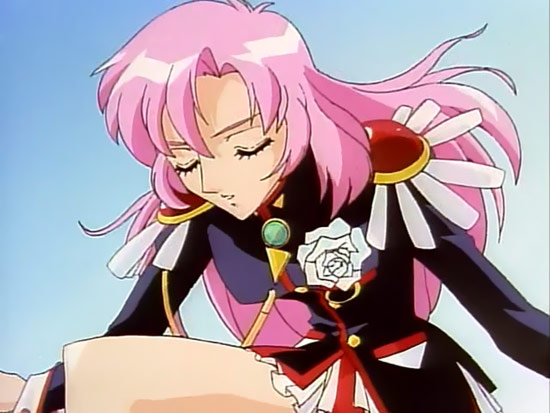
Utena, as I shall refer to it from hereon, is clearly from a very different period to the anime I have watched to date. It has a very distinctive "'90s anime" appearance to it, particularly with regard to character proportions and design — everyone has chins that could cut glass, and all the girls have inhumanly long legs, a fact usually accentuated by their clothing — but it still makes use of a lot of common non-realistic "stylized" features that we see in modern anime, particularly with regard to facial expressions and the way people move.

Thematically, it's also of a genre I haven't really explored before — technically, it could be described as a "magical girl" anime since Utena regularly gains special powers accompanied by special effects and recognisable catchphrases, but it's a lot more than just Pretty Girl Fights Crime. No; so far I'm only relatively few episodes into the whole thing but it's very clear that there are a lot of things going on.

A friend of mine described Utena as being "like a fever dream" and that's absolutely true. There's a curious sense of surrealism about most of the episodes, with fairly mundane activities juxtaposed with obviously fantastic happenings that only certain characters are aware of. The whole thing is also absolutely riddled with imagery and visual metaphor, some of which are more obvious than others and most of which only contribute to the strange, surreal feelings of things not quite being what they seem.

But you probably want to know what it's all about, right? Well… as I say, I've only seen a few episodes so far so I can't comment with full authority on everything that has happened, but here goes.

00003sp0Utena is a statuesque high school girl who habitually dresses as a boy. The reason for this is that when she was younger, she was helped by a kind "prince", who gives her a ring with a rose signet and tells the young Utena that it will "lead her to him". It transpires that there are other people out there who wear the rose signet on their rings, and they're at Utena's school. Specifically, they're the student council, who appear to have some sort of special relationship with an unknown entity, person or organisation known as "End of the World" and are keen to "smash the world's shell to bring about revolution" as dictated by their creed. ("If it cannot break out of its shell, a chick will die without being born. We are the chick. The world is our egg.")
Key to the plans of the Student Council is the "Rose Bride" Anthy Himemiya, who also happens to be a student at Utena's school — and who appears to share some characteristics with the "prince" from Utena's past. Anthy, for the most part, appears to be a normal girl, but whoever is "engaged" to her "possesses" her and can make her do anything they want. Through a series of unfortunate happenings, Utena becomes engaged to Anthy and then proceeds to protect her from the other members of the Student Council, who all have their own reasons for wanting to possess the "power of Dios" that Anthy contains.

The interesting thing about the series so far is that no-one is really outright "evil" — there are plenty of obnoxious characters who are unpleasant or dislikable, but they all appear to have their reasons for doing the things they do. In fact, there are several characters who, despite being on the Student Council and thus at various points taking the role of "antagonist", are actually rather sympathetic and/or likable. It's really cool, and I'm looking forward to finding out the truth behind some of them.

Anyway, given that I'm only partway through the series' first story arc, that's really all I can say for now, but I will say that I'm enjoying it, even if it's currently very confusing and bewildering. I get the impression that's entirely deliberate, though — I wonder how many answers I'll have by the end of it all?

1175: Stream of Rubbish

I'm really not at all sure what to write about tonight, so I'm going to indulge in some "freewriting", if you'll pardon me. For those unaware, "freewriting" is where you just start writing and keep going for a set period of time without stopping or going back to correct the things you've done in order to make them make sense. (When freewriting on the computer, I find it very difficult to break my normal habits of automatically correcting typos for the most part, so I am allowing myself that small indulgence, but otherwise this post will be pure, bona fide stream-of-consciousness bullshit. I hope you enjoy. And if you don't… well, I don't really care all that much as it's 11:33 in the evening and I'd quite like to go to bed. I should probably close these brackets and finish this paragraph sometime soon, huh.)

Anyway. What is happening right now? Not a lot, because it's 11:33 in the evening and I'd quite like to go to bed, as previously mentioned. I am sitting in front of my Mac frantically typing this blog post while Andie is sitting in the other room watching Family Guy on BBC Three. This must be at least the sixth or seventh time I've heard the whole series go around and around and around and I'm never quite sure how I feel about it. Family Guy can be quite entertaining, but it's one of those things that it seems to be quite fashionable to bash on these days, so I'm never quite sure if I'm supposed to like it or not. I do know that I like it rather less now that it's been around and around so many times. Certain things remain entertaining on repeat viewings — as I've previously said elsewhere on this blog, for me Friends is one of those shows that I can watch over and over again without getting tired of it for the most part — but for me, Family Guy is a bit of a one-trick pony, particularly when they start pulling the "remember the time when" etc etc jokes where they cut away to something HILARIOUS that probably didn't really happen. What a hoot!

I'm going to stop talking about Family Guy now and think of something else to say. But what? Hmm. How about food? Today we went out for lunch with my parents to Yo! Sushi in WestQuay. I'm a big fan of Yo! Sushi even if it is a bit expensive, really. Go on Sunday, though, and it's an all-you-can-eat for £20 sort of affair, though, so if you leave plenty of room you can ensure you get your money's worth. I really like the food there, too. It's tasty. I'm sure it's not quite up to the standard of a "proper" sushi restaurant, but it's certainly very tasty and a bit different from the normal sort of things that you get around the place.

I can still hear Family Guy and it's a little bit distracting. I will try and maintain my concentration. I set a goal for myself to keep writing non-stop for ten minutes and I'm about halfway through at this point. Lucy the rat is currently running rather aggressively on the wheel in her cage — I can hear, not see her — so I will have to go and check on her in a bit. I like our rats. They are friendly. Lara likes to run up the sleeve of my dressing gown, which is very amusing except when she does a wee in my armpit. To be fair to her, she has only done that once, but it was not very nice.

Anyway, I believe I was talking about sushi before I got distracted by Family Guy. One of the things I like at Yo! Sushi is takoyaki — octopus dumplings which various Japanese video games taught me about the existence of. (I'm specifically thinking of the takoyaki stand people hang out at in Persona 3, but the game I'm currently playing on the DS, Lifesignsalso features a lot of mentions of takoyaki). For some reason, mentioning something repeatedly like that really makes me want to investigate it and try it for myself — and hey, what do you know? Turns out that takoyaki is pretty tasty, though I'm not sure it was quite what I expected when I first had it. I recommend you try it. I didn't have it today because by the time it came around on the conveyor belt at Yo! Sushi, we were already pretty full on everything else we'd eaten. Another time, dear octopus balls, another time.

One more minute to go. Can I break a thousand words by the time that minute passes? Probably not. I'd have to type a little bit quicker than I am typing right now. I can type pretty quickly, but I'm not sure I can type 250 words in a minute. That would be pretty speedy. Superhuman speedy, in fact.

Oh, time's up. Time to go. I apologise for the disjointed, dumb nature of this blog post but I thought I'd do that instead of babbling on about Ar Tonelico II again. (I'll get back to that tomorrow! Just kidding! Maybe.) Anyway. Time for bed. Good night.

1174: The Second Tower

I beat Ar Tonelico II: Melody of Metafalica this evening. Or, more accurately, I saw one of its four endings. Two of the other endings won't be particularly difficult to obtain with the tactical saves I made on the way to the finale, but the last remaining one will require playing about 80% of the game again, albeit with a completely different second "phase". I'll probably take care of that last ending alongside a new game, which will either be Hyperdimension Neptunia Victory or the third Ar Tonelico game, both of which I anticipate I will be enthusing about considerably on these pages in the very near future if previous instalments in their respective franchises are anything to go by.

Anyway, Ar Tonelico II. It's… well, fantastic. I must confess to having not been as immediately smitten with it as I was the first game, as the conflicting art styles between the field and battle sprites (and between the field sprites of the first game and the second game) were initially a little jarring. (Seriously, everyone has really, really big hands and massive feet on the field maps and it's very disconcerting to begin with.) But after not very long at all, I found myself looking past this rather superficial consideration and immersing myself in what turned out to be a very pleasingly deep and meaningful story packed with good characterisation and questionable translation from the original Japanese. (On that note, though, the translation was at least understandable despite a few errors, and certainly no worse than some visual novels I've played.)

Spoilarz Ahead

2a91og8Ar Tonelico II stands on its own, but also fits into the current "trilogy" as the sort of "dark middle episode". Whereas the first Ar Tonelico was rather bright and breezy most of the way through, the land of Ar Tonelico II is a bit bleaker. The people are struggling, there isn't enough land for everyone and everyone is clinging to the seemingly hopeless desire that the land's Holy Maiden will be able to create "Metafalica" — a verdant green land summoned through the use of Reyvateil Song Magic. Plenty of political machinations and backstabbings threaten to fuck everything up completely (and pretty much do on several occasions over the course of the entire narrative) but, this being a JRPG, our plucky band of heroes are there to wander the lands, right wrongs and eventually figure out how in the world they are going to help everyone find hope for the future.

Ar Tonelico II's story is nice in that it isn't quite the clichéd "Big Bad wants to destroy the world" business. Sure, there's world-threatening stuff going on and the eventual aim of the game is to save the world from an unpleasant fate, but it's not quite what you might expect. For starters, you spend most of the game not being quite sure who the "good" and "bad" guys are. There's no sign of a single easily-identifiable antagonist who is fucking shit up and needs a good Omnislash to the face; no white-haired pretty boy accompanied by tubular bells and organ music every time he appears. In fact, over the course of the narrative, none of these characters are presented as one-dimensional — most of them go through some sort of change and/or growth as the story progresses.

Perhaps the most interesting thing about Ar Tonelico II in this regard is the fact that the final boss "Mir" from the first game is actually a party member in the second — though you don't know this when you first meet her, and in fact it's entirely possible to go through pretty much the whole game without noticing this or figuring it out, depending on the choices you make and the optional events you witness. Not having played the first game won't affect your enjoyment of the second, but if you have played the first game, the moment where you find yourself going "Wait… OH. Mir?!" is a "big reveal" on a par with Darth Revan in Star Wars: Knights of the Old Republic or SHODAN's first appearance in System Shock 2.

Herein lies one of the interesting things about the first two Ar Tonelico games in general: "good" and "evil" aren't absolute. In Ar Tonelicowe get some insight into why Mir is the way she is and why she is so angry about everything — and it's easy to find yourself sympathising with her rather than just wanting to kick her ass. In Ar Tonelico II, by spending some time with her as a (relatively) normal person, we get to find out a whole lot more about her — what happened to her in the distant past, what led her to her actions in the first game, and how she feels about what has happened to her then and since. If you follow her "route" through to its complete conclusion in Ar Tonelico II, it's a really wonderful story arc for one of the most interesting, troubled characters I've encountered in a very long time. I don't yet know if she shows up in Ar Tonelico Qoga, the third game, but I'll be very happy to see her again if she does.

The overriding theme of the Ar Tonelico series is that of bonds between people, and this is particularly apparent in the second game. The main theme of Ar Tonelico II's story is that the more intense a relationship between two or more people, the more painful it is. The more people you surround yourself with, the more "alive" you feel from being part of something bigger than yourself, but the more pain you suffer when you lose those precious people. The world-ending chaos at the end of Ar Tonelico II is not brought about by a desire for dominance or a display of power, but instead out of a simple desire to not feel that sharp pain of loss any longer. If everyone was able to abandon their physical bodies and live on purely as an individual spiritual entity, the primary antagonist's theory goes, no-one would have any need for other people, no-one would feel the pain of loss, and everyone would be happy in their complete and total individuality. But, responds the protagonist, no-one would be truly alive then. Life would not have meaning drawn from the people around you and the hardships you work together to overcome. You'd be little more than data.

It's an interesting and somewhat bittersweet message, but it works hugely well in the context of both the overarching plot and the smaller, individual character-led stories that unfold over the course of the whole game. I'm all for exploring deep and thought-provoking themes through interactive entertainment, and Ar Tonelico II successfully achieves that without sacrificing the "spectacular" side of its overall experience. It's still recognisably a JRPG with all the over-the-top pyrotechnics and anime-style special attacks that entails, but at the same time it's a complex and emotional tale far beyond the "Evil Guy Is Over There, Go Stab Him" trope that people (largely incorrectly) assume still characterises the genre.

In other words, just go play it, all right?

1173: Am I Missing Something?

Yesterday, game-centric social network Raptr reported that in the month of March, its members played more of King's Candy Crush Saga than StarCraft II, World of Tanks and Halo: Reach (all historically very popular games) combined.

This is significant for a number of reasons. Firstly, it shows that Raptr is getting some pretty wide usage by more casual gamers as well as those who care about achievements, hour counts and whatnot — demonstrating (arguably) that a lot of people playing Candy Crush Saga are "serious" enough about their gaming to sign up for a game-centric social network and tracking service.

Secondly, it shows something we all know: the vast numbers of people playing Facebook and mobile games far outstrips those who have perhaps grown up with the industry and who play what one might call "traditional" video games — players whom mobile and social gaming companies euphemistically refer to as "core" gamers.

The second point isn't all that surprising; how many people do you know who don't have a Facebook account? While we're not yet in a world where every single person is permanently jacked in to the social network via a transmitter in their spinal column, I'm willing to bet that regardless of your age, there's probably a large proportion of the people you know who have Facebook accounts, and of those people most of them have probably tried playing some games at least once. The exact same situation is true when we consider smartphone ownership these days — of those who have acquired a new mobile phone recently, it's highly likely that it was one of the two most well-supported platforms out there: iOS and Android. And of those who haven't acquired a new mobile phone recently, a lot of people are investigating tablets as a home computer solution — pretty much all of which run, you guessed it, iOS and Android.

It's the first point that surprises me, though. Raptr is the sort of service that is historically only of interest to those "core" gamers we mentioned earlier, as your average soccer mom who only plays games on Facebook has no real need or desire to keep up with industry happenings or the latest stupid thing that a Microsoft employee has said on social media — let alone how their number of hours played stacks up against their friends. So what does it mean when the number of hours racked up on Candy Crush Saga outstrips some of Raptr's most heavily-tracked, popular titles?

Well, it could mean one of a couple of things. Firstly, it could mean that Facebook and/or mobile gamers are more serious about tracking their playtime and achievements in the games they play than most people thought. I find this rather difficult to believe, to be honest, as the sort of people who only play Facebook and mobile games are typically playing them as a means to fill a spare few minutes rather than as an engaging form of entertainment that they feel particularly passionate about.

Secondly, it could mean that those "core" gamers out there are playing Facebook and mobile games as well as (apparently, more than) "traditional" computer and console games that are aimed specifically at them? Judging by the notifications that pop up on the Raptr client that runs on my PC, this is much more likely; there are several people on my friends list whom I would describe as "core" gamers by that definition, but who are regularly seen playing everything from FarmVille to Marvel Avengers Alliance and Candy Crush Saga.

One question, though: why?

No, seriously, why?

If you're a "core" gamer by the popular definition, you're serious about your interactive entertainment. You might play games instead of (or as much as) watching movies and TV shows. Your exact reasons for playing may vary — those who enjoy Call of Duty play it much like a competitive team sport, while people like me prefer narrative-centric experiences that stimulate similar parts of the brain to movies and TV shows — but the fact is, you're highly likely to make time for your gaming rather than indulge in it as an idle diversion. You'll sit down, you'll play a game for a not-inconsiderable amount of time, then you'll switch off and do something else. Or pass out with the controller in your sweaty mitts.

So if you're investing time and probably money into what is, after all, a hobby rather than a mindless pastime, why, dear "core" gamers, aren't you playing anything better? Don't get me wrong, Candy Crush Saga has performed so well because it's a polished product that is pretty accessible even to those who haven't played many games before, but 1) it's a Bejeweled ripoff, and Bejeweled 3 (or just Bejeweled as it is called on mobile) is a better game with more variety; 2) it's rammed to the gills with obnoxious enforced "social" features that don't actually promote social interaction at all (ask for lives! ask friends to unlock levels! brag about your score!); 3) it's rammed to its other gills with obnoxious monetization — aside from the fact that every so often you'll run into a wall where it literally just stops you from playing unless you either wait for several hours or pay money, there's one powerup in the game that costs £35 and can be used once per level. Thirty-five pounds. Bejeweled 3, which, as previously mentioned, is an infinitely superior game that doesn't bug you every five fucking seconds to insert coins or invite friends, costs £14.99 — less than half the price of that one powerup in Candy Crush Saga — on Steam (and is regularly reduced in price in sales), and sixty-nine pence on mobile phones.

"But Candy Crush Saga is free to download!" I hear you cry. "Surely people aren't dimwitted enough to repeatedly spend money on this when they could just buy a copy of Bejeweled outright and then never have to pay again!" Wrong. Candy Crush Saga is, as I write this, the number 1 Top Grossing app on the App Store. Note: "app" not "game". (It is also the number 1 Top Grossing game, but that shouldn't be surprising given its other position.)

Let me reiterate that. Candy Crush Saga, which is free to download, is making more money than apps that cost money. By a significant margin. It is making more money than high-quality productivity apps for professionals, which typically carry a relatively hefty price tag. It is making more money than high-quality "pay once, play forever" games. It is making more money than Bejeweled, which is basically the same fucking game for the price of a packet of Chewits. It is making more money than anything else on the App Store.

It is at this point I throw my hands up and say I absolutely do not understand why this is the case. It absolutely boggles my mind, because can see why I wouldn't want to repeatedly and indefinitely churn money into a game that isn't noticeably better than another game I've already paid for once (Bejeweled), so why can't these hundreds, thousands, millions of other people? It does not make any sense whatsoever. And this isn't even considering the question above of why on Earth "core" gamers are apparently playing this game so much when there is so much other good stuff out there — too much for one games enthusiast to ever hope to fit into one lifetime, even if they became hikikomori in order to try and do so.

I am so, so torn about this sort of thing, and have been for a while now. On the one hand, it's great that more and more people are embracing video games as a pastime, form of entertainment or even hobby. On the other, the swathes of people who are coming to gaming as a result of free-to-play mobile and social games are perpetuating a business model that, while immensely profitable, is not particularly friendly to the consumer and is actually quite unsafe to people who don't keep a tight rein on their finances. More people playing games? Good. Sending the message that charging £35 for one powerup is okay? Very, very bad.

1172: Mage Knight

It was a board games evening tonight, and since we were down one member from our usual troupe to play Descent: Second Edition we decided to crack open a new acquisition and give it a shot: Mage Knight.

None of us really knew anything about Mage Knight prior to going in save for the fact it was supposed to be good, so it was always going to be something of a learning experience. Due to the relative complexity of the rules — or at least, the relative complexity of introducing the rules to everyone — we didn't manage to finish a complete game, but at least now we have a good understanding of the basic mechanics and will probably be able to romp through the introductory scenario without too much difficulty.

Mage Knight, if you're unfamiliar, is a rather interesting game with elements of role-playing, strategy and deck-building card games. You play a single character who begins with a deck of basic abilities — one of which is unique to each character, the rest of which are the same for everyone — and then work your way towards the objective of the scenario you're playing. Scenarios vary from cooperative ones where you work together as a group to competitive ones, where whoever gets the most points after the end condition is fulfilled wins, to "very competitive" ones, where whoever fulfils the victory condition first wins.

Play is split into rounds, which represent either day or night-time, and each round can and will go on for several circuits of the table. On each turn within a round, you can play some cards from your hand, some of which award you with movement, combat or influence points, and can then use those points to do various things. For example, moving requires a particular number of points according to the type of terrain you're moving over, and influence is used in settlements and other friendly locations to do things like make use of services or acquire troops. Some cards have special abilities, too, and most have two possible functions — one simple one that can be used for "free", and a more powerful one that generally requires a specific colour of mana to activate. Mana can be acquired through cards, through crystals you've stocked up on through various means, or most frequently through the dice that represent the "Source" — the mana naturally flowing through the world.

Through moving and attacking, you'll reveal more and more areas of the map, each of which include various things to do. In villages, you can recruit new troops, get healing or pillage them. Come across a fortress and you can assault it in an attempt to take it over for yourself. Discover a wizard's tower and you'll have the opportunity to get some powerful spells. Most actions affect your "fame" level — which acts as a combined score and "experience" system, allowing the player to grow stronger in various ways every so often — and your reputation in the area, which provides bonuses or penalties to the amount of influence points required to do "friendly" actions. Defeating marauding monsters improves your reputation; attacking fortresses unprovoked has a negative impact. There's a nice feeling of "consequence" to your actions.

We didn't play far enough to finish the first scenario, but we learned enough to be able to make it through the next time we try it. We learned about the simple but elegant combat system, which requires you to make careful use of your cards to defeat your enemies, and about the various ways you can acquire the more powerful abilities and items. There's clearly a lot to this game, and the really nice thing about it is that it's one of those games that, like Descent, scratches both the strategic Eurogame and theme-heavy Ameritrash itches simultaneously. Consequently, I can see it hitting the table reasonably often — though the only downside for our group is that it only supports up to four players, whereas our full complement is typically five people.

I'm looking forward to trying it again, anyway. It looks like a great game and the components are gorgeous — lovely linen-backed cards, pre-painted miniatures and high-quality tokens and other bits and pieces. It takes a while to set up but once you're up and running it's a game that continues to look good in the middle of a session rather than devolving into a chaotic mess. Combine that with the host of scenarios and variants provided in the rulebook and here's a game with the potential to be pretty different each time you play it. I can see why it's so well-regarded.

1171: Easy Listening, Part 2

As promised, I'm continuing yesterday's post with another game music fest to introduce you to the joys of some soundtracks you might not be familiar with.

Today, it's Cavia/Square Enix's strange, wonderful and rather depressing action-JRPG Nier.

Nier

Nier wasn't particularly well-received by critics upon its release due to a variety of factors. Having played it (and adored it, I might add), I can see why it was criticised, but equally I feel it was treated a little too harshly. Not only was it doing some fascinating things with the way it told its story and what its story was about — I'll leave the spoilers out of the discussion for now — but it was also doing some really interesting things with its gameplay, too. What initially appeared to be a relatively conventional third-person character action game/RPG subsequently revealed itself to have elements of visual novels, text adventures, farming sims, 2D platform games, isometric-perspective dungeon crawlers, bullet hell shooters and numerous other genres. It really was a massively interesting game in almost every way.

And then there was its soundtrack, which even if you don't like the game is indisputably amazing. Let's look at some standout tracks.

This track, known as Hills of Radiant Wind, is one of the tracks you'll hear most frequently in the game, since it typically accompanies your jaunts across the countryside surrounding the small settlement where the title character Nier and his daughter Yonah live. This track is hugely memorable both for having a catchy melody and capturing the atmosphere of the game world beautifully. The pounding drums at the bottom of the mix give a sense of adventure and driving forwards, while the vocal line atop the relatively simple accompaniment gives a suitable air of melancholy to the experience. Nier is not a happy game, and this track, while one of the more "upbeat" ones from the soundtrack, reflects that nicely.

This song, simply called Grandma, is beautiful, and is, to me, probably the most representative piece of music that illustrates what the Nier experience is all about. A simple accompaniment accompanied by a mournful voice provides a massively atmospheric backdrop to some of the most emotional story moments in the game.

And then we move on to a few tracks that use the "leitmotiv" technique I'm so fond of, where a number of different pieces make use of similar melodic or harmonic sequences to reflect various things happening to different characters and/or places.

Let's start with Emil, who, without spoiling anything, gets fairly consistently screwed over throughout the course of the whole game, through no fault of his own. Poor kid.

Anyway, here's Emil's "Sacrifice" theme, which accompanies some heartbreaking, sad moments:

And by contrast, here's his "Karma" theme, which comes shortly after a heartbreaking, sad moment when you're venting some aggression on the perpetrators:

The addition of the pounding drums and the urgent piano line in this one always gives me shivers, particularly when I remember how it was used in context.

Then we have Popola and Devola, two characters who are extremely important to the overall narrative in ways I won't spoil right now. When we encounter them, we hear various versions of the "Song of the Ancients" theme, beginning with this acoustic guitar-centric version:

…and moving on to this… I'm not sure how to describe this, really. Plinky-plonky version?

Well, if you're going to do two different versions based on the two characters who sing it, you might as well do a third version where they sing it together, mightn't you? Yes, obviously. This, along with Devola's theme above, are some of the only examples of diegetic music in the game — the rest is there to evoke a mood rather than actually be "present" in the world.

And, hell, if you're going to do that, you may as well go the whole hog and have a battle theme based on their (by now) iconic song, right? Of course.

The latter one, like Emil's "Karma" theme, still gives me shivers because I can remember it in context. Gobsmacking.

Then we come to Kainé, possibly one of the most fascinating characters in any game ever for a whole host of reasons, many of which aren't made entirely explicit in the game. Kainé has two main versions of her theme: a slow one, which goes like this…

…and a fast one, which goes like this.

Those who know their Nier lore will be familiar with the fact that Kainé is intersex. If you weren't familiar with your Nier lore, now you know too — don't worry, this isn't technically a spoiler in terms of the game's overall plot, and in fact knowing it beforehand brings a whole host of hidden meanings to a bunch of sequences in the game to the fore. I like to think that the markedly different character of these two pieces reflects Kainé's "masculine" and "feminine" sides, because she is most definitely in possession of both. She is, it's fair to say, a very angry person — and with good reason — but not afraid to express her feminine side in some rather… flamboyant ways.

One of the most interesting things about the vocal-heavy tracks in Nier are that they don't use a language from this world. Instead, vocalist Emi Evans was encouraged to make up words in a "futuristic language" — Nier is set in the far, far future — and used elements of Scottish Gaelic, Portuguese, Spanish, Italian, French, English and Japanese to create something with a very distinctive sound, but which doesn't "mean" anything in and of itself. Instead, the vocal sounds are simply intended, for the most part, to evoke the overall feeling of sadness that pervades the whole game without distracting the player with recognisable words.

So that's Nier. Easily one of my favourite game soundtracks of all time, and a score which adds a huge amount of emotion to what is already a game rammed to the rafters with heartbreak.

1170: Easy Listening, Part 1

I am, as you probably know, a big fan of video game soundtracks. They've come on a very long way since the bleep-bleep-bloop of yore, and in many cases these days are eminently worth listening to in their own right.

Over the next few posts I'd like to take a mildly self-indulgent tour around some of my favourite tracks from some of my favourite soundtrack albums. YouTube-heavy post ahead… you have been warned.

Trauma Team

Let's start with something that's fresh in my memory. The Trauma Center series as a whole has pretty consistently great soundtracks, largely composed by Atlus mainstays Shoji Meguro and Atsushi Kitajoh. Both of them have a very distinctive (and quite similar) sound to their compositions, and this is very much in evidence throughout the Trauma Team soundtrack.

What's most striking about the Trauma Team soundtrack, though, is how well the various pieces of music reflect the different characters. For example, for the cool "ice maiden" that is forensic investigator Dr Naomi Kimishima, we have this wonderfully chilled-out number called, appropriately enough, Cool Beauty:

Dr Naomi's segments, as it happens, have some of the best music in the game. For the uninitiated (or those of you who haven't read my enthusing at length about this wonderful game), Dr Naomi's levels are adventure game-style puzzles in which you must unravel the mystery of what happened to one or more corpses using various forensic investigation techniques. As you progress through them, the truth gradually gets closer and closer until finally everything clicks into place and you understand exactly what happened to the poor person lying on the slab in your examination room.

That gradual uncovering of the truth is something beautifully captured by this piece, imaginatively titled Uncover the Truth, which starts out simple and gradually builds up in complexity as it progresses through. Accompanying this piece on screen is Dr Naomi piecing together all the case's various pieces — with a little help from you, of course — and coming to a firm conclusion about what happened. It's pretty great — and surprisingly powerful in context:

Dr Naomi is just one of six different doctors who star in Trauma Team, however, and each of them has their own distinctive "sound" throughout. For example, nameless surgeon "CR-S01"'s pieces are all rather electronic-rock in nature and wouldn't sound out of place in a Shin Megami Tensei game — unsurprising, considering the composers:

Meanwhile, Dr Hank Freebird's pieces focus a lot more on gradually-building tension, such as this piece, which in-game builds itself up as your "combo" of moves made without mistakes (or taking a break) grows:

Dr Cunningham the diagnostician, meanwhile, is a much more laid-back sort of dude for the most part:

Except when things get serious, of course.

Trauma Team's story is split into two distinct segments. The first half sees the six doctors working largely independently from one another, following their own parallel storylines that do nonetheless make a coherent narrative if played in the correct order. However, the really interesting stuff starts happening in the second half, which is completely linear, and follows the entire team's attempts to battle against a disease known as the Rosalia virus.

This part of the game makes use of one of my favourite compositional techniques for soundtracks, which is to take one theme and gradually evolve and adapt it over the course of the story. Rosalia's theme goes through a number of changes throughout the second half of Trauma Team, culminating in something pretty spectacular.

Here we have Spread of Rosalia, a piece that plays during the endoscopy sequences of the game while battling against the Rosalia virus. The recognisable chord sequence and strings backing of the Rosalia theme is present and correct here, with a nervous, tense, slow-moving melody overlaid over the top of it. Treating Rosalia is something that requires care, precision and nerves of steel; this piece of music reflects that rather nicely.

Encounter Rosalia during Maria's First Response missions, meanwhile, and you get treated to this wonderfully intense number that really gets the pulse pounding. Just the thing you need while you're running back and forth between five different patients trying not to let any of them die, huh?

This piece of music, meanwhile, plays during Dr Hank Freebird's orthopaedic surgery missions where he comes across Rosalia. Hank's missions aren't as time-sensitive as many of the other operations throughout Trauma Team, but the high level of accuracy required in them makes them some of the most tense, most physically-exhausting levels you'll be challenged with:

This track, on the other hand, plays while discussing Rosalia and how best to treat it. It's less intense than the other Rosalia pieces, but has a certain air of desperation about it, while at the same time offering a sense of hope… before exploding in intensity towards the end.

Finally, spoilers I guess, our final showdown with Rosalia comes pre-packed with this rockin' piece of music — beautifully fitting for an intense surgical battle against a thoroughly unpleasant illness. Will our heroes make it through…? Well, that's up to you, really…

More tomorrow.

1169: Suffering Fools

The Internet has ruined April Fools' Day.

That's the sentiment that seems to have been prevalent on social media for most of today. And to be fair, it has. Between Operation Rainfall's teasing of games that will never exist (Catherine 2, The Last Story II, Theatrhythm Deus Ex) to the utterly cringeworthy press release I received earlier claiming that Doodle Jump is becoming a Broadway show (seriously, guys, 1) Doodle Jump hasn't been relevant for several years now, and 2) try harder) it's been a thoroughly irritating day to be online. Thankfully, a significant proportion of the press seems to have grown up a bit and is refusing to play along with these shenanigans, but there's just as many reputable publications putting out exceedingly lame "jokes" that they really should know better than to post. The Guardian producing special liberal glasses that block Richard Littlejohn columns? Hilarious. The New Statesman rebranding entirely in Comic Sans? Oh, help me, Doctor Tendo, for my sides have split.

Thinking about it, though, I'm not sure April Fools' Day has ever been particularly… well, fun. Sure, the stuff Google comes up with is often mildly amusing, but for the most part it seems to be a day where people think that lying as much as possible is an adequate substitute for being genuinely entertaining. That's sort of mean when you think about it, really.

I'm trying to think back to a time before the Internet (yes, young 'uns, we did live in such dark times once) and whether or not April Fools' Day was fun then. I have a peculiar feeling that it wasn't. I recall a time at school when everyone suddenly and inexplicably learned the word "gullible" simultaneously for some dark purpose, and it was a hellish few weeks of people making up outlandish stories and then jeering "HAAHAHHAAH GULLIBLE" and running away if you even looked like you were about to say "really?" April Fools' Day is just like that, really. An opportunity for unfunny twats to be particularly unfunny twats and think they're being Comedy Gods.

I know it's all a bit of fun and I shouldn't be so grumpypants about it. But as with so many things on the Internet, oversaturation leads to cynicism and active dislike. And over the last few years, we've seen so many painfully obvious April Fools' Day jokes that it's just a bit old now. By far the most laughable example was the Doodle Jump press release I mentioned earlier — that actually really made me quite cross, though I restrained myself from rebuking the sender with a tersely-worded response — but that's far from an isolated example.

To quote my former editor Mr Jason Wilson: "Journalism isn't about jokes. No one for a journalistic site should be making up shit. No one at a PR agency should be, either. Send me that BS and you go straight into my 'you suck at PR' folder."

Quite. The news is enough of a disorganised mess in which it's a nightmare for some stories to get noticed anyway; quit cluttering these channels up with your made-up crap. It's not big, it's not clever and it's not funny.

This has been your Grouch for the day. Tomorrow I will write about something nice.