#oneaday Day 905: The Breakfast Show

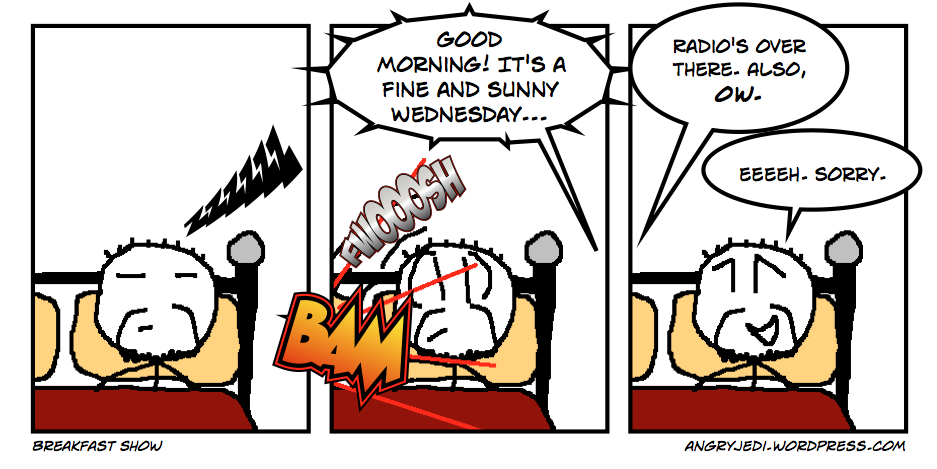
It was announced today that self-professed "saviour of Radio 1" Chris Moyles is stepping down as the host of the station's Breakfast Show, a post he has held since January of 2004. Moyles' early-morning show is the longest-running show in Radio 1's history, but it is sadly coming to an end in September of this year.
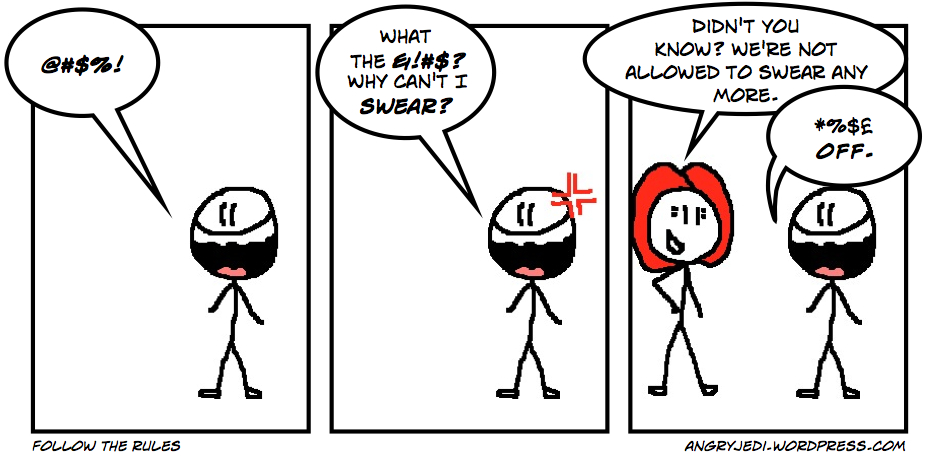
I like Chris Moyles. I have done ever since I first inadvertently discovered him by tuning in my radio to our local station at 10pm one night when I was a teenager. I was enraptured by his irreverent humour and continued listening long into the night. I was accustomed to DJs on said local station being characterless, personality-devoid track title  reading machines, so to hear someone actually acting like a human being — taking the piss out of the music he was playing, having light-hearted jabs at callers and taking an irreverent (though never offensive) approach to reviewing the day's happenings — was something of a revelation.

I was delighted when, a number of years later, I rediscovered Moyles on Radio 1. I hadn't followed his career after I stopped listening to the radio regularly, so I had no idea what he had been up to in the interim. But having him back on my stereo entertaining me in the mornings as I endured a lengthy commute to a job I hated was a bright spot in an otherwise fairly dark part of my life. The chemistry he had with his team was excellent, and the fast pace of the show was just the thing I needed to wake me up in the morning. Some criticised him for "talking too much" but I actually preferred listening to the team's light-hearted banter to the musical monstrosities that make up the majority of Radio 1's playlists.

At some point, it became fashionable to hate on Moyles. This happens with certain comedians, usually once they have reached a certain level of fame and ubiquity. Recently, it's happened with Peter Kay (everyone loved him for a while, around the time of Phoenix Nights, then suddenly everyone hated him), Michael McIntyre (who appeared semi-regularly on shows such as Mock the Week for a while before everyone arbitrarily decided that he was no longer Flavour of the Month) and, as I say, Moyles, who is most frequently criticised for being egotistical and arrogant.

Moyles' "persona" certainly has a large ego and a degree of arrogance, but it's important to note that it is a persona — it's a character he plays, a mask he puts up to the public. It's the act he's always done, ever since I first heard him on that late night local radio show, and I've always found it entertaining, because it's abundantly clear to anyone who listens that all the self-aggrandisement is done with a knowing wink to the listener. Moyles was well aware that his ego and arrogance seemed ill-placed — he knew he wasn't the most attractive guy in the world, that his occasional beard made him looked like a tramp and that he was overweight — so he played it up deliberately to an absurd degree. Some people took that literally, however. Understandable, but inaccurate. When he needed to be, Moyles could be genuine and heartfelt, and some of his most memorable moments on radio came when he was at his most earnest and honest.

It's for these reasons that I'll miss listening to Chris Moyles on the radio. Granted, I haven't had the Breakfast Show on for a while now — I tend to get up a bit late for it these days, and I don't have a clock radio by my bed any more — but Moyles and the team were very much a fixture in my life for a considerable amount of time, and I'll be sorry to see them go. I hope they find a new home somewhere else — Moyles is certainly well over the unofficial "age limit" to become a Radio 2 presenter!

#oneaday Day 904: Furry

We've had our pet rats for a little while now and they're both starting to get a bit more confident. Willow, the shy one, has grown significantly more than her sister Lara, making it quite an amusing sight when they play-fight in the evenings.

One thing I find with all animals is that I can't help but anthropomorphise them. They are little people to me, even though I know they can't understand the things I'm saying and that the cute little nibbling thing they do on your finger isn't necessarily a sign of affection — it's more likely them determining whether or not I'm something they can eat.

This means I do silly things like talk to animals. I talk to cats. I talk to dogs. And I talk to our rats, even though they probably find those freakishly huge giants who keep dropping treats into their home utterly terrifying.

I can't help it. I don't know why I talk to them when I know they can't understand me. But I do. I say their names, hoping that they'll learn them. I hope that they'll come when I call them. When they do do something, it's easy to assume that it's because I did something to encourage them. If I say their name and they jump on the side of the cage to climb up and see me, it feels like "I did that" even though it's probably just coincidence. (I know that you can train a lot of animals to respond to their names and to come when you call them, and that rats are surprisingly intelligent little furballs, so it's not beyond the realm of possibility that they are responding to me and coming to see what I'm doing.)

I guess this sense of attachment I feel to pets, and the assumption that they are somehow "little people" rather than "not particularly intelligent bundles of fluff", is what makes them good companions and nice things to have around. And animals certainly do have their own personalities — our two rats have clearly defined character traits, and the two cats who have been a part of my family in the past both also acted in their own unique ways. The two cats who live next door to Andie and I now, too, are both their own "people", though they are both united in their desire to get into our house as often as possible. (They haven't succeeded since we got our new sofa, and are being kept well away now we have the rats, too!)

The downside of seeing pets as "little people", of course — and I apologise for getting maudlin here — is that it makes it hard to deal with when they pass on. I recall feeling genuine grief — like, the sort of grief you feel when an actual person dies — when both our family cats died. One such outpouring of said grief can be found here, from the early days of this blog.

But let's not focus on sad things. We have pets now, and they are great. They are becoming much more confident, too, so soon we might even be able to actually take them out of the cage, pet them and play with them. They're still a bit too jumpy for that just yet — Andie's had a couple of bites just from trying to pick them up — but they seem to be learning that the Big Scary Things who keep opening their cage are actually sources of Treats rather than things to be feared.

We have thus far resisted the urge to fill Facebook with rat pictures in the same way people with new babies incessantly fill Facebook with baby pictures (please don't change your profile pic to your baby, it's creepy) but I'm sure that will change as they get happier and more at ease with us. So you can look forward to that.

#oneaday Day 903: Running Review

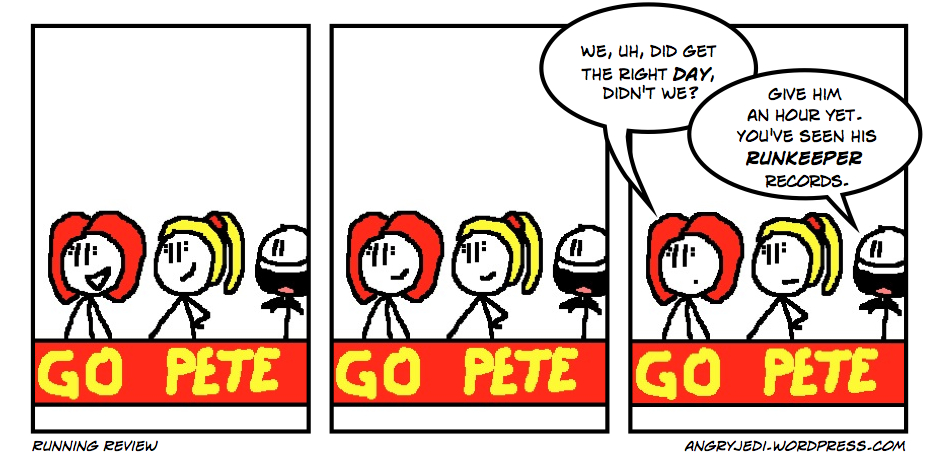
I've been running through the Couch to 5K programme again, no pun intended. If you're unfamiliar with this well-paced running programme, check out the image at the end of this post for more information. Also, play through Emi's path on Katawa Shoujo and you'll really want to do it.

Ahem. Anyway. Tonight was the first day of my fourth week on the programme. I've done it through to completion once previously, but that was quite a while ago now and my fitness has lapsed somewhat, so I decided to start again. Week 4 is where the pace starts to step up a bit and the jumps in difficulty begin to become more noticeable. For example, tonight I did two three-minute runs and two five-minute runs; on the previous trip out, I did two minute-and-a-half runs and two three-minute runs.

I got on pretty well. I didn't have to stop at all, and I paced myself well. Said pace is still fairly glacial compared to people who aren't carrying around as much weight as I am, but I'm satisfied so far.

One thing I remember noticing last time I did all this and am noticing again now is the fact that running is good stress relief. It's actually probably exercise in general, but I'm finding it particularly apparent while running.

When I say "stress relief" I don't necessarily mean "making the stress go away". If it was possible to just make stress dissipate… well, then the world would be a much nicer place. (I also don't mean "stress relief" in the same way that J-List refers to "stress relief toys". If you don't know what I'm talking about, don't worry.)

No, what I mean, in fact, is that running seems to "shake things loose" in my head. Stressful thoughts which have been clogging up my head all day come to the fore, particularly when reaching the end of a session. This isn't always a massively pleasant experience, but it can be helpful and cathartic in the long run. It's easy for stressful thoughts to get "backed up" and simply cause you to "feel stressed" all day for no specific reason — releasing these thoughts helps dissipate that vague "meh" feeling, though naturally you still have the specific thoughts themselves to deal with.

The human brain is weird.

Anyway, I'm happy with my progress on Couch to 5K so far. I remember being impressed with myself when I made it through the last time I did so, and being even more impressed when I successfully made it through an entire 10K race in London. (Okay, again I wasn't especially quick, but at least I didn't come in last place!) I'm contemplating setting myself some sort of target such as another race somewhere so I have something to aim for — the end of the programme is all very well and good, but where do you go from there?

Well, I'll cross that bridge when I come to it. For now I shall enjoy the small victory of successfully running for 3 minutes, 5 minutes, 3 minutes and 5 minutes without stopping.

#oneaday Day 902: Follow the Rules (That Haven't Been Written Yet)

I've been playing a bunch more of The Secret World today and I stand by my initial impressions that it's a significant step, nay, leap forward for the MMORPG genre. My only slight criticism would be that so far I've had very little incentive to actually play alongside other people, but 1) this is nothing unusual for modern MMOs and 2) I haven't tried any "dungeon" missions yet.

It's in the Investigation missions that I mentioned yesterday where the game truly distinguishes itself. I shall try and resist spoiling specifics at this point, but completing one today involved searching for something in the game world, finding a laptop (password-protected, natch) and then having to break into it. The clue on the computer was vague at best, and there was nothing in the immediate vicinity to help. A little exploration was required, and then some actual honest-to-goodness deduction and lateral thinking on the part of the player. It was a true case of "I wonder if this works… holy crap, it does." As I say, spoiler-free, but it involved the sort of shenanigans normally reserved for "alternate reality games". Which is impressive stuff.

What all this clever puzzle-solving leads to, though, is something of a dilemma for the community. In other MMOs, the General chat channel is the home for people asking how to do things — when it's not the home of teenage boys soliciting sex from hot female Night Elf avatars, of course. It's sort of expected that if you ask a question such as "where is quest objective x?" that you'll get a straight answer. And that's fine — a lot of MMOs are still a bit clunky on the whole "user-friendliness" part and thus often forget to point the player in the right direction, necessitating either a lot of tedious searching the game world or simply asking other players.

In The Secret World, however, the confusion inherent in these Investigation missions is part of the appeal. The sense of satisfaction when you unravel one of the game's cryptic clues is unprecedented in the usually rather predictable MMO genre. Assuming you worked it out yourself, of course — and herein lies the problem.

Players coming to The Secret World straight from titles like World of Warcraft and Star Wars: The Old Republic will come to General chat or the dedicated Help channel and pose the usual sorts of questions. One of two things then almost inevitably happens — 1) someone posts the answer and everyone then yells at them for spoilers. 2) someone posts a vague clue and the new player then gets annoyed at not being able to get a straight answer.

Actually, this is an exaggeration — so far, from what I've seen, the vast majority of the community is on the side of "give hints, not answers" and only a few people ruin that. The trouble is, if you happen to glance at General chat when one of these people is spoiling a quest solution — perhaps unintentionally — then you can't unsee it. You'll know forever that Dr Bannerman's computer password is — wait, hang on, you won't get it out of me that easily!

Funcom's GMs are apparently being pretty strict about those they catch posting spoilers in the chat channels, so hopefully the community will be "trained" out of that particular practice sooner rather than later. The trouble is, tempers often run unchecked online, meaning that some people will fly off the handle to a disproportionate degree at these spoiling types — who, in many cases, simply hadn't yet got a handle on the game etiquette. Sure, it's common sense that in a game with a heavy puzzle-solving component that people might not want to just hear the answers blurted out, but it's entirely possible for the reasons I mentioned above that people may not have considered this. Getting yelled at and verbally abused by people isn't going to help them change their behaviour — it's simply going to make them defensive and often lash out back at their "aggressors", thereby perpetuating a cycle of people bitching and complaining at each other unnecessarily.

In many ways, it's the same as in teaching. In the classroom, if you spot someone misbehaving — or if another child comes up and "tells on" the miscreant, the worst possible thing you can do is yell, shout, scream and otherwise draw attention to their inappropriate behaviour. In many cases, the child was simply seeking attention, so to succeed so completely — even if it's with negative attention — will not train them to behave more appropriately in the future. Instead, a more assertive approach is the way to play it — take the child aside and discuss quietly and discreetly with them why what they did was wrong rather than encouraging them to get upset and strike back.

Now, obviously most of the players of The Secret World are a little older than primary school children (hopefully), but this approach is still a sound one. If someone behaves inappropriately — such as by posting spoilers — it may be easy to simply publicly shame them in General chat with an "FFS" and a few choice expletives, but all that will do is make them call you a "moron" (or worse) and ensure that you both end up on each other's Ignore lists. Instead, a simple, polite private message explaining why what they did was inappropriate or unacceptable is the way forward. No malice, a simple — but assertive — desire to help them out and make the experience more pleasant for everyone involved. Easy, right? Well, it should be. In practice it doesn't always work that way, but people will settle down over time as the "norms" of the game community are established.

The way online communities interact with one another is something that's always been fascinating to me, and the fact that The Secret World is even running into this issue at all shows what a big shift away from conventional, predictable MMO thinking it really is. The community is going to have tom come up with established conventions and ground rules — perhaps policed by GMs in the early stages — and those used to a different set of norms will have to adjust and adapt appropriately.

Anyhow. That's that. If you haven't figured it out already, The Secret World is most definitely worth your time and money, particularly if you have the slightest interest in Lovecraftian horror, or if you enjoyed Funcom's adventure titles The Longest Journey and Dreamfall. While it has its flaws and its bugs, it's certainly a far more interesting experience than the vast majority of other online titles out there, and I recommend you give it a shot — even if you're not normally into MMOs.

#oneaday Day 901: Lost in The Secret World

Well, I've spent a great deal of today playing Funcom's new MMO The Secret World and… and…

Well. Wow.

You remember how everyone hailed The Old Republic as a massive step forward for MMORPGs — before everyone realised it was actually just World of Warcraft in space, that is? Yeah. The Secret World actually is a significant step forward for MMORPGs.

Why, you ask?

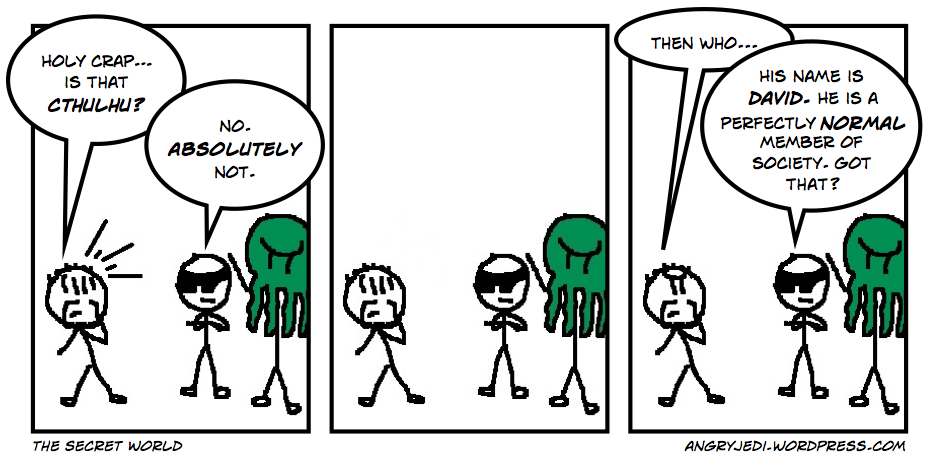
Well, let's consider its thematic content for starters. The Secret World is a lush, rich combination of all manner of influences, including, among other things, Illuminati/Templar/some Asian dudes conspiracy theories, The X-Files and the work of H.P. Lovecraft. The early stages of the game feel very much like what a hypothetical Arkham Horror Online would play like — you're an "investigator" for one of the three factions in a town called Kingsmouth (which, in the "creepy American small town" stakes is in the unenviable position of being somewhere between Lovecraft's Innsmouth and Silent Hill's, uh, Silent Hill), you wander around trying to get to the bottom of what has caused a zombie apocalypse (I KNOW, ZOMBIES, but bear with me) and the mysterious fog that has come in from the sea. Also, big slobbering tentacle monsters. And people going "a bit mental." Apparently Cthulhu is involved at some point, but I haven't got that far as yet.

So The Secret World eschews the usual fantasy or sci-fi tropes of the MMORPG genre in favour of a modern-day setting dripping with Lovecraftian atmosphere — at least in its initial stages, anyway. And it actually bothers to tell a fully-realised story (with full speech and cutscenes) rather than a limp, loosely-connected set of questlines. But it's not just the theme and the strong narrative that distinguishes The Secret World from its numerous competitors. The game systems are also an impressive breath of fresh air.

Let's start with the quests. While some quests do include objectives such as "kill [x] [y]s", these are usually part of a longer chain of events. Where things get interesting are when you break away from what the game refers to as "action" missions and you get to take on "sabotage" and "investigation" quests. While "action" missions, as you might expect, involve killing things, "sabotage" and "investigation" challenges are a little different.

In a sabotage mission, stealth and environmental puzzle solving is emphasised. In an early example, you have to retrieve a number of security cameras from abandoned businesses around the town and set them up in strategically advantageous places for both the police and your faction. Many of the cameras are out of reach from ground level, necessitating a bit of exploration as you figure out how you can actually reach them. As the mission progresses, you eventually find yourself exploring an instanced "mini dungeon" in which you have to avoid security cameras and laser tripwires while working out a route to disable various control panels without being spotted.

Investigation missions, meanwhile, are a lot more elaborate. The current one I'm working on has 18 steps in it. If you consider that your average MMO quest has 3 steps at most (get quest, kill/collect shit, return to questgiver), this is pretty impressive. When you look at what some of these steps involve, it's even more impressive.

In investigation missions, the fourth wall is broken slightly as the player has to put their own intelligence to the test. Clues are given for various challenges, and it's up to the player to figure out how to solve them. An early, simple example involves working out the password for someone's computer using a couple of hints they've left around the place, but later ones see you doing everything from deciphering morse code messages to making use of the in-game web browser to research real-world things. (Of course, you could just cheat using said web browser, but the community is already rather sensitive about spoilers, so you'll be surprised at how few "answers" are out there already.)

This brilliantly diverse questing system is coupled with an excellent levelling mechanic. Players level up at a consistent rate throughout the game and can eventually unlock all the skills from all the disciplines — but it's only possible to equip seven active and seven passive skills at once, much like how Guild Wars does things. It's possible to save these "decks" of skills, however, allowing you to easily switch your character build on the fly according to the situation you're in or what the group you're with needs you to do.

Combat, too, is quite interesting. While it's the usual "hotbar and cooldown" approach, there's a much more "action game" feel to it here, thanks in part to the fact that positioning is important — particularly when baddies start doing area-of-effect attacks. You can take on a lot more enemies at once than in many other MMOs, giving the game a much more exciting, dynamic feeling rather than simply getting into the rhythm of pressing the number keys that titles like World of Warcraft offer.

In short, The Secret World is evidence that there is still some creativity among those who make MMOs. Not everyone wants to make a World of Warcraft clone, and Funcom have succeeded in creating an experience that is very much its own thing — and very much worth your time and money. C'mon. You can't say the prospect of doing a raid on Cthulhu doesn't appeal just a little bit.

#oneaday Day 900: Gravity Rush Wrap-Up

I finished Gravity Rush on Vita tonight. I was rather disappointed to note it's a game that gets significantly worse the further you go rather than better. That's not to say it's not worth playing, however — more that it's clear roughly 75% of the way through that the team simply ran out of ideas.

Gravity Rush is a joy to play initially. Once you get your head around the strange gravity-flipping mechanic and realise it's different from a conventional "flight" system (you can't really steer while "falling", for example — you have to stop and then start "falling" in a different direction) it's a lot of fun to swoop around, run up walls and leap down onto things.

The thing is, the whole gravity-shifting thing seems somewhat underused. There aren't any particularly clever puzzles through the game that require you to run up walls or on the ceiling or anything, so after some time you begin wishing that protagonist Kat could just fly like a proper superhero.

This problem is compounded when we get to the dreadful aerial combat, which coincidentally is the reason the game's "fun factor" takes a significant nosedive when on the home straight. I mentioned this a few days ago, but it became the cause of significant teeth-gnashing frustration as the game progressed. Allow me to explain.

When floating in the air, Kat is able to launch a "gravity kick" move by aiming the on-screen reticle at something and then holding the Square button. She then swoops towards the thing you pointed at, hopefully causing damage. Fair enough.

The trouble with this is that a lot of enemies, particularly later in the game, are only vulnerable in specific weak points. If said weak point is on the far side of an enemy, Kat will simply plough into said enemy and do no damage whatsoever, usually putting herself in harm's way. (This isn't helped by the fact that a lot of late-game enemies also have the ability to fire bullets at Kat, which the player has to dodge by swiping on the touchscreen.) A lot of late-game combat simply becomes a case of launching Kat at enemies from a distance and hoping she hits them — because more often than not, they'll simply dodge out of the way before impact, and it's honestly difficult to tell whether or not the game actually "locks on" to these enemies or not. (I believe it is supposed to, though you could have fooled me.)

By far the worst thing, though, was the "Special Forces" DLC that came free with the "special edition" of the game I got — it was the same price as the normal game for a limited period, so I figured there'd be no loss in getting it.

Oh man. If ever there was an argument for DLC being tacked on, pointless, moneygrabbing shite, this is it.

It contains just two missions, both of which are immensely tedious "fetch and kill" quests, and the latter of which incorporates a totally unreasonable time limit in which to accomplish your objectives — which, by the way, aren't marked with navigation pointers unlike in the rest of the whole game. The latter mission also makes heavy use of the game's idiosyncratic "throwing" system, whereby Kat can pick up objects in her gravity field and then fling them at things. The trouble is, this mission requires Kat to fling things precisely, but the game regularly decides that you actually wanted to aim at that enemy a little to the left of where you were actually pointing when you pressed the "throw" button. In a non-time sensitive situation, it would have been helpful to have this quasi-"lock on" facility when throwing things; when attempting to fling water towers at fires, however, it's a pain in the arse.

I'll be honest, I didn't finish the DLC because it irritated me so much — thankfully, it's possible to cancel out of the missions once they've started and simply proceed back on with the main story. As a matter of fact, the second mission in the pack soured me so much on the game by making its flaws so abundantly apparent that it significantly impacted my enjoyment of the finale which, on reflection, wasn't terrible.

Gravity Rush isn't a bad game. In fact, it's a very good game, and a fine showcase of the Vita's capabilities and unique features. But with a bit of work it could have been an amazing game. It looks fantastic, it has an endearing main character and a wonderfully entertaining core game mechanic, but it simply falls to pieces at the end with a string of unimaginative fetch and kill quests. These just make you want to get to the end so you don't have to play any more, not because you want to see the end of the story (which, incidentally, leaves a whole lot of frustratingly unanswered questions).

It may sound like I'm being unduly harsh on this game and perhaps I am. I did like it overall, and I'm glad I played it. If you own a Vita, you should play it too.

It's not perfect. It has potential, though, and that's quite exciting. The possibilities that a Gravity Rush sequel might offer are very intriguing indeed. For my money, I'd like to see more creative use of the gravity mechanic for puzzle-solving, less aimless open world flying around, less combat (or at least combat that isn't so incredibly irritating) and a story that wraps up properly.

That's that for now, though. Next up is Persona 2.

#oneaday Day 899: I'll Be There For You

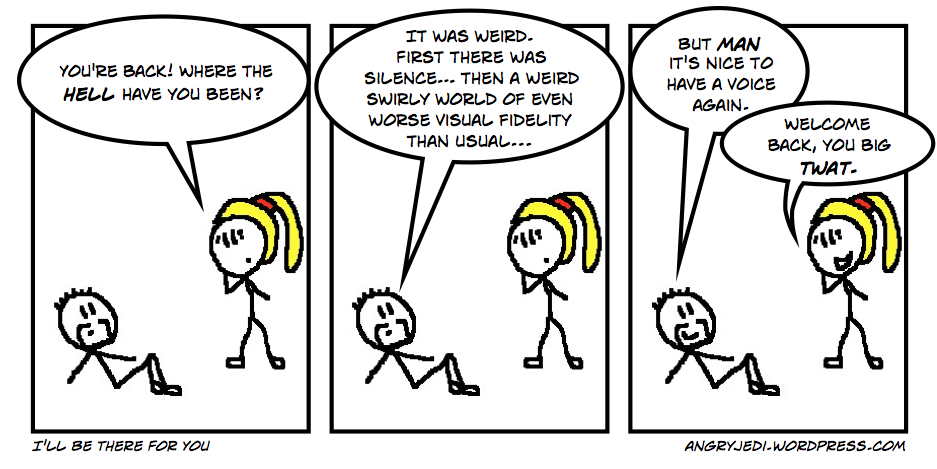
I have social anxiety. I may have mentioned this before once or twice.

What that means is that sometimes I get tongue-tied and don't know what to say. Sometimes I let conversations run inside my head but worry about what the possible outcome of them will be, and end up saying nothing. Sometimes I quite literally have nothing to say whatsoever. And sometimes I do say something and don't get the reaction I expected and consequently feel weird.

As you might expect, this makes the prospect of "making friends" a fairly terrifying one. Obviously I have made friends over the years, otherwise I wouldn't have any right now, but I can never quite remember how it happened. In some cases, it was a simple matter of being thrown together in some context — living together, studying together, working together — but in others, it's not quite so clear.

While I am more than happy with the friends I do have, I do sometimes wish I could have more. That may sound greedy, but the fact is that I don't get to actually see the friends I have all that often. The vast majority of them live in the States (thank you, Internet) and the others live just far enough away for it to be A Big Effort to go and see them. And, you know, sometimes I just want people to play board games with. I bought a copy of Legend of Drizzt, one of the cooperative Dungeons & Dragons adventure games, this week and I'm hoping I get the chance to play it more than once or twice. If I had more friends (who liked board gaming) then I'd be able to play it more often — at the moment, however, it's determined largely by mutual availability and whether at least one of us can be bothered to drive about 50 miles. I'm more than happy to for the prospect of board game fun, but it's the former bit that can be tricky sometimes. Hopefully if and when Andie and I manage to move a bit closer to Southampton it'll be a bit easier to be more spontaneous — as it stands, however, it's a relatively rare treat to see people.

This is all rather self-pitying I know, but I direct you back to the first line of this post. Social anxiety makes the act of making new friends — even the prospect of just talking to strangers — a terrifying and difficult prospect. Even in an environment that should be "friendly" — I know there's a local board game shop in Bristol that does games evenings, for example, but I don't even feel especially confident about that. My mind gets caught in a cycle of "what ifs" and I just end up deciding not to go.

Perhaps one day I'll get over this social anxiety and be more confident about making new friends and considering that people might actually want to spend time with me if they don't have to. That day is not today, however, which means that I'm all the more grateful for the friends I do have and the time I do get to spend with them.

Anyone fancy a game of Legend of Drizzt?

#oneaday Day 898: Contemplating the Darkness

I'd like to share a couple of posts with you. First of all, this piece by Jeff Green, published today. (If you don't know who Jeff Green is, he's currently PopCap's director of editorial and social media and used to work on U.S. games magazine Computer Gaming World, later Games for Windows Magazine.) Many people expressed surprise at Jeff posting this, because, to quote several commenters, "you wouldn't know he had depression." I've only met Jeff maybe once or twice, but it's true; he "hides it well," as it were. That doesn't diminish his suffering in any way, of course — it simply means that he's found ways (and help) to deal with it in a way that doesn't affect his public persona.

Second of all, and related, this post from January of last year by me. I shan't talk about that post too specifically right now since you can just go and read it, but I did want to contemplate the subject a little further today, as reading Jeff's post shortly after he published it (and undoubtedly went back and forth on whether or not he should share it with the world) got me thinking.

I am a lot better than I was. I hit my lowest ebb just over two years ago when my wife and I decided to split. I won't go into the specific details of that right now, but suffice to say that it was a mutual decision by the pair of us that was partly a consequence of, ironically, my own depression. I had left a job I hated, gone to PAX East for the first time (and had an amazing time) and then came back home to no job, no prospects and a thoroughly bleak outlook for the future. Depression at my situation (which was at least partially self-inflicted, I will freely admit — I could have stuck at the job I left, but it probably wouldn't have been good for me at all) sapped my motivation and just made me want to curl up into my own private little world and not talk to anyone. It wasn't the first time it had happened to me. It was a recurring pattern. And, realistically, there are times when it will likely happen again in the future.

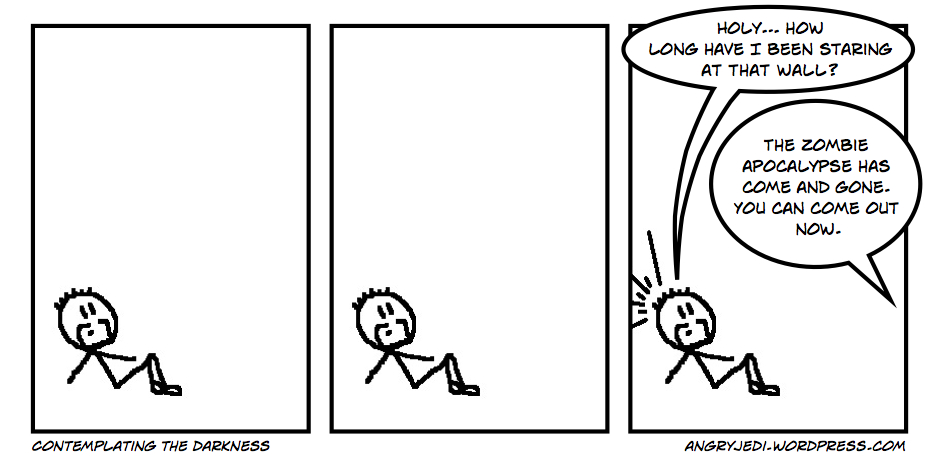
The one thing that people don't seem to mention about depression is that it can be addictive. Sometimes, when given the choice between 1) getting up to do something positive that you know will make yourself feel better and 2) slumping on the sofa staring at an interesting spot on the wall for several hours, all your brain wants to do is 2). It gets into the habit of doing 2) and it becomes a natural, conditioned response to anything that upsets you or frustrates you. Over time, it gets harder and harder to not do 2) even though there's usually at least a small rational part of your brain saying "STOP IT! STOP IT! STOP IT!" That rational part gets drowned out by the bit going "staring at the wall is comforting, safe, and you won't have to talk to any people."

Getting over that stage is the difficult part. Fighting against the desire to do nothing and wallow in your own self-pity is one of the hardest things anyone suffering from depression has to do. Only then can you figure out exactly what to do when you pull yourself up off the floor/bed/sofa and make a conscious decision to do… something. Whether that's simply trying to "get on with your life" or actively seeking help to if not "cure" your condition then at least improve it.

Sometimes even the most straightforward tasks can be made to feel like insurmountable obstacles to those suffering a depressive episode. That in itself can cause people to feel ashamed of their condition and not want to talk about it. Thankfully, I've seen a heartening trend recently: people overcoming the stigma attached to talking about mental health issues and publicly baring their souls about these important topics. Jeff Green's post is just the latest example of people with higher profiles than me publicly "coming out", as it were, and talking about this aspect of themselves that, however unpleasant it may be, helps define the person that they are.

Feeling able to write about it publicly and talk about it face-to-face are two very different things, however. I know that personally speaking, I still find it difficult to talk about depression with anyone except my very closest friends, but I'll happily (perhaps the wrong word, there) post things like this to an (admittedly small) audience the world over.

The important thing to remember if you have ever suffered from depression, though, is that you most certainly are not alone and that there is nothing to be ashamed of. You may hate the condition and what it does to you, but that doesn't mean you should hate yourself or feel you should lock yourself away in isolation. On the contrary, you should seek out people you feel able to talk about it with and then get some things off your chest. And you should seek help if you need it.

#oneaday Day 897: Dungeon Crawling

20120704-013250.jpg

I'm a big fan of board games, as regular readers will know. And I have fairly diverse tastes, too — I like everything from Eurogames such as Catan to theme-heavy Ameritrash like Last Night on Earth. Exactly what I want to play at any given moment is largely determined by my mood at the time, but I can pretty much always muster up enthusiasm to play a dungeon-crawling game.

I own several dungeon crawlers, but I'm planning on picking up the very interesting-looking Descent: Journeys in the Dark Second Edition when it releases, as it sounds like just the sort of game I want to play. It also sounds like it's been improved significantly over the original edition, which could take up to 4 or 5 hours to complete a single quest. The new version reportedly keeps play sessions down to much more manageable lengths while incorporating a solid "campaign" system for character advancement and a branching narrative. I'm looking forward to it a lot.

As for the ones I already own, each of them have their pros and cons, and I like them all.

Starting at one end of the spectrum we have Games Workshop's Dungeonquest, which saw a rerelease by Fantasy Flight Games recently. Dungeonquest is gloriously random and is best left on the shelf if you like to plan out what you're doing well in advance, because progression is determined largely by the luck of the draw. Consequently, it is a very difficult game to "succeed" in — even the instruction manual helpfully informs you that players have approximately a 34% chance of survival in any given playthrough.

In Dungeonquest, players take it in turns to draw dungeon tiles from a pool in order to build the dungeon as they go. If it's a corridor, they get to move again. If it's a room, things happen, determined largely by drawing cards and making skill checks. If it's a special room, super-special things (usually bad for the player) happen. Many of these things end in instant death for the player, meaning games can be over relatively quickly if you're unlucky.

The aim of Dungeonquest is to make it to the middle of the board to raid the slumbering dragon's massive treasure pile, then make it out again before the sun rises — the time limit in question being represented by an ever-advancing "track" at the side of the board. If players don't get out before sunrise, they die. If they run out of health, they die. If the fall down a bottomless pit, they die. Hilarity (and, usually, frustration) ensues. It's not a great game, but it is an entertaining one.

Moving up somewhat is MB and Games Workshop's Hero Quest. This was my introduction to fantasy role-playing when I was a kid, and it still holds a very fond place in my heart to date. It's an adversarial game where a team of up to four "hero" characters of varying classes take on the forces of darkness, controlled by a single "evil wizard" player. The evil wizard has a book of preset quests with which to challenge the heroes, and following these through in sequence provides a rather loose narrative. The game was later expanded with a number of additional packs that broadened the scope somewhat with new monsters, traps and additional rules to make things more interesting.

Hero Quest is good because it bridges the gap between traditional "family-friendly" board game conventions and the more abstract, strategic nature of role-playing games. It's accessible enough for pretty much anyone to understand, has high-quality components and a wide variety of things to do — plus is very expandable and customizable.

Advanced Heroquest not only changed the "correct" way to punctuate the phrase "Hero Quest"/"Heroquest" but also revamped the game completely to be significantly closer to a Dungeons & Dragons-style role-playing game. It also incorporated rules for limitless replayability including random dungeon generation, character advancement and a heavy emphasis on customization. While the original Hero Quest released an expansion allowing players to create their own adventures, Advanced Heroquest practically demanded that the Games Master (or "GM" — effectively the "evil wizard" player by another name) come up with some of their own creative, fresh ideas. And it was up to the GM in question how far they wanted to take it — Advanced Heroquest's rules catered for simple story-free "hack and slash" dungeons as much as elaborate, story-driven scenarios featuring light role-playing. The game even came with full rules for solo play, which was a godsend for me when I was a kid, as short on nearby friends as I was.

Then came Warhammer Quest. This is pretty hard to find now, which explains why I paid nearly £100 for a copy on eBay. Warhammer Quest takes the formula of Advanced Heroquest and shoots off in a different direction rather than necessarily making it more complex. Warhammer Quest has a lot more in the way of random elements, but also features a lot more rules to prevent the game from running away from the players. Where Advanced Heroquest often had dungeons that spiralled off into myriad dead ends, Warhammer Quest's dungeon generation rules ensure that players move quickly from encounter to encounter on a much more linear path, giving the game a much faster pace. That's not to say that either approach is "better" as such — Advanced Heroquest had the thrill of exploring the unknown, while Warhammer Quest always had something interesting through the next door — but it marked a significant difference between the two.

Warhammer Quest contains a fairly heavy degree of luck. If you were playing a campaign, after completing a dungeon you then had to roll repeatedly on a table to determine the events that happened during the journey back to town. These frequently got rather ridiculous, as demonstrated abundantly through the adventures of Kurt von Hellstrom and his friends.

Warhammer Quest has one cool thing over its two predecessors, however — it can be played without a GM/evil wizard. The base rules for the game include an artificial intelligence system for the monsters that determine how they move and attack, allowing all the players at the game table to cooperate and take on the dungeons together rather than one being forced to constantly be "the bad guy." Rules were there to allow the game to be played with a GM, too, but for those craving a purely cooperative experience, Warhammer Quest was a great one.

I don't get to play these games nearly as often as I'd like to. I'm hoping that I'll be able to get Descent out regularly once I get my hands on a copy — and I'm also pretty curious about the Dungeons & Dragons boardgames, too. Full reports on each and any of those I get the chance to play will, naturally, follow.

#oneaday Day 896: Gravity Rush

20120703-010706.jpg

I've been playing a fair ol' bit of Gravity Rush on the Vita recently. My feelings about it are somewhat mixed, but on the whole it's a very good game, and certainly one of the most impressive handheld games I've ever played.

Of all things, my least favourite thing about it is the name. "Gravity Rush" is not the name of an epic, sprawling, visually sumptuous adventure. "Gravity Rush" is, to me, the name of an iPhone game — perhaps an Angry Birds Space ripoff — or an obscure downloadable console title at best, perhaps. (Or perhaps I'm just associating it too much with Gravity Crash on PSN, which is nothing to do with Gravity Rush.)

That aside, though, there's a lot to like.

For the uninitiated, Gravity Rush is ostensibly an open world… platform game, I guess you'd call it if you had to pin it down to an established genre, but to pigeonhole it thus is to do it a gross disservice. It's a platform game. A racing game. A mindbending puzzle game. An air combat game. And plenty of other things besides. It actually has a surprising amount in common with underrated open-world gem Crackdown, of all things. Oh, and it was designed by Keiichiro Toyama, who true game geeks will know is the creator of the Silent Hill series. According to Wikipedia, Gravity Rush was the first game he ever wanted to create, but was only able to bring his vision to fruition recently.

In Gravity Rush, you play Kat, a young amnesiac girl with red eyes, blonde hair and surprisingly dark skin for an anime-style character. Kat is also clad in an outfit best described as "bizarre", and is accompanied by a black cat. Oh, and she can shift gravity at will with the assistance of said black cat, allowing her to "fall" in any direction she pleases, stick to walls, skid along the ground and do gravity-defying flying kicks.

Kat is far and away the highlight of the game. Despite her hackneyed amnesiac introduction, she quickly proves herself to be a fun character to play with. She's a bit dizzy, she's confused, she's obsessed with her own appearance and appeal to the opposite sex, and she's easily distracted. But despite these flaws, she has a noble streak — she wants to do the right thing and use her powers to help people, despite not really understanding where they came from or what they're for. As the game progresses, the residents of the city where the majority of the game is set go from fearing her strange powers to respecting and appreciating her talents.

Gameplay in Gravity Rush is mission-based, but it's up to the player when they want to trigger each subsequent mission. Between missions, it's possible to tool around any of the unlocked city areas collecting gems (which can be used to level up Kat's abilities), talking to residents to gain a greater understanding of the strange world the game is set in and taking part in "challenge missions." The latter are very difficult timed tasks of various kinds — some might see Kat having to defeat as many enemies as possible in a time limit, others see her racing through a series of checkpoints, perhaps with some limitations on her abilities in place. Each challenge has three tiers of rewards, with increasing numbers of gems available for completing these tricky tasks by more impressive margins.

This may all sound relatively unremarkable so far, but it's the excellent way that Gravity Rush makes use of the Vita's distinctive capabilities that make it interesting. The "gravity shifting" mechanic is a prime example. By tapping the R button, Kat floats up into the air; tapping it again causes her to "fall" forwards according to where the screen is pointing, regardless of which way is "up". The specific direction she falls can be controlled using the Vita's right analogue stick, but a surprising degree of precision can be attained by combining the stick controls with the tilt sensors in the Vita. If you're feeling completely un-self conscious, you can completely control the direction of the camera in these floaty bits by tilting and rotating the Vita, but that would be both impractical and undesirable for most people, so the combination of stick and tilt works very well.

Similarly, when Kat uses her "slide" move (accomplished by pressing and holding on the bottom two corners of the touchscreen), it's possible to steer her by tilting the Vita side to side and jump by "flicking" the device. You can also "drift" in a Wipeout style by releasing one corner of the touchscreen as Kat goes around a corner.

A more subtle use of the Vita's capabilities comes in the comic-style cutscenes that punctuate each mission. Tilting the device causes the perspective on the comic panels to shift slightly — unnecessary, but cool — while swiping with a finger advances to the next panel, just like in an iOS/Android comic reader app. These little touches arguably don't add much to the experience, but they certainly don't hurt it, either.

The game is a joy to navigate — gravity shifting and "falling" through the skies towards your destination is thrilling every time, and the world is an interesting, beautifully-designed environment to explore — but things do fall apart a little when it comes to combat. On the ground, Kat is limited to a not-particularly-effective kick attack as well as a useful "dodge" move achieved by swiping on the touchscreen. In the air, Kat can do a "gravity kick" manoeuvre where she "locks on" to an enemy then flies through the sky with high heel outstretched, with more damage being done if she "falls" on the enemy from a greater distance.

This is all very well and good and would be absolutely fine were it not for the fact that every enemy is only vulnerable in specific weak spots. Crash into an enemy anywhere other than their obvious glowing weak spots and you'll do no damage. Early in the game this isn't an issue, because the weak spots are in easily-accessible locations, but later enemies have multiple weak points all over their body and often thrash about, making it difficult to hit them. One boss in particular will have you flinging your Vita in frustration as it seemingly always dodges aside just as you get lined up perfectly. None of these challenges are insurmountable, but it does sometimes give the game some rather artificial-feeling difficulty spikes, which is a bit of a shame.

The game's considerable charms (mostly in the form of Kat and the interesting, mysterious story she becomes embroiled in) outshine its flaws, however — at least to me. I've been playing it quite a bit today and I've found it an engrossing, immersive experience. I think quite a bit of that is due to the fact it's a handheld game, which surprised me — traditionally, I've regarded handheld experiences to be less immersive, not more — but Gravity Rush draws you in like few other games I've played recently, and then doesn't let go.

If you have a Vita, be sure to grab a copy. If you don't have a Vita, it's certainly a great example of what the system can do. Is it a "killer app" for the system? Perhaps — it's certainly not perfect, but I can't imagine it working quite the same on, say, a console. The touch and tilt controls are excellently integrated into the more traditional button-based commands, and the whole thing feels like it was designed specifically for the Vita rather than envisaged as a console title with Vita features shoehorned in later. The gorgeous cel-shaded graphics, heavily influenced by a combination of French comics and anime, also make it one of the most distinctive-looking games I've seen for a long time.

If nothing else, it's a game I'd certainly like to see a sequel to in the future, so let's hope it enjoys some success.