#oneaday Day 70: Waste Not

[The comics for the next few days are a little disjointed as I'm going away for the weekend. Fans of Rogue, if there are any, will be pleased to see he has his own utterly pointless mini-series.]

I'm sitting in my "study" (for want of a better word—it's the room I have with my desk and computer in) and despite staring at the screen enjoying the wonders of the electronic, digital age (such as this delightful blog) I am literally surrounded by pieces of paper. I don't dare throw any of these pieces of paper away because one day, one of them might be important for something I can't possibly predict. I have discovered this to my cost a number of times in the past.

This is annoying, though. I have one of those expandy box file things that has burst its seams because of the amount of shitty useless paperwork crammed inside it. Some of this paperwork is from houses I haven't lived in for five years. Some is from, I don't know, last week? All of it is completely useless, until you really need it, when it becomes the most important thing in the world and consequently is nowhere to be found even though you know you put it in that section of the file and can remember looking at it and thinking "I know this will be important some day".

Conversely, I know that if I have all these shitty annoying stupid bits of paper everywhere and close to hand that I will never ever need them ever again. And then I will throw them out to tidy up. And then I'll suddenly need them again.

Why? Why do we surround ourselves with such crap? The world is full of so many wonders and yet it seems that in order to just survive and go about our daily business we have to sign this, keep this safe, keep this secret, remember this handy 300-digit number that also includes letters just to be awkward, keep every single piece of paper that includes numbers and currency symbols just in case you need to show people that you understand what money is or something, and read 15-page long letters that make no sense but basically amount to saying "if you break something or have it nicked, you can have some money but only if we feel like it and by GOD we will investigate thoroughly for the best part of fifteen years before we even think of paying out".

And relax.

I should probably add at this point that I've never had to claim through an insurance company so haven't encountered the above situation before, but I did do some temping for a firm of "loss adjusters"—a profession I didn't know existed before I did that job briefly—and was alarmed to discover some claims had indeed been going on for a healthy number of years. I was also shocked to see quite how many pointless companies exist in the world. In one instance, an insurance company contacted the loss adjusters who contacted some surveyors (odd, since the loss adjusters had their own in-house surveyors, but never mind) who contacted some builders who contacted some architects who contacted some draftsmen… and then they all contacted each other back in the other direction again. This isn't an exaggeration for comic effect, there legitimately were that many people involved. No wonder we're drowning in fucking paperwork.

Please consider the environment before you print this blog post. And please consider the environment before you post me a metric shit-ton of paper I will never read.

#oneaday Day 69: PAX Bostona

PAX East is happening tomorrow, and I'm not there. This makes me inordinately sad for a number of reasons. Firstly, PAX East last year was the last time I could legitimately say that I was 100% completely, totally and utterly happy. For those few days, I had left all my growing troubles behind in the UK and was able to immerse myself in the culture that I loved so much. I was able to be an unabashed nerd and surround myself with thousands of other people like myself.

Secondly, PAX East represented the last time I had the chance to see some of the people I consider to be my best friends in the world. It sounds sappy, I'm sure, but the relationships I've cultivated online over the last few years are some of the strongest friendships I've ever had—and in some cases, I've met these people once or twice… and in many cases, not at all.

Thirdly, PAX East last year pretty much marked the start of the career path that I'd very much like to follow full-time, given the opportunity: being part of the games press. At the time I was writing for Kombo.com and between meeting up with people and seeing cool panel discussions (some of which didn't feature my brother) I was hunting down interesting stories and reporting on them. I'd been writing the news for a little while by then, but attending an event and spotting the new hotness was a lot of fun, and something I want to do more of in the future.

The best thing about PAX East, though, I've already touched on, and I blogged about at length last year. It's a place to call home. A place where people who enjoy video games can come together and nerd out to their hearts' content without fear of judgement, without feeling like they have to "hide" their hobby or play it down. No, this is a place where girls could dress as Bayonetta without (much) shame, where people could experience new aspects to their hobby, where people could meet some of their idols and where people could get together and meet each other.

In short, it was awesome. And that's why right now I am very much wishing I was there in Boston, scoping out the nearest coffee shops and Dunkin' Donuts to the convention centre, arguing about which places to go for food and playing "spot the influential industry figure".

So to all of you over there in Boston right now, I hope you have the best time of your lives over the next few days. Because if you don't have the best time of your lives, I could clearly have had your tickets and had the best time of my life instead. (Assuming I could have actually flown over to Boston, of course. Planes are expensive. But that's beside the point.)

Yeah. I JELLY. Deal with it.

Have an awesome time, PAX East. Wish I was there.

#oneaday Day 68: What Now?

It's coming up on a year since my departure from the obnoxiously-named "world of work", when I left my employment at a primary school, went to PAX East and had what was to this day the happiest week of my life, then came home only for my life to completely fall to pieces two short months later.

Now, here I am, and some things have changed, and some things aren't any further along than they were even back then. I have some awesome new people of various descriptions in my life, for one thing, and while most of them are some distance away, none of them are so far away as to make it completely impractical to go and see them. This is a Good Thing.

I also have a sweet writing gig that I'm absolutely loving. I enjoy doing the news posts every day and I've had great fun at the events I've had the opportunity to attend so far. This is also a Good Thing.

But I get the impression that some Decisions are going to have to be Made at some point. How much do I want to be a writer in the games industry? Quite a lot, as it happens. Despite having been technically "unemployed" for the last year, I've been doing a lot of writing and I haven't reached that "jaded" stage that some writers have got to—the stage where they've forgotten to have fun with what was once their hobby. I don't see myself getting to that point any time soon because I'm a fan of games, the games industry and everything it involves, and hopefully that comes across in my writing. I believe that I'm a good writer and a valuable addition to any of the teams I've been part of over the years, and friends and colleagues would (hopefully) back me up on that front. I certainly have a heap of LinkedIn recommendations that would attest to this.

So what's the problem? Well, as much as I love it, it's not a full-time gig… at the moment, anyway. Making it into a full-time gig would likely, at this time anyway, involve having to whore myself around to a number of outlets on a freelance basis, without any particular guarantee of a particular amount of money coming in each month. I wouldn't have a problem with this were it not for the fact that the events of the last year have left me in a terrible state financially. The thing I find myself constantly coming back to is whether I should leave behind "the dream" and get a full-time job instead. Practically speaking, it's the thing that would probably make most financial sense, and anyway, there's nothing to say I can't continue contributing to sites on a freelance basis while I hold down another job.

So I have been applying for jobs. And applying. And applying. And tweaking my CV and cover letter and trying new templates and writing in different styles. And nothing. This is immensely frustrating as I know that I am Good At Stuff. But on paper I am qualified for just two things: writing and teaching. Teaching I have no desire to go back to as it's nearly killed me on two separate occasions, but I have a lingering fear that it's the only career path I can all but guarantee I'll be able to find myself a position in. I've held three teaching jobs in the past, all of which were in schools that could politely be described as "challenging" and as such my perception of the profession may have been coloured in a slightly negative light. But I'm not sure I want to risk my sanity and happiness (well, potential happiness, anyway) diving back in "just to see" if I was just imagining it was as awful as I thought it was.

In summary, I'm not sure what I "should" do. A job's a job, after all, and anything that gets some money coming in is surely better than doing nothing and having no money coming in whatsoever. My quandary is this, then: after this long out of full-time work, should I continue looking for that elusive something that's going to make me happy? Or after this long, should I just take whatever the hell I can get?

And are you hiring?

#oneaday Day 67: Cultural Differences

Games are a fairly unique medium in that they allow pretty much anyone easy access to material from other cultures without the language barrier necessarily getting in the way. A book in a language you don't understand, for example, is pretty much useless. A film can be appreciated for its direction and cinematography if not understood. Music can be enjoyed on a certain level. But a foreign game, assuming its not too story-heavy, can be enjoyed by anyone.

It's here that we run into the East-West divide. Both parts of the world enjoy producing games with stories, though Western stories often tend to err on the side of "gritty" while Japanese tales tend for the most part to be more on the colourful, melodramatic side, often derided by people who don't enjoy them as being "emo". Let's leave narrative-heavy games aside for a moment, though, and look at games that are "gameplay experiences" first and foremost.

For comparison purposes, I'm going to take dear departed Bizarre Creations' Geometry Wars 2 for the Western front, and CAVE's Deathsmiles for the Eastern front. Both are Xbox 360 titles, both released at a low price point, though Deathsmiles saw a retail release as opposed to Geometry Wars 2's Xbox LIVE Arcade-only release. This, in itself, is somewhat telling.

Let's consider the games' respective aesthetics first. Geometry Wars 2 is, as you may expect from the title, abstract in nature. There are no "characters", there's no "story", it's just a bunch of neon shapes against one little white abstract "ship", and everything explodes into a shower of beautiful fireworks. It's spectacular to behold (assuming the person playing is any good) and recognisably "next-gen" (or "current-gen" if you prefer, since it's technically more accurate).

Deathsmiles, on the other hand, looks like a SNES game, albeit one with enough things on screen to make the little Nintendo box explode. It's all sprite-based, it has chunky pixel-art backgrounds that have been upscaled to HD but not quite by enough, it has animations done by hand rather than generated procedurally and suffers from occasional slowdown due to the sheer amount of shit happening on screen at once.

Not only that, though, but Deathsmiles has "character". Rather than the abstract appearance of Geometry Wars 2, the player "ship" in Deathsmiles is a person. Specifically, it's one of four underage Gothic Lolita angels dressed in borderline-inappropriate costumes accompanied by a familiar. Similarly, all the enemies are recognisable as "monsters", be they humanoid, dragons, flying eye things with bat wings, spiders or indeed the wonderfully named final boss, Tyrannosatan.

The key thing about the two games' respective aesthetics, though, is that Geometry Wars 2 is consciously trying to look shiny and new, while Deathsmiles is more than happy to look like an arcade game from at least 10 years ago—the "if it ain't broke, don't fix it" approach. Neither approach is necessarily more or less valid than the other, but it's an interesting contrast.

Then we come to how the two games play. Geometry Wars 2 has a variety of modes, all of which can be explained very easily. They all involve killing things before they touch your ship, with only a couple of modes (King, in which you may only fire while sitting in certain temporary "zones"; and Pacifism, in which you can't fire at all and can only destroy things by detonating "gates" by passing through them) varying even slightly from this formula.

Deathsmiles, on the other hand, should be a simple matter to explain. It's a shoot 'em up, after all—how complicated can it be? But I attempted to explain it to a friend earlier and ended up confusing both myself and him. The game's tutorial makes it sound rather straightforward—fire in either direction, use a smart bomb, charge up shots or use a lock-on attack—but in fact there's a surprising amount of hidden depth.

Firstly, since it, like Geometry Wars 2, is a game about getting high scores, there's a somewhat intricate method to attaining the highest scores that involves destroying the correct enemies with the correct type of shots. The game mentions this in passing, but it's up to the player to determine what it actually means. Geometry Wars 2, on the other hand, is about shooting shit and using a bomb if you're in an inescapable situation.

Secondly, there's the key element of the "bullet hell" shooter—the hitbox. Graze any enemy in Geometry Wars 2 and your ship explodes. But the same isn't true in Deathsmiles—mercifully, since the player sprite is relatively large. No, instead there's a pulsing "heart" symbol in the middle of your characters chest and that—and only that—is the thing that can be damaged. Because this is so small, it means you can navigate your player character through intricate arrangements of bullets that initially seem impossible to avoid. Much of the game becomes about less about shooting things and more about learning how and when these patterns appear, and finding an appropriate path through them. The patterns are the same each time, too, so you certainly can "learn" the game, as opposed to Geometry Wars 2's more random chaos.

Then there's the matter of replay value. Both games are designed to be replayed in a "score attack" style. But Geometry Wars 2's sessions tend to be rather short for the most part—a few minutes at most. In most modes, the game ends when you're dead. More skilled players get to play for longer in most cases.

Deathsmiles, on the other hand, takes you through at least 6 levels, the order of which you can select to a certain degree, and offers you unlimited continues. The whole game takes about 20-30 minutes from start to finish. This means that "beating" the game is within the reach of absolutely anyone, even on the hardest difficulty settings. Sure, you'll get crap scores, since your score resets to zero every time you continue, but you can at least reach the end and whore for Achievements if that's your bag. The sign of a skilled Deathsmiles player, then, is not how long they play for, but how long they can survive without their score resetting. This doesn't necessarily have to be from the beginning of the game, as tackling the levels in different orders can provide optimum bonus-point scoring potential, but then we get into a whole other order of depth.

It's interesting to see two wildly different approaches to what is essentially the same genre—the shmup—and contrast them. I like both games very much, but I feel that most people will probably find themselves favouring one or the other, much like game design philosophy in general.

I'll leave you with one of the most interesting things to ponder: whether Deathsmiles' character designs would have ever been green-lit by a Western developer, even knowing the fact that the arguably "sexualised" nature of them doesn't factor into the game itself at all? I somehow doubt it. Don't believe me? Take a look:

Cute, right? Bit of a stockings and thighs and boobs theme going on. We've seen self-consciously sexy Western female characters before, so surely nothing new there. How about if I tell you how old they're all supposed to be?

Yeah. Pervert.

#oneaday Day 66: Is Traditional Writing Dead?

It seems every other week, particularly in tech-related industries, there is some sort of discussion over whether this or that is "dead". Inevitably, the answer is usually some vague waffle about how most people may have stopped using their Nokia N-GAGE but there are a few people out there utterly determined to beat Tomb Raider on a portrait-wise screen on a device which can survive being run over by a bus (I speak from experience) and thus the thing in question isn't dead, just on perpetual life support. Until it gets run over by one bus too many, of course.

A discussion I participated in earlier today on Twitter regarding grammatical usage of hashtags got me thinking, though. Is the concept of "traditional writing" dead?

When considering this, though, it's first important to determine what you mean by "traditional writing". And it's not an easy thing to define. Is this blog "traditional writing"? It mostly follows grammatical conventions (except when I'm being deliberately obtuse or conversational) and uses paragraphs. But no; I'd argue that it isn't writing in the traditional sense. Blogs are designed as a platform upon which people can share their thoughts on a subject and invite responses from other people. That last bit—the invitation for other people to respond, whether or not it's taken up by commenters—is the important part of blogging for many people. The best blogs are "conversations"—or at the very least, pieces which start discussions amongst other people.

You could argue, of course, that persuasive writing, philosophy and the like has had this sort of thing covered for many years, and you'd be right—people still debate Nietzsche down the pub, right? (I don't go to the pub that often.) But the key thing is that with blogs and their commenters, everyone has a voice of (relatively) equal power. Ironically, though, the popular blogs diminish the power of their own commenters by having so many that people are unlikely to read them all. But at least some of them get read, unlike a weighty tome on all matters philosophical, in which those pub conversations rarely go any further than the pub.

Then there's Twitter, the reason I got thinking about this in the first place. Here's the kind of tweet that got me wondering:

We'll leave @tanaymodi1's absent apostrophe and misspelling of "myself" aside for a moment, and look at those hashtags. Being someone brought up on "traditional" writing and grammar rules, those hashtags in the middle of a sentence are somewhat jarring to me and interrupt the flow of what's being said somewhat. Now, in theory, the use of those hashtags allows anyone reading that tweet to click on either #AngryBirds or #Mac and read what other people are saying on those topics. A sensible idea for hot topics under discussion. But I've seen people do it with more vague concepts, such as "I'm writing a #novel" or "Is Sasha Grey a model of fashionable female #sexuality?" that could be taken in all manner of different contexts. Are they still useful?

Apparently so; a number of people came forward in response to my query and said that they find it useful to have the facility to find out what other people are saying on the subject. The only fly in the ointment, however, is that not everyone uses them. If I'm writing a tweet about my Mac, for example, I'll use the word "Mac" and have never, ever hashtagged it, if only for the fact it saves one of Twitter's precious 140 characters. The only time I use hashtags are if I'm participating in a discussion about something (like, say, a TV show that's on at the time) and appending the hashtag on the end of the tweet, for these blog posts or for #lamehashtaghumourthatifindquitefunnysometimes.

This is obviously a different use of writing to how it's used here on my blog, how I use it when writing for GamePro, how I use it when writing an email and how I'd use it if I were writing a book. But it doesn't mean that any of these forms of writing are "dead" or "dying". Increasingly what's happening over time is that things that were once on a relatively linear path, such as the evolution of language, are splitting off into separate branches with their own contexts and purposes. Some people stick resolutely to one path and thus find it rather jarring when something from one of the other paths invades their consciousness. Other people can happily jump back and forth between the different strands, adapting their language to the situation as they see fit.

So no. I don't believe that traditional writing is dead, nor is it a niche interest that only a few dedicated souls are continuing with. It's simply one branch of an increasingly-complicated tree. As we find ourselves with more and more different means of communication available to us, language adapts, changes, broadens. And it will continue to do so for some time.

Where does it stop? Will (English-speaking) people on Twitter end up speaking their own language that looks a bit like English but isn't? Perhaps not. But it's something to ponder.

#oneaday Day 65: Character Sheet

RPGs, as everyone knows, are nonsense. No amount of battering your way through the world's wildlife with a stick repeatedly makes you powerful enough to take down, say, a helicopter with your bare hands. But that's not to say that we don't have our own special skills and abilities of our own. So here, in the style of Final Fantasy XIII thanks to the many and varied roles I have taken on over the years, is my official Character Sheet. (Bonus points if you can figure out how I calculated my EXP, amount of EXP to next level, HP and MP, because yes, I am nerdy enough to work out a system to do just that.)

Pete
Hume M
Level 29

HP: 1557/1557
MP: 5/358

EXP: 261696
NEXT: 1320

Role: WRITER (WRI), Lv. 25
Bonus: Adds to party's Grammatical Error detection radius.

Abilities
Literate: Read and write.
Literata: Read and write well.
Literataga: Read and write well enough to do professionally.
Literataja: Read and write super-fast to borderline-inhuman deadlines.
Barego: Protect against bruised ego.
Bolster: Restore morale.
Enhumor: Add Comedy element to attacks, cancel Sadness status.
Eninform: Add Knowledge element to attacks, cancel Ignorance status.
Yankbrit: Toggle stance between British and American English.

Role: TEACHER (TCH), Lv. 3
Bonus: Double EXP acquisition for other party members.

Abilities
Teach: Able to explain general things in some detail.
Teacha: Able to explain complicated concepts to inexperienced types.
Teachaga: Able to explain complicated concepts without getting frustrated.
Teachaja: Able to adapt explanations on the fly while teaching several targets.
War Cry: Inflict Silence on all targets temporarily.
Bolster: Restore morale.
Eninform: Add Knowledge element to attacks, cancel Ignorance status.
Patience: Cancel Berserk status on self. Usable once per day.

Role: BARD (BRD), Lv. 25
Bonus: Increased success rate of party buffs.

Abilities
Piano: Equip Piano-class equipment.
Clarinet: Equip Clarinet-class equipment.
Saxophone: Equip Saxophone-class equipment.
Bellowing Honk: (Requires Saxophone) Knockback and Stun all targets.
Piercing Screech: (Requires Clarinet) Silence and Slow all targets.
Shine on Me: Buff the party with Barbershop Power.
Pinkapingpangpong: Confuse all targets.
Rachmaninoff's Fury: Inflict punch damage over a slightly wider-than-usual radius.
Perform: 50/50 chance to Impress or Depress friendly target.
Accompany: Double attack power of any Soloist in the party.
Accompanya: Triple attack power of any Soloist in the party.
Accompanyaga: Max out Soloists' attack power and add your own.

Role: NERD (NRD), Lv. 25
Bonus: Bolster party's performance in video game-related quizzes.

Abilities
Score Attack: Spend an entire ATB bar increasing your score on Geometry Wars.
Recognition: Increased chance to recognise obscure music from Japanese games.
Unfazed: Impossible for bizarre/impossible events to inflict Confusion status.
Desensitised: Think of the children!
Persistence: Extra chance at all failable actions, chance of Boredom status increases.
Fix: Restore HP to Mechanical or Electrical targets.
Break: Damage Mechanical or Electrical targets with increased efficiency.
Google: Impossible to be inflicted with Ignorance status if in an area with Wi-Fi.
Maru: Summon cat videos.
Marua: Summon a cat video appropriate to the occasion.
Maruga: Summon the perfect cat video for the occasion to escape from danger.

Role: RETAIL MONKEY (RMK), Lv. 2
Bonus: Double Gil from sold items.

Abilities
Sell: Sell items.
Sella: Sell junk items.
Sellaga: Sell junk and regular items for increased profit.
eBay: Sell items to people in other zones.
eBaya: Sell junk items to people in other zones.
eBayaga: Sell junk and regular items to people in other zones for increased profit.
Packin': Equip Packing Tape Dispenser-class equipment.
Cable Management: Remove Tangled status from Mechanical or Electrical targets.

Role: EMPATH (EMP), Lv. 10
Bonus: Decreased chance for friendly party members to suffer Debuffs.

Abilities
Listen: Listen.
Listena: Listen without judging.
Listenaga: Listen without judging or offering stupid advice.
Empathy: Transfer all negative status effects from friendly target to self.
Empatha: Remove one negative status effect that both you and target are suffering.
Empathaga: Remove all negative status effects from target, inflict Confusion on self.
Bolster: Restore morale.

Did I miss anything? Obviously I'm leaving my Limit Breaks a secret as I don't want to play my hand too early.

#oneaday Day 64: Welcome to Bullet Hell

David Cage, of Heavy Rain fame, recently made some comments at GDC regarding traditional game structure. He argued that levels, bosses, missions, that sort of thing—all of them were obsolete, and that we should move on. Now, in some senses, I kind of agree with him—I certainly want to play more games like Heavy Rain for one thing—but to say that traditional structural devices in games should be left behind forever is foolish and misguided.

Why? Well, because there's still a place for gamey-games. Not everything has to be an epic interactive movie that is beautifully crafted and cinematographatised. Not everything has to be about in-depth moral decisions and the consequences of those actions. It's okay to chase high-scores, and it's okay to put the words "GAME OVER" in front of the player if they mess up.

The reason why this has suddenly popped into my mind is the fact that I was dragged kicking and screaming into the world of the "bullet hell" shooter last night. I'd heard a few good things about the recently-released Deathsmiles on Xbox, and asked a few people on Twitter what they thought. Everyone who got back to me said that it was an excellent game, and also recommended a couple of iPhone titles—Espgaluda II and Dodonpachi Resurrection. It was too late to go and grab a copy of Deathsmiles thanks to the fact most of the country shuts down at around 6pm, but I could at least try the iPhone games. And they had Lite versions for trial purposes, too, which makes a nice change.

I tried them both and was astonished at how impressive 2D pixel art can still be. Neither game is consciously trying to look "retro", they're just made of well-drawn, well-animated art rather than 3D graphics. Not only that, though, they're a huge amount of fun to play. I'd always figured the "bullet hell" shooter as being punishingly difficult—otherwise the word "hell" wouldn't figure into its genre description, surely—but I was pleasantly surprised to discover that rather than being super-difficult, they're just quite technical and require rather more than hosepiping the screen with laser fire. Instead, it's a case of quickly determining what the best route through the bajillion incoming shots is—and the excellent touch-screen controls on the iPhone games (worthy of celebration in itself) makes navigating through them a snap.

The other thing I hadn't realised about the genre is that the "hitbox" (the area of the ship that registers collisions) is super-tiny—much smaller than the ship itself. This means that you can get away with "scraping" bullets and, in fact, in one mode of Dodonpachi Resurrection, this is encouraged by building up your score multiplier. And speaking of scores, if you're the sort of person who likes building up gigantic scores, this is the genre for you. Both the iPhone games have full OpenFeint and Game Center support, a bunch of Achievements and full Leaderboard functionality, with an individual Leaderboard for each mode—hopefully free of the sort of cheating we see on the Fruit Ninja leaderboards.

The final thing that I find particularly noteworthy is the fact that the inappropriateness of the music throughout is second only to DEADLY PREMONITION. Check out this music from the first stage of Dodonpachi Resurrection and I defy you to not be smiling by the end of it. Now imagine blowing up like a million tanks whilst listening to that. Yeah. That's why that game is awesome, and why @feenwager will hate it.

#oneaday Day 63: Mr Sheen

So. Charlie Sheen, eh? What a card. Winning. Tiger blood. I wish there were some way to show my appreciation for him through the medium of the Internet, such as saying "winning" every few minutes. Oh wait.
Sarcasm aside, I find this whole farrago (yes, farrago, deal with it) surrounding Mr Sheen somewhat bewildering. As someone pointed out on Twitter yesterday, Pete Doherty does a bunch of drugs, acts like a dickhead and is vilified, while Sheen does a bunch of drugs, acts like a dickhead and is elevated to Internet meme deity status? It makes no sense whatsoever.

Sheen himself isn't helping, with his Twitter account attracting over a million followers in the course of 25 hours, a new Guinness World Record. (I wasn't even aware there were Guinness World Records for how quickly people got Twitter followers, but I guess you live and learn.) His bewildering gibberish seems to have the majority of the Internet frothing at the mouth in giddy euphoria, wondering what on earth he's going to say or do next. Sheen acquired well over half a million followers before he'd posted anything at all on Twitter, with rubberneckers urging each other to "hold on to your hats" and the like.

I've never been one for celebrity culture and gossip, or gossip in general for that matter. As far as I'm concerned, what people do in their personal life should remain personal, whether they're the man on the street or someone in the public eye. Sure, public figures arguably have a responsibility to set a good example to impressionable people—but if they do this when they're out in public, is there any need to go prying into their private life?

Of course, one could argue that Sheen was rather public in his dickheadishness, in which case at that stage the press should step in and see what's up. But if that's the case, why is he being put up on such a pedestal? Is being a drug-addled twat really something to aspire to? If so, that's kind of sad. Or is it that he's a broken man acting more and more erratically as he makes more and more of a mess of his life, and everyone's laughing at him? Because that's kind of sad, too.

Not only that, but the LA Times revealed yesterday that Sheen had signed up with celebrity ad-whoring agency ad.ly, who pay Sheen and a number of other corporate shill "celebrities" including the Kardashians (whom I'm still not sure why are famous), Mike Tyson, Linkin Park and 50 Cent, to advertise products in their Twitter stream. A clever, if arguably obnoxious, idea. Fortunately, none of them are the kind of people I have the slightest interest in following, so I've remained relatively free of their selling-out-ness. But the fact remains that ad.ly are clearly taking advantage of Sheen's questionable mental state (and people's fascination with it) to make a quick buck.

Still. The usual response to disapproving of a situation like this is to advise one to "just ignore it". So, barring anyone coming up and shouting "WINNING!" in my face (who will get a punch in their face) that is what I intend to do from now. Having just written 541 words on the subject.

Now who's winning?

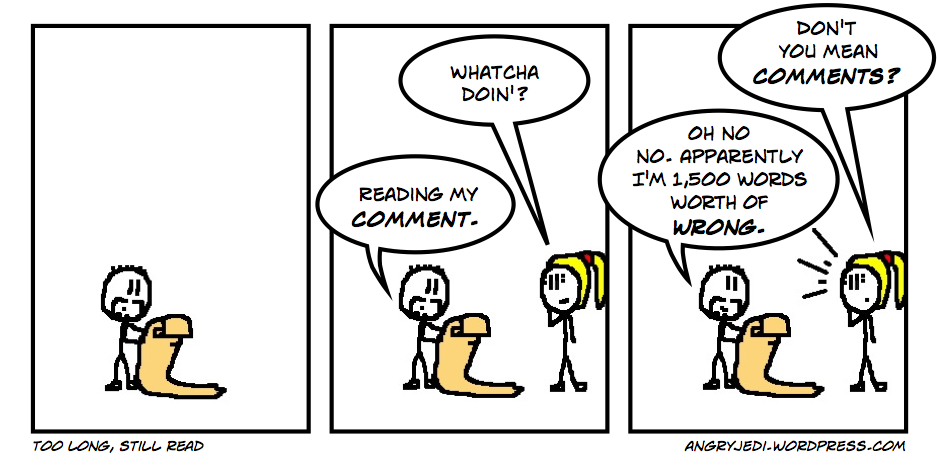
#oneaday Day 62: Too Long, Still Read

I'm almost entirely certain I have ranted on this topic at least once in the past. But, well, it bears repeating, given what I do both here and professionally.

More than one paragraph isn't bad.

More than 140 characters isn't bad. (Unless you're using Twitter, when all the deck.ly and TwitLonger nonsense kind of defeats the object.)

I read an answer to a question on GameFAQs earlier. The original poster had asked something which required quite a detailed answer. One respondee gave a detailed, good answer that was two paragraphs long, probably about 150-200 words or so. He apologised for writing "alot of text" (sic)—and I'll let the "alot" slide for the minute because there are bigger issues at work here, dammit. (Incidentally, if you've never seen this, well, you should.)

No. Stop apologising when you write things. Stop complaining at people in forums if they write detailed thoughts. Stop providing lazy people with "TL;DR" summaries and make them read. No wonder people haven't got the patience for books any more if they can't bear to read more than 10 words of someone else's opinion at a time and inevitably respond with something utterly inane like "lol". (And I bet they're not even really laughing out loud either, the bastards.)

Language is an incredibly powerful thing. Look at all the things it's built over the years. Those things didn't come about by people worrying about writing an "OMFG WALL OF TEXT" and people ignoring them. Those people had something to say and damn well said it, in detail, and argued their case. Their passion for what they were talking about came through in the power of the words that they chose, their enthusiasm for the topic came across with the depth into which they explored their topics verbally and on paper.

Now granted, there are times when brevity is better than verbosity. Anything from any government agency or law office, for example. I received a letter from the tax office a while back which went on for 3 pages when the single word "no" would have sufficed. These people have nothing to say and ironically spend pages and pages proving how little they have to say. Why? Who knows. To sound "official", perhaps.

But people with opinions? People debating things? People being—who'd have thought it—helpful? There's no sin in using a few more words if it might make someone think, discuss or smile.

So stop apologising when you write something, be it a blog post, forum post, Yahoo! Answers answer (well, someone has to write them) or blog comment. If you have something to say, it is absolutely your right to be able to say it without worrying about whether its length is going to put people off (*deftly sidesteps "that's what she said" gag*). And those who are too lazy to read a couple of paragraphs of comment? Well, they're probably not the sort of person you'd want to engage in a debate anyway. So F them in the B.

TL;DR: Stop being a dick.

#oneaday Day 61: Killing One's Dick Off

Bulletstorm should be the last game that appeals to me. I've criticised games such as Killzone for having generic-sounding "ShootMan: Kill"-type names, and my frustration with the market's oversaturation of first-person shooters is well-documented.

So why do I find myself wanting to play it?

Well, there's quite a few reasons, actually, and despite Bulletstorm's generic-sounding title and the fact it is indeed a first-person shooter, there's enough in it to get me interested. Most importantly, though, it's a game which doesn't take itself too seriously in the slightest. It knows only too well how ridiculous it is, and it's happy to provide said ridiculousness in spades.

There's a couple of specific things that get me, though. First up is score attack. Score attack is something that I seem to have developed something of a liking for in the last couple of years thanks mostly to Geometry Wars 2 and Pac-Man Championship Edition DX or whatever the bloody thing is called. Score attack is a simple, asynchronous way for people to play "together" and compete. It allows people on opposite sides of the world the chance to enjoy some friendly competition without those pesky timezones getting in the way. It encourages people to talk about the game. And it encourages people to replay the game rather than just ditching it after they've beaten the campaign.

The second thing about Bulletstorm is ironically one of the things that I thought would put me off it, and that is its immaturity. It has a sense of humour and throws obscenities around with gay abandon and from everything I've heard from reputable sources of information (well, friends) is all the better for it. A line about "killing your dick off" is supposedly a particular highlight, but the fact the demo for the game ended by referring to the player as "dick-tits" pretty much convinced me that this was a game built on the same values as late 90s shooters in which cheeky, immature fun was at the forefront, not trying to be over-the-top epic.

Fun is good. A lot of shooters, in my experience anyway, seem to be forgetting that part. When you repeat the same bit over and over again due to cheap deaths and hear the same annoying bit of inevitably-shouted dialogue over and over again, it kills all sense of immersion in the story which the developers are clearly trying so hard to achieve. Sure, I haven't played the full version of Bulletstorm yet, but since the plot is rather secondary to the gameplay and the scoring, it strikes me as something that will be rather less frustrating than the reason I put Gears of War down and have never touched that series since.

All of the above isn't to say that I am going to get Bulletstorm. I haven't decided yet. But they've done something right along the way, as it's the first shooter in a very long time that I've been genuinely very interested in playing.