#oneaday Day 555: Silly things from around the Web

I can't think of anything in particular to write about today, so I'm going to just talk about a few random things I happen to have seen around the Web recently, or perhaps not-so-recently in a few cases. Hopefully that will at least provide me with some inspiration to say something about each of them. So let's begin.

Lord Heath's farts

This is one of those things that I don't remember the specifics of how I stumbled across it, but I was thoroughly glad that I did. There's a chap on YouTube who goes by the name "Lord Heath", and his channel primarily consists of him doing short, light-hearted review videos of various soft drinks.

However, at various points in his past, he has also committed to video some of the most impressive flatulence ever emitted by a human being. I present to you exhibit A, which still makes me literally cry with laughter every time I watch it (and, more importantly, listen to it):

Everything about this is perfect. The earnest explanation. The explosive opening. The gradual howling of descending pitch. The crescendo towards the end as it comes in to land. The final thrust that accompanies the last burst. The fact that he's naked. Absolutely no notes whatsoever.

Five years I have been pissing myself laughing at that specific video. And I suspect I will continue to do so for many more years to come.

Jucika Daily

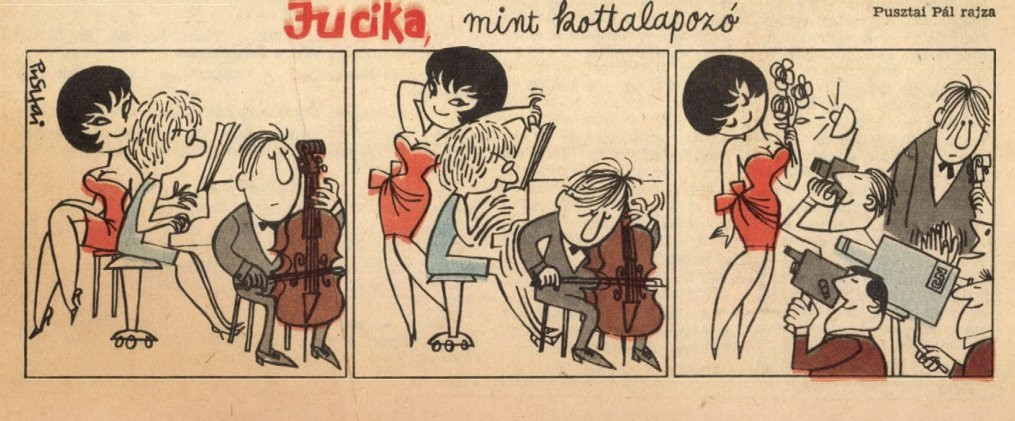
Jucika Daily originated on Twitter before migrating over to Bluesky when everyone realised that the place had become a Nazi bar. It's an account that posts Jucika strips, with Jucika being a mostly wordless Hungarian comic strip that ran from 1957 up until its creator's death in 1970.

Jucika centres on the life and times of an attractive young woman called Jucika and the various misadventures she has. She is depicted as being somewhat saucy, risqué and romantically forward, but the comic mostly parodies sexist attitudes rather than objectifying Jucika herself. Indeed, more often than not, Jucika is shown taking advantage of the sexist attitudes of the men around her in order to put herself at an advantage.

The Jucika Daily account posts comics from the 500 strip strong Jucika archive every day, and often includes helpful context in the alt text for each image. While the comics are almost always entirely free of dialogue, there are occasional Hungarian terms that appear on signs and suchlike, so the creator goes out of their way to explain these things where necessary.

At the time of writing, the account's creator is facing a large medical bill for an emergency kidney operation, but they are continuing to post strips while promoting their crowdfunding efforts. Even if you have no intention of handing over money to a complete stranger on the Internet, do at least go and check out the comic strips — they will make you smile.

CheapShow

The CheapShow podcast is ostensibly a show about going through the bargain bins and Poundlands of Great Britain and coming back with the treasure from amongst the trash, but really it's an excuse for best friends Paul Gannon and Eli Silverman to hang out and get very silly with one another — and to include us, the audience, in with their nonsense.

CheapShow has a number of regular features, including The Price of Shite, where Paul and Eli have to guess the prices of various pieces of tat purchased from charity shops; Off-Brand Brand-Off, where one or the other does a blind taste test of branded and unbranded variants of a particular product to determine which is best; and Eli's Country Urban Noodle Test-lab Kitchen, in which the pair taste-test different varieties of instant noodles. Alongside these, which tend to rotate in and out with each episode, the pair also often go on real-life "walkabout" episodes, where they decide to follow a walking tour on a route that falls outside of the usual "tourist" spots in London, and perhaps learn something along the way.

CheapShow works so well because Paul and Eli have magnificent chemistry with one another, and brilliant senses of humour that will resonate well with anyone around the age of 40 or so — particularly those who enjoy a good bit of old-fashioned British toilet humour. Paul and Eli are also both thoroughly lovely chaps outside of the podcast, and they deserve your support.


That'll do for today. I hope you find some enjoyment from these — I certainly have!


Want to read my thoughts on various video games, visual novels and other popular culture things? Stop by MoeGamer.net, my site for all things fun where I am generally a lot more cheerful. And if you fancy watching some vids on classic games, drop by my YouTube channel.

If you want this nonsense in your inbox every day, please feel free to subscribe via email. Your email address won't be used for anything else.

#oneaday Day 376: The death of ambition

Earlier today, Dave Gilbert, renowned modern adventure game developer and publisher, happened to point out that Adventure Gamers, a website with a near 25-year history, had, at some point, sold out and become an online casino shilling site, leeching off the prior content — which, after 25 years, you can bet had some decent SEO juice, even with the myriad changes to such algorithms over the years — in order to hook people into shady gambling sites.

My immediate reaction to this was "ew, gross", shortly followed by "I bet I could make a really good adventure game site". Unfortunately, this thought was then almost immediately followed by "…but why should I bother?"

This isn't the first time I've thought something along these lines. The modern Web is killing, stifling any sense of ambition I might have once had. It's not one, single thing like generative AI causing me to feel this way — though you better believe the amount of AI slop out there is a big part of it — but rather a continual piling-up of little micro-enshittifications. Over the course of the last 10 years in particular, these micro-enshittifications have all accumulated into the garbage fire that is the Web of 2025: a place where it's hard to find reliable information, where it's even harder to verify whether what you're looking at is reliable information, and where the people with the power to make a difference don't seem to give a shit.

Let me tell you a little bit about myself, in case you've not been here on the previous occasions I've done so.

When I was a kid, I grew up surrounded by computers: specifically, the Atari 8-bit and ST, with MS-DOS and Windows PCs following along around the early '90s. For pretty much my entire childhood, my Dad and my brother were both regular contributors to an Atari magazine initially called Page 6 and later New Atari User, after it took over the name from a publication that was bowing out of the Atari 8-bit scene.

I loved getting a new issue of Page 6 every couple of months; I loved reading through all the features, even if I didn't understand all of them, and it gave me great pride to see my Dad and my brother's name in print pretty much every issue after a certain point. My Dad would cover flight simulators, productivity software and the use of music technology, while my brother would cover Atari ST games. We got a lot of free software out of this arrangement — much of which is now in my possession — and it's fair to say that this played an instrumental role in defining my interests and hobbies growing up.

When my brother left home, he had decided to forego university in favour of a staff writer position on a magazine called Games-X. This was a risky and ultimately unsuccessful venture on the part of publisher Hugh Gollner, but it was a nice idea: a weekly games magazine that covered new releases for the home computers and consoles that were around at the time — the tail end of the 8-bit era, the heyday of the ST and Amiga, and the days when the Mega Drive and SNES were just starting to get some attention.

I was immensely proud to have a family member in the games press, published every week in an actual magazine you could walk into a newsagent and buy. (Page 6 had a stint on newsstands, too, but it eventually went back to its roots as a subscription-only magazine, clinging on to dear life until 1998, impressively.) And my pride only continued after Games-X folded and my brother followed Gollner to the then-fledgling Maverick Magazines, where he initially worked as a staff writer on Mega Drive Advanced Gaming, while his girlfriend at the time held the same position on its Super NES counterpart Control.

It continued further still as he worked his way up the ranks, through several publications and publishing companies, until eventually he found himself in the United States working on the Official PlayStation Magazine and Electronic Gaming Monthly, and helping to launch the pioneering video game social networking site 1up.com — dearly missed.

Every step of the way, I followed his career with interest, conscious of the fact that I was 10 years younger than him, thinking "one day I'll get my chance; I really want to follow in his footsteps, and one day I'll have that opportunity if I just keep trying."

I did keep trying. I did some articles for Page 6, just as my brother had. I did some freelance contributions to PC Zone and the Official Nintendo Magazine, back in the days when one article would get you the money that two months' worth of news posts nets you today. I worked on some little sites, most of which have now disappeared, sadly, and I eventually had the opportunity to work on both GamePro and USgamer, two decent-sized but, admittedly, American sites.

For some reason I had found the UK games press perpetually impossible to crack after a certain point, and after attending a few PR events on behalf of both GamePro I understood why: there was very much a heavily cliquey, old boys' club thing going on, and as a socially awkward (and what I now know to be) autistic loser, that was not something I felt in any way able to crack my way into.

But still I wanted to believe. I wanted to believe that GamePro was the start of something big, until we were told via email one morning just before Christmas that none of us had jobs any more. I wanted to believe that USgamer was another opportunity for something big, until I found myself screwed over and, once again, informed via email, this time on my actual birthday, that I no longer had a job.

After that, I didn't seek any further positions in the games press. I'd taken too many beatings. But I didn't want to give up. That's when I started MoeGamer, which initially began as a means of continuing some of the work I'd done at USgamer covering Japanese games that other publications didn't give the time of day. This was work that people in both the industry and from the "public" side of things told me that they found valuable and helpful, because I wasn't just going "ew, anime art" and writing things off as "pandering" or whatever.

Long-term, I wanted to build MoeGamer into something that really stood by itself: a site where you could look up information on a wide variety of games and find some thoughtful, well-considered writing about it. And I think I have achieved that, even if I don't have the time or energy to update it as often as I'd like; the one positive about my previous job, which was beyond tedious, was that it gave me ample time and energy to write new articles and make new videos.

I still never really "made it", though. Few people online know who I am; even fewer go "oh, wow, a Pete Davison article, gotta read that" — although I do have a pleasingly enthusiastic following in the Evercade community, at least, thanks to my work on the official site — and I just find myself wondering… was all this for nothing? Is there even any point trying any more?

The Adventure Gamers thing stings, because were it 10-15 years ago, I'm pretty sure I could have put together a banger of an adventure game-centric website, developed a decent following and kept it up and running for 25+ years without selling out to online casino shills. But now, from every corner of the Web I read horror stories about sites struggling for discoverability, struggling to earn the money to keep the lights on and struggling to get anyone to give a shit about the written word. There are rare outliers, and the rise of worker-owned, reader-supported initiatives such as Aftermath and Giant Bomb is encouraging — but both of those (and others like them) already had ready-made, built-in audiences thanks to the people involved and their prior positions; how long would a brand-new website with a specialist focus even last these days, if it wasn't "the next project from [insert big name site] alumnus, [name]"?

I feel utterly demoralised. I feel like what was once my dream career just doesn't really exist any more. I recognise that I'm extraordinarily fortunate to have fallen into the position I'm in now, where I get to work on games that I care about, crafting written material to help people understand and appreciate quite why I love them so much — and hopefully help said readers learn to love them, too — but there are days of increasing frequency when I wonder if anyone really gives a toss. The days when I have people screeching obscenities at me on social media because they can't buy a cartridge that is out of print. The days when I have to deal with endless, mind-numbing, Queen's Duck-level "feedback" from people who absolutely don't care about the games I'm working on as much as I do. The days when I'm genuinely fearful for the history and legacy of the hobby I love so much, and where I weep for the traditional, written-word games press, a side of the industry which almost doesn't exist at all any more.

I was born 10 years too late. And believe me, it really sucks to have spent a significant portion of your life thinking "I really want to do that", only to find out, much too late, that "that" just isn't really a thing any more.

The obvious answer to all this is something I've thought of and felt before — that even if there doesn't seem to be a "place" for something, you should do it anyway, because someone, somewhere, will appreciate it. But with every site sold to private equity companies and gutted to turn into an AI slop factory, the motivation and ambition to do something significant and meaningful diminishes, bit by bit. What was once a roaring flame of determination is now little more than a flicker. And I hate that.


Want to read my thoughts on various video games, visual novels and other popular culture things? Stop by MoeGamer.net, my site for all things fun where I am generally a lot more cheerful. And if you fancy watching some vids on classic games, drop by my YouTube channel.

If you want this nonsense in your inbox every day, please feel free to subscribe via email. Your email address won't be used for anything else.

#oneaday Day 223: The Old Internet

As the rot economy continues apace, more and more people are starting to recognise the modern Web for what it is: an unpleasant place, in which commercial interests and venture capitalists come first, and making an actually pleasant, enjoyable and educational place for the actual users is far, far down the list. As a result, "the old Internet" is often romanticised, perhaps to an overly nostalgic, rose-tinted degree, but I have to kind of concur; things did used to be much more enjoyable online before our daily routine was nothing but scrolling through the only two or three websites that actually exist to most people.

I think about this a lot when I'm writing on here or MoeGamer. I used to get fairly decent numbers on both blogs, even though I was just posting daily nonsense on this one. Now, I get maybe double figures daily on here, if that. MoeGamer still pulls in about a thousand views a day, which is nice, but a lot of those views are for things I wrote about several years ago at this point, and rarely for things I've written about recently.

Now, I don't do either this blog or MoeGamer for the views, but I feel the trajectory this site has taken in terms of numbers is symptomatic of the way the Web has changed over the years. People just don't do blogs any more, either as writers or readers. Part of this is down to the fact that RSS readers just aren't a part of people's daily online routine any more (though I'm aware they still exist) — and even those "magazine-style" apps that were never really a good replacement for Google Reader seem to have died a bit of a death. Not only that, but the usefulness of search engines has declined considerably, too.

Instead, it is, of course, all about social media. It's all about having a presence on the "important" social networks — though even that has seen something of an upset over the last few years, and particularly in the last few months. Twitter was already circling the drain in terms of usefulness for sharing stuff even before Elon took over and did… whatever the fuck he's doing there; Facebook has been such a horrible experience to use for so long now that I question the sanity of anyone who is still using it — to say nothing of the frankly quite disturbing policy changes they've had recently; and the less said about TikTok, the better.

So what, exactly, is someone looking to express themselves online to do today? If you want to get seen, you seemingly have little choice but to sign your soul over to one of these companies and plunge your data into the mire that is "The Algorithm". Telling people that they should start their own website is a noble and proper goal, and one I stand behind, but the fact is… a lot of folks just don't and won't leave social media — and many of the social media companies are doing their best to keep those folks on their platform as much as possible.

Look at Twitter (no, I'm not calling it "X") and how Elon is desperate for people to "post content" on it, completely failing to see that it is a platform woefully ill-equipped for anything other than that which it was originally designed for: microblogging. No-one in their right mind is going to set up a video-centric Twitter account instead of a YouTube channel, even if the site wasn't infested with the worst bigots the Internet has to offer. And no writer is ever going to use Twitter as their primary means of posting their work.

Everyone knows this. And yet it's so difficult to get people to notice you if you're not spending all day "building your personal brand" or some such bullshit. Artists struggle to get commissions without social media. Writers struggle to get publishers without social media. Video makers struggle to get views on their videos without social media. It all sucks, and it feels far too late to be able to do anything about it.

All you can do, really, is just be stubborn. Keep plugging away at your own personal passion projects, and do those projects for the passion, not for the potential of monetising them. I keep doing this blog because I like writing and it's good therapy for me — nothing more. It's always a thoroughly welcome sight when I see someone I recognise in the comments, but that's becoming an increasingly rare occurrence these days. Family and friends who used to read on a regular basis just… don't any more, and the worst thing is, I completely understand why. The modern Web simply isn't built to support personal sites any more, and that's a real shame. It feels like we're very much at risk of losing an important part of our collective culture — because what happens to everyone's "content" (ugh) when one of these social media companies eventually implodes?

Anyway, close your Meta accounts, get off Twitter and read more blogs. That's my advice for surviving online today.


Want to read my thoughts on various video games, visual novels and other popular culture things? Stop by MoeGamer.net, my site for all things fun where I am generally a lot more cheerful. And if you fancy watching some vids on classic games, drop by my YouTube channel.

If you want this nonsense in your inbox every day, please feel free to subscribe via email. Your email address won't be used for anything else.
#oneaday, Day 337: Internet Games #2: TinyURLette

It's easy to get stuck in a rut when browsing the web, visiting the same few sites over and over and over again in a vain attempt to find something new to waste your ultimately meaningless existence with. Facebook is usually the timesink of choice for many people, closely followed by Twitter, TVTropes, Wikipedia and a few others.

As such, it's easy to forget that there's a wider web out there, filled with sites that you may not have ever come across during your daily browsing routine. Some sites you would never have wanted to discover, ever. And some are real gems that you'll be happy you came across.

So what better way to explore the web than to make it into a little game? There used to be a website devoted to this very philosophy. Called ShuffleTime, it allowed players to jump around the web seemingly at random, answering trivia questions about the pages they were seeing. Correctly answering the questions allowed the players to collect cards and coins and purchase rewards and entries into prize draws. Sadly, it didn't last very long, but I thought it was a great idea.

So here's a variation on it. I can't promise any kind of reward (short of discovering something horrendous/wonderful) but it's a good time waster. Probably not safe for work, but if you're reading this at work then you're probably not concerned about that, either. Here is a picture of Rise from Persona 4 in a bikini to make you feel uncomfortable about reading this at work.

Well, it serves you right. Get on with what you're supposed to be doing and I won't have to embarrass you again.

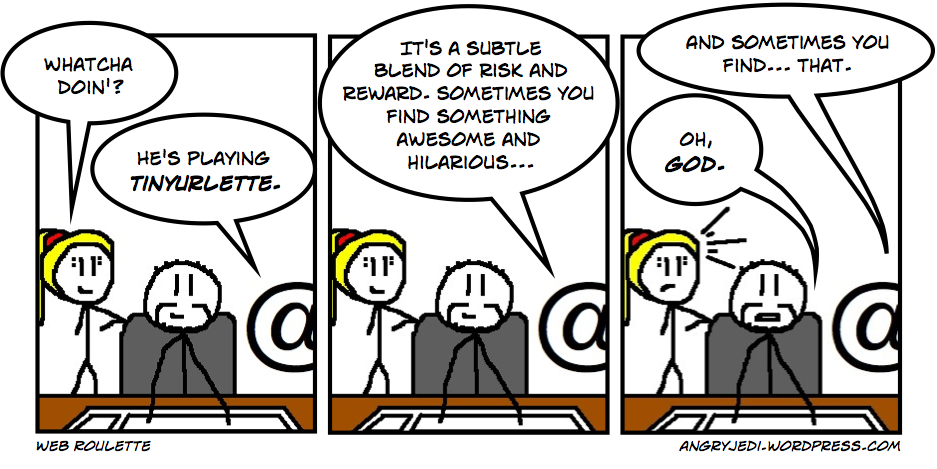
Alternatively, you could embarrass yourself further by playing TinyURLette, a game of discovery. The rules are very similar to The TwitPic Game which I informed you all of a few days ago (and no-one participated, boo) except this time we're dealing with websites.

So here's what to do. Visit your link-shortening service of choice and simply add whatever you like after the URL. I will attempt this with both TinyURL and bit.ly links to demonstrate.

So first up, we have http://bit.ly/blargh, which takes us to a page of YouTube comments for this video. It is a Scottish guy who has obviously been studying phonetics recently. He also says hello to a lot of people. And goes off on a rant against one of the members of his channel. He also does that irritating "quick-editing" thing that people are doing all the time on YouTube. "Hello! I am [edit] a person [edit] who is [edit] talking [edit] to you about [edit] rubbish." Enough of him.

http://tinyurl.com/ihateyou, conversely, is appropriately named and takes you to a picture you really don't want to see. Especially if you're at work. You have been warned. It's not porn or gore.

http://bit.ly/arse takes us to BioEthics Bytes, a blog about multimedia resources for teaching bioethics. An unfortunate URL for a page that looks quite interesting.

http://tinyurl.com/what takes us to an article from the San Francisco Chronicle about the death of Margaret Singer, an expert on brainwashing and cult activity. The obituary is an interesting read, actually, with some quotes from Singer herself.

By extension, http://tinyurl.com/whatisthisidonteven takes you to a page clearly intended to RickRoll you. Unfortunately for them, the video they have been using for RickRolling purposes is a broken link, meaning that this page is, in fact, a failed RickRoll. A RickStumbleAndFallOnYourAss, if you will.

http://bit.ly/yourface features a news headline from Twitter very literally about your face.

http://tinyurl.com/stopit gives us a blog post in Russian about Lifespring, the now-defunct "human potential training" company. Or, as Google Translate puts it, "Layfspringe", which is a much better name.

Finally, http://bit.ly/borednow takes us to a page from McCarthy Psychology Services from Australia about care provision for the elderly.

I'm a little disappointed. Out of 8 different pages, only one of them is the slightest bit inappropriate. You are not doing your job properly, Internet.

Found any entertaining TinyURL or bit.ly shortlinks through playing this stupid game? Let me know in the comments.