#oneaday Day 504: Enshittification comes for TV Tropes

Like it or loathe it — and there's an increasing number of people in the latter camp in more recent years, for reasons I'll get onto — but TV Tropes is an Internet institution.

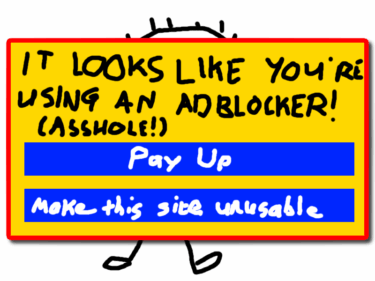
At least it was, until today, when they decided that enough was enough with all those pesky users who didn't want their privacy invaded and their data sold and thus were running adblockers. Now, when attempting to view a page on TV Tropes, you get this screen:

TV Tropes
Please allow ads on our site or subscribe

Looks like you're using an ad blocker. We rely on advertising to help fund our site. Please turn off your ad blocker and refresh the page.

Allow Ads
Subscribe
Login

This will probably be familiar to anyone who has viewed any number of websites in recent years. It's a step back from being a complete paywall, in that they'll allow you in if you just disable your adblocker a little bit, pweeeze, we'll only share some of your data with unknown third parties. But it's still a shitty move — particularly for a site like TV Tropes, which has always been a community-driven site. In fact, without the community, TV Tropes wouldn't exist.

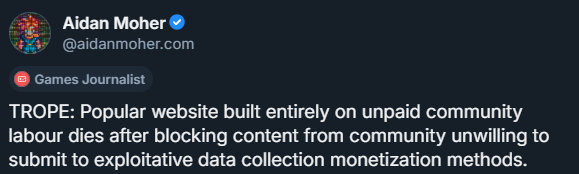
As writer Aidan Moher put it earlier on Bluesky:

Aidan Moher
@aidanmoher.com
(Games Journalist)

TROPE: Popular website built entirely on unpaid community labour dies after blocking content from community unwilling to submit to exploitative data collection monetization methods.

That's right. Part of the reason why TV Tropes was so beloved, even with its problems — we're getting to those, I promise — was because it was built by the people. Much like Wikipedia, albeit on a somewhat smaller scale, TV Tropes was absolutely dependent on its enthusiast, volunteer authors and editors. Without those people tirelessly cataloguing examples of tropes used in all manner of media to a frighteningly comprehensive degree, there would be no TV Tropes.

But… now what? People are not going to pay for TV Tropes, and an adblocker is pretty much essential for browsing the modern Internet if you want an experience that is in any way tolerable. So now someone who might otherwise have wanted to contribute to the community effort that is TV Tropes is now locked out from doing so, with their only choices being to pay up or open the floodgates to God knows whatever advertisers are doing these days. (No, I'm not opening up a non-adblocked browser just to see what it's like now.)

Not only that, but this is essentially TV Tropes saying that it wants to profit from the unpaid labour all those volunteer contributors and editors have put in over the years. Because you can bet your sweet bippy none of that $5 a month/$25 a year subscription fee is going anywhere near the pockets of the people who have really made the site what it is today.

This, obviously, sucks, and is just another example of enshittification. Specifically, it's almost a textbook example of what Cory Doctorow was referring to in one of his first pieces he wrote on the subject, The Enshittification of TikTok:

Here is how platforms die: first, they are good to their users; then they abuse their users to make things better for their business customers; finally, they abuse those business customers to claw back all the value for themselves. Then, they die.

I call this enshittification, and it is a seemingly inevitable consequence arising from the combination of the ease of changing how a platform allocates value, combined with the nature of a "two-sided market", where a platform sites between buyers and sellers, holding each hostage to the other, raking off an ever-larger share of the value that passes between them.

In the case of TV Tropes, you have your "users", who are the people who browse the site for fun, entertainment or in the hope of learning something; then you have your "business customers", who are the volunteer contributors, without whom the site wouldn't exist; the abuse of those "business customers" through locking them out unless they subscribe or open the adblock gates is the stage we're at now. I'd argue in this instance we skipped the usual "abusing users" part and jumped straight to "abusing business customers and users".

As I say, this clearly sucks, and it seems like a sure-fire way for TV Tropes to almost immediately make itself completely irrelevant to the rest of the Internet.

But! That might not be the worst thing in the world. Hear me out.

This is not to put down the incredible amount of time and effort TV Tropes contributors have spent cataloguing myriad tropes and even more countless uses across many, many different forms of media. I absolutely do not have an issue with the people who have taken the time to do that, because those people are creatives; they have made something.

No, the problem with TV Tropes is that, over time, it became a resource for the lazy. This is not TV Tropes' fault itself, but rather it's an extension of a general sense of dwindling media literacy across society. Why think for yourself about something you've just seen, played or heard, when there's a 3 hour YouTube video essay waiting to "explain" it to you in what appears to be authoritative detail? Why ponder the specific way a movie, TV show, video game or book chose to present its narrative, when you can just look it up on TV Tropes and get a ready-made list of "discussion points" that you can "borrow" and use for yourself? (Certain members of the "3 hour YouTube video essay maker" group are definitely prone to this, with some pretty much quoting TV Tropes pages verbatim in the name of "analysis".)

I have had conversations with people who will not even consider starting to watch a new TV show if there isn't a "companion" podcast (official or otherwise) ready and waiting to explain each and every episode to them. This is both frightening and baffling to me! Particularly when it comes to media that is designed to be fairly undemanding, mainstream entertainment!

TV Tropes isn't solely to blame for this, of course — blame can also be laid at the feet of reactionary, short-form video content on platforms like TikTok and YouTube Shorts as well as the generally dwindling attention span of people online these days — but it is a symptom of a broader problem. And one of those sources of that problem going away might not be a terrible thing in the long term, as callous as that might sound to those who have poured hours of time and effort into researching things for that site.

Regardless of your feelings on TV Tropes — on the whole, I've always been fond of it, but then I've always used it more as entertainment than a source of "serious" research or analysis — this is an unfortunate day for an Internet institution, and I suspect it absolutely will not be the last longstanding website to take this direction.

Once Wikipedia and the Internet Archive go that way — and no, them occasionally badgering you for donations doesn't count — that's when you know we're really fucked. Let's hope that never happens.


Want to read my thoughts on various video games, visual novels and other popular culture things? Stop by MoeGamer.net, my site for all things fun where I am generally a lot more cheerful. And if you fancy watching some vids on classic games, drop by my YouTube channel.

If you want this nonsense in your inbox every day, please feel free to subscribe via email. Your email address won't be used for anything else.
#oneaday Day 343: MiSTerious

I have been, as you do, contemplating my impending ownership of a MiSTer Multisystem 2. And, as so often happens with such things, I have been pondering how I might make good use of it as something that spurs me on to be creative.

The obvious, simple answer is to use it to write about things and make videos in the places I already have: this site, my YouTube channel, MoeGamer. But part of me also wants to start something new, something a bit different.

Let me tell you the idea I've been kicking around in my head. I'm not particularly looking for "feedback" on this, but I think it will help me out to get this out of my head and onto the page.

You know how everyone likes to say they have a "newsletter" now, rather than a "blog"? Well, I was thinking about that, and thinking about how it might be fun to take that "newsletter" idea a little more literally. Specifically, I was thinking about how practical it might be to do some sort of newsletter/blog thing where, rather than individual articles being about one thing, each post was actually an "issue", like a magazine.

I was thinking it might be interesting to do such a thing with the MiSTer Multisystem 2. Each "issue" could have a brief summary of any news about the system itself — and perhaps about the broader MiSTer ecosystem, though as I type this I know absolutely bugger all about that — and then move on to some magazine-style features, perhaps with a theme for each issue. There could be a "preview" of an upcoming "modern retro" game by one of today's indie developers. There could be a "big review" of a noteworthy game that particularly fit the theme. There could be tips and tricks for classic games. There could be short, capsule reviews for smaller games. And, of course, there could be straightforward features on a particular subject, using the MiSTer Multisystem 2 as a means of exploring and researching that subject.

Realistically speaking, I'm not sure such a thing would really work, because you know what people's attention spans are like these days. Were I to put all that in a single blog post or email newsletter, how many people would read beyond the first paragraph? Perhaps it might be better to do individual posts on an existing site, and then provide some sort of separate newsletter that people could subscribe to via email. I used to do this with Rice Digital and it was fun. The newsletter had a good number of subscribers, too, but honestly I inherited most of those from the previous owners.

The reality of the situation is that it would almost certainly be piss in the wind, because you almost certainly know how hard it is to get noticed online these days. The recent rise of independent publications is great, but in a lot of cases these are already well-established names, and I think (no, I know) there's a lot of great individual independent creators out there who just don't get the credit they really deserve when putting their work out into the world.

So I dunno. I have a lot to think about, but I also have a lot of time to think about it, given that the MiSTer Multisystem 2 isn't arriving until August.

I could also just enjoy the damn thing without worrying about any of this nonsense, but where's the fun in not agonising over things that don't matter, hmm?


Want to read my thoughts on various video games, visual novels and other popular culture things? Stop by MoeGamer.net, my site for all things fun where I am generally a lot more cheerful. And if you fancy watching some vids on classic games, drop by my YouTube channel.

If you want this nonsense in your inbox every day, please feel free to subscribe via email. Your email address won't be used for anything else.
1185: Top Ten Panty Shots in Video Games

I'm not normally a big fan of Ben Kuchera's work (for reasons I won't go into right now because they're not relevant to what I want to talk about) but he's bang on the money (no pun intended) with this piece.

I shan't reiterate Kuchera's points here — read the feckin' article! — but I will say that on this note, I do agree with him.

The Internet's (and tech in general's) reliance on advertising has to end. It's not sustainable. It simply isn't. And in the meantime, all it's doing is devaluing content, pissing people off and causing us to continually circle the plughole, drawing ever closer to being sucked into oblivion forever, or at the very least into that weird, disgusting black smelly goo we found in the end of the pipe the last time our sink got blocked.

Whenever a site like, say, Kotaku (who are usually the ones who get picked on for this sort of thing, but they're far from the only offenders) posts some bullshit story that gets everyone riled up about how irrelevant/pointless/offensive it is, the war cry that goes up is that they're doing it "for the hits". More accurately, as Kuchera says, they're doing it for the pageviews, because like it or not, the bullshit stories that make everyone angry are the ones that lots of people take a look at "just to see what the fuss is about". The Daily Mail makes a living from posting this sort of garbage on a daily basis; Kotaku at least punctuates its rubbish with some interesting and thought-provoking pieces, while the Mail is just uninterrupted crap. As Kuchera notes, though, the bullshit more often than not pays for the interesting and thought-provoking pieces.

It's not just professionally-written content that suffers from this problem, though. Look at Facebook and the idiotic, illiterate ads that festoon its sidebar on every page. Look at Facebook (again) and its obnoxious, obtrusive "Sponsored Posts" thrusting themselves in your face uninvited. Look at Twitter and its "Promoted Tweets" that you don't want to see. Look at whatever bullshit ad WordPress has decided to serve up underneath my writing on this site (although only on the mobile site, seemingly) Look at the mobile app I reviewed today, which rammed two full-screen ads down my throat before I could even open the main menu, and two more when I started picking a photo from my device's photo library to manipulate. (I was not kind to said app in the review.) Look at the ads you get for casinos and shady-sounding "download services" any time you browse for porn or torrents or anything else you wouldn't admit to looking for in polite company, but which we all know everyone looks for. (Yes, even you, you pervert.)

Internet advertising isn't positive or helpful. It is, for the most part, shady, misleading, obnoxious and obtrusive. Which is, of course, why it's so understandable that so many people — particularly the tech-savvy among us — run ad-blockers and thus deprive many sites of what little revenue they are scraping in from these revolting blights on the otherwise awesome nature of the Internet's global community.

I don't run ad-blockers. Honestly, this isn't for any particularly noble reason — I simply haven't set one up. But knowing what I know of the online publishing industry from the inside, I don't intend to run one, either. Those "One Weird Tip to Peel Your Skin Off and Whiten Your Teeth in the Casino that One Weird Old Florida Mum Found While Downloading Now!!" ads are many sites' main means of income. This isn't the magazine industry — there's no "cover price"; no newsagent looking over your shoulder and asking rather bluntly "you gonna buy that, mate?" (The magazine industry is, of course, in decline, meaning its model isn't necessarily particularly desirable either — but what do you think damaged it beyond repair in the first place?)

It's clear that this situation has to change. But it's not going to be an easy process. Readers used to consuming content for free and blocking ads are going to have to suck it up and start paying for their content. Content creators need to be confident enough in their work to make it worth paying for. And those responsible for the sort of bullshit ads you see on the Internet every single day… well, frankly they need to find a new career, because they've done more than enough damage to the media biz already.

If things don't change, there are going to be big problems down the line. Whether these problems take the form of the entire "new media" industry turning into the most stupid parts of your Facebook News Feed over and over again or the business collapsing entirely remains to be seen — but I'd rather not see either of those things happen if at all possible.

#oneaday, Day 52: Desperately Seeking Perfection

The modern age brings with it many benefits. The ability to communicate with anyone in the world at any time (so long as they're not asleep). The ability to express one's creativity in a broader range of media than ever before. The ability to acquire pornography to cater to any and all fetishes. And, of course, more ways for people you want to avoid to track you down and "see how you are".

The downside of all this, though, is that everyone always seems to feel the need to constantly be reinventing themselves. It's a particular problem when it comes to popular websites such as Facebook and Twitter. Someone, somewhere decides that it's really important that sites have particular features in place, and some poor sod of a programmer out there has to implement said features. Then when said poor sod has implemented said features, everyone whinges and moans that it's "worse than it used to be" and "shit now" and blah blah blah and conveniently forgets that said services are, in fact, free and the owners of them are perfectly within their rights to do what they want with them, however stupid some of those moves might be.

But why does this happen? It's seen as "necessary" to constantly update and reinvent to "stay competitive". Why? It usually ends up doing more damage than good, because as we've seen on many, many occasions in the past, People Hate Change and will react in somewhat inflammatory, stroppy manners.

This isn't to say that all change is bad, of course. Not at all. Genuine changes that benefit someone's experience are to be applauded. New ideas that are experimented with should be treated with a "well, let's try this" attitude rather than the outright hostility we get right now. But change for change's sake when something already works just fine? That, right there, is the reason that we get aforementioned hostility. People just want a bit of stability, and when they feel they've got it and the rug is pulled out from under them, it's sort of understandable that they kick off a bit. Not always handled in the best way (in fact, usually handled in the style of a stroppy 8-year old) but at least a little bit understandable.

Combine stroppiness with the anonymity of the Internet and you get some ugly scenes indeed. It's a fast-paced world we live in these days, and some might argue it really doesn't need to be quite so fast-paced. It'd be nice to be able to slow down a bit, enjoy the view and only fix things when they break.

But nah, that's never going to happen. Everyone has to be the Very Best, to strive towards the "perfect" experience, the criteria for which seem to change on an hourly basis. And striving for perfection means having the techie types constantly at work with their hammers and nails and bits of code. A permanent state of construction. The eternal beta.

One day the Internet might be finished. But I don't see it happening just yet.

#oneaday, Day 249: Remember Reach... Uh, Kombo

The death of a website is a curious thing. In practical terms, it's no different to deleting a file, switching something off, throwing out a piece of technology that is no longer used. But it's more than that. A dying website normally knows it is dying before the plug is finally pulled. And, these days in particular, it's not just a website that dies. It's the community that the site built. The readers who came back every day, whether they were vocal ones who commented on everything or people who just diligently read every article because they'd chosen that particular site to be their "home".

I've witnessed the death of several websites I've been involved with either as an employee or an active community member of in my time, and it's never pleasant. 1up.com isn't dead, of course, but when The Great Exodus occurred some time back, the Squadron of Shame and I left the site behind and never looked back. The site still maintains an active blogging community, but it's a shadow of its former self when I think back to the glory days of the 1up Radio boards.

Then came B4HD, a relatively short-lived retro games project that I was involved with. We had a team of dedicated writers who loved games of the past with a passion and loved writing about them. But for various reasons documented in the site's final post, it had to close and those involve seek other outlets for their work.

Most recently, of course, is Kombo. Kombo is still there, of course, for now. But the staff aren't. Sure, there are some who are still there diligently posting articles on the site and holding things together as the site's last few commitments are fulfilled. But some time soon, that site and everything attached with it—the content, the artwork, the community, the recognisable writers—will cease to be.

What happens at that point? Where do all these lost souls go? Sometimes they have nowhere to go straight away, and simply have to pick another place to call home and latch on to it. Sometimes they have to start from scratch again, building a reputation from the ground up like they once did. Sometimes they float aimlessly for a while. And sometimes they immediately land on their feet and produce something awesome.

It's perhaps premature to be holding a "wake" for a site like Kombo when it hasn't even died yet. Rest assured that the talented crowd from Kombo are not going anywhere. That dedicated team who knew and loved their audience (even Wiiboy) and what they wanted to hear are alive, well and waiting.

"Waiting for what?" you may ask. That's not for me to say… yet. But let's just say that those of you who enjoyed the writing of myself, Jeff, Brad, Joey, Eric, Keri, Ryan, Mike, Matt, Joel, Dan, Ryan and Geoff won't have to wait too long to see what we're up to. It's going to be great, and we hope you like it a lot.

A love of the cloak and dagger prevents me from saying anything else right now. For those of you who care, though, we're fine. And I know that I for one am hugely happy to have met such an awesome crowd of writers, and even happier that we're sticking together for new and exciting projects.

Watch this space for the latest.

#oneaday, Day 245: Obituary or Rebirth?

Dear GOG users,

We have recently had to give serious thought to whether we could really keep GOG.com the way it is. We've debated on it for quite some time and, unfortunately, we've decided that GOG.com simply cannot remain in its current form.

We're very grateful for all support we've received from all of you in the past two years. Working on GOG.com was a great adventure for all of us and an unforgettable journey to the past, through the long and wonderful history of PC gaming.

This doesn't mean the idea behind GOG.com is gone forever. We're closing down the service and putting this era behind us as new challenges await.

On a technical note, this week we'll put in place a solution to allow everyone to re-download their games. Stay tuned to this page and follow us on Twitter and Facebook for updates.

All the best,
GOG.com Team

An hour or two ago, that message had done the rounds of the Internet. If you hadn't seen it yet, I apologise for being the bearer of bad news. If you head on over to Good Old Games right now, that's all you'll see. No store. No games. No community. All gone.

For the uninitiated, Good Old Games was the place to go to purchase and download DRM-free copies of old (and not so old) classic games for low, low prices. It was, for a long time, the only place to go to find the classic Sierra adventures, or sci-fi Wolfenstein 3D spinoff Blake Stone: Aliens of Gold, or the best puzzle game of all time, The Incredible Machine. I wrote a number of pieces for that site, so yes, I have something of a vested interest in it and actually feel pretty sad about its apparent demise. But even if I didn't have such a personal stake in it, it was a fantastic place to go to pick up the games of my youth. Even better, they'd been tweaked and optimised to work on current hardware.

The tragic news above comes after a tweet posted by the company a few days ago:

Sometimes it's really hard being DRM-free… hard to keep things the way they are and keep management and publishers happy 🙁

It didn't sound good. Someone was obviously putting a bit of pressure on the company, and some cracks were starting to form. Those who had supported the service since the beginning knew that a DRM-free service in an age of rampant piracy was going to have its work cut out for it. But was that really the reason?

No-one knows as yet. No-one except the people at GOG, who are playing their cards close to their chest. The community are assured that this isn't the end of GOG, however, just the end of this chapter of its existence. Those who have purchased games from the service in the past will be directed to a "solution" to re-download these games in the next few days. And some announcements will hopefully be forthcoming very soon.

Personally speaking, I'm hoping it's good news. There were a ton of games on the site that I'd love to have had the chance to play again. Games like Gabriel Knight 2, which a friend borrowed some time ago and never gave back, and now I can't remember which friend it was.

The games of this era represent a time when gameplay was everything and graphics were necessarily limited by the hardware of the time. And it may just be nostalgia talking, but some of my fondest memories of childhood and adolescence come from the games I was playing at the time. It'd be shame if the memories of these games fade. But, as I say, GOG claims that this is not the end, just the end for the service in its current form.

So pour out a stiff drink, take off your hat and, I don't know, sing a mournful song in honour of GOG or something. Hopefully they'll be back better than ever sometime soon.

Rest in peace, GOG. For a little while. Then come back as an awesome zombie who wants to sell us old games rather than eat our brains.

WHATAREYABUYIN'?