#oneaday Day 594: Point. Click.

I love point-and-click adventures. Back in the '90s, they were probably my favourite type of game. I devoured everything LucasArts came out with and a lot of stuff Sierra did — though I must confess, there are still a few gaps in my knowledge on the latter front.

LucasArts stuff was just better than Sierra stuff, at least in the early days. Early on, LucasArts' developers decided to take the things that annoyed people about Sierra games — chiefly the ability to die and get yourself into unwinnable situations — and throw them out of the window. Far from removing all challenge from the games as a result, this just made them much more fun to play — although it's interesting to note quite how short a lot of those games are by modern standards.

One thing to remember is that when we were playing stuff like Indiana Jones and the Fate of Atlantis, Internet access wasn't particularly widespread. Hell, GameFAQs wouldn't exist for another few years, even if you could get on the Internet; some resourceful folks were writing walkthroughs and posting them on places like CompuServe's GAMERS forum (a frequent online hangout for myself), but for the most part, when it came to solving a tricky game, you had two options: figure it out yourself, or wait for a magazine to print a walkthrough.

This meant that games that are maybe three or four hours long start to finish could actually take days, weeks or even months to complete. We had a lot more patience for that sort of thing back then — although I do recall finding it quite eye opening when I bought a brand new copy of Full Throttle, played it for two hours with my brother and we rolled credits on it.

Today, point and click adventures are still going strong. Press and public alike have enjoyed saying the genre is "dead" for many years, but in reality it's been nothing of the sort. What changed is the part of the market that point-and-click adventures occupied; while once a Sierra or LucasArts game would be considered a "big release" in a similar fashion to today's triple-A titles, after the turn of the millennium they became more niche interest affairs.

I'm not entirely sure why, either; they hadn't fundamentally changed what they were doing, or their core appeal elements. Although thinking about it, that's probably precisely why they became more niche interest affairs. From the late '90s onwards, the "upper" (for want of a better term) end of the market was going 3D, exclusively. And adventure games, up until this point, had been resolutely 2D affairs, tending to be showcases for beautiful rotoscoped or hand-drawn animation, painted backdrops and suchlike. In the age of PlayStation, that suddenly wasn't fashionable any more for a variety of reasons — and the few attempts to bring point-and-click adventures into the 3D realm had been met with a mixed response.

As with most niche interest things, an enthusiast community developed, with many of them rallying around a piece of software called Adventure Game Studio. Initially DOS-based, this was a tool that allowed anyone with a creative mind and the ability to produce basic graphics to put together a point-and-click adventure. It took effort, mind; this wasn't a "game generator", but a fully featured game engine, suitable for creating point-and-click games similar in style to Sierra, LucasArts and any number of other models.

Remarkably, Adventure Game Studio is still going to this day — and the enthusiast community is still using it. Only now, we see a lot more commercial releases from independent developers. And even more remarkably, the stuff being put out today by small outfits is pretty consistently better than anything from the genre's supposed "golden age" of the mid '90s.

There are more point-and-click adventure games that have been released in the last few years than there ever were back in the '90s. And they're really, really good. For just a few recommendations: the Kathy Rain series is an excellent series of investigative adventures; Old Skies by Wadjet Eye Games is an incredibly thoughtful narrative-centric game with a time travel hook; Lamplight City by Grundislav Games is what happens if you take Gabriel Knight and stick it in a steampunk setting; Brok the InvestiGator by CowCat Games is a brilliant, lengthy animated adventure with optional beat 'em up mechanics.

Even better, these games are a lot longer than their mid '90s counterparts. Old Skies took me a good 12 hours. The two Kathy Rain games are about 8 hours each. I'm 7 hours into Lamplight City so far and on the fourth chapter of five. I'm not sure how long Brok was but I have a feeling it was pushing 20 hours.

"Length of play" isn't the sole metric by which you should measure a game's worth, of course. But what a longer game means in the adventure game space is a more detailed, in-depth story to explore and enjoy. The difference between watching a movie and a whole season of a TV show. Both have their place, of course — I'm not averse to a short adventure game, still, and frequently go back to some '90s faves — but it's always nice when one of these modern games really gives you something to get your teeth into properly.

Best of all, though, is that there's loads of them. The ones I've mentioned above are just scratching the surface. As someone who has always loved this type of game, that excites me. And I've really been enjoying playing Lamplight City of late in particular. More on that over on MoeGamer when I've beaten it, though….


Want to read my thoughts on various video games, visual novels and other popular culture things? Stop by MoeGamer.net, my site for all things fun where I am generally a lot more cheerful. And if you fancy watching some vids on classic games, drop by my YouTube channel.

If you want this nonsense in your inbox every day, please feel free to subscribe via email. Your email address won't be used for anything else.

#oneaday Day 498: Forgetful... again

Ooh, I forgot to write something yesterday, again. To be honest, yesterday just sort of went by in a haze. I don't feel like I really "achieved" anything. We went food shopping, which was something, but aside from that, not a lot happened. I didn't even really feel like I had much time to spend doing things I enjoy — before I knew it, the day was just over.

I did play the demo for the upcoming Nighthawks on Steam, though. I'll likely write something more substantial about this soon, but my first impressions on this short-but-sweet demo were very encouraging.

For the unfamiliar, Nighthawks is an adventure game/visual novel/RPG type thing published by adventure game maestros Wadjet Eye Games and developed by The Curiosity Engine. It's a vampire-themed game that obviously takes some heavy cues from Vampire: The Masquerade without actually using the World of Darkness license. Which is good, because it sounds as if the long-awaited Vampire: The Masquerade – Bloodlines 2 has turned out to be… not so good. As if anyone is surprised at that after its cursed development cycle.

Nighthawks, though — that gets the whole World of Darkness vibe, with a few interesting twists. For starters, in the world of Nighthawks, humanity is aware of the existence of vampires, so no need for the "Masquerade". That said, making use of your vampiric powers somewhere that you can be noticed is still frowned upon, so you still have to be a bit careful.

The game starts with you creating a character by establishing some elements of your background: where you came from, who your sire was, what your specialisms are. From there, you're thrown into the plot proper, where you arrive in town in search of a former contact who has absconded with something precious to you. As a pretty new vampire, you have no money to your name, no contacts and no reputation, so it's up to you to establish all these things — and I believe the full game ends up with you owning the eponymous nightclub and having to run it.

I really like what I've seen so far, and I'm going to try playing the demo again with a different character archetype to see what — if anything — changes. It looks as if it's going to be one of those games where you can very much "role-play" your character and have a markedly different experience depending on your choices, both during character creation and once the game proper is underway.

The demo is still up at the time of writing as part of Steam Next Fest, so be sure to download it and give it a go if it sounds like your sort of thing. In the absence of a good Vampire: The Masquerade game (though I must confess I never played those visual novels from a while back) it's looking like it has the potential to be a very good substitute.


Want to read my thoughts on various video games, visual novels and other popular culture things? Stop by MoeGamer.net, my site for all things fun where I am generally a lot more cheerful. And if you fancy watching some vids on classic games, drop by my YouTube channel.

If you want this nonsense in your inbox every day, please feel free to subscribe via email. Your email address won't be used for anything else.

#oneaday Day 409: Beneath the Old Skies

I've talked a bit recently about how the adventure game genre is probably in a better place than it's ever been — in fact, I think I'd even argue that now, it's better off than it was in its supposed heyday of LucasArts and Sierra in the early '90s.

The reason is games like Wadjet Eye's Old Skies, which I've played a good four hours of this evening. This is a masterfully put together adventure game in terms of involvement, emotional engagement and just being a plain compelling interactive narrative. While there are some who have criticised it for not having interesting "mechanics" — by that, what they really mean is that it doesn't have any puzzles they got stuck on — I think there's a strong argument to be made that the genre has moved beyond the necessity for being overtly and deliberately obtuse for the sake of inflating playtime.

Y'see, while Sierra and, to a lesser extent, LucasArts games put in deliberately complicated and sometimes baffling puzzles as a means of hiding the fact that their total runtimes were, in many cases, only one or two hours at most, today's adventure game developers have the resources, budget and ability to put together games that are much longer. As such, there's no real need for these games to artificially inflate their length through obtuse puzzles, because the core of what they offer — their narrative, and the player's involvement in it — is compelling enough to stand on its own merits.

This is definitely the case for Old Skies, which has a thoroughly interesting and enjoyable premise. You take on the role of Fia Quinn, a time-travelling agent who accompanies clients on recreational jaunts to the past in order to ensure that they don't get up to mischief or cause any paradoxes that are too significant. The nature of time travel means that there will always be a certain amount of impact on the future, reflected in the game world by flashes of purple light that signal a "Chrono-Shift", where something notable changes in the "present" due to interference in the past, but the Earth depicted in Old Skies also has sufficient technology to "Chrono-Lock" anything that is particularly important, protecting it from such instances.

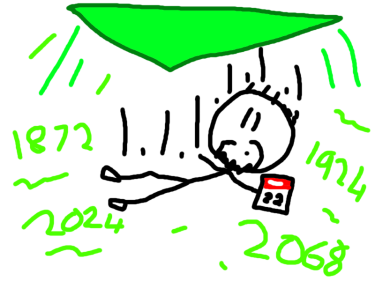
Each main chapter of Old Skies focuses on one of Fia's jaunts to the past with her client. The first is a relatively short trip back to the New York of 2024 as a renowned scientist hopes to resolve some lingering regrets. Things… do not go entirely according to plan, setting what one would anticipate to be a template for the rest of the game. But interestingly, the second immediately subverts that expectation by being much longer, more involved and more complex, both mechanically and narratively. In this chapter, set in the "Gilded Age" of the late 19th Century, something still goes "wrong", but in an entirely different way, forcing both Fia and her client to work through a complex series of events in two closely related time periods (six months apart) in order to set things what is, to their best interpretation, "right".

The whole thing raises some interesting questions about the very ethics of something like time travel. How do you ensure someone's selfish actions don't make a real mess for everyone in the future? How, exactly, do you police such things? Who decides who and what is "important" to the coherence of the overall timeline — and how? Why were they given that opportunity?

I'm looking forward to seeing how the story evolves, and it also appears that this game is going to be pretty substantial by adventure game standards. At four hours to complete the first two chapters, and I believe at least seven in total, this is looking like a fairly beefy adventure, though its chapter-based structure also means that it feels nicely episodic, so you can leave it at a natural break and come back to it another day.

Thus far, I haven't really seen the problem that some reviewers argue is the game's "weak mechanics"; the game doesn't rely much on using inventory items on things in the game world to progress, but instead prompts you to think carefully about the pieces of information you gather, how they relate to one another and, in some cases, how closely related time periods might relate to one another, too. There are some particularly clever sequences in the second chapter, requiring you to jump back and forth to revisit the same locations six months apart and manipulate the information you find in order to secure an advantageous outcome for everyone involved… as much as is possible, given your own interference, anyway.

The game is beautifully presented, with some absolutely stellar voice acting and music, and some really nice animation on the main characters. It's also nice to see an adventure game breaking free from the seeming "obligation" that some developers feel to use '90s-style pixel art; Old Skies instead adopts a true high-definition look that feels like a true successor to the brief period of "Super VGA" adventures during the winding-down of the Sierra and LucasArts "golden age".

Anyway, I'm sure I'll have more to say in the coming days/weeks as I work my way through it on evenings where I feel like something a little more chilled out than Donkey Kong Bananza. In the meantime, if you're a point-and-click type, I can highly and confidently recommend Old Skies; it's another fantastic game from Wadjet Eye (developed by them this time, as opposed to the numerous other titles they've published in recent years) and well worth the £17 it costs. Take that, £75 video games!


Want to read my thoughts on various video games, visual novels and other popular culture things? Stop by MoeGamer.net, my site for all things fun where I am generally a lot more cheerful. And if you fancy watching some vids on classic games, drop by my YouTube channel.

If you want this nonsense in your inbox every day, please feel free to subscribe via email. Your email address won't be used for anything else.

#oneaday Day 259: Excavations

I successfully did what I planned yesterday — for two nights in a row, even. Last night I spent some time with Smashing the Battle on Nintendo Switch, which I'll write a bit more about once I've spent some more time with it, and tonight I have seemingly spent nearly six hours playing The Excavation of Hob's Barrow, a point-and-click adventure by Cloak & Dagger Games, published by modern adventure game specialists Wadjet Eye Games.

It always does my soul good to see how not-dead the point-and-click adventure genre has been for quite some time now, because there was definitely a period in the mid 2000s and early 2010s where it felt like there weren't any being made. 3D tech was getting better and everything was suddenly all about cinematic action games — something that certainly hasn't gone away in more recent years — but, looking back, it's clear that adventure games never really went anywhere. And these days, I'd say they're thriving more than they ever have done, even in their supposed golden age. Because not only can we enjoy the established classics from that golden age, there's a host of new ones seemingly being made all the time.

I'll write more specifics about The Excavation of Hob's Barrow when I've fully completed it — I've pressed pause on it for this evening as it's a quarter to one and I should probably sleep. Suffice to say for now that it's very good, though.

In The Excavation of Hob's Barrow, you take on the role of Thomasina Bateman, an antiquarian who has made it her mission to document the various ancient burial mounds scattered around the English countryside. We join the story as she arrives in a remote Northern village, supposedly the home of the titular Hob's Barrow, but she's immediately confronted with mysteries as her contact is nowhere to be seen and no-one seems to want to talk about Hob's Barrow.

That's all I'll say on the plot for now. The interface uses a pretty standard two-button system, with left-clicking "doing" things and right-clicking "looking" at things, but there's plenty of thinking required. Thus far there has been no real "moon logic" to speak of, just a sequence of tasks to complete that provide a sense of relative freedom without overwhelming you with possibilities. In fact, the game is quite cleverly designed in that the "freedom" you feel is not really present at all; there's quite a fixed sequence of things to do with a chain reaction of dependencies, but the fact you discover the beginnings of all these various threads before you start figuring out which order you need to solve them in is what makes this game really work.

It's beautifully presented in low-res pixel art combined with modern graphical techniques and greater colour depth, which gives it a wonderfully distinctive aesthetic. The voice acting is very good, too, seemingly making use of native Northerners in many cases.

I'm intrigued to see where it goes, but not quite enough to pull an all-nighter on it. After all, GOG Galaxy says I've already spent 5 hours and 28 minutes on it this evening and I've only completed two of the in-game "days". I don't know how many there are in total, but it does feel as if the third one is going to be somewhat climactic, so I estimate I'm maybe a little over halfway to two-thirds through? We shall see, I guess.

Anyway, if you're jonesing for a modern point-and-click adventure, I can definitely recommend this one. It's kept me pretty enraptured for the whole evening and I'm looking forward to seeing how it all concludes.

For now, though, sleep. Sleep!


Want to read my thoughts on various video games, visual novels and other popular culture things? Stop by MoeGamer.net, my site for all things fun where I am generally a lot more cheerful. And if you fancy watching some vids on classic games, drop by my YouTube channel.

If you want this nonsense in your inbox every day, please feel free to subscribe via email. Your email address won't be used for anything else.

2454: Spooks and Spectres

0454_001

I finally got around to starting the Blackwell miniseries of adventure games this evening. These are some games that I've had in my GOG.com library for quite a while now, but have never gotten around to playing before.

So far as I'm concerned, the Blackwell games have a good pedigree, as they come from Dave Gilbert's Wadjet Eye Games, who produced the subject of the very first Squadron of Shame SquadCastThe Shivah. While The Shivah was a little lacking in production values (as, too, is Blackwell — at least, its first episode is, anyway; I can't yet speak for the subsequent ones) it told an interesting story and was a good adventure game to boot.

The Blackwell series centres around protagonist Rosangela Blackwell, last of her family line. Both her aunt and her grandmother succumbed to a mysterious mental illness, and Rosa discovers that she may be at risk too. What the psychiatrists didn't know, however, is that the Blackwell family has a legacy: a ghost named Joey, who has been stuck in between this life and the next for the last forty years, and who has found himself "attached" to each generation of Blackwell women to fulfil some sort of greater purpose. Rosa is the latest to discover the existence of Joey, and is determined to get to the bottom of who he is and why he has been haunting her family.

The Blackwell Legacy, the first installment in the series, is largely concerned with establishing the characters and the setting. Joey isn't present until a good halfway through the storyline; prior to that, we simply see life through Rosa's eyes as she learns what little there is to know of her family's mysterious apparent mental illness. Once Joey shows up, however, the story becomes much more supernatural in nature: he and Rosa team up to help restless spirits move on to the next world.

The Blackwell Legacy opens with Rosa investigating the suicide of an NYU student. It gradually comes to light that she and two of her friends had been meddling in the occult — did these people not pay any attention to horror movies? — and consequently, two out of the group of three had ended up dead. The girl Rosa was originally sent to investigate passed on with no regrets, it seems, but one of her friends finds herself stuck between realities, unable to accept that she is dead, while the third attempted suicide and failed, ending up in the same psychiatric hospital where Rosa's aunt spent her twilight years.

The story strikes a good balance between "real world" investigation and the supernatural; in order to help the restless spirit move on, Rosa has to research the people involved and what they were up to. The game features a cool "clues" system where Rosa makes notes of important people, places and things in her notebook, and these can then all be brought up as topics of conversation when questioning witnesses. There's also an Ace Attorney Investigations-style system whereby Rosa can "connect" pairs of these clues to produce a third clue based on her conclusion, and indeed most of the puzzles in the game revolve around doing this, then asking someone about it.

The Blackwell Legacy was a short but enjoyable adventure that I enjoyed a lot — it certainly made me curious to see where the story goes in its subsequent installments. Its low-res pixel art with jerky scrolling brings to mind the old LucasArts games, it had some good, atmospheric music throughout and the voice acting was decent — albeit done with poor equipment and software, a criticism which could also be levelled at The Shivah. Joey is particularly prone to shouting into the mic and performing with particularly plosive plosives, for example, while other voiceovers have a great deal of background noise, presumably as a result of boosting quieter voices up in volume a bit too much.

The game was also a bit prone to crashing to desktop — I'm not sure what it is about adventure games that make them some of the most crashy games on the planet, but I swear, of all the games that have crashed on my PC in the last few years, most of them have been adventure games — but fortunately there's an autosave system that prevents losing too much progress.

Overall, I enjoyed The Blackwell Legacy a lot and I'm looking forward to playing its sequels. If you're a fan of classic late '90s-era point-and-clickers, you could do far worse than check it out.