#oneaday Day 509: A new age of "talkies"

Back when the CD-ROM era first started, and game developers suddenly had a lot more storage capacity to play with, a revolution unfolded. Games became "talkie", with formerly text-based dialogue now being supported (or sometimes, in those less enlightened times, replaced) with voice acting of variable quality. This was, for the most part, seen as a significant step forwards in terms of games being able to tell interesting and convincing stories, though some genres benefited from it more than others, with probably the biggest beneficiary being point-and-click adventures.

These games already had pretensions of movie-style storytelling. Indeed, back when Ron Gilbert of LucasArts coined the term "cutscene" with Maniac Mansion, he defined them as "short, animated sequences — like scenes from a movie — which can provide clues and information about the characters" (emphasis mine). As such, it was only natural that as interactive entertainment and movies moved ever-closer together, we would start to hear game dialogue as much as read it.

That wasn't universally the case, mind; not every game that featured dialogue was fully voiced. In many cases this was because the storage capacity of a CD wouldn't have been sufficient to include the entire script for longer games such as RPGs, particularly on console, where they had been becoming more and more dialogue-heavy. In those cases, the extra storage space instead went to other purposes such as pre-rendered video sequences or even live action video.

The advent of DVD didn't lead to longer games suddenly becoming "talkie", either; while there was often a lot more speech in these games, they still often weren't fully voiced. Final Fantasy X is a good example — major story scenes in that game are fully voiced, but incidental interactions and random NPC conversations remain text-based. And this situation has continued right up until this day — even with the huge storage capacity of modern flash memory-based cartridges and Blu-Ray discs, there are still a fair number of RPGs that have unvoiced dialogue — although that number is dwindling a bit. Many Japanese games, even from relatively low-budget studios like Compile Heart, even have dual audio today.

We're in a position now where it's possible for another minor revolution in "talkie" terms, and one of the best examples I've seen is the recent Final Fantasy Tactics remake. This is one of those games where, as outlined above, there was far too much in the way of script for them ever to be able to make it fully voiced back in the PlayStation days. Not only that, but video game voice acting in the late '90s was generally… Not Good. There was the odd exception, yes, but going back and listening to some of those early "talkie" games sometimes makes you just want to turn the speech off and go back to fully text-based dialogue. King's Quest V says hello. (King's Quest VI, meanwhile, is excellent.)

Today, though, we have a wide and diverse variety of voice actors with plenty of video game experience, and pretty much all of them can be heard in Final Fantasy Tactics. And the result is simply smashing. By combining the revised (and considerably better) retranslation for the PlayStation Portable "War of the Lions" version of Final Fantasy Tactics with a cast of voice actors who can actually act, we have one of the most gloriously theatrical games I think I've ever played. It really is a thing of wonder, and it adds so much to the game.

It makes me want to see more games from the PS1 era tackled like this. I would love to see some remasters of games from that period where the basic gameplay isn't touched all that much aside from a few interface and balance tweaks, but a fully voiced script delivered by people who know what they're doing is added. There's a bunch of games that would really benefit from this treatment — though it remains to be seen if companies like Square Enix will feel inclined to do this any more.

By all accounts, Final Fantasy Tactics: The Ivalice Chronicles appears to have been doing well both critically and commercially, though, so hopefully this is taken as a sign of something people would like to see (and hear) more often.

In the meantime, I'm off to go enjoy it a bit more.


Want to read my thoughts on various video games, visual novels and other popular culture things? Stop by MoeGamer.net, my site for all things fun where I am generally a lot more cheerful. And if you fancy watching some vids on classic games, drop by my YouTube channel.

If you want this nonsense in your inbox every day, please feel free to subscribe via email. Your email address won't be used for anything else.
1236: On Being That Guy Who Picks 'Japanese' in the Sound Menu

Jun 07 -- AaaaaaaaI always used to be one for having my game's voices in English. I liked being able to understand what they were saying as well as reading the subtitles on screen. In some cases, I didn't have the option; I'll always associate Persona 3 and 4 with English voices, for example, even though, in retrospect, it would probably be better with Japanese voice acting. In others, the English voiceover job was so genuinely good that I didn't want to try the Japanese version — Xenoblade Chronicles springs immediately to mind in this regard.
I can remember the moment that I realised Japanese voice acting was something worth exploring even though I didn't speak the language, though. It was while I was playing the utterly terrifying PSP visual novel/adventure game Corpse Party — one of my favourite games on that platform, and legitimately one of the most disturbing games I've ever experienced — that I realised that, frankly, Japanese video game voice actors aren't afraid to let rip with the utterly raw emotion. They'll shout until their voice cracks; they'll scream; they'll cry. And by God, they sound like they mean it.

It was around one of the many points in Corpse Party where one of the characters is bawling their eyes out and screaming in terror at the horrific situation they've found themselves in that I realised when it comes to voice acting in games — which are typically accompanied by subtitles, particularly in the visual novel and JRPG genres — it's not about the words that are being said, but about how they're being said. It didn't matter that I didn't understand the Japanese words that were being screeched into my ears (seriously, play that game on headphones and you'll never want to turn the light out again) — the meaning was all too clear simply from the tone of voice.

Those who have been reading regularly will know that I've been playing Ar Tonelico 3 recently. I played the first game in that series in English, largely because I found the English voices in the video cutscenes too jarring when paired with Japanese speech in the main game. I played the second in Japanese because I'd been warned that the English dub, much like the overall translation job, was somewhat questionable. And I started the third in English, but after not very long I switched to Japanese. It is a decision I did not regret.

It's very obvious from the huge rift in quality between the English and Japanese voice tracks in something like Ar Tonelico 3 that the English actors are, for the most part, phoning it in somewhat, while the Japanese actors care about what they're doing. In many cases, it is the difference between a rush job (English) and having well-known professionals handle the voices.

I witnessed a scene this evening — no spoilers — that had me more than a little choked up due to the amount of raw emotion and passion that the actress playing one of the characters was throwing into the delivery of her lines. I believed that she meant what she was saying. This character was supposed to be upset, and I believed that.

The other thing that comes into play is that when a game's dialogue has been translated relatively literally from the original Japanese rather than fully localised, reading it out loud in English often sounds very stilted and artificial, simply because that's not how English people talk. We don't say things like "what is this, all of a sudden?" and start entire conversations with "By the way". We don't refer to ourselves in the third person to be cute. (Usually. Saki will do it!) And we don't use the term "lovey-dovey" anywhere near as much as Japanese people apparently do.

There's nothing wrong with doing a literal translation from the Japanese — so long as you do it with enough care to make it understandable, of course — but if you're going to take this approach to translation, I've come to the conclusion it's best to leave the voices as they are. If, on the other hand, you're going to take the Ace Attorney/Cherry Tree High Comedy Club/Recettear approach to localisation and actually make the dialogue significantly and noticeably more "Western" in the process, then we can talk about English voiceovers.

I must confess to always having found an attitude like the one I just described a little snobby in the past. Having immersed myself in this side of gaming (and anime) culture for this long, though, I totally get it. Once you get used to the infinitely more professional job Japanese voice actors do on productions like Ar Tonelico (and even on lighter fare like Hyperdimension Neptunia, for that matter) you'll likely never want to go back.

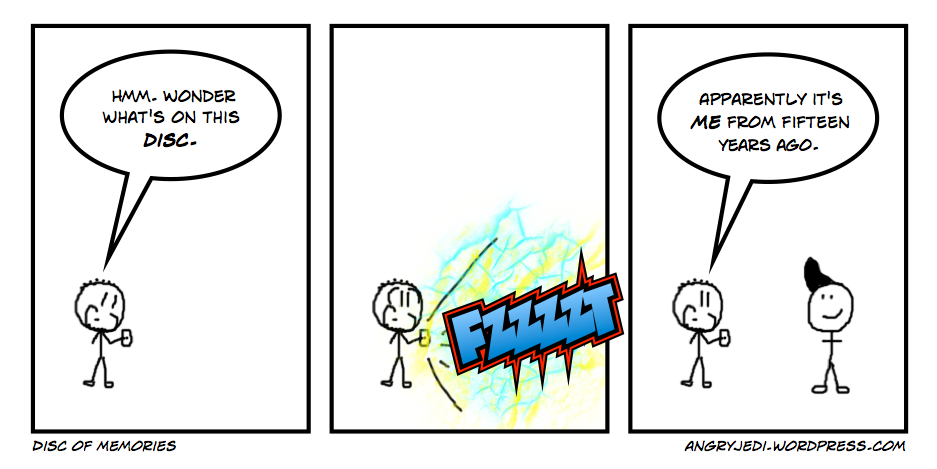
1129: Disc of Memories

Page_1For the longest time, I've kept a specific CD-R hanging around. Somehow it's survived all the different house moves I've gone through since leaving home and is still intact. I'm more impressed that I haven't lost it or accidentally thrown it out than by the fact it still works, but I guess that's pretty cool, too.

The raggedy inlay lists a few bits and pieces on the front, but gives relatively little indication to its contents. "PETE'S STUFF" it proudly announces in green felt-tip pen. "\PIERRE\ (GENERAL), \KNP\ (KLIK GAMES), \FFCOLLECTION\ (FINAL FANT.)" it elaborates, also in green felt-tip pen. The last entry is simply a collection of emulators and ROM files for all the Final Fantasy games up until VI, including a translated Japanese ROM for the NES original version of III. But it's the other two that are more interesting.

The "Pierre" folder is from my first PC, which was a mighty Pentium 133 that could run Doom and Quake like nobody's business. It had both a DVD-ROM drive and a CD rewriter, and I also eventually installed a Sound Blaster Audigy into it, which took up another drive bay with a ridiculous front-panel audio interface that looked pretty cool. Said folder contained a wide variety of almost-organised bits and pieces, consisting almost entirely of MIDI files downloaded from CompuServe and the Internet at large — mostly music from Final Fantasy and Chrono Trigger, with a brief break into Wild Arms, Xenogears and Zelda territory — as well as saved walkthroughs from an early incarnation of GameFAQs. This was the age of dial-up networking, you see, and thus it wasn't possible to simply "quickly" hop onto GameFAQs to check a walkthrough; it was much more efficient to save it. (If you're wondering, my saved guides included Alundra, Bust-a-Groove, Rival Schools, Wild Arms and Xenogears.)

Also in this folder is an early form of a tabletop roleplaying game system called "The Returners," based on Final Fantasy, along with original text files for some of my earliest pieces of freelance writing work — a two-part guide to Final Fantasy VII for PC Zone, a 3,000 word Discworld II guide, a Lands of Lore II guide that was an absolute nightmare to put together, and a walkthrough to Turok 2 using the Official Nintendo Magazine's curious internal system of markup to include special characters and other layout bits and pieces.

Pleasingly, one thing that I have found among all this crap is a folder containing a bunch of half-finished creative writing works from a long time ago. There's a sci-fi epic I started working on that was loosely based on Sierra's excellent spacefaring strategy game Alien Legacy (kudos if you remember that, it was awesome) along with a piece I wrote for my A-Level English Language coursework. I liked it so much when I wrote it that I extended it somewhat. It's also probably my earliest example of writing creative prose in "stream of consciousness" style — we'd not long covered Jean Rhys' Wide Sargasso Sea in English Lit class, and the curiously disjointed method of writing had proven to be quite appealing to me, so I experimented with it. It paid off with a good mark, as I recall, though I'm not sure it holds up quite so well to further inspection some fifteen years later. Still, it's nice to have it.

(Oh, also, there's a subfolder in the "Pierre" folder just labelled "ANNA KOURNIKOVA IS FIT", which I think is fairly self-explanatory.)

The "KNP" folder is an interesting one, as it contains a selection of half-finished (yes, I have a habit of half-finishing things) games made with Clickteam's excellent software Klik and Play, later superseded by The Games Factory and Multimedia Fusion. This folder contains the earliest ever incarnation of the story "Dreamwalker", which I still fully intend to get out of my head and into some form of creative medium before I die. The original version of Dreamwalker was more an experiment to see if it was possible to make a Zelda-style action-adventure using the rather limited Klik and Play tools, and indeed it was, with a bit of creativity. Once I'd started making it, though, I found myself getting quite attached to the characters involved, even if I'd borrowed the basic concept (if not the setting and characters) from Alundra on PS1, which I'd played around the same time. I also actually composed some music for Dreamwalker, which I still have the MIDI files for, and which are in dire need of mixing properly. Perhaps that can be a project sometime — the tunes themselves are actually pretty solid, in my humble opinion.

The KNP folder also includes the original version of Pie Eater's Destiny, one of the only four complete video games that I have ever made. (The other three are London Taxi Chase, London Taxi Chase II and… a remake of Pie Eater's Destiny) Pie Eater's Destiny holds a fond place in my heart because it was a collaborative project between me and my two best buds in the late stages of school, and it's a running joke among us that one day we'll make a sequel. We've started several times, but somehow, well over ten years later, we're yet to get anywhere. Pleasingly, the data files for Pie Eater's Destiny also include the original .WAV file recordings of us doing voice acting for the game, including the outtakes which we saved. There are also .WAV files of us experimenting with pitch shifting and other special effects, including several alarmingly-convincing "Jabba the Hutt doing things he was never supposed to be depicted doing" files. JABBAWNK.WAV, indeed.

Anyway, I was happy to rediscover some of the useless crap on this disc when I opened it up on a whim today. It's missing a few things that I hoped I'd find on there, but I'm glad I found the other stuff. Perhaps when I can be bothered I might share some of it here. Those voice acting outtakes are crying out to be edited into some sort of YouTube clip.