#oneaday Day 672: Return to virtuality

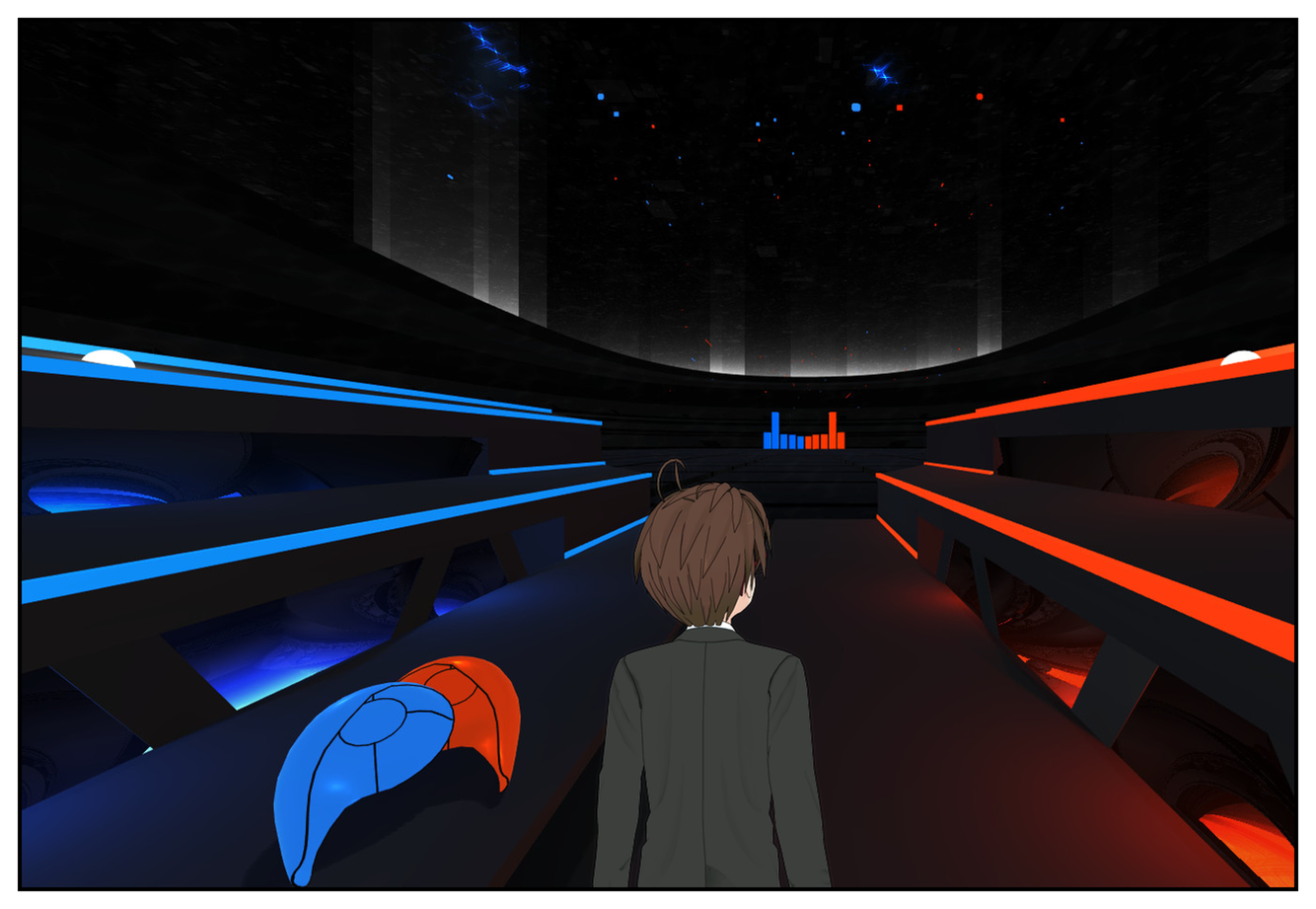
Since starting Resident Evil 7 in VR a little while ago — after discovering that our carefully cable-managed solution for PSVR did not, in fact, work due to using a USB extender that didn't do data — I've been getting a bit back into VR stuff. And the good thing with the original PSVR is that because its games are a few years old now, they're exceedingly cheap. I picked up Wipeout Omega Collection, Battlezone, No Man's Sky (I know what I said a couple of days ago, but… c'mon) and Ultrawings to give a try, and add these to the several VR games already on my shelf that I haven't got around to playing yet, such as the second Summer Lesson game, and the PSVR visual novel, Tokyo Chronos.

I'm installing Wipeout as we speak. I suspect this will be the most… challenging to deal with, shall we say, but I'm also looking forward to giving it a try. I love thrill rides, but as a fat person I cannot ride real ones, so I'm hoping that something like Wipeout will scratch that itch somewhat. And even if it doesn't, I've been meaning to try Wipeout Omega Collection for a long time anyway.

The others I know a bit less about. I know Battlezone was quite well-regarded when it first launched quite early in the PSVR's lifespan, No Man's Sky should hopefully be quite an experience — though I do wonder how its more complex gameplay elements will translate to VR — and Ultrawings I know nothing about, but it was three quid so even if it's rubbish I don't mind.

VR has its flaws, particularly with earlier implementations like the first PSVR. But I do like it. It's an interesting way of experiencing things, and it's kind of a shame that it has never quite taken off in the way anyone really hoped it would — largely due to those flaws, in many cases, and the expense in others. (That said, I bet you could probably grab yourself a PSVR relatively cheap now. PSVR2 is still pricey though.) I will be interested to see what the supposed "Steam Frame" does for VR, if anything; saying that, I will be interested to see whether it launches at all, given the, uh, "challenges" that tech is facing right now as a result of ongoing AI cuntishness and… various geopolitical events, shall we say.

Anyway, Wipeout has finished installing, so I'm off to give it a quick blast before my dinner and to see if my stomach contents remain intact. Wish me luck!


Want to read my thoughts on various video games, visual novels and other popular culture things? Stop by MoeGamer.net, my site for all things fun where I am generally a lot more cheerful. And if you fancy watching some vids on classic games, drop by my YouTube channel.

If you want this nonsense in your inbox every day, please feel free to subscribe via email. Your email address won't be used for anything else.

#oneaday Day 524: Steam powered

So Steam announced a bunch of new hardware, and some of it looks quite nice — though the fact that no prices have been mentioned as yet is a bit of a concern.

Of the items that have been announced, I find the "Steam Frame" probably the most interesting. This is a standalone VR headset that can either stream games from another computer, or run games installed on its own storage. It doesn't have to be VR games, either; you can play standard 2D games on a big "virtual screen" in VR.

There are a number of attractive things about this. Firstly is the fact that it looks like being a relatively lightweight, comfortable headset — certainly a far cry from the units of even just a few years ago. Secondly is, of course, the Steam compatibility; by running things from your Steam library just like a Steam Deck (or the newly announced Steam Machine), it has an immediate ready-made library of thousands of games to choose from without having to worry about whether the platform will be supported over the long term. Thirdly is the fact that it's a standalone headset that has nothing to do with Meta — since up until now, your only real option in that regard has been a Quest.

Now, of course, being tied to Valve and Steam has its own concerns. Steam's community features remain a rancid cesspit of the very worst examples of humanity, for example, as discussion forum after discussion forum is overrun by right-wing fuckheads crying about "DEI" and "woke" at the slightest hint of a female character in a leading role. That is something that the company probably should address, but it also feels like it's probably much too late for them to be able to do anything about at this point. We are very much in "lunatics running the asylum" territory at this point, since it's extremely rare anyone from Valve actually steps in to deal with a situation; mostly it's up to developer and publisher community managers to stem the tide of absolute sludge from the dickheads of the Internet — and I absolutely do not blame any of them who simply refuse to engage with a Steam discussion forum on principle.

Then, of course, there's the matter of several of Valve's games encouraging a form of gambling with their lootboxes and tradable items and whatnot. Add the exploitative (and easily exploited) trading card system to the mix and you have a whole mess of ethically questionable stuff going on, because this stuff probably makes Valve a lot of money.

And finally, of course, there's the fact that Steam is the one example of online-centric DRM that everyone has been sort of fine with for a long time. Sure, there are many games that can run without Steam being open, but it can be a bit of a pain to find out which games this applies to, and which require you to have a stable Internet connection. There's no good way to take your games "out" of Steam in the same way that GOG.com provides, either; no making your own physical copies or backups of Steam games.

There's also the fact that Steam was pretty much single-handedly responsible for completely destroying the collectible physical market for PC games — although I will be fair here: if you're going to be gaming on a standalone VR headset you probably don't want to be inserting discs into it while you're trying to get your game on.

I'll be interested to see what people think of these new machines once they're out in the wild. I have no particular need for a Steam Machine, as I have a perfectly competent "living room PC" that can run most games I'm interested in playing on PC rather than console — but, as I say, the Steam Frame is of at least moderate interest to me for gaming purposes. If I do end up getting one, I will almost certainly keep my living room PC up and running as it is, as I don't just game on it; it's also an entertainment centre, my video editing system and where I do just… general computery things. I'm not entirely ready to make the switch to Linux (which SteamOS is a flavour of) as yet, but I suspect that time will come at some point.

Anyway, I'm reserving judgement until I've seen prices and I've heard what people I trust think of these things. But there's definite potential for Valve to have something special here. I certainly think they're well-placed to fill the growing Xbox-shaped hole in the games industry with Microsoft's continual missteps in that regard.

We shall see!


Want to read my thoughts on various video games, visual novels and other popular culture things? Stop by MoeGamer.net, my site for all things fun where I am generally a lot more cheerful. And if you fancy watching some vids on classic games, drop by my YouTube channel.

If you want this nonsense in your inbox every day, please feel free to subscribe via email. Your email address won't be used for anything else.

2345: Keep Talking

0345_001

I went over to my friend Tim's house this evening for our semi-regular games and food event that we at least attempt to have on a fortnightly basis. Tonight it was just three out of our usual five members, so we spent the evening playing VR games on Tim's HTC Vive.

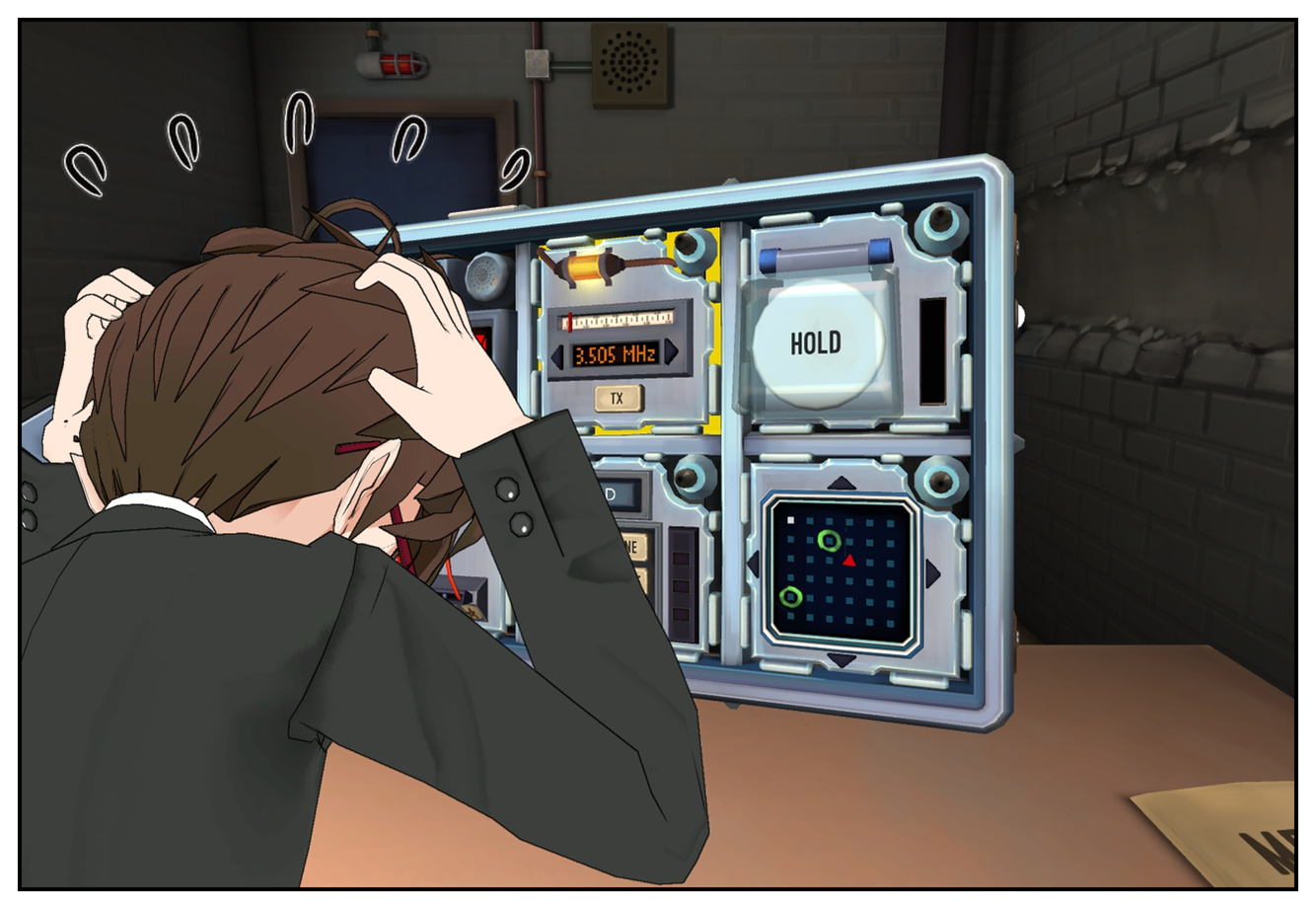
The most interesting experience we had was with a game called Keep Talking and Nobody Explodes, which I've been curious to try for a while. This is a game that doesn't actually need VR to play, but keeping one player quasi-isolated with a VR headset adds a great deal to the experience and makes it considerably more fun. It'll be even better when full support for the Vive controllers is added; at present, the room-scale movement works, but you have to interact with it using a standard gamepad.

Keep Talking and Nobody Explodes is a party puzzle game in the Spaceteam mould in that it's asymmetrical in terms of player roles and requires good communication in order to be successful. The player with the VR headset on is faced with a bomb consisting of a number of discrete modules, while all the other players (which can be literally as many as you want) are "experts" telling the VR player what to do. The twist? The "experts" can't see the bomb, so the VR player has to describe what they see in the hope that the experts can decipher the rather garbled instruction manual and make the correct decisions.

The bombs start off simple with modules such as collections of wires, which require you to read a sequence of logical statements and cut the appropriate wire according to which one is true. There are also buttons that require you to first of all determine a specific condition and then, in some cases, press and release the button with appropriate timing. These are pretty easy to work out and execute.

The more complicated modules range from a memory test that requires you to push buttons according to one of four logical statements, some of which refer to things you did in previous steps, to working out a five-letter password using the available letters in each position to determine what it's most likely to be from a list of possibilities. Then there's a more advanced wire-cutting exercise that requires deciphering a ridiculous Venn diagram according to the colour of the wire and whether or not lights and stars are lit up, and a maze that the VR player has to navigate without being able to see where the walls are.

After a little while, it's possible to "learn" how all these modules work, so at this point the game starts introducing distractions. Initially these are simple: the lights occasionally go off, meaning that you can't see the bomb (but can still interact with it if you remember what you're doing), or an alarm clock starts bleeping obtrusively. Later there are so-called "needy modules" on the bomb which can't be disabled and keep doing inconvenient things during your defusing attempts, so you have to divide your time between taking care of these persistent pests and making progress on the actual disposal effort.

I really liked it as a game. It's simple and intuitive to play, surprisingly immersive as both the "experts" and as the VR player, and has a real, genuine sense of tension to it all. Some of the modules are pretty difficult to work with — the Morse code one being the worst by far — but what's a game without challenge?

I'm glad we gave it a go, and I'm looking forward to playing it again sometime soon. If you're lucky enough to have a VR headset and at least one friend, I recommend grabbing a copy. Even if you don't have a VR headset, for that matter, it's worth a play — just make sure your "expert" players can't see your screen!

2342: A Belated Account of My First VR Experience

0342_001

It occurred to me a few days ago that I had a go in Virtual Reality recently and didn't write about it. Let's rectify that right now.

My friends Tim and Tom both grabbed the HTC Vive pretty much as soon as it became available, because both of them have disposable income and a gaming-related gadget fetish. Last week, I finally had the opportunity to give Tim's setup a go. And I came away rather more impressed with the whole thing than I was expecting to be.

The Vive headset itself is surprisingly comfortable and not ridiculously bulky like the Virtuality headsets of the '90s, which were my only previous experience with VR. The picture quality was reasonably good, too — certainly a far cry from the Virtuality screens, which felt like holding two Atari Lynxes up to your face — but I did find it a little tricky to position the headset absolutely perfectly so that everything on the display was in focus; I found stuff around the edges (particularly the lower edge) was difficult to remove the blurriness from, but I adjusted to it after a little while.

The first thing I tried was the Vive "training" setup, which gives you some examples of how to interact with virtual worlds using the headset and the two Vive controllers. It introduces you to the idea of "room scale" play — the ability to actually physically move around and have your body movements accurately reflected in your virtual viewpoint — and how the Vive controllers offer 1:1 motion tracking that is so accurate, even though you can't see your own hands while you have the headset on, you can still reach out, grab the controllers and press the buttons without any difficulty.

I think the most immediately striking thing about the Vive's VR is the room scale thing, which is, after all, that particular setup's unique gimmick. I was very surprised how natural it felt; there was no kind of input lag when moving my head around, nor when I moved my body; I could tell I wasn't actually in the location I was looking at, due to the lack of tactile feedback in the environment, but I could move around and interact with things as easily as I could in the real world. Particularly impressive in the training demo was the part where you inflate balloons using the controllers, and can then hit them around the room as if they were right there. Again, there was no tactile feedback, but the accuracy of the motion tracking was such that I could intuitively reach out to hit them with a controller, and they would react appropriately. Impressive.

The next thing I tried was Space Pirate Trainer, which is one of the first games to come out on the platform. It's a very simple affair that sees you standing on a platform wielding two pistols and having to shoot down waves of drones that pop up from all sides. The pistols can be switched to various different fire modes, and you can physically dodge the incoming laser bolts from the drones to avoid being hit.

This latter aspect was the thing I found most unusual and surprising to adjust to. I've played games that involve physical movement before — primarily on the Wii, but a couple of EyeToy and Kinect games, too — but I've never played a game where you can see a bullet flying at your face and actually lean out of the way of it. I mean, sometimes I instinctively do it when playing Overwatch (I can't help it!) but in Space Pirate Trainer you actually have to do it in order to survive. And it's not a Time Crisis-style situation where you can either be "hiding" or "shooting" — you can position yourself how you please. You can kneel down to crouch under the shots. You can sidestep them. You could probably even jump over them if you tried. It's kind of amazing, although the game itself is fairly bare-bones, to say the least.

Next up I tried Google's VR art package Tiltbrush. This is actually one of the things I was most interested to try, despite it being utterly "directionless" — it is what you make of it, in other words.

Essentially, Tiltbrush allows you to paint in 3D using various materials. The left Vive controller acts as an artist's palette with several sides, and the right Vive controller acts as your paintbrush and cursor to pick things from the palette. You can then paint with light, colour, fire and various other substances, then the truly impressive part is that you can physically walk around your creation in 3D to admire it from all angles. By extension, this also means that you can create 3D sculptures rather than just flat paintings, and indeed many of the example materials produced by both Google and the community are designed with this in mind. What's really nice about them, too, is that loading them up allows you to watch a recording of the exact strokes and steps they took to create the finished product; it can be fascinating to watch and, moreover, give you some ideas of your own on how to make some interesting designs.

Last of all, I tried Audioshield, a game by the developer of the excellent Audiosurf, and a game designed in the same mould: create levels from your own music tracks or those pulled from Soundcloud, then play through them. In the case of Audioshield, you wield two different coloured shields, one in each hand, and have to block incoming coloured balls that reach you in time with the beats and sounds in the music. While there's less moving around than something like Space Pirate Trainer — the balls only come from one side, though you will have to look up and down — it's probably the most "physical"-feeling of the games I played, in that there was a very strong urge to "punch" the balls (hurr) as they arrived, rather than just blocking them. Indeed, the game rewards you for actually doing this, as well as moving around more than is necessary ("dancing", in the loosest possible sense of the word, in that convulsing like a spastic having an epileptic fit while in anaphylactic shock will also get you credit)  to actually block the incoming beats.

By the time I took the Vive headset off, I was actually sweating. The various games — particularly Audioshield — proved to be a surprisingly intense workout, although the foam thing on the headset that goes around your eye area also seems to just naturally get a bit sweaty. (That and Tim's flat is usually the temperature of the Sun.) I'd had a great time, and I came away much more convinced that VR is something that is going to be really cool in the near future than I had previously been. I'm still not necessarily convinced it's the future of gaming as some seem to think, but I'm certainly completely on board for experiences like Tiltbrush and its ilk.

I'm very interested to see how the launch of PlayStation VR in October of this year affects the VR landscape in general. I have a strong suspicion that it will help drive the technology into the "mainstream", and we'll start seeing a lot more interesting products than the current swathe of what are effectively tech demos that we have now. Very impressive, fun tech demos, admittedly — tech demos that make me kinda want a Vive of my own — but tech demos nonetheless.

So yes. VR looks like it's going to be around for a while yet; we finally have the technology that allows us to have fairly convincing experiences in our own home, which is considerably more than can be said for the last time VR tried to be a thing back in the '90s.

2234: Is VR Really Going to Take Off?

0234_001

I have, believe it or not, a friend. I have several, in fact, but this friend's name is Tom. Tom primarily spends his money on bits and pieces for his PC, and is extremely excited about the impending virtual reality revolution — so much so that he's bought an incredible "gaming chair" with attached steering wheel, pedals and HOTAS (Hands On Throttle And Stick) control scheme, ready to play everything from Elite: Dangerous to a variety of racing games in glorious, stereoscopic, head-tracking 3D.

Me, I'm yet to be convinced by the value of VR. I know that theoretically it should be enormously exciting, but at present, there are two big things that put me off: firstly, the cost, which, for however much HTC and Oculus might try to argue that they're making VR more mainstream, is well out of the budget of most people; and secondly the fact that there's still a fundamental disconnect between yourself and the virtual reality into which you're trying to immerse yourself.

There's not a lot to say about the cost, really — it's a lot, I can't afford it, because I'd have to upgrade my PC as well as buy all the hardware, that's about it — so I'll focus on the latter aspect, because that's what bothers me about the technology long-term.

There are certain applications for which VR seems ideally suited. Something like Elite: Dangerous, for example, will likely be very good indeed, because the entire Elite experience is based on you sitting in a chair in your spaceship cockpit, flipping switches and jiggling joysticks in order to fly around and do spacey things. Likewise, driving games will also be very good, since again, the experience is based around you sitting in a chair holding on to a steering wheel for dear life. In other words, the experiences that my friend Tom is already pretty much set up for will probably be pretty good, though I do still find myself wondering how you'll find the right buttons to press with a bloody great helmet attached to your face — particularly if you're not using a fancy-pants HOTAS setup.

It's when we get into other types of experience that I feel the disconnect between the real and the virtual will be somewhat more jarring. Anything first-person would theoretically be excellent in VR, were it not for the fact that you're not actually going anywhere; the lack of physicality to motion through the world seems like something that would be very disconcerting indeed. There are companies that are attempting to get around this very issue, most notably with a big-ass treadmill-like thing that allows you to actually physically walk in order to control your motion through the game world, but at this point you're escalating the already substantial costs of VR even further just to get the feeling of immersion that VR is theoretically supposed to provide.

I don't know. I think my issue is that I'm yet to see a true "killer app" for VR; something which, without a doubt, shows that VR is the absolute only way to do this. Until that killer app comes along — or technology improves to allow things like true haptic feedback and a true feeling of physically inhabiting "another world" — then I shall remain both cautious and skeptical about the whole thing, and very surprised if it takes off with anyone but the most dedicated enthusiasts of expensive lumps of plastic wired up to their computer.