#oneaday Day 528: Thoughts on Google+

You can't say I don't provide you with variety here, dear readers. Just yesterday I was talking about underage boys simulating anal sex in a school library in order to avoid doing work, and today I'm telling you about what may or may not be the next big thing in social networking: Google+, Google Plus, Googlyplus, G+ or whatever the hell you want to call it.
If you haven't got in yet, don't ask me for an invite at the moment as they've switched them off for now. Keep an eye on Twitter or Facebook, though — I'll let you know if I have any more spare.

So, to business. What is Google+? Well, the cynical would say it's a rebranded Facebook, and indeed we've already seen at least one article today bemoaning the fact that Google+ has some features in common with Facebook. I'm not sure why they felt the need to draw attention to this, as the features they show are pretty commonplace in all social networks.

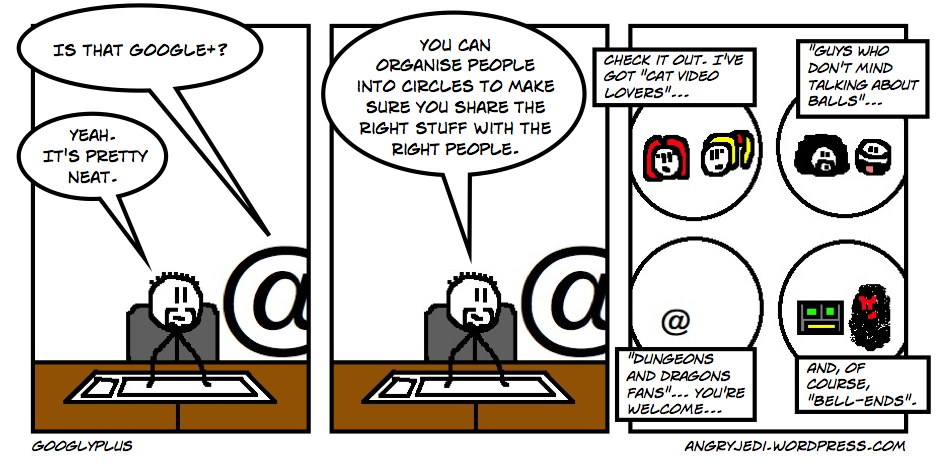
But are those cynics right? Well… yes and no. Google+ does indeed resemble Facebook. You have a news feed, people can comment on posts, people can Like things (or "+1" in this case) and people can share content. The key difference between Google+ and Facebook is how it handles the way you interact with people. There are no "friend requests" on Google+, simply Circles. Circles is an evolution of Facebook's Groups system, in which you can categorise your friends, acquaintances and family members into, well, categories. Then, when you post something on the network, you can choose which individuals or Circles it's visible to — or even make it completely public. This is a nice idea. It allows people to tailor the content they spew out to different social groups without feeling that they need to have a "work" profile and a "professional" profile. So long as, of course, you remember to keep the stories about the hooker you threw up on to your "Drinking Buddies" Circle and don't accidentally copy in your boss.

So the way you deal with people is different. But there's more; the photo interface is simple, elegant and much better than Facebook's slightly clumsy lightbox. While I think that the lightbox was a good addition to Facebook's interface, many disagreed, and the fact it's difficult to view the image and look at the comments at the same time unless you have the highest-resolution screen in the world is not great. Google+ takes a different approach. Not only does the service allow you to upload pictures at considerably higher resolution than the artifacted messes that Facebook's compression creates, but the interface allows for simple inline commenting while still viewing the picture. It's a simple case of putting the comments in a sidebar rather than underneath the picture, and it works beautifully well.

Then there's the fact that the Photos feature on Google+ integrates with Google's Picasa service. Anything you post on Picasa will be available on Google+, and vice-versa. You can even use Picnik to edit the photo, add text and generally arse about with it, save it back to Picasa (even overwriting the original if you don't need it any more) and the modified version will be right there in your feed without you needing to refresh the page. Clever. Since Picnik is a third-party service, though, this isn't integrated quite as well as it could be — an "Edit with Picnik" option when viewing a photo on Google+ would be nice, for example — but it's early days yet. And Google+ allows simple iPhoto-style edits of colours and the like to be applied to pictures without having to leave the page, which is nice, particularly for those who either don't know a lot about photo editing or don't have the software to do anything fancy-pants.

This isn't even getting started on the excellent Sparks feature, where you can subscribe to topics of your choice and be fed a constant stream of relevant articles — which can, of course, then be shared with the Circles of your choice if you see fit.

As you can tell, I'm quite enamoured with the new service and genuinely hope it takes off. My only worry is that it, like Facebook, might try and do too much. Facebook was an excellent service when it felt personal, but now it's as much a home for businesses to engage with their clientèle as a means of communication, it's becoming increasingly irrelevant to people who just want to talk to their friends. Google+'s simple elegance that it has at the moment doesn't have any of that noise — and none of the associated spam from social games and endless "What Length of Pubic Hair Are You?" quizzes, for that matter. I'm sure it won't stay that way, as social game and app developers are already pricking their ears up at the buzz surrounding the service, but I hope it stays that way for at least a little while. There's definitely a market for a clean, clear social network with minimum fuss that offers something a little more than Twitter but a lot less than Facebook. And I think Google+ has the potential to be it if the developers handle it correctly.

#oneaday Day 144: Superinjunctivitis

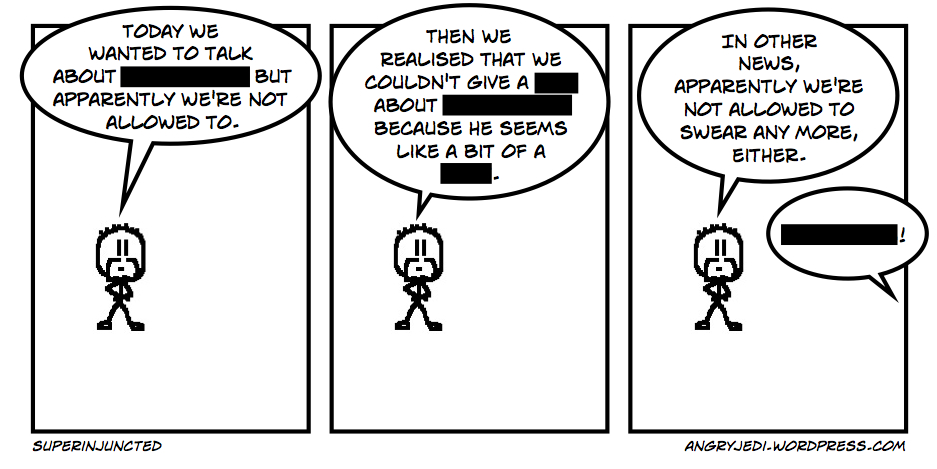
I'm not going to pretend to know everything about this footballer/slag business that is all over the news at the minute, and I'm not particularly concerned about said footballer's hilarious attempt to sue Twitter over supposedly breaking his precious superinjunction, because that's like someone suing a sword manufacturer because their hand got cut off by an insane nutter with a sword.
The question that this sort of thing always raises in my mind, though, is "who the bloody hell cares?" This whole situation wouldn't have come about without the public's incessant need for celebrity gossip — vapid nonsense about whatever [insert celebrity first name here so it sounds like you know them] is wearing this week, or whether [insert different celebrity first name here] is going to the shops on Tuesday or Wednesday this week.

A footballer shagged someone who wasn't his wife. Allegedly. This is not news. We all know that footballers are Neanderthal morons who should probably be fitted with chastity belts, so frequently do their dicks turn up in unauthorised places. We also know that anyone who appeared on Big Brother is probably not averse to the idea of selling their story, however vapid and pointless, to the "newspapers" in a desperate attempt to cling on to a bit of their waning fame. Even if said story is "Hey! I shagged a married man! I'm a massive slag!"

It's pissing in the wind, of course, but I really wish that the world could move on from the obsession it seems to have with every little thing that every celebrity, whatever they might be famous for, is up to. People who read Heat magazine need to wake up to the fact that they probably aren't going to ever meet, let alone be friends with whoever is this week's hotness.

You could argue it's escapism. Perhaps true — but why not read a work of fiction instead? Why the need to pry into the private lives of people? I guess it gives people who like to hide in bushes a means of being gainfully employed rather than arrested, but it still strikes me as incredibly obnoxious.

I follow a few celebrities on Twitter and make an effort to watch certain people when they come on TV. But that's it. I have no desire to snoop into their private lives and I certainly don't give a shit who they may or may not be having sex with. That's their business, whether it's an extramarital affair or not. Their life in the public eye should be limited to whatever it is they're famous for, then they should be left alone to deal with their problems in privacy, not subjected to endless flashbulbs.

Of course, I could (and should) just ignore it all. But when some twat who can't keep his pecker in his pants starts taking aim at a service I use every single day for both personal and professional reasons — as an indirect result of our culture's obsession with celebrities? Fuck that. I think I have every right to be pissed off.

So, Ryan Giggs. Kindly stop being a dick. Everyone knows where your penis has been by now, so trying to fight for your right to "privacy" actually strikes me as nothing more than attention-seeking, ironically.

#oneaday Day 104: Acrid Black Smoke

Earlier today, a story broke that divided opinions somewhat. The point and content of the story at this stage isn't especially important or relevant to what I'm particularly interested in right now, but the gist of the arguments that people are having is that it was a report based on anonymous sources that sounded like "just another rumour".
And perhaps it was. Or perhaps it wasn't. Anonymous sources aren't the most convincing sources of information to some people, thanks mostly to their anonymity. But these are people who would likely be immediately fired if their names were attached to things which are—presumably—supposed to stay secret for now.

Again, not the point I'm trying to make.

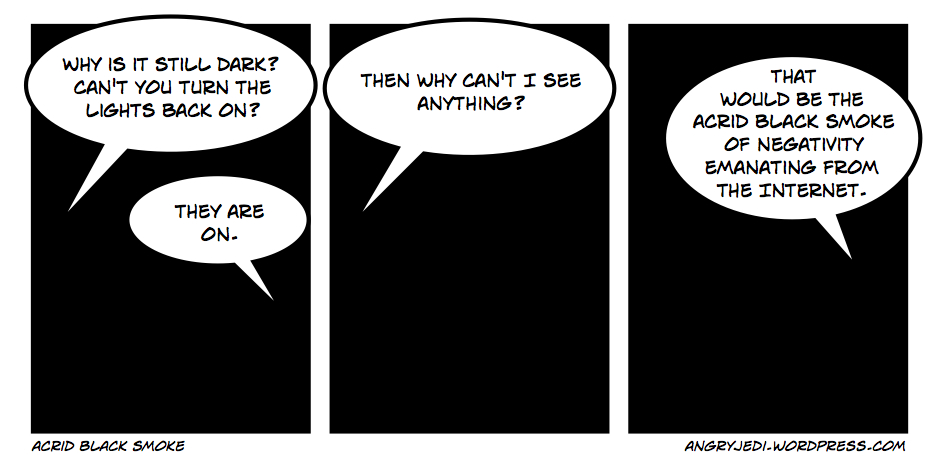
The point I am trying to make is the surprising amount of negativity the story in question attracted, and the subsequent high-school clique-style bitching and sniping that ensued on Twitter between high-profile members of the industry for the next few hours. People laugh and joke about passive-aggressive status updates from people who want to bitch about someone without naming them—"I wish SOMEONE would stop being such a jackass!"—but this was taking it to a whole new level, with, in some cases, high profile representatives of respected publications taking the passive-aggressive approach and arguing with thin air, presumably to try and make some kind of point.

I'm not going to name and shame anyone because there's no point in doing that and it wouldn't achieve anything. All I am going to say is that any time something like this erupts, I'm surprised and disappointed in people. Perhaps the story in question will turn out to be nothing—or perhaps it will turn out to be something big. Regardless, it was a rumour, and an interesting one at that, and people will want to know it. The original article made it very clear that it was a rumour based on things that anonymous sources had said. People can make their own minds up whether or not to believe it, but there's really no need for all the bitching and sniping.

It is, sadly, a hallmark of the Internet, though; comment sections were described on a radio show earlier today as "the bottom half of the Internet" due to their relentless negativity—a fact which made Charlie Brooker sit up and take notice, unsurprisingly. But why? Why the hate? Why the behaving like teenage girls?

Perhaps I'm just too much of a nice guy. I don't hate anyone, and I respect the work of others. I'll slag something off if it's genuinely bad, but I don't hate things for the sake of hating them like some people seem to. And whatever the reason for people's reactions to the story which broke earlier (still not getting into it!) there's certainly no reason for the ugly and thinly-disguised jealousy which has been evident this evening.

If people could just be a bit nicer to each other and a bit less negative about everything, the whole world would be a much more pleasant place.

It's nice to want things.

Day 452

#oneaday Day 101: Endless Punning

Oh, Twitter. You know I love you. But there are times when being with you is like being stuck in a convention of Dads. And then being stuck in a time-slowing-down machine. For several days, in many cases.
I am, of course, referring to the endless streams of puntastic hashtag humour. Now don't get me wrong, some of these collections of nonsense are genuinely amusing—but the fact they seem to go on interminably until they have outstayed their welcome by a considerable margin is something which… I don't know that it "bothers" me as such, but let's just say it sometimes makes me glad of the "mute" function in Twitter apps such as Echofon.

Take today. Someone—I couldn't say who—started a #gamejournalistpickuplines hashtag and proceeded to post a few witty innuendoes themed around the common things games journalists are accused of, issues they have to deal with regularly and things that they often say. Funny—assuming you're in the know. And if you're following game journalists on Twitter, chances are you are at least a little bit "in the know".

Hmm… is "funny" quite accurate? Well, yes. At least until it gets to 10pm in the evening and it's still going, and all the Americans who have now woken up have started making the same jokes that all the Europeans made six hours ago. It's an occupational hazard of dealing with a worldwide service such as Twitter, of course, but it does mean you tend to get bombarded with the same shite hour after hour after hour.

But now wait a minute. Back up a sec, take a moment to look at this from a distance. As woeful as some of the puns and innuendoes might be, it's actually kind of cool to see people from such disparate parts of the world coming together—even if it's just to make a few lame jokes. There have been people from all over the globe contributing to the hashtag—and it's the same every time something equally inane, childish and briefly amusing (such as #replacegamenamewithboner) comes up. Funny for a bit, relatively easily ignored (unless certain people who shall remain nameless are online) and interminable.

I guess, then, we all have to get used to the fact that one joke can indeed be strung out for hours, days, weeks, months thanks to the power of social media. Don't even get me started on the "fake" Twitter accounts for various celebrities, video games, industry figures.

Or, you know, perhaps I should stop being such a curmudgeon.

(Clarification for anyone about to make an indignant comment about their right to indulge in hashtag humour: I don't mind it really. I just find myself tending to observe such things from the outside and not joining in. Largely because I'm awful at coming up with puns and jokes on the spot. You knock yourself out, and if replacing parts of game names with "boner" makes you happy, then you just keep on truckin'.)

Day 449

#oneaday Day 66: Is Traditional Writing Dead?

It seems every other week, particularly in tech-related industries, there is some sort of discussion over whether this or that is "dead". Inevitably, the answer is usually some vague waffle about how most people may have stopped using their Nokia N-GAGE but there are a few people out there utterly determined to beat Tomb Raider on a portrait-wise screen on a device which can survive being run over by a bus (I speak from experience) and thus the thing in question isn't dead, just on perpetual life support. Until it gets run over by one bus too many, of course.
A discussion I participated in earlier today on Twitter regarding grammatical usage of hashtags got me thinking, though. Is the concept of "traditional writing" dead?

When considering this, though, it's first important to determine what you mean by "traditional writing". And it's not an easy thing to define. Is this blog "traditional writing"? It mostly follows grammatical conventions (except when I'm being deliberately obtuse or conversational) and uses paragraphs. But no; I'd argue that it isn't writing in the traditional sense. Blogs are designed as a platform upon which people can share their thoughts on a subject and invite responses from other people. That last bit—the invitation for other people to respond, whether or not it's taken up by commenters—is the important part of blogging for many people. The best blogs are "conversations"—or at the very least, pieces which start discussions amongst other people.

You could argue, of course, that persuasive writing, philosophy and the like has had this sort of thing covered for many years, and you'd be right—people still debate Nietzsche down the pub, right? (I don't go to the pub that often.) But the key thing is that with blogs and their commenters, everyone has a voice of (relatively) equal power. Ironically, though, the popular blogs diminish the power of their own commenters by having so many that people are unlikely to read them all. But at least some of them get read, unlike a weighty tome on all matters philosophical, in which those pub conversations rarely go any further than the pub.

Then there's Twitter, the reason I got thinking about this in the first place. Here's the kind of tweet that got me wondering:

We'll leave @tanaymodi1's absent apostrophe and misspelling of "myself" aside for a moment, and look at those hashtags. Being someone brought up on "traditional" writing and grammar rules, those hashtags in the middle of a sentence are somewhat jarring to me and interrupt the flow of what's being said somewhat. Now, in theory, the use of those hashtags allows anyone reading that tweet to click on either #AngryBirds or #Mac and read what other people are saying on those topics. A sensible idea for hot topics under discussion. But I've seen people do it with more vague concepts, such as "I'm writing a #novel" or "Is Sasha Grey a model of fashionable female #sexuality?" that could be taken in all manner of different contexts. Are they still useful?

Apparently so; a number of people came forward in response to my query and said that they find it useful to have the facility to find out what other people are saying on the subject. The only fly in the ointment, however, is that not everyone uses them. If I'm writing a tweet about my Mac, for example, I'll use the word "Mac" and have never, ever hashtagged it, if only for the fact it saves one of Twitter's precious 140 characters. The only time I use hashtags are if I'm participating in a discussion about something (like, say, a TV show that's on at the time) and appending the hashtag on the end of the tweet, for these blog posts or for #lamehashtaghumourthatifindquitefunnysometimes.

This is obviously a different use of writing to how it's used here on my blog, how I use it when writing for GamePro, how I use it when writing an email and how I'd use it if I were writing a book. But it doesn't mean that any of these forms of writing are "dead" or "dying". Increasingly what's happening over time is that things that were once on a relatively linear path, such as the evolution of language, are splitting off into separate branches with their own contexts and purposes. Some people stick resolutely to one path and thus find it rather jarring when something from one of the other paths invades their consciousness. Other people can happily jump back and forth between the different strands, adapting their language to the situation as they see fit.

So no. I don't believe that traditional writing is dead, nor is it a niche interest that only a few dedicated souls are continuing with. It's simply one branch of an increasingly-complicated tree. As we find ourselves with more and more different means of communication available to us, language adapts, changes, broadens. And it will continue to do so for some time.

Where does it stop? Will (English-speaking) people on Twitter end up speaking their own language that looks a bit like English but isn't? Perhaps not. But it's something to ponder.

#oneaday, Day 52: Desperately Seeking Perfection

The modern age brings with it many benefits. The ability to communicate with anyone in the world at any time (so long as they're not asleep). The ability to express one's creativity in a broader range of media than ever before. The ability to acquire pornography to cater to any and all fetishes. And, of course, more ways for people you want to avoid to track you down and "see how you are".

The downside of all this, though, is that everyone always seems to feel the need to constantly be reinventing themselves. It's a particular problem when it comes to popular websites such as Facebook and Twitter. Someone, somewhere decides that it's really important that sites have particular features in place, and some poor sod of a programmer out there has to implement said features. Then when said poor sod has implemented said features, everyone whinges and moans that it's "worse than it used to be" and "shit now" and blah blah blah and conveniently forgets that said services are, in fact, free and the owners of them are perfectly within their rights to do what they want with them, however stupid some of those moves might be.

But why does this happen? It's seen as "necessary" to constantly update and reinvent to "stay competitive". Why? It usually ends up doing more damage than good, because as we've seen on many, many occasions in the past, People Hate Change and will react in somewhat inflammatory, stroppy manners.

This isn't to say that all change is bad, of course. Not at all. Genuine changes that benefit someone's experience are to be applauded. New ideas that are experimented with should be treated with a "well, let's try this" attitude rather than the outright hostility we get right now. But change for change's sake when something already works just fine? That, right there, is the reason that we get aforementioned hostility. People just want a bit of stability, and when they feel they've got it and the rug is pulled out from under them, it's sort of understandable that they kick off a bit. Not always handled in the best way (in fact, usually handled in the style of a stroppy 8-year old) but at least a little bit understandable.

Combine stroppiness with the anonymity of the Internet and you get some ugly scenes indeed. It's a fast-paced world we live in these days, and some might argue it really doesn't need to be quite so fast-paced. It'd be nice to be able to slow down a bit, enjoy the view and only fix things when they break.

But nah, that's never going to happen. Everyone has to be the Very Best, to strive towards the "perfect" experience, the criteria for which seem to change on an hourly basis. And striving for perfection means having the techie types constantly at work with their hammers and nails and bits of code. A permanent state of construction. The eternal beta.

One day the Internet might be finished. But I don't see it happening just yet.

#oneaday, Day 33: Twitter: A Skewed Window on a Weird World

Twitter is many things, as I've said a number of times on this blog before. It's arguably my primary means of communication these days, since the vast majority of my friends are quite-to-a-very long way away, and asynchronous communication is nice and convenient. It's a good source of information (in fact, Twitter themselves now describe themselves as an "information source" rather than a means of "short, timely messages" like they used to) and a good way to keep up with what people you're interested in are up to—and not just when they're having a shit.
By far the most remarkable thing it does, though, is something that it wasn't originally designed to do, but which it was always naturally going to do, given its nature. And that is the way it can give an eye-opening snapshot of "this day in history". Even when seemingly nothing is happening.

Today, there happened to be several things of (in some cases questionable) note occurring. Depending on where the tweets were coming from, it was interesting to see the differences and priorities.

By far the most horrifying tweets were emanating from the Middle East, where Egypt has been undergoing some not-inconsiderable turmoil. Today, there were violent clashes in Tahrir square, and via one Middle East-based person I follow who was RTing someone stuck in the middle of the violence and horror, it was possible to get a "first-hand" account of what was going on. It was oddly sobering to see the whole thing unfold, and although I didn't know the person being RTed in question, I was hoping that their tweets would keep coming and end on a positive note. I didn't want to think about what a sudden cessation of the "commentary" would have meant.

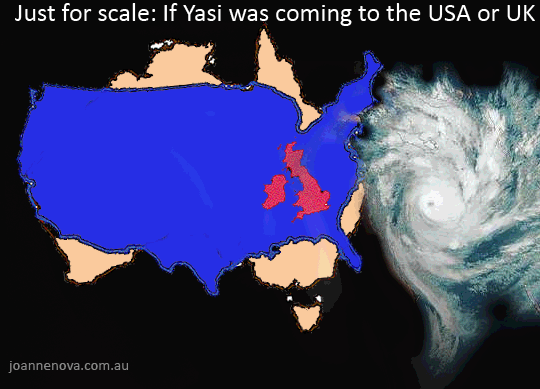
Elsewhere in the world, Australia was preparing for an enormous cyclone. They haven't had a great deal of luck over there recently. Due to the fact I don't think I follow anyone who actually lives in Australia, most of the reportage on the incident that I saw today was pretty cold and clinical, although this image, showing what said cyclone would look like if it were en route to the UK instead of Australia, gave pause for thought.

And then there was the curious incident of Justin Lee Collins' new girlfriend, which was reported by the Daily Mail today featuring a series of obnoxious paparazzi pictures of the couple on holiday. The article in itself was objectionable enough—as far as I'm concerned, celebrity squeezes aren't news, even if they're squeezing another celebrity—but what I found rather surprising was the reaction from quite a few (games journalist) people I knew on Twitter.

It transpires that the "mystery brunette" the Mail was referring to is actually someone who works in PR for the video games industry. I don't know the person in question and have never had any direct contact with her, so I wasn't much the wiser once people had explained the whole situation to me. But a lot of people seemed to find the whole situation hilarious—something which I found rather bewildering.

Now, granted, there's a certain element of "hey, I know that person!" if you see an acquaintance or friend in the paper. But personally speaking, whether or not the games journalism biz had "got one up on the Mail" (normally cause for celebration), if I was the woman in question, I'm not sure I'd be particularly happy about the widespread discussion amongst a number of people I may well have had direct contact with in the past. It's not her fault she got snapped by some paparazzi scumbag. Some may say it's an occupational hazard of dating a "celebrity", but that's no excuse. Her privacy has been invaded; and while the discussion of the fact "we know who she is and the Mail doesn't" hasn't been malicious in tone, it's drawn an unwarranted degree of attention to her.

In my opinion, anyway. But then I've never been one for any kind of gossip; people's relationships are their own business—not mine, not yours and certainly not the Daily fucking Mail's.

On a more uplifting note, one positive thing that came out of Twitter today was the #whatstigma hashtag started by comedienne @RebeccaFront. Via this hashtag, she was encouraging people to speak openly about mental illness, depression, anxiety and so forth, without fear of judgement or, well, stigma. It was heartening to see how many people took to it, and proof positive that there are plenty of people out there who are getting on with their lives despite struggling with difficult mental conditions. It was also, hopefully, a slap in the face to the sort of people who like to say "get over it". (Hello again, Daily Mail.) I'd actually like to write a bit more on this subject as it's one I do feel strongly about, but I think I'll save that for another day.

So, on the 2nd of February 2011, what happened? Several shit things. One invasion of privacy. And thousands of people stepping up to publicly say something about themselves without fear or shame.

While not the most positive day the world has ever seen, to say the least, it was certainly an interesting day. Will it go down in the history books? Who knows? But those of us who were here have our own personalised record of the whole thing. And that's pretty cool.

Good job, Internet.

#oneaday, Day 22: Make Love, Not Hate

On the Internet, opinions exist in a binary state for many people. There is your opinion (1), and there is everyone else's opinion (0). Sometimes other people's opinions coincide with your own, meaning they can join you in the happy 1 gang, while the 0-toting losers get to stand over there being Wrong.

It's strange, though, really, isn't it? People develop such strong feelings about particular issues, and these opinions spread virally very quickly via all forms of the media. I remember reading about this in A-level Sociology and forget all the names and dates of studies concerned, but since this isn't an essay I'm not going to go and look them up. What I do know is that nowadays, such opinions spread far quicker than they have ever done before thanks to the immediacy of online social interactions, meaning that in some cases people may end up feeling that they should change their opinions on things in order to remain somehow "credible".

'Twas ever thus, of course, with the school bullies always listening to the most badass music out there whilst the flute-playing pansies amongst us voluntarily listened to—or even played—classical music. (Guess which of the two categories I was in, though I didn't play the flute. Flutes are for girls.) One group tended to kick the shit out of the other on a fairly regular basis, and it was usually a pretty one-sided battle.

You shouldn't start actively hating something just because other people say so, though. You should take pride in your tastes, however idiosyncratic or separate from the supposed "norm" they are.

Let's take a few examples of Things I Like That Should Be Embarrassing To Admit But Really Aren't, Honestly, No, Stop Looking At Me Like That And Please Don't Unsubscribe, Think Any Less Of Me Or Be Any Less Likely To Do Nice Things For Me (Like Buy Me Cake, Give Me A Big Wet Snog Or Make Me A Delicious Roast Dinner) Should The Opportunity Come Up.

Okay. I can do this.

(takes deep breath)

I like Robbie Williams. I also enjoy the comedy of Michael McIntyre, the radio show of Chris Moyles, the bubblegum pop music of MIKA and think Ke$ha's album is a work of quirky genius that I believe I have described as "sounding like Kelly Clarkson being forcibly inserted into a NES" on several occasions. I voluntarily bought both Dead or Alive Xtreme games and played them a lot, and not just for the bazongas involved, I enjoyed the dumbass illogical "dating sim" mechanics that were in there too. I follow Katy Perry on Twitter and find her music cheerfully uplifting. And I own two Spice Girls CDs.

Tastes change over time, of course, but who's to say that I'm "wrong" for liking any of those things just because the popular opinion is to hate them and deride those who enjoy them? I'm just as guilty as anyone else, of course; I find myself hating shows such as The X-Factor, Strictly Come Dancing and the like irrationally and automatically. I loathe Call of Duty. I would rather gouge my own eyes out than watch anything involving Piers Morgan (I think we can all agree on that one, surely).

The world would undoubtedly be a nicer place where everyone could feel more confident in themselves if our personal preferences stopped being scrutinised so much, and assumptions made based on those preferences. Take the recent announcement of Final Fantasy XIII-2, for example, a sequel to one of the most controversial Final Fantasy games there has ever been. Not because of the content, but because of the gameplay, which wasn't to everyone's liking. There are people out there who assume that because Final Fantasy XIII wasn't to their taste, XIII-2 is going to be shit as well. Justifications range from "Square have lost their way" (well, perhaps, but can't they pick it up again?) to "it's the same team, of course it's going to be rubbish" (because everyone is always universally good or universally bad?) and it's nonsense. Nonsense I tell you!

Basically, do your blood pressure a bit of good and start concentrating on the things you like a bit more. Tell people how much you like them, by all means. But let's all make a pact to stop making people feel bad about things that you, personally, "hate".

Unless it's terrorism, AIDS or Piers Morgan. You can hate those as much as you like.

#oneaday, Day 18: Why Blog?

Mark Fraser wrote a great post earlier today on the nature of blogging—particularly daily blogging—and the reasons we do it. In this post, I thought I'd explain why I do it. It seems like a faintly topical thing to do, especially since tomorrow marks one year since I started writing daily. One year. 365 entries, most of which are around the 500-1,000 word mark. That's a lot.

So why do it?

Because I enjoy it.

Shit, that sounds like far too simple an answer, and at the end of this sentence that's only 93 words. That's not enough for the arbitrary minimum I set myself back when I started.

But it's the truth. The reason I write this blog is because I enjoy it. Sure, it's great that some people come and read it. Some people are even subscribed to it (that's dedication for you). Other readers have undoubtedly come and gone. Some are recent additions to my little family of readers (oh, you, I love you all) but, you know, the only reason I'm writing this is because I enjoy it. The fact that you lot out there in readerland seem to enjoy some of the things I write is a happy bonus that I wouldn't exchange for anything.

I can tell when something I post is going to be a big hit, though. When I posted about Kevin Smith's unfortunate experiences with Southwest Airlines, I saw a big spike in people reading. Similarly, when I bitched about that ridiculous campaign on Facebook where everyone changed their avatar to a childhood cartoon, I had, I think, the most daily hits I've ever had. Which, given that the daily cartoon for that particular post featured someone masturbating furiously, was something of a bittersweet success. So to speak.

The thing is, though, I don't deliberately court readers. The notion of "hit-chasing" is seen as a necessary evil in the world of online journalism, which is why we get so many games sites lowering the tone with "OMG BEWBZ" articles, because that will get the clicks from the horny teenage boys who supposedly populate the Internet. Unfortunately, it seems to work, leading to something of a self-perpetuating cycle. Similarly, the Daily Mail undoubtedly enjoys a massive spike in traffic by posting something completely cuntish like they did the other day. Go find it yourself, I'm not linking to those bastards again.

But this site? No. This is for me. It's selfish but it's true. I'm very lucky to have some friends who enjoy reading my work and appreciate my stupid cack-handed cartoons—and occasionally some random strangers, too. Writing this blog every day is something fun to do that I look forward to. It's helped me work my way through some difficult times. And it's helped my writing as a result.

Basically, I don't play the game in the same way Mark describes. At least not consciously. But one thing I do enjoy is being an active part of the One A Day Project community—one of the reasons I decided to step up and try and organise the whole thing this year was based on one of the most common complaints last year: there was no sense of community. There was no "centralised" place for people to come together, and some of the participants weren't even aware of each others' existence. This led to the situation where there were only six people left at the end of the year. (Ironically, of course, this led to us becoming friends, as six blogs are much easier to keep up with than 160.)

This year, though, we're already seeing people posting some cool responses to each others' posts as standalone entries in their own right, some discussion and banter on Twitter, and I know of at least a couple of awesome friendships that have already formed as a direct result of all this.

So while I primarily still write for my own amusement, catharsis and/or personal development, I feel it's important to say that I do appreciate the community of other bloggers out there, some of whom might be reading this right now.

Kissy kissy. Wuv yooo.

#oneaday, Day 13: My Name Is Wicka Wicka Slim Shady

Anyone who's had any kind of interaction with any kind of online community and wanted to take your relationship with the people you know to the "next level" will have dealt with the situation above at some point or another in their life. You're sure you recognise someone from their avatar, but you're not quite sure if you should go over and say hello to them or not, even though you might have been exchanging filthy penis anecdotes online for the last two years. (Filthy anecdotes about penises. Not anecdotes about filthy—oh, you know.)

Then, once you finally do summon up the courage to walk over and say hello to this person that you might have thought you were quite close to until you were faced with the terror of spending time in physical proximity to them, you are faced with a very difficult question, and one which has baffled philosophers throughout the years.

"Who am I?"

There's a moment of silence when time seems to freeze. It occurs right after you say the words "Hello, I'm" and is a moment that seems to last forever. You have an important decision to make at this point—a decision which will determine your conversational partner's immediate reaction to you.

That decision is whether to introduce yourself as your username or your actual name. For people whose usernames are their real names, this isn't an issue (though it does often prompt the overly-formal seeming "introduction using both first and last names, occasionally including middle initials" situation rather than the more casual "Hey. I'm Pete.") but for those of us who picked ridiculous usernames and are now stuck with them, known better as our self-appointed, perfectly-justifiable-to-ourselves-but-harder-to-explain-to-others monikers than our actual names? It's a difficult decision to make.

"Hello, I'm Pete," assumes that your conversational partner has paid attention to your profile (assuming you put your real name on it, which some people don't) and carries the risk of them looking at you blankly and going "Who?" while walking up to someone and cheerfully announcing that "I'm angryjedi!" could simply prompt a look of bewilderment, a cry of "No, I'm angryjedi!" to start echoing around the room or someone laughing in your face.

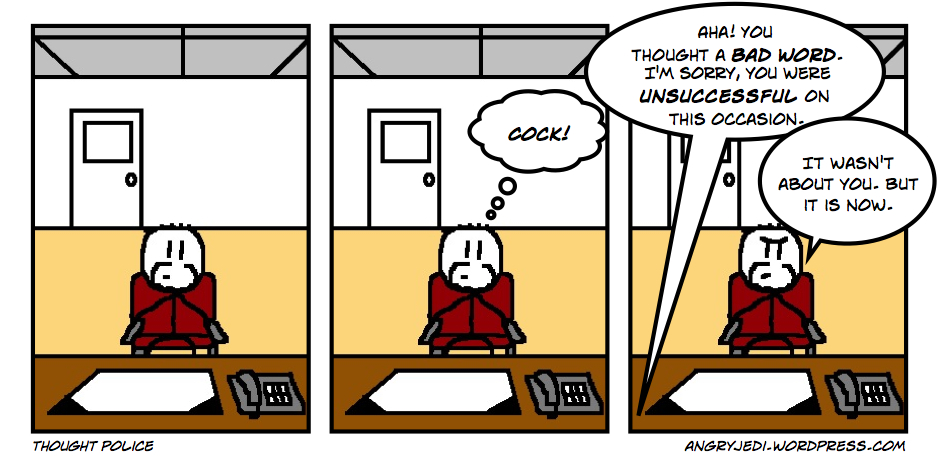
In my experience, it's often best to do both. "Hello, I'm Pete—@angryjedi from Twitter." This is usually followed by a "Well, you don't look very angry to me!" (obviously they haven't read this blog enough) which we all have a good titter about and then move on to actual proper grown-up conversation. Or possibly shouting "COCK!" at each other, depending on the appropriateness of doing so in the context.

Last night, I attended an event at which a number of people I knew from Twitter, including several other One A Day Project bloggers, were in attendance. It was probably the smoothest this particular exchange has ever gone, with the possible exception of PAX East last year, an environment that positively embraces nerdism and encourages you to cry "I am xXSanguine-Warrior69Xx!" from the rooftops.

I was actually surprised at myself. Confronted with a room full of those that I see as SUPA IMPOARTANNT PEEPLE FOR MUCH RESTECP (including Ian Livingstone, Jon Hare, Richard Wilson of TIGA, Andy Payne of UKIE, a whole mess of MPs and a variety of journo types) I was expecting to freeze up and/or drink myself into oblivion with the graciously-provided free refreshments. It was not to be, though. I schmoozed with the best of them, got some great interviews (the iPhone is fantastic as a portable recorder, if you've never tried it, incidentally) and had a brilliant time.

I came out of the whole thing thinking "Yeah. This is something I want to do." Which is nice.

Now to get on that.