1151: Twitter Let Me Down (Or: Why I'm Not Going Back)

Page_1Let's recap.

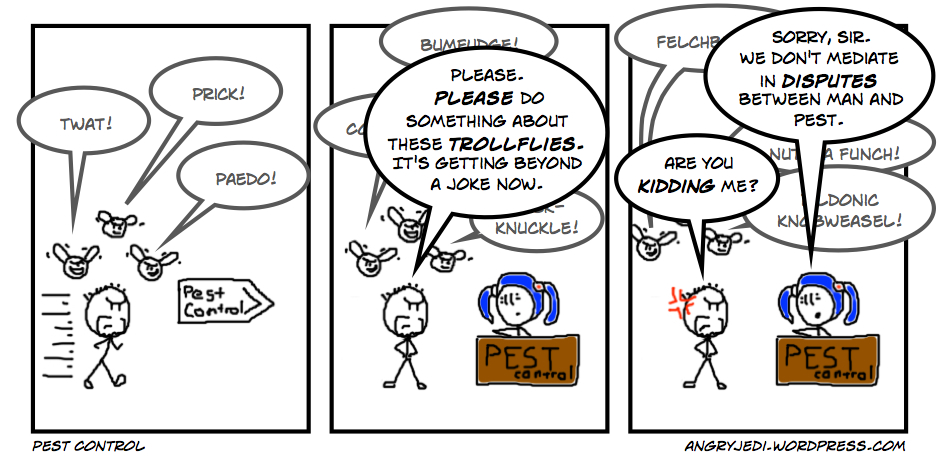
About a month ago, I was the victim of an organised "cyberbullying" campaign on Twitter. (Aside: I hate the term "cyberbullying", but it seems to be the accepted terminology so I will use it for now.) Members of an Internet-based organisation known as the "GNAA" (NSFW Wikipedia link) started harassing me, attempting to spread slanderous rumours that I was a paedophile, and copying me in on their pronouncements, presumably attempting to get a rise out of me. I blocked and ignored them as is the sensible thing to do in this sort of situation, but still they kept coming.

They started phoning people close to me — specifically, my brother and the owner of Games Are Evil, both of whose phone numbers are stored in the "WHOIS" information for their respective websites. Not just one phone call, either — several, each increasing the intensity of the threats to get the authorities called on me for my supposed (and, I'm sure I don't have to add, fictional) perversions.

The reason for this group's attack on me, it transpires, was the fact I had the word "Brony" on my Twitter bio. ("Brony", for those who don't know, is the term for adult-age fans of the recent My Little Pony: Friendship is Magic TV show, a group which I identify myself as being a part of. Seriously, that show's great.) This group had been attacking Bronies for a while and attempting to slander them in similar ways. They were also responsible for a high-profile attack on the social networking/blogging platform Tumblr back in December — said hack was also an attack on the Brony community.

Because this unprovoked assault on both me and my reputation was frightening and unpleasant, I reported it to Twitter. Because it was spilling out of the online sphere and into the "real world" with the phone calls, I also reported it to my local police station. The latter weren't able to do much about it — I wasn't really expecting them to be able to, to be honest — but I did at least feel somewhat reassured that I'd done all the things they would have suggested I do in this situation: change my username, block the perpetrators, do not engage with them, let other people know what's going on. Eventually, the perpetrators tracked down my new username and hijacked my old one, using it to impersonate me with the most obviously fake "this is what a paedophile does" sort of posts you'd ever see.

I reported the impersonation to Twitter as a separate issue, which required me to fax them a copy of my passport at my own expense to prove my identity. (Fax? Seriously?) It took them a few days to respond to this, but they eventually suspended my old Twitter username to prevent it from posting further offensive content in my name; in the meantime, I closed my Twitter account completely.

What I'm particularly disappointed about is Twitter's handling of the rest of the issue. I reported the problems I had been having back when that original post I linked to was written — mid February — and only received a response last night. The response I received was boilerplate text that simply said there had been no violation of Twitter policy, and that they didn't mediate in disputes between users. No attempt to address my concerns. No response to the fact that I had clearly laid out a series of tweets that showed an organised — and demonstrably unprovoked — campaign of hate against me. No concern for my wellbeing.

There is a difference between a "dispute between users" or a "difference of opinion" and an organised campaign to victimise someone based on their tastes and preferences. The offenders in this particular case went above and beyond simple name-calling into full-on harassment of not only me, but also my family and friends — and not only on the Internet, but also over the phone. None of this appears to have been taken into account in the month that Twitter's safety team have had to review this situation. In the meantime, the unpleasant individuals responsible for causing me such upset remain at large and unpunished, free to do it again to someone different for just the same stupid reasons they attacked me.

For this reason, I will not be returning to Twitter as a means of personal communications or social networking. While I appreciate a network of that size is difficult and time-consuming to police, that doesn't mean that the site's user safety department should get to just sit back and say "deal with it." This incident caused me considerable personal distress, and doubtless it upset and confused my family and friends who were dragged into it, too. The complete lack of concern Twitter's user safety department has shown towards a demonstrable case of organised harassment and bullying means that I do not feel comfortable trusting them in future; consequently, I will not be returning.

I doubt they care, of course; one user is but a drop in the ocean. I felt the need to share my frustration regarding this issue, however. Cyberbullying is a real problem that destroys lives — literally in many cases — and for Twitter to just turn a blind eye like this doesn't strike me as particularly acceptable.

If you used to follow me on Twitter, please feel free to share this post with any of our mutual friends. I would like to spread the word about this if at all possible.

Thanks, as always, for listening.

1139: Just Shut Up

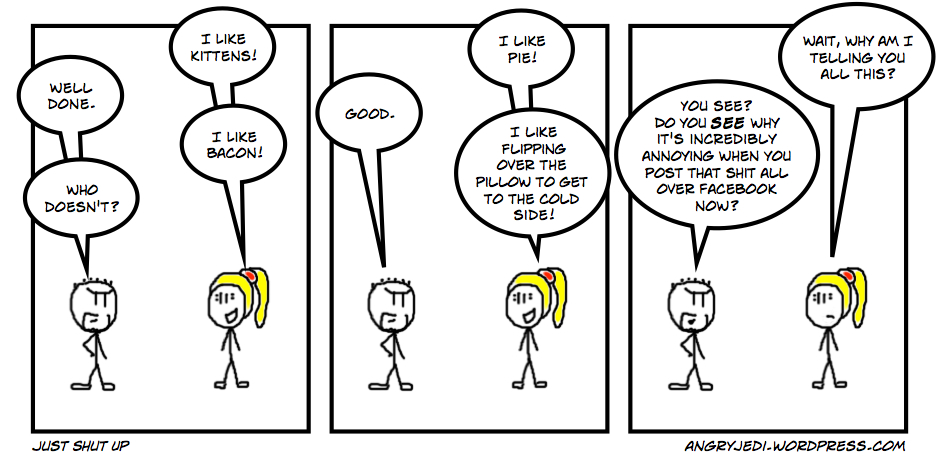
Page_1I think I'm "over" social media. Allow me to clarify that bold statement, however, as it's perhaps not entirely accurate as is. I think I am over social media as it exists today — a sprawling, disorganised mess of ill-defined concepts that contribute very little to the people's understanding of one another, and more often than not is about vanity rather than actual socialisation.

In other words, I yearn for the days when social media was simple and straightforward — when its sole intended purpose was to allow people to stay in touch with each other and perhaps, occasionally, share a photograph or two with them.

Looking back on this blog, I see I have written about this subject at least twice in the past, and my disillusionment with it has only grown over the last year or so — perhaps due in part to the fact that as part of my job I come into contact with some of the most utterly pointless examples of social media that I've ever seen.

These days, there are social media apps to share anything you can think of. I mean, there are literally (YES LITERALLY) apps and services that allow you to share anything you can think of. There are also more specialised ones with questionable usefulness to society as a whole. I reviewed one recently where the entire purpose was to share what your current mood was — you couldn't add any text explaining said mood, only an emoticon — and another where you could share the weather in your local area, then "like" or comment on the weather in other places. Another still allowed you to send a video or photo to someone, but they were only allowed to look at it for ten seconds, after which it locked itself and became useless (I swear I'm not making this up).

The trouble with these things is that despite their pretensions towards being "social media," they're not actually all that social at all in terms of the way in which people use them. They're a means of broadcasting things and seeking approval of other people rather than a means of actually engaging in conversation with anyone. Take a look at the average comments thread on an Instagram picture of a moderately-attractive person (usually a woman) and you'll see what I mean. No-one's actually talking to each other — everyone's just dropping an asinine opinion bomb and then never coming back. The poster of the selfie is seeking approval from commenters telling them how attractive they are; meanwhile, the commenters are seeking approval from the poster and hoping that their specific compliment is the one that will get them some specific attention.

This isn't the case universally, obviously. There are still some actual conversations that go on on Facebook, for example, but these can easily be lost in the torrent of people resharing crap from pages like "I fucking love science" (do you? Then go do some rather than recycling endless fucking memes) and "LIKE AND SHARE!!" (NO!!). Twitter is a reasonable platform for discussion at times, but conversations are easily derailed and, as has been proven hundreds of times in the past year alone, 140 characters is really not enough to make a coherent argument about a complex issue. It's also incredibly easy to be taken out of context on Twitter.

Google+ perhaps fares the best out of all of these services in my experience, though even that's variable. Join a good, small community that has a clear focus and whose moderators keep a tight leash on discussion and you'll have a good experience chewing the fat with people who may well become good friends. Follow Felicia Day or Wil Wheaton and you might see some interesting content, but the quality of discussion goes out of the window. Follow Google+'s own page and all you get are blithering idiots making ill-informed political rants any time the team behind the page even dare to mention the President.

I think the thing that's been striking me most heavily recently is "do I really need to share this? Do people really need to know this?" And more often than not, the answer is "no". I don't feel the need to collect an arbitrary set of "Likes" with services like CircleMe or GetGlue. I don't feel the need to "check in" to places with Foursquare. I don't even really need to use stuff like Raptr to broadcast my gaming activity, but that has, on occasion, sparked some good discussions — as, I'm sure, the other services do in some cases. Just not mine. Not any more. Perhaps once in the past — I met some good friends through Foursquare's now-defunct competitor Gowalla — but not now.

Consequently, since quitting Twitter a while back (and not really missing it, to be honest — though I do miss some of the people) I've been paring back my personal social media use hugely. I've closed my Tumblr account — I never really understood the point of that site, and these days all it seems to be used for is white people shouting about how guilty they are about being white and how we should all stop being such racists/misogynists/fedora-wearing perverts — and I've unistalled the vast majority of social apps from my phone, including Twitter and Instagram. Facebook made the cut, because as much as I dislike it at times, it's still a good way of staying in touch with a lot of people, and Google+ also survived, as it's the new home of the Squadron of Shame and serving our needs well.

Obviously this blog is still going, too (and will be for a long time to come, hopefully!) and I still comment on friends' blogs — but I don't really count that as "social media" in the same way, particularly as the discussions had tend to be (for the most part, anyway) wordy and thought-provoking rather than inspiring little more than a knee-jerk "lol".

Everything else, though? Out the window. And life is much calmer and more pleasant as a result.

1128: Suddenly Silenced

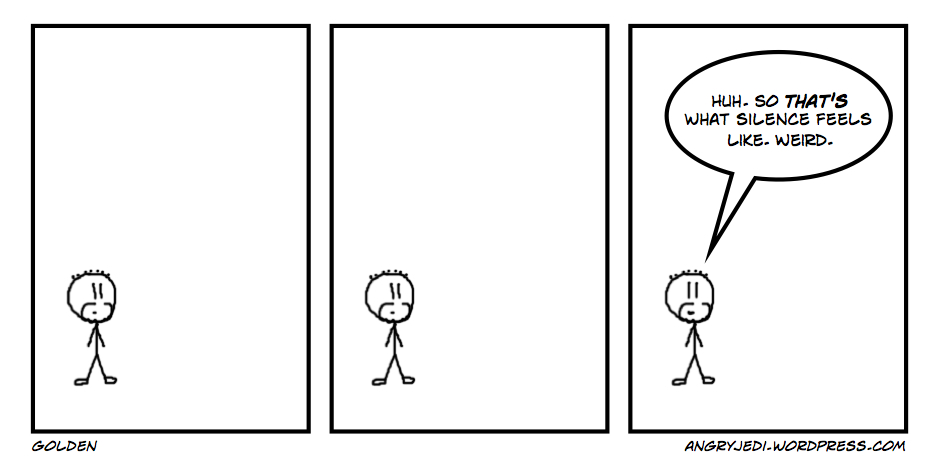
Page_1While I don't particularly relish the circumstances under which I left Twitter recently — which I won't go into now as it's all still a bit "raw" and upsetting, to be honest — it's sort of been nice to not have the omniscient little blue bird hovering over my shoulder all the time.

Twitter was a big part of my life for a very long time. According to my Twitter archive — which I downloaded before I closed my account — I first posted a tweet on May 8 of 2008, but didn't really do anything with it until the end of June of that year. It's fair to say that I — like many other people — didn't really "get" what it was all about to begin with, largely because it was so ill-defined and hadn't pervaded popular culture quite as much as it has today. "It's like Facebook statuses," I'd say to people when trying to explain it, "but without all the other crap."

It sort of is like Facebook statuses without all the other crap — those early tweets of mine very much followed the "Pete is… [doing something]" format — but it quickly became a lot more than that. It became one of my primary means of communication with my international friends.

As many of you reading this may know, I have a lot of friends, but disappointingly few of them live in the same place as me. I have at least rectified that a little by moving back to Southampton to be near my university and board game buddies, but many of my other friends are still scattered the world over, all the way from America to Japan and lots of places in between. It's sort of awesome to have such a global group of friends, though it naturally means that I've never actually met an awful lot of them and possibly never will in some cases. It also meant that I needed a good, simple, reliable means of staying in touch with them; Facebook was all right, but as it gradually became more and more cluttered with crap, fewer and fewer people were using it as a serious means of communication. Today, it's a bloated mess that it's very difficult to be "heard" on, but it still has a place.

Twitter, meanwhile, was simple, pure and to the point. It was like exchanging text messages with friends, only on a global scale. I made a lot of new friends through Twitter and got to know some a bit better. I got through some tough times, too; the immediacy of the service meant that it was a good outlet for me to talk about the way I was feeling when I was going through my "difficult period" a few years back, and I appreciated the support I got from my friends — and sometimes strangers — during that dark period.

Twitter is addictive, though. It becomes a compulsion. Install it on your phone and you'll find yourself idly opening the app to see if anyone has said anything interesting in the last two minutes, even if you just stepped away from your computer where you were staring at a Twitter client. You'll find yourself wanting to step into (or start) conversations at silly hours in the morning, and get relatively little sleep as a result. It'll worm its way into your life, in short, and start to take over.

Not that that's necessarily a bad thing — as I've already outlined above, it proved to be a good means of communication for me, and a good means of meeting new people. It allowed me to put myself out there a lot more than I feel comfortable doing in the "real world", and in many ways helped me to build confidence. And let's also not forget that I met Andie through Twitter, so that's pretty cool.

The recent things that happened to me, though, brought the service's public nature into sharp focus. Sure you can be free to be open and honest about your feelings, your likes and dislikes, but that also means that you can be open to attack, too, without provocation. And once you're in the sights of one of these obnoxious groups, it's very difficult to get yourself out of them. Twitter the company aren't much help, either — after several support messages keeping them apprised of everything that was going on, the only thing I've heard from them is a request for a clarification on something. They take great pains in their terms and conditions to say that they don't mediate personal disputes — though I feel there's a strong case for what happened to me to be considered a criminal offence, and as such I reported it to the police and intend to keep hounding Twitter until they do something about it.

In some ways, I feel sickened and angry that I was forced off a service that has been a prominent and important part of my life for a long time now. In other ways, it's actually quite relieving to know that I don't need to read that feed of inanities any longer, or get frustrated at people trying to have in-depth discussions on tricky issues in 140 characters when what they should really do is pen a 3,000-word blog post. I'm not ruling out a return in the future when the scumbags who drove me away give up and do something else, but for the moment I can certainly live without it — and there's no way I'm going back to a service which I don't feel safe using.

1115: Twittertwat

Page_1Quite a few people I know have quit Twitter in the last year or so. A few of them have also come back again, and some have gone through this process more than once, but a few have gone, never to return, either. Fortunately, in the cases of people I'm actually interested in staying in touch with, I have alternative means of contacting them, and Twitter was only ever a way of easily sending short messages to them — a global texting service, if you will.

I use Twitter a lot, for engaging in conversations, posting links to my work and just generally being part of the global community. But over the past few weeks, I'm starting to understand why increasing numbers of people are jumping ship.

The experience is, of course, as with so much else on the Internet, exactly what you make of it, and I've taken fairly ruthless control of my experience by simply blocking people I find objectionable and/or annoying. Not necessarily people who are being abusive — I appear to be a relatively inoffensive tweeter that doesn't attract trolls compared to some — but people whom I just don't want to hear from. (If only real life were that simple.)

Even with doing this, though, it's still increasingly frustrating when the entirety of my timeline is taken up by some sort of snark on one subject or another. Today, there were several subjects — a report by Edge about the next-generation Microsoft console which framed a bunch of rumours as if they were confirmed facts; the ECA announcing that HipHopGamer was going to be their new ambassador; and something about J. J. Abrams and Valve. I've only really dipped in and out of Twitter today, and the snark in relation to all of these things was unbearable then, so I can't imagine how irritating it would have been had I had a client open all day.

This is the thing, though. There's nothing really fundamentally wrong with having strong opinions on matters such as those mentioned above — which will, of course, mean nothing to people who don't follow the games industry — but Twitter is not a particularly good place in which to have discussions about those opinions. It's fine for raising awareness of something — perhaps posting a link to a relevant story — but when people start trying to have "debates" about these things, it all sort of starts to fall apart a bit, really. Any pretext of rational discussion is inclined to quickly go out of the window in favour of short, snappy arguments, and the ease with which a tweet can be posted means that things are often spoken in haste without any real thought. To me, the very benefit of arguing a point using the written word is that you can take your time over it and consider it carefully; not so if you're in a Twitter argument.

I haven't been involved in any of these discussions/debates/arguments as I know how they inevitably go. I also know the people to avoid engaging with by now — those who seem to take offense at everything it's even slightly possible to take offense to. Even though I don't engage with them, though — and in many cases, as mentioned above, have blocked them — it's still exhausting to feel that there are certain subjects which just can't be broached; certain turns of phrase which can't be used; certain words which are off-limits. (And I'm not talking about anything explicitly offensive like racial epithets or anything like that; I'm talking about words which these people specifically choose to interpret using the worst possible meaning rather than the tone and context in which they were intended.)

I'm rambling a bit, I know, but the gist of the matter is that this week I've come closer to quitting Twitter altogether than I have ever done. Twitter has been an important part of my life for a long time, a key way in which I stay in touch with a lot of my international friends and the means through which I first met Andie, but I'm beginning to feel that "honeymoon" period is over. It doesn't feel like the warm, welcoming, positive community it used to be. Perhaps that's just the people I follow, and I'm long overdue for a ruthless unfollow-and-block session — or perhaps people really are being more snarky than they were. Either way, the negativity is starting to get to me a bit.

It's doubtful that I will quit Twitter at any point in the near future — I still have too many friends who use it as their primary means of communication, and it's still the best way to quickly and easily share things that probably don't really need to be shared with the world — but I just found it mildly interesting that this is the closest I've ever come to actually ditching it.

1078: Things I Hope We See the Back of in 2013

As I noted yesterday, 2012 was a reasonable year, if a relatively unremarkable one. However, it did play host to a number of trends that really, really need to fuck the fuck off. Here is a selection of my picks for things that I would very much like to not see any more next year.

Gangnam Style

LOOK! LOOK AT THE FUNNY KOREAN MAN! HE DANCING! HAHAHAHAHA

No. Fuck off. When your "viral sensation" gets performed on X-Factor, you know it has officially jumped the shark.

The phrase "jumped the shark"

I can remember it now, but I originally had to look this up five or six times before I could actually remember what it meant. It is a Happy Days reference, for heaven's sake. Is there not something a bit more, you know, timely you could refer to? Or perhaps just say what you mean? Speaking of which…

Using the term "nice guy" to mean "creep"

I have ranted at length on this subject before so I will spare you that this time and simply say that by doing this you are simply perpetuating the stereotype that people who describe themselves as "nice guys" are creeps and rapists-in-training. Some of them are creeps, to be sure, but some of them are simply shy people with poor social skills. I count myself in the latter category, and have referred to myself as a "nice guy" in the past, and now feel hideously guilty about that. So quit tarring everyone with the same brush and find a new term to describe creepy guys who make women feel uncomfortable, regardless of what they call themselves. I suggest "creepy guys who make women feel uncomfortable" or perhaps just, you know, "creeps". Capitalising Nice Guy or adding a ™ is not an acceptable way of creating a new term.

Reducing complex sociological issues to binary debates

This is apparent when you look at a number of different issues in today's sociological climate, but it's particularly evident any time someone starts talking about sexism and/or feminism. If you're not in support of the most vocal, outspoken, ranty people who are standing up against sexism, you're a misogynist. If you are someone who speaks out against sexism, regardless of whether or not you're being obnoxious in your arguing techniques, you're a "feminazi". If you try and have a reasoned, rational debate on this subject, you're "part of the problem". There are no shades of grey here.

(Clarification that I am annoyed I feel obliged to include: My beliefs: sexism is bad, regardless of who it is directed towards. Women are awesome. Men are equally awesome. If the world learned this and treated people accordingly, it would be a much nicer place. Yelling incoherently at people is not the same as re-educating them.)

"dot TXT" Twitter accounts

NaNoWriMo participants, fanfic authors and bloggers are all pretty brave to put their work out there for public scrutiny, so how do you think they might feel about having extracts of things they have written or said quoted out of context, posted to Twitter and then retweeted to all and sundry? Yeah. Cut that shit out. On the subject…

Public shaming

Twitter users like "@fart" spend an awful lot of time trawling the social network for examples of things like "ungrateful teens" at Christmas, retweeting what is apparently their most offensive tweet and then, as a bit of frantic backpedaling, encouraging their followers not to harass these people. (I'm aware @fart isn't the only one, but he's certainly one of the most well-known.) Sites like BuzzFeed then collect together these tweets and post them as evidence of "first world problems" and other such bullshit. An example was here, but it has since been removed by the author, perhaps partly as a result of this article on Slate.

Public shaming of people for things like this is a horrible way to behave that makes you little more than a bully — especially in cases such as this, where we see that all is not necessarily as it first appears. Call people out if they are genuinely being publicly offensive, sure, but don't hold them up for ridicule.

Tumblr

Back in 2008, I posted this short entry in which I lamented the fact I didn't really know what Tumblr was for or why anyone would want to use it. Now I know: it's for telling the world how awful white people, men, and white men are. The second a white person says something stupid, you can count on there being a Tumblr for it within a matter of minutes, which runs whatever "joke" there was well and truly into the ground, often setting world records for how quickly it can make grumpy people like me want to set fire to anyone who makes such a reference.

White straight cis male guilt

Much of the above leads to white straight cis male guilt. (If you don't know what "cis" means, it is an abbreviation of "cisgender", which is where an individual's self-perceived gender matches their sex, and the opposite of "transgender". I had to look it up, despite the number of people who are now using it regularly, often in an attempt to make themselves look super-socially aware.) Being a white straight cis male is not anything to be ashamed of, but from the number of people who preface pieces of work by seemingly apologising for being the person they are, you'd think it was the worst thing in the world. The white straight cis male viewpoint is just as valid as the black gay transgender female perspective, and nothing to feel guilty about.

The only thing you should feel guilty about is not giving viewpoints other than your own the time of day, regardless of your ethnicity, sexual orientation, gender, sex and any other factors. You can give respect to viewpoints other than your own without diminishing the relevance of your own contributions.

Variations on that Keep Calm and Carry On poster

If I never have to see an "amusing" poster that says "Keep Calm and [something that isn't Carry On]" again in 2013 and beyond, I will be happy. Indeed, if I never see a piece of merchandise that has the original "Keep Calm and Carry On" slogan on it again in 2013 and beyond, I will be happy. For those who were unaware, the original poster was put out in very limited quantities in 1939 to raise the morale of the British public in the face of the rise of the Nazis, and was subsequently rediscovered in 2000, at which point it exploded and was everyfuckingwhere. Ironically, the reaction on seeing a "Keep Calm and Carry On" poster is now a crushing sense of distress at the state of the modern world rather than a feeling of increased morale.

Data limits

We're living in the future. We really are. We carry around gizmos in our pocket that are straight out of Star Trek, and yet our usage of them is artificially limited by mobile phone companies' desire to squeeze as much money out of us as possible. That didn't happen in Star Trek.

Negativity towards new tech

The new consoles that have been released recently — 3DS, Vita and Wii U — were all met with negativity upon their initial release. The situation with 3DS has improved somewhat, but Vita is still struggling a bit, and it's too early to say with Wii U so far. These are all great bits of kit that, in many cases, don't deserve the beatdowns they get. In 2013 I'd like to see a much greater focus on the things that these systems do well, and things that people who have bought one can appreciate, rather than endless Why Not To Buy One pieces.

Sales figures being equated to whether something is any good or not

People don't like buying stuff that isn't selling (see: Vita) but this doesn't mean that those things aren't actually any good. The Vita (sorry to keep harping on about it, but it's a good example) is a gorgeous piece of kit, but people are ignoring this arguably more important fact because its sales figures aren't very good.

Fact: pretty much everything I've enjoyed this year has been a "niche" title that hasn't been designed to sell in massive quantities. Not everything has to be a blockbuster.

Unnecessary mobile social networking apps

If you're considering seeking funding for a new mobile app that "lets you Like anything!" or is yet another Instagram ripoff then just stop. Now. No-one is going to use your product for more than five minutes. Before you design your app consider whether or not the world really needs it or would at least find it somehow beneficial. If the answer to either of those questions is "no", then reconsider what you are doing.

Blind reposting

This has been a particular issue on Facebook this year. People see something that they think is amazing (like that supposed Morgan Freeman quote on the school shooting) and then blindly reshare it to their Facebook friends without checking to see whether or not it's actually trueIt subsequently spreads and spreads and spreads, because very few people along the way bother to fact-check it. When someone does fact-check it, discovers it to be bollocks and says so, they are often lambasted. "It does no harm," people will say. "It's a nice quote, does it matter who said it?"

Well, perhaps not in the case of a thought-provoking quote misattributed to Morgan Freeman, but when you see the massive virality of scaremongering posts accusing, say, Red Bull of containing a chemical that causes brain tumours, that's when you can hopefully start to see where the problem lies.

Let me introduce you to Snopes.com. If something sounds suspiciously like bollocks, it probably is, so check it out on Snopes.

____

I could go on but I've already written nearly 1,500 words so far. I think if all of the above just went and vanished in time for the new year, I'd be happy for maybe a few days at least. Then something new will undoubtedly come along to irritate me, and I can write another post like this on December 31, 2013. See you then.

(Actually, I'll see you tomorrow, but you know.)

Oh, and happy new year for later, I guess.

1050: I Said A-Snark, Snark, A-Snarkitty Snark, A Snark-Snark-Snarkitty-Snark

Page_1Another day, another day of snark on the Internet. This time the sources were twofold: firstly, the Pope joined Twitter (and, apparently, his first tweet will be on December 12, begging the question why the account has been set up and announced now) and secondly, it emerged that Kate Middleton (or whatever we're supposed to call her now) is pregnant and suffering from "acute morning sickness", apparently.

Neither of these things are of particularly earth-shattering importance, and both of them can be easily ignored. I have spent most of the day ignoring them both completely, and am only mentioning them now out of frustration — not at the things themselves, of course, but rather at the reaction to them.

The Pope's presence on Twitter was, of course, greeted by numerous sarcastic replies and fake retweets; the news of the "royal baby" (as it is now known) was greeted by general disdain and constant repetition of "THIS ISN'T NEWS". Well, whether or not it is is a matter of opinion, of course, but if you don't think it's news and have no wish to contribute to making it news, you could always, you know, stop talking about it.

I don't know if my weariness with this sort of thing is just a symptom of getting older or general fatigue at having seen so much snark over the past couple of years in particular, but either way… yes, I am tired of it. Because it doesn't let up, either. You can unfollow and block the people who are being a pain, but they'll get retweeted and quoted; you can close your social media windows altogether, but then you can't talk to your friends. (And when you are, at least for the next couple of weeks, a long way away from your nearest friends, yes this is a big deal.)

It is probably related to my general fatigue with the Internet-based slacktivists (previously discussed here) who rant and rave about a particular issue (usually, at the time of writing, sexism) until they're blue in the face but then don't appear to actually do anything beyond declare certain blog posts and articles "mandatory reading" and then ignore any attempts to actually engage in discussion or education.

The ironic thing with this behaviour is that it drowns out the actual message they're trying to convey. In the case of the fervent anti-sexism brigade, who are quick to splatter anyone who disagrees with them with the "privileged white male" brush — perhaps fairly in some cases, perhaps not in others — it means that the underlying message of tolerance, acceptance and equality gets lost in all the noise of people shouting and screaming and demanding that everyone unfollow a particular person on Twitter because they said something they don't agree with. (It wasn't me.)

Not only does it drown out the message they're trying to convey, it makes me care less, which is the complete opposite of what they're trying to do, surely. I don't know if anyone else feels this way, but I certainly do. The more these people froth at the mouth and shout and bellow and point fingers and demand that people read this article by their friend, the less of a shit I give — because I don't want to be associated with them. Not because I disagree with their ideals — as I've mentioned a number of times previously, I agree with what they're arguing for in most cases! — but because the confrontational, aggressive way in which they try to get their points across is just so completely loathsome to me that I don't want anything to do with it.

So I block them. I literally silence them. Which is exactly one of the things that they complain about, usually without any sense of irony that their own furious, righteous anger is itself intimidating and silencing people who genuinely want to discuss, engage and understand these complex, non-binary issues in greater depth.

I didn't take the decision to block a bunch of these people lightly, and I occasionally feel guilty that I have done so. Many of them are supposedly "respected" figures, and some are friends with people that consider to be friends. But I haven't unblocked them.

Why? Because I have tried to engage them in discussion. I have tried to see these complex issues from a variety of different perspectives and talk about them accordingly. I have tried to have a rational, reasoned debate. And yet the last time I attempted to do this — I forget the exact topic now, as I unfollowed the Facebook comment thread shortly afterwards feeling genuinely upset — I was shouted down with the words "get a grip". No attempt to engage. No attempt to discuss or debate. No attempt to help me understand their points of view. A simple shutdown.

I gave up at that point. That is when I wrote this post. That is when I simply decided to avoid confrontation altogether and "stay out of trouble", as it were.

This isn't how it should be, surely. People should be aware of these issues and feel able to discuss them openly without fear. Fighting hate with hate is counter-productive and achieves nothing except alienating people like me while causing both "sides" of the debate to dig their heels in and argue ever-more aggressively.

#oneaday Day 948: Please Find Another Term for "Nice Guys"

I had a lengthy discussion with a couple of people on Twitter earlier regarding the term "Nice Guy" and the negative connotations it appears to have picked up recently.

For the uninitiated, the term "Nice Guy" (with caps) refers to the sort of creep who hangs around women in an attempt to get into their pants simply by trying to make himself the "default" choice. He does his best to worm his way into their life and make himself available, and doesn't take no for an answer, instead preferring to guilt-trip his targets and complain to anyone who will listen about being "friend-zoned".

Now, I won't lie; I've used the term "friend zone" before (usually jokingly) and, when single, have got depressed that certain women whom I liked and was spending a lot of time with didn't seem to reciprocate my feelings. Or, to be frank, in most cases didn't know about my feelings at all. Because I didn't tell them. Because I am a nervous wreck in even the most mundane of social situations at times, let alone a high-pressure one like confessing that you like someone. If I had been turned down, I would have left it at that. (And in fact, in one case where I did confess my feelings and got turned down, I hit the brakes immediately.)

In short, while I may have, in the past, used some of the terminology or exhibited some of the behaviours of these "Nice Guys", I am certainly not and have never been a creep. I do not and have never believed, as the wise Mitu Khandaker once said to me when describing this phenomenon, that "if I put in enough Kindness Coins then Sex will fall out".

I do consider myself a nice guy (no caps), though.

Herein lies the problem I have with this term "Nice Guy" (with caps). It carries with it such baggage that it is no longer possible to refer to yourself or someone else as a "nice guy" (no caps) because of the negative associations with "Nice Guys" (with caps).

See where the confusion is coming from, now?

The thing is, being a person who considers himself (and is often described as) a "nice guy" (no caps) makes me feel like absolute fucking shit any time the "Nice Guy" (with caps) discussion comes up. I know that it's not about me, I know that I don't exhibit those behaviours or put women in unsafe or uncomfortable situations, but it still makes me feel like crap. I already lack confidence in personal (not professional) social interactions, especially when meeting new people. I already worry about coming across as a dick, as being boring, as being a creep, and now, with this "Nice Guy" phenomenon and the widespread adoption of "Nice Guy" (with caps) as the accepted terminology, have to worry about whether or not I'm being too nice and coming across as, in the words of my fine friend Campfire Burning (a participant in the discussion from an earlier and another self-professed "nice guy" (no caps)) a "creepy misogynistic would-be or actual rapist or paedophile".

So please, for the love of all us genuine nice guys (no caps), please please please find another way to describe these creeps. There's one, in fact. What's wrong with "creep"? Or "jerk"? Or "terrifying, predatory guy who just won't leave me alone"? Or "Hello, police, please? Yeah, I'm being stalked."

I know the reason that people refer to them as "Nice Guys" (with caps) is because they refer to themselves as "Nice Guys" (with caps), but in doing so you're just reinforcing the stereotype that the words "nice" and "guy" when put together is somehow a bad thing. And it isn't. Those of us who are nice guys (no caps) are being slammed with the reputation of an unpleasant, undesirable part of society. And that is most certainly Not Okay. So cut it out. Please.

#oneaday Day 934: Stop, Check and Check Again

The social Web is an incredibly frustrating place to be at times. I'm aware that I've commented on this subject a number of times before, but it's important: the spread of misinformation is at best irritating and at worst incredibly dangerous.

The most recent example was a result of this image:

This image has been doing the rounds recently — first on Twitter, where the supposed exchange took place, and subsequently, as tends to happen, a day later when Facebook's denizens caught up with the rest of the Internet.

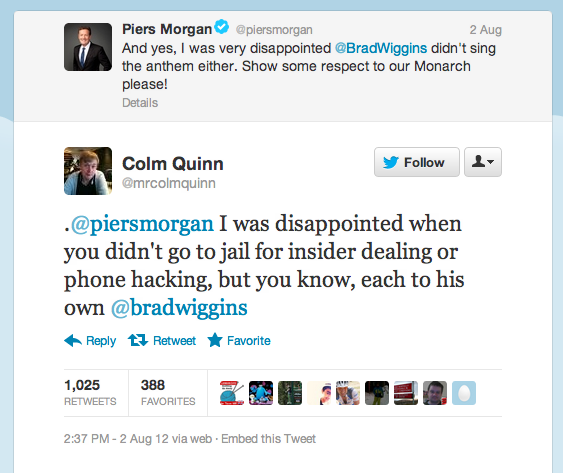
It is, of course, bollocks. This exchange took place, oh yes, but it was not between Piers "Cuntface" Morgan and Bradley Wiggins. No, instead, this is what happened:


You have doubtless noticed that the person who replied to Piers Morgan was not, in fact, Bradley Wiggins, and was instead one Colm Quinn, who just happened to mention Wiggins in his tweet, which is where the misunderstanding came from — probably from someone who doesn't quite understand how Twitter works. (Ending the message with "@bradwiggins" could look like a "signature" to someone not familiar with the way a typical Tweet is structured.)

As usual, however, the fact that "BRADLEY WIGGINS GAVE PIERCE MOREGAN AN AWESUM COMEBAK" makes a better story than "SOME DUDE YOU'VE NEVER HEARD OF GAVE PIERS MORGAN AN AWESOME COMEBACK" struck, and it struck hard. The (inaccurate) story spread like wildfire, of course, with no-one bothering to actually check Wiggins' timeline to see if he actually said the things that were attributed to him. And it spread. And spread. And spread.

Over time, some people got wise to the truth of the matter and pointed this fact out. But more and more people continued to post the inaccurate details — and then it spread to Facebook, and the whole thing started all over again, with both sides getting increasingly frustrated with one another.

I know it's a seemingly silly little thing to get riled about, but like I say, consider the potential implications if the "fact" that started spreading was something that could actually put someone in danger, or ruin a person's reputation. When the entire social Web starts acting like Daily Mail reporters by just blindly reposting things without even bothering to see if they're true or not, we have the potential for a real mess. Just look at the reactions of Facebook-bound idiots who don't know what The Onion is for a preview of what might be.

Fact-checking isn't just for journalists. Of course, there are plenty of journalists out there who seem to think it doesn't apply to them, either, but that's another matter entirely. It takes a matter of seconds to check something like a Tweet is the genuine article. You should be immediately skeptical of anything posted as a screen grab of a bit of plain text that looks like it was written in WordPad, or anything described by someone as SO AWESOME/FUNNY/HILARIOUS/LMAOOOOOOO etc. And, most importantly, if something sounds like it was too awesome to be true, it probably was.

Respect to Mr Colm Quinn for his excellent admonishment of Piers Morgan's twattish behaviour. Disrespect to all of you out there (you know who you are) who fall for this crap every time, whether it's "OMG TODAY WAS THE DAY MARTY MCFLY WENT TO IN BACK TO THE FUTURE PART II!" (for the last time, it is October 21, 2015) or "OMG! PIERS MORGAN GOT BURRRRRRRRNED BY BRADLEY WIGGINS".

Simple routine: before you retweet or share something, stop, check, then check again. It's not that hard.


#oneaday Day 914: Chinese Whispers

Twitter was angry today. There was some degree of justification — the horrific shooting in Aurora at the screening of the new Batman movie had emotions running high, and I certainly don't begrudge anyone that. But it demonstrated, once again, some of the dangers inherent in social media — a force which should, by all accounts, be a positive thing.

Misinformation spreads like wildfire on the Internet thanks to services like Twitter. People post things without thinking, without bothering to back things up with research and evidence. Journalists encourage this, with TV news being a particular offender, inviting people to contribute their own thoughts on a particularly pertinent story using hashtags. It thus becomes something of a challenge to determine exactly what the facts are, and what is simple hyperbole dreamed up by the increasingly-hysterical mass of people who suddenly all think that They Know Best.

I shan't talk too much about the Aurora shooting specifically here because I haven't read up on all the gory details myself as yet. I will refer to a couple of other recent incidents where this phenomenon became particularly apparent, however.

Most recently was the "Arctic Ready" campaign, in which Shell apparently made the amateurish misstep of opening up a slogan competition on a controversial subject — drilling in the Arctic — to the public. The "Let's Go! Social" gallery page promptly became filled with anti-drilling, environmentalist slogans and it looked, by all accounts, to be one of the most colossal fuck-ups in social marketing history.

Except that it wasn't. It was actually a genius piece of social marketing, but not by Shell. No; the whole thing was, in fact, a clever ruse by Greenpeace, who then went on to troll Shell even further by picking a "winner" from the supposed competition and putting it on a billboard right outside Shell's Houston headquarters.

It should have been pretty obvious to anyone who stopped to think about the whole thing for a moment that this clearly wasn't Shell's doing. The kind of people who handle social media marketing are generally fairly savvy sorts (though there are exceptions) and would have stepped in to deal with the mass trolling of the supposed competition. In fact, they would have probably removed it altogether fairly sharpish. They certainly wouldn't have left it up for several weeks, opened up a new Twitter account just to repeatedly request that people don't retweet "offensive" adverts and generally keep poking the fire.

Unfortunately, it wasn't obvious to a lot of people. It caught people out not once, but twice — first, when the "Arctic Ready" site first appeared, and again a few weeks later when the Twitter account appeared. People posted, retweeted and commented without stopping to think about whether or not it was real. Others who were wise to it posted, retweeted and commented about how it was clearly fake. But amid all the noise from both sides it became impossible to differentiate who was talking sense and who was simply repeating the digital equivalent of what they had heard down the pub while drunk.

The Shell incident isn't the only one either. The "Today Is The Day They Went To In Back To The Future Part II" hoax has been around twice, too. Both times it caught people out. Why? Because, again, no-one bothered to check. No-one took a moment to fire up the movie and take a look. If they had, they would have seen that the claims made by whoever started that ridiculous rumour on each occasion were patent nonsense.

It happens in journalism too, and particularly in games journalism. One site posts a "Rumour:" or "Report:" story, and others pick up on it. The content spreads and becomes somewhat distorted over time. It happened today with a story from MCV which, as it turned out, apparently misreported the facts in the first place (or rather, more accurately, posted a story with a misleading headline) and was then sourced by Destructoid and a ton of other sites. This then inspired Ben Kuchera, official unelected and self-styled arbiter of How To Do Games Journalism On The Internet, to pen this piece bemoaning the whole situation, and by God I hate agreeing with Ben Kuchera — but he had a point. With a bit of research (or indeed just carefully reading the quotes that MCV included in its own piece) it's clear that the "story" (or, more specifically, the headline) that was going around simply wasn't true.

It's exhausting at times to keep up with all this stuff, and while it's great to be able to tap the pulse of everyone at the same time on a hot topic, it's less great to find yourself in the world's biggest game of Chinese Whispers. So do me a favour. Before you blindly retweet something that seems a little "off", take a minute and check to see whether or not it's actually genuine.

#oneaday Day 872: Haters Gonna Inspire Worldwide-Trending YouTube Videos

I really love it when someone I know achieves success with something. That's why it was so utterly delightful to see something that a friend from university worked on gradually spread around the world today.

I am talking, of course, about this video, which if you haven't watched yet… well, you just should. (Probably NSFW.)

I don't know Isabel Fay (the lead performer) directly, but I do know one Mr Tom Hopgood, who co-produced the piece and has worked very hard with Isabel and the rest of the team at Clever Pie TV to produce some high-quality comedy skits over the last few years. Today, it seems, all that hard work really paid off.

I watched it happen over the course of the day. Another university friend shared the video. I expected this. But then someone who, to my knowledge, had no direct connection to Tom or Isabel shared the video, which surprised me. Then I shared it after watching it and finding it hilarious.

Then I went and did some work. As the day progressed, I saw the video start appearing in various tweets along with Facebook and Google+ posts.

Then Stephen Fry shared it, which is pretty much a guarantee that you're going to be a sudden global sensation, at least temporarily. Sure enough, a lot of the YouTube comments indicated that Stephen Fry sent them.

As it gets close to bedtime, I see more and more people still sharing it, including other unrelated Twitter followers. It truly is something which has spread worldwide and has enjoyed universal appeal among everyone I know online. This is delightful to see.

It's especially delightful to see as it was absolutely perfectly timed. I have a feeling it was just a happy coincidence that it happened to appear on everyone's radar today, but after reading this depressing post over on Feminist Frequency regarding the harassment, misogyny and silencing tactics the author had endured after promoting her upcoming research and video series, it just seemed perfectly, perfectly apt. Perhaps the fact that hateful comments on the Internet are very much at the forefront of people's minds right now meant that it resonated more than it might have done otherwise.

Or, you know, perhaps it's just a great piece with an infuriatingly catchy melody.

Whatever the reasons were for the video enjoying the success it has done so far (and still is — Twitter mentions of it are still flowing in even as I type this) don't really matter, though. I'm absolutely stoked for Isabel, Tom and the rest of the Clever Pie gang, and though I haven't seen Tom for a large number of years now I'm very proud to say that I have both known and worked with him. I have photos to prove it and everything.

I hope this is the beginning of something really big for Clever Pie. If they can continue to tap into relevant topics like this, then they've got it made. "Thank You Hater!" manages to be both topical and timeless at the same time — Internet trolls are always going to be an issue, but they're particularly prominent in people's minds right now for various reasons.

Enough gushing. Time for the weekend. Have a good one, everyone.