#oneaday Day 652: New Tricks - done

I've finished watching the full run of New Tricks, the BBC sort-of police procedural about the "Unsolved Crime and Open Case Squad", or UCOS, a unit in London's Metropolitan Police made up of one actual police officer and several other retired coppers. I enjoyed it a lot, even if the cast changes in its latter seasons arguably made it into a bit of a different show, and it meandered a bit in search of its own identity as a result.

New Tricks opens with UCOS being fronted by Sandra Pullman (Amanda Redman), a semi-disgraced police officer who gained notoriety after shooting a dog on a bungled raid that left the person she was supposed to be rescuing paralysed after falling out of a window. She assembles a colourful team of former police officers, including the diamond geezer Gerry Standing (Dennis Waterman), the extremely neurodivergent Brian "Memory" Lane and the relatively-normal-but-talks-to-his-dead-wife Jack Halford.

Between them, they form an initially uneasy alliance that subsequently blossoms into both genuine friendship and a wonderful sense of camaraderie as they solve a series of cold cases, many of which have been dormant for 20-30 years or more. As a result, Pullman more than redeems herself in the eyes of her superiors — though she still occasionally gets stick about the whole dog-shooting thing — and her band of merry old men find some meaning in their lives, as well as some closure in some longstanding issues.

This core cast remains constant for a significant proportion of the show, and we get to know them all very well. Halford is the first to leave; after finding closure on the murder of his wife, he departs to live out the end of his life peacefully after discovering he has a terminal illness. Lane is next to go, once again after reaching some closure on his "case that got away" — closure that involves him sacrificing his new career in the name of justice and the truth when he accuses a powerful member of the police for wrongdoing.

Standing lasts the longest, sticking around until the second episode of the show's final season. The two-part story that sees him departing after having faked his own death gives him a good story to go out on; he didn't have quite the same "issues" hanging over his head as Halford and Lane, so he needed something like this to make his departure an event of note in the same way, and it worked well, revealing some hitherto unknown details about his past career that felt very much in keeping with what we had learned about him over the course of the prior eleven seasons.

The replacement cast members include the Glaswegian Steve McAndrew (Denis Lawson), who is rebuilding his life following estrangement from his wife and son; Dan Griffin (Nicholas Lyndhurst), who is a frighteningly competent, knowledgeable individual who acts a bit as the group's "Superman" at times, despite occasionally demonstrating himself to be a bit unaware in terms of social interactions; and the latest to join the group, following Standing's departure, is Ted Case (Larry Lamb), a superstitious but intelligent former detective with a gift for interviewing witnesses and interrogating suspects. Outside of the "old men" of the group, Pullman is eventually replaced by Sasha Miller (Tamzin Outhwaite) towards the end of the series, and while this is probably the biggest upheaval the series saw, she settles into the new role quickly and does a good job.

New Tricks, across its entire run, strikes a good balance between the inherent comedy in such an unusual, eccentric ensemble cast, and the inherent darkness of a series about investigating longstanding cold cases, typically murders. The show thankfully sidesteps some of the clichés of police procedurals after its initial episodes; the pilot episode and the first couple of regular episodes give Pullman a superior who is the very definition of the stereotypical "shouting police chief", but before long he is replaced by Robert Strickland (Anthony Calf), an altogether calmer individual who, while coming from a background of privilege, often sides with "the little guy" (relatively speaking) rather than The Establishment as a whole. In the context of the series, this means that while he is often outwardly a by-the-book sort of individual, on the down-low he is immensely supportive of UCOS' eccentricities and lets them get away with a lot — because they get results.

(Yes, I know UCOS can be argued to be part of "The Establishment" also, given that they are a police department in their own right. But New Tricks makes a point of showing that the police as a whole are certainly not infallible, and there are several cases that involve the unit uncovering corruption within the organisation, eventually bringing justice to someone who had been wronged, many years ago in some cases.)

New Tricks' biggest strength is in its characters. We get to know the initial ensemble cast particularly intimately over the course of their time with the show; the later additions are also plenty likeable and get their own stories to shine, though by the simple fact that they have less time on screen in total, we never feel we quite get to know them as well as Pullman, Standing, Lane and Halford. Ted Case is the character who suffers the most in this regard; joining the cast full-time partway into its final season, some of his development feels a little rushed — although this, in itself, works quite well in the context of his character. The reveal that he is gay is handled in a particularly entertaining way that, from the relatively little we know of him at that point, feels very much in keeping with how he does things.

Given that the show ran for a long time — 2003-2015, to be exact — means that things change quite significantly in society over the course of its complete run. The show starts in a pre-smartphone age, for one, though the team are all comfortably using tablets (as in, iPads, not little boxes of pills) by its conclusion, and, as you might expect from the composition of its cast, issues such as sexism and ageism are explored. Several episodes, particularly later in the show's overall run, also deal with crimes that have a racial component or that involve domestic abuse and sexual assault, and while the show isn't particularly gory or shock-horror, it also doesn't shy away from real issues.

I'm sure there's plenty one could criticise about the show as a whole, particularly as today, in 2026, a lot of people have a somewhat skeptical view of the police and their role in society — and the way in which police-centric TV shows can somewhat "whitewash" this fact. But taking it as pure escapism — as a fun detective show with some colourful characters — it was highly entertaining, and I'm glad I took the time to watch it from start to finish.

Now I need something to replace it…


Want to read my thoughts on various video games, visual novels and other popular culture things? Stop by MoeGamer.net, my site for all things fun where I am generally a lot more cheerful. And if you fancy watching some vids on classic games, drop by my YouTube channel.

If you want this nonsense in your inbox every day, please feel free to subscribe via email. Your email address won't be used for anything else.
#oneaday Day 632: New Tricks

Longtime readers may recall that back in November, I started watching a show called New Tricks from the BBC. It's a detective show with an interesting concept: following the exploits of a fictional Metropolitan Police department known as the Unsolved Crime and Open Case Squad (aka UCOS), the show sees its core cast (which gradually changes over time) reopening various cold cases and getting to the bottom of them.

I'm just coming up on the end of the tenth series out of twelve and I've been enjoying it a lot. It's been a consistently interesting watch, with some excellent characters who have some good backstories that get some decent payoff over the long term. I understand that the point I'm currently watching is where some people feel like it started to run out of steam a bit, leading to, among other things, one of the original cast members moving on because he felt things had become stale and another two departing after an apparently public spat with the writers, but I'm still enjoying the show with its new cast members. Former lead Amanda Redman said she felt like the cast had lost their anarchic edge in the later episodes, and I see why she said that — but really it's just a different vibe thanks to a different set of characters.

Of particular note is the presence of Nicholas Lyndhurst, an actor who I'm sure most people associate with comedic roles thanks to his most well-known appearances as Rodney in Only Fools and Horses and Gary Sparrow in Goodnight Sweetheart, but in New Tricks he does extremely well as a particularly serious-seeming member of the team. He still has his humorous moments, but they're mostly delivered through deadpan humour; the show is somewhat on the "gritty" side, but isn't above a bit of levity, primarily through little character moments.

The show covers an interesting time period, too. It launched in an era before smartphones and ran until the mid-2010s. A lot of things changes about society in that period, in retrospect, and it's interesting to see the show reflect that. Quite a few early episodes of the show are about Redman's Detective Superintendent Pullman character having to fight to be taken seriously in a world that is still very much male-dominated — and particularly after her assignment to UCOS came after a botched raid in which she shot a dog — and there are frequent explorations of the challenges people with mental health concerns have to face in their daily life.

Of particular note in this regard is the character Brian "Memory" Lane, who is a recovering alcoholic and highly likely to be autistic. Some of the best character moments in the show come from an exploration of Brian struggling to deal with simply existing in a world that he doesn't quite feel comfortable in, and the unique challenges he faces considering his background and his daily struggles. He could easily have become a pathetic, tragic character, but the show handles him well and shows that people contending with the things he is dealing with still have something to offer society, and that they can often find great comfort from the love of people who support them unconditionally. His exit from the show, involving an extremely satisfying resolution to a plot thread that had been dangling for most of the series' run, was handled very well.

The exit of Redman's Pullman character was a little more sudden, however, and it was a little unsatisfying. It feels like she just sort of suddenly decided to move on, and her reasons for doing so just weren't really explored all that much; on top of that, I feel like it would be a much longer process for someone in the Metropolitan Police, particularly in a leadership position, to be able to move on, whereas she was pretty much just out the door and gone. Her replacement, Tamzin Outhwaite's Sasha Miller, seems like a solid character, though, and has already had some interesting things happening to her in just the two episodes I've seen her in so far.

Dennis Waterman's Gerry Standing, as the longest fixture in the series, is a great anchor point for the show. While his cheeky chappy Cockney act could have easily become a bit tiresome, he is shown throughout the series to be a character with some interesting depth and plenty of admirable qualities, even if he sometimes takes a somewhat laissez-faire approach to following the rules. Some of his interest comes from his three amicable divorces and the fact that all his ex-wives and children form one big extended family, but he also gets plenty of his own moments to shine.

The show isn't anything particularly revolutionary and I'm sure it's not regarded as a "classic" or anything, but it did successfully run for twelve series, which suggests it was doing something right along the way. I've enjoyed watching it so far, and I'm glad I took a chance on it; if you're after a detective show to spend some time with, you could do far worse.


Want to read my thoughts on various video games, visual novels and other popular culture things? Stop by MoeGamer.net, my site for all things fun where I am generally a lot more cheerful. And if you fancy watching some vids on classic games, drop by my YouTube channel.

If you want this nonsense in your inbox every day, please feel free to subscribe via email. Your email address won't be used for anything else.

#oneaday Day 537: Old dogs

Since I've exhausted both Death in Paradise and its spin-off series Beyond Paradise for the moment, I was looking for a new "detective" show to watch. I considered the other Death in Paradise spinoff, Return to Paradise, but thought I fancied something a bit different. And BBC iPlayer was certainly keen to provide suggestions.

I settled on a show called New Tricks, which I hadn't heard of before, but which apparently first aired all the way back in 2003, and concluded its complete run in 2015. I've watched two episodes so far, and while it's a very different sort of show to Death in Paradise and Return to Paradise, I've enjoyed what I've seen so far.

New Tricks (at least initially) follows the semi-disgraced Detective Superintendent Sandra Pullman (Amanda Redman) of the Metropolitan Police who, after a botched hostage rescue in which she shot a dog and the person she was supposed to be rescuing flung himself out of a window, paralysing himself when he landed on a car several storeys below, has been placed in charge of the fictional "Unsolved Crime and Open Case Squad", or UCOS. This is a branch of the Met specifically tasked with re-investigating unsolved "cold cases", with the officer in charge, initially Pullman, charged with wrangling a small group of retired former officers in the hope of their insights being able to put the various cases to bed once and for all.

Conceptually, it's a tad silly, particularly since the initial lineup of old men all initially appear to be somewhat comedic caricatures. There's Brian Lane (Alun Armstrong), who struggles with severe mental health issues and an obsession over the case that ended his career on the force; there's Jack Halford (James Bolam), who talks to his dead wife when no-one else is around, but is otherwise the most well-grounded of the bunch; and there's Gerry Standing (Dennis Waterman, the only constant member of the cast throughout the entire run of the show), who is a bit of a geezer and a "naughty boy", in his words, with a string of failed marriages behind him and a somewhat unorthodox approach to following the rules. The characters are all introduced as each having their own sort of "thing" that defines them, but just the initial two episodes shows that there's clearly potential for some interesting character work going on.

What I've found quite fun about New Tricks so far is that it blends quite a few disparate elements and comes out feeling quite coherent. There's the obvious conflict between Pullman being a modern police officer (by 2003 standards, anyway) — and a woman, at that — and these retired former officers, all of whom are set in their ways to varying degrees. And then there's the friction between the private lives of all the characters and their professional responsibilities. The show is, on the whole, somewhat on the "gritty" side, with the struggles the various characters encounter all being somewhat realistic and relatable rather than the easily resolved fluff or material for comic relief that the Paradise series tended to favour, but there's also plenty of comedy inherent in the whole situation — particularly when Pullman shows herself to be the sort of woman who takes absolutely no shit from anyone.

The fact that the show premiered in 2003 with a 90-minute pilot before going into full production in 2004 is an interesting consideration, too. In some respects, the way the show is presented makes it clear it's from a different time — and while I try not to think of 2004 as being too much "of a different time" to right now, the fact is, it was over 20 years ago — and it's quite pleasant to return to that world. I'm not talking thematically or in terms of societal norms displayed in the show, obviously, but rather literally the way it is presented. It has a theme song, for Heaven's sake, and one sung by one of the cast members (Waterman), at that! What was the last show you watched that had a full-on theme song — and, more to the point, one that had been specifically composed to include the show's title as part of its lyrics?

Anyway, that's about all I want to say about it for the moment. I'm looking forward to getting to know the series a bit better. I'd actually never heard of it before, somehow, but I guess if it ran for twelve seasons, it must have had something to it, no?

Or, to put it another way: it's all right. It's okay!


Want to read my thoughts on various video games, visual novels and other popular culture things? Stop by MoeGamer.net, my site for all things fun where I am generally a lot more cheerful. And if you fancy watching some vids on classic games, drop by my YouTube channel.

If you want this nonsense in your inbox every day, please feel free to subscribe via email. Your email address won't be used for anything else.
#oneaday Day 496: Farewell, DI Parker

I am still watching Death in Paradise on my lunch breaks, and I've just got to the end of Ralf Little's run as the lead, Detective Inspector Neville Parker. He follows Ardal O'Hanlon, Kris Marshall and Ben Miller in taking the central role, and I think his run on the series might have been one of my favourites to date.

I enjoyed Miller, Marshall and O'Hanlon's time in the leading role, too, but Little's time in the hot seat felt like it had one of the most coherent character arcs for the central character. It helped that he, as a character, probably had the most room to grow of all the show's leading men to date — and the fact he was in place for about three and a half seasons, which is longer than his predecessors.

Death in Paradise is a heavily formulaic show, and to some people, that sort of thing can be annoying. Hell, formulaic shows are, at times, anathema to me — I can't stand reality TV shows that all adopt the "one of them gets voted off after a long, pregnant pause" format, for example — but for some reason, I find the relative predictability of Death in Paradise enjoyable, even comforting.

That extends to the role of the lead character, too: they're always a fish-out-of-water detective who has been brought across from some British police force (O'Hanlon's character, despite being Irish, was part of the Metropolitan Police in London before joining the Honoré gang) but the exact form of that varies somewhat. Miller's DI Poole was a grumpy old fart who gradually softened as he spent time with his comrades, until he was murdered, anyway; Marshall's DI Goodman was clumsy and scatterbrained but brilliant; O'Hanlon's DI Mooney was by far the character who was most at ease on the island; then Little's DI Parker went to the other extreme.

Initially resistant to everything the island of Saint-Marie had to offer — and allergic to everything — Parker was gradually brought out of his mosquito-repellent shell by his DS, Florence Cassell (Josephine Jobert), who had been a fixture on the show for some time, and showed some real character growth, culminating in him developing feelings for Florence. It was not to be, however, as not only did she reject him, at least partly because she was still smarting from the murder of her former fiancée, but a case forced her undercover and subsequently into the witness protection programme, conveniently bringing her time on the show to a close for a while.

Parker had a number of other good storylines along the way, too. They were ridiculous if you stop to think about them for a moment, but the same is true for the entirety of Death in Paradise. If a single locale had the murders per capita that Saint-Marie has, I suspect the authorities would declare it a complete lost cause and just firebomb it into oblivion. But I digress.

Probably the best of Parker's storylines was his holiday romance with a woman named Sophie. This initially appeared to be a complete mirror image of Goodman's romance with Martha, which ultimately led to him departing the show (and the pair getting their own spinoff series) but subsequently developed into something much more interesting. I doubt any of you reading this particularly care about Death in Paradise spoilers, but for the sake of anyone who might fancy watching this silly show, I will refrain from giving any further details for now.

Parker's finale, which saw him all set to depart Saint-Marie on a worldwide journey of self-discovery — just in time for Florence to return to the island and realise her feelings for him — was a good one, too. The promotional material for the episodes on BBC iPlayer did a good job of implying that it might be Parker who ended up murdered in his last episode — as previously noted, it wouldn't be the first time the show had killed off its lead — but he ultimately got a good, happy sendoff. I was glad about that; as a character, it felt like he deserved a happy ending. Not that Miller's poor old DI Poole didn't, but the surprise, sudden nature of his departure was very effective, and I'm not sure it would have worked for a second time, even with multiple seasons in between them.

Anyway, I'm surprised at a few things about my enjoyment of this show. Firstly, quite how attached I am to the various characters. Secondly, how well it handles feeling coherent despite a core cast that has been almost completely replaced multiple times over the course of its various seasons. By firmly grounding the show in its geographical setting, and having characters like Commissioner Patterson and bar owner-turned-mayor Catherine, the show establishes itself as a firm base that the rotating core cast builds atop, and it works. It helps prevent the show feeling too stale — and it's nice to see that some characters do get the chance to come back, too. I was particularly pleased to see the return of Danny John-Jules' Dwayne Myers, especially since his former squeeze Darlene had become an officer of the Honoré force in the meantime.

It's ultimately all rather silly comfort TV, and I suspect as soon as I've finished watching its complete run, I'll forget all about it. But for now, Death in Paradise has been a thoroughly pleasant watch — and I look forward to seeing where it goes from hereon.


Want to read my thoughts on various video games, visual novels and other popular culture things? Stop by MoeGamer.net, my site for all things fun where I am generally a lot more cheerful. And if you fancy watching some vids on classic games, drop by my YouTube channel.

If you want this nonsense in your inbox every day, please feel free to subscribe via email. Your email address won't be used for anything else.

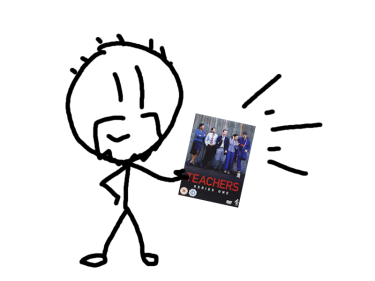
#oneaday Day 449: Revisiting Teachers

Back in the dim, distant past before streaming video services were a thing, and in a wonderful time before the apparently collective decision that if you're not continually "consuming new content" you're Doing It Wrong, there were several DVD series I had on my shelf that were in almost continual rotation in my DVD player. Spaced, Black Books, Peep Show, Big Train, that sort of thing; a particular brand of British comedy, almost always originally broadcast on Channel 4, and in many cases involving the exact same cast members.

(Aside: a fair few of these have been sullied a little in recent years by their association with Graham "I Hate Trans People… Wait, Why Do You All Hate Me Now" Linehan, but I do try my best not to let that bother me too much, because these series — and the work of the actors therein, most of whom do not subscribe to Linehan's odious bigotry — will always be special to me.)

One of my absolute favourites was Teachers, which was a thoroughly interesting show. I've just re-acquired the DVDs of the complete season, and I watched the first episode last night for the first time in a very long while.

Teachers, if you're unfamiliar, is probably best described as a comedy-drama rather than an out-and-out comedy. It initially focuses on the life of a 27 year old English teacher named Simon, who works at a comprehensive school in Bristol. In later series, several of the original cast members (including Andrew Lincoln, who played Simon) depart to make way for a new ensemble cast, so as a complete run it's more of a snapshot of a moment in a group of people's lives rather than a particularly "personal" story as such. There are a few constants along the way, though.

One of the most interesting things about Teachers is its heavily stylised nature. A trademark of the show is how each episode looks at several days across a typical week, and the introduction to each week is done diegetically through the name of the day appearing on something in the world — on a billboard, on a sheet of paper being photocopies, on a computer display, that sort of thing. This is just the beginning of things, though.

There's an almost hallucinogenic quality to certain sequences in Teachers, which certainly in the initial series is intended to reflect the somewhat turbulent state of mind that our hero, Simon, is in. Simon, you see, is a bit stressed out and starting to have significant doubts over whether he actually wants to be a teacher, and his rather rocky relationship with his peer in the English department, a stern woman named Jenny (played with great enthusiasm by Nina Sia), certainly doesn't make things any easier.

Sometimes these stylised sections are very obvious, such as when Simon returns to school the night after a drunken night out, during which he and his friends broke into the school and let a sheep in, among other things, and starts hallucinating that a full-on forensics team is dusting down his classroom for prints. At others, they are subtle, such as peculiar things happening in the background of scenes — the aforementioned sheep continually shows up throughout the series, for example — or little sound effects, such as when Jenny aggressively touches Simon on the shoulders with her fingertips while admonishing him, and you can hear the sound of sizzling.

One of the best things about the show is the ensemble of Kurt and Brian, played by Navin Chowdhry and Adrian Bower respectively. This pair are, in many ways, the worst of the worst. They're male chauvinist pigs constantly obsessing over people's arses, they always do their best to avoid getting out of having to do anything, they're utterly irresponsible, and they're absolute pranksters.

And yet you can't help but love them. Their behaviour towards women, which might initially seem winceworthy in the somewhat more enlightened world we supposedly live in today, is endearingly, amusingly pathetic in light of the fact that the pair of them seemingly get no action whatsoever for the vast majority of the run (that and the female members of the cast are more than capable of standing up for themselves); their irresponsibility actually comes across as a relatively healthy method of coping with the potentially overwhelming stress of working as a teacher; and their pranks… well, they're always amusing.

Probably the absolute best thing about the show, though, is its use of music, which almost exclusively consists of late '90s/early '00s Britpop and indie rock. In some respects it dates the show enormously — as does the fact that a plot point of the first episode is that teachers are no longer allowed to smoke in the school building in the "smoking room" — but in others it forms an absolutely core part of the show's identity.

Teachers is great because it tells some believably human stories about a distinctly down-to-earth cast of characters and doesn't get hung up on high drama — which is something that subsequent school-based TV shows, like Waterloo Road, could be accused of — and focuses on just being entertaining. Watching Teachers is like being included in this little friendship group of characters; you get to see them at their best and, more frequently, their worst — but that "worst" is never anything particularly serious — and it's always a joy to be among them.

It's definitely a show that is very much "of its time", but after revisiting the first episode earlier, I'm looking forward to watching some more.


Want to read my thoughts on various video games, visual novels and other popular culture things? Stop by MoeGamer.net, my site for all things fun where I am generally a lot more cheerful. And if you fancy watching some vids on classic games, drop by my YouTube channel.

If you want this nonsense in your inbox every day, please feel free to subscribe via email. Your email address won't be used for anything else.

#oneaday Day 423: Destination X

I watched a potentially interesting new TV show the other day. I've only watched one episode so far and I'm not 100% sure if it was actually any good or not, but the concept was, at least, interesting.

The show is on the BBC and is known as Destination X. I was mostly attracted to it by Rob Brydon being in the presenting role; I have a lot of time for Brydon and his work, and this looked nicely different from his usual panel show stuff.

The concept of Destination X is that a bunch of randos are thrown together and, via various circumstances, placed in a situation where they don't know where they are going and, at various legs of their journey, where they are. At the end of each episode, each contestant has to plop an "X" down on a map of Europe where they think they are, and whoever's X is the furthest away from where they actually are is booted out of the competition.

Naturally, numerous obstacles are placed in the competitors' way, but they also have the opportunity to earn clues as to where they are, too. There are "challenges" along the way, which can potentially provide clues to everyone, but which also give a particular advantage to whoever had the strongest individual performance in the challenge.

In the first episode, all the contestants were stuck in a box, with various items of imagery adorning the walls. The box was split into an "A" side and a "B" side, and the group was asked a series of questions with two possible answers. Each contestant had to stand on the side they believed was the correct answer, and, without revealing whether the answer was correct or not, they would then have the opportunity to look out of a tiny window of the box to see either a clue (if they were on the "correct" side) or a red herring (if they were on the "wrong" side).

There's also some artificial drama added, at least in this first episode, by the person who "won" the challenge having the opportunity to bring someone else along to gain their particular advantage — and they also have the option to earn another clue, on the condition that no-one else must learn that clue, otherwise they'll be immediately disqualified. It sounds complicated, but it makes sense in the moment.

It's an interesting format, for sure, though there are some rather mean tricks played on the contestants even with the supposedly "helpful" clues — the worst of which was having a helpful guide tell them about a building they were standing in front of them in German… when they were actually in France. The added "drama" just felt a bit gratuitous, too, particularly given that the person given the opportunity to conspire with another contestant and/or screw the others over clearly was not at all comfortable with this side of proceedings.

As with any show featuring (supposed) members of the general public, too, the cast appears to have been picked to have the maximum possible number of annoying dickheads in it. There's a particularly odious-seeming individual who is obsessed with social media, and they come across as a complete tool. I have little to no doubt that there is heavy scripting and editing involved in order to make these otherwise boring members of Joe Public into "characters", but, again, it feels a bit gratuitous, and not really necessary in a show where the basic format is already kind of intriguing.

I'm not sure if I'm going to watch any more of it, but I didn't dislike the first episode that I watched. I may watch another one or two episodes to see if it's worth sticking with; you never know, you might enjoy it, though, so that's what today's post was all about!


Want to read my thoughts on various video games, visual novels and other popular culture things? Stop by MoeGamer.net, my site for all things fun where I am generally a lot more cheerful. And if you fancy watching some vids on classic games, drop by my YouTube channel.

If you want this nonsense in your inbox every day, please feel free to subscribe via email. Your email address won't be used for anything else.

#oneaday Day 407: More Death in Paradise

My slide into middle-age is ongoing as I find myself continuing to watch Death in Paradise, the murder mystery show about a fish-out-of-water detective from jolly old England finding themselves solving murders on a Caribbean island with probably the highest murders per capita figure in the entire world.

I'm up to the fifth season now, which is well into second lead Kris Marshall's tenure on the show. His arrival at the start of the third series, thanks to the impressively ballsy move of murdering the former lead, DI Poole (played with aplomb by Ben Miller), marked a notable shift for the show, but it handles it well. Most crucially, it continues to be enjoyable and appealing for much the same reasons as when Miller's Poole character had the leading role, and I suspect that later changes in the core cast will continue this trend.

It's not just the lead that changes, either. While Danny John-Jules' excellent Officer Dwayne Myers remains in place for a significant portion of the run — I believe he finally stops being a regular around the seventh season or so? — the other "main characters" shift around a bit. The lead detective's second, initially a young woman named Camille (Sara Martins), departs the show partway through the fourth season after having been a failed love interest for both Miller and Marshall's characters, and is replaced by Florence (Joséphine Jobert), who initially takes the place of Fidel, one of the uniformed officers in the show, and is subsequently promoted to take Camille's place after the latter takes a job in Paris. The open "second uniformed officer" slot is then taken up by JP (Tobi Bakare), who stays in place, as far as I can make out, until the end of the show's present run.

Anyway, point is, the cast undergoes some quite substantial changes over the course of the show's complete run to date, but it still feels coherent. There's a good sense of "handover" from prior cast members to new ones, and the overall "feel" of the show remains remarkably consistent.

Part of this is entirely deliberate, and somewhat lampshaded by the structure of the show — especially the denouement, during which the lead detective gathers all the main suspects and witnesses together, then dramatically explains whodunnit, how and why. Early in Marshall's run on the show, he is introduced to this format as being how DI Poole did things, and there are plenty of jokes in subsequent episodes when certain individuals talk about going to arrest a suspect, only to be told "that's not how we do things around here".

It's intensely, extremely formulaic, but in many ways that's what makes it so comforting. The details of each case are different enough to keep each episode feeling fresh, but the structure of the storytelling is always the same. It's a structure that works, and is effective at telling a fun murder-mystery story over the course of each hour-long episode.

I've always had a real spot for detective stories. I read all the Sherlock Holmes stories as a youth, in a book that basically reprinted all the old Strand magazine pages they originally appeared in, in extremely tiny print. I played a bunch of detective-style adventure games with my mother as a kid — and continued to do so into my adult life. And I don't think there's a detective-style TV show that I've watched to date that I haven't enjoyed.

There are some today who would probably argue that this sort of show is "copaganda", and I get that. There are many things one can criticise the real-world police for, and in more recent years I really feel like I understand why some people feel quite so aggrieved at the very existence of police forces.

But at the same time, a good old murder mystery is a classic story format with good reason, and a cast of police officers is an ideal vehicle for telling a story like that. So I don't feel the slightest bit guilty in unironically enjoying shows like Death in Paradise simply for what they are. The real police may, in many ways, suck, but that doesn't mean you can't root for fictional detectives to crack each case!


Want to read my thoughts on various video games, visual novels and other popular culture things? Stop by MoeGamer.net, my site for all things fun where I am generally a lot more cheerful. And if you fancy watching some vids on classic games, drop by my YouTube channel.

If you want this nonsense in your inbox every day, please feel free to subscribe via email. Your email address won't be used for anything else.

#oneaday Day 366: Bardic Investigations

I have now watched roughly half of the complete run to date of Shakespeare and Hathaway: Private Investigators, and I'm still really enjoying it. It's low-effort TV but not in an "insulting to your intelligence" sort of way; more that it's quite gentle in terms of both it's dramatic and comedic aspects.

A good example of this is the fact that in the 21 episodes I've watched so far, there hasn't been a single fight scene, and action scenes in general are fairly limited. There's been a few car chases and a number of on-foot pursuits, too, but given the two protagonists are neither exactly in the prime of life, they mostly conclude with them outwitting their quarry rather than taking them down dramatically.

There's no swearing, either. I don't mind a bit of effing and jeffing at all — heaven knows I do it enough around here — but it is nice to watch a show that isn't being particularly tryhard about showing the "gritty" side of life.

In fact, as I noted in my first impressions, Shakespeare and Hathaway is mostly rather cartoonish, or perhaps more accurately, theatrical. Villains are unmistakably evil, with most of them practically twirling their figurative moustaches at every opportunity. Far from making the show cheesy and silly, though, this is one of many things that helps it to be so easily digestible and enjoyable without demanding too much of the viewer.

I'm not saying all TV should be like that by any means, but in an age where I know multiple people who won't start watching a new series if there isn't an analysis podcast running alongside it, it is very nice to watch something that just knows what it is, and which delivers consistent, straightforward entertainment.

An easy recommendation, then, if only for the exchange "What's the first rule of stakeouts?" "…no farting?"

#oneaday Day 357: Shakespeare & Hathaway

So, dear reader, you may be wondering: after my frankly unnecessary agonising over whether or not I "should" start watching it, given all the other stuff on my media plate right now, I did, in fact, start watching Shakespeare & Hathaway: Private Investigators. And I'm enjoying it a lot!

For the unfamiliar, Shakespeare & Hathaway (as I shall refer to it hereafter) is a fairly light-hearted crime drama about the unlikely Stratford-upon-Avon-based duo of private detective Frank Hathaway and his partner in crime-solving, Lu Shakespeare. The pair are brought together during the first episode when there is a murder case at Lou's wedding, and they just sort of… stick together after that.

Shakespeare & Hathaway is not a show that concerns itself with small details, such as whether or not Lu would be allowed to work with Frank as an investigator with no experience or qualifications — a quick Google reveals that private investigator licenses are not actually required here in the UK, but they are strongly advised — but rather in simply providing a series of interesting crimes for the duo to solve. And in that, it succeeds pretty admirably.

As with most crime dramas, each episode focuses on a single case. And they're a varied bunch, to be sure. In one episode, the duo are investigating on behalf of an undertaker who has been given 24 hours to live by a pair of sinister hitmen. In another, they look into the case of a boy who has curious blackouts and is convinced that he is going to commit a murder. In another still, a gift shop owner turns up dead after an apparently botched break-in, but something just doesn't quite seem right.

One of the things I really like about the show is how it isn't afraid to be kind of "cartoony", particularly where its villains are concerned. This is a show where the villains don't exactly twirl their moustaches and do full-on evil laughs, but they honestly come pretty damn close on quite a few occasions.

Perhaps it's more accurate (and fitting) to say that the show is rather theatrical, given its setting and title — and the fact that Shakespeare and Hathaway's long-suffering assistant Sebastian is a RADA-trained (but out-of-work, natch) actor. And, yes, he is often convinced to perform (pun intended) undercover assignments that involve him dressing up in elaborate costumes and often playing "characters" that are very different from his rather mild-mannered but camp and sarcastic real persona. The highlight so far was a scene where he attended a cross-dressing bar and made such a convincing woman that he turned everyone's heads — and I suspect more than a few viewers might not have immediately clocked it was him until he opened his mouth, either.

Also, as you might expect given the Stratford setting, the show is riddled with Shakespearean references, both subtle and slap-you-in-the-face obvious. But Bard nerds will be happy.

The show's not going to win any grand awards or be remembered for years to come, I'm sure. But it is an eminently likeable piece of television, featuring a central cast who have good chemistry with one another. This isn't a show about said central cast going through high drama or amazing revelations — at least, it hasn't been yet — but I'm honestly fine with that. Frank is a pleasingly likeable, flawed everyman type — and I appreciate that he's a larger gentleman, played excellently by Mark Benton — while Lu is someone keen to prove her usefulness, yet endearingly ditzy. There's more than a touch of Daisy from Spaced about her in terms of personality and mannerisms.

I'm coming up on the end of the first series, and I've very much enjoyed it so far. If you're a fan of crime drama that doesn't get too grim, and which takes joy in theatrics and comedy, I would comfortably recommend it to anyone. It's not a demanding watch, but it is oddly compelling. And I'm looking forward to watching more!


Want to read my thoughts on various video games, visual novels and other popular culture things? Stop by MoeGamer.net, my site for all things fun where I am generally a lot more cheerful. And if you fancy watching some vids on classic games, drop by my YouTube channel.

If you want this nonsense in your inbox every day, please feel free to subscribe via email. Your email address won't be used for anything else.

#oneaday Day 323: Bing biddly bing bong bingy bong boooo

Regular readers will recall I started rewatching Friends a while back. I'm up to the fifth season out of ten as of the time of writing, and I'm really enjoying it.

The "culture shock" of watching it for the first time in more than ten years has mostly dissipated now, and the fact that no-one is ever seen fiddling with a mobile phone, looking things up on the Internet or experiencing life entirely through their camera lens feels pretty much natural now. Stop to think about it, and it's still clear that the world has changed a lot — mostly for the worse, I'd say, unfortunately — but after a while, Friends has, for me, shown that it has that magical "drawing you in" nature that means it doesn't matter that it's dated in some ways.

Friends was never really about a specific time period, anyway. Sure, it acts quite nicely as a snapshot of the late '90s and early (pre-smartphone) '00s now, but I'm not sure it was ever intended to be that. Instead, it was a show that was always about the people: specifically, it was about the concept of found family, and how the group of people you chose to surround yourself with was just as important as — or in some cases, more important than — those you were related to by blood.

I must admit to a certain melancholy about viewing Friends in this light, because for all the wonderful conveniences and whatnot we have today, I miss just… hanging out with friends. I miss everything from walking a couple of miles into town during a free period of sixth form in order to get peer pressured into buying a new N64 or PlayStation game. I miss skipping lectures to go play Perfect Dark. I miss Board Game and Curry Night being a regular thing. In short, I very much miss having that "found family", because in 2025… it just doesn't feel like it's there any more, for a whole manner of reasons, not just technology-related.

But at the same time this is why I find an occasional rewatch of something pleasantly familiar like Friends to be extremely comforting. I may not literally be there with the main cast — and I wasn't back at the time, either — but the nice thing about the show is how it makes you feel included. You see the ups and downs of each of the main cast's lives; you see the little in-jokes they have with one another and you understand where they came from, because you were there when they were first coined. And you root for them; even seeing what colossal dildos they all are at various points in the series — particularly both Ross and Rachel — you cannot help but root for them and wish them happiness.

And the nice thing is, you know they get that happiness, because it's that kind of show. Even if you've never seen the show all the way to the end, you almost certainly know what at least some of the main "resolutions" are going to be. Arguably it's only really Joey who is left without a real sense of wrapping things up neatly — and his spin-off series didn't really fix that either, though I must confess I haven't seen it — but even so, one gets the feeling he's probably going to be all right.

It's a bit sad how many of the Friends cast are no longer with us. Matthew Perry was, of course, a tragic loss a couple of years back, and I was sad to learn recently that James Michael Tyler, who played the recurring coffee house barista Gunther, passed away in 2021. Add this to the fact that several people from Star Trek: Deep Space Nine, which I watched all the way through a while back, are also no longer of this world, and it's a little bit sobering. At least they all have a wonderful legacy to leave behind.

This got a little more morbid than intended, but whatchagonnado. Friends is still a wonderful thing, and I am really enjoying my rewatch of it. There's nothing quite like returning to the media you loved in your formative years to bring a teensy bit of comfort to the bleakness of modern existence. If you haven't done it for a while, I highly recommend it.


Want to read my thoughts on various video games, visual novels and other popular culture things? Stop by MoeGamer.net, my site for all things fun where I am generally a lot more cheerful. And if you fancy watching some vids on classic games, drop by my YouTube channel.

If you want this nonsense in your inbox every day, please feel free to subscribe via email. Your email address won't be used for anything else.