#oneaday Day 674: A product of its time

For some reason, I decided to start re-watching the Channel 4 comedy show Peep Show recently. I say re-watch; I'm not sure I've ever watched it all the way through, but it is a show that I always used to like, and as the show that shot David Mitchell and Robert Webb to stardom (or at the very least "household name" status), it's something I've always considered to be fairly evergreen, even if its somewhat "cringe comedy" nature makes it unpalatable to some folks — my wife being one of them.

I was dismayed to discover upon starting my rewatch that Peep Show is over twenty fucking years old. I don't know why, given that I remember having DVDs of it just after my time at university, but I've always thought of it as a relatively "recent" show. But no! It's a show that pre-dates smartphones and flatscreen TVs and monitors; it's a show that is old enough to come with one of those "this show was made in 2003 and is not representative of today's values" disclaimers that you normally see on shit from the 1920s.

The source of this particular warning is a scene early in the second series that is essentially blackface. I say "essentially" because the scene in question is actually criticising blackface, particularly in the context of using it as something to be deliberately provocative — or even a fetish — but it still involves Robert Webb with his skin painted a darker colour and thus I appreciate that to some, it may be hard to defend.

I do find the whole "today's values" thing mildly interesting, and occasionally annoying. I find it especially grating when people start talking about how a piece of dialogue is "problematic", when the dialogue in question is supposed to be depicting a character that is a piece of shit. There's a certain subset of people, many of whom have grown up with what passes for cultural critique on asinine platforms like TikTok, who have a very black-and-white (no pun intended, given the above) view of morality in fiction. These people tend to find it especially "problematic" — a word I've always hated, if that wasn't already clear — when "villains" of the piece act in a villainous manner. Who would have thought it?

I mean, sure. You probably can get across the fact that a person is a piece of shit without resorting to actions and utterances that are offensive by modern standards. But at the same time, I do feel writers should be able to depict characters who are offensive in some way or another — otherwise your critique of them and their actions lacks a bit of bite. It's like all the people on YouTube who bleep out any time they say words like "sex" or "death". It's a bit too much, y'know?

Obviously I'm not advocating for black-and-white minstrel shows and racial slurs 24/7, but I feel like there comes a point where you can wrap modern audiences in cotton wool just a little too much, and the result is an entire cohort of people who cannot cope with being challenged by fiction even a little bit. We already see this on "BookTok" (ugh). Don't even get me started on those idiots.

I guess, thinking rationally, the solution Channel 4 took with this Peep Show episode is probably as good as one can expect right now; the episode itself is untouched, it just has a warning before you watch it. And, as far as I'm aware, that hasn't caused any particular scandals around the place online. So perhaps we should just keep quiet, acknowledge these when they exist and just get on with things. Because the alternative is a dark place for the creative arts, as we're already starting to get a hint of in some places.


Want to read my thoughts on various video games, visual novels and other popular culture things? Stop by MoeGamer.net, my site for all things fun where I am generally a lot more cheerful. And if you fancy watching some vids on classic games, drop by my YouTube channel.

If you want this nonsense in your inbox every day, please feel free to subscribe via email. Your email address won't be used for anything else.
#oneaday Day 449: Revisiting Teachers

Back in the dim, distant past before streaming video services were a thing, and in a wonderful time before the apparently collective decision that if you're not continually "consuming new content" you're Doing It Wrong, there were several DVD series I had on my shelf that were in almost continual rotation in my DVD player. Spaced, Black Books, Peep Show, Big Train, that sort of thing; a particular brand of British comedy, almost always originally broadcast on Channel 4, and in many cases involving the exact same cast members.

(Aside: a fair few of these have been sullied a little in recent years by their association with Graham "I Hate Trans People… Wait, Why Do You All Hate Me Now" Linehan, but I do try my best not to let that bother me too much, because these series — and the work of the actors therein, most of whom do not subscribe to Linehan's odious bigotry — will always be special to me.)

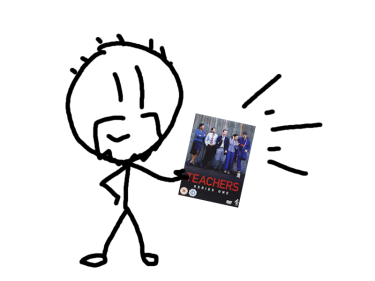
One of my absolute favourites was Teachers, which was a thoroughly interesting show. I've just re-acquired the DVDs of the complete season, and I watched the first episode last night for the first time in a very long while.

Teachers, if you're unfamiliar, is probably best described as a comedy-drama rather than an out-and-out comedy. It initially focuses on the life of a 27 year old English teacher named Simon, who works at a comprehensive school in Bristol. In later series, several of the original cast members (including Andrew Lincoln, who played Simon) depart to make way for a new ensemble cast, so as a complete run it's more of a snapshot of a moment in a group of people's lives rather than a particularly "personal" story as such. There are a few constants along the way, though.

One of the most interesting things about Teachers is its heavily stylised nature. A trademark of the show is how each episode looks at several days across a typical week, and the introduction to each week is done diegetically through the name of the day appearing on something in the world — on a billboard, on a sheet of paper being photocopies, on a computer display, that sort of thing. This is just the beginning of things, though.

There's an almost hallucinogenic quality to certain sequences in Teachers, which certainly in the initial series is intended to reflect the somewhat turbulent state of mind that our hero, Simon, is in. Simon, you see, is a bit stressed out and starting to have significant doubts over whether he actually wants to be a teacher, and his rather rocky relationship with his peer in the English department, a stern woman named Jenny (played with great enthusiasm by Nina Sia), certainly doesn't make things any easier.

Sometimes these stylised sections are very obvious, such as when Simon returns to school the night after a drunken night out, during which he and his friends broke into the school and let a sheep in, among other things, and starts hallucinating that a full-on forensics team is dusting down his classroom for prints. At others, they are subtle, such as peculiar things happening in the background of scenes — the aforementioned sheep continually shows up throughout the series, for example — or little sound effects, such as when Jenny aggressively touches Simon on the shoulders with her fingertips while admonishing him, and you can hear the sound of sizzling.

One of the best things about the show is the ensemble of Kurt and Brian, played by Navin Chowdhry and Adrian Bower respectively. This pair are, in many ways, the worst of the worst. They're male chauvinist pigs constantly obsessing over people's arses, they always do their best to avoid getting out of having to do anything, they're utterly irresponsible, and they're absolute pranksters.

And yet you can't help but love them. Their behaviour towards women, which might initially seem winceworthy in the somewhat more enlightened world we supposedly live in today, is endearingly, amusingly pathetic in light of the fact that the pair of them seemingly get no action whatsoever for the vast majority of the run (that and the female members of the cast are more than capable of standing up for themselves); their irresponsibility actually comes across as a relatively healthy method of coping with the potentially overwhelming stress of working as a teacher; and their pranks… well, they're always amusing.

Probably the absolute best thing about the show, though, is its use of music, which almost exclusively consists of late '90s/early '00s Britpop and indie rock. In some respects it dates the show enormously — as does the fact that a plot point of the first episode is that teachers are no longer allowed to smoke in the school building in the "smoking room" — but in others it forms an absolutely core part of the show's identity.

Teachers is great because it tells some believably human stories about a distinctly down-to-earth cast of characters and doesn't get hung up on high drama — which is something that subsequent school-based TV shows, like Waterloo Road, could be accused of — and focuses on just being entertaining. Watching Teachers is like being included in this little friendship group of characters; you get to see them at their best and, more frequently, their worst — but that "worst" is never anything particularly serious — and it's always a joy to be among them.

It's definitely a show that is very much "of its time", but after revisiting the first episode earlier, I'm looking forward to watching some more.


Want to read my thoughts on various video games, visual novels and other popular culture things? Stop by MoeGamer.net, my site for all things fun where I am generally a lot more cheerful. And if you fancy watching some vids on classic games, drop by my YouTube channel.

If you want this nonsense in your inbox every day, please feel free to subscribe via email. Your email address won't be used for anything else.
#oneaday Day 353: Too much media?

The world can be an overwhelming place for all manner of reasons, and one of the things most likely to overstimulate all of us at one point or another is the sheer amount of media that there is. There is more stuff in the world than one person can reasonably experience in a single lifetime, and most of us likely feel at various times like we're being pulled in multiple directions, the constant threat of Maybe Not Enjoying The Thing You Picked As Much As The Thing You Didn't Pick a common source of analysis paralysis.

Case in point: this evening, I happened to see over Andie's shoulder that she's watching a TV show called Shakespeare & Hathaway: Private Investigators. I can tell from the bits I've watched over her shoulder that I would almost certainly enjoy this show, but is it something that I "should" add to my plate, given I have games on my shelves I haven't played, DVDs and Blu-Rays on other shelves that I haven't watched, and an entire Internet full of possibilities just a click away?

The answer, of course, is "stop overthinking it, and if you think you might enjoy it, watch it". And I think I just might. It's not as if I have to commit to watching it to the exclusion of all else, and it's not as if I have to watch it every day without fail otherwise I'll forget what's going on. As a TV show, it's designed to be inherently "disposable", as horrible as that sounds to say about a creative work; perhaps "transient" is a better descriptor. It's something designed for you to enjoy in the moment, then not think particularly hard about. There are plenty of other TV shows that I've watched in the past that fall into this category — I quite often look back over past entries of this blog and see entries about shows I apparently watched but have absolutely no recollection of whatsoever — and I don't feel too bad about that. I enjoyed them in the moment, which was their purpose.

Not everything needs to have meaning, to be life-changing, or to have a particularly strong and powerful message to deliver. Sometimes entertainment is simply for entertainment's sake, and there's nothing wrong with that.

So y'know what? I think I might just start watching Shakespeare & Hathaway: Private Investigators. It looks like a fun show that I think I will enjoy, and my instincts are usually pretty good on these things. I may not remember it a year or two down the line, but does that really matter? Not at all; if it's enjoyable now, and it helps distract from the shitshow that is life in 2025, bring it on, I say. The planet might have burned down in a couple of years, and when that time comes it's not going to matter one jot what my media consumption habits were.

This isn't even a new problem. For as long as television has existed, people have doubtless agonised over which channel they should watch, or if they should do something other than watching television. That particular problem is compounded for those who had satellite or cable TV, of course, as they had even more choice. And in times before electronic media, were people agonising over which book they should read, which painting they should admire or which sonata they should play on the piano? Entirely possible.

Life is short; much too short to agonise over decisions as ultimately trivial as what you're going to do to entertain yourself of an evening. So if you feel like you might fancy something, just take the plunge and enjoy it. There are no wrong choices. (Well, there are, but that's not the sort of decision we're talking about here.) Taking care of yourself is of paramount importance, and allowing yourself to get trapped into a mental spiral of trying to prioritise things of equal unimportance is a sure-fire way to make yourself miserable.

So, y'know, don't do that. I am going to try and take my own advice here.


Want to read my thoughts on various video games, visual novels and other popular culture things? Stop by MoeGamer.net, my site for all things fun where I am generally a lot more cheerful. And if you fancy watching some vids on classic games, drop by my YouTube channel.

If you want this nonsense in your inbox every day, please feel free to subscribe via email. Your email address won't be used for anything else.
#oneaday Day 252: Lighter fare

Whew, that was heavy going yesterday huh? I am pleased to report that it resulted in some healthy and worthwhile discussions, so I'm pleased I plucked up the courage to write it. But I figured I should probably go a little lighter this evening. And not just because I've left it until 1am to write this.

I've been enjoying working my way through the first season of Angel as some bedtime viewing, and I'm now about halfway through the fourth disc of the set. I'm glad that this show is just as good as I remembered; I'm always a little concerned when revisiting an old favourite after many years, but thinking back on things, there's been very few, if any, occasions when I've felt let down by something I used to love.

Perhaps this is because in a lot of ways, I've never really left the past completely behind. I often think back fondly on my school and university days, for example, which is when I was enjoying shows like Friends and Angel, and hell, I still play a lot of the video games I played from before I was even ten years old.

There have only been a couple of things that I'm hesitant to go back to, and they're all things that raging transphobe Graham Linehan was involved in — stuff like Father Ted and The IT Crowd. But then I haven't had a problem going back to Angel knowing that Joss Whedon is a bit of a tool, because "his" shows were much more about the writers, the directors and the actors than just him. So I'm sure if I went back to Linehan's shows I'd be separating art from artist in no time, because they, too, are all about their casts and their performances.

In fact I think these days it's much too easy to get hung up on whether the creator of a former favourite is actually an awful person or not. In some respects, I think I was happier just not really knowing anything about anyone, and just letting the creative works speak for themselves. But that's not really an option these days.

Anyway, regardless of all that, Angel is still good. And I think that's all I really want to say today!

#oneaday Day 248: Bing biddly bing bongy bing boo

I watched the first episode of Friends over lunch today. By my reckoning, it's over 10 years since I last watched Friends all the way through, and I've had a bit of a hankering for it recently. It's nothing to do with the inexplicable rise of Friends merchandise (up to and including Krispy Kreme doughnuts) in the last year or so but rather simply the fact that Friends always was, more than pretty much anything else on television, my "comfort show".

I was always aware that Friends was going to age. Hell, when I first started watching it, the first season in particular already looked very dated in terms of the fashion sense and hairstyles. But there are ways in which it shows its age now that I wouldn't have considered back when I was obsessively watching it as a teen.

The laugh track, for example. Audience or canned laughter has completely fallen out of favour for TV shows over the course of the last 20-25 years or so, to such a degree that there are those who find it (if you'll pardon my use of GenZ vernacular for a moment) "cringe". Even people who were there for it first time around.

Honestly, I've never had a problem with a laugh track. In fact, with Friends, it was part of the experience — as emphasised by the YouTube videos that remove it and make Ross in particular look like a psychopath as a result. But it was more than just a signal of when something funny had happened; I really enjoyed hearing the audience reactions that were other than just laughter.

For example, during that all-important moment in the second season where Rachel learns exactly how much Ross was in love with her in his late teens and ends up kissing him, there's an absolutely glorious moment as she walks across the room to him in complete silence, the only sound being her shoes echoing on the hardwood floor of Monica's apartment. Then, as she comes up to Ross and grabs his face in preparation to kiss him, there's an audible gasp from an audience member that feels completely genuine. Then, when the kiss happens a moment later, there is cheering, screaming and applauding. It's an amazing moment, made all the more amazing by how the audience had clearly been rooting for them, but were unsure if the writers were ever going to resolve that particular dangling thread.

Friends, like many shows of its time, was filmed in front of a live studio audience, and this allowed the cast to work around the laughter and other reactions. Supposedly Lisa Kudrow, who played Phoebe, absolutely hated it when the audience interrupted her lines with laughter, but she never let it show. At the other end of the spectrum, it's abundantly clear that the late, great Matthew Perry adored playing to the crowd, with much of his delivery reliant on pausing for reaction and playing off the audience's response. It's different from what TV shows today do, yes, but it's not an inferior way of doing things by any stretch of the imagination.

Sometimes this backfires for a non-native audience, such as when a guest star shows up to rapturous applause from the American audience, but no-one in the UK has any clue whatsoever who the person in question is. (Okay, I very rarely knew who the person was, outside of a few obvious exceptions like when George Clooney and Noah Wyle, riding the peak of ER's fame at the time, showed up.) But you can get something from that even if your response isn't the same as the audience's; it's a sign that Friends was huge, and Hollywood people were almost certainly queueing around the block to make a guest appearance in what was, for a long time, the hottest sitcom in town.

With the bizarre resurgence in Friends merchandise there has been recently, I wonder how much it really resonates with a modern audience — i.e. those who grew up after the launch of smartphones, and after the ubiquity of the Internet had been well and truly established. Very few people in Friends even have a mobile phone, and computer use is rare to see, often the subject of comedy. The way people develop interpersonal relationships has changed massively since Friends' time. Hell, even the concept of just hanging out with your friends in person at their place is likely to be completely alien to some people — I was there for it, and it even feels like a distant memory to me, to be perfectly honest.

But the strength of Friends wasn't necessarily that it was a snapshot of a time and place — although, many years after it was current, it functions quite nicely as just that — but rather that it was a show with some strong, well-defined and nuanced characters, with a wide array of interesting storylines, many of which were rather boundary-pushing at the time of the show's original broadcast. So far as I'm concerned, it still holds up very well as a "comfort show" for me due to its familiarity — and I suspect, so long as a younger viewer can get around the culture shock of certain ubiquitous aspects of 21st century life just being flat-out absent from much of the show's run, there's still a lot they can get from it, too.

There is, I'm sure, plenty you can criticise Friends for if you want to get on the tedious "everything is problematic" bus, but fuck that. I love Friends, I always have done, and starting this new rewatch afresh this lunchtime, I suspect I always will.


Want to read my thoughts on various video games, visual novels and other popular culture things? Stop by MoeGamer.net, my site for all things fun where I am generally a lot more cheerful. And if you fancy watching some vids on classic games, drop by my YouTube channel.

If you want this nonsense in your inbox every day, please feel free to subscribe via email. Your email address won't be used for anything else.

#oneaday Day 242: City of Angel

I finally got around to starting to watch the DVD box set of Angel I nabbed for cheap from a CEX a while back.

Aside: I still object to the use of "box set" to describe a run of something being on a streaming service. One, because there's no fucking box. Two, because "box set" implies that you own it, and we all know that streaming services often "lose" shows with little to no warning. And three, because there's no fucking box.

Angel and its predecessor Buffy the Vampire Slayer are two of my favourite TV shows from "back in the day", and I haven't revisited either for a long time. To be honest, in recent years I'd been feeling a little odd about them given that Joss Whedon is apparently not a very nice person, but at some point you have to 1) separate art from artist and 2) remember that Whedon was just one part of what made those shows so good.

And so it was that I found myself watching two episodes of Angel back-to-back last night. And I enjoyed them a lot. It's always a pleasure to go back to what is probably now considered "old TV", because it's a reminder of how much things have changed… and how, although we do have some legitimately great series these days, I still, on the whole, prefer that blissful late '90s-early 2000s era. And y'know the really great thing? You can nab DVD box sets of the complete runs of all these series for a fraction of the cost buying one season of them would have cost back in the day.

Sure, for that price you probably won't get a fancy-pants Blu-Ray version, but in many cases I think that honestly might be preferable; there have been all too many examples of Blu-Ray upscales being a bit of a mess, and while standard definition shows can look a bit grimy at times, that sometimes adds to their appeal somewhat. It certainly does with Angel, and I'm sure it will with other shows, also, such as The Wire, which I've never seen, just remembered I'd never seen, and now have an £8 box set of the entire thing headed my way before I'd even finished writing this post.

But anyway. Angel. On the off-chance you're not familiar, here's the gist. Angel was a recurring character in the early seasons of Buffy the Vampire Slayer. He was a thoroughly good-looking young man in the "smouldering, brooding" mould and, of course, he was a tragic hero in that he was a vampire who had been cursed with a soul. That effectively put him on the side of the "good guys", and our heroine Buffy ended up falling hard for him. One thing led to another, they boned, and we learned exactly what the release conditions of Angel's curse — that he would return to his vampiric form if he ever experienced "one moment of true happiness" — really meant.

Long story short, Buffy managed to successfully re-curse Angel, moments before he was dragged into Hell for quite some time, and when he came back he quite understandably decided that he probably needed a bit of space. So he left Sunnydale, the setting of Buffy the Vampire Slayer, and headed off to Los Angeles to start his own spin-off series. There, he became a sort of supernatural private investigator, initially supported by Doyle, a demon that has premonitions supposedly sent by the "powers that be", and Cordelia Chase, the "spoiled rich girl" character from Buffy the Vampire Slayer who had something of a humiliating crash back down to Earth when she, too, moved to LA, hoping to find fame and fortune.

It would have been easy for Angel to simply become Buffy, But Somewhere Different, but it quickly distinguished itself with a much darker tone. It went heavier on the gore — though not excessively so — and didn't shy away from looking at the bleaker side of life in the city. Don't get me wrong, Buffy got pretty dark, too, particularly in its later seasons, but Angel's 18 certificate is there with good reason.

I can't remember a lot about the complete run of Angel, which is why I'm keen to revisit it, and I really enjoyed the couple of episodes I watched last night — particularly since, as you can probably tell from yesterday's post, I was feeling pretty bleak and dark myself.

In some respects, it's obviously aged — no-one in Angel has a smartphone, for example, because it predates them, and any computer use is on a big chunky desktop PC with a CRT monitor, which is always a delight to see — but that's no bad thing. The nice thing about Buffy and Angel when they originally released was that they felt very much "of their time" — not in a way that they would age poorly, but in that they represented a good snapshot of what life was like during the years they were broadcast. Retrospectively, that makes these shows particularly interesting to look at, and contemplate quite how seismic some of the changes we've seen in society in the last 25 years have really been. (And not for the better in a lot of cases, I'd say.)

Anyway, I'm not going to rush through Angel — I'm probably going to put it on a rotation with the aforementioned The Wire and some other things I nabbed in an impromptu CEX order not ten minutes ago — but I am going to enjoy it. And if you've never seen it, I'd encourage you to seek it out; it's a great example of TV from that era, and deserves more recognition than it tends to get.

And yes, I heard the recent story about there being a possibility of a Buffy the Vampire Slayer reboot. Not sure quite how to feel about that right now, but we'll see. For now, the original (and Angel) still exists, and is still good, and whatever ends up happening with any sort of modern reimagining won't change that.


Want to read my thoughts on various video games, visual novels and other popular culture things? Stop by MoeGamer.net, my site for all things fun where I am generally a lot more cheerful. And if you fancy watching some vids on classic games, drop by my YouTube channel.

If you want this nonsense in your inbox every day, please feel free to subscribe via email. Your email address won't be used for anything else.

#oneaday Day 14: Sleep, Needed

In stark contrast to yesterday's very good sleep (albeit with interruption by noisily vomiting cat), last night I slept terribly. I went to bed with a pain in my back and took some painkillers, which helped a bit, but it took me ages to get to sleep and I woke up multiple times throughout the night. There wasn't even a good reason for it this time; Patti was, as usual, in her spot at the foot of our bed, but she wasn't in the way or being sick. I was just waking up and then taking a long time to actually get back to sleep again.

Still, it's the weekend now, so if I want to (I probably want to) I can have a nice lie-in tomorrow. I don't think we have anything vastly important planned for the weekend, so we can just have a bit of nice relaxing time, I can make some videos and we can generally recharge and recuperate ahead of it all starting again on Monday.

I'm not going to the gym or swimming today as I still feel extremely stiff and achey, not helped by the poor night's sleep. I have succeeded in my original goal, though, which was to get out of the house in the morning and do something active at least twice, and I think I will make some time over the weekend to go either swimming or to the gym, depending on their respective availability.

I'm feeling motivated to try and get things going back in the right direction, so it's a bit frustrating that it feels like my body is just going "eh, no" right this second, but I'm sure that's 1) a temporary thing and 2) something that I'll have to power through in the long term. I'm willing to put in that work, but there's also no rush to get it done. Past experience tells me that working up to things gradually is the way to go; try and do too much too soon and it's easy to completely lose all that motivation you'd built up. And I don't want that to happen.

Apropos of nothing, I thought I'd look back at what I was up to ten years ago today, since the long life of this blog means I can actually check such things. It appears that I was 1,615 posts deep into my original #oneaday effort, and I'd just watched a then-new show on the TV channel Dave known as Alan Davies: As Yet Untitled. I have no idea if this show is still running, but reading back over the post, I remember it being enjoyable, lightweight television that didn't demand too much of the viewer.

Reading that makes me think how much our relationship with media has changed in just ten years. Today, I'm very unlikely to watch anything "on television" (i.e. live broadcasts), and a lot of the stuff I do watch on a day-to-day basis is via YouTube. Right now, I am watching through all of Star Trek: Deep Space Nine on DVD as a bedtime activity, though, and that's a nice reminder of how enjoyable classic TV could be… hell, how enjoyable a show of that format still is.

In fact, I'm probably due some sort of retrospective post on Deep Space Nine and my relationship with Star Trek in general. Well, I guess that's a topic for tomorrow sorted! For now, though, my dinner is ready so I'm off to eat and then quite possibly to just collapse into bed aftwards.


Want to read my thoughts on various video games, visual novels and other popular culture things? Stop by MoeGamer.net, my site for all things fun where I am generally a lot more cheerful. And if you fancy watching some vids on classic games, drop by my YouTube channel.

If you want this nonsense in your inbox every day, please feel free to subscribe via email. Your email address won't be used for anything else.

#oneaday Day 995: Cultural Victory

Can you have too much culture? Can the sum of human creative endeavours add up to too much for someone to take in?

Well, first of all, those are two different questions. The answer to the second one, at least, is "yes"; the former? I'm not so sure.

We're already at a point where there is so much Stuff in the world it's impossible to keep on top of it all. Whatever media you're into, be it books, movies, TV shows, music or games, there's enough Stuff out there to keep you entertained probably for the rest of your life in just one of those formats, let alone if you, like most people, spread your time between several. Even if you spend your time focusing entirely on one genre within a single medium, you'll never get to the bottom of the pile. You'll never "finish" culture. You'll never see everything there is to see.

Depending on your outlook, this is either a fantastic thing or incredibly depressing news. For many, there's a degree of "shame" over not having caught up on things that are supposedly "canonical" or "essential" for everyone to have read/seen/played/whatever. The very term "pile of shame" (from which the Squadron of Shame takes its name) is used to refer to one's backlog of entertainment that has been purchased but not consumed — or, in some cases, the definition is stretched a little to include Stuff that the owner of said pile intends to consume at some point in the future, but perhaps hasn't quite got around to just yet.

With books, it's fine. Books are passed down from generation to generation; republished and republished. Today, we can keep a book alive forever by converting it to a digital format and scattering it to the four corners of the Internet. Sure, you lose some of the joy of turning paper pages and that distinctive musty smell they have, but at least the important bit — that's the work printed on those pages, lest you forget — is immortalised. You can read it on your computer; on your tablet device; on your e-reader; on your phone. You can annotate it and share your thoughts with other people around the world in an instant. Books are just fine.

Music, too, has proven itself to be pretty timeless over the years — for the most part, anyway. Throughout history there has been plenty of "disposable" music, but the true greats endure for years. Look how long the works of Bach and Mozart have lasted — people are still listening to, performing and studying these pieces hundreds of years after they were first composed. In more recent years, look at how the music of artists such as Elvis Presley and the Beatles is still interesting and relevant today. In very recent years… well, it remains to be seen which artists (if any) will leave a lasting legacy on culture, but there will almost certainly be some. (And if there's any justice, it won't be anyone who has ever won or been involved with The X-Factor.)

Movies, too, have become increasingly timeless with the improvements in technology over the years. While once a movie only lasted as long as the medium on which it was physically printed, now, like books, we can archive and keep movies forever. Sure, some moviemaking techniques now look antiquated and are unpalatable to modern audiences, but those truly interested in the full history of the medium can trawl back as far as they wish and see how it has developed.

Games, though, are arguably a bit more tricky, as they have an inherent "expiry date" due to the numerous proprietary technologies involved. While emulation technology is getting better all the time, it's still not perfect, and the legal grey areas surrounding it make it something that some people prefer to shy away from altogether. When you consider "PC" games, too, there's even titles that are ostensibly on the same platform that will no longer run on more modern technology. Fortunately, there are places like GOG.com who aim to keep these titles alive for modern audiences, but eventually even their remastered, tweaked versions will "expire" as technology makes the next big leap forward. What happens when computers become wearable and we don't use TVs any more? Will we still be able to play classic titles designed for the flat screen?

With all this, it's easy to wonder how you can possibly get through all those things that you're "supposed" to watch/read/see. The answer is surprisingly simple: don't. Accept the fact that you're never going to read Great Expectations; you're never going to see Citizen Kane; you're never going to listen to anything by The Smiths; you're never going to get caught up on the Assassin's Creed series. Cherry-pick the stuff you're interested in, finish what you start, and don't feel obliged to jump in to things just because they're brand new and everyone is talking about them right now. Get to them when you have time to appreciate them rather than rushing through them in the ultimately futile attempt to feel "relevant".

Crucially, enjoy (or at least appreciate) the culture you consume, whatever medium it's in. Your tastes are your own, and no-one has the right to try and change them. People can share their own opinions, sure, and these may help sway your thoughts one way or the other, but ultimately your feelings about the things you like and dislike are entirely up to you. There's no "correct" opinion; no gold standard of cultural awareness you need to aspire to; no "checklist" to complete. The sooner you recognise this fact, the sooner you can get on with working your way through that "pile of shame" — because there's some great stuff in there that you haven't discovered yet. And the stuff that is shiny and new right now will still be here in a few years time.

Take your time. Enjoy it. It's the least you can do for the people who have invested their time, money, blood, sweat and tears into entertaining you.