#oneaday Day 477: The things all modern games do

I saw a fun comment a little while back — I forget who it was and even where it was posted, so apologies to the person who originally made it — that put forward a theory: you could release a game from ten years ago today, such as Metal Gear Solid V, and no-one would be any the wiser, outside of maybe some improvements in performance and/or resolution.

This made me laugh, because there's a certain amount of truth to it. It feels like modern mid-to-big budget games that have chosen "quasi-photorealistic" as their aesthetic of choice are becoming increasingly indistinguishable from one another. This type of visual style has long since stopped impressing me, and it's actually kind of starting to bug me how much all the top-end developers appear to be shamelessly cribbing from one another.

So here's a list of things that I would really rather see less of. Very few of these things are "bad" as such, it would just be nice to see some games that didn't do them.

Gears of War cam

You know the one. Third-person, camera shifted a little back from the character enough to see most of their upper torso but not their legs (because if you can see their legs you can see that we still can't quite animate people going up and down steps properly) and to the right, positioning the character just to the left of centre on your screen.

Bonus points if the camera wobbles around when the character is sprinting, in simulation of a cameraman running behind the character while attempting to hold an unwieldy camera steady.

The slow pan down to interactivity

The "seamless transition from cutscene to gameplay" thing stopped being impressive a long time ago. Final Fantasy VII pulled it off (kind of) in 1997. Just once, just once, it would be nice for a cutscene to end without a slow pan to Gears of War-cam while the background audio and music fades to calmness and the protagonist slowly, but perfectly in time with the camera pan, takes a stance ready for action.

Painfully obvious objective markers

"Go through the door". No, really? This door that I just spent half an hour solving puzzles to open? Really? You want me to go through it?

A health bar that grossly misrepresents how much damage you can take

To be fair, this has been a problem since Namco's Rolling Thunder gave you a segmented health bar that suggested you would be able to take up to eight hits before keeling over, then immediately killed you if you got hit by a single bullet. But this has become so common it's a bit of a problem ever since everyone decided that everything needs, to one degree or another, to be a Souls-like.

If you're giving me a health bar of a reasonable length, I don't want 75% of it to fall off the moment I take one hit from an enemy. Not every game has to have "brutal, hard-as-nails" combat, as marketing people like to put it. Sometimes it's okay — even desirable — to have flashy, button-mashy combat where the protagonist can take as much punishment as the enemies do.

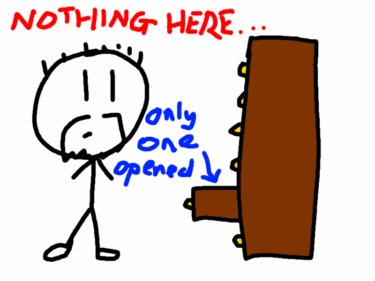
Opening a single drawer from a chest and finding nothing

I don't know which game first did the "protagonist searches a chest of drawers by opening one completely empty drawer and 90% of the time doesn't find anything" thing, but it's an absolute plague these days. Granted, at the other end of the spectrum we have Shenmue, a game which can be looked upon at least in part as the world's most detailed cupboard-opening simulator, but I feel like there's probably a happy medium somewhere.

See also: lootable objects in non-RPGs with nothing in them. Why do you do this?

Progression mechanics in games that aren't RPGs

Stop it. I don't need to level up and I don't need to grind in every single game. Just give me what I need to beat the game from the outset. You may — may — under certain circumstances unlock new moves and weapons as the game progresses, but these should not be tied to any sort of "experience" system.

Photo mode and New Game+ added as post-launch updates

You know you're going to do them. Just put them in from the start.


And just for good measure, one thing I wish we saw more of:

Post-game unlocks that significantly alter the game

My benchmark for this is Silent Hill 3, which, under the correct circumstances, allows you to dress the protagonist Heather up in a retro-futuristic outfit and unleash her devastating "Heather Beam" on enemies. Optionally, you could also add an on-screen health bar to the game, which is not normally present because it's a survival horror game. These two elements completely changed the feel of Silent Hill 3, and offered an incentive to replay that wasn't just "play through the entire thing again with some minor changes to get a different ending".

These days, sadly, costumes are primarily DLC and additional modes that significantly alter the way the game plays just don't really feel like a thing any more. Part of this is down to modern games being considerably expanded in length over stuff from, say, the PS2 era (which is when Silent Hill 3 originally came out), but also some developers just don't seem all that willing to have a bit of silly fun with their creations. And that's a bit sad!


Want to read my thoughts on various video games, visual novels and other popular culture things? Stop by MoeGamer.net, my site for all things fun where I am generally a lot more cheerful. And if you fancy watching some vids on classic games, drop by my YouTube channel.

If you want this nonsense in your inbox every day, please feel free to subscribe via email. Your email address won't be used for anything else.
1853: Waifutine's Day

The whole "waifu" thing is something I find quite interesting.

For the uninitiated, a proud declaration that someone is your "waifu" (or, optionally, and possibly spelled differently, "hasubando") is something oddly peculiar to fans of Japanese popular entertainment. It goes far beyond simple attraction to the physical depiction of a character — particularly since it's very rare for anime- and manga-styled media to have unattractive characters, particularly female ones — and instead is to do with how the character is depicted: usually a combination of artwork, animation, voice acting and writing.

I say it's peculiar to fans of Japanese popular entertainment because you simply don't see it happening with Western entertainment. People might be sexually attracted to someone like, say, Doctor Who's Amy Pond; people might be attracted to the intelligence of someone like Deep Space Nine's Jadzia Dax; people might simply want to hang out with someone cool like Robin from How I Met Your Mother (yes, these are all examples from my own personal tastes; please feel free to replace them with your own choices, including gentlemen, if you so desire) — but it's pretty rare for someone to proudly and simply declare that one of these characters is their "waifu" (or just plain "wife") and develop a borderline obsession with them. Among other things, it's seen as creepy to have an obsession with a "3D" person, whereas when it comes to "2D" characters, pretty much anything goes as far as most people are concerned, since they're not "real people" in the first place.

Perhaps it's to do with the contrast between animation and live action: in Japanese popular media, we get animation covering all sorts of subject matter and for all ages, while in the West, with a few exceptions like Archer, The Venture Bros., South Park and a few others, animation is still seen very much as children's entertainment, and live-action is seen as more appropriate for adults. The thing with animation is it depicts a heavily idealised perception of reality where pretty much everyone is physically beautiful and completely visually distinct from one another, and a lot of characters fall into easily definable, easily categorisable tropes that people can latch on to and identify as being appealing to them.

In this way, the declaration of a "waifu" could be argued to be a distillation of a person's individual tastes. It's rare (and undesirable) to pigeon-hole real people into neat tropes like tsundere, kuudere, ojou-sama and the like, since real people are complex; meanwhile, it's expected in anime and Japanese games. These characters are deliberately exaggerated interpretations of particular personality traits; in reality, everyone might have a bit of all of these tropes in them, whereas when we're talking about animated entertainment, one of these tropes tends to be the defining characteristic of a particular character. In other words, by declaring a particular character to be one's "waifu" you are effectively nailing your colours to a particular personality trait's standard and declaring that this, above all others, is something you find appealing for whatever reason.

And it doesn't even have to match how you feel in the "real world". I'm crazy about tsundere characters in games and anime, for example, but if I was confronted with someone who was that bitchy and mean to me in reality, I'd be quite uncomfortable. (Although if you listened to Andie and I insult one another on a daily basis — without meaning any of it, I might add — you might question my assertion here.) Likewise, something like the yandere trope can be extremely compelling — your favourite, even — in fiction, but something you would absolutely want to stay the hell away from in reality. (And with good reason; if you're not sure what a yandere is, I'd urge you to go and play School Days through a few times; if you hit the "Bloody End", then you'll soon figure it out.)

On a vaguely related note, having now completed three out of the four endings of Akiba's Trip on the Vita, I'm fairly confident that Rin will be my waifu from that particular work of interactive entertainment. And I will fight anyone who doesn't agree she is best girl! 🙂

1527: Trope-ical Crush

The word "tropes" has taken on something of a pejorative meaning in recent years, but I find something oddly comforting about the use of common, established, recognisable tropes — particularly when it comes to Japanese entertainment. I also find it interesting that Japanese entertainment — both games and anime — is a lot more willing to fully embrace the idea of tropes as part of the medium's language rather than attempting to hide what it's doing.

Take the common character tropes, for example. In a typical "harem" situation (usually a male protagonist surrounded by female characters, one of whom is typically positioned as the "main" love interest, but the others of whom are optionally also either interested in the protagonist or the objects of the protagonist's affections) you tend to have your tsundere, your kuudere, your childhood friend, your "princess" type, your genki girl and, depending on how many characters are involved, numerous others. And yet the predictability of this type of cast makeup, for me, doesn't prove to be tiresome; quite the opposite, in fact. I enjoy being able to point to the various characters and say "well, she's clearly… and she's clearly…" because it provides a recognisable, established starting point for these characters that can then subsequently be built on over the course of the rest of the work.

Exactly how — or if — these tropes are built upon by the work depends entirely on the work in question. Some works embrace the established tropes wholeheartedly and make the characters into textbook examples of the character types they initially appear to be: a valid approach. Conversely, some works deliberately work to subvert the tropes they establish in their early hours with some surprising twists and turns for the characters: also a valid approach. And, for some archetypes, subversion of expectations is part of the trope itself: witness the tsundere, for example — usually frowning, overly defensive and, at times, somewhat aggressive — and how her character arc typically involves her "softening" and showing her deredere side. Or the yandere — quiet and meek, but with something seriously unpleasant festering inside that demure exterior. Knowing that at some point she's going to strike doesn't diminish the impact when it happens; if she's a particularly well-disguised yandereit's even more shocking and surprising.

I'm a fan of tropes, then; I enjoy that feeling of comforting familiarity that comes about when I come across a new character and recognise their traits. And everyone has their favourites, too; for me, I must confess to having a soft spot for tsunderes, but I do also like a kuudere and there's always something heartwarming about a nice childhood friends romance. And the older sister "nee-chan" type. And a cutie imouto. And… Oh dear. (Essentially, I think I'm saying that my ideal anime harem would be made up of the cast of My Girlfriend is the President.)

If you'll excuse me, I'm off to bed to read TVTropes. (Warning if you're at work: settling down for a "quick read" of that site is a good way to lose a few hours.)