#oneaday Day 519: Hero of Hyrule

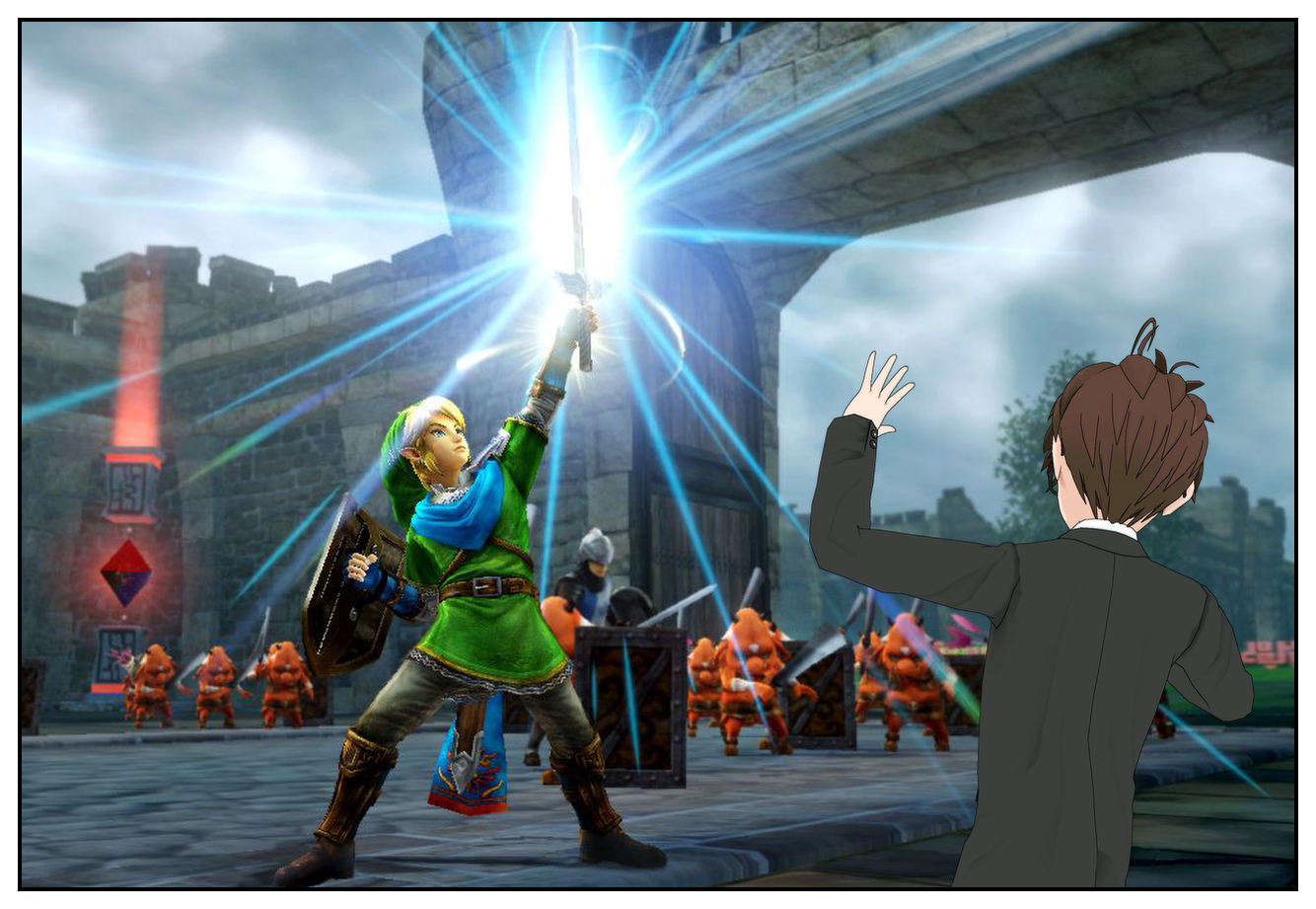
In my head, I've had a bit of a weird relationship with the Legend of Zelda series over the years. There have been large tracts of time when I haven't played any games in the series, and there are still a number of entries (primarily handheld) that I haven't tried at all. I've known Zelda obsessives over the years, and I've never counted myself among them; likewise, I don't think I've ever bought a Zelda game on launch… with the exception of the new Hyrule Warriors: Age of Imprisonment, which I'm sure someone will argue isn't a Zelda game, but it actually is — just a different kind of Zelda game.

Anyway, I think I've come to the conclusion, many years too late, that yes, I, in fact, do like the Legend of Zelda series, and I always have done.

I think I know where my hesitancy over this came from, and it dates back to the late 1990s. I had just discovered console-style RPGs with Final Fantasy VII, and then Ocarina of Time came out, offering a very different sort of game to Final Fantasy VII, and… I felt like I didn't like it as much. At least, not in terms of story. Final Fantasy VII's narrative was unlike anything I'd ever experienced in gaming at that point, while Ocarina of Time was basically reading from the same script as A Link to the Past, which I had played (and enjoyed a lot) several years earlier.

Link didn't speak, either, which made the narrative immediately less interesting to me.

Of course, I know this is a silly comparison now, because Final Fantasy VII and Ocarina of Time are so different from one another as to basically be completely different genres — and that's not getting into the interminably tedious arguments over whether Zelda is "an RPG" or not.

No; I can see very clearly now that the intent behind the two series, and those entries in them in particular, is very different. Final Fantasy VII was all about delivering a spectacular, emotionally engaging narrative; Ocarina of Time was about being a well-designed video game. And, although Zelda plots have become more and more elaborate over the years — not to mention the series' timeline becoming ever more convoluted — this distinction has, for the most part, remained.

This isn't to say that Final Fantasy has bad gameplay or that Zelda has a poor story, mind. It's simply that their focal points are different, and, as with anything, if you go in with the wrong things in mind, you're almost certainly not going to resonate with it as much as you would if you had more realistic expectations.

Anyway, I think back over the years and the many Zelda games I have played, and I don't think I've ever had a bad time with a Zelda game.

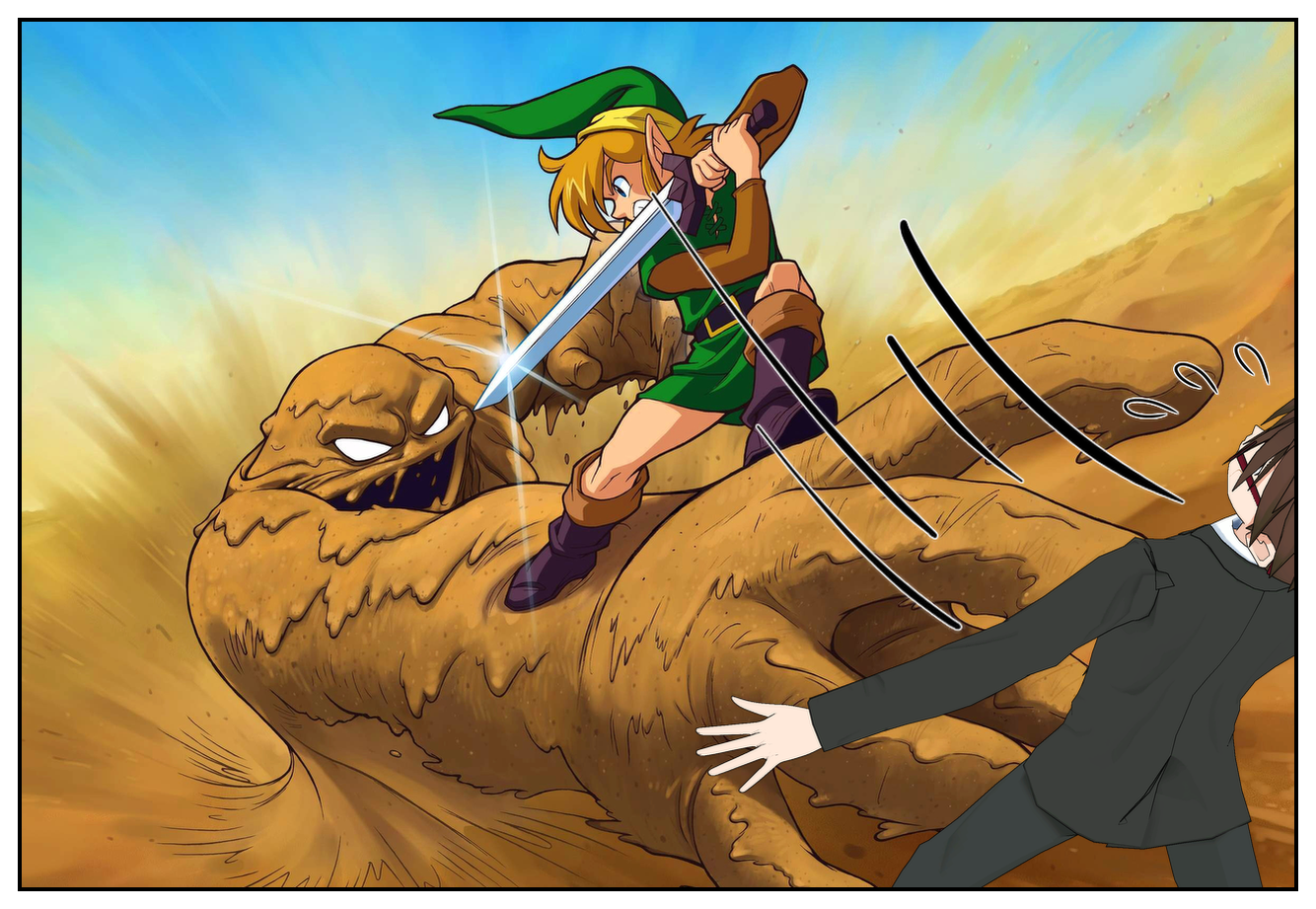
My first ever encounter with the series was with Zelda II: The Adventure of Link on a family friend's NES. When I first played this, I didn't understand it at all, as I was very young and had never really encountered a game like it before. With how different Zelda II was from the rest of the series, I at least know I wasn't alone in feeling like that — although today I respect Zelda II immensely for having the balls to do something so drastically different from its predecessor.

I have a few oddly vivid memories of that first time I played Zelda II. The towns of Ruto and Rauru, both of which would lend their names to characters in the series many years later. The slightly wobbly melodic line on the music. The distinctive overworld map theme — which starts very similarly to the well-known Zelda theme before branching off in its own direction. The caves that are too dark to see until you get a candle. Link making a noise that sounds like he's going "whoops" every time he takes damage — a sound effect shared with Simon Belmont from Castlevania. The BLBLBLBLBLBLBLBLBLBL noise and strobes when you lose a life. And the fact I always thought Link looks like a chef when he's doing his "damage" pose. I saw it once, I can't unsee it now.

A few years later, I got a Super NES, and one of the games I asked for one Christmas or birthday was A Link to the Past. I knew absolutely nothing about this game, save for the fact that magazines talked about it in tones of reverence, and I remembered quite liking my time with Zelda II.

I got it. And I was absolutely blown away by it — particularly the music. To this day, I'm still impressed that the game has full-on orchestral cymbal clashes in its music. Absolutely one of the best uses of the SNES' sound chip there ever was.

Anyway, I dutifully bought Ocarina of Time like every self-respecting N64 owner was supposed to back in the day, and I quite enjoyed it, with the caveats mentioned above. What I liked a whole lot more, though, was Majora's Mask, the direct sequel, which never seemed to resonate with the public in quite the same way despite getting good reviews — but which gets its dues much more frequently these days.

Majora's Mask basically corrected what I felt was lacking a bit from Ocarina of Time: the emotional engagement angle. Because it offered a story that wasn't just a retelling of the usual Link vs Ganon legend, it was immediately much more interesting — and its time-based mechanic allowed the narrative to go to some seriously interesting places. To this day, I'm yet to see anything quite like the conclusion of the "Anju and Kafei" questline, which resolves with literally seconds before the world ending.

I didn't get along with The Wind Waker when I first played it on Gamecube, but when I played the rebalanced Wii U version some time later, I enjoyed it a lot more. Likewise, I skipped Twilight Princess on its original release and played the Wii U version, enjoying it greatly.

I was late to the party with Breath of the Wild and it took me a long time between starting it and actually finishing it, but when I had done so, I was very glad I had taken that journey. I am having a similar experience with Tears of the Kingdom in that I have come to it very late, but playing it alongside the new Hyrule Warriors, which acts as a prequel and/or parallel storyline, is going to be very interesting indeed, I think.

I know some folks don't love the direction the series has taken with Breath of the Wild and Tears of the Kingdom and to an extent I get that — but then there has also been the excellent Link's Awakening remake and the equally good Echoes of Wisdom for those hungry for a more "traditional" Zelda experience.

All in all, it's a thoroughly interesting series, and one that very much deserves its long and proud history. And, at this point, I may as well admit that I think I'm a Zelda fan. Particularly as I've played 15 hours of Hyrule Warriors: Age of Imprisonment since yesterday evening.

Now time for a bit of Tears of the Kingdom, I think…


Want to read my thoughts on various video games, visual novels and other popular culture things? Stop by MoeGamer.net, my site for all things fun where I am generally a lot more cheerful. And if you fancy watching some vids on classic games, drop by my YouTube channel.

If you want this nonsense in your inbox every day, please feel free to subscribe via email. Your email address won't be used for anything else.
#oneaday Day 517: First impressions from Hyrule Warriors: Age of Imprisonment

Hyrule Warriors: Age of Imprisonment arrived today and, keen to see quite how wrong that awful review from the other day was, I booted it up right after work and have been enjoying it since. I'm not very far in yet, and there seem to be a lot of mechanics and structural elements that are still locked, but I like what I see so far.

It's going to be interesting playing this alongside Tears of the Kingdom because, as anyone who has played the latter will know, a plot point in that is Zelda being sent back in time to the founding of Hyrule, and through a sidequest, Link can get occasional visions of key events during her time in the past. What Age of Imprisonment provides is a complete story from Zelda's perspective, from the moment she arrived in the past and was discovered by King Rauru and Queen Sophia, up until… well, I don't know, yet, but I assume some form of "imprisonment" will be involved, likely with Ganon(dorf) at the middle of it.

Thus far the game feels like it's taking some elements from previous Hyrule Warriors games (I say this with the caveat that I've not actually played Age of Calamity as yet) and combining them with some fun new(?) elements. Of particular note is a counterattack system, where major enemies do heavily telegraphed attacks, and you can use your characters' cooldown-based special abilities to interrupt them. This is never not satisfying, particularly when combined with the "weak point" mechanic introduced in the first Hyrule Warriors, where after certain attacks, some enemies reveal a weak spot and, if you batter this down enough, you get to perform a fancy cinematic attack on them.

There are also giant enemies, much like in the original Hyrule Warriors, and these have their own ways of being dealt with. They're not quite so rigid in their "solutions" as the original Hyrule Warriors, though, which is nice. You can, in many cases, jump on them and wail on their weak points while standing on top of them, though, which is always a delight to do in any game that allows you to do so.

The characters seem like fun, too. Particular highlight so far has been Mineru, sister of King Rauru, who is a Zonai scientist lady who commands constructs to do her bidding. Her "run" animation is her riding a motorised unicycle type thing, and most of her attacks involve summoning giant mechanical things, cannons and all manner of other fun stuff to cause chaos over a wide area. I think she's going to be enjoyable to play with, though I'm also intrigued to see what other characters are on offer and how the game incentivises you to play as them.

Mecha-Link has made an appearance, too, and he's predictably fun to play as, handling much as he did in the older Hyrule Warriors. He did conclude his first appearance by literally turning into a spaceship and flying off into the sunset, though, so I am looking forward to the first of his apparent Star Fox-esque sequences, whenever that might arise.

My concern with Age of Imprisonment (and indeed Age of Calamity, when I eventually get around to it) is that neither of them will live up to the original Hyrule Warriors in terms of Stuff To Do. For the unfamiliar, the original Hyrule Warriors, particularly in its Definitive Edition incarnation on Switch, not only had a lengthy story mode to play through (multiple times if you want to get all the rewards), but also had a brilliant mode called Adventure in which you gradually unlocked cells on pixel-art recreations of classic Zelda maps and took part in various battles in each space. Some of these were full-scale battles similar to what you do in the story mode, while others were battles that had some sort of special conditions or rules in place. The sheer amount of stuff to do in the Adventure mode, across a variety of different maps, meant that the original Hyrule Warriors had near-infinite replayability, and with the way Age of Imprisonment seems to be structured, I suspect it doesn't have anything like that.

That's not necessarily a bad thing, though. It means that Age of Imprisonment might actually be completable. And if and when I'm done with it, I can always return to the original for more of that sweet Adventure mode action.

In the meantime, I'm having a lot of fun with it, and learning today that its soundtrack is by MONACA, best known for their work on the Nier series, has made this game all the more interesting to me. And so I'm off for another battle or two before bed, I think…


Want to read my thoughts on various video games, visual novels and other popular culture things? Stop by MoeGamer.net, my site for all things fun where I am generally a lot more cheerful. And if you fancy watching some vids on classic games, drop by my YouTube channel.

If you want this nonsense in your inbox every day, please feel free to subscribe via email. Your email address won't be used for anything else.
#oneaday Day 511: Stop hitting me so hard

One of my biggest annoyances with a lot of modern games is enemies that hit like absolute dump trucks from the start of the game. Of recent games that I've played (and liked), Clair Obscur: Expedition 33 did this, Silent Hill f did this, and I've just started playing The Legend of Zelda: Tears of the Kingdom, and that does it too. It's especially annoying in that, because you start with so little health, and having literally 95% of it gone if you get hit once in an early fight is very frustrating.

I'm pretty convinced that this aspect of game design is a side-effect of the popularity of FromSoftware's work, because in a Souls game, you expect all enemies to hit like dump trucks, even if they're absolute trash fodder, and the game is designed and built around that. To put it another way, Souls games are, in some respects, survival horror games, in which you play a vulnerable protagonist with limited resources facing overwhelming odds and unimaginable, often unexpected horrors.

I'm sure anyone who played Dungeons & Dragons games that started you off at level 1 are laughing at me right now, too. Believe me, I know all about old D&D.

Zelda, though? I don't want the game to patronise me or anything, but it would be nice if it took things a bit easier on you from the beginning. This is the exact same bugbear I had with Breath of the Wild, and it's probably a major contributing factor to how long it took me to actually beat that game.

See, I do like Breath of the Wild, and I like what I've played of Tears of the Kingdom so far. But when every single combat feels like you're a razor's edge away from frustrating death, it's kind of exhausting. Not only that, it's different to how past Zelda games did it, too. Earlier Zelda games still started you off with a pitiful amount of health, but to compensate for that somewhat, enemies you meet in the early hours do very little damage. And that works! Ease the player in gradually without smacking them in the face for making the slightest mistake, then as the game continues, escalate things gradually by increasing the power of the enemies at a roughly similar rate to the player gaining in power.

It's a very different sort of game, but this is something that Final Fantasy Tactics sort of nails. I say "sort of" because the game's story battles are pretty much at fixed levels, while the random encounters — which will likely form the majority of what you will be using to level up your characters most effectively — scale to your level. This means that you're always presented with a decent challenge when facing a random encounter; the flip side of that is that it's possible to charge into a story encounter either woefully underprepared and get your head shoved firmly up your anus, or extremely overprepared to such a degree that you trivialise supposedly dramatic encounters. Such has always been the way with role-playing games, of course, and there's a convincing argument to be made that part of the joy of Final Fantasy Tactics is seeing absolutely how much you can break it.

You can't do that with Breath of the Wild or Tears of the Kingdom, though. You have to do the game's opening quests with the vitality of a wet paper bag, the lung capacity of a chaffinch and equipment so flimsy Chinese Amazon sellers would be embarrassed to put their nonsensical names on.

In some respects, you can look on this as the game saying "hey, you don't have to fight literally everything, and in fact it might be in your interests not to". But when you have situations like one I encountered this evening, where two particularly frustrating enemies were guarding a chest that wouldn't open until I beat them, you kind of feel like you do have to beat them. (Except the chest had nothing in it but a shiny rock. I was annoyed.)

I don't want to be too tough on Breath of the Wild and Tears of the Kingdom, though, because I did ultimately very much enjoy the former and, outside of the above-mentioned encounter, I've had a lovely time with the latter this evening. I just think it would be nice if we had a few modern games where taking a single glancing blow from an enemy didn't feel like someone had just dropped a piano on your head.


Want to read my thoughts on various video games, visual novels and other popular culture things? Stop by MoeGamer.net, my site for all things fun where I am generally a lot more cheerful. And if you fancy watching some vids on classic games, drop by my YouTube channel.

If you want this nonsense in your inbox every day, please feel free to subscribe via email. Your email address won't be used for anything else.
#oneaday Day 202: Boxing clever

We're finally home. I say "finally"; we were only away for a couple of nights, but the cats are pleased to see us and they are already enjoying their presents. As I type this, Oliver is happily chewing and dragging his new toy around, and Patti is just sitting near me, happy that her favourite person is back where he should be.

The rest of today is going to be spent doing as little of value as possible. I'm going to veg out and play some more The Legend of Zelda: Echoes of Wisdom and… probably not much else. I would like to write something about Paper Mario: The Thousand-Year Door, which I finished literally immediately before we left for our Christmas trip, but I think I'll save that for tomorrow.

I'm still very much in a Nintendo mood, so I'm currently forming a vague plan for something along the lines of a "Year of Nintendo" special feature over on MoeGamer. There's a lot of first-party Nintendo stuff on Switch that I haven't played, let alone written about yet, and this might be a good excuse to knuckle down and get on with that. Plus it's highly likely that the Switch itself is coming to the end of its lifespan; while the successor hasn't yet been revealed, now seems like a good time for some sort of retrospective exploration of all the "big name" games for the platform, all in one place.

Anyway, that's something to think about further tomorrow. I've also spent some of my Christmas money on filling a few first-party gaps in my Switch collection — Nintendo stuff rarely, if ever, drops in price, so I may as well pick it up when I have a bit of spare money to burn. I'm looking forward to getting stuck into some titles I've been putting off for a long time — like Fire Emblem: Three Houses, which I'm pretty sure someone bought for me several Christmases ago — and potentially having a "big project" to work on over the course of the year. There's also Xenoblade Chronicles X in March, and I am very excited to revisit that game; it'll be particularly cool to check out its multiplayer features on a more popular platform than its original host of the Wii U.

That's about all my brain is capable of processing right now, so it's time for Zelda. I hope you all had a lovely Christmas, and here's to the end of another shitty year.


Want to read my thoughts on various video games, visual novels and other popular culture things? Stop by MoeGamer.net, my site for all things fun where I am generally a lot more cheerful. And if you fancy watching some vids on classic games, drop by my YouTube channel.

If you want this nonsense in your inbox every day, please feel free to subscribe via email. Your email address won't be used for anything else.
2173: Three Swords

0173_001

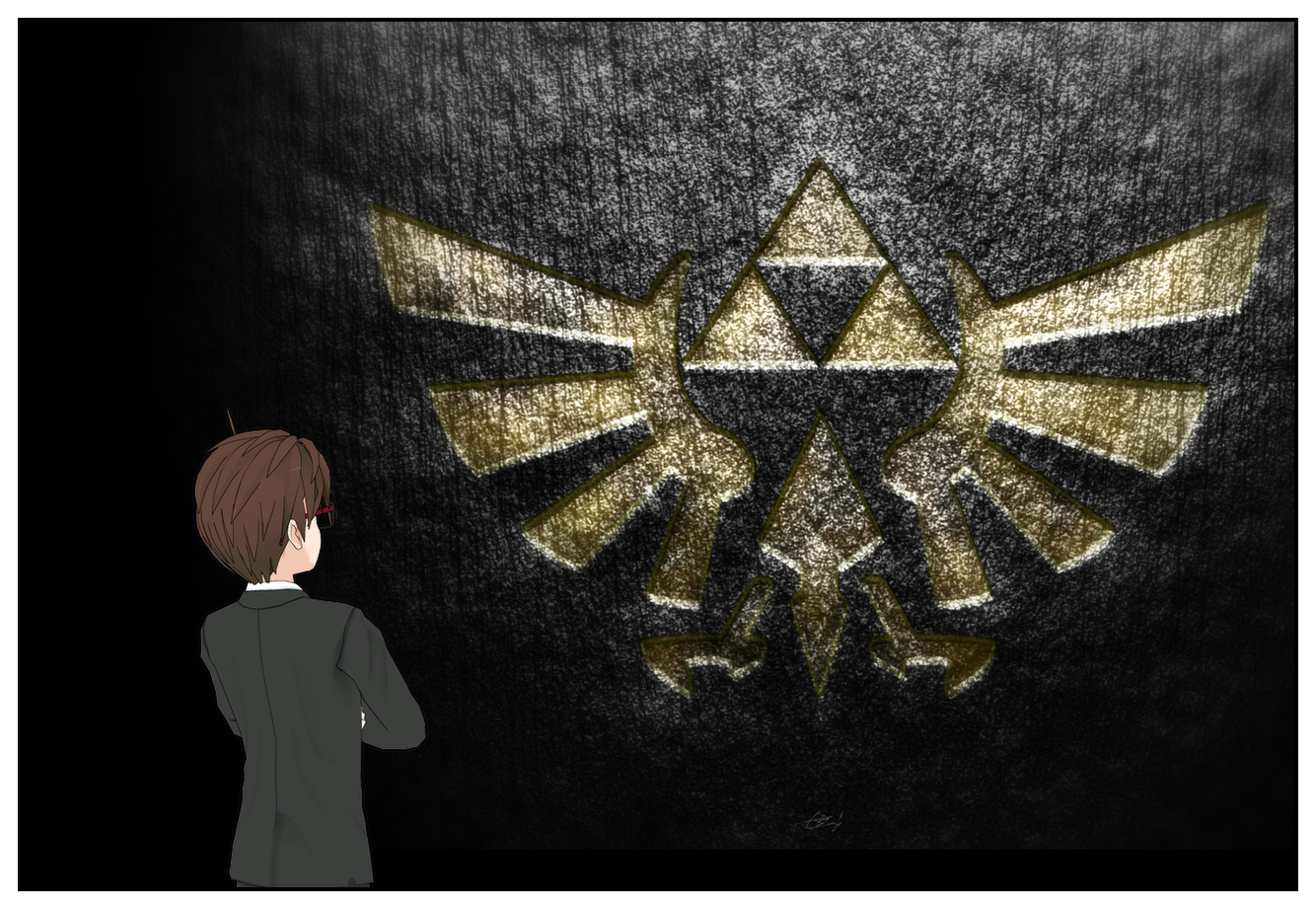
Been playing a little bit of one of my Christmas acquisitions recently: the intriguing The Legend of Zelda: Triforce Heroes. This isn't a "mainline" Zelda game in that it's not particularly narrative focused and is instead a largely cooperative multiplayer affair, but I've been very pleasantly surprised quite how playable it is — and how it very recognisably has that Nintendo "magic" about it.

Triforce Heroes casts you in the role of a Toon Link who may or may not actually be Link and throws you into the town of Hytopia, which is currently undergoing something of a crisis: the local evil witch is apparently cursing everyone who is getting a bit too fashionable, and thus it's up to the local heroes (for whom the populace have very specific requirements) to sort things out once and for all.

It's an eminently stupid premise, obviously, but in a way that works in the game's favour, because the lack of focus on a coherent narrative allows the game to instead concentrate on gameplay, and in a multiplayer-centric affair, this is by far the best approach.

Triforce Heroes unfolds over a series of discrete levels, each of which makes up a number of different regions in the Drablands, the area the witch calls home. As you complete the various levels, you'll acquire materials and Rupees, both of which can be used to create new costumes for maybe-Link and confer special abilities and bonuses — or, in some cases, penalties. You then repeat the process, gradually increasing your completion and/or grinding levels you've already done for more materials. That is, so far as I can determine, it. But rather than being a throwaway affair, it's actually rather compelling.

It helps that the levels are well designed to necessitate cooperation. Unlike, say, Super Mario 3D World, where additional players were more of a distraction than anything else, Triforce Heroes' levels are specifically designed with three players in mind. Most of the cooperation involves picking up and throwing around the other two players to reach out-of-reach platforms — not-Link, as ever, can't jump — but also making use of the "totem" ability to create a stack of up to three people in order to shoot at/smack/bomb/collect things that are too high off the ground for a single player.

One particularly charming aspect of the game is that as with most Nintendo online games, Triforce Heroes has no means of directly chatting with other players. Instead, you're given a set of endearing emotes ranging from "Over here!" to "Noooo!" that you can spam at will. Most players have already developed a means of "communicating" using these emotes creatively — and, indeed, it's a heartwarming moment when you come together with two strangers all spamming the "cheerleader" emote to signal your joy at having completed a particularly difficult area of the dungeon you're in.

Perhaps best of all for those who have friends with 3DSes, though, is the fact that the game supports Download Play, meaning that only one person needs to actually own a game cartridge for a group of three to be able to enjoy some cooperative fun. Obviously this doesn't apply when it comes to online play, but for local multiplayer sessions I can see it being a riot — I'm looking forward to trying it sometime.

It's not the sort of game I see being a thing you'd spend hours on at a time. But as something to while away a few minutes with at a time, Triforce Heroes is an impressive achievement: a cooperative game where yelling at each other is kept to a minimum, and where the whole experience just feels so delightfully wholesome that you can't help but enjoy it with a big smile on your face.

2144: Link's Awakening

0144_001

Closing in on the end of The Legend of Zelda: Link's Awakening, and I've really enjoyed it — quite possibly more than A Link to the Past, which was previously one of my favourite Zelda games alongside Majora's Mask.

I haven't quite finished it yet so I'm not sure of the complete "truth" behind everything, but I'll comment on what I have seen so far, which is up to about halfway through the eighth dungeon, Turtle Rock.

One of the things I like a lot about Link's Awakening is its strange blend of melancholy and silly humour. This is something that Nintendo has been quite good at with the Zelda series in particular, but it's particularly pronounced in Link's Awakening. The frequent suggestion that everything that is going on is a dream of the "Wind Fish" — and whether or not this is the case is yet to be revealed to me, so no spoilers, please! — allows the game to throw in peculiar and unconventional things along the way, as well as cameos from numerous other Nintendo characters.

Pleasingly, these cameos don't feel overly forced and, in most cases, aren't shoehorned in — they're just there. For example, there are characters who look like Mario and Luigi, but they're never referred to as such. There's a Yoshi doll in one of the shops that kicks off one of the major sidequests in the game. Mr Write from the SNES version of SimCity is there, indulging in a romantic, long-distance letter-writing relationship with a young goat-woman, who is misrepresenting herself using a photograph of Princess Peach. Goombas show up in several dungeons as enemies, as does a monsters that looks and acts remarkably like Kirby. The list goes on.

Another thing I like is how the game blends elements of the original Legend of Zelda and A Link to the Past. There's the stronger sense of narrative from the latter coupled with the challenging but satisfying exploration of the former. Dungeons incorporate the side-view "cellars" from the original Legend of Zelda, but in a more fleshed-out manner — rather than simply being somewhere that you either get an item or find a route to another part of the dungeon, these cellars are often mini platforming challenges in their own right that make use of the "Roc Feather" item that allows Link to jump manually for, so far as I can remember, the only time in the series.

The dungeons are beautifully designed, too. While their layout is simpler than their counterparts in A Link to the Past, being single-screen rooms rather than larger, scrolling rooms, navigating them is a pleasure, and very often the game rewards experimentation with its mechanics, and even demands it in places. This is not a game that holds your hand in the slightest, which I appreciate, but I also very much appreciate that the game does have the facility for you to get a hint or two to nudge you in the right direction if you're really struggling.

For me, the only slightly underwhelming part has been the bosses, which, although decent enough, don't seem to be quite as interesting and challenging as those seen in some other Zelda games, and several of them are reused once or twice in later dungeons. At least they're better than the ones from the original Legend of Zelda, mind, and there are a few interesting mechanics to play with on some of them. I also like the use of "mid-bosses" in dungeons as well as the big bosses at the end; I'm a fan of boss fights in general, so getting more than one per dungeon is something I enjoy.

Anyway. I'm hoping I finally beat the game this evening, because when I get home from holiday, it's going to be Xenoblade Chronicles X time for the foreseeable future, and I'd just feel bad if I got this far in Link's Awakening and didn't see it all through until the end!

2141: #NotAllZeldas

0141_001

I've been continuing my leisurely jaunt through Nintendo's The Legend of Zelda series for the last few days, and have finished A Link to the Past and started on Link's Awakening. The degree to which I'm enjoying these games suggests to me that this is something I should have probably done quite some time ago, but no matter; the nice thing about the Zelda games, I'm discovering, is that despite their technical limitations in their older incarnations, they are mostly pretty timeless experiences that stand up very well today.

The other thing I've discovered is that the oft-mentioned criticism that "every Zelda game is the same", at least with regards to plot — a criticism that I have myself leveled at the series in the past — is actually complete bollocks. Don't believe me? Let's take stock.

The Legend of Zelda: Ganon kidnaps Zelda. Link has to save her and defeat Ganon. This is the wafer-thin plot that everyone assumes is the same in every subsequent Zelda.

The Adventure of Link: The Link from the first game seeks to awaken a Zelda who is not the Zelda from the first game by taking magic crystals to palaces. Meanwhile, Ganon's followers seek to resurrect their pig-faced twat of a master by sprinkling Link's blood on Ganon's ashes.

A Link to the Past: A Link from several eras prior to the first two Zelda games follows his uncle into battle having received a telepathic message from yet another Zelda, who is a descendant of seven wise men who sealed away the Demon King Ganon. Ganon is trapped in the Dark World, which was once the Golden Land, where the Triforce lay. Link takes up the Master Sword to strike down Ganon and return the Dark World to its former status as the Golden Land, and to undo the damage Ganon's machinations have done to the Light World.

Link's Awakening: The Link from A Link to the Past washes up on a mysterious island and is not immediately beset by requests for help from anyone called Zelda, instead finding himself meeting a cast of weird and wonderful characters and given the inevitable quest to clear out a bunch of dungeons, this time to "wake the Wind Fish" and escape the island.

Ocarina of Time: A Link from several eras before A Link to the Past and even more eras prior to The Legend of Zelda becomes aware that there is something special about him after a somewhat humble beginning in his forest village. He witnesses how Ganondorf, leader of thieves, becomes Ganon the Demon King, and through somewhat convoluted means involving time-travel, gives Ganon a right good kicking. Possibly. If he doesn't, A Link to the Past happens. If he does, Majora's Mask might happen, or Wind Waker might happen. It all gets a bit complicated here.

Majora's Mask: The young Link from Ocarina of Time finds himself drawn into a strange other land called Termina, which is set to be destroyed in a horrible cataclysm in three days' time thanks to the machinations of the peculiar Skull Kid, who has decided it would be a really good idea to call the moon down from the sky to blow everything up. Link, being a pro at this time-travel thing by now, repeatedly cheats death for everyone in Termina by rewinding time to the beginning of this three-day period until he can finally prevent the disaster from occurring. (It's a tad more complicated than this.)

I could go on, since there are a lot more Zelda games than these six, but I won't for now. Suffice to say, the assumption that "all Zelda games are about rescuing Zelda and killing Ganon" is completely mistaken, with the series actually having a rather complex and fascinating timeline if you care to explore it in detail. The nice thing about it, though, is that if you don't care to explore it in detail, each game stands perfectly well by itself without requiring any prior knowledge of its prequels, sequels or parallel timeline tales that the series has exploded into over the years.

Whether this complexity was entirely intentional or more of an "oh shit!" response to the folks at Nintendo realising they'd fucked up their own canon repeatedly isn't entirely clear. But it works for me, and the more I explore the Zelda series this time around, the more I'm glad I'm coming to it when its hype is at a somewhat more temperate level. It means I can explore — or revisit, in some cases — these games with relative "beginner's mind", and make up my own mind up about what I'm playing.

So far, I'm enjoying the experience a lot. Whether I'll make it through all of the Zelda games released to date — all of the good ones, anyway; I doubt I'll touch those CD-i monstrosities — remains to be seen, but I'm hopeful about my progress so far.

Now, back to Link's Awakening…

2135: Zelda 3: Still Great

0135_001

I remember playing Zelda 3, or The Legend of Zelda: A Link to the Past, to give it its full title, for the first time. It was an eye-opening experience; prior to this, most of the games I'd played on computer and console had been fairly straightforward arcade-style affairs — you put them in, you hit Start, you start playing from the beginning, you get as far as you can get before hitting a Game Over screen, you try again.

A Link to the Past was different, though. Having never owned my own NES, the series was new to me, and so I didn't know that it had been providing this sort of ongoing, lengthy grand adventure for quite some time prior to its Super NES incarnation. But I was immediately enraptured with it; here was a game that provided me with a convincing open world to explore, some challenging dungeons to defeat, a convincing sense of getting stronger and more powerful as the game progressed, and an enjoyable, if somewhat simple, story to follow.

I played A Link to the Past through numerous times, so much did I enjoy it. It got to the stage where I could run through the game pretty much on autopilot, though I must confess I never quite reached total completionist status with it; I enjoyed the experience of progressing through the game and beating it rather than doing things like hunting down the myriad Pieces of Heart scattered around the game's two worlds.

My love for Zelda waned a little over the years. I recall being a little underwhelmed with Ocarina of Time when I first played it, though I can partly attribute this to the fact that I had been playing Final Fantasy VII around a similar time and, to my inexperienced, rather shallow eyes, they simply didn't compare to one another. I enjoyed Ocarina of Time enough to finish it, mind, but I didn't love it in quite the same way I loved A Link to the Past. I did, however, love Majora's Mask in the same way I loved A Link to the Past, but that's probably a story for another day.

Anyway, to the point: after finally finishing (the first quest of) the original Legend of Zelda the other day, I felt like continuing my journeys through Hyrule, so I skipped Zelda II, not quite feeling up to its punishing ways at present, and went straight to A Link to the Past. (For the Zelda-illiterate: most of the Zelda games tell their own, self-contained stories that feature characters with the same names and same appearances as those in other games, but who are actually different people from different times. This means that skipping a game in the series doesn't mean you'll skip important plot, though if you care to research it there is a complicated, convoluted chronology of how it all fits together.)

I was immediately reminded how much I love this game, even so many years after I last played it. It has an extremely strong opening — one of the reasons it made me sit up and take notice the first time I played it — and some highly memorable music. It's also a massive, massive improvement mechanically on the original Legend of Zelda, which it most closely resembles; Zelda II went off and did a bunch of weird things with RPG mechanics and platforming, but A Link to the Past was a return to the original formula, but better.

And everything really is better. Instead of having to wander around aimlessly, hoping you'll find the right order to challenge the dungeons, you'll be nudged in the right direction by the game, though you'll never be completely railroaded, and you are free to go off and explore any time you want. There's also a much stronger sense of the overall map being a coherent world; Hyrule may be relatively small, apparently consisting of only a single village and a castle that is bigger than the whole village, but there are plenty of interesting things going on and memorable characters to stumble across.

And, somewhat surprisingly for a Nintendo game if you're used to Mario and its ilk, A Link to the Past is pretty dark and bleak in places. The strong opening I mentioned before sees Link acquiring his first sword and shield by stumbling across his dying uncle, who had left the house in Link's stead earlier in the night in an attempt to save him from the trouble that becoming the Hero of Hyrule would be. Later, there are other equally subtle, sad scenes, such as the spirit of the young flute-playing boy in a clearing, whom you later discover close to death in the Dark World, a realm that deforms body and spirit, so you grant his dying wish before he gives up on life entirely and turns into a tree.

In many ways, it's kind of stunning to think that the same creative mind behind Super Mario Bros. also came out with Zelda, something that, while still ultimately pretty family-friendly, is a quantum shift away from Nintendo's mascot in terms of tone. I've spent a good few years feeling like I wasn't a particular fan of Zelda, since I felt as if none of them quite captured my attention in the same way as more conventional role-playing games, which had, of course, subsequently turned out to be a favourite genre. After enjoying the first and third Zelda games so much so far, though — not to mention Hyrule Warriors — I feel like it's probably time to educate myself on the series as a whole, so I'm going to try and work my way through them one by one. Who knows — I may even make it through Zelda II one of these days, though not today…

2134: Hyrule Warriors is My New Favourite Musou

0134_001

I'd been meaning to check out Wii U title Hyrule Warriors for some time, and my recent Zelda bingeing seemed to be an ideal time to do it. I primarily picked the game up as something to play as a co-op game with a local friend, but I've found myself playing through a number of missions this evening and having a great deal of fun.

I've always enjoyed the Musou games since Dynasty Warriors 2 on PlayStation 2. Their hack-and-slash nature appeals to the brawler fan in me, but they've always had a surprising amount of depth to them — not necessarily in the combat itself, but in choosing the right characters for the job, keeping an eye on the overall battle situation, and responding appropriately to what is happening.

For the unfamiliar, the Musou series covers the various Warriors games, including the Dynasty Warriors, Samurai Warriors and Warriors Orochi series. Hyrule Warriors was an interesting break from the norm for developers Omega Force in that rather than being loosely (very loosely, in some cases) based on established historical fiction such as Romance of the Three Kingdoms, it's based on an established other property — in this case, the Legend of Zelda series.

It isn't the first time Omega Force has tackled a licensed Musou game; there are Warriors games based on the popular anime and manga One Piece, Fist of the North Star and Gundam, among others. But Hyrule Warriors is arguably one of the more "accessible" properties that the team has chosen to adapt into the Musou style, since Zelda is one of Nintendo's properties with near-universal appeal, and much more ripe for adaptation than, say, Mario.

Hyrule Warriors, like its stablemates, casts you in the role of one of several different playable characters and tasks you with turning the tide of a large-scale battle on a sprawling map. Your character is just one part of your "side's" overall efforts, but you're considerably more powerful than the rather dim footsoldiers that litter the battlefield, usually standing around looking perplexed. You're not alone, though; in two-player mode, a second player takes on the role of one of the other present allied generals to support you, and even in single-player you'll find yourself fighting alongside other characters: they'll come to your aid, but you'll be expected to do the same in return.

In what I've played of Hyrule Warriors so far, there seems to be quite a bit more variety than, say, the Dynasty Warriors series, thanks in part to the setting being considerably more fantastic than ancient China. But it's not just about the monstrous enemies and magic flying around — it's also about varied objective during battle. It's pretty rare, even in the early stages of the game, to be confronted with a battle that simply involves cutting a path to the enemy boss; instead, you'll find yourself supporting your troops in various areas, capturing strongholds to gain a foothold and advance into enemy territory, dealing with counterattacks from enemies and, in true Zelda style, occasionally accidentally clipping a chicken one too many times with your sword and inviting the wrath of its myriad friends, who will come and peck you to death in pretty short order.

The game also makes use of its Zelda roots well by adding a number of mechanics based on the iconic Zelda inventory items. As you progress through the game's "Legend" mode, you'll acquire various items that can be used in battle, ranging from bombs (blow stuff up, reveal secrets) to a bow and arrow (shoot things) and a boomerang (cut down things that a sword just won't chop). Fulfilling various secret requirements in battle will also reward you with heart containers and pieces of heart to extend your characters' life bars, and Ocarina of Time's Gold Skulltulas make an appearance, too, spawning on the battlefield when you fulfil a specific condition and then requiring you to track them down by searching a marked area of the map and listening carefully for their telltale scraping sounds.

I feel like I've barely scratched the surface of the game so far; I've only played Legend Mode as of now, but there are a variety of other ways to play, with one of the most interesting sounding being Adventure Mode, which tasks you with exploring a grid-based map based on the original NES Legend of Zelda game and fighting various battles in order to take control of it piece by piece. I don't yet know how well this is executed, but I'm looking forward to trying it out. Even if it turns out to be bobbins, though, just the battles in Legend Mode have proven to be more than worthwhile and enjoyable so far — and it looks very much as if the game has continued to develop and expand long after launch, if the multiple pages of patch notes that appeared the first time I booted the game up are anything to go by!

I'm looking forward to trying it out co-op later this week, all being well, but in the meantime I can already confidently say that it's one of the best Musou games I've played to date, and anyone who enjoys a good bit of hack and slash should most definitely check it out, Zelda fan or no.