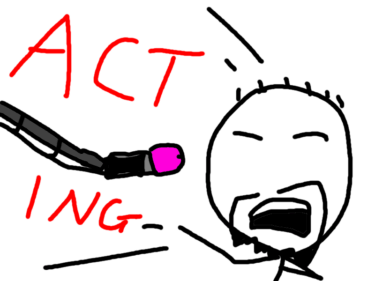
#oneaday Day 509: A new age of "talkies"

Back when the CD-ROM era first started, and game developers suddenly had a lot more storage capacity to play with, a revolution unfolded. Games became "talkie", with formerly text-based dialogue now being supported (or sometimes, in those less enlightened times, replaced) with voice acting of variable quality. This was, for the most part, seen as a significant step forwards in terms of games being able to tell interesting and convincing stories, though some genres benefited from it more than others, with probably the biggest beneficiary being point-and-click adventures.

These games already had pretensions of movie-style storytelling. Indeed, back when Ron Gilbert of LucasArts coined the term "cutscene" with Maniac Mansion, he defined them as "short, animated sequences — like scenes from a movie — which can provide clues and information about the characters" (emphasis mine). As such, it was only natural that as interactive entertainment and movies moved ever-closer together, we would start to hear game dialogue as much as read it.

That wasn't universally the case, mind; not every game that featured dialogue was fully voiced. In many cases this was because the storage capacity of a CD wouldn't have been sufficient to include the entire script for longer games such as RPGs, particularly on console, where they had been becoming more and more dialogue-heavy. In those cases, the extra storage space instead went to other purposes such as pre-rendered video sequences or even live action video.

The advent of DVD didn't lead to longer games suddenly becoming "talkie", either; while there was often a lot more speech in these games, they still often weren't fully voiced. Final Fantasy X is a good example — major story scenes in that game are fully voiced, but incidental interactions and random NPC conversations remain text-based. And this situation has continued right up until this day — even with the huge storage capacity of modern flash memory-based cartridges and Blu-Ray discs, there are still a fair number of RPGs that have unvoiced dialogue — although that number is dwindling a bit. Many Japanese games, even from relatively low-budget studios like Compile Heart, even have dual audio today.

We're in a position now where it's possible for another minor revolution in "talkie" terms, and one of the best examples I've seen is the recent Final Fantasy Tactics remake. This is one of those games where, as outlined above, there was far too much in the way of script for them ever to be able to make it fully voiced back in the PlayStation days. Not only that, but video game voice acting in the late '90s was generally… Not Good. There was the odd exception, yes, but going back and listening to some of those early "talkie" games sometimes makes you just want to turn the speech off and go back to fully text-based dialogue. King's Quest V says hello. (King's Quest VI, meanwhile, is excellent.)

Today, though, we have a wide and diverse variety of voice actors with plenty of video game experience, and pretty much all of them can be heard in Final Fantasy Tactics. And the result is simply smashing. By combining the revised (and considerably better) retranslation for the PlayStation Portable "War of the Lions" version of Final Fantasy Tactics with a cast of voice actors who can actually act, we have one of the most gloriously theatrical games I think I've ever played. It really is a thing of wonder, and it adds so much to the game.

It makes me want to see more games from the PS1 era tackled like this. I would love to see some remasters of games from that period where the basic gameplay isn't touched all that much aside from a few interface and balance tweaks, but a fully voiced script delivered by people who know what they're doing is added. There's a bunch of games that would really benefit from this treatment — though it remains to be seen if companies like Square Enix will feel inclined to do this any more.

By all accounts, Final Fantasy Tactics: The Ivalice Chronicles appears to have been doing well both critically and commercially, though, so hopefully this is taken as a sign of something people would like to see (and hear) more often.

In the meantime, I'm off to go enjoy it a bit more.


Want to read my thoughts on various video games, visual novels and other popular culture things? Stop by MoeGamer.net, my site for all things fun where I am generally a lot more cheerful. And if you fancy watching some vids on classic games, drop by my YouTube channel.

If you want this nonsense in your inbox every day, please feel free to subscribe via email. Your email address won't be used for anything else.
#oneaday Day 506: Tactical Sunday

Final Fantasy Tactics is a game I absolutely love and respect greatly, but I have to be in the right mood to play it. Today I was very much in the mood to play it, so play it I did. I got to a point that proved to be a sticking point for me when I first played it on PlayStation — Golgollada Gallows, also known as Golgorand Execution Site in the original — and, indeed, it proved to be a bit of a sticking point for me this time around, also.

However! This time around, I was armed with the knowledge of how I beat it last time around, which was to spend several hours doing random battles to level up my core units to such a point that they could survive the challenge of Golgollada Gallows — notorious as one of the toughest fights in the relatively early game — and progress without too much trouble.

Y'see, the difficulty I had with this first time around is that Final Fantasy Tactics sort of positions itself as a game where you move from story beat to story beat without any interruptions. Because it's not a conventional RPG in which you directly control the protagonist as he wanders around towns and dungeons, it's easy to see the random engagements you can run into on the node-based world map as annoying inconveniences preventing you from seeing the next bit of story.

But they are there for a reason — and, indeed, The Ivalice Chronicles version of the game makes it even easier for you to take advantage of them by making them not random at all. Sure, sometimes as you move from node to node you'll get the distinctive "swoosh" that indicates a battle is incoming, but unlike the PlayStation original, you can choose not to engage if you don't want to. This prevents you from encountering a minor softlock if, for example, you're trying to get to a town to stock up on healing items or refresh your units' equipment.

However, it also goes the other way. If you pass through a non-story node and you don't have an encounter there, you can choose to "search for enemies" and manually trigger a battle. This means if you actually want to spend some time levelling your units or earning them some new abilities — which the game doesn't tell you to do, but which is very much a good idea — you can do that much more easily than in the PlayStation version. If you want to, you can just stand on one battlefield, do a fight, then immediately trigger another one — no running back and forth between nodes in the hope of getting the "swoosh", because you can trigger it at will, and you can ignore it if it's inconvenient.

While I'm not normally a fan of being able to turn off encounters in a regular RPG — it feels very much like cheating, plus it does you out of some progression that you probably need — in a game like Final Fantasy Tactics, where battles take 5-10 minutes or more rather than a few seconds, this was an important and very welcome tweak to the formula.

Anyway, upshot of all this is that I beat Golgollada Gallows on my second attempt rather than taking the many, many, many attempts I did back in the day. I was still relatively new to console RPGs when I first picked up Final Fantasy Tactics, after all, and it hadn't occurred to me to grind because I wasn't super-familiar with the concept. Once I spent that time levelling my units properly, though, everything fell into place, and the rest of the game was much more straightforward. As, indeed, I suspect it will be this time around, too.

Final Fantasy Tactics: The Ivalice Chronicles is a wonderful remake of an already wonderful game. I have greatly enjoyed my time playing today, and, having got over that notorious difficulty spike, I suspect the remainder of the game (except maybe "that" Wiegraf fight) will be even more enjoyable.

So your lesson for the day, then, if you're new to Final Fantasy Tactics, is don't be afraid to grind. Embrace it. Love it. You will come to appreciate it when all your units are suddenly orders of magnitude more effective with just four or five additional levels under their belts!


Want to read my thoughts on various video games, visual novels and other popular culture things? Stop by MoeGamer.net, my site for all things fun where I am generally a lot more cheerful. And if you fancy watching some vids on classic games, drop by my YouTube channel.

If you want this nonsense in your inbox every day, please feel free to subscribe via email. Your email address won't be used for anything else.

#oneaday Day 485: Forgetful

Missed yesterday. I have no excuse, I just forgot. You can blame Final Fantasy Tactics or God. I did make some videos and write about Master Detective Archives: Rain Code, though. You can read that here.

Speaking of Final Fantasy Tactics, I'm really impressed with the new The Ivalice Chronicles version. I wasn't initially sold on the new look of the "remastered" mode, but seeing it in action makes it make a lot more sense than still screenshots might suggest. There's a nice almost "fabric"-like texture to everything, which makes the game sort of look like it's unfolding on a tapestry, which is entirely appropriate for the nature of the narrative it's telling.

The biggest upgrade by far is the full voice acting. I remember back in the PlayStation 1 era thinking that it was a bit sad, if understandable, that big games like RPGs didn't have full voice acting. The reality is that the voice data for a game as big as Final Fantasy Tactics probably wouldn't fit on a CD! We have no such constraints today, however, so a fully voiced Final Fantasy Tactics is a thing of wonder, and there's an incredible voice cast doing their thing with the excellent War of the Lions script from the PSP version — definitely an upgrade from the borderline nonsensical PS1 original.

The game is still just as hard as it ever was, though. It will absolutely kick your ass if you don't take a bit of time to buff up your characters — and you still need to use a solid strategy during the missions themselves, even if you've levelled up a bit and got good equipment. The computer-controlled "Guest" characters are still as dimwitted as ever, unfortunately, which can lead to some annoying situations, but you can just look at it as these characters being true to their personalities. I can't say I was sorry any time Argath got knocked out.

One of the little things I like the most is the fact that all your "cannon fodder" party members — i.e. the ones who aren't directly relevant to the story — have their own voices, too. And rather than having just one male voice and one female voice, there are actually several, so your individual, "unimportant" characters each have their own personality, which helps you become attached to them. And, given that Final Fantasy Tactics has permadeath (albeit a somewhat forgiving take on it, where you have a few turns to resurrect them before they're gone forever) that's an important part of the experience.

I'm not far into the game as yet, but I'm enjoying it a lot, and I suspect I will get a lot more out of it now than when I played it back in the day. It's a truly great game, and I'm thrilled that it's got a new release — and a release in Europe, which it never had back in the day!


Want to read my thoughts on various video games, visual novels and other popular culture things? Stop by MoeGamer.net, my site for all things fun where I am generally a lot more cheerful. And if you fancy watching some vids on classic games, drop by my YouTube channel.

If you want this nonsense in your inbox every day, please feel free to subscribe via email. Your email address won't be used for anything else.