#oneaday Day 512: Can't stop grinding

I have a problem, and its name is Final Fantasy Tactics. Specifically, it is Final Fantasy Tactics' progression system. It's not that it's bad. Oh, no. Not at all. Quite the opposite, in fact.

My problem is that I'm having too damn much fun beefing up my little guys. I have spent several entire play sessions doing nothing but fighting random battles and levelling up my guys, because the next thing that I think it would be cool to unlock is always just over the horizon, yet within reach. And so I keep going, and going, and going… and now my main team is pushing level 40 and is about 75% of the way through Chapter 3.

Part of the reason this has happened is due to the situation I described the other day, where the Golgollada Gallows fight proved to be something of a roadblock until I spent a bit of time grinding my way to be able to survive it convincingly. While I was engaging in that process, I found myself thinking "hey, this is actually kind of fun in and of itself", and so I have found myself drifting back towards just playing for level and job progression rather than advancing the story.

Oh, I'm not going so far as some particularly extreme examples of the genre, such as in Chris Person's excellent piece on Aftermath describing how he spends five hours at the start of every Final Fantasy Tactics playthrough absolutely breaking the game's progression system on the very first map, before the story even gets underway properly. No. That does sound like it might be fun to try sometime, but I'm not going that far for only my second full playthrough of this game in my life.

I'm just levelling everyone probably 10 levels higher than they need to be for the point in the story I'm at, and unlocking some of the seriously powerful jobs. Dragoon's fully upgraded Jump ability being able to hit almost any square on the map from any other point, after a small delay? Working on it. Ninja's frankly obscenely overpowered Dual Wield ability? Got it. Arithmetician's ability to nuke the entire map instantly and without using magic points? Definitely working on it.

As Chris says in his Aftermath piece, doing this is "funny and the game doesn't stop you". Nope; because the random encounters scale to your characters' levels, you'll always be presented with appropriately levelled opponents and be able to score some decent experience from them. As such, you can quite feasibly level all the way to 99 if you feel that way inclined — and in doing so, you'd likely unlock most, if not all, of the available jobs with some canny switching at appropriate moments.

I have set myself a milestone, though. When my "main five" hit level 40, I'm going to move on with the story.

Probably.

I mean, I want to make sure I can handle that Wiegraf fight, right? Maybe just a few more levels…


Want to read my thoughts on various video games, visual novels and other popular culture things? Stop by MoeGamer.net, my site for all things fun where I am generally a lot more cheerful. And if you fancy watching some vids on classic games, drop by my YouTube channel.

If you want this nonsense in your inbox every day, please feel free to subscribe via email. Your email address won't be used for anything else.

#oneaday Day 506: Tactical Sunday

Final Fantasy Tactics is a game I absolutely love and respect greatly, but I have to be in the right mood to play it. Today I was very much in the mood to play it, so play it I did. I got to a point that proved to be a sticking point for me when I first played it on PlayStation — Golgollada Gallows, also known as Golgorand Execution Site in the original — and, indeed, it proved to be a bit of a sticking point for me this time around, also.

However! This time around, I was armed with the knowledge of how I beat it last time around, which was to spend several hours doing random battles to level up my core units to such a point that they could survive the challenge of Golgollada Gallows — notorious as one of the toughest fights in the relatively early game — and progress without too much trouble.

Y'see, the difficulty I had with this first time around is that Final Fantasy Tactics sort of positions itself as a game where you move from story beat to story beat without any interruptions. Because it's not a conventional RPG in which you directly control the protagonist as he wanders around towns and dungeons, it's easy to see the random engagements you can run into on the node-based world map as annoying inconveniences preventing you from seeing the next bit of story.

But they are there for a reason — and, indeed, The Ivalice Chronicles version of the game makes it even easier for you to take advantage of them by making them not random at all. Sure, sometimes as you move from node to node you'll get the distinctive "swoosh" that indicates a battle is incoming, but unlike the PlayStation original, you can choose not to engage if you don't want to. This prevents you from encountering a minor softlock if, for example, you're trying to get to a town to stock up on healing items or refresh your units' equipment.

However, it also goes the other way. If you pass through a non-story node and you don't have an encounter there, you can choose to "search for enemies" and manually trigger a battle. This means if you actually want to spend some time levelling your units or earning them some new abilities — which the game doesn't tell you to do, but which is very much a good idea — you can do that much more easily than in the PlayStation version. If you want to, you can just stand on one battlefield, do a fight, then immediately trigger another one — no running back and forth between nodes in the hope of getting the "swoosh", because you can trigger it at will, and you can ignore it if it's inconvenient.

While I'm not normally a fan of being able to turn off encounters in a regular RPG — it feels very much like cheating, plus it does you out of some progression that you probably need — in a game like Final Fantasy Tactics, where battles take 5-10 minutes or more rather than a few seconds, this was an important and very welcome tweak to the formula.

Anyway, upshot of all this is that I beat Golgollada Gallows on my second attempt rather than taking the many, many, many attempts I did back in the day. I was still relatively new to console RPGs when I first picked up Final Fantasy Tactics, after all, and it hadn't occurred to me to grind because I wasn't super-familiar with the concept. Once I spent that time levelling my units properly, though, everything fell into place, and the rest of the game was much more straightforward. As, indeed, I suspect it will be this time around, too.

Final Fantasy Tactics: The Ivalice Chronicles is a wonderful remake of an already wonderful game. I have greatly enjoyed my time playing today, and, having got over that notorious difficulty spike, I suspect the remainder of the game (except maybe "that" Wiegraf fight) will be even more enjoyable.

So your lesson for the day, then, if you're new to Final Fantasy Tactics, is don't be afraid to grind. Embrace it. Love it. You will come to appreciate it when all your units are suddenly orders of magnitude more effective with just four or five additional levels under their belts!


Want to read my thoughts on various video games, visual novels and other popular culture things? Stop by MoeGamer.net, my site for all things fun where I am generally a lot more cheerful. And if you fancy watching some vids on classic games, drop by my YouTube channel.

If you want this nonsense in your inbox every day, please feel free to subscribe via email. Your email address won't be used for anything else.

#oneaday Day 485: Forgetful

Missed yesterday. I have no excuse, I just forgot. You can blame Final Fantasy Tactics or God. I did make some videos and write about Master Detective Archives: Rain Code, though. You can read that here.

Speaking of Final Fantasy Tactics, I'm really impressed with the new The Ivalice Chronicles version. I wasn't initially sold on the new look of the "remastered" mode, but seeing it in action makes it make a lot more sense than still screenshots might suggest. There's a nice almost "fabric"-like texture to everything, which makes the game sort of look like it's unfolding on a tapestry, which is entirely appropriate for the nature of the narrative it's telling.

The biggest upgrade by far is the full voice acting. I remember back in the PlayStation 1 era thinking that it was a bit sad, if understandable, that big games like RPGs didn't have full voice acting. The reality is that the voice data for a game as big as Final Fantasy Tactics probably wouldn't fit on a CD! We have no such constraints today, however, so a fully voiced Final Fantasy Tactics is a thing of wonder, and there's an incredible voice cast doing their thing with the excellent War of the Lions script from the PSP version — definitely an upgrade from the borderline nonsensical PS1 original.

The game is still just as hard as it ever was, though. It will absolutely kick your ass if you don't take a bit of time to buff up your characters — and you still need to use a solid strategy during the missions themselves, even if you've levelled up a bit and got good equipment. The computer-controlled "Guest" characters are still as dimwitted as ever, unfortunately, which can lead to some annoying situations, but you can just look at it as these characters being true to their personalities. I can't say I was sorry any time Argath got knocked out.

One of the little things I like the most is the fact that all your "cannon fodder" party members — i.e. the ones who aren't directly relevant to the story — have their own voices, too. And rather than having just one male voice and one female voice, there are actually several, so your individual, "unimportant" characters each have their own personality, which helps you become attached to them. And, given that Final Fantasy Tactics has permadeath (albeit a somewhat forgiving take on it, where you have a few turns to resurrect them before they're gone forever) that's an important part of the experience.

I'm not far into the game as yet, but I'm enjoying it a lot, and I suspect I will get a lot more out of it now than when I played it back in the day. It's a truly great game, and I'm thrilled that it's got a new release — and a release in Europe, which it never had back in the day!


Want to read my thoughts on various video games, visual novels and other popular culture things? Stop by MoeGamer.net, my site for all things fun where I am generally a lot more cheerful. And if you fancy watching some vids on classic games, drop by my YouTube channel.

If you want this nonsense in your inbox every day, please feel free to subscribe via email. Your email address won't be used for anything else.

2483: Shadows of Hong Kong

0483_001

GOG.com has a sale going on right now; it's really rather good. Like their previous sales, they have a tiered reward system where if you complete various arbitrary tasks on the website and/or buy a couple of games, you'll get some freebies, no questions asked. This seemed like an ideal opportunity to acquire a few titles I've wanted to grab for a while, even if I didn't want to play them immediately.

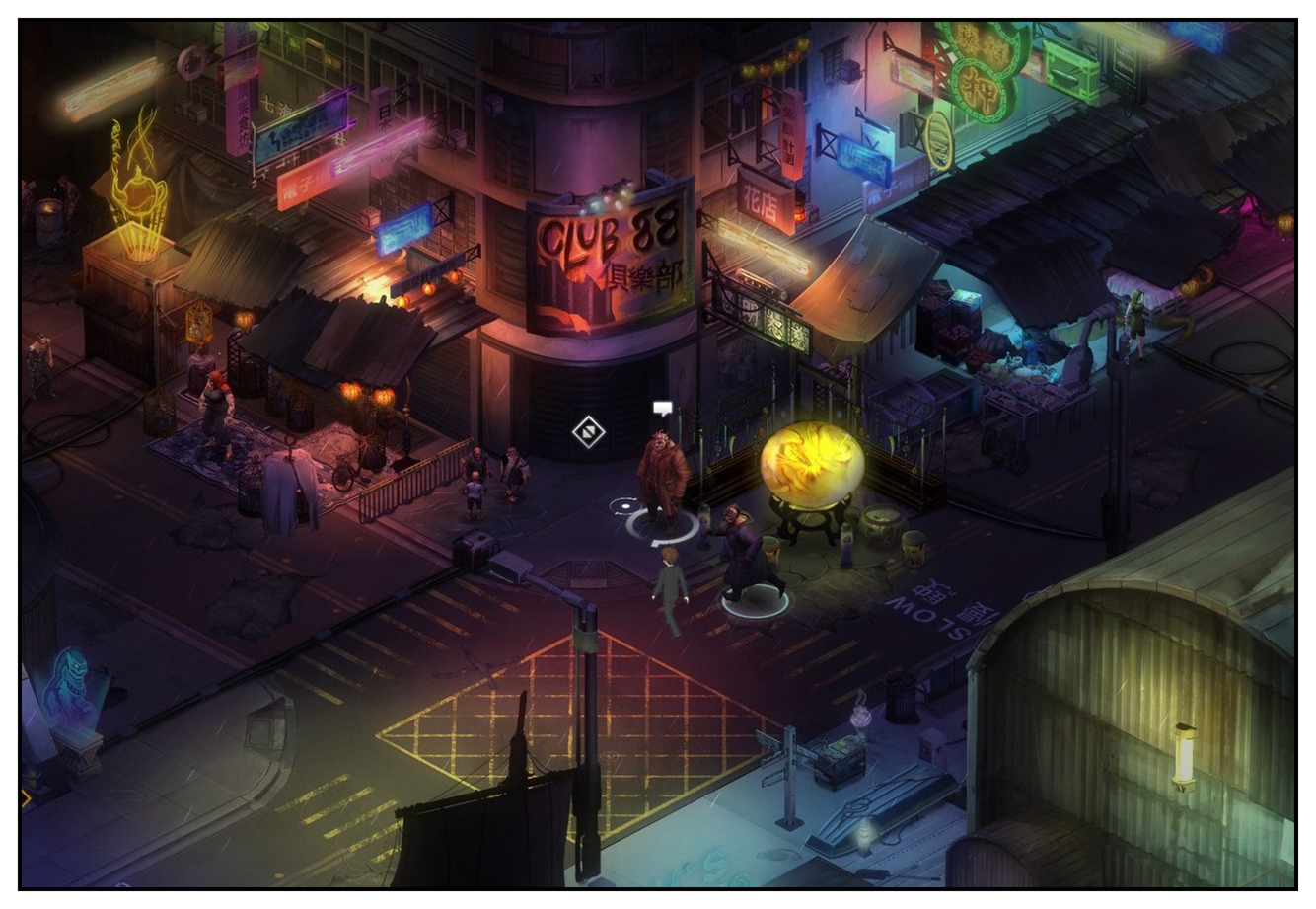
Among the titles I nabbed in the sale today were two of the new Shadowrun games: Shadowrun Hong Kong and Shadowrun Dragonfall. I've spent a bit of time with the former this evening and come away very impressed — and a little surprised.

I'm not particularly familiar with the Shadowrun setting, but it's a concept I like: combining hacking, grime-and-neon cyberpunk with orcs, elves and magic fantasy brings together two of my very favourite things, so Shadowrun was always something I was interested in. I'd just never gotten around to checking it out.

I went in expecting something along the lines of the old Infinity Engine role-playing games — that is to say, largely functional graphics, excellent writing, deep character and party building and a non-linear storyline in which you were free to pursue all manner of different sidequests at your leisure before deciding that yes, now was the right time to go and confront The Big Bad, whoever it was this time around.

What I got from Shadowrun Hong Kong was… almost that, but with enough differences to the standard formula to give it a very distinct identity.

I'll back up a moment and give you some background. In Shadowrun Hong Kong, you play a player character of your own design, who can be male or female and any of the main races found in the setting: human, ork, elf, dwarf or troll. You can then either pick a starting class or build your own by spending "Karma", the game's skill point equivalent. There are no traditional experience points or levels in Shadowrun; you simply gain Karma in varying degrees for accomplishing various tasks. Consequently, you can build some interesting characters without having to "grind" as such.

The opening of Shadowrun Hong Kong sees you contacted by your onetime foster father Raymond Black, who urges you to come to Hong Kong to discuss something very important. When you arrive there, you're met by your adoptive sibling Duncan, an ork man that you grew up with but subsequently became estranged from following an unfortunate run-in with corporate security in your past. Your reunion is far from joyful, since Duncan doesn't quite know what to make of you having spent so much time apart from you, and before long it becomes clear that something very bad indeed is going on. A group of mercenaries that Black hired to escort you are murdered along with Duncan's superior officer Carter, and all of a sudden you're on the run, thrust into Hong Kong's seedy underbelly to wipe your old identities clean and take up the mantle of Shadowrunners: individuals who work on the fringes of society, often doing illicit deeds for whoever will pay the most. Your eventual aim is to determine what has become of Black, and perhaps to make sense of some mysterious dreams you start having shortly after the story begins.

So far so RPG. Where Shadowrun Hong Kong diverges from what I expected is in its structure: rather than unfolding in a large open world that you can explore at will a la Baldur's Gate or the first two Fallout games, Shadowrun Hong Kong is instead mission-based. There's a "hub" area from which you can interact with NPCs, purchase equipment and accept new missions, but each of these missions are self-contained areas that combine a variety of different gameplay styles, each telling their own mini-story along the way, ultimately — I presume, anyway — combining to tell the entire narrative.

The missions are pretty varied; none of them appear to be simple "get to point X" or "kill Y". Rather, you're often given a fairly vague objective — perhaps with some optional additional tasks along the way — and then left up to your own devices to decide how to handle it according to how you've built your character and the party you've brought with you.

One of the first missions in the game, for example, sees you having to deliver a message from the local crime lord Kindly "Auntie" Cheng to one of her underlings, who has started to take things into his own hands a little too much. In order to get to the recipient, you can fight your way in through the guards that block the entrance (in which case you'll fail the optional "don't kill anyone" objective), or you can sneak across the rooftops, or you can hack the electronic locking system in the basement, or you can learn the keycode to another "secret" entrance. Along the way, you'll encounter a number of side objectives, including assisting a young woman who is researching qi flow in the area and retrieving a stolen credit stick from an old man who is mugged by one of your target's henchmen. Most of these side objectives can be resolved in multiple ways, too; for example, when attempting to recover the credit stick, you can fight the guy and take it by force, attempt to smooth-talk your way through the situation or use your knowledge of criminal culture (assuming you have it) to appeal to his sense of "honour among thieves".

If and when combat does erupt, the action switches to mechanics straight out of the more recent XCOM games. Each character has a number of "action points" per round, and these can be used on moving, using items or performing various attacks with their weapons. More powerful techniques, spells or items tend to take multiple action points to perform, and some also have a "cooldown" of a number of rounds before they can be used again. There's a simple cover-and-flanking system in play, allowing you and your enemies to gain tactical advantages over one another through careful movement, and as your characters grow stronger they have more and more different abilities available to use.

Hacking, meanwhile, results in a gloriously abstract minigame straight out of a 1990s RPG whereby you control an "avatar" of yourself in cyberspace, attempting to avoid the various security measures or brute-forcing your way through using "combat" programs if necessary. Reach your eventual destination — be it a valuable piece of data or simply the method to unlock an electronic door — and you'll have another minigame within the minigame, whereby you'll have to remember numerical combinations and then decrypt a sequence of glyphs before time runs out. And, in true cyberpunk tradition, fucking up hacking can damage your physical body, so you have to be careful.

The whole thing is tied together by a wonderfully evocative script written by people who actually know how to write, combining vibrant, descriptive narration with believable dialogue. In many ways, it's as much a piece of interactive text-based fiction as it is an RPG or tactical strategy game; whatever it is, I really like it so far, and am looking forward to playing some more as a much-needed break from all the Palace of the Dead in FFXIV!

2295: You Should Play Aselia the Eternal

0295_001

JAST USA recently released Aselia the Eternal on Steam. The game's been around for a good few years now — its original Japanese version for even longer — but its release on Steam will doubtless allow a whole new audience to (hopefully) enjoy it. I will now attempt to explain why it is worth giving it a go.

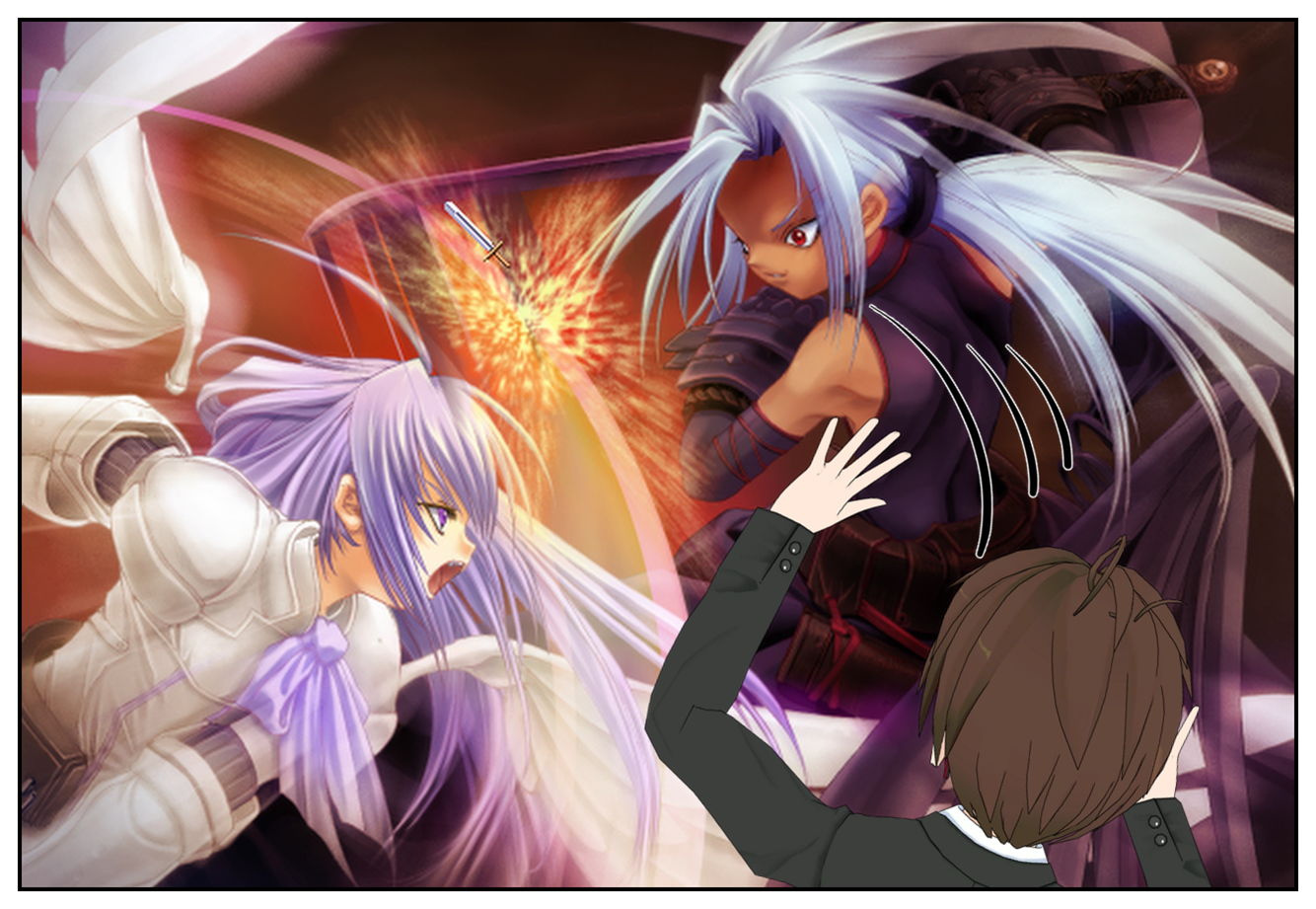
Aselia the Eternal is a combination of a visual novel and a strategy game. The overall balance is very much in favour of the story side of things — it's a good six hours of reading before you get to the game's first strategy battle sequence — but when you do get to the strategic aspect, it's a game that puts up a good fight.

The narrative concerns the player-protagonist Yuuto, who finds himself drawn into another world populated by people who speak a completely different language to him. Unable to find his way home, he gradually learns to communicate with these people — the ones with whom he's staying known as "Spirits" — and finds himself recruited into the army as an "Etranger", a wielder of a powerful, sentient sword that regularly threatens to eat his soul.

Gradually, as Yuuto becomes more and more involved in the lives of the Spirits, he starts to worry less and less about trying to find his way back home and more about helping to resolve the conflict that threatens to tear this fantasy world apart. As such, the narrative becomes very much a high fantasy sort of affair — war on a grand scale, magic and mayhem around every corner, transcendence of humanity not at all out of the question — and builds to a thoroughly exciting conclusion that I won't spoil here.

The story is compelling, interesting, well-written and well-translated, but it's the gameplay part that is perhaps the most interesting thing about it, since it's one of the most original takes on strategic RPG-style combat I've seen. Virtually eliminating all luck from the equation, combat in Aselia the Eternal is actually about putting units together in small squads to perform most effectively according to what type of unit they are — and by doing this correctly you can effectively guarantee that you'll win a conflict before you reach it. The tricky part is in finding those suitable combinations in the first place.

The basic rules of engagement have each of your squads made up of three ranks — a frontline fighter, a mid-range tank and a support fighter bringing up the rear. Each of the different types of Spirits perform best in a particular slot: Blue Spirits (such as the eponymous heroine) do their best work as speedy damage dealers in the front row; Green Spirits tend to have the highest defense and HP, so sit in the middle; Red Spirits often have support abilities that can damage an entire enemy squad or provide suitable benefits to your own, so sit at the back. You're not limited to this arrangement — and indeed, with Yuuto in the mix, who is none of those things, you'll have at least one squad with an unconventional lineup — but there are clearly optimal ways to do things, making each of the battles in the game as much of a puzzle as a strategic RPG experience.

Aselia the Eternal comes together so nicely because everything it does is in service to its narrative and worldbuilding. Despite not having an open world you can freely explore, its excellent storytelling and descriptive narration builds a wonderfully convincing setting that gives the strategic sequences genuine meaning and drama. And, as a result of that worldbuilding, your units in the strategic sequences become more than just sets of stats and abilities; they become people. People who you don't want to see die, because yes, this game has permadeath.

The question of being "more than just a soldier" is one of the main narrative themes explored in the game, and it's a rather wonderful moment when you realise that you, the player, are having the same epiphany that the characters in the game are. There are some wonderfully touching sequences with Yuuto and the Spirits as they get to know one another, and you're right there with them. And, as the narrative ramps up and you bring more and more allies with you, the tension becomes palpable as you take them into battles that you really don't want to see them lose.

I don't want to say too much more because part of the wonder of Aselia the Eternal is exploring the experience for yourself and discovering everything this remarkable work has to offer. Suffice to say if you enjoy in-depth storytelling — and lots of if — and aren't averse to a bit of red-hot strategy action, you should most certainly check it out. And then strongly consider supporting JAST's recent release of the sequel Seinarukanawhich I'll be investigating for myself in the near future!

1895: More Noire

Been playing some more Hyperdevotion Noire today, so I make no apologies for spending another post talking about it.

I am enjoying it a whole lot so far, and although I'm still relatively early on in the game, the interesting mission and map design is starting to shine through as the game adds more and more map gimmicks and mechanics to take into account while playing.

Of the last few missions, I've played, for example, one saw my party of four (Noire, Neptune, Vert and Blanc) fighting against the emphatically-not-Chun-Li-oh-wait-she-clearly-is "road pugilist" Lee-Fi. She was on the far side of a large arena whose walls were electrified, which means that knockback attacks had a use beyond simply getting enemies away from you. Some of the floor was electrified, too, necessitating careful route planning and an understanding of the game's "orientation" system, whereby the direction a character is facing when they start moving (you can change it freely) determines the initial direction they move if the target space is not in a straight line from their current position.

This was followed up by a fight against the emphatically-not-Solid-Snake-with-tits-oh-wait-she-clearly-is superspy Lid, whose battlefield was riddled with booby-traps, necessitating, again, careful navigation while fending off her supporting units. Two strips of the battlefield are also covered by large, heavy damage-dealing cannons, too, though once you notice that they can only fire in a straight line immediately in front of them it's easy enough to avoid them.

This was then followed by a battle against the Agarest-inspired character Resta, who was on the other side of a huge chasm, the only means of traversing which was a rickety railway carriage that could only hold three of your four party members at once. Resta also has an absolutely devastating super-move which obliterated my party in a single turn by dropping giant explosive bunches of bananas on their heads, so after my second "Game Over" of the game (the first being not paying attention to the cannons in Lid's stage) I realised that it was essential to take her down in a single turn and not get distracted by her supporting units, since the mission objective was simply to defeat her, not everything on the map.

Thus far the game has put up a reasonably stiff challenge. The first couple of missions are deceptively simple, but beginning with the Lee-Fi fight, things have been getting noticeably more difficult — and a little more gradually than most Neptunia games, which are somewhat notorious for inconsistent difficulty spikes throughout most of the experience, then becoming ridiculously easy once you pass a particular level threshold. The difficulty hasn't been insurmountable, though, and the new mechanics have been introduced gradually enough that I haven't felt as overwhelmed as I have done in similar games like Advance Wars and Fire Emblem, where I often can't work out why my strategy failed when it inevitably does. Here, failure seems to generally be the result of not paying enough attention — and given that you can examine all the units on both sides of the battle before you start fighting, there's really no excuse for the mistakes I have made up until this point; I've certainly learned to carefully survey the battlefield before charging in now!

I've always quite liked tactics games and even finished Final Fantasy Tactics way back in the day, but Hyperdevotion Noire is the first one I feel like I'm understanding a little better. It's designed well, plays well, looks great and features probably my favourite cast of characters in gaming. What's not to like?

1120: Warm Symbol

Page_1So I finally popped my Fire Emblem cherry today. This is a series that I've been aware of on the periphery of my vision for some time, but have never actually got around to exploring. Which is sort of weird, really, because it's exactly my sort of thing.

Naturally, because I'm an arbitrary sort of person, I am not playing the newly-released Fire Emblem Awakening on 3DS (largely because it's not out yet, and also because Andie is away all week and has taken the 3DS with her) — no, instead, I am playing the Gamecube game Path of Radiance, which I acquired at great expense recently after being informed that I should probably play it before the Wii version Radiant Dawn that I got for a pocketful of change when Game was undergoing its, uh, "troubles" a while back.

Although Fire Emblem Awakening's immensely positive reception from press and public alike has caused the series to enjoy unprecedented visibility recently, it's entirely possible that some of you reading this may, like me, have missed out on it so far. So allow me to explain.

Fire Emblem is a strategy RPG series developed by Intelligent Systems, who over the years have also been responsible for the Paper Mario and Advance Wars series as well as the excellent 3DS puzzle games Pushbloxpullmo or whatever they're called in each territory. It is closer in execution to a strategy game with a linear campaign like Advance Wars than something more explicitly RPG-ish like Final Fantasy Tactics, but the important thing about it is that you're taking it in turns with the enemy to move little dudes around on a grid-based map and beat the snot out of each other, much like a board game.

Even the mechanics are very similar to Advance Wars — certain units may only perform "direct" attacks by standing next to enemies; others may only perform "indirect" ones by standing a square away from their target. Attacking an enemy isn't a guarantee you'll get away unscathed, either — a typical combat exchange between two units allows both attacker and defender to strike, assuming the defender survived the initial blow, of course.

I often find strategy games somewhat daunting as I'm not very good at them, but the relatively little I've played of Path of Radiance so far does a good job of introducing concepts to you very gradually and letting you explore them for yourself. At the core of the combat system is a sort of "rock, paper, scissors" system whereby characters with swords are better against ones with axes, characters with axes are better against those with lances, and characters with lances are better against those with swords. This is gradually built upon with ranged combat, mounted units, magic-using units who can cast spells using a staff, static ballistae on the battlefield and numerous other considerations. It eventually — presumably, anyway, I'm only four missions in — builds up to something of satisfying complexity, but which remains straightforward enough to be easily understandable for even rookie wargamers.

Then there are the interesting other mechanics laid atop these foundations. In maps based on towns, for example, you can spend a turn "visiting" any building with an open door, which leads to a short conversation with the inhabitant and usually an item. It also secures that building and prevents the enemy from destroying it; conversely, an enemy who gets to an open-door building before you will raze it to the ground, preventing you from getting at the goodies within and making you feel bad for the residents in the process.

And, of course, there's the series' trademark: permadeath or, in other words, if you lose a unit it's gone forever. This is a thorny issue for some — some believe that it adds an extra layer of excitement to the game (I'm inclined to fall into this camp) while others simply find it frustrating. Others still find themselves appreciating the permadeath system, but restarting any mission they lose one of their units on — a point which Matt's blog post linked above argues may be missing the point a little!

I'm a fan of the permadeath system. The last game I played that was vaguely like Fire Emblem was Aselia the Eternal, which featured a similar system whereby if you lost a particular character, they were gone forever. I managed to get all the way through the entire game (with a few tactical reloads, admittedly) only using one single unit in the final battle. (Her sacrifice was worth it.) I tend to find that a permadeath system is best paired with a strong sense of characterisation, however; for some people, the feeling of having nurtured an awesome character up to level amazing is enough, but for me I like to know who this person is before I feel bad about losing them. It's something that Aselia the Eternal did particularly well with its incidental scenes between its protagonist and his troops, and it also looks like Fire Emblem will be this way, too.

I'm very early in the game so far but I can tell it's going to be a pretty cool experience, plus its extremely linear mission-based nature means that it's friendly to being played alongside other stuff and has natural "break points" to stop, which is good. I will probably play it alongside Ar Tonelico and the other bits and pieces I'm enjoying at the moment, and then move on to Radiant Dawn when I'm done. By the time I'm finished with that, you never know, the 3DS Awakening might be out over here in Europe!