I occasionally find myself pondering when I think the happiest time in my life was, and I always conclude with one of two closely related period: sixth form (for non-British folks, this is the optional "Year 12" and "Year 13" you take if you want to stay on in non-compulsory education after finishing secondary school, typically taken before going to university) and my four years at university (three on my BA in English and Music, one on my PGCE in Music). Today I want to reminisce a bit about the former.
There was absolutely no question as to whether or not I was going to stay on at school after I finished compulsory education. My life has, to date, followed the typical autistic/ADHD trajectory of performing very well in school, then sliding into tepid mediocrity in adult life, so at the point I was finishing my GCSEs, I knew that I wanted to stay on and keep studying. I ended up choosing English Language, English Literature, Sociology and Music as my four subjects; at my school, it was considered unusual to take four A-Levels (five if you count General Studies, but no-one in their right mind does, for reasons that will become apparent), but all my teachers agreed that I could handle it. So I did. (And I did.)
I was excited about sixth form. I had seen my brother pass through sixth form at the same school some ten years earlier, and I knew what a good time he'd had while he was there. He'd made some good friends, he'd had a band, he had a long-term girlfriend, and he'd studied some interesting-sounding stuff that wasn't anything like the boring old National Curriculum gubbins I'd gone through lower down the school. I was looking forward to the whole experience, though I was also nervous about a few things.
One of them was the fact that I'd have more contact with a teacher known as Mr Watts, who was renowned at our school as one of the most terrifying teachers there was. He taught History, had a severe-looking moustache that always make it look like he was furious and, to be fair, he often seemed to be furious — particularly at anyone under the age of 15.
I'd actually had a year of Mr Watts as a History teacher in… Year 9, I think it was? Kids of that age are just on the cusp of what he considered to be actual human beings, so we got a bit of a taste of what he was really like. He could still be terrifying if someone stepped out of line, sure, but he also had a wicked sense of humour, and was a genuinely excellent teacher.
That didn't stop me being nervous about the fact he was head of Sixth Form, though. I don't really know why, because I wasn't the sort of kid who got into trouble particularly regularly (I think I had a grand total of two detentions during my entire time at school, at least one of which I managed to wangle my way out of thanks to music rehearsals) but Mr Watts just had that sort of impressive aura about him that made you want to stay well and truly in line.
Thankfully, we quickly discovered that Head of Sixth Form Mr Watts was a completely different person to History Teacher Mr Watts. He was much more down-to-earth, much more willing to let that sense of humour shine through, and extremely supportive of anyone who came to him with questions or concerns. He was a comforting presence, in other words; it was a surprise to many of us, to be sure, but a welcome one.
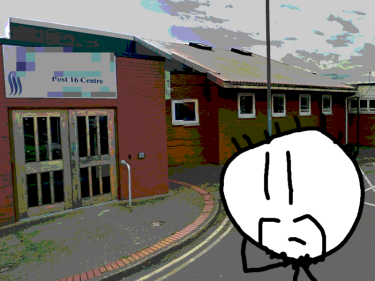
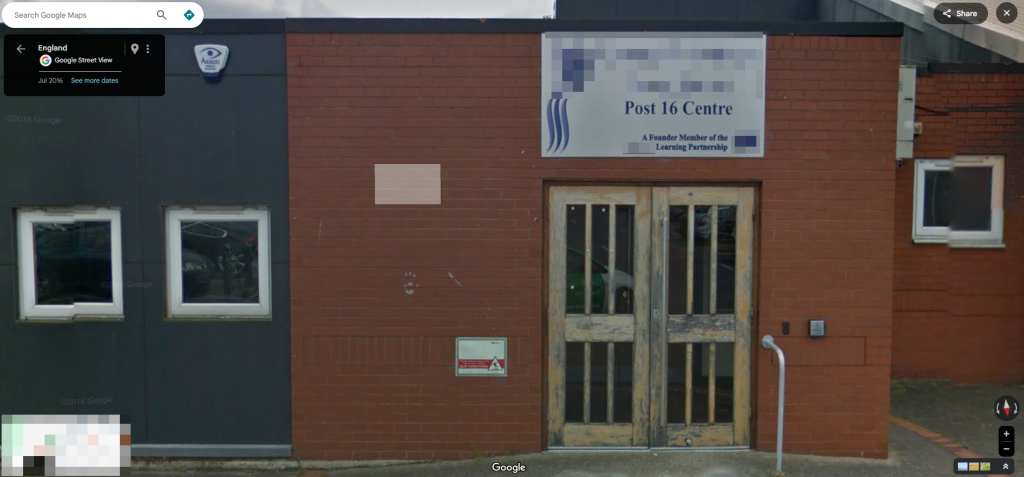
Our year was the first to make use of the new sixth form centre that had been built on our school's campus. The Upper School Dining Hall (aka just "Upper Dining") had given its life so that the Sidney Banks Sixth Form Centre may live, and it was great. The building, being new, was in great condition, and it was outfitted with reasonably decent PCs for the period; prior to joining the sixth form, most of our computer-related lessons in school had been on Acorn Archimedes computers, but by the time we reached sixth form, proprietary platforms like the ol' Archie were falling out of favour as Windows 95-equipped PCs became the norm in homes, offices and society in general.
The sixth form centre mostly consisted of computer rooms, in fact. Each of its "classrooms" were in fact just rooms with tables and a bunch of PCs, and the main large room in the middle was split in half between the common room and a study area (with more computers), with a sliding divider door allowing for the rooms to be separated completely when necessary.
In the common room, we didn't have a lot of exciting facilities, but I recall we did have a stereo, and folks tended to bring magazines in and leave them for others once they were done with them. For the most part, though, the common room was a space for chilling out, hanging with friends and making use of any of your own entertainment that you had happened to bring.
As it happened, I ended up spending a lot of my time in sixth form in the Art room. My friends Ed and Woody were both studying Art, so in the times where I wasn't attending my own lessons, I tended to hang with them in there. Since the number of folks studying Art at A-level was relatively small, they had their own little common area in the corner of the art room; again, it wasn't really equipped with anything other than a few chairs, but it was a nice place to just hang out.
One thing we were supposed to do as part of our time at sixth form was attend General Studies lessons. We would, we were told, get another A-level out of these lessons, but after attending just one or two at the start of our time in sixth form, we realised that they were largely worthless, so we just… stopped going. And, as part of the whole "treating us as adults" thing that came along with joining the sixth form, no-one ever pursued us about it or queried us on it.
Well, that's not quite true. One General Studies period we did see Mr Watts out and about, seemingly looking for people, so we hid under the chairs in the Art room common area. But that was just once. We all did the exam at the end of our two years in sixth form; I don't know how anyone else did, but I got an "A" having attended one lesson in two years. That should give you a general idea of what General Studies is all about. (One of the questions on the final exam paper was "In Alice in Wonderland, the text describes the Cheshire Cat as 'disappearing tail first'. Assuming the cat did not simply vanish, which direction must he have moved to disappear in this way?")
I mostly enjoyed my A-level studies. I particularly enjoyed English Language, because we got to write essays about swearing, and English Literature exposed me to a variety of interesting novels and plays that I probably wouldn't otherwise have read. Sociology was a thoroughly interesting subject to study, too, and the overall "vibe" of those classes was quite interesting given I was the only boy present; the rest of the class was all girls, and our teacher, Mrs Lloyd, was, of course, a lady also. I wasn't made to feel out of place or anything, I hasten to add; in fact, throughout my time at secondary school, I'd become good friends with a lot of the girls in that class already, so it was nice to have some time where it was just me and them.
Music was a good time, also. At the time I was doing A-level Music, I was also preparing to take my Advanced Certificate practical exam, and doing so basically exempted me from having to do some of the Music A-level, which was pretty neat. The only bit of the Music course I didn't like was learning about how to do Baroque four-part harmony; it felt like it was frustratingly bound by rules rather than truly creative, and I didn't like the teacher much, either. He wasn't one of the regular Music teachers; he was actually the peripatetic strings teacher.
One of the best things about sixth form was how we weren't obliged to stay on the school campus all day if we didn't have lessons. That meant we often walked into town; it was probably about a mile's walk from the school to the town centre, and being young and (relatively) spry at the time, we could do this in a not-unreasonable amount of time.
Our typical town routine involved wandering down there, getting a steak slice and a Belgian Bun from The Baker's Oven, then visiting the CD shop Barneys and computer shop First Compute. Inevitably, upon a visit to the latter, I would be encouraged by my friends to pick up a new game, which I often did, and then we'd head back to school. The reason I was able to grab so many new games at the time was because I'd done some occasional freelancing for PC Zone and the Official Nintendo Magazine, and back in those days you'd get £500 for one article — an absolute fortune to a teenage kid, and, hell, an absolute fortune to anyone involved in freelancing for the games press today.
On one trip to First Compute, I happened to see that a budget rerelease of a piece of software called Klik and Play for PC was on one of the racks. I recalled reading a fun review of this in PC Zone by the one and only Charlie Brooker; a review that had attracted numerous complaints (as did many other pieces Brooker contributed) for using a game in which you knocked a decapitated Frenchman's head around the screen as its demonstration project.
I was attracted to Klik and Play because it promised programming-free game making. I'd previously learned to program in BASIC on Atari 8-bit and STOS on Atari ST, but had never really got into the upper echelons of "knowing how to code", and by this point in the late '90s, "coding" had moved into realms like C and Java, and I didn't really understand those at all. Klik and Play promised to allow creativity without needing to get super-technical, so I was excited to give it a go.
And boy did we love it. Not just me, but my friends Ed and Woody, too, since of course I let them borrow the disc and install it on their own PCs. We made so many stupid games with Klik and Play, many of which remained unfinished, but our crowning achievement was, without a doubt, Pie Eater's Destiny.
This was a game where we'd started with the title, which was intended to take the piss out of our mutual friend Andrew, who was a big lad and enjoyed the game Fighter's Destiny on Nintendo 64. It grew a life of its own after I was demonstrating how to use Klik and Play to Ed and Woody one day, and I imported a scanned image of Andrew's face as an enemy sprite, then added a ripped Contra sprite for the player to move around and shoot at the giant head.
Something about this stupid, humble beginning captured our imagination, and we ended up making a full game with full voice acting, with each level unfolding as a single boss fight against a digitised head of someone we knew, culminating with a battle against the most powerful force in the galaxy: Mr Watts.
Naturally, once Pie Eater's Destiny was completed, we brought it in to school to install on the sixth form computers, and we ended up showing it to Mr Watts. We were initially nervous about this, but the moment he saw that he was the villain, with his introductory line being simply "YOU PATHETIC BASTARDS, YOU WILL NEVER DEFEAT ME! MUHAHAHAHAHAHAHA", he was absolutely delighted with it.
My time at sixth form is full of wonderful memories like these. I don't recall a single moment of being unhappy while I was at sixth form, and dear Lord, I miss living that life and being that person.
But you can't go back, can you? So these memories have to remain just that: memories. Still, I will always have them, and when times get tough I can think back to a time where life just seemed simpler, easier, more full of possibilities. Not everyone has the luxury of good memories like this, so I should treasure them. And you'd better believe that I do, as the preceding 2,000 words has hopefully made clear.
Want to read my thoughts on various video games, visual novels and other popular culture things? Stop by MoeGamer.net, my site for all things fun where I am generally a lot more cheerful. And if you fancy watching some vids on classic games, drop by my YouTube channel.
If you want this nonsense in your inbox every day, please feel free to subscribe via email. Your email address won't be used for anything else.